Welcome to the 30th post in the rarified R recommendation resources series or R4 for short. The last post introduced BSPM. In the four weeks since, we have worked some more on BSPM to bring it to the point where it is ready for use with continuous integration. Building on this, it is now used inside the run.sh script that driven our CI use for many years (via the r-travis repo).
Which we actually use right now on three different platforms:
All three use the exact same script facilitating this, and run a matrix over Linux and macOS. You read this right: one CI setup that is portable and which you can take to your CI provider of choice. No lock-in or tie-in. Use what works, change at will. Or run on all three if you like burning extra cycles.
This is already used by handful of my repos as well as by at least two repos of friends also deploying r-travis. How does it work? In a nutshell we are
downloading run.sh via curl and changing its mode;
running run.sh bootstrap which sets the operating system default:
on Linux we use Ubuntu,
add two PPAs repos for R itself and over 4600 r-cran-* binaries,
and enable BSPM to use these from install.packages()
on macOS we use the standard setup also used on Travis, GitHub Actions and elsewhere;
this provides us with fast, reliable, easy, and portable access to binaries on two OSs under dependency resolution;
running run.sh install_deps to install just the requireded Depends:, Imports: and LinkingTo:
running run.sh tests to build the tarball and test it via R CMD check --as-cran.
There are several customizations that are possible via environment variables
additional PPAs or drat repos can be added to offer even more package choice;
alternatively one could run run.sh install_all to also install Suggests:;
optionally one could run run.sh install_r pkgA pkgB ... to install packages explicitly listed;
optionally one could also run run.sh install_aptget r-cran-pkga r-cran-pkgb otherpackage to add more Ubuntu binaries.
We find this setup compelling. The scheme is simple: there really is just one shell script behind it which can also be downloaded and altered. The scheme is also portable as we can (as shown) rotate between CI provides. The scheme is also more flexible: in case of debugging needs one can simply run the script on a local Docker or VM instance. Lastly, the scheme moves away from single points of failure or breakage.
Currently the script uses only BSPM as I had the hunch that it would a) work and b) be compelling. Adding support for RSPM would be equally easy, but I have no immediate need to do so. Adding BioConductor installation may be next. That is easy when BioConductor uses r-release; it may be little more challenging under r-devel to but it should work too. Stay tuned.
In the meantime, if the above sounds compelling, give run.sh from r-travis a go!
If you like this or other open-source work I do, you can now sponsor me at GitHub. For the first year, GitHub will match your contributions.
Launchpad still requires Python 2, which in 2020
is a bit of a problem.
Unlike a lot of the rest of 2020, though, there s good reason to be
optimistic about progress.
I ve been porting Python 2 code to Python 3 on and off for a long time, from
back when I was on the Ubuntu Foundations team and maintaining things like
the Ubiquity installer. When I moved to
Launchpad in 2015 it was certainly on my mind that this was a large body of
code still stuck on Python 2. One option would have been to just accept
that and leave it as it is, maybe doing more backporting work over time as
support for Python 2 fades away. I ve long been of the opinion that this
would doom Launchpad to being unmaintainable in the long run, and since I
genuinely love working on Launchpad - I find it an incredibly rewarding
project - this wasn t something I was willing to accept. We re already
seeing some of our important dependencies dropping support for Python 2,
which is perfectly reasonable on their terms but which is starting to become
a genuine obstacle to delivering important features when we need new
features from newer versions of those dependencies. It also looks as though
it may be difficult for us to run on Ubuntu 20.04 LTS (we re currently on
16.04, with an upgrade to 18.04 in progress) as long as we still require
Python 2, since we have some system dependencies that 20.04 no longer
provides. And then there are exciting new features like type
hints and
async/await that we d like
to be able to use.
However, until last year there were so many blockers that even considering a
port was barely conceivable. What changed in 2019 was sorting out a
trifecta of core dependencies. We ported our
database layer, Storm. We
upgraded
to modern versions of our Zope Toolkit dependencies
(after contributing various fixes upstream, including some substantial
changes to Zope s test runner
that we d carried as local patches for some years). And we
ported
our Bazaar code hosting infrastructure to
Breezy. With all that in place, a port
seemed more of a realistic possibility.
Still, even with this, it was never going to be a matter of just following
some standard porting advice and calling it
good. Launchpad has almost a million lines of Python code in its main git
tree, and around 250 dependencies of
which a number are quite Launchpad-specific. In a project that size, not
only is following standard porting advice an extremely time-consuming task
in its own right, but just about every strange corner case is going to show
up somewhere. (Did you know that StringIO.StringIO(None) and
io.StringIO(None) do different things even after you account for the
native string vs. Unicode text difference? How about the behaviour of
.union() on a subclass of
frozenset?)
Launchpad s test suite is fortunately extremely thorough, but even just
starting up the test suite involves importing most of the data model code,
so before you can start taking advantage of it you have to make a large
fraction of the codebase be at least syntactically-correct Python 3 code and
use only modules that exist in Python 3 while still working in Python 2; in
a project this size that turns out to be a large effort on its own, and can
be quite
risky
in places.
Canonical s product engineering teams work on a six-month cycle, but it just
isn t possible to cram this sort of thing into six months unless you do
literally nothing else, and please can we put all feature development on
hold while we run to stand still is a pretty tough sell to even the most
understanding management. Fortunately, we ve been able to grow the
Launchpad team in the last year or so,
and so it s been possible to put Python 3 on our roadmap on the
understanding that we aren t going to get all the way there in one cycle,
while still being able to do other substantial feature development work as well.
So, with all that preamble, what have we done this cycle? We ve taken a
two-pronged approach. From one end, we identified 147 classes that needed
to be ported away from some compatibility code in our database layer that
was substantially less friendly to Python 3: we ve ported 38 of those, so
there s clearly a fair bit more to do, but we were able to distribute this
work out among the team quite effectively. From the other end, it was clear
that it would be very inefficient to do general porting work when any
attempt to even run the test suite would run straight into the same crashes
in the same order, so I set myself a target of getting the test suite to
start up, and started hacking on an enormous git
branch that I never
expected to try to land directly: instead, I felt free to commit just about
anything that looked reasonable and moved things forward even if it was very
rough, and every so often went back to tidy things up and cherry-pick
individual commits into a form that included some kind of explanation and
passed existing tests so that I could propose them for review.
This strategy has been dramatically more successful than anything I ve tried
before at this scale. So far this cycle, considering only Launchpad s main
git tree, we ve landed 137 Python-3-relevant merge proposals for a total of
39552 lines of git diff output, keeping our existing tests passing along
the way and deploying incrementally to production. We have about 27000 more
lines of patch at varying degrees of quality to tidy up and merge. Our main
development branch is only perhaps 10 or 20 more patches away from the test
suite being able to start up, at which point we ll be able to get a buildbot
running so that multiple developers can work on this much more easily and
see the effect of their work. With the full unlanded patch stack, about 75%
of the test suite passes on Python 3! This still leaves a long tail of
several thousand tests to figure out and fix, but it s a much more
incrementally-tractable kind of problem than where we started.
Finally: the funniest (to me) bug I ve encountered in this effort was the
one I encountered in the test runner and fixed in
zopefoundation/zope.testrunner#106:
IDs of failing tests were written to a pipe, so if you have a test suite
that s large enough and broken enough then eventually that pipe would reach
its capacity and your test runner would just give up and hang. Pretty
annoying when it meant an overnight test run didn t give useful results, but
also eloquent commentary of sorts.
Sun is the daughter and heir of the mercurial Queen-Marshal Eirene, ruler
of the Republic of Chaonia. Chaonia, thanks to Eirene and her ancestors,
has carved out a fiercely independent position between the Yele League and
the Phene Empire. Sun's father, Prince Jo o, is one of Eirene's three
consorts, all chosen for political alliances to shore up that fragile
position. Jo o is Gatoi, a civilization of feared fighters and supposed
barbarians from outside Chaonia who normally ally with the Phene, which
complicates Sun's position as heir. Sun attempts to compensate for that
by winning battles for the Republic, following in the martial footsteps of
her mother.
The publisher's summary of this book is not great (I'm a huge fan of
Princess Leia, but that is... not the analogy that comes to mind), so let
me try to help. This is gender-swapped Alexander the Great in space.
However, it is gender-swapped Alexander the Great in space with her
Companions, which means the DNA of this novel is half space opera and
half heist story (without, to be clear, an actual heist, although there
are some heist-like maneuvers). It's also worth mentioning that Sun, like
Alexander, is not heterosexual.
The other critical thing to know before reading, mostly because it will
get you through the rather painful start, is that the most interesting
viewpoint character in this book is not Sun, the Alexander analogue. It's
Persephone, who isn't introduced until chapter seven.
Significant disclaimer up front: I got a reasonably typical US grade
school history of Alexander the Great, which means I was taught that he
succeeded his father, conquered a whole swath of the middle of the
Eurasian land mass at a very young age, and then died and left his empire
to his four generals who promptly divided it into four uninteresting
empires that no one's ever heard of, and that's why Rome is more important
than Greece. (I put in that last bit to troll one specific person.)
I am therefore not the person to judge the parallels between this story
and known history, or to notice any damage done to Greek pride, or to pick
up on elements that might cause someone with a better grasp of that
history to break out in hives. I did enough research to know that one
scene in this book is lifted directly out of Alexander's life, but I'm not
sure how closely the other parallels track. Yele is probably southern
Greece and Phene is probably Persia, but I'm not certain even of that, and
some of the details don't line up. If I had to hazard a guess, I'd say
that Elliott has probably mangled history sufficiently to make it clear
that this isn't intended to be a retelling, but if the historical
parallels are likely to bother you, you may want to do more research
before reading.
What I can say is that the space opera setup, while a bit stock, has all
the necessary elements to make me happy. Unconquerable Sun is
firmly in the "lost Earth" tradition: The Argosy fleet fled the
now-mythical Celestial Empire and founded a new starfaring civilization
without any contact with their original home. Eventually, they invented
(or discovered; the characters don't know) the beacons, which allow for
instantaneous travel between specific systems without the long (but still
faster-than-light) journeys of the knnu drive. More recently, the beacon
network has partly collapsed, cutting off the characters' known world from
the civilization that was responsible for the beacons and guarded their
secrets. It's a fun space opera history with lots of lost knowledge to
reference and possibly discover, and with plot-enabling military choke
points at the surviving beacons that link multiple worlds.
This is all background to the story, which is the ongoing war between
Chaonia and the Phene Empire mixed with cutthroat political maneuvering
between the great houses of the Chaonian Republic. This is where the
heist aspects come in. Each house sends one representative to join the
household of the Queen-Marshal and (more to the point for this story)
another to join her heir. Sun has encouraged the individual and divergent
talents of her Companions and their cee-cees (an unfortunate term that I
suspect is short for Companion's Companion) and forged them into a good
working team. A team that's about to be disrupted by the maneuverings of
a rival house and the introduction of a new team member whom no one wants.
A problem with writing tactical geniuses is that they often aren't good
viewpoint characters. Sun's tight third-person chapters, which is a
little less than half the book, advance the plot and provide analysis of
the interpersonal dynamics of the characters, but aren't the strength of
the story. That lies with the interwoven first-person sections that
follow Persephone, an altogether more interesting character.
Persephone is the scion of the house that is Sun's chief rival, but she
has no interest in being part of that house or its maneuverings. When the
story opens, she's a cadet in a military academy for recruits from the
commoners, having run away from home, hidden her identity, and won a
position through the open entrance exams. She of course doesn't stay
there; her past catches up with her and she gets assigned to Sun, to a
great deal of mutual suspicion. She also is assigned an impeccably
dressed and stunningly beautiful cee-cee, Tiana, who has her own secrets
and who was my favorite character in the book.
Somewhat unusually for the space opera tradition, this is a book that
knows that common people exist and have interesting lives. It's primarily
focused on the ruling houses, but that focus is not exclusive and the
rulers do not have a monopoly on competence. Elliott also avoids
narrowing the political field too far; the Gatoi are separate from the
three rival powers, and there are other groups with traditions older than
the Chaonian Republic and their own agendas. Sun and her Companions are
following a couple of political threads, but there is clearly more going
on in this world than that single plot.
This is exactly the kind of story I think of when I think space opera.
It's not doing anything that original or groundbreaking, and it's not
going to make any of my lists of great literature, but it's a fun romp
with satisfyingly layered bits of lore, a large-scale setting with lots of
plot potential, and (once we get through the confusing and somewhat
tedious process of introducing rather too many characters in short
succession) some great interpersonal dynamics. It's the kind of book in
which the characters are in the middle of decisive military action in an
interstellar war and are also near-teenagers competing for ratings in an
ad hoc reality TV show, primarily as an excuse to create tactical
distractions for Sun's latest scheme. The writing is okay but not great,
and the first few chapters have some serious infodumping problems, but I
thoroughly enjoyed the whole book and will pre-order the sequel.
One Amazon review complained that Unconquerable Sun is not a space
opera like Hyperion or
Use of Weapons. That is entirely true,
but if that's your standard for space opera, the world may be a
disappointing place. This is a solid entry in a subgenre I love, with
some great characters, sarcasm, competence porn, plenty of pages to keep
turning, a few twists, and the promise of more to come. Recommended.
Followed by the not-yet-published Furious Heaven.
Rating: 7 out of 10
Previously: v5.6
Linux v5.7 was released at the end of May. Here s my summary of various security things that caught my attention:
arm64 kernel pointer authentication
While the ARMv8.3 CPU Pointer Authentication (PAC) feature landed for userspace already, Kristina Martsenko has now landed PAC support in kernel mode. The current implementation uses PACIASP which protects the saved stack pointer, similar to the existing CONFIG_STACKPROTECTOR feature, only faster. This also paves the way to sign and check pointers stored in the heap, as a way to defeat function pointer overwrites in those memory regions too. Since the behavior is different from the traditional stack protector, Amit Daniel Kachhap added an LKDTM test for PAC as well.
BPF LSM
The kernel s Linux Security Module (LSM) API provide a way to write security modules that have traditionally implemented various Mandatory Access Control (MAC) systems like SELinux, AppArmor, etc. The LSM hooks are numerous and no one LSM uses them all, as some hooks are much more specialized (like those used by IMA, Yama, LoadPin, etc). There was not, however, any way to externally attach to these hooks (not even through a regular loadable kernel module) nor build fully dynamic security policy, until KP Singh landed the API for building LSM policy using BPF. With this, it is possible (for a privileged process) to write kernel LSM hooks in BPF, allowing for totally custom security policy (and reporting).
execve() deadlock refactoring
There have been a number of long-standing races in the kernel s process launching code where ptrace could deadlock. Fixing these has been attempted several times over the last many years, but Eric W. Biederman and Ernd Edlinger decided to dive in, and successfully landed the a series of refactorings, splitting up the problematic locking and refactoring their uses to remove the deadlocks. While he was at it, Eric also extended the exec_id counter to 64 bits to avoid the possibility of the counter wrapping and allowing an attacker to send arbitrary signals to processes they normally shouldn t be able to.
slub freelist obfuscation improvements
After Silvio Cesare observed some weaknesses in the implementation of CONFIG_SLAB_FREELIST_HARDENED s freelist pointer content obfuscation, I improved their bit diffusion, which makes attacks require significantly more memory content exposures to defeat the obfuscation. As part of the conversation, Vitaly Nikolenko pointed out that the freelist pointer s location made it relatively easy to target too (for either disclosures or overwrites), so I moved it away from the edge of the slab, making it harder to reach through small-sized overflows (which usually target the freelist pointer). As it turns out, there were a few assumptions in the kernel about the location of the freelist pointer, which had to also get cleanedup.
RISCV page table dumping
Following v5.6 s generic page table dumping work, Zong Li landed the RISCV page dumping code. This means it s much easier to examine the kernel s page table layout when running a debug kernel (built with PTDUMP_DEBUGFS), visible in /sys/kernel/debug/kernel_page_tables.
array index bounds checking
This is a pretty large area of work that touches a lot of overlapping elements (and history) in the Linux kernel. The short version is: C is bad at noticing when it uses an array index beyond the bounds of the declared array, and we need to fix that. For example, don t do this:
int foo[5];
...
foo[8] = bar;
The long version gets complicated by the evolution of flexible array structure members, so we ll pause for a moment and skim the surface of this topic. While things like CONFIG_FORTIFY_SOURCE try to catch these kinds of cases in the memcpy() and strcpy() family of functions, it doesn t catch it in open-coded array indexing, as seen in the code above. GCC has a warning (-Warray-bounds) for these cases, but it was disabled by Linus because of all the false positives seen due to fake flexible array members. Before flexible arrays were standardized, GNU C supported zero sized array members. And before that, C code would use a 1-element array. These were all designed so that some structure could be the header in front of some data blob that could be addressable through the last structure member:
Converting all the zero- and one-element array members to flexible arrays is one of Gustavo A. R. Silva s goals, and hundreds of these changes started landing. Once fixed, -Warray-bounds can be re-enabled. Much more detail can be found in the kernel s deprecation docs.
However, that will only catch the visible at compile time cases. For runtime checking, the Undefined Behavior Sanitizer has an option for adding runtime array bounds checking for catching things like this where the compiler cannot perform a static analysis of the index values:
int foo[5];
...
for (i = 0; i < some_argument; i++)
    ...
    foo[i] = bar;
    ...
It was, however, not separate (via kernel Kconfig) until Elena Petrova and I split it out into CONFIG_UBSAN_BOUNDS, which is fast enough for production kernel use. With this enabled, it's now possible to instrument the kernel to catch these conditions, which seem to come up with some regularity in Wi-Fi and Bluetooth drivers for some reason. Since UBSAN (and the other Sanitizers) only WARN() by default, system owners need to set panic_on_warn=1 too if they want to defend against attacks targeting these kinds of flaws. Because of this, and to avoid bloating the kernel image with all the warning messages, I introduced CONFIG_UBSAN_TRAP which effectively turns these conditions into a BUG() without needing additional sysctl settings.
Fixing "additive" snprintf() usage
A common idiom in C for building up strings is to use sprintf()'s return value to increment a pointer into a string, and build a string with more sprintf() calls:
/* safe if strlen(foo) + 1 < sizeof(string) */
wrote  = sprintf(string, "Foo: %s\n", foo);
/* overflows if strlen(foo) + strlen(bar) > sizeof(string) */
wrote += sprintf(string + wrote, "Bar: %s\n", bar);
/* writing way beyond the end of "string" now ... */
wrote += sprintf(string + wrote, "Baz: %s\n", baz);
The risk is that if these calls eventually walk off the end of the string buffer, it will start writing into other memory and create some bad situations. Switching these to snprintf() does not, however, make anything safer, since snprintf() returns how much it would have written:
/* safe, assuming available <= sizeof(string), and for this example
 * assume strlen(foo) < sizeof(string) */
wrote  = snprintf(string, available, "Foo: %s\n", foo);
/* if (strlen(bar) > available - wrote), this is still safe since the
 * write into "string" will be truncated, but now "wrote" has been
 * incremented by how much snprintf() *would* have written, so "wrote"
 * is now larger than "available". */
wrote += snprintf(string + wrote, available - wrote, "Bar: %s\n", bar);
/* string + wrote is beyond the end of string, and availabe - wrote wraps
 * around to a giant positive value, making the write effectively
 * unbounded. */
wrote += snprintf(string + wrote, available - wrote, "Baz: %s\n", baz);
So while the first overflowing call would be safe, the next one would be targeting beyond the end of the array and the size calculation will have wrapped around to a giant limit. Replacing this idiom with scnprintf() solves the issue because it only reports what was actually written. To this end, Takashi Iwai has been landing a bunch scnprintf() fixes.
That's it for now! Let me know if there is anything else you think I should mention here. Next up: Linux v5.8.
-name:create a device in NetBoxnetbox_device:netbox_url:http://netbox.localnetbox_token:s3cretdata:name:to3-p14.sfo1.example.comdevice_type:QFX5110-48Sdevice_role:Compute Switchsite:SFO1
However, if NetBox is not your source of truth, you may want to
ensure it stays in sync with your configuration management
database1 by removing outdated devices or IP addresses. While it
should be possible to glue together a playbook with a query, a loop
and some filtering to delete unwanted elements, it feels clunky,
inefficient and an abuse of YAML as a programming language. A specific
Ansible module solves this issue and is likely more flexible.
The network team is not the sole tenant in NetBox. While adding new
objects or modifying existing ones should be relatively safe, deleting
unwanted objects can be risky. The module only deletes objects it did
create or modify. To identify them, it marks them with a specific tag,
cmdb. Most objects in NetBox accept tags.
Module definition
Starting from the skeleton described in the previous article, we define the module:
It contains an additional optional arguments defining the number of
workers to talk to NetBox and query the existing objects in parallel
to speedup the execution.
Abstracting synchronization
We need to synchronize different object types, but once we have a list
of objects we want in NetBox, the grunt work is always the same:
check if the objects already exist,
retrieve them and put them in a form suitable for comparison,
retrieve the extra objects we don t want anymore,
compare the two sets, and
add missing objects, update existing ones, delete extra ones.
We code these behaviours into a Synchronizer abstract class. For
each kind of object, a concrete class is built with the appropriate
class attributes to tune its behaviour and a wanted() method to
provide the objects we want.
I am not explaining the abstract class code here. Have a look at the
source if you want.
Synchronizing tags and tenants
As a starter, here is how we define the class synchronizing the tags:
classSyncTags(Synchronizer):app="extras"table="tags"key="name"defwanted(self):return"cmdb":dict(slug="cmdb",color="8bc34a",description="synced by network CMDB")
The app and table attributes defines the NetBox objects we want
to manipulate. The key attribute is used to determine how to lookup
for existing objects. In this example, we want to lookup tags using
their names.
The wanted() method is expected to return a dictionary mapping
object keys to the list of wanted attributes. Here, the keys are tag
names and we create only one tag, cmdb, with the provided slug,
color and description. This is the tag we will use to mark the objects
we create or modify.
If the tag does not exist, it is created. If it exists, the provided
attributes are updated. Other attributes are left untouched.
We also want to create a specific tenant for objects accepting such an
attribute (devices and IP addresses):
Synchronizing sites
We also need to synchronize the list of sites. This time, the
wanted() method uses the information provided in the YAML file: it
walks the devices and builds a set of datacenter names.
Thanks to the use of the only_on_create attribute, the specified
attributes are not updated if they are different. The goal of this
synchronizer is mostly to collect the references to the different
sites for other objects.
Synchronizing manufacturers, device types and device roles
The synchronization of manufacturers is pretty similar, except we do
not use the only_on_create attribute:
Synchronizing devices
A device is mostly a name with references to a role, a model, a
datacenter and a tenant. These references are declared as foreign keys
using the synchronizers defined previously.
The remove_unused attribute is a safety implemented to fail if we
have to delete more than 10 devices: this may be the indication there
is a bug somewhere, unless one of your datacenter suddenly caught
fire.
Synchronizing IP addresses
The last step is to synchronize IP addresses. We do not attach them to
a device.2 Instead, we specify the device names in the
description of the IP address:
classSyncIPs(Synchronizer):app="ipam"table="ip-addresses"key="address"foreign="tenant":SyncTenantsremove_unused=1000defwanted(self):wanted=fordetailsinself.source['ips']:ifdetails['ip']inwanted:wanted[details['ip']]['description']= \
f"details['device'] (and others)"else:wanted[details['ip']]=dict(tenant="Network",status="active",dns_name="",# information is present in DNSdescription=f"details['device']: details['interface']",role=None,vrf=None)returnwanted
There is a slight difficulty: NetBox allows duplicate IP addresses,
so a simple lookup is not enough. In case of multiple matches, we
choose the best by preferring those tagged with cmdb, then those
already attached to an interface:
defget(self,key):"""Grab IP address from NetBox."""# There may be duplicate. We need to grab the "best".results=super(Synchronizer,self).get(key)iflen(results)==0:returnNoneiflen(results)==1:returnresults[0]scores=[0]*len(results)foridx,resultinenumerate(results):if"cmdb"inresult.tags:scores[idx]+=10ifresult.interfaceisnotNone:scores[idx]+=5returnsorted(zip(scores,results),reverse=True,key=lambdak:k[0])[0][1]
Getting the current and wanted states
Each synchronizer is initialized with a reference to the Ansible
module, a reference to a pynetbox s API object, the data contained
in the provided YAML file and two empty dictionaries for the current
and expected states:
Each synchronizer has a prepare() method whose goal is to compute
the current and wanted states. It returns True in case of a
difference:
# Check what needs to be synchronizedtry:forsynchronizerinsynchronizers:result['changed'] =synchronizer.prepare()exceptAnsibleErrorase:result['msg']=e.messagemodule.fail_json(**result)
Applying changes
Back to the skeleton described in the previous article, the last step is to apply the changes if there
is a difference between these states. Each synchronizer registers the
current and wanted states in sync_args["before"][table] and
sync_args["after"][table] where table is the name of the table for
a given NetBox object type. The diff object is a bit elaborate as
it is built table by table. This enables Ansible to display the name
of each table before the diff representation:
# Compute the diffifmodule._diffandresult['changed']:result['diff']=[dict(before_header=table,after_header=table,before=yaml.safe_dump(sync_args["before"][table]),after=yaml.safe_dump(sync_args["after"][table]))fortableinsync_args["after"]ifsync_args["before"][table]!=sync_args["after"][table]]# Stop here if check mode is enabled or if no changeifmodule.check_modeornotresult['changed']:module.exit_json(**result)
Each synchronizer also exposes a synchronize() method to apply
changes and a cleanup() method to delete unwanted objects. Order is
important due to the relation between the objects.
The complete code is available on GitHub. Compared to using
netbox.netbox collection, the logic is written in
Python instead of trying to glue Ansible tasks together. I believe
this is both more flexible and easier to read, notably when trying to
delete outdated objects. While I did not test it, it should also be
faster. An alternative would have been to reuse code from the
netbox.netbox collection, as it contains similar primitives.
Unfortunately, I didn t think of it until now.
In my opinion, a good option for a source of truth is to
use YAML files in a Git repository. You get versioning for free
and people can get started with a text editor.
This limitation is mostly due to laziness: we do not
really care about this information. Our main motivation for
putting IP addresses in NetBox is to keep track of the used IP
addresses. However, if an IP address is already attached to an
interface, we leave this association untouched.
There are a number of large and very successful Debian Local Groups
(Debian France, Debian Brazil and Debian Taiwan, just to name a few),
but what can we do to help support upcoming local groups or help spark interest
in more parts of the world?
There has been a session about
Debian Local Teams at Debconf20
and it generated quite a bit of constructive discussion in the live stream
(recording available at
https://meetings-archive.debian.net/pub/debian-meetings/2020/DebConf20/),
in the session's Etherpad
and in the IRC channel (#debian-localgroups). This article is an attempt at
summarizing the key points that were raised during that discussion, as well as
the plans for the future actions to support new or existent Debian Local Groups
and the possibility of setting up a local group support team.
Pandemic situation
During a pandemic it may seem strange to discuss offline meetings, but this is
a good time to be planning things for the future. At the same time, the current
situation makes it more important than before to encourage local interaction.
Reasoning for local groups
Debian can seem scary for those outside. Already having a connection to Debian - especially
to people directly involved in it - seems to be the way through
which most contributors arrive. But if one doesn't have a connection,
it is not that easy; Local Groups facilitate that by improving networking.
Local groups are incredibly important to the success of Debian
since they often help with translations, making us more diverse, support,
setting up local bug squashing sprints, establishing a local DebConf team
along with miniDebConfs, getting sponsors for the project and much more.
Existence of a Local Groups would also facilitate access to "swag" like stickers
and mugs, since people not always have the time to deal with the process
of finding a supplier to actually get those made.
The activity of local groups might facilitate that by organizing related logistics.
How to deal with local groups, how to define a local group
Debian gathers the information about Local Groups in its
Local Groups wiki page (and subpages).
Other organisations also have their own schemes, some of them featuring a map,
blogs, or clear rules about what constitutes a local group. In the case of Debian
there is not a predefined set of "rules", even about the group name.
That is perfectly fine, we assume that certain local groups may be very small,
or temporary (created around a certain time when they plan several activities,
and then become silent). However, the way the groups are named and how they are
listed on the wiki page sets expectations with regards to what kinds of activities
they involve.
For this reason, we encourage all the Debian Local Groups to review their entries
in the Debian wiki, keep it current
(e.g. add a line "Status: Active (2020)), and we encourage informal groups of
Debian contributors that somehow "meet", to create a new entry in the wiki page, too.
What can Debian do to support Local Groups
Having a centralized database of groups is good (if up-to-date),
but not enough. We'll explore other ways of propagation and increasing visibility,
like organising the logistics of printing/sending swag and facilitate access
to funding for Debian-related events.
Continuation of efforts
Efforts shall continue regarding Local Groups.
Regular meetings are happening every two or three weeks;
interested people are encouraged to explore some other relevant DebConf20 talks
(Introducing Debian Brasil,
Debian Academy: Another way to share knowledge about Debian,
An Experience creating a local community on a small town),
websites like Debian flyers
(including other printed material as cube, stickers),
visit the events section of the Debian website
and the Debian Locations wiki page,
and participate in the IRC channel #debian-localgroups at OFTC.
My inverter has unfortunately died, and I wanted to replace it with the
same model. Ideally before I lose the contents of the fridge. It's a 24v
inverter, which is not at all as easy to find a replacement for as a 12v
inverter would be.
Somehow Walmart was the only retailer that
had it available
with a delivery estimate: Just 2 days.
It's the second day now, with no indication they've shipped it.
I noticed the "sold and shipped by Zoro", so went and
found it on that website.
So, the reality is it ships direct from China via container ship. As does
every product from Zoro, which all show as 2 day delivery on Walmart's website.
I don't think this is a pandemic thing. I think it's a trying to compete
with Amazon and failing thing.
My other comically bad shipping estimate this pandemic was from Amazon
though. There was a run this summer on Kayaks, because social distancing is
great on the water. I found a high quality inflatable kayak.
Amazon said "only 2 left in stock" and promised delivery in 1 week.
One week later, it had not shipped, and they updated the delivery
estimate forward 1 week. A week after that, ditto.
Eventually I bought a new model from the same manufacturer, Advanced
Elements. Unfortunately, that kayak exploded the second time I inflated it,
due to a manufacturing defect.
So I got in touch with Advanced Elements and they offered a replacement. I
asked if, instead, they maybe still had any of the older model of kayak
I had tried to order. They checked their warehouse, and found
"the last one" in a corner somewhere.
No shipping estimate was provided. It arrived in 3 days.
Welcome to the August 2020 report from the Reproducible Builds project.
In our monthly reports, we summarise the things that we have been up to over the past month. The motivation behind the Reproducible Builds effort is to ensure no flaws have been introduced from the original free software source code to the pre-compiled binaries we install on our systems. If you re interested in contributing to the project, please visit our main website.
This month, Jennifer Helsby launched a new reproduciblewheels.com website to address the lack of reproducibility of Python wheels.
To quote Jennifer s accompanying explanatory blog post:
One hiccup we ve encountered in SecureDrop development is that not all Python wheels can be built reproducibly. We ship multiple (Python) projects in Debian packages, with Python dependencies included in those packages as wheels. In order for our Debian packages to be reproducible, we need that wheel build process to also be reproducible
Reproducible builds at DebConf20
There were a number of talks at the recent online-only DebConf20 conference on the topic of reproducible builds.
Holger gave a talk titled Reproducing Bullseye in practice , focusing on independently verifying that the binaries distributed from ftp.debian.org are made from their claimed sources. It also served as a general update on the status of reproducible builds within Debian. The video (145 MB) and slides are available.
There were also a number of other talks that involved Reproducible Builds too. For example, the Malayalam language mini-conference had a talk titled , ? ( I want to join Debian, what should I do? ) presented by Praveen Arimbrathodiyil, the Clojure Packaging Team BoF session led by Elana Hashman, as well as Where is Salsa CI right now? that was on the topic of Salsa, the collaborative development server that Debian uses to provide the necessary tools for package maintainers, packaging teams and so on.
Jonathan Bustillos (Jathan) also gave a talk in Spanish titled Un camino verificable desde el origen hasta el binario ( A verifiable path from source to binary ). (Video, 88MB)
Development work
After many years of development work, the compiler for the Rust programming language now generates reproducible binary code. This generated some general discussion on Reddit on the topic of reproducibility in general.
Paul Spooren posted a request for comments to OpenWrt s openwrt-devel mailing list asking for clarification on when to raise the PKG_RELEASE identifier of a package. This is needed in order to successfully perform rebuilds in a reproducible builds context.
In openSUSE, Bernhard M. Wiedemann published his monthly Reproducible Builds status update.
Chris Lamb provided some comments and pointers on an upstream issue regarding the reproducibility of a Snap / SquashFS archive file. []
Debian
Holger Levsen identified that a large number of Debian .buildinfo build certificates have been tainted on the official Debian build servers, as these environments have files underneath the /usr/local/sbin directory []. He also filed against bug for debrebuild after spotting that it can fail to download packages from snapshot.debian.org [].
This month, several issues were uncovered (or assisted) due to the efforts of reproducible builds.
For instance, Debian bug #968710 was filed by Simon McVittie, which describes a problem with detached debug symbol files (required to generate a traceback) that is unlikely to have been discovered without reproducible builds. In addition, Jelmer Vernooij called attention that the new Debian Janitor tool is using the property of reproducibility (as well as diffoscope when applying archive-wide changes to Debian:
New merge proposals also include a link to the diffoscope diff between a vanilla build and the build with changes. Unfortunately these can be a bit noisy for packages that are not reproducible yet, due to the difference in build environment between the two builds. []
56 reviews of Debian packages were added, 38 were updated and 24 were removed this month adding to our knowledge about identified issues. Specifically, Chris Lamb added and categorised the nondeterministic_version_generated_by_python_param and the lessc_nondeterministic_keys toolchain issues. [][]
Holger Levsen sponsored Lukas Puehringer s upload of the python-securesystemslib pacage, which is a dependency of in-toto, a framework to secure the integrity of software supply chains. []
Lastly, Chris Lamb further refined his merge request against the debian-installer component to allow all arguments from sources.list files (such as [check-valid-until=no]) in order that we can test the reproducibility of the installer images on the Reproducible Builds own testing infrastructure and sent a ping to the team that maintains that code.
Upstream patches
The Reproducible Builds project detects, dissects and attempts to fix as many currently-unreproducible packages as possible. We endeavour to send all of our patches upstream where appropriate. This month, we wrote a large number of these patches, including:
diffoscopediffoscope is our in-depth and content-aware diff utility that can not only locate and diagnose reproducibility issues, it provides human-readable diffs of all kinds. In August, Chris Lamb made the following changes to diffoscope, including preparing and uploading versions 155, 156, 157 and 158 to Debian:
New features:
Support extracting data of PGP signed data. (#214)
Try files named .pgp against pgpdump(1) to determine whether they are Pretty Good Privacy (PGP) files. (#211)
Support multiple options for all file extension matching. []
Bug fixes:
Don t raise an exception when we encounter XML files with <!ENTITY> declarations inside the Document Type Definition (DTD), or when a DTD or entity references an external resource. (#212)
pgpdump(1) can successfully parse some binary files, so check that the parsed output contains something sensible before accepting it. []
Temporarily drop gnumeric from the Debian build-dependencies as it has been removed from the testing distribution. (#968742)
Correctly use fallback_recognises to prevent matching .xsb binary XML files.
Correct identify signed PGP files as file(1) returns data . (#211)
Logging improvements:
Emit a message when ppudump version does not match our file header. []
Don t use Python s repr(object) output in Calling external command messages. []
Include the filename in the not identified by any comparator message. []
Codebase improvements:
Bump Python requirement from 3.6 to 3.7. Most distributions are either shipping with Python 3.5 or 3.7, so supporting 3.6 is not only somewhat unnecessary but also cumbersome to test locally. []
Drop some unused imports [], drop an unnecessary dictionary comprehensions [] and some unnecessary control flow [].
Correct typo of output in a comment. []
Release process:
Move generation of debian/tests/control to an external script. []
Add some URLs for the site that will appear on PyPI.org. []
Update author and author email in setup.py for PyPI.org and similar. []
Testsuite improvements:
Update PPU tests for compatibility with Free Pascal versions 3.2.0 or greater. (#968124)
Mark that our identification test for .ppu files requires ppudump version 3.2.0 or higher. []
Add an assert_diff helper that loads and compares a fixture output. [][][][]
Misc:
Duplicate docker instructions in the Get diffoscope section of the diffoscope website. []
In addition, Mattia Rizzolo documented in setup.py that diffoscope works with Python version 3.8 [] and Frazer Clews applied some Pylint suggestions [] and removed some deprecated methods [].
Clarify & fix a few entries on the who page [][] and ensure that images do not get to large on some viewports [].
Clarify use of a pronoun re. Conservancy. []
Use View all our monthly reports over View all monthly reports . []
Move a is a suffix out of the link target on the SOURCE_DATE_EPOCH age. []
In addition, Javier Jard n added the freedesktop-sdk project [] and Kushal Das added SecureDrop project [] to our projects page. Lastly, Michael P hn added internationalisation and translation support with help from Hans-Christoph Steiner [].
Testing framework
The Reproducible Builds project operate a Jenkins-based testing framework to power tests.reproducible-builds.org. This month, Holger Levsen made the following changes:
System health checks:
Improve explanation how the status and scores are calculated. [][]
Update and condense view of detected issues. [][]
Query the canonical configuration file to determine whether a job is disabled instead of duplicating/hardcoding this. []
Detect several problems when updating the status of reporting-oriented metapackage sets. []
Detect when diffoscope is not installable [] and failures in DNS resolution [].
Mark that the u-boot Universal Boot Loader should not build architecture independent packages on the arm64 architecture anymore. []
Finally, build node maintenance was performed by Holger Levsen [], Mattia Rizzolo [][] and Vagrant Cascadian [][][][]
Mailing list
On our mailing list this month, Leo Wandersleb sent a message to the list after he was wondering how to expand his WalletScrutiny.com project (which aims to improve the security of Bitcoin wallets) from Android wallets to also monitor Linux wallets as well:
If you think you know how to spread the word about reproducibility in the context of Bitcoin wallets through WalletScrutiny, your contributions are highly welcome on this PR []
Julien Lepiller posted to the list linking to a blog post by Tavis Ormandy titled You don t need reproducible builds. Morten Linderud (foxboron) responded with a clear rebuttal that Tavis was only considering the narrow use-case of proprietary vendors and closed-source software. He additionally noted that the criticism that reproducible builds cannot prevent against backdoors being deliberately introduced into the upstream source ( bugdoors ) are decidedly (and deliberately) outside the scope of reproducible builds to begin with.
Chris Lamb included the Reproducible Builds mailing list in a wider discussion regarding a tentative proposal to include .buildinfo files in .deb packages, adding his remarks regarding requiring a custom tool in order to determine whether generated build artifacts are identical in a reproducible context. []
Jonathan Bustillos (Jathan) posted a quick email to the list requesting whether there was a list of To do tasks in Reproducible Builds.
Lastly, Chris Lamb responded at length to a query regarding the status of reproducible builds for Debian ISO or installation images. He noted that most of the technical work has been performed but there are at least four issues until they can be generally advertised as such . He pointed that the privacy-oriented Tails operation system, which is based directly on Debian, has had reproducible builds for a number of years now. []
If you are interested in contributing to the Reproducible Builds project, please visit our Contribute page on our website. However, you can get in touch with us via:
So many good books, so little reading time.
Jairus Banaji A Brief History of Commercial Capitalism
(nonfiction)
Steven Brust The Baron of Magister Valley (sff)
Micaiah Johnson The Space Between Worlds (sff)
Ian McDonald Luna: New Moon (sff)
Elizabeth Moon Trading in Danger (sff)
Tamsyn Muir Harrow the Ninth (sff)
Suzanne Palmer Finder (sff)
Kit Rocha Beyond Shame (sff)
Kit Rocha Beyond Control (sff)
Kit Rocha Beyond Pain (sff)
Arundhati Roy Azadi (nonfiction)
Jeff VanderMeer Authority (sff)
Jeff VanderMeer Acceptance (sff)
K.B. Wagers Behind the Throne (sff)
Jarrett Walker Human Transit (nonfiction)
I took advantage of a few sales to get books I know I'm going to want to
read eventually for a buck or two.
Here s my (eleventh) monthly update about the activities I ve done in the F/L/OSS world.
Debian
This was my 20th month of contributing to Debian.
I became a DM in late March last year and a DD last Christmas! \o/
Well, this month we had DebConf! \o/
(more about this later this week!)
Anyway, here are the following things I did in Debian this month:
Uploads and bug fixes:
rubocop (0.89.1+dfsg-1) - New upstream version for RuboCop::Packaging.
ruby-rubocop-ast (0.3.0+dfsg-1) - New upstream version for RuboCop's latest version.
Also, I log daily updates at gsocwithutkarsh2102.tk.
Since this is a wrap and whilst the daily updates are already available at the above site^, I ll quickly mention the important points and links here.
Continuation of GSoC for other Ruby related stuff!
Whilst working on Rubocop::Packaging, I contributed to more Ruby projects, refactoring their library a little bit and mostly fixing RuboCop issues and fixing issues that the Packaging extension reports as offensive .
Following are the PRs that I raised:
Debian (E)LTS
Debian Long Term Support (LTS) is a project to extend the lifetime of all Debian stable releases to (at least) 5 years. Debian LTS is not handled by the Debian security team, but by a separate group of volunteers and companies interested in making it a success.
And Debian Extended LTS (ELTS) is its sister project, extending support to the Jessie release (+2 years after LTS support).
This was my eleventh month as a Debian LTS and my second as a Debian ELTS paid contributor.
I was assigned 21.75 hours for LTS and 14.25 hours for ELTS and worked on
the following things:
Started working on uwsgi update for CVE-2020-11984. It seems that src:apache2 wasn t affected by that, but src:uwsgi was.
ELTS CVE Fixes and Announcements:
Issued ELA 255-1, fixing CVE-2020-14344, for libx11.
For Debian 8 Jessie, these problems have been fixed in version 2:1.6.2-3+deb8u3.
Issued ELA 259-1, fixing CVE-2020-10177, for pillow.
For Debian 8 Jessie, these problems have been fixed in version 2.6.1-2+deb8u5.
Issued ELA 269-1, fixing CVE-2020-11985, for apache2.
For Debian 8 Jessie, these problems have been fixed in version 2.4.10-10+deb8u17.
Started working on clamAV update, it s a major bump from v0.101.5 to v0.102.4. There were lots of movings parts. Contacted upstream maintainers to help reduce the risk of regression. Came up with a patch to loosen the libcurl version requirement. Hopefully, the update could be rolled out soon!
Other (E)LTS Work:
I spent an additional 11.15 hours working on compiling the responses of the LTS survey and preparing a gist of it for its presentation during the Debian LTS BoF at DebConf20.
approved deletion of
opencc (screenshot of the github repo),
telegram-desktop (low quality)
rejected deletion of
mumble (screenshots are versioned),
audacious (keyboard mash),
apache2/hashcat/onboard/jack-keyboard/kcharselect/inxi (spam reason)
Administration
Debian:
restarted RAM eating service
Debian wiki:
unblock IP addresses,
approve accounts
Sponsors
The cython-blis/preshed/thinc/theano bugs and smart-open/python-importlib-metadata/python-pyfakefs/python-zipp/python-threadpoolctl backports were sponsored by my employer.
All other work was done on a volunteer basis.
Here is another monthly update covering what I have been doing in the free software world during August 2020 (previous month):
Filed a pull request against django-enumfield, a library that provides an enumeration-like model field for the Django web development framework. The classproperty helper has been moved to django.utils.functional in newer versions of Django. [...]
As part of my role of being the assistant Secretary of the Open Source Initiative and a board director of Software in the Public Interest, I attended their respective monthly meetings and participated in various licensing and other discussions occurring on the internet, as well as the usual internal discussions, etc.
Filed a pull request for JSON-C, a reference counting library to allow you to easily manipulate JSON objects from C in order to make the documentation build reproducibly. [...]
Reviewed and merged some changes to my django-auto-one-to-one library for Django from Dan Palmer
(which automatically creates and destroys associated model instances) to not configure signals for models that aren't installed and to honour INSTALLED_APPS during model setup. [...]
Merged a pull request from Michael K. to cleanup the codebase after dropping support for Python 2 and Django 1.x [...] in my django-slack library which provides a convenient wrapper between projects using the Django and the Slack chat platform.
Updated my django-staticfiles-dotd utility that concatenates Debian .d-style directories containing Javascript and CSS to drop unquote usage from the six compatibility library. [...]
I uploaded Lintian versions 2.86.0, 2.87.0, 2.88.0, 2.89.0, 2.90.0, 2.91.0 and 2.92.0, as well as made the following changes:
New features:
Check for StandardOutput= and StandardError= fields that use the deprecated syslog or syslog-consolesystemd facilities. (#966617)
Add support for clzip as an alternative for lzip. (#967083)
Check for User=nobody and Group=nogroup in systemd.service files. (#966623)
Update link to the detagtive web interface code as it has been moved to the lintian salsa namespace. [...]
Drop the misleading "Beta testing" from the webpage header. [...]
Misc:
Add justification for the use of the lzip dependency in a previous debian/changelog entry. (#966817)
Update the generate-tag-summary release script to reflect change of tag definition filename extension change from .desc.tag. [...]
Revert a change to the spelling-error-in-rules-requires-root tag's severity; this is not a "spelling" check in the sense that it does not use our dictionary. [...]
Drop an unused $skip_tag argument in the extract_service_file_values routine. [...]
Reproducible Builds
One of the original promises of open source software is that distributed peer review and transparency of process results in enhanced end-user security. However, whilst anyone may inspect the source code of free and open source software for malicious flaws, almost all software today is distributed as pre-compiled binaries. This allows nefarious third-parties to compromise systems by injecting malicious code into ostensibly secure software during the various compilation and distribution processes.
The motivation behind the Reproducible Builds effort is to ensure no flaws have been introduced during this compilation process by promising identical results are always generated from a given source, thus allowing multiple third-parties to come to a consensus on whether a build was compromised.
The project is proud to be a member project of the Software Freedom Conservancy. Conservancy acts as a corporate umbrella allowing projects to operate as non-profit initiatives without managing their own corporate structure. If you like the work of the Conservancy or the Reproducible Builds project, please consider becoming an official supporter.
Responded at length to a discussion about the status of the reproducibility of ISO images [...], wrote back to the maintainer of WalletScrutiny asking why Android developers appear to be "allergic" to their application not being reproducible [...] and passed on an issue about the diffoscope website being down [...]. I also added a few short remarks on a proposal to bundle .buildinfo files within .deb archives [...].
This month, I:
Filed a pull request for JSON-C, a reference counting library to allow you to easily construct JSON objects from C in order to make the documentation build reproducibly. [...]
Categorised a large number of packages and issues in the Reproducible Builds "notes" repository.
Filed a build-failure bug against the muroar package that was discovered while doing reproducibility testing. (#968189)
We operate a large and many-featured Jenkins-based testing framework that powers tests.reproducible-builds.org. This month, I updated the self-serve package rescheduler to use HTML <pre> tags when dumping any debugging data. [...]
diffoscope
I made the following changes to diffoscope, including preparing and uploading versions 155, 156, 157 and 158 to Debian:
New features:
Support extracting data of PGP signed data. (#214)
Try files named .pgp against pgpdump(1) to determine whether they are Pretty Good Privacy (PGP) files. (#211)
Support multiple options for all file extension matching. [...]
Bug fixes:
Don't raise an exception when we encounter XML files with <!ENTITY> declarations inside the Document Type Definition (DTD), or when a DTD or entity references an external resource. (#212)
pgpdump(1) can successfully parse some binary files, so check that the parsed output contains something sensible before accepting it. [...]
Temporarily drop gnumeric from the Debian build-dependies as it has been removed from the testing distribution. (#968742)
Correctly use fallback_recognises to prevent matching .xsb binary XML files.
Correct identify signed PGP files as file(1) returns "data". (#211)
Logging improvements:
Emit a message when ppudump version does not match our file header. [...]
Don't use Python's repr(object) output in "Calling external command" messages. [...]
Include the filename in the "... not identified by any comparator" message. [...]
Codebase improvements:
Bump Python requirement from 3.6 to 3.7. Most distributions are either shipping with Python 3.5 or 3.7, so supporting 3.6 is not only somewhat unnecessary but also cumbersome to test locally. [...]
Drop some unused imports [...], drop an unnecessary dictionary comprehensions [...] and some unnecessary control flow [...].
Frontdesk duties, responding to user/developer questions, reviewing others' packages, participating in mailing list discussions, attending the Debian LTS BoF at DebConf20 etc.
Issued ELA-263-1 for qtbase-opensource-src and ELA-261-1 for qt4-x11, two components of cross-platform C++ application framework. A specially-crafted XBM image file could have caused a buffer overread.
Issued ELA-268-1 to address unsafe serialisation vulnerabilities that were discovered in the PHP-based squirrelmail webmail client.
Issued DLA 2311-1 for zabbix, the PHP-based monitoring system to fix a potential cross-site scripting vulnerability via <iframe> HTML elements.
Issued DLA 2334-1 to fix a denial of service vulnerability in ruby-websocket-extensions, a library for managing long-lived HTTP 'WebSocket' connections.
Issued DLA 2345-1 for PHP 7.0 as it was discovered that there was a use-after-free vulnerability when parsing PHAR files, a method of putting entire PHP applications into a single file.
I also updated the Extended LTS website to pluralise the "Related CVEs" text in announcement emails [...] and dropped some trailing whitespace [...].
You can find out more about the project via the following video:
Dealing with the void during MiniDebConf Online #1
Between 28 and 31 May this year, we set out to create our first ever online MiniDebConf for Debian. Many people have been meaning to do something similar for a long time, but it just didn t work out yet. With many of us being in lock down due to COVID-19, and with the strong possibility looming that DebConf20 might have had to become an online event, we rushed towards organising the first ever Online MiniDebConf and put together some form of usable video stack for it.
I could go into all kinds of details on the above, but this post is about a bug that lead to a pretty nifty feature for DebConf20. The tool that we use to capture Jitsi calls is called Jibri (Jitsi Broadcasting Infrustructure). It had a bug (well, bug for us, but it s an upstream feature) where Jibri would hang up after 30s of complete silence, because it would assume that the call has ended and that the worker can be freed up again. This would result in the stream being ended at the end of every talk, so before the next talk, someone would have to remember to press play again in their media player or on the video player on the stream page. Hrmph.
Easy solution on the morning that the conference starts? I was testing a Debian Live image the night before in a KVM and thought that I might as well just start a Jitsi call from there and keep a steady stream of silence so that Jibri doesn t hang up.
It worked! But the black screen and silence on stream was a bit eery. Because this event was so experimental in nature, and because we were on such an incredibly tight timeline, we opted not to seek sponsors for this event, so there was no sponsors loop that we d usually stream during a DebConf event. Then I thought Ah! I could just show the schedule! .
The stream looked bright and colourful (and was even useful!) and Jitsi/Jibri didn t die. I thought my work was done. As usual, little did I know how untrue that was.
The silence was slightly disturbing after the talks, and people asked for some music. Playing music on my VM and capturing the desktop audio in to Jitsi was just a few pulseaudio settings away, so I spent two minutes finding some freely licensed tracks that sounded ok enough to just start playing on the stream. I came across mini-albums by Captive Portal and Cinema Noir, During the course of the MiniDebConf Online I even started enjoying those. Someone also pointed out that it would be really nice to have a UTC clock on the stream. I couldn t find a nice clock in a hurry so I just added a tmux clock in the meantime while we deal with the real-time torrent of issues that usually happens when organising events like this.
Speaking of issues, during our very first talk of the last day, our speaker had a power cut during the talk and abruptly dropped off. Oops! So, since I had a screenshare open from the VM to the stream, I thought I d just pop in a quick message in a text editor to let people know that we re aware of it and trying to figure out what s going on.
In the end, MiniDebConf Online worked out all right. Besides the power cut for our one speaker, and another who had a laptop that was way too under-powered to deal with video, everything worked out very well. Even the issues we had weren t show-stoppers and we managed to work around them.
DebConf20 Moves Online
For DebConf, we usually show a sponsors loop in between sessions. It s great that we give our sponsors visibility here, but in reality people see the sponsors loop and think Talk over! and then they look away. It s also completely silent and doesn t provide any additional useful information. I was wondering how I could take our lessons from MDCO#1 and integrate our new tricks with the sponsors loop. That is, add the schedule, time, some space to type announcements on the screen and also add some loopable music to it.
I used OBS before in making my videos, and like the flexibility it provides when working with scenes and sources. A scene is what you would think of as a screen or a document with its own collection of sources or elements. For example, a scene might contain sources such as a logo, clock, video, image, etc. A scene can also contain another scene. This is useful if you want to contain a banner or play some background music that is shared between scenes.
The above screenshots illustrate some basics of scenes and sources. First with just the DC20 banner, and then that used embedded in another scene.
For MDCO#1, I copied and pasted the schedule into a LibreOffice Impress slide that was displayed on the stream. Having to do this for all 7 days of DebConf, plus dealing with scheduling changes would be daunting. So, I started to look in to generating some schedule slides programmatically. Stefano then pointed me to the Happening Now page on the DebConf website, where the current schedule block is displayed. So all I would need to do in OBS was to display a web page. Nice!
Unfortunately the OBS in Debian doesn t have the ability to display web pages out of the box (we need to figure out CEF in Debian), but fortunately someone provides a pre-compiled version of the plugin called Linux Browser that works just fine. This allowed me to easily add the schedule page in its own scene.
Being able to display a web page solved another problem. I wasn t fond of having to type / manage the announcements in OBS. It would either be a bit prone to user error, and if you want to edit the text while the loop is running, you d have to disrupt the loop, go to the foreground scene, and edit the text before resuming the loop. That s a bit icky. Then I thought that we could probably just get that from a web page instead. We could host some nice html snippet in a repository in salsa, and then anyone could easily commit an MR to update the announcement.
But then I went a step further, use an etherpad! Then anyone in the orga team can quickly update the announcement and it would be instantly changed on the stream. Nice! So that small section of announcement text on the screen is actually a whole web browser with an added OBS filter to crop away all the pieces we don t want. Overkill? Sure, but it gave us a decent enough solution that worked in time for the start of DebConf. Also, being able to type directly on to the loop screen works out great especially in an emergency. Oh, and uhm the clock is also a website rendered in its own web browser :-P
So, I had the ability to make scenes, add elements and add all the minimal elements I wanted in there. Great! But now I had to figure out how to switch scenes automatically. It s probably worth mentioning that I only found some time to really dig into this right before DebConf started, so with all of this I was scrambling to find things that would work without too many bugs while also still being practical.
Now I needed the ability to switch between the scenes automatically / programmatically. I had never done this in OBS before. I know it has some API because there are Android apps that you can use to control OBS with from your phone. I discovered that it had an automatic scene switcher, but it s very basic. It can only switch based on active window, which can be useful in some cases, but since we won t have any windows open other than OBS, this tool was basically pointless.
After some quick searches, I found a plugin called Advanced Scene Switcher. This plugin can do a lot more, but has some weird UI choices, and is really meant for gamers and other types of professional streamers to help them automate their work flow and doesn t seem at all meant to be used for a continuous loop, but, it worked, and I could make it do something that will work for us during the DebConf.
I had a chicken and egg problem because I had to figure out a programming flow, but didn t really have any content to work with, or an idea of all the content that we would eventually have. I ve been toying with the idea in my mind and had some idea that we could add fun facts, postcards (an image with some text), time now in different timezones, Debian news (maybe procured by the press team), cards that contain the longer announcements that was sent to debconf-announce, perhaps a shout out or two and some photos from previous DebConfs like the group photos. I knew that I wouldn t be able to build anything substantial by the time DebConf starts, but adding content to OBS in between talks is relatively easy, so we could keep on building on it during DebConf.
Nattie provided the first shout out, and I made 2 video loops with the DC18/19 pictures and also two Did you know cards. So the flow I ended up with was: Sponsors -> Happening Now -> Random video (which would be any of those clips) -> Back to sponsors. This ended up working pretty well for quite a while. With the first batch of videos the sponsor loop would come up on average about every 2 minutes, but as much shorter clips like shout outs started to come in faster and faster, it made sense to play a few 2-3 shout-outs before going back to sponsors.
So here is a very brief guide on how I set up the sequencing in Advanced Scene Switcher.
If no condition was met, a video would play from the Random tab.
Then in the Random tab, I added the scenes that were part of the random mix. Annoyingly, you have to specify how long it should play for. If you don t, the no condition thingy is triggered and another video is selected. The time is also the length of the video minus one second, because
You can t just say that a random video should return back to a certain scene, you have to specify that in the sequence tab for each video. Why after 1 second? Because, at least in my early tests, and I didn t circle back to this, it seems like 0s can randomly either mean instantly, or never. Yes, this ended up being a bit confusing and tedious, and considering the late hours I worked on this, I m surprised that I didn t manage to screw it up completely at any point.
I also suspected that threads would eventually happen. That is, when people create video replies to other videos. We had 3 threads in total. There was a backups thread, beverage thread and an impersonation thread. The arrow in the screenshot above points to the backups thread. I know it doesn t look that complicated, but it was initially somewhat confusing to set up and make sense out of it.
For the next event, the Advanced Scene Switcher might just get some more taming, or even be replaced entirely. There are ways to drive OBS by API, and even the Advanced Scene Switcher tool can be driven externally to some degree, but I think we definitely want to replace it by the next full DebConf. We had the problem that when a talk ended, we would return to the loop in the middle of a clip, which felt very unnatural and sometimes even confusing. So Stefano helped me with a helper script that could read the socket from Vocto, which I used to write either Loop or Standby to a file, and then the scene switcher would watch that file and keep the sponsors loop ready for start while the talks play. Why not just switch to sponsors when the talk ends? Well, the little bit of delay in switching would mean that you would see a tiny bit of loop every time before switching to sponsors. This is also why we didn t have any loop for the ad-hoc track (that would have probably needed another OBS instance, we ll look more into solutions for this for the future).
Then for all the clips. There were over 50 of them. All of them edited by hand in kdenlive. I removed any hard clicks, tried to improve audibility, remove some sections at the beginning and the end that seemed extra and added some music that would reduce in volume when someone speaks. In the beginning, I had lots of fun with choosing music for the clips. Towards the end, I had to rush them through and just chose the same tune whether it made sense or not. For comparison of what a difference the music can make, compare the original and adapted version for Valhalla s clip above, or this original and adapted video from urbec. This part was a lot more fun than dealing with the video sequencer, but I also want to automate it a bit. When I can fully drive OBS from Python I ll likely instead want to show those cards and control music volume from Python (what could possibly go wrong ).
The loopy name happened when I requested an @debconf.org alias for this. I was initially just thinking about loop@debconf.org but since I wanted to make it clear that the purpose of this loop is also to have some fun, I opted for loopy instead:
I was really surprised by how people took to loopy. I hoped it would be good and that it would have somewhat positive feedback, but the positive feedback was just immense. The idea was that people typically saw it in between talks. But a few people told me they kept it playing after the last talk of the day to watch it in the background. Some asked for the music because they want to keep listening to it while working (and even for jogging!?). Some people also asked for recordings of the loop because they want to keep it for after DebConf. The shoutouts idea proved to be very popular. Overall, I m very glad that people enjoyed it and I think it s safe to say that loopy will be back for the next event.
Also throughout this experiment Loopy Loop turned into yet another DebConf mascot. We gain one about every DebConf, some by accident and some on purpose. This one was not quite on purpose. I meant to make an image for it for salsa, and started with an infinite loop symbol. That s a loop, but by just adding two more solid circles to it, it looks like googly eyes, now it s a proper loopy loop!
I like the progress we ve made on this, but there s still a long way to go, and the ideas keep heaping up. The next event is quite soon (MDCO#2 at the end of November, and it seems that 3 other MiniDebConf events may also be planned), but over the next few events there will likely be significantly better graphics/artwork, better sequencing, better flow and more layout options. I hope to gain some additional members in the team to deal with incoming requests during DebConf. It was quite hectic this time! The new OBS also has a scripting host that supports Python, so I should be able to do some nice things even within OBS without having to drive it externally (like, display a clock without starting a web browser).
The Loopy Loop Music
The two mini albums that mostly played during the first few days were just a copy and paste from the MDCO#1 music, which was:
I have much more things to say about DebConf20, but I ll keep that for another post, and hopefully we can get all the other video stuff in a post from the video team, because I think there s been some real good work done for this DebConf. Also thanks to Infomaniak who was not only a platinum sponsor for this DebConf, but they also provided us with plenty of computing power to run all the video stuff on. Thanks again!
On Saturday 29 August 2020, the annual Debian Developers
and Contributors Conference came to a close.
DebConf20 has been held online for the first time, due to the coronavirus
(COVID-19) disease pandemic.
All of the sessions have been streamed, with a variety of ways of participating:
via IRC messaging, online collaborative text documents,
and video conferencing meeting rooms.
With more than 850 attendees from 80 different countries and a
total of over 100 event talks, discussion sessions,
Birds of a Feather (BoF) gatherings and other activities,
DebConf20 was a large success.
When it became clear that DebConf20 was going to be an online-only
event, the DebConf video team spent much time over the next months to
adapt, improve, and in some cases write from scratch, technology that
would be required to make an online DebConf possible. After lessons
learned from the MiniDebConfOnline in late May, some adjustments were
made, and then eventually we came up with a setup involving Jitsi, OBS,
Voctomix, SReview, nginx, Etherpad, and a newly written web-based
frontend for voctomix as the various elements of the stack.
All components of the video infrastructure are free software, and the
whole setup is configured through their public
ansible repository.
The DebConf20 schedule included
two tracks in other languages than English: the Spanish language MiniConf,
with eight talks in two days,
and the Malayalam language MiniConf, with nine talks in three days.
Ad-hoc activities, introduced by attendees over the course of the entire conference,
have been possible too, streamed and recorded. There have also been several
team gatherings to sprint on certain Debian development areas.
Between talks, the video stream has been showing the usual sponsors on the loop, but also
some additional clips including photos from previous DebConfs, fun facts about Debian
and short shout-out videos sent by attendees to communicate with their Debian friends.
For those who were not able to participate, most of the talks and sessions are already
available through the
Debian meetings archive website,
and the remaining ones will appear in the following days.
The DebConf20 website
will remain active for archival purposes and will continue to offer
links to the presentations and videos of talks and events.
Next year, DebConf21 is planned to be held
in Haifa, Israel, in August or September.
DebConf is committed to a safe and welcome environment for all participants.
During the conference, several teams (Front Desk, Welcome team and Community team)
have been available to help so participants get their best experience
in the conference, and find solutions to any issue that may arise.
See the web page about the Code of Conduct in DebConf20 website
for more details on this.
Debian thanks the commitment of numerous sponsors
to support DebConf20, particularly our Platinum Sponsors:
Lenovo,
Infomaniak,
Google
and
Amazon Web Services (AWS).
About Debian
The Debian Project was founded in 1993 by Ian Murdock to be a truly
free community project. Since then the project has grown to be one of
the largest and most influential open source projects. Thousands of
volunteers from all over the world work together to create and
maintain Debian software. Available in 70 languages, and
supporting a huge range of computer types, Debian calls itself the
universal operating system.
About DebConf
DebConf is the Debian Project's developer conference. In addition to a
full schedule of technical, social and policy talks, DebConf provides an
opportunity for developers, contributors and other interested people to
meet in person and work together more closely. It has taken place
annually since 2000 in locations as varied as Scotland, Argentina, and
Bosnia and Herzegovina. More information about DebConf is available from
https://debconf.org/.
About Lenovo
As a global technology leader manufacturing a wide portfolio of connected products,
including smartphones, tablets, PCs and workstations as well as AR/VR devices,
smart home/office and data center solutions, Lenovo
understands how critical open systems and platforms are to a connected world.
About Infomaniak
Infomaniak is Switzerland's largest web-hosting company,
also offering backup and storage services, solutions for event organizers,
live-streaming and video on demand services.
It wholly owns its datacenters and all elements critical
to the functioning of the services and products provided by the company
(both software and hardware).
About Google
Google is one of the largest technology companies in the
world, providing a wide range of Internet-related services and products such
as online advertising technologies, search, cloud computing, software, and hardware.
Google has been supporting Debian by sponsoring DebConf for more than
ten years, and is also a Debian partner sponsoring parts
of Salsa's continuous integration infrastructure
within Google Cloud Platform.
About Amazon Web Services (AWS)
Amazon Web Services (AWS) is one of the world's
most comprehensive and broadly adopted cloud platforms,
offering over 175 fully featured services from data centers globally
(in 77 Availability Zones within 24 geographic regions).
AWS customers include the fastest-growing startups, largest enterprises
and leading government agencies.
Contact Information
For further information, please visit the DebConf20 web page at
https://debconf20.debconf.org/
or send mail to press@debian.org.
DebConf20 is taking place online, from 23 August to 29 August 2020.
It is the 21st Debian conference, and organizers and participants are working hard
together at creating interesting and fruitful events.
We would like to warmly welcome the 17 sponsors of DebConf20, and introduce them to you.
We have four Platinum sponsors.
Our first Platinum sponsor is Lenovo.
As a global technology leader manufacturing a wide portfolio of connected products,
including smartphones, tablets, PCs and workstations as well as AR/VR devices,
smart home/office and data center solutions, Lenovo
understands how critical open systems and platforms are to a connected world.
Our next Platinum sponsor is Infomaniak.
Infomaniak is Switzerland's largest web-hosting company,
also offering backup and storage services, solutions for event organizers,
live-streaming and video on demand services.
It wholly owns its datacenters and all elements critical
to the functioning of the services and products provided by the company
(both software and hardware).
Google is our third Platinum sponsor.
Google is one of the largest technology companies in the
world, providing a wide range of Internet-related services and products such
as online advertising technologies, search, cloud computing, software, and hardware.
Google has been supporting Debian by sponsoring DebConf for more than
ten years, and is also a Debian partner.
Amazon Web Services (AWS) is our fourth Platinum
sponsor.
Amazon Web Services is one of the world's
most comprehensive and broadly adopted cloud platforms,
offering over 175 fully featured services from data centers globally
(in 77 Availability Zones within 24 geographic regions).
AWS customers include the fastest-growing startups, largest enterprises
and leading government agencies.
Our Gold sponsors are Deepin, the Matanel Foundation, Collabora, and HRT.
Deepin is a Chinese commercial company focusing on
the development and service of Linux-based operating systems. They also lead
research and development of the Deepin Debian derivative.
The Matanel Foundation operates in Israel,
as its first concern is to preserve the cohesion of a society and a nation
plagued by divisions. The Matanel Foundation also works in Europe, in Africa
and in South America.
Collabora is a global consultancy delivering
Open Source software solutions to the commercial world.
In addition to offering solutions to clients, Collabora's engineers and developers
actively contribute to many Open Source projects.
Hudson-Trading
is a company led by mathematicians, computer scientists, statisticians,
physicists and engineers. They research and develop automated trading algorithms
using advanced mathematical techniques.
Our Silver sponsors are:
Linux Professional Institute, the global
certification standard and career support organization for open source professionals,
Civil Infrastructure Platform,
a collaborative project hosted by the Linux Foundation,
establishing an open source base layer of industrial grade software,
Ubuntu,
the Operating System delivered by Canonical,
and Roche,
a major international pharmaceutical provider and research company
dedicated to personalized healthcare.
Bronze sponsors:
IBM,
MySQL,
Univention.
And finally, our Supporter level sponsors, ISG.EE
and Pengwin.
Thanks to all our sponsors for their support!
Their contributions make it possible for a large number
of Debian contributors from all over the globe to work together,
help and learn from each other in DebConf20.
Participating in DebConf20 online
The 21st Debian Conference is being held online, due to COVID-19,
from August 23 to 29, 2020. Talks, discussions, panels and other activities run from 10:00 to 01:00 UTC.
Visit the DebConf20 website at https://debconf20.debconf.org
to learn about the complete schedule, watch the live streaming and join the different
communication channels for participating in the conference.
DebConf20 is happening from 23 August to 29 August. The full is schedule available on the DebConf20 website.
I m preparing (or helping to prepare) 3 sessions for this DebConf. I wish I had the time for more, but with my current time constraints, even preparing for these sessions took some careful planning!
Bits from the DPL
Time: Aug 24 (Mon): 16:00 UTC.
The traditional DebConf talk from the DPL, where we take a look at the state of the Debian project and where we re heading. This talk is pre-recorded, but there will be a few minutes after the talk for questions.
https://debconf20.debconf.org/talks/9-bits-from-the-dpl/
Leadership in Debian BOF/Panel
Time: Aug 27 (Thu): 18:00 UTC.
In this session, we will host a panel of people who hold (or who have held) leadership positions within Debian.
We ll go through a few questions for the panel and then continue with open questions and discussion.
https://debconf20.debconf.org/talks/46-leadership-in-debian-bofpanel/
Local Teams
Time: Aug 29 (Sat): 19:00 UTC.
We already have a number of large and very successful Debian Local Groups (Debian France, Debian Brazil and Debian Taiwan, just to name a few), but what can we do to help support upcoming local groups or help spark interest in more parts of the world?
In this BoF, we ll discuss the possibility of setting up a local group support team or a new delegation that will keep track of local teams, manage budgets and get new local teams bootstrapped.
https://debconf20.debconf.org/talks/50-local-teams/
Update
I have to stand corrected. noahm@ wrote me, because the Debian
Cloud Image maintainer only ever included python explicitly
in Azure images. The most likely explanation for the change
in the Google images is that Google just ported the last
parts of their own software to python 3, and subsequently
removed python 2.
With some relieve one can just conclude it's only our own
fault that we did not build our own images, which include all
our own dependencies. Take it as reminder to always build your
own images. Always. Be it VMs or docker. Build your own image.
Original Post
Fun in the morning, we realized that the Debian Cloud image builds
dropped python 2 and that propagated to the Google provided Debian/buster
images. So in case you use something like ansible, and so far assumed
python 2 as the default interpreter, and installed additional python 2
modules to support ansible modules, you now have to either install python 2
again or just move to python 3k.
We just try to suffer it through now, and set interpreter_python = auto
in our ansible.cfg to anticipate the new default behaviour, which is planned
for ansible 2.12. See also
https://docs.ansible.com/ansible/latest/reference_appendices/interpreter_discovery.html
Other lesson to learn here: The GCE Debian stable images are not stable.
Blends in nicely with this rant,
though it's not 100% a Google Cloud foul this time.
 Welcome to the 30th post in the rarified R recommendation resources series or R4 for short. The last post introduced BSPM. In the four weeks since, we have worked some more on BSPM to bring it to the point where it is ready for use with continuous integration. Building on this, it is now used inside the

 Previously:

 The following contributors were added as Debian Maintainers in the last two months:
 My inverter has unfortunately died, and I wanted to replace it with the
same model. Ideally before I lose the contents of the fridge. It's a 24v
inverter, which is not at all as easy to find a replacement for as a 12v
inverter would be.
Somehow Walmart was the only retailer that





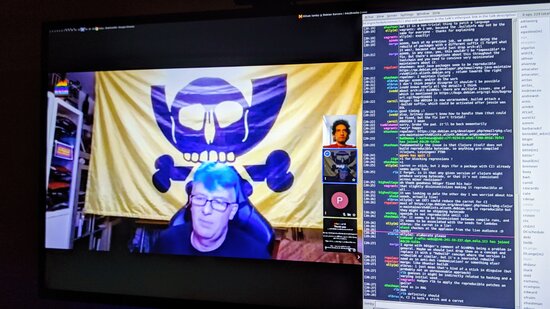










 In May, I got selected as a


 Here is another monthly update covering what I have been doing in the free software world during August 2020 (


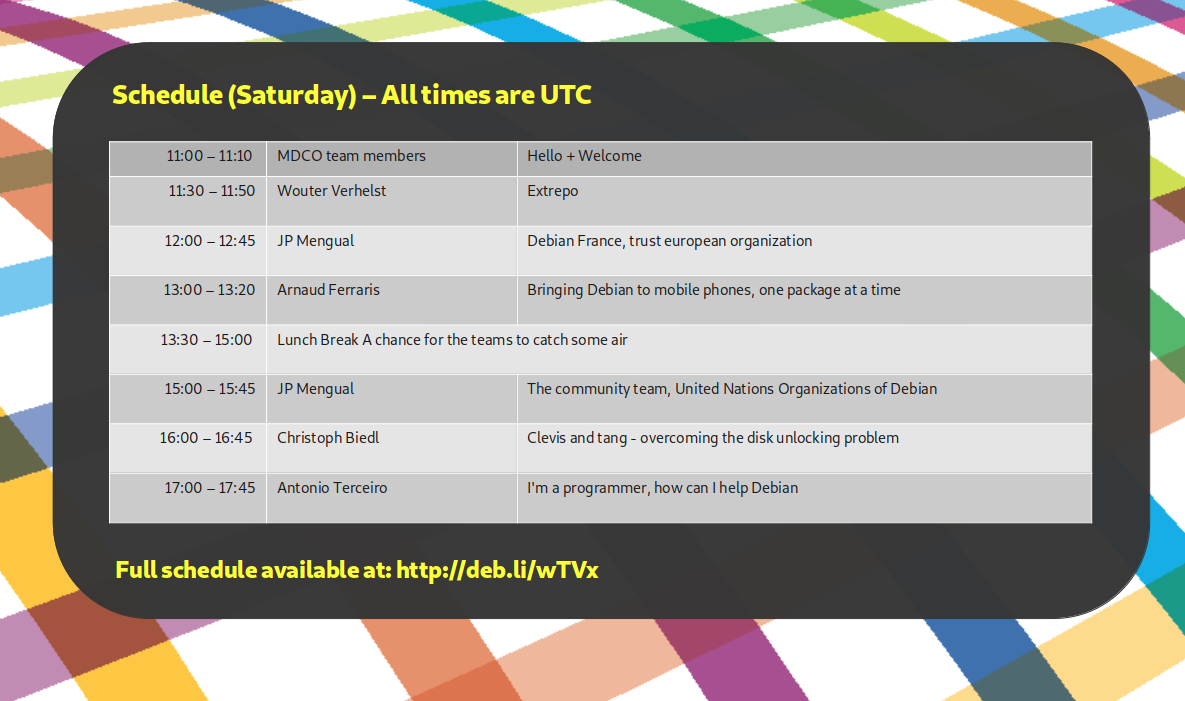
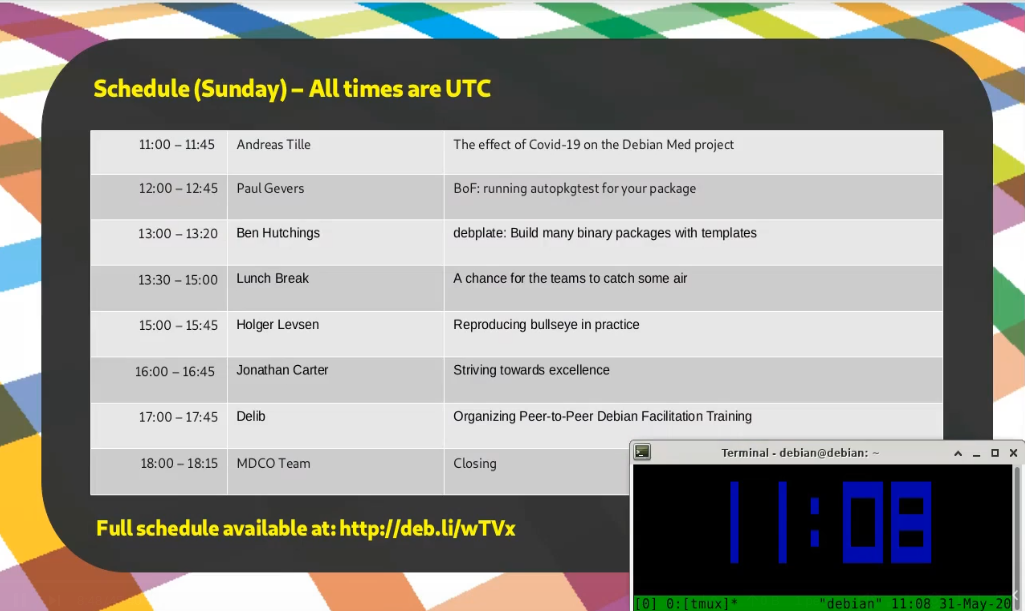
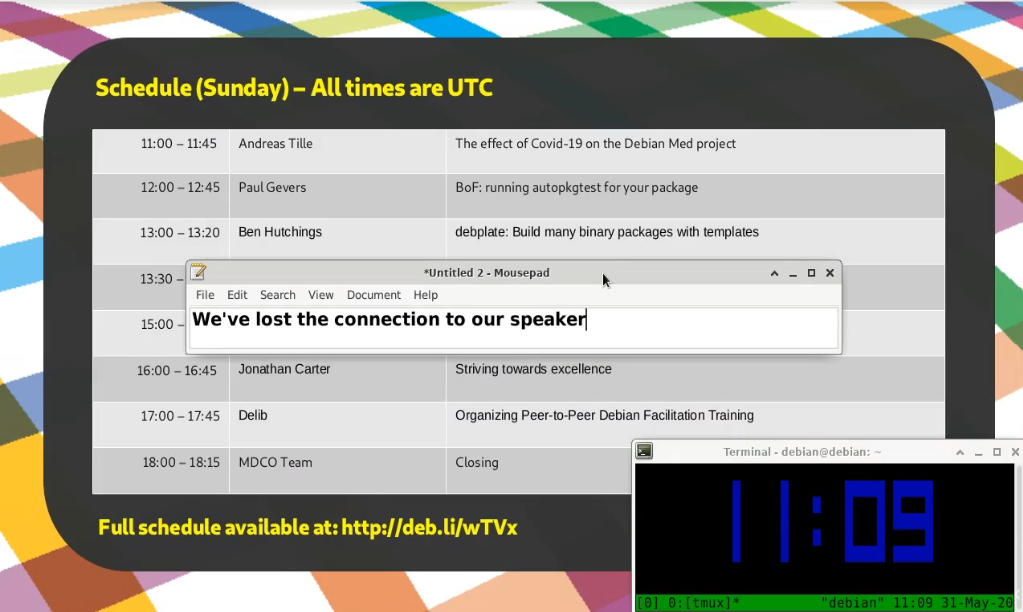
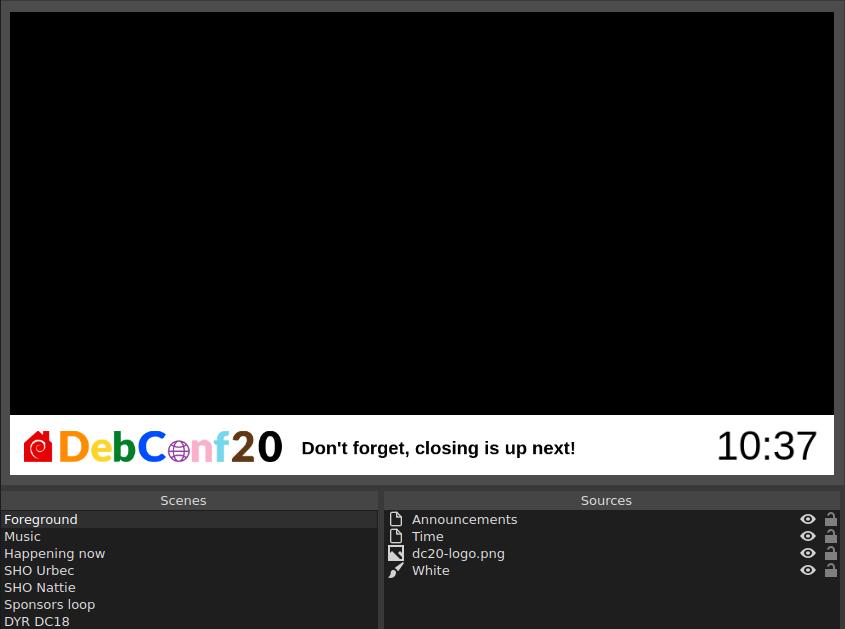
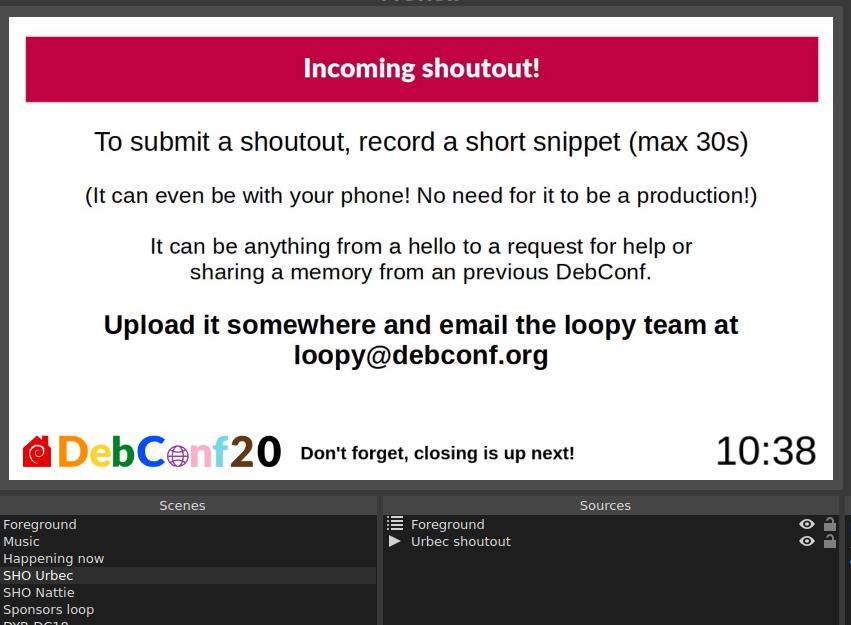
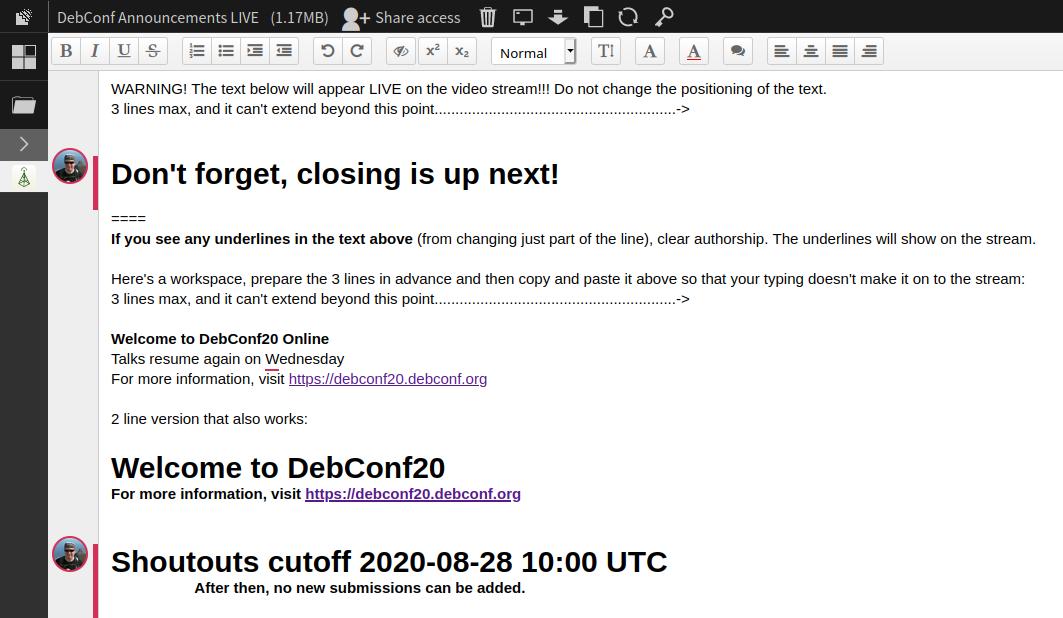
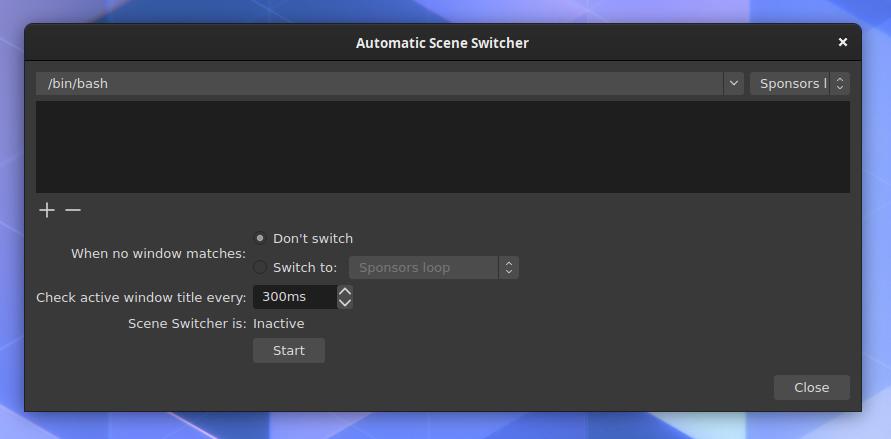
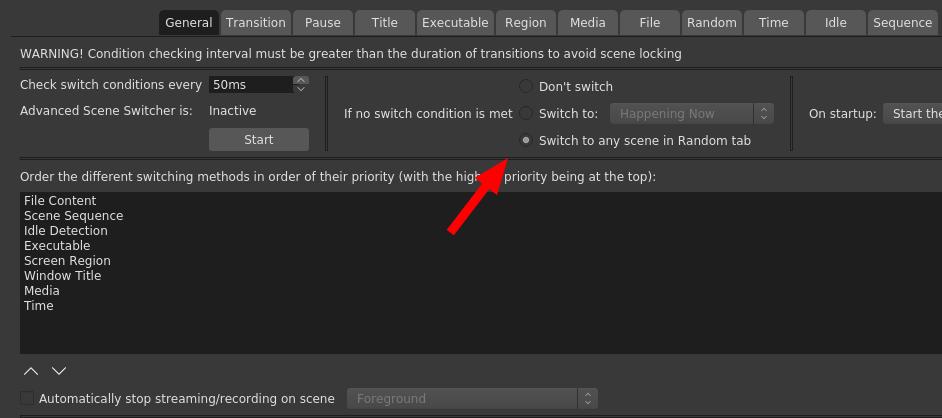
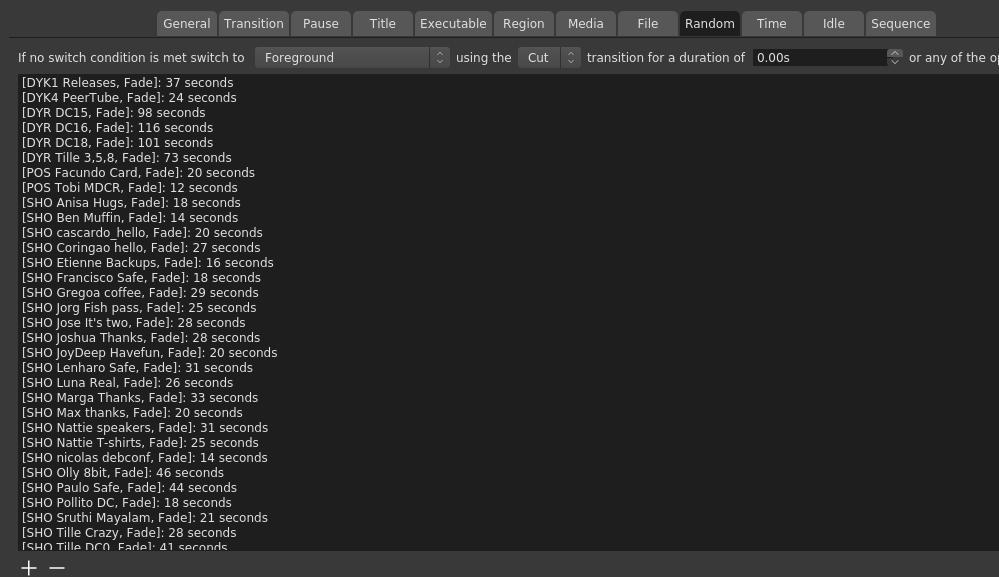
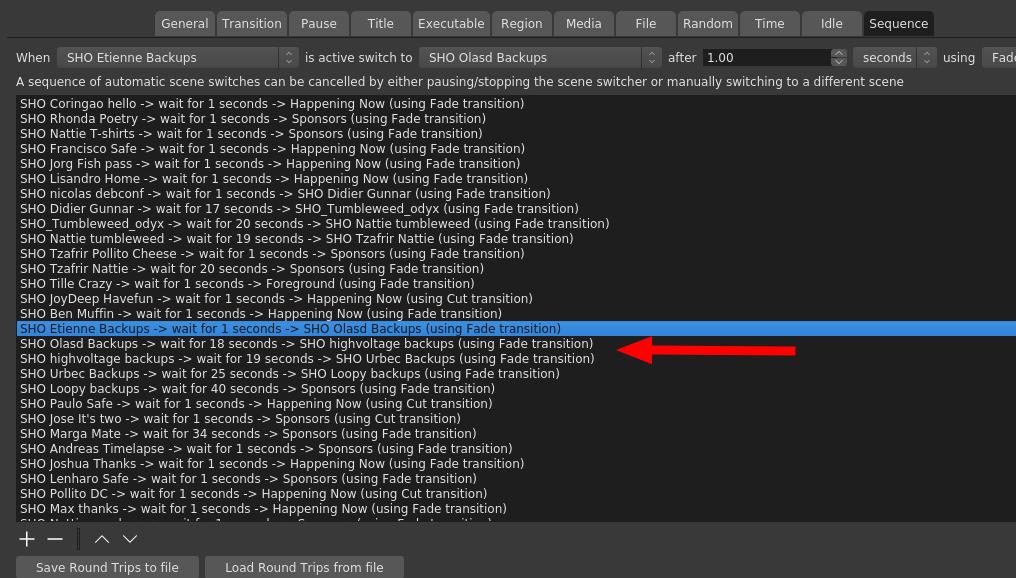
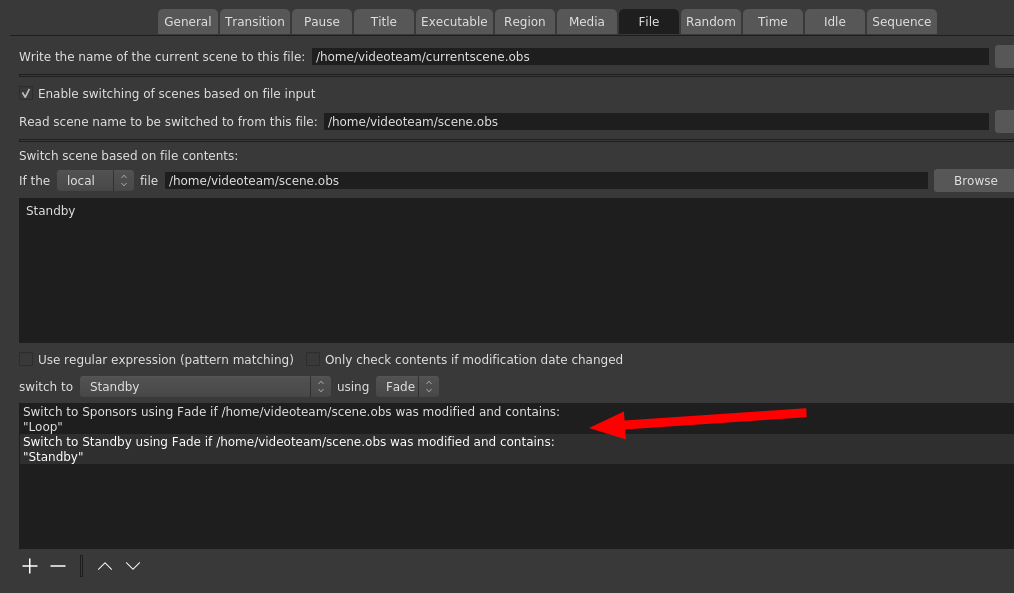
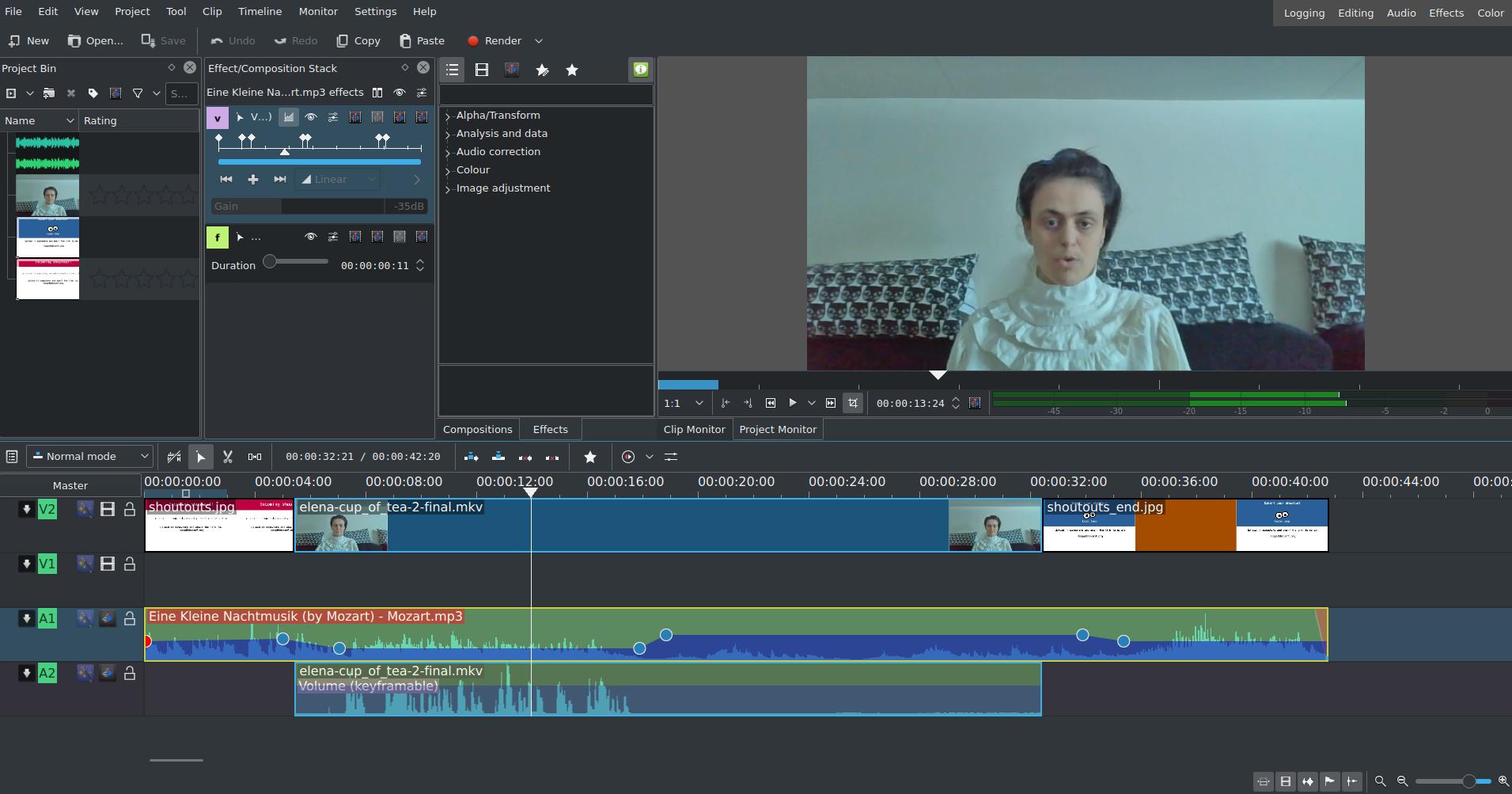

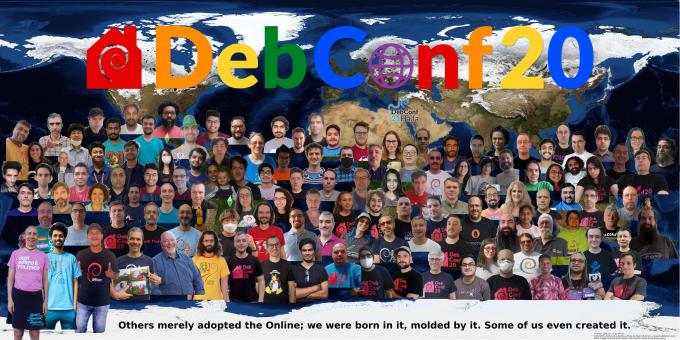
 DebConf20 is taking place online, from 23 August to 29 August 2020.
It is the 21st Debian conference, and organizers and participants are working hard
together at creating interesting and fruitful events.
We would like to warmly welcome the 17 sponsors of DebConf20, and introduce them to you.
We have four Platinum sponsors.
Our first Platinum sponsor is
