Search Results: "angel"

18 September 2012

Martin Pitt: PyGObject 3.3.92 released

I just released PyGObject 3.3.92, for GNOME 3.5.92. There is nothing too exciting in this release; a couple of small bug fixes and a lot of new test cases. See the detailled list of changes below. Thanks to all contributors! Changes:

6 September 2012

Joey Hess: UPS farce

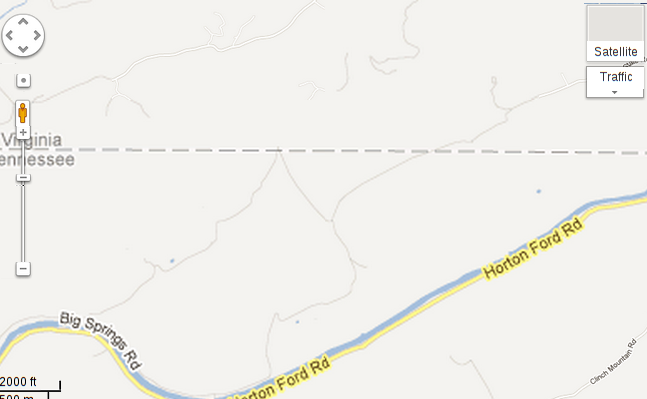
This is not the kind of place I live, though I don't mind a visit. Errol looking out over Salsalito and the Bay I'm not bothered by a more rural life, I thrive on peace and quiet, and am not bothered by needing to haul my water, split firewood, or spend an hour just mowing my driveway. I bought a GPS the other day, and it doesn't know where my driveway is..
or where the road leading to my driveway is..
or even about the highway leading to that road!
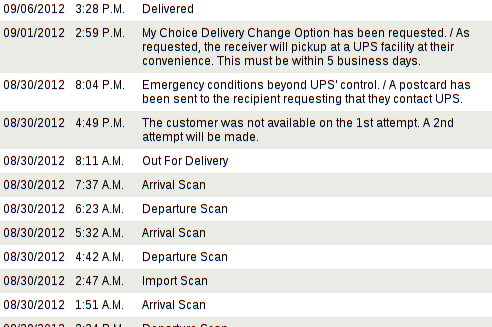
not many roads on this map.. The only thing that really bothers me about living here off the map is that I'm in the middle of a food desert too. The nearest semi-decent grocery store and produce market are 40 minutes away. There's one restaurant worth eating at, and while a very congenial place to eat rustic food while watching the river flow by, it serves almost no vegetables. Adding to the problem, my fridge is a rather expensive propane model, which is about half a normal size, and has no freezer. Managing a healthy meal plan is a constant struggle, though I do have time to cook, at least, thanks to not having the kind of commute that is typical around here. Well, the food desert was my only real problem. Now I can add to that the UPS emergency. A week ago, a package left Shenzen China for here. It quickly passed through Anchorage Alaska, and with a few days had arrived an hour and a half from here. Getting it here has taken the whole rest of the week.
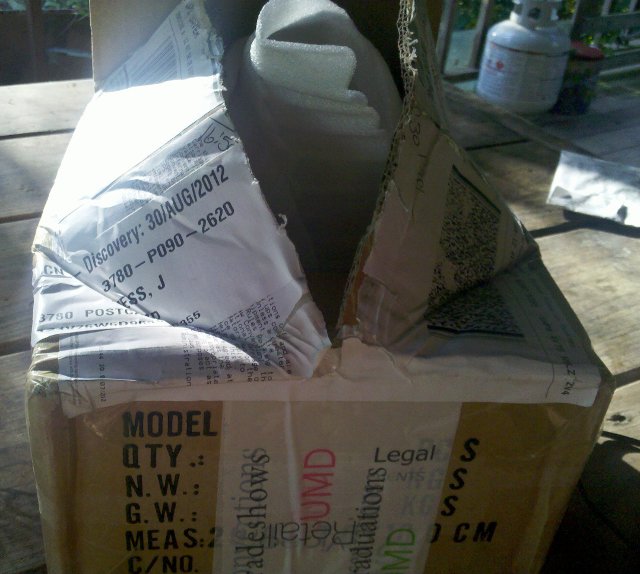
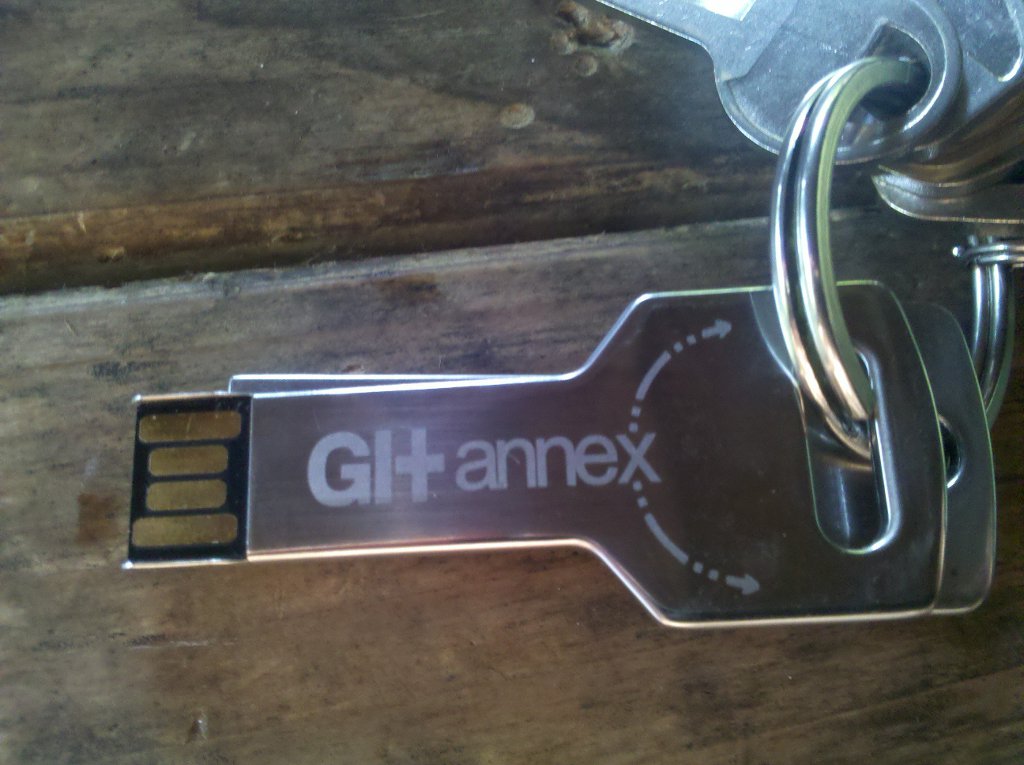
I only knew UPS attempted delivery because a neighbor told me. Seems they took one look at my driveway and turned around. They never tried again, and they didn't bother to leave a note on the mailbox, or anything. Now, the US postal service is happy to drive up this driveway; they drive a sensible 4x4 around here. I think DHL and Fedex have been here too. (Contrary to John Goerzen's experiences) My compact car is not bothered by my driveway either... But UPS's brand involves large brown trucks, even where inappropriate, and damage to them from such things as low-hanging branches apparently comes out of the driver's paycheck. And while normally UPS leaves small things in my mailbox, or with a neighbor, this was an important package from China, and it needed a signature. But really, a post card? "emergency"?! So, I bought the GPS to find UPS, because my package was in an industrial park in some town I've never been to. And on Tuesday I was within an hour of there and swung by. And it was closed. UPS's website had not mentioned this; other businesses are open the day after Memorial day. That turned out to be a really annoying day all around. When I got home, after a night away, I found my fridge's fire had blown out, and nearly all my food was only fit for the dog. Today I went out to try again (and buy groceries). When I reached the UPS depot.. it was closed! Until 3 pm. At this point I felt this story was reaching full-on farce. After cooling my heels in a library for three hours, I was finally able to open the most over-packed package I've probably ever seen. My kickstarter reward sample looks good.. I'll be ordering a lot more, but not to this address. As a coda to the UPS farce, arriving home today I checked my mailbox, and found the UPS postcard had finally arrived. It included mention of the 3 pm opening time, and noted that I had until tomorrow before they'd return my package to China. The coda to the coda is that on my way home from this second annoying day delivered courtesy of UPS, I stumbled on a restaurant overlooking a waterfall, just outside the town where I get my groceries. It serves food that satisfies both my Cajun and healthy cravings. Now I just need a larger fridge..

29 August 2012

John Goerzen: Kindergarten Computer Class and Password Security

Jacob started Kindergarten last week. More on that in another post. He s been loving it, until yesterday. At least part of his disgruntlement was because it was his first visit to computer class. Putting together a few conversations, we learned this:
Jacob: Something was different about Kindergarten today. Us: Oh? What was it? Jacob: I had computer class today. Us: What did you do? Jacob, super frustrated: Nothing. NOTHING, NOTHING, NOOOO THIIING. Nothing. Us: You didn t get to use a computer? Jacob: All we did was log on and log off the whole time. Log on and log off. My username is Jacob and my password is Jacob. (annoyed and confused voice) Why are they the same??
I guess his teachers weren t used to children that had been logging on to computers for two years before Kindergarten. And probably also weren t expecting any of them to take some sort of offense at their password poicy. He probably couldn t appreciate how reasonable it was to tech Kindergarteners how to log in to a computer on the first day of computer class

27 August 2012

Michael Prokop: jenkins-debian-glue: Continuous Integration for Debian and Ubuntu made easy

jenkins-debian-glue is an open source project of mine which recently celebrated its first birthday and it s time to finally write about it. jenkins-debian-glue allows you to build Debian and Ubuntu packages directly from the Jenkins continuous integration system. It retrieves package sources from a version control repository, adjusts debian/changelog (handle version number + mention changes that took place) and builds according source and binary packages out of it. Its lintitan integration provides Q/A reports about the resulting source and binary Debian packages. It started as a small pet project of mine to get integration of Debian packaging inside Jenkins. I mainly had the needs for the Grml project in mind and starting with Grml 2011.12 every release (including also all the daily builds) was built using Jenkins since then. It turned out that my project would also be a perfect match for one of my customers, Sipwise GmbH. In December 2011 the sip:provider 2.4 was the first stable release that was built 100% through Jenkins and featuring jenkins-debian-glue. Thanks to special needs and the open source friendliness of Sipwise I could invest further time into the project. Recently the project got even some further drive thanks to interest by some fellow Debian Developers, most notably are the icinga, nagios-plugins, packages and the PostgreSQL in Debian Hackathon. Now if you re also interested in it: there s an automated deployment procedure available for your service to get started with the whole jenkins-debian-glue and Jenkins stack in less than 10 minutes, working just fine on Debian as well as Ubuntu. For further details please head over to jenkins-debian-glue.org or check out this 6:36min screencast (safe for work, no audio :) ): <iframe allowfullscreen="allowfullscreen" frameborder="0" height="315" src="http://www.youtube.com/embed/9asp2ZvH90A?autohide=1&amp;showinfo=0" width="560"></iframe> This embedded video doesn t work for you? Try heading over to YouTube.

25 August 2012

John Goerzen: Voice Keying with bash, sox, and aplay

There are plenty of times where it is nice to have Linux transmit things out a radio. One obvious example is the digital communication modes, where software acts as a sort of modem. A prominent example of this in Debian is fldigi. Sometimes, it is nice to transmit voice instead of a digital signal. This is called voice keying. When operating a contest, for instance, a person might call CQ over and over, with just some brief gaps. Most people that interface a radio with a computer use a sound card interface of some sort. The more modern of these have a simple USB cable that connects to the computer and acts as a USB sound card. So, at a certain level, all that you have to do is play sound out a specific device. But it s not quite so easy, because there is one other wrinkle: you have to engage the radio s transmitter. This is obviously not something that is part of typical sound card APIs. There are all sorts of ways to do it, ranging from dedicated serial or parallel port circuits involving asserting voltage on certain pins, to voice-activated (VOX) circuits. I have used two of these interfaces: the basic Signalink USB and the more powerful RigExpert TI-5. The Signalink USB integrates a VOX circuit and provides cabling to engage the transmitter when VOX is tripped. The TI-5, on the other hand, emulates three USB serial ports, and if you raise RTS on one of them, it will keep the transmitter engaged as long as RTS is high. This is a more accurate and precise approach. VOX-based voice keying with the Signalink USB But let s first look at the Signalink USB case. The problem here is that its VOX circuit is really tuned for digital transmissions, which tend to be either really loud or completely silent. Human speech rises and falls in volume, and it tends to rapidly assert and drop PTT (Push-To-Talk, the name for the control that engages the radio s transmitter) when used with VOX. The solution I hit on was to add a constant, loud tone to the transmitted audio, but one which is outside the range of frequencies that the radio will transmit (which is usually no higher than 3kHz). This can be done using sox and aplay, the ALSA player. Here s my script to call cq with Signalink USB:
#!/bin/bash
# NOTE: use alsamixer and set playback gain to 99
set -e
playcmd ()  
        sox -V0 -m "$1" \
           "  sox -V0 -r 44100 $1 -t wav -c 1 -   synth sine 20000 gain -1" \
            -t wav -   \
           aplay -q  -D default:CARD=CODEC
 
DELAY=$ 1:-1.5 
echo -n "Started at: "
date
STARTTIME= date +%s 
while true; do
        printf "\r"
        echo -n $(( ( date +%s -$STARTTIME) / 60))
        printf "m/$ DELAY s: TRANSMIT"
        playcmd ~/audio/cq/cq.wav
        printf "\r"
        echo -n $(( ( date +%s -$STARTTIME) / 60))
        printf "m/$ DELAY s: off         "
        sleep $DELAY
done
Run this, and it will continuously play your message, with a 1.5s gap in between during which the transmitter is not keyed. The screen will look like this:
Started at: Fri Aug 24 21:17:47 CDT 2012
2m/1.5s: off
The 2m is how long it s been going this time, and the 1.5s shows the configured gap. The sox commands are really two nested ones. The -m causes sox to merge the .wav file in $1 with the 20kHz sine wave being generated, and the entire thing is piped to the ALSA player. Tweaks for RigExpert TI-5 This is actually a much simpler case. We just replace playcmd as follows:
playcmd ()  
        ~/bin/raiserts /dev/ttyUSB1 'aplay -q -D default:CARD=CODEC' < "$1"
 
Where raiserts is a program that simply keeps RTS asserted on the serial port while the given command executes. Here's its source, which I modified a bit from a program I found online:
/* modified from
 * https://www.linuxquestions.org/questions/programming-9/manually-controlling-rts-cts-326590/
 * */
#include <stdio.h>
#include <stdlib.h>
#include <termios.h>
#include <unistd.h>
#include <sys>ioctl.h>
#include <sys< sys="">types.h>
#include <sys>stat.h>
#include <fcntl.h>
static struct termios oldterminfo;
void closeserial(int fd)
 
    tcsetattr(fd, TCSANOW, &oldterminfo);
    if (close(fd) < 0)
        perror("closeserial()");
 
int openserial(char *devicename)
 
    int fd;
    struct termios attr;
    if ((fd = open(devicename, O_RDWR)) == -1)  
        perror("openserial(): open()");
        return 0;
     
    if (tcgetattr(fd, &oldterminfo) == -1)  
        perror("openserial(): tcgetattr()");
        return 0;
     
    attr = oldterminfo;
    attr.c_cflag  = CRTSCTS   CLOCAL;
    attr.c_oflag = 0;
    if (tcflush(fd, TCIOFLUSH) == -1)  
        perror("openserial(): tcflush()");
        return 0;
     
    if (tcsetattr(fd, TCSANOW, &attr) == -1)  
        perror("initserial(): tcsetattr()");
        return 0;
     
    return fd;
 
int setRTS(int fd, int level)
 
    int status;
    if (ioctl(fd, TIOCMGET, &status) == -1)  
        perror("setRTS(): TIOCMGET");
        return 0;
     
    status &= ~TIOCM_DTR;   </sys>* ALWAYS clear DTR */
    if (level)
        status  = TIOCM_RTS;
    else
        status &= ~TIOCM_RTS;
    if (ioctl(fd, TIOCMSET, &status) == -1)  
        perror("setRTS(): TIOCMSET");
        return 0;
     
    return 1;
 
int main(int argc, char *argv[])
 
    int fd, retval;
    char *serialdev;
    if (argc < 3)  
        printf("Syntax: raiserts /dev/ttyname 'command to run while RTS held'\n");
        return 5;
     
    serialdev = argv[1];
    fd = openserial(serialdev);
    if (!fd)  
        fprintf(stderr, "Error while initializing %s.\n", serialdev);
        return 1;
     
    setRTS(fd, 1);
    retval = system(argv[2]);
    setRTS(fd, 0);
    closeserial(fd);
    return retval;
 
This compiles to an executable less than 10K in size. I love it when that happens. So these examples support voice keying both with VOX circuits and with serial-controlled PTT. raiserts.c could be trivially modified to control other serial pins as well, should you have an interface which uses different ones.

22 August 2012

Eugene V. Lyubimkin: Cupt package manager in Debian: from Squeeze to Wheezy

A status update for what changed since Squeeze release and what is the state of Cupt in Wheezy. No new things for those few who follow small blog posts or the changelog, but an overview for, maybe, softly or newly interested.

Cupt, the high-level package manager for Debian with a console interface and therefore APT's competitor, continued its development since the first stable series. In the second major version it's rewritten in C++(11), got many new features such as numerous improvements in the depedency resolver and the dpkg action scheduler, the support of index diffs, the tutorial, wget-based download method, position action override options, logging, colored action preview prompt, treeish detailed error messages if no solutions were found, to name most important. That said, if you want multiarch, CDROM repository support or, say, some exotic download method, -- Cupt won't suit, at least for now. Project-wide support is also still almost completely missing as many developers accept no more than two package managers.

The "bug-freeness" aim still holds, at the moment of writing there is no unfixed runtime bugs of priority normal+. Here I thank again those people who reported bugs, you all definitely made Cupt better. I am sure there are bugs still which wait their time to show up, but that's hardly avoidable.

All in all, 2.x is a big step forward from 1.x. Not a last step -- development continues.

19 August 2012

John Goerzen: Crazy Enough?

So far this year, I ve read somewhere in the neighborhood of 5000 pages. As I ve started to read more, I ve started to watch TV, movies, and Youtube less, because they are simply boring and shallow in comparison. War and Peace, in particular, deeply touched me. Lately I have been reading the Wheel of Time series, which has its own unique characteristics. Whether an epic (or super-epic, such as Wheel of Time) novel, or the Sherlock Holmes series, or nonfiction works, there is something magical about reading a book. We often see characters, real or fictional, that rise from obscurity to do great things for the world. We are transported in time and place to a time or place we will never be able to experience, perhaps because it is long past, or perhaps because it never was. But in any case, we can be inspired. I am reminded of this quote: The people crazy enough to think they can change the world are the ones that do. If someone told me that a street vendor in Tunisia would, in less than a year, cause the overthrow of 4 dictatorships and reform in a handful more, I would have, yes, thought that was crazy. And while Mohamed Bouazizi isn t a household name in much of the world, he managed exactly that. But not just him. It took crazy unarmed people to occupy Tahrir Square, some to die, for progress to be made in Egypt. This story is written all over history. People have done the impossible, have defied all odds, through sheer belief that they could. Civil rights have been granted due to the leaders we all know, but also due to the millions of marchers we don t. Changing the world doesn t have to mean that the world knows you. It just has to mean that you love the world, as Tolstoy pointed out:
Love hinders death. Love is life. All, everything that I understand, I understand only because I love. Everything is, everything exists, only because I love. Everything is united by it alone. Love is God, and to die means that I, a particle of love, shall return to the general and eternal source.
Whatever your stance on religion, this is a powerful quote. Sometimes particles of love might look crazy. But isn t it then that they are the most alive? Isn t it then that they are the greatest hindrance to death and despair?

13 August 2012

John Goerzen: Summer

It s been a hot year in Kansas this year. Really hot. Our average high for July was 101F / 38C. It s also been extremely dry. So we haven t had too many pleasant opportunities to enjoy a bit of an upcycling project I had with the boys. When we renovated our old farmhouse, we had two chimneys removed. The bricks were saved in a large pile out back, and we haven t really touched them in the last 5 years. I got the idea at some point that it would be nice to have a fire ring on our yard. The boys love campfire-style cooking, and enjoy helping gather kindling and watching the fire grow. I had looked at fire rings in stores, but just couldn t bring myself to pay $60 or $100 or even more for what was really a piece of round metal. I decided we would find a way to build our own fire ring. So the idea of chimney bricks seemed perfect. Some of these bricks still have mortar on them, so the result is imperfect, but it is functional. More importantly, the boys helped. They picked out bricks one at a time, set them in the wheelbarrow (or even carried a few themselves, as Jacob insisted on doing sometimes.) Then we d dump them out on the ground, and I d make some attempt at making the thing round, while the boys would put them on the pile. We did this over the course of several evenings, with me filling in on some of it after they lost interest. When we got it done, they of course loved cooking outside. I made sure that we placed it in a place that will be in the shade every summer evening so we d be comfortable. I made no attempt to mortar it in; this way, it s easy to move or resize. And it s safer for the boys than a metal one, since the outer edge never even gets warm to the touch. Anyhow, it finally got a little cooler last week, so we cooked out there for dinner two days in a row. One day, after eating, the boys came back out to help put out the fire with the hose. After that, Jacob and I went out there to eat dessert. He sat on the grass, and I sat down next to him. He scooted over a bit to be closer to me. Pretty soon, Oliver came running out too, and sat on my lap. The three of us just sat there on the grass, eating our desserts and enjoying the evening. It s the kind of moment that makes a dad happy. The other evening, they again helped me put out the fire with a hose. They d been active that day, so after I finished hosing down the fire ring, I gave them each a small spray with the hose. After a brief flicker of indecision, they both decided this was hilarious. Jacob took off running, yelling You ll never catch me! (And clearly hoping I would.) Oliver copied him, and so I proceeded to chase them around the yard with a hose for quite awhile. There was much laughter from them, and they wound up totally soaked and happy. Another good evening. You never know what will happen outdoors, but so often it is very good.

12 August 2012

John Goerzen: A Verbose, Hands-On Nexus 7 Review

Some of you may have noticed that I am not a concise author. Perhaps that has something to do with the fact that I am not a concise reader. I like facts, details, and lots of them. So as a recent Nexus 7 purchaser, here you go. Genesis I ve long used Android devices, and last year had a company-issued Motorola Xoom, which was the first Google Experience tablet with Honeycomb. That tablet has specs roughly similar to iPads; its 10.1 screen was the same, the 1280 800 screen was better than the iPad available at the time, and its 730g weight identical to the early iPads (though 10% higher than the current iPad). I lost access to it when I changed jobs, and had been without a tablet until recently. Other devices I own are the Galaxy Nexus, sporting a 4.65 screen; and what s now called the Kindle Keyboard, with an eInk screen. I had been somewhat interested in the Kindle Fire, but the closed nature and limited capability of the system kept me away. The Nexus 7 reviews, however, were stunning, as was the price. $200 for a great tablet. I wound up buying the $250 16GB model. But not until after I spent a great deal of time thinking about size. Physical Size My main concern was that the Nexus 7 would be too small to be useful. I had never been particularly pleased with my input speed on the Xoom. I tried to touch type on it, but was just never fast enough to surpass frustratingly slow. I have long been a fast and accurate typist on keyboard; well over 100 words per minute, and it is frustrating when my fingers can t maintain that speed. I figured the situation would be even worse on the Nexus 7, given its smaller size. I also found the Xoom to sometimes feel a little small with the 10 screen, and was concerned about that as well. And finally, 7 doesn t sound all that much larger than 4.65 . However, having actually had the Nexus 7 for a little while now, I m very pleased with the size, and may even prefer it. The 10 tablets are just too big and heavy to comfortably hold in one hand, and I ve realized that part of my Xoom frustration was the fact that I had to set it down and prop it up for anything beyond very brief use. At 340g, the Nexus 7 is less than half the weight of the Xoom or iPad, and it makes a huge difference. While still nowhere near where I d be with a keyboard, two-thumb typing in portrait mode, or even something approaching touch typing in landscape mode, is possible on the Nexus 7. The screen size hasn t been a bother, at all. This may be due to the fact that it s higher resolution (it s 1280 800 like the Xoom, but those pixels are crammed into only 7 ). I think it s also partly due to the fact that the browser in Jelly Bean is significantly better than the one in Honeycomb, and perhaps that websites are better at tablet-friendliness, too. Overall, the Nexus 7 feels a lot farther from the size of a laptop than did the Xoom, and as such is more prone to come with me in lots of situations, I think. It works reasonably well with foldable Bluetooth keyboards, so when thinking about a laptop replacement or alternative, that might be the way I go. A Bluetooth mouse also works with it, though I found it didn t provide near the utility that a BT keyboard does. Display The display is both amazing and disappointing. Browse some photos and some of them will show up in eye-popping clarity. Websites display fine. But the screen can also take on a washed-out appearance at times. I am notoriously picky in my displays, and this bothered me enough that I researched it. Analysis has shown that poor firmware calibration has lead to the compression of highlights, which mirrors what I was seeing. I am mostly used to it by now, but it s a disappointment. Most of the time, though, the screen is excellent. In comparison to my eInk Kindle, however, I don t think any tablet will ever be as good for book reading. The eInk screen truly is easier on the eyes, and the reflection of overhead lights on the Nexus 7 display can be distracting at first. I have had occasional issues with it not registering touches properly. This is always cleared up by touching the power button to put the unit to sleep, then waking it back up. Other Hardware There are three hardware buttons: power and volume up/down. Physically, the device fits my hand well, though I might wish it was a little lighter like my Kindle. Charging is accomplished via high-power 2A micro-USB, and there is, of course, a headphone port. There is no alert LED like my Galaxy Nexus has, and no vibration feature. The speaker is on the back, and the microphones along the left side a position which, it appears, many Nexus 7 cases are blocking. Battery Life I am astonished at how good this device is battery-wise, especially compared to the battery disaster that is the Galaxy Nexus. Google claims the Nexus 7 can survive 8 hours of solid screen-on use, and I don t doubt it. Mine s never gotten low enough to get a solid measurement. Wifi The wifi works well, as far as it goes. The wifi doesn t support 802.11n in 5GHz, which although somewhat common for devices like this, is a bit of a disappointment. Software The big story about the Nexus 7 is Jelly Bean. I had used Honeycomb on the Xoom, and Ice Cream Sandwich on my Galaxy Nexus, so I m familiar with its predecessors. Let s take a look. Project Butter Much has been made of Project Butter, Google s attempt to optimize Android to improve its responsiveness and the smoothness of things like scrolling. I can say they have done quite well. This device is so smooth you don t notice how smooth it is. It wasn t until I had been using it for a bit that I really noticed. That s a job well-done. Chrome The browser in Jelly Bean is now called Chrome. I am not sure if this is just marketing or not. It doesn t really feel all that different from previous versions of the Android browser, and the changes have been along the lines of incremental changes Google has introduced before. One of the very best new features happens when you touch a link that is close to other links on a page. Rather than getting a pretty much random page, Chrome pops up a partial-screen zoom box showing the part of the page near where your finger touched. With everything showing up huge, it is now easy to touch the precise link you want. Do so, and the box goes away, and your page loads. I am amazed at how much improvement this one change brings. Compared to ICS Browser, bookmarks can be brought up quicker, and the tab interface is nicer. All is not perfect in the land of Chrome, however. It contains several regressions from the Ice Cream Sandwich browser. I have two complaints about bookmarks. One is that previous versions of the browser would show thumbnails of sites in the bookmark viewer. This was a nice navigation aid. Chrome shows only favorites icons, if one is available, or a generic icon if not. Also, the bookmarks synced with other Android devices are called, confusingly enough, Desktop Bookmarks now, and require an extra tap to access. I have had occasional trouble with Chrome not wanting to prompt for credentials for servers on my LAN that use HTTP auth. Chrome has also removed the ICS browser s ability to save a page, including all its elements, for offline viewing. Good for things like an airline checkin screen and such. I have no idea why Chrome removed this. I installed the Firefox Beta for Android, which also doesn t have the offline save feature, but it does have a save to PDF feature. Soft Keyboard The on-screen soft keyboard in Jelly Bean is a significant regression from previous versions of Android. My biggest complaint is the lack of visual feedback for keypresses. On earlier versions of Android, when you push a key, you ll see an image of it pop up on the screen, offset a little from the location of the key itself. In JB, all that happens is that the key itself changes colors. Not very helpful, because it is under your finger at the time. This small thing frustrates me to no end. The keyboard in ICS introduced some nice features as well, mainly long-presses as shortcuts to other features. For instance, you can long-press a key on the top row of letters to get numerals without having to switch to the number mode. Similarly, long press the period and you get other common punctuation. The JB keyboard removed both of those features. Thankfully, in the Market, there is an app called Ice Cream Sandwich Keyboard. It appears geared towards people running earlier versions of Android. Sadly, it is also a step up over what we have in JB. Google Now and Voice Recognition The other main headline feature in Jelly Bean is Google Now. The somewhat-competitor to Apple s Siri, Google Now takes a bit of a different approach than Apple. It is said that Siri is better than Google Now at responding to queries, but Google Now is better at predicting what you want to know before you ever ask. I haven t ever used Siri, but I would buy that explanation. Google Now is available with a swipe up from the bottom of the screen, or with a single touch from any Home screen. Bring it up and it shows you current information about what it thinks you need to know. Examples include weather and forecast information, time to get to home or work from your current location, alerts that you need to leave soon to get to a certain place on time, flight schedules, sports scores, etc. Google Now has been mostly a gimmick to me, but that may be because I fall outside its target demographic in significant ways. I live nowhere near a public transportation system, work at home for the most part, haven t flown wince I ve had the Nexus 7, don t follow sports, and already know how long it takes to get places (and when it varies, it s because of muddy roads or harvest neither things that traffic services know about.) The weather widget always seems to show the temperature from a couple of hours ago. It does show the weather in your current location. Well, mostly. I was in Newton, KS one day. I tapped on the icon for more detail. That simply took me to a Google search for weather Newton . Which showed me the weather for Newton, Massachusetts 1600 miles away. Fail. Speech recognition in JB is definitely improved. It is somewhat useful with Google Now. I like being able to simply say set alarm for 30 minutes. And it does it a lot quicker than I could in the interface. It s supposed to be able to let me bring up my contacts in the same way, but it is much more likely to try turning such an attempt into a Google search than an actual display of a contact. It s picky on the precise language used for setting an alarm too; say it slightly differently, and it s another Google search. JB also supports limited offline speech recognition. I say limited because it s a bit strange. I have, for instance, a Remember the Milk widget on my home screen. It has a microphone icon to use to speak a new reminder. Tap it, and you can t use it offline. It also has a button that brings up the on-screen keyboard. Do that, then touch the microphone on the keyboard, and you can use offline recognition. I have no idea how to explain this difference, since both are clearly using Google s engine. The speech recognition is indeed better, and might make it suitable for use instead of a keyboard for composing short texts and such. But it rarely produces even a sentence that I don t have to correct in some way, even now. Conclusion Despite some of its shortcomings, I am very fond of the Nexus 7. It is an excellent device. And at $200-$250, it is an AMAZING device. I am truly impressed with it, and don t regret my purchase at all.

11 August 2012

Patrick Matth i: Debian Wheezy status of fglrx-driver

After too much months without a working fglrx-driver for Wheezys Xserver 1.12 we have got now a fully working version! What happened? Freeze exception for it is filled since > 10 days, we are now just waiting for an answer. If you are missing support for the older RadeonHD series, Andreas (co-maint of fglrx-driver) just packaged the legacy driver, which is available in experimental.
Very much thanks to him, especially for all his very good fglrx-driver packaging work!

3 August 2012

Paul Tagliamonte: monomoy (the next generation of qlight)

I ve been working on a replacement to qlight since I ve blogged about it something a bit more self-contained and clean. I ve settled on the name monomoy, since I had a lot of the ideas i ve been using come to me on the real monomoy. In particular, I d like for it to support having remote build-nodes, and non-archive upload patterns I d like to be able to upload pkg-foo/1.1.2-1 (UNRELEASED) 20 times without bumping the changelog. Now, my approach and local test-code has been unorthodox. I ve decided to throw caution to the wind, and store as much as I can in mongodb, including parsed debian control files. I ve recently (this afternoon) added support for build queues, which I hope to build out. More to come once it s sane, but it s working-ish!

1 August 2012

Rapha&#235;l Hertzog: My Debian Activities in July 2012

This is my monthly summary of my Debian related activities. If you re among the people who made a donation to support my work (72.65 , thanks everybody!), then you can learn how I spent your money. Otherwise it s just an interesting status update on my various projects. This month has been a short one since I have been away for 2 weeks of vacation. Dpkg My dpkg work encompasses a bunch of small tasks: Packaging I updated nautilus-dropbox to version 1.4.0 and python-django-registration to version 0.8. Both have been uploaded to unstable and I initially wanted to request an unblock for the latter, but it turns out it has gained reverse dependencies and version 0.8 introduces API changes so it s not an option at this point of the freeze. QA work I investigated and fixed #678356 where it had been reported that the PTS static news were no longer working as expected. At the start of the month, I also unblocked the mostly-unknown but important mole service it was out of date of several weeks and several people were annoyed that the information about new upstream versions was no longer up-to-date. Vacation Almost no Debian work during my vacation but the lack of Wifi nearby made me look for solutions to connect my computer through my Nokia N900 3G/GPRS connection. I discovered the Mobile Hotspot application (homepage) and it worked like a charm (although it required Maemo s non-default devel repository to be able to install the alternative kernel for power users ). The Debian Handbook Michal iha proposed us to host a Weblate instance to help translate the book with a web interface. He kindly agreed to implement some improvements to better suit my requirements. Those have been completed and the weblate instance is now live at debian.weblate.org. There s no requirement to use Weblate for translations teams but for those that do, it sure makes it easier to recruit volunteers who have no prior knowledge of Git and PO files. If you want to help, please checkout this page first though, you should not start using Weblate without getting in touch with the respective translations teams. Apart from translations, I also had the pleasure to merge some patches from Philipp Kern who improved the section covering IPv6 and a few other parts. We can make the book even better if more people share their expertise in the part of the book where they know better than me and Roland. :-) Thanks See you next month for a new summary of my activities.

No comment Liked this article? Click here. My blog is Flattr-enabled.

31 July 2012

John Goerzen: Proof Humans Are Capable of Working Magic

What an astonishing thing a book is. It s a flat object made from a tree with flexible parts on which are imprinted lots of funny dark squiggles. But one glance at it and you re inside the mind of another person, maybe somebody dead for thousands of years. Across the millennia, an author is speaking clearly and silently inside your head, directly to you. Writing is perhaps the greatest of human inventions, binding together people who never knew each other, citizens of distant epochs. Books break the shackles of time. A book is proof that humans are capable of working magic.
Carl Sagan, The Persistence of Memory

28 July 2012

John Goerzen: How to get started programming?

I have been asked for advice from several people recently on how to get started programming, or how to further develop a nascent interest in coding or software engineering. The people asking the questions range in age from about 10 years old to older than me. These are people that, for various reasons, are not very easily able to take computer science courses right now. One would think that, since I ve been doing this for somewhere around a quarter century (oh I do feel old now), that I d be ready to offer up some great advice. And offer some suggestions I have. But I m not convinced they re good ones. I have two main tensions. The first is that I, like many in the communities I tend to hang out in such as Debian s, have a personality that leads me to take a deep dive into details of anything that holds my interest. Whether it s Linux, Haskell, or amateur radio, I want to do more than skim the surface if I m having fun with it. Many people are not like that. They may have a lot of fun programming in Visual Basic, not really caring that other languages are out there. Or some people are not like this yet. I feel unqualified to provide good advice to people that are different from me in that way. To put it a different way: most people don t want to wait 4 years to be useful, and want to start out right away and get better over time (and I was the same way too.) The second is related. I learned programming at a time when, other than BASIC, interpreted languages were not really available to me. (Yes, they were available, but not to me.) I cut my teeth on BASIC, Pascal, and C. Although I rarely use C anymore, I can still drop into it at a moment s notice and be perfectly comfortable. I feel it was a fundamentally valuable experience, and that it would be very hard to become a great programmer without ever having lived and breathed something like C, where memory and pointers must be managed manually. Having said that, it is probably possible to become a good coder without ever having touched C. Here, then, is an edited version of some rambly advice I sent to someone recently, where learning OOP was particularly mentioned. I would welcome your comments and suggestions. I may point people that ask to this post in the future. For simply learning how to write code, Dive Into Python has long been a decent resource, though it may assume more experience than some have. I haven t read them myself, but I ve also heard good things about the How to Think Like a Computer Scientist series from Green Tea Press. They re all available as free PDF downloads, too! Eric S. Raymond s The Art of Unix Programming is another work I ve heard good things about, despite having never read it myself. A quick glance at the table of contents makes me think that even if people don t wind up working on Unix, the lessons and philosophy should be informative. It seems that many Computer Science programs are using Java for the core of their instruction, or even almost exclusively. Whether that is good or bad, I m not completely sure. It certainly gets people into OOP more deeply, but I m a right tool for the job kind of person. Despite the hype, OO like everything else isn t the right tool for every job. It is fine for people to dive straight into OO and become good programmers/engineers. However, I think it would be difficult to become a great programmer/engineer without ever having a solid understanding of a more low-level language, such as C in particular. I did my CS work when it was mostly based in C, and am glad for it. If someone never has to manage memory or pointers, I suspect they will be at a disadvantage in the long run for not being able to understand or work with the system at a more fundamental level. If a person knows C, plus some concepts of OO and Functional Programming (FP), it should be easy to pick up just about any other language out there. I used to think Python was a great first language, but during the 2.x series they added so much fluff and so many special cases that I m less enthusiastic now, though I don t know how much of that got cleaned up in 3.x. I am not too keen on Java as a first language, because too many things that should be simple aren t. I have a fondness for Haskell, and its close relationship to mathematics could make it a great first language or maybe a poor one, depending on your perspective. One other thing I think it s important for good programmers to have experience with all three major models of programming (procedural, OO, functional.) Even if a person winds up working mostly in one universe, knowledge of and experience with the others is important and informative and, in my experience, leads to better algorithms and architecture all around.

21 July 2012

Siegfried Gevatter: A gentle introduction to Zeitgeist s Python API

In this post I ll make a quick introduction by example on how to use Zeitgeist s Python API for good and profit. If you re interested in using Zeitgeist from C instead, see the libzeitgeist examples; to use it with C++/Qt, Trever s a web browser in 4 steps may be of interest. First things first In case you re not familiar with Zeitgeist, it may prove helpful to first read Mikkel s introduction to Zeitgeist post. If that s too much to read, just should know that Zeitgeist is an event log. Like the history in your browser, it keeps track of what websites you open at which point in time. It also keeps track of when you close them, and of what browser you used, since it s a system-wide service. Furthermore, it does the same for files, conversations, e-mails, and anything else you want to insert into it. So Zeitgeist is a database of events, and an event can be pretty much anything. But what does it look like? It s main attributes are the following: Additionally, each event has one or more subjects, which have the following attributes: Retrieving recent data Okay, so let s say you want to know the last song you ve listened to (if you have a Zeitgeist-enabled music player). It s a simple as:
from zeitgeist.client import ZeitgeistClient
from zeitgeist.datamodel import *
 
zeitgeist = ZeitgeistClient()
 
def on_events_received(events):
    if events:
        song = events[0]
        print "Last song: %s" % song.subjects[0].uri
    else:
        print "You haven't listened to any songs."
 
template = Event.new_for_values(subject_interpretation=Interpretation.AUDIO)
zeitgeist.find_events_for_template(template, on_events_received, num_events=1)
 
# Start a mainloop - note: the Qt mainloop also works
from gi.repository import GLib
GLib.MainLoop().run()
This may need some explaining. We start by importing the Zeitgeist client and some associated data structures (such as Event and Interpretation), and create an instance of the client. The ZeitgeistClient class is a wrapper around Zeitgeist s D-Bus API which not only makes it much nicer to use, but also makes it easy to install monitors (as we will see later) and provides convenient functionality such as automatic reconnection if the connection to the engine is lost. To query for the most recent song, we just need to create a template with the restrictions we want to impose and submit it to Zeitgeist using the find_events_for_template call. If you haven t read Mikkel s post yet, please do so, as it introduces the structure of events and subjects (in short: an event has a timestamp, some other properties, and one or more subjects representing the resources -files, websites, people - involved in the event). The Python API is inherently asynchronous (if for some reason you need a synchronous API, you may still use the lower level ZeitgeistDBusInterface class), so we need to define a callback function to handle the results we receive from the Zeitgeist engine. Finally, we need to create a main loop so the asynchronous functions can run.
Now this was a pretty simple example. Let s make it more interesting. One song isn t much, so let s get the 5 most recent songs. Also, now we want both songs and videos. The first part is pretty easy, we just need to change the num_events parameter. For the second extension, we have to change the event template. In fact, now we need two different event templates and the find_events_for_templates function, which takes an arbitrary number of event templates and ORs them. The result is as follows:
from zeitgeist.client import ZeitgeistClient
from zeitgeist.datamodel import *
 
zeitgeist = ZeitgeistClient()
 
def on_events_received(events):
    for event in events:
        print "- %s" % event.subjects[0].uri
 
tmpl1 = Event.new_for_values(subject_interpretation=Interpretation.AUDIO)
tmpl2 = Event.new_for_values(subject_interpretation=Interpretation.VIDEO)
zeitgeist.find_events_for_templates([tmpl1, tmpl2],
                                    on_events_received, num_events=5)
 
# Start a mainloop
from gi.repository import GLib
GLib.MainLoop().run()
This will work, but unless you re lucky you re likely to get some duplicate line. Why is this? Well, other than that you may have used the same file twice, don t forget that what you are requesting are actually events. If you ve started playing a given song, you probably also stopped playing it, so that s actually two of them (an AccessEvent and a LeaveEvent). Since this isn t what we want, we ll change the query a bit:
zeitgeist.find_events_for_templates(
    [tmpl1, tmpl2],
    on_events_received,
    num_events=5,
    result_type=ResultType.MostRecentSubjects,
    storage_state=StorageState.Available)
By requesting the most recent subjects, vs. the most recent events, we can filter out events with duplicate URI. See the ResultType documentation for other modes you can use. Note particularly the MostPopularSubjects result type. I also used the chance to introduce the storage_state parameter. This one will filter out events for files Zeitgeist knows aren t available (this mostly means online resources won t be shown if you don t have a network connnection; there s also support for handling external storage media, but because of problems with GIO this is currently disabled). Last but not least, the find_events_for_* methods also accept a timerange parameter. It defaults to TimeRange.until_now(), but you may change it to TimeRange.always() (if for some reason you re working with events in the future) or to any other time range of your choice. Here it s important to note that Zeitgeist s timestamps use millisecond precision.
For more advanced queries, you can use more complex combinations of events and subject templates. The rule to keep in mind here is that events are OR d and subjects are ANDed. Additionally, some field (actor, origin, mimetype, uri and current_uri) may be prefixed with an exclamation mark ( ! ) for NOT, or you may append an asterisc ( * ) to them for prefix search. You can even combine the two operators together. Here s an example of a template you could build:
subj1 = Subject.new_for_values(interpretation=Interpretation.SOURCE_CODE,
                               uri="file:///home/rainct/Development/*")
subj2 = Subject.new_for_values(uri="!file:///home/rainct/Development/zeitgeist/*")
tmpl1 = Event.new_for_values(interpretation=Interpretation.MODIFY_EVENT,
                             subjects=[subj1, subj2])
templates = [tmpl1]
In my case, this template would fetch a list of the source code files I modified most recently but excluding those related to the Zeitgeist project. Working with big sets of data In case you re trying to do something crazy, you may end up with a Zeitgeist query complaining that it exceeded the memory limit. You re not supposed to do that. Instead, we provide some methods for working with large collections of events.
from zeitgeist.client import ZeitgeistClient
from zeitgeist.datamodel import *
 
zeitgeist = ZeitgeistClient()
 
def on_events_received(events):
    for event in events:
        print '- %s' % event.subjects[0].uri
 
def on_ids_received(event_ids):
    print 'A total of %d source code files were found.' % len(event_ids)
    print 'Fetching the first 100...'
    zeitgeist.get_events(event_ids[:100], on_events_received)
 
tmpl = Event.new_for_values(subject_interpretation=Interpretation.SOURCE_CODE)
zeitgeist.find_event_ids_for_templates(
    [tmpl],
    on_ids_received,
    num_events=10000, # you can use 0 for "all events", but do you really need to?
    timerange=TimeRange.from_seconds_ago(3600*24*30*3),
    result_type=ResultType.MostPopularSubjects)
 
# Start a mainloop
from gi.repository import GLib
GLib.MainLoop().run()
And there you have the source code files you worked with during the last 3 months, ordered from most to least popular (popularity is measured counting the number of events; for more precision, maybe you could limit the results to events with interpretation AccessEvent). Why do we provide this mechanism instead of querying with a simple offset? Well, this avoids problems when the log changes (events are inserted or deleted). Have you ever been exploring the latest posts in some website, and as you change to the next page some of the results from the previous page show up again (because new posts have been added in the meantime)? With Zeitgeist this won t happen. Receiving information in real time At this point you re an expert at requesting all sorts of data from Zeitgeist, but now you want to show a list of the last kitten images you ve viewed, updated in real time. Don t worry, Zeitgeist can provide for this:
from zeitgeist.client import ZeitgeistClient
from zeitgeist.datamodel import *
 
zeitgeist = ZeitgeistClient()
 
def on_insert(time_range, events):
    # do awesome stuff with the events here
    print events
 
def on_delete(time_range, event_ids):
    # a previously inserted event was deleted
    print event_ids
 
templates = [Event.new_for_values(subject_uri='file:///home/user/kittens/*',
                                  subject_interpretation=Interpretation.IMAGE)]
zeitgeist.install_monitor(TimeRange.always(), templates, on_insert, on_delete)
 
# Start a mainloop
from gi.repository import GLib
GLib.MainLoop().run()
It s important to note that on_delete won t be called when an image is deleted (that d be a newly inserted event with interpretation=DELETE_EVENT); rather, it s called when a previously inserted event is deleted (for example, using the forget recent history option in Activity Log Manager). In case you re curious: for best performance, this doesn t actually use D-Bus signals. Instead, this little call will setup a D-Bus object behind the scenes and register it with the Zeitgeist engine, so it can notify said object when (and only when) an event of its interest is registered. To stop receiving notifications for a template, you ll need the save the object returned by the install_monitor call:
m = zeitgeist.install_monitor(TimeRange.always(), templates, on_insert, on_delete)
zeitgeist.remove_monitor(m)
Pro Tip: You can use the Zeitgeist Explorer GUI to quickly try out different queries (note: it s still work in progress, so much funcionality is missing, but it does work somewhat). Contextual awesomeness: finding related events By now you re familiar with retrieving events and keeping them up to date. Now it s time for a little secret:
import time
from zeitgeist.client import ZeitgeistClient
from zeitgeist.datamodel import *
 
zeitgeist = ZeitgeistClient()
 
def on_related_received(uris):
    print 'Related URIs:'
    for uri in uris:
        print ' - %s' % uri
 
query_templates = [Event.new_for_values(
    subject_interpretation=Interpretation.SOURCE_CODE,
    subject_uri='file:///home/rainct/Development/zeitgeist/*',
    subject_mimetype="text/x-vala")]
 
result_templates = [Event.new_for_values(
    subject_interpretation=Interpretation.WEBSITE,
    subject_manifestation=Manifestation.WEB_DATA_OBJECT)]
 
now = time.time()*1000
zeitgeist.find_related_uris_for_events(
    query_templates,
    on_related_received,
    time_range=TimeRange(now - 1000*3600*24*30*6, now),
    result_event_templates=result_templates,
    num_events=10)
 
# Start a mainloop
from gi.repository import GLib
GLib.MainLoop().run()
This little query example will return up to 10 websites I used at the same time as the Vala files inside my Zeitgeist directory, considering only data from the last 6 months. Nice, huh? This is an experimental feature, and it doesn t work well when operating on big inputs, so it s usually better to use the find_related_uris_for_uris variant (which replaces the first query_templates parameter with a list of URIs). Advanced searching: the FTS extension Some people think prefix searches aren t good enough for them, and this is why the Zeitgeist engine ships by default with a FTS (Full Text Search) extension. Using the methods provided by this extension you can perform more advanced queries against subjects current_uri and text properties (unlike the name may suggest, the FTS extension doesn t index the content of the files, but just the information in the event). This is exposed as zeitgeist_index_search in libzeitgeist (the C library), but unfortunately isn t currently available in the Python API. If you still need it, you ll have to fallback to pretty much using the D-Bus interface (you still get reconnection support, though). Here s an example:
from zeitgeist.client import ZeitgeistClient
from zeitgeist.datamodel import *
 
zeitgeist = ZeitgeistClient()
index = zeitgeist._iface.get_extension('Index', 'index/activity')
 
query            = 'hello' # search query
time_range       = TimeRange.always()
event_templates  = []
offset           = 0
num_events       = 10
result_type      = 100 # magic number for "relevancy" (ResultType.* also work)
 
def on_reply(events, num_estimated_matches):
    print 'Got %d out of ~%d results.' % (len(events), num_estimated_matches)
    events = map(Event, events)
    for event in events:
        print ' - %s' % event.subjects[0].uri
 
def on_error(exception):
    print 'Error from FTS:', exception
 
index.Search(query, time_range, event_templates,
             offset, num_events, result_type,
             reply_handler=on_reply, error_handler=on_error)
 
# Start a mainloop
from gi.repository import GLib
GLib.MainLoop().run()
The most interesting thing here is the query parameter. Quoting from the C documentation:
The default boolean operator is AND. Thus the query foo bar will
be interpreted as foo AND bar. To exclude a term from the result
set prepend it with a minus sign - eg foo -bar. Phrase queries
can be done by double quoting the string "foo is a bar". You can
truncate terms by appending a *.
There are a few keys you can prefix to a term or phrase to search
within a specific set of metadata. They are used like key:value.
The keys name and title search strictly within the text field of
the event subjects. The key app searches within the application
name or description that is found in the actor attribute of the
events. Lastly you can use the site key to search within the
domain name of the subject URIs.
You can also control the results with the boolean operators AND
and OR and you may use brackets, ( and ), to control the operator
precedence.
Modifying the log So far we ve only queried Zeitgeist for information, let s get a bit more active. You can delete events from Zeitgeist with the following query:
from zeitgeist.client import ZeitgeistClient
 
zeitgeist = ZeitgeistClient()
 
def on_deleted(timerange):
    print 'Deleted events going from %s to %s' % (timerange[0], timerange[1])
 
event_ids = [50] # put the IDs of the events you want to delete here
 
zeitgeist.delete_events(event_ids, on_deleted)
 
# Start a mainloop
from gi.repository import GLib
GLib.MainLoop().run()
The confirmation callback will receive a timerange going from the first to the last event. If no events were deleted (because they didn t exist), you ll get (-1, -1).
And now for the interesting part. If your application involves resources (files, websites, contacts, etc.) of any sort, you ll probably want to let Zeitgeist know that you re using them. It s time that you write a data-source! We start by registering the data-source. Here we go:
import time
from gi.repository import GLib
from zeitgeist.client import ZeitgeistClient
from zeitgeist.datamodel import *
 
zeitgeist = ZeitgeistClient()
 
def on_status_changed_callback(enabled):
    """ This method will be called whenever someone enables or disables
        the data-source. """
    if enabled:
        print 'Data-source enabled and ready to send events!'
    else:
        print 'Data-source disabled; don\'t send event, they\'ll be ignored.'
 
def register():
    # Always use the same unique_id. Name and description can change
    # freely.
    unique_id = 'com.example.your.data.source'
    name = 'user visible name (may be translated)'
    description = 'user visible description (may be translated)'
 
    # Describe what sort of events will be inserted (optional)
    subject_template = Subject()
    subject_template.interpretation = Interpretation.PLAIN_TEXT_DOCUMENT
    subject_template.manifestation = Manifestation.FILE_DATA_OBJECT
    templates = []
    for interp in (Interpretation.ACCESS_EVENT, Interpretation.LEAVE_EVENT):
        event_template = Event()
        event_template.interpretation = interp
        event_template.manifestation = Manifestation.USER_ACTIVITY
        event_template.append_subject(subject_template)
        templates.append(event_template)
 
    zeitgeist.register_data_source(unique_id, name, description, templates,
                                   on_status_changed_callback)
Once that s done (and if it is enabled), we are free to send our events:
def log(title, uri, opened):
    subject = Subject.new_for_values(
        uri=uri,
        interpretation=Interpretation.PLAIN_TEXT_DOCUMENT,
        manifestation=Manifestation.FILE_DATA_OBJECT,
        origin=GLib.path_get_dirname(uri),
        mimetype='text/plain',
        text=title)
    event = Event.new_for_values(
        timestamp=time.time()*1000,
        manifestation=Manifestation.USER_ACTIVITY,
        actor='application://your_application_name.desktop',
        subjects=[subject])
    if opened:
        event.interpretation = Interpretation.ACCESS_EVENT
    else:
        event.interpretation = Interpretation.LEAVE_EVENT
 
    def on_id_received(event_ids):
        print 'Logged %s (%d) with event id %d.' % (title, opened, event_ids[0])
 
    zeitgeist.insert_events([event], on_id_received)
 
if __name__ == '__main__':
    register()
 
    log('test.txt', 'file:///tmp/test.txt', opened=True)
    log('another_file.txt', 'file:///tmp/another_file.txt', opened=True)
    log('another_file.txt', 'file:///tmp/another_file.txt', opened=False)
    log('test.txt', 'file:///tmp/test.txt', opened=False)
 
    # Start a mainloop
    GLib.MainLoop().run()
If you don t know what interpretation and manifestation your subject should have, you can use the following utility methods:
from zeitgeist.mimetypes import *
 
print get_interpretation_for_mimetype('text/plain')
print get_manifestation_for_uri('file:///tmp/test.txt')
Event better, with Zeitgeist 0.9 you can just leave the subject (but not event!) interpretation and manifestation fields empty, and they ll be guessed the same way as if you used those utility methods. Pro Tip: You can examine all registered data-sources and toggle whether they are enabled or not using the zeitgeist-data-sources-gtk.py tool. Conclusion Wow, I m impressed if you ve got this far. By now you should have quite a good idea on how to use the Zeitgeist API, and I m looking forward to seeing what you do with it in your next awesome project. If you have any problem with Zeitgeist, feel free to visit us on IRC (#zeitgeist on irc.freenode.net), or join our mailing list. We ll also be at GUADEC next week, so if you re there make sure to say hi! In case you missed them, here are some useful links:
No comments
Siegfried-Angel Gevatter Pujals, 2012. Permalink License Post tags: ,
flattr this!

20 July 2012

John Goerzen: A Linux-Based RFID Thing Finder

Sometimes I have things nicely organized. Power adapters for radios in one drawer, for cameras in the next. And sometimes not so much. Sometimes I m not sure if things are in the basement or the attic. It seems like technology should be able to help solve this problem, but as far as I can tell, no such solution exists yet. So I m planning to build one. Here s my general idea. Feedback, of course, is welcome. Each item to be tracked can have an RFID tag of some sort attached to it. These tags can be read by an RFID reader at a distance of somewhere between 1ft and 1m in typical conditions. The reader could then act as a proximity alert to an object being searched for a you re close beep, for instance. That helps, but is only part of the battle. It doesn t help if you don t even know which room to look in. So the second part of the plan is that the RFID reader is constantly talking to an object database. Besides the obvious association between RFID tag IDs and object descriptions, the database will also capture background reads of RFID tags. Logged with accurate timestamps, we can then conjecture that RFID reads that occurred within a few seconds of each other are probably physically nearby. If boxes have RFID tags on them, then I can probably get a reasonable idea, down to a box or two, of which box that elusive book is in. If I further put tags on certain immovable physical locations in the house, such as every few feet along shelving, then these will also be captured in the background and hopefully associated with objects nearby, giving a good physical idea of where things are. What s more, the simple act of looking for things using the RFID reader would help keep the proximity tables up-to-date, since it could of course log the RFID tags it sees on the way. The only discipline required to keep this info current is to periodically hover nearby storage areas when moving things around. I like this concept a lot. That doesn t mean it s necessarily simple. Implementation requirements Software side I m envisioning the software being split into two components. One would run on an embedded system with the RFID reader. Its job is simple transmitting of scanned RFIDs to the server, receiving instructions from the server, and generating a tone if it s in search mode and the item being searched is nearby. On the server lies a database. The database would contain descriptions for the objects that are tagged (so that the tag ID can be looked up). It would also contain the timestamped scan logs. I envision a simple CGI-based frontend to it that is mobile-friendly, so a laptop, phone, tablet, etc. could be the user interface for the thing saving the cost of a display and input device by reusing what most people already have. This is the part I feel most qualified to work on already. Hardware The first question is what kind of RFID tags to use. Optimizing for cost per tag, the 800/900MHz UHF tags (EPC gen 2) seem ideal. I have found them in costs approaching $0.10 per tag when bought in rolls of 500 or 1000 Avery RFID labels. That s reasonable. The RFID reader is the more complicated part. UHF RFID readers are a lot more costly than their HF or LF counterparts. So far, the cheapest solution I have found started with a post about an Arduino UHF reader. It used a SolidDigi UHF reader board with UART interface for $177. That same board is also available with a USB interface at the same cost. There is also the need for an antenna. There is a small 5dBi one rated 0-50cm for $8, or a $100 8dBi version rated 1-6m designed for wall mounting. They sell these in kit form that include power adapter, USB cables, etc. as well. The kit with the small antenna runs $192, including reader board. Next is the compute platform. A DreamPlug might work for this at $160, though both the cost and the power consumption (5VDC 3A) are high. A Raspberry Pi seems perfect, though for whatever reason seem to be backordered by months everywhere and don t include wifi. The Pi is $35, and the USB wifi is another $30, plus a cheap SD card, so we re around $80 of computing. The running total of the project, then, is at least $272. Add on provisions for batteries, some sort of case, etc. and we re probably past the $300 mark. That s a lot cheaper than the $1000 for handheld RFID readers. The final item is tags. Bulk tags can be found in the $100 to $200 range, making the total cost of the project $400 to $500. Higher than I d like, but providing some valuable experience building something. Risks There are a few major risks to the project. First among them is read distance. If it s not long enough, the usefulness of the project will be low. Fortunately, $100 gets a more high-gain antenna and I d only be out the $8 if the cheaper one doesn t pan out. But that s something of a cold comfort, as it s another, well, $100. Having a bunch of RFID hardware can be used for all sorts of other interesting things, though, so it could perhaps be reused or repurposed. Another risk is that RFID collisions wouldn t be handled as intelligently as I d like, meaning that the read range required to be useful would activate so many tags that collision algorithms break down. I don t know enough about RFID collision algorithms to know if this is a serious councern.

14 July 2012

Christian Perrier: DebConf running: stage 11

This morning, I ran again with No l, my longstanding Debian running friend. The goal was, this time, to explore the South-East heights of Managua. I noticed a road that seemed to be quiet enough and not requiring a too long transit through busy, noisy and bad smelling highways. So, at 06:00 we headed from the Seminole hotel to the road to Masaya (the very large highway that goes in front ofMetrocentro). We had to run along it for a bit less than 2km. Not the best thing but the road was not very busy at that time. Then, we turned right into a road heading towards a quite "classy" neighbourhood where roads are well paved, there are sidewalks, etc, etc. It was going up ALL TIME LONG, which is interesting as a start. This placed is named "Lomas de Santo Domingo" in Google Maps. We even found there the embassy of the Islamic Republic of Iran. I can tell you, the Iran ambassador is quite living in a neat place and probably very happy to be there..:-) Fromthere, a very good concrete road starts to go up and up and up and up. many many very high standard villas, with fences, guards, etc. Strangely, there were several "For Sale" signs instead of "Se Vende". So, I guess this is a sign that this place is mostly inhabited by (very rich) foreigners, diplomats, etc. This very nice road was also....climbing a lot: 180m in 3.5km, so 5.1% average, but sometimes closer to 10%! At the very end of the road, we however ended....on a fence. It's apparently guarding the final part of the road where even more fancier villas seem to be, according to the satellite view..:-). We tried to use a small path up, but had to stop quite quickly. (OK, No l is definitely blurry there....blame the tired eyes after 8.7km climbing all the way) And then, all we had to do was....going down..:-). Being both in a fairly good shape, that went quite fast. But we both agreed that the final part, above 12km/h along the highway, with the sun hitting hard, was quite a challenge. I really admire those people who happen to run long distance in places like Managua. I can't even imagine running a marathon here.... GPS trace of what finally turns out to be my longest run here as of now with 17.5km in about 1h40.

Rudy Godoy: svn changelist

Not few times I ve come upon the situation where I m working over a Subversion working copy locally and I wanted to commit bits of what I ve already baked and ready to go. Odds are that there s only one file not belonging to such changeset but mostly there are many files scattered around. This situation, I learned, can be managed with a lot more flexibility and fun.
svn changelist is a nice tool for such situation. svn changelist allows you to create a list of files I want to do something with meaning that you can use the changelist on your usual svn operations, read commit, remove, etc. Let s suppose you start with a project myapp, then you start creating three files A, B and C.
dragon% touch A B C
dragon% ls -lh
total 0
-rw-r--r-- 1 rudy rudy 0 Jul 13 20:16 A
-rw-r--r-- 1 rudy rudy 0 Jul 13 20:16 B
-rw-r--r-- 1 rudy rudy 0 Jul 13 20:16 C
dragon% svn add A B C
A A
A B
A C
dragon% svn ci "first commit of A, B and C" .
Adding A
Adding B
Adding C
Transmitting file data ...
Committed revision 1.
Now we want to edit A and add few pieces of text. Then edit B also.
dragon% echo "This file looks empty, so let's put some text inside it" > A
dragon%
dragon% echo "I'm afraid this one also is empty. Just in case" >> B
Now, I need to work on this C file and that implies touching B also. I don t want to commit the changes I ve already made since I haven t made up my mind about them.
dragon% echo "C is a nice name for a source file, but this one doesn't look like one does it?" > C
dragon% echo "I'm going to add few lines to B too" >> B

dragon% svn st
M A
M B
M C
So, let s suppose I m ready to hit the key and commit the 2nd revision. But I m not done on A, so I want to commit just B and C the way they are now. Here svn changelist enters the arena. I can create a changelist for the two files and do several tasks related to them. Let s see.
dragon% svn changelist mylist B C
Path 'B' is now a member of changelist 'mylist'.
Path 'C' is now a member of changelist 'mylist'.
Now I have a changelist named mylist that I can do operations with. For instance,
dragon% svn st
M A
--- Changelist 'mylist':
M B
M C

dragon% svn diff --changelist mylist
Index: B
===================================================================
--- B (revision 1)
+++ B (working copy)
@@ -0,0 +1,2 @@
+I'm afraid this one also is empty. Just in case
+I'm going to add few lines to B too
Index: C
===================================================================
--- C (revision 1)
+++ C (working copy)
@@ -0,0 +1 @@
+C is a nice name for a source file, but this one doesn't look like one does it?
Now let s commit the list.
dragon% svn ci -m "Comitting files from the mylist changelist" --changelist mylist
Sending B
Sending C
Transmitting file data ..
Committed revision 2.

dragon% svn st
M A
Now that I ve committed the files, the changelist mylist vanishes from our working copy. I cannot do any new operations with it. Few things you have to consider when using svn changelist.
changelist s are created in a one-time list, that means you cannot add another file to an existing list. If I type svn changelist mylist A it will define the changelist mylist to have just one member, A. It will not add A to the existing member files, B and C. Now, you are free to remove any file from an existing changelist using svn changelist mylist --remove B, for our previous example. That will make the changelist shrink to just have one element, C. You can also have as many changelists as you want, and member files can be associated to each one of them. Use case for that could be a diff over specific files. For this test project it almost makes no difference using this feature, but when you have lots of file sitting modified on your working copy, this feature will keep your hair on it s place, and maybe save the day. svn changelist is available since Subversion 1.5.

12 July 2012

Richard Hartmann: Do what I mean

And I still get into arguments about why I prefer apt-get over aptitude... Sometimes, stupid is good.
# apt-get update
[...get Debian sid package list...]
# aptitude install libdbd-csv-perl
The following NEW packages will be installed:
  libdbd-csv-perl libparams-util-perl a  libsql-statement-perl a  libtext-csv-xs-perl a 
The following packages will be upgraded:
  libdbi-perl perl perl-base perl-modules
4 packages upgraded, 4 newly installed, 0 to remove and 1459 not upgraded.
Need to get 9,845 kB of archives. After unpacking 1,069 kB will be used.
The following packages have unmet dependencies:
  libperl5.14: Depends: perl-base (= 5.14.2-7) but 5.14.2-12 is to be installed.
The following actions will resolve these dependencies:
      Remove the following packages:
1)      elinks
2)      irssi
3)      irssi-scripts
4)      libperl5.14
5)      perlmagick
6)      vim-gtk
7)      xchat
      Leave the following dependencies unresolved:
8)      elinks-data recommends elinks (= 0.12~pre5-7)
9)      vim-gui-common recommends vim-gnome   vim-gtk   vim-athena
10)     xchat-common recommends xchat
11)     inkscape recommends perlmagick
Accept this solution? [Y/n/q/?] ^C
# apt-get install libdbd-csv-perl
Reading package lists... Done
Building dependency tree
Reading state information... Done
The following extra packages will be installed:
  libdbi-perl libparams-util-perl libperl5.14 libsql-statement-perl libtext-csv-xs-perl perl perl-base perl-modules
The following NEW packages will be installed:
  libdbd-csv-perl libparams-util-perl libsql-statement-perl libtext-csv-xs-perl
The following packages will be upgraded:
  libdbi-perl libperl5.14 perl perl-base perl-modules
5 upgraded, 4 newly installed, 0 to remove and 1458 not upgraded.
Need to get 10.6 MB of archives.
After this operation, 1,081 kB of additional disk space will be used.
Do you want to continue [Y/n]?
Get:1 http://ftp5.gwdg.de/pub/linux/debian/debian/ unstable/main perl i386 5.14.2-12 [3,701 kB]
Get:2 http://ftp5.gwdg.de/pub/linux/debian/debian/ unstable/main libperl5.14 i386 5.14.2-12 [731 kB]
Get:3 http://ftp5.gwdg.de/pub/linux/debian/debian/ unstable/main perl-base i386 5.14.2-12 [1,494 kB]
Get:4 http://ftp5.gwdg.de/pub/linux/debian/debian/ unstable/main perl-modules all 5.14.2-12 [3,438 kB]
Get:5 http://ftp5.gwdg.de/pub/linux/debian/debian/ unstable/main libtext-csv-xs-perl i386 0.90-1 [73.1 kB]
Get:6 http://ftp5.gwdg.de/pub/linux/debian/debian/ unstable/main libdbi-perl i386 1.622-1 [897 kB]
Get:7 http://ftp5.gwdg.de/pub/linux/debian/debian/ unstable/main libparams-util-perl i386 1.07-1 [25.4 kB]
Get:8 http://ftp5.gwdg.de/pub/linux/debian/debian/ unstable/main libsql-statement-perl all 1.33-1 [179 kB]
Get:9 http://ftp5.gwdg.de/pub/linux/debian/debian/ unstable/main libdbd-csv-perl all 0.3500-1 [36.4 kB]
Fetched 10.6 MB in 10s (980 kB/s)
Retrieving bug reports... Done
Parsing Found/Fixed information... Done
Reading changelogs... Done
(Reading database ... 278465 files and directories currently installed.)
Preparing to replace perl 5.14.2-7 (using .../perl_5.14.2-12_i386.deb) ...
Unpacking replacement perl ...
Preparing to replace libperl5.14 5.14.2-7 (using .../libperl5.14_5.14.2-12_i386.deb) ...
Unpacking replacement libperl5.14 ...
Preparing to replace perl-base 5.14.2-7 (using .../perl-base_5.14.2-12_i386.deb) ...
Unpacking replacement perl-base ...
Processing triggers for man-db ...
Setting up perl-base (5.14.2-12) ...
(Reading database ... 278465 files and directories currently installed.)
Preparing to replace perl-modules 5.14.2-7 (using .../perl-modules_5.14.2-12_all.deb) ...
Unpacking replacement perl-modules ...
Selecting previously unselected package libtext-csv-xs-perl.
Unpacking libtext-csv-xs-perl (from .../libtext-csv-xs-perl_0.90-1_i386.deb) ...
Preparing to replace libdbi-perl 1.617-1 (using .../libdbi-perl_1.622-1_i386.deb) ...
Unpacking replacement libdbi-perl ...
Selecting previously unselected package libparams-util-perl.
Unpacking libparams-util-perl (from .../libparams-util-perl_1.07-1_i386.deb) ...
Selecting previously unselected package libsql-statement-perl.
Unpacking libsql-statement-perl (from .../libsql-statement-perl_1.33-1_all.deb) ...
Selecting previously unselected package libdbd-csv-perl.
Unpacking libdbd-csv-perl (from .../libdbd-csv-perl_0.3500-1_all.deb) ...
Processing triggers for man-db ...
Setting up libperl5.14 (5.14.2-12) ...
Setting up perl-modules (5.14.2-12) ...
Setting up perl (5.14.2-12) ...
Setting up libtext-csv-xs-perl (0.90-1) ...
Setting up libdbi-perl (1.622-1) ...
Setting up libparams-util-perl (1.07-1) ...
Setting up libsql-statement-perl (1.33-1) ...
Setting up libdbd-csv-perl (0.3500-1) ...
#

And don't get me started about waiting for aptitude *upgrade to resolve its dependency graph...

Enrico Zini: More diversity in Debian skills

More diversity in Debian skills This blog post has been co-authored with Francesca Ciceri. In his Debconf talk, zack said:
We need to understand how to invite people with different backgrounds than packaging to join the Debian project [...] I don't know what exactly, but we need to do more to attract those kinds of people.
Francesca and I know what we could do: make other kinds of contributions visible. Basically, we should track and acknowledge the contributions of webmasters, translators, programmers, sysadmins, event organisers, and so on, at the same level as what we do for packagers: DDPO, minechangelogs, Portfolio... For any non-packaging activity that we can make visible and credited, we get: Here's an example: who's the lead translator for German? And if you are German, who's the lead translator for Spanish? Czech? Thai? I (Enrico) don't know the answers, not even for Italian, but we all should! Or at least it should be trivial to find out. To start to change this, is just a matter of programming. Francesca already worked on a list of trackable data sources, at least for translators. Here are some more details, related to translation: And here are some notes about other fields: And finally, if you are still wondering who those translation coordinators are, they are listed here, although not all teams keep that page up to date. Of course, when a data source is too hard to mine, it can make sense to see if the workflow could be improved, rather than spending months writing compicated mining code. This is a fun project for people at Debconf to get together and try. If by the end of the conference we had a way to credit some group of non-packaging contributors, even if just one like translators or website contributors, at least we would finally have started having official trackers for the activities of non-packagers.

Next.

Previous.