Search Results: "sto"

14 June 2010

Christine Spang: Christine Spang: the end of an era

The world around me seems to whirl these days. One week ago, I graduated from MIT. People I've known during the last four years have been dispelling to various parts of the globe one by one, day by day. California, Canada, Indonesia, Seattle. Some will be back again. Some will not, or if so only to visit. pika is a continuous bustle of activity as the summer has commenced and it has filled with creative and adventurous MIT students who've suddenly found themselves having free time. A hammock being built on the roofdeck. Thrice-weekly icecream forays. Common areas overflowing with people playing musical instruments, chatting, and messing around on laptops. Summer's warmth has arrived, bringing with it farmer's markets, strawberry picking, and swimming expeditions. While it's wonderful to get to meet so many new people living in a college environment, I can't help but feel sadness thinking about everyone who's left. There are always more friends to be made as new people arrive, but old ones moving away leave bittersweet memories, and the new relationships are always a bit different as the age discrepancy between me and others changes. Or the me-the-ephemeral-collection-of-thoughts-which-when-regarding-other-people-sometimes-involve-the-mentor/mentee-distinctions-caused-by-one-party-being-older-or-more-knowledgeable-than-the-other-at-least-in-certain-areas changes. The end of a semester always feels like this, but this year even more so as the people I started university with start down new paths. For me, that was going to involve staying on at MIT to complete a one-year master's program, the "M.Eng." in electrical engineering and computer science. That plan, too, has changed. I've deferred the degree and accepted a full-time engineering position at Ksplice, an exciting early-stage Linux startup here in Cambridge. I'd been working at Ksplice part-time since January before joining full-time immediately following graduation. Ksplice is the realization of ideas I saw being born on the whiteboard at SIPB when I was a freshman, and it's fun to see that play out in a small, ever-changing, low-bullshit company. All in all, there are many more exciting things down the road, and, working at an MIT startup, I haven't even escaped the MIT/Cambridge reality-distortion bubble yet. Still, it's tempting to resist change and let myself romanticize the good old days, hoping to catch every person I've ever enjoyed spending time with and hold them down here forever. That's not the way life works, though. Change happens.

13 June 2010

Petter Reinholdtsen: Lenny->Squeeze upgrades, removals by apt and aptitude

My testing of Debian upgrades from Lenny to Squeeze continues, and I've finally made the upgrade logs available from http://people.skolelinux.org/pere/debian-upgrade-testing/. I am now testing dist-upgrade of Gnome and KDE in a chroot using both apt and aptitude, and found their differences interesting. This time I will only focus on their removal plans. After installing a Gnome desktop and the laptop task, apt-get wants to remove 72 packages when dist-upgrading from Lenny to Squeeze. The surprising part is that it want to remove xorg and all xserver-xorg-video* drivers. Clearly not a good choice, but I am not sure why. When asking aptitude to do the same, it want to remove 129 packages, but most of them are library packages I suspect are no longer needed. Both of them want to remove bluetooth packages, which I do not know. Perhaps these bluetooth packages are obsolete? For KDE, apt-get want to remove 82 packages, among them kdebase which seem like a bad idea and xorg the same way as with Gnome. Asking aptitude for the same, it wants to remove 192 packages, none which are too surprising. I guess the removal of xorg during upgrades should be investigated and avoided, and perhaps others as well. Here are the complete list of planned removals. The complete logs is available from the URL above. Note if you want to repeat these tests, that the upgrade test for kde+apt-get hung in the tasksel setup because of dpkg asking conffile questions. No idea why. I worked around it by using 'echo >> /proc/pidofdpkg/fd/0' to tell dpkg to continue. apt-get gnome 72
bluez-gnome cupsddk-drivers deskbar-applet gnome gnome-desktop-environment gnome-network-admin gtkhtml3.14 iceweasel-gnome-support libavcodec51 libdatrie0 libgdl-1-0 libgnomekbd2 libgnomekbdui2 libmetacity0 libslab0 libxcb-xlib0 nautilus-cd-burner python-gnome2-desktop python-gnome2-extras serpentine swfdec-mozilla update-manager xorg xserver-xorg xserver-xorg-core xserver-xorg-input-all xserver-xorg-input-evdev xserver-xorg-input-kbd xserver-xorg-input-mouse xserver-xorg-input-synaptics xserver-xorg-input-wacom xserver-xorg-video-all xserver-xorg-video-apm xserver-xorg-video-ark xserver-xorg-video-ati xserver-xorg-video-chips xserver-xorg-video-cirrus xserver-xorg-video-cyrix xserver-xorg-video-dummy xserver-xorg-video-fbdev xserver-xorg-video-glint xserver-xorg-video-i128 xserver-xorg-video-i740 xserver-xorg-video-imstt xserver-xorg-video-intel xserver-xorg-video-mach64 xserver-xorg-video-mga xserver-xorg-video-neomagic xserver-xorg-video-nsc xserver-xorg-video-nv xserver-xorg-video-openchrome xserver-xorg-video-r128 xserver-xorg-video-radeon xserver-xorg-video-radeonhd xserver-xorg-video-rendition xserver-xorg-video-s3 xserver-xorg-video-s3virge xserver-xorg-video-savage xserver-xorg-video-siliconmotion xserver-xorg-video-sis xserver-xorg-video-sisusb xserver-xorg-video-tdfx xserver-xorg-video-tga xserver-xorg-video-trident xserver-xorg-video-tseng xserver-xorg-video-v4l xserver-xorg-video-vesa xserver-xorg-video-vga xserver-xorg-video-vmware xserver-xorg-video-voodoo xulrunner-1.9 xulrunner-1.9-gnome-support aptitude gnome 129
bluez-gnome bluez-utils cpp-4.3 cupsddk-drivers dhcdbd djvulibre-desktop finger gnome-app-install gnome-mount gnome-network-admin gnome-spell gnome-vfs-obexftp gnome-volume-manager gstreamer0.10-gnomevfs gtkhtml3.14 libao2 libavahi-compat-libdnssd1 libavahi-core5 libavcodec51 libbluetooth2 libcamel1.2-11 libcdio7 libcucul0 libcupsys2 libcurl3 libdatrie0 libdirectfb-1.0-0 libdvdread3 libedataserver1.2-9 libeel2-2.20 libeel2-data libepc-1.0-1 libepc-ui-1.0-1 libfaad0 libgail-common libgd2-noxpm libgda3-3 libgda3-common libgdl-1-0 libgdl-1-common libggz2 libggzcore9 libggzmod4 libgksu1.2-0 libgksuui1.0-1 libgmyth0 libgnomecups1.0-1 libgnomekbd2 libgnomekbdui2 libgnomeprint2.2-0 libgnomeprint2.2-data libgnomeprintui2.2-0 libgnomeprintui2.2-common libgnomevfs2-bin libgpod3 libgraphviz4 libgtkhtml2-0 libgtksourceview-common libgtksourceview1.0-0 libgucharmap6 libhesiod0 libicu38 libiw29 libkpathsea4 libltdl3 libmagick++10 libmagick10 libmalaga7 libmetacity0 libmtp7 libmysqlclient15off libnautilus-burn4 libneon27 libnm-glib0 libnm-util0 libopal-2.2 libosp5 libparted1.8-10 libpoppler-glib3 libpoppler3 libpt-1.10.10 libpt-1.10.10-plugins-alsa libpt-1.10.10-plugins-v4l libraw1394-8 libsensors3 libslab0 libsmbios2 libsoup2.2-8 libssh2-1 libsuitesparse-3.1.0 libswfdec-0.6-90 libtalloc1 libtotem-plparser10 libtrackerclient0 libxalan2-java libxalan2-java-gcj libxcb-xlib0 libxerces2-java libxerces2-java-gcj libxklavier12 libxtrap6 libxxf86misc1 libzephyr3 mysql-common nautilus-cd-burner openoffice.org-writer2latex openssl-blacklist p7zip python-4suite-xml python-eggtrayicon python-gnome2-desktop python-gnome2-extras python-gtkhtml2 python-gtkmozembed python-numeric python-sexy serpentine svgalibg1 swfdec-gnome swfdec-mozilla totem-gstreamer update-manager wodim xserver-xorg-video-cyrix xserver-xorg-video-imstt xserver-xorg-video-nsc xserver-xorg-video-v4l xserver-xorg-video-vga zip apt-get kde 82
cupsddk-drivers karm kaudiocreator kcoloredit kcontrol kde kde-core kdeaddons kdeartwork kdebase kdebase-bin kdebase-bin-kde3 kdebase-kio-plugins kdesktop kdeutils khelpcenter kicker kicker-applets knewsticker kolourpaint konq-plugins konqueror korn kpersonalizer kscreensaver ksplash libavcodec51 libdatrie0 libkiten1 libxcb-xlib0 quanta superkaramba texlive-base-bin xorg xserver-xorg xserver-xorg-core xserver-xorg-input-all xserver-xorg-input-evdev xserver-xorg-input-kbd xserver-xorg-input-mouse xserver-xorg-input-synaptics xserver-xorg-input-wacom xserver-xorg-video-all xserver-xorg-video-apm xserver-xorg-video-ark xserver-xorg-video-ati xserver-xorg-video-chips xserver-xorg-video-cirrus xserver-xorg-video-cyrix xserver-xorg-video-dummy xserver-xorg-video-fbdev xserver-xorg-video-glint xserver-xorg-video-i128 xserver-xorg-video-i740 xserver-xorg-video-imstt xserver-xorg-video-intel xserver-xorg-video-mach64 xserver-xorg-video-mga xserver-xorg-video-neomagic xserver-xorg-video-nsc xserver-xorg-video-nv xserver-xorg-video-openchrome xserver-xorg-video-r128 xserver-xorg-video-radeon xserver-xorg-video-radeonhd xserver-xorg-video-rendition xserver-xorg-video-s3 xserver-xorg-video-s3virge xserver-xorg-video-savage xserver-xorg-video-siliconmotion xserver-xorg-video-sis xserver-xorg-video-sisusb xserver-xorg-video-tdfx xserver-xorg-video-tga xserver-xorg-video-trident xserver-xorg-video-tseng xserver-xorg-video-v4l xserver-xorg-video-vesa xserver-xorg-video-vga xserver-xorg-video-vmware xserver-xorg-video-voodoo xulrunner-1.9 aptitude kde 192
bluez-utils cpp-4.3 cupsddk-drivers cvs dcoprss dhcdbd djvulibre-desktop dosfstools eyesapplet fifteenapplet finger gettext ghostscript-x imlib-base imlib11 indi kandy karm kasteroids kaudiocreator kbackgammon kbstate kcoloredit kcontrol kcron kdat kdeadmin-kfile-plugins kdeartwork-misc kdeartwork-theme-window kdebase-bin-kde3 kdebase-kio-plugins kdeedu-data kdegraphics-kfile-plugins kdelirc kdemultimedia-kappfinder-data kdemultimedia-kfile-plugins kdenetwork-kfile-plugins kdepim-kfile-plugins kdepim-kio-plugins kdeprint kdesktop kdessh kdict kdnssd kdvi kedit keduca kenolaba kfax kfaxview kfouleggs kghostview khelpcenter khexedit kiconedit kitchensync klatin klickety kmailcvt kmenuedit kmid kmilo kmoon kmrml kodo kolourpaint kooka korn kpager kpdf kpercentage kpf kpilot kpoker kpovmodeler krec kregexpeditor ksayit ksim ksirc ksirtet ksmiletris ksmserver ksnake ksokoban ksplash ksvg ksysv ktip ktnef kuickshow kverbos kview kviewshell kvoctrain kwifimanager kwin kwin4 kworldclock kxsldbg libakode2 libao2 libarts1-akode libarts1-audiofile libarts1-mpeglib libarts1-xine libavahi-compat-libdnssd1 libavahi-core5 libavc1394-0 libavcodec51 libbluetooth2 libboost-python1.34.1 libcucul0 libcurl3 libcvsservice0 libdatrie0 libdirectfb-1.0-0 libdjvulibre21 libdvdread3 libfaad0 libfreebob0 libgail-common libgd2-noxpm libgraphviz4 libgsmme1c2a libgtkhtml2-0 libicu38 libiec61883-0 libindex0 libiw29 libk3b3 libkcal2b libkcddb1 libkdeedu3 libkdepim1a libkgantt0 libkiten1 libkleopatra1 libkmime2 libkpathsea4 libkpimexchange1 libkpimidentities1 libkscan1 libksieve0 libktnef1 liblockdev1 libltdl3 libmagick10 libmimelib1c2a libmozjs1d libmpcdec3 libneon27 libnm-util0 libopensync0 libpisock9 libpoppler-glib3 libpoppler-qt2 libpoppler3 libraw1394-8 libsmbios2 libssh2-1 libsuitesparse-3.1.0 libtalloc1 libtiff-tools libxalan2-java libxalan2-java-gcj libxcb-xlib0 libxerces2-java libxerces2-java-gcj libxtrap6 mpeglib networkstatus openoffice.org-writer2latex pmount poster psutils quanta quanta-data superkaramba svgalibg1 tex-common texlive-base texlive-base-bin texlive-common texlive-doc-base texlive-fonts-recommended xserver-xorg-video-cyrix xserver-xorg-video-imstt xserver-xorg-video-nsc xserver-xorg-video-v4l xserver-xorg-video-vga xulrunner-1.9

12 June 2010

Matt Zimmerman: How to decide what to read (and what not to read)?

Like you, dear Internet readers, I have no shortage of reading material. I have ready access to more engaging, high quality, informative and relevant information than I can possibly digest. Every day, I have to choose what to read, and what to pass by. This seems like an important thing to do well, and I wonder if I do a good enough job of it. This is just one example of a larger breadth/depth problem, but I m finding the general problem difficult to stomach, so I m focusing on reading for the moment. These are my primary sources of reading material on a day-to-day basis: How do you decide what to read, and what not to read? How does your experience differ between your primary information sources? How have you tried to improve?

Russell Coker: Defense in Depth and Sudo

My blog post about logging in as root and whether sudo provides any benefit [1] got some interest on Redit. In the Reddit comments on my post [2] there are a lot of strange things. One interesting comment was to suggest that logging in as non-root provided defense in depth . The NSA is credited with inventing the term Defense in Depth as applied to the computer industry, they have a PDF that gives an overview of the concept [3]. It seems that Defense in Depth is all about having multiple different layers of security, firewalls, IDS/IPS, passwords, PKI, etc. Entering the same password twice (once to login and once to run sudo which seems to be a fairly typical configuration of sudo) hardly seems to count. Can using sudo provide Defense in Depth benefits? With a typical configuration the use of sudo provides no real protection. The user either enters their own password or the root password to gain full root access, in either case the attacker can exploit their session and get the password. A session exploit can be easily arranged by creating a shell function or alias that makes sudo run something else (such as using netcat to send the password out over the network). One way of making this sort of attack more difficult is to make root own the user home directory, files such as ~/.login that are used by the user shell, the ~/.ssh directory and the ~/.ssh/authorized_keys file. This way a hostile party can t change the configuration, so a successful attack has to involve a long running process that uses ptrace to intercept the shell and divert an attempt to run sudo. If the non-root user is prevented from using ptrace then things start to become a little more difficult for the attacker. In some quick tests I was able to capture about half the data through messing with /proc/X/fd/0 and /proc/X/fd/1 for a target process, but it seems that it would be difficult to get an entire password that way. To disable ptrace you could compile a kernel without ptrace support, use a SE Linux policy that prevents prevent ptrace access for the sessions in question, or make the user s shell SETGID. If the root account and the account used for su or sudo use different authentication methods, where the options include ssh authorized keys, password, and security token (maybe both password and token for the root account) then it does seem that it would provide some Defense in Depth benefits. sudo can be used to only permit executing certain commands. While this is a real security benefit it doesn t allow full sysadmin work, merely delegating some portions of operations to people who don t have full sysadmin rights. As someone needs to have full access to fix any problem that might occur on the machine someone needs to have access to run any command as root. So while sudo is great for providing limited administrative access to certain junior people, it s not going to stop an attack on a member of the sysadmin team. Conclusion In a typical sudo configuration the non-root account is configured in a default Unix manner (with the user having ownership of their home directory). The user who logs in to that account controls it s environment through .login and other scripts, so sudo doesn t gain anything. In a typical configuration ptrace is enabled so even if the critical environment files can t be modified by a hostile party they can get the same result through ptrace. Admittedly using a SETGID shell is not going to be difficult to implement after you have changed the ownership of the home directory. If you have a configuration where ptrace is not available and the non-root user can t modify their own profile files then it starts to become difficult for an attacker. If root authentication requires using a security token such that every login uses a different code and the code expires rapidly then it becomes even more difficult for an attacker. But for all configurations that are close to the default for every OS that I ve ever used none of these conditions hold. Also none of those conditions held for any of the systems I ve been employed to use which were configured to require su or sudo for root access. As it seems that most sudo configurations don t provide any extra security, and that auditing the actions of the sysadmin can be better done in other ways (such as the Bash 4.1 syslog feature) [4] it seems that for the vast majority of systems sudo doesn t provide a benefit. The fact that sudo could provide a benefit if configured in a way that is quite different to all the defaults and the ways that it is typically used is worth noting. I m not going to argue with anyone who wants to configure their systems in such a manner and who believes that they need to do so. But anyone who thinks that sudo is the only way to go because the Ubuntu default configuration does it really needs to investigate the issues. Remember that blind faith in the security choices of other people can be a security problem.

Russell Coker: Links June 2010

Seth Berkley gave an interesting TED talk about developing vaccines against the HIV and Influenza viruses [1]. The part I found most interesting was the description of how vaccines against viruses are currently developed using eggs and how they plan to use bacteria instead for faster and cheaper production. One of the problems with using eggs is that if the chickens catch the disease and die then you can t make a vaccine. Aigars Mahinovs wrote a really good review of Microsoft Azure and compared it to Amazon EC2 [2]. It didn t surprise me that Azure compared poorly to the competition. Johanna Blakley gave an insightful TED talk about IP lessons from the fashion industry [3]. She explained how an entire lack of IP protection other than trademark law was an essential part of the success of the fashion industry. She also compared the profits in various industries and showed that industries with little or no IP protection involve vastly larger amounts of money than industries with strong IP protection. Lisa D wrote an insightful post about whether Autism Spectrum Disorders (such as Asperger Syndrome) should be considered to be disabilities [4]. I don t entirely agree with her, but she makes some really good points. Sharmeen Obaid-Chinoy gave an interesting TED talk about the way the Taliban train young children to become suicide bombers [5]. Apparently the Taliban prey on large poor families, sometimes paying the parents for taking children away to school . At the Taliban schools the children are beaten, treated poorly, and taught theology by liars who will say whatever it takes to get a result. Then after being brain-washed they are sent out to die. Wired has an interesting article about Charles Komanoff s research into New York traffic problems [6]. He aims to track all the economic externalities of traffic patterns and determine incentives to encourage people to do things that impose less costs on the general economy. His suggestions include making all bus travel free as the externality of the time spent collecting fares is greater than the fare revenue. It s a really interesting article, his research methods should be implemented when analysing traffic in all large cities, and many of his solutions can be implemented right now without further analysis such as free buses and variable ticket pricing according to the time of day. William Li gave an interesting TED talk about starving cancer by preventing new blood vessels from growing to feed it [7]. Drugs to do this have been shown to increase the life expectancy of cancer patients by more than 100% on average. Also autopsies of people who died in car accidents show that half the women in their 40 s had breast cancer and half the men in their 50 s prostate cancer but those cancers didn t grow due to a natural lack of blood supply, so the aim here is to merely promote what naturally happens in terms of regulating cancers and preventing them from growing larger than 0.5mm^3. There are a number of foods that prevent blood vessels growing to cancers which includes dark chocolate! ;) Also drugs which prevent blood vessel growth also prevent obesity, I always thought that eating chocolate all the time prevented me from getting fat due to the central nervous system stimulants that kept me active Graham Hill gave an inspiring TED talk about becoming a weekday vegetarian [8]. Instead of making a commitment to being always vegetarian he s just mostly vegetarian (only eating meat on Sundays). He saves most of the environmental cost and doesn t feel guilty if he ever misses a day. It s an interesting concept. Cory Doctorow wrote an insightful article for the Guardian about the phrase Information Wants To Be Free [9]. He points out that really it s people who want to be free from the tyranny that is being imposed on us in the name of anti-piracy measures. He also points out that it s a useful straw-man for the MAFIAA to use when claiming that we are all pirates. The Atlantic has an interesting article about the way that Google is working to save journalistic news [10]. Adam Sadowsky gave an interesting TED talk about creating a Rube Goldberg machine for the OK Go video This Too Shall Pass [11]. At the end of the talk they include a 640*480 resolution copy of the music video. Brian Cox gave an interesting TED talk advocating increased government spending on scientific research [12]. Among other things he pointed out that the best research indicates that the amount of money the US government invested in the Apollo program was returned 14* to the US economy due to exports of new American products that were based on that research. It s surprising that any justification other than the return on investment for the Apollo program is needed! Moot gave an interesting TED talk about Anonymity [13]. I don t think that he made a good case for anonymity, he cited one person being identified and arrested for animal cruelty due to the efforts of 4chan people and also the campaign against the Cult of Scientology (which has not been very successful so far). Rory Sutherland gave an intriguing TED talk titled Sweat the Small Stuff [14]. He describes how small cheap changes can often provide greater benefits than huge expensive changes and advocates corporations having a Chief Detail Officer to take charge of identifying and implementing such changes. TED Hosted an interesting debate between pro and anti nuclear campaigners [15]. They agreed that global warming is a significant imminent problem but disagree on what methods should be implemented to solve it.

10 June 2010

Rog rio Brito: A version of xpdf with the poppler backend available

Well, it s been some time since I last wrote here and things are quite hectic, due to some real-life happenings. Announcement For those people that are insterested in a small PDF viewer, based on an actively maintained backend, and that doesn t bring your computer to a halt when you try to zoom your documents when you need to see some details, then you might want to give this version of xpdf a try. I already received some reports for some bugs and fixed them, with one of them being a problem related by a kind user of Gentoo. Motivation Some people have asked me why this even needs to exist in the first place and I agree that it would be better if it didn t: I would love to spend my time actually using my computers rather than fixing my computers for better tasks (read: studying Mathematics, etc). The upstream maintainer of xpdf uses it as one source of income and keeps it running across many system (even legacy ones). I imagine that this one of the reasons why he tries to keep xpdf almost self contained, with many parts that could be delegated to other libraries, and with some abstraction code that makes the code compile even in the presence of very broken compilers. Of course, this means, in part, that as long as you take more duties, maintaing the code becomes more and more complex. He told me that he doesn t offer an open development tree because he wants to give his customers some advantages over the public version and his reasons are perfectly justifiable, of course. He also manifested the interest of possibly basing xpdf on a more modern toolkit and, when I asked him what that would be, he mentioned that, perhaps, it would be Qt. The development of xpdf will, quite probably, take newer directions. Unfortunately, xpdf has not seen a new upstream release since 2007-02-27. It did, though, have some patchlevel updates released. Taking care of the maintainance of the code is a high concern for distributions. Some people, though, would like to keep it simple (me included). Unfortunately, some efforts to maintain it had not had the necessary coordination and duplication of effort has occured. Proposal I am willing to become a patch aggregator for the code in xpdf with a poppler backend. I would love to give it some refactoring too, drop some of the legacy code that is not used (and only serves to make the code hard to read), and adopt some good coding style standard (I particularly like the one from the Linux Kernel with the proper adaptations for C++). I have already contacted the people at Gentoo, and I would love to get people from Fedora, Ubuntu, and Suse involved also. Alas, the last time I tried to mail their mailing lists, I got messages telling me that my messages were rejected or waiting for moderation, because I was not a subscriber. I never heard back, since. I appreciate it if you could help spread the word. Thanks.

Russell Coker: Logging Shell Commands

In response to my previous post about logging in directly as root [1] it was suggested that using sudo is the only way to log the commands that are entered as root. One reason for doing this is if you don t trust the people who are granted root access and you want to log all commands to a remote server that is run by different people. I wonder whether it is really possible to run systems with untrusted sysadmins, if someone can apply patches etc then they can surely install a trojan and then wait a while before activating it to make things more difficult for anyone who is analysing the logs. One of the many issues is that even the restricted version of vim permits the :r and :w commands, so one could start vim from sudo with an innocuous file as the target of the edit operation and then read and write some critical file such as /etc/shadow. I expect that someone has written an editor which has a restricted mode that doesn t allow reading/writing files other than the one specified on the command-line, and if not it surely wouldn t be difficult to patch vim (or your favorite editor) to have such a mode of operation. But there are always other programs that can access files other than the ones specified on their command-line. It seems that using the auditctl interface to log access to certain critical files (EG read access to /etc/shadow and write access to everything under /etc, /bin, /sbin, and /usr) would be a necessary part of an effective auditing strategy and that sudo would only comprise a small part of a useful configuration. There are other viable ways of logging everything that is done as root which offer benefits over sudo. Ways of Logging Shell Commands The Korn shell supports doing all the logging you might desire as part of a shell function [2]. Bash can have a similar shell function to do the logging, but when a command is entered the previous command is logged [3], this means that any single bash command that unsets this will never be logged. It might be possible to solve this if you know more about Bash than I do. I wonder if the Korn shell function has the same issue. This is still probably useful for some situations when you want to track what honorable sysadmins do, but of little benefit for tracking hostile sysadmins (tracking hostile sysadmins is actually possible). You can put code in a file such as /etc/bash.bash_logout to log the commands elsewhere, but even trivial things such as kill -9 $$ can defeat that so it s only useful when the sysadmin is trusted. The Sudoshell project exists to log all data that is entered in a shell [3]. One deficiency of this for the people who don t trust the root user is that it logs the data to files on disk, but it shouldn t be difficult to rewrite sudoscriptd to write directly to another machine over the network. Also one benefit of this for auditing is that it captures all the output of the commands as well (which can be a little inconvenient to decipher when curses programs are run. The web site also describes some of the problems with trying to use sudo directly for everything (such as pipelines). If you compile Bash version 4.1 with the SYSLOG_HISTORY macro enabled (which can be done by editing the file config-top.h) then it will log all commands to syslog. RootShell.be has a short post about this which mentions the security issues, some commands take passwords as parameters and these passwords could be exposed to the network [5]. Of course the best option is to just avoid such commands. Thanks to Chris Samuel for pointing out the Bash logging feature. Conclusion If you use sudo for auditing root access then you lose some shell functionality. Sudo also only logs the commands that are executed you don t get logging of output. It seems that depending on the exact needs either a modified version of Sudoshell or the logging that can be compiled in to Bash would be the way to go depending on the exact requirements. The main benefit of using sudo for logging would be that some distributions of Linux are configured that way by default but it seems unlikely that someone would go to the effort of running a separate logging server that the regular sysadmin team can t touch and then configure their servers in a default manner.

9 June 2010

Thibaut Girka: Second week of GSoC

Hi, already two weeks (and a half)! Now, this time, I haven't made as much progress I would have wanted, but here is what have been done during this week (and a half): What I've been doing As a result, the Debian Installer works on the FreeRunner, you can install Debian on the FR using it, but it won't setup anything for the bootloader. Oh, and another important thing is that the GIT repos are now up and running! You can try the prebuilt image or build it yourself. Note that you'll probably want to use a custom repo with the modified udebs. An alternative is to modify pkg-lists/netboot/network-console/armel/s3c24xx.cfg to include them in the image. What's coming next Well, nothing is sure, but I may:

David Welton: Some difficult decisions?

I am, by nature, a tinkerer. I love to build things to see how they will work or because I have an idea that I think is fun. I am not so much of a natural business guy. I go build something "because it's there". Or rather, it's there in my mind, and I want to make it. I earn money, however, via consulting work. There are problems with this line of business though, namely that it doesn't scale very well unless, besides being good at a skill, you've also got the skills to build up a consulting business, which is very much about adding and managing people, something I'm not all that passionate about and would rather avoid. So what happens is that you go through slumps with less than full capacity, and then things pick up again, and before you know it, you hit your upper limit and can't take on any new work, putting a ceiling over your potential earnings. Sure, you can raise prices a bit, but that'll only get you so far. For a while now, I've been considering this problem, and I think some sort of product would be an ideal way out. Stories like Balsamiq's are inspirational, and along the lines of what I think might be nice. Don't get me wrong, I like my clients and like to help people solve problems a lot, but it's a stressful job in that you're never very far from having no income. I'm not much of an entrepreneur, though, in the sense of someone with a nose for making money. I tend to think about building something cool first, and not really worrying about making money with it. Predictably, some of the sites I have created are popular, but don't make any money. Sure, they have some ads, but that doesn't really make much unless you get really huge page views or have some sort of content that attracts users who will click on very lucrative advertisements. I've started to think that perhaps I should constrain myself in new initiatives to creating things that have a direct source of revenue: you want to use it, you pay. In my daydream world, I'd probably just hack on open source all day long, but there's no money in that for someone like me who is not the author of some huge, famous piece of software, nor a particularly great hacker in any case (I've met some, like Andrew Tridgell, and it's a really humbling experience). So that brings up the question of what to do with the aforementioned sites. One option would be to sell them off via a site like flippa.com, another would be simply to just let them sit there and stew, but they do take up some resources on my server, and require some maintainance now and then, and they're a bit of a distraction too (I start wondering about things to add or how to fiddle with them). Maybe there's a way to make money from some of them, but I'm too blind to see it. The ones I'm thinking about, are, in no particular order:

Gerfried Fuchs: Battle for Wesnoth 1.8

Some people still ask me from time to time when I'll upload Battle for Wesnoth 1.8. My usual answer is that it's there already since before the official announce went out in the wesnoth-1.8 package. The longer answer which also answers Why the name change? goes like this: People asked for a way to be able to install different branches side-by-side so that they can keep the old stable branch around for finishing started campaigns there while still being able to play with their friends multiplayer games using the new stable branch. Also people using the development version wanted to not having to get rid of the stable version just to use the development branch. So there it is! Enjoy! There though is still something missing though, and that's why the question where the 1.8 version of Wesnoth is still pops up: There is no transitional/meta package yet. This requires a bit more work including adding alternative handling (so one can still run wesnoth and not have to use the versioned wesnoth-1.8 binary name) and for that some dpkg-divert magic about the historical unversioned wesnoth packages. Given that my release is requesting quite some support overhead I can't tell yet when these things will be done, but a similarly related support contract will run out by the end of the month so potential I'll be able to find some time next month to finish this for good. If you want to have it done earlier or feel like helping out, feel free to send in patches after talking with me about the fineprints and potential approaches. Thanks in advance!

Francois Marier: Restoring a single table from a Postgres database or backup

After dropping and restoring a very large database a few times just to refresh the data in a single table, I thought that there must be an easier way to do this. I was right, you can restore a single table.

If you are starting with a live database, you can simply use pg_dump to backup only one table:
pg_dump --data-only --table=tablename sourcedb > onetable.pg

which you can then restore in the other database:
psql destdb < onetable.pg

But even if all you've got is a full dump of the source database, you can still restore that single table by simply extracting it out of the large dump first:
pg_restore --data-only --table=tablename fulldump.pg > onetable.pg

before restoring it as shown above, using psql.

8 June 2010

Jelmer Vernooij: Proof of concept OpenChange server working

Seeing this makes me very happy. It's taken us a couple of years to get to this point but we've finally made it, mostly thanks to the dedication and persistence of Julien and Brad.

Matt Zimmerman: DevOps and Cloud

DevOps I first heard about DevOps from Lindsay Holmwood at linux.conf.au 2010. Since then, I ve been following the movement with interest. It seems to be about cross-functional involvement in software teams, specifically between software development and system administration (or operations). In many organizations, especially SaaS shops, these two groups are placed in opposition to each other: developers are driven to deliver new features to users, while system administrators are held accountable for the operation of the service. In the best case, they maintain a healthy balance by pushing in opposite directions, but more typically, they resent each other for getting in the way, as a result of this dichotomy:
Development Operations
is responsible for creating products offering services
is measured on delivery of new features high reliability
optimizes by increasing velocity controlling change
and so is perceived as reckless and irresponsible obstructing progress
Of course, both functions are essential to a viable service, and so DevOps aims to replace this opposition with cooperation. By removing this friction from the organization, we hope to improve efficiency, lower costs, and generally get more work done.
So, DevOps promotes the formation of cross-functional teams, where individuals still take on specialist development or operations roles, but work together toward the common goal of delivering a great experience to users. By working as teammates, rather than passing work over the wall , they can both contribute to development, deployment and maintenance according to their skills and expertise. The team becomes a devops team, and is responsible for the entire product life cycle. Particular tasks may be handled by specialists, but when there s a problem, it s the team s problem. Some take it a step further, and feel that what s needed is to combine the two disciplines, so that individuals contribute in both ways. Rather than thinking of themselves as developers or sysadmins , these folks consider themselves devops . They work to become proficient in both roles, and to synthesize new ways of working by drawing on both types of skills and experience. A common crossover activity is the development of sophisticated tools for automating deployment, monitoring, capacity management and failure resolution. DevOps meets Cloud Like DevOps, cloud is not a specific technology or method, but a reorganization of the model (as I ve written previously). It s about breaking down the problem in a different way, splitting and merging its parts, and creating a new representation which doesn t correspond piece-for-piece to the old one. DevOps drives cloud because it offers a richer toolkit for the way they work: fast, flexible, efficient. Tools like Amazon EC2 and Google App Engine solve the right sorts of problems. Cloud also drives DevOps because it calls into question the traditional way of organizing software teams. A development/operations division just doesn t fit cloud as well as a DevOps model. Deployment is a classic duty of system administrators. In many organizations, only the IT department can implement changes in the production environment. Reaping the benefits of an IaaS environment requires deploying through an API, and therefore deployment requires development. While it is already common practice for system administrators to develop tools for automating deployment, and tools like Puppet and Chef are gaining momentum, IaaS makes this a necessity, and raises the bar in terms of sophistication. Doing this well requires skills and knowledge from both sides of the fence between development and operations, and can accelerate development as well as promote stability in production.
This is exemplified by infrastructure service providers like Amazon Web Services, where customers pay by the hour for black box access to computing resources. How those resources are provisioned and maintained is entirely Amazon s problem, while its customers must decide how to deploy and manage their applications within Amazon s IaaS framework. In this scenario, some operations work has been explicitly outsourced to Amazon, but IaaS is not a substitute for system administration. Deployment, monitoring, failure recovery, performance management, OS maintenance, system configuration, and more are still needed. A development team which is lacking the experience or capacity for this type of work cannot simply switch to an IaaS model and expect these needs to be taken care of by their service provider.
With platform service providers, the boundaries are different. Developers, if they build their application on the appropriate platform, can effectively outsource (mostly) the management of the entire production environment to their service provider. The operating system is abstracted away, and its maintenance can be someone else s problem. For applications which can be built with the available facilities, this will be a very attractive option for many organizations. The customers of these services may be traditional developers, who have no need for operations expertise. PaaS providers, though, will require deep expertise in both disciplines in order to build and improve their platform and services, and will likely benefit from a DevOps approach. Technical architecture draws on both development and operations expertise, because design goals like performance and robustness are affected by all layers of the stack, from hardware, power and cooling all the way up to application code. DevOps itself promotes greater collaboration on architecture, by involving experts in both disciplines, but cloud is a great catalyst because cloud architecture can be described in code. Rather than talking to each other about their respective parts of the system, they can work together on the whole system at once. Developers, sysadmins and hybrids can all contribute to a unified source tree, containing both application code and a description of the production environment: how many virtual servers to deploy, their specifications, which components run on which servers, how they are configured, and so on. In this way, system and network architecture can evolve in lockstep with application architecture. Cloudy promises such as dynamic scaling and fault tolerance call for a DevOps approach in order to be realized in a real-world scenario. These systems involve dynamically manipulating production infrastructure in response to changing conditions, and the application must adapt to these changes. Whether this takes the form of an active, intelligent response or a passive crash-only approach, development and operational considerations need to be aligned. So what? DevOps and cloud will continue to reinforce each other and gain momentum. Both individuals and organizations will need to adapt in order to take advantage of the opportunities provided by these new models. Because they re complementary, it makes sense to adopt them together, so those with expertise in both will be at an advantage.

Russell Coker: Is the PC Dying?

I just read an interesting article about the dispute between Microsoft and Apple about types of PC [1]. Steve Jobs predicted a switch from desktop PCs to portable devices, while Steve Ballmer of Microsoft claimed that the iPad is just a new PC. Defining a PC I think that the defining characteristic of the IBM Compatible PC was it s open architecture. Right from the start the PC could have it s hardware expanded by adding new circuit boards into slots on the motherboard (similar to other PC systems of that era such as the Apple 2 and the S-100 bus). The deal with IBM included Intel sharing all it s CPU designs with other manufacturers such as NEC and AMD from the 8086 until the mid-90 s. AMD specialised in chips that were close copies of Intel chips at low prices and higher clock rates while NEC added new instructions. Compaq started the PC clone market as well as the laptop market, and system software for the IBM compatible PCs was primarily available from IBM and Microsoft in the early days, along with less popular variants such as CP/M86, Novell Netware and others. In the late 80 s there was OS/2 as an alternate OS and Windows as one of several optional GUI environments to run on top of MS-DOS or PC-DOS. In the mid 90 s PCs were used for running protected mode OSs such as Linux and Windows/NT. Now if we look at a system such as a Netbook then it clearly misses some of the defining characteristics of the desktop PC. I can t upgrade a Netbook in any meaningful way changing a storage device or adding more RAM does not compare to adding an ISA/MCA/EISA/VL-Bus/PCI/PCIe expansion card. With my EeePC 701 I don t even have an option of replacing the storage as it is soldered to the motherboard! A laptop allows me to add a PCMCIA or PC-Card device to expand it, but with a maximum of two cards and a high price this isn t a great option. What is Best for Home Users? For a while now my parents have been using 3G net access for their home Internet use [2]. So it seems that a laptop provides greater benefits for their use now than it previously did when they used Cable and ADSL net access. My parents have been considering getting a new monitor (1920*1080 resolution monitors are getting insanely cheap nowadays) and driving such a monitor effectively might require a more capable PC. I recently bought myself a nice refurbished Thinkpad for $796 [3], it seems likely that I could find a refurbished Thinkpad at auction which is a little older and slower for a lower price, even buying an old T41p would be a reasonable option. This would give my parents not only the option of using the Internet when on holidays, but also in a different part of their house when they are at home. The Apple iPad would probably be quite a reasonable Internet platform for my parents if it wasn t for the fact that it uses DRM. While it s not a great platform for writing, my parents probably don t do enough that it would be a huge problem for them. So I might look for a less restrictive tablet platform for my parents. At the moment the best resolution for a tablet seems to be 1024*768, but I expect that some tablets (maybe with a hybrid tablet/laptop design like the Always Innovating Smartbook [4]) with a higher resolution will be released soon. I hope that the iPad and other closed devices don t get any serious market share, but it seems likely that OSs such as Android which are only slightly more open will have a significant market share. Ultra-Mobile Design vs PCs Design One significant problem with ultra-mobile devices is that they make significant engineering trade-offs to get the small size. For a desktop system there are lots of ways of doing things inefficiently, running the AMD64 or i386 architecture which is wasteful of energy and having lots of unused space inside the box in case you decide to upgrade it. But for a laptop there are few opportunities for being inefficient, and for a tablet or smart phone everything has to be optimised. When the optimisation of a device starts by choosing a CPU that s unlike most other systems (note that there is a significant range of ARM CPUs that are not fully compatible with each other) it makes it very difficult to produce free software to run it. I can salvage a desktop PC from a rubbish bin and run Linux on it (and I ve done that many times), but I wouldn t even bother trying to run Linux on an old mobile phone. It seems that in the near future my parents (and many other people with similar needs) will be best suited by having a limited device such as a tablet that stores all data on the Internet and not having anything that greatly resembles a PC. In many ways it would be easier for me to support my parents by storing their data in the cloud and then automatically backing it up to removable SATA disks than with my current situation of supporting a fully capable PC and backing it up to a USB device whenever I visit them. I m also considering what to do for some relatives who are about to go on a holiday in Europe, they want to be able to send email etc. It might not be possible just yet, but it seems like an ideal way of doing this would be to provide them with something like an iPad that they can use with a local 3G SIM for the country that they stay in and they could then upload all their best photos to some server that I can backup and send email to everyone they know. An iPad isn t good for this now as you don t want to go on holidays in another country while carrying something that is really desirable to thieves. Ultra Mobile Devices are Killing PCs It seems to me that Google Android and the Apple iPad/iPhone OS are taking over significant parts of the PC market. The people who are doing traditional PC things are increasingly using Laptops and Netbooks, and the number of people who get the freedom that a PC user did in the 80 s and 90 s is decreasing rapidly. I predict that by 2012 the majority of Linux systems will be running Google Android on hardware that doesn t easily allow upgrading to more open software. At the moment probably the majority of Linux systems are wireless routers and other embedded devices that people don t generally think about. But when iPad type devices running a locked-down Linux installation start replacing Ubuntu and Fedora desktop systems people will take notice. I don t think that the death of the PC platform as we know it will kill Linux, but it certainly won t do us any good. If there were smarter people at Microsoft then they would be trying to work with the Linux community on developing innovative new ways of using desktop PCs. Of all the attempts that Microsoft has made to leave the PC platform the only success has been the X-Box which is apparently doing well. Tablet devices such as the iPad could work really well in a corporate environment (where MS makes most of it s money). On many occasions I ve been in a meeting and we had to adjourn due to someone needing to go to their desk to look something up. If everyone had an iPad type device at their desk that used a wired network when it was available and encrypted wireless otherwise then for a meeting everyone could take their tablet without it s keyboard and be able to consult all the usual sources of data without any interruption. Could a high-resolution version of the iPad kill MS-Windows in the corporate environment?

7 June 2010

Daniel Stone: and one more thing ...

So, I spent an hour or two this afternoon following the iPhone 4 liveblog. It all looked fairly compelling (the screen!), right up until Steve's 'and one more thing': video calling.
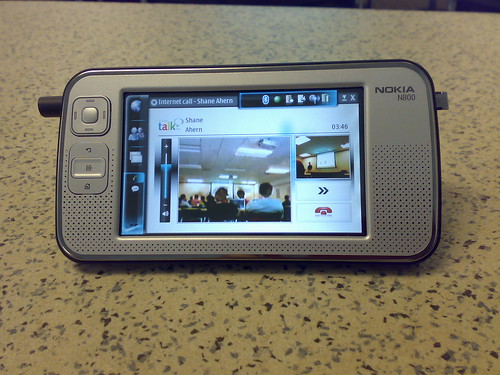


HELLO I'M IN 2007, CAN YOU HEAR ME
(Photo of the Nokia N800, which shipped in January 2007, from rnair.)

The moral of the story? If you want to be four years ahead of the WWDC closing bombshell, email sales@collabora.co.uk. :)


PS: The 2010 'fuck it, we're going to fivefour blades' version; we also had a six-way video call going earlier today.

Mart&iacute;n Ferrari: Python WTF

Lately, I have recurring WTF moments when working with Python. I'm still more or less a novice in Python, as I started to use it in my day job last year, so sometimes it could be blamed to ignorance. Today I was writing some code that takes any file descriptor as argument, and thought it could be nice to accept also objects that represent one. But it seems there is no common ancestor to file objects and socket objects, for example. In Perl, I'd just check for IO::Handle. Then, I wrote code to check if a passed argument was a socket, or a file descriptor to one, with some obvious check: isinstance(s, socket.socket). WRONG, when you create sockets with socketpair, they are of an undocumented type which is not a descendant of socket, nor of SocketType! (There is a patch for this since 2007) In general, I have found a lack of any reasonable object hierarchy, and many inconsistencies in the low-level interfaces, which is a pity, because Python is in general quite tidy. Comparing with Perl is unavoidable, and I would have expected that Python had learnt more from it. Another thing that amazes me is the lack of anything like CPAN, which is one of the reasons Perl was so successful. The cheese factory doesn't come close, as you need to publish your files somewhere else, there is no automated testing, no automatically generated documentation, or anything that requires access to the source code. In Perl-land, many people loathe the venerable MakeMaker, and some of the alternatives are ugly as hell. The Python equivalent (or so) to Makemaker, distutils, looks to me like a bad joke: advanced customisation is black magic (if possible at all), and doesn't provide absolutely basic things like running your unit tests! After fighting with it for some days, I decided to go back writing my own Makefile and calling distutils just to build and install. Tags: Planet Debian, Planet Lugfi, Programaci n

Steve McIntyre: Also sad about the Poulsbong^H^H

Apropos Matthew's post... I picked up a cheap netbook for Jo a couple of months ago, an Acer Aspire One 751. She liked the look and feel of the machine, and it was much smaller and more carryable than the massive old Dell "slab" she'd been using previously. Got a very good deal on it too, as it was the last one in stock at the local Comet store. All went well until we got it home and I started playing with it. That was when I found the painful truth: it was based on the Poulsbo, using Intel's crippled GMA500 graphics chipset. Up until then, I'd been very happy with buying Intel kit: for the last few years it's been a sure sign that the hardware would work well with Debian and Linux. Now they've come out with a crappy product that has destroyed that goodwill. I spent many hours working through various options to try and get this new netbook up and running properly using Debian, but to no avail - the various binary blobs wanted newer versions of code than was in Lenny and (by then) older stuff than was available in Squeeze. In the end I gave up and installed an outdated version of Ubuntu on the machine just so Jo could have it working for her when we went on holiday together. Since then, she's had to get used to the machine locking up once or twice a day while she's using it (something I can only assume is caused by the shitty drivers). She's happy enough in that it's much better than her old Vista-infested Dell machine, but it's really not a great experience for her compared to the Thinkpads she sees others using reliably and flawlessly at home. At some point I guess we'll simply ditch the machine altogether and get something less nasty. Thanks for the good stuff you used to make, Intel, but you've lost your way. I'll be damned careful next time to avoid this trap.

Julien Danjou: Announcing erc-track-score

A couple of months ago, I've started using ERC to hang out on IRC. I've read all the pages on EmacsWiki about it, just to see how far I could customize it. I must admit that I was not disappointed, even if I expected to be. It's quite a nice software, and once well configured it's more convenient that my old irssi setup. While browsing EmacsWiki, I read an interesting idea about channel scoring/temperature on the erc-track page. The idea is to see if it's worth jumping to an IRC channel to see what people are talking about. Challenge accepted! I sat up and started to dig though ERC source code to find the information I needed about variables and functions. I finally did write something nice, which I called erc-track-score. And yet another piece of software I wrote for my lovely Emacs! How does it work? Ha-ha, I was sure you would ask. You're so predictable, dude! Read the following, and you'll know everything you ever wanted to know about it since the moment you read the title of that blog entry. Which probably turned you on. Nasty you. First of all, the score of a channel starts at zero. Zero means "seriously, don't bother, nothing is happening here". Upon each new message arrival, the score is incremented by 1. If a new message contains a keyword, your nickname or is sent by a pal, the score is increased by configurable values, by default between 2 and 20 points, depending on the match type. On the other hand, when a message is send by some fool, the score is decreased by 1 by default. Obviously, if the score is going negative, you really should not jump to the channel. Finally, the score is permanently and slowly brought back to 0. By default, the score is decreased by 1 point every 10 seconds. Overall, reading the score should gives you a good idea of the channel temperature. I'm still not sure what is the best formula to compute the score, but so far the default values seem quite good. We'll see.

6 June 2010

Gunnar Wolf: Spot the differences?

Spot the differences?
Left: British Petroleum's logo. British Petroleum gained international notoriety last April because of the catastrophic oil spill it is still unable to contain in the North of the Gulf of Mexico; so far, the oil has reached the coasts of Louisiana and Mississippi, and keeps growing and spreading, as probably the worst-ever oil spill. So far, the sea surface covered by oil is larger than several countries in the world. Some sites have very interesting maps that might help understand the importance and size of the spill: BP Gulf Oil Spill Maps in The Daily Green, Deepwater Horizon Incident, Office of Response and Restoration, USA National Ocean Service, Article on Slashdot about quantifying and dealing with the deepwater spill. Right: Mexico's de facto government's logo. One of the most pushed projects of Felipe Calder n's government (that was fortunately canceled) was to pursue the tesorito de las aguas profundas (little treasure that lies deep in the water); they strongly pushed for a reform in the oil legislation, which is 100% government-funded since 1938, to allow for private investment in orded to build platforms reaching oil deposits 3000m below the Gulf's surface. Yup, precisely like the one that produced this massive spill, although most would probably be bound to much less strict regulation and controls to what they have in the US. Is the similarity between the two logos just a strange coincidence?

5 June 2010

Jos? Parrella: Ditching PCI cards in Asterisk for fun and profit

In the past, I ve used PCI cards providing telephony TDM for my Asterisk-based projects. I ve only worked with Digium s FXO/FXS and T1/E1 cards, both in PCI and PCI-x formats, until a client asked for a gateway solution with FXO, FXS and E1, where using the PCI cards in a 1U IPBX was simply out of the question. Using Ethernet gateways has always been a problem in those cases, since entry-to-medium level solutions lack the processing power for massive call handling, and signalling is poor, making the architecture unfit for reporting purposes and specialized apps such as call centers. But hey, that s my experience with gateways. Therefore, I looked into Xorcom s Astribank. They pack FXO, FXS and PRI/BRI ports inside a convenient 19 1U case, which can connect to an Asterisk-based IPBX server via USB and gets recognized as an integral DAHDI device in modern setups. So I ordered a composite 8xFXO, 8xFXS and 1xE1 PRI from Astribank, labelled XR0072. Getting the equipment from Arizona to Florida was easy, and since I worked with DHL, getting it to Guayaquil in Ecuador was a breeze (next-day delivery) but passing customs is, as always in Latin America, a time-consuming operation. After paying 12.5% taxes and then some for DHL operations, and 15 days waiting, I got the equipment in Quito. To my surprise, the Astribank was extremely light and small, slightly near 3 Kg in 1U form factor and under 1/4 depth in the rack. While it had a rack-mounting kit, which I used, it could also rest securely over my IPBX without rack screws. My Astribank uses a single USB cable to connect to the master PBX it could also be connected to a secondary PBX and provide a fault tolerant setup. It also depends on a DC supply, which they included. Since I was using a modern Debian, with a modern Asterisk with already-compiled modern DAHDI (formerly called Zapata/Zaptel) drivers, I just connected the equipment via USB to the IPBX, issued an invoke-rc.d dahdi restart and we were good to go. Note: you do need the fxload package in Debian for firmware loading to the Astribank. And for good to go I mean you can check the registered spans with dahdi_registration and, as soon as you connect the E1 cable that comes from the CPE to the CPE port (which in my XR0072 is the first on the lower row for PRI) you get an OK status with dahdi_tool. Also note that I use an E1/CPE port, which is the default for the Astribank, otherwise I d have to set the XPP_PRI_SETUP variable as indicated on the User Manual. DAHDI insists on configuring a crc4 parameter for the detected spans, which I needed to remove and restart DAHDI so the equipment could sync with the CPE (that is, the box that the telco provided, with the balun and the crossover RJ45 cable) and avoid some nasty noise issues on the line, that also occur with Digium s Wildcard for PRI.
usb:008/005          xpp_usb+     e4e4:1162 Astribank-modular FPGA-firmware
 LABEL=[usb:...]       CONNECTOR=@usb-0000:00:1d.7-1
	XBUS-00/XPD-00: E1       (31)  Span 1  DAHDI-SYNC
	XBUS-00/XPD-10: FXS      (8)   Span 2
	XBUS-00/XPD-20: FXO      (8)   Span 3
Using DAHDI s dahdi_genconf command writes an /etc/asterisk/dahdi-channels.conf file with the group and channel configuration as detected by DAHDI. It should be included by the chan_dahdi.conf file, which, in my case, is not necessary since I only wanted to enable one DAHDI group (DAHDI/g0) with my 31 E1 channels (1-15,17-31)
group=0
context=from-pstn
channel => 1-15,17-31
That means that when I want to use the FXO/FXS ports, it d probably be easier to include the dahdi-channels.conf (FXS ports, for example, belong to a different context, from-internal) so I don t have to type more than my laziness permits. I also found that, in my setup, some Asterisk parameters were superfluous, such as the switchtype (either national or euroisdn work, and the former is the default) or the echo-cancelling stuff, so I assume Astribank s doing a great job in negotiating that with the CPE. Do take note, however, that in my case the CPE needed to be cold-restarted so I could get an Up status in Asterisk (pri show spans) and that my only non-default, channel related configuration in chan_dahdi.conf is signalling=pri_cpe. So far, so good. I m really happy with the Astribank and I can fully understand how useful it is in terms of price (quite competitive in comparison with traditional cards, specially when bought from resellers -like me-), size/weight and functionality/ease of setup and administration. Kudos!

Next.

Previous.