Search Results: "ema"

21 May 2007

Meike Reichle: The barbecue season has now officially begun!

a plate with the remains of a barbecue on it
1 Pack of mixed BBQ meat: 5,90
1 Bottle of 2005 Montepulciano d'Abruzzo: 1,99
1 Throw away grill: 3,50

The fun that is an indoor BBQ party: Priceless! With the weather being so great and everyone having nice barbecues, we wanted to have one too. Unfortunatelly we don't have a balcony or a (nice) garden. (We do have a grassy patch in front of our house but it's not exactly a place you want to sit at and have dinner.) Also do not have a proper barbecue to take somewhere nice and somehow when we travel to friends we always bring bad weather with us. This weekend however, we decided to go for it. We got ourselfs one of those disposable grills, put it on the largest window sill, strategically placed a fan and a bucket of water and declared the indoor barbecue season officially opened.
Our experiences in short Good:
Bad:
PS: How do you extinguish a throw away grill once you're done? PPS: Shower! PPPS: Kids, do not try this at home!

Evan Prodromou: 1 Prairial CCXV

I just got back from taking Zach Copley to the airport, and for the first time in a few days I'm sitting in front of my desktop computer again, trying to get back on track. I think it's probably a good idea to get my notes about RoCoCoCamp down on electronic paper while the experience is still fresh in my mind. (I wrote about the first day in Journal/29 Flor al CCXV). Saturday morning I got up considerably later than I had the day before, and I took my time getting to SAT. Which was OK, since things went much smoother in the morning. The only really annoying thing about Saturday was that I had to wash about 50 cups by hand -- we'd run out of clean cups, and I couldn't figure out how to run the dishwasher. It didn't take long, but it meant that I had my head down in the sink as people came in and didn't get to spend as much time talking to them. I was glad to hear that people had a good time going to L'Utopik on Friday night. Apparently a few people who'd flown in late on Friday got a chance to meet up with the experienced crew at L'Utopik, so they were well-prepped for Saturday. Probably the biggest buzz of the pre-sessions was SJ Klein's pair of functional OLPC laptops. They were cute and fun -- I got a few minutes to play with them, and I enjoyed the interface tremendously -- although it took me a few tries to open it. People were fiddling with them throughout the day -- including Amita June, who came late in the afternoon -- and Tristan P loquin even blogged about them. My first session was about wiki and other technologies, which I titled Wiki And.... (I borrowed the name from Last Exit to Brooklyn, in which it seems no-one eats anything but "coffee and".) My main point was that a) wiki people tend to overuse wiki where other software tools may be more appropriate and b) we need to be careful with impedance mismatches when using wiki with technologies with other cultures behind them. Wikis and blogs mismatch; wikis and forums mismatch. You need to work out ways to make them work culturally. As a proof-of-concept that there are ridiculous applications for wiki, I created in about 3 minutes before the session the wikiclock. It's a computer clock that runs on wiki technology: the time is kept up-to-date by human beings editing the page, rather than with software. I was so pleased with myself that I twittered about it, and from there it's taken on a life of its own. The clock is implemented on the amazing minimalist system pageoftext.com. I heard about p.o.t. from Liz Henry's April report from Palo Alto Wiki Wednesday, and I think it's totally great. It's a cross between a pastebin and a wiki -- like an open-edited ImageShack for text. Brilliant. The second session I did was a hyper-focused one on a particular Semantic Web problem. Both Wikitravel and Open Guides have tons of information on "places" in various cities. (That is, restaurants, bars, nightclubs, hotels, museums, parks, etc.). It would be good to export our data on these places to each other, so we could possibly keep them in sync. For example, if a restaurant changes its hours , that info could be updated on The Open Guide to London and automatically synched to the Wikitravel page on London. So we went over some ways to do this kind of interchange; we'd brainstormed before about it on the Open Guides' RDF Workshop, but it was good to sit down with Earle Martin and do some face-to-face hacking on the idea. We don't yet have a vocabulary for it, but we'll get something going on the new wikirdf.org site (which also emerged from this session). I had a great lunch with a lot of people from RoCoCo on the terrace at the Bar St. Sulpice, about 8 blocks away on rue St. Denis. The sun was out, it was cool, and we had a very nice time. It was especially nice to see Marcus Bornfreund and Tina Pipers of Creative Commons Canada, who'd come to talk about the PDwiki, a project to collaboratively document Canadian works in the public domain (see Canadian Public Domain Registry Announced). We talked quite a bit about the social challenges of getting a community excited about such a dry subject, but I think we got some good ideas about it. In the afternoon I led a session on MediaWiki. We were lucky enough to have Tim Starling sit in, and he told everyone about the new developments going on with MW. He's refactoring some very deep parts of the storage and rendering sections of the code, which will result in considerably better reliability, performance, and flexibility. I think it sounds great. I had to work the registration desk for the last session of the day, which was pretty great because I ended up baby-sitting Anoushka Jaroski-Biava for most of the time. But I missed Robin Millette's cool talk about BuzzyBee, which looks to be really fun to play with. We rounded out the evening with music, pizza, and beer at the SAT. tobias.dj played some great dance music, and we had some wiki-collaborative VJ-ing using the SAT's fancy screen systems. All the kids were there -- Mark and Allegra's daughter No ma as well as Amita June. Fun. Sunday morning I didn't have to start coffee until 9AM -- luxury! We had a great Open Space Technology convergence -- a way to turn the discussions of the previous few days into action items for going forward. I did a convergence session on the future of RecentChangesCamp. We had most of the interested parties available (except for the RCC Portland organizers, who had to fly out early that morning). We made some decisions about future RCCs, and we made some plans for next year's RCC -- in the Bay Area (California). Last night we brought back the Keiki gang to our house, since it was great to have them all in Montreal for the event. We did a big brainstorming session on next steps to launching the project, and we also did some graphic design review of potential logos. We have some great designs coming; I'm really happy we got Sarven Capadisli and Bridget to work on the site. I had to crash out at 10:30PM -- Amita and I fell asleep together -- but others were up late talking and thinking. I don't know how they did it -- I was all talked out by the end of RoCoCo. All in all I had a fantastic time -- the event far surpassed my expectations. It was hard -- too hard. I bit off far more than I could chew. But I think we did a good job of establishing Montreal as a technology city -- Wiki City Canada -- in the international mind, and I think we also brought together some really interesting people for some fruitful and productive work. You can see some of the projects that came directly out of RoCoCo on the FutureChanges page -- an ingenious name courtesy of Pm. And there are some indirect ones that we can expect soon. tags:

Cause and solution So, Technorati has a good listing for rocococamp items, but I especially liked Steve Faguy's post: Wiki: The cause of, and solution to, all of life s problems. Steve was an extremely game participant in the event, which I think was pretty incredible. He wrote a good overview of wikis in the Montreal Gazette this year. A funny thing happened on Friday evening during the daily wrap-up known as "Evening News". We had Open Space's minimalist instructions posted on the walls of the SAT, so people would see and remember them. Steve pointed out that the first of Open Space's "four principles" is grammatically incorrect: Whoever comes is the right people. He said, "In the spirit of wiki, I'm going to correct it right now!" And to applause, he got up with a marker and changed the "is" to "are". This stimulated an interesting discussion. One person noted that the "is" is there because possibly only one person could show up for a session, and that's OK. Finally, Brandon CS Sanders stood up and said, "I like 'is' because when we come together like this, we form a cohesive group, however temporary -- 'a people'. So I'm going to change it back." And he did -- to lots of applause, again. Steve came up to me at the end of the night, laughing. "I got reverted! I should have started an edit war!" It was a hoot; he's got a good sense of humour. tags:

MJ Ray: Leukemia Research Weston-super-Mare Bikeathon: Report

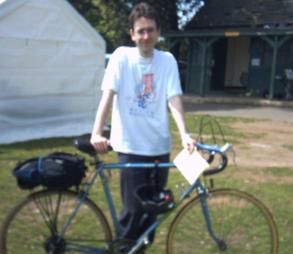
On Sunday 20 May, I rode in the Leukemia Research Weston-super-Mare Bikeathon which "has so far raised in excess of 120,000 for the charity." I finished the course of about 23 miles in a bit over 2 hours. That was slightly slower than I expected, but I hadn't anticipated the batched mass start (20 riders set off every 30s or so) and the relatively slow speed of the large group ride to the first hill where the short course filtered off. I wasn't the fastest or the slowest by a long way. The first hill, Bleadon Hill, was new to me and it was a bit of a pain. It was rideable, unlike the hill nearest me, but it continued upwards at a challenging gradient for a long time. I'd estimate it's about 4km and mostly over 5% - I'll not be riding it again in a hurry. The view from the top was almost worth it (even if it didn't photograph well, looking almost south at 11am) but then you remember that you've just ridden up there from sea level and everything aches. Getting down from that hill was also fun. The descent was through Canada Coombe, which looks about 10% down for about 1km and it's a narrow uneven road with loose gravel washed onto the road. Then it was a fairly direct link north to Locking and Worle, a flattish loop from the crematorium to Ebdon, Bourton, Icelton and Wick St Lawrence (which felt good, like I could ride it forever - it's amazing how easy a well-tuned bicycle feels) and back to town via Sand Bay and Kewstoke. [photo] The picture is of me outside the pavillion at Clarence Park, just after finishing. The pack contained repair kit, water, food, rain gear and extra top, none of which was needed. I didn't pack sun block or insect-repellent, which would have helped (although thankfully not vital)! Thanks to everyone who sponsored me. If you still want to contribute, please put it in the comments form with an email address, and/or email me directly.

Alexander Schmehl: Playing with the package file

For Meikes thesis, we needed a csv-File from the Debian-Package file, so I wrote a small script to do that. You can get it from my repository (or via websvn). (Not yet perfect, but worked well enough for us; patches welcome.) If you just need the csv to copy the data in a database (like she did), don't try to guess, how long a textfield (e.g. for depends or the long description) should be; we tried and failed several times (Sure... 2000 characters should be enough for a long description.). We finally used the following database (We used PostgreSQL, should work similar on other database systems): CREATE TABLE packages ( package character varying (75) NOT NULL, source character varying (75), priority character varying(10) NOT NULL, section character varying(20) NOT NULL, installedsize integer NOT NULL, maintainer character varying(150) NOT NULL, architecture character varying(4) NOT NULL, version character varying(40) NOT NULL, depends character varying(5000), conflicts character varying(5000), recommends character varying(5000), suggests character varying(5000), enhances character varying(500), predepends character varying(500), provides character varying(500), replaces character varying(500), buildessential character varying(3), essential character varying(3), filename character varying(200) NOT NULL, md5sum character(33) NOT NULL, origin character varying(100), sha1 character(41) NOT NULL, sha256 character(65) NOT NULL, size integer NOT NULL, tag character varying(1000), task character varying(400), description text NOT NULL, longdescription character varying(30000), CONSTRAINT pk PRIMARY KEY (package) );. Now that you've created a table, you need to fill it. Easiest method is to use the COPY statement, as follows: copy packages (package, source, priority, section, installedsize, maintainer, version, depends, conflicts, recommends, suggests, enhances, predepends, replaces, buildessential, essential, filename, md5sum, origin, sha1, sha256, size, tag, task, description, longdescription) FROM '/path/to/your/csv-file' DELIMETER ';' CSV;. You should now have a nice database to play with :) Some examples... Which are the packages with the longest longdescription?
debian_packages=> select package, length(longdescription) as length from packages order by length desc limit 5;
        package           length
------------------------+--------
 texlive-latex-extra       25337
 texlive-fonts-extra        5719
 emacs-goodies-el           4502
 xbase-clients              4403
 postgresql-contrib-7.4     4223
(5 rows)
Or... Which maintainer have the most packages?
debian_packages=> select maintainer, count(*) as anzahl  from packages group by maintainer order by anzahl desc limit 5;
                            maintainer                              anzahl
------------------------------------------------------------------+--------
 Debian Qt/KDE Maintainers <debian-qt-kde@lists.debian.org>            465
 Debian QA Group <packages@qa.debian.org>                              458
 Debian X Strike Force <debian-x@lists.debian.org>                     274
 Debian Perl Group <pkg-perl-maintainers@lists.alioth.debian.org>      261
 Daniel Baumann <daniel@debian.org>                                    255
(5 rows)
Or... Is there a package, whose sha256-sum contains Meikes birthday?
debian_packages=> select package, sha256 from packages where sha256 like '%261081%';
           package                                           sha256
------------------------------+-------------------------------------------------------------------
 libobject-realize-later-perl   5188126108146fc0b1328473125687fb388bd8d87f460e335952dbb1b66aa3d1
(1 row)
And another goodie (We needed to alter the database several times, to make this package fit into it): Which is the package with the longest name?
debian_packages=> select package, length(package) from packages order by length(package) desc limit 1;
                         package                           length
---------------------------------------------------------+--------
 libmaypole-plugin-authentication-usersessioncookie-perl       55
(1 row)
A lot of fun... and a lot of interesting facts to be discovered...

Benjamin Mako Hill: National Free Culture Conference

Harvard Free Culture is helping to organize this years' National Free Culture Conference -- the meeting for North American Free Culture student groups. The whole shindig is planned for May 26, 2007 at Harvard University here in Cambridge, Massachusetts. The schedule is solidifying and I will presenting and arguing for adoption or support of the Free Cultural Works Definition within the FC student movement and probably also be talking about community building and advocacy in some free software groups I've worked with. Housing is available and the event is open to the public. If you d like to attend, speak, or help out with the conference, please email freeculture@hcs.harvard.edu or check out the Facebook event. If you're on the fence about attending, you can read this glowing endorsement of the conference by high protectionist James DeLong at IP Central.

Romain Francoise: How to create Xinerama-friendly desktop backgrounds

I recently started using a new machine with two 20" flat panels used as one giant desktop with Xinerama. It's very nice and comfortable, but X isn't yet smart enough to manage the backgrounds of the two screens separately, and wants one image stretched across the whole desktop.

So here's how to turn two 1680x1050 images such as these into one 3360x1050 image with ImageMagick:

$ montage -size 3360x1050 -geometry +0+0 left-image.jpg right-image.jpg result.jpg

It's much easier than assembling the images manually in The Gimp.

20 May 2007

Pete Nuttall: Apology - Not being caught up on accomodation email

As you may have noticed if you have mailed accomodation@debconf recently, I haven't replied, and nor has anyone else. There are a couple of reasons for this, the main one being Jon Dowland is talking to the hostels right now about space, and I therefore can not give definitive answers. The other two reasons are I'm sitting my finals and do not have much free time, and that we sent out sponsorship mails to all saying what they had, and as such there is a pile of requests to deal with. If you have mail waiting in my inbox, then don't fret, I'll deal with it on Tuesday. Quick point - If you want to change your dates and aren't dealing with your own food and accomodation (thats most people), thats fine, but please tell us. You should email accomodation _at_ debconf.org. If you are sponsored, you should mail herb _at_ debconf.org as well. Don't worry, we most probably aren't going to say no, but its nice to be informed.

Erich Schubert: Updating address books and privacy

An often quoted feature of services such as OpenBC/Xing (and most of such 'pure social networking' sites) is that they basically allow you to keep an address book without having the need to update it yourself.Some people may even argue that this is the only real benefit these social networking sites do actually offer.There are of course services dedicated to helping you keep your address book up to date. These often offer plugins for Thunderbird and Outlook, so you can actually use the address book directly. (e.g. Plaxo) Some email providers even have a function to send out "please update my address book entry on you" emails to your receipients (e.g. web.de), but most people find these quite annoying.Now some people might argue that you could use the FOAF standard for this. But publishing your FOAF data on the web is a privacy problem. Most people won't be willing to publish much more than their email address there. Just like some people are not willing to entrust their information to services such as OpenBC.Using e.g. HTTP authentification to restrict access to your FOAF data is also not working very well: you'd need some user management to be able to revoke access or change the access credentials if the passwords are leaked somehow.OpenID would definitely be interesting, but how many of your friends have OpenID yet? And not everybody has access to deploy the server side needed for this.The easiest to deploy approach would be to just use public key encryption. You could then upload an encrypted copy of your data for each 'friend' to any web site. You could also upload different data (including work contact information only, for example) for different recipients.My idea is like this: Big benefits of this approach: Drawbacks:

Steve Kemp: I dont mind not knowing what lies down the track

I ve got my first real rails application working correctly a simple online bookmark system, which is scuttle-lookalike. (This is part of my master-plan to remove PHP utterly from the few remaining places where it exists upon my server(s), so it isn t as pointless a project as it appears to be!) It is pretty neat, and it handles most of the things you d expect. Fetch it from CVS and install it with the following recipe:
cvs -d :pserver:anonymous@cvsrepository.org:/home/cvs login
cvs -d :pserver:anonymous@cvsrepository.org:/home/cvs co bookmarks
cd bookmarks/
mysql --user=root -p -e "CREATE DATABASE Books_development" 
rake db:migrate
ruby script/server
Once that is done point a browser at http://localhost:3000/ and you should see something like this. (If there is no admin user setup it will display a signup link, once there is an admin defined this will go away. When you re an admin you can view/edit/modify all the bookmarks which are set to private .) I m new to rails, and ruby for that matter, so if this is packaged badly, or is missing something to make it work please do let me know. Updated: Changed from download to the CVS repository. I also have a collection of tools for exporting from Insipid & Scuttle if they are useful let me know.

Steve Kemp: While we live according to race, colour, or creed

I m back from Vienna (Ask Alfie for picture(s) of me wearing my partner s hat ..!) with a new need to update my killfile. I use procmail to filter my mail, and my current setup looks like this:
# If the sender is in the killfile then drop the mail into killfile
:0:
# grep for it in the killfile
* ? grep -i  formail -rtzxTo:  $HOME/.procmail_killfile
/dev/null
This invokes formmail to get the sender of each incoming message and then drops the mail into /dev/null if the message is from somebody whos email address is contained in ~/.procmail_killfile there are two problems with this approach: Any improved recipes are greatfully received. And that s all I m going to say about Debian communications for today.

Neil Williams: DD upstream

I've been wondering if it is worth packages.d.o indicating if the DD is also (one of) the
upstream developer(s) of their maintained (non-native?) packages. I'd expect that it may help bug reporters to know this, with regard to where to file certain bug reports or just be useful information generally. It could help by indicating whether a quick release is possible and whether patches will migrate upstream automatically.

debian/copyright isn't sufficient for this because there isn't necessarily a match between the upstream and Debian email addresses, but maybe it's yet another field for debian/control.

Just idle musings really.

19 May 2007

Adam Rosi-Kessel: More adventures in language acquistion

Esther turned two recently. She’s come a long way in language acquisition since January. Now she is a rich source of linguistics grammaticality problem sets:
Me: Do you want a hug?
Esther: Yes. Me: Big hug or little hug?
Esther: None hug.
And, this morning:
Me: What’s better, music or rugula?
Esther: Rugula and music.
(Note that “rugula” is not actually the longest word in her vocabulary — that would probably be “arboretum.”) Our household’s technology focus is also apparent: any small hook-like device is an “email.” For example, a bluetooth headset and a refrigerator hook magnet are both emails. Shorthand for “another book” is “i-book.”

Evan Prodromou: 29 Flor al CCXV

Busy day yesterday; the first day of RoCoCoCamp, and the first day seeing a lot of friends and friendly faces from out of town. I was out of bed at 6AM yesterday. I stopped at St. Viateur Bagel on Mont Royal and got 10 dozen bagels -- enough for our expected crowd. I got to SAT at about 8AM, just in time to start the coffee machines. The big percolators I rented for the event require about an hour to make coffee, so if people were going to be coming in at 9AM, I really wanted to get them started by 8. Alain Bernardeau from computation.to got there soon after, and set up the spare computers his organization is lending us. Brandon Sanders, Mark Dilley and Nathan R also came in early, looking for work to do. I got them all into the job of setting up the food for breakfast. By 9AM we were trucking along, and I figured I'd go try a cup of joe, which should be ready. But all I got from the carafe was cold water. The percolators draw so much current that they'd blown a circuit. Guillaume, the SAT tech, and I tried about 8 different ways to keep them running, but nothing worked. Finally he put them on the 220V industrial circuit, which they didn't blow. Awesome, but at 9:30AM, with almost everyone there, we had no expectation of coffee for another hour. Yikes! But by the time people started filtering into the circle for starting the event proper, coffee was rolling and I was much relieved. Our facilitator, Deborah Hartmann, gave a great bilingual introduction to Open Space Technology and got the ball rolling. I always have a moment of dread during the beginning of a Open Space event: what if this is the time that Open Space doesn't work? But it did, again, which is great. The first session I went to was Zach Copley's, about consensus-supporting software features. Brandon Sanders had some great cases from AboutUs's adult content policy. We shared a lot of Wikitravel's culture, too. I also stopped in to talk about Wikitravel:RDF with Reini Urban, who was demoing Semantic MediaWiki. It's a neat project, and it's a different tack than I've taken with Wikitravel. I'd like to see the two approaches harmonized at some time in the future. Lunch came quickly, and we had far too much to eat. I spent a lot of time talking to Simon Law about possibly using Open Space in some way for BarCampMontreal. I think it's a good idea -- it's growing to a point where our current format is straining under the load. We also talked about ubiquitous wikis and the cool browser Amaya, where Web pages are in edit mode by default. It's a good idea. After lunch I had a chance to hang out with Earle Martin of Open Guides and talk about wiki and the geospatial web. Mark Jarowski of Wikevent was there, and together we've decided to hammer out a RDF vocabulary for exchanging RDF data about business listings. It's the kind of productive talk I like having. I also spent some time with Jack Herrick talking about wiki entrepreneurship. Jack had a prepared presentation about wikiHow's business experience, which was really great, and provided a great case study for talking about commercialization of wikis in general. With Angela Beesley and Ray King around us, we had most of the interesting wiki content businesses represented. Pretty neat. It was a really productive first day, but by the time we got around to 5PM I was exhausted. Maj, Zach, Mark, Niko and I all went to our new house at 4690 rue Pontiac to meet Allegra and their two daughters, No ma and baby Anoushka. We got pizza and had beers and sat on our new couch and had a good old time. Technorati's rocococamp tag shows a lot of other positive responses on the Web: Matt Forsythe's sketches from RoCoCoCamp, NathanR's continuing paranoia, CITIZENShift (which quotes me, when I was talking about wiki entrepreneurship), and Patrick Tanguay.
 
I'm off to SAT again this morning. Should be a fun one, and I hope to get a little more time to myself before the event starts today. tags:

Wouter Verhelst: Updating Debian/m68k patches for gcc 4.2

In a perfect world, software would work perfectly. Unfortunately... well, you know the drill. Since GCC 4.2 is upcoming, our resident GCC guy doko asked me to find someone to have a look at updating the Debian patches for GCC 4.1 so that they'd apply. Since I need to learn about GCC anyway for the Debian/ColdFire project (which nobody seems to be working on except for me), I started looking into it myself. The procedure is simple enough: uncomment lines in debian/rules.patch, and fix those m68k-specific patches that break. The first one was easy. debian/patches/m68k-gc.dpatch has been integrated upstream, so is no longer necessary. The second one was slightly more involved. But only slightly so; the patch tried to change libffi/src/m68k/sysv.S, which had received some three extra lines that conditionally add a .note.GNU-stack section. These three lines weren't there at first; but the .S file was otherwise entirely unchanged, so fixing this was rather easy. The next one is, uh, pretty hard. gcc/config/m68k/m68k.md is a file of 7k LOC in the GCC-specific "RTL" pseudo-assembly language, which I'm not at all familiar with. Yet, anyway. As a bonus, the first hunk in this file which fails to apply does so because that bit of this code has been changed rather significantly from GCC 4.1 to 4.2. Meaning:
  1. I need to figure out how this RTL code works
  2. I need to figure out what this particular RTL code block does
  3. I need to figure out what the point of this particular patch was
  4. I need to figure out how to write a patch (in RTL) which semantically does the same thing as what the original patch was doing. Without breaking the changes between 4.1 and 4.2
Wish me luck. At least the first two parts are almost finished; after skimming through chapters 12 and 14 of gccint.info, this hugging code almost makes sense to me. (oh, and if that last link doesn't make any sense to you, ask me for my fortune file at debconf) (which is in less than a month! whee! excitement!)

Jose Carlos Garcia Sogo: Apple drop

Or how online media can affect shares markets. Reading Enrique Dans' blog I have found an interesting entry on how a wrong piece of news published in an online medium made Apple shares to drop more than 4% in 6 mins. The history starts when Engadget published a false ticket talking about a delay in iPhone and Lepard releases. A supposed real internal mail from Apple was leaked to them, stating that delay. Actually that was a hoax. A spoofed mail that trespassed Apple mail servers and was delivered to a bunch of Apple employees, one of them leaking it to Engadget. About one hour and a half later, Apple sent another mail to their employees stating the untruth of the previus mail, and Engadget quickly published a rectification. But, in the meantime, the word spread fast and shares drop the 4% percent I mentioned before and with a lot of volume, which is an important signal for brokers that something is going wrong and that you have to sell your shares, increasing the effect in a snow ball way. The shares price drop meant Apple's market capitalization was 4 billion less (as US billions here) in 6 minutes. Information is crucial nowadays. But the speed at which it spreads is even more important.

Apple Market Cap drop

18 May 2007

Nico Golde: grml-1.0 released


3 1/2 years after mika registered grml.org it's done. Congratulations! HURRAY!!!11!1!!
grml provides more than 2500 software packages! Excluding library stuff, more than 1700 packages remain. We don't ship KDE and OpenOffice, but more than 800 packages which Knoppix does not provide. You'll get sysadmins favourite tools, security- and network-related software, data recovery- and forensic-tools, LaTeX, many editors, shells, and of course many texttools.

grml provides several scripts and utils which make life easier. zsh is configured with the completion mechanism. grml-x is a wrapper for configuring and using the X window system. grml-crypt is a program that provides an easy wrapper arround cryptsetup, mkfs, losetup and mount. grml-vpn is a program to establish encrypted communication channels in a network, and so on...


Grml 1.0 release name Meilenschwein was just released.

I am tired of sitting in front of my PC for today, that's why I just link to the:
release announcement.

Russell Coker: SE Linux in Debian

I have now got a Debian Xen domU running the strict SE Linux policy that can boot in enforcing mode. I expect that tomorrow I will have it working with full functionality and that I will be able to run another SE Linux Play Machine in the near future. After getting the strict policy working I want to build a Debian kernel with CONFIG_AUDITSYSCALL and an audit package so that I can audit system calls that an application makes and also so that the auditd can collect the SE Linux log messages. Other people have talked about packaging audit for Debian, hopefully one of them will do it first and save me the effort, but it shouldn’t be too difficult to do if they don’t. Then I need to investigate some options for training people about SE Linux. As I don’t currently have the bandwidth for serving large files I’m thinking of basing some SE Linux training on Xen images from the jailtime.org repository. My rough plan at the moment is to have people download Xen images, run through them while consulting a web page, and ask questions on an IRC channel. I’m not sure what the demand will be for this but some web pages teaching people about SE Linux will be a useful resource even if the IRC based training doesn’t work out. Another thing I want to do is to get PolyInstantiated Directories working in Debian. The pam_namespace.so module needed for this is written for a more recent version of PAM, so I might just work on merging the Debian patches with the latest upstream PAM instead of back-porting the module to the ancient Debian PAM.

MJ Ray: Leukemia Research Weston-super-Mare Bikeathon

On Sunday 20 May, I will be riding in the Leukemia Research Weston-super-Mare Bikeathon which "has so far raised in excess of 120,000 for the charity." If you'll sponsor me, please put it in the comments form with an email address, and/or email me directly.

MJ Ray: Installing a complex perl web application

I've been smashing my head against this brick wall for a while and can't decide: is it possible to use MakeMaker or one of the other perl installers to install some modules and some cgi-bin scripts in one action? How? Update: Tincho writes in How to recognise different types of trees from quite a long way away: About installing a complex perl web application
"In a nutshell, if you only want to process modules and CGIs, you can do it with MakeMaker"
Unfortunately, I think I have lots of templates and images, so I guess I really do need to do something sick and twisted if I want to use MakeMaker. Is there some web application that does this already? What's long, red, has four wheels and eats grass?

Next.

Previous.