Search Results: "will"

14 January 2012

Lior Kaplan: Israel to recognize software patents

The Israeli patent registrar have reverted previous ruling regarding patents on software and published a draft for the procedures to accept such patents. The procedures are open to public comments for the next 30 days. Two years ago the patent registrar have started to consider revising the the issue and got many position papers (e.g. Hamakor s papter). At the end he decided not to accept patents on software. De facto, at least one such patent (US patent 7,596,609) was accepted to be valid in Israel after that ruling. Now that the rulings is reverted, I guess will see many more software patents granted here. I wonder about the implications on the local software market hopefully it won t stagnate due to patent wars such as the ones we see every now and then in the US.
Filed under: Software Patents

Francois Marier: Debugging OpenWRT routers by shipping logs to a remote syslog server

Trying to debug problems with consumer-grade routers is notoriously difficult due to a lack of decent debugging information. It's quite hard to know what's going on without at least a few good error messages.

Here is how I made my OpenWRT-based Gargoyle router send its log messages to a network server running rsyslog.

Server ConfigurationGiven that the router (192.168.1.1) will be sending its log messages on UDP port 514, I started by opening that port in my firewall:
iptables -A INPUT -s 192.168.1.1 -p udp --dport 514 -j ACCEPT
Then I enabled the UDP module for rsyslog and redirected messages to a separate log file (so that it doesn't fill up /var/log/syslog) by putting the following (a modified version of these instructions) in /etc/rsyslog.d/10-gargoyle-router.conf:
$ModLoad imudp
$UDPServerRun 514
:fromhost-ip, isequal, "192.168.1.1" /var/log/gargoyle-router.log
& ~
The name of the file is important because this configuration snipet needs to be loaded before the directive which writes to /var/log/syslog for the discard statement (the "& ~" line) to work correctly.

Router ConfigurationFinally, I followed the instructions on the Gargoyle wiki to get the router to forward its log messages to my server (192.168.1.2).

After logging into the router via ssh, I ran the following commands:
uci set system.@system[0].log_ip=192.168.1.2
uci set system.@system[0].conloglevel=7
uci commit
before rebooting the router.


Now whenever I have to troubleshoot network problems, I can keep a terminal open on my server and get some visibility on what the router is doing:
tail -f /var/log/gargoyle-router.log

13 January 2012

Steve Kemp: Some misc. updates

Security
Today I made available a 3.2.0 kernel for my KVM guest which has a bastardised version of the PID hiding patch configured: So now on my guest, as myself, I can only see this:
steve@steve:~$ ls -l /proc/   egrep ' [0-9]+$'
dr-xr-xr-x  7 steve users          0 Jan 13 17:22 15150
dr-xr-xr-x  7 steve users          0 Jan 13 17:29 15739
dr-xr-xr-x  7 steve users          0 Jan 13 17:29 15740
lrwxrwxrwx  1 root  root          64 Jan 13 17:20 self -> 15739
Running as root I see the full tree:
steve:~#  ls -l /proc/   egrep ' [0-9]+$'
total 0
dr-xr-xr-x  7 root        root                 0 Jan 13 17:20 1
dr-xr-xr-x  7 root        root                 0 Jan 13 17:20 1052
dr-xr-xr-x  7 root        root                 0 Jan 13 17:20 1086
dr-xr-xr-x  7 root        root                 0 Jan 13 17:20 1101
dr-xr-xr-x  7 root        root                 0 Jan 13 17:20 1104
dr-xr-xr-x  7 root        root                 0 Jan 13 17:21 1331
dr-xr-xr-x  7 pdnsd       proxy                0 Jan 13 17:21 14409
dr-xr-xr-x  7 root        root                 0 Jan 13 17:21 14519
..
This (obviously) affects output from top etc too. It is a neat feature which I think is worth having, but time will tell..
mod_ifier
A long time ago I put together an Apache module which allowed the evaluation of security rules against incoming HTTP requests. mod_ifier was largely ignored by the world. But this week it did receive a little attention. The recent rash of Hash Collision attacks inspired inspired a fork with parameter filtering. Neat.
Otherwise nothing too much to report - though I guess I didn't actually share the link to the RESTful file store I mentioned previously. Should you care you can find it here: ObQuote: "I saw a man, he danced with his wife" - Chicago, Frank Sinatra

Jon Dowland: vi

As seen on reddit: an old Bill Joy quote often banded about as part of the (largely synthetic) vi-vs.-emacs holy war starts as follows:
vi was written for a world that doesn't exist anymore
The context of that quote is:
I was trying to make it usable over a 300 baud modem. That's also the reason you have all these funny commands. It just barely worked to use a screen editor over a modem. It was just barely fast enough. 9600 baud is faster than you can read. 1200 baud is way slower. So the editor was optimized so that you could edit and feel productive when it was painting slower than you could think.
(source: the register). Furthermore:
unless you decide to get a satellite phone and use it to connect to the Net at 2400 baud, in which case you'll realize that the Net is not usable at 2400 baud.
You don't need anything as esoteric as a satellite phone: a cellular mobile phone will suffice. I've no idea what the effective/equivalent baud rate of GPRS is (or EDGE), but I have a new-found appreciation for vi's design goals having tried to run an SSH session over such a connection.

Raphaël Hertzog: People Behind Debian: Steve McIntyre, debian-cd maintainer, former Debian Project Leader

Steve McIntyre has been contributing to Debian since 1996, 2 years before I joined! But I quickly stumbled upon Steve: in 1999, he was struggling with getting his debian-cd script to produce 2 ISO images (it was the first time that Debian did no longer fit on a single CD), I helped him by rewriting debian-cd with a robust system to split packages on as many ISO images as required. I remember those times very well because Steve was very supportive of my efforts and it was a real pleasure to get this done. His friendly nature probably also explains why he got elected Debian Project Leader twice! Anyway, enough history, check out his interview to learn more about the great work he s doing nowadays. My questions are in bold, the rest is by Steve. Raphael: Who are you? Steve: I m a professional software engineer, 37, living in Cambridge (England) with my new wife Jo. I studied for the EIST degree at the University of Cambridge, then (like many people here, it seems) I just forgot to go home again afterwards and settled here. I spent more of my study time playing with Linux than working on my degree, so I guess I m lucky that it worked and I found a career in that area! Raphael: How did you start contributing to Debian? Steve: During my time in college, I started hacking on software in my free time, using Slackware as my first Linux distribution from the middle of 1994. After encountering more and more problems with Slackware, I was encouraged by a number of friends to make the jump over to Debian and in October 1996 I did. The installation process back then was much harder than anything people see today, but after a long weekend I finally had my Debian system up and running. I was already one of the main upstream developers for the Mikmod music player at that time, so that very same weekend I applied to be a DD so I could maintain it in Debian too. Back then, the NM process was much simpler: I just mailed a key to Bruce and he set me up with an account almost immediately! I then found that Joey Hess had beaten me to it and already packaged Mikmod. Grrr! :-) Raphael: What s your biggest achievement within Debian? Steve: Without a doubt, my proudest achievement within Debian is being elected Project Leader for 2 years by the other developers. It s a great feeling to have earned the trust of your friends and peers, and also a great responsibility to go and help Debian where needed: talking to the press about Debian, assisting wherever problems crop up, etc. The DPL job is certainly a lot of hard work, and I have nothing but respect for anybody who volunteers for it.
It s a great feeling to have earned the trust of your friends and peers.
Elsewhere, I ve been leading the Debian CD team for years too, both doing most of the maintenance of the debian-cd package and producing and testing the regular installation CDs and DVDs that we ship to the world. Again, this is a time-consuming job but it needs doing and it s worthwhile. Raphael: You re currently employed by ARM. What are you working on and are they supportive of your Debian involvement? Steve: The situation within ARM is very interesting; I m employed in PDSW (Processor Division, SoftWare), a new group founded just a couple of years back to help improve the state of software on ARM. Most of the people in the group are working on Free Software at this stage (e.g. toolchains, browsers, Linux kernel), which is lovely. Some of the engineers have also been seconded into a new non-profit company Linaro, which is a collaboration between ARM and a number of other companies investing in core Linux software and tools for ARM-based CPUs. I m one of the ARM engineers in Linaro, and I m a Technical Architect in the Office of the CTO. My role includes looking at future projects for Linaro to help with (e.g. ARM servers), but for the last few months I ve been concentrating on the new armhf architecture in Debian, Ubuntu and elsewhere. armhf is a new architecture in Debian and Ubuntu terms, but it s not strictly a new type of hardware. Instead, it s a new ABI. We have two reasons for doing this work:
  1. It targets the latest version of 32-bit ARM CPUs (v7) and makes better use of the hardware, for better performance. Compare targetting i686 instead of i386, for example. We ll still support the older armel port for the foreseeable future for users with older hardware that can t run armhf.
  2. More importantly: we are standardising on the ABI / compiler options / hardware support for future users.
In the past, there has been a huge amount of specialisation (aka fragmentation) in the ARM Linux environment, and that worked OK for specialised devices that only ever ran the software shipped with them. ARM CPUs are now becoming more and more mainstream, so people will expect to be able to install generic software on their machines. That gives a requirement for a standard base platform, and armhf (arm-linux-gnueabihf in GNU triplet terms) is that standard that we are pushing in the community. Debian, Ubuntu, Fedora, Suse and others are all going to use this, making compatibility possible. I ve been working with a small team of people to make armhf happen, helping where needed: putting together build machines; patching Debian packages directly; discussing and fixing toolchain issues with Ubuntu folks; agreeing ABI specifications with people from Fedora; advising people from other distros bootstrapping their new ARM ports. ARM and Linaro are very supportive of this work, and it s been lovely being sponsored to work directly on Free Software like this. It s work that will directly benefit ARM and its partners (of course!), but it s also helping out more generally too: Debian QA work, cross-build support, bootstrapping efforts, multi-arch. More and more of the ARM market is driven by Free Software, and companies are acknowledging that. I should probably also mention that we re hiring ! :-) Raphael: What are your plans for Debian Wheezy? Steve: There are three main tracks here. Obviously, I m interested in seeing armhf release with Wheezy. We ve just been added to Testing last weekend, so that s going well. We ve got over 90% of the archive built now, and we re mopping up the remaining issues. I m the primary maintainer of cdrkit at this point, but I d prefer to have it go away. Xorriso and the associated software in libisoburn is almost capable of replacing all the aging cdrtools-derived software that we have in Debian, The only missing feature that I m aware of is creating the HFS hybrid filesystems that we use for installations on Mac systems. I ve been talking with the upstream folks about this for some time already, and I m hoping we can finish this soon enough that we can get it into Wheezy. Finally, I ve got the ever-growing wishlist of things for debian-cd. We ve got the beginnings of an automated test suite that Mart n Ferrari has written, but it needs integrating and improving. I want to help get regular weekly/daily/release debian-live builds running on the main CD build machine. There s work needed if we want to make good installation media for the new multi-arch world, too. The Emdebian people are asking for help making CD images The list goes on :-) Raphael: The ARM community seems to be very interested in multi-arch. Can you explain why? Steve: There are a number of reasons for ARM people to be interested in multi-arch; two really stand out for me:
This is potentially the killer app for multi-arch: simply install the libraries for the target architecture [ ], install a simple cross-gcc package [ ] and you re all set.
Raphael: What s the biggest problem of Debian? Steve: For me, Debian s biggest problem has been the same for a long time: we are forever short of enough people to do the work that we re trying to do. That might sound like a weird thing to claim when Debian is one of the largest Free Software projects on the planet, but it s more a statement of just how huge our goals are. Many of the largest things in Debian are developed or controlled by very small teams working very hard, and there s always a risk of losing people due to burnout in those situations.
We are forever short of enough people to do the work that we re trying to do.
Some of the tasks that should be easy given our large membership (e.g. large-scale packaging transitions) can often instead take a very long time. We are fortunate to have more people wanting to join in Debian s work all the time, but we also need to be careful to keep on promoting what we re doing and recruiting new contributors, encouraging them to get more and more involved in core work. Debian gets ever bigger in terms of the size and the number of packages we distribute; we re not currently matching that growth rate elsewhere. Raphael: What motivates you to continue to contribute year after year? Steve: This one is much easier to answer! The thing that first attracted me to Debian was the fact that I could help to develop it, help to decide how things could and should be done within it. Instead of being forced to accept what some corporation decided I could do with my computer, I could change the software to suit my needs and preferences. Alongside that, I could get involved with a strong community of similar people all over the world, all with their own strong opinions about how software should work. I joined in and found it was great fun and very rewarding. That hasn t changed for me in the intervening years, and that s why I m still around. I work on Debian because it helps me to get the OS that I want to use. It seems that lots of people around the world find it useful too, and that s awesome. :-) Raphael: Do you believe that Stefano Zacchiroli will be the first DPL who managed to stay 3 consecutive years on the seat? Would you like him to candidate again? Steve: To be honest, I would be very surprised if Zack stood again for DPL this year. He told me himself that he wasn t planning on it, and I can understand that decision. He s been an awesome DPL in my opinion, and I m glad that he took the job. But: it is also a very difficult and time-consuming task that would be enough to wear down anybody. If Zack does decide to stand again, I would support him 100%. But I know that we also have lots of other good people in Debian who would be ready to take up the challenge next. Raphael: Is there someone in Debian that you admire for their contributions? Steve: There are lots of people I admire in Debian, so many so that I almost don t want to list individuals here for fear of missing people out. But :-) Bdale Garbee has been an inspiration to many of us, for many years. He s technically excellent, a great friend to many of us, an endless source of sage advice and (last but not least) he has some wonderful stories to tell about his experiences over the years. On top of that, he s just cool. :-) Christian Perrier is another exceptional developer, in my eyes he s great at co-ordinating people in translations, working tirelessly to make this very important part of Debian work better and better with every release. He s also a really nice guy and we all love him. I also have to mention Joey Hess here, whether he likes it or not. *grin* He s been responsible for so many good things in Debian over the years, even if he did steal my first package Finally, the teams of people who make sure that Debian is always working: the security team and DSA. The rest of us can choose to take time off from Debian to go and do other things, but these people need to cover things every day. That s a major responsibility, and I salute them for taking on that challenge.
Thank you to Steve for the time spent answering my questions. I hope you enjoyed reading his answers as I did. Note that you can find older interviews on http://wiki.debian.org/PeopleBehindDebian.

Subscribe to my newsletter to get my monthly summary of the Debian/Ubuntu news and to not miss further interviews. You can also follow along on Identi.ca, Google+, Twitter and Facebook.

One comment Liked this article? Click here. My blog is Flattr-enabled.

Michal Čihař: Looking forward to FOSDEM

I just got confirmed my flight bookings for FOSDEM 2012, so I'm looking to meet all great people there again. This year we've again arranged there meeting of phpMyAdmin developers, now it also includes three new faces from last years GSoC. As for my schedule I did not yet find time to check all the schedule, but what definitely sounds interesting for me is Open Mobile Linux Devroom and some talks in MySQL and Friends Devroom. Rest will be (as usual) scheduled on the fly as I meet people there. This year I decided to deliberately skip keysigning as last year I anyway did not manage to attend it and I expect this year to be equally busy. In case you want to meet me there, just let me know, we can try to arrange something in free slots :-).

Filed under: Debian English Gammu Phpmyadmin Suse 0 comments Flattr this!

C.J. Adams-Collier: The Very Model of a Poster to CLPM

So, in 2002 I attended my first SPUG meeting. Also in attendance were Randal, Tim, J.P. (I think) and quite a few of the other usual suspects. The guest speaker was the inestimable Dr. Damian Conway. This night might be the single most important event in my career as a builder of the internets. I was already set in my ways regarding my operating system, and I knew enough perl to get by, but I wasn t in touch with any users groups until then. The crown jewel of the night was Damian s recital in full of his poem, I Am The Very Model of A Poster To CLPM (sung to the tune of that song from Pirates of Penzance). I must admit that I d never heard of CLPM and that it all sounded like gobble-de-gook at the time. If I recall correctly, this happened just after he took about 10 minutes to teach us all to pronounce the name of then-Pumpking, Jarkko Hietaniemi. This was the same year that the following video was made <iframe allowfullscreen="allowfullscreen" frameborder="0" height="315" src="http://www.youtube.com/embed/XkU_GQVOCqo" width="420"></iframe> With that in mind, there s one more thing I need to share with you before disclosing the lyrics. This piece was developed during a time when it was common for members of the perl community to flame one another on news feeds, take their anger and frustration out on newbies and generally be the bane of most of the internet. I like to think that it helped to shape me into a kinder, gentler perl programmer, debian user and general netizen over the years. I would also like to think that it will do the same for future members of our communities. And so, without further ado, Damian Conway s
I Am The Very Model of a Poster to CLPM Now everything I need to know about the Perl community
I learned in kindergarten when I was a little lad of three
And in these next few minutes I ll relate those five apothegm
For I am the very model of a poster to c.l.p.m. The first truism I was ever taught upon my mother s knee
Was that our dad s a better dad than their s could ever hope to be.
His name is Larry Wall, and that s determinism nom native
Since of the mural attributes he demonstrates proof positive. He s eight feet tall and ten feet wide; of granite-like solidity.
He wards us from the serpent s tabs and coffee bean s stupidity.
He guards us from that Gallic tower s B&D urbanity,
And makes sure we don t see sharp code that might cut loose our sanity. He watches over each of us, like Odin of the Norse belief
The stern All-Father figure and, at times, the comical relief.
So, if you vaunt our patriarch s supreme linguistic acumen,
You are a model sychophantic poster to c.l.p.m. The second tenet that I learned concerns, of course, the fairer sex
And why they are in short supply, while geek-boy JAPHs are multiplex.
As every schoolboy knows each conversation has single aim:
To raise one s own significance, whilst razing others down in flame. And thus good men and true who hold this principle as sacrosanct
Will all pursue beligerence as though they were from Mars. Or tanked.
It is the tenor of your newgroup posts that she from Venus flies:
Because most threads devolve into comparisons of ..meanness, guys. When every post affronts their own collaborative sorority
It must exasperate them, for it renders the majority
Of female Perl geeks absent, till we re forced to rename blonde Dutch men
To act as female models of a poster to c.l.p.m. The third grand aphorism that was drummed into my youthful head
Was: if you can t say something nice about someone, you should instead
Say every nasty thing you can impart, imagine, or invent
In any public forum that it happens you should both frequent. This goes especially for the young, and new, and shy, and innocent.
To flame a newbie is a joy, t will make you feel omnipotent.
To watch them squirm and bleat and bleed and scurry back into their hole,
The surge of ecstasy it brings is worth the way it eats your soul. So never hesitate to turn the wrath of your vocabul ry
Upon the hapless supplicant for Perl epistomology
And if you flame each FAQ, and every question that s beneath you then
You ll be the very model of curmudg nly R.T.F.M. The next point I should like to make s the obverse of the previous
For while it s true that to be newbie is a sin most grieveous
It ain t as bad as being old and greyed and staid and tedious
And sitting at the keys all day dispensing thoughts invidious. What right have you to tell me not to ask about my CGI???
I thought that Perl was all about website development, and I
Expect that you d extend to me the simple human courtesy
Of dropping everything so you can do this homework now for me. The Internet exists so I need never read the manual
And so my inane questioning can form a stream continual
While pleading for an email since I never read this group, as well
As posting them in jeopardy, in caps, and in HTML. The rule I learned in kinder that explains where this approach springs from
Is fundamental to a certain class of Gen-X hackerdom
The single principle that guides their Internet activity
Is: me, me, me, me, me, me, me, me, me, me, me, me, me, me, ME! So if you are prepared to treat the Net as your god-given right
And suck the newsgroups dry like some goodwill-devouring parasite
And use them as a help-desk and a perldoc substitute, well then
You are the very model clueless poster to c.l.p.m. The final precept that my pre-school inculcated in my head
Is one I would commend as antithetical to all I ve said.
It is a noble concept that once used to garner more elan
The idea that, when I grow up ..I want to be a fireman. The fire-fighter s job s to help, despite the inconvenience
And spare the inexperienced the cost of their own ignorance
And put out fires when the flames ignite the common living space
And through it all maintain an air of competence and skill and grace. And this, my friends, I recommend to all of our community
That rather than a careless match or carefully lit incendiary
You spray out knowledge, patience, and a gentle stream of good advice
And save the newbies from themselves, and oldies from their prejudice. And be yea more as Larry is, a fire-Wall against the threat
Of ignorance and arrogance, with both of which we re still beset.
For if you choose to help your fellow JAPHs instead of scorching them,
You ll be the next burnt offering we spit-roast on c.l.p.m. ;-) [edit]

Russ Allbery: git-pbuilder 1.27

Two changes in this release. First, Guido G nther submitted a patch (which I then mangled) to notice if the DIST ends in -backports and git-pbuilder is calling the builder with an action like create and, in that case, passing --othermirror with the Debian backports mirror. This lets one create new build chroots for squeeze-backports with just:
    env DIST=squeeze-backports git-pbuilder create
without any additional configuration required. Second, Rafa D ugo cki pointed out the cause of the weird error message that I'd been noticing for years: "W: /root/.pbuilderrc does not exist". git-pbuilder runs the builder with sudo when performing an action like login or create, but sudo resets the environment including HOME, so it tries to load .pbuilderrc from root's home directory. This isn't very useful, so now git-pbuilder checks if a .pbuilderrc exists in the user's home directory and loads it with an explicit --configfile option if it does. You can get the latest version from my scripts distribution page, and I expect it will turn up in the git-buildpackage package before long.

12 January 2012

Michal &#268;iha&#345;: Tiny blog improvements

Finally, I've found some time to do some improvements on this blog engine. First thing which was more and more missing is reasonable content for description in HTML headers. This lead to sites like Google+ always fetch the constant text and that did not look that. So now, there is something really relevant to the content, either first paragraph (what is the case for all old entries) or something I can manually edit (in case I won't be too lazy). For automatic extraction I tried several approaches. First attempt was simply extracting first paragraph from Markdown, however I quickly remembered that quite a lot of older posts were written directly in HTML, which made this big failure. Later trying BeautifulSoup on rendered HTML, what lead to missing spaces around text which was originally in links. Finally I discovered html2text, which worked pretty easily and does what I need. In the end the code looks like following:
def get_auto_summary(self):
    h2t = html2text.HTML2Text()
    h2t.body_width = 0
    h2t.ignore_images = True
    h2t.ignore_links = True
    h2t.ignore_emphasis = True
    text = h2t.handle(self.body.rendered)
    return text.splitlines()[0]
Other change affects Flattr, as providing Flattr links for each posts is now possible even without javascript (it's called Auto-submit URL), I've decided to implement them this way. Let's see how many things will get on Flattr this way (at least it will give me better indication what somebody considered being useful). Thanks for commenters on my older blog post for hints.

Filed under: Django English Website 2 comments Flattr this!

11 January 2012

Jon Dowland: The Silent Land

I've just finished reading Graham Joyce's haunting The Silent Land: an atmospheric and moving love story set in an Alpine ski resort. Husband and Wife Jake and Zoe head out to the slopes early one morning and are caught in an avalanche. They survive, narrowly, but upon returning to the resort, everything has changed Anyone who has read any quantity of SF or fantasy will probably make an early guess at what's going on, and you'd most likely get it wrong. Even if you know where you're going, the journey is often the point, rather than the destination, and this journey is pretty gripping. I do most of my reading on the train to and from work. I often listen to music when I'm reading and I try to choose things which aren't going to distract my attention from the book too much. Film soundtracks are good; so is classical; so is a lot of Eno's work. For this book I mostly listened to the score from the latest film version of The Girl with the Dragon Tattoo, by Trent Reznor and Atticus Ross. Clocking in at only seven minutes shy of three hours, this is a haunting score that evokes a cold, isolated Swedish winter, and thematically matched the book perfectly. The score is a little less accessible than their previous work, but is rewarding on repeat listen. You can get a free 6-track sampler at the website linked above.

Craig Small: MediaServer with Rygel

Rygel XVI

Image by Cayusa via Flickr

Like a lot of people, I have one of those set-top TV boxes that can record TV shows at set times. I made sure that I could get at the files (using a FTP server in this case) and that the files were some sort of common standard (MPEG 4 TS). I also have a bunch of mp3 music files. That s fine when I m on the desktop because the files are local. I wanted to make these available to anyone in the household. DLNA seemed to be a reasonably OK way of doing this, the problem was, how to get it working in Linux? A lot of the problem is that it is hard to find a DLNA only server. Sure MythTV could do it, but it needs a tv tuner or a lot of fiddling around. XMBC can also do it, but it needs to be running a GUI. I even tried mediatomb but could not get the thing to compile as the library calls to mozjs were all using deprecated functions. I just wanted a daemon that served stuff, nothing more; no fancy ui, no need for X just file serving goodness. Rygel is almost that. You could say it is a user server much like a torrent client/server. The nice thing is you can fiddle around with rygel so it becomes close to a real server. This is how I did it. First, I made a rygel user with a home directory, but disabled login. I don t like programs running root if they don t need it and rygel doesn t need it. The home directory needs to be writeable to the rygel user too otherwise the program doesn t work too well. I use /var/local/rygel as its home. For the configuration, copy /etc/rygel.conf to ~rygel/.config/rygel.conf This is the configuration file for rygel. I disabled all of the modules except MediaExport. Make sure you disable Tracker otherwise MediaExport will not work. Tracker is only useful for real users who are logged in and have dbus etc going which this user is certainly not. I made a simple rygeld file in /usr/local/sbin which basically starts the program, forks and grabs the PID to write to a pidfile. This mean it was easier to track the program in the init scripts.
#!/bin/sh
#
# Rygel daemon handling
RYGEL='/usr/bin/rygel'
RYGEL_ARGS=''
su -s /bin/sh -c "nohup $RYGEL $RYGEL_ARGS &gt; /var/local/rygel/rygel.log 2&gt;&amp;1 &amp;"
rygel
EXIT_CODE=$?
if [ $EXIT_CODE != 0 ] ; then
        return $EXIT_CODE
fi
PGROUP= ps --no-headers -o pgrp $$ 
PID= pgrep -g $PGROUP -f $RYGEL 
echo $PID &gt; /var/run/rygel.pid
exit 0
In case you were wondering, the pgrp finds the program group so the pgrep finds the right rygel process that has the same program group as the starting shell. The init script is a standard init script except the exec flag checks for /usr/bin/rygel but the start line starts /usr/local/sbin/rygeld This is because we want to kill the real rygel process but start it with the script. This setup works rather well. You do get some messages in the logfile about dbus not working but it is harmless. I tried disabling the mpris and external plugins but no matter what flag or configuration file option I tried, they would always try to start and fail with no dbus. Rygel is a a reasonably light-weight way of serving media to your home network. It idles 200 MB virtual with 16MB resident and when idle uses almost no CPU.

10 January 2012

John Goerzen: Social Overload

I m finding social media is becoming a bit annoying. I enjoy using it to keep in touch with all sorts of people, but my problem is the proliferation of services that don t integrate well with each other. Right now, I have: So my problems are:
  1. Posting things multiple places. I currently can post on identi.ca, which automatically posts to twitter, which automatically posts to Facebook. But then I d still have to post to Google+, assuming it s something that I d like to share with both my Facebook friends and my Google+ circles it usually is.
  2. The situation is even worse for re-tweeting/re-sharing other people s posts. That is barely possible between platforms and usually involves cutting and pasting. Though this is somewhat more rare.
  3. It s probably possible to make my blog posts automatically generate a tweet, but not to automatically generate a G+ post.
All the hassle of posting things multiple places leads me to just not bother at all some of the time, which is annoying too. There are some tools that would take G+ content and put it on Twitter, but without a character counter on G+, I don t think this would be useful. Anyone else having similar issues? How are you coping?

Petter Reinholdtsen: Changing the default Iceweasel start page in Debian Edu/Squeeze

In the Squeeze version of Debian Edu / Skolelinux soon to be released, users of the system will get their default browser start page set from LDAP, allowing the system administrator to point all users to the school web page by updating one setting in LDAP. In addition to setting the default start page when a machine boots, users are shown the same page as a welcome page when they log in for the first time. The LDAP object dc=skole,dc=skolelinux,dc=no have an attribute labeledURI with "http://www/ LDAP for Debian Edu/Skolelinux" as the default content. By changing this value to another URL, all users get to see the page behind this new URL. An easy way to update it is by using the ldapvi tool. It can be called as "ldapvi -ZD '(cn=admin)'' to update LDAP with the new setting. We have written the code to adjust the default start page and show the welcome page, and I wonder if there is an easier way to do this from within Iceweasel instead.

9 January 2012

Craig Small

Following up from the upstream release of a new procps, the debian packages have also been updated. This upload has a significant change in that, I hope, procps is now multi-arch compliant. To make this happen, the libprocps library is now in it s own package, separate from the binaries. It also means that if you have programs not from procps that link to this library they are now broken. I put in a Breaks: line for the three I know about which will need a recompile with a small tweak in the control file and linked statements. As suggested in the multi arch wiki page, I tested the libprocps0-dev package by compiling something against it, in this case another Debian package xmem. Doing this was very useful for teasing out some bugs on the dev package itself that did not appear while linking the library to the procps binaries. In short, the new procps has a lot fewer patches than the old ones and the next version will have less as I have already included the current changes into the upstream git repository. The main differences are now The three are really bugs, especially the last, which is why the patches will disappear next release.

Craig Small: procps 3.32 Debian packages

Following up from the upstream release of a new procps, the debian packages have also been updated. This upload has a significant change in that, I hope, procps is now multi-arch compliant. To make this happen, the libprocps library is now in it s own package, separate from the binaries. It also means that if you have programs not from procps that link to this library they are now broken. I put in a Breaks: line for the three I know about (xmem, guymager and open-vm-tools) which will need a recompile with a small tweak in the control file and linked statements. As suggested in the multi arch implementation wiki page, I tested the libprocps0-dev package by compiling something against it, in this case another Debian package xmem. Doing this was very useful for teasing out some bugs on the dev package itself that did not appear while linking the library to the procps binaries. In short, the new procps has a lot fewer patches than the old ones and the next version will have less as I have already included the current changes into the upstream git repository. The main differences are now The three are really bugs, especially the last, which is why the patches will disappear next release.

Eddy Petri&#537;or: Another Windows tip - How to store cvspass login for CVSNT

Since I am currently working on a Windows machine at work I am looking for ways to make this thing work in a sane way. The latest insane thing is the fact that I wasn't able to log on a CVS server at work from WinCVS (which uses CVSNT) with my regular credentials, while the cached password in Cygwin did work with the Cygwin CVS.

So the obvious fix was to copy the .cvspass file from cygwin to whereever CVSNT kept its cvspass file. Well, it isn't that easy, since CVSNT keeps such passwords in the Windows registry. But since I had no previous logins with CVSNT, I didn't knew what to put in the registry.

I found really easily that the key is under HKEY_CURRENT_USER\Software\cvsnt\cvspass, but how do I save it? Looking at the line in my cygwin .cvspass I saw the line had the format:

/1 :pserver:username@our.cvs.server.net:/u S()meh4s'h00

I finally found out that I have to create a string value with the name ":pserver:username@our.cvs.server.net:/u" and the value data that hash "S()meh4s'h00" and plainly ignore the first field.


Stay tuned. The next article will be about what's common between Windows 7 and GNOME 3 / gnome-shell, since I upgraded my home laptop to wheezy (I really wanted to use pitivi 0.15), and my desktop at work to Windows 7.

Steve McIntyre: Armhf buildds and status in Debian

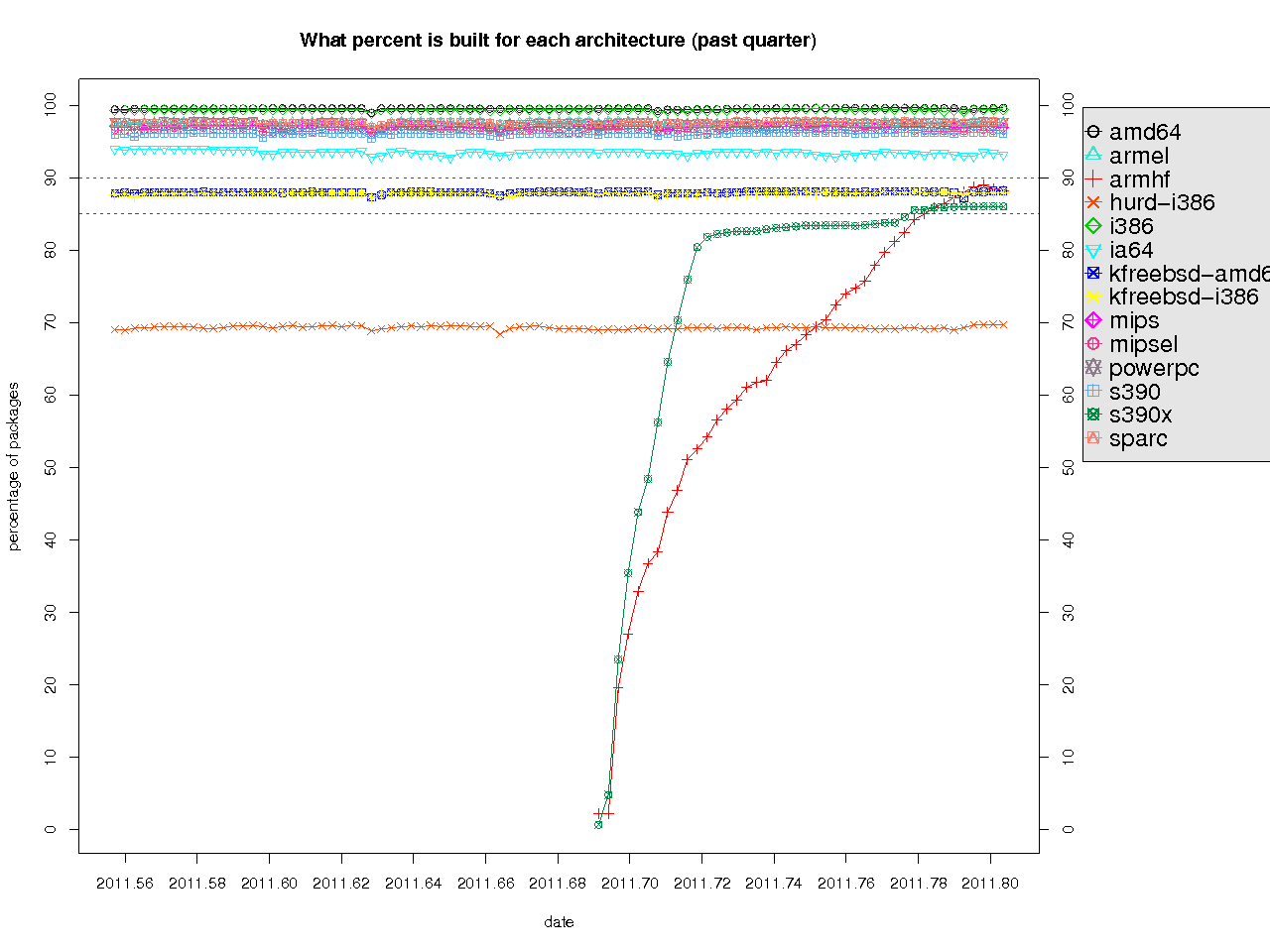
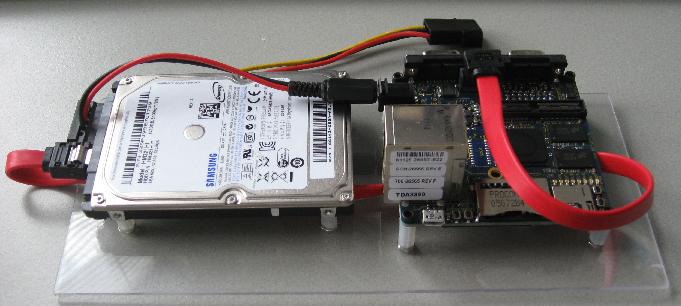
Current status Back in September, I wrote about the machines that I set up to help bootstrap the new armhf port in Debian. Basing on Konstantinos' huge efforts in bringing up the new "architecture" in debian-ports, we started importing armhf into the main Debian archive on the 24th of November. Since then, those builders have been churning away night and day to build the huge collection of software that makes up the Debian archive. The current state can be seen on the armhf buildd status page, and there's a nice graph showing how quickly we've managed to run from 0 to over 90% of the archive here. (Click on the image for a larger version, or visit https://buildd.debian.org/stats/ for other versions. We overtook hurd-i386 quickly and are now ahead of the kfreebsd-* architectures. armhf bootstrap graph We've recently brought 3 more similar build machines online (hildegard, howells and hummel), again sponsored by the nice folks at Linaro but now hosted at the York NeuroImaging Centre at the University of York. This gives us both more build horsepower to keep up with building more different bits of Debian (experimental, updates etc.) and more redundancy in case of problems. We now have the vast majority of the archive built, and now a number of us are concentrating on fixing the remaining issues: language bootstraps and bugs. Also, on the 7th of January we were just added into testing, the next step on our path for inclusion as a Debian release architecture. Setting up the machines A lot of people have been asking me about the physical setup I showed in my last blog about these machines, so here's more details for those who are interested. Mount the 6 boards into the mini-rack, connect up the Molex power connectors to each board, attach ethernet cables and turn it all on! Each board comes with a micro-SD card containing uboot and an Ubuntu installation. I've configured uboot to boot off the hard drive directly, but leaving configuration available to use the Ubuntu on the micro-SD as a simple rescue system should the need arise. The Quickstart boards are not ideal physically for two reasons: the lack of SATA power, plus you need to push a power button on each board to boot it - they don't boot automatically the moment power is applied. However, they're quite inexpensive little machines and have done a great job of building the Debian archive so far! The ideal machines for us would also include more RAM at this point. CPU on these is adequate, but the larger C++ packages (yay webkit!) use a huge amount of memory at link time. Linking in swap is not the best thing, performance-wise... :-( UPDATE 2012-01-12: Ian tells me that the newer Quickstart-R boards apparently have a different power controller; these now boot up straight away without needing you to push a button. That sounds useful.

Antonio Terceiro: Life after exec()

From the not necessarily big news, but still useful department. The situation: for Very Good Reasons 1, you want to replace your current process by calling exec(), but you still want to have the chance to do something after the process you exec()ed finishes. This is a simple technique I just came up with: just before replacing the current process by calling exec(), you fork() a process in the background that will wait for the current process id to disappear from the process list, and then does whatever you want to do. A simple proof-of-concept I wrote is composed of two bash programs: wrapper and real. real is really simple: it just waits a few seconds and then prints its process id to the console:
#!/bin/bash
sleep 5
echo $BASHPID
wrapper is the program that handles the situation we want to exercise: it replaces itself with real, but still has the chance to do something after real finishes. In this case, wrapper notifies the user that real finished.
#!/bin/bash
echo $BASHPID
real_program_pid=$BASHPID
(
  while ps -p "$real_program_pid" >/dev/null; do
    sleep 0.1s
  done
  notify-send 'real program finished'
) &
exec ./real
One nice property that wrapper explores is that when exec() starts real, it really replaces wrapper, and therefore has the same process id (in this case accessible by bash in the $BASHPID variable). Because of this, the background process that wrapper starts just before the exec() call already knows which process it has to watch for. The actual code for waiting is not optimal, though. I cannot use waitpid() (the wait builtin in bash), since real is not a child process of wrapper. I went with a brute force approach here, and I am pretty sure there is a cheaper way to wait for a random PID without a busy loop (but that wasn t the point here). 1 update: I am aware of the classic fork()/exec() pattern. My Very Good Reasons include the fact that I can t control the flow: I am writing a plugin for a program that calls its plugins in sequence, and after that, calls exec(), but my plugin is interested in doing some work after exec() finishes.

8 January 2012

Niels Thykier: Testing migration and package relations

While looking at the dpkg Breaks-field[0]
$ aptitude show dpkg
Package: dpkg
[...]
Version: 1.16.1.2
[...]
Breaks: apt (< 0.7.7), aptitude (< 0.4.7-1), dpkg-dev (< 1.15.8), libdpkg-perl (< 1.15.8), pinfo (< 0.6.9-3.1), tkinfo (< 2.8-3.1)
it occurred to me that most (all?) of these relations were irrelevant to Britney when she migrated dpkg 1.16.1.2 to testing. Right now, at least the APT relations are only relevant if you are doing something like a distribution upgrade from Lenny/Squeeze to Wheezy. Similarly, the version constraints in a lot of dependency relations (e.g. libc6 (>= 2.11) ) are satisfied in testing and unstable at the same time. Removing the version constrains on dependencies is a rather minor thing as it is basically just a minor constant time optimization on each dependency check. However, removing an entire clause slightly reduces the problem size a bit. Particularly, the Conflicts/Breaks relations tends to be expensive for us. The first task was to identify the relations that can (or cannot) be simplified. In a Britney run we at most 4 versions of the same package per architecture, though usually only 1 or 2[1]. I devised a small set of rules to simplify the relations. These rules are applied to each package in the relation (atomic proposition, if you will).
  1. If the relation is versioned and it involves a virtual package in any suite, then do not change the relation in any way. Rationale: A virtual package cannot satisfy any versioned relation (Policy Manual 7.5)
  2. If the relation is a dependency (i.e. Pre-Depends or Depends) and the package is not available in any suite, then do not change the relation in any way.
  3. If the relation is versioned and the relation is satisfied in all suites (where the relationed-on package is available), then remove the version constrain. Rationale: If all (present) versions satisfy the relation, then version constrain does not change the semantics.
  4. If the relation is a conflict (i.e. Conflicts or Breaks) and relation is unsatisfiable in all suites, then remove the relation. Rationale: If none of the (present) versions satisfy the conflict-relation, then there is no conflict[2].
The rules are rather conservative in some cases and there is room for improvements. However, one has to remember that removing too few relations costs a bit in runtime, removing too many breaks testing and possibly a lot. Obviously, I prefer the former to the latter (especially because I will be a part of the clean up -crew). I tested my implementation of those four rules above against the current master branch. In short, it produces the same result as the master branch in all the tests so far. In the hand-made test-suite, the tests generally do not have any superfluous relations. Thus, it is slightly slower, though usually within 0.1 seconds of the master branch. On the other hand, in the live-data samples I have collected so far it does vastly better. For the longest run (sample from 2011-12-13), it reduces the runtime with ~70 seconds (from ~215 to ~145 seconds). In the other runs, it reduces total runtime with ~35 and ~2 seconds, respectively. In these samples, only the amd64 and i386 packages are considered (and human hints are ignored). For those interested, the code is available in my branch. :) [0] There is perfectly valid reason for doing that. I might get back to that in a later post. [1] One in unstable, testing, testing-proposed-updates and proposed-updates. The latter may seem a bit weird, but [0] [2] This is the rule that prune relations like the one in the dpkg Breaks-field. Edit: 2011-01/09, clarified that we have at most 4 versions per architecture.

Next.

Previous.