Search Results: "mak"

2 May 2011

Michal Čihař: PPA for Debian

There seem to be lot of momentum in discussions about making Debian testing more attractive to users on debian-devel mailing list (see Lucas's summary for summary of the lengthy discussion). One of the raised points there is that Debian misses equivalent of Ubuntu's PPA or openSUSE build service. As Debian is usually about do-ocracy, it will be there once it will be implemented, but I still don't think it is always useful to have such thing. The problem with both (but this is especially the case for openSUSE build service) is that you need to add dozens of home: projects with questionable quality of the software. This usually leads to horrible mess, especially in case of incompatible libraries with different build options (anybody using wxWidgets?). It can definitely lower barrier for people to create packages for the distro, but is it really good to lower barrier that much? I'd really prefer new things to be uploaded to Debian itself without need to use any external repositories, it would ensure at least some level of quality and compatibility with other packages.

Filed under: Debian English Suse 5 comments Flattr this!

Lucas Nussbaum: Debian rolling discussion on -devel@

Here is my attempt at a summary of the rolling discussion currently happening on debian-devel@. It might not be complete, it s probably a bit biased, but I hope that it s still better than nothing. It was also posted on debian-devel@. If you are involved in Debian development, please discuss it on debian-devel@, rather than in the comments of this blog. If you want to provide feedback about the Debian rolling idea, use this Doodle poll and/or the comments of this blog.
Update : Someone had the good idea to vandalize the poll, and remove all the votes from people in favor of rolling. Before the vadalism (log), the results were:
37 votes: I am a Debian user, I use testing or unstable, and I would like rolling to happen.
6 votes: I am a Debian user, I use testing or unstable, and I DON T want rolling to happen.
17 votes: I am a Debian user, I use stable, and I would like rolling to happen.
3 votes: I am a Debian user, I use stable, and I DON T want rolling to happen.
7 votes: I am NOT a Debian user, but I would probably use it if rolling happened.
1 vote: I am NOT a Debian user, and I don t care about rolling. Motivations There s some user demand for rolling releases. For evidence, one can look at the usage of Debian testing or unstable which clearly goes further than the Debian development community. Or at the quickly growing market share of ArchLinux. Or at the interest in LinuxMint and Aptosid. Or at the DPL s report of his interactions with the press. Debian s only official product is its stable releases. While it s a clearly great and useful product, many users and developers don t recognize themselves in it: it contains software that is too old for their needs. The success of Ubuntu is related to this problem: Ubuntu proposes a different compromise between stability and up-to-date-ness. While concurrencing Ubuntu with more frequent stable releases (released every 6-months, for example) doesn t look like the right thing to do, Debian is in a perfect position to provide a rolling release with marginal additional work, since Debian already has testing (and unstable) to build on. The rolling discussion investigates how we could endorse the concept of a rolling release, provided as a product in addition to stable releases. This rolling release would be based on the current testing branch. Benefits for Debian: Current proposed plan for rolling (Disclaimer: this is mostly my view. It is shared by others, but some details might not be) rolling is mostly about (external) communication. It is not expected to change our development processes fundamentally.
It would be a statement by the project (through a GR, for example). A very preliminary draft was proposed by Raphael Hertzog:
Title: Debian endorses usage of testing by end-users, and renames it to rolling The Debian project recognizes that the Debian testing distribution initially created to make it easier to prepare and test the next stable release has become a useful product of its own. It satisfies the needs of users who are looking for the latest stable versions of software and who can cope (or even appreciate) a system that s constantly evolving. The Debian project decides to endorse this usage and will strive to provide a good experience to users of testing . To better communicate this policy change to our users, testing will be renamed rolling .
Yes, it s mostly PR bullshit , and I don t expect it to significantly change Debian development processes. However, communication is necessary if we want to attract new users. What would change is more attention from developers to what happens in testing/rolling, which is a good thing since a better testing/rolling makes it easier to create stable releases from it. Open questions Most of the discussion is about the influence of the introduction of rolling on Debian development processes, and in particular, on the painful process resulting in stable releases. Many fear that, with rolling , it will be harder to get stable releases out. The root question is: if we do rolling, what do we do during freezes? Several options have been mentioned in the thread:
  1. We could decide not to do anything special: just freeze rolling for ~6 months, as we used to freeze testing. That might bore people who like the constant flux of new upstream releases, but if we decide that it s the only way to ensure high-quality stable releases, so be it.
  2. We could decide to fork a frozen branch when we freeze, and continue to manage rolling using migrations from unstable.
  3. We could mix both solutions: freeze rolling for 3 months, so that most of the stabilization work occurs with a single active branch, and then, for the final release preparation, fork frozen off rolling, and unfreeze rolling.
Two kinds of objections have been raised: Other things that were discussed: Tentative personal conclusion I have the impression that advertising testing as a rolling release usable by end-users is generally considered a good thing.
The renaming of testing to rolling is not as consensual, but most opponents have a whatever ; if you want position. How we deal with freezes is the hard point in this discussion. I m personnally in favor of the freeze rolling for 3 months, then fork frozen and unfreeze rolling plan, though it has some problems too (it is not clear whether the required manpower really decreases at the end of freezes). Where do we go from there? After another round of discussion, we might postpone the how to deal with freezes question to later, and proceed with a GR to measure the support for the testing for end-users + s/testing/rolling/ proposal.

30 April 2011

Russell Coker: Autism Awareness and the Free Software Community

It s Autism Awareness Month April is Autism Awareness month, there are lots of articles about Autism, most of them are at best misleading if not wrong. The most common error seems to be describing non-verbal Autistic children and then claiming that Autistic people comprise about 1% of the population. The number of non-verbal Autistic children is a lot less than 1% of the population, and at least 1/3 of the people on the Autism Spectrum have good verbal skills and often talk more than average. To be precise, they are describing the symptoms of people who would be diagnosed with Severity 3 according to the American Psychiatric Association s Diagnostic and Statistical Manual (the DSM) as applying to all people who are on the Autism Spectrum even though of the currently diagnosed people probably about 1/3 might be classified as Severity 2 and 1/3 as Severity 1. It seems that severity 1 Autism is going to be the replacement for Asperger Syndrome in the new DSM-5. The problem with misleading information in regard to what comprises Autism is that parents really don t want to have a child who s abnormal and search for evidence to make their wishes come true. At the extreme there are parents who can convince themselves that a 4yo non-verbal child isn t on the Autism Spectrum. When people are given the impression that Autism is only about non-verbal children then they will probably think that a 6yo who can give a half-hour lecture on a topic of interest (regardless of whether the audience is interested) isn t on the Autism Spectrum. There is also a similar issue with undiagnosed adults, I would have probably got assessed at least a decade earlier if I had learned more about Autism instead of believing some of the stories. In a quick Google search for Autism Awareness Month I haven t found any clear and accurate information on what Autism is or what should be done about it, so it seems to me that the awareness project has largely been a failure. The Autism page on Wikipedia [1] and the page for Asperger Syndrome [2] are good places to start reading. By merely pointing to those two Wikipedia pages I ve made this post a lot more useful than every article I ve seen in the mainstream media. To find some useful and insightful posts about Autism awareness you have to add some search terms such as neurodiversity, which turns up posts such as a post by Leah Jane about Autism Acceptance [3]. It seems that the Autism Awareness articles that are most useful at informing people will only be found by people who are already aware of some of the issues. Most People Who Read this are Geeks The majority of the readers for my blog come from aggregators that cater to fairly geeky people. Geek culture is largely Aspie culture. So I think that most people who read my blog have a good general knowledge of what people who might be diagnosed with Asperger Syndrome or High Functioning Autism are like they just think that such people are merely a bit more geeky than is typical for the Free Software community. So it s not as if all Autistic people are hidden away somewhere because they can t live independently. Many of us work in the computer industry and in academia. Probably the majority of people who have a university degree related to science or engineering have had a professor who was on the Autism Spectrum, probably most people who have any significant experience in the computer industry have had colleagues who are on the Spectrum. After having become used to the geek culture I initially found it difficult to believe that I could be on the Autism Spectrum because I knew heaps of people in the Free Software community who are at least as geeky as me but apparently weren t on the Autism Spectrum. I now think that the majority of people who are as geeky as me would get diagnosed with Asperger Syndrome (or High Functioning Autism under DSM-5) if they were assessed. Adult Diagnosis If you are wondering whether you might be on the Autism Spectrum then it s worth reading the pages linked from the DSM 5 draft process have the full diagnostic criteria (both for DSM-4 and DSM-5) [4]. Also Glenn Rowe has a web page with tests designed by Professor Simon Baron-Cohen [5] and Leif Ekblad has a project to do long-term analysis of changes to personality test scores which starts with a quick Aspie quiz [6] (and also has lots of links to other relevant sites). If you think that you might be on the Autism Spectrum (which means Asperger Syndrome in the case of most people who read my blog) then I recommend that you get assessed if possible. As assessment by a psychologist isn t cheap there is the option of self-diagnosis in which case Chaotic Idealism s post about self-diagnosis is worth reading [7].

Thomas Girard: ACE+TAO Debian packaging moved to git

We recently converted Debian ACE+TAO package repository from Subversion to git. This was a long and interesting process; I learned a lot on git in the course. I had been using git for a while for other packages: BOUML, dwarves and GNU Smalltalk. But I did not really get it. A preliminary study led by Pau[1] showed that out of the following three tools: the last one was giving results that look better.
The conversion svn-all-fast-export requires physical access to the repo, so the Alioth SVN repo was copied on my machine svn-pkg-ace/ before running the tool:
svn-all-fast-export --identity-map authors.txt --rules pkg-ace.rules svn-pkg-ace
Here's the content of the pkg-ace.rules configuration file that was used:
create repository pkg-ace
end repository
match /trunk/
  repository pkg-ace
  branch master
end match
match /(branches tags)/([^/]+)/
  repository pkg-ace
  branch \2
end match
The author mapping file authors.txt being:
markos = Konstantinos Margaritis <email-hidden>
mbrudka-guest = Marek Brudka <email-hidden>
pgquiles-guest = Pau Garcia i Quiles <email-hidden>
tgg = Thomas Girard <email-hidden>
tgg-guest = Thomas Girard <email-hidden>
The tool sample configuration file merged-branches-tags.rules recommends to post-process tags, which are just a branch in SVN. That's why the configuration file above treats branches as tags. The conversion was indeed fast: less than 1 minute.
Post-conversion observations Invoking gitk --all in the converted repo revealed different kind of issues:
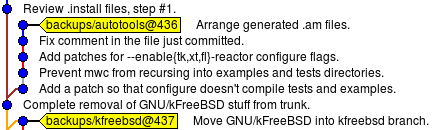
  • svn tags as branches: http://thomas.g.girard.free.fr/ACE/tags-as-branches.png Branches are marked with green rectangles, and tags with yellow arrows. What we have here (expected given our configuration of the tool) are branches (e.g. 5.4.7-5) corresponding to tags, and tags matching the SVN tagging commit (e.g. backups/5.4.7-5@224). We'll review and fix this.

  • merged code that did not appear as such: http://thomas.g.girard.free.fr/ACE/missing-merge-metadata.png Branches that were not merged using svn merge look like they were not merged at all.

  • commits with wrong author: http://thomas.g.girard.free.fr/ACE/wrong-author.png Before being in SVN, the repository was stored in CVS. When it was imported into SVN, no special attention was given to the commit author. Hence I got credited for changes I did not write.

  • obsolete branches: http://thomas.g.girard.free.fr/ACE/obsolete-branches.png The tool leaves all branches, including removed ones (with tag on their end) so that you can decide what to do with them.

  • missing merges: http://thomas.g.girard.free.fr/ACE/missing-merge.png The branch 5.4.7-12 was never merged into the trunk!

Learning git Based on observations above, I realized my limited knowledge won't do to complete the conversion and clean the repository. There are tons of documentation on git out there, and you can find a lot of links from the git documentation page. Here's the one I've used:
The Git Object Model It's described with pictures here. You really need to understand this if you haven't already. Once you do, you understand that git is built bottom-up: the plumbing then the porcelain. If you can't find the tool you need, it's easy to write it.
git fast-import The Migrating to Git chapter explains how you can use the git fast-import tool to manually import anything into git. I've used it to create tags with dates in the past, slightly changing the Custom Importer example in the book:
#!/usr/bin/env ruby
#
# retag.rb
#
# Small script to create an annotated tag, specifying commiter as well as
# date, and tag comment.
#
# Based on Scott Chacon "Custom Importer" example.
#
# Arguments:
#  $1 -- tag name
#  $2 -- sha-1 revision to tag
#  $3 -- committer in the form First Last <email>
#  $4 -- date to use in the form YYYY/MM/DD_HH:MM:SS

def help
  puts "Usage: retag <tag> <sha1sum> <committer> <date> <comment>"
  puts "Creates a annotated tag with name <tag> for commit <sha1sum>, using "
  puts "given <committer>, <date> and <comment>"
  puts "The output should be piped to git fast-import"
end
def to_date(datetime)
  (date, time) = datetime.split('_')
  (year, month, day) = date.split('/')
  (hour, minute, second) = time.split(':')
  return Time.local(year, month, day, hour, minute, second).to_i
end
def generate_tag(tag, sha1hash, committer, date, message)
  puts "tag # tag "
  puts "from # sha1hash "
  puts "tagger # committer  # date  +0000"
  print "data # message.size \n# message "
end
if ARGV.length != 5
  help
  exit 1
else
  (tag, sha1sum, committer, date, message) = ARGV
  generate_tag(tag, sha1sum, committer, to_date(date), message)
end
graft points (graft means greffe in French) Because of missing svn:mergeinfo some changes appear unmerged. To fix this there are graft points: they override git idea of parents of a commit. To create a graft point, assuming 6a6d48814d0746fa4c9f6869bd8d5c3bc3af8242 is the commit you want to change, currently with a single parent 898ad49b61d4d8d5dc4072351037e2c8ade1ab68, but containing changes from commit 11cf74d4aa996ffed7c07157fe0780ec2224c73e:
me@mymachine$ echo 6a6d48814d0746fa4c9f6869bd8d5c3bc3af8242 11cf74d4aa996ffed7c07157fe0780ec2224c73e 898ad49b61d4d8d5dc4072351037e2c8ade1ab68 >> .git/info/grafts
git filter-branch git filter-branch allows you to completely rewrite history of a git branch, changing or dropping commits while traversing the branch. As an additional benefit, this tool use graft points and make them permanent. In other words: after running git filter-branch you can remove .git/info/grafts file. I've used it to rewrite author of a given set of commits, using a hack on top of Chris Johnsen script:
#!/bin/sh

br="HEAD"
TARG_NAME="Raphael Bossek"
TARG_EMAIL="hidden"
export TARG_NAME TARG_EMAIL
filt='
    if test "$GIT_COMMIT" = 546db1966133737930350a098057c4d563b1acdf -o \
            "$GIT_COMMIT" = 23419dde50662852cfbd2edde9468beb29a9ddcc; then
        if test -n "$TARG_EMAIL"; then
            GIT_AUTHOR_EMAIL="$TARG_EMAIL"
            export GIT_AUTHOR_EMAIL
        else
            unset GIT_AUTHOR_EMAIL
        fi
        if test -n "$TARG_NAME"; then
            GIT_AUTHOR_NAME="$TARG_NAME"
            export GIT_AUTHOR_NAME
        else
            unset GIT_AUTHOR_NAME
        fi
    fi
'
git filter-branch $force --tag-name-filter cat --env-filter "$filt" -- $br
(Script edited here; there were much more commits written by Raphael.)

Important

It's important to realize that the whole selected branch history is rewritten, so all objects id will change. You should not do this if you already published your repository.

The --tag-name-filter cat argument ensures our tags are copied during the traversal; otherwise they would be untouched, and hence not available in the new history.

Hint

Once git filter-branch completes you get a new history, as well as a new original ref to ease comparison. It is highly recommended to check the result of the rewrite before removing original. To shrink the repo after this, git clone the rewritten repo with file:// syntax -- git-filter-branch says it all.

Cleaning up the repo To recap, here's how the ACE+TAO git repo was changed after conversion:
  1. Add graft points where needed.

  2. Clean tags and branches. Using git tag -d, git branch -d and the Ruby script above it was possible to recreate tags. During this I was also able to add missing tags, and remove some SVN errors I did -- like committing in a branch created under tags/.

  3. Remove obsolete branches.

  4. Merge missing pieces. There were just two missing debian/changelog entries. I did this before git filter-branch because I did not find a way to use the tool correctly with multiple heads.

  5. Fix commit author where needed. Using the shell script above Raphael is now correctly credited for his work.

That's it. The ACE+TAO git repository for Debian packages is alive at http://git.debian.org/?p=pkg-ace/pkg-ace.git;a=summary.
[1]http://lists.alioth.debian.org/pipermail/pkg-ace-devel/2011-March/002421.html
[2]available in Debian as svn-all-fast-export

Christian Perrier: Pytrainer: finally

This week, I finally switched to use pytrainer to track my running data. Up to now, I was still using Garmin proprietary software on Elizabeth's Windows copmuter for this. Mostly because my GPW watch is a Forerunner 405, that uses a bloody crappy stupid USB stick with proprietary communication protocol (ANT+). So, the use of proprietary crappy software was kinda mandatory. There is however some code floating around to handle this device in Linux, named "Gant". This is far from being very polished, but I finally managed to make it work more or less reliably to get the GPS traces from my watch to my Debian laptop. So, during the week , I brought all my old running data back from "Garmin Training Center" (the Windows software provided by Garmin) back to my laptop and imported it in pytrainer. And I imported new data from my daily runs with help of that "gant" software. So, this is now time to really jump into maintenance of pytrainer and help my friend No l (that will be easy as pytrainer is kinda well maintained), then package "gant" for Debian, as part of the work in the "pkg-running" maintenance team (Ralf Treinen, No le K the and /me). New challenge for me: learn how to create a git public repo and maintain a package in it (I already participate to maintenance work with git for several things, but I never initiated any). Other plans: some bug triage on pytrainer (if some is needed, I indeed don't know yet) and eventually deal with things that have to be reported upstream. Looking at Launchpad might also be a good idea as I suspect that many are using pytrainer with Ubuntu.

29 April 2011

John Goerzen: Anniversary: Europe Ideas?

Terah and I have our 10th wedding anniversary coming up this fall. We ve discussed a bit what we d like to do. Terah said that she d enjoy a relaxing resort on a beach somewhere with a reasonable hotel room so there isn t really anything we have to do just relax. I said that I d love to go back to Europe enjoy some more history, have a fun adventure together, see more of the countryside perhaps. This didn t sound all that relaxing to Terah. So I commented that Europe also has plenty of water, beaches, and resorts and perhaps we could find a place in Europe with history and adventure, plus also a relaxing beach so we can have some adventure but not too much <grin> We ll probably be looking to travel in September or October and would hope for reasonably warm weather though if we need to go at a different time of year, that option is still open. I m at a loss for where to start looking here, so I m hoping readers of this blog can give a suggestion. I very much appreciated the great tips last time I asked. Our first trip to Europe last year was great it was nice to stay with some old friends and make some new ones, to see some amazing cities and buildings, and live for a few days someplace with a culture different from home. Our boys would not be coming with us on this trip. We did get passports for them recently and are looking at some options for a trip with them, but that wouldn t be this one.

Ian Wienand: Toolchains, libc and interesting interactions

When building a user space binary, the -lc that gcc inserts into the final link seems pretty straight forward link the C library. As with all things system-library related there is more to investigate. If you look at /usr/lib/libc.so; the "library" that gets linked when you specify -lc, it is not a library as such, but a link script which specifies the libraries to link, which also includes the dynamic linker itself:
$ cat /usr/lib/libc.so
/* GNU ld script
   Use the shared library, but some functions are only in
   the static library, so try that secondarily.  */
OUTPUT_FORMAT(elf64-x86-64)
GROUP ( /lib/libc.so.6 /usr/lib/libc_nonshared.a  AS_NEEDED ( /lib/ld-linux-x86-64.so.2 ) )
On very old glibc's the AS_NEEDED didn't appear; so every binary really did have a DT_NEEDED entry for the dynamic linker itself. This can be somewhat confusing if you're ever doing forensics on an old binary which seems to have these entries for not apparent reason. However, we can see that that /lib/libc.so itself does actually require symbols from the dynamic linker:
$ readelf --dynamic /lib/libc.so.6   grep NEEDED
 0x0000000000000001 (NEEDED)             Shared library: [ld-linux-x86-64.so.2]
Although you're unlikely to encounter it, a broken toolchain can cause havoc if it gets the link order wrong here, because the glibc dynamic linker defines minimal versions of malloc and friends -- you've got a chicken-and-egg problem using libc's malloc before you've loaded it! You can simulate this havoc with something like:
$ cat foo.c
#include <stdio.h>
#include <syslog.h>
int main(void)
 
   syslog(LOG_DEBUG, "hello, world!");
   return 0;
 
$ cat libbroken.so
GROUP ( /lib/ld-linux-x86-64.so.2 )
$ gcc -o -Wall -Wl,-rpath=. -L. -lbroken -g -o foo foo.c
$ ./foo
Inconsistency detected by ld.so: dl-minimal.c: 138: realloc: Assertion  ptr == alloc_last_block' failed!
Depending on various versions of things, you might see that assert or possibly just strange, corrupt output in your logs as syslog calls the wrong malloc. You could debug something like this by asking the dynamic linker to show you its bindings as it resolves them:
$ LD_DEBUG_OUTPUT=foo.txt LD_DEBUG=bindings ./foo
Inconsistency detected by ld.so: dl-minimal.c: 138: realloc: Assertion  ptr == alloc_last_block' failed!
$ cat foo.txt.11360   grep "\ malloc'"
     11360:	binding file /lib/libc.so.6 [0] to /lib64/ld-linux-x86-64.so.2 [0]: normal symbol  malloc' [GLIBC_2.2.5]
     11360:	binding file /lib64/ld-linux-x86-64.so.2 [0] to /lib64/ld-linux-x86-64.so.2 [0]: normal symbol  malloc' [GLIBC_2.2.5]
     11360:	binding file /lib/libc.so.6 [0] to /lib64/ld-linux-x86-64.so.2 [0]: normal symbol  malloc' [GLIBC_2.2.5]
Above, because the dynamic loader comes first in the link order, libc.so.6's malloc has bound to the minimal implementation it provides, rather the full-featured one it provides internally. As an aside, AFAICT, there is really only one reason why a normal library will link against the dynamic loader -- for the thread-local storage support function __tls_get_addr. You can try this yourself:
$ cat tls.c
char __thread *foo;
char* moo(void)  
	return foo;
 
$ gcc -fPIC -o libtls.so -shared tls.c
$ readelf -d ./libtls.so    grep NEED
 0x00000001 (NEEDED)                     Shared library: [libc.so.6]
 0x00000001 (NEEDED)                     Shared library: [ld-linux.so.2]
 0x6ffffffe (VERNEED)                    0x314
 0x6fffffff (VERNEEDNUM)                 2
Thread-local storage is worthy of a book of its own, but the gist is that this support function says "hey, give me an address of foo in libtls.so", the magic being that if the current thread has never accessed foo then it may not actually have any storage for foo yet, so the dynamic linker can allocate some memory for it lazily and then return the right thing. Otherwise, every thread that started would need to reserve room for foo "just in case", even if it never cares about moo. But looking a little closer at the symbols of libc.so is also interesting. libc.so doesn't actually have many functions you can override. You can see what it is possible to override by checking the relocations against the procdure-lookup table (PLT).
Relocation section '.rela.plt' at offset 0x1e770 contains 8 entries:
  Offset          Info           Type           Sym. Value    Sym. Name + Addend
00000035b000  084600000007 R_X86_64_JUMP_SLO 00000000000a2100 sysconf + 0
00000035b008  02e000000007 R_X86_64_JUMP_SLO 0000000000075e50 calloc + 0
00000035b010  01dd00000007 R_X86_64_JUMP_SLO 0000000000077910 realloc + 0
00000035b018  029300000007 R_X86_64_JUMP_SLO 00000000000661c0 feof + 0
00000035b020  046f00000007 R_X86_64_JUMP_SLO 00000000000768c0 malloc + 0
00000035b028  000400000007 R_X86_64_JUMP_SLO 0000000000000000 __tls_get_addr + 0
00000035b030  01b400000007 R_X86_64_JUMP_SLO 0000000000076dd0 memalign + 0
00000035b038  086000000007 R_X86_64_JUMP_SLO 00000000000767e0 free + 0
i.e. instead of jumping directly to the malloc defined in the libc code section, any internal calls will jump to this stub which, the first time, asks the dynamic linker to go out and find the address of malloc (it then saves it, so the second time the stub just jumps to the saved location). This is an interesting list, seemingly without much order. feof, for example, stands out as worth checking out a bit closer why would that be there when fopen isn't, say? We can track down where it comes from with a bit of detective work; knowing that the value of the symbol feof will be placed into 0x35b018 we can disassemble libc.so to see that this address is used by the feof PLT stub at 0x1e870 (luckily, objdump has done the math to offest from the rip for us; i.e. 0x1e876 + 0x33c7a2 = 0x35b018)
000000000001e870 <feof@plt>:
   1e870:       ff 25 a2 c7 33 00       jmpq   *0x33c7a2(%rip)        # 35b018 <_IO_file_jumps+0xb18>
   1e876:       68 03 00 00 00          pushq  $0x3
   1e87b:       e9 b0 ff ff ff          jmpq   1e830 <h_errno+0x1e7dc>
From there we can search for anyone jumping to that address, and find out the caller:
$ objdump --disassemble-all /lib/libc.so.6   grep 1e870
000000000001e870 <feof@plt>:
   1e870:	ff 25 a2 c7 33 00    	jmpq   *0x33c7a2(%rip)        # 35b018 <_IO_file_jumps+0xb18>
   f19f7:	e8 74 ce f2 ff       	callq  1e870 <feof@plt>
$ addr2line -e /lib/libc.so.6 f19f7
/home/aurel32/eglibc/eglibc-2.11.2/sunrpc/bindrsvprt.c:70
Which turns out to be part of a local patch which probably gets things a little wrong, as described below. The sysconf relocation is from a similar add-on patch (being used to find the page size, it seems). libc, like all sensible libraries, uses the hidden attribute on symbols to restrict what is exported by the library. The benefit of this is that when the linker knows you are referencing a hidden symbol it knows that the value can never be overridden, and thus does not need to emit extra code to do indirection just in case you ever wish to redirect the symbols. In the above, it appears that feof has never been marked as hidden, probably because no internal glibc functions used it until that add-on patch, and since it is not considered an internal function the linker must allow for the possibility that it will be overridden at run time and provide a PLT slot for it. There are consequences; if this was on a fast-path then the extra jumps required to go via the PLT may matter for performance and it may also cause strange behaviour if somebody had preloaded something that took over feof. Note, this is different from saying that your library can override symbols provided by libc.so; such as when you LD_PRELOAD a library to wrap an open call. What you can not override is the open call that say, the internal libc.so function getusershell does to read /etc/shells. Having the malloc related calls as preemptable seems intentional and sane; although I can not find a comment to the effect of "we deliberately leave these like this so that users may use alternative malloc implementations", it makes sense so that libc.so is internally using the same malloc as everything else if you choose to use something such as tc-malloc. tl;dr? Digging into your system libraries is always interesting. Be careful with your link order when creating toolchains, and be careful about symbol visibility when you're working with libraries.

Rapha&#235;l Hertzog: Do we need project-wide support for Debian rolling?

The discussion about Debian rolling started sooner than expected on debian-devel (see the thread here). I initially wanted to iron out the biggest problems through discussions on my blog and try to submit a somewhat polished proposal instead we ended up discussing the same things both on -devel and on my blog. That said it s not that bad (except for the time I lost to have similar conversations in both places) because the debian-devel discussions included members of the release team and it looks like they are not fundamentally opposed to the idea. Despite this, the introduction of a frozen suite branched off from testing/rolling is not really consensual (yet?). But the idea of officially supporting testing on a best-effort basis appears to have almost no opposition. While some will undoubtedly believe that this is a useless exercise, I believe it would help if the project stated this in a somewhat official manner. My answer to the question in the title is thus: YES I am thus considering to submit a general resolution to that effect. My current draft is below.

Title: Debian endorses usage of testing by end-users, and renames it to rolling The Debian project recognizes that the Debian testing distribution initially created to make it easier to prepare and test the next stable release has become a useful product of its own. It satisfies the needs of users who are looking for the latest stable versions of software and who can cope (or even appreciate) a system that s constantly evolving. The Debian project decides to endorse this usage and will strive to provide a good experience to users of testing . To better communicate this policy change to our users, testing will be renamed rolling . While we believe that this is a good move, we would like to remind our users that Debian is a volunteer project and that our resources are not infinite. Package maintainers are contributing to Debian on a best-effort basis. This means that they might not be able to properly support their package(s) in all distributions. In that case, the project recommends that maintainers apply the following priorities:
  1. Support in stable (security updates, release critical bugs)
  2. Preparation of the next stable release
  3. Support in rolling
Note that this general resolution could have amendments with s/rolling/current/ and that would solve the bikeshedding over the name that started several times already. I deliberately separated Preparation of the next stable release and Support in rolling so that priorities are clear even if we decide to not freeze rolling and to introduce a frozen distribution to finalize the next stable release. I also did not go into too much details on the implications that it might have, it s best to leave that up to each contributor/team/etc. I hesitated to add a paragraph stating that we want to try to gradually improve the usability of testing but in the end I think it would be somewhat redundant. We re always trying to do our best when we decide to take on something. All comments welcome (even if you just agree and would be willing to second such a GR). Update: I will tweak the draft included in this article when I get good suggestions. Thanks to Lucas Nussbaum for the first one.

10 comments Liked this article? Click here. My blog is Flattr-enabled.

Petter Reinholdtsen: Initial notes on adding Open311 server API on FixMyStreet

The last few days I have spent some time trying to add support for the Open311 API in the Norwegian FixMyStreet service. Earlier I believed Open311 would be a useful API to use to submit reports to the municipalities, but when I noticed that the New Zealand version of FixMyStreet had implemented Open311 on the server side, it occurred to me that this was a nice way to allow the public, press and municipalities to do data mining directly in the FixMyStreet service. Thus I went to work implementing the Open311 specification for FixMyStreet. The implementation is not yet ready, but I am starting to get a draft limping along. In the process, I have discovered a few issues with the Open311 specification. One obvious missing feature is the lack of natural language handling in the specification. The specification seem to assume all reports will be written in English, and do not provide a way for the receiving end to specify which languages are understood there. To be able to use the same client and submit to several Open311 receivers, it would be useful to know which language to use when writing reports. I believe the specification should be extended to allow the receivers of problem reports to specify which language they accept, and the submitter to specify which language the report is written in. Language of a text can also be automatically guessed using statistical methods, but for multi-lingual persons like myself, it is useful to know which language to use when writing a problem report. I suspect some lang=nb,nn kind of attribute would solve it. A key part of the Open311 API is the list of services provided, which is similar to the categories used by FixMyStreet. One issue I run into is the need to specify both name and unique identifier for each category. The specification do not state that the identifier should be numeric, but all example implementations have used numbers here. In FixMyStreet, there is no number associated with each category. As the specification do not forbid it, I will use the name as the unique identifier for now and see how open311 clients handle it. The report format in open311 and the report format in FixMyStreet differ in a key part. FixMyStreet have a title and a description, while Open311 only have a description and lack the title. I'm not quite sure how to best handle this yet. When asking for a FixMyStreet report in Open311 format, I just merge title an description into the open311 description, but this is not going to work if the open311 API should be used for submitting new reports to FixMyStreet. The search feature in Open311 is missing a way to ask for problems near a geographic location. I believe this is important if one is to use Open311 as the query language for mobile units. The specification should be extended to handle this, probably using some new lat=, lon= and range= options. The final challenge I see is that the FixMyStreet code handle several administrations in one interface, while the Open311 API seem to assume only one administration. For FixMyStreet, this mean a report can be sent to several administrations, and the categories available depend on the location of the problem. Not quite sure how to best handle this. I've noticed SeeClickFix added latitude and longitude options to the services request, but it do not solve the problem of what to return when no location is specified. Will have to investigate this a bit more. My distaste for web forums have kept me from bringing these issues up with the open311 developer group. I really wish they had a email list available via Gmane to use for discussions instead of only a forum. Oh, well. That will probably resolve itself, one way or another. I've also tried visiting the IRC channel #open311 on FreeNode, but no-one seem to reply to my questions there. This make me wonder if I just fail to understand how the open311 community work. It sure do not work like the free software project communities I am used to.

28 April 2011

Russell Coker: What is Valid SE Linux Policy?

Guido Trentalancia started an interesting discussion on the SE Linux policy development list about how to manage the evolution of the policy [1]. The Problem The SE Linux policy is the set of rules that determine what access is granted. It assigns types to files and domains to processes and has a set of rules that specify all the permitted interactions between processes and files (among many other things). The policy evolves over time to match the requirements of programs (applications and daemons). As a program evolves the things that it does will change and the SE Linux policy will tend to evolve to permit the set of all operations that were requested by all versions because people only complain when things stop working not when excessive privilege is granted. So we need to periodically remove old allow rules from the policy. One difficulty in this regard is the fact that multiple versions of programs are often available for use at the same time. Debian in particular has a good history of providing separate packages for the old and new versions of programs such as Apache to meet the needs of users who want the tried and tested version and of users who want the newer version with better performance, more features, better documentation, or something else good. There is also a demand to have the same policy work with multiple versions of a distribution without excessive effort. Finally all the distributions that have SE Linux support have different people deciding when the new version of a daemon is ready for inclusion and therefore there is a need to support multiple versions for multiple distributions. So support for older versions of daemons can t be removed easily. One of the things I do to make these things a little easier to manage is to put ifdef( distro_debian', before any Debian specific bits of policy. When policy is conditional and only used in Debian I can freely remove it at any future time if Debian works well without it. Also it doesn t matter if such Debian specific policy allows access that is not needed or desired in other distributions, the only down-side to this is that sometimes other distributions need to repeat work that I did, they determine what access is needed for their configuration and discover that it was already enabled for Debian. What is Valid Policy? We went to only have Valid Policy (as described by Christopher J. PeBenito), so the challenge is determining what is Valid Policy. It seems to me that there are three type of access granted by valid policy (it is debatable whether type #3 is valid):
  1. Access that is needed for an application to perform it s minimal designed task.
  2. Access that is needed for the application to perform all the optional configurations, EG an ftpd running from inetd or as a daemon, and daemons like http server being granted access to ssl keys or not.
  3. Access that is needed to perform all the operations the application requests, but which the application doesn t require or shouldn t require if it worked correctly.
Some common operations that aren t required include opening utmp for write, searching /root, and many other relatively innocuous access attempts which don t affect the program operation if they are denied. There are also many things such as writing temporary files to /root that don t seem unusual if the application developer is not considering SE Linux (but which are often considered bad practice anyway). Some of these things (like using /root for stuff that belongs in /var/lib) have the potential to break things (for the daemon or for other system processes) even if you don t consider SE Linux. How to deal with those types:
  1. In most cases this can be determined without too much effort. For example a web server needs to listen on port 80 and read files and directories that relate to data. When writing policy I can write a lot of the allow rules without even testing the application because I know from the design what it will do. A large part of the other access is obvious in a I can t believe I didn t realise it would need this sense.
  2. The main question here is whether we have booleans (settings which can be tuned at run-time by the sysadmin which determine how the policy works) to specify which optional tasks or whether we allow all access for optional configurations by default. The secondary question is when certain unusual corner cases should be not supported at all such that the people who do such unusual corner cases need to use audit2allow to generate local policy to allow their operations.
  3. Sometimes we have to allow things that we really don t like. Even when we write policy to allow a daemon to do unusual things (such as using /root instead of /var/lib) it s still a lot better than running without SE Linux. Also SE Linux policy to allow such obviously broken things stands out and is a constant reminder that the daemon needs fixing, this is better than allowing symptoms of broken design to be forgotten.
How to Improve the Situation We could have comments in the policy source for everything that is in category 3. If the comments had a fixed format so that a recursive grep could find them all then it would allow us to more easily remove the gross things from the policy at a later date. But it seems to me that the main problem is a lack of people working on this. I am not aware of any people actively testing Debian policy for excessive privilege in regard to such issues.

Rapha&#235;l Hertzog: No freeze of Debian s development, what does it entail?

The main feature of rolling is that it would never freeze. This is not without consequences. Possible consequences It can divert developers from working on the release No freeze means developers are free to continue their work as usual in unstable. Will it be more difficult to release because some people will spend their time working on a new upstream version instead of fixing RC bugs in the version that is frozen? Would we lose the work of the people who do lots of NMU to help with the release? It makes it more difficult to cherry-pick updates from unstable No freeze also means that unstable is going to diverge sooner from testing and it will be more difficult to cherry-pick updates from unstable into testing. And the release team likes to cherry-pick updates that have been tested in unstable because updates that comes through testing-proposed-updates have often not been tested and need thus a more careful review. Frozen earth My responses to the objections Those are the two major objections that we ll have to respond to. Let s try to analyze them a bit more. It s not testing vs rolling On the first objection I would like to respond that we must not put testing and rolling/unstable in opposition. The fact that a contributor can t do its work as usual in unstable does not mean that he will instead choose to work on fixing RC bugs in testing. Probably that some do, but in my experience we simply spend our time differently, either working more on non-Debian stuff or doing mostly hidden work that is then released in big batches at the start of the next cycle (which tends to create problems of its own). I would also like to argue that by giving more exposure to rolling and encouraging developers to properly support their packages in rolling, it probably means that the overall state of rolling should become gradually better compared to what we re currently used to with testing. The objection that rolling would divert resources from getting testing in a releasable shape is difficult to prove and/or disprove. The best way to have some objective data would be to setup a questionnaire and to ask all maintainers. Any volunteer for that? Unstable as a test-bed for RC bugfixes? It s true that unstable will quickly diverge from testing and that it will be more difficult to cherry-pick updates from unstable into testing. This cannot be refuted, it s a downside given the current workflow of the release team. But I wonder if the importance of this workflow is not overdone. The reason why they like to cherry-pick from unstable is because it gives them some confidence that the update has not caused other regressions and ensures that testing is improving. But if they re considering to cherry-pick an update, it s because the current package in testing is plagued by an RC bug. Supposing that the updated package has introduced a regression, is it really better to keep the current RC bug compared to trading it for a new regression? It sure depends on the precise bugs involved so that s why they prefer to know up-front about the regression instead of making a blind bet. Given this, I think we should use testing-proposed-updates (tpu) as a test-bed for RC bug fixes. We should ask beta-testers to activate this repository and to file RC bugs for any regression. And instead of requiring a full review by a release manager for all uploads to testing-proposed-updates, uploads should be auto-accepted provided that they do not change the upstream version and that they do not add/remove binary packages. Other uploads would still need manual approval by the release managers. On top of this, we can also add an infrastructure to encourage peer-reviews of t-p-u uploads so that reviews become more opportunistic instead of systematic. Positive reviews would help reduce the aging required in t-p-u before being accepted into testing. This changes the balance by giving a bit more freedom to maintainers but still keeps the safety net that release managers need to have. It should also reduce the overall amount of work that the release team has to do. Comments welcome Do you see other important objections beside the two that I mentioned? Do you have other ideas to overcome those objections? What do you think of my responses? Does your experience infirm or confirm my point of view?

18 comments Liked this article? Click here. My blog is Flattr-enabled.

Patrick Schoenfeld: On Debian discussions

In my article "Last time I've used network-manager" I made a claim for which I've been criticized by some people, including Stefano, our current (and just re-elected) DPL. I said that a certain pattern, which showed up in a certain thread, were a prototype for discussions in the Debian surroundings.

Actually I have to commit, that this was a very generalizing statement, making my own point against the discussion point back directly at myself.
Because as Stefano said correctly there has been some progress in the Debian discussion cult.
Indeed, there are examples of threads, were discussions followed another scheme.
But to my own advocacy I have to say that such changes are like little plants (in the botanical sense). They take their time to grow and as long as they are so very new, they are very vulnerable to all small interruptions. Regardless of how tiny those interruptions may seem.

I've been following Debian discussions for 6 or 7 years. That scheme I was describing was that which had the most visibility of all Debian discussions. Almost every discussion which were important for a broader audience followed that scheme. It has a reason that Debian is famous for flamewars.
In a way its quiet similar to the network-manager perception, some people have. Negative impressions manifest themselves. Especially if they have years of time.
Positive impressions does not have a chance to manifest themselves as long as the progress is not visible enough to survive small interruptions.

I hope that I didn't cause to much damage with my comment, which got cited (context-less) on other sites. Hopefully the Debian discussion cult will improve further to a point where there is no difference between the examples of very good, constructive discussions we already have in some parts of the project and the project-wide decision-making-discussions which affect a broad audience and often led to flamewars.

Patrick Schoenfeld: Directory-dependent shell configuration with zsh (Update)

For a while I've been struggling with a little itch. I'm using my company notebook for company work and for Debian related stuff. Now, whenever I switch between those two contexts, I had to manually fix the environment configuration. This is mostly related to environment variables, because tools like dch et cetera rely on some, which need to be different for the different contexts, like DEBEMAIL.
A while ago I had the idea to use directory dependent configuration for that purpose, but I never found the time and mood to actually fix my itch.
Somewhere in the meanwhile I applied a quick hack ("case $PWD in ...; do export...; esac") to my zsh configuration to ease the pain, but it still did not feel right.


For the impatient: Below you find a way to just use whats described here. The rest of the article just contains detailed information on how to implement something like this.


The other day I were cleaning up and extending my zsh configuration and it came to my mind again. I then thought about what my requirements are and how I could solve it. First I thought about using a ready solution, like the one in the Grml Zsh configuration, but at that point I did not remember it (it needed a hint by a co-worker *after* I finished the first version of my solution). Then I came up with my requirements:

It lead to a configuration approach as a first start. When thinking about how to represent the configuration I looked into the supported data types in zsh. zsh supports arrays, which is perfect for my need. I came up with something like that:
typeset -A EMAILS ENV_DEBIAN ENV_COMPANY
EMAILS=(
"private" "foo@bar.org"
"company" "baz@foo.org"
"debian" "schoenfeld@debian.org"
)
ENV_DEBIAN=(
"DEBEMAIL" "$EMAILS[debian]"
"EMAIL" "$EMAILS[debian]"
)
ENV_COMPANY=(
"DEBEMAIL" "$EMAILS[company]"
)
The next part was selecting the right profile. In the first version I used the old case logic, but it was breaking my separate logic and configuration paradigm. Approximate at this point the co-worker lead me to the grml approach, which I borrowed an idea from:


# Configure profile mappings
zstyle ':chpwd:profiles:*company*' profile company
zstyle ':chpwd:profiles:*debian*' profile debian

and the following code to lookup profile based on $PWD:

1 function detect_env_profile
2 local profile
3 zstyle -s ":chpwd:profiles:$ PWD " profile profile profile='default'
4 profile=$ (U)profile
5 if [ "$profile" != "$ENV_PROFILE" ]; then
6 print "Switching to profile: $profile"
7 fi
8 ENV_PROFILE="$profile"
9

For an explanation: zstyle is a zsh-builtin which is used to "define and lookup styles", as the manpage says, or put different: Another way to store and lookup configuration values.
Its nice for my purpose, because it allows storing patterns instead of plain configuration values which can be compared against $PWD easily with all of the zsh globbing magic. This is basically whats done in line 3. zstyle then sets $profile to the matching zstyle configuration in the :chpwd:profiles: context or to 'default' if no matching zstyle is found.

The (almost) last part is putting it together with code to switch the profile:

1 function switch_environment_profiles
2 detect_env_profile
3 config_key="ENV_$ENV_PROFILE"
4 for key value in $ (kvP)config_key ; do
5 export $key=$value
6 done
7
The only non-obvious part in this are lines 3 and 4. Remember, the profiles were defined as ENV_PROFILE, where PROFILE is the name of the profile. We cannot know that key in advance, therefore we have to construct the right environment variable from the result of detect_env_profile. We do that in line 3 and lookup this environment variable in line 4.
The deciding aspect for that is the P-flag in the parameter expansion. It tells zsh that we do not want the value of $config_key, but instead the value of $WHATEVER_CONFIG_KEY_EXPANDS_TO.
The other flags k and v tell zsh that, from the array, we want both: keys and values. If we'd omitted those flags it would have given us the values only.
We then loop over that to configure the environment. Easy, hu?

We would be finished, if this would do anything. The code above needs to be called. Lucky for us thats pretty easy to achieve, as zsh has a hook for when a directory is changed. Making all this work is simply a matter of adding something like this:

function chpwd()
switch_environment_profiles

Now, one could say, that the solution in the grml configuration has an advantage. It allows calling arbitrary commands on profile changing, which might be useful to *unset* variables in a given profile or whatever you could think of.
Well, its a matter of three lines to extend the above code for that feature:


# Taken from grml zshrc, allow chpwd_profile_functions()
if (( $ +functions[chpwd_profile_$ENV_PROFILE] )) ; then
chpwd_profile_$ ENV_PROFILE
fi

to the end of switch_environment_profiles and now its possible to additionally add a function chpwd_profile_PROFILE which is called whenever the profile is changed to that profile.


USAGE: I have put the functions into a file which can be included into your zsh configuration, which can be found on github.
Please see this README and the comments in the file itself on further usage instructions.

Russell Coker: Australia Needs it s own Monarch

Tomorrow Prince William will marry Kate Middleton. If we don t change anything he will probably become the King of Australia at some future time, so I think that now is the time to start discussing the options. Walter Block makes some interesting points in favor of longer terms for politicians and for having a monarch to get a long-term view of the national interest [1], he s not the only person to make such points, but he makes them in a better way than most. Of course the problem with this is the long history of kings not doing what s best for their country part of the ownership rights to property is the right to destroy it, so a monarch who owns a country therefore can be considered to have the right to cause the wholesale death of their subjects. There are some examples of President for Life political leaders demonstrating this at the moment. Even with a monarch who is generally a nice person and who has controls to prevent the worst abuses there is the possibility of Control Fraud. In the Constitutional Monarchy system that doesn t happen because a constitutional monarch has little power (no official position of power). But there is still the issue of whether the monarchy is any good. Charles Stross wrote an interesting post about the apparent human need to have a leadership figure [2]. So getting rid of a monarch tends to result in a president getting the trappings of a king, and if things go wrong (as they often do) then they get absolute power until the next revolution. It seems that having one person who is the head of government and the head of state (as done in the US for example) is a bad idea, they can start to think that it s all about them. I don t think that the US is at risk of getting a president for life in the near future and I don t think that Australia will do so if we become a republic, but that doesn t mean that the republican system works well. I think that the Australian system is working better than the US system and I will generally vote against any changes that make Australia more like the US. As long as the House of Windsor provides monarchs who are as sensible as Queen Elizabeth 2 I will vote in favor of the continued rule of the House of Windsor in preference to an Australian republic (if Prince Charles ever becomes king I may support a republic). A Way of Improving Things I want to have an Australian monarch. Someone who will live in Australia for most of the time (as opposed to a distant monarch who visits once a decade if we are lucky). Protocol should dictate that the Prime Minister and cabinet ministers are forced to show ritual respect to the monarch, bowing etc, and no touching. A separation between the person who performs most of the ceremonial functions and the person who actually makes the political decisions should help constrain political egos. When a Prime Minister feels the need to suck up to someone more powerful it would be better to have that person be an Australian monarch than the US president. Tradition has it that monarchs have to be descended from other monarchs (although there are cases of elected monarchs as happened in Danish history). An election for a monarch probably wouldn t work well in a modern political environment, so we need someone with royal ancestry. One possibility is to have a spare descendant of our current Queen become the monarch of Australia, I think it s quite likely that given a choice between remaining a UK prince or princess for the rest of their life and becoming the monarch of Australia there would be someone who would take the latter option and I expect that the Queen would consent to that arrangement if asked (she would have to prefer it to a Republic). Another possibility is the fact that Mary the Crown Princess of Denmark has more children than the Danish monarchy requires [3]. As she was born in Australia it seems likely that her children will have more interest in Australia than most royals and a skim read of some tabloid magazines indicates that her family is quite popular. I expect that if a Danish prince or princess was invited to become the monarch of Australia then this would be acceptable to the Queen of Denmark. In an ideal world there would not be such a thing as a monarchy. But as we don t get to have ideal voters and therefore our politicians are far from ideal it seems to me that the constitutional monarchy is the least bad system of government. Don t think that I am in favor of a monarchy, I just dislike it less than the other options. Finally the Queen is the Supreme Governor of the Church of England. I think that it would be good to have a separation between church and state and therefore anyone who is in a leadership position of any religious organisation should be considered unsuitable to be the monarch.

Daniel Kahn Gillmor: USAA Deposit@Home: bad engineering and terrible UX

I use USAA for some of my finances. They specialize in remote banking (i've never been in a physical branch). Sadly, they can still be pretty clueless about how to use the web properly. My latest frustration with them was trying to use their Deposit@Home service, where you scan your checks and upload them. No problem, right? I've got a scanner and a web browser and i know how to use them both. Ha ha. Upon first connecting, i'm rejected, and i find the absurd System Requirements -- only Windows and Mac, and only certain versions of certain browsers. You also need Sun's Java plugin, apparently. Deliberately na ve, i call their helpdesk and ask them if they could just give me a link to let me upload my scanned checks. They tell me that they want 200dpi images, and then give an absurd runaround that includes references to the Gramm-Leach-Bliley Act as the reason they need to limit the system to Windows or Mac, and that security is the reason they need to control the scanner directly (apparently your browser can control your local scanner on Windows? yikes). But they let slip that Mac users don't have the scanner controlled directly, and can just upload images (apparently the federal law doesn't cover them or something). Preposterous silliness. The Workaround Of course, it turns out you can get it working on Debian GNU/Linux, mainly by telling them what they want to hear ("yes sir, i'm running Mac OS"), but you'll also have to run Sun's Java (non-free software) to do it, since their Java uploader fails with nasty errors when using icedtea6-plugin. I set up a dedicated system user for this goofiness, since i'm going to be running apparently untrustworthy applets on top of non-free software. I run a separate instance of iceweasel as that user; all configuration described is for that user's homedir. If you do this yourself, You'll need to decide if you want the same level of isolation for yourself. So i have the choice of installing sun-java6-plugin from non-free and having the plugin installed for all web browsers, or just doing a per-user install of java for my dedicated user (and avoiding the plugin for my normal user). I opted for the latter. As the dedicated user, I fetched the self-extracting variant from java.com, unpacked it, and added it to the iceweasel plugins:
chmod a+x ~/Download/jre-6u25-linux-i586.bin
mkdir -p ~/lib ~/.mozilla/plugins
cd ~/lib
~/Download/jre-6u25-linux-i586.bin
ln -s ~/lib/jre*/lib/*/libnpjp2.so ~/.mozilla/plugins/
Then i closed iceweasel and restarted it. In the relaunched iceweasel sesson, I told Iceweasel 4 to pretend that it was actually Firefox 3.6 on a Mac. I did this by going to about:config (checking the box that says i know what i'm doing), right-clicking, and choosing "new >> string". The new variable name is general.useragent.override and i found that setting it to the following (insane, false) value worked for me:
Mozilla/5.0 (Macintosh; U; PPC Mac OS X Mach-O; en-US; rv:1.9.2.3) Gecko/20060426 Firefox/3.5.18
Note that this configuration might make hotmail think that you are a mobile device. :P If you try to use this browser profile for anything other than visiting USAA, you might want to remove this setting, or install xul-ext-useragentswitcher to be able to set it more easily than using about:config. Once these changes were made, I was able to log into USAA, use the Deposit@Home service to upload my 200dpi grayscale scans. I guess they think i'm a Mac user now. The Followup After completing the upload, I wrote them this review (i doubt they'll post it):
The Deposit@Home service has great potential. Unfortunately, it currently appears to be overengineered and unnecessarily restrictive. The service requires two scans (front and back) of the deposited check, at 200dpi, in grayscale or black-and-white, in jpeg format, reasonably-cropped. The simplest way to do this would be to show some examples of good scans and bad scans, and provide two file upload forms. Once the user uploaded their images, the web site could run its own verification, and display them back for the user to confirm, optionally using a simple javascript-based image-cropper if any image seems wrong-sized. This would work fine with any reasonable browser on any OS. Instead, Deposit@Home requires the user to present a User-Agent header claiming to be from specific versions of Mac or Windows, running certain (older) versions of certain browsers, and requires the use of Sun's Java plugin. Entirely unnecessary system requirements to do a simple task. Disappointing. :(
Acknowledgements I found good background for this approach on the ubuntu forums. The Takeaway I continue to be frustrated and annoyed by organizations that haven't yet embraced the benefits of the open web. Clearly, USAA has spent a lot of money engineering what they think is a certain experience for their users. However, they didn't design with standard web browsers in mind, so they appear to have boxed themselves into a corner where they think they have to test and approve of the entire software stack running on the end-user's machine. This is not only foolish -- it's impossible. When you're designing a web-based application, just design it for the web. Keep it simple. If you want to offer some snazzy java-hooked-into-your-scanner insanity, i will only have a mild objection: it seems like a waste of time and engineering effort. My objection is much stronger if your snazzy/incompatible absurdity is the only way to use your service. A simple, web-based, browser-agnostic interface should be available to all your clients. Even more aggravating is the claim that they don't think they should engineer for everyone. I was told during the runaround that they would only support Linux if 4% of their users were using Linux (which they don't think is the case at the moment -- if you are a USAA customer, and you use something other than Mac and Windows, please tell them so). I tried to tell them that I wasn't asking for Linux support; i was asking for everyone support. If you just use generic engineering in the first place, there's no extra expense for special-casing other users. But they couldn't understand. And now, since i'll need to lie to them in my User Agent string every time i want to deposit a check online, those visits won't even show up in their logs to be counted. "Our web site deliberately disables itself for $foo users; we haven't written it for them; but that's OK, we don't have any $foo users anyway" is a nasty self-fulfilling prophecy. Why would you do that?

Adrian von Bidder: cmot died on April 17th 2011

Sadly, I have to make an end to this blog. Adrian - my husband - died on april 17th of a heart attack. Debian obituary

Jaldhar Vyas: Now Make Him Dance

Donald Trump you magnificent bastard, you did it. You actually did it. What you did is irrelevant and counterproductive but still gold star and a tick for perseverence. In possibly related news, SETI is closing down their radio telescope array. I don't think I'd want to show this planet off to the neighbors either.

27 April 2011

Kees Cook: non-executable kernel memory progress

The Linux kernel attempts to protect portions of its memory from unexpected modification (through potential future exploits) by setting areas read-only where the compiler has allowed it (CONFIG_DEBUG_RODATA). This, combined with marking function pointer tables const , reduces the number of easily writable kernel memory targets for attackers. However, modules (which are almost the bulk of kernel code) were not handled, and remained read-write, regardless of compiler markings. In 2.6.38, thanks to the efforts of many people (especially Siarhei Liakh and Matthieu Castet), CONFIG_DEBUG_SET_MODULE_RONX was created (and CONFIG_DEBUG_RODATA expanded). To visualize the effects, I patched Arjan van de Ven s arch/x86/mm/dump_pagetables.c to be a loadable module so I could look at /sys/kernel/debug/kernel_page_tables without needing to rebuild my kernel with CONFIG_X86_PTDUMP. Comparing Lucid (2.6.32), Maverick (2.6.35), and Natty (2.6.38), it s clear to see the effects of the RO/NX improvements, especially in the Modules section which has no NX markings at all before 2.6.38:
lucid-amd64# awk '/Modules/,/End Modules/' /sys/kernel/debug/kernel_page_tables   grep NX   wc -l
0
maverick-amd64# awk '/Modules/,/End Modules/' /sys/kernel/debug/kernel_page_tables   grep NX   wc -l
0
natty-amd64# awk '/Modules/,/End Modules/' /sys/kernel/debug/kernel_page_tables   grep NX   wc -l
76
2.6.38 s memory region is much more granular, since each module has been chopped up for the various segment permissions:
lucid-amd64# awk '/Modules/,/End Modules/' /sys/kernel/debug/kernel_page_tables   wc -l
53
maverick-amd64# awk '/Modules/,/End Modules/' /sys/kernel/debug/kernel_page_tables   wc -l
67
natty-amd64# awk '/Modules/,/End Modules/' /sys/kernel/debug/kernel_page_tables   wc -l
155
For example, here s the large sunrpc module. RW is read-write, ro is read-only, x is executable, and NX is non-executable:
maverick-amd64# awk '/^'$(awk '/^sunrpc/  print $NF ' /proc/modules)'/','!/GLB/' /sys/kernel/debug/kernel_page_tables
0xffffffffa005d000-0xffffffffa0096000         228K     RW             GLB x  pte
0xffffffffa0096000-0xffffffffa0098000           8K                           pte
natty-amd64# awk '/^'$(awk '/^sunrpc/  print $NF ' /proc/modules)'/','!/GLB/' /sys/kernel/debug/kernel_page_tables
0xffffffffa005d000-0xffffffffa007a000         116K     ro             GLB x  pte
0xffffffffa007a000-0xffffffffa0083000          36K     ro             GLB NX pte
0xffffffffa0083000-0xffffffffa0097000          80K     RW             GLB NX pte
0xffffffffa0097000-0xffffffffa0099000           8K                           pte
The latter looks a whole lot more like a proper ELF (text segment is read-only and executable, rodata segment is read-only and non-executable, and data segment is read-write and non-executable). Just another reason to make sure you re using your CPU s NX bit (via 64bit or 32bit-PAE kernels)! (And no, PAE is not slower in any meaningful way.)

Matthew Garrett: On platforms

At some stage the seminal KDE vs Gnome paper vanished from its original home, and while it's still available in a few places (such as here) it set me thinking. What are the fundamental differences between Gnome and KDE development? There's lots of little differences (2006: Gnome parties on a beach. Akademy has melted ice cream in the rain) but they're both basically communities made up of people who are interested in developing a functional and interesting desktop experience. So why do the end results have so little in common?

Then I read this and something that had been floating around in my mind began to solidify. KDE assumes a platform and attempts to work around its shortcomings. Gnome helps define the platform and works on fixing its shortcomings.

It's pretty easy to see this across the platform. The developer of the Gnome Bluetooth support has multiple commits to the underlying Bluetooth stack, while nobody who's committed to bluedevil appears to. The main developer of the Gnome Networkmanager support is Networkmanager upstream, with the same applying to the Gnome power management infrastructure. And when Gnome developers find limitations in graphics drivers, those tend to be fixed in the graphics drivers rather than worked around in the UI code. KDE builds on top of what's already there, while Gnome is happy to flatten some mountains first.

I should emphasise that I'm not criticising KDE here[1]. These are both rational development models. One optimises for making things work and will compromise on functionality in order to be more portable to different underlying operating systems. The other optimises for additional functionality at the cost of being tied to a much smaller number of underlying operating systems that have to be completely up to date. But understanding that this distinction exists is key to understanding fundamental differences between the projects, and any argument about which is better or about how there should be more collaboration has to take these fundamentally different approaches into consideration. My personal belief is that a tightly integrated platform is going to produce a more compelling product in the long run than one built on top a series of abstraction layers, but we'll see what happens in the long run.

And then, of course, there's Unity and Canonical's gradual effort to turn Ubuntu into a platform distinct from either Gnome or KDE. But that's a separate post.

[1] Well, except for the melted ice cream at Akademy 2006. But I think that's fair.

(comment count unavailable Comments Comment on this)

Rapha&#235;l Hertzog: Towards Debian rolling: my own Debian CUT manifesto

As you might know, I m of one the people who promote the idea of having a Constantly Usable Testing (CUT). I will post a set of articles on this topic to help me clarify my ideas and to get some early feedback of other Debian contributors. I plan to use the result of this process to kickstart a broader discussion on debian-devel (where I hope to get the release team involved). Let s start by defining my own objectives with Debian CUT. I won t speak of the part of Debian CUT that plans to make regular snapshots of testing with installable media because that s not where I will invest my time. I do hope other people will do it though. Instead I will concentrate on changes that would improve Debian testing for end-users. I consider that testing (in its current form) is largely usable already but there are two main obstacles to overcome. Testing without freezes = rolling The first one is that testing is no longer testing during freezes. The regular flow of new upstream versions that makes testing so interesting for many users is stalled because we re using testing to finalize the next stable version. That s why I d like to introduce a new suite called rolling that would work like the current testing except that it never freezes. Testing would no longer be a permanent suite, it would only exist during the freeze and it would be branched off from rolling. Rolling should be a supported distribution The second obstacle is not really technical. We must advertise rolling as a distribution that ordinary people can use but we should make it clear that it s never going to have the same level of polish that a stable release can have. And to back up this assertion, we must empower Debian developers to be able to provide good support of their software in rolling, this probably means using rolling-proposed-updates more often to push fixes and security updates when the natural flow of updates is blocked by transitions or other problems. Some maintainers won t have the time required to provide the same level of support as they currently do for a stable release and that s okay, it s not worse than the current testing. The goal is to treat it on a best-effort basis and to try to gradually improve the situation. My goal for wheezy This is the the minimal implementation of CUT that I would like to target in the wheezy timeframe. Having testing as a temporary branch of rolling is not a strict requirement, although I d argue that it s important to not waste resources towards maintaining two separate yet very similar distributions. Should Debian embrace those goals? Ignoring all possible problems that will surface while trying to implement those goals, can we agree that Debian should embrace those goals because it means providing a better service to a class of users that is not satisfied by the current stable release? I will come back to the expected problems in a subsequent post and we will have the opportunity to discuss them. Here I just want to see whether we can have broad buy-in on the principles behind Debian rolling and CUT.

23 comments Liked this article? Click here. My blog is Flattr-enabled.

Next.

Previous.