Search Results: "ina"

23 August 2011

Matthew Palmer: Oh HP, you Bucket of Fail

I recently got given a new printer, a HP LaserJet Professional 1 P1102w. It s fairly loudly touted on HP s website that this printer has Full support under Linux. And yet, it won t work with my Linux-based print server. Why? Because it uses a proprietary driver plugin, and that plugin is only available for x86 and amd64, and my print server is ARM-based. Well done, HP. You ve managed to revive the old all the world s a VAX philosophy, on an OS that is more than capable of running on practically anything. You got that for free. Why do you insist on screwing with it? As an added bonus, when I try to Ask a Question on the HPLIP website, to politely (ha!) inquire as to the possibility of an ARM binary, I get sent to Launchpad, which does nothing more than tell me that there is an Invalid OpenID transaction . That s the entire content of the page. Useful. Lies, damned lies, and a double helping of proprietary software fail. My day is complete.
  1. I use scarequotes around Professional because, as far as I can tell, this is just an entry-level personal laser printer. There is nothing particularly professional about it.

Rudy Godoy: Compute clusters for Debian development and building final report

Compute clusters for Debian development and building final report Summary
-
The goal of this project was intended to have Eucalyptus cloud to
support ARM images so it allows Debian developers and users to be able
to use such facility for taks such package building, software
development (ie. Android) under a Debian pre-set image,
software testing many others. What was expected to have at the end is a modified version of Eucalyptus
Cloud that supports ARM images on the first place. To date this goal has
been reached but is not complete, read production-ready. Extensive test
needs to be done. Besides that we have another goal which is to get
Debian community to use this new extended tool. Project overview
-
Eucalyptus is a hybrid cloud computing platform which has a Open Source
(FLOSS) version. It s targetted to be used for PaaS (Platform as a
Service), IaaS (Infrastructure as a Service) and other distribution
models. It can be used also for cloud management. Given that it has
implemented the EC2, for computing, and the S3, for storage, API, it s
compatible with existing public clouds such Amazon EC2. Currently it
supports running i386 and amd64 images or NC (Node Controllers) in
Eucalyptus naming. Eucalyptus is a complex piece of software. It s architechture it s
modular composed by five components. Cloud Controller (CLC), Walrus (W),
Storage Controller (SC), Cluster Controller (CC) and Node Controller
(NC). The first three are written in Java and the remaining are written
in C. Our project modifications was targetted to the NC component,
altough there is a remaining task for hacking the UI to allow setting
the arch of the uploaded NC image instance. The Node Controller is in charge of setting the proper information for
Eucalyptus to be able to run virtualized images. Eucalyptus uses XEN and
KVM hyphervisor to handle internal virtualization subsystem, and
Libvirt, which is an abstraction of the existing virtualization
libraries, for program interfacing. Having that in mind we are back to our project. For our project to be
sucessful we had various tasks to do. Beginning with understanding such
complex piece of software, followed by hacking the requiered bits and
later integrate the work so it results in a useful tool. Our approach to
the project was then inline with such description. The project s history
I started my participation in GSoC approaching Steffen to discuss about
what was expected, or more accurately, what was in his mind. We
exchanged emails previous to my application and that resulted on my
application being submitted. From the beginning I should tell that I
wasn t much clear on the final product of the project, however we
refined ideas and goals during the weeks following to the official
begining of the project. What was clear for me, after all, is that for
this to see the light and gain adoption Eucalyptus code needed to be
dealt with. Our first task was review ARM image creation from scratch, using the
work done by Aurelien and Dominique in previous GSoC. I ve managed to
get an updated ARM image running under qemu-system-arm. The issues
presented in the past were almost unexistant now that the versatile
kernel is official. You can see this on my first report. After that being done and sometimes in parallel my main goal was then understand
the internals of the Eucalyptus software in order to figure out it s
feasibility, where do we need to extend and how big the task is, we
didn t knew upfront. From the beginning of the project Steffen was kind
to introduce me to the Eucalyptus developers and that have resulted in a
good outcome for Debian, IMHO, to date. Understanding Eucalyptus internals was quite a fun task to say the less. As you
can see on the first part of the report Eucalyptus is modularized and
the component I was expected to work with was the NC (Node
Controller). Given that I isolated my work focus, I started to focus on
learning the internals about that component. Node Controller as described is in charge of talking with
virtualization hyphervisors in order to arrange things to run guest
image instances. The module has basically one main component: handler.c,
in charge to talk to the appropiate hyphervisor and there are
extensions (think of OOP polymorphism but acknoledge it s plain C)
that interact with KVM or XEN. I figured that if qemu-kvm is ran in Hyphervisor mode we can manage to
run an ARM image with qemu-system-arm. Given that Eucalyptus has
interaction with KVM hyphervisor in place, this answered the question of
the project s feasibility. First green light on.
>From this point the scope reduced to interacting with the KVM handler
(node/handler_kvm.c) and extend it to support running an image that is
not amd64 or i386. NC makes use of libvirt to abstract interaction with Hyphervisors. So,
the next phase was learning about it s API and figure what s needed to
be modified next. Libvirt uses a XML file for setting Domain (in
libvirt s naming) definitions. So, Eucalyptus provides a Perl wrapper to
generate this file on runtime and allow the NC to invoke libvirt s API
to run the instance. Next task then, was adapt such script to support
ARM arch. The current script is taiolred for amd64 and i383. I worked on
that front and managed to get a script prototype, that can later be
improved and support more arch s. Generating an adequate Libvirt s XML Domain definition file for ARM can
be a heroic task. There are many things to have in mind given the
diversity of the ARM processor and vendors. I focused on the versatile
flavour given that I was going to test the image I built on the first
place and it ran fine under qemu-system-arm.
The Perl script wrapper then was adapted for such configuration and it
can be tested independently by issuing the following command: $ tools/gen_kvm_libvirt_xml arch arm The arch parameter is what I implemented and it s intended to be
called from the kvm handler on instance creation. With the extensibility
in mind I ve created a hash to associate the arch with their
corresponding emulator. our %arches = (
amd64 => /usr/bin/kvm ,
arm => /usr/bin/qemu-system-arm ,
); Added the arch parameter to the GetOptions() function and used
conditions to tell whether the user is looking for a particular arch,
arm in our case. The most important parts to be considered are the
, and entries. hvm $local_kvm There s also and that require to be tailored for arm. root=0800 As output the script generates an XML template that can be adapted to
your needs and it could be used and tested with tools like Libvirt s
virsh. So that, it can be useful independently of Eucalyptus. I managed
to get to this point before the midterm evaluation. Now that we had the XML wrapper almost done, the next task was to make
the handler call pass the arch as an argument to the script, so the
image is loaded with the proper settings and we are able to run it. Eucalyptus doesn t have a arch field for NC s instances. So, after approaching
Eucalyptus developers, with whom we had already being interacting, I
settled to my proposal of extending the ncInstance struct with an arch
field (util/data.h). The ncInstance_t struct stores the metadata for the
instance being created. It s used for storing runtime data as well as
network configuration and more. It was indeed the right place to add a
new field. I did so by creating the archId field.
Now I needed to make sure the arch information is stored and later used on the
libvirt s call. typedef struct ncInstance_t
char instanceId[CHAR_BUFFER_SIZE];
char imageId[CHAR_BUFFER_SIZE];
char imageURL[CHAR_BUFFER_SIZE];
char kernelId[CHAR_BUFFER_SIZE];
char kernelURL[CHAR_BUFFER_SIZE];
char ramdiskId[CHAR_BUFFER_SIZE];
char ramdiskURL[CHAR_BUFFER_SIZE];
char reservationId[CHAR_BUFFER_SIZE];
char userId[CHAR_BUFFER_SIZE];
char archId[CHAR_BUFFER_SIZE];
int retries; /* state as reported to CC & CLC */
char stateName[CHAR_BUFFER_SIZE]; /* as string */
int stateCode; /* as int */ /* state as NC thinks of it */
instance_states state; char keyName[CHAR_BUFFER_SIZE*4];
char privateDnsName[CHAR_BUFFER_SIZE];
char dnsName[CHAR_BUFFER_SIZE];
int launchTime; // timestamp of RunInstances request arrival
int bootTime; // timestamp of STAGING->BOOTING transition
int terminationTime; // timestamp of when resources are released (->TEARDOWN transition) virtualMachine params;
netConfig ncnet;
pthread_t tcb; /* passed into NC via runInstances for safekeeping */
char userData[CHAR_BUFFER_SIZE*10];
char launchIndex[CHAR_BUFFER_SIZE];
char groupNames[EUCA_MAX_GROUPS][CHAR_BUFFER_SIZE];
int groupNamesSize; /* updated by NC upon Attach/DetachVolume */
ncVolume volumes[EUCA_MAX_VOLUMES];
int volumesSize;
ncInstance; With that in place what was left was modifying the functions that
store/update the ncInstance data, and also the libvirt s function that
calls the gen_kvm_libvirt_xml script. I ve modified the following files:
- util/data.c
- node/handlers_kvm.c
- node/handlers. c,h
- node/test.c
- node/client-marshall-adb.c Most important the allocate_instance() function that is in charge of setting up
the instance metadata a prepare it to pass it to the handler, then
hyphervisor trough Libvirt s API. The function now has a new archId
parameter as well, to keep coherence with the field name. It also
handles whether the field is set or not. We (Eucalyptus developers and
I) haven t settled wether to initialize this field with a default value
or not. I d stepped up and initialized with a NULL value for this string
type var. if (archId != NULL)
strncpy(inst->archId, archId, CHAR_BUFFER_SIZE);
Stores the value only if it s passed to the function. This is essential to
don t break existing functionality and keep consistency for later releases.
With this we almost finished the part of extending Eucalyptus to support
arm images. It took quite long to get to that point. Next step: test. As I mentioned in my previous report the current Eucalyptus packaging
has issues. From the beginning I ve approached the pkg-eucalyptus team,
who were very hepful. So I myself set me up and joined the pkg team with
commit access to the repo. Even the GSoC is not intended for packaging
labour, I needed to clear things on that side because what we want is
adoption so anyone, say a DSA or a user, could setup a cloud that has
support for running arm instances under amd64 arch. Over the weeks between mid-term evaluation and past week I ve worked on
that front. Results were good, as you can see in the pkg-eucalyptus
mailing list and SVN repo.
Eucalyptus has a couple of issues that because of it s nature and complexity
triggered build errors. Those issues came from the Java side of the project and
few form the C-side. The C-part was a problem with AXIS2 Jar used to generate
stubs for later inclusion on build-time. There s no definitive solution to date
because one of the Makefile on gatherlog/Makefile issues a subshell call that
doesn t catches the AXIS_HOME environment variable. I ve worked around this
by defining it as a session env var from .zshrc. The other problem is related
to the Java libary versioning and most likely (we had to investigate further)
to groovy versioning. As I explained Eucalyptus has 3 components written in Java. The Java code uses
extensively the AXIS2 library for implementing webservices calls, the groovy
language for JVM, and many other Java libaries. Eucalyptus open source version
ships both online and offline versions. The difference is basically that
the offline version ships the Java libaries JAR files inside the source code,
so you can build with all required deps. Our former packaging used a file to list which Java libraries the package
depends on and it symlinked them using system wide installed packages. This
rather than helping out triggered a lot of problems I explaing with more detail
on the pkg-eucalyptus ml. I worked around this by telling the debian/rules
not to use such file to symlink and instead use the existing ones from
the source. The last weekend I managed to get to that point and built
sucessfully the software under Debian. I ve done that in order to have a
complete build-cycle for my changes, and then test. In fact today I ve
spotted and fixed a couple of bugs there. What s available now

To date we have a Eucalyptus branch where my patches are sent. The level of
extension is nearly complete, more testing needed. One missing bit is to
change the UI so that the user selects which arch her image is and that
value is passed to the corresponding functions on the Node Controller
component. We also have an ARM image that can be tested and later automated. I ve
recently learned about David Went s VMBuilder repo that extends Ubuntu s
vmbuilder to support image creationg. I might talk to him to adapt the tool
in order to support creation of arm images and use it to upload to an
Eucalyptus cloud. I ve also created a wiki page with different bits on which I was working on.
I ve yet need to craft it to be more educational. I guess I m going to use
this report as a source :) We also had more strong cooperation with the Eucalyptus project and
involved their developers on the packaging and this project, which is
something I consider a great outcome for this project and GSoC goals:
to attract more people to contribute to FLOSS. I ve also been contacted by
people from the Panda Project and we might cooperate also. Future work

I plan to keep working on the project regardless the GSoC ends. Our goal
as Debian could be integrating this into the Eucalyptus upstream
branch. We have good relations with them so expect news from that side.
I also plan to keep working with the Eucalyptus team and related
software in Debian, given that I m familiarized with the tools and
projects.
I m also planning to advocate SoC for Debian in my faculty. To date we
had already 4 students, IIRC, that have participated in the past. Project challenges and lessons
During the project I faced many challenges both in the personal side
and in the technical one. This part is a bit personal but I expect we
learn from this. First challenge was the where do I sit problem. My project was
particular, indeed quite different from the others on it s nature. I had
to work on a software that is not Debian s and then come and say Hey we
have this nice tool for you, come test it! . So, indeed, my focus was on
the understanding of such tool, Eucalyptus, and not much on looking back
at Debian because I didn t feel I had something to advertise yet and
indeed I got most valuable/useful feedback from Eucalyptus developers
rather than Debian s, which for the case is OK IMHO. I had great
mentoring. This situation probably looked a bit of isolation from my
side, from Debian s POV, but it was not intended it s just how it needed
to be IMHO. I felt that I wasn t contributing directly to the
project. I ve spoke about such thing with Steffen a couple of times. I d
like to say that it was also my concern but I probably failed on
communicating this, second challenge. Third challenge was more technical and related to the first one. Since I
was not writing any code for a Debian native package/program but instead for
other project I faced the situation of where to publish my
contributions. Eucalyptus had some issues on managing their FLOSS repo
and the current development one is outdated comparing to the
-src-offline 2.0.3 release. The project didn t fit pkg-eucalyptus repo
neither, even we thought to branch the existing trunk and ship my
contribs as quilt patches, but it involved a lot of more work and burn
on reworking something that has issues now. Later on time I branched the
bzr eucalyptus-devel Launchpad repo and synced there with the
src-offline code. I was slow to react on thing I can say. Fourth challenge was also technical and still dealing with. I was looking to
setup a machine to set a cloud and test my branch. The Dean of my faculty
kindly offered a machine but I ve never managed to get things arranged
with the technical team. Steffen and I discussed about this and evaluated
options, at the end we settled on pushing adoption rather than showcasing it.
Since for adoption we need a use case, I ve spend some SoC money on hardware
for doing this. I should have news this week on that side :) Finally, I d like to thank everyone on the Debian SoC team for this
opportunity to participate. I like to thank Steffen for his effort on
arranging things for me, Graziano from Eucalyptus for his advice on
working with the software code. The different people from Eucalyptus I
interacted with and showed interest on the project s sucess. My
classmates and teachers from the Computer Science School at UCSP in
Arequipa-Peru, friends from the computing community in Peru SPC and
finally my family. Thank you, I learned a lot, specially on the personal
side. As Randy Pausch put: The brick walls are there to give us a
chance to show how badly we want something. Resources
Please see the Wiki page[1] for any reference to the project s resources. 1- http://wiki.debian.org/SummerOfCode2011/BuildWithEucalyptus/ProjectLog Best regards,
Rudy

22 August 2011

Debian Med: Experimenting with Amazon ... cloud and shop

Amazon has recently renewed a voucher for their AWS cloud services. It is enough to keep 4 machines up 24/7 for two years ... or to experiment with this and that with some confidence not to be surprised at the month's end. Thank you, Amazon. And you all, if there is something you want to experiment with, tell me to start it ... or inform me / pressure me to finally find out how I can delegate my credentials.

Something I would like you all to play with is to start shopping through the many links to your right, where most of you should find an Amazon store close to you. Tell me what country is missing. There is sadly no earnings for what I buy personally, but for everything I get someone else to buy through those links, there is up to 5%. This shall pay someone's travel to the next sprint, so I hoped. But so far it is only the tons of canned dog food my wife bought through Amazon (which is great, she did not need to carry it and it was a free delivery), that contributed to it all with 6 Euros. I do not see who bought what or what is bought in a single order (well, there are not too many orders), but I see what was bought ... not that it matters much, but you should know.

Just recently I discovered the Amazon personal Shops, so I created a Debian Med Shop. This allows to mention various products easily. And we can use it to point each other to some good stuff that has crossed our ways. I put a pointer to "The Cell" there, which may be obvious to many of you, but it is not for the typical IT guy approaching bioinformatics outside the UK/US bookmarket. And Kensington stopped my RSI problems ten years back, together with Microsoft, admittedly. What is missing? We should possibly have more of such shops, but give me feedback on how easy it is to switch to one's home Amazon. An I should then check if indeed one gets any earnings assigned when the Amazon is changed - would be positively surprised if so.

All this Amazon partnering has the gigantic disadvantage that it is personal to me. So you need to trust me that I indeed forward the money. I can of course just paste the summary Amazon gives me, but you still need to trust me. And you need to send me the items you wish to see in the shop and ... annoying. Please comment with better ideas ... and if in need of something consider doing that shopping through the links to the right ... it might accumulate to something and help the one or other patch / new package during the next Debian Med Sprint on Bioinformatics.

Mesutcan Kurt: Python Multi-Build for Python Extensions Packaging - Report 5

<meta content="text/html; charset=utf-8" equiv="content-type">
Hi everybody,

This is the 5th and the final report of my Google Summer of Code project for Debian,
Python Multi-Build for Python Extensions Packaging.

During the Google's Summer of Code 2011 period, I coded a tool to packaging Python extensions which can be built by distutils, autotools, cmake and scons. I finished tool for Python3.X (py3build), its CDBS files and working on integrating it with debhelper's sequencer and the tool for Python2.X (pybuild) and its BDS/DebHelper files. I will surely continue after GSoC finished and will continue improving the tool. The tool's git repository is here[1].

I'm a bit behind of my schedule. I finished all plugins for Python3.X except packaging module. Instead of that I worked on CDBS and DebHelper files. I finished CDBS files, also write a DebHelper but we decided to do DH file a different way. So I need to change it. I will port the tool to Python2.X.

In git repository there is contrib/ directory to contain CDBS and DebHelper files. CDBS files are in contrib/cdbs/ directory and debhelper files are in contrib/debhelper/ directory. I put original files if they exists (with .orig suffix) and modified files. I also created a new file for CDBS, called python-py3build.mk.in for handling all build systems. And modified python-distutils.mk.in and pyt<wbr>hon-autotools.mk.in files. All they are in git repository.

I'm still working on DebHelper file. After that I'll work on pybuild. And surely testing all of them and if any bug or problem occurs I will fix it.

Also, I need to improve my build system detection algorithm. At first, I thought that if there is multiple build system matches then show which are usable and then exit but I realized that in CDBS and DebHelper I need one build system. So even if there is multiple matches, it should return something. I'm also working on that.

For now that's all. Thanks everybody. It is a pleasure to contribute to Debian and participating from Google's Summer of Code. I will be in touch with Debian Project as a contributor.

[1] git://git.debian.org/~<wbr>mesutcan-guest/py3multibuild.<wbr>git

21 August 2011

Vincent Sanders: A year of entropy

It has been a couple of years now since the release of the Entropy Key Around a year ago we finally managed to have enough stock on hand that I obtained a real production unit and installed it in my border router.

I installed the Debian packages, configured the ekeyd into EGD server mode and installed the EGD client packages on my other machines and pretty much forgot about it.

The recent new release of the ekey host software (version 1.1.4) reminded me that I had been quietly collecting statistics for almost a whole year and had some munin graphs to share.

The munin graphs of the generated output is pretty dull. Aside from the minor efficiency improvement in the 1.1.3 release installed mid December the generated rate has been a flat 3.93 Kilobytes a second.
The temperature sensor on the Entropy key shows a good correlation with the on-board CPU thermal sensors within the host system.
The host border router/server is a busy box which provides most network services including secure LDAP and SSL web services, it shows no sign of not having enough entropy at any point in the year.
The sites main file server and compile engine is a 4 core 8 gigabyte system with 12 drives. This system is heavily used with high load almost all the time but without the EGD client running has almost no entropy available.
The next system is my personal workstation. This machine often gets rebooted and is usually turned off overnight which is why there are gaps in the graph and odd discontinuities. Nonetheless entropy is always available just like the rest of my systems ;-)
And almost as a "control" here is a file server on the same network which has not been running EGD client (Ok, Ok already it was misconfigured and I am an idiot ;-)
In conclusion it seems an entropy key can keep at least this small network completely filled up with all the entropy it needs without much fuss. YAY!

Christian Perrier: 10 years being Debian Developer - part 1: before 1992

So, on July 31st 2011, it was exactly 10 years since I am a Debian developer. What happened in the meantime? What lead me to this? What turned this unskilled dude into a sometimes quite visible contributor of one of the major free software projects? If you're interested in that, please read on. Otherwise, well, this is just yet another "bubulle talks about self" post and you can skip it. Well, first of all, how did I end up being a DD? And first of firsts, how did I end up not being a random user of Windows, playing games on his desktop computer at work? I am not a computer scientist, an "informaticien" as we sometimes say in French (most often, what people who are not in computing stuff say...thinking that all folks working more or less closely to computers know everything about them). I graduated with a PhD in Materials science, in 1989 after conducting a research on "Influence of Yttrium Oxide dispersion on the strength of titanium alloys", at Onera, a French public research institution for aerospace and defence. I was then hired, still at Onera (where I'm still working, 25 years after starting my PhD work) to lead the Mechanical Testing Laboratory in the Materials Science department. So, my lab had many big machines designed to conduct creep and fatigue tests often at interestingly high temperatures such as 2000 C, on samples of various materials that are used in aircrafts structures, engines, etc. or in various space thingies (remember Herm s, the european shuttle?) or in various "things that fly but just one way and you shouldn't be there when they land". So, we had computers handling data acquisition for these tests. So I became involved with designing data acquisition setups, or even programming data acquisition programs (one of mine, written in Forth, ran all Onera creep tests until 2004 and successfully passed Y2K because I knew that 2000 was a leap year. It could even pass 2100 as I knew this is not a leap year..:-) One day, I had to buy a modem in order to communicate with out italian counterpart (CIRA) and exchange tests results. Then I had to learn how modems work in MS-Dos(yeah...). Then, I discovered "online" resources...indeed more that strange world that was then called "BBS" (Bulletin Board Systems), those mysterious things ran by some happy few who were using modems at their home place to communicate in "forums" and everything related to technology. PC-Board, Remote Access, Fidonet, etc. became familiar to me these days, back in 1988-1990. So familiar that I ended up running my own BBS at home, killing our phone bills and using very sophisticated techniques such as US Robotics "High Speed Transfer" modems that could be used at 19200bps asymetrical for very high speed transfers of kilobytes and kilobytes of useless MS-Dos "freeware" and "shareware". Indeed, my very first BBS didn't even have one of these: it was using a cheaper V.22bis modem operating at 2400bps. I was waiting for my order of a sophisticated HST modem to arrive from USA through obscure import channels meant to circumvent the French telephone company regulations that were forbidding the use of "unapproved" systems, in order to protect the famous French Telephone System from interferences brought by Bad American Material. Bubulle System was born. During those years, I discovered very interesting things: computers can run together once you draw a wire between them. That's called Local Area Network and you can even transfer data at 1Mbps between two computers, assuming you don't forget to put terminating resistors at the end of the line on these funny 10-baseT connectors at the back of your home-assembled PC that was using 2MB of RAM (bought for very cheap through the help of an American friend who was in touch with some Chinese folks who were selling 256kb RAM sticks for half the retail price....assuming you want to drive in a mysterious storing place close to Charles de Gaulle airport or Eurodisney). Hello Gordon. Yes, I know, we're still friends on Facebook and you're probably still using that weird programming language which you were, IIRC, the only person in the world to use. 2MB, that should be enough for barely anything, including running *multitasking* software where, miracle, I could run two tasks at the same time on my one and only PC at home. Miracle, I don't have to shutdown my BBS if I want to read forums on my friends BBS. Yay for Desqview/386! Multitasking for dummies Still, I have to build one of these "networks" at home. Elizabeth won't like that as it means one more box (home-made of course) in our living room and some more wires. And why the hell is it running 24/7? So that friends can visit the BBS, darling... And I can even communicate with them: I write a message, I get an answer the day after and so on. In one full week, we can have a great conversation that would have taken *minutes* to have in the real life. Isn't this the miracle of technlogy? And, yes, this is a good reason for having phone bills raising up to 500 Francs/month: people can "exchange" programs through my BBS, that horrible white box running in the living room. Often, these programs are written for free and some of them are even given with "source code", which allows people to *modify* them. And that even makes friends, you know? Imagine that some day we have to move from one house to another: then I can just call out "who wants to help bubulle moving?", and probably a dozen of (sometimes scary but always nice and polite...and sometimes even showered) geeks will pop up and happily carry boxes full of my vinyl LP collection all day long. An entire world of friends. "bubulle", you say, dear? What's that? That's my nickname. It was invented by one of these friends, a really strange guy named Ren Cougnenc who wrote this "free software" program anmed BBTH, which allows you to use modems to connect to BBS, and even to those many "Minitel" BBS we have in France, thanks to our wonderful world-leading technology using V.23 communication. Many people know me as "bubulle" because, you know, Perrier water has bubbles and Ren likes Gaston Lagaffe fish companion who he named "bubulle". Ren , I love you. You chose to leave this world back in 1998. We'll no longer have our "p'tits midis" in Antony where you were showing me the marvels of what's coming in next episode. All this was around 1988 and about 1992, doing all these mysterious things at home (between Jean-Baptiste and Sophie's diapers) while still working with data acquisition MS-Dos machines at work. How did this end up being a Debian Developer? You'll know in the next episode..:-)

Matthew Palmer: Unintended Consequences: Why Evidence Matters

If you were trying to get rid of hiring discrimination (on grounds irrelevant to the ability to do the job), you d think a good way to do it would be to reduce the ability of the hiring manager to discriminate, by restricting their access to irrelevant (but possibly prejudicial) information. It s certainly what I might come up with as an early idea in a brainstorming session. I m not alone: France had this same idea, and gave it a go, by passing a law requiring companies to anonymise resumes before they got to any decision makers. So far, so average. But rather than just coming up with an idea and inflicting it on everyone by a blanket law, they did what should be done with all new ideas: they trialled it (with 50 large corporations, according to the report) before making it universal, to make sure that the theory matched reality. Then, after giving it a good shake, they examined the evidence, and found that the idea had some unintended consequences:
Applicants with foreign names, or who lived in under privileged areas were found to be less likely to be called in for an interview without the listing of their name and address. Researchers reasoned that this was because employers and recruiters made allowances for subpar presentation or limited French speaking if their performance could be explained by deprivation or foreign birth.
The icing on the cake is that now the evidence is in, they re now planning on making it optional (I m not sure how that s different from killing it entirely, but I guess it s worth the same in the end). So we ve got the quinella of decision-making awesome: Far too often, we get far too attached to our ideas, and don t let them go when reality doesn t fit our preconceptions. Kudos to the people involved in this idea for not letting their egos get in the way of good government. Let it be an object lesson for us all.

20 August 2011

Thorsten Glaser: FrOSCon 2011, Day 1

Built the ISO in the morning, today. Finally. Whew. It was much too warm in the m nsa, and why did I have to get up so early anyway? Real Conferences don t start before 10 o clock, and there are no sensible activities before 11 o clock anyway Talked to a lot of people, introduced my favourite Fedora Packager to Geocaching. Now my throat is sore and I m tired. Social Event was not my case, as usual. (And even the vegetarian food now costs money as opposed to, I think, two years ago.) At least dry and not too loud. Still, best thing of FrOSCon is the Friday Evening Jugoslawian Food Mealtime ;-)

19 August 2011

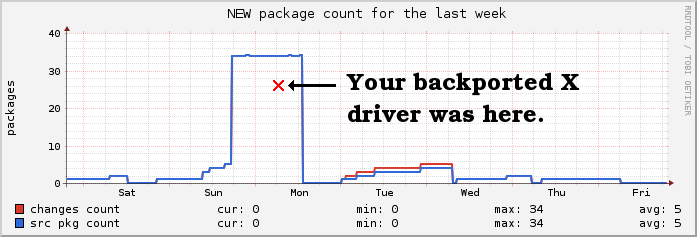
Cyril Brulebois: Squeeze backports for Xorg

It took some time but it finally happened! NEW queue for backports Rule of thumb: if you're happy with Squeeze s X, stick to it. If you need a newer driver, for example for Intel Sandy Bridge, then give squeeze-backports a shot, and cross fingers! As usual, x.debian.net contains the relevant documentation. Hopefully, the short squeeze-backports instructions will be sufficient. If you encounter some issues, feel free to contact debian-x@.

Michael Prokop: Use of VCS in Debian packages some stats

Everyone loves stats, ok well at least I do. I was doing some research with regards to package maintenance within the Debian distribution and since the results might be interesting for someone else there we are. On 19th of August 2011 there have been: Therefore ~59% of all packages in Debian/sid are officially managed with a version control system (VCS). Now, which VCS do those packages use?
  1. Svn: 4939
  2. Git: 4377
  3. Darcs: 284
  4. Bzr: 247
  5. Hg: 61
  6. Cvs: 31
  7. Arch: 28
  8. Mtn: 10
I ve retrieved the numbers from the Ultimate Debian Database (UDD). Sadly there s a bug in UDD regarding the Vcs-Type information, see #637524. Therefore I ve extracted a list of 80 packages where a Vcs-Browser header is available but the Vcs-Type entry is empty in UDD. 29 packages of them are managed inside CVS but don t appear as such in UDD, so I manually corrected the number for CVS in the numbers above. The remaining 51 packages have a Vcs-Browser field set but lack the according Vcs-* entry, some of them pointing to upstream VCS instead of the according Debian package repository, some of them result in 404 errors, etc. As a result I ve reported bugs where applicable (#638466, #638468, #638469, #638470, #638471, #638472, #638474, #638475, #638476, #638477, #638479, #638482, #638486, #638488, #638493, #638497, #638501, #638475, #638475, #638502, #638503, #638505, #638506, #638508, #638509, #638510, #638511, #638512, #638513, #638516, #638518, #638519, #638520, #638522, #638523, #638524, #638525, #638526, #638527, #638528, #638529, #638530, #638516, #638531). Disclaimer: I found Debian s Statistics wiki page and Zack s VCS usage stats after starting to play with my own stats. AFAICT Zack s slightly higher numbers are the result of looking at multiple versions for the same source packages, as you ll see when comparing numbers from UDD s sources_uniq view (which I used) with either 1) UDD s sources table, 2) source table count from projectb or 3) Package count from http://$DEBIAN_MIRROR/debian/dists/unstable/ main,contrib,non-free /source/Sources.bz2. Conclusion: 9316 packages are officially managed with Subversion and Git as of today, representing ~94% of the VCS managed packages. This means ~55% of all the Debian (source) packages are available through either a Git or Subversion repository and that s actually the number I was originally interested in. Thanks to Alexander Wirt, Christian Hofstaedter, Gerfried Fuchs, J rg Jaspert and Michael Renner for hints in forming up the final stats results.

Alexander Reichle-Schmehl: How to read ftp-masters package numbers table

In my previous blog about Debian's growing archive size I pointed as reference to an hard to read table on the ftp-master server, and missed that the table is not self explanatory and on the first glance hard to read. The table currently looks like the following:
                  e      s     p-u     t      u    t-p-u   l-r    s-u     o    o-p-u   s-r   
---------------------------------------------------------------------------------------------
     all         1096  12034     70  14442  15784     20      1     12   8910    230      0  
    alpha           -      -      -      -      -      -      -      -  13183    297      -  
    amd64        1164  16997    242  18581  19605     39      -     21  13964    342      -  
     arm            -      -      -      -      -      -      -      -  13251    291      -  
    armel         988  16401    239  17879  18680     39      -     21  13411    327      -  
     hppa           -      -      -      -      -      -      -      -  13227    264      -  
  hurd-i386       445      -      -      -  12622      -      -      -      -      -      -  
     i386        1178  17188    242  18727  19751     39      -     21  14377    350      -  
     ia64         951  16036    239  17303  18045     39      -     21  13554    329      -  
kfreebsd-amd64    807  14499    231  15905  16480     39      -     21      -      -      -  
kfreebsd-i386     826  14491    231  15881  16498     39      -     21      -      -      -  
     mips         974  16269    241  17730  18504     39      -     21  13638    323      -  
    mipsel        984  16291    239  17807  18558     39      -     21  13600    319      -  
   powerpc       1078  16677    239  18156  19036     39      -     21  13872    332      -  
     s390        1030  16252    239  17678  18469     39      -     21  13331    327      -  
    source        522  14974     51  16376  17405      1     19      6  12519     75    151  
    sparc         992  16423    239  17895  18673     39      -     21  13542    329      -  
The lines represent different hardware architectures Debian supports, like amd64 (for 64-Bit PCs), i386 (for 32-Bit PCs), etc. Two lines are kind of special, the one marked source and the one marked all. Let's start with the source line: That counts the number of source packages. Those are rarely seen by end users. Source packages contain the actual source needed to build a package, as well as Debian specific changes and a blue print on how to create an actual installable binary package from the source. As you can see Debian supports quite some architectures, which leads to a small problem on the mirrors: Quite a lot shipped in Debian is actually architecture independent. For example documentation, most sound and graphic files, or level data for a game. To avoid storing the very same date multiple times, Debian makes haeavy use of so called arch: all packages. You might have noticed them already while installing them:
Hole:5 ftp://ftp.rrzn.uni-hannover.de/debian/debian/ squeeze/main extremetuxracer-data all 0.4-4 [28,1 MB]
Hole:6 ftp://ftp.rrzn.uni-hannover.de/debian/debian/ squeeze/main extremetuxracer amd64 0.4-4 [273 kB]
In this example I installed a quite small game on the amd64 architecture, which depends on a quite big architecture independent package (notice the all between package name and version) containing it's data.So, to get the actual number of packages a user can install on a specific architecture, one has to add the number in the all line to the number in the specific architecture line. But what column to pick? The columns represent so called suites. The s is for stable, currently Debian 6.0 aka Squeeze and o for oldstable, aka Debian 5.0 Lenny. The t is for testing, aka Wheezy or the upcoming Debian 7.0. The u is for unstable aka sid. The e is for experimental, used for stuff probably not yet ready to be part of a stable release and therefore not uploaded to unstable. The rest is not that interesting (as you see it's mostly empty anyway), like s-u for stable updates, several p-u suites for proposed-updates (that is stuff that might end up in the next point release, and should be tested). And then we have s-r and l-r which I forgot what they are about... Sorry. But back to topic: As I explained briefly a source package is mostly used internally, but may create several binary packages, which a user can install. So the most interesting number for users is the number of binary packages on an arch. So we usually publish this number. So for example, using squeeze on i386 you can install: 17'188 (architecture dependent packages, column s row i386) + 12'034 (architecture independent packages columns s row all) = 29'222 packages. And for completeness: They are build from 14'974 source packages (row source column s). So if look that up for unstable on amd64 you should get to the result 35'389 binary packages build from 17'405 source packages. Slightly less than I reported yesterday, because we removed some old stuff e.g. obsolete libraries in the meantime. Update: J rg just explained me, that the s-r and l-r are there to ensure Debian complies with the GPL. They hold the sources of everything shipped in the original lenny and squeeze releases. Update 2: J rg explained it to me again: s-r and l-r contains sources used without being referenced by a package, and so might get lost otherwise. One example is the kernel used by the debian installation system. You have to boot a kernel somehow, so it can't be packaged. But we still need to save the sources, so it is referenced in these suites and won't get lost.

Vincent Bernat: jchroot: chroot with more isolation

Linux 2.6.24, released more than three years ago, introduced two very interesting features: PID and network namespaces. They allow to create a process that does not share the same PID namespace or the same network namespace than other processes. Those namespaces are then inherited by the children (unless they are assigned new namespaces).

PID & mount namespaces A PID namespace is a view of the processes running on the system. Each PID namespace will have its own numbering of the processes contained in its namespace (including the namespace of the children). Other processes are hidden and therefore, it is not possible to issue any operation requiring a PID on them, like kill(2). Moreover, the process that was created first in a namespace will get PID 1. If it gets killed, the namespace is destroyed and all other processes contained in this namespace are killed as well. systemd, a system and service manager for Linux, targeted as a replacement for the old SysV init, uses could use this feature to launch daemons in their own PID namespace and keep track of them without relying on their cooperation. When it needs to kill a daemon, it just kills the process with PID 1 (which has another PID in the global namespace) and the kernel will do the hard work of killing all processes that were started in this namespace. You can get more details about this namespace in the manual page of clone(2) (search for CLONE_NEWPID). UPDATED: In fact, systemd does not use PID namespaces but cgroups to group processes together. There is no PID numbering here but spawned processes are all enclosed into one cgroup and therefore can be killed easily. For example, here is the result of pstree -p inside a PID namespace:
root@guybrush:/# pstree -p
bash(1) pstree(8)
         sleep(7)
The PID of sleep is 7. In the global namespace, it is 31762 instead. But it is the same processus!
root@guybrush:/# ps -eo pid,command   grep sleep
31762 sleep 1000
Linux have also supported mount namespaces since a long time. Each process can have its own mount points that will be visible only by processes in the same namespace or in children namespaces. When the namespace is destroyed (when no process left), the kernel will do the cleanup itself.

chroot A common way to test experimental software or do packaging work is to build a chroot: debootstrap is used to build a new complete system inside a directory and chroot allows to enter into this new system. Tools like schroot can become handy if you need to do that often. Unfortunately, you only get an isolated filesystem. When you start launching daemons and mounting partitions, you need to keep track of all your actions to undo them. Quitting the chroot will not kill any daemon nor unmount any partition. Extending an existing tool, like schroot to use PID and mount namespaces seems the best way to prevent such problems. I have filed bug #637870 for this purpose. However, this is not as simple as it seems since schroot allows to run a process into an existing session. When the session is a chroot, this is quite easy: just chroot into the same root filesystem and launch the process here. With other kind of namespaces, you need to use a new system call, setns(), to change the current namespace of the running process. However, some bits are still missing. First, the GNU C Library does not implement the appropriate wrapper. Second, Linux (as of 3.0) does not contain the support to change the PID namespace of a running process yet. Other tools exist, like lxc (aka Linux Containers). However, it is more targeted at providing a complete container. I have reported that lxc-execute is not able to spawn a standalone shell but got no luck. UPDATED: systemd ships with systemd-nspawn which was exactly what I needed. However, it requires systemd. Otherwise, it seems less basic than the alternative that I describe below (some sensible mount points are setup, the console is correctly configured, signals are correctly transmitted, ). If you use systemd, look at it!

jchroot Building a chroot clone using namespaces is quite easy. The only difficulty is the use of clone(2). Here is a sketch:
int main()  
  pid_t pid;
  int ret;
  long stack_size = sysconf(_SC_PAGESIZE);
  void *stack = alloca(stack_size) + stack_size;
  /* New process with its own PID/IPC/NS namespace */
  pid = clone(step2,
              stack,
              SIGCHLD   CLONE_NEWPID   CLONE_NEWIPC  
              CLONE_NEWNS   CLONE_FILES,
              NULL);
  /* Wait for the child to terminate */
  while (waitpid(pid, &ret, 0) < 0 && errno == EINTR)
    continue;
  return WIFEXITED(ret)?WEXITSTATUS(ret):EXIT_FAILURE;
 
static int step2(void *a)  
  /* Mount /proc as an example */
  mount("proc", "/proc", "proc", 0, "");
  /* Chroot */
  chroot("/srv/debian");
  chdir("/");
  /* Drop privileges */
  setgid(1000);
  setgroups(0, NULL);
  setuid(1000);
  /* Exec shell */
  execl("/bin/bash", "/bin/bash", NULL);
 
Add command flags, error handling and fstab parsing for the definition of mount points and you get jchroot. Here is an example of use:
$ cat fstab
proc     /proc  proc    defaults                  0  0
sys      /sys   sysfs   defaults                  0  0
/home    /home  none    bind,rw                   0  0
/dev/pts /dev/pts none  bind,rw                   0  0
/var/run /var/run tmpfs rw,nosuid,noexec,mode=755 0  0
/etc/resolv.conf /etc/resolv.conf none bind,ro    0  0
$ sudo jchroot -f fstab -n test /srv/debian/squeeze /bin/bash
# hostname
test
# ps auxww
USER       PID %CPU %MEM    VSZ   RSS TTY      STAT START   TIME COMMAND
root         1  0.0  0.0  19480  1888 pts/1    S    15:18   0:00 /bin/bash
root         3  0.0  0.0  16536  1184 pts/1    R+   15:18   0:00 ps auxww
# /etc/init.d/postgresql start
Starting PostgreSQL 9.0 database server: main.
# exit
$ ps auxwwc   grep postgres
$
I hope that jchroot won t live for too long and that its features will be integrated into regular chroot tools. I was thinking at proposing a patch for chroot(8). Anyone knows if this would have a chance to be accepted?

18 August 2011

Thorsten Glaser: How not to create DEB files

Once upon a time, there was Deb and Ian. That was about exactly 18 years ago. We don t talk about the 0.939000 format any more, but they eventually settled on:

	$ ar rc pkg_1.0_all.deb debian-binary control.tar.gz data.tar.gz
	$ hexdump -C pkg_1.0_all.deb   head
	00000000  21 3c 61 72 63 68 3e 0a  64 65 62 69 61 6e 2d 62   !<arch>.debian-b 
	00000010  69 6e 61 72 79 20 20 20  31 33 31 33 36 38 33 35   inary   13136835 
	00000020  32 39 20 20 31 30 30 36  20 20 32 30 30 20 20 20   29  1006  200    
	00000030  31 30 30 36 34 34 20 20  34 20 20 20 20 20 20 20   100644  4        
	00000040  20 20 60 0a 32 2e 30 0a  63 6f 6e 74 72 6f 6c 2e      .2.0.control. 
	00000050  74 61 72 2e 67 7a 20 20  31 33 31 33 36 38 33 35   tar.gz  13136835 
	00000060  32 39 20 20 31 30 30 36  20 20 32 30 30 20 20 20   29  1006  200    
	00000070  31 30 30 36 34 34 20 20  31 33 39 31 20 20 20 20   100644  1391     
	00000080  20 20 60 0a 1f 8b 08 00  00 00 00 00 00 03 ed 59      ............Y 
	00000090  eb 6f db 36 10 f7 d7 f0  af b8 3a 5e 9b 74 b1 f5   .o.6......:^.t.. 
 

By then, systems were a.out(5), and everything was good. (Of course, if you look at the mtimes, you ll notice I faked this. But it s really equivalent to the real thing.

But oh horror! GNU binutils, not always everyone s friend, switched from using BSD style Unix Archiver libraries in ar(1) to SYSV style libraries on elf(5) systems:

	$ ar rc on-elf debian-binary control.tar.gz data.tar.gz
	$ hexdump -C on-elf   head
	00000000  21 3c 61 72 63 68 3e 0a  64 65 62 69 61 6e 2d 62   !<arch>.debian-b 
	00000010  69 6e 61 72 79 2f 20 20  31 33 31 33 36 38 33 35   inary/  13136835 
	00000020  32 39 20 20 31 30 30 36  20 20 32 30 30 20 20 20   29  1006  200    
	00000030  31 30 30 36 34 34 20 20  34 20 20 20 20 20 20 20   100644  4        
	00000040  20 20 60 0a 32 2e 30 0a  63 6f 6e 74 72 6f 6c 2e      .2.0.control. 
	00000050  74 61 72 2e 67 7a 2f 20  31 33 31 33 36 38 33 35   tar.gz/ 13136835 
	00000060  32 39 20 20 31 30 30 36  20 20 32 30 30 20 20 20   29  1006  200    
	00000070  31 30 30 36 34 34 20 20  31 33 39 31 20 20 20 20   100644  1391     
	00000080  20 20 60 0a 1f 8b 08 00  00 00 00 00 00 03 ed 59      ............Y 
	00000090  eb 6f db 36 10 f7 d7 f0  af b8 3a 5e 9b 74 b1 f5   .o.6......:^.t.. 
 

Can you spot the difference?

Of course, ELF is what you want , so there is little choice. Unix Archiver libraries are system dependent, and no format has ever been normed, but DEB files use it as format so what is one to do?

	$ GNUTARGET=a.out-i386-linux ar rc with-aout \
	> debian-binary control.tar.gz data.tar.gz
	$ md5sum pkg_1.0_all.deb with-aout on-elf
	248f78d42f8ca8f2a3560f9800b2bf01  pkg_1.0_all.deb
	248f78d42f8ca8f2a3560f9800b2bf01  with-aout
	09eca70c9b11b6b55bbadcab5c3201fb  on-elf
 

OK, and what do I do on my Debian/m68k system?

ar(1) uses bfd, and GNU binutils can not only forcibly set the target emulation but also show them:

debian_m68k$ ar -h 2>&1 grep '^ar: supported targets'
ar: supported targets: elf32-m68k a.out-m68k-linux elf32-little elf32-big plugin srec symbolsrec verilog tekhex binary ihex trad-core
debian_i386$ ar -h 2>&1 grep '^ar: supported targets'
ar: supported targets: elf32-i386 a.out-i386-linux pei-i386 elf32-little elf32-big elf64-x86-64 elf32-x86-64 pei-x86-64 elf64-l1om elf64-k1om elf64-little elf64-big plugin srec symbolsrec verilog tekhex binary ihex trad-core
debian_i386$ ar -h 2>&1 grep '^ar: supported targets' # binutils-multiarch
ar: supported targets: elf32-i386 a.out-i386-linux pei-i386 elf32-little elf32-big elf64-alpha ecoff-littlealpha elf64-little elf64-big elf32-littlearm elf32-bigarm elf32-hppa-linux elf32-hppa elf64-x86-64 elf32-x86-64 elf64-l1om elf64-k1om elf64-ia64-little elf64-ia64-big pei-ia64 elf32-m68k a.out-m68k-linux coff-m68k versados ieee a.out-zero-big elf32-tradbigmips elf32-tradlittlemips ecoff-bigmips ecoff-littlemips elf32-ntradbigmips elf64-tradbigmips elf32-ntradlittlemips elf64-tradlittlemips elf32-powerpc aixcoff-rs6000 elf32-powerpcle ppcboot elf64-powerpc elf64-powerpcle aixcoff64-rs6000 aix5coff64-rs6000 elf32-s390 elf64-s390 elf32-shbig-linux elf32-sh-linux elf32-sh64-linux elf32-sh64big-linux elf64-sh64-linux elf64-sh64big-linux elf32-sparc a.out-sparc-linux elf64-sparc a.out-sunos-big pei-x86-64 elf32-m32r-linux elf32-m32rle-linux elf32-spu plugin srec symbolsrec verilog tekhex binary ihex trad-core
mirbsd_i386$ ar -h 2>&1 grep '^ar: supported targets'
ar: supported targets: elf32-i386 coff-a29k-big a.out.adobe aix5coff64-rs6000 a.out-zero-big a.out-mips-little epoc-pe-arm-big epoc-pe-arm-little epoc-pei-arm-big epoc-pei-arm-little coff-arm-big coff-arm-little a.out-arm-netbsd pe-arm-big pe-arm-little pei-arm-big pei-arm-little b.out.big b.out.little efi-app-ia32 efi-app-ia64 elf32-avr elf32-big elf32-bigarc elf32-bigarm elf32-bigarm-symbian elf32-bigarm-vxworks elf32-bigmips elf32-cr16c elf32-cris elf32-crx elf32-d10v elf32-d30v elf32-dlx elf32-fr30 elf32-frv elf32-frvfdpic elf32-h8300 elf32-hppa-linux elf32-hppa-netbsd elf32-hppa elf32-i370 elf32-i386-freebsd elf32-i386-vxworks elf32-i860-little elf32-i860 elf32-i960 elf32-ia64-hpux-big elf32-ip2k elf32-iq2000 elf32-little elf32-littlearc elf32-littlearm elf32-littlearm-symbian elf32-littlearm-vxworks elf32-littlemips elf32-m32r elf32-m32rle elf32-m32r-linux elf32-m32rle-linux elf32-m68hc11 elf32-m68hc12 elf32-m68k elf32-m88k elf32-mcore-big elf32-mcore-little elf32-mn10200 elf32-mn10300 elf32-msp430 elf32-nbigmips elf32-nlittlemips elf32-ntradbigmips elf32-ntradlittlemips elf32-openrisc elf32-or32 elf32-pj elf32-pjl elf32-powerpc elf32-powerpc-vxworks elf32-powerpcle elf32-s390 elf32-sh elf32-shbig-linux elf32-shl elf32-shl-symbian elf32-sh-linux elf32-shl-nbsd elf32-sh-nbsd elf32-sh64 elf32-sh64l elf32-sh64l-nbsd elf32-sh64-nbsd elf32-sh64-linux elf32-sh64big-linux elf32-sparc elf32-tradbigmips elf32-tradlittlemips elf32-us-cris elf32-v850 elf32-vax elf32-xstormy16 elf32-xtensa-be elf32-xtensa-le elf64-alpha-freebsd elf64-alpha elf64-big elf64-bigmips elf64-hppa-linux elf64-hppa elf64-ia64-big elf64-ia64-hpux-big elf64-ia64-little elf64-little elf64-littlemips elf64-mmix elf64-powerpc elf64-powerpcle elf64-s390 elf64-sh64 elf64-sh64l elf64-sh64l-nbsd elf64-sh64-nbsd elf64-sh64-linux elf64-sh64big-linux elf64-sparc elf64-tradbigmips elf64-tradlittlemips elf64-x86-64 mmo pe-powerpc pei-powerpc pe-powerpcle pei-powerpcle a.out-cris demo64 ecoff-bigmips ecoff-biglittlemips ecoff-littlemips ecoff-littlealpha coff-go32 coff-go32-exe coff-h8300 coff-h8500 a.out-hp300hpux a.out-i386 a.out-i386-bsd coff-i386 a.out-i386-freebsd a.out-i386-lynx coff-i386-lynx msdos a.out-i386-netbsd i386os9k pe-i386 pei-i386 coff-i860 coff-Intel-big coff-Intel-little ieee coff-m68k coff-m68k-un a.out-m68k-lynx coff-m68k-lynx a.out-m68k-netbsd coff-m68k-sysv coff-m88kbcs a.out-m88k-mach3 a.out-m88k-openbsd mach-o-be mach-o-le mach-o-fat coff-maxq pe-mcore-big pe-mcore-little pei-mcore-big pei-mcore-little pe-mips pei-mips a.out-newsos3 nlm32-alpha nlm32-i386 nlm32-powerpc nlm32-sparc coff-or32-big a.out-pc532-mach a.out-ns32k-netbsd a.out-pdp11 pef pef-xlib ppcboot aixcoff64-rs6000 aixcoff-rs6000 coff-sh-small coff-sh coff-shl-small coff-shl pe-shl pei-shl coff-sparc a.out-sparc-little a.out-sparc-linux a.out-sparc-lynx coff-sparc-lynx a.out-sparc-netbsd a.out-sunos-big sym a.out-tic30 coff-tic30 coff0-beh-c54x coff0-c54x coff1-beh-c54x coff1-c54x coff2-beh-c54x coff2-c54x coff-tic80 a.out-vax-bsd a.out-vax-netbsd a.out-vax1k-netbsd versados vms-alpha vms-vax coff-w65 coff-we32k coff-z8k elf32-am33lin elf32-ms1 srec symbolsrec tekhex binary ihex netbsd-core

Wow. While binutils share no single supported working target, they can be built multiarch, or (on MirBSD) with --enable-targets=all --enable-64-bit-bfd. Doesn t help if you want to stay portable: GNUTARGET=srec is common on all Debian (sid) binutils versions (single or multiarch), but errors out on older binutils. The a.out-* targets are not common. Sure, you could hack around things, but this is tedious. If you follow things or know me a little, you might already have guessed that I wouldn t let that stand.

pax(1) to the rescue. On MirBSD, we use paxtar, which has cpio(1) and tar(1) front-ends and supports multiple formats (4 cpio and 2 tar variants) and has already been extended a lot and is lovingly called paxmirabilis (mirabilos peace in Latin) it has options to anonymise archives: set uid and gid to zero, set mtime to zero, (for ustar) only write the numeric uid and gid to the archive, (for cpio formats) serialise inodes and device information, write content of hardlinked files only once (breaks partial extraction but saves a lot of space, e.g. 2 MiB off the Grml initrd.gz). And, recently, the ability to append a trailing slash to pathnames of ustar members which are directories (GNU tar does it and I thought some Debian utilities check for it). So why not (the -M dist and fakeroot set the uid/gid to 0)

	$ find debian-binary control.tar.gz data.tar.gz   \
	> mircpio -oHar -Mdist >with-mircpio
	$ mirpax -w -M dist -f with-mirpax -x ar \
	> debian-binary control.tar.gz data.tar.gz
	$ mirtar -M dist -A -cf with-mirtar \
	> debian-binary control.tar.gz data.tar.gz
	$ GNUTARGET=a.out-i386-linux fakeroot ar rc with-aout-ar \
	> debian-binary control.tar.gz data.tar.gz
	$ md5sum with-*
	a466e2fd57cdee141fe585a43245548f  with-aout-ar
	a466e2fd57cdee141fe585a43245548f  with-mircpio
	a466e2fd57cdee141fe585a43245548f  with-mirpax
	a466e2fd57cdee141fe585a43245548f  with-mirtar
 

Voil . I got it, and even appending is possible. It supports the BSD format with special focus on DEB files, and deals with long filenames, but not symbol or filename tables (used by ranlib(1) or strange formats, respectively, but since we don t create *.a files to use with some native linker/binder/loader, we don t need that anyway).

On extraction (oh, and listing!) it deals with SYSV style filenames as well.

	$ mirtar tvf on-elf
	-rw-r--r--  1 tg       tg          4 Aug 18 16:05 debian-binary
	-rw-r--r--  1 tg       tg       1391 Aug 18 16:05 control.tar.gz
	-rw-r--r--  1 tg       tg      18135 Aug 18 16:05 data.tar.gz
	$ mirtar tvf with-aout
	-rw-r--r--  1 tg       tg          4 Aug 18 16:05 debian-binary
	-rw-r--r--  1 tg       tg       1391 Aug 18 16:05 control.tar.gz
	-rw-r--r--  1 tg       tg      18135 Aug 18 16:05 data.tar.gz
 

One of the real benefits is that you can use the front-ends interchangably for example, mirtar tzf foo.cpio.gz would work (which GNU tar can t do), and mircpio s ustar implementation, unlike GNU cpio s, is not horribly broken. Of course, there are some drawbacks: it s not GNU tar or GNU cpio, so there are absolutely zero --long-options. Some of their features are missing (but tar s -O is implemented now), so it s no replacement (but very well usable alongside it). The format called pax, committee-designed to replace ustar, isn t yet supported ironically, but that s on the TODO.

So, what do you think?

	tg@frozenfish:~/Debs/dists/sid/wtf/Pkgs/mircpio $ ll *.deb
	-rw-r--r-- 2 tg freewrt 78140 Aug 17 11:04 mircpio_20110817-0wtf2_amd64.deb
	-rw-r--r-- 3 tg freewrt 72262 Aug 17 11:00 mircpio_20110817-0wtf2_i386.deb
	-rw-r--r-- 1 tg freewrt 67446 Aug 17 18:21 mircpio_20110817-0wtf2_m68k.deb
 

Should I upload this to Debian proper? As for the licence: 3-clause UCB (and 2-clause BSD, which is a subset of it), so no problem. I m asking because the other package which I had been using for a long time and not uploaded, jupp, got uploaded recently (during DebConf) on user input (people wondered why it did not yet exist in Debian proper). I guess the old saying if it s not in Debian, it doesn t exist holds true in many parts of the OSS world. It s up to date wrt. standards btw, and lintian-clean save for two pedantic-class warnings (no upstream changelog file, no homepage link) which aren t fulfillable (could link this wlog entry as homepage). If you know Alioth you re familiar with the software formerly known as SourceForge, formerly known as GForge, currently known as FusionForge. My employer both uses it and contributes to it, we run an adapted (mostly themed, prototyping new functions that often end up in FusionForge itself, and backporting functions from FF to our production codebase ) version.

I ve backported the extratabs plugin to appease project managers and other non-technical people while we move our codebase to FF 5.1, and I did so on an installed version of the plugin rather than the source because the latter was tightly integrated with rather heavy packaging style changes.

	[ ]
	dh_builddeb
	# create fusionforge-plugin-extratabs binary package
	toplev=$$(pwd); cd plugins/fusionforge-plugin-extratabs; \
	p=$$(print -r -- $$(sed -n '/^Package: /s///p' C/control   head -1)); \
	v=$$(print -r -- $$(sed -n '/^Version: /s///p' C/control   head -1)); \
	a=$$(print -r -- $$(sed -n '/^Architecture: /s///p' C/control   head -1)); \
	d=$$ p _$$ v _$$ a .deb; \
	rm -f $$toplev/../$$d control.tar.gz data.tar.gz; \
	(cd control; find .   fgrep -v /.svn   sort   \
	    mircpio -oC512 -Hustar -M0x0B -Mgslash)   gzip -n9 >control.tar.gz; \
	(cd data; find .   fgrep -v /.svn   sort   \
	    mircpio -oC512 -Hustar -M0x0B -Mgslash)   gzip -n9 >data.tar.gz; \
	mirtar -M dist -Acf $$toplev/../$$d debian-binary cont*gz dat*gz; \
	rm -f control.tar.gz data.tar.gz; \
	cd $$toplev; dpkg-distaddfile $$d non-free/devel optional
 

The hardest part of extending debian/rules with that was to get the autobuild and dpkg-distaddfile call right. This works, even though I d call it a temporary kludge. (No need to tell me I should have used && I know. And I only shell out to mksh(1) because the inner part was already there from before, when I still used ar(1). This was slightly edited for the wlog.) In the meanwhile, apt-extracttemplates can deal with SYSV style filenames in DEB files on Debian sid, but not on Kubuntu hardy, which some people are using as Desktop OS still

Thorsten Glaser: FrOSCon 2011

This year without our friends from Grml, but The MirOS Project (all two active developers and our Booth Babe gecko2@) will of course attend FrOSCon, nicknamed Froschkon, again. We ll have a pre-event meal time at my favourite Jugoslawian Restaurant on Friday (20:00 CEST) contact me privately for the co rdinates if interested. On Saturday and Sunday we ll staff a booth and answer questions about the many projects we have (more or less) running, including but not limited to paxmirabilis (aka MirCPIO), The MirBSD Korn Shell aka mksh(1), jupp the editor, and developers private projects such as slowly undermining Debian or Google-Go. While slow we are still working on World Domination. And teaching people good shell programming by example code. We might even bring CDs, but I m still working on the ISO last night s build aborted because the OS grew a bit making the floppy image not fit any more. (Solution, drop ping(8) and rtsol(8), but re-add sf(4) and bce(4) now that they fit again.)

Thorsten Glaser: ??? ??? or mira meets d-i

(originally published on 2011-01-26, but reposting so the people on Pl net Debian can have some fun) While helping a cow-orker setting up an encrypted hard disc (basically, putting / and swap into LVM inside cryptsetup, and /boot outside), mirabilos managed to discover an entirely new side of Kubuntu 10.10 on his voyage Warped
wo noch nie ein Debian Developer zuvor gewesen ist oder? (Only a reboot helped at that point. Earlier, the dialogue box was shown only once, but upon re-entry of the partitioning clickibunti d-i tool, neither button did anything save redrawing this interesting, informative and intuitive error message.)

Jo Shields: Why we mustn t allow smartphones to become a 2 or 3 horse race

A very popular refrain on tech sites is that the high street cannot support multiple competing phone ecosystems. It s a reasonable position to take. Do phone stores want to train their employees on six or seven different OSes? Do consumers understand the differences, and should they need to? Do app developers want to rewrite their app six or seven times? The obvious answer to all of these is no . Stores only want to train their employees once, developers want to write their app once. Choice is bad, because choice is complicated. You can have it in any colour, so long as it s black. The problem is, we need those competing efforts, for the entire market to increase in quality. Until the iPhone appeared on the market, Google s nascent mobile phone OS looked more like a poor man s Blackberry OS than what ended up shipping on the HTC Dream and later devices. Windows Phone 7 didn t ship with any multitasking at all and now the Mango update will be incorporating a multitasking model largely thieved from WebOS. iOS only just got support for updating the phone s firmware without being plugged into a host PC via USB, something which a few Android devices and all WebOS devices have always supported. Consider, for comparison, the web browser market. It would be easiest if there was only one web browser but that browser would quickly stagnate and cause pain, the way Internet Explorer 6 did when it had almost the entire market. It wasn t until upstarts like Firefox and Opera and Chrome and more started showing off their unique ideas that the entire pack started improving including IE, with IE9 supporting most of the features that the competition introduced. Every smartphone shipping today has something to offer that other devices don t and every smartphone OS shipping today has something to offer that other OSes don t. iOS has the widest app catalog. Android is Open Source (FSVO Open ). WebOS has the best multitasking, and Just Type . Windows Phone 7 offers a drastic new user interface paradigm. Blackberry OS is built for messaging tasks, and has the best sysadmin control. Symbian is well, okay, sometimes there s a time to let go but the same applies for web browsers too. Smartphones are communication devices that people use every day of their lives, and every consumer has different needs we shouldn t try to push them into an ill-fitting category, just to satisfy ourselves that it s probably only possible for three mobile platforms to succeed in the mass-market . For some people, Blackberry OS really *is* the best choice, and no matter how much you pretend, an iPhone would enhance their lives. And as for the app question tough shit. Plenty of app developers only target iOS even though Android is overtaking in the market, and if they really want to reach as many people as possible, then use a cross-platform framework like PhoneGap or some of Xamarin s products. Single-ecosystem apps are a low-effort push to reach as many people possible with minimal investment, and the only way to satisfy that class of developer is to eliminate ALL competition in the marketplace iOS-only devs are this decade s IE6-only devs. Everyone is entitled to their opinion, but I for one am sick of all the tales of doom and gloom that immediately surround any effort which isn t iOS or pure Android. We have a marketplace of ideas, which we should be celebrating, and not dumping on. I m eagerly awaiting delivery of my HP Pre 3, with all the unique possibilities it offers me which simply another Android device wouldn t have. And the big difference between WebOS and Nokia s Maemo/MeeGo efforts, for those who are still doubtful, is HP haven t spent years trying to deliberately sabotage the platform. Give it time. If I m wrong, the worst-case scenario is being lumbered with an awesome phone.

Asheesh Laroia: OpenHatch round two: the non-profit

For the past year or two, readers of asheesh.org (including those on Planet Debian) have been hearing on and off about OpenHatch, a project that began in Atlanta two summers ago. The OpenHatch website has been a place to find out how new contributors can get involved in free software. Lately, I've discovered how much fun it is to help people get involved. I've also discovered oodles of enthusiasm for learning more about joining an open source project. So I've been transitioning OpenHatch to be more of a non-profit and to work on more of those outreach events, and particularly I've been transitioning my life to support me (self-funded) working on that effort full-time for a year. If there's one thing I learned while creating a startup under incubation, it was how to save money. The OpenHatch blog has the rest of the story. Here's a taste:
I m writing to announce three big changes for the project. First, OpenHatch is changing its organizational structure to reflect our not-for-profit goals. Second, we ll emphasize our new work beyond the website, building and promoting outreach events that bring new people into the free software community. Finally, I am taking a year to do that full-time as the project lead of OpenHatch in Somerville, MA.
This change has been a long-time coming, and it's thanks to so many people who have given advice and feedback along the way. One special shout-out goes to Bradley Kuhn, who told me in March 2010 that OpenHatch should be a non-profit. I hope you'll read more.

17 August 2011

Joey Hess: summer trips wrapup

Finally back from a solid month away. For the past three days I've been coding, which feels good after all that time away.

Tanguy Ortolo: Booting with UEFI

A combat boot I have just bought a new motherboard, a ASRock E350M1/USB3 with and embedded AMD E350 processor. I was mostly interested in trying the embedded GPU and the UEFI firmware (UEFI is simply the name of EFI 2). According to ASRock's marketing, the main benefit of that UEFI is its graphical interface that allows to use the mouse to configure the board. I cannot agree with that, because I think it is perfectly possible to implement that with a BIOS (and I think some BIOSes actually do it), and it is pointless anyway. For me, the main benefits are a faster and cleaner boot (no idea why it should be faster, but it is).The EFI boot process EFI seems to suffer from some (many?) design errors, but I find its boot process more clean and flexible than the old BIOS one:
  1. It starts with a boot manager which is similar to the temporary boot device selection menu of most recent BIOSes.
  2. When you have selected the device to boot from, it looks into its EFI System partition, identified by its type GUID, as FAT file system, and executes a boot loader from a file at a specific path: /efi/boot/bootx64.efi (on amd64 platforms) by default, specially for removable devices.
  3. Once the boot loader is loaded, the boot process continues as usual and is no longer specific to EFI (although the ABI used by the boot loader is specific, of course).
It is worth mentioning that the boot manager configuration, which lies in the EFI NVRAM, can be accessed and modified from an operating system, to add random entries for loading a boot loader at any path accessible from the boot manager (you will not be able to load a file from an Ext4 file system, for instance). GRUB on EFI To be able to install GRUB on EFI you need an EFI System partition, formatted in FAT and mounted on /boot/efi. GRUB will simply install itself on /boot/efi/efi/debian/grubx64.efi (on Debian) according to the EFI Specification, and use efibootmgr to create a new boot manager entry called debian and pointing to it. Tricks Well, for me, it did not work. The debian boot option failed, saying that this was not a bootable disk. I managed to get an EFI Shell, by putting Tianocore's shell into a FAT-formatted USB stick as /boot/efi/efi/boot/bootx64.efi. Using this DOS-smelling shell, I found that the directory /efi was unusable: it was listed, but any command trying to access to it failed. The reason was quite tricky, caused by a broken FAT implementation. With FAT, the file system label is stored both in the file system header and as a bogus root directory entry (yes, this sounds completely crazy). As I labelled my EFI System partition as EFI , there was such a bogus entry for this name: I think ASUS' implementation of FAT was taking it for the /efi directory. It took me hours to finally find the cause of this problem and fix it be re-formatting the partition with a new label (re-labelling may have been sufficient but I wanted to be safe).

15 August 2011

Steve McIntyre: In one word: AWESOME

Every year I worry that DebConf might not be as good as I hope, or not as good as previous years. Well, I've yet to be let down! The road trip down to Banja Luka was good fun, even if it took a little longer than planned. We ended up travelling down through Germany on the same Friday as much of the country finished work/school for their summer vacation, so there was a lot of traffic. Meh, we got there in the end. I made my usual mistake of planning some things to hack on during the DebConf week; by now I should know better... :-) I made a start on one small project, but then got so distracted by so many talks and side meetings with people that it's still waiting. As always, my own personal TODO list picked up huge amounts of extra stuff from those discussions. Catching up with, and socialising with, Debian friends from all over the world was also fun as always! Lots of highlights of the week for me, both for technical and social reasons: Banja Luka was a lovely place to visit, and a great host city for DebConf. Looking forwards to Managua now!

Next.

Previous.