Search Results: "ema"

28 May 2007

Eric Dorland: The Ghost of Browser Past

Even though Iceweasel has been a reality since November, it seems that there is still some backlash about the rename. Thanks very much to Andrew for jumping to my defense (and also for organizing dinner the last time I was in Mountain View, it was a fun evening). Nothing he said was fundamentally incorrect, but it doesn't paint the full picture.

Once upon a time (somewhere around Firefox 0.9) we happily shipped the fox hugging the globe icon. Then it was pointed out the copyright license on that piece of artwork wasn't DFSG free (and probably wouldn't be free under any reasonable free software or even open content license), so we removed it and used the plain globe icon they shipped in the tarball instead. Eventually the Mozilla Foundation asked us to remove mozilla- from the package name (it was mozilla-firefox at the time) which we did, and the issue of the icon and trademark came up. After explaining why we couldn't ship the icon they gave us permission to continue to use the name. They said they would periodically check up to make sure we weren't shipping crap that would harm the brand. This seemed a fairly good compromise and we accepted.

This situation persisted for a year or so, in both Debian and Ubuntu, but then the Mozilla Corporation (who was now in possession of the trademarks) insisted we couldn't use the name without the non-free logo. They also wanted to approve any changes made before they were uploaded. They are certainly within their rights to do this, but to hear Mr. Fowler tell it we were on a crusade to purge the name from the distro. We were not, we were content with the status quo. I also must take exception with Mr. Fowler stating: "They've persisted, despite the best efforts of the Mozilla project team to engage with the Debian packagers to resolve the situation." I think from the discussion we were trying our best to reach some sort of compromise and the Mozilla side seemed firmly entrenched in their position, not offering us a lot of alternatives. The non-free nature of the logo and the unprecedented "control-freak" review process didn't leave us with a lot of alternatives.

Ubuntu does ship the officially branded version of the Firefox, but they have a weaker set of freedom guidelines than Debian. Whether you think that is good or bad is personal choice, but one of the reasons I like Debian so much is its commitment to free software, even if that means not everything is as easy or expedient as one would like.

With respect to the new name and icon, this is again a matter of personal taste. I do tend to think "Iceweasel" doesn't have that much sex appeal but it was a popular choice and had the benefit of having already been used to refer to a potential name fork of Firefox. And BTW this is really only a name fork, the amount of changes we've actually put in to the tree (beyond renaming ones) are minimal. In fact the last time it was checked, our patches were a strict subset of the patches Ubuntu uses in their Firefox package. So Iceweasel is in fact functionally identical to Firefox with what I like to think are some minor improvements from upstream.

As to your other points, I will admit to being poorly-socialized, but I think most who have met me wouldn't call me self-obsessed, egotistical or a moron.

I think Debian is developing a bit of a bias against it where we're assumed to be a bunch of crazy Free software nuts, and the presumption is anytime we act against the grain we're the ones being unreasonable despite any evidence to the contrary. I don't know how we can fight this perception, but I think we should.

Russell Coker: New Blogs

After reading advice from ProBlogger I have become convinced that I should create separate blogs for some of the content that is currently on my blog. The first such blog that I will create will be about computer security. Naturally it will cover SE Linux to some degree, but the exact focus is something I have not yet determined. Here are the options I’m considering: Also if you have any other suggestions for blogs that you would read if I was to write them then plese send them in via a blog comment or email.

Andrew Pollock: [tech] LVM, you've done it again

The good thing about having kept a blog these last few years, is I have a searchable record of hardware changes. Recently, I noticed a few disk errors on caesar, and I was wondering how old that disk was. I disk some searching, and found via this post that the disk in it was a hand-me-down from when I decommissioned daedalus Mk I. One of the reasons I decommissioned it when I did, was the RAID-1 was exhibiting some strange errors during resynchronisation, and I didn't want to leave the country leaving behind an ageing problematic server with my stuff on it. I'd previously been unable to fault either 120 Gb disk under some light testing with badblocks, so I just reused them, and so around October 2005, I put the larger disk in caesar. So this disk has seen a fair bit of use, originally in daedalus, and then in caesar for another 20 months. It's allowed to fail, it's served me well. Anyway, so I bought a 750 Gb drive a couple of weeks ago, because one thing that I've wanted to do with caesar was do remote backups of daedalus, and there just wasn't enough space to do that, so I went for as big as I could find, and essentially repeated the same trick as last time, to upsize:
  1. Power down, attach new disk as a slave
  2. Boot into single user mode
  3. Unmount everything, remount root read-only
  4. sfdisk -d /dev/hda sfdisk /dev/hdb to copy the partition table (I use a root, swap, LVM, three partition layout)
  5. dd if=/dev/hda1 of=/dev/hdb1 bs=1M to copy the root filesystem to the new disk
  6. mkswap /dev/hdb2 to put the swap signature on what will become the new swap device
  7. cfdisk /dev/hdb and blow away the third partition and recreate it using all of the available space (there's probably a programmatic way of doing this, but hey, it's not exactly hard to do in cfdisk either)
  8. pvcreate /dev/hdb3 to put an LVM signature on the new LVM physical volume
  9. vgextend base /dev/hdb3 to tell LVM there's two disks in the volume group for the time being
  10. Remount the root filesystem read-write
  11. rm /boot/grub/device.map and run /usr/sbin/grub-install /dev/hdb to install GRUB in the MBR of what will become the new boot disk
  12. Power down, swap the disks around so that the new disk is now primary and the old disk is now the slave
  13. Boot into single user mode again, unmount everything except root
  14. pvmove /dev/hdb3 /dev/hda3 to relocate all of the allocated physical extents off the old disk onto the new one
  15. Twiddle thumbs for a couple of hours. Admire artwork on computer's motherboard (did you know Compaq EVO's have a picture of a car on their motherboards? A map of Texas?)
  16. vgreduce base /dev/hdb3 to take the old disk out of the volume group
  17. pvremove /dev/hdb3 to remove the LVM signature from the old disk
  18. Power down and remove the old disk
  19. Reboot into multi-user mode and profit from all the additional free physical extents
I absolutely love how I can do this with LVM, with a minimum of fuss. Last time I did this, I had a kernel panic during the pvmove, but that didn't even stop it, I just rebooted and reran the pvmove and it carried on from the last checkpoint. No such excitement this time. I'm sure Solaris' ZFS does all of this with substantially less manual steps, but hey, I like my Linux :-)

27 May 2007

Miriam Ruiz: Debian multiple binary packages: example 2

Some days ago I wrote a small example of creating multiple binary packages from a source where the program was built and installed with autotools. Now I’ve remade the example, starting from a system built directly using a make script, and which doesn’t provide an install target. Even more, it is supposed to get the data from a directory relative to the working directory. This is, in fact, a scheme often found when packaging games. The debian/rules script uses quilt to apply the necessary patches, so that absolute directories are used for the data file.

Andrew Pollock: [tech] Finding out just how hot the linen cupboard is...

I decided to move the old 1-RU Pentium III server (the thing providing all the storage for my MythTV box via ATAoE) from under the bed in the spare room to the linen cupboard. It had a brief stop in the wardrobe in the spare room, but it didn't really help with the noise. Sarah was a concerned about the heat in the linen cupboard, as this is where the patch panel is, so caesar is already in here, along with an Ethernet switch, an ADSL modem, a wireless access point, and the Vonage ATA. There's a lot of DC plug packs generating heat, so it was a reasonable concern. I figured in this day and age, someone must make some sort of USB temperature sensor, and after some searching around, I discovered the DLP-TEMP-G, which seemed to be about the right price, doing what I wanted. I'm going to say the web page was a bit ambiguous, but it was probably just late at night, because I read the bottom as having the option to buy it from Mouser, or via PayPal directly with DLP Design. So I went down the latter path, because I generally prefer to deal directly with the manufacturer. Turns out what I was actually ordering was just a "Test Application", so that email I'd received the day after I placed my order for two units was all I was going to get. I figured this out after a week or so of wondering when it was going to arrive. They were really good about it, and refunded me my $40, even though I'd received said software, and I placed a new order with Mouser for what I really wanted. Now this time, I just didn't read things thoroughly enough, although I'll still say that things were a little ambiguously worded. The page I've linked to above does say "DLP-TEMP-G and 1 DS18B20 sensor $25.00", but when reading datasheet, it goes on about three sensors, and coming with one that isn't soldered on so that you can optionally run a cable between it and the board. I somehow interpreted this as meaning there were two sensors on the board, and one loose. Not the case. The board supports having up to three DS18B20 sensors attached to it, however you please. It comes with one unattached. In hindsight, why would you want two temperature sensors directly on the board? So the moral of this story is I just can't read. Anyway, I got home from Santa Monica last night, and the goods had finally turned up, so I had a play. The DS18B20 just looks like a transistor. I initially ignored it, and just shoved the USB board in caesar, and it happily recognised it
usb 1-1: new full speed USB device using uhci_hcd and address 8
usb 1-1: configuration #1 chosen from 1 choice
drivers/usb/serial/usb-serial.c: USB Serial support registered for FTDI USB Serial Device
ftdi_sio 1-1:1.0: FTDI USB Serial Device converter detected
drivers/usb/serial/ftdi_sio.c: Detected FT232BM
usb 1-1: FTDI USB Serial Device converter now attached to ttyUSB0
usbcore: registered new driver ftdi_sio
drivers/usb/serial/ftdi_sio.c: v1.4.3:USB FTDI Serial Converters Driver
I then fooled around with minicom, and discovered that the little transistor thing I'd been ignoring was indeed the temperature sensor, as I got a reading of zero back (when using this program I found on the 'net). So I went to bed, and this morning did a bit of messing around with the sensor, and with a bit of creative bending, I've got it sitting in the S1 holes without requiring any soldering. It tells me the linen cupboard is about 44 degrees Celsius. Warm, but I don't think it's in any immediate danger of bursting into flames. Wouldn't surprise me if some of the gear in there isn't too keen about the temperature though. At least we won't have to worry about mold. Next step is to convince cacti to graph it, and nagios to monitor it, and we're in business. Here's a little Python program I knocked up to grab the temperature. pyserial is nice. Read on, Macduff!

26 May 2007

Jeff Bailey: Going through the inbox

Wow - I'm finally starting to go through my email inbox from when Leif was born and starting to say thanks to folks for their support. I read them all at the time, but it's crazy to go back 3 months and see how many people were cheering for us.

There will be more photos up this weekend. =) Recent things for him include creeping off of his blanket on the floor and rolling from his back to his front in bed. It's amazing how the simplest things are "OMG come see this, quickly!" events. =)

David Welton: Airlines and rand()

Ilenia and I are looking for tickets to go "home" (Eugene, Oregon) this summer. We've had pretty good luck with Lufthansa in the past (as opposed to Air France, which lost a huge bag of my stuff), so we turned to them first to look for flights. I like the page they have for prices/dates, which gives you a nice way to look around for a better price without stabbing randomly at dates: Big long Lufthansa URL However, the maddening thing is that the prices change frequently. Not every day, but often after even 5 minutes! They bounce around up to 100 euro at a time. I understand the theory behind price descrimination, but this is the classic case where the customer ends up feeling like they're being made fun of and goes elsewhere. United, in our case, which offers a cheaper price for the same plane (they're Lufthansa's partner and thus share flights).

Evan Prodromou: 5 Prairial CCXV

Incredible day here in Montreal. The temperature got over 31C today -- about 88 F -- which made for a steamy, jungly day. Remember how I said we had predictions of snow flurries two weeks ago? Things change quickly. Of course, hot weather and high humidity are a recipe for smog. Add on top of that the fact that Montreal is in the middle of a public transit strike, and you've got a serious air quality problem. Fortunately we should have some rain this weekend to shake that out. tags:

EC2 I spent a big part of my day twiddling around getting a nice Ubuntu server running on Amazon Web Services. Amazon's EC2 is an innovative server-provisioning API; beta testers for EC2 can build or tear down servers for any purpose in a few minutes using EC2 and Amazon S3. I wrote a few years ago, in a widely-reproduced email, a reply making fun of Jeff Bezos and Amazon's supposed innovations. But let me be frank: Amazon Web Services are a shithouse crazy idea. I think that Jeff Bezos must have been a complete nutjob to bet the company on these zany technologies; I also think it's brilliant, and it's going to change the way we think about using computers. I included EC2 in Ten Web 2.0 APIs you can really use. I think that decision was really justified. My EC2 instances now run Ubuntu Feisty Fawn; lighty, MySQL and PHP. It seems to be a winning combination; I'm looking forward to using EC2 for a production Web or database server. tags:

rel-edit I mentioned already the great work that AboutUs.org is doing to organize a Universal Wiki Edit Button. I decided to kick in on the machine-readable side and proposed a rel-edit microformat. So far the microformats-discuss mailing list has been pretty positive on the idea, but I'm going to wait a few days before posting a draft on the microformats wiki. tags:

Salt I just finished reading Salt: A World History, a nice non-fiction book by researcher extraordinaire Mark Kurlansky. The book covers this important mineral, its importance to human life, and the many ways to extract it to make it available for us. The book covers mummification in ancient Egypt, salt taxes in China, fish sauce in Vietnam, and Mahatma Gandhi's great salt march in India. It's so comprehensive that it can really make your head spin; but it's also exciting to see world history refracted through these whitish crystals. I think it's a great book, and I'm looking forward to reading Cod: A Biography of the Fish That Changed the World, by the same author. But we just got Everything is Miscellaneous from Amazon this week, so I think I'll be digging through that before I get to Cod. tags:

reCAPTCHA I heard about recaptcha via Hugh's article about same. Brilliant idea; why didn't someone think of this before? (Update: it was about 5 minutes after I posted this that I realized, "Hey! That can't work!" So I went back and re-read the docs on reCAPTCHA again. Now I'm even more impressed.) tags:

I want to ride my I've been thinking of picking up a bicycle for a few weeks now, as the weather has cleared here in town. So today I went up to Garantie Bicycle on rue Marie-Anne and bought the cheapest damn bike they had that wasn't made specifically for pre-pubescent children. Woohoo! The last time I had I bike, I lived in San Francisco. It was a beautiful cherry-red Cannondale hybrid -- with that great fat Cannondale tube, but light enough that I could lift it with one finger. I rode it around SF a lot, and took it out for trail biking on weekends in Marin County and the Peninsula and even the Sierra Nevada. It was a tough bike to ride, but once you got used to it it was a dream to take up hills. But that bike was stolen at Burning Man 2001, during the actual Burn. It's a classic mistake: professional bike thieves go to Burning Man each year to snag bikes left unlocked by tired and idealistic Burners, especially at times when camps are left empty, like during the Burn. To be honest, it was kind of a relief: I'd already moved out of my apartment and was planning a trip around North America, and I didn't have room in my Citro n DS for a bike. Nor in my storage locker at the weird and wonderful Sunshine Storage in Oakland. But it was too nice a bike to throw away or give to one of my no-good friends, who were mostly too short for it anyways. So bicycle theft was the best solution. Sam Phillips had his bike stolen at the same time. The bike thieves left a lot of cheapo bikes around our camp. They liked mine and Sam's, though. Anyways, my new bike was quite inexpensive, and it weighs a metric ton. It's built like you're supposed to drive trains over it. I could never, ever carry it up a steep and muddy hill, and I wouldn't bother. Fortunately for me Montreal is really, really flat, so I don't really need to worry about riding this thing up hills. It will look pretty good with a baby seat on the back, though. tags:

25 May 2007

Biella Coleman: Protected: test

There is no excerpt because this is a protected post.

Biella Coleman: Pricefull and Priceless

$ 5000 medical bill (that insurance won’t pay for)
$ 450 water bill in Puerto Rico
$ 150 library fine for one lost book that normally costs under 20 dollars Anxiety and rage from dealing with these ludicrous bills: priceless. Ok seriously I am now dealing with these three things and it has been really really really unpleasant. I sometimes wonder if I was once a bad as* Roman tax collector by the name of Biella Plebius and now, reincarnated as Biella Coleman, I am suffering the karmic consequences of extorting people in the 3rd century A.D. Other times I take a lighter approach to all of this and console myself that if nothing else, I am learning a lot. For example, as I had mentioned awhile back, Blue Cross Blue Shield Horizon of New Jersey is stalling and denying health insurance bills for my mole surgery. Because I had a pre-existing clause in my contract, they are trying to squirrel out of it. However, since I never had a pre-existing issue with moles, I am pretty sure they are required to pony up the cash but getting them to do this has been a Herculean, no Sisyphean task. Since it was clear they were not going to pay if I alone was applying pressure, I was about to file a claim in Special Civil court (the bill is too high for small claims court) but I wanted to see if I had any other options. So hours and hours after diligent web research, I finally found on lawyers.com that I can file a complaint against my health insurance via the Department of Banking and Insurance. I am amazed that NO ONE in the doctor’s office, including those whose only job is to deal with health insurance, had a clue about this option. And even when you go to the Dept of Insurance website it is not totally obvious that you can file a complaint (it is under the “file for assistance” category). But once I got in touch with them, they have been incredibly helpful. Now, my detailed complaint letter is with them, and some other documentation and apparently they have an investigator on the case. I am not sure if this route will be enough pressure to get the job done but at least by the time this is over, I will be in the greater NY area so that I can move to the court option. The take away lesson here is that if you are having any trouble with claims and health insurance, do do do do file a complaint with your state Department of Banking and Insurance. This is a great first option to use.

Biella Coleman: From Past to Future

In the last two weeks, life has been jam packed, full of movement and travel and a bit of sensory overload. I went to San Francisco to visit friends from the past but also took a trip to NYC to help set things up for the future. Logistically, it certainly was not enjoyable to travel from Edmonton to SF to NYC and back to SF before heading back to Edmonton, which was only made worse by the fact that I was sick flying back from NYC to SF. But taken from an aesthetic point of view, there was something that made sense about going back and forth between cities that in reality connect my past with my future. For it was my time in SF when I did my research that more or less made possible my future life in NYC. I had not been back to SF since I had left in the summer of 2003. My mom’s illness kept me away from the west, pulled instead toward the east. In fact, right before I left SF was also the time when my mother’s condition took a turn for the worse and I started to travel only for work or to visit my mom PR (or Debconf, which is, well, somewhere in between work and play). Because of my relatively long absence and the many memories of the area, my return hit vividly. You may leave a place, but when you return you are reminded of how much a place always leaves some imprint in your body and soul, which resurface upon your return. Feelings and memories of the past flickered to consciousness when my eyes first absorbed the stunningly beautiful (but also vulnerable) geography of the Bay Area: the pale blue sky, the colorful bridges and houses, the ridiculously steep hills, the wispy and thick fog. San Francisco is a city, it seems to me, that has made a Faustian pact with nature. Nature and the geography have not been completely conquered. They seep right into the man-made environment, which is why it is so beautiful here. But it comes at a price measured in ways small and large. Daily battle with the hills is a small reminder and the larger reminders come in the form of terrifying earthquakes. It was really great to see many friends, many of whom I have stayed in constant touch with on IRC, but of course, from time to time, a little flesh and blood goes a lot further than the bits and bytes. While SF does not have a high retention rate (apparently 30% of the population changes every 2 years), many of my techie friends have faithfully remained and other techie friends have since made their way to Bay Area. As much as I find this city amazing, I was reminded of how much I find San Francisco’s weather completely objectionable, disliking it even more than the cold Canadian north (really).The damp cold and constant wind are impossible to escape, only made worse by lousy indoor heating like the cozy heater I already blogged about (and apparently, this is how you can fix it). I am staying in the outer Mission district, which is where I lived for a while, and I do love the slightly warmer temperatures, flatness of the streets, and very colorful murals. While Valencia street has moved up a few notches on the gentrification scale, it does not seem out of control. And of course, the city is brimming with a particular mixture of youth and tech. In the many coffee shops, youthful faces are illuminated by Shiny New Laptops and it seems like at least every third person you meet works in the technology industry. I had not planned on heading out to the east coast but since I was given the option of seeing a couple of apartments courtesy of NYU housing, I decided it was well worth my while to make the cross country trip, given that it may be my future home for many years. Spring in NYC is one of its more flattering incarnations for there is a slight touch of nature that drapes the city, a touch that is absent during the height of the summer when the hot concrete jungle overtakes the flowers and trees. Heading to NYC briefly also reminded me that moving to NYC feels like a really BIG move. And not because the distance between Edmonton and NYC is 3900 KM but because of what it represents. It sort of dawned on me recently that becoming an assistant professor is not unlike the grueling period real doctors go through once they graduate medical school: residency. Even though by the time you start your job, you have been bequeathed with the title of a doctor, and are prepared to teach, advise, etc., in reality you are only half-baked and there is more cooking for you to go under. You need to go through a few more years of somewhat intense training to seal the deal and that is what is awaiting me starting this fall.

Jonathan McDowell: Thoughts on calendars

I keep having what I've started to think of as the "calendar conversation" with various people. I start by outlining what I think are some fairly reasonable requirements. I'd like to have multiple calenders viewable by different sets of people. So Simon would be able to view my work calendar, while Katherine could see my personal calender (and possibly small bits of work calender where I was going to be away from home). I also want to be able to view my calenders from a variety of devices. My desktop, my phone and my laptop, for example. A web interface might be nice too, though less important to me. This doesn't seem like a lot to ask. My general hope is that whoever I'm boring about this will then say "Oh, you need to look at foo and maybe bar". After all, that's the case with most software related things I need - it's already been done, and there's a good solution available. What actually happens is the person I'm talking to nods in agreement and says they'd like the same sort of things but don't know of anything that manages it. I think the problem comes down to syncing. Sharing my calendars with other people is effectively allowing them to sync their calendar(s) with mine, with some sort of filtering so we each see only what the other wants to see. Likewise, multiple devices is all about syncing. Changes made via one method need to be visible on all of them (ideally as soon as possible). Decent syncing also brings another advantage; client independence. If I can reliably sync my information to a variety of devices/clients then I can try a different client with little risk. We have this already for mail - anything that can talk POP3, IMAP and/or mbox is easy to try out and if you don't like it then you can just change back to what you had before or try something else. Calendaring doesn't seem to have that. I don't think that the interface a client exposes needs to be complex. At a basic level what you need is a way to find out what the client thinks has been added, removed or changed. You also need to present this information in a standard format. Unfortunately iCal (RFC2445) appears to be what we've got here. I think it's a bit overly inclusive, which seems to lead to incomplete implementations. Is there a complete iCal parser library out there? The best hope for syncing that I'm aware of is OpenSync. And I haven't been that impressed; while I managed to get it to move the contacts from my SonyEricsson v600i to my Nokia E70 some of the details got mangled on the way. And lack of things like recurring event support in some of the plugins (eg the Google Calendar syncing adaptor) or warnings about data loss in the Sunbird plugin aren't encouraging. Speaking of Sunbird, I'm not impressed. Last time I looked (and it doesn't appear to have moved very far since then) it didn't make any attempt to support syncing. I'm sorry, WebDAV isn't a syncing system. It's a way of storing files remotely. Sure, I found the interface ok, but I need to make my calendaring data accessible for it to be useful. The Windows approach to all of this seems to be ActiveSync and the use of Outlook. I don't believe that it really handles more than the desktop client and a remote device though? And group calendar sharing requires an Exchange server? Not exactly the flexible solution I'm looking for. I think a key point is that all of this needs to be reliable. I didn't spend time debugging my OpenSync contact syncing issues partly because I didn't notice straight away that there was a problem (it was with additional details like email addresses rather than names/numbers IIRC), but also because it was a lot of work to delve into the code and find out just what on earth was going on. A while back I started looking at writing some calendar syncing code (called Pony) and hit a problem with complete inconsistency in handling time zones between clients that put me right off. If it's not reliable it's not useful. If it's not useful people won't test it and fix it. I think a starting point is a reliable iCal implementation that can handle everything in the spec. From there you can write plugins that will take whatever bastardised variant your device/client supports and translate to and from it. The syncing tool will need to keep a master copy of all the data, because there's no guarantee anything else will be able to support all the fields. A local complete copy should enable appropriate frobbing of data to/from any device/client without losing the information if a new device/client that can handle the data is added. Of course almost all the above applies to contacts as well; I have work contacts, personal contacts, boring house contacts (plumber, garage etc). vCard is the appropriate interchange format for that (why did vCalendar become iCalendar, but vCard not change?), but contacts feature similar issues to calendars I believe. Does this seem reasonable? Please tell me someone has already done it. Point me at Debian packages that will let me sync my phone, my Google Calendar and a local client and make me very happy. I have visions of a suite of tools all chatting over DBus; a little client that looks for my phone to appear over bluetooth and then syncs when it does, a little client that monitors Google Calendar for changes. Sunbird reporting when something changes (and accepting notification of changes). Some other client ([Dates http://www.pimlico-project.org/dates.html]?) doing the same. Another sending the data over WebDAV or SFTP so that my laptop can pick up the info when I'm on the move. I don't think I'm the only person looking for this sort of stuff. Where is it?

24 May 2007

Biella Coleman: Proportional Registration

Though I am not all that fond of Karl Fogel’s so called “cozy” San Francisco heater(because it does not work), I am more fond of his ideas on copyright. And I think his recent modest proposal that calls for a shorter term period for copyright and proportional registration is a good one. I agree with 90% of it although I am not sure that all types of creations are “created” equal in so far as I would be more comfortable with having software under a shorter term and books under a slightly longer one.

Biella Coleman: Just Say No

I am in SF now and saw that the local weekly just published a really good article on those who steer clear of psychiatric drugs, called Just Say No. It is quite good, check it out.

Alastair McKinstry: Preprocessor abuse : chapter 2 of lots.

Those who program C are used to seeing function / subroutine definitions in header files. Not so in Fortran, there people use the C pre-processor to put Header files in subroutine definitions. Don't try this at home, folks. Again, names changed to protect the afflicted ...
subroutine  funmame( param1,
	      param2, param3,
#ifdef FOO32
	     foo, bar,
#endif
	      param7, param8, 
#include "basarg.h"
	     )
Remarkably, basarg.h included:
	C Comment.
	param5, param6,
#ifdef SOMETHING
        param10, param20,
#endif
There were in fact dozens of parameters in basarg.h.. And even a higher.h that included basarg.h but had more parameters ... Tags , , ,

23 May 2007

Gunnar Wolf: On sending out the right image

At my Institute, we get the El Financiero newspaper - I like it quite a bit. It's very well balanced, with opinions from all of the political and economical points of view. Of course, it has huge business and market sections which I don't usually even care on looking at, as I won't understand much anyway. Those sections usually include advertisements for potential courses and businesses.
Today, Nadezhda showed me an ad that's just beautiful - It shows off the level of commitment and seriousness a company has. It is so beautiful that it deserves me copying it in Spanish and translating it for your further enjoyment. Of course, if somebody stumbles upon this advertisement at my personal blog - I don't know them, they might just be serious but clueless :)
GRUPO DE ASESORES PROFESIONALES
CONVOCA
A acad micos, investigadores, intelectuales, economistas y expertos en reformas estructurales para el an lisis de las siguientes:
  • Econom a y finanzas
  • Educaci n y empleo
  • Seguridad y desarrollo social
  • Pol tica y Energ a
  • Reforma del estado
Para integrarse a un equipo serio y propositivo de Profesionales en estas reas que brinde asesor a puntual sobre las antes descritas.
REQUISITOS: Titulados con Maestr a y/o Doctorado. Contar con publicaciones especializadas.
Interesados enviar CV al correo electr nico:
juan_zzz_at_starmedia_dot_com
juan_3zzz_at_yahoo_dot_com_dot_mx
Bosque de Ciruelos No. 140, piso 12, oficina 1202, col. Bosques de las Lomas
And now, for your further amusement, in my hastily translated English, as faithfully as I can do it.
GROUP OF PROFESSIONAL ADVISORS
INVITES
Academics, researchers, intelectuals, economists and structural reform experts for the analysis of the following areas:
  • Economics and finances
  • Education and employment
  • Social security and development
  • Politics and Energy
  • State reform
To join a serious and propositive team of Professionals in the above areas that gives punctual advice regarding the aforementioned.
REQUIREMENTS: Holders of a title, with M.Sc. or Ph.D. studies. Having specialized publications.
Interested people, send your CV by email to:
juan_zzz_at_starmedia_dot_com
juan_3zzz_at_yahoo_dot_com_dot_mx
Bosque de Ciruelos No. 140, piso 12, oficina 1202, col. Bosques de las Lomas
Yes, several of the redaction mistakes are in the original text (and several more were introduced due to my English translation, of course).
Anyway... Would you believe in the seriousness of a professional-looking group of economists, paying around US$2000 for 1/4 page in one of the leading Mexican newspapers? By the way, their offices are located at one of Mexico City's most exclusive, expensive areas. But... For $ deity 's sake... COME ON! Please tell juan_zzz to get a decent-looking mail and domain! Having their main contact addresses at two free mail providers, Starmedia and Yahoo, does no service at all to their professional image! How can people still not pay even a bit of attention to those basic details?

22 May 2007

Daniel Jacobowitz: New hosting

The machine (formerly) hosting this blog was a dedicated server. I’ve got nothing bad to say about the hosting company, but it had the usual pitfalls of dedicated hosting. It was very expensive, which is why I split the service with two friends. We underutilized it. They didn’t provide backup services, so I ran my own using rdiff-backup - I won’t tell you how long I ran it before I bothered to set that up, though. And when something went wrong it could take quite a while to get the machine fixed and running again. Fortunately that only happened twice in all the time we were there. Anyway, our contract with them was up in February, and we decided not to renew. Since all of us were insanely busy at the time we decided to pay the higher monthly rate for three months to give us some time to migrate off. Which of course I left to the last minute. This blog is one of the first services I’ve moved to my new hosting at Slicehost. I don’t have a lot to say about these guys yet, since I haven’t had any trouble. The only downside was catching them at a somewhat turbulent and resource-starved time as they dealt with a wait list for orders, so it took a month for me to get one. They’re working on that problem, though. Towards the end I was checking every two days or so how long it said I’d have to wait. Note to everyone, progress bars that don’t progress are just infuriating. But I happened to check one day during the five minute window between when they sent me confirmation and when my mail client checked for new mail, and poof there it was. This is virtual hosting - Etch on Xen - thus the “slice” naming. They’re a heavy on automation shop, which fits right in with my style. And there is something so viscerally awesome about entering your credit card number, clicking OK, having their software allocate and create a virtualized disk, bootstrapping Etch onto it, and showing you its IP and root password. It doesn’t get much better than that. So far I’m happy. I took the opportunity to move to WordPress, away from my old hacked up Blosxom installation. WordPress imported entries easily, although I had to manually fudge the RSS file to prevent it from inserting a log of bogus <br> tags that I didn’t want in the middle of my paragraphs. I probably could have gotten comments imported too, but I didn’t bother - sorry folks, well, it’s not like there were a whole lot of them. The Debian WordPress packages work fine, although the configuration is a bit messy; my biggest complaints were the centralized upload and themes directories so that I had to mess around with symlinks in /usr to get everything going. Maybe I’ll actually use it more :-) I hacked up the GUIDs a bit by hand, so this shouldn’t flood planet, but here’s hoping. Next step: migrating email service to the new system. Always a joy.
Thijs Kinkhorst: Den en Rust revisited

Tomorrow I will be attending a cremation for the second time in two weeks - at the same crematorium even: Den en Rust in Bilthoven. (You won't believe how detailed Wikipedia treats the subject of cremation) Two weeks ago my friend and former flatmate BAAS (eng.: BOSS) died at the age of 34 after nine years of cancer. Still it came as a surprise to me: we've gotten a bit "used to" BAAS being subject to therapy every once in a while, recovering, and then starting the whole circle right over. It was a good service that highlighted the diverse social circles he was active in, and was concluded with a gathering that featured a lot of drinks and snacks. Tomorrow the service will be dedicated to my uncle Koert, who died last week at the age of 60, also from cancer. I surely didn't expect to return to "Den en Rust" that soon. I'm wondering what the service will be like, although it's in the same place, it will probably be quite different.

Adam Rosi-Kessel: Mind Walker and Cookies

Pete, an old high school friend and biology-project partner, recently discovered my email address and we reconnected. It occurred to me that the next generation may never experience reunion with long-lost friends: they’re all on Facebook and Myspace from middle school on up, so how will they ever lose touch in the first place? Peter wrote to ask me the name of an Amiga game we used to play in the late 1980’s. I knew immediately which game he was asking about: Mind Walker. I remembered it as a fantastic surreal action/video game exploration of the human psyche. I think it was probably more Freudian than Jungian. Only a few games stuck with me at this level — another one was Weird Dreams. (The problem with Weird Dreams was that it was impossibly difficult to get past the level where you have to smack Dali-esque statues with flying fish. If anyone ever did, I’d like to know what happened next.) This review gives a good summary of Mind Walker:
You are a physics professor gone mad. Your course of action? Delve into your Mind, to inspire “Ideas” by tracing “Paths of Coherent Thought”, with the help of your split ego. Then through opened-up Tubes, enter your Brain, to retrieve “Shards of Sanity”. Finally, put them back together in Subconscious.
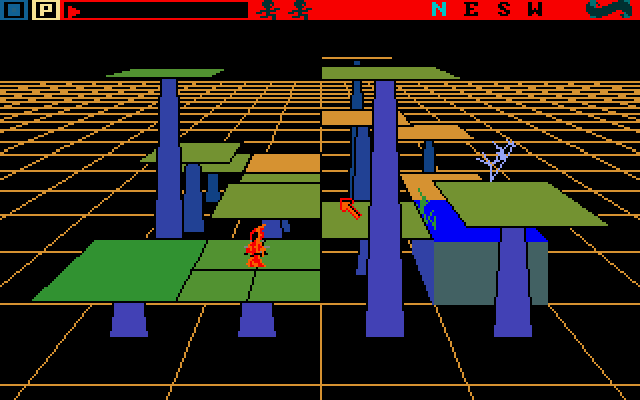
I remember Mind Walker as having amazingly spooky and captivating graphics. Then I found this screenshot: Mind Walker Screenshot Oh well. I’m sure it actually was impressive at the time. This discovery reminded of times when I’ve rediscovered a favorite food from childhood — for example, a certain type of cookie — only to find that it really isn’t very good at all. Just kind of sugary and low-quality chocolate. It’s also like going back to watch the original Jurassic Park again. The amazement is gone. Actually, even though the Mind Walker graphics aren’t as impressive as I remember them, I’m sure it was still a great game. Anyone have screenshots from Weird Dreams?

21 May 2007

Neil Williams: gpe-cash - double entry accounts on handhelds

subtitle: Break up GnuCash into lots of forks

With an ISP problem throttling my broadband to 4000B/s, I've switched to developing in C instead of building Emdebian packages - downloading Debian sources was taking an hour or more even for small packages.

This has made time for a long overdue project: gpe-cash - double entry accounting for handhelds. It's a spin-off from the stalled cashutil project and it just might provide the impetus to get cashutil into a releasable state.

gpe-cash uses QOF (Query Object Framework) which itself was spun out from GnuCash some years ago when it was described as "the gnucash engine without all the financial stuff". So gpe-cash is a happy reunion of the engine and the financial stuff along with Gtk+, only a lot smaller than GnuCash. Yes, it is a fork but a fork done for, IMHO, very good reasons. (Why write free software and then frown on forked projects?) There's little hope of getting GnuCash to run on any embedded hardware (it would probably end up as a laptop instead of a handheld in the process) so it has to be broken up: forked into a few smaller bits and simply dropping larger bits.

I've long wanted to break up the GnuCash behemoth and this is how this fork will work:

  1. Package the basic GnuCash objects as a shared library with -dev, -dbg and -doc

  2. Package the GnuCash business objects as another shared library, with ditto.

  3. Leave the commodity (stocks and shares) objects for a later date due to QOF compatibility issues with the GnuCash code.

  4. Use the pilot-qof Default Currency Table to create a tiny set of gnucash compatible currencies. (Also used by gpe-expenses already.)

  5. Share live expense data with gpe-expenses and gpe-cash (prevent duplication)

  6. Share contacts and live calendar data with gpe-invoice (calculate invoices)

  7. Drop direct file compatibility with GnuCash until GnuCash itself supports a sane backend, a suitable data import or cashutil is fixed, whichever comes soonest.

  8. Retain object compatibility with GnuCash at the QOF level - permits removing certain parts of GnuCash specific code from the objects whilst retaining functionality.

  9. Drop all reports, graphs, CSV import, QIF import, Scheme and other complexity of GnuCash.

  10. Use a simple SQLite backend via QOF.


Best laid plans . . . etc. It always ends up a bit different to the plan but you have to have a plan of some kind. (No?, well I do.) ;-)

The code is a combination of gpe-expenses and cashutil. It will (eventually) live within the cashutil SVN at SourceForge but I haven't committed the first changeset yet. The basic structures already work, it is tying the C objects to the Gtk that is the bulk of the remaining work.

If anyone is interested in upstream development, subscribe to the (very low volume) QOF-devel mailing list and let me know.

Next.

Previous.