Search Results: "sto"

23 June 2010

Petter Reinholdtsen: Idea for a change to LDAP schemas allowing DNS and DHCP info to be combined into one object

A while back, I complained about the fact that it is not possible with the provided schemas for storing DNS and DHCP information in LDAP to combine the two sets of information into one LDAP object representing a computer. In the mean time, I discovered that a simple fix would be to make the dhcpHost object class auxiliary, to allow it to be combined with the dNSDomain object class, and thus forming one object for one computer when storing both DHCP and DNS information in LDAP. If I understand this correctly, it is not safe to do this change without also changing the assigned number for the object class, and I do not know enough about LDAP schema design to do that properly for Debian Edu. Anyway, for future reference, this is how I believe we could change the DHCP schema to solve at least part of the problem with the LDAP schemas available today from IETF.
--- dhcp.schema    (revision 65192)
+++ dhcp.schema    (working copy)
@@ -376,7 +376,7 @@
 objectclass ( 2.16.840.1.113719.1.203.6.6
        NAME 'dhcpHost'
        DESC 'This represents information about a particular client'
-       SUP top
+       SUP top AUXILIARY
        MUST cn
        MAY  (dhcpLeaseDN $ dhcpHWAddress $ dhcpOptionsDN $ dhcpStatements $ dhcpComments $ dhcpOption)
        X-NDS_CONTAINMENT ('dhcpService' 'dhcpSubnet' 'dhcpGroup') )
I very much welcome clues on how to do this properly for Debian Edu/Squeeze. We provide the DHCP schema in our debian-edu-config package, and should thus be free to rewrite it as we see fit. If you want to help out with implementing this for Debian Edu, please contact us on debian-edu@lists.debian.org.

Matt Zimmerman: Habit forming

I find that habits are best made and broken in sets. If I want to form a new habit, I ll try to get rid of an old one at the same time. I don t know why this works, but it seems to. Perhaps I only have room in my head for a certain number of habits, so if I want a new one, then an old one has to go. I m sure some combinations are better than others. I m currently working on changing some habits, including: I m thinking of adding a reading habit to the set, but it s going well so far and I don t want to overdo it. I feel good, and am forming a new routine. The flossing is definitely the hardest of the three. I hate pretty much everything about flossing. It also unbalances the set, so that I have a net gain of one habit. Maybe that s the real reason, and if I broke another habit, it would get easier. Does anyone else have this experience? What sort of tricks do you employ to help you change your behavior?

Bernd Zeimetz: creating a google sitemap for ikiwiki

ikiwiki is not yet able to create a Google sitemap internally, so I'm using google-sitemapgen. To run it automatically when the website is being updated, I've changed the git hook to run it after the ikiwiki hook. /path/to/myikiwiki.git/hooks/post-update
#!/bin/sh
/path/to/myikiwiki.git/hooks/post-update.ikiwiki
/usr/bin/google-sitemapgen --config=/path/to/mywikiconfig/sitemap_config.xml
exec git-update-server-info
/path/to/mywikiconfig/sitemap_config.xml
<?xml version="1.0" encoding="UTF-8"?>
<site
  base_url="http://bzed.de/"
  store_into="/path/to/bzed.de/sitemap.xml.gz"
  verbose="0"
  suppress_search_engine_notify="0"
  default_encoding="UTF-8"
  >
  <directory
    path="/path/to/bzed.de"
    url="http://bzed.de/"
    default_file="index.html"
  />
  <!-- Exclude URLs that end with a '~'   (IE: emacs backup files)      -->
  <filter  action="drop"  type="wildcard"  pattern="*~"           />
  <!-- Exclude URLs within UNIX-style hidden files or directories       -->
  <filter  action="drop"  type="regexp"    pattern="/\.*"     />
  <!-- Exclude ikiwiki directories -->
  <filter  action="drop"  type="regexp"  pattern="/helponformatting/*"           />
  <filter  action="drop"  type="regexp"  pattern="/ikiwiki/*"                    />
  <filter  action="drop"  type="regexp"  pattern="/markdown/*"                   />
  <filter  action="drop"  type="regexp"  pattern="/openid/*"                     />
  <filter  action="drop"  type="regexp"  pattern="/pagespec/*"                   />
  <filter  action="drop"  type="regexp"  pattern="/preprocessordirective/*"      />
  <filter  action="drop"  type="regexp"  pattern="/sandbox/*"                    />
  <filter  action="drop"  type="regexp"  pattern="/shortcuts/*"                  />
  <filter  action="drop"  type="regexp"  pattern="/smileys/*"                    />
  <filter  action="drop"  type="regexp"  pattern="/subpage/*"                    />
  <filter  action="drop"  type="regexp"  pattern="/templates/*"                  />
  <filter  action="drop"  type="regexp"  pattern="/theme/*"                      />
  <filter  action="drop"  type="regexp"  pattern="/wikiicons/*"                  />
  <filter  action="drop"  type="regexp"  pattern="/wikilink/*"                   />
  <filter  action="drop"  type="regexp"  pattern="/wmd/*"                        />
  <!-- Exclude css files, favicon and javascript -->
  <filter  action="drop"  type="wildcard"    pattern="*.css"                         />
  <filter  action="drop"  type="wildcard"    pattern="*favicon.ico"                  />
  <filter  action="drop"  type="wildcard"    pattern="*.js"                          />
  <!-- Exclude ikiwiki.cgi -->
  <filter  action="drop"  type="wildcard"    pattern="ikiwiki.cgi"                   />
</site>
See the examples and README files in /usr/share/doc/google-sitemapgen/ for an introduction into configuring google-sitemapgen. So far the generated sitemaps works very well, especially for search engines which are not able to use the rss feeds like Google does.

David Welton: Ovi Lays an Egg

In the local dialect here in Padova, Italy, "ovi" means "eggs". For those who aren't native English speakers, "to lay an egg" means to fail at something or do it poorly. The connection is very appropriate.
To see what it was about, and if it was worth pursuing, I decided to submit a couple of simple applications to Nokia's OVI store. Nothing fancy, or that I'd spent much time developing, and they were actually little things I'd done for myself before the ovi.com store came out, but I had hoped to see about making a bit of money out of the time invested nonetheless.
So I went ahead and started adding them, with a quick glance the publisher guidelines. Too quick, as it turns out. A month after submitting my application, their "QA" process lets me know my application is not going to be accepted because it's not signed. Uh... yeah? Couldn't you have simply run a script on the file I uploaded to tell me the same damn thing? It's not exactly as if you have to have a human look at the file with a hex editor to determine whether it's signed or not. My phone can tell, of course - presumably Nokia ought to be able to figure it out programmatically and let me know? Sure, I should have read their big, long document prior to starting, but come on, it would have saved everyone time if their software had simply informed me that my application, being unsigned, was not ok. Now, when it comes to signing, Java ME is pretty much the worst in the business, although Apple is giving them a run for their money. At least Apple does it to make the applications good for their users (for their definition of good). So there you have it, Java ME involves more fees than the other ones, and is probably as slow and bureaucratic to boot. I'm not going to find out, though, this pretty much concludes my experiment with ovi.com - there's no way I'm going to spend all that money on a little fun application that I'd only sell for a few euros. Being a fan of open source and openness in general, my next phone will certainly be Android based. I think someone at Nokia probably realizes things are broken: they appear to be working on a way to make it not cost anything to sign Symbian apps. But I don't have a Symbian app, so that's pretty useless for me. Oh, and while I'm bitching about their whole process, their publisher interface was down all of last weekend in order to "add a new set of metadata which will improve the Ovi Store user experience". It took a whole weekend of downtime to add that?
Furthermore, I signed up for Ovi as soon as it came out - I was going to push Hecl to it (but didn't bother at the time) but now it appears they want 50 euros from you just to sign up. Here's a hint: save your money.

Steve Kemp: I am the edge!

Over the past few years I've amassed a collection of a few thousand images taken with a succession of digital cameras. I'm pretty good at organising images, in a directory hierarchy which makes sense to me, in a few simple and broad categories:
skx@birthday:~$ tree -L 1 ~/Images/
/home/skx/Images/
 -- Misc
 -- Parties
 -- People
 -- Pets & Animals
 -- Travel
Beneath ~/Images/People, for example, I have subdirectories for specific individuals (or a "Debian/" folder for Debian-people who've been snapped but don't warrant their own folder.) ~/Images/Travel has things like Travel/Local/2010, Travel/Vienna/2008, etc. In summary I have images of people, places, and things stored beneath what should be a reasonably discoverable directory hierarchy, however this just doesn't work. I still struggle to find images - for example images of myself might be located in ~/Images/People/Self/*, but in practise I'm often included in ~/Images/Travel/* as well. A few times I've looked at using f-spot, digikam, and similar tools to perform image-organisation (but not editing, or timelines, or anything else. Just organisation). I've found I didn't like being locked into their formats, didn't want them to copy my images to a second location, and other gripes. In the end I've forced myself to come up with a Steve-Specific-Solution. Not for the first time, but I think I have just cause... I'm now using the User-Comment field in the image's EXIF data to store tags. (When it comes to EXIF data I keep camera-generated fields, but sometimes update/set "Copyright", "Comment", and "Title" fields. So UserComment is one I've never used until now, and thus I run no risk of trashing existing meta-data.) I've put together a simple perl script, called itag, which will: This is enough for me to be able to see all images of "Edinburgh", via:
~$ qiv --fullscreen --slide --delay 5 $(itag --search=edinburgh)
Similarly I could find myself:
~$ itag --search=steve --search=people
I'm not sure it is useful to others, mostly on the basis that people probably fall into their own routine when it comes to filing, and I suspect that people with vast collections of images will just get annoyed by the obscenely slow indexing process I've got. (Hint: run "exiftool" on every /.jpe?g$/i file..) Still its a simple enough idea and I think it should scale in the future - I can even see myself writing a wee GUI to do tag exploration and similar. Just not today. ObFilm:Aeon Flux ObRandom: Apologies for people waiting on email - it's been that kind of week.

Stefano Zacchiroli: Debian consultancy for the European Framework Programme

on the interaction of FOSS communities with EU research projects The 7th Framework Programme (or FP7) is a well-known European program to fund research projects and promote the creation of the European Research Area. For some European countries, FP7-funded projects are so important that they can make the difference between an institution that has the resources to pursue its research & teaching activities and an institution that doesn't, which will then have hard time surviving. As part of FP7 and its previous editions, the European Commission (EC) has been funding research into FOSS for a while now, with different degrees of "FOSS-involvement". Some projects routinely use FOSS products, some fund the development of relevant FOSS projects (e.g. PyPy), some try to address shortcomings of specific communities (e.g. EDOS and Mancoosi, on which you surely are aware of my bias ...), some others try to remove barriers to FOSS adoption in various contexts (e.g. FLOSSinclude). A nice overview of EU-funded FOSS projects is available as a leaflet. As with all project funding initiatives: having a project funded does not mean it will be successfully. By analogy: the fact that the project (proposal) mentions FOSS does not mean it will be successful in interacting with FOSS communities. Luckily, the EC is well aware of existing difficulties and is now seeking input from FOSS communities to understand how to better interact with them, from the standpoint of FP7 research projects. That is why last week I've joined, upon invitation and as a Debian representative, a meeting at the EC in Brussels on the above topics. At the table we were about a dozen people, including representatives of ongoing research projects (both from academia and large industries), EC commissioners, ... and Debian (i.e. yours truly). Beside joining the brainstorming, what I've brought to the table are some thoughts on best and worst practices on the interaction between research projects and FOSS communities, answering to some working questions. There is probably little to see in the slides for people belonging to FOSS communities, as all suggestions would seem fairly obvious (e.g.: do not invent/use yet another FOSS license, do not jail people into specific forges, do not expect people to work at your place, etc.). Still, I assure you that most of them were not obvious for EC commissioners and that they have been very much interested in hearing Debian feedback, which is perceived has having no other interest than serving Free Software. I'm personally very proud of the fact that Debian was there, as a purely community-driven project run by volunteers, whose opinion is clearly valued by an important program as FP7 is. Various possible next steps have been discussed: from drafting guidelines that will help reviewers in evaluating the commitment of project proposals to FOSS communities, to create a scenario-based license chooser based on the needs of FP7 projects. While I did not volunteer to take part in all such initiatives, I'll keep you posted of advancements.

Christoph Berg: Cool Unix Features: nproc

Since coreutils 8.1 (in Squeeze, not Lenny), there is a command that simply prints out how many processors (cores, processing units) are available:
$ nproc
2
The use case is obvious:
$ make -j $(nproc)
On a side note, this is gnulib's nproc module wrapped into a C program. If you didn't know gnulib before (it had slipped my attention until recently), it is a library of portability functions and other useful things. Adding it to a project is simply done by calling gnulib-tool and tweaking a few lines in the automake/whatever build scripts. PS: do not use nproc unconditionally in debian/rules. Parse DEB_BUILD_OPTIONS for "parallel" instead.

John Goerzen: Thyroid Surgery & The Boys

Terah has been having thyroid troubles for some time now (you can read about it on her blog). Today was the day for it to be removed. This procedure is somewhat delicate. Running through each half of the thyroid are nerves that control the vocal chords. Also embedded in each half are tiny parathyroids, which regulate the body s calcium levels. Losing either of these things in one half of the thyroid is no big deal, but losing either of them entirely can be serious. For this reason, the general plan was for Terah to have half of her thyroid out, unless it was obvious in surgery that it would be a health risk to leave the other half in, or that it was obvious that the removal of the first half had successfully preserved the nerves and parathyroids. Jacob and Oliver spent the night with my parents last night an event that Jacob was incredibly excited about. I came home last night to find him running in circles in the kitchen. I had this conversation with him: Me: Jacob, are you excited about something? Jacob: Yes! Me: What are you excited about? Jacob: I don t know. (He usually says this when he doesn t want to say, but I figured it was his pending overnight stay) .. a minute later .. Jacob: I am excited about something blue. Me: [genuinely confused] Hmmm . I don t know what blue thing you might be excited about. Can you tell me? Jacob: A blue house! Me: Oh, is it grandma and grandpa s blue house? Jacob: YEAH! Now you ve got it! I m so excited! He was still running in circles the whole time. So Jacob and Oliver left, and Terah and I worked on the house. This morning, we arrived at the hospital at 6:15 to check in. At usual, the staff there was incredibly friendly and helpful. And two of them made connections: one of the intake nurses had taught at the college where my dad works, and another nurse knows his cousin. Living where we do, we were not surprised by this. (You sort of wonder how many connections you ll make at a place like this.) The surgery area is right next to the ER, and people waiting for people in surgery normally wait there. Having got my fill of the TV playing infomercials for the morning in the 5 minutes we sat there, I arranged to wait in the cafeteria (which is large and quiet in the middle of the morning) and they just called my cell phone when Terah was done. I was with Terah for as long as possible, then ate breakfast in the cafeteria, walked over to the doctor s office next door for my weekly allergy shots, and then waited with my Kindle in the cafeteria. They called, and a little while later the surgeon explained how the surgery went: far easier than they had expected. He was confident the left side surgery went well, and so took out the whole thing and was confident the right side removal also went well. I went to wait in Terah s room for her to exit recovery, and our pastor and his daughter showed up to wait too. When she arrived, she was very tired but said a few words before going to sleep. Our pastor gave the two of us a minute before coming in, and read a selection from Psalm 139 before leaving. I then mostly waited with my Kindle some more until she woke up. I brought back some lunch from the cafeteria, and eventually Terah woke up. We chatted just a bit (it was mostly me talking). I went to pick up the boys, and brought them to the hospital. They were glad to see her. But then, the dilemma: I had promised Jacob that we would eat in the hospital restaurant , but it was only 4 and they didn t start serving supper until 5. Jacob somehow remembered that we went exploring in the hospital when Oliver was born 11 months ago, and had been talking about doing this already. So off we went: Jacob sometimes helping me push Oliver s stroller, sometimes running on ahead, enjoying himself and spelling out letters on big signs on the walls. We got a whole bunch of smiles and compliments. Oliver was laughing, and Jacob was happy and well-behaved. We went towards the cafeteria at 4:30 and I got Jacob some of their free lemonade. He was complaining about not eating, and I remembered that he noticed a nurse walking out of there with an ice cream cone while we were exploring. Obviously the soft-serve machine was already up, so I got him and me ice cream cones. I m sure he ll be talking about the hospital ice cream for days. Anyhow, it took him about half an hour to eat it, so it was perfect timing for supper. We ate, went back to see Terah, and then headed out. I do believe that these may be the only two boys I know of that actually think of a hospital as a fun place to go. It wouldn t surprise me at all if Jacob asks to go back there. Both boys fell asleep on the way home. Jacob, unfortunately, had a rather significant accident, possibly due to the large amounts of free lemonade he insisted on drinking. And it was hot outside. So I carried Jacob in, and he sort of groggily looked at me. I suggested he take a nap on the rug in the kitchen (his room is upstairs) while I bring Oliver in. He sort of collapsed onto the rug and was back asleep a few seconds later. I got Oliver in, and brought down new shorts and an overnight pullup for Jacob. Put them on, had him use the toilet, and got him in bed. By that time, Oliver was awake and hungry. So I got him fed, and neither one of them quite went to sleep easily but they did. I watered the flowers and garden, did a load of laundry, etc. Jacob had been worried about the surgery, though had trouble verbalizing it. I think he s better about it now, though some of his trouble falling asleep tonight was probably still worry about that. Hopefully he ll be better once Terah is back home, which should hopefully be tomorrow.

22 June 2010

Joey Hess: longest day

Here on the porch at Dani's, enjoying the chill breeze as a distant storm passes by, and the last half hour of daylight, it seems right to have been awake to see the solstice dawn, and out in the world all day. Though after 16 hours, the part of the day spent napping in a hammock barely seems enough. Such an early start to this day, first visiting a small-town garage with Dad, where skype video calls were being made, and then racing the morning heat north, out of South Carolina. (I can't hear "frakking water" on the radio without snickering. Congratulations to all the news-people who pulled that phrase off today.) A long drive punctuated by picking up my passenger, and my own Goodbye Solo drive up by Blowing Rock, looking in the mirror at passenger dreaming in the backseat. Thinking about how, in the flat lands, cresting a long, slow hill, I often feel as if the road ahead could at any moment vanish, sending the car plunging into nothing; a latent agoraphobia. And in the mountains, as the road narrows and winds, I'm always confident it continues solidly around each blind bend.

MJ Ray: Budget 2010: take 2 (IT, Co-ops and Community edition)

I ve been watching the June budget and pondering its effects on me, our co-op, co-ops in general and the wider community.
IT Taxes
I just want to flag this one up as a special interest: the telephone tax is killed off before it starts. Yippee! But now we get to wait and see how the government will support private investment to get universal provision of fast broadband. I ve no problem with tax relief for the video games industry being scrapped - why should any type of software get special treatment?
VAT up 2.5% to 20% from 4 January 2011
This seems bad for everyone. It s a bit less bad for our co-op because we have some international suppliers, whose sales tax rates won t change, but we buy a lot from the UK too and it hurts all our workers.
Personal Taxes
The basic income tax allowance rise of 1,000 is welcome, as is restoring the pension-earnings links. More widely, the freezes in various things, increase in Capital Gains Tax and drop in cider tax all seem broadly good ideas. The housing benefit 400 maximum is a bit mixed - how bad it is may depend how lenders react when borrowers get into difficulty.
Business Taxes
At a time when a VAT increase is called unavoidable , it stinks a bit to cut corporation tax, extend the 10% capital gains tax allowance and raise the employers National Insurance threshold. Of course, our co-op pays none of those, so it also hurts us by giving our competitors an advantage.
Business Incentives
George Osborne said he wants to tackle regional economic differences, but the big change in this budget is bad for all existing businesses outside London, the South-East and East: National Insurance exemptions for new businesses. Once again, existing co-ops take it in the neck from another government obsessed with capitalism and employment instead of businesses and work. Meanwhile, increasing the Enterprise Finance Guarantee props up debt-laden business and a new Growth Capital Fund encourages capitalist businesses, while both appear useless to good co-ops at first glance. I don t mind being ignored, but could we please elect a government which doesn t actively hinder co-ops? Where s the fabled commitment to fairness ? Promises around the Green Investment Bank and Green Deal sound good, but are in the future.
Council Tax
Council Tax will be frozen for a year. I wonder if that applies to parish councils, because our village planned a cut after a one-year project-based increase last year. The Budget Document has pretty much no detail.
So, how was it for you? Have I missed some friendly changes?

Biella Coleman: Wanna Volunteer during Debconf?

Debconf is fast approaching I thought I would pass on some helpful news: some helpful to you all, some more to us. First, a number of volunteers have compiled this astonishingly detailed list of things to do in NYC, including many that are free. Clearly you can come to Debconf and not come to Debconf. We hope you still do, but if you want to sneak out a few times and venture into this city, this is the list to consult. We are also now coordinating our on-site volunteers and perhaps you are interested in pitching in here and there. If you are, here is a list of things we need help with. If you do want to help, you can drop a line on our mailing list (please write [volunteer in the subject line). You can post even if you are not subscribed (although there are times it takes awhile for message approval. Alternatively, you can drop me a note (contact information here and I can pass on the information.

Craig Small: Book: Do Androids Dream of Electric Sheep?

Actually they're more interested in freedom, to be no longer slaves to humans. I don't think it's any spoiler to mention that an electric sheep does appear in the book.

This is a classic science fiction story of a dark not-so-distant future. In fact given that it's over 40 years old it could be set in some alternate now. Some disaster has occurred and many have either left earth or died. Some andriods, or andys have escaped and bounty hunters are after them.

You may not know the book by its correct title, but you may of heard the movie that is based upon it, called Blade Runner. Like most movies based on books, it takes some of the concepts and ideas of the book but in my opinion is a pale imitation.

I'm glad I read this book. It hasn't aged that much and it's very though provoking. Sci-Fi often uses some alternate reality to put a mirror up to what happens in the real world and this book is no exception.

And a token link to Debian, if you want you own electric sheep you can install the screensaver electricsheep package which draw pretty fractals on your screen.

<script defer="defer" src="http://static.zemanta.com/readside/loader.js" type="text/javascript"></script>

Michael Prokop: FAI Developer Workshop 2010

From 2nd to 4th of July 2010 the FAI developer workshop will take place at the Linuxhotel in Essen/Germany. FAI? FAI is the abbreviation for Fully Automatic Installation. It s a non-interactive system to install, customize and manage Linux systems and software configurations on computers as well as virtual machines and chroot environments, from small networks to large-scale infrastructures and clusters. As the name states the workshop is targeted towards FAI developers. We the FAI developers want to get FAI into shape for squeeze, discuss pending issues like Ubuntu packaging, release management and of course meet in real life for networking and socializing. Our rough roadmap for the FAI weekend looks like this: Friday: Saturday: Sunday: Further details are available in the FAI wiki at http://faiwiki.informatik.uni-koeln.de/index.php/DeveloperWorkshopJuly2010. The meeting wouldn t be possible without sponsors so special thanks to: If you are interested in sponsoring the FAI Developer Workshop as well please contact FAI lead developer Thomas Lange.

Russell Coker: Virtual Hosting Prices

Linode has just announced a significant increase in the amount of RAM in each of their plans [1]. The last time I compared virtual hosting prices in a serious manner was over two years ago [2], so it seems like a good time to compare the prices again. Now there are some differences between these providers that make things difficult to compare. Gandi used to not include the OS in the disk allocation presumably they did de-duplication, I m not sure if they still do that. OpenVZ/Virtuozzo and Xen can t be directly compared. OpenVZ is an Operating System Level Virtualisation that allows virtual machines to share resources to some extent which should allow better overall utilisation of the system but may allow someone to hog more resources than they deserve I prefer virtual machines so tend to avoid that. Virtuozzo is a technology I m not familiar with so with all things being equal I would choose Xen because I know it better. Years ago Vpsland deleted one of my DomUs without good notification and without keeping a backup and I m not about to forgive them. XenEurope and Gandi get good reviews, but I have no personal experience with them so in my personal ranking they are below Linode and Slicehost. RapidXen offers native IPv6 a very noteworthy feature. But they are quite expensive. Note that I have only included providers that advertise in English. I could use Google translation to place an order on a non-English web site but I am not going to risk a situation where Google translation is needed for technical support. In the price comparison tables I have used $US for price comparisons, where the price was advertised in another currency I put the $US price in brackets. For every provider that doesn t advertise prices in $US I used XE.com to get a spot price. Note that if you convert between currencies you will not get that rate, I used the spot rate because most of my readers don t use the $US as their native currency (either due to living in a country that uses it or having business interests based on the $US) converting from $AU to $US has about the same overhead for me as converting to the Euro or pound. The bandwidth is listed as either a number of Gigabytes per month that can be transferred or as a number of Megabits per second that the connection may use. I have tried to roughly order the offerings based on how good they seem to be. But as there are so many factors to consider it s quite obvious that no provider can be considered to be universally better than the others. The biggest surprise for me was how well Xen Europe compares to the others. Last time I did the comparison they were not nearly as competitive. Finally note that I am comparing the options for low-end servers. These are services that are useful for hobbyist use and low-end servers for commercial use. Some providers such as Xen Europe exclude themselves from consideration for serious commercial use by not offering big servers Xen Europe only supports up to 1GB of RAM. Prices of Xen virtual servers:
ISP RAM Disk Bandwidth Price
XenEurope 128M 10G 1TB E5 ($6.15)
XenEurope 512M 30G 1TB E17.50 ($21.52)
Linode 512M 16G 200GB $20
RackVM 128M 10G 100GB #4UK ($5.90)
RackVM 512M 30G 300GB #16UK ($23.62)
Slicehost 256M 10G 150GB $20
Slicehost 512M 20G 300GB $38
Gandi 256M 8G 5Mb/s $16
Gandi 512M 16G 10Mb/s $32
RapidXen 256M 20G 2Mb/s $20
RapidXen 512M 20G 2Mb/s $30
Rimuhosting 160M 4G 30GB $20
Rimuhosting 400M 8G 150GB $30
Prices of non-Xen virtualisation systems:
ISP Virtualisation RAM Disk Bandwidth Price
Quantact OpenVZ 256M 15G 300GB $15
Quantact OpenVZ 512M 35G 600GB $35
FreeVPS VMWare 256M 10G 100GB #10UK ($14.76)
FreeVPS VMWare 512M 20G 200GB #15UK ($22.14)
Vpsland Virtuozzo 512M 10G 250GB $20
Vpsland Virtuozzo 1024M 20G 500GB $35
Update: Added RackVM to the listing, and removed the ambiguous part about Gandi disk allocation.

21 June 2010

Scott Kitterman: Hello Planet Debian

This is the obligatory Hello world post. I m a developer both in Ubuntu and Debian. In Debian most of my work has been in the Python world where I co-maintain python-defaults and python3 defaults as well as several modules, extensions, and applications. I ve been contributing to Debian development for about 3 years now and recently became a DD.
Just so this post won t be completely free of technical content
Most of you will have heard that Python 2.6 is now the default in Sid. Once this transition is complete and migrated, the Python system that s planned for Squeeze will be in place (I know this is a topic that is very dear to some people, but I don t care to discuss the history of it in my blog and won t approve comments in that direction).
Of more technical interest, I think, is that the core system around Python 3 is starting to appear. The current version of Debian Python Policy begins to address Python 3 issues for the first time and we now have a supported and default Python 3. There is more work coming between now and freeze time to more completely define how the Debian Python 3 system should work. While many upstreams don t support Python 3 yet, we want to provide a solution that makes it easy for maintainers to provide Python 3 packages where they do.

Colin Watson: GRUB 2 boot problems

(This is partly a repost of material I've posted to bug reports and to debian-release, put together with some more detail for a wider audience.) You could be forgiven for looking at the RC bug activity on grub2 over the last couple of days and thinking that it's all gone to hell in a handbasket with recent uploads. In fact, aside from an interesting case which turned out to be due to botched handling of the GRUB Legacy to GRUB 2 chainloading setup (which prompted me to fix three other RC bugs along the way), all the recent problems people have been having have been duplicates of one of these bugs which have existed essentially forever: When GRUB boots, its boot sector first loads its "core image", which is usually embedded in the gap between the boot sector and the first partition on the same disk as the boot sector. This core image then figures out where to find /boot/grub, and loads grub.cfg from it as well as more GRUB modules. The thing that tends to go wrong here is that the core image must be from the same version of GRUB as any modules it loads. /boot/grub/*.mod are updated only by grub-install, so this normally works OK. However, for various reasons (deliberate or accidental) some people install GRUB to multiple disks. In this case, grub-install might update /boot/grub/*.mod along with the core image on one disk, but your BIOS might actually be booting from a different disk. The effect of this will be that you'll have an old core image and new modules, which will probably blow up in any number of possible ways. Quite often, this problem lies dormant for a while because GRUB happens not to change in a way that causes incompatibility between the core image and modules, but then we get massive spikes of bug reports any time the interface does change. Since these bugs sometimes bite people upgrading from testing to unstable, they get interpreted as regressions from the version in testing even though that isn't strictly true (but it tends not to be very productive to argue this line; after all, people's computers suddenly don't boot!). Any problem that causes the core image to be installed to a disk other than the one actually being booted from, or not to be installed at all, will show up this way sooner or later. On 2010-06-10, there was a substantial upstream change to the handling of list iterators (to reduce core image size and make code clearer and faster) which introduced an incompatibility between old core images and newer modules. This caused a bunch of dormant problems to flare up again, and so there was a flood of reports of booting problems with 1.98+20100614-1 and newer, often described as "the unaligned pointer bug" due to how it happened to manifest this time round. In previous cases, GRUB reported undefined symbols on boot, but it's all essentially the same problem even though there are different symptoms. The confusing bit when handling bug reports is that not only are there different symptoms with the same cause, but there are also multiple causes for the same symptom! This takes a certain amount of untangling, especially when lots of people have thought "ooh, that bug looks a bit like mine" and jumped in with their own comments. Working through this was a worthwhile exercise, as it came up with an entirely new cause for a problem I thought was fairly well-understood (thanks to debugging assistance from Sedat Dilek). If you had set up GRUB 2 to be automatically chainloaded from GRUB Legacy (which happens automatically on upgrade from the latter to the former), never got round to running upgrade-from-grub-legacy once you confirmed it worked, and then later ran grub-install by hand for one reason or another, then the core image you installed by hand would never be updated and would eventually fall over the next time the core/modules interface changed. Fixing future cases of this was easy enough, but fixing existing cases involved figuring out how to detect whether an installed GRUB boot sector came from GRUB Legacy or GRUB 2, which isn't as easy as you might think. Fortunately, it turns out that there are a limited number of jump offsets that have ever been used in the second byte of the boot sector, and none of the GRUB 2 values clash with the only value ever used in GRUB Legacy; so, if you still have /boot/grub/stage2 et al on upgrade, we scan all disks for a GRUB 2 boot sector, and if we find one then we offer to complete the upgrade to GRUB 2. Unless anything new shows up, that just leaves the problems that were already understood. Today, I posted a patch to generate stable device names in device.map by default. If this is accepted, then we can do something or other to fix up device.map on upgrade, switch over to /dev/disk/by-id names in grub-pc/install_devices at the same time, and that should take care of the vast majority of this kind of upgrade bug. I think at that point it should be feasible to get a new version into testing, and we should be down from 18 RC bugs towards the end of last month to around 6. We can then start attacking things like the lack of support for mdadm 1.x metadata. Since my last blog entry on GRUB 2, improvements have included: The next upstream snapshot will bring several improvements to EFI video support, mainly thanks to Vladimir Serbinenko. I've been working on making grub-install actually work on UEFI systems as one of my goals for the next Ubuntu release, and I hope to get this landed in the not-too-distant future.

20 June 2010

Stefano Zacchiroli: debian meeting guidelines RFC

How to have a (Debian) summit without turning into a secret cabal It seems rather uncontroversial that sponsoring various kinds of Debian meetings (conferences, sprints, BSPs, etc.) is a good way to spend, actually invest, Debian money. Historically, that has not always saved the Debian community from muttering about "cabal-ish" meetings in very few specific occasions. (No, there is no cabal, in case you wonder.) I've always believed in the good faith of people and I don't think that we have ever had "secret meetings" on purpose. Nevertheless the question of how to have meetings in a community-compatible way is a sound one. Answering properly to such a question is something that it's harder than what it might seem at first sight (at least for me). In particular, organizers have to carefully balance the high efficiency that meetings offer (e.g.: communication bandwidth is higher than when working remotely, people have less distractions, more enthusiasm, more fun!, etc.) with the risk of cutting out the rest of the community which cannot attend the meeting, for whatever reason. Note also that since Debian is not a company, we cannot just require that everybody who is interested attend the meeting. As DPL, I'm starting to get quite some requests for meeting sponsorship, and that's just wonderful: it means that we have thrilling groups of people that are eager to get together and hack to improve Debian! Still, in doing so, we should all try to minimize the above risk; that's why I've started to apply the following Debian meeting guidelines, as a kind of prerequisite for sponsoring.
  1. Before the meeting: the meeting should be announced to the most relevant public mailing list(s); ideally, the tentative agenda of the meeting should be included in the announcement.
    That will enable people interested in the meeting topics to provide their inputs and more generally to know what is going on.
  2. During the meeting (preparation): expenses should be minimized, as a form of respect for all people that donate to Debian. Since we value their contributions, we do our best not to waste them. (TTBOMK, we've always done that, but making it explicit won't hurt.)
  3. After the meeting: meeting minutes should be sent to the most relevant public mailing list(s), usually to d-d-a for meetings that cover topics of general development interest.
    As an obvious consequence, minutes should be taken during the meeting; it is a bit of extra burden, but the risk of leaving the rest of the community in the dark is just not acceptable a community as wide and diverse as ours.
  4. In general, think about communication, e.g.: (micro)blog about the meeting, contact press/-publicity to prepare a news item about it, enable others to attend virtually on IRC or other media, etc.
For now, the above is just a brain dump.
Now, what do you think? Are the above reasonable demands? What else should we ask for?
Feel free to leave a comment or mail me about that.

Daniel Baumann: Debian Live Web Images Builder

Richard Nelson, an outstanding debian-live contributor and team member since many years, has setup an instance of the live-helper CGI scripts that are included within live-helper. This webbuilder lets users get their own customized images without the need of having to install live-helper and build them on their own. It's available at live-helper.debian.net. Apart from having some better looking html form and adding an online-help that will be worked on soon, it's working great. Thanks you, Richard.

19 June 2010

Torsten Werner: Results from the Debian Community Poll

I have announced the Debian Community Poll in my former blog post. I have closed the poll today and I will start publishing its results now.
What is the codename of the current stable release?This is the only compulsory question with the intention to block spammers. The correct codename is Lenny but I have accepted almost any answer that is somehow related to Debian. Version numbers, names from Sarge to Experimental, even well known codenames and version numbers from Ubuntu have been counted as correct. 22 partipants answered wrongly and their submissions got removed from the result set. A whopping number of 3258 submissions have been accepted and get analyzed now. Thanks to all participants!
How long have you been using Debian?

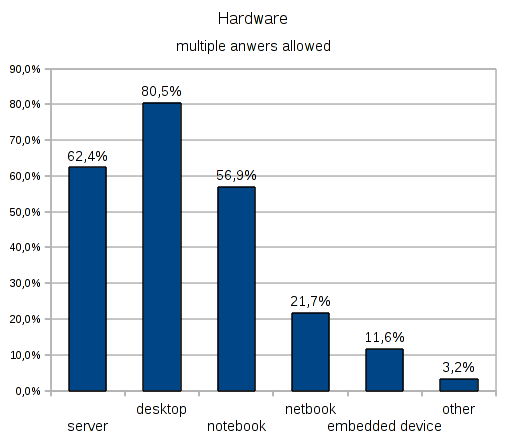
On what kind of hardware are you using Debian?
Multiple answers are allowed for this question and that is why the values do not sum up to 100%.
  • 80.5% are using Debian on the desktop
  • 62.4% on the server
  • 56.9% on the notebook
  • 21.7% on the netbook
  • 11.6% on embedded device(s)
  • 3.2% on other device(s)
The following other devices have been mentioned: smartphone, virtual machine, nettop, NAS, HTPC, workstation, pendrive, live cd, cluster, thin client, router, rocket flight computer, ibm mainframe, and automatic bar tender.

Do you contribute to Debian?
  • 50.0% choose answer #5: I don't contribute on a regular base.
  • 31.2% choose answer #4: I'm regularly helping other Debian users.
  • 8.0% choose other (see below) or simply did not answer
  • 4.9% choose answer #3: I'm regularly contributing to Debian packages without uploading them by myself.
  • 4.5% choose answer #1: I'm a Debian developer.
  • 1.4% choose answer #2: I'm a Debian maintainer.
The following other answers have been provided:
  • upstream developer or contributor
  • translator
  • bug reporter
  • advocator
  • former DD or DM
  • prospective DD or DM
  • mirror maintainer
  • package/installer tester
  • documentation writer
  • donator or debconf sponsor
  • debconf organizer or helper

How do you think about the Debian Free Software Guidelines (DFSG)?
  • 46.0% choose answer #2: I like the DFSG but it is not the most important reason for using Debian.
  • 36.6% choose answer #1: The DFSG is very important to me. I could live with many changes in Debian but I would be very upset if Debian would allow non-free software into its main component in the future.
  • 10.1% choose answer #3: I don't know.
  • 4.9% choose answer #4: I don't care.
  • 2.4% did not answer.

Are you using Debian derived distributions, too?
Multiple answers are allowed for this question and that is why the values do not sum up to 100%. There were a lot of different answers but the most frequent are:
  • 47.1%: Ubuntu (Kubuntu, Lubuntu, Xubuntu)
  • 40.8%: no answer; this was the only way to say that someone does not use a derived distribution
  • 11.0%: other (see below)
  • 7.0%: damn small linux
  • 4.8%: Sidux
  • 4.3%: grml (juxlala)
  • 2.2%: Knoppix
  • 1.6%: ELive
  • 1.4%: Maemo
The other answer includes the following distributions: 64studio, ALT Linux, arch linux, ArtistX, BackTrack, BRLix, Canaima GNU/Linux, catix, cdlinux.pl, CloneZilla, CrunchBang, Custom, ddwrt, debian arm userspace for zipit z2, DebXO (?), DreamLinux, Easy Peasy, eb4, eeebuntu, EMC2 Ubuntu (linuxcnc.org), Emdebian, Estrella Roja, Fedora, Finnix, Gentoo, gNewSense, Hackable:1, Kanotix, Kuliax, LFS and CLFS, LinEx, Linux Mint, live CDs, live-helper, Mepis antix, Musix, My own LiveCD, Mythbuntu, OpenInkpot, openwrt, paipix gnu, Parsix, Peppermint, personal debian derived, proxmox, Puppy, PureOS, qtopia, SHR, simplyMEPIS, Skolelinux, slackware, SymphonyOS, Toutou, Trisquel, tty GNU/Linux, UHU Linux, Univention Corporate Server, vinux, Voyage, Vyatta, whiite, Xandros, Xarnoppix. Not all of them are derived from Debian.

- to be continued -

Julien Valroff: My experience without Adobe Flash Player

Adobe recently announced they have (temporarily) stopped working on the amd64 version of their Flash Player for GNU/Linux. The previous releases contain a big security issue, which makes them totally unusable. As I didn t want to wait until the flashplugin-nonfree package to be updated to support the i386 plugin through nspluginwrapper (as suggested in #586273), I have decided to simply switch to the free alternative: gnash. After a few hours with it, I am now able to use most of the websites I usually visit, including Youtube and Dailymotion. Note that I use Iceweasel, which does not support WebM (for now), nor H.264 (which will never be supported by Mozilla). Youtube support is brought by a Greasemonkey user script available at: http://turanct.wordpress.com/2010/02/25/gnash-youtube/
The only tiny drawback is that the videos load in pause mode. For now, everything else seems to work fine. Users of other browers (Chromium, Safari, Opera) can try their HTML5 beta: http://www.youtube.com/html5 It is even easier for Dailymotion, as the videos on their HTML5 beta program are encoded in the Ogg Theora format, which is natively supported by Iceweasel/Firefox >= 3.5. To ease things, I have written a small Greasemonkey script which simply automatically redirects www.dailymotion.com to openvideo.dailymotion.com. This script can be downloaded here. The drawback is that videos won t play before they are loaded completely, which is not a big problem anyway. I still cannot play the videos avilable on Vimeo, and have noticed while wirting this post that the Flash file uploader of WordPress didn t work with gnash (obviously, WP provides an alternative way for file upload). I will go on with this experience as long as I do not see major issue with gnash.
I will also update this post, or add comments, if I encounter other issues, or find any alternatives. I would be curious to read your comments if you have run similar experience.

Next.

Previous.