Search Results: "mak"

9 May 2011

Jonathan McDowell: A minor keyring-maint rant

This should probably be an official FAQ, but a) I wanted to rant a bit more than is probably acceptable for something "official" and b) the sort of person this information is directed at never bloody reads keyring.debian.org, which is the logical place for it. Who are keyring-maint? Currently Gunnar Wolf (good cop) and Jonathan McDowell (bad cop). Previous keyring maintainers include Igor Grobman & James Troup. I'd like to be a DM/DD. Do I send you my key? No. You go through the DebianMaintainer or NM processes. Then the DM team or DAM tell us to add your key to the appropriate keyring. I'd like to replace my DM/DD key in the Debian keyring. What should I do? Read the instructions at http://keyring.debian.org/replacing_keys.html I have a new key that isn't signed by anyone else, will you accept it? No. Did you read http://keyring.debian.org/replacing_keys.html ? I've got a single DD signature on my new key. That's enough, right? Not unless your old key has been lost and you're getting a different DD to request the replacement for you (and if they're prepared to ask for a key replacement we'll wonder why they're not prepared to sign the new key too). Did you read http://keyring.debian.org/replacing_keys.html ? I'm still really confused about how I should request a key replacement. Help? Try reading https://rt.debian.org/Ticket/Display.html?id=3141 (which just happens to be a recent decent example). Clear subject line (I'd have added a real name too, but it's still fairly clear), full fingerprint of the old and new keys, inline signed so RT doesn't mangle it. New key signed by old key and 3 other DDs. Request signed by old key. That RT link needs a login. I don't have one. Have you tried reading up on the Debian RT system? There's a generic read only login that'll get you access. That's too hard. Can't you just give me the details? Damnit. It appears the read-only login details are currently disabled due to misuse (one wonders how). Try reading http://wiki.debian.org/rt.debian.org Why are you using RT? Isn't bugs.debian.org more appropriate? We need the ability to for people to contact us is in a private fashion, for example if they need to us to remove a key because it's been lost or compromised. We could only use RT for that purpose and use bugs.d.o for things that can be public, but this way all the information is in one place and we get to make the call about when it becomes a publicly viewable ticket. What's with jetring? Should I send you a jetring changeset? jetring is a tool written by Joey Hess that used to be used to manage the Debian Maintainers keyring. keyring-maint borrowed a number of good ideas from jetring but don't use it at all. We ignore jetring changesets. So you just want key fingerprints, not attached keys? Yes. Of course you have to make sure your key is actually on a public keyserver so we can get it. the.earth.li is a good choice (because Jonathan runs it and thus pays more attention to it), but subkeys.pgp.net or pool.sks-keyservers.net are also commonly used. My key has expired and I want to update the key expiry date. I should email RT asking for this to be done, right? No, you should send the updated key via HKP to keyring.debian.org. You can do this with "gpg --keyserver keyring.debian.org --send-key <keyid>" Obviously replace <keyid> with your own key ID. I tried to send an entirely new key via HKP to keyring.debian.org, but I can't see it there. What gives? keyring.debian.org only accepts updates to keys it already knows about. That means you can send updated expiry dates, new uids and new signatures to your existing key, but not an entirely new key. I sent my updated key via HKP to keyring.debian.org and can see it's updated there, but the Debian archive processing tools (eg dak) don't seem to recognize the update. Why not? The updates sent via HKP are folded back into the HKP server automatically every 15 minutes or so. They are folded into the live Debian keyrings on a manual basis, at least once a month. This means if your key has an expiry date then you probably want to update your key at least a month before it expires. Where can I find these live Debian keyrings? They're what's available via rsync from keyring.debian.org::keyrings/keyrings/ This is canonical location for the current Debian Developers and Debian Maintainers keyrings. What about the debian-keyring package? This is a convenience package of the keyrings. It's usually the most out of date. We update it sporadically and try to ensure that the version shipped with a stable Debian release is current at the point of release. It is not used by any of the official Debian infrastructure. Why don't you automatically update my key in the live keyring when I send an update via HKP? We think that automatic updates of keys that allow uploads to Debian are a bad thing and that invoking a human eye at some step of the process is a useful sanity check. Paranoid much? Never enough. How are updates to the keyring tracked? We use bzr to maintain the keyring, with a separate file per key that can then be easily combined into the various keyrings. You can see the repository at: http://bzr.debian.org/scm/loggerhead/keyring/debian-keyring/changes Note that this is only updated when a keyring is pushed to live; the working tree may contain details of compromised keys and thus isn't public. What's with the whole replacement of 1024 bit keys? 2 things. Firstly 1024 bit keys tend to use SHA1 as a hash algorithm, which has been shown to be weaker than expected. While we're not aware of active exploits against this updating all of the keys Debian uses is not a trivial process and it's wiser to get it done /before/ there's a known issue. Secondly computing power has moved on and we feel that upgrading to larger key sizes is prudent. Elliptic curve cryptography (ECC) keys look like the future. Can I use one for Debian? No, not at present. When there are tools that are part of a Debian stable release that support them we'll look into it, after discussion with the major users of the keyring (DSA, ftpmaster, the secretary).

8 May 2011

Stefano Zacchiroli: debconf11 and you

DebConf11 program, the FOSS way
I'm going to DebConf11 and, once more, I'm thrilled at idea of living for about 2 weeks immersed in a very very very, very Debian-ic life. DebConf10, DebConf edition of last year, has been for me one of the most intense DebConfs ever, it would be hard to match it. But one of the nice things about DebConf, no matter the edition, is that it's very "open source" and do-ocratic in they way it is organized: everyone could contribute into making it even better than the previous edition. For one thing, there is no "event organizer" company behind DebConf. Rather, most of the hard work that goes into making a DebConf possible is done by the DebConf team, a volunteer team formed by a mixture of Debian contributors, local team members, and DebConf enthusiasts. But while they take care of most of the work and hence deserve the thanks of all DebConf attendees for that they do not account for all that makes a DebConf a great DebConf. For instance, having a great program is up to DebConf participants and the event proposals they submit: talks, BoF, panel discussions, film projections, contests, you name it. Today, in deadline frenzy mode (read on), I've submitted for review the following events for DebConf11: That's it from me, how about you?
Are you going to DebConf and willing to attend a conference with a great program? Great, then start submitting a great event yourself! Anything you are working on in Debian or you are excited about qualifies. And don't worry if you've never attended DebConf either, video archives from past DebConfs can give you more than a feeling of typical DebConf events. While the first deadline for events submission expires today, submissions will be open all the way to the end of the conference, but you should better hurry up as the early birds get the best scheduling slots (and missing the deadline, you'll miss the round of the review for the main program ... but you still have a few hours left :)). Good luck and see you in Banja Luka.

Dominique Dumont: Checking versioned dependencies in Debian packages Take 2

One of my last blog suggested a way to systematically clean up versioned dependencies in packages. Given the comments posted thereafter, it s clear that the one-size-fits-all strategy is ill-advised. Sorry about that. So, should these versioned dependencies be cleaned up or not ? Well It depends. Cleaning up versioned dependencies will hurt people when the package you re working on may be back-ported to old version of Debian. In corporate world, upgrading a machine may cost a lot, so you can still find production machine running etch. I would not be surprised to hear about older systems still used in production. In consumer world (mostly desktop or multimedia), people will mostly run more recent versions of Debian. All in all, the following elements must be considered before removing old versioned dependencies: Unfortunately, there s no universal strategy. In case you want to clean up old dependencies, the latest version of Dpkg::Control model for Config::Model will be helpful. The last version of this models provides a bunch of meta Dpkg parameters. These parameters are used to customize the behavior of the Dpkg editor tool to suit your needs (For more details, see Config::Model::models::Debian::Dpkg::Meta). The dependency meta parameters will enable you to tune the behavior of config-edit to your needs. There are 3 dependency parameters, from the most global to the most specific ones: Before applying a cleanup, config-edit will check the policies in the above order. The most specific one will be applied. Ie. the group policy will supersede your personal policy and the package specific policy will override the group policy. Here s a screenshot of config-edit GUI invoked on a package: config-edit with a view on dpkg meta parameters From the parameters set in the GUI above, you can see that a warning will be raised for : Last but not least, if you want to use config-edit without any dependency filtering, just make sure that all these filter parameters are empty. You will still benefits from other features, like warning if a package dependency is unknown, which is useful to catch typos. All the best

7 May 2011

Kai Wasserb ch: KVIrc 4.1 snapshot and the stable update

I've just uploaded a new KVIrc SVN snapshot (r5829) to Unstable. This one took a little longer than the "normal" ten days because the transition of the previous version waited for some other packages to migrate first. This transition might also take longer than we hope for, due to #625607 in EGLIBC, which leads to a segfault in CMake on SPARC. The stable update to (more or less) upstream's 4.0.4 is also almost ready. We hope for an upload soon.

Ritesh Raj Sarraf: CM7

CyanogenMod does list Samsung Galaxy S in its list of devices, but given that it is marked experimental I was not very confident of trying it out. But yesterday, I took the plunge. Even though experimental, the ROM is pretty good. And the Cyanogen goodness just makes it awesome. This ROM (also being AOSP GingerBread) is Super Fast. So in a day of use, my impressions: The CyanogenMod experience is also good because it makes me feel like home, just like our Debian project. read more

Lars Wirzenius: Beep be gone

It is a fundamental part of my belief structure that computers should be silent, unless told otherwise. A default install of the operating system should not make any sounds, unless there is a really good reason to. Thus, I object to the following: I'm sure there are situations when it would be OK for my computer to make noise to alert me. For example, supposed I'm asleep, and a zombie has penetrated my defensive perimeters and is about to chop off the top of my skull so it can devour my brain. In that case, I would be OK with my computer beeping. Once. Some remedies: Now, it's possible that other people might like or need their computer to make sounds. I imagine, for example, that the GDM login-ready beep is to help people with vision problems. I'm all for that. However, I wish it be easier to shut things up in one simple place for those of us who don't need it. Edit: Thanks to NP237, noshadow, lindi-, flightplan, and others on #debian-devel with help on shutting up wall.

Jonathan McDowell: Not going to DebConf11

no-debconf11.pngI'm sad to report that I won't be attending DebConf11. I'd have loved to go, but unfortunately I couldn't get the time off work due to various schedule conflicts. I'll have to find another excuse to make it to Bosnia at some point.

6 May 2011

Daniel Kahn Gillmor: Please use unambiguous tag names in your DVCS

One of the nice features of a distributed version control system (DVCS) like git is the ability to tag specific states of your project, and to cryptographically sign your tags. Many projects use simple tag names with the version string like "0.35". This is a plea to ensure that the tags you make explicitly reference the project you're working on. For example, if you are releasing version 0.35 of project Foo, please make your tag "foo_0.35" for security and for future disambiguation. There is more than one reason to care about unambiguous tags. I'll give two reasons below, but they come from the same fundamental observation: All git repositories are, in some sense, the same git repository; some just store different commits than others. it's entirely possible to merge two disjoint git repositories, and to have two unassociated threads of development in the same repo. you can also merge threads of developement later if the projects converge.
Avoid tag replay attacks
Let's assume Alice works on two projects, Foo and Bar. She wraps up work on a new version of Foo, and creates and signs a simple tag "0.32". She publishes this tag to the Foo project's public git repo. Bob is trying to attack the Bar project, which is currently at version 0.31. Bob can actually merge Alice's work on Foo into the Bar repository, including Alice's new tag. Now looks like there is a tag for version 0.32 of project Bar, and it has been cryptographically-signed by Alice, a known active developer! If she had named her tag "foo_0.32" (and if all Bar tags were of the form "bar_X.XX"), it would be clear that this tag did not belong to the Bar project.
Be able to merge projects and keep full history
Consider two related projects with separate development histories that later decide to merge (e.g. a library and its most important downstream application). If they merge their git repos, but both projects have a tag "0.1", then one tag must be removed to make room for the other. If all tags were unambiguously named, the two repos could be merged cleanly without discarding or rewriting history.
I noticed this because of a general principle i try to keep in mind: when making a cryptographic signature, ensure that the thing you are signing is context-independent -- that is, that it cannot be easily misinterpreted when placed in a different context. For example, do not sign e-mails that just say "I approve" -- say specifically what you are approving of in the body of the signed mail. Otherwise, someone could re-send your "I approve" e-mail In-Reply-To a topic that you do not really approve of. By extension, signing a simple tag is like saying "the source tree in this specific state (and with this specific history) is version 0.3". A close inspection of the state and the history by a sensitive/intelligent human skilled in the art of looking at source code can probably figure out what the project is from its contents. But it's much less ambiguous to say "the source tree in this specific state (and with this specific history) is version 0.3 of project Foo". Once you start using unambiguous tag names, you make it safe for people to set up simple tools that do automated scans of your repository and can take action when a new signed tag appears. And you respect (and help preserve) the history of any future project that gets merged with yours.Tags: git, security

Asheesh Laroia: I'm going to Libre Graphics Meeting 2011

This is just a quick note to say: Next week, I am going to be at: My goals for the conference: I'm going to arrive in Montreal at 6:30am on Tuesday on an overnight Greyhound bus from Boston. So another goal: If you want to say hi to me during the conference, email me and make sure we meet up!

Rapha&#235;l Hertzog: People behind Debian: Steve Langasek, release wizard

Steve Langasek has been contributing to Debian for more than a decade. He was a release manager for sarge and etch, and like many former release managers, he s still involved in the Debian release team although as a release wizard (i.e. more of an advisory role than a day-to-day contributor). Oh, and he did the same with Ubuntu: on the picture on the left, he just announced the release of Ubuntu 10.04 from his Debian-branded laptop. ;-) He has also been maintaining PAM in Debian for as long as can I remember and does a great job at that. He s very knowledgeable and fully deserves his place within the Debian Technical Committee. I m glad he still has the time to participate on several important Debian mailing lists because his contributions are always very useful. I m sure you ll notice this just by reading his answers below. My questions are in bold, the rest is by Steve. Who are you? I m 32 years old, have been running Linux since my first year in college back in 96, and have been a Debian developer now for ten years. Along the way I ve been involved in maintaining a variety of server packages, worked on the Alpha port for a while, did a stint as a release manager for a couple of years, and serve on the technical committee. This year I m also celebrating my ten year anniversary with my lovely wife Patty, who many know as an erstwhile front-desk volunteer at DebConf. God only knows why she puts up with my late-night hacking! These days in my day job I m a manager on the Ubuntu Platform team at Canonical, working to help make Ubuntu a daughter distribution that the Debian community can be proud of. What s your biggest achievement within Debian or Ubuntu? There s no doubt that my biggest achievement in Debian has been overseeing the release of two Debian releases as release manager. On the other hand, the scope of a release is so huge, and it represents the output of so many developers working together, that it would be arrogant to claim the release itself as an achievement of my own. Also, sarge and etch have long since been rotated off of the mirrors so no one cares about them anymore. ;) For a more personal and lasting contribution in the distro itself, I m very proud of writing pam-auth-update. It s a small piece of code, but one that Debian was missing for a long time it s made a big difference to PAM module integration in packages! What are your plans for Debian Wheezy? My top priority for this cycle is to see multiarch through. We re still not far enough along in Debian for most developers to see any difference and once we are, the first thing people are going to see is a fair bit of breakage when we start breaking a lot of assumptions about paths that have been hard-coded upstream. But I m still excited by the progress that is being made here. We should be able to ship wheezy without any ia32-libs package. We might even be able to get rid of all the biarch library packages, including those used by the toolchain itself. 54 packages in testing build-depend on gcc-multilib right now, in order to build 32-bit code to ship in the amd64 package; a bunch of those should go away with absolutely no reduction in functionality, saving us a bit of space in the archive and saving the maintainers a lot of complexity in their packages, while at the same time giving us much better support for cross-compilation than we ve ever had before. It s a tall order, certainly, but the pieces are falling into place one by one. My second priority is to get a policy in Debian around packages integrating upstart jobs. It would of course benefit Ubuntu to have many packages back in sync with Debian, but if all we wanted was to sync with Debian, we could mostly just make debhelper ignore upstart jobs in Debian, prefer them in Ubuntu, and call it good. I m interested in making sure Debian also gets the benefits of being able to use upstart, because as Linux has become increasingly asynchronous (doing more in parallel at start up), the traditional sysvinit has not been able to keep up. There are all kinds of bugs now related to network startup, for instance, that we don t have a good answer for in a sysvinit model but that we can fix with an event-based system. Upstart has been around for a while now, but we ve been slow to integrate it into Debian because it only works on Linux. It would be a shame if right after the first Debian GNU/kFreeBSD technology preview, packages all stopped working on kFreeBSD because they started to assume the availability of upstart! Unfortunately, having been so cautious we now have systemd on the scene, which not only doesn t support non-Linux but seems to be in the process of trying to gobble up other, non-Linux-specific components of the desktop stack. So I have to wonder what the future holds for the free desktop on non-Linux kernels. If you could spend all your time on Debian, what would you work on? Well, based on my previous experiences when I did spend all my time on Debian, I think the answer here is QA / release work. :) Otherwise, I don t know. My hands are full enough now with multiarch that it s hard for me to see what the Next Thing would be. You re a member of the technical committee. In the interview of Bdale Garbee, I have argued that it s not working well. What s your point of view on this topic? Well, I feel a constant low level guilt about my own poor level of activity in the TC; but that doesn t translate into a belief that the system is broken. This is, after all, the decision making body of last resort for technical disputes in Debian, and as such it should really be used sparingly. And if a reputation for glacial deliberation means more developers work out their disputes on their own rather than asking the TC to step in, I think that s actually a healthy thing! I do still wish we were more effective at resolving those issues that do come our way, but there s no silver bullet for this. Though the funny thing is, I ve noticed that the majority of issues that get referred to the TC nowadays never even need us to make a decision; a short conversation with the disputants is often enough to get them to come to an agreement. What s the biggest problem of Debian? By and large, I think Debian is still doing a great job at what it s best at delivering a rock-solid distribution that users can rely on. If I would highlight one problem in Debian, though, it would be that I think we re becoming less innovative as time goes on. Part of that comes from being such a large project that we re bound to be more conservative as an institution; but even though the three pet Debian projects of mine that I mentioned above are fairly innovative (multiarch, pam-auth-update, upstart), each of these has landed first in Ubuntu rather than in Debian. Always with a clear intent of pushing back up into Debian, of course, but it just wasn t possible to do this work within Debian for the first cut without much longer delays. I worry that if Debian is no longer the place to try new things, that we re going to miss out on attracting contributions from the folks who are inspired to make Free Software better and not simply to make it stable. I m not sure how to address this, though. Maybe improved conversations with derivatives such as (but not limited to) Ubuntu, about what crack of the day is being tried where and how that can be integrated into Debian once it s proven to work? I don t think that team-based maintenance or low-threshold NMUs do anything to address this, though, as the kinds of innovation that matter most are ones that require discussion and consensus-finding not just routing around inactive maintainers. Do you have wishes for Debian Wheezy? Well, I d like to see the armhf port get on its feet and become an official port. Over the lifetime of the arm and armel ports, the state of the art on ARM has changed quite a bit; it would be great to see Debian taking advantage of this richer platform, to let people make better use of their hardware via Debian. As a former release manager, you re now a release wizard . I guess you have seen it on debian-devel, there are proposals to not freeze testing and to use another distribution starting as a snapshot of testing to finalize the new stable release. According to your experience, what needs to happen to make this possible? Frankly, I ve stayed out of that discussion because I don t think what s being asked for is possible. I think proponents of a freezeless release have seriously underestimated the amount of work required on the part of the release team to wrangle testing into a releasable product, and that anything that makes propagation of fixes into the pending release more time consuming will make Debian worse on the whole, not better. If people really want to avoid long freezes for the Debian release, the best way they can help this happen is by making Debian more releasable on an ongoing basis, by helping to hold our packages to our shared standards for quality (i.e., by fixing RC bugs!). The biggest factor in long freezes for Debian is the slow rate at which we bring the RC bug count down during the freeze. Back in the sarge, etch days we used to have really great bug squashing parties that would get people together on weekends to hack through RC bugs by the dozens. I don t see that happening as much anymore. I d really like us to get back to that, but my few attempts at this so far since retiring as release manager have led me to think I m really terrible at organizing parties of any kind. :) On the other side, as seen at http://bugs.debian.org/release-critical/, the RC bug count for testing at the beginning of the release cycle keeps getting higher and higher. I d love to know why that is so we can address it. I know we ve gotten better at detecting some classes of RC bugs; that s part of it, but I don t think it explains the whole trend. Is there someone in Debian that you admire for their contributions? Wow, what kind of arrogant jerk would I be if I didn t admire anyone in Debian for their contributions? Debian is and always has been an amazing community of top-notch developers; there are certainly too many I admire to list them all here. Joey Hess certainly makes the list, for his longstanding example of code speaking louder than words and for his ability to get to the heart of common problems and come up with elegant solutions. So does Russ Allbery, who by all accounts had his ability to feel anger in response to email burned out of him at a young age in a flame-related accident on Usenet. ;-) The list goes on, but here I think I have to follow Joey s example and cut the words short.
Thank you to Steve for the time spent answering my questions. I hope you enjoyed reading his answers as I did. Subscribe to my newsletter to get my monthly summary of the Debian/Ubuntu news and to not miss further interviews. You can also follow along on Identi.ca, Twitter and Facebook.

3 comments Liked this article? Click here. My blog is Flattr-enabled.

5 May 2011

Russell Coker: Osama bin Laden

After almost 10 years the Americans finally found Osama bin Laden, unfortunately they were unable to take him alive. The Reid Report has a good summary of what happened [1]. Sam Varghese wrote an interesting analysis of the political aspects of this event in Pakistan [2], and he s a lot less positive about it than most people. Later he wrote about the inconsistencies in the reports, it seems that bin Laden was executed while unarmed [3]. When dealing with someone who is no stranger to suicide attacks and who has stated an intention to never be taken alive it s not unreasonable to shoot quickly, it s just a pity that they couldn t have been honest from the start. Dr. Pamela Gerloff wrote an insightful article for Psychology Today titled Why We Should Stop Celebrating Osama Bin Laden s Death [4]. She asks the rhetorical questions What kind of nation and what kind of species do we want to be? Do we want to become a species that honors life? Do we want to become a species that embodies peace? and suggests that we should mourn the series of tragedies that led up to this situation and to feel compassion for anyone who, because of their role in the military or government, American or otherwise, has had to play any role in killing another . Daniel R. Hawes wrote an insightful article for Psychology Today that s quite different from Dr. Gerloff s article [5]. He is quite glad that bin Laden is dead. But he considers how the people who have lost friends and relatives on 9-11 might feel about this and says that the shouts and celebratory chants that rang around America today seemed to me to carry a certain element of irreverence for those affected most deeply by the September 11 attacks and the entire military operations that followed . To represent the people who are partying now there is a post by Jenny Lind Schmitt that is totally unworthy of a site such as Psychology Today [6]. Jenny told her small children about al Quaeda: They hate you because you are American. Their god is destruction, and they would kill you, a little child, if they had the chance, just because you are American. She also describes al Quaeda as lunatics . Describing all your enemies as lunatics is quite common in general conversation, but it s not suitable for a web site that discusses psychology (where some respect for people with mental health issues is expected). Teaching children to be bigoted against Islam is a bad thing too. It seems to me that a factor in the violence that comes from the middle-east is a result of women just like her telling their children similar things but with country names and religions switched. Finally some capacity for empathy is required for someone to have any insight into psychology, someone who can t understand such things can t be competent to discuss psychology. In stark contrast to Jenny (who bears an irrational hatred in spite of apparently not having any close connection to the events in question) there is a TED talk by Phyllis Rodriguez (who s son was killed in the 9-11 attacks) and Aicha el-Wafi (who s son is in jail for being a member of al Quaeda and was accused of being part of the 9-11 plot) [7]. The two women became friends after 9-11 and work together in the cause of peace. From reading some interviews that Google turned up Aicha seems like a very intelligent woman, I think that the TED talk with her section translated from French to English didn t seem to show this. Perhaps people who speak French and English would get more from the TED talk than I did. Also perhaps if she gave a talk to a French audience and it was subtitled then the result would be better. Now of course the less intelligent people on the right-wing are trying to spin this to say that Bush deserves credit for getting bin Laden. The Reid Report has a good analysis of the history of the hunt for bin Laden and it doesn t make Bush look good [8]. Also the Reid Report has an interesting analysis of the operation to get bin Laden and the possibility for peace now that he s gone [9]. LA Times has an article about the use of the name Geronimo as a code-word for bin Laden [10]. But compared to the use of words such as crusade and paladin by the US armed forces this hardly rates a mention.

4 May 2011

Daniel Kahn Gillmor: test-driven development: refactoring, difficulties

liw recently wrote about test-driven development:
This all sounds like a lot of bureaucratic nonsense, but what I get out of this is this: once all tests pass, I have a strong confidence that the software works. As soon as I've added all the features I want to have for a release, I can push a button to push it out
To my mind, this is only one of the benefits. He doesn't describe another major benefit, which is the confidence with which you can take on re-factoring in projects with well-developed test infrastructure. If your project has no test infrastructure at all, and you make a deep and/or potentially invasive change, you might well produce something that is heinously broken for users who have a different pattern of using the tool than you do. But if you have a well-developed, reasonable test suite with fairly wide coverage, you can make a deep or invasive change, and be confident that -- if the tests all pass -- the stuff you release isn't going to be too horrific. And if you do break something with a change which the test suite didn't cover, that's an indication that the test suite is lacking. Hopefully, you can factor out a problem report into its own test, so that future changes will ensure that the behavior doesn't regress too. The upshot of more-confident re-factoring is that your development can be much bolder, you can roll out new features more quickly, and you can spend less time agonizing about whether you've got the various abstraction layers exactly right the first time through. These are all good things (though i do think the agony of abstraction perfectionism is well-warranted in some contexts, like API definitions, and wouldn't want test-driven development to make people give up on that necessary task). when testing can't cover everything Some things are just hard to test well. for example, if you have 20 different boolean options to a command-line tool, you can't realistically test them in all combinations and permutations; that would be over a million tests. User experience is also notoriously difficult to test, as are tools that rely heavily on network interaction, which can be flakey and unpredictable. other downsides Test suites themselves require maintenance, as the components they rely on can change over time. More than once, i've had a test suite failure that was really a failure of the test infrastructure, not the code itself. But in those same projects, that's usually followed or preceded by a test suite failure that picks out a particularly nasty or subtle bug in the tested code that might have persisted for quite a while unnoticed. So the test suite does in some sense create more work all around. more and better testing is good for Debian Even when we know that coverage isn't perfect, and even with its additional overhead, well-integrated tests (at the unit level and more generally) are worth the tradeoffs. It's worth doing because of the robustness and guarantees that we can give each other with regularly-tested code. It's a more stable foundation which surprisingly also gives us more flexibility going forward. This is good for free software in general. It also helps us find our bugs before our users do, so it's better for our users. So more and better testing directly supports the two main priorities outlined in the Debian Social Contract.

Craig Small: JFFNMS 3rd RC lucky?

I ve just uploaded to sourceforge the third and hopefully last RC for jffnms network management system version 0.9.0 The reason for the delay was easter as well as I wanted to test the engines for a long while to make sure I was not getting any orphan children or items. Previous versions had processes that never died or if they died the parent didn t realise and didn t handle the item, permanently making the item out for work . PHP5 has much better job and process handling and the new version takes advantage of this handling. It s run well on my on test setup for a week or two. You can find the RC code or just the older releases at https://sourceforge.net/projects/jffnms/files/

Gerfried Fuchs: Different Interpretations

Mostly everything in life boils down to the same troublesome issue: people are reading different things into what they read, and interpret them regularly in a way it wasn't meant to. It seems that in certain areas a culture of interpreting things in a bad way instead of good or asking how they were actually meant has established the rules of (not) working together but rather against each other and around each other. At times I would like to account it to language barriers, or cultural differences, but it happens with people from all areas so that reasoning would be too easy. Even artists manage to do that, and in that certain area it creates something extremely creative and thoughtful. This blog entry thus contains three songs and six videos: Two different interpretations of the same lyrics. Maybe this is able to stir some thinking process whether the interpretation that one found for a given situation might be biased or even just looking from the wrong angle. Enjoy! One thing I'd like to mention, and that is two cross references to former blog entries. For the first song, James Iha played as guitarist in The Smashing Pumpkins before he joined A Perfect Circle. The second cross reference is with respect to my former blog entry about the Wise Guys: They did also cover Mad World, in the Gary Jules' interpretation but of course in a capella.

/music permanent link Comments: 6 Flattr this

3 May 2011

Craig Small: IPv6 and address translation

We re in that in-between place where there is plenty of IPv4 out there, but sometimes you either need or want to get to IPv6 addresses. With the IPv4 address allocations out of ARIN now empty there is going to be an increased need of NAT either between the address families or within it. This is a quick overview of the different sorts of systems that do this address translations. 6tunnel The best way to describe this is port forwarding across the address families. You can have a IPv4 port on your local device that when you connect to it forwards the connection via IPv6 to a remote device, perhaps on a different port. You can also do it the other way, so connecting to a local IPv6 port will connect to a remote IPv4 port. Of course remote could be another port on the same computer. Squid You could replace squid with any other sort of proxy server that can work as a reverse proxy and understands IPv6. From the deployments I ve heard of, this arrangement where the IPv4 only webservers are front-ended with a dual stack IPv4/IPv6 squid (or other) reverse proxy server or set of servers. It is a real simple way of getting your webserver onto IPv6, if you cannot do it in the webserver itself. The usual advantages and disadvantages of using a reverse proxy apply here. The better long-term solution is to have the servers just run IPv6 natively, but this is a reasonable stop-gap. That s a brief overview of the various packages out there that can help with address translation to either get your servers understanding IPv6 or a client to get to an IPv6 server. Ideally these are only temporary measures but as some methods people use to write programs (the latest I ve seen has weird hard-coded 4 byte offset tree-table with 256 long list inside good luck fixing that!) they may be temporary for some time. Tayga This program implements NAT64 which is a 1:1 address translation. It can work both ways so IPv6 clients can connect to IPv4 servers and vice-versa. You would normally use this for your own hosts, rather than for connecting to the internet as you need to specify prefixes. It works like the old style static nat ranges in IPv4 where 1.1.1.10-100 would map to 2.2.2.10-100 tnat64 Now this package is a little back-to-front to the others in that it takes an existing IPv4 only application and makes it able to connect, at least at the socket level, to a IPv6 server. It works by preloading a library which overloads the socket functions like socket() and connect() so it can attempt to find IPv6 servers. totd This is a small DNS proxy which can be used to translate IPv4 A records to IPv6 AAAA records. You often use it with translation technologies like Tayga.
totd This is a small DNS proxy which can be used to translate IPv4 A records to IPv6 AAAA records. You often use it with translation technologies like Tayga.

Pietro Abate: On the apt-get installation plan

One important aspect of the mancoosi project is to build a model of the installation process in order to simulate packages upgrades before committing the changes on the machine. This work described here and here (and in upcoming publications) relays on the availability installation plan of the meta-installer (the exact order in which packages will be installed, configured and removed ) to run a simulation of maintainers scripts and check for potential problems accordingly to the model. Thanks to the help of Julian Andres Klode upstream and maintainer of the python-apt bindings it is now possible to extract the installation plan from apt-get without resorting to debug printout or other hacks. A forthcoming integration with mpm (Mancoosi-Package-Manager, our testbed meta-installer) will give us the possibility to hook the model checker to the meta-installer and to run it before every upgrade. The two important changes in the python-apt bindings that will make this possible are the new bindings to the class OrderList and the sub-classing of the class package manager. PackageManager . Regarding the latter, this is a small example (thanks again Julien !) that you can use to get the installation plan as computed by apt-get. In theory, this will also allow to experiment with different back-ends (like rpm - blah ! :) ) easily without the need to hack the c++ code.
import apt_pkg, sys
import apt

class PkgManager(apt_pkg.PackageManager):

parent = apt_pkg.PackageManager
depcache = apt_pkg.DepCache(apt_pkg.Cache())
installionplan = []

def install(self, pkg, file):
#print "Installing", pkg.get_fullname(True)
self.installionplan.append((pkg,"Inst"))
return True

def configure(self, pkg):
#print "Configuring", pkg.get_fullname(True)
self.installionplan.append((pkg,"Conf"))
return True

def remove(self, pkg, purge):
#print "Removing", pkg.get_fullname(True)
self.installionplan.append((pkg,"Rem"))
return True

def go(self, fd):
for (p,a) in self.installionplan :
if a == "Inst" or a == "Conf" :
ver = self.depcache.get_candidate_ver(p)
else :
ver = p.current_ver
print a, p.name, ver.ver_str, ver.arch

return True

apt_pkg.PackageManager = PkgManager


cache = apt.Cache()
pkg = cache["python"]
if pkg.is_installed:
pkg.mark_delete()
else:
pkg.mark_install()

apt_pkg.config.set("APT::Get::Simulate","true")
apt_pkg.config.set("dir::cache","/tmp")

print "COMMIT"
cache.commit(install_progress=apt.progress.base.InstallProgress())
And this is the result on my machine :
abate@zed.fr:~$python pkgmanager-test.py
Reading package lists... Done
Building dependency tree
Reading state information... Done
COMMIT
Rem alacarte 0.13.2-1 all
Rem apt-listchanges 2.85.7 all
Rem apt-xapian-index 0.41 all
Rem gnome-accessibility 1:2.30+7 all
Rem gok 2.30.0-1 amd64
Rem dasher 4.11-1 amd64
Rem gnome-orca 2.30.2-2 all
Rem python-pyatspi 1.30.1-3 all
Rem at-spi 1.30.1-3 amd64
Rem bluetooth 4.91-1 all
Rem gnome-bluetooth 2.30.0-2 amd64
Rem bluez 4.91-1 amd64
Rem brasero 2.30.3-2 amd64
Rem gthumb 3:2.13.1-1 amd64
Rem libbrasero-media0 2.30.3-2 amd64
Rem brasero-common 2.30.3-2 all
Rem bzr 2.3.1-2 all
Rem gnome-core 1:2.30+7 amd64
Rem gnome-control-center 1:2.30.1-3 amd64
Rem capplets-data 1:2.30.1-3 all
Rem cheese 2.30.1-2 amd64
Rem cheese-common 2.30.1-2 all
Rem cython 0.14.1-5 amd64
Rem dasher-data 4.11-1 all
Rem deluge 1.3.1-1 all
Rem deluge-gtk 1.3.1-1 all
Rem deluge-common 1.3.1-1 all
Rem deskbar-applet 2.32.0-1+b1 amd64
Rem dia 0.97.1-8 amd64
Rem dia-common 0.97.1-8 all
Rem doxygen 1.7.4-1 amd64
Rem doxygen-latex 1.7.4-1 all
Rem dput 0.9.6.2 all
Rem duply 1.5.4.2-1 all
Rem duplicity 0.6.13-1 amd64
Rem edos-debcheck 1.0-9 all
Rem edos-distcheck 1.4.2-12 amd64
Rem eog 2.30.2-1 amd64
Inst libxp6 1:1.0.1-1 amd64
Inst lesstif2 1:0.95.2-1 amd64
Inst xpdf 3.02-12 amd64
Conf libxp6 1:1.0.1-1 amd64
Conf lesstif2 1:0.95.2-1 amd64
Conf xpdf 3.02-12 amd64
[ ... ]

Michal &#268;iha&#345;: phpMyAdmin translation status

It's time to report again progress on phpMyAdmin translations. I will make it shorter this time :-). There has been great progress in translation progress. Japanese translation is near completing (only 55 messages are missing right now) thanks to Yuichiro who did tremendous work there. There is also ongoing effort for Sinhala translation lead by Madhura Jayaratne. Nevertheless the number of complete translations is still 14 (see my previous post for complete list). Besides translating phpMyAdmin itself, there was lot of work on translating documentation, so we now have complete documentation translated to Spanish and very good progress on Chinese one. As the final release of 3.4.0 is really close, anybody is welcome to translate missing bits. Any Norwegian, Polish or Finnish readers of this blog? I'm sure you can still make your translation complete! (Others are welcome as well of course.)

Filed under: English Phpmyadmin 0 comments Flattr this!

Josselin Mouette: Rolling release

Since this has been a major request from users for a long time, I can only cool with the idea of seeing the Debian project support a rolling release. However I m not pleased with the proposed ideas, since they don t actually include any serious plan to make this happen. Sorry guys, but a big GR that says We want a pony rolling release to happen doesn t achieve anything. Let me elaborate. First of all, discussions have focused a lot on what to do when we re in a freeze phase. Numerous cool ideas have been proposed, including PPAs (which again, won t happen until someone implements them). This is all good, but this is only the tip of the iceberg. Above all, before wondering what can happen in a freeze that lasts 20% of the time, let s wonder what can happen for the 80% remaining time. Once you have something that works in the regular development phase, you can tune it to make it happen, even if in a less optimal way, when the distribution is frozen. So let s not put the cart before the horse. There are three options if you want to make a rolling release happen.

  1. Make unstable usable. to make it happen, you have to prevent the disasters that rarely but unavoidably happen here. You don t want to make all rolling systems unusable because someone broke grub or uploaded a new version of udev that doesn t work with the kernel.
  2. Make testing usable. This sounds easy since RC-buggy packages are already prevented from migrating, but actually it is not. A large number of RC bugs are discovered at the time of testing migration, when some packages migrate and others don t. Worst of all, they require several days to be fixed, and it is very often that they require several months, when one of the packages gets entangled in a transition.
  3. Create a new suite for rolling usage.
The proponents of the CUT project obviously believe in option 2. Unfortunately, I haven t seen many things that could make it happen. A possible way to fix the situation would be to run large-scale regression testing on several upgrade paths. I don t know if there are volunteers for this, but that won t be me. That would also imply to make a lot of important bugs RC, since they could have a major effect on usability, but the release team will not be keen to make it happen. Because of the testing situation, when someone asks me for a rolling release, I point her to unstable with apt-listbugs. As of today, this is the closest thing we have to a rolling release, so we should probably examine more deeply option 1. Is it that complicated to write a tool to prevent upgrades to broken packages? A 2-day delay in mirror propagation and a simple list of broken packages/versions (like the #debian-devel topic, would be enough. Add an overlay archive, that works like experimental, and you can now handle freezes smoothly. Wait isn t that aptosid? We would probably gain a lot of insight from the people who invented this, instead of trying to reinvent the wheel. Finally, option 3 could open new horizons. There s a risk that it might drive users away from the testing and unstable suites, and this makes us wonder how we could have proper testing for our packages. Still, build a process that would (and that s really only an example) freeze unstable every month, give people 10 days to fix the most blatant issues, add a way to make security updates flow in from unstable, and you have a really nice rolling distribution. So overall, it only requires people to make things happen. You want option 2 to happen? Instead of working on GR drafts, start working with maintainers and release managers on ways to avoid breakage in testing. You want option 3 to happen? Start it as a new .debian.net service and see how it works. Personally, I d be in favor of offering aptosid developers to become DDs and offer their solution as a Debian service. It would bring in new people rather than driving away existing developers from working on our releases.

Rapha&#235;l Hertzog: My Debian activities in April 2011

This is my monthly summary of my Debian related activities. If you re among the people who support my work, then you can learn how I spent your money. Otherwise it s just an interesting status update on my various projects. GNOME 3 packaging Right after the GNOME 3 release, I was eager to try it out so I helped the pkg-gnome team to update some of the packages. I did some uploads of totem, totem-pl-parser, gvfs, mutter, gnome-shell, gnome-screensaver. I also kept people informed via my blog and prepared a pinning file for adventurous users who wanted to try it out from experimental (like me). One month later, I m still using GNOME 3. There are rough edges still, but not so many. And I m starting to get used to it. Debian Rolling planning Debian Rolling is a project on my TODO list for quite some time. I decided it was time to do something about it and started a series of articles to help clarify my ideas while getting some early feedback. My goal was to prepare a somewhat polished proposal before posting it to a Debian mailing list. But as usual with Murphy s law, my plan did not work out as expected. Almost immediately after my first post the discussion started on debian-devel:
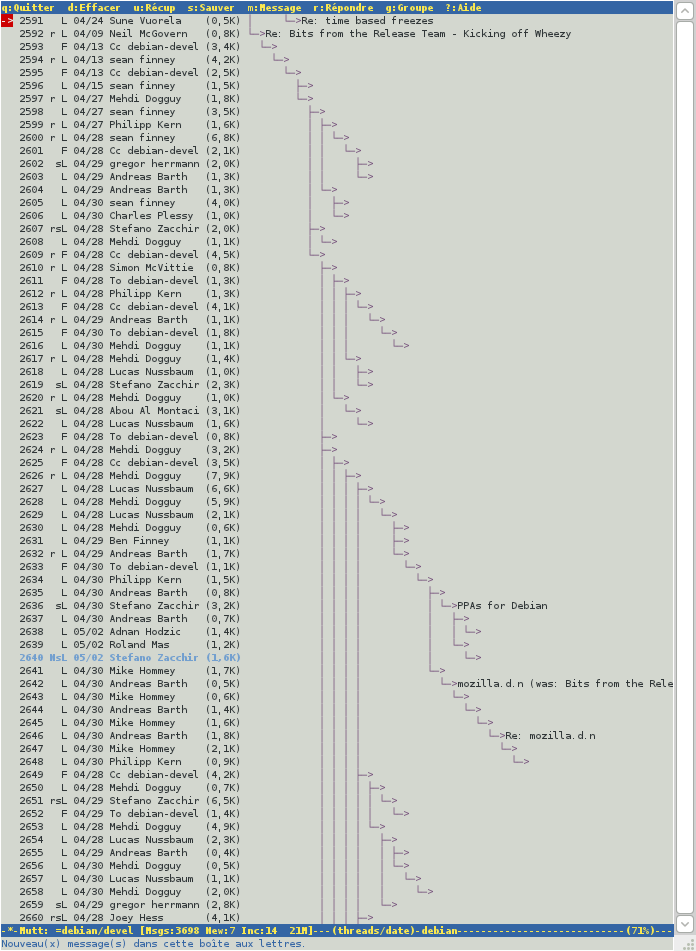
At this point it s a discussion thread of several hundreds of messages (there are several screens of messages like the one above). Many of the sub-threads have been interesting, but the general discussions mixed too many different things so that there s no clear outcome yet. Lucas Nussbaum tried to make a summary. Obviously I must adjust my plan, there s lots of feedback to process. I accepted to drive a DEP together with Sean Finney to help structure the part of the discussion that focuses on allowing development to continue during freezes. But I m also eager to fix the marketing problem of testing and have the project recognize that testing is a product in itself and that end-users should be encouraged to use it. Package Tracking System maintenance The Package Tracking System is an important tool for Debian developers, and it has been broken by some change on the Bug Tracking System. I worked around it quite quickly so that few people noticed the problem but Cron kept reminding me that I had to properly fix it. I ended up doing it last week-end. While working on the PTS, I took the opportunity to merge a patch from Jan Dittberner to enhance the news RSS feed that the PTS provides. And I also integrated information from backports.debian.org (thanks to Mehdi Dogguy for reminding me #549115). Multiarch update Not much new this month. I fixed two bugs in the multiarch dpkg branch thanks to bug reports from Ubuntu users (LP 767634, LP 756381). I m still waiting on Guillem Jover finishing his review of the multiarch branch. I m pinging him from time to time but it looks like multi-arch is no longer in his short term priority list. :-( I ve been running this code for more than 2 months and it works fine. I want to see it merged. I m ready to update my code should anything need to be changed to please Guillem. But without any feedback we re in a deadlock. Misc dpkg work While fixing a bug in update-alternatives (found in one of the valid reports on launchpad), I noticed that there was room for improvements in the error messages output by update-alternatives. I changed them to reuse the same strings that were already used in other parts of dpkg. The result is that there are a few strings less to translate (always a nice thing for the poor translators who have to deal with the thousands of strings that dpkg contains). I also tried to fix some of the most cryptic error messages in dpkg (see #621763) but that work is stalled at the request of Guillem. Book update We (me and Roland Mas) are almost done with the update of our French book for Debian Squeeze. It will hit the shelves in July or September. I m starting to prepare the fundraising campaign to make an English translation of it. We ll use ulule.com for this. On my blog I have been pleased to interview Meike Reichle, it s the first women that I have interviewed in the series but it s certainly not the last one. I also interviewed Adam D. Barratt, one of our tireless release managers. Thanks Many thanks to the people who gave me 180.35 in March and 235.37 in April. That represents 1.5 and 2 days of work for those months. See you next month for a new summary of my activities.

8 comments Liked this article? Click here. My blog is Flattr-enabled.

Luke Faraone: Your release sucks.

I look forward to Ubuntu s semiannual release day, because it s the completion of 6ish months of work by Ubuntu (and by extension Debian) developers.I also loathe it, because every single time we get people saying This Ubuntu release is the worst release ever! .Ubuntu releases are always rocky around release time, because the first time Ubuntu gets widespread testing is on or after release day.We ship software to 12 Million Ubuntu Users with only 150 MOTUs who work directly on the platform. That s a little less than 1 developer with upload rights to the archive for every 60,000 users.1 Compared to Debian, which (at last estimate in 2010) had 1.5 million uniques on security.debian.org, yet has around 1000 Debian Developers.Debian has a strong testing culture; someone once estimated that around of Debian users are running unstable or testing. In Ubuntu, we don t have good metrics on how many people are using the development release that I m aware of (pointers welcome), but I d guess that it s a very very small percentage. A common thread in bug reports, if we get a response at all, goes on as follows:

Triager:2 Is this a problem in $devel?

User: I ll let you know when it hits final

Triager: It s too late then. Then we ll want you to test in the next release. We have to fix it BEFORE its final

User: Ok, I ll test at beta.

Triager: That s 2 weeks before release, which will be too late. Please test ASAP if you want us to have time to fix it Of course, there are really important bugs with hardware support which keep on cropping up. But if they re just getting reported on or around release day, there are limits to what can be done about them this cycle.We need to make it easier for people to run early development versions, and encourage more people to use them (as long as they re willing to deal with breakage). I m not sure whether unstable/testing is appropriate for Ubuntu, and I m fairly confident that we don t want to move to a rolling release (currently being discussed in Debian, summary). But we badly need more developers, and equally importantly, more testers to try it out earlier in the release process.To users: please, please try out the development versions. Download a LiveCD and run a smoketest, or check if bugs you reported are in fact fixed in the later versions. And do it early and often.

  1. This number, like all other usage data, is dated, and probably wasn t even accurate when it was first calculated
  2. Developer, bugcontrol member, etc. Somebody who is not experiencing the problem but wants to help.

Next.

Previous.