Search Results: "ed"

23 March 2016

Daniel Pocock: GSoC 2016 opportunities for Voice, Video and Chat Communication

I've advertised a GSoC project under Debian for improving voice, video and chat communication with free software. Replacing Skype, Viber and WhatsApp is a big task, however, it is quite achievable by breaking it down into small chunks of work. I've been cataloguing many of the key improvements needed to make Free RTC products work together. Many of these chunks are within the scope of a GSoC project. If you can refer any students, if you would like to help as a mentor or if you are a student, please come and introduce yourself on the FreeRTC mailing list. If additional mentors volunteer, there is a good chance we can have more than one student funded to work on this topic. The deadline is Friday, 25 March 2016 The student application deadline is 25 March 2016 19:00 UTC. This is a hard deadline for students. Mentors can still join after the deadline, during the phase where student applications are evaluated. The Google site can be very busy in the hours before the deadline so it is recommended to try and complete the application at least 8 hours before the final deadline. Action items for students:
  • Register yourself on the Google Site and submit an application. You can submit applications to multiple organizations. For example, if you wish to focus on the DruCall module for Drupal, you can apply to both Debian and Drupal.
  • Join the FreeRTC mailing list and send a message introducing yourself. Tell us which topics you are interested in, which programming languages your are most confident with and which organizations you applied to through the Google site.
  • Create an application wiki page on the Debian wiki. You are permitted to edit the page after the 25 March deadline, so if you are applying at the last minute, just create a basic list of things you will work on and expand it over the following 2-3 days
Introducing yourself and making a strong application When completing the application form for Google, the wiki page and writing the email to introduce yourself, consider including the following details:
  • Link to any public profile you have on sites like Github or bug trackers
  • Tell us about your programming language skills, list the top three programming languages you are comfortable with and tell us how many years you have used each
  • other skills you have or courses you have completed
  • any talks you have given at conferences
  • any papers you have had published
  • any conferences you have attended or would like to attend
  • where you are located and where you study, including timezone
  • any work experience you already have
  • any courses, exams or employment commitments you have between 22 May and 24 August
  • anybody from your local free software community or university who may be willing to help as an additional mentor
Further reading Please also see my other project idea, for ham radio / SDR projects and my blog Want to be selected for Google Summer of Code 2016?. If you are not selected in 2016 We try to make contact with all students who apply and give some feedback, in particular, we will try to let you know what to do to increase your chances of selection in the next year, 2017. Applying for GSoC and being interviewed by mentors is a great way to practice for applying for other internships and jobs.

22 March 2016

Michal Čihař: Weekly phpMyAdmin contributions 2016-W11

Last week was a bit less working for me as I had few days off. The 4.6.0 is about to be released in the time as this blog post will be published, so the focus was obviously on fixing bugs. Most of annoying issues I've fixed were caused by our SQL Parser which we need to generate some export statements and which didn't properly understand some more complex syntax. Most of the export issues are now fixed, but there are still situations where it doesn't parse the query right, usually this is true for nested SELECT statements or some more complex constructs (CASE). Anyway it's being improved and works better with every release. Handled issues:

Filed under: English phpMyAdmin 0 comments

Ben Hutchings: I'm super, thanks for asking!

Some of you (but though probably not many) will know that I've suffered from depression at times. It has made it very difficult for me to do my job, to keep my home in order, even to have real conversations. Many important tasks seemed to require more energy than I had, and every setback left me feeling hopeless. I have sought treatment on several occasions, with very limited results. Certainly I would get better eventually, but it was hard to tell whether this had anything to do with the medication or therapy I received. And even while I felt better, I still didn't feel particularly happy or hopeful except when going to my favourite social events like DebConf. As I was recovering from the 'flu a weeks ago, I realised that I was feeling enthusiastic and energetic for no particular reason. Obviously I was recovering from physical illness, but that was brief. I had also just started a new project at work, but it isn't that exciting (at this stage) and I'm already aware of plenty of problems with it. So nothing external seemed to have changed to make me feel better, and yet my mood was so high that I worried that my illness could have changed to bipolar disorder and that I was entering a manic phase. Thankfully, I'm not behaving manically. I have been doing a lot more shopping than usual, but almost the first purchase was a whiteboard to maintain the to-do list that I had been keeping rather unreliably in my head, and mostly I've been buying things off that list - that I've intended to get for months or years. It's just been so long since I could feel generally positive and optimistic about my life - outside of any special event - that I didn't immediately recognise this state of mind as normality. It's now been two three weeks since my recovery, and I still feel so much better: As I feel better in myself I also find myself less self-centred and more able to focus on other people's needs, particularly my wife Nattie. Frankly I've been an asshole pretty often while I was depressed, so I apologise to those who've been the brunt of that. I hope you'll find me more pleasant to deal with from now on. There's lots more I could write, but I'll end this entry now and maybe say more at a later date.

21 March 2016

Lunar: Reproducible builds: week 47 in Stretch cycle

What happened in the reproducible builds effort between March 13th and March 19th 2016:

Toolchain fixes
  • Petter Reinholdtsen uploaded naturaldocs/1.51-1.1 which makes the output reproducible. Original patch by Chris Lamb.
  • Damyan Ivanov uploaded libpdf-api2-perl/2.025-2 which will make internal font ID reproducible.
  • Christian Hofstaedtler uploaded ruby2.3/2.3.0-5 which sets gzip embedded mtime field to fixed value for rdoc-generated compressed javascript data.

Packages fixed The following packages have become reproducible due to changes in their build dependencies: diction, doublecmd, ruby-hiredis, vdr-plugin-epgsearch. The following packages became reproducible after getting fixed: Some uploads fixed some reproducibility issues, but not all of them: Patches submitted which have not made their way to the archive yet:
  • #818128 on nethack by Reiner Herrmann: implement support for SOURCE_DATE_EPOCH, set LC_ALL to C, and ensure deterministic build order when running parallel builds.
  • #818111 on debian-keyring by Satyam Zode: fix the order of files in md5sums.
  • #818067 on ncurses by Niels Thykier: strip trailing whitespaces introduced when using dash as system shell.
  • #818230 on aircrack-ng by Reiner Herrmann: build assembly code as a separate .o file.
  • #818419 on mutt by Daniel Shahaf: use C locale when listing files to be put in README.Patches.
  • #818430 on ruby-coveralls by Dhole: ensure UTC is used as the timezone when generating the documentation.
  • #818686 on littlewizard by Reiner Herrmann: use the C locale in the script for iterating over the files.
  • #818704 on strigi by Reiner Herrmann: sort keys when traversing hashes in makecode.pl.

Package reviews 44 reviews have been removed, 40 added and 5 updated in the previous week. Chris Lamb has reported 16 FTBFS.

Russ Allbery: Term::ANSIColor 4.05

This Perl (core) module provides a variety of functions and tools for manipulating ANSI color and text style escape sequences. The primary change in this release is a few internal tweaks to reduce memory usage, which apparently had ballooned by 70% since Perl 5.14. Unfortunately, that also meant dropping support for non-ASCII characters in color aliases, which I think previously would have theoretically worked (not that it was ever documented or tested). I have mixed feelings, but since the memory usage was reported as a bug (and this is the sort of module that one might legitimately want to use in some space-constrainted situations as part of core), and no one ever mentioned non-ASCII color aliases, I decided to apply this patch. Yell at me if this broke something. I also cleaned up the metadata management following all the work that others helped me with for podlators. You can get the latest release from the Term::ANSIColor distribution page.

Russ Allbery: podlators 4.07

This is a minor bug fix release of the Perl POD translators for text and man pages. It fixes a warning about use of uninitialized variables when run on a Perl module in the current directory, cleans up a confusing warning during the Perl core build, and fixes a long-standing bug in turning off italic font in =item tags in a C<> block. You can get the latest release form the podlators distribution page.

20 March 2016

Sean Whitton: Spring Break in San Francisco

Last night I got back from spending around 5 days in the Bay Area for Spring Break. I stayed in a hostel in downtown SF for three nights and then I stayed with a friend who is doing a PhD at Stanford. When initially planning this trip my aim was just to visit somewhere interesting on the west coast of the continental United States. I chose the Bay Area because I wanted to get my PGP key signed by some Debian Developers and that area has a high concentration of DDs, and because I wanted to see my friend at Stanford. But in the end I liked San Francisco a lot more than expected to and am very glad that I had an opportunity to visit. The first thing that I liked was how easy it seemed to be to find people interested in the same kind of tech stuff that I am. I spent my first afternoon in the city exploring the famous Mission district, and at one point while sitting in the original Philz Coffee I found that the person sitting next to me was running Debian on her laptop and blogs about data privacy. We had an discussion about how viable OpenPGP is as a component of a technically unsophisticated user s attempts to stay safe online. Later that same day while riding the subway train, someone next to me fired up Emacs on their laptop. And over the course of my trip I met five Debian Developers doing all sorts of different kinds of work both in and outside of Debian, and some Debian users including one of Stanford s UNIX sysadmins. This is a far cry from my day-to-day life down in the Sonoran Desert where new releases of iOS are all anyone seems to be interested in. Perhaps I should have expected this before my trip, but I think I had assumed that most of the work being done in San Francisco was writing web apps, so I was pleased to find people working on the same kind of things that I am currently putting time into. And in saying the above, I don t mean to demean the interests of the people around me in Arizona for a moment (nor those writing web apps; I d like to learn how to write good ones at some point). I m very grateful to be able to discuss my philosophical interests with the other graduate students. It s just that I miss being able to discuss tech stuff. I guess you can t have everything you want! One particular encouraging meeting I had was with a Debian Developer employed by Google and working on Git. While my maths background sets me up with the right thinking skills to write programs, I don t have knowledge typically gained from an education in computer science that enables one to work on the most interesting software. In particular, low-level programming in C is something that I had thought it wouldn t be possible for me to get started with. So it was encouraging to meet the DD working on Git at Google because his situation was similar: his undergraduate background is in maths and he was able to learn how to code in C by himself and is now working on a exciting project at a company that it is hard to get hired by. I don t mean that doing exactly what he s doing is something that I aiming for, just that it is very encouraging to know the field is more open to me than I had thought. I was also reminded of how fortunate I am to have the Internet to learn from and projects like Debian to get involved with. Moving on from tech, I enjoyed the streets of San Francisco, and the Stanford campus. San Francisco is fantastically multicultural though with clear class and wealth divisions. A very few minutes walk from the Twitter headquarters with its tech bros , as the maths PhD students I met at Stanford call them, are legions of the un- and barely-employed passing their time on the concrete. I enjoyed riding one of the old cable cars through the aesthetically revealing and stark combination of a west coast grid system on some very steep hills. I was fortunate to be able to walk across the Golden Gate Bridge on a perfectly clear and mist-free day. Meeting people involved with Debian and meeting my old friend at Stanford had me reflecting on and questioning my life in the desert even more than usual. I try to remind myself that there is an end date in sight and I will regret spending my time here just thinking about leaving. I sometimes worry that I could easily find myself moving to the big city London, San Francisco or elsewhere and letting myself be carried by the imagined self-importance of that, sidelining and procrastinating things that I should prize more highly. I should remember that the world of writing software in big cities isn t going away and my time in the desert is an opportunity to prepare myself better for that, building my resistance to being swept away by the tides of fashion.

Norbert Preining: Debian/TeX Live 2015.20160320-1 and biber 2.4-1

About one month has passed and here is the usual updated of TeX Live packages for Debian, this time also with an update to biber to accompany the updated version of biblatex. This will be (probably) the last upload before TeX Live 2015 gets frozen in preparation for 2016. After the freeze there will be some time of piece, and updates will got to experimental with the new binaries. Debian - TeX Live 2015 From the list of updated and new packages I want to mention that biblatex has been updated together with biber, and most biblatex styles should already by updated to work with the new biblatex, too. From the new packages one has in particular caught my attention: prooftrees. As I am writing a lot of proofs in my research, I am happy to see new package dealing with this, especially because this package is built on top of the excellent package forest (which in turn uses tikz), allowing for very compact proofs. Updated packages aastex, abntex2, academicons, acro, amsmath, animate, archaeologie, asciilist, babel, babel-french, babel-friulan, babel-russian, babel-spanish, beamertheme-metropolis, bibexport, biblatex, biblatex-apa, biblatex-bookinarticle, biblatex-caspervector, biblatex-chem, biblatex-fiwi, biblatex-gost, biblatex-manuscripts-philology, biblatex-nature, biblatex-philosophy, biblatex-phys, biblatex-publist, biblatex-realauthor, biblatex-science, bxjscls, cabin, caption, cbfonts-fd, celtic, chemmacros, computational-complexity, crimson, csplain, datetime2-english, diagbox, disser, droit-fr, dtk, dvips, ejpecp, emisa, factura, fibeamer, fithesis, forest, gost, hobby, hyperxmp, inconsolata, lualatex-math, mandi, mcf2graph, media9, nameauth, ocgx2, parades, pdftex, pkuthss, poetrytex, ptex, reledmac, roundrect, showhyphens, siunitx, spath3, splitindex, suftesi, tcolorbox, tetex, tex4ht, texinfo, texlive-scripts, thuthesis, titlesec, turabian-formatting, unicode-data, uptex, velthuis, venndiagram, xassoccnt, xint, xsavebox. New packages beamercolorthemeowl, bibletext, cochineal, formation-latex-ul, gobble, keyvaltable, lroundrect, luatex85, mathpartir, miama, multidef, parades, pgfornament, prooftrees, visualpstricks, visualtikz, xsavebox, ycbook. Enjoy.

Gunnar Wolf: Busy with the worthy things...

My online activity, in most if not all of the projects I most care about, has dropped to a lifelong minimum. But that is not necessarily a bad thing Yes, I want to be more involved again in everything. And yes, I am in a permanent crisis of lack of time (and/or sleep). I didn't even remember to blog about this on time... but never mind... A little over a year after the single, most important moment I have lived, we are not only enjoying, but deeply understanding the true meaning of life.

19 March 2016

Petter Reinholdtsen: UsingQR - "Electronic" paper invoices using JSON and QR codes

Back in 2013 I proposed a way to make paper and PDF invoices easier to process electronically by adding a QR code with the key information about the invoice. I suggested using vCard field definition, to get some standard format for name and address, but any format would work. I did not do anything about the proposal, but hoped someone one day would make something like it. It would make it possible to efficiently send machine readable invoices directly between seller and buyer. This was the background when I came across a proposal and specification from the web based accounting and invoicing supplier Visma in Sweden called UsingQR. Their PDF invoices contain a QR code with the key information of the invoice in JSON format. This is the typical content of a QR code following the UsingQR specification (based on a real world example, some numbers replaced to get a more bogus entry). I've reformatted the JSON to make it easier to read. Normally this is all on one long line:
 
 "vh":500.00,
 "vm":0,
 "vl":0,
 "uqr":1,
 "tp":1,
 "nme":"Din Leverand r",
 "cc":"NO",
 "cid":"997912345 MVA",
 "iref":"12300001",
 "idt":"20151022",
 "ddt":"20151105",
 "due":2500.0000,
 "cur":"NOK",
 "pt":"BBAN",
 "acc":"17202612345",
 "bc":"BIENNOK1",
 "adr":"0313 OSLO"
 
The interpretation of the fields can be found in the format specification (revision 2 from june 2014). The format seem to have most of the information needed to handle accounting and payment of invoices, at least the fields I have needed so far here in Norway. Unfortunately, the site and document do not mention anything about the patent, trademark and copyright status of the format and the specification. Because of this, I asked the people behind it back in November to clarify. Ann-Christine Savlid (ann-christine.savlid (at) visma.com) replied that Visma had not applied for patent or trademark protection for this format, and that there were no copyright based usage limitations for the format. I urged her to make sure this was explicitly written on the web pages and in the specification, but unfortunately this has not happened yet. So I guess if there is submarine patents, hidden trademarks or a will to sue for copyright infringements, those starting to use the UsingQR format might be at risk, but if this happen there is some legal defense in the fact that the people behind the format claimed it was safe to do so. At least with patents, there is always a chance of getting sued... I also asked if they planned to maintain the format in an independent standard organization to give others more confidence that they would participate in the standardization process on equal terms with Visma, but they had no immediate plans for this. Their plan was to work with banks to try to get more users of the format, and evaluate the way forward if the format proved to be popular. I hope they conclude that using an open standard organisation like IETF is the correct place to maintain such specification. Update 2016-03-20: Via Twitter I became aware of some comments about this blog post that had several useful links and references to similar systems. In the Czech republic, the Czech Banking Association standard #26, with short name SPAYD, uses QR codes with payment information. More information is available from the Wikipedia page on Short Payment Descriptor. And in Germany, there is a system named BezahlCode, (specification v1.8 2013-12-05 available as PDF), which uses QR codes with URL-like formatting using "bank:" as the URI schema/protocol to provide the payment information. There is also the ZUGFeRD file format that perhaps could be transfered using QR codes, but I am not sure if it is done already. Last, in Bolivia there are reports that tax information since november 2014 need to be printed in QR format on invoices. I have not been able to track down a specification for this format, because of my limited language skill sets.

18 March 2016

Enrico Zini: Adjusting with Moore's Law

In my last post I used zxcvbn to check the strength of passwords, and it gave estimates in hundreds of centuries. However, there's Moore's law. If we assume that every 18 months the effective computing power will double...
#!/usr/bin/python3
import sys
years = int(sys.argv[1])
# How many 18 months intervals we spent
count = 0
# How many original-computation-time-months we compute each 18 months interval
step = 18
# How many original-computation-time-months we computed so far
total = 0
# How many original-computation-time-months we need
target = years * 12
# Iterate each 18 months interval
while True:
    count += 1
    total += step
    if total > target: break
    step *= 2
print(" :.2f  years needed".format(count / 12 * 18))
...then something that is now estimated in 152 centures is likely to take, well:
$ ./actual_years 15200
9.33 years needed
Update Fixed algorithm (thanks John MacGregor). Now the estimate is a little longer, but still:
$ ./actual_years 15200
21.00 years needed
ukasz Stelmach proposed an analytic solution:
There are two cars (remember phisics in primary school?). They both have the same speed V0. It is going to take "54.697 centuries" for car A to travel the desired distance at constant speed. Car B is accelerating, its speed is 2^(t/18m)*V0 (18 [m]onths). s = V0 * T (car A, T is 54.697 centuries) s = 2^(t/18)*V0 dt (car B, we're looking for t) It's been some time but as far as I can tell it is s = V0 * 2^(t/18) * 1/((1/18) * ln 2) 2^(t/18) * 1/((1/18) * ln 2) = 54.697 * 100 * 12 [months] 2^(t/18) = 2527.54 t = 18*log2(2527.54) t = 16.96 years (still reasonable strength).

Daniel Pocock: FOSSASIA 2016 at the Science Centre Singapore

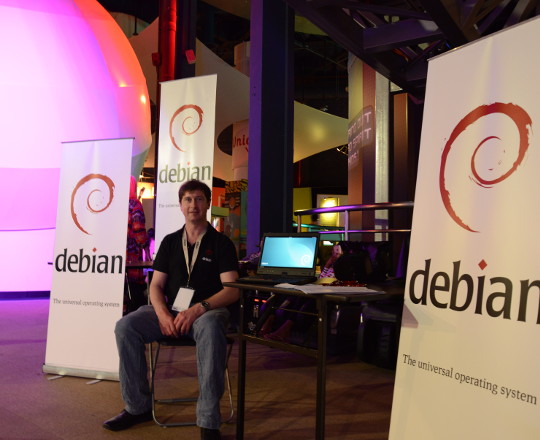
FOSSASIA 2016 is now under way. The Debian, Red Hat and Ring (Savoir-Faire Linux) teams are situated beside each other in the exhibit area. Thanks to Hong Phuc from the FOSSASIA team for helping us produce these new Debian banners Google Summer of Code 2016 If you are keen to participate in GSoC 2016, please feel free to come and discuss it with me in person or attend any of my sessions at FOSSASIA this weekend. Please also see my blog about getting selected for GSoC, attending a community event like FOSSASIA is a great way to distinguish yourself from the many applications we receive each year. (Debian Outreach / GSoC information). Real-time communications, WebRTC and mobile VoIP at FOSSASIA There are a number of events involving real-time communications technology throughout FOSSASIA 2016, please come and join us at these:

Event Time
Hands-on workshop with WebRTC and mobile VoIP (1 hr) Saturday, 14:30
Talk: Free Communications with Free Software (20 min) Saturday, 17:40
Ring: a decentralized and secure communication platform Sunday, 13:00
and the full program details, including locations, are in the schedule.

17 March 2016

Aurelien Jarno: (Pseudo-)virtualizing Intel USB controllers

I own a motherboard an Intel 8-Series Lynx Point chipset, with an Intel Haswell CPU supporting VT-d. This allow me to use Linux s VFIO features and assign PCIe devices to a KVM-based virtual machine. High-end network controllers goes even further with the Single Root I/O Virtualization (SR-IOV) capabilities, allowing them to be shared between to multiple virtual machines. The Lynx Point chipset provides a total of 14 USB ports arranged in 6 USB 3.0 ports and 8 USB 2.0 ports. It would be nice to be able to assign USB ports to virtual machines. QEMU already allows to assign a USB device to a virtual machine, but it works emulating a USB controller, and the traffic goes through userland. In addition it only works for a specific known device, a random device plugged to a given port is not automatically assigned to the guest (though I guess it can be scripted using the libvirt API). The xHCI specification, the one behind USB 3.0, has been designed to also support SR-IOV, to the best of my knowledege none of them actually support it. We ll see that with some hacks it is possible to actually assign a set of USB ports to a virtual machine, with the restrictions that running ports in SuperSpeed mode is allowed only on one side, host or virtual machine. First let s look at how the USB controllers appears on a Lynx Point chipset using lscpi:
00:14.0 USB controller [0c03]: Intel Corporation 8 Series/C220 Series Chipset Family USB xHCI [8086:8c31] (rev 04)
00:1a.0 USB controller [0c03]: Intel Corporation 8 Series/C220 Series Chipset Family USB EHCI #2 [8086:8c2d] (rev 04)
00:1d.0 USB controller [0c03]: Intel Corporation 8 Series/C220 Series Chipset Family USB EHCI #1 [8086:8c26] (rev 04)
As one can see, three controllers are visible, one xHCI one and two EHCI ones. Let s now look at how the USB ports are arranged using lsusb -t
/: Bus 04.Port 1: Dev 1, Class=root_hub, Driver=ehci-pci/3p, 480M
__ Port 1: Dev 2, If 0, Class=Hub, Driver=hub/8p, 480M
/: Bus 03.Port 1: Dev 1, Class=root_hub, Driver=ehci-pci/3p, 480M
__ Port 1: Dev 2, If 0, Class=Hub, Driver=hub/6p, 480M
/: Bus 02.Port 1: Dev 1, Class=root_hub, Driver=xhci_hcd/6p, 5000M
/: Bus 01.Port 1: Dev 1, Class=root_hub, Driver=xhci_hcd/15p, 480M
explain EHCI/OHCI/XHCI http://www.intel.com/content/www/us/en/chipsets/8-series-chipset-pch-datasheet.html the kernel in the VM might move back the devices to the xHCI controller. This is always the case for old kernels (like the 3.2 in Debian Wheezy), but for recent kernel it only happens if there is an intel EHCI controller available (either passed through VFIO or emulated by QEMU). add table Add warning

Enrico Zini: Enhanced xkcd password generator

gpw and xkcdpass have entered testing. How about putting them together?
#!/usr/bin/python3
import subprocess
import random
import re
re_spaces = re.compile(r"\s+")
def get_words(cmd):
    out = subprocess.check_output(cmd, universal_newlines=True)
    return (x for x in re_spaces.split(out) if x)
words = set()
words.update(get_words(["xkcdpass", "-c", "10"]))
for l in range(6, 9):
    words.update(get_words(["gpw", "10", str(l)]))
for i in range(7):
    print(" ".join(random.sample(words, 5)))
Let's check the results:
#!/usr/bin/python
from __future__ import print_function
from zxcvbn import password_strength
import sys
for line in sys.stdin:
    pw = line.strip()
    info = password_strength(pw)
    print(" pw :  crack_time_display   entropy ".format(pw=pw, **info))
$ xkcdpass -n 5 -c 7   ./checkpass
moribund fasten cologne enamor by-and-by: centuries 132.586
woolen leptonic pogrom roster Serra: centuries 127.145
shorthand Piman suctional elution unholy: centuries 119.809
Blackwell mauvish covey selenium finished: centuries 112.936
asthma bloat crenulate clean-cut cytoplasm: centuries 150.181
agreeable refined racism Captain Cyrenaic: centuries 104.28
Bothnia stagnant atomist these revise: centuries 97.91
$ gpw 7   ./checkpass
ncenspri: 11.0 days 33.903
orsterma: instant 19.54
entsssel: 14.0 hours 29.788
tempispi: instant 20.058
nidgersi: 14.0 hours 29.725
oligalin: 51.0 minutes 25.824
iseartio: 10.0 minutes 23.207
$ ./metapass   ./checkpass
herups icirop overdub oldster cingsape: centuries 147.265
mujahidin usufruct rition porky prignam: centuries 153.684
cannula irenics tableaux ntshed calcific: centuries 152.196
stopgap stale orthente Amazonia sharer: centuries 113.474
edudives mmingsso eremab prignam tableaux: centuries 147.354
tingei heroism Nathaniel cannula molasses: centuries 103.007
Torres blood lewdness prignam eremab: centuries 118.475
The strength, according to zxcvbn, seems only marginally better, and it's a wonderful way to grow a vocabulary of nonexisting words that can be dropped into cheap talk conversation to confuse the innocents.

Patrick Matth i: Debian Jessie 8.3: Short howto for Corosync+Pacemaker Active/Passive Cluster with two nodes and DRBD/LVM

Hello, since I had to change my old heartbeat v1 setup to an more modern Corosync+Pacemaker setup, because heartbeat v1 does not support systemd (it first looks like it is working, but it fails on service start/stops), I want to share a simple setup: First you have to activate the jessie-backports repository, because the cluster stack is not available/broken in Debian Jessie. Install the required packages with:
apt-get install -t jessie-backports libqb0 fence-agents pacemaker corosync pacemaker-cli-utils crmsh drbd-utils
After that configure your DRBD and LVM (VG+LV) on it (there are enough tutorials for it). Then deploy this configuration to /etc/corosync/corosync.conf:
totem
version: 2
token: 3000
token_retransmits_before_loss_const: 10
clear_node_high_bit: yes
crypto_cipher: none
crypto_hash: none
transport: udpu
interface
ringnumber: 0
bindnetaddr: 192.168.99.0

logging
to_logfile: yes
logfile: /var/log/corosync/corosync.log
debug: off
timestamp: on
logger_subsys
subsys: QUORUM
debug: off

quorum
provider: corosync_votequorum
two_node: 1
wait_for_all: 1
nodelist
node
ring0_addr: node1-1

node
ring0_addr: node1-2

Both nodes require a passwordless keypair, which is copied to the another node, so that you can ssh from one to each other. Then you can start with crm configure:
property stonith-enabled=no
property no-quorum-policy=ignore
property default-resource-stickiness=100 primitive DRBD_r0 ocf:linbit:drbd params drbd_resource= r0 op start interval= 0 timeout= 240 \
op stop interval= 0 timeout= 100 \
op monitor role=Master interval=59s timeout=30s \
op monitor role=Slave interval=60s timeout=30s
primitive LVM_r0 ocf:heartbeat:LVM params volgrpname= data1 op monitor interval= 30s
primitive SRV_MOUNT_1 ocf:heartbeat:Filesystem params device= /dev/mapper/data1-lv1 directory= /srv/storage fstype= ext4 options= noatime,nodiratime,nobarrier op monitor interval= 40s primitive IP-rsc ocf:heartbeat:IPaddr2 params ip= 123.123.123.123 nic= eth0 cidr_netmask= 24 meta migration-threshold=2 op monitor interval=20 timeout=60 on-fail=restart
primitive IPInt-rsc ocf:heartbeat:IPaddr2 params ip= 192.168.99.4 nic= eth1 cidr_netmask= 24 meta migration-threshold=2 op monitor interval=20 timeout=60 on-fail=restart primitive MariaDB-rsc lsb:mysql meta migration-threshold=2 op monitor interval=20 timeout=60 on-fail=restart
primitive Redis-rsc lsb:redis-server meta migration-threshold=2 op monitor interval=20 timeout=60 on-fail=restart
primitive Memcached-rsc lsb:memcached meta migration-threshold=2 op monitor interval=20 timeout=60 on-fail=restart
primitive PHPFPM-rsc lsb:php5-fpm meta migration-threshold=2 op monitor interval=20 timeout=60 on-fail=restart
primitive Apache2-rsc lsb:apache2 meta migration-threshold=2 op monitor interval=20 timeout=60 on-fail=restart
primitive Nginx-rsc lsb:nginx meta migration-threshold=2 op monitor interval=20 timeout=60 on-fail=restart group APCLUSTER LVM_r0 SRV_MOUNT_1 IP-rsc IPInt-rsc MariaDB-rsc Redis-rsc Memcached-rsc PHPFPM-rsc Apache2-rsc Nginx-rsc
ms ms_DRBD_APCLUSTER DRBD_r0 meta master-max= 1 master-node-max= 1 clone-max= 2 clone-node-max= 1 notify= true colocation APCLUSTER_on_DRBD_r0 inf: APCLUSTER ms_DRBD_APCLUSTER:Master
order APCLUSTER_after_DRBD_r0 inf: ms_DRBD_APCLUSTER:promote APCLUSTER:start commit
The last (bold marked) lines made me some headache. In short they define that the DRBD device on the active node has to be the primary one and that it is required to start the APCLUSTER on the host, since the LVM, filesystem and services require to access its data. Just a short copy paste howto for an simple use case with not so much deep explanaitions..

Dirk Eddelbuettel: RcppArmadillo 0.6.600.4.0

armadillo image Conrad announced a new Armadillo release 6.600.4 yesterday. This followed some work we had done for thorough pre-release checking with reverse dependencies tests for the over 200 CRAN packages using it and resulted in one more squashed bug. This releasehas been folded into RcppArmadillo 0.6.600.4.0 which arrived on CRAN and Debian earlier today. Armadillo is a powerful and expressive C++ template library for linear algebra aiming towards a good balance between speed and ease of use with a syntax deliberately close to a Matlab. Changes in this release are as follows:
Changes in RcppArmadillo version 0.6.600.4.0 (2016-03-15)
  • Upgraded to Armadillo 6.600.4 (Catabolic Amalgamator)
    • expanded sum(), mean(), min(), max() to handle cubes
    • expanded Cube class to handle arbitrarily sized empty cubes (eg. 0x5x2)
    • added shift() for circular shifts of elements
    • added sqrtmat() for finding the square root of a matrix
    • fix for gmm_diag when using Mahalanobis distance
  • The configure script now reflects the full LAPACK fallback offered by R 3.3.0 or later (PR #81)
Courtesy of CRANberries, there is also a diffstat report for this release. As always, more detailed information is on the RcppArmadillo page. Questions, comments etc should go to the rcpp-devel mailing list off the R-Forge page.

This post by Dirk Eddelbuettel originated on his Thinking inside the box blog. Please report excessive re-aggregation in third-party for-profit settings.

Julian Andres Klode: Clarifications and updates on APT + SHA1

The APT 1.2.7 release is out now. Despite of what I wrote earlier, we now print warnings for Release files signed with signatures using SHA1 as the digest algorithm. This involved extending the protocol APT uses to communicate with the methods a bit, by adding a new 104 Warning message type.
W: gpgv:/var/lib/apt/lists/apt.example.com_debian_dists_sid_InRelease: The repository is insufficiently signed by key
1234567890ABCDEF0123456789ABCDEF01234567 (weak digest)
Also note that SHA1 support is not dropped, we merely do not consider it trustworthy. This means that it feels like SHA1 support is dropped, because sources without SHA2 won t work; but the SHA1 signatures will still be used in addition to the SHA2 ones, so there s no point removing them (same for MD5Sum fields). We also fixed some small bugs!
Filed under: Debian, Ubuntu

16 March 2016

Enrico Zini: Postprocessing files saved by vim

Processing vim buffers through an external program on save, is a technique that is probably in use, and that I have not found documented anywhere, so here we go. Skip to the details for the entertaining example. I wanted to integrate egt with TaskWarrior so that every time I am editing an egt project file in vim, if I write a line in a certain way then a new taskwarrior task is created. Also, I have never written a vim plugin, and I don't want to dive into another rabbit hole just yet. Lynoure brought to my attention that taskwiki processes things when the file is saved, so I thought that I can probably get a long way by piping the file from vim into egt and reading it back before saving. I created a new egt annotate command that reads a project file, tweaks it, and then prints it out; I opened a project file in vim; I typed :%!egt annotate %:p --stdin and saw that it could be done. I find the result quite fun: I type 15 March: 18:00-21:00 in a log in egt, save the file, and it becomes 15 March: 18:00-21:00 3h. I do something in TaskWarrior, save the file in egt, and the lines that are TaskWarrior tasks update with the new task states. Details Here's a step by step example of how to hook into vim in this way. First thing, create a filter script that processes text files in some way. Let's call this /usr/local/bin/pyvimshell:
#!/usr/bin/python3
import sys
import subprocess
for line in sys.stdin:
    print(line.rstrip(), file=sys.stdout)
line = line.strip()
if line == "$":
    pass
elif line.startswith("$"):
    out = subprocess.check_output(["sh", "-c", line[1:].strip()], universal_newlines=True)
    sys.stdout.write(out)
    if not out.endswith("\n"):
        sys.stdout.write("\n")
    print("$ ", file=sys.stdout)
Then let's create a new filetype in ~/.vim/filetype.vim for our special magic text files:
if exists("did_load_filetypes")
  finish
endif
augroup filetypedetect
  au! BufNewFile,BufRead *.term setf SillyShell
augroup END
If you create a file example.term, open it in vim and type :set ft it should say SillyShell. Finally, the hook in ~/.vim/after/ftplugin/SillyShell.vim:
function! SillyShellRun()
    :%!/home/enrico/dev/egt/pyvimshell
    :$
endfunction
autocmd BufWritePre,FileWritePre <buffer> :silent call SillyShellRun()
Now you can create a file example.term, open it in vim, type $ ls, save it, and suddenly you have a terminal with infinite scrollback. For egt, I actually want to preserve my cursor position across saves, and egt also needs to know the path to the project file, so here is the egt version of the hook:
function! EgtAnnotate()
    let l:cur_pos = getpos(".")
    :%!egt annotate --stdin %:p
    call setpos(".", l:cur_pos)
endfunction
autocmd BufWritePre,FileWritePre <buffer> :silent call EgtAnnotate()
I find this adorably dangerous. Have fun.

Dirk Eddelbuettel: Rblpapi 0.3.3

A new release of Rblpapi is now on CRAN. It provides a direct interface between R and the Bloomberg Terminal via the C++ API provided by Bloomberg Labs (but note that a valid Bloomberg license and installation is required). This marks the fourth release since the package first appeared on CRAN last year. Thanks to multiple contributors, it packs a number of changes (including two new functions bsrch() and fieldInfo()), numerous internal as well as build improvements, additional documentation and last but not least use of unit testing (provided a Bloomberg connection is available, ie not at CRAN or on Travis CI). See the NEWS.Rd extract for more details:
Changes in Rblpapi version 0.3.3 (2016-03-14)
  • configure adds a missing method="libcurl" options (PR #109 by Martin Bel).
  • New function bsrch() adds basic search functionality (PR #111 by Morgan Williams fixing ticket #82).
  • The licensing status of the Rblpapi source package was clarified (PR #119).
  • The bds() help page now shows an example using an overrides argument (PR #121).
  • A new function fieldInfo was added, and field information is used in bdh and bdp (PRs #122, #123, #125, and #127).
  • The bdp function now checks the order (PR #126).
  • Unit testing was added (PRs #129 and #131).
  • Data retrieval is now smarter about the types returned from Bloomberg (PR #132 and #133; and #141 and #142).
  • The bdh and bds functions now support an option verbose (PRs #138).
Courtesy of CRANberries, there is also a diffstat report for the this release. As always, more detailed information is on the Rblpapi page. Questions, comments etc should go to the issue tickets system at the GitHub repo.

This post by Dirk Eddelbuettel originated on his Thinking inside the box blog. Please report excessive re-aggregation in third-party for-profit settings.

15 March 2016

Joerg Jaspert: Removing checksums

And as just announced on d-d-a, I m trying to break all the tools dealing with the (Debian) archive. Or something like it. But its about time to get rid of MD5Sum checksums, and SHA1 can go with it directly. As it is only in experimental for now, we can test and see what still breaks. I hope it won t be too much, so we can get it over all the archive (minus the stable stuff, of course). For some reason, what I like most in this change is the following python code that ended up in our InRelease file generation tool:
import apt_pkg
# Note: suite.checksums being an array with possible values of md5sum, sha1, sha256
hashfuncs = dict(zip([x.upper().replace('UM', 'um') for x in suite.checksums],
                      [getattr(apt_pkg, "%s" % (x)) for x in [x.replace("sum", "") + "sum" for x in suite.checksums]]))
Though I m sure this can be done in much more readable ways, it s doing what we need, but heck, took me a while to get it. But probably the change to get rid of gzip will be much more challenging / hard to get through. Lets see, in the few minutes after my mail, I already got some notices about possible breakage here. Fortunately those indices and the release file stuff are nicely seperated settings, so if it turns out we only take the checksums drop for now into the other suites, thats doable.

Next.

Previous.