Search Results: "sto"

2 July 2010

Daniel Stone: xhost plus considered harmful

So, flipping through the otherwise good MeeGo SDK setup instructions, I was pretty disheartened to see this:
Next, configure X on the host machine to enable the Simulator (running from the chroot) to access the display of the normal user:

xhost +local:

This gives everyone who can execute anything on your machine full permission to rip your credit card numbers out of Chromium and your password out of gnome-terminal. Sweet. This comes up all the time, so man wouldn't it be great if there was some kind of better way?

xhost +SI:localuser:usernametogiveaccesstogoeshere

I'm pretty sure this has been available in every single X.Org release since 6.8 or so, so next time you see someone advocating something as daft as the above, please point them towards the correct way. Thanks.

(Pushed it with the wrong date originally; couldn't fix it without bumping it to the top again. Sorry!)

1 July 2010

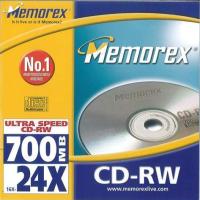
Sylvain Le Gall: 5 years old CD-RW...

This blog post is a kind of followup of a previous blog post about reading 10 years old CD-R. Today, I get a new shiny ASRock ION 330 to play with, in itself this PC has nothing particular. As usual, I begin by using System Rescue CD to check bad blocks on the hard drive, before working with it (badblocks -v -s -w -c 4096 /dev/sda). Once done, I will check the memory (memtest). This is my standard procedure when receiving a new PC. But I don't have my System Rescue CD at hand. No problem, I download it and and write it on an old CD-RW, bought 5 years ago but still sealed into his blister. For your information, this is a Memorex CD-RW 700MB 16-24x. I blank it (wodim blank=all). I write it at speed 16x, because I don't know how to lower the speed. After writing the CD, I re-read it to check everything is fine (readom dev=/dev/cdrw1 f=test.iso). Ooops:
$ readom dev=/dev/cdrw1 f=test.iso
[...] 
Errno: 5 (Input/output error), read_g1 scsi sendcmd: no error
CDB:  28 00 00 01 3C 00 00 00 40 00
status: 0x2 (CHECK CONDITION)
Sense Bytes: 70 00 03 00 00 00 00 0A 00 00 00 00 11 05 00 00
Sense Key: 0x3 Medium Error, Segment 0
Sense Code: 0x11 Qual 0x05 (l-ec uncorrectable error) Fru 0x0
Sense flags: Blk 0 (not valid) 
cmd finished after 6.614s timeout 40s
readom: Input/output error. Cannot read source disk
readom: Retrying from sector 80896.
.............
readom: Error on sector 80908 corrected after 9 tries. Total of 0 errors.
..............---
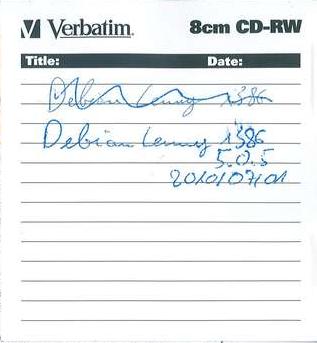
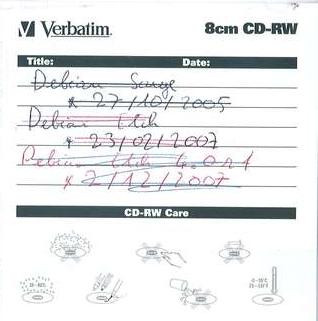
OK, I re-blank it (wodim blank=fast) and rewrite it. The CD seems to be readable this time. But when I try to boot with it my new ASRock, it fails. Enough is enough, I get an heavy used Verbatim 8cm CD-RW. Just to show you how old he is: the first ISO written on it was "Debian Sarge". And the magic happens: it works on the first try!!!! You will probably think that I work for Verbatim. This is not true but I must admit that first-price CD-RW/CD-R seems to be very low quality and don't hold data in time. This is probably related to the chemical compounds of the CD. The failing Memorex CD-RW will end up in a trash and I will continue to use my 5 years old Verbatim CD-RW. Dear reader, in order to find a way not to dump this failing CD-RW, do you know a way to make it to work? What you should now about the failing CD-RW:

30 June 2010

Vincent Sanders: Programmers are suckers for a meme

Many Open Source projects have and IRC # for developers. The NetSurf project is no different. During a discussion someone jokingly suggested that one contributor should be asked to take the FizzBuzz test. Can you guess what happened next?

Ten minutes later Michael Drake posted this solid example in C which is where it all ought to have ended.

<iframe src="http://pastebin.com/embed_iframe.php?i=MesmvSjk" style="border:none;width:100%;height:200px;"></iframe>

Being programmers, of course this had a predictable result. The original question, the reason for asking it and any the serious point being made in the original article were discarded. Just so everyone (including myself) could play silly buggers over our lunch break. Coders, it would seem, simply like to produce a solution even if it is only for fun.

None of these programs took more than ten minutes (except the JAVA monstrosity), are reproduced with permission and I am to blame for none of them (ok maybe just the one ;-).

First up was Rob Kendrick with the classic solution in C (his day job is as a support team lead which seems to make those programmers who cannot do this seem even more scary bad.)

<iframe src="http://pastebin.com/embed_iframe.php?i=EaQ2414U" style="border:none;width:100%;height:200px;"></iframe>

Next was Daniel Silverstone who turned this Lua solution out very quickly and berated the rest of us for not following the rules ;-)

<iframe src="http://pastebin.com/embed_iframe.php?i=cYY0YDYM" style="border:none;width:100%;height:220px;"></iframe>

The final C solution was my own uber silly sieve implementation

<iframe src="http://pastebin.com/embed_iframe.php?i=5w5BhKt3" style="border:none;width:100%;height:200px;"></iframe>

Peter Howkins decided the world required a solution in PHP

<iframe src="http://pastebin.com/embed_iframe.php?i=h2aQ5eXM" style="border:none;width:100%;height:200px;"></iframe>

When pointed out that his solution stopped at 50 he presented this vastly superior and obviously idiomatic solution

<iframe src="http://pastebin.com/embed_iframe.php?i=k8T6VtJu" style="border:none;width:100%;height:200px;"></iframe>

Finally after a long time James Shaw caused mental anguish and wailing with this abomination unto Nuggin.

<iframe src="http://pastebin.com/embed_iframe.php?i=GFeHdJdr" style="border:none;width:100%;height:200px;"></iframe>

With Luck everyone has now got it out of their system and we will never have to put up with this again (yeah right). And now you also know why Open Source projects sometimes take ages to release ;-)

Marco T&uacute;lio Gontijo e Silva: Immix on GHC Summer of Code weekly report #7

My project. This post assumes that the reader has read my last post. This week I had less time to work on my project than the last ones, because it was kind of the last week of the semester for some disciplines. This was unfortunate from a point of view, but it s good in another, because now I ve finished most of my disciplines and can focus more. This is also the reason why the weekly report is slightly delayed. Most of my work this week was continuing the investigation of the segfault caused by my implementation of allocation in lines. The most interesting thing I discovered came after a suggestion from my menthor: to use +RTS -DS to turn on the sanity checker. I runned the code with my allocation implementation and the sanity checker and got a segfault. I runned again only with the code to free memory in lines and I got also a segfault. Then I runned without all my patches, using sweep, and I got the segfault. So it seems that there is something wrong with sweep, and now I m investigating this new segfault. I m using the bernouilli program from nofib to test, running with 148 as a parameter and, naturally, +RTS -w -DS passed to the RunTime System. The output of gdb:
Current directory is /home/marcot/trabalho/livre/ghc/nofib/imaginary/bernouilli/
GNU gdb (GDB) 7.1-debian
Copyright (C) 2010 Free Software Foundation, Inc.
License GPLv3+: GNU GPL version 3 or later <http://gnu.org/licenses/gpl.html>
This is free software: you are free to change and redistribute it.
There is NO WARRANTY, to the extent permitted by law.  Type "show copying"
and "show warranty" for details.
This GDB was configured as "x86_64-linux-gnu".
For bug reporting instructions, please see:
<http://www.gnu.org/software/gdb/bugs/>...
Reading symbols from /home/marcot/trabalho/livre/ghc/nofib/imaginary/bernouilli/Main...done.
(gdb) r 148 +RTS -w -DS
Starting program: /home/marcot/trabalho/livre/ghc/nofib/imaginary/bernouilli/Main 148 +RTS -w -DS
[Thread debugging using libthread_db enabled]
Program received signal SIGSEGV, Segmentation fault.
0x00000000006309cb in LOOKS_LIKE_INFO_PTR_NOT_NULL (p=12297829382473034410) at includes/rts/storage/ClosureMacros.h:225
(gdb) where
#0  0x00000000006309cb in LOOKS_LIKE_INFO_PTR_NOT_NULL (p=12297829382473034410) at includes/rts/storage/ClosureMacros.h:225
#1  0x0000000000630a16 in LOOKS_LIKE_INFO_PTR (p=12297829382473034410) at includes/rts/storage/ClosureMacros.h:230
#2  0x0000000000630a4b in LOOKS_LIKE_CLOSURE_PTR (p=0x7ffff6c84062) at includes/rts/storage/ClosureMacros.h:235
#3  0x0000000000631427 in checkClosure (p=0x7ffff6853a08) at rts/sm/Sanity.c:320
#4  0x00000000006319ef in checkHeap (bd=0x7ffff68014c0) at rts/sm/Sanity.c:479
#5  0x000000000063222f in checkSanity (check_heap=rtsTrue) at rts/sm/Sanity.c:686
#6  0x000000000062dfdb in GarbageCollect (force_major_gc=rtsFalse, gc_type=0, cap=0x8d2ec0) at rts/sm/GC.c:768
#7  0x0000000000620431 in scheduleDoGC (cap=0x8d2ec0, task=0x8f5080, force_major=rtsFalse) at rts/Schedule.c:1420
#8  0x000000000061fa2c in schedule (initialCapability=0x8d2ec0, task=0x8f5080) at rts/Schedule.c:539
#9  0x0000000000620c77 in scheduleWaitThread (tso=0x7ffff6c80000, ret=0x0, cap=0x8d2ec0) at rts/Schedule.c:1902
#10 0x000000000065762b in rts_evalLazyIO (cap=0x8d2ec0, p=0x89d8b0, ret=0x0) at rts/RtsAPI.c:495
#11 0x000000000061d3db in real_main () at rts/RtsMain.c:66
#12 0x000000000061d4ca in hs_main (argc=5, argv=0x7fffffffe6d8, main_init=0x406558 <__stginit_ZCMain>, main_closure=0x89d8b0) at rts/RtsMain.c:115
#13 0x00007ffff6fbcabd in __libc_start_main (main=<value optimized out>, argc=<value optimized out>, ubp_av=<value optimized out>, init=<value optimized out>, fini=<value optimized out>, rtld_fini=<value optimized out>, stack_end=0x7fffffffe6c8) at libc-start.c:222
#14 0x0000000000403a69 in _start ()
I started the investigation with the most obvious test: to remove the call to sweep() in rts/sm/GC.c.
  if (major_gc && oldest_gen->mark)  
      if (oldest_gen->compact)
          compact(gct->scavenged_static_objects);
      // else
      //     sweep(oldest_gen);
The result was the same, same segfault in the same place. So I decided to do it a little stronger and avoid the blocks getting the BF_MARKED flag, so that they are not even marked.
                if (!(bd->flags & BF_FRAGMENTED))  
                    // bd->flags  = BF_MARKED;
                 
This one worked. The code in sweep() is not commented, but it s irrelevant, since it ignores blocks that don t have this flag. My third try was to comment the places where the BF_MARKED flag is read, to see each one was causing the segfault. I got a list of places to search with grep, and there weren t a lot of them.
$ grep BF_MARKED rts/sm/*.c
rts/sm/Compact.c:       if (bd->flags & BF_MARKED)
rts/sm/Evac.c:  if ((bd->flags & (BF_LARGE   BF_MARKED   BF_EVACUATED)) != 0)  
rts/sm/Evac.c:        if (bd->flags & BF_MARKED)  
rts/sm/GCAux.c:    if ((bd->flags & BF_MARKED) && is_marked((P_)q,bd))  
rts/sm/GC.c:                    if (!(bd->flags & BF_MARKED))
rts/sm/GC.c:                        // time, so reset the BF_MARKED flags.
rts/sm/GC.c:                        // compact.  (search for BF_MARKED above).
rts/sm/GC.c:                        bd->flags &= ~BF_MARKED;
rts/sm/GC.c:                // Also at this point we set the BF_MARKED flag
rts/sm/GC.c:                // BF_MARKED is always unset, except during GC
rts/sm/GC.c:                    bd->flags  = BF_MARKED;
rts/sm/Sweep.c:        if (!(bd->flags & BF_MARKED))  
The first one is in rts/sm/Compact.c, so it s not relevant to the use with -w. The second one, in rts/sm/Evac.c, is a bit indirect.
  if ((bd->flags & (BF_LARGE   BF_MARKED   BF_EVACUATED)) != 0)  
      // pointer into to-space: just return it.  It might be a pointer
      // into a generation that we aren't collecting (> N), or it
      // might just be a pointer into to-space.  The latter doesn't
      // happen often, but allowing it makes certain things a bit
      // easier; e.g. scavenging an object is idempotent, so it's OK to
      // have an object on the mutable list multiple times.
      if (bd->flags & BF_EVACUATED)  
          // We aren't copying this object, so we have to check
          // whether it is already in the target generation.  (this is
          // the write barrier).
	  if (bd->gen < gct->evac_gen)  
	      gct->failed_to_evac = rtsTrue;
	      TICK_GC_FAILED_PROMOTION();
	   
	  return;
       
      /* evacuate large objects by re-linking them onto a different list.
       */
      if (bd->flags & BF_LARGE)  
	  info = get_itbl(q);
	  if (info->type == TSO &&
	      ((StgTSO *)q)->what_next == ThreadRelocated)  
	      q = (StgClosure *)((StgTSO *)q)->_link;
              *p = q;
	      goto loop;
	   
	  evacuate_large((P_)q);
	  return;
       
      /* If the object is in a gen that we're compacting, then we
       * need to use an alternative evacuate procedure.
       */
      if (!is_marked((P_)q,bd))  
          mark((P_)q,bd);
          push_mark_stack((P_)q);
       
      return;
   
The first if, in line 466, is executed if any of the three flags is present: BF_LARGE, BF_MARKED or BF_EVACUATED. The second if, in line 474, checks for BF_EVACUATED, and returns. The third if, in line 487, checks for BF_LARGE and returns. The code in lines 502-505 is only executed if BF_MARKED is present, and not the other ones. I tried commenting this code, and got an assertion fail in the user code, so I think this is not a good path to follow. The second occurence of BF_MARKED is in the same file.
        if (bd->flags & BF_MARKED)  
            // must call evacuate() to mark this closure if evac==rtsTrue
            *q = (StgClosure *)p;
            if (evac) evacuate(q);
            unchain_thunk_selectors(prev_thunk_selector, (StgClosure *)p);
            return;
         
Commenting it, with or without the call to sweep() commented, causes the same segfault. So, I m tending to think this part of the code is unrelated to the issue. The third occurence is in rts/sm/GCAux.c. I tried commenting it with all the four combinations of the two others commented and not commented, and all resulted in the segfault in the same place. There s another place to check in rts/sm/GC.c. Again, commenting it made no difference. The last one is part of sweep(), so it s avoided anyway when the call to this function is commented.

29 June 2010

Marco d'Itri: DNSBLs and IPv6

From time to time I see people arguing that the wide deployment of IPv6 will force DNSBLs to significantly change their operations and semantics. Usually they have little or no actual experience with IPv6 and the main argument used to justify this view appears to be more or less "OMG so many bits!1!!!". I have no reason to believe that this will really happen. People are already sending mail over IPv6 and I expect that the same reputation mechanisms used for IPv4 will be deployed as soon as they will be needed, with small policy changes to cope with the fact that end users typically get a whole network instead of a single IP address. So I expect that DNSBLs will continue to operate as usual like they currently do for IPv4 addresses, optionally by promoting "single IP" listings to "whole /64" listings when appropriate.

Let's briefly categorize the common types of DNSBL listings: If anything, with IPv6 much less guessing is needed to know how large each customer assignment is, so some things will actually be easier for operators. (I have been using IPv6 for at least ten years and I have received email over IPv6 networks for at least five.)

Daniel Stone: xhost plus considered harmful

So, flipping through the otherwise good MeeGo SDK setup instructions, I was pretty disheartened to see this:
Next, configure X on the host machine to enable the Simulator (running from the chroot) to access the display of the normal user:

xhost +local:

This gives everyone who can execute anything on your machine full permission to rip your credit card numbers out of Chromium and your password out of gnome-terminal. Sweet. This comes up all the time, so man wouldn't it be great if there was some kind of better way?

xhost +SI:localuser:usernametogiveaccesstogoeshere

I'm pretty sure this has been available in every single X.Org release since 6.8 or so, so next time you see someone advocating something as daft as the above, please point them towards the correct way. Thanks.

28 June 2010

Russell Coker: Can you run SE Linux on a Xen Guest?

I was asked Can you run SELinux on a XEN guest without any problem? . In a generic sense the answer is of course YES, Xen allows you to run Linux kernels with all the usual range of features and SE Linux isn t a particularly difficult feature to enable. I do most of my SE Linux development and testing on virtual machines and until recently I didn t have any hardware suitable for running KVM, so in the last few years I ve done more SE Linux testing on Xen than on non-virtual machines. My SE Linux Play Machine [1] (which will be online again tomorrow) is one SE Linux system running under Xen. But the question was asked in the context of my blog post comparing the prices of virtual hosting providers [2], which changes things. Both Linode and Slicehost (the two virtual hosting providers that my clients use) provide kernels without SE Linux support, the command grep selinux /proc/filesystems (which is the easiest way to test for SE Linux support) gives no output. I am not aware of any other virtual hosting company that provides SE Linux support. If anyone knows of a virtual hosting company that runs Xen or KVM virtual machines with SE Linux support then please let me know, I ll write a blog post comparing such companies if there are some. For the people who work at ISPs: If your company supports SE Linux virtual machines then I would be happy to review your service, just give me a free DomU for a couple of weeks so I can test it out. If your company is considering offering such virtual machines then I would be happy to have a confidential discussion about the issues that you will face, while I am available for paid consulting work in this area I am more than happy to spend an hour or two helping a company that s going to help support my favorite free software project without expecting to be paid. But I have to note that if a dozen hosting companies happen to want advice I won t be able to provide two hours of free advice to each of them. I think that there is an unsatisfied market demand for SE Linux virtual machines. I don t expect all virtual hosting companies to support it in the near future, but this will make it more profitable for those that do. If for the sake of discussion we assume that 5% of sysadmins who are making purchasing decisions regarding virtual servers really want to have SE Linux support and if 5% of virtual hosting companies were to offer such support, then those hosting companies would almost double their market share as a result of supporting SE Linux. It s the usual economic factors relating to small companies that profit from providing good support for the needs of a minority of customers.

27 June 2010

Martin-&#201;ric Racine: How much does Free Software influence my career prospects?

Funny how life brings those A-HA moments in the least probable of circumstances. Take my career's development, for instance. I'm currently taking a training to become a government bureaucrat. During this training, each student goes through a thorough skill assessment to help the trainer select an appropriate training place in some government office. Asides from covering the obvious aspects of formal education and employment history, we also reviewed achievements and accumulated skills. My A-HA moment came as a result of our trainer asking me to completely rewrite my CV to match some known template. Additionally, she requested that I emphasize my technology background more. I countered by pointing out that the word "technology" tends to mean "engineer" to the average employer and yet I've have always been in Product Management or Business Development, which are more Sales-oriented roles than anything else, hence why I emphasize the Sales aspect and deflate the technology aspect in my CV. Still, while she conceded that difference in emphasis, she insisted that having worked in technology probably influenced my skills or my preferred workflow in one way or another. At the moment, I simply could not think of how it might have. Boy, was I wrong! Where do I begin? First of all, it dawned onto me that I simply cannot claim to know Microsoft Office anymore. Until recently, my Open Office skills were easily applicable to Microsoft Office, because Open Office borrowed a lot of concepts from its Microsoft counterpart. However, following the recent redesign of Microsoft Office, I found that I cannot navigate my way around Microsoft Word's menus anymore. While this new user interface paradigm indeed removes a lot of clutter, it also hides too many features in less than obvious places, which resulted in me concluding that I simply have to downgrade my Microsoft Office skills to medium. Given the progressive conversion of several Finnish agencies and ministries to Open Office, I'm not in such an uncomfortable position but, then again, other agencies and ministries fiercely cling on to their Microsoft licenses and have recently upgraded them. As such, should my practical training take place in one of those offices, I would essentially be unable to perform at my job. Redeeming factor: a friend who only knows Microsoft products faced similar frustrations last year when she got back from her summer vacations, after she realized that their network administrator had upgraded her workstation. It took her the whole autumn before she felt comfortable using Word again. Another aspect of working in Free Software that influences my workflow: telecommuting and teleworking. As anyone working on Free Software projects knows, teams tend to be distributed around the globe, which means that there's always someone somewhere pushing a commit or answering bug reports, at any given time of the day. Simultaneously, work quickly becomes location-independent and flexible schedules are the norm; whatever and wherever works for a given developer, as long as the work gets done. Without anyone really noticing, this work methodology has permeated the whole technology ecosystem, even at fortune-500 companies. Employees come in and out of the office at whichever time suits them, while others choose to work from home and only show up whenever face-to-face meetings are called. Others even adopt a nomad lifestyle, constantly roaming the globe for adventures and connecting to the office network via VPN, from the comfort of their hotel room or from a friend's couch, on the other side of the globe. In my case, having twice worked for Estonian companies while living in Finland, it meant taking the ferry twice a week to visit the office. This brought in more benefits than one might initially think: first of all, the quick walk between the metro station and the harbor in Helsinki meant that I arrived on the ferry with blood pumping adrenaline and fully alert. Being on the ferry gave me 2 hours of quiet time to grab my first coffee and plan my day. Getting out of the ferry in Tallinn meant another quick walk, this time between the harbor and the tramway. By the time I arrived at the office, I had exercised twice and planned all my workday. It's probably the most productive that I've ever been in my whole career. Additionally, I was frequently on the road, meeting customers and following on sales leads, which meant that I got to close many deals using my laptop in my hotel room. As our CEO used to joke, "I have no idea where in the world Martin- ric is today but, just as long as the purchase orders keep on pouring in, it's all the same to me." As a result of this reflexion, I had to explain to our trainer why I am extremely well-suited to government jobs that require a lot of traveling and where Free Software is used on the desktop and, vice-versa, extremely unsuited to back-office jobs where whatever Microsoft products of the day are the norm. I've had to put particular emphasis on what Open Office is all about, because many homeworks were supposed to be submitted in Microsoft Word format. While Writer indeed offers the option to import and export Microsoft formats, it doesn't come with any WYSIWYG guarantee, which is why I took on the habit of sending her PDF documents. Sadly, this did not always work out so well, especially in cases where the intention was to forward selected parts of a document to third-parties. Conclusion: working in the Free Software industry, even in non-engineering roles, indeed has a strong influence on someone's choice of methodology, tools and workflow. In some cases, it can even disqualify someone from making certain career choices. Who would have thought?

Neil Williams: Switching from iceweasel to chromium

I've grown tired of the firefox/iceweasel memory hog for a couple of reasons:

Chromium is just faster, everywhere. A nice touch is the new tab behaviour too - previews of the most recently viewed pages is far more useful than the usual homepage. Chromium is also faster than epiphany/webkit.

I'll still be using two different browsers, because neither iceweasel nor chromium can do the clever smart bookmarks thing of epiphany. I have come to utterly rely on bookmark input boxes for direct access to specific Debian bug numbers, individual PTS pages, Google searches, dwww searches, specific manpages, buildd reports and various other pages where a bookmark really needs to be an input box, not a label, and the bookmark itself sits on a toolbar and can then use http://url/%s which makes life so much easier.
Update
I wondered if epiphany smart bookmarks would be understood but apparently not. So:

The smart bookmarks are BTS, Google, PTS, buildd and man. At work, I've got a wider screen and I add several more for internal bug tracker numbers and similar.
Chromium and iceweasel/FF have nothing like this. Entering a bug number is utterly trivial - it even works with middle mouse button paste which, cleverly, opens the page in a new tab too. Iceweasel/FF can do this ONCE but only once, via an extension. The key points with epiphany are:

So, yes, Leo, the way epiphany does this is massively more effective for a "work-type" browser situation where there is such a need to access a specific page immediately, with no editing or keyboard usage.

26 June 2010

John Goerzen: Perfect use for broken technology: Give it to a 3-year-old

I last wrote about Jacob s new computer back in April. He has had fun with it, but is still a little young to appreciate it a whole lot. It s a fun thing, but not yet a favorite. Yesterday, though, I introduced Jacob to several bits of technology that really got him excited. We have a pair of FRS radios. These are low-power Family Radio Service devices, with a maximum practical range of maybe a mile, and are about as cheap a radio as you can buy that still has any sort of practical use. Anyhow, the receive circuit on one broke. I ordered a pair of TriSquare digital radios to replace them, which are incompatible. So, I have two radios, one with a broken receive circuit. What to do? GIVE THEM TO JACOB! I explained that one radio is the talking radio (the broken one) and the other is the listening radio. Then I demonstrated how I could use the talking radio and he could hear me on the listening radio. That was great fun. I encouraged him to go to the kitchen and see if he could still hear me in the next room. Cackles of laughter gave me the answer. Then he discovered the call button would make the other radio sound like a telephone, which was all the more exciting. He and I took turns with the talking and listening radios. Then I used the belt clip and attached the listening radio to the back of his shirt. I pointed out to him that this was sort of like a loudspeaker. Anything he said into the talking radio while holding town the transmit button would sound louder because it would also come out the radio on his back. Much cackling followed, and he ran around the house yelling MEOW! at the top of his lungs into the radio, then saying, Dad, did you hear THAT? It was VERY loud! He has spent hours listening to himself, listening to me, and generally enjoying life with radios. IMG_4218.JPG Jacob s second discovery was a cassette tape player. Awhile back, Terah rescued an old cassette tape player that was being thrown out, and bought a few 15-cent tapes for Jacob at a thrift store. The idea is that we can just let him play, and not care if he smashes it to bits. He enjoys it, but like the computer, didn t really get excited about it. Until yesterday, when we had this conversation: Me: Jacob, would you like to record your own voice on a tape? Jacob: (excited) Sure! Me: OK, bring me your tape recorder. Jacob: (exasperated) Dad, it s not a tape RECORDER. It s a tape PLAYER. Me: Jacob, it is a tape player, but it s also a tape recorder too. Jacob: (paused for about 5 seconds, then ) Ooooo! That is silly! (scampers off to find it) He found it, and I helped him put some tape over the write-protect tab on a cassette he had. Then he recorded his voice. He eventually figured out the stop, rewind, play, and record buttons with my help. But he s still confused: while he s recording, why doesn t he hear anything? Our first recording had me asking him some questions, and then telling him to press the stop button when he was done. He listened to it dozens of times, and each time my recorded voice asked a question, he answered it a little before his recorded voice did. And each time my recorded voice told him to press the stop button, he would say, I don t want to while his recorded voice asked is this it? He pretty well understands what the radios are about, but doesn t really get the tape recorder yet. Nevertheless, it has just become a far more exciting device in his eyes. Terah has been rolling her eyes at me today as I ve been trying to think up what other broken or old bits of technology we might have that Jacob would enjoy. My latest plan involves adapting his broken old batte
ry-operated fan into some sort of lego-related car. I think he d have fun working on it with me too. All this reminds me of things I did as a kid. My dad worked with a semi-retired man (Herb Miller) that loved to build weird contraptions. One of my favorites was a ball shooter made out of an old vacuum cleaner with a cardboard tube attached to the output spot. I also remember building a motorized car out of an erector set that sort of bent the rules at a school science class project. The idea was to launch a vehicle down a ramp and person whose vehicle went the farthest got a prize. There were no rules against using batteries and a scavenged motor to get that extra little edge over gravity. My car was the only one to manage to crash into the wall on the far side of the gymnasium. The science teacher, in a bit of fast thinking perhaps, announced my car the winner of the electric division. For some reason, I seem to be poised to encourage this sort of thinking in Jacob

Anand Kumria: Get Low

A story about getting people together to tell them a story of regret involving the main character, which we see at the start. The story itself isn't very dramatic. Which is why there isn't a film about that. Instead we have the story about getting people to tell the story. This is a great example of a movie with a mind-boggingly amazing cast (Bill Murray, Robert Duvell, Sissy Spacek, Lucas Black) having a script that is crap. Having the director present, to discuss the film, after the screening lifted this from a 1 to 2. Hearing Aaron talk about the different styles of Duvell, Murray and how the editing process was actually done (Final Cut Pro) was very entertaining. The story drifts, the soundtrack doesn't annoy and the filmography is alright. Oh, the period setting is done very well. Not much else to recommend it though. Get Low refers to burying in the film. Something I think that should have happened to this film.

25 June 2010

Steve Kemp: Good morning, Bastian

So previously I introduced the idea of my image-tagging system. There seemed to be at least a little interest. So here's a brief introduction and real update. There is a command line tool, itag, which will index the UserComment field from a hierarchy of JPG files. (This field is compatible with digikam, by happy accident). Additionally there are a pair of GUI tools, both very nasty in terms of code quality and extensibility:

itagview
This presents a list of all the tags which are found, (by invoking "itag --tags"), and allows you to view thumbnails of all images with a single specific tag. Double-click to launch the image full-sized.
itagger
This is a GUI tool which will present thumbnails of all images beneath a given directory, recursively, and allow you to enter tags either on individual images, or on multiple ones. This doesn't update the DBM cache file that itag uses though, so you'll want to re-run that aftward.
Anyway enough pimping, if you like the sound of it visit the itag page. If you're optimistic, abhor reading, and just wanna play then there is an itag package for Lenny. Patches welcome, especially to the nasty Gtk2 code... ObFilm: The NeverEnding Story

Anand Kumria: Barry Munday

This is a fairly classic coming of age story involving an unwanted pregnancy. Like the others in this genre, it has a twist (in this case neither of the parents are teenagers, like Juno) but revealing it would give away much of the plot. Oddly this film was finished in 2008 but has taken two years to surface. Apparently the first cuts just did not work. So it was redone a few times. I am glad that the extra time was done, since this film feels "right". Patrick Wilson, from Watchmen, is perfecly cast as Barry. The other big names make this a delight to watch, as they put in a comedic turn. There are quite a few cringe worthy moments, especially when Barry is being his pick-up artist self. But he evolves and makes the film warm-hearted. If you end up seeing this film, I think you'll enjoy it. It won't challenge you but it will entertain.

Anand Kumria: Beginning Django Development

Oddly, I have had four different people ask me about the best way to begin a Django project or setup their system to make it easy to develop with Django. Since I've now given my response via email so many times, I figure I might as well broadcast it and hopefully this will help others as well My assumptions: What we will do is create a private binary directory and another Python modules. Then take a checkout of the two most important Django projects, and make them work. First: create your user
$ sudo adduser newbie
$ ssh localhost -l newbie
$ whoami
newbie
Then we want to create some local bin and lib directories. First the binary directory $ mkdir ~/bin # On Ubuntu/Debian, this will automatically be in your PATH the next time you login And now a local directory for our various libraries
$ mkdir -p ~/lib/python
$ echo "PYTHONPATH=~/lib/python:" >> ~/.bashrc
$ echo "export PYTHONPATH" >> ~/.bashrc
This will add that directory to our Python path. If you happen to also use another language you can put things into ~/lib/ruby, ~/lib/perl as appropriate
$ mkdir ~/Projects
$ cd ~/Projects
Here is where we will store copies of upstream software. What is the reason for using the repositories rather than packages? This allows us to checkout specific versions to match what our clients might be using. Or test things against newer versions of the upstream project. First, let's setup Django. I tend to use git by default, especially if the upstream is using Subversion. If they are using Mercurial or Bazaar, I use those directly.
$ git svn clone -s http://code.djangoproject.com/svn/django/
Initialized empty Git repository in /home/newbie/Projects/django/.git/
Using higher level of URL: http://code.djangoproject.com/svn/django => http://code.djangoproject.com/svn
r1 = 5cda37203ffa6ea83da2958a95c377984482877f (refs/remotes/trunk)
	A	django-docs/images/flatfiles_admin.png
	A	django-docs/images/users_changelist.png
	A	django-docs/model-api.txt
	A	django-docs/build.py
	A	django-docs/db-api.txt
	A	django-docs/writing-apps-guide-outline.txt
	A	django-docs/templates.txt
r2 = b8249ac45e2154933b9649fd8181d5769e31c9fc (refs/remotes/trunk)
	A	django/utils/feedgenerator.py
	A	django/utils/datastructures.py
[...]
r13399 = f3902c67a3b8788de2145899e435a394c512b455 (refs/remotes/releases)
	M	tests/regressiontests/m2m_through_regress/tests.py
r13400 = cd72207306a5a4eecdf07f65c109f37c8317ed81 (refs/remotes/trunk)
$
Now we have Django, push it into our python path
$ cd ~/lib/python
$ ln -s ~/Projects/django/django/
$ python
Python 2.6.5 (r265:79063, Apr 16 2010, 13:57:41) 
[GCC 4.4.3] on linux2
Type "help", "copyright", "credits" or "license" for more information.
>>> import django
>>> django.VERSION
(1, 2, 1, 'final', 0)
Now, let's do the same for South. South is a database migration helper for Django. These are the two things you want to have in any Django at a minimum. There are also plenty of other amazing things like haystack, piston, satchmo, etc. You can follow the same recipie for them too.
$ cd ~/Projects
$ hg clone http://bitbucket.org/andrewgodwin/south/
destination directory: south
requesting all changes
adding changesets
adding manifests
adding file changes
added 802 changesets with 1340 changes to 183 files (+1 heads)
updating to branch default
143 files updated, 0 files merged, 0 files removed, 0 files unresolved
$ cd ~/lib/python
$ ln -s ~/Projects/south/south
$ python 
Python 2.6.5 (r265:79063, Apr 16 2010, 13:57:41) 
[GCC 4.4.3] on linux2
Type "help", "copyright", "credits" or "license" for more information.
>>> import south
>>> south.__version__
'0.7.1'
Finally, we want to be able to create Django projects. There is a great helper called django-admin that will do this. Let's put it into our path
$ cd ~/bin
$ ln -s ~/Projects/django/django/bin/django-admin.py
$ hash -r
That last statment will cause your interpreter to re-read PATH and make anything new available for execution. Now, you should go ahead and create your projects. There are a variety of ways to do this. However what I like to do is keep Django applications separate from the Django project. That way, they can easily be re-used if required. So, for a project called 'foo', we might have
$ mkdir -p ~/Work/foo
$ cd ~/Work/foo
$ mkdir foo.example.com
$ mkdir templates
$ mkdir media
$ mkdir <individual apps>
For each individual app, put them into the Python library. And you then have your re-usability from within Django. For a application called 'bar', you would do:
$ cd ~/Work/foo
$ django-admin.py startapp bar
$ cd ~/lib/python
$ ln -s ~/Work/foo/bar
And now, in your Django foo.example.com setting.py's file you can put 'bar' as one the installed applications and things will Just Work Obviously there are many way to slice this particular mango, but I've found that this works pretty well for me. You can spruce it up by revision controlling each directory in your project (I do) and also take advantage of things like virtualenv and Fabric to make deploying just as easy as developing. But I'll leave those topics until a later date

Matthew Garrett: In better news

The GNOME Foundation released their conference speaker guidelines today. This is an important step not just in helping speakers know what's acceptable, but also in helping audience members understand in advance what the community is likely to find objectionable and ensure that they can feel comfortable in raising concerns.

Of course, guidelines mean little without enforcement. My original draft of these suggested that event runners be able to stop presentations if they felt they were gratuitously in breach of the guidelines. Opinions on this were fairly strongly split, with several people concerned that this effectively allowed individuals to immediately shut down presentations with little oversight. That's a genuine concern, but it does seem to assume bad faith on the part of conference organisers in a way we've rarely (never?) seen. On the other hand, conferences in our field have endured presentations that have contained offensive material from start to finish. If an offended individual is in a minority then it's not easy for them to potentially challenge the audience by vocally expressing their unhappiness, and even standing up and leaving may be a difficult and obvious act.

But I don't set the behavioural standards of the community, and attempting to enforce standards that people don't agree with isn't going to fly. Some people are likely to feel that even the level of enforcement suggested is an unwelcome intrusion into free discussion of some topics, so I think this is a good compromise that is a great signal for our unwillingness to accept inappropriate presentations. With luck we'll see other communities enact similar guidelines and we can come to a broad consensus that covers the majority of our conferences.

24 June 2010

Matthew Garrett: Joojoo

I've had the opportunity to look into the Joojoo tablet recently. It's an interesting device in various ways, ranging from the screen being connected upside down and everything having to be rotated before display, to the ACPI implementation that's so generic it has no support for actually attaching most embedded controller interrupts to ACPI devices and so relies on a hacked kernel that exposes individual interrupts as ACPI events that are parsed in userspace, to the ChangeOrientation binary that's responsible for switching between landscape and portrait modes containing gems like ps aux grep fgplayer grep -v grep and containing references to org.freedesktop.PandaSystem, a somewhat gratuitous namespace grab. Hardware-wise it seems to be little more than battery, generic nvidia reference design board and touchscreen with an accelerometer and LED glued to the chipset's GPIO lines. The entire impression is one of an ambitious project not backed up by the level of technical expertise required to get things done properly. Frankly, I think Michael Arrington came out of this rather better than he could have done - behind the reasonably attractive UI, the entire device is pretty much held together by string and a following wind.

Of course, releasing shoddily put together technology isn't generally illegal and from that point of view Fusion Garage aren't any worse than a number of products I've had the misfortune to actually spend money on. But they're distributing Linux (stock Ubuntu with some additional packages and a modified kernel) without any source or an offer to provide source. I emailed them last week and got the following reply:

Dear Sir,

we are still actively making changes to the joojoo software. We will make
the source release available once we feel we are ready to do so and also
having the resources to get this sorted out and organized for publication.
We seek your kind understanding on our position and appreciate your
patience on this. Thank you.

Best Regards
joojoo Support Team


Strong work, Fusion Garage. Hardware and software may not be your strong points, but you're managing copyright infringement with the best of them.

Anand Kumria: Brilliant Love

With great love, comes great sex. This felt like a truly British film, kind of like it captured the essense of Lily Allen (Noon looks a lot like Lily Allen), Natasha Beddingfield, Kate Nash. The photage is raw there is probably too much nudity for this film to get a large run in the UK (or elsewhere). Basically this is an exploration of young lovers, one of whom is a photographer, the other a taxidermist. So there is this undercurrent of trying to capture the present (photo, stuffed animals) for the future. That exploitation theme runs throughout the movie, in fact you could say it is self-referential too. The story is fairly simplistic, so I'll focus more on the technical aspects of the film. The costuming was excellent; Mel O'Connor really captured the typical artist look. Slightly odd and somewhat edgy. Sometimes I wonder if artists really dress this way, or only because everyone expects them too The soundtrack fitted the film: obscure, offbeat but all good. The Cinematograhy: lush, raw and very personal.

David Bremner: Yet another tale of converting Debian packaging to Git

racket (previously known as plt-scheme) is an interpreter/JIT-compiler/development environment with about 6 years of subversion history in a converted git repo. Debian packaging has been done in subversion, with only the contents of ./debian in version control. I wanted to merge these into a single git repository. The first step is to create a repo and fetch the relevant history.
TMPDIR=/var/tmp
export TMPDIR
ME= readlink -f $0 
AUTHORS= dirname $ME /authors
mkdir racket && cd racket && git init
git remote add racket git://git.racket-lang.org/plt
git fetch --tags racket
git config  merge.renameLimit 10000
git svn init  --stdlayout svn://svn.debian.org/svn/pkg-plt-scheme/plt-scheme/
git svn fetch -A$AUTHORS
git branch debian
A couple points to note: Now a couple complications arose about upstream's git repo.
  1. Upstream releases seperate source tarballs for unix, mac, and windows. Each of these is constructed by deleting a large number of files from version control, and occasionally some last minute fiddling with README files and so on.
  2. The history of the release tags is not completely linear. For example,
rocinante:~/projects/racket  (git-svn)-[master]-% git diff --shortstat v4.2.4  git merge-base v4.2.4 v5.0 
 48 files changed, 242 insertions(+), 393 deletions(-)
rocinante:~/projects/racket  (git-svn)-[master]-% git diff --shortstat v4.2.1  git merge-base v4.2.1 v4.2.4 
 76 files changed, 642 insertions(+), 1485 deletions(-)
The combination made my straight forward attempt at constructing a history synched with release tarballs generate many conflicts. I ended up importing each tarball on a temporary branch, and the merges went smoother. Note also the use of "git merge -s recursive -X theirs" to resolve conflicts in favour of the new upstream version. The repetitive bits of the merge are collected as shell functions.
import_tgz()  
    if [ -f $1 ]; then
        git clean -fxd;
        git ls-files -z   xargs -0 rm -f;
        tar --strip-components=1 -zxvf $1 ;
        git add -A;
        git commit -m'Importing ' basename $1 ;
    else
        echo "missing tarball $1";
    fi;
 
do_merge()  
    version=$1
    git checkout -b v$version-tarball v$version
    import_tgz ../plt-scheme_$version.orig.tar.gz
    git checkout upstream
    git merge -s recursive -X theirs v$version-tarball
 
post_merge()  
    version=$1
    git tag -f upstream/$version
    pristine-tar commit ../plt-scheme_$version.orig.tar.gz
    git branch -d v$version-tarball
 
The entire merge script is here. A typical step looks like
do_merge 5.0
git rm collects/tests/stepper/automatic-tests.ss
git add  git status -s   egrep ^UA   cut -f2 -d' ' 
git checkout v5.0-tarball doc/release-notes/teachpack/HISTORY.txt
git rm readme.txt
git add  collects/tests/web-server/info.rkt
git commit -m'Resolve conflicts from new upstream version 5.0'
post_merge 5.0
Finally, we have the comparatively easy task of merging the upstream and Debian branches. In one or two places git was confused by all of the copying and renaming of files and I had to manually fix things up with git rm.
cd racket   /bin/true
set -e
git checkout debian
git tag -f packaging/4.0.1-2  git svn find-rev r98 
git tag -f packaging/4.2.1-1  git svn find-rev r113 
git tag -f packaging/4.2.4-2  git svn find-rev r126 
git branch -f  master upstream/4.0.1
git checkout master
git merge packaging/4.0.1-2
git tag -f debian/4.0.1-2
git merge upstream/4.2.1
git merge packaging/4.2.1-1
git tag -f debian/4.2.1-1
git merge upstream/4.2.4
git merge packaging/4.2.4-2
git rm collects/tests/stxclass/more-tests.ss && git commit -m'fix false rename detection'
git tag -f debian/4.2.4-2
git merge -s recursive -X theirs upstream/5.0
git rm collects/tests/web-server/info.rkt
git commit -m 'Merge upstream 5.0'

Adrian von Bidder: Extensible Database Backends

I very much like that it is so easy to extend PostgreSQL in various ways, including adding server-side languages (for triggers and other stored procedures) as dynamically loadable modules. But somehow the thought that some people actually seem to use PHP as a server-side language, or consider making it possible to use JavaScript, makes me very afraid (recent discussion on the general pg mailing list.) Should PostgreSQL have a taint flag like the kernel? (Admittedly JS is a side effect of also enabling Lua and Scheme, which may make more sense.)

Anand Kumria: Silent Voices

The introduction of this movie felt really contrived. A group of people waiting to go on a prison visit, when one of them suddenly becomes hysterical because she is unable to read the piece of paper telling her if this is the right place. The pullaway shot of one person tugging the arm of another to drag them away from the specticle was a nice touch though. There are three major story threads going on during this movie:
  • Alexandre + Laure A young couple who have met, fallen for each other and are struggle to remain together even though one is behind bars
  • Stephane + Else An older couple who are struggling to find direction, money and love with each other
  • Zorah A mother who is trying to understand what has happened to her son
Each of these has a number of sub-threads. Unfortunately, I found both the first two story threads to be clich d. Cute, but clich d. Obviously each of the threads intersects, and the finale helps you understand the title. Farida Rahouadj's portrayal of Zorah was very compelling and makes up for all the other imperfections of the movie. It held the movie together and made it watchable. 3.5 out of 5.

Next.

Previous.