
Search Results: "pa"

11 December 2015

Lunar: Reproducible builds: week 32 in Stretch cycle

The first reproducible world summit was held in Athens, Greece, from December 1st-3rd with the support of the Linux Foundation, the Open Tech Fund, and Google. Faidon Liambotis has been an amazing help to sort out all local details. People at ImpactHub Athens have been perfect hosts. North of Athens from the Acropolis with ImpactHub in the center Nearly 40 participants from 14 different free software project had very busy days sharing knowledge, building understanding, and producing actual patches. Anyone interested in cross project discussions should join the rb-general mailing-list. What follows focuses mostly on what happened for Debian this previous week. A more detailed report about the summit will follow soon. You can also read the ones from Joachim Breitner from Debian, Clemens Lang from MacPorts, Georg Koppen from Tor, Dhiru Kholia from Fedora, and Ludovic Court s wrote one for Guix and for the GNU project. The Acropolis from  Infrastructure Several discussions at the meeting helped refine a shared understanding of what kind of information should be recorded on a build, and how they could be used. Daniel Kahn Gillmor sent a detailed update on how .buildinfo files should become part of the Debian archive. Some key changes compared to what we had in mind at DebConf15: Hopefully, ftpmasters will be able to comment on the updated proposal soon. Packages fixed The following packages have become reproducible due to changes in their build dependencies: fades, triplane, caml-crush, globus-authz. The following packages became reproducible after getting fixed: Some uploads fixed some reproducibility issues, but not all of them: Patches submitted which have not made their way to the archive yet: akira sent proposals on how to make bash reproducible. Alexander Couzens submitted a patch upstream to add support for SOURCE_DATE_EPOCH in grub image generator (#787795). reproducible.debian.net An issue with some armhf build nodes was tracked down to a bad interaction between uname26 personality and new glibc (Vagrant Cascadian). A Debian package was created for koji, the RPM building and tracking system used by Fedora amongst others. It is currently waiting for review in the NEW queue. (Ximin Luo, Marek Marczykowski-G recki) diffoscope development diffoscope now has a dedicated mailing list to better accommodate its growing user and developer base. Going through diffoscope's guts together enabled several new contributors. Baptiste Daroussin, Ed Maste, Clemens Lang, Mike McQuaid, Joachim Breitner all contributed their first patches to improve portability or add new features. Regular contributors Chris Lamb, Reiner Herrmann, and Levente Polyak also submitted improvements. diffoscope hacking session in Athens The next release should support more operating systems, filesystem image comparison via libguestfs, HTML reports with on-demand loading, and parallel processing for the most noticeable improvements. Package reviews 27 reviews have been removed, 17 added and 14 updated in the previous week. Chris Lamb and Val Lorentz filed 4 new FTBFS reports. Misc. Baptiste Daroussin has started to implement support for SOURCE_DATE_EPOCH in FreeBSD in libpkg and the ports tree. Thanks Joachim Breitner and h01ger for the pictures.

Mike Gabriel: First impressions of my new Jolla Smartphone

"It" has arrived [1]. Finally... Summary first... In a nutshell: Support Jolla, support the Mer Project, support the development of Sailfish OS!!! If you are brave enough, even get a Jolla device yourself and find out what it's like. Impressions then... First impression... Go and get one yourself. Jolla smartphones are awesome. Second impression... Wow, there are some bugs here and there that require being fixed. Dropping the idea of giving away Jolla phones for X-mas to family members for now... Third impression... The Jolla Oy company currently goes through some sort of a death valley [2] that startups regularly face. Let's keep fingers crossed that the company survives. Well, then... Fourth impression... The hosting location of the source code of the free parts of the SailfishOS is not always evident. I am still investigating this... Especially software offered via http://openrepos.net does not always come with a reference to the source code of provided binary blobs. Overall impression... If you are a nerd or brave enough otherwise, go and get one!!! Especially if your N900 gradually starts falling apart. Personally, my impression is that the Jolla smartphone is the best of an "up-to-date" Free Software phone, we can get at the moment. read more

Mike Gabriel: My FLOSS activities in November 2015

November 2015 was a month where I could not work on much FLOSS, unfortunately. Due to family members and myself being ill, things got stalled and delayed. Local customer projects always receive prioritized attention in such phases. Ayatana Indicators As already posted in a separate article [1], I spent quite some time on studying the architectural design of Ayatana/Ubuntu Application Indicators. For the pure purpose of studying I forked various code projects around Indicators and tested them on Debian unstable. Unfortunately, I did not come to a point where things really started working at runtime. Git projects of the various Ayatana Indicators compenents can be found on Github [2]. Debian and Debian LTS For Debian LTS, I had to dispatch several of the open hours to other team members, because things got delayed here. I spent 6.5h on backporting a patch for CVE-2015-1335 [3] to lxc 0.7.x (as found in Debian squeeze and Ubuntu 12.04) [4]. This is still work in progress and I hope for a solution before X-mas. Locally, I did a lot of work for our Debian Edu / Skolelinux customers, but there has not been much to contribute back to the FLOSS realm, so far. read more

Ben Hutchings: Debian LTS work, November 2015

I've now been working on Debian LTS for a full year, so I'm going to stop counting months. In November, I carried over 5 hours from October and was assigned another 15 hours of work by Freexian's Debian LTS initiative. However, I spent much of the month on sick leave, so I only worked 5 billable hours on Debian LTS plus some unbilled time while on leave. I had another week in the front desk role, and triaged about 20 new issues. Less than half actually affected packages supported in squeeze-lts, and only about 5 were important. CVE-2015-5309 in putty had a patch that was fairly easy to backport, so I did that, uploaded and sent DLA 347-1. I backported several security fixes to linux-2.6 and sent some of those we had already released to Willy Tarreau for inclusion in Linux 2.6.32-longterm. At the end of the month, I reviewed Linux 2.6.32.69-rc1 and found a couple of bugs, leading to an -rc2. I applied that to the linux-2.6 packaging branch for squeeze-lts and spent a little time testing it, thankfully not hitting any regressions.

10 December 2015

Eddy Petrișor: HOWTO: Setting and inserting/using MS Word 2013 document properties in the body of the document

I wrote this so I won't forget it and for others to find, if confronted with the same issue.

I hate Microsoft Office in all its incarnations, but I have to use it at work for various stuff. One of them is maintaining some technical documentation. we now use Office 365 and Office 2013.

Since MS Office Word 2013 is not a technical documentation program, some of the support for it is clunky. For things such as version numbers or others strings that might repeat throughout the document, (advanced) document properties is a way to go.

To set them select File > Info > Properties > Advanced Properties > Custom then fill in the 'Name:', 'Type:' and 'Value:', then press Add, then OK.

Once the properties are set, it can be inserted in the document by selecting its name in the 'Property:' list from the menu: INSERT > Quick Parts > Field... > Categories:Document Information > DocProperty.

After updating the value of any property (from the Advanced Properties dialog), to update all the places where the properties were used in the document, press Ctrl+A then right click > Update Filed > Update entire table > OK.

And, yes, 'Update entire table' will update the values, although it's name is stupid.

Dmitry Shachnev: Magic infinite sequences for Python

Today I have released a small module for Python 3 that implements cached lazy infinite sequences. Here are some examples that demonstrate what this module can do:
>>> InfSequence(5, 6, ...)
<InfSequence: 5 6 7 8 9 10 ...>
>>> InfSequence.geometric_progression(9)
<InfSequence: 1 9 81 729 6561 59049 ...>
>>> InfSequence.cycle('foo', 'bar')
<InfSequence: 'foo' 'bar' 'foo' 'bar' 'foo' 'bar' ...>
>>> InfSequence.fibonacci()
<InfSequence: 0 1 1 2 3 5 ...>
Slicing works:
>>> InfSequence(5, 6, ...)[5:]
<InfSequence: 10 11 12 13 14 15 ...>
>>> InfSequence(5, 6, ...)[5::2]
<InfSequence: 10 12 14 16 18 20 ...>
A somewhat reverse operation:
>>> (2, 3, 4) + InfSequence(5, 6, ...)
<InfSequence: 2 3 4 5 6 7 ...>
Various arithmetic operations are supported:
>>> InfSequence(1, 2, ...) ** 2
<InfSequence: 1 4 9 16 25 36 ...>
>>> InfSequence(3, 5, ...) - InfSequence(1, 2, ...)
<InfSequence: 2 3 4 5 6 7 ...>
>>> InfSequence(1, 2, ...).partial_sum(10)
55
More magic methods:
>>> InfSequence(1, 2, ...).accumulate()
<InfSequence: 1 3 6 10 15 21 ...>
>>> InfSequence(0, 2, ...) @ InfSequence(1)
<InfSequence: 1 4 9 16 25 36 ...>
For the complete API overview, please look at the documentation. You can install the module from PyPI. It is licensed under 3-clause BSD license. The source code is available on GitHub.

Hideki Yamane: more kfreebsd, please

We have regular Debian meeting at Tokyo and Kansai area (mostly Osaka).

Last month at Shibuya ( ), Norimitsu Sugimoto ( @dictoss) had a talk about Debian GNU/kFreeBSD. He's using kFreeBSD for several years, and talk with his experience was interesting. Then, I thought I can do something for kFreeBSD port, and made a patch for adding jail support with jls and jexec.

And the patch was accepted, yeah :-)

James McCoy: filtering-packaging-mails

I had been meaning to post about filtering package related emails for awhile now. Initially, it was going to be to spread the word about the under documented List-ID headers, which are useful when you don't have the ability to filter on arbitrary headers. The recent transition of such mails from the PTS to Debian's instance of Distro Tracker reminded me about this, and some info on how to transition current filtering may be useful for more than just me. Old PTS emails Mails sent via the PTS contained a few headers to aid filtering. There were various old keywords, but here are some of the ones I found useful:
bts
Normal bug tracking traffic
bts-control
Notifications from control@bugs.debian.org
buildd
Build failures
contact
Mails to $srcpackage@packages.debian.org
cvs
Version control notifications
upload-binary
Binary package uploads
upload-source
Source package uploads
New Distro Tracker emails The mails sent by Distro Tracker have a different set of headers. The set of new keywords are almost the same, but a few changes have been made.

9 December 2015

Daniel Pocock: Is WebRTC one of your goals for 2016?

WebRTC continues to gather momentum around the world. Over the next week, Paris will host a TADHack event on WebRTC (12-13 December) followed by Europe's most well known meeting of the WebRTC community, the annual WebRTC Conference and Expo, 16-18 December. 2015 has been a busy year for WebRTC developers, in the browser, on the server-side and even in documentation, with the online publication of The RTC Quick Start Guide. These efforts have all come together to create a stable foundation for many implementations in 2016. Demo The JSCommunicator demo video shows just how convenient WebRTC can be, looking at the first customer-facing WebRTC deployment on Wall Street, a project I put together back in 2014: This solution was implemented entirely with free, open source software integrated with a traditional corporate PBX. The project involved significant innovation to bring together a new technology like WebRTC with a very established corporate telephony infrastructure. For example, the solution makes use of the reSIProcate Python scripting to add the Avaya UUI headers to the SIP signaling, so it can integrate seamlessly with all existing Avaya customizations and desktop CRM software. Is this something you can imagine on your organization's web site or as part of your web-based product or service? DruCall module for Drupal - WebRTC without coding If you run a Drupal CMS or if you would like to, the DruCall module provides a very quick way to get started with WebRTC. On a Debian or Ubuntu server, you can automatically deploy the entire Drupal stack, Apache, MySQL and all module dependencies with $ sudo apt-get install -t jessie-backports drupal7-mod-drucall JSCommunicator, the generic SIP phone for web pages If you don't want to do any JavaScript development, JSCommunicator may be the way to go. JSCommunicator is a completely generic solution that can be completely re-branded just by tweaking the HTML and CSS. All phone features can be enabled and disabled using the configuration file. WebRTC plugins for CRM solutions As part of Google Summer of Code 2014, Juliana Louback created a WebRTC plugin for the xTuple enterprise CRM and ERP suite. The source code of the DruCall and xTuple plugins provide an excellent point of reference for developing similar plugins for other web applications. Both of them are based on JSCommunicator which is designed to embed easily into any existing HTML page or templating system. Get involved To find out more and discuss RTC using free software and open standards, please join us on the Free-RTC mailing list.

Vincent Fourmond: Announcing QSoas, a powerful y=f(x) data analysis software

Why a new data analysis software ?I'm a researcher at the interface between physics, chemistry and biology, and in our team, we pride ourselves on making the most of the data we acquire, especially through quantitative analysis and modelling. In fact, we spend a lot of time doing fitting simple formulas or complex differential equations to our data. As we were not really satisfied with the data fitting capacities of the software available, we've had our custom data processing/fitting tool, SOAS, for ages. However, that tool was hard to maintain (Fortran + Fortran libraries interfacing with X11 with ABI changing every once in a while without notice), impossible to port to non-X11 platforms, not very user-friendly, and not easy to extend at all. So, when I got my permanent position, a rewrote a completely new version from scratch, called QSoas using C++, Qt, Ruby and the GNU Scientific Library. The result is incomparably more powerful, more easy to maintain, more user-friendly, and more portable (I build it for Linux, Mac and Windows).
What does it do ?The main features of QSoas are:
What has it done already ?We've relied heavily on QSoas's functionalities for the past 3-4 years, and a great part of the team's publications just wouldn't be there without QSoas. More precisely on selected examples:
I hope it will also help you get more than you previously could from your data (and faster, too !).
I want it, where can I get it ?You can download QSoas version 1.0 on its website. The source code is fully available under the GNU General Public License. For those not too compilation-savvy, we sell pre-built binaries for windows and mac, in collaboration with Satt Sud-Est and eValorix. Compilation under Linux is very simple, but I'm willing to come up with a Debian package, should some of you want that. You should definitely have a look at the tutorial and the command reference.

Michal &#268;iha&#345;: Gammu 1.36.8

Yesterday, Gammu 1.36.8 has been released. This time the focus was mostly on fixing problems introduced in 1.36.7. You an support further Gammu development at Bountysource salt.

Filed under: English Gammu Wammu 0 comments

Guido G nther: Running ansible's integration tests

ansible is a great tool for deployments. While it doesn't ship that many unit tests it comes with heaps of integration tests that can be run using:
git submodule update --init
. hacking/env-setup
cd tests/integration
make
after cloning the repo from here. However when working on individual parts one often only wants to test a single role. This can be done via:
git submodule update --init
. hacking/env-setup
cd tests/integration
ansible-playbook -e @integration_config.yml -i"testhost," -c local test_filters.yml
when e.g. working on some new filers. Just putting it here since I just found myself digging this out the second time.

8 December 2015

Pau Garcia i Quiles: Extension: FOSDEM 2016 Desktops DevRoom Call for Talks

Want to give a talk at a 6,000+ guest conference with more than 6,000 guests? Do you feel you can deliver better than any other the other 250 speakers? Here is your opportunity! The FOSDEM Organization has graciously given devroom organizers a little extension. We are therefore extending our own deadline for the Desktops DevRoom: the new deadline is December 14th. There will be no further extensions. Check the details on how to submit in the Call for Participation: FOSDEM Desktops DevRoom 2016 Call for Participation Topics include anything related to the Desktop: desktop environments, software development for desktop/cross-platform, applications, UI, etc See you in Brussels!
Daniel Pocock: Comparison of free, open source accounting software

There are a diverse range of free software solutions for accounting. Personally, I have been tracking my personal and business accounts using a double-entry accounting system since I started doing freelance work about the same time I started university. Once you become familiar with double-entry accounting (which doesn't require much more than basic arithmetic skills and remembering the distinction between a debit and a credit) it is unlikely you would ever want to go back to a spreadsheet. Accounting software promoted for personal/home users often provides a very basic ledger where you can distinguish how much cash goes to rent, how much to food and how much to the tax man. Software promoted for business goes beyond the core ledger functionality and provides helpful ways to keep track of which bills you already paid, which are due imminently and which customers haven't paid you. Even for a one-man-band, freelancer or contractor, using a solution like this is hugely more productive than trying to track bills in a spreadsheet. Factors to consider when choosing a solution Changing accounting software can be a time consuming process and require all the users to learn a lot of new things. Therefore, it is generally recommended to start with something a little more powerful than what you need in the hope that you will be able to stick with it for a long time. With proprietary software this can be difficult because the more advanced solutions cost more money than you might be willing to pay right now. With free software, there is no such limitation and you can start with an enterprise-grade solution from day one and just turn off or ignore the features you don't need yet. If you are working as an IT consultant or freelancer and advising other businesses then it is also worthwhile to choose a solution for yourself that you can potentially recommend to your clients and customize for them. The comparison Here is a quick comparison of some of the free software accounting solutions that are packaged on popular Linux distributions like Debian, Ubuntu and Fedora:
Product Postbooks Tryton GnuCash LedgerSMB HomeBank Skrooge KMyMoney BG Financas Grisbi
GUI Y Y Y N Y Y Y Y Y
Web UI Y Y N Y N N N N N
Multi-user Y Y N Y N N N N Y
File storage N Y Y N Y Y Y N N
SQL storage Y Y Y Y N N Y Y Y
Multi-currency Y Y Y Y N Y Y Y
A/R Y Y Y Y N Y Y Y
A/P Y Y Y Y N Y Y Y
VAT/GST Y Y Y Y N N Y Y
Inventory Y Y N Y N N N
Linux Y Y Y Y Y Y Y Y Y
Windows Y Y
Mac OS Y Y
Technology C++, JavaScript, Node Python C Perl C Java
License CPAL GPL3 GPL2 GPL2
The table doesn't consider Odoo (formerly OpenERP) because the packages were considered buggy and are not maintained any more, it is replaced by Tryton. Compiere and Adempiere are other well known solutions but they haven't been packaged at all. Features in detail While the above list gives a basic summary of features, it is necessary to look more closely at how they are implemented. For example, if you need to report on VAT or GST, there are two methods of reporting: cash or accrual. Some products only support accruals because that is easier to implement. Even in commercial products that support cash-based VAT reporting, the reports are not always accurate (I've seen that problem with the proprietary Quickbooks software) and a tax auditor will be quick to spot such errors. The only real way to get to know one of these products is to test it for a couple of hours. Postbooks, for example, provides the Demo database so you can test it with dummy data without making any real commitment. User interface choices If you need to support users on multiple platforms or remote users such as an accountant or book-keeper, it is tempting to choose a solution with a web interface. The solutions with desktop interfaces can be provisioned to remote users using a terminal-server setup. The full GUI solutions tend to offer a richer user interface and reporting experience. It can frequently be useful to have multiple windows or reports open at the same time, doing this with browser tabs can be painful. File or database storage There are many good reasons to use database storage and my personal preference is for PostgreSQL. Using a database allows you to run a variety of third-party reporting tools and write your own scripts for data import and migration. Community and commercial support When dealing with business software, it is important to look at both the community and the commercial support offerings that are available. Some communities have events, such as xTupleCon for Postbooks or a presence at other major events like FOSDEM. Summary My personal choice at the moment is Postbooks from xTuple. This is because of a range of factors, including the availability of both web and desktop clients, true multi-user support, the multi-currency support and the PostgreSQL back-end.

Mark Brown: Maximising the efficiency of chained regulators

Linux v4.4 will include a cool new feature contributed by Sascha Hauer of Pengutronix which propagates voltages set on a regulator to the regulators that supply it (taking into account the minimum headroom that the child regulator needs). The original reason for implementing it was to allow us to set voltages through simple unregulated power switches but the cool bit is that we can also use this to save power in some systems. There are two standard types of voltage regulator, DCDCs which are very efficient but produce noisy output and LDOs which are much less efficient but a lot cheaper and simpler and produce much cleaner output. What a lot of systems do to avoid a lot of the inefficiency of LDOs is to use a DCDC to reduce the voltage from the main system power supply (eg, the battery) to something close to the minimum power supply for the LDOs in the system This means that most of the voltage reduction (which is what generates inefficiency) comes from the DCDC rather than the LDO but you still get the clean power supply from the LDO and can have several different output voltages from a single expensive DCDC. By managing the voltage we set on the DCDC at runtime depending on the LDO configurations we can maximise the power savings from this setup, putting as much of the work onto the DCDC as we can at any given moment. This has been at the back of my mind for a long time, I m really pleased to see it implemented. It s a pretty small change code wise and probably not worth implementing for any one system but when we do it in the core like this hopefully many systems will be able to use it and the effects will add up.

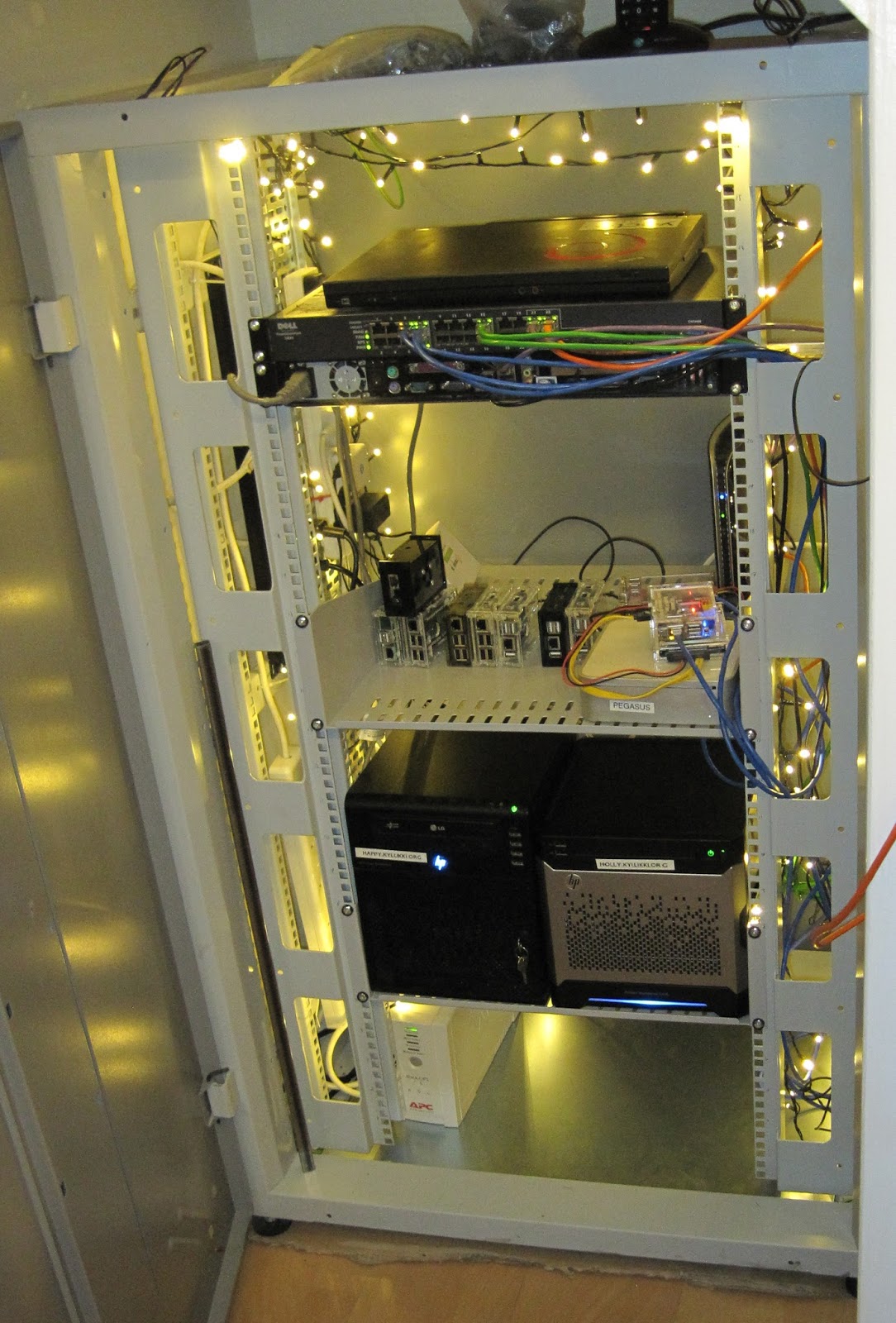
Vincent Sanders: I said it was wired like a Christmas tree

I have recently acquired a 27U high 19 inch rack in which I hope to consolidate all the computing systems in my home that do not interact well with humans.

My main issue is that modern systems are just plain noisy, often with multiple small fans whining away. I have worked to reduce this noise by using quieter components as replacements but in the end it is simply better to be able to put these systems in a box out of the way.

The rack was generously given to me by Andy Simpkins and aside from being a little dirty having been stored for some time was in excellent condition. While the proverbs "never look a gift horse in the mouth" and "beggars cannot be choosers" are very firmly at the front of my mind there were a few minor obstacles to overcome to make it fit in its new role with a very small budget.

The new home for the rack was to be a space under the stairs where, after careful measurement, I determined it would just fit. After an hour or two attempting to manoeuvre a very heavy chunk of steel into place I determined it was simply not possible while it was assembled. So I ended up disassembling and rebuilding the whole rack in a confined space.

The rack is 800mm wide IMRAK 1400 rather than the more common 600mm width which means it employs "cable reducing channels" to allow the mounting of standard width rack units. Most racks these days come with four posts in the corners to allow for longer kit to be supported front and back. This particular rack was not fitted with the rear posts and a brief call to the supplier indicated that any spares from them would be eyewateringly expensive (almost twice the cost of purchasing a new rack from a different supplier) so I had to get creative.

Shelves that did not require the rear rails were relatively straightforward and I bought two 500mm deep cantilever type from Orion (I have no affiliation with them beyond being a satisfied customer).

I took a trip to the local hardware store and purchased some angle brackets and 16mm steel square tube. From this I made support rails which means the racked kit has support to its rear rather than relying solely on being supported by its rack ears.

The next problem was the huge hole in the bottom of the rack where I was hoping to put the UPS and power switching. This hole is intended for use with raised flooring where cables enter from below, when not required it is filled in with a "bottom gland plate". Once again the correct spares for the unit were not within my budget.

Around a year ago I built several systems for open source projects from parts generously donated by Mythic Beasts (yes I did recycle servers used to build a fort). I still had some leftover casework from one of those servers so ten minutes with an angle grinder and a drill and I made myself a suitable plate.

The final problem I faced is that it is pretty dark under the stairs and while putting kit in the rack I could not see what I was doing. After some brief Googling I decided that all real rack lighting solutions were pretty expensive and not terribly effective.

At this point I was interrupted by my youngest son trying to assemble the Christmas tree and the traditional "none of the lights work" so we went off to the local supermarket to buy some bulbs. Instead we bought a 240 LED string for 10 (15usd) in the vague hope that next year they will not be broken.

I immediately had a light bulb moment and thought how a large number of efficient LED bulbs at a low price would be ideal for lighting a rack. So my rack is indeed both wired like and as a Christmas tree!

Now I just have to finish putting all the systems in there and I will be able to call the project a success.

Michal &#268;iha&#345;: Weekly phpMyAdmin contributions

As announced earlier, I will try to publish weekly reports on contributing to the phpMyAdmin. Here comes the first one. Last week I've focused on some pain points with deploying phpMyAdmin and improved these a bit. The installation using PHP Composer is now documented. It's far from being perfect (you have to add our repository), but it seems to work fine. What was more challenging for me is Docker support. I've never really used it so far, so I had to learn some things about the filesystem layering (to avoid too big image), but now it's there. You can get the sources from GitHub, it's available on Docker Hub and of course it is covered by our documentation. Bugs fixed:

Filed under: English phpMyAdmin 0 comments

Dirk Eddelbuettel: Rblpapi 0.3.2

The second update to the Rblpapi package (since the initial CRAN upload in August) is now available. Rblpapi connects R to the Bloomberg system, giving access to a truly vast array of time series data and custom calculations. This release brings a new subscribe() function for real-time data, written by Whit. Don't get too excited because R's single-threadedness places some limits of the usefulness of this--but it is still tremendously valuable for checking other data sources etc pp. Also included in this release are a ton of bug fixes, many contributed by Rademeyer -- see below for more details.
Changes in Rblpapi version 0.3.2 (2015-12-07)
  • A new subscribe() function supports live data subscription for a set of tickers and fields (#88).
  • In the beqs() example the correct date format is used (PR #85 by Rademeyer).
  • Both getTicks() and getBars() now check the start and end times for proper Datetime class.
  • The getBars() function now also return the value traded (request of #89).
  • An error in the documentation for bdh was corrected (PR #93 by Rademeyer closing #85).
  • The beqs() function is now more robust with respect to empty return columns (PR #100 by Rademeyer fixing ticket #99).
  • The getBars() function now uses a single (named) vector options to pass optional values to the underlying function (PR #105 updating PR #48 and fixing #47).
  • When R is built with libcurl support, it used to download the build-time library and headers; otherwise curl is used. This avoids an issue on OS X where curl is insufficient.
Courtesy of CRANberries, there is also a diffstat report for the this release. As always, more detailed information is on the Rblpapi page. Questions, comments etc should go to the issue tickets system at the GitHub repo.

This post by Dirk Eddelbuettel originated on his Thinking inside the box blog. Please report excessive re-aggregation in third-party for-profit settings.

7 December 2015

Francois Marier: Tweaking Cookies For Privacy in Firefox

Cookies are an important part of the Web since they are the primary mechanism that websites use to maintain user sessions. Unfortunately, they are also abused by surveillance marketing companies to follow you around the Web. Here are a few things you can do in Firefox to protect your privacy.

Cookie Expiry Cookies are sent from the website to your browser via a Set-Cookie HTTP header on the response. It looks like this:
HTTP/1.1 200 OK
Date: Mon, 07 Dec 2015 16:55:43 GMT
Server: Apache
Set-Cookie: SESSIONID=65576c6c64206e6f2c657920756f632061726b636465742065686320646f2165
Content-Length: 2036
Content-Type: text/html;charset=UTF-8
When your browser sees this, it saves that cookie for the given hostname and keeps it until you close the browser. Should a site want to persist their cookie for longer, they can add an Expires attribute:
Set-Cookie: SESSIONID=65576c...; expires=Tue, 06-Dec-2016 22:38:26 GMT
in which case the browser will retain the cookie until the server-provided expiry date (which could be in a few years). Of course, that's if you don't instruct your browser to do things differently.

Third-Party Cookies So far, we've only looked at first-party cookies: the ones set by the website you visit and which are typically used to synchronize your login state with the server. There is however another kind: third-party cookies. These ones are set by the third-party resources that a page loads. For example, if a page loads JavaScript from a third-party ad network, you can be pretty confident that they will set their own cookie in order to build a profile on you and serve you "better and more relevant ads".

Controlling Third-Party Cookies If you'd like to opt out of these, you have a couple of options. The first one is to turn off third-party cookies entirely by going back into the Privacy preferences and selecting "Never" next to the "Accept third-party cookies" setting (network.cookie.cookieBehavior = 1). Unfortunately, turning off third-party cookies entirely tends to break a number of sites which rely on this functionality (for example as part of their for login process). A more forgiving option is to accept third-party cookies only for sites which you have actually visited directly. For example, if you visit Facebook and login, you will get a cookie from them. Then when you visit other sites which include Facebook widgets they will not recognize you unless you allow cookies to be sent in a third-party context. To do that, choose the "From visited" option (network.cookie.cookieBehavior = 3). In addition to this setting, you can also choose to make all third-party cookies automatically expire when you close Firefox by setting the network.cookie.thirdparty.sessionOnly option to true in about:config.

Other Ways to Limit Third-Party Cookies Another way to limit undesirable third-party cookies is to tell the browser to avoid connecting to trackers in the first place. This functionality is now built into Private Browsing mode and enabled by default. To enable it outside of Private Browsing too, simply go into about:config and set privacy.trackingprotection.enabled to true. You could also install the EFF's Privacy Badger add-on which uses heuristics to detect and block trackers, unlike Firefox tracking protection which uses a blocklist of known trackers.

My Recommended Settings On my work computer I currently use the following:
network.cookie.cookieBehavior = 3
network.cookie.lifetimePolicy = 3
network.cookie.lifetime.days = 5
network.cookie.thirdparty.sessionOnly = true
privacy.trackingprotection.enabled = true
which allows me to stay logged into most sites for the whole week (no matter now often I restart Firefox Nightly) while limiting tracking and other undesirable cookies as much as possible.

Next.

Previous.
