Now back to Google Summer of Code: Google sponsored 5 talented students who were working
hard on various subjects. As a result we now have a new core developer and various new features
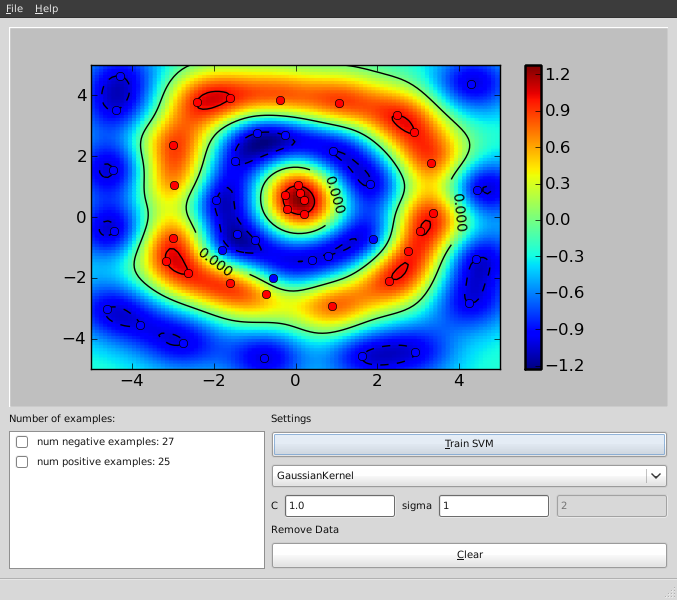
implemented in shogun: Interfaces to new languages like java, c#, ruby, lua
written by Baozeng; A model selection framework written by Heiko Strathman,
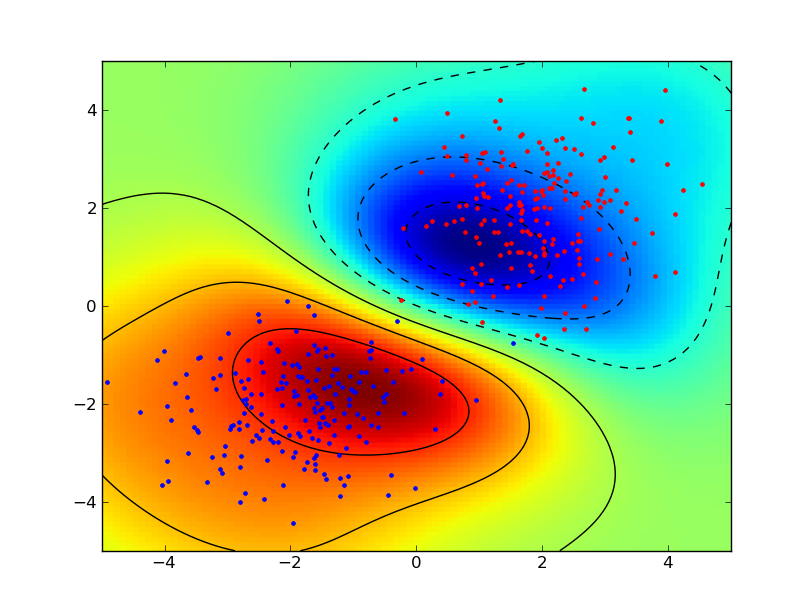
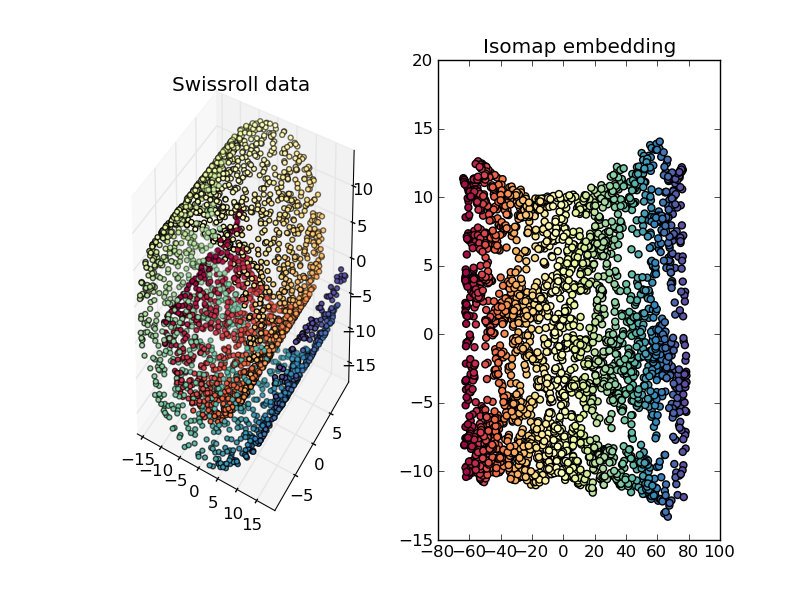
many dimension reduction techniques written by Sergey Lisitsyn, Gaussian
Mixture Model estimation written by Alesis Novik and a full-fledged online
learning framework developed by Shashwat Lal Das. All of this work has already been
integrated in the newly released shogun 1.0.0. In case you
want to know more about the students projects continue reading below, but
before going into more detail I would like to summarize my experience with GSoC 2011.
My Experience with Google Summer of Code
We were a first time organization, i.e. taking part for the first time in GSoC.
Having received many many student applications we were very happy to hear that
we at least got 5 very talented students accepted
but still had to reject about
60 students (only 7% acceptance rate!). Doing this was an extremely tough decision for us. Each of us
ended up in scoring students even then we had many ties. So in the end we
raised the bar by requiring contributions even before the actual GSoC started.
This way we already got many improvements like more complete i/o functions,
nicely polished ROC and other evaluation routines, new machine learning
algorithms like gaussian naive bayes and averaged perceptron and many bugfixes.
The quality of the contributions and independence of the student aided us
coming up with the selection of the final five.
I personally played the role of the administrator and (co-)mentor and scheduled
regular (usually) monthly irc meetings with mentors and students. For other org admins or mentors wanting into GSoC here come my lessons learned:


Cross-Validation Framework
Heiko Strathmann (Mentor: Soeren Sonnenburg)
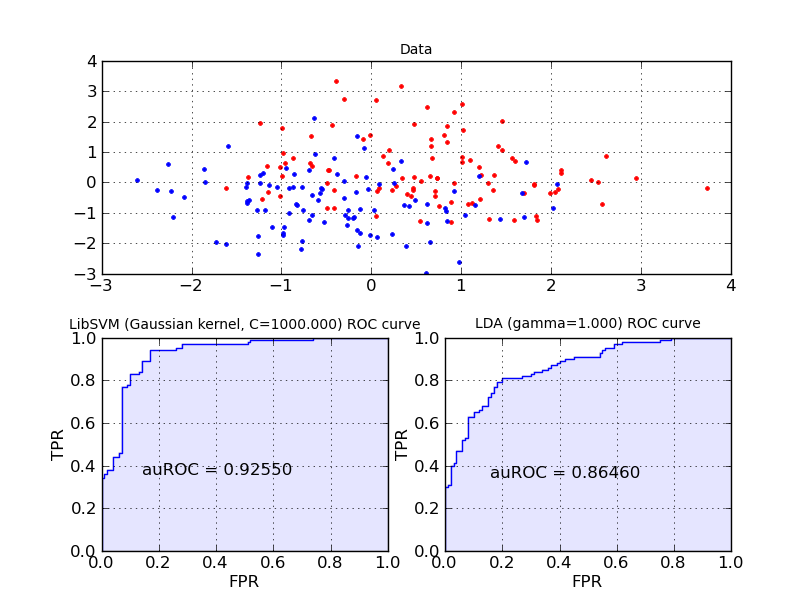
Nearly every learning machine has parameters which have to be determined manually. Before Heiko started his project one had to manually implement cross-validation using (nested) for-loops. In his highly involved project Heiko extend shogun's core to register parameters and ultimately made cross-validation possible. He implemented different model selection schemes (train,validation,test split, n-fold cross-validation, stratified cross-validation, etc and did create some examples for illustration. Note that various performance measures are available to measure how good'' a model is. The figure below shows the area under the receiver operator characteristic curve as an example.
Interfaces to the Java, C#, Lua and Ruby Programming Languages
Baozeng (Mentor: Mikio Braun and Soeren Sonnenburg)
Boazeng implemented swig-typemaps that enable transfer of objects native to the language one wants to interface to. In his project, he added support for Java, Ruby, C# and Lua. His knowlegde about swig helped us to drastically simplify shogun's typemaps for existing languages like octave and python resolving other corner-case type issues. The addition of these typemaps brings a high-performance and versatile machine learning toolbox to these languages. It should be noted that shogun objects trained in e.g. python can be serialized to disk and then loaded from any other language like say lua or java. We hope this helps users working in multiple-language environments.
Note that the syntax is very similar across all languages used, compare for yourself - various examples for all languages (
python,
octave,
java,
lua,
ruby, and
csharp) are available.
Largescale Learning Framework and Integration of Vowpal Wabbit
Shashwat Lal Das (Mentor: John Langford and Soeren Sonnenburg)
Shashwat introduced support for 'streaming' features into shogun. That is instead of shogun's traditional way of requiring all data to be in memory, features can now be streamed from e.g. disk, enabling the use of massively big data sets. He implemented support for dense and sparse vector based input streams as well as strings and converted existing online learning methods to use this framework. He was particularly careful and even made it possible to emulate streaming from in-memory features. He finally integrated (parts of) vowpal wabbit, which is a very fast large scale online learning algorithm based on SGD.
Expectation Maximization Algorithms for Gaussian Mixture Models
Alesis Novik (Mentor: Vojtech Franc)
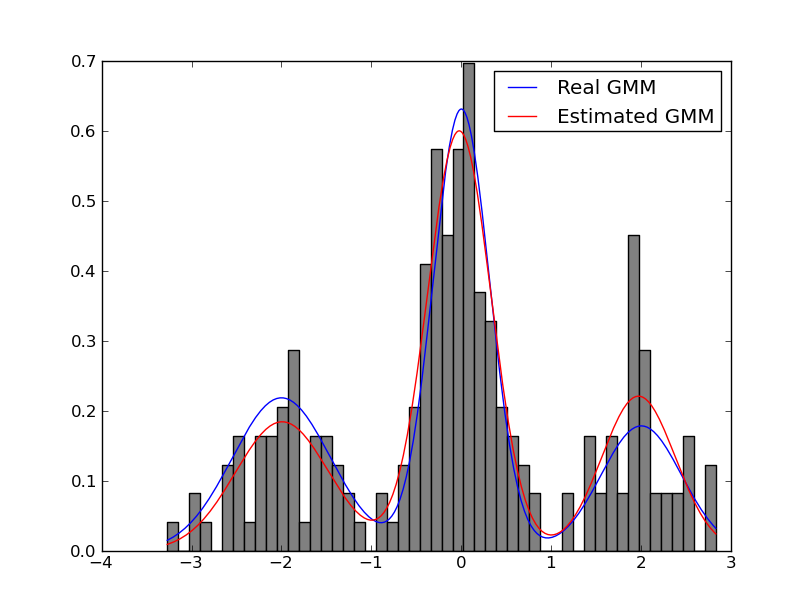
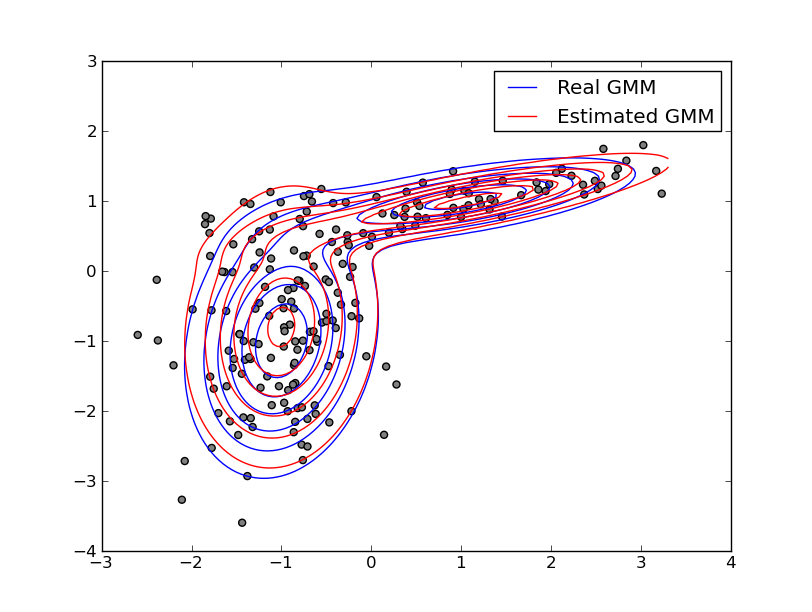
The Expectation-Maximization algorithm is well known in the machine learning community. The goal of this project was the robust implementation of the Expectation-Maximization algorithm for Gaussian Mixture Models. Several computational tricks have been applied to address numerical and stability issues, like

Final Remarks
All in all, this year s GSoC has given the SHOGUN project a great push forward and we hope that this will translate into an increased user base and numerous external contributions. Also, we hope that by providing bindings for many languages, we can provide a neutral ground for Machine Learning implementations and that way bring together communities centered around different programming languages. All that s left to say is that given the great experiences from this year, we d be more than happy to participate in GSoC2012.
This was the second most rainy day of the year, so far. 28 hours of solid
rain and counting. Good time to take stock of the water situation here at the
cabin after a year's experience.
The springs were as seasonal as I'd feared. After running strongly
all Spring, the main spring ebbed and died in the Summer months. By mid-July
there was no remaining source of potable water. If I had not been away so
much over the summer it would have been worse. As it was, I needed
only twenty gallons of water hauled from neighbor Lee's well.
The large cistern was filled in a single night during the most rainy period
this Spring, and provided wash water for two months of the summer, and that
only lowered it by a quarter. So I could have been less sparing with it,
and not relied so much on rain water catchment for supplimental wash water.
Today I replaced the pump, so I can use the pressure tank and have running
water in the house. I could have done this earlier, but what can I say; I
enjoy hauling buckets of water, when it doesn't involve breaking ice.
In the winter when there's firewood to haul instead, I'll enjoy the
indoor plumbing.
Also today, I may have finally fixed the pipe to the large cistern
properly, so it won't only fill at the heaviest rain times. Along with the
ability to cross-pump water from the small to the large cistern, it should
be easier to keep it filled, and I might be able to reduce the turbidity
enough that it's potable eventually. Will see.
I don't live in a dry region, but this is a relatively dry place for the
area. It's been interesting to get a taste of what it'd be like to live
somewhere where water is actually scarce.
I'm in the middle of setting up new build machines for the armhf
port (see the
wiki for more details). We'll shortly have six machines set up in
the machine room here at ARM in Cambridge:
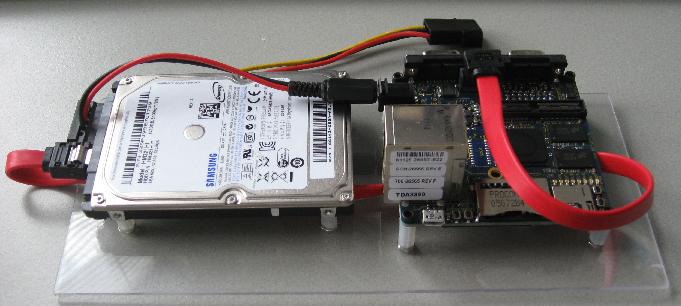
All of these machines are Freescale i.MX53 Quickstart (aka "loco")
development boards. They include a 1GHz i.MX53 CPU (based around the
ARM Cortex A8, one of the ARMv7-A family). They have 1GB of RAM and
native SATA. They're lovely little machines, measuring just 3 inches
square. To mount them usefully in a machine room, I've mounted each
board with a 320GB notebook hard drive and the necessary cabling onto
a small perspex card as you can see here. Then we can fit 6 such
machines and a normal PC-style ATX PSU into a 3U mini-rack. Well,
it almost fits - the power supply pokes out a little so we'll
need 4U of space when we come to mount it.
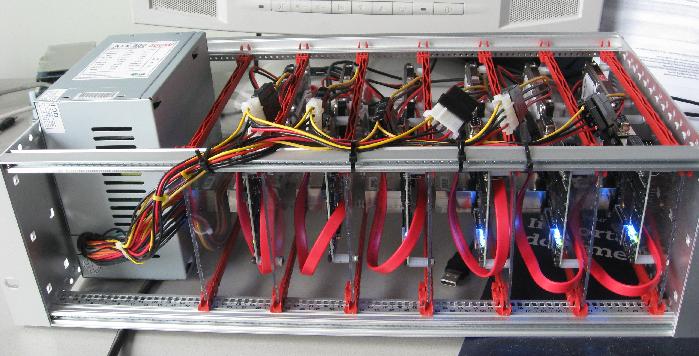
The Quickstart boards have been sponsored
by Linaro, and ditto my time
setting up these machines. Thanks!
As is common with new development boards, these machines are
not quite fully supported in Debian yet. The kernels we're
using are locally-built, using the sources supplied by Freescale. For
now, that means a heavily-patched "2.6.35" kernel but we're expecting
to be able to switch to mainline very soon. The .config I'm using
is kernel.config,
and I've built it natively on harris using
fakeroot make -j2 deb-pkg DEBEMAIL=93sam@debian.org DEBFULLNAME="Steve McIntyre" KDEB_PKGVERSION=1buildd1
Similarly to the setup for
the armel
machines, for now I've tweaked things when installing the
kernel:
/etc/kernel/postinst.d/depmod to do this.
/etc/kernel/postinst.d/initramfs-tools into
place from my amd64 machine; I'm guessing this would be there
automatically on a new-enough version of initramfs-tools on
the armel machines, but we're still using Lenny as a base
system for now even if I'm using a Squeeze-based kernel.
/etc/kernel/postinst.d/zz-flash-kernel) to
create uImage and uInitrd files from the kernel zImage and the
initramfs.
MX53-LOCO U-Boot > setenv loadaddr 0x70800000
MX53-LOCO U-Boot > setenv initrdaddr 0x71000000
MX53-LOCO U-Boot > setenv bootargs_sata set bootargs \$\ bootargs\ root=/dev/sda2 rw rootwait
MX53-LOCO U-Boot > setenv load_sata_kernel ext2load sata 0:1 \$\ loadaddr\ /uImage
MX53-LOCO U-Boot > setenv load_sata_initrd ext2load sata 0:1 \$\ initrdaddr\ /uInitrd
MX53-LOCO U-Boot > setenv load_sata run load_sata_kernel load_sata_initrd
MX53-LOCO U-Boot > setenv bootcmd_sata sata init\; run bootargs_base bootargs_sata load_sata\; bootm \$\ loadaddr\ \$\ initrdaddr\
MX53-LOCO U-Boot > setenv bootcmd run bootcmd_sata
And I've added extra config into uboot to use the pre-installed
Ubuntu system on the micro SD card as a fall-back:
MX53-LOCO U-Boot > setenv bootcmd_rescue sata init\; run bootargs_base bootargs_sata\; mmc read 0 \$\ loadaddr\ 0x800 0x1800\; bootm
Went to see One
Day yesterday. As I usually do after watching a movie, I next went
to wikipedia to read up more about it.
Was shocked to read that it received 'mostly negative' reviews. I
thought it was pretty good.
After reading a few of the aforementioned reviews, I understand what
the problem is, and though I disagree with the resulting negativity in
the review, I can see where it's coming from.
You see, One Day is a novel-turned-movie. As with most movies that
were sourced from a novel, the movie is a disappointment to those who
read the book, mainly because there's always going to be more material
in the book, and therefore some of your favourite passages from the book
are going to be removed, or changed so that they'll lose some
of their original goodness. This is even true for beyond-feature-length
movies sourced from novels; for instance, when I saw
the horse whisperer
after reading the book, I found it a disappointment too, even if my
brother and sister who saw it at the same time as me did like it.
Ignoring that, there's a second problem; while it's a love story, I
don't think it qualifies as a 'romantic comedy'. For it to be a romantic
comedy, you'd expect 'happily ever after', and you'd expect a story
about two people quickly (or slowly, as the case may be) falling in love
with eachother, overcoming some problems that stand in the way of their
relationship. Most importantly, you'd expect it to be lighthearted and
funny you'd expect it to be a comedy.
One day doesn't deliver that; if you go see it, expecting a romantic
comedy, you'll be sorely disappointed. But if you accept the fact that
it isn't a romantic comedy, it's still a very interesting film. It's not
lighthearted, but that doesn't mean there isn't a laugh or a cry in
there. And, without wanting to spoil the plot, while the movie doesn't
bring 'happily ever after', it does still come up with a believable,
emotional, and very compelling ending.
The plot takes you through the 15th of July in the lives of the two
main characters, every year for two decades. Sometimes they're spending
that day together, sometimes they're not. Sometimes they're calling,
sometimes they're fighting, sometimes they're kissing. The days shown
are snapthots of both their lives; this adds an interesting angle to the
plot, as much of the story, much of what is going on, can't actually be
shown on-screen, since it happened in between the two 15ths of July.
While, as said, I wouldn't describe the movie as a romantic comedy, I
think it can be accurately described as a romantic drama. It's not going
to be a legendary movie, a must-have-seen, one which you'll grow to hate
over watching it on every TV station's prime time over the next few
years. But it's a charming, novel, and interesting piece of drama.
Did I like it? Definitely. When I go to the movies, sometimes I want
a silly movie, some action flick that I can have a bit fun laughing at;
but sometimes I want a movie that touches my heart and makes me reflect
on my own life while feeling for the characters. When I went to see The Expendables, I have
a lot of fun for one night, and then promptly forgot about it. But 'One
Day' rang true with me on an emotional level; and for that alone, I can
recommend it.
Even if that wasn't the reason why I chose to pay 8 for this movie
rather than anything else. I'll be perfectly honest: Anne Hathaway. Good
actress, and sporting the most interesting pair of bright eyes
you've ever seen; what more could one want?
A film that allows these two eyes, and acting talent to
shine, of course. And One Day delivers.
This is my monthly summary of my Debian related activities. If you re among the people who made a donation to support my work (91.44 , thanks everybody!), then you can learn how I spent your money. Otherwise it s just an interesting status update on my various projects.

Dpkg work
When I came back from Debconf, I merged my implementation of dpkg-source --commit (already presented last month). I continued some work on the hardening build flags but it s currently stalled waiting on Kees Cook to provide the required documentation to integrate in dpkg-buildflags(1).
Following a discussion held during DebConf, Michael Prokop has been kind enough to setup a git-triggered auto-builder of dpkg (using Jenkins). You can now help us by testing the latest git version. Follow those instructions:
$ wget -O - http://jenkins.grml.org/debian/C525F56752D4A654.asc sudo apt-key add - $ sudo sponge /etc/apt/sources.list.d/dpkg-git <<END deb http://jenkins.grml.org/debian dpkg main END $ sudo apt-get update && sudo apt-get upgradeOn the bug fixing side I took care of #640198 (minor man page update), #638291 (a fix to correctly handle hardlinks of conffiles), #637564 (the simplification logic of union dependencies was broken in some cases) and #631494 (interrupting dpkg-source while building a native source package left some temporary files around that should have been cleaned). WordPress update I released WordPress 3.2.1 in unstable (after having taken the time to test the updated package on my blog!) and fixed its RC bug (#625773). In the process I discovered a false positive in lintian (I reported it in 637473). Gnome-shell-timer package From time to time, I like to use the Pomodoro Technique. That s why I was an user of timer-applet in GNOME 2. Now with the switch to GNOME 3, I lost this feature. But I recently discovered gnome-shell-timer, a GNOME Shell extension that provides the same features. I created a Debian package of it and quickly filed some bugs while I was testing it (two usability issues and an encoding problem) QA Work During DebConf I met Giovanni Mascellani and he was interested to help the QA team. He started working on the backlog of bugs concerning the Package Tracking System (PTS) and submitted a bunch of patches. I reviewed them and merged them but since they were good, I quickly got lazy and got him added to the QA team so that he can commit his fixes alone. It also helps to build trust when you have had the opportunity to discuss face to face.
Thanks
See you next month for a new summary of my activities.
3 comments Liked this article? Click here. My blog is Flattr-enabled.
I often hear criticism of "negative campaigning" in the free software
movement. For example, in reply to a blog post I once wrote about
an FSF campaign, several people argued against, "negative campaigning
of any sort, in any realm." Drawing an analogy to political smear
campaigns, some members of the free software community have taken
the position that negative campaigning in general is not useful
and that negativity has no place in our advocacy.
First, it is important to be clear on what we mean by a negative
campaigns. I believe that there is a fundamental difference between
speaking out against policies or actions and smear campaigns that
employ untrue claims, ad hominem attacks, and that attempt to avoid a
real conversation about issues. I will categorically condemn the
latter form of smear campaigning in campaigns for software freedom or
for anything else.
That said, negativity directed at negativity has had a positive effect
in many social movements. I have supported and participated in
"negative" campaigns against proprietary software, software patents,
DRM, centralized network services, and the firms behind these
practices. I've done so because I believe that if one is taking an
ethical position, it is justified, and often necessary, to not only
speak about the benefits of freedom but against acts of dispossession
and disenfranchisement.
In some of the most effective social movements, unambiguously negative
messages have been central. Should a campaign for abolishing child
labor talk only about how valuable adult workers are to their
employers or how happy kids are when they don't work? Should a
campaign trying to abolish land mines talk only about the benefits of
bomb-free fields and intact lower limbs? Should a free speech
organization only speak out about the social welfare brought by a free
press and never against acts of censorship? These may seem like
outlandish comparisons but you can find people writing, only a couple
centuries ago, about how slavery should be abolished by arguing in
favor of the benefits of paid labor. Even if the economic arguments
in favor of paid work are strong, these arguments seems irrelevant and
offensive today. Whether slavery is more or less efficient is a moot
point. Society has rejected it because it is wrong.
We have made important strides toward eliminating injustices like
child labor and slavery because activists waged decidedly negative
campaigns against them and convinced others to join in opposition. In
doing so, activists declared the status quo unconscionable and created
an ethical responsibility to find alternatives and to redefine what
was "realistic." While I will not suggest that the movement for
software freedom is comparable in ethical weight to these other
causes, I know that the free software mission is similar in kind.
Of course, if one does not think that user control over technology is
an ethical issue but is instead merely a matter of choice, one will
probably oppose negative campaigns. It is also possible that a
particular negative campaign is tactically unwise in that it is
unlikely to reach a large audience, unlikely to change people's minds,
or be difficult to carry out successfully. But such campaigns are a
bad idea because they are ineffective, not because they are
negative. Additionally, a movement that is purely negative and offers
no reasonable alternative to the stated ill may also be unlikely to
succeed. This is why, for example, I believe it is good that the FSF
uses the large majority of its resources in the "positive" role of
supporting free software.
For those that do treat technological empowerment as an ethical ideal,
it is both justified and essential to condemn the systematic
disempowerment of others through non-free software just as we
celebrate the benefits of software freedom. "Negative" campaigns
against proprietary software, software patents, and DRM in music have
already led our community to important -- if incomplete --
victories. The desire to right wrongs has been a critical part of our
movement's success and of many others'. We would be wise not to give
it up.

(Photo credit: Obey Arthur Liu; originally on Picasa, license.)
Three weekends ago, I participated in a Debian bug squashing party. It was more fun than I had guessed!
The event worked: we squashed bugs. Geoffrey Thomas (geofft) organized it as an event for MIT's student computing group, SIPB. In this post, I'll review the good parts and the bad. I'll conclude with beaming photos of my two mentees and talk about the bugs they fixed.
So, the good:
Jessica McKellar is a software engineer at
Noah Swartz is a recent graduate of Case Western Reserve University where he studied Mathematics and played Magic. He is an intern at the MIT Media Lab where he contributes to DoppelLab in Joe Paradiso's Responsive Environments group. This was definitely his first direct contribution to Debian. It was also one of the most intense command-line experiences he has had so far. Noah wasn't originally planning to come, but we were having lunch together before the hackathon, and I convinced him to join us.
Noah fixed #625177, a fails-to-build-from-source (FTBFS) bug in nslint. The problem was that "-Wl" was instead written in all lowercase in the debian/rules file, as "-wl". Noah fixed that, making sure the package properly built in pbuilder, and then spent some quality time with lintian figuring out the right way to write a debian/changelog.
That's a wrap! We'll hopefully have one again in a few months, and before that, I hope to write up a guide so that we run things even more smoothly next time.
rxvt-unicode is a terminal emulator with some interesting features. Here is
one of them I find most amazing and elegant: it can generate the symbol
characters corresponding to keyboard keys.
It works by pressing and releasing + ( is the
symbol for the Control key, and is Shift, of course), then the key which symbol you want to get.
For instance, to get the Caps lock symbol, you type +
, , which gives you the following symbol: . Here are some other nice
examples: (Return) (AltGr aka Level3 Shift) (BackSpace) (Insert)
(Delete) (Home) (End) (Prior) (Next).
Beware that this will not cancel the effect of Caps, Num lock keys: you will get their symbols but also enter the corresponding mode.
As a spectator to sporting events, there are times when the ability
to read a sport(wo)man's mind would be... interesting.
For instance.
Yesterday's woman's 1500m final at the world athletics championships
in Daegu was won by Jennifer Simpson. This was a surprise to many,
including (apparently) Jennifer herself, as evidenced by the look on her
face after the finish. See, for instance, this youtube clip
(interesting bits around the 4 minute mark)
Alternatively, I'd love to know what went through Carlos
Berlocq when he won his first game in the match against Novak Djokovic
in the third set. I mean, obviously nobody expected the world
number one to lose from a relatively unknown 74-ranked argentine player,
but that doesn't make it less painful.
The kernel.org compromise has people talking about the security of git's
use of sha1. Talking about this is a good thing, I think, but there's
a lot of smug "we're cryptographically secure" in the air that does not
seem warranted coming from non-cryptographers like me.
Two years ago I had a discussion on my blog about git and
sha1, that reached similar conclusions to what I'm seeing
here: It seems that current known
sha1 attacks require somehow getting an ugly colliding binary file accepted
into the repository in the first place. Hard to manage for peer reviewed
source code. We all hate firmware in the kernel, so perhaps this is another
reason it's bad. ;-) Etc.
Well, not so fast. Git's exposure to sha1 collisions is broader than
just files. Git also stores data for commits, and directory trees.
Git's tree objects are interesting because they're a bag of bytes that is
rarely if ever manually examined. If there was a way to exploit git such
that it ignored some trailing garbage at the end of a tree object, then
here's an attack injection vector that would be unlikely to be caught by
peer review.
If you can change the content of a tree without changing its sha1, you can
simply make it link to an older version of a file that had an exploitable
problem. Or you can assemble a combination of files that results in an
new exploitable problem. (For example, suppose a buffer size was hardcoded
in two files in the kernel, and then the size was changed in both -- make a
tree that contains one change and not the other.)
Now, git's tree-walk code, until 2008, mishandled
malformed data by accessing memory outside the tree buffer. Was this
an exploitable bug in git? I don't know. It is interesting that
the fix, in 64cc1c0909949fa2866ad71ad2d1ab7ccaa673d9 relied on the
parser stopping at a NULL -- great if you want to put some garbage after
the tree's filename. With that said, the particular exploit I describe
above probably won't work -- I tried! Here's all the code that stands
between us and this exploit:
if (size < 24 buf[size - 21])
die("corrupt tree file");
path = get_mode(buf, &mode);
if (!path !*path)
die("corrupt tree file");
Any good C programmer would recognise that this magic-constant-laden code
needs to be careful about the size of the buffer. It's not as clear though,
that it needs to be careful about consuming the entire contents of the
buffer. And C programmers involved with git have gotten this code wrong
before.
tldr: If git is a castle, it was built just after cannons were invented,
and we've had our fingers in our ears for several years as their power
improved. Now the outer wall of sha1 is looking increasingly like one of
straw, and we're down to a rather thin inner wall of C code.
John Layt recently blogged about his adventure with having children use Plasma Active with quite some success.
The task
I was this evening out at a board meeting in my local scout group, and for such a event you of course need the following
There was another upsurge in discussion of Android GPL issues last month, triggered by couple of posts by Edward Naughton, followed by another by Florian Mueller. The central thrust is that section 4 of GPLv2 terminates your license on violation, and you need the copyright holders to grant you a new one. If they don't then you don't get to distribute any more copies of the code, even if you've now come into compliance. TLDR; most Android vendors are no longer permitted to distribute Linux.For example, Android uses bootcharting logic, which uses the 'bootchartd' script provided by www.bootchart.org, but a C re-implementation that is directly compiled into our init program. The license that appears at www.bootchart.org is the GPLv2, not the Apache 2.0 license that Google claims for its implementation.
I personally believe that intellectual property rights should usually be enforced against infringing publishers/manufacturers rather than mere resellers, but that's a separate issue.
You may not copy, modify, sublicense, or distribute the Program except as expressly provided under this License. Any attempt otherwise to copy, modify, sublicense or distribute the Program is void, and will automatically terminate your rights under this License.
You may not propagate or modify a covered work except as expressly provided under this License. Any attempt otherwise to propagate or modify it is void, and will automatically terminate your rights under this License
However, if you cease all violation of this License, then your license from a particular copyright holder is reinstated (a) provisionally, unless and until the copyright holder explicitly and finally terminates your license, and (b) permanently, if the copyright holder fails to notify you of the violation by some reasonable means prior to 60 days after the cessation.
--quiet). On a related note, Lintian will now error out if it sees an unknown field in a vendor profile. Previously it would just silently ignore the field.
There is one more change I would like to highlight and this one is probably best served with an example:
$ lintian --show-overrides ../lintian_2.5.2.dsc
N: We build-depend on cdbs for the test suite
O: lintian source: unused-build-dependency-on-cdbs
N: We build-depend on quilt for the test suite
O: lintian source: quilt-build-dep-but-no-series-file
N: We don't have a patch system for lintian itself
O: lintian source: patch-system-but-no-source-readme
Lintian will now attempt to extract and print the comment related to the override from the overrides file. The comment will be printed above each tag the override applies to (so you may see some repeated comments). The full documentation for how Lintian finds the comments (or why it does not find the comment) is available in the Lintian User Manual.
The exact format of the comments being outputted may change in the near future. Particularly, we may add a marker to assist the tools generating lintian.d.o to find the comments. Hopefully we will be able to close #512901 soon.
Beyond the changes above, I am very happy to see the bug count drop below 180 unfixed bugs[1]. We have not been this low there since the 2.5.0~rc1 upload (in February) and I hope we can keep it this time.
In light of the fact that it seems possible to fit the plastic caps of
a Debian branded Swiss Army Knife (Last orders
today!) on an existing Swiss Army Knife (German written
howto as PDF), I started to think about which Victorinox Cybertool
would be the best fitting for me.
And because the Victorinox comparison page doesn t really show diffs, just
columns with floating text which are not very helpful for generating
diffs in your head, I used command line tools for that purpose:
wdiff
Because the floating texts are not line- but just whitespace-based,
the tool of choice is not diff but wdiff, a word-based diff. It encloses additions and removals
in + + and [- -] blocks.
(No, those aren t Japanese smileys although they look a lot like some.
^^).
The easiest and clearest way is to copy and paste the texts from Victorinox comparison page into some text files and
compare them with wdiff:
$ wdiff cybertool34.txt cybertool41.txtSo this already extracted the information which are the seven tools which are in the Cybertool 41, but not in the Cybertool 34. Nevertheless the diff is still not easily recognizable on the first glance. There are several ways to help here. First
+Schraubendreher 2.5mm,+ Pinzette, N hahle mit Nadel hr, +Holzs ge,+ Bit-Schl ssel( 5 mm Innensechskant f r die D-SUB Steckverbinder, 4 mm Innensechskant f r Bits, Bit Phillips 0, Bit Phillips 1, Bit-Schlitzschrauben 4 mm, Bit Phillips 2, Bit Hex 4 mm, Bit Torx 8, Bit Torx 10, Bit Torx 15 ), Kombizange( H lsenpresser, Drahtschneider ), Stech-Bohrahle, Kugelschreiber( auch zum DIP-Switch verstellen ), Mehrzweckhaken (Pakettr ger), +Metalls ge( Metallfeile, Nagelfeile, Nagelreiniger ),+ Dosen ffner( kleiner Schraubendreher ), Kleine Klinge, Grosse Klinge, Ring, inox, Mini-Schraubendreher, Kapselheber( Schraubendreher, Drahtabisolierer ), +Holzmeissel / Schaber,+ Bit-Halter, Stecknadel, inox, Schere, Korkenzieher, Zahnstocher
wdiff has an option --no-common (the
according short option is -3) which just shows added and
removed words:
$ wdiff -3 cybertool34.txt cybertool41.txt ====================================================================== +Schraubendreher 2.5mm,+ ====================================================================== +Holzs ge,+ ====================================================================== +Metalls ge( Metallfeile, Nagelfeile, Nagelreiniger ),+ ====================================================================== +Holzmeissel / Schaber,+ ======================================================================This is already way better to quickly recognize the actual differences. But if you still also want to see the common tools of the two knifes you need some visual help: One option is to use
wdiff s --terminal (or
short -t) option. Added words are then displayed inverse
and removed words are shown underlined (background and foreground
colors hardcoded as there is no invert colors style in CSS or HTML):
But some still like to to use color instead of the contrast-rich inverse and the easily to oversee underlining. This is where colordiff comes into play: colordiff colordiff is like syntax highlighting for diffs on the command line. I works with classic and unified diffs as well as with wdiffs and debdiffs (the$ wdiff -t cybertool34.txt cybertool41.txt
Schraubendreher 2.5mm, Pinzette, N hahle mit Nadel hr, Holzs ge, Bit-Schl ssel( 5 mm Innensechskant f r die D-SUB Steckverbinder, 4 mm Innensechskant f r Bits, Bit Phillips 0, Bit Phillips 1, Bit-Schlitzschrauben 4 mm, Bit Phillips 2, Bit Hex 4 mm, Bit Torx 8, Bit Torx 10, Bit Torx 15 ), Kombizange( H lsenpresser, Drahtschneider ), Stech-Bohrahle, Kugelschreiber( auch zum DIP-Switch verstellen ), Mehrzweckhaken (Pakettr ger), Metalls ge( Metallfeile, Nagelfeile, Nagelreiniger ), Dosen ffner( kleiner Schraubendreher ), Kleine Klinge, Druckkugelschreiber, Grosse Klinge, Ring, inox, Mini-Schraubendreher, Kapselheber( Schraubendreher, Drahtabisolierer ), Holzmeissel / Schaber, Bit-Halter, Stecknadel, inox, Schere, Korkenzieher, Zahnstocher
debdiff command is part of the
devscripts package).
$ wdiff cybertool34.txt cybertool41.txt colordiff(Coloured Screenshots done with ANSI HTML Adapter from the package aha.) Some, especially those who are used to git, are probably confused by the default choice of diff colors. This is easily fixable by writing the following into you
+Schraubendreher 2.5mm,+ Pinzette, N hahle mit Nadel hr, +Holzs ge,+ Bit-Schl ssel( 5 mm Innensechskant f r die D-SUB Steckverbinder, 4 mm Innensechskant f r Bits, Bit Phillips 0, Bit Phillips 1, Bit-Schlitzschrauben 4 mm, Bit Phillips 2, Bit Hex 4 mm, Bit Torx 8, Bit Torx 10, Bit Torx 15 ), Kombizange( H lsenpresser, Drahtschneider ), Stech-Bohrahle, Kugelschreiber( auch zum DIP-Switch verstellen ), Mehrzweckhaken (Pakettr ger), +Metalls ge( Metallfeile, Nagelfeile, Nagelreiniger ),+ Dosen ffner( kleiner Schraubendreher ), Kleine Klinge, Grosse Klinge, Ring, inox, Mini-Schraubendreher, Kapselheber( Schraubendreher, Drahtabisolierer ), +Holzmeissel / Schaber,+ Bit-Halter, Stecknadel, inox, Schere, Korkenzieher, Zahnstocher $ wdiff cybertool29.txt cybertool41.txt colordiff
+Schraubendreher 2.5mm,+ Pinzette, N hahle mit Nadel hr, +Holzs ge,+ Bit-Schl ssel( 5 mm Innensechskant f r die D-SUB Steckverbinder, 4 mm Innensechskant f r Bits, Bit Phillips 0, Bit Phillips 1, Bit-Schlitzschrauben 4 mm, Bit Phillips 2, Bit Hex 4 mm, Bit Torx 8, Bit Torx 10, Bit Torx 15 ), +Kombizange( H lsenpresser, Drahtschneider ),+ Stech-Bohrahle, +Kugelschreiber( auch zum DIP-Switch verstellen ), Mehrzweckhaken (Pakettr ger), Metalls ge( Metallfeile, Nagelfeile, Nagelreiniger ),+ Dosen ffner( kleiner Schraubendreher ), Kleine Klinge, [-Druckkugelschreiber,-] Grosse Klinge, Ring, inox, Mini-Schraubendreher, Kapselheber( Schraubendreher, Drahtabisolierer ), +Holzmeissel / Schaber,+ Bit-Halter, Stecknadel, inox, +Schere,+ Korkenzieher, Zahnstocher
~/.colordiffrc:
newtext=green oldtext=red diffstuff=darkblue cvsstuff=darkyellow(See also
/etc/colordiff for the defaults and hints.)
colordiff has by the way two operating modes:
$ colordiff cybertool29-lines.txt cybertool34-lines.txt 12a13,14 > Kombizange( H lsenpresser > Drahtschneider ) 13a16,17 > Kugelschreiber( auch zum DIP-Switch verstellen ) > Mehrzweckhaken (Pakettr ger) 16d19 < Druckkugelschreiber 25a29 > SchereOr as unifed diff with some context:
$ colordiff -u cybertool29-lines.txt cybertool34-lines.txt --- cybertool29-lines.txt 2011-08-31 20:55:37.195546238 +0200 +++ cybertool34-lines.txt 2011-08-31 20:55:11.667710504 +0200 @@ -10,10 +10,13 @@ Bit Torx 8 Bit Torx 10 Bit Torx 15 ) +Kombizange( H lsenpresser +Drahtschneider ) Stech-Bohrahle +Kugelschreiber( auch zum DIP-Switch verstellen ) +Mehrzweckhaken (Pakettr ger) Dosen ffner( kleiner Schraubendreher ) Kleine Klinge -Druckkugelschreiber Grosse Klinge Ring inox @@ -23,5 +26,6 @@ Bit-Halter Stecknadel inox +Schere Korkenzieher ZahnstocherSo if you want nicely colored diffs with Subversion like you re used to with git, you can use
svn diff colordiff.
TeleMini Dual-deploy altimeter with telemetry now available
TeleMini is a miniature dual-deploy flight computer with data logging
and radio telemetry. Small enough to fit comfortably in an 18mm tube,
this powerful package does everything you need on a single board:
I don t have anything in these images to show just how tiny this board
is but the spacing between the screw terminals is 2.54mm (0.1in), and the
whole board is only 13mm wide (1/2in).
We ve been flying these for quite a while; testing the hardware and
tuning the firmware. My new 29mm mmt airframe, Koala, sports a
TeleMini board for apogee-only deployment. It s been really nice to
have something flying on G s and H s that doesn t depend on the
vagaries of delay grains.
On the 26th of June I wrote that I wouldn t be able to travel anywhere this summer (including DebConf 11), because I was going to be teaching lots of things related to Information and Communication Technologies (ICT) to a bunch of kids. That was a bit more than two months ago. On the 27th of June we started the first edition of Fantastic Park with a lot of enthusiasm, and hoping that the kids participating could get in touch to the ICT world while having fun. After all, it was summer holidays.
The results have not only more than fulfilled our expectations but, from what their parents tell, we have also been able to overcome what the children were expecting. It was somehow encouraging to know that the kids were telling their parents to get up half an hour earlier (heh, sorry for them, but that s what being a parent is about, isn t it?), to be able to start as soon as they could, and also to make them wait until the last minute for going back home.
These four editions have involved more than two months of work (280 hours), and 82 kids have taken part on it (57 boys and 25 girls). There have also been visits to different companies that work on the field of ICT (32 in total), and there was an important number of other people collaborating (thanks to all of them). Finally, the last edition of the Park has ended yesterday.
Along these weeks, the kids have been able to get acquainted with a lot of different things, such as robotics (using Lego WeDo), digital photography and photo edition (using Pinta), Free Software, satellites, GPS or learning to code with Scratch. It has been very intensive and I m almost exhausted, but I m also quite sad that it s over. Hopefully some of these children might have developed an interest in this field, and who knows what might come out of it.
If somebody is interested in the daily activities at the Park, we have been writing a blog with daily entries (in Spanish, sorry). We have also published quite a lot of photos of the activities. Of course, needless is to say that I m really happy to have taken part on it, and that the kids participating were simply great. I ll miss them.


Next.