Search Results: "ron"

3 October 2008

Christian Perrier: Why I think Foss.in/2008 is missing its target..

(long post, you've been warned) With his his 'Omelette Post' about FOSS.IN/2008 Call for Participation, Atul Chitnis, the FOSS.IN team 'leader' indeed sent an strong sign. For those who aren't aware of it, FOSS.IN is the longstanding major FLOSS event in India and, still (just like our beloved Debconf) only run by volunteers. Last year, along with Sam Hocevar, I had the chance to attend the event and share the groove of that big, huge, conference, with over 2,000 participants. Some other Debian fellows also made it in the past (Jaldhar, Bdale...). During the Debian Project Day as well as regular conference days, we had the great opportunity to meet with the people who currently participate in Debian (and Ubuntu) in South Asia, as well as first meeting some major contributors from other projects. For me, and, I think, of all people I met up there, this was a great *and productive* event. Maybe not productive at the moment it happened, but productive in terms of mutual awareness, knowledge and friendship. All people who attended such conferences (should I say "Debconf" or "FOSDEM"?) know what I'm talking about. The conference was still quite focused on "real" FLOSS contribution more than evangelizing or politics. And I think it succeeded in it quite well. This year, I already planned to not attend...mostly because such event, with the associated long travel time, is something I can't really fit in my real life right now. Also, because it conflicts with a planned Extremadura work session, indeed. Still, I would indeed not have attended it. Atul's post makes it clear: the even will only be about coding. The point is to put focus on people who code and we do 'real' code. Bug fixing is not coding. Translation effort is not coding. Work on support for complex languages is not coding. Actually, what FOSS.IN/2008 organizers are trying to do is a kind of big Debcamp. I'm afraid it won't work this way. From what I have seen in years of participation to Debian, things just don't come up this way. People don't sit down and code because they're invited to. And, still, are only "people who code" the only people that matter in a project? Debian is sometimes seen as one of the biggest FLOSS projects all around (probably shared with the Linux kernel). How many people in Debian just "sit down and code"? What about those people who maintain our web site, our archive, setup our infrastructure, our new maintainer queue, our communication channels? What about those dozens of people who nicely maintain packages and keep the link with upstream developers, or fix bugs.... Those people do not seem welcomed at FOSS.IN/2008. "Not only bug fixing" is said in this announcement. This, I don't get it. At all. Why would "bug fixing" be second class work? Why would it be more noble to "code" new stuff? Maybe Atul did not mean to say this. He wants to have Indian contributors in FLOSS to be more visible....but I don't share this. Indian contributors in Debian *are* visible. Giridhar Appaji Nag is visible, "my" translator crew is visible, Kartik Mistry is visible (he once was too visible, even, by maintaining a little bit too many packages...). Bug fixing is the most noble task I see in FLOSS development. This is what we need the most. I recently blogged about how I feel APT to be 'poorly' maintained (once again, that was not targeted to current APT maintainers). What I would respect deeply is to see a bunch of Indian contributors stand up and take this task over. Atul, that would certainly not be "outsourcing code/package maintenance" and, no, these are not things one can get involved with instantly. Really, I don't buy this vision and that saddens me. That saddens me mostly because I know the folks there. I know the FOSS.IN organizers and I have deep respect for them. I just think they're missing the target and are too ambitious: one cannot change an event so drastically by just saying it has to change..:-) And, really, I'm even more sad to see localization work be called a low-hanging fruit from a country where there are 22 official languages. Or take words such as "talk is cheap, show me the code" as $ DEITY 's Holy Word just because it was once said by Linus Torvalds (who said many stupid things). Code is just one part of FLOSS development. Certainly one of the important parts but still one part. What would have happened to FLOSS if only "coders" had been working on it all over those years? It would be something used by about 10,000 people all around the world, that's all. We should not make an opposition between those who code and those who don't. By the way, do *I* code? When I'm sitting at 07:00AM on a Saturday morning, hacking on Samba packages and try to have Samba 3.2.4 built with the set of patches we have on Debian....do I code? I'm not *producing* code....the code was produced by those wonderful Samba Team folks. Does Karolin Seeger code when she's releasing samba with such a precise and constant schedule as she's doing since early 2008? Or Ana Guerrero when she (not alone!) compiles dozens of KDE packages and organizes and bumps the maintenance of KDE in Debian for the best of our users. Or Miriam Ruiz when she picks up each and every possible free game and tries to get it in Debian, talks with upstream developers, help them to fiw their code to suit the severe requirements of the Debian policy? Or Clytie Siddall when she translates about every major FLOSS in Vietnamese (nor URL here, sorry)? All these folks are part of the FLOSS game. You want Indians to be part of FLOSS game? Then allow the potential Karolin, Ana, Miriam or Clytie to be part of Indian FLOSS game and don't try to make FOSS.in the place where you seek the future Indian Linus Torvalds and only him her. Talk is cheap, show me the contribution.

Jeff Bailey: In the US for one more month...

Hey - we're heading to Montreal for part of the next week on a house hunting trip. Keeping in mind that our toddler's bed time is ~19h30 and then we can't leave him, we'd love to see people for early dinners. Thursday and Friday we'll be in Quebec city for CLLAP. Back in Montreal on Saturday and flying home on Sunday. It seems this will be Thanksgiving-free year for us with the move timing.

And thinking of things to be thankful of.. How do you people in the US cope without Neo-Citron?

John Goerzen: What Traditional Values Mean to Me

A comment on Facebook yesterday got me thinking what American "traditional values" are all about. We hear it a lot, and I suspect it means something different to different people.

Here's what it means to me.

It starts with an ethic fundamentally informed by the central tenets of Christianity -- which are also excellent standards of decency by secular standards. We are called to have a relentless drive to care for the repressed, poor, downtrodden. As Jesus said, "whatever you do to the least of these, so you do to me." It means extending the hand of friendship and compassion to all, in our own neighborhood and around the world. It means taking good care of the resources we have, acting responsibly, and affirming and supporting others so they can do the same. It means that, as our founding fathers emphasized, remembering that all people are created equal, are equally deserving of a good life, and deserve liberty and freedom. Finally, it means a constant realization that we are creating a human institution, and will always have an imperfect answer to these ideals, but that we can -- and must -- recognize our faults and strive to make things better.

How do these apply to our time?

We must start with the poor, the repressed, and habitually think of their situation in everything we do. That means remembering that when we drop a bomb in Afghanistan to kill a terrorist, we also usually kill 50 innocent bystanders, and devastate their families. It means remembering that illegal immigrants from Mexico come here because all they want is refuge from drug wars, food on the table, and a roof over their head. It means showing compassion in deportation proceedings: when illegal immigrant parents have a child born in the United States, the child is an American citizen and can't be deported, but deporting the parents will create an orphan. It means actively helping the repressed people of the world, whether they be in Sudan, Georgia, or AIDS victims in Africa, Muslims in New York. It means reducing taxes on the poor, giving them the skills and tools they need to make their way in life. It means caring for those with alcohol drug addictions, helping them to summon the strength to get past those problems, rather than locking them up or throwing them out on the street. In days past, this might have meant sharing firewood with the family down the road that was at risk of freezing in winter. Today it might mean assistance with winter heating bills.

Remembering that all people are created equal means that we must provide good education for everyone, whether they live in suburban California, inner city Detroit, or rural Appalachia. We owe quality health care to everyone; those without means to pay for health care, or to pay for a car to get to a clinic, should be treated with dignity and respect, and have equal access to medicine.

Remembering that all people are created equal also means that we must provide equal justice under law, and give everyone a fair trail. We must abandon the death penalty, because we have a shocking number of people on death row -- hugely disproportionately black and poor -- that have been shown innocent of their crimes thanks to advances in DNA testing. We must maintain the integrity of checks and balances in government, and support judicial oversight over search and seizure. We must avoid warrantless wiretapping because it subverts judicial oversight and corrupts our justice system by making the exercise of power secret. We must denounce torture, and refuse to employ it, because no human, being created equal, deserves to be treated in such a way -- and we have been applying it to innocent humans.

We owe the opportunity to grow up in a loving family, in a safe community, to every child. We must make sure that gangs no longer have the run of our streets, that drugs aren't displacing hard work as the currency of the community, and that adoption is inexpensive and practical for more families, rather than costing thousands of dollars. Doing so will help every child grow up knowing that they are valued, are important, rather than being unwanted and therefore abused or neglected.

Extending the hand of friendship and compassion to all starts with being a good example -- that shining city on a hill that Reagan talked about. We have to run an open, just, and fair society ourselves. We must not fear those that are different than us, just because they're different. We have to recognize that citizens of Iran, Russia, North Korea, Palestine, and the United States fundamentally are humans, created equal, seeking the same thing: a safe and secure future for themselves and their families. Being able to coexist peacefully means starting from that point, and being willing to talk to them, and yes, even their leaders, regardless of how distasteful they may be.

Acting responsibly with our resources starts at home -- things like not driving up credit card debt, not living outside our means. The same applies to government: massive deficits each year are exceptionally irresponsible and place us at great risk both at the present and in the future. We also have a duty to care for the planet and the environment in which we live, which means actively working to curb the things we do to harm the planet and cause global warming.

What about recognizing our faults? Perhaps the most patriotic duty asked of Americans is dissent. It is never easy, but is essential to keeping our democracy functioning. This country has a long history of successes, and also a long history of failures. We failed so many by keeping slavery legal for so long, and discrimination and lynching legal for even longer. We failed that Native Americans by forcing them from their lands and treating them with brutality. We have, to some extent, risen above these failures thanks to the ability to recognize them and try, to the best of our ability, to fix them. This is what the civil rights movement was about, and why we have a holiday for Martin Luther King, Jr. He spoke out against a society that said some couldn't eat in a restaurant because of the color of their skin, or who were repressed because of their economic status. He recognized that problem in America, and by speaking out against it, helped to change this country for the better.

Today we have to recognize the things we are doing wrong, and try to change them. We are torturing potentially innocent people. We are discriminating against Muslims and homosexuals in our midst. We are giving extraordinary power to big media companies through changes in copyright law, to big communications companies through failure to enact network neutrality laws. And we are labeling people that disagree with war as unpatriotic.

Notice some things I didn't mention, such as abortion. It's not really relevant, and the lines we are fed by both sides present us with this false pro choice vs. pro life debate. In reality, it seems to me that both sides want the best for the children: for every child to grow up in a loving family, where he or she is wanted. We all know from research that laws banning abortion do not actually reduce it. So we ought all to come together and try to make it more rare by providing more support to single parents, by making it easier to adopt children, by trying to make the perceived need for an abortion to go away.

So, in this election, I look at the candidates and it seems pretty clear which one is promoting traditional values and which one isn't. Obama is actively trying to reach across the aisle and find common ground. Even in his convention speech, he suggested ways to work together on abortion like I just mentioned. In the debate, he listened carefully to his opponent and acknowledged when he thought McCain was right. This is a necessary first step in working together to move forward. McCain subsequently released an ad mocking Obama for this.

What about caring for the poor? Again, Obama's tax policies, education policies, and health care policies take care of them far better than McCain's. About responsibility? McCain supported these deficit-busting budgets of the last 6 years, supported the oil-centric energy policies, and has been only lukewarm towards dealing with global warming. McCain and Palin mock Obama for trying to help poor Chicago neighborhoods 20 years ago, for being willing to just talk to our supposed enemies, for actually reaching across the aisle.

So yes, I am a values voter, and that's why I can't possibly do anything but vote for Obama.

Adrian von Bidder: Desktop integration

Sune Vuorela raises a few interesting points about integration of various (meta)data storage frameworks on your KDE desktop (read the comments, too, as several of these issues have been or are being addressed.) A huge, somewhat related, itch to me is that the end user of a Linux desktop still has to care if an application uses KDE, GNOME, XFCE, GNUstep, old style X11 or whatever. As an end user, I don't care that GIMP is a GTK application. Somebody told me that I can use fish:/ URLs to open remote files and I've duly noted down the syntax because I have no idea what this does, but it does open this file the webdude has told me I should edit with kolourpaint, and now I want to use GIMP because it's much nicer to use ... Similar issues with settings (I did set the web proxy in the system settings, now why do half of the application not respect this?) and all kinds of other stuff. I believe it's issues like this that will hamper the Linux on the Desktop the most in future. Obviously, in a controlled (corporate) environment, this is not a big problem because it's a problem for the IT staff, but in the SOHO and home computer market, these are real, difficult problems, and since they don't know any of the technical problems behind it it's also very hard to explain why it's not easy for me to set up their system so it works like they feel it should (I already have problems explaining why there should be different Linux distributions at all ... ) Update: It occurs to me that this is the kind of stuff we (distribution developers) should be concentrating on, by putting pressure on upstream and doing some of the work. I guess we've concentrated too much on just packaging the stuff.

Ian Wienand: Poking around in AUXV, part 2

I've written about AUXV previously, focusing on one of its most interesting applications -- its role in helping find linux-gate.so.1. If you're starting your program, you can get the dynamic loader to echo out the AUXV fields with the environment variable LD_SHOW_AUXV, but if your process has started you'll need to pull the values out of /proc/pid/auxv directly. This is pretty internal stuff for the dynamic loader and is probably only useful if you're writing a debugger or doing some other low-level tricks (such as debugging!). However, should you need to, here is some sample code which does just that. Hopefully it will save someone else some time!

2 October 2008

Russell Coker: How Many Singularities?

There is a lot of discussion and speculation about The Singularity. The term seems to be defined by Ray Kurzweil’s book “The Singularity Is Near” [1] which focuses on a near-future technological singularity defined by significant increases in medical science (life extension and methods to increase mental capacity) and an accelerating rate of scientific advance. In popular culture the idea that there will only be one singularity seems to be well accepted, so the discussion is based on when it will happen. One of the definitions for a singularity is that it is a set of events that change society in significant ways such that predictions are impossible - based on the concept of the Gravitational Singularity (black hole) [2]. Science fiction abounds with stories about what happens after someone enters a black hole, so the concept of a singularity not being a single event (sic) is not unknown, but it seems to me that based on our knowledge of science no-one considers there to be a black hole with multiple singularities - not even when confusing the event horizon with the singularity. If we consider a singularity to merely consist of a significant technological change (or set of changes) that change society in ways that could not have been predicted (not merely changes that were not predicted) then it seems that there have been several already, here are the ones that seem to be likely candidates: 0) The development of speech was a significant change for our species (and a significant change OF our species). Maybe we should consider that to be singularity 0 as hominids that can’t speak probably can’t be considered human. 1) The adoption of significant tool use and training children in making and using tools (as opposed to just letting them learn by observation) made a significant change to human society. I don’t think that with the knowledge available to bands of humans without tools it would have been possible to imagine that making stone axes and spears would enable them to dominate the environment and immediately become the top of the food chain. In fact as pre-tool hominids were generally not near the top of the food chain they probably would have had difficulty imagining being rulers of the world. I’m sure that it led to an immediate arms race too. 2) The development of agriculture was a significant change to society that seems to have greatly exceeded the expectations that anyone could have had at the time. I’m sure that people started farming as merely a way of ensuring that the next time they migrated to an area there was food available (just sowing seeds along traditional migration routes for a hunter-gatherer existence). They could not have expected that the result would be a significant increase in the ability to support children and a significant increase in the number of people who could be sustained by a given land area, massive population growth, new political structures to deal with greater population density, and then wiping out hunter-gatherer societies in surrounding regions. It seems likely to me that the mental processes needed to predict the actions of a domestic animal (in terms of making it a friend, worker, or docile source of food) differ from those needed to predict the actions of other humans (who’s mental processes are similar) and from those needed to predict the actions of prey that is being hunted (you only need to understand enough to kill it). 3) The invention of writing allowed the creation of larger empires through better administration. All manner of scientific and political development was permitted by writing. 4) The work of Louis Pasteur sparked a significant development in biology which led to much greater medical technology [3]. This permitted much greater population densities (both in cities and in armies) without the the limitation of significant disease problems. It seems that among other things the world-wars depended on developments in preventing disease which were linked to Louis’ work. Large populations densely congregated in urban areas permit larger universities and a better exchange of knowledge which permitted further significant developments in technology. It seems unlikely that a population suffering the health problems that were common in 1850 could have simultaneously supported large-scale industrial warfare and major research projects such as the Manhattan Project. 5) The latest significant change in society has been the development of the Internet and mobile phones. Mobile phones were fairly obvious in concept, but have made structural changes to society. For example I doubt that hand-writing is going to be needed to any great extent in the future [4], the traditional letter has disappeared, and “Dates” are now based on “I’ll call your mobile when I’m in the area” instead of meeting at a precise time - but this is the trivial stuff. Scientific development and education have dramatically increased due to using the Internet and business now moves a lot faster due to mobile phones. It seems that nowadays any young person who doesn’t want to be single and unemployed needs to have either a mobile phone or Internet access - and preferably both. When mobile phones were first released I never expected that almost everyone would feel compelled to have one, and when I first started using the Internet in 1992 I never expected it to have the rich collaborative environment of Wikipedia, blogging, social networking, etc (I didn’t imagine anything much more advanced than file exchange and email). Of these changes the latest (Internet and mobile phones) seems at first glance to be the least significant - but let’s not forget that it’s still an ongoing process. The other changes became standard parts of society long ago. So it seems that we could count as many as six singularities, but it seems that even the most conservative count would have three singularities (tool use, agriculture, and writing). It seems to me that the major factors for a singularity are an increased population density (through couples being able to support more children, through medical technology extending the life expectancy, through greater food supplies permitting more people to live in an area, or through social structures which manage the disputes that arise when there is a great population density) and increased mental abilities (which includes better education and communication). Research into education methods is continuing, so even without genetically modified humans, surgically connecting computers to human brains, or AI we can expect intelligent beings with a significant incremental advance over current humans in the near future. Communications technology is continually being improved, with some significant advances in the user-interfaces. Even if we don’t get surgically attached communications devices giving something similar to “telepathy” (which is not far from current technology), there are possibilities for significant increments in communication ability through 3D video-conferencing, better time management of communication (inappropriate instant communication destroys productivity), and increased communication skills (they really should replace some of the time-filler subjects at high-school with something useful like how to write effective diagrams). It seems to me that going from the current situation of something significantly less than one billion people with current (poor) education and limited communications access (which most people don’t know how to use properly) to six billion people with devices that are more user-friendly and powerful than today’s computers and mobile phones combined with better education as to how to use them has the potential to increase the overall rate of scientific development by more than an order of magnitude. This in itself might comprise a singularity depending on the criteria you use to assess it. Of course that would take at least a generation to implement, a significant advance in medical technology or AI could bring about a singularity much sooner. But I feel safe in predicting that people who expect the world to remain as it is forever will be proven wrong yet again, and I also feel safe in predicting that most of them will still be alive to see it. I believe that we will have a technological singularity (which will be nothing like the “rapture” which was invented by some of the most imaginative interpretations of the bible). I don’t believe that it will be the final singularity unless we happen to make our species extinct (in which case there will most likely be another species to take over the Earth and have it’s own singularities).

Michal Čihař: Why gpg-agent does not work?

Summary: If programs would have useful man pages or error messages, man would not have to look into source code. I just set up Debian sid chroot on my computer and have to sign something inside this chroot (dpgk-buildpackage). Okay, I want it to use gpg-agent in my host system, that should not be hard. Looking at gpg man page, GPGAGENTINFO variable is used to forward information about agent socket, PID and protocol version, so I set this variable according to host system, but it still does not work, giving nothing saying error that agent is not working. So let's debug this beast - strace reveals, that communication with agent works, but it replies "113 Server Resource Problem". Hmm, still not much useful information, but let's google for this problem. Fortunately Google reveals related Seahorse code, where man can find, that not set DISPLAY variable is causing this issue. Could not the error be more friendly, so that it tells me directly what is wrong?

Russell Coker: Solutions for the Housing Crisis

Currently we have a huge husing crisis in the US which involves significant political corruption including the federal government preventing state governments from stopping predatory banking practices [1]. The corrupt plan to solve this is to simply give the banks a lot of taxpayer money, so the banking business model then becomes to do whatever it takes to make a short-term profit and then rely on federal funds for long-term viability. The bank employees who caused the problem by aggressively selling mortgages to people who could never repay them if the housing prices stabilised - let alone if the prices fell. If the aim is to protect families, then the first requirement is that they not be evicted from their homes. The solution to this is to void the mortgage of anyone resident home owner who purchased a house on the basis of false advice from the bank or who unknowingly entered into a mortgage that any reasonable person who is good at maths can recognise as being impossible for them to repay. The bank would end up with clear title to the property and the ex-homeowner would end up with no debt. Then such properties could be set for a controlled rent for a reasonable period of time (say 5 years). The bank (or it’s creditors) would have the option of renting the property to the ex-mortgagee for a minimum of five years or selling the property to someone else who was willing to do so. Of course the ex-mortgagee (who would not be bankrupt) would have the option of seeking out a new mortgage at reasonable rates and then buying thier home again. Also to benefit families the rent control period could be extended for as long as they have dependent children. The losers in this would be the banks and the people who purchased multiple investment properties (the ones who caused all the problems). Finally what is needed is a cultural shift towards austerity (as described by Juan Enriquez and Jorge Dominguez) [2]. Glen makes an interesting point about the irony of typical homeowners in the US demonstrating more financial literacy than the people who run banks [3].

MJ Ray: The Trouble With Big Webmail

So last week, a relative commented to me that a solicitor sent a letter in reply to an email. I suggested that it might be because the email reply address was on one of the major free web email providers. “What’s wrong with my webmail?” So I explained… First of all, as far as I know, no Big Webmail service supports encrypted email (and there are complications in how you’d provide such a thing on webmail anyway) and it can be fairly easy to trick the webmail service into giving access to other people. My relative was sceptical, but within a day, US vice-presidential candidate Sarah Palin’s Yahoo mail was cracked and splashed across the news. (By the way - gov.palin counted as a personal email address? Huh? Her name isn’t “gov”.) Even without passwords going astray, there’s no telling that the intended recipient is the only person reading the email. Here’s a fun paragraph from the Google Mail Terms:-
“Google maintains and processes your Gmail account and its contents to provide the Gmail service to you and to improve our services. The Gmail service includes relevant advertising and related links based on the IP address, content of messages and other information related to your use of Gmail.” (emphasis added)
The Electronic Privacy Information Center suggests this includes wiretapping. There’s finally a growing awareness that free webmails are not safe, built on artificial anti-competitive encouragements like “you need a Yahoo!ID to subscribe to this yahoogroup” (no - the old “stick -subscribe after the group name, before the @” still works, just like it did before they bought it from egroups). Internet Psychologist Graham Jones writes:-
“It’s time to review your online security and think about whether you actually need Google and its like at all. Probably not.” (source)
I agree with that. Both of my phone companies (The Phone Co-op agency and 3) include webmail - although I have some personal domains (for long-term contactability), those webmails are fine for lists and short-term use. The sort of thing most people seem to use Big Webmail for. The other main point in my argument was that free webmails are unreliable, thanks to tactics like Yahoo’s shoddy anti-spam attacks on other mailservers. There’s no telling whether the email will get through such bad behaviour and delivery-receipts are unreliable. I can quite understand why a solicitor won’t send email to the likes of hotmail, even if I think it’s just as probable that the solicitor doesn’t “get” email. “Oh” said my relative. I think she’s still using Big Webmail though.

1 October 2008

Axel Beckert: NSLU2 in a Tux Case

It started harmless when Thomas asked on Linux User Group Switzerland mailing list if someone knows a tux-shaped alarm clock. But the topic of that thread quickly moved to two other things in tux shape: the Tux Droid, a device similar to the Nabaztag, but needs a Linux host with USB, and ACME Systems’ Tux-Server, a ETRAX CRIS based Foxboard inside a tux-shaped case. We found out that Telion, the Swiss importer for Foxboards, also imports ACME Systems’ Tux Case — although the Tux Case is not mentioned on their website. Even better: They had a few old Tux Cases in stock which don’t fit anymore on current Foxboards since the position of the power socket changed. (So only one hole in the case was missing.) And they wanted to get rid of them quite fast: They offered us the Tux Cases for 10 CHF (6€) each instead of 28 CHF each (17€) if we buy all of them. Of course we couldn’t reject this offer and bought all five remaining cases. Another part of the thread was about performance. Although ETRAX CRIS is used by its inventor AXIS in many of its products (they’re famous for the Linux based web-cams) many were not sure if the board’s performance would be sufficient for their ideas. Another disadvantage of the ETRAX CRIS architecture is that no mainstream Linux distribution supports it. Another point was the Foxboard’s price (169€, ca. 268 CHF). Bones just mentioned that an NSLU2 costs only about 100 CHF (60€). Probably on IRC someone (probably Bones, too) wondered if it’s possible to fit a NSLU2 into such a quite inexpensive Tux Case. We took Wikipedia’s picture of the NSLU2 board, compared the size of the USB ports on that picture, compared them with real-life USB ports and found out the size of the board that way. And when I got my Tux-Case I noticed that the NSLU2 board really could fit into the Tux-Case. Since I’m already building a bigger NAS-like home server, I have no use for another, much slower NAS. But since I more or less gave up the also ARM-based Thecus N4100, another ARM-based machine in my hardware collection wouldn’t be bad. So it didn’t took long and the idea was born to build the NSLU2 board into a Tux-Case and let the website tux.ethz.ch run on it. (I inherited its administration from Beat and it’s currently just a virtual host on one of our webservers.) Then it would be a server named Tux, serving Tuxes, looking like a Tux and running Tux’ operating system Linux. :-) I ordered an NSLU2 at Brack for 117.60 CHF (ca. 70€). Played around with the original firmware for a moment, but it’s horrible from a security point of view: You can’t even change the admin password (default: “admin”) if no USB harddisk is attached. And no, a USB stick doesn’t suffice. So I didn’t wait long and tried to install Debian’s “armel” (ARM, Little Endian) port on it. But the NSLU2 refused the “new firmware” with the error message “Upgrade: no enough free space.”. While this is not in the Debian specific NSLU2 FAQ, it is mentioned in the general troubleshooting FAQ. As described in there, first upgrading to the most recent firmware version and then uploading the Debian installer worked fine. After I had successfully installed Debian Lenny on a pqi 4 GB USB sticked into the NSLU2 and verified that everything is working fine, I opened the NSLU2 case and checked if it really would fit into a Tux Case. It does, but very, very close. You’ll have to drill some holes and the ethernet socket will stick out Tux’s shoulder, but everything else should fit perfectly after a few mounting parts inside the Tux Case have been removed. As a proof of concept I laid the NSLU2 board on the Tux Case’s back:
Pictures taken with my Nokia E51
So later the LEDs will be in Tux’ one shoulder while the network socket will be in his other shoulder. And the USB stick will be inside his paunch via a USB hub.

Russell Coker: Could we have an Open Computing Cloud?

One of the most interesting new technologies that has come out recently is Cloud Computing, the most popular instance seems to be the Amazon EC2 (Elastic Cloud Computing). I think it would be good if there were some open alternatives to EC2. Amazon charges $0.10 per compute hour for a virtual machine that has one Compute Unit (equivalent to a 1.0 to 1.2GHz 2007 Opteron core) and 1.7G of RAM. Competing with this will be difficult as it’s difficult to be cheaper than 10 cents an hour ($876.60 per annum) to a sufficient extent to compensate for the great bandwidth that Amazon has on offer. The first alternative that seems obvious is a cooperative model. In the past I’ve run servers for the use of friends in the free software community. It would be easy for me to do such things in future, and Xen makes this a lot easier than it used to be. If anyone wants a DomU for testing something related to Debian SE Linux then I can set one up in a small amount of time. If there was free software to manage such things then it wuld be practical to have some sort of share system for community members. The next possibility is a commercial model. If I could get Xen to provide a single Amazon Compute Unit to one DomU (not less or more) then I wouldn’t notice it on some of my Xen servers. 1.7G of RAM is a moderate amount, but as 3G seems to be typical for new desktop systems (Intel is still making chipsets that support a maximum of 4G of address space [2], when you subtract the address space for video and PCI you might as well only get 3G) it would not be inconceivable to use 1.7G DomUs on idle desktop machines. But it’s probably more practical to have a model with less RAM. For my own use I run a number of DomUs with 256M of RAM for testing and development and the largest server DomU I run is 400M (that is for ClamAV, SpamAssassin, and Wordpress). While providing 1.7G of RAM and 1CU for less than 10 cents an hour may be difficult, but providing an option of 256M of RAM and 0.2CU (burstable to 0.5CU) for 2 cents an hour would give the same aggregate revenue for the hardware while also offering a cheaper service for people who want that. 2 cents an hour is more than the cost of some of the Xen server plans that ISPs offer [3] but if you only need a server for part of the time then it would have the potential to save some money. For storage Amazon has some serious bandwidth inside it’s own network for transferring the image to the machine for booting. To do things on the cheap the way to go would be to create a binary diff of a common image. If everyone who ran virtual servers had images of the common configurations of the popular distributions then creating an image to boot would only require sending a diff (maybe something based on XDelta [4]). Transferring 1GB of filesystem image over most network links is going to be unreasonably time consuming, transferring a binary diff of an up to date CentOS or Debian install vs a usable system image based on CentOS or Debian which has all the updates applied is going to be much faster. Of course something like this would not be suitable for anything that requires security. But there are many uses for servers that don’t require much security.

Romain Beauxis: Sound APIs in Linux (yet again)

I would like to add some clarifications to the debate on linux sound APIs that happened last friday on planet. First, despite being portrayed as such, I am nothing like an OSS zealot. I was just recently surprised that OSS developpement still exists and that no one cares. Hence, my initial motivation for my post was to correct false informations, not to advocate for any solution. Now, since the debat has been opened to the issue of linux sound APIs, I feel like adding my two bits. In particular, unlike Josselin, I don't believe that the debate is irrelevant. I, too, would like that we consider two levels for sound APIs: However, there are few points that are missing in Josselin's claim: So, yes, I believe there is still a debate which should not be closed be throwing away idealistic solutions, but by discussing the real issues and trying to settle real solutions. Lennart also commented on previous message that he had adressed most of the remarks concerning the initial guide. In particular, he notices that OSS4 does a lot of audio processing in-kernel, objecting that this means that OSS4 will never be part of the official kernel. This is true, but it doesn't mean there are no life outside of the stock kernel. Here, again, it is a matter of liberty of choice. If some audio applications are better suited for OSS4, then I don't see why we shouldn't provide this alternative.

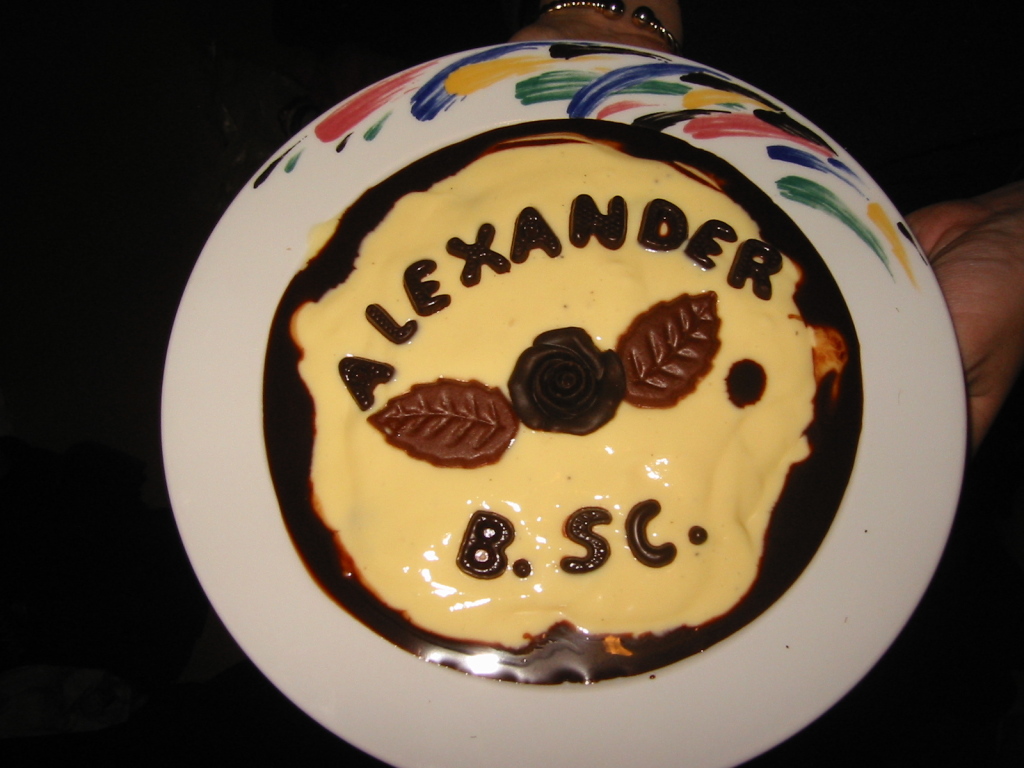
Alexander Reichle-Schmehl: I'm done

A Bachelor Pudding I'm well aware of the irony of becoming a bachelor after getting married.

MJ Ray: How not to be a Popular Politician

So, while everyone was watching the Bush Bank Bail-out plan get rejected by Congress, they also found time to approve more bad copyright law, an RIAA-backed initiative to attack cooperative download tools like BitTorrent. Thankfully, the attempt to empower the Department of Justice to prosecute on behalf of Big Music was lost (DoJ didn’t want the task anyway) and the Bush administration is minded to veto it. But that’s been the least of my politician annoyances in September. Earlier this year, we were encouraged by Cooperatives-UK to get involved with our Local Strategic Partnership. I went to North Somerset Partnership’s event but I was less than impressed by it. There’s no obvious way that NSP is capable of promoting cooperation. Publishing a thick glossy book about sustainability makes me wonder if it’s capable of doing anything sensible - most people I’ve shown it to have either laughed at it, or got angry about the wasted resources. They’re not the only LSP we have here. Last week, I went to the West of England Partnership’s Transport Forum which
“horrendously perverted the idea of a “forum” - the event would have been better titled “Joint Transport Lectures” because nearly all our time was spent watching council officers and consultants tell us how wonderful transport is here (they’re meeting 18 out of 21 targets, you know!) and what roads and bus roads they will build next. … The whole event seems like a colossal waste of resources for all involved.”
So, I seem to be having a bad time with politicians recently. If the above wasn’t enough, we got a reply to our petition requesting ODF at the National Archives which amazingly doesn’t mention Open Document Format at all. I’ve written to our MP (John Penrose) asking about that. And finally, I asked Climate Change Minister Joan Ruddock MP
“If there’s no windfall tax to fund it, how will the government remove the climate-harming services from the market and encourage new suppliers (particularly Third Sector ones who should show concern for their communities and sustainable energy) into the market?”
and got the non-answer of
“The Government is tackling a very wide range of issues that impact on Climate Change through a variety of mechanisms. The energy efficiency programme recently announced is directed at those most in need and where a small expenditure can produce a significant and lasting saving in energy use. Thus saving households money and reducing CO2 emissions.”
What the heck has that to do with removing harmful services and encouraging new suppliers? If any politicians want to be held in better esteem, try giving some straight answers instead of imitating the above, please. “Yes, Minister” was meant to be a satire!

30 September 2008

Axel Beckert: Mini-ITX based Home Server: Planning and Hardware

Ever since my former desktop machine gsa died and I started using only laptops at home, I noticed a need for a home server for storing all my MP3s, holiday pictures, games, and backups of my other machines. And I also want a filtering web proxy at home again. Current situation Currently my Norhtec MicroClient Jr. “c2” with it’s 120 GB 2.5" harddisk does some of these jobs (mostly storage and backup), but it neither has the disk space nor the performance to do all the things I want. For storage I once bought a TheCus N4100, the big brother of the popular and officially Debian supported N2100. Unfortunately there are a few things different than in the N2100 (NIC without MAC) which makes it much more difficult to get Debian on it and the original firmware doesn’t support NFS at all. *grmpf* I had hints from others who managed to get Debian on this NAS, but I didn’t find the time and leisure to really dig into cross-compiling kernels. (Although with the new 1.3.06 firmware, so called modules became possible also for the N4100 and a SSH module has been posted with which a Debian chroot could be installed and the required kernel build on the machine itself.) I though wasn’t very angry when the N4100+ came out shortly after I bought the N4100, because the N4100+ was no more an ARM based device but had a Celeron processor inside instead. And a NAS which is built on average PC hardware wasn’t as appealing as some device based on some more exotic architecture mainly used in embedded devices. :-) The Mini-ITX Appeal This view changed rapidly, when Raffzahn showed me a few Mini-ITX boards and cases. I surfed around on Mini-ITX.com store and stumbled upon the NAS-like ES34069 case from Chenbro featuring four S-ATA hotswap 3.5" slots, a slim-line CD-ROM drive slot, a SD card reader, and enough space for an additional 2.5" hard disk and a low profile Mini-ITX board. Additionally, the VIA EPIA SN series of Mini-ITX boards sports 4 S-ATA ports and either a passively cooled 1 GHz C7 processor or an actively cooled 1.8 GHz C7 processor. That should be enough power for a small multi-purpose home server while still keep the power consumption low. And I’m not the only one having this idea, Mini-ITX.com suggests this combination and Chenbro officially supports the VIA EPIA SN boards. Additionally, Debian 5.0 Lenny seems to run fine on the SN series, only lm-sensors seems to have problems with SN18000G and SN10000EG (but not SN18000 and SN10000E). So when the Chenbro ES34069 case showed up in digitec’s online shop, I ordered one there and a VIA EPIA SN18000G board at Brack. I didn’t order any disks since for data storage I plan to use the four Samsung 400 GB 3.5" S-ATA disks I bought for the N4100, and for the system I plant to use the 2.5" disk I initially bought for my MicroClient JrSX “c1”, but then continued to use it only with the CF card. Not yet sure, if I’ll also equip the slim-line optical drive slot, too. The case took several weeks to deliver and the mainboard hasn’t arrived yet. Instead I got an e-mail from Brack that VIA products are currently very difficult to get in Switzerland. Reason is said to be that VIA tries to channel the distribution of their products to a single distributor. (Sounds somehow similar to what Apple tried with the iPhone and failed.) Mini-ITX boards and power consumption So I now have a nice case without a board. There aren’t that many Mini-ITX boards out there sporting 4 S-ATA ports. One which cleary stood out was the new Intel DG45FC Mini-ITX board with LGA775 socket. (In Switzerland neither available at Brack nor at digitec, but e.g. at PCP.) But reading the specs of this board it was also clear that it wasn’t thought for NAS systems but high-performance HTPCs — the focus seems to be on multimedia performance which a NAS doesn’t need. Its newer sister, the Intel DQ45EK Mini-ITX board is focussed more on office and business PCs than on multimedia. But Intels remote adminstration is not really a plus for me (don’t need it, I’ve got SSH ;-) and it’ neither cheaper than the DG45FC nor has it significantly lower power-consuption. Despite the 120W power-supply there are people who already combined the Chenbro ES34069 with the Intel DG45FC or DQ45EK board, e.g. one of the administrators of the German NAS-Portal forums built such a machine and this German guy who wants to build a Windows Home Server based on such a combination. At least the NAS-Portal administrator found out that the board consumes so much power that together with the 4 S-ATA disks the included 120W power supply doesn’t suffice and the system is not stable in this configuration. Trusted Reviews review of the DG45FC explains why: It’s one of the first Mini-ITX board not following the MoDT idea, has a desktop chipset instead a mobile chipset and therefore hasn’t all of the power-saving features of those mobile chipsets. But it’s easy to see anyway: Most of the CPUs supported by the DG45FC and DQ45EK boards have a TDP of 65W. Offically the processor cooler delivered with the case supports processors with up to 65W, but 65W is already more than the half of what the power supply delivers and according to the Trusted Reviews review, the board itself consumes another 35W itself. So for the four 3.5" S-ATA disks — which are usually not as economical as notebook disks — about 20W are left. This can’t work! The guy from NAS-Portal.org plans to solve the problem by using a universal 180W notebook power supply instead of the original one. In comparison to the 100W of the both Intel boards, VIA’s SN18000G consumes only 26W (the fanless SN10000EG even only 22W) and that’s board and processor! That’s about ¼ of what the Intel board consumes. Imagine the difference between having a 100W light bulb (suffices for a whole small room) shining 365 days a year compared to a 25W light bulb (often used in bedside lamps) in a year. Other Mini-ITX mainboards with 4x S-ATA include the following ones: Conclusion For now, I decided to wait a little bit more for my VIA EPIA SN18000G board which still seems to be the best board for the Chenbro ES34069 case although not really cheap. But if I once in a not that distant future decide to have a desktop at home again, I’m quite sure it’ll sport a cute Mini-ITX case (perhaps a nice black-orange HFX micro M1 case by mCubed — unfortunately the M2 is no more available in a color combination including orange ;-) with an Intel DG45FC or Kontron 986LCD-M/mITX and a decent Core 2 Duo processor. Software Plans Of course my home server will run Debian GNU/Linux 5.0 Lenny on it, with software RAID-5 and LVM2 over the 1.6 TB of S-ATA disks resulting in 1.2 TB available disk space which will be offered using at least NFS, SMB and SSH (think sshfs). Planned software includes BackupPC (a very fine pulling backup system for machines which are not online 24/7) and Privoxy. I’ll perhaps also install Tor and a caching proxy like Squid or Polipo. Another idea is to run Mediatomb on that machine. :-)

Martin F. Krafft: Customer service how-not-to: Miles & More

I ve previously ranted about the Lufthansa website. Trying to help out a blind friend obtain some assistance from Miles & More, the Lufthansa frequent flyer programme, I can confidently say that the two companies have a common origin and probably read the same customer service guidelines, which must be somewhat along the following lines: If you follow the above guidelines carefully and possibly add a twist here or there, you can rest assured that you ll fit in quite perfectly with most of your competitors and companies in many other fields. You ll understand that the customer is evil and you have to protect your company and your customer service staff from them, by making it extraordinarily difficult and inconvenient to reach them, and ensuring that they won t get any further than the computerised guard at the front door. It s not like they are your most important asset. Interestingly, neither Swiss, SAS, nor Thai have read these guidelines. I hope they will never find them. NP: Porcupine Tree: The Sky Moves Sideways

Martín Ferrari: Detektivbyr n

Found via the fine Coilhouse blog (which in turn was discovered a few days ago after a middle-button-click crisis), these Swedes are a strange mix of music box, electronic and folk music. This video made me crave for more, but fear not, the two albums they've already released can be found in the usual places. Update: Forgot to include the link to the (quite ugly :)) Detektivbyr n's webpage, thanks Erik for noticing. Tags: Planet Lugfi, Planet Debian, Musica

29 September 2008

Axel Beckert: OMG, they killed del.icio.us! You bastards!

Yeah, it happened already a while ago, but I still get angry about it, so I need to rant about it in my blog: Yahoo!, the owner of del.icio.us, recently renamed the cool old del.icio.us to the no more cool and two bytes longer delicious.com. WTF? Part of del.icio.us’ popularity was its cool host name, why drop that? And even if a few dumbasses don’t understand the wordplay on the perfect host name, they could have offered delicious.com as a second domain name which works in parallel. But no, they dropped the good old del.icio.us in a way so that all old bookmarklets, bookmarks, plugins, etc. don’t work right anymore and I need to login each time I want to save a bookmark on all browsers where I once was logged in on the old site even if I’m already logged in at the new site in the same browser session. delicious.com sucks. And no, I don’t let count Gabor’s argument that people have difficulties with domains like del.icio.us, since many sites are well known or can be easily remembered because of their creative host or domain name: del.icio.us, script.aculo.us, wua.la, identi.ca, certifi.ca, laconi.ca, cr.yp.to, buenz.li (Swiss German), go.to, bit.ly, chickensh.it, gibts.net (German), doma.in, etc. No wonder, Montenegro sells many second level domains under their top level domain .me as “premium domains”.

Wouter Verhelst: SSH with Belgian electronic ID card

OpenSSH can be compiled against OpenSC. Since the latter has support for the Belgian electronic ID card, that means you can use your eID card to log on to a remote server using OpenSSH. To do this is fairly simple, once you know how it works. First, obviously, you need to have ssh compiled against opensc. Unfortunately, the Debian package comes with that option disabled, but it's easy to enable that:
sudo apt-get build-dep openssh
sudo apt-get source openssh
cd openssh-*
$EDITOR debian/rules
Find the "Common build options", and add another line:
confflags += --with-opensc=/usr
Now add another changelog entry, so that your next apt-get upgrade won't overwrite your locally-modified SSH package:
dch -i
Next, build and install the package:
dpkg-buildpackage -rfakeroot -b -uc -us
cd ..
sudo dpkg -i openssh-client*
You now have an OpenSSH that can access smartcards. So, how do you use it to log on to a remote system? Simple:
pkcs15-tool -c
ssh-keygen -D 0
The first command will tell you the order of the certificates on the card. In my case, the Authentication certificate is first, while the Signature certificate is second. You do not want the Signature certificate; you only want the Authentication certificate. The second command will output the RSA public keys that are on the smartcard in both SSH1 and SSH2 format, in the same order as in the pkcs15-tool output. You only want the SSH2 version, and you only want to get the Authentication key. That key needs to be added to your ~/.ssh/authorized_keys on the remote host. Note that the '0' assumes that your smartcard is in slot 0; if that doesn't work, 'pkcs11-tool -L' should tell you which slot you need. After we've done this, we're ready to start using the smartcard to log in. While ssh-add has an option to load keys from a smartcard, this only works with smartcards that allow one to download the private key from the smartcard into the computer's RAM. This is not possible with the eID (and for good reason), so you can't use ssh-agent with your eID card. However, you don't really need it.
beid-pkcs11-tool -l -t
This will log in to the Authentication key on the smartcard (note that while it is possible to log in to the Authentication key, it is not possible to do the same with the Signature key). You will get the familiar belpic login window now, and the smartcard will now allow use of the private key. In order to actually use this key, you need to specify one extra option to ssh:
ssh -I 0
The -I option instructs SSH to use a smartcard key as a private key. Since we're already logged in to the smartcard, we do not need to enter a PIN code (and regardless, SSH does not know how to do that). You will now be logged on to the server. Note that there is no way to 'log out' of a smartcard; the proper way to do that is to remove your card from the cardreader...

Ian Wienand: Kernel Development Course

Here are some slides and examples I used for a kernel course I developed (some time ago now). The course was aimed at C developers who wanted an introduction to both general UNIX-style user-space and Linux kernel development with a focus on embedded systems issues. The course is aimed at two 8-hour days, and is pretty packed in even then. The first day is user-space development and kernel building, focusing on things like make, autotools, advanced gcc, getting cross-compilers working, configuring the kernel and building. The second day we get into kernel internals; building up a kernel module to produce some simple proc nodes, take data, crash and debug, etc, look at internals like concurrency and the driver model, and focus on USB quite a bit. Here is a tarball of the entire thing, including the examples. Hopefully these can help out anyone tackling the design of such a course.

Next.

Previous.