Search Results: "tim"

8 May 2013

Steve Langasek: Plymouth is not a bootsplash

Congrats to the Debian release team on the new release of Debian 7.0 (wheezy)! Leading up to the release, a meme making the rounds on Planet Debian has been to play a #newinwheezy game, calling out some of the many new packages in 7.0 that may be interesting to users. While upstart as a package is nothing new in wheezy, the jump to upstart 1.6.1 from 0.6.6 is quite a substantial change. It does bring with it a new package, mountall, which by itself isn't terribly interesting because it just provides an upstart-ish replacement for some core scripts from the initscripts package (essentially, /etc/rcS.d/*mount*). Where things get interesting (and, typically, controversial) is the way in which mountall leverages plymouth to achieve this. What is plymouth? There is a great deal of misunderstanding around plymouth, a fact I was reminded of again while working to get a modern version of upstart into wheezy. When Ubuntu first started requiring plymouth as an essential component of the boot infrastructure, there was a lot of outrage from users, particularly from Ubuntu Server users, who believed this was an attempt to force pretty splash screen graphics down their throats. Nothing could be further from the truth. Plymouth provides a splash screen, but that's not what plymouth is. What plymouth is, is a boot-time I/O multiplexer. And why, you ask, would upstart - or mountall, whose job is just to get the filesystem mounted at boot - need a boot-time I/O multiplexer? Why use plymouth? The simple answer is that, like everything else in a truly event-driven boot system, filesystem mounting is handled in parallel - with no defined order. If a filesystem is missing or fails an fsck, mountall may need to interact with the user to decide how to handle it. And if there's more than one missing or broken filesystem, and these are all being found in parallel, there needs to be a way to associate each answer from the user to the corresponding question from mountall, to avoid crossed signals... and lost data. One possible way to handle this would be for mountall to serialize the fsck's / mounts. But this is a pretty unsatisfactory answer; all other things (that is, boot reliability) being equal, admins would prefer their systems to boot as fast as possible, so that they can get back to being useful to users. So we reject the idea of solving the problem of serializing prompts by making mountall serialize all its filesystem checks. Another option would be to have mountall prompt directly on the console, doing its own serialization of the prompts (even though successful mounts / fscks continue to be run in parallel). This, too, is not desirable in the general case, both because some users actually would like to have pretty splash screens at boot time, and this would be incompatible with direct console prompting; and because mountall is not the only piece of software that need to prompt at boot time (see also: cryptsetup). Plymouth: not just a pretty face Enter plymouth, which provides the framework for serializing requests to the user while booting. It can provide a graphical boot splash, yes; ironically, even its own homepage suggests that this is its purpose. But it can also provide a text-only console interface, which is what you get automatically when booting without a splash boot argument, or even handle I/O over a serial console. Which is why, contrary to the initial intuitions of the s390 porters upon seeing this package, plymouth is available for all of Debian's Linux architectures in wheezy, s390 and s390x included, providing a consistent architecture for boot-time I/O for systems that need it - which is any machine using a modern boot system, such as upstart or systemd. Room for improvement Now, having a coherent architecture for your boot I/O is one thing; having a bug-free splash screen is another. The experience of plymouth in Ubuntu has certainly not been bug-free, with plymouth making significant demands of the kernel video layer. Recently, the binary video driver packages in Ubuntu have started to blacklist the framebuffer kernel driver entirely due to stability concerns, making plymouth splash screens a non-starter for users of these drivers and regressing the boot experience. One solution for this would be to have plymouth offload the video handling complexity to something more reliable and better tested. Plymouth does already have an X backend, but we don't use that in Ubuntu because even if we do have an X server, it normally starts much later than when we would want to display the splash screen. With Mir on the horizon for Ubuntu, however, and its clean separation between system and session compositors, it's possible that using a Mir backend - that can continue running even after the greeter has started, unlike the current situation where plymouth has to cede the console to the display manager when it starts - will become an appealing option. This, too, is not without its downsides. Needing to load plymouth when using crypted root filesystems already makes for a bloated initramfs; adding a system compositor to the initramfs won't make it any better, and introduces further questions about how to hand off between initramfs and root fs. Keeping your system compositor running from the initramfs post-boot isn't really ideal, particularly for low-memory systems; whereas killing the system compositor and restarting it will make it harder to provide a flicker-free experience. But for all that, it does have its architectural appeal, as it lets us use plymouth as long as we need to after boot. As the concept of static runlevels becomes increasingly obsolete in the face of dynamic systems, we need to design for the world where the distinction between "booting" and "booted" doesn't mean what it once did.

7 May 2013

Matthew Garrett: A short introduction to TPMs

I've been working on TPMs lately. It turns out that they're moderately awful, but what's significantly more awful is basically all the existing documentation. So here's some of what I've learned, presented in the hope that it saves someone else some amount of misery.
What is a TPM?TPMs are devices that adhere to the Trusted Computing Group's Trusted Platform Module specification. They're typically microcontrollers[1] with a small amount of flash, and attached via either i2c (on embedded devices) or LPC[2] (on PCs). While designed for performing cryptographic tasks, TPMs are not cryptographic accelerators - in almost all situations, carrying out any TPM operations on the CPU instead would be massively faster[3]. So why use a TPM at all?
Keeping secrets with a TPMTPMs can encrypt and decrypt things. They're not terribly fast at doing so, but they have one significant benefit over doing it on the CPU - they can do it with keys that are tied to the TPM. All TPMs have something called a Storage Root Key (or SRK) that's generated when the TPM is initially configured. You can ask the TPM to generate a new keypair, and it'll do so, encrypt them with the SRK (or another key descended from the SRK) and hand it back to you. Other than the SRK (and another key called the Endorsement Key, which we'll get back to later), these keys aren't actually kept on the TPM - the running OS stores them on disk. If the OS wants to encrypt or decrypt something, it loads the key into the TPM and asks it to perform the desired operation. The TPM decrypts the key and then goes to work on the data. For small quantities of data, the secret can even be stored in the TPM's nvram rather than on disk.

All of this means that the keys are tied to a system, which is great for security. An attacker can't obtain the decrypted keys, even if they have a keylogger and full access to your filesystem. If I encrypt my laptop's drive and then encrypt the decryption key with the TPM, stealing my drive won't help even if you have my passphrase - any other TPM simply doesn't have the keys necessary to give you access.

That's fine for keys which are system specific, but what about keys that I might want to use on multiple systems, or keys that I want to carry on using when I need to replace my hardware? Keys can optionally be flagged as migratable, which makes it possible to export them from the TPM and import them to another TPM. This seems like it defeats most of the benefits, but there's a couple of features that improve security here. The first is that you need the TPM ownership password, which is something that's set during initial TPM setup and then not usually used afterwards. An attacker would need to obtain this somehow. The other is that you can set limits on migration when you initially import the key. In this scenario the TPM will only be willing to export the key by encrypting it with a pre-configured public key. If the private half is kept offline, an attacker is still unable to obtain a decrypted copy of the key.
So I just replace the OS with one that steals the secret, right?Say my root filesystem is encrypted with a secret that's stored on the TPM. An attacker can replace my kernel with one that grabs that secret once the TPM's released it. How can I avoid that?

TPMs have a series of Platform Configuration Registers (PCRs) that are used to record system state. These all start off programmed to zero, but applications can extend them at runtime by writing a sha1 hash into them. The new hash is concatenated to the existing PCR value and another sha1 calculated, and then this value is stored in the PCR. The firmware hashes itself and various option ROMs and adds those values to some PCRs, and then grabs the bootloader and hashes that. The bootloader then hashes its configuration and the files it reads before executing them.

This chain of trust means that you can verify that no prior system component has been modified. If an attacker modifies the bootloader then the firmware will calculate a different hash value, and there's no way for the attacker to force that back to the original value. Changing the kernel or the initrd will result in the same problem. Other than replacing the very low level firmware code that controls the root of trust, there's no way an attacker can replace any fundamental system components without changing the hash values.

TPMs support using these hash values to decide whether or not to perform a decryption operation. If an attacker replaces the initrd, the PCRs won't match and the TPM will simply refuse to hand over the secret. You can actually see this in use on Windows devices using Bitlocker - if you do anything that would change the PCR state (like booting into recovery mode), the TPM won't hand over the key and Bitlocker has to prompt for a recovery key. Choosing which PCRs to care about is something of a balancing act. Firmware configuration is typically hashed into PCR 1, so changing any firmware configuration options will change it. If PCR 1 is listed as one of the values that must match in order to release the secret, changing any firmware options will prevent the secret from being released. That's probably overkill. On the other hand, PCR 0 will normally contain the firmware hash itself. Including this means that the user will need to recover after updating their firmware, but failing to include it means that an attacker can subvert the system by replacing the firmware.
What about using TPMs for DRM?In theory you could populate TPMs with DRM keys for media playback, and seal them such that the hardware wouldn't hand them over. In practice this is probably too easily subverted or too user-hostile - changing default boot order in your firmware would result in validation failing, and permitting that would allow fairly straightforward subverted boot processes. You really need a finer grained policy management approach, and that's something that the TPM itself can't support.

This is where Remote Attestation comes in. Rather than keep any secrets on the local TPM, the TPM can assert to a remote site that the system is in a specific state. The remote site can then make a policy determination based on multiple factors and decide whether or not to hand over session decryption keys. The idea here is fairly straightforward. The remote site sends a nonce and a list of PCRs. The TPM generates a blob with the requested PCR values, sticks the nonce on, encrypts it and sends it back to the remote site. The remote site verifies that the reply was encrypted with an actual TPM key, makes sure that the nonce matches and then makes a policy determination based on the PCR state.

But hold on. How does the remote site know that the reply was encrypted with an actual TPM? When TPMs are built, they have something called an Endorsement Key (EK) flashed into them. The idea is that the only way to have a valid EK is to have a TPM, and that the TPM will never release this key to anything else. There's a couple of problems here. The first is that proving you have a valid EK to a remote site involves having a chain of trust between the EK and some globally trusted third party. Most TPMs don't have this - the only ones I know of that do are recent Infineon and STMicro parts. The second is that TPMs only have a single EK, and so any site performing remote attestation can cross-correlate you with any other site. That's a pretty significant privacy concern.

There's a theoretical solution to the privacy issue. TPMs never actually sign PCR quotes with the EK. Instead, TPMs can generate something called an Attestation Identity Key (AIK) and sign it with the EK. The OS can then provide this to a site called a PrivacyCA, which verifies that the AIK is signed by a real EK (and hence a real TPM). When a third party site requests remote attestation, the TPM signs the PCRs with the AIK and the third party site asks the PrivacyCA whether the AIK is real. You can have as many AIKs as you want, so you can provide each service with a different AIK.

As long as the PrivacyCA only keeps track of whether an AIK is valid and not which EK it was signed with, this avoids the privacy concerns - nobody would be able to tell that multiple AIKs came from the same TPM. On the other hand, it makes any PrivacyCA a pretty attractive target. Compromising one would not only allow you to fake up any remote attestation requests, it would let you violate user privacy expectations by seeing that (say) the TPM being used to attest to HolyScriptureVideos.com was also being used to attest to DegradingPornographyInvolvingAnimals.com.

Perhaps unsurprisingly (given the associated liability concerns), there's no public and trusted PrivacyCAs yet, and even if they were (a) many computers are still being sold without TPMs and (b) even those with TPMs often don't have the EK certificate that would be required to make remote attestation possible. So while remote attestation could theoretically be used to impose DRM in a way that would require you to be running a specific OS, practical concerns make it pretty difficult for anyone to deploy that at any point in the near future.
Is this just limited to early OS components?Nope. The Linux kernel has support for measuring each binary run or each module loaded and extending PCRs accordingly. This makes it possible to ensure that the running binaries haven't been modified on disk. There's not a lot of distribution infrastructure for setting this up, but in theory a distribution could deploy an entirely signed userspace and allow the user to opt into only executing correctly signed binaries. Things get more interesting when you add interpreted scripts to the mix, so there's still plenty of work to do there.
So what can I actually use a TPM for?Drive encryption is probably the best example (Bitlocker does it on Windows, and there's a LUKS-based implementation for Linux here) - while in theory you could do things like use your TPM as a factor in two-factor authentication or tie your GPG key to it, there's not a lot of existing infrastructure for handling all of that. For the majority of people, the most useful feature of the TPM is probably the random number generator. rngd has support for pulling numbers out of it and stashing them in /dev/random, and it's probably worth doing that unless you have an Ivy Bridge or other CPU with an RNG.

Things get more interesting in more niche cases. Corporations can bind VPN keys to corporate machines, making it possible to impose varying security policies. Intel use the TPM as part of their anti-theft technology on education-oriented devices like the Classmate. And in the cloud, projects like Trusted Computing Pools use remote attestation to verify that compute nodes are in a known good state before scheduling jobs on them.
Is there a threat to freedom?At the moment, probably not. The lack of any workable general purpose remote attestation makes it difficult for anyone to impose TPM-based restrictions on users, and any local code is obviously under the user's control - got a program that wants to read the PCR state before letting you do something? LD_PRELOAD something that gives it the desired response, or hack it so it ignores failure. It's just far too easy to circumvent.
Summary?TPMs are useful for some very domain-specific applications, drive encryption and random number generation. The current state of technology doesn't make them useful for practical limitations of end-user freedom.

[1] Ranging from 8-bit things that are better suited to driving washing machines, up to full ARM cores
[2] "Low Pin Count", basically ISA without the slots.
[3] Loading a key and decrypting a 5 byte payload takes 1.5 seconds on my laptop's TPM.

comment count unavailable comments

Gunnar Wolf: Talking about Debian while Debian was getting released

Last Saturday, I was invited to talk about Debian to Hackerspace DF, a group that is starting to work at a very nice place together with other collectives, in a quite centric place (Colonia Obrera). I know several of the people in the group (visited them a couple of times in the space's previous incarnation), and wish them great luck in this new hackerspace! Anyway I was invited to give an informal talk about Debian. And of course, I was there. And so was Alfredo, who recorded (most of) it. So, in case you want to see me talking about how Debian works, mostly on a social organization level (but also regarding some technical details). Of course, given the talk was completely informal (it started by me standing there, asking, "OK, any questions?"), I managed to mix up some names and stuff... But I hope that, in the end, the participants understood better what Debian means than when we started. Oh, and by the end of the talk, we were all much happier. Not only because I was about to shut up, but because during my talk, we got notice that Debian 7.0 "Wheezy" was released. Anyway If you want to see me talking for ~1hr, you can download the video or watch it on YouTube.

Jo Shields: Windows 8: Blood from a Stone

Ordinarily, I m a big believer that it is important to keep up to date with what every piece of software which competes with yours is doing, to remain educated on the latest concepts. Sometimes, there are concepts that get added which are definitely worth ripping off. We ve ripped off plenty of the better design choices from Windows or Mac OS, over the years, for use in the Free Desktop. So, what about Windows 8, the hip new OS on everyone s lips? Well, here s the thing I ve been using it on and off for a few months now for running legacy apps, and I can t for the life of me find anything worth stealing. Let s take the key change Windows 8 has apps built with a new design paradigm which definitely isn t called Metro. Metro apps don t really have windows in the traditional sense they re more modeled on full-screen apps from smartphones or tablets than on Windows 1.0 -> 7. Which is fine, really, if you re running Windows 8 on a tablet or touchscreen device. But what if you re not? What about the normal PC user? As Microsoft themselves ask:

How do you multitask with #windows8? The answer to that is, well, you sorta don t. Metro apps can exist in three states fullscreen, almost fullscreen, or vertical stripe. You re allowed to have two apps at most at the same time one mostly full screen, and one vertical stripe. So what happens if you try to *use* that? Let s take a fairly common thing I do watch a video and play Minesweeper. In this example, the video player is the current replacement for Windows Media Player, and ships by default. The Minesweeper game isn t installed by default, but is the only Minesweeper game in the Windows 8 app store which is gratis and by Microsoft Game Studios. Here s option A:

Unusable Windows 8 option 1 And for contrast, here s option B:

Unusable Windows 8 option 2 Which of these does a better job of letting me play Minesweeper and watch a video at the same time? Oh, here s option C, dumping Microsoft s own software, and using a third-party video player and third party Minesweeper implementation:

Windows 7 flavour It s magical almost as if picking my own window sizes makes the experience better. So, as you can see above, the old OS is still hiding there, in the form of a Windows 8 app called Desktop . Oh, sorry, didn t I say? Metro apps, and non-Metro apps, are segregated. You can run both (the Desktop app can also be almost-fullscreen or a vertical strip), but they get their own lists of apps when multitasking. Compare the list on the left with the list at the bottom:

Needs moar task lists And it s even more fun for apps like Internet Explorer, which can be started in both modes (and you often need both modes). Oh, and notice how the Ribbon interface from Office 2007 has invaded Explorer, filling the view with large buttons to do things you never want to do under normal circumstances. So, that s a short primer on why Windows 8 is terrible. Is there really nothing here worth stealing? Actually, yes, there is! After much research, I have discovered Windows 8 s shining jewel:

win8multitasking-004 The new Task Manager is lovely. I want it on my Linux systems. But that s it.

Timo Jyrinki: Qt 5 in Debian and Ubuntu, patches upstreaming

PackagesI quite like the current status of Qt 5 in Debian and Ubuntu (the links are to the qtbase packages, there are ca. 15 other modules as well). Despite Qt 5 being bleeding edge and Ubuntu having had the need to use it before even the first stable release came out in December, the co-operation with Debian has gone well. Debian is now having the first Qt 5 uploads done to experimental and later on to unstable. My work contributed to pkg-kde git on the modules has been welcomed, and even though more work has been done there by others, there haven't been drastic changes that would cause too big transition problems on the Ubuntu side. It has of course helped to ask others what they want, like the whole usage of qtchooser. Now with Qt 5.0.2 I've been able to mostly re-sync all newer changes / fixes to my packaging from Debian to Ubuntu and vice versa.

There will remain some delta, as pkg-kde plans to ask for a complete transition to qtchooser so that all Qt using packages would declare the Qt version either by QT_SELECT environment variable (preferable) or a package dependency (qt5-default or qt4-default). As a temporary change related to that, Debian will have a debhelper modification that defaults QT_SELECT to qt4 for the duration of the transition. Meanwhile, Ubuntu already shipped the 13.04 release with Qt 5, and a shortcut was taken there instead to prevent any Qt 4 package breakage. However, after the transition period in Debian is over, that small delta can again be removed.

I will also need to continue pushing any useful packaging I do to Debian. I pushed qtimageformats and qtdoc last week, but I know I'm still behind with some "possibly interesting" git snapshot modules like qtsensors and qtpim.

PatchesMore delta exists in the form of multiple patches related to the recent Ubuntu Touch efforts. I do not think they are of immediate interest to Debian let's start packaging Qt 5 apps to Debian first. However, about all of those patches have already been upstreamed to be part of Qt 5.1 or Qt 5.2, or will be later on. Some already were for 5.0.2.

A couple of months ago Ubuntu did have some patches hanging around with no clear author information. This was a result of the heated preparation for the Ubuntu Touch launches, and the fact that patches flew (too) quickly in place into various PPA:s. I started hunting down the authors, and the situation turned out to be better than I thought. About half of the patches were already upstreamed, and work on properly upstreaming the other ones was swiftly started after my initial contact. Proper DEP3 fields do help understanding the overall situation. There are now 10 Canonical individuals in the upstream group of contributors, and in the last week's sprint it turned out more people will be joining them to upstream their future patches.

Nowadays about all the requests I get for including patches from developers are stuff that was already upstreamed, like the XEmbed support in qtbase. This is how it should be.

One big patch still being Ubuntu only is the Unity appmenu support. There was a temporary solution for 13.04 that forward-ported the Qt 4 way of doing it. This will be however removed from the first 13.10 ('saucy') upload, as it's not upstreamable (the old way of supporting Unity appmenus was deliberately dropped from Qt 5). A re-implementation via QPA plugin support is on its way, but it may be that the development version users will be without appmenu support for some duration. Another big patch is related to qtwebkit's device pixel ratio, which will need to be fixed. Apart from these two areas of work that need to be followed through, patches situation is quite nice as mentioned.
ConclusionFree software will do world domination, and I'm happy to be part of it.

6 May 2013

Michal Čihař: phpMyAdmin in GSoC 2013

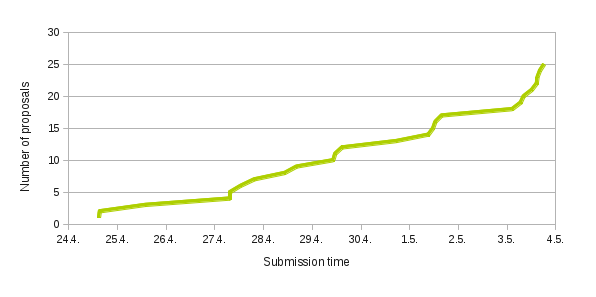
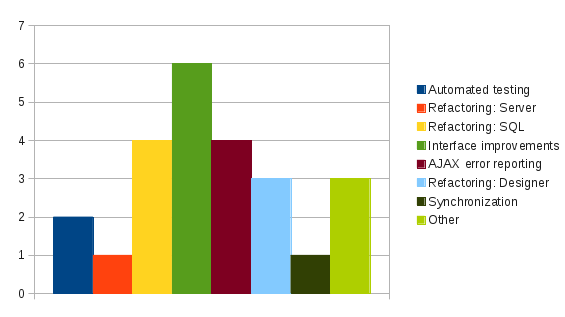
As student application period of Google Summer of Code 2013 is over, it's time to look at proposals we got for phpMyAdmin. First of all we got slightly less proposals than in past years. This is probably related to the fact that we still heavily focus on code cleanup this year and this is definitely not that interesting topic as adding new features. I think quality has also slightly improved and this time we received no bogus or spam proposals. Also as usual, people tend to leave submission for very last date (though not that much as in past years): Number of applications over time Quite unsurprisingly the most interesting topic seemed to be interface improvements, though it is quite wide. You can see how other topics were frequent in following chart: Number of applications for various types Please note that the numbers are not 100% accurate as some proposals really did not fit into above categories. Anyway we're just working on evaluation and will finalize it in upcoming days. Of course you will know the results from Google on May 27th.
Filed under: English Phpmyadmin 0 comments Flattr this!

Sylvestre Ledru: Follow up on Debian & Clang

A week after the Euro LLVM conference, I am glad to share the results I presented and discussed during the event. 1) Parallel building infrastructure using clang instead of gcc Based on the work that Alexander Pashaliyski and I did during the GSoC 2012, we are now able to automatically rebuild each package uploaded in Unstable transparently. Results are published here:
http://buildd-clang.debian.net/
This provides a quick and easy way to any Debian contributors or upstream packaged in Debian to check how the package behaves with clang.
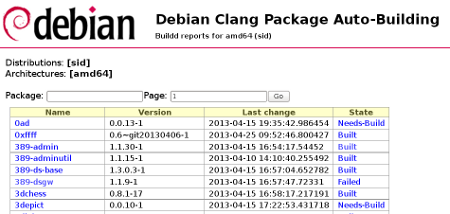
For Debian Developer and maintainer, a per maintainer view is also provided. This will list all packages maintained by a Debian packager. My page as example Here is an example of the list of package:
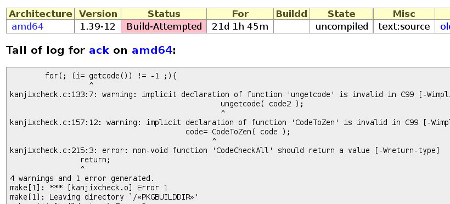
And an example of package failing:
At time of writing, most of the packages in unstable have been rebuilt (16 % are remaining). However, due to resource constraints, only amd64 packages are built. Contact me if you have resources to share for other architectures. Thanks to Paul Wise, the PTS (Debian package tracking system) proposes a link to the clang build logs (failing or not). A repository will be automatically updated with the results of these builds (once I find the time to get into buildd). 2) clang-built repository

Thanks to the Amazon Cloud, with our new DPL (Debian Project Leader), Lucas Nussbaum, we rebuilt unstable last April and published it at the following address:
deb http://clang.debian.net/repository-2013-04-07/ unstable-clang main
This allows some cool stuff like:
$ echo "deb http://clang.debian.net/repository-2013-04-07/ unstable-clang main">>/etc/apt/sources.list
$ apt-get update
$ apt-get install coreutils/unstable-clang
$ ls
$ awk
Note that this repository was only one-shoot and does not get updated. Quality of the binary produced (performance and size) can be tested thanks to this repository. Feedbacks are welcome!

Sylvestre Ledru: Follow up on Debian & Clang

A week after the Euro LLVM conference, I am glad to share the results I presented and discussed during the event. 1) Parallel building infrastructure using clang instead of gcc Based on the work that Alexander Pashaliyski and I did during the GSoC 2012, we are now able to automatically rebuild each package uploaded in Unstable transparently. Results are published here:
http://buildd-clang.debian.net/
This provides a quick and easy way to any Debian contributors or upstream packaged in Debian to check how the package behaves with clang.
For Debian Developer and maintainer, a per maintainer view is also provided. This will list all packages maintained by a Debian packager. My page as example Here is an example of the list of package:
And an example of package failing:
At time of writing, most of the packages in unstable have been rebuilt (16 % are remaining). However, due to resource constraints, only amd64 packages are built. Contact me if you have resources to share for other architectures. Thanks to Paul Wise, the PTS (Debian package tracking system) proposes a link to the clang build logs (failing or not). A repository will be automatically updated with the results of these builds (once I find the time to get into buildd). 2) clang-built repository
Thanks to the Amazon Cloud, with our new DPL (Debian Project Leader), Lucas Nussbaum, we rebuilt unstable last April and published it at the following address:
deb http://clang.debian.net/repository-2013-04-07/ unstable-clang main
This allows some cool stuff like:
$ echo "deb http://clang.debian.net/repository-2013-04-07/ unstable-clang main">>/etc/apt/sources.list
$ apt-get update
$ apt-get install coreutils/unstable-clang
$ ls
$ awk
Note that this repository was only one-shoot and does not get updated. Quality of the binary produced (performance and size) can be tested thanks to this repository. Feedbacks are welcome!

Christian Perrier: Wheezy is out: my main box upgraded the same day

As you may have noticed, Debian 7.0 wheezy was released yesterday. And, well, for the first time ever, I upgraded my main server (kheops....running Debian since buzz is out) to the finest and latest release the same day it was released. I didn't run into many problems, just a few glitches (some of them might still get some of our users angry, though). Most noticeably, I couldn't easily update two key packages on this serveer (where I receive all my incoming mail) : roundcube and dovecot. Roundcube indeed lost support for SQLite backend and that was probably the reason for which I falled into the "Could not perform immediat econfiguration" trap for it. The workarounds mentioned in the release notes did not work and the only solution was to remove the Roundcobe packages then re-add them later on. Not a big deal, as Roundcube is only used by my son (who will attend Debconf again, by the way) for the few mail he still receives on kheops. Dovecot was more tricky and my mail server temporarily stopped working for my lapto pto grab mail from it. OK, admitedly, I should have read NEWS.Debian that was explaining all problems one might have, particularly problems related to SSL certificates and the use of the "mail" group. But, indeed, that should have deserved a note in the release notes. After all, we're talking there about an obscure php5-suhosin package, right? :-) Finally, it took me less than 3 hours to upgrade everything with no service interruption for users on my local network, except a 30-minute stop of the IMAP server. I still have to reboot to get the new kernel in operation and voil . Let's now go on our way to jessie!

Olly Betts: Debian GSoC Applications for 2013

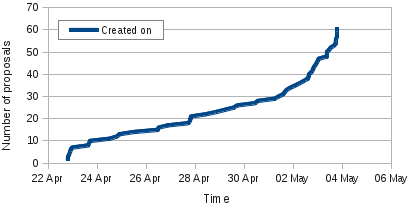
I've produced a graph of the 61 student applications which Debian received for GSoC this year: Graph of student applications to Debian in GSoC 2013 Ana blogged a similar graph last year if you want to compare. It looks like the total is down a little (though I'm not sure if the figure of 81 from the text, or ~68 read from the graph is correct for last year) - this is likely at least partly due to the number of proposals each student can send having been reduced from 20 last year to 5 this year, which should have reduced the number of low quality proposals. The timeline this year is later, which may have also had an effect. If you're an admin or a mentor, you can produce a similar graph for your own org(s) - just download this OpenDocument spreadsheet and follow the instructions inside.

5 May 2013

Timo Jyrinki: Whee!! zy

Congrats and thanks to everyone,
Debian 7.0 Wheezy releasedUpdating my trusty orion5x box as we speak. No better way to spend a (jetlagged) Sunday.

Michael Banck: 5 May 2013

Debian 7.0 "wheezy" has been released this weekend!

Quite a few new Debichem packages are now available in a stable Debian release for the first time:

Vasudev Kamath: CDBS Packaging: package relationship management

(It took me a while to come up with new CDBS packaging series post not because I stopped using CDBS just because I was procrastinating myself as busy) This is the second post in the CDBS packaging series. In this series I'm going to talk about package relationship management. The better example where this feature is useful is packages where build-depends and run-time dependencies overlap. Most of the Perl modules which have test suites have build-depend and run-time dependency intersection. So let me take example of a Perl module. First lets see control file of a Perl package which is not using CDBS and then let me explain how CDBS can help you improve the situation. I choose libxml-libxml-perl lets see part of control file which includes Build-Depends Depends Suggests Recommends.
Source: libxml-libxml-perl
Maintainer: Debian Perl Group <pkg-perl-maintainers@lists.alioth.debian.org>
Uploaders: Jonathan Yu <jawnsy@cpan.org>,
 gregor herrmann <gregoa@debian.org>,
 Chris Butler <chrisb@debian.org>
Section: perl
Priority: optional
Build-Depends: perl (>= 5.12),
 debhelper (>= 9.20120312),
 libtest-pod-perl,
 libxml2-dev,
 libxml-namespacesupport-perl,
 libxml-sax-perl,
 zlib1g-dev
Standards-Version: 3.9.4
Vcs-Browser: http://anonscm.debian.org/gitweb/?p=pkg-perl/packages/libxml-libxml-perl.git
Vcs-Git: git://anonscm.debian.org/pkg-perl/packages/libxml-libxml-perl.git
Homepage: https://metacpan.org/release/XML-LibXML/
Package: libxml-libxml-perl
Architecture: any
Depends: $ shlibs:Depends , $ misc:Depends , $ perl:Depends ,
 libxml-namespacesupport-perl,
 libxml-sax-perl
Breaks: libxml-libxml-common-perl
Replaces: libxml-libxml-common-perl
Description: Perl interface to the libxml2 library
 XML::LibXML is a Perl interface to the GNOME libxml2 library, which provides
 interfaces for parsing and manipulating XML files. This module allows Perl
 programmers to make use of the highly capable validating XML parser and the
 high performance Document Object Model (DOM) implementation. Additionally, it
 supports using the XML Path Language (XPath) to find and extract information.
So 2 packages are both in Build-Depends and Depends field
  1. libsax-xml-perl
  2. libxml-namespacesupport-perl
So in this situation there is a possibility that we miss to add one or both of these packages into Depends field, I'm not saying we will surely miss but we might after all we are all human beings. So how can we improve the situation using CDBS? Let me go through step by step on what we need to do.
  1. Create a file called control.in with same above contents but slight modification in Build-Depends and Depends section. I will display the diff below to avoid re-pasting entire file again and again.
--- debian/control      2013-04-28 23:08:11.930082600 +0530
+++ debian/control.in   2013-05-04 20:51:18.849680419 +0530
@@ -5,13 +5,7 @@
  Chris Butler <chrisb@debian.org>
 Section: perl
 Priority: optional
-Build-Depends: perl (>= 5.12),
- debhelper (>= 9.20120312),
- libtest-pod-perl,
- libxml2-dev,
- libxml-namespacesupport-perl,
- libxml-sax-perl,
- zlib1g-dev
+Build-Depends: @cdbs@
 Standards-Version: 3.9.4
 Vcs-Browser: http://anonscm.debian.org/gitweb/?p=pkg-perl/packages/libxml-libxml-perl.git
 Vcs-Git: git://anonscm.debian.org/pkg-perl/packages/libxml-libxml-perl.git
@@ -20,8 +14,7 @@
 Package: libxml-libxml-perl
 Architecture: any
 Depends: $ shlibs:Depends , $ misc:Depends , $ perl:Depends ,
- libxml-namespacesupport-perl,
- libxml-sax-perl
+ $ cdbs:Depends 
 Breaks: libxml-libxml-common-perl
 Replaces: libxml-libxml-common-perl
 Description: Perl interface to the libxml2 library
@@ -30,4 +23,3 @@
  programmers to make use of the highly capable validating XML parser and the
  high performance Document Object Model (DOM) implementation. Additionally, it
  supports using the XML Path Language (XPath) to find and extract information.
-
  1. Next we need to have something like below in the rule files
#!/usr/bin/make -f
include /usr/share/cdbs/1/rules/debhelper.mk
include /usr/share/cdbs/1/rules/utils.mk
include /usr/share/cdbs/1/rules/upstream-tarball.mk
include /usr/share/cdbs/1/class/perl-makemaker.mk
pkg = $(DEB_SOURCE_PACKAGE)
deps = libxml-libxml-perl libxml-sax-perl
deps-test = libtest-pod-perl
CDBS_BUILD_DEPENDS +=, $(deps), $(deps-test)
CDBS_BUILD_DEPENDS +=, zlib1g-dev, libxml2-dev, perl (>= 5.12)
CDBS_DEPENDS_$(pkg) = , $(deps)
So basically we moved all Build-Depends and Depends to rules file. The common ones are placed in deps variable and assigned to both Build-Depends and Depends. CDBS uses following variables for package relationship management.
  1. CDBS_BUILD_DEPENDS: This variable helps you manage Build-Depends field and all you need to do is in your control.in files Build-Depends field put place holder @cdbs@
  2. CDBS_DEPENDS: This field can be used to manage Depends field of binary package for each binary package you need to have one CDBS_DEPENDS_pkgname variable with depends assigned to it. And in your control.in append $ cdbs:Depends to Depends field.
  3. CDBS_PROVIDES, CDBS_BREAKS, CDBS_RECOMMENDS, CDBS_PREDEPENDS, CDBS_SUGGESTS, CDBS_REPLACES: all these does the job what you think it does :-).
Other than CDBS_BUILD_DEPENDS all other variables work using substvars i.e. CDBS will put the respective substitutions in pkgname.substvars file which will be used during deb creation to replace things in control file. So to make CDBS generate new control file run the below command
DEB_MAINTAINER_MODE=1 fakeroot debian/rules debian/control
Basically this command needs to be executed before starting build process if you miss your changes will not be reflected into debian/control. Additionally this feature is Maintainer Mode helper tool because Debian policy prohibits change of debian/control during normal package build. So what is the benefit of using this feature of CDBS? I've listed some of them which I felt are obvious.
  1. When there is intersection in Build-Depends and Depends this feature from CDBS is helpful. As I shown above put all intersecting dependencies in common variable and appropriately assign them wherever it is required. Thus we can avoid possible missing of some of run-time dependencies due to human error.
  2. It is also possible that newer version of package requires specific version of some package (mostly libraries) and we updated build dependencies but we might forget to do the same in Depends, by using this feature we can make sure we will not miss such minute details.
One last thing I want to point out is if you are NMUing a CDBS package
NMUs need not (but are encouraged to) make special use of these tools. In particular, the debian/control.in file can be completely ignored.
Before closing down the post, If you find some mistake in the post please let me know either through comments or through the email. Soon I will be back with new CDBS recipes till then cya.

Petter Reinholdtsen: Debian Wheezy is out - and Debian Edu / Skolelinux should soon follow! #newinwheezy

When I woke up this morning, I was very happy to see that the release announcement for Debian Wheezy was waiting in my mail box. This is a great Debian release, and I expect to move my machines at home over to it fairly soon. The new debian release contain heaps of new stuff, and one program in particular make me very happy to see included. The Scratch program, made famous by the Teach kids code movement, is included for the first time. Alongside similar programs like kturtle and turtleart, it allow for visual programming where syntax errors can not happen, and a friendly programming environment for learning to control the computer. Scratch will also be included in the next release of Debian Edu. And now that Wheezy is wrapped up, we can wrap up the next Debian Edu/Skolelinux release too. The first alpha release went out last week, and the next should soon follow.

Bits from Debian: Debian 7.0 Wheezy released!

Alt Keep calm and install Wheezy The new stable version of Debian, codenamed Wheezy, is finally here.
Main features of Debian 7.0 Wheezy are multiarch support, specific tools to deploy private clouds, a greatly improved installer and a complete set of multimedia codecs and front-ends which remove the need for third-party repositories.
For a complete list of new features and updated software, take a look at the official announcement. Want to give it a try?
Check out the live images! Want to install it?
Choose your favourite installation media among Blu-ray Discs, DVDs, CDs and USB sticks.
Already a happy Debian user and you only want to upgrade?
You are just an apt-get dist-upgrade away from Wheezy! Find how, reading the installation guide and the release notes. Some useful links:

4 May 2013

Jonathan McCrohan: New packages in Debian 7.0 Wheezy

Given that Debian 7.0 Wheezy will be released in a few hours, I thought it would be a good time to take part in Michael Prokop's #newinwheezy effort to publicise the new packages that have uploaded to Debian as part of Wheezy. I have introduced two new packages to Debian for this release: I've also have become (co-)maintainer of the following packages, updating them for this release: I hope you find them useful. Enjoy!

Joerg Jaspert: Wheezy release

There was Lenny, there was Squeeze, now there is Wheezy. Another major release of Debian where I had the pleasure to do the ftpmaster work for the release. Like the last times, Mark joined to help with the work. But 2 FTPMasters aren t enough for one Wheezy, or so, so Ansgar had his first run aside from point releases. With the whole load of work the release team did in the past to prepare this, combined with all the changes in dak we had since Squeeze, it turned out to be rather easy for us. Again, a few moments and not a detailed log (times in CEST): Right now (that is, 21:08 CEST) I am mostly waiting for the CD build to finish. Current schedule seems to have that in some two and a half hours, after which we can push the mirrors and our press people announce it. Except if Murphy wants to show up, but lets hope that not. Thanks go out to everyone involved in preparing this release, be it in the past by fixing bugs, uploading packages, doing whatever was needed, as well as doing the work today.

Ian Campbell: Taking over qcontrol upstream, releasing qcontrol 0.5.0

Taking over Qcontrol upstream When I took over the qcontrol package in Debian, back in October 2012, I was aware that upstream hadn't been active for quite a while (since late 2009). I figured that would be OK since the software was pretty simple and pretty much feature complete. Nevertheless since I've been maintaining the package I've had a small number of wishlist bugs (many with patches, thanks guys!) which are really upstream issues. While I could carry them as patches in the Debian package they would really be better taken care of by an upstream. With that in mind I mailed the previous upstream (and original author) Byron Bradley back in February to ask if he would mind if I took over as upstream. Unfortunately I haven't yet heard back, given how long upstream has been inactive for this isn't terribly surprising so having waited several months I have decided to just go ahead and take over upstream development. Thanks Byron for all your work on the project, I hope you don't mind me taking over. Since it is unlikely that I will be able to access the old website or Subversion repository I have converted the repository to git and uploaded it to gitorious: I don't expect I'll be doing an awful lot of proactive upstream development but at least now I have a hat I can put on when someone reports an "upstream" issue against qcontrol and somewhere which can accept upstream patches from myself and others. I'm still deciding what to do about a website etc. I may just enable the gitorious wiki or I may setup an ikiwiki software site type setup, which has the advantage of being a little more flexible and providing a neat way of dealing with bug reports without being too much overhead to setup up. In the meantime its been almost 5 years since the last release, so... New Release: qcontrol 0.5.0 This is a rollup of some changes which were made in the old upstream SVN repository but never released and some patches which had been made in the Debian packaging. What's here corresponds to the Debian 0.4.2+svn-r40-3 package. The 0.4.2 release was untagged in SVN, but corresponds to r14, new stuff since then includes: As well as the change of maintainer I think the addition of the daemon mode warrants the bump to 0.5.0. Get the new release from git or http://www.hellion.org.uk/qcontrol/releases/0.5.0/.

Russ Allbery: Review: Democracy at Work

Review: Democracy at Work, by Richard Wolff
Publisher: Haymarket
Copyright: 2012
ISBN: 1-60846-247-1
Format: Kindle
Pages: 220
I've been reading (mostly on-line) and thinking quite a bit lately about workplace governance models, economic structure, and why the current organization of the US workplace bothers me so intensely, partly triggered by reading John Kenneth Galbraith's The Affluent Society. The economic monoculture has made that process particularly frustrating. It's rare to find a discussion, even in the context of organizational strategies that are considered radical, that avoids the standard frame of productivity and business value. Most discussion is long on tactics and short on strategy and examination of goals. Wolff's appearance on Moyers & Company was a rare breath of fresh air, enough so that I grabbed his book shortly afterwards. Wolff is a Marxian economist (meaning that he makes use of Marxist analysis of economics and capitalism while separating them from Marxist politics and Marx's advocacy of revolutionary socialism), which for me was part of the interest. Marxist thought of any branch is not common in the United States; we're regularly deprived of several sides in the international conversation on economic models. I was taught Marxist theory in elementary and high school (in retrospect, surprisingly even-handedly and well, despite the biases of my schooling), but none of the later developments of Marxist thought. I think that's a typical experience here; in the United States, Marxism culminated in Mao and Stalin, and no further development of the underlying theories is ever mentioned. Democracy at Work is subtitled A Cure for Capitalism and does indeed advocate a concrete alternative to capitalist business structures. But this is only the last third of the book (and in some ways the least useful, as I'll discuss in a moment). The first two-thirds of the book is basically a remedial education in modern, as opposed to historic, Marxian economics for US readers like myself who have never heard it before, cast in the context of the current financial crisis. This may well be old hat for Europeans, but if you've been wondering what (at least some) modern-day Marxists actually believe, or are saying to yourself "there are modern-day Marxists after the collapse of the Soviet Union?", I recommend this book to your attention. It's an excellent summary, which I read with the delightful feeling of an expanding viewpoint and the discovery of new directions from which to look at a problem. There's quite a bit in this section that's worth thinking about, including another take on the nature of the recent economic collapse and how that fits into a Marxian analysis of capitalist crises. But there was one point in Wolff's explanation that I found particularly helpful. He completely restructured my understanding of the Marxian analysis of worker exploitation and profit allocation. There are two angles of Marxist economic thought and socialist economics that get a great deal of attention, at least in the United States, in history and economics classes: the role (or lack thereof) of markets in price setting, and the ownership of the means of production. Defenders of capitalism like to focus on the former, since it's quite easy to identify the advantages of theoretical free markets in finding ideal prices and balancing supply and demand, whereas central planning of prices and production has resulted in some catastrophic and deadly failures. (Although I will note, with passing interest, that those failures predate large-scale computing, and there are now large corporations that manage budgets larger than some countries via centralized command-and-control economic practices.) Defenders of socialism are more likely to focus on the ownership of the means of production, since it's easy to show prima facie unfairness in owners of capital extracting vast profits without having to do any work themselves, only be lucky enough to start with large quantities of money. Wolff, however, argues that both of these focuses misses a core critique by Marx of the workplace structure in capitalism, and that, by ignoring that critique, supposedly Marxist countries did not create anything that was actually Marxist in implementation. The Soviet Union was just as much a capitalist country as the United States is. It was state capitalism rather than private capitalism, but the core capitalist structure was intact. Wolff arrives at this conclusion, which may be well-trodden ground in parts of the world that include active Marxist thought but which was quite startling to this American, by treating the ownership of capital as a partial distraction. He focuses on a more direct question and practical question: who determines what a worker does on a day-to-day basis and how that product is used? Who determines what profits are collected and how they are spent? In private capitalism, this is done by the owners of the capital: large shareholders, major investors, and the managerial class that they hire. In Soviet state capitalism, this is done by national politicians, bureaucrats, and the managerial class that they hire. In neither model is it done by the workers themselves. The Soviet model gives theoretical ownership of the capital to the workers, but that ownership is diffused, centralized, and politicized, redirected through the mechanisms of the state, and therefore is effectively ignored. Ownership and control is entirely captured by the political class. Both of these systems are capitalist in Wolff's view of Marx: there is a class of owners and managers, who control the terms and nature of work and who allocate the profits, and a class of workers, who have to do what they're told, are not paid full value for their labor, and don't have a say in how the profits their work generates are spent. At the most important level of day-to-day autonomy and empowerment, they are functionally identical. They are both equally hierarchical and exploitative; the only difference is in whether the system is controlled by rich individuals or by well-connected politicians. (And, as any study of modern politics quickly reveals, the distinction between those two groups in most countries is murky at best.) Wolff convincingly recasts modern economic history as a constant pendulum swing between private capitalism and state capitalism. Crises in one system push countries towards the other system; subsequent crises push the country back towards the first system. Regulation grows and shrinks, companies are nationalized and then privatized, but both systems are united in excluding the worker from any meaningful control over their work life. The first two-thirds of the book was full of insights like this for me. I didn't agree with all of it, but all of it was worthwhile and thought-provoking. But I was a bit leery of Wolff's proposed solution. My past experience with critics of capitalism is that the critique is often quite compelling, but the proposed solution is much less believable. And, sadly, that concern was warranted here as well. The core of Wolff's proposal is predictable but possibly sound: a restructuring of the workplace to be radically democratic. The business would be owned entirely and exclusively by the people who work for it, equally regardless of the job of the worker, and the workers would decide democratically or via elected repesentatives from among the workers how to allocate the profits of the business, what standards and business practices should be followed, and how the work is to be done. I was particularly interested to hear that this model (workers' self-directed enterprises) has apparently been successful in Spain in the form of the Mondragon Cooperative. Given all the tricky, small details that have to be resolved in an actual workplace, an existence proof is worth more than pounds of theory. Unfortunately, like a lot of proposed alternatives, Wolff's description of WSDEs is quite fuzzy and involves a lot of hand-waving. I was never able to build, from this book, a coherent and complete mental model of how such a workplace would function. Wolff tends to surround every specific in a halo of contingencies, possibilities, and alternative models, and is maddeningly nonspecific on such practical matters as how line management would work, how such a business would do financial planning or project approval, how competing interests in different parts of the organization would be balanced, and other practical governance matters that fill my work life. Maybe the answer to all of that is just "democracy," but I'm dubious. Democracy has a number of well-known flaws that I thought weren't adequately addressed. For example, democracies are often quite happy to further and reinforce existing prejudice (such as sexism or racism), and are prone to yielding control to the most charismatic. Democracies also have an informed voter problem, which seems like it would be particularly acute if democracy is going to make detailed business decisions. And, for larger organizations, control by pre-existing money could re-enter the equation via propaganda and campaigning around votes. Some of this gap in the book could be addressed via a more in-depth look at how Mondragon and any other real-life examples work, but that is sadly missing here. (I am interested enough now, though, that I'd read a good popular treatment of the history and methodology of Mondragon, although I don't think I'm up to working through an academic study.) The hierarchical, dictatorial management structure imposed by capitalism is so awful that WSDEs don't have a particularly high bar to meet to be fairer and more empowering than what we have today. The question, rather, is would they function sufficiently well that the business would be able to make effective decisions, and that's unclear to me from this book. This is, as Wolff spends some time discussing, particularly difficult when in direct competition with capitalist enterprises. This sort of endeavor will probably trade some degree of economic efficiency and raw marketplace power for improvements to fairness and empowerment, but that means it's going to require support from the surrounding society, which is a huge obstacle. I doubt there's a free lunch here: true fairness and equity also leading to improved economic efficiency in a capitalist context is a nice dream, but not horribly practical. Wolff also seems to suffer from something else I associate with Marxist thought: a preferential focus on a very narrowly-defined type of productive worker, apparently left over from Marx's original critique in the context of industrialization. Wolff inserts a very odd and quite awkward distinction in his WSDE model between workers who directly produce the product that's sold, and who in his model therefore produce the profits of the business, and all other workers in the business. He then gives special privileges to the former group to decide how much profit to return in worker compensation and how much to use for other purposes, thus making the supporting workers second-class citizens within this supposedly equal workplace. Speaking as someone who works in IT, and hence would be classified by Wolff into the supporting rather than directly productive category, I do not find this division at all convincing, and Wolff never provides a coherent explanation for why he introduced it. He only says that it's necessary for the governance of the business to not be exploitative, which seems to assume that there is a special economic role played by the workers who work directly on a saleable product. Maybe there is some analysis that could convince me of this, but, if so, it's not present in this book. It struck me as a recipe for continuing the exploitation of the most invisible and powerless workers in capitalism: janitors, groundskeepers, and other low-paid service jobs. I wish the whole book were as insightful and pointed as the first two-thirds, but alas I found the WSDE discussion to be somewhat muddled and utopian. "How do we get there from here" is always the hardest part of this type of discussion, and Wolff has no special skill in that department. But, despite that, I got a lot of fascinating ideas and new conceptual frameworks out of this book, and I'm tempted to read it again. I suspect some of this, similar to my discovery of promises and infinite streams in programming, is filling in of odd gaps in my personal education rather than a discovery of unusual, new ideas. But if you too have gotten your political education within the US capitalism ber alles bubble, this book may fill in similar gaps in your knowledge. If so, it's a very rewarding experience. If you're curious about a preview of Wolff's perspective without paying for the book, I recommend watching the first episode of Moyers & Company in which he appeared. Wolff is a clear and engaging speaker, and his interview provides a good feel for his discussion style and his general perspective. Rating: 8 out of 10

Next.

Previous.