Search Results: "ina"

26 September 2011

Michal Čihař: GePeS - another hacweek project

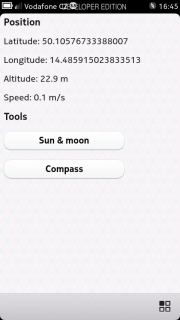
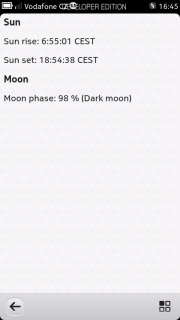
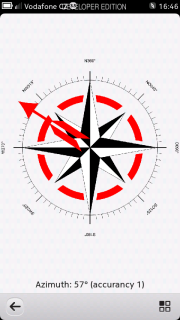
With no clear plans for Hackweek this year, I decided to play even more with N950. As I quite lack some GPS application I decided to write it :-). The feature set will be based on things I would use, though I still think it will be useful for others: I've named the application as GePeS and you can find sources on Gitorious: https://gitorious.org/gepes During first day I've managed to implement basic things, check screenshots: Main screen Sun and moon screen Compass screen

Filed under: English Meego Suse 0 comments Flattr this!

Biella Coleman: Photos for Coding Freedom

So my first book, Coding Freedom: The Ethics and Aesthetics of Hacking is mostly sort of done. All the arguments are in place and I am doing the final, very annoying, seemingly endless work of adding a few final citations, hunting for permissions, and tweaking about 10 paragraphs that I feel can be slightly improved (down from about 20 last week). The book is based on the dissertation but re-framed significantly with lots of new material and best of all a lot of the cruft has been zapped away, I think. The book will include two published pieces, although slightly revised. One of them is one of my all time favorite pieces on the hacker conference (which is the least academic/jargony of the peer reviewed articles). I thought it might be fun to change some of the photos for my book: so if you have some awesome, high quality photos that exude the joy of conferencing from past Debconfs or ANY hacker conference (preferably with computers in the background) please share. I am open to anything although I am looking for a high quality/sharp photo of people hacking away in the hack lab. The photo I have is good but I would like one with better lighting/sharper focus. The book will be published under a CC license (the most restrictive one, but heck as a junior scholar, I took what I could get and it is the first book that Princeton University Press is releasing under such a license). If you hold the copyright, I will need more official permission, otherwise, if it is under a CC or copyleft license, I will be adding the correct attribution/notice in the book.

Julien Danjou: Google Contacts for Emacs

I finally finished a thing I was really missing: accessing my Google Contacts from Emacs. That's now possible, thanks to my new google-contacts.el package.

<video controls="controls"> <source src="http://julien.danjou.info/images/emacs-google-contacts.ogv" type="video/ogg"> </video> It includes searching for any contact and displaying the result in a window. You can also jump to a contact from Gnus by pressing a key, and complete e-mail addresses while composing a mail.
Flattr me!

25 September 2011

Christian Perrier: [life] [running] Berlin marathon: I ran in the world record race...

...but I didn't break it myself. Still, Patrick Makau broke today Haile Gebresselassie's world record by 21 seconds, lowering it down to 2h03'38". This is an impressive performance, considering the quite "high" temporature today in Berlain (about 23 C). My own race was quite good, though not perfect. My goal was targeting 3h36', to break my own record (3h40'24"). However, my preparation was complicated by an hurted ankle in early August, then a very shaky September month at work with a lot of stress and work days up to 12 hours. Not the best way to prepare a marathon. Last two weeks were fairly good wrt running, with an half-marathon run in 1h43' two weeks ago. Still, we complicated this by speding a few days to do sightseeing in Berlin (you can't really be in such a nice city and not try to see it!). So, that means a lot of walking here or there, with museum visits and quite long days. Again, not the best way to prepare a marathon..:-) Still, my watch was set on a 5'07"/km pace. My goal was starting like this, work to avoid going faster over the first 20K ad see what happens. At the beginning, it worked fairly well. Contrary to Paris marathon, Berlin's start in Strasse des 17. Juni is very cool for the first 3 kilometers with an incredibly wide avenue, whilst Paris marathon shrinks in Rue de Rivoli after km 1.5, making it fairly complicated to pass. Also, runners in Germany are much more respectful of running principles and very few register for starting blocks that are nont their real performance (like registering for 3h30 while your best time if 4h). So less passing and a much more costant pace. Up to km15 in Kreuzbeg, everything went well, though the heat was growing, which already made me suspect that I would not make it (0-5K in 25'31", 5-10K in 25'54", 10-15K in 25'55") . From this point, I had to "fight" a bit more to keep the pace...and a few streets without shade had their effect. Moreover, I already had to refill my belt bottle after drinking 0,8l for the first 17KM. The pace thus went down to about 5'10-5'15" and I reached half-marathon in 1h50'28", already not really on time for less than 3h40). 15-20K in 26'41", including a bottle refill. Then 20-25 in 25'44", so small drop after all. However, the wall hit me on km28. For the first time in my marathon life, I think I considered abandoning because I was feeling without any energy and still 1/3 of a marathon to run. Well, that was only the 30K wall which they apparently moved 2K earlier..:-) After calming myself down, I decided to do what has to be done in such case: refill with energy. So long for the gels I had and particularly the hyper-glucidic "Coup de Fouet". Finally, around KM30, I found more motivation to complete the race. Anyway, we were then very very far away, at the end of Hohenzollendamm, so the only option was to come back anyway! Despite all this, I kept a very decent pace, after all: 26'45" for 25-30K. Each kilometer, my watch was beeping to remind me that I was not crawling on the street but more keeping about 5'20". Still, the last kilometers on these giants avenues (oh, endless Leipziger Strasse after Postdamer Platz!) needed a lot of motivation to be completed. It's indeed only at Gendarmenmarkt that I finally could be reliefed and know that I would not only finish, but also do it in a very decent time. 30-35K in 27'43", 35-40K in 27'38". Then we turned in Unter den Linden and, even better, at KM41, my beloved Elizabeth was there yelling. This, plus Brandenburder Tor not so far away....I could then "sprint" at 5'08" for the last kilometer. Finally, this marathon (my 6th official) was completed in 3h44'50", which is my second best. I'm really happy with this result, finally. OK, I didn't break my record as I was intending to (I think I can go down to 3h35 with a normal preparation and good conditions), but the way I managed the difficulty was finally good. So, now, let's prepare the next goal, a 67km night race in November, the longest distance I have ever run. Yet another different thing to prepare. And what about Berlin in all this? Well, in short, that city is *great*. What could I tell more?

Tanguy Ortolo: Increase your productivity with two spaces

Shell prompts are often designed to provide a reminder of useful context information such user name, host and current directory:
PS1="\u@\h:\w\$"
tanguy@muscat:~/public_html$
Such a prompt is sufficient to serve its original purpose, but it can be enhances in at least one useful way. Sometimes you have to copy the path of the current directory: with this prompt, it means selecting it by precisely dragging the mouse over it. Well, by adding spaces around the current directory you can become able to select it with a simple double click:
PS1="\u@\h: \w \$"
tanguy@muscat: ~/public_html $
Indeed, with such a prompt, you can now roughly point to the path, double click, and let your terminal emulator's word detection feature select the whole path for you. This simple modification may save you several tenths of seconds!

23 September 2011

Matthew Garrett: Supporting UEFI secure boot on Linux: the details

An obvious question is why Linux doesn't support UEFI secure booting. Let's ignore the issues of key distribution and the GPL and all of those things, and instead just focus on what would be required. There's two components - the signed binary and the authenticated variables.

The UEFI 2.3.1 spec describes the modification to the binary format required to produce a signed binary. It's not especially difficult - you add an extra entry to the image directory, generate a hash of the entire binary other than the checksum, the certificate directory entry and the signatures themselves, encrypt that hash with your key and embed the encrypted hash in the binary. The problem has been that there was a disagreement between Microsoft and Intel over whether this signature was supposed to include the PKCS header or not, and until earlier this week the only widely available developer firmware (Intel's) was incompatible with the only widely available signed OS (Microsoft's). There's further hilarity in that the specification lists six supported hash algorithms, but the implementations will only accept two. So pretty normal, really. Developing towards a poorly defined target is a pain. Now that there's more clarity we'll probably have a signing tool before too long.

Authenticated variables are the other part of the puzzle. If a variable requires authentication, the operating system's attempt to write it will fail unless the new data is appropriately signed. The key databases (white and blacklists) are examples of authenticated variables. The signing actually takes place in userspace, and the handoff between the kernel and firmware is identical for both this case and the unauthenticated case. The only problem in Linux's support here is that our EFI variable support was written to a pre-1.0 version of the EFI specification which stated that variables had a maximum size of 1024 bytes, and this limitation ended up exposed to userspace. So all we really need to do there is add a new interface to let arbitrary sized variables be written.

Summary: We don't really support secure boot right now, but that's ok because you can't buy any hardware that supports it yet. Adding support is probably about a week's worth of effort at most.

comment count unavailable comments

Matthew Garrett: UEFI secure booting (part 2)

Microsoft have responded to suggestions that Windows 8 may make it difficult to boot alternative operating systems. What's interesting is that at no point do they contradict anything I've said. As things stand, Windows 8 certified systems will make it either more difficult or impossible to install alternative operating systems. But let's have some more background.

We became aware of this issue in early August. Since then, we at Red Hat have been discussing the problem with other Linux vendors, hardware vendors and BIOS vendors. We've been making sure that we understood the ramifications of the policy in order to avoid saying anything that wasn't backed up by facts. These are the facts:
Microsoft have a dominant position in the desktop operating system market. Despite Apple's huge comeback over the past decade, their worldwide share of the desktop market is below 5%. Linux is far below that. Microsoft own well over 90% of the market. Competition in that market is tough, and vendors will take every break they can get. That includes the Windows logo program, in which Microsoft give incentives to vendors to sell hardware that meets their certification requirements. Vendors who choose not to follow the certification requirements will be at a disadvantage in the marketplace. So while it's up to vendors to choose whether or not to follow the certification requirements, Microsoft's dominant position means that they'd be losing sales by doing so.

Why is this a problem? Because there's no central certification authority for UEFI signing keys. Microsoft can require that hardware vendors include their keys. Their competition can't. A system that ships with Microsoft's signing keys and no others will be unable to perform secure boot of any operating system other than Microsoft's. No other vendor has the same position of power over the hardware vendors. Red Hat is unable to ensure that every OEM carries their signing key. Nor is Canonical. Nor is Nvidia, or AMD or any other PC component manufacturer. Microsoft's influence here is greater than even Intel's.

What does this mean for the end user? Microsoft claim that the customer is in control of their PC. That's true, if by "customer" they mean "hardware manufacturer". The end user is not guaranteed the ability to install extra signing keys in order to securely boot the operating system of their choice. The end user is not guaranteed the ability to disable this functionality. The end user is not guaranteed that their system will include the signing keys that would be required for them to swap their graphics card for one from another vendor, or replace their network card and still be able to netboot, or install a newer SATA controller and have it recognise their hard drive in the firmware. The end user is no longer in control of their PC.

If Microsoft were serious about giving the end user control, they'd be mandating that systems ship without any keys installed. The user would then have the ability to make an informed and conscious decision to limit the flexibility of their system and install the keys. The user would be told what they'd be gaining and what they'd be giving up.

The final irony? If the user has no control over the installed keys, the user has no way to indicate that they don't trust Microsoft products. They can prevent their system booting malware. They can prevent their system booting Red Hat, Ubuntu, FreeBSD, OS X or any other operating system. But they can't prevent their system from running Windows 8.

Microsoft's rebuttal is entirely factually accurate. But it's also misleading. The truth is that Microsoft's move removes control from the end user and places it in the hands of Microsoft and the hardware vendors. The truth is that it makes it more difficult to run anything other than Windows. The truth is that UEFI secure boot is a valuable and worthwhile feature that Microsoft are misusing to gain tighter control over the market. And the truth is that Microsoft haven't even attempted to argue otherwise.

comment count unavailable comments

22 September 2011

Christian Perrier: R.I.P. Troy Davis

Just like Saudi Arabia, China and a few other democratic countries, the state of Georgia which is part of United States of America still murders its citizens. Troy Davis has just been murdered by lethal injection 27 minutes ago. I'm not always proud to live in the country I'm living in, but today I am. Even if we were the last country in EU to abandon death penalty, on october 9th 1981, we can't legally murder our citizens for nearly 30 years now. I hope that M. Troy Davis now rests in peace. My only hope is that the noise made around this will help all those people who daily fight against deatch penalty in USA. Don't abandon hope. Full abolition will happen.

21 September 2011

Ian Wienand: Exploring $ORIGIN

Anyone who works with building something with a few libraries will quickly become familiar with rpath's; that is the ability to store a path inside a binary for finding dependencies at runtime. Slightly less well known is that the dynamic linker provides some options for this path specification; one in particular is a path with the special variable $ORIGIN. ld.so man page has the following to say about the an $ORIGIN appearing in the rpath:
  ld.so understands the string $ORIGIN (or equivalently $ ORIGIN )
  in  an  rpath specification to mean the directory containing the
  application  executable.  Thus,  an   application   located   in
  somedir/app   could   be  compiled  with  gcc  -Wl,-rpath,'$ORI 
  GIN/../lib' so that it finds an  associated  shared  library  in
  somedir/lib  no matter where somedir is located in the directory
  hierarchy.
  
As a way of a small example, consider the following:
$ cat Makefile
main: main.c lib/libfoo.so
	gcc -g -Wall -o main -Wl,-rpath='$$ORIGIN/lib' -L ./lib -lfoo main.c
lib/libfoo.so: lib/foo.c
	gcc -g -Wall -fPIC -shared -o lib/libfoo.so lib/foo.c
$ cat main.c
void function(void);
int main(void)
 
   function();
   return 0;
 
$ cat lib/foo.c
#include <stdio.h>
void function(void)
 
   printf("called!\n");
 
$ make
gcc -g -Wall -fPIC -shared -o lib/libfoo.so lib/foo.c
gcc -g -Wall -o main -Wl,-rpath='$ORIGIN/lib' -L ./lib -lfoo main.c
$ ./main
called!
Now, wherever you should choose to locate main, as long as the library is in the right relative location it will be found correctly. If you are wondering how this works, examining the back-trace from the linker function that expands it is helpful:
$ gdb ./main
(gdb) break _dl_get_origin
Function "_dl_get_origin" not defined.
Make breakpoint pending on future shared library load? (y or [n]) y
Breakpoint 1 (_dl_get_origin) pending.
(gdb) r
Starting program: /tmp/test-origin/main 
Breakpoint 1, _dl_get_origin () at ../sysdeps/unix/sysv/linux/dl-origin.c:37
37	../sysdeps/unix/sysv/linux/dl-origin.c: No such file or directory.
	in ../sysdeps/unix/sysv/linux/dl-origin.c
(gdb) bt
#0  _dl_get_origin () at ../sysdeps/unix/sysv/linux/dl-origin.c:37
#1  0x00007ffff7de61f4 in expand_dynamic_string_token (l=0x7ffff7ffe128, 
    s=<value optimized out>) at dl-load.c:331
#2  0x00007ffff7de62ea in decompose_rpath (sps=0x7ffff7ffe440, 
    rpath=0xffffffc0 <Address 0xffffffc0 out of bounds>, l=0x0, 
    what=0x7ffff7df780a "RPATH") at dl-load.c:554
#3  0x00007ffff7de7051 in _dl_init_paths (llp=0x0) at dl-load.c:722
#4  0x00007ffff7de2124 in dl_main (phdr=0x7ffff7ffe6b8, 
    phnum=<value optimized out>, user_entry=0x7ffff7ffeb28) at rtld.c:1391
#5  0x00007ffff7df3647 in _dl_sysdep_start (
    start_argptr=<value optimized out>, dl_main=0x7ffff7de14e0 <dl_main>)
    at ../elf/dl-sysdep.c:243
#6  0x00007ffff7de0423 in _dl_start_final (arg=0x7fffffffe7c0) at rtld.c:338
#7  _dl_start (arg=0x7fffffffe7c0) at rtld.c:564
#8  0x00007ffff7ddfaf8 in _start () from /lib64/ld-linux-x86-64.so.2
Just from a first look we can divine that this has found the RPATH header in the dynamic section and has decided to expand the string $ORIGIN.
$ readelf --dynamic ./main
Dynamic section at offset 0x7d8 contains 23 entries:
  Tag        Type                         Name/Value
 0x0000000000000001 (NEEDED)             Shared library: [libfoo.so]
 0x0000000000000001 (NEEDED)             Shared library: [libc.so.6]
 0x000000000000000f (RPATH)              Library rpath: [$ORIGIN/lib]
 0x000000000000000c (INIT)               0x4004d8
 0x000000000000000d (FINI)               0x4006f8
At this point it proceeds to do a readlink on /proc/self/exe to get the path to the currently running binary, effectively does a basename on it and replaces the value of $ORIGIN. Interestingly, if this should fail, it will fall back on the environment variable LD_ORIGIN_PATH for unknown reasons. This might be useful if you were in a bad situation where /proc was not mounted and you still had to run your binary, although you could probably achieve the same thing via the use of LD_LIBRARY_PATH just as well. This feature should be used with some caution to avoid turning your application in a mess that can't be packaged in any standard manner. One common example of use is probably your java virtual machine to find its implementation libraries.
$ readelf --dynamic /usr/lib/jvm/java-6-sun/bin/java
Dynamic section at offset 0x9a28 contains 25 entries:
  Tag        Type                         Name/Value
 0x0000000000000001 (NEEDED)             Shared library: [libpthread.so.0]
 0x0000000000000001 (NEEDED)             Shared library: [libjli.so]
 0x0000000000000001 (NEEDED)             Shared library: [libdl.so.2]
 0x0000000000000001 (NEEDED)             Shared library: [libc.so.6]
 0x000000000000000e (SONAME)             Library soname: [lib.so]
 0x000000000000000f (RPATH)              Library rpath: [$ORIGIN/../lib/amd64/jli:$ORIGIN/../jre/lib/amd64/jli]
 ...
There is a small but interesting security issue. If an attacker can hardlink to your binary that is using $ORIGIN then any path expansion is now relative to the attackers directory. Hence it is possible to make the linker read in arbitrary libraries and hence run arbitrary code. Clearly if your program is running setuid as someone else, such as root, you've just given up the keys to the house! Luckily, the dynamic linker will not let you shoot yourself in the foot like this, and prevents expansion of the $ORIGIN field if the program is running setuid.
$ sudo chown root ./main
$ sudo chmod +s ./main
$ ./main
./main: error while loading shared libraries: libfoo.so: cannot open shared object file: No such file or directory
However, this is a good example of why you might want to keep users home and temp directories on separate file systems away from where binaries live. There is also a similar variable $PLATFORM, which describes the current running system. This is gained via the auxiliary vector, which I have written about here and here. Setting LD_SHOW_AUXV=1 will allow you to examine this value.
$ LD_SHOW_AUXV=1 ls
...
AT_PLATFORM:     x86_64
...

20 September 2011

Axel Beckert: Creative Toilet Paper Usage in Webcomics

Funnily two of my daily web comics recently featured interesting things you could do with toilet paper: Zits on 19th of September 2011 involving a fan and Calvin and Hobbes on 13th of September 2011 involving flushing the toilet. Although both experiments are obviously resource wasting, they look like quite some fun and I m tempted to actually try them both at least once. (I though don t plan to try this, too. :-)
Matthew Garrett: UEFI secure booting

Since there are probably going to be some questions about this in the near future:

The UEFI secure boot protocol is part of recent UEFI specification releases. It permits one or more signing keys to be installed into a system firmware. Once enabled, secure boot prevents executables or drivers from being loaded unless they're signed by one of these keys. Another set of keys (Pkek) permits communication between an OS and the firmware. An OS with a Pkek matching that installed in the firmware may add additional keys to the whitelist. Alternatively, it may add keys to a blacklist. Binaries signed with a blacklisted key will not load.

There is no centralised signing authority for these UEFI keys. If a vendor key is installed on a machine, the only way to get code signed with that key is to get the vendor to perform the signing. A machine may have several keys installed, but if you are unable to get any of them to sign your binary then it won't be installable.

This impacts both software and hardware vendors. An OS vendor cannot boot their software on a system unless it's signed with a key that's included in the system firmware. A hardware vendor cannot run their hardware inside the EFI environment unless their drivers are signed with a key that's included in the system firmware. If you install a new graphics card that either has unsigned drivers, or drivers that are signed with a key that's not in your system firmware, you'll get no graphics support in the firmware.

Microsoft requires that machines conforming to the Windows 8 logo program and running a client version of Windows 8 ship with secure boot enabled. The two alternatives here are for Windows to be signed with a Microsoft key and for the public part of that key to be included with all systems, or alternatively for each OEM to include their own key and sign the pre-installed versions of Windows. The second approach would make it impossible to run boxed copies of Windows on Windows logo hardware, and also impossible to install new versions of Windows unless your OEM provided a new signed copy. The former seems more likely.

A system that ships with only OEM and Microsoft keys will not boot a generic copy of Linux.

Now, obviously, we could provide signed versions of Linux. This poses several problems. Firstly, we'd need a non-GPL bootloader. Grub 2 is released under the GPLv3, which explicitly requires that we provide the signing keys. Grub is under GPLv2 which lacks the explicit requirement for keys, but it could be argued that the requirement for the scripts used to control compilation includes that. It's a grey area, and exploiting it would be a pretty good show of bad faith. Secondly, in the near future the design of the kernel will mean that the kernel itself is part of the bootloader. This means that kernels will also have to be signed. Making it impossible for users or developers to build their own kernels is not practical. Finally, if we self-sign, it's still necessary to get our keys included by ever OEM.

There's no indication that Microsoft will prevent vendors from providing firmware support for disabling this feature and running unsigned code. However, experience indicates that many firmware vendors and OEMs are interested in providing only the minimum of firmware functionality required for their market. It's almost certainly the case that some systems will ship with the option of disabling this. Equally, it's almost certainly the case that some systems won't.

It's probably not worth panicking yet. But it is worth being concerned.

comment count unavailable comments

John Goerzen: Mexico Part 6: Conclusion

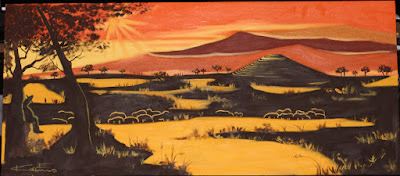
The sixth in a series; see also parts 1, 2, 3, 4, and 5. It s been about two weeks now since we got back home. Every few days, our boys still talk about Mexico. Jacob talks about what he will want to do when we go back and how he d like to see Jonathan over there again. Jacob, Oliver, and I look at photos from our trip a few times a week. This is all a sure sign that our boys loved the trip. And I keep trying to find Mexican food that tastes as good as the real thing (and, so far, failing). Another sign of a good trip! I think it is possible to have fun, relax, and enjoy new experiences all at the same time. We did that in Mexico. We had a lazy afternoon or two with the boys taking naps or playing with other children at the house we stayed at. And we stayed in a beautiful hotel without air conditioning, explored old downtown areas and ancient ruins, and bought things from crowded markets and people selling things from a table along a road. To anyone thinking about visiting: Go. Enjoy it, bring back memories, and live a little more serendipitously than usual. That s what I hope to do when we visit Greece before too long. Finally, here s a photo of the painting I bought from a roadside vendor for $17. Make sure to view it full screen. I think it says more about Mexico than 6 blog posts do.

MJ Ray: Six of the Best Podcasts?

I m listening to quite a few podcasts recently. Here are my current favourites: And now for number six, what are you listening to? Anything you d recommend?

19 September 2011

Sylvain Beucler: Building Android NDK samples

I searched forever for a way to just build the examples in the Android NDK, preferably from the command line. Here's how. First step: build the C++ code:
cd /usr/src/android-ndk-r6/samples/san-angeles/
/usr/src/android-ndk-r6/ndk-build
Simple enough. Second step:
You will then need to generate your final .apk through the usual means. -- Android NDK Dev Guide
Thanks a ****ing lot! In addition the documentation is very much Eclipse-centered - and I can't be bothered to install and configure all the Eclipse stack for a mere Java wrapper for the above-generated .so file XD We first need to use the 'android' wrapper and download the "SDK Platform Android 2.2, API 8, revision 3" - aka "android-8", the first environment to support OpenGL ES 2.
/usr/src/android-sdk-linux_x86/tools/android
It appears we first need to "manage the project", more precisely import from an existing project: http://developer.android.com/guide/developing/projects/projects-cmdline.html So we create a project by importing the sources from the current directory:
/usr/src/android-sdk-linux_x86/tools/android update project \
  --name san-angeles --path . --target "android-8"
Then we use ant to build the thing: http://developer.android.com/guide/developing/building/building-cmdline.html
apt-get install ant openjdk-6-jdk
ant debug  # avoid messing with signing
We now have a bin/san-angeles-debug.apk and we can run it in the emulator. Create a new "Virtual device" using the "android-8" platform we downloaded above, and launch it. Given the time needed to boot the OS, I suggest enabling snapshots. Scaling to display resulted in a very tiny, dark and slow display, in a first step I suggest using a non-scaled one.
/usr/src/android-sdk-linux_x86/tools/android
At last we can run it! Install it in the emulator:
/usr/src/android-sdk-linux_x86/platform-tools/adb install -r bin/san-angeles-debug.apk
You'll find a DemoActivity in your apps directory :)
Note: I tried to compile the "hello-gl2", showcasing OpenGL ES 2.0, but sadly it crashes:
Sorry! The application GL2JNI (process com.android.gl2jni) has stopped unexpectedly. Please try again.
The emulator apparently doesn't advertise EGL_OPENGL_ES2_BIT (checked in in GL2JNIView.java). If you try to by-pass it, you'll get loads of:
E/libEGL ( 333): called unimplemented OpenGL ES API
It's worth noting the OpenGLES20 sample from the "API Demos" application uses a fall-back OpenGL ES 1 renderer if v2 is not available - it made me mistakenly believe that OpenGL ES 2 was supported only from Java >( OpenGL ES 2 is not supported in the emulator as of 2011-09-17 - period.

Stefano Zacchiroli: why there are so many debian derivatives

A while ago I've been interviewed for a forthcoming article in the LinuxUser magazine on the topic of why there are so many Debian derivatives and on the potential impact, on them, of the (potential) advent of the so called "Debian Rolling" experiment. Below you can find my take on those topics. Questions are by Ferdinand Thommes, who has been involved in various Debian derivatives, including the forthcoming Siduction.
1.) Why do you think people base distributions on Debian? Looking at how many there is, since Corel and Libranet set sail in 1999, there must be a reason why, for one, people fork Debian in the first place, and secondly, why they choose Debian to do so and not some other distribution.
There are always advantages in creating a so called "derivative" distribution with respect to creating one from scratch. The main one is the possibility of reusing the packaging work which is already done in the "upstream" distro, focusing derivatives' efforts on customization, usually with clear target public in mind. Debian pushes most of those advantages (for derivatives) at their extremes. But there are also a couple of "political" reasons for basing derivatives on Debian. One is quite subtle and applies mostly to commercial distributions. If you are designing one such commercial distro, you have to be based on an independent distro with no commercial interests, lest risking that petty (technical or otherwise) choices might be made just to undermine your business. Among "popular" GNU/Linux distros, Debian is essentially the only one which is both volunteer-based and not ascribable to any specific company. The last reason why I think many derivatives are based on Debian is our vocation to universality. Since we are not targeting any specific public, but rather trying to provide an operating system suitable for several different use cases (e.g. the tasks supported by the Debian installer or the choice of Debian Pure Blends), we offer an ideal starting point for those who are going to have customization as their main business.
2.) What could be the benefits for Debian and for its Derivates, if the discussions about a second Debian Release based on the Testing branch really come to be reality?
We are considering the possibility of adding a new Debian suite which is "rolling" like Testing, in the sense that new software releases flow in regularly rather than only at periodic bumps corresponding to major distribution releases. There seem to be user demand for that and I personally believe that such a scheme could address the needs of both advanced desktop users and of developers, which are now strand to mix and match Debian suites ending up using package combinations which benefit, as a whole, of very little quality check. The main issues to face to get there is how to make sure that adding such a suite would not get in the way of preparing high quality Stable releases, in terms of quality control, developer focus, etc. Note that such a hypothetical "rolling" suite needs does not necessarily need to be based on Debian Testing, although that is a good starting point. The reason why it's not a good endpoint is that Testing has been created (circa 2000), and is still used, as an internal tool to prepare the forthcoming Debian Stable release. As such, it is not entirely suitable for final user consumption. For instance, during the Debian "freeze" period the flow of new software releases that reach Testing is greatly reduced up to stopping completely just before the release of a new Debian Stable. I've been told that users of testing-based (derivative) rolling releases regularly complain about this aspect during Debian freezes, which is not surprising. The main advantage for derivatives which are already offering a Debian-based "rolling" release will then be the possibility of basing their work on a suite less bound to the life cycle of Debian Stable than Testing is at present. On the converse side, that would also mean that derivatives will need to differentiate more from Debian than by just saying they are "rolling", which is a good thing: differences among distros are healthy and drive innovation. With those derivatives, on the other hand, which will recognize their goals as being aligned with Debian's goals---Debian Stable today, maybe Debian "rolling" tomorrow---we will be happy to join efforts.

18 September 2011

Philipp Kern: python-gnucash, historic build stats

Two tiny bits:

Paul Wise: Revisiting personal software freedom

Since it was Software Freedom Day again, I figured I should revisit my personal software freedom and see what has changed since my post two years ago. There hasn't been a vrms meme again this year so I don't have anyone else to compare with. A small survey on IRC indicates folks still need non-free nVidia drivers, embedded software, GNU documentation, Java and more. Since then I have switched my laptop from the Dell Inspiron 6400 to the Thinkpad X201 Tablet. Nothing really changed with my laptop, GNU documentation is still non-free and the new Intel WiFi chip on my new laptop still uses non-free embedded software. To remind myself of the non-free bits embedded in the hardware (CPU microcode, BIOS, EC etc), I have installed intel-microcode and microcode.ctl. Since then I didn't get any new phone, still the same OpenMoko FreeRunner. I'm now using QtMoko on a 4GB microSD card and Debian and SHR on other cards for testing. QtMoko is based on Debian and is the latest incarnation of Qtopia. It is probably free but I haven't done any audit of it. One interesting thing that changed with the FreeRunner in the past two years is that Harald Welte and friends started OsmocomBB, a project to create free software for the GSM modem built into the FreeRunner and many old feature-phones. I haven't tried it yet due to lack of time. While at the Chaos Communication Camp 2011 I learnt about the blackbox that SIM cards are (video), which hopefully OsmocomBB has a chance to protect against. AFAIK nothing else has changed to improve software freedom on the FreeRunner, the WiFi, GPS and other parts still contain non-free software with no chance of a replacement in sight. Since then I am still using the same wireless router and ADSL modem and I wasn't brave enough to try replacing their software. I still use gmail out of intertia, but I at least have started using offlineimap to prepare for the day when I will move away from it. I still use Google Maps, mainly for searching for public transport routes. With my recent travels in Europe I encountered many places where OpenStreetMap has much better coverage than Google. One nice thing about Google Maps adding public transport information is that public transport organisations have been publishing public data feeds for Google to consume. Apparently there is also a realtime variant. I also found one website using a JSON API for Google street view. The combination of these gives me hope for better support for spatial data in free software. The data (aerial and streets) will obviously remain a much longer term freeness issue though. For flash video on the web get-flash-videos appeared and made it even easier to ignore flash, especially since I got a few patches added to it. In addition Swfdec died but Gnash improved enough to replace it. Lightspark was also created but has so far been pretty buggy and unstable. Free RAR v3 format support appeared in the form of TheUnarchiver. The Voxware audio codec and DigiTrakker MDL files are still not supported by Rhythmbox. Unicode has been updated and so now Debian doesn't support every script fully. I still manage to avoid Skype. The nouveau drivers have matured enough to provide 3D support, multi-monitor support and general stability for the one nVidia card I used in the past two years. Overall, I'm reasonably happy with my level of software freedom. My main strategy for preventing regressions in my software freedom remains to just avoid doing things that require non-free software. The most problematic FLOSS issues for me are embedded software, spatial data support and Flash support. Please feel free to contact me with any comments or questions. Happy Software Freedom Day everyone!

17 September 2011

Andrew Pollock: [life/americania] Whirlwind visit to the Windy City

Our friend Susan was going to be in Chicago for a conference, and as we hadn't seen Chicago yet, and it was on the list of cities we wanted to visit, we made the semi-spur of the moment decision to have a three day weekend there last weekend. We got the Virgin America red-eye flight from SFO, which left on Friday at around 5pm, and got into Chicago at around 11:30pm, local time. Zoe didn't do as well as she has previously, and didn't sleep very well on the flight over, despite us getting lucky and scoring an empty seat between us on an otherwise fairly full flight. I think she's getting too big to comfortably sleep in the Ergo baby carrier (or isn't keen on sleeping vertically any more). We stayed at the Swissotel, because that was where Susan was staying (and was where her conference was) and nearby hotels seemed to be around the same price range. When we checked in, we let them talk us into an upgrade to a larger room, which had fantastic views of Lake Michigan and the Chicago River. Lake Michigan is just mind-bogglingly big. It's an inland sea. What can I say? I was totally in love with Chicago. The weather while we were there was unbelievable. Clear skies. High 20's (Celsius). It was more humid than the Bay Area, but less humid than Brisbane. The first thing we did on Saturday was go visit a friend of Sarah's who lived in Bryn Mawr. We took the "L" there. The elevated train was an interesting affair, and turned out to be less accessible than we'd been led to believe from some light research in advance. In fact, I found Chicago in general to be fairly wheelchair (and by extension, stroller) unfriendly. We had to lug Zoe's stroller up and down stairs quite a bit to get from the river level to where the hotel was. Zoe seemed to find it amusing, at least. Aside from that problem, the city seemed pretty flat. I'm really glad that we got out of the city and into Bryn Mawr, because it was really great to see that aspect of Chicago life as well. Lovely, quiet, tree-lined streets with wide sidewalks. Beautiful buildings. Sarah's friend was fostering 8 kittens, so Zoe got to have a play with all of them, which she thought was pretty cool. After we returned to the city, Sarah and I kicked back in Millennium Park while Zoe napped in the stroller. Saturday, being 9/10/11 in US date format, seemed to be particularly popular for weddings, and there were a lot of couples getting wedding photos taken in the park. That night, we tried to have some deep dish pizza at Uno, the home of deep dish pizza, but the line was ridiculous. We subsequently learned about Due, and went there the following night. The pizza was good, and I found the crust to be slightly different from what we'd get at Patxi's. We checked out the Navy Pier on both Sunday and Monday, taking Zoe to the Chicago Children's Museum both days (we got free entry thanks to our membership at the Children's Discovery Museum of San Jose). We had grand plans of checking out the Shedd Aquarium, but it turned out that Monday was a "free for all Illinois residents" day, and the line at 11am was ridiculous, so we gave it a miss and took at water taxi back to Navy Pier. It was Zoe's first boat ride, and she enjoyed it. I got some unbelievably good photos of the city skyline from the boat. Our flight out was at 7pm, so we took the train to Midway. I was very impressed that we could get all the way to the airport by train for the standard price. I love flat-rate fares. I really love a city with good mass public transit. The only thing that detracted from this in Chicago was the accessibility issues. We explicitly went to the Orange Line Clarke/Lake station to go to Midway because it was listed as being wheelchair accessible, and we had a stroller and a suitcase. We ended up going up to the wrong platform, and getting across to the other side was a bit of a mission. We'd entered the station from the street level, took the elevator up, and then realised we were on the wrong side. We had to go back down the elevator to the level below the street, cross the street from underneath it, and then go back up the elevator on the other side. Aside from these sorts of shenanigans, the whole elevated train thing was pretty cool (but I wouldn't have wanted to have an apartment with the train line right outside my window). If only the cars had glass roofs, the Loop would have been a lot more scenic. Overall, it'd be hard to say whether I liked Chicago or New York City better. I liked the clean, flat nature of Chicago, the architecture and the lower density of buildings, but I also really love New York just because it's New York, and has an awesome (probably equally stroller-unfriendly) subway system. Photos from the trip are here.

Patrick Schoenfeld: Struggling with Advanced Format during a LVM to RAID migration

Recently I decided to invest in another harddisk for my atom system. That system, I built up almost two years ago, has become the central system in my home network, serving as a fileserver to host my personal data, some git repositories etc., streaming server and since I switched to a cable internet connection it also serves as a router/firewall.
Originally, I bought that disk to backup some data, of the systems in the network, but I realized that all data on this system were hosted on a single 320GB 2,5" disk and it became clear to me, that, in absense of a proper backup strategy, I at least should provide some redundancy.


So I decided, once the disk was in place, that the whole system should move to a RAID1 over the two disks. Basically this is not that hard as it may seem at a first glance, but I had some problems due to a new sector size in some recent harddisks, which is called Advanced Format.


But lets begin from the start. The basic idea of such a migration is:
  1. Install mdadm with apt-get. Make sure to answer 'all' to the question which devices need to be activated in order to boot the system.
  2. Partition the new disk (almost) identical.
    Because the new drive is somewhat bigger that wouldn't make sense, but at least the two partitions which should be mirrored on the second disk, need to be identical.
    Usually this is achieved easily by using
    sfdisk -d /dev/sda sfdisk /dev/second/sdb

    In this case, it wasn't that easy. But I will come to that in a minute.
  3. Change the type of the partitions to 'FD' (Linux RAID autodetect) with fdisk
  4. Erase evidence of an eventual old RAID from the partitions, which is probably pointless on a brand-new disk, but we want to be sure:
    mdadm --zero-superblock /dev/sdb1
    mdadm --zero-superblock /dev/sdb2
  5. Create two DEGRADED raid1 arrays from the partitions:
    mdadm --create /dev/md0 --level=1 --raid-devices=2 /dev/sdb1 missing
    mdadm --create /dev/md1 --level=1 --raid-devices=2 /dev/sdb2 missing
  6. Create filesystem on the first raid device, which will become /boot.
  7. Mount that filesystem somewhere temporary and move the contents of /boot to it:
    mount /dev/md0 /mnt/somewhere
  8. Unmount /boot, edit fstab to mount /boot from /dev/md0 and re-mount /boot (from md0)
  9. Create mdadm configuration with mdadm and append it to /etc/mdadm/mdadm.conf:
    mdadm --examine --scan >> /etc/mdadm/mdadm.conf
  10. Update the initramfs and grub (no manual modification needed with grub2 on my system)
    and install grub into the MBR of the second disk.

    update-initramfs -u
    update-grub
    grub-install /dev/sdb
  11. The first point to pray: Reboot the system to verify it can boot from the new /boot.
  12. Create a physical volume on /dev/md1:
    pvcreate /dev/md1
  13. Extend the volume group to contain that device:
    vgextend <volgroup_name> /dev/md1
  14. Move the whole volume group physically from the first disk to the degraded RAID:
    vgmove <volgroup_name> /dev/md1

    (Wait for it to complete... takes some time ;)
  15. Reduce first disk from the VG:
    vgreduce <volgroup_name> /dev/sda2
  16. Prepare it for addition to the RAID (see step 3 and 4) and add it:
    mdadm --add /dev/md0 /dev/sda1
    mdadm --add /dev/md1 /dev/sda2
  17. Hooray! Watch into /proc/mdstat. You should see that the RAID is recovering.
  18. When recovery is finished pray another time and hope that system is still booting with it running from the RAID entirely. If it does: Finished :-)

Now to the problem with the advanced format:
There is some action taking place with the hardware vendors to move to a new sector size. Physically my new device has a size of 4096 bytes per sector. Somewhat different to the 512 bytes disks used to have the last decade.


Logically it still has 512 bytes per sector. As far as I understand this is achieved by placing 8 logical sectors into one physical sector, so when partitioning a new disk the alignment of the disk has to be so that partitions start in a sector which is a multiple of 8.

That, obviously, wasn't the case with the old partitioning on my first disk. So I had to manually create partitions by specifying start points manually and making sure they are dividable by 8.

Otherwise fdisk would complain about the layout on the disk.
This does not work with cfdisk, because it does not accept manual alignment parameters and unfortunately the partitions it creates do have a wrong alignment. So good old fdisk and some calculations how many sectors are needed and where to start, to the rescue.

So the layout is now:
Device Boot Start End Blocks Id System
/dev/sdb1 2048 291154 144553+ fd Linux raid autodetect
/dev/sdb2 291160 625139334 312424087+ fd Linux raid autodetect


Christian Perrier: RWC: Giant Ireland

Just completed watching Ireland-Australia. What could I say except "I knew they could make it"? This so Irish team won the fight against Australia and, of course, I'm happy. Let's dream for IRL-FRA in final...:) Oh, that Rugby World Cup in case you hadn't noticed and such a game is exactly why I like rugby.

Next.

Previous.