Search Results: "cas"

1 January 2008

Ross Burton: For Sale: Camera Bag

I'm selling my camera bag and lens case as I never use them, and thought I'd offer them here first before they hit eBay. Camera bag: Lowepro Toploader 65AW. Very good condition: it's mostly been in a cupboard apart from three weeks in India a while ago. I'm thinking £25 including delivery to the UK. Lens case: Lowepro 1W. This is as-new, and has never left the office. £10 including delivery. If anyone is interested, drop me a mail. NP: Another Late Night: Zero 7

Lior Kaplan: Responsible Behavior


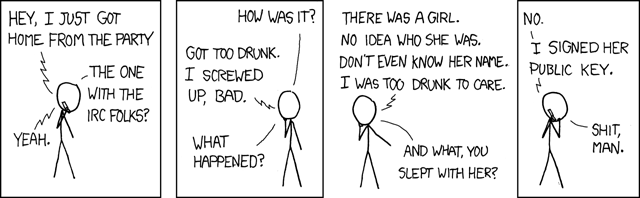
For all those DDs who love to drink: (click to enlarge) By xkcd, A webcomic of romance, sarcasm, math, and language.

31 December 2007

Mark Brown: Security here we come

The IMAP client provided with the version of Symbian on my phone has an interesting way of verifying certificates used for encrypting IMAP connections. As one would expect the client verifies the signatures on the certificate offered by the IMAP server and will prompt the user if it sees signatures that it can’t trace back to an authority it trusts. Unfortunately it is not possible to tell the device to remember the decision which means that when the device prompts it will prompt every time it connects to the server in question. The result of this is user irritation and a reduction in security since there is much less chance that a changed server certificate will be noticed. You would expect that there would be a lot of users encountering this given that so many sites don’t use a signed certificate but it turns out that this is not the case. Someone must have realised how many systems would be affected and so a solution was provided - if the server is using an unsigned certificate then the phone will accept it without warning the user at all. Only servers with signatures from an unknown trust source like a private certificate authority will cause the user to be prompted to verify the server certificate. This avoids both user irritation and any chance that the user will actually verify the fingerprint of the server they are connecting to, exposing users to spoofing and redirection based attacks. Clearly someone hasn’t thought through what they’re doing here - it all rather defeats the point of signing in the first place. On the bright side, this is the first Symbian phone I have seen where the native IMAP client encrypted connections at all so having this problem is progress.

Masayuki Hatta: What I did in 2007, What I will do in 2008

I just came back from Taiwan(went there basically for TWDebCamp2007) tonight. I met lots of great people down there and had lots of fun. I'll write about it later. Theoretically speaking, I was supposed to have decent Internet connections everywhere, but in most cases it didn't work or I was away from it anyway(and we had busy schedule!). So now I'm kinda catching up things quickly, especially what happend on the Net lately. Anywise, it would be a good time to look back 2007 and foresee 2008. Personally, these things were significant for me in 2007:
Finished GPLv3
GPLv3 is finally out, and I'm proud I took part in the revision process. Also I could manage to finish my Japanese translation of GPLv3/LGPLv3. Now my translations are being reviewed by lawyers and other legal professionals, so it will be more sophisticated soon.
Establishing MIAU
As I wrote before, we founded a little organization called MIAU, in hope of becoming a Japanese version of EFF. At the copyright war front in Japan, we are partly losing the battle since the Japanese government essentially ignored our 1800+ unique public comments and seems dare to go the wrong direction somehow. However, we are not going to give up easily -- next year, we will sophisticate our tactics and try to get more people involved. Chris Salzberg wrote up a series of great articles on these or related issues in English, and also submitted his story to Slashdot.
Joined Wikimania 2007
This was also a great fun in Taiwan. I gave a talk at there and also met many great people.
Released GNU a2ps 4.14
Well, this is far less significant, but the new release is now out. I hacked up this release in my hotel room just before I left, so may contain stupid bugs. anyway, as usual, enjoy.
So, now we seem to be in 2008 now. Happy New Year or whatever. I'm gonna do the following this year, at least:
Finish my PhD thesis
This will be the highest priority, of course. I'm planning to make it be a comprehensive study on FLOSS from management/organizational theorists' view. Will contain some math. Maybe not.
Finish my book
I'm still writing a book on Open Source licensing. This was supposed to be done within 2007, so it's long overdue now.
Finish translations
I'm still translating Peter Seibel's great book Practical Common Lisp into Japanese. Also, I guess I should update my Japanese translations of www.gnu.org.
Reduce weight
I'm obviously overweight. I'm gonna go to swim, cycling, or even jogging, and do my best not to eat too much. I'm serious!
Anyway, again I'd say Happy New Year to all, and enjoy your life.

Tag this post with del.icio.us!

Matthew Palmer: Cowboys

I am very saddened by the state of the IT industry. It seems like nearly everyone who works in or around IT is, to put it bluntly, a cowboy. There appears to be very little desire for actually helping people; instead all I see is a very large number of people circling around looking for the next person they can make a quick buck off. In short, most of the IT industry is composed of people who are little better than shysters and conmen. As a case in point, I recently had contact with someone who is trying to get an online store running. They've been trying, unsuccessfully so far, for several months. They've been screwed over by basically every IT-related person they've had contact with so far. Now, after all of their suffering, they've finally gotten in contact with me. Most of their money is gone, and they're deeply behind schedule. So I'm left trying to pull a miracle job in little time and with little money. Yes, I could shoo them away, because they're asking for more than they can afford, but there's a little spark of helpfulness left in me, and I'll try to get them going as best they can with what they've got. If they'd found someone competent right at the beginning, they'd have been fine. They started with sufficient cash and time to produce a good end result. But chancing upon someone decent doesn't have good odds in IT; it's a bit like winning the lottery. This story isn't unique in my personal experience, by any stretch. There seems to be a near-endless procession of non-technical people who come out of their encounters with the IT industry battered and bruised, whether it be on the web, in their business infrastructure, or their personal computing needs. While it's easy to blame the customer for not managing themselves and their computing properly, I don't think it's fair to lay the blame on them -- to me, that's like blaming the patient for dying on the operating table, when the responsibility must lie, prima facie, with the surgeon. It's the surgeon, after all, who is the (presumably) trained and experienced professional in the relationship, and it is his responsibility, primarily, to ensure that everything goes smoothly[1]. Depressingly, I don't see much of a way around this problem. The few IT people who did care could try and group together, build some sort of a rating or "membership implies quality" system, educate the consumer, and try and drive the cowboys out, but guilds and trade associations are frowned upon these days, smacking (as they do) of restraint of trade and collusion. Government regulation never seems to produce anywhere near the desired result, while hoping that the consumer will either rise up and demand quality, or will gain sufficient knowledge to be able to pick a cowboy is a complete non-starter, for the same reason as teaching everyone basic surgical techniques isn't going to improve the quality of hospitals.
There's an ad that used to be on Australian TV for a certain bank, where a guy is at a party and he's asked by another of the partygoers what he does for a living. As he replies, "I work in banking", the entire party goes silent and stares at him in horror. It's only when he says, "It's OK, I'm with $BANK_BEING_ADVERTISED" that everyone looks happy again and continues on with their party. Although I've never had that particular experience, I'm almost getting to the point where I'm not happy telling people what I do for a living. This is because in any non-trivial collection of people, there's almost certainly going to be at least one person who has had such a poor experience with the IT industry that they're either going to take it out on me, ask me interminable questions about computers, or will just hate me on principle. It's unfortunate that brothels don't have pianos any more; if I were to say "I play piano in a whorehouse" I'm pretty sure the response would be "lawyer or sysadmin?". As Edsger Dijkstra said back in 2001, "The average customer of the computing industry has been served so poorly that he expects his system to crash all the time, and we witness a massive worldwide distribution of bug-ridden software for which we should be deeply ashamed." Are you?
1. That isn't to say that the patient (or client) has no responsibility in ensuring a positive outcome -- if you go bungee jumping the day after open heart surgery, or never send your web developer any content, you're very unlikely to have a positive outcome. However, it seems to me as though the only customer consultation done by most IT "professionals" on taking on a project is a Homeresque "I only have two questions. 'How much?' and 'give it to me'".

30 December 2007

Meike Reichle: Without words ...

presenting engagement
rings
Intercultural disclaimer: In Germany it is customary to buy the wedding rings
on the occasion of the engagement and wear them on the left hand until the
actual marriage. Afterwards they are worn on the right hand.

29 December 2007

Joerg Jaspert: SSH “triggers”

Following my post about SSH jumphost I have another SSH feature to share with you, which IMO isn’t known or used enough. Imagine you have some data on one host which gets regenerated every now and then and you also need this data on other hosts too. There are multiple ways to sync the data to other machines. You can The problem of the first option is that you need to make the data available via http/ftp, which needs an extra daemon to run. And then you need to cron a script fetching it, which wastes resources if the data is updated infrequently. The problem of the second option is that you need some daemon available which allows you to write to the host. Depending on what you chose that might be with passwords transferred unencrypted. Or you aren’t able to set it up yourself, as you are not the admin of the machine. So, lets take the third solution. Its safe to assume that SSH is available on the hosts you login to (don’t tell me you still use telnet/rlogin on remote machines), so lets use SSH features. I assume that usage of basic SSH public key authentication is known, if not you first want to google for it and learn about that. Using SSH keys to trigger actions on remote hosts is basically the same as a login to the machine and manually running a command - except you don’t need to do it yourself, a script is doing it. Which leads to one big difference for a “trigger” key compared to a “login” key: You do not set a passphrase for that SSH key! As a consequence of that you use such a key only for exactly one purpose, nothing else. Generate a new key for another trigger. Never, ever, use such a passphrase-less SSH key for normal logins to other machines… Having generated a passphrase-less key on host a (let it have IP 1.2.3.4) we copy the .pub file over to the target host b and put it into the authorized_keys file (usually in ~/.ssh/). The difference to normal login keys is the large line of options we put in front of it:
command="rsync --server -vlHogDtprz --delete --delete-after --ignore-errors . /org/backup/something",no-port-forwarding,no-X11-forwarding,no-agent-forwarding,from="1.2.3.4" ssh-key-here
or
command="/var/mirror/ftpsync &",no-port-forwarding,no-X11-forwarding,no-agent-forwarding,no-pty,from="1.2.3.4" ssh-key-here
Both commands allow to use the SSH key from host a with its IP 1.2.3.4 and will run the command thats defined here. No matter what command or options are are specified on the commandline on host a, host b will only do the above. There wont be any port, X11 or agent forwarding and due to the forced command there also wont ever open a shell. With the first command we trigger the remote hosts rsync to write the data we send into that path, using the given options. Of course that means we send data using rsync from our host. The SSH connection stays available for the whole time the command runs. The second command instead runs the given binary, a shell script in this case, in background. As we also forbid tty allocation the SSH connection is closed right after the script is started. To avoid DOSing the remote machine such a script should have some kind of lockfile check and abort if a second copy is already running. SSH also allows to use such limited SSH keys for the root user, while disallowing normal root logins: Change PermitRootLogin in sshd_config from no to forced-commands-only and you wont be able to login to the remote host as root but you can trigger actions that should be run as root. If you want to know what else you can do using options specified in the authorized_keys file then read its man-page, it has some details how you can use it to limit port forward requests, use more than just one IP in the from= parameter, … Some users of the above way of automating tasks on remote machines are

Jeff Licquia: Christmas Gadgets: Creative Zen, LCD Monitor

So it’s a few days after Christmas, and like most of us tech-heads, I’ve got a few more gadgets to play with. First up: the Creative Zen 4GB. This one was a little bit of a saga. Last year, we got the kids no-name MP3 players, on the theory that we didn’t want to spend megabucks on something they wouldn’t use. They made valiant attempts to use them, but the little machines just weren’t up to the job. So, it seemed prudent to buy them iPods this year. Well, except for Apple’s attempts to break all non-iTunes iPod software, which had the side effect of making the devices unusable under Linux. Still, this was what they wanted, and they had been good this year, and very patient with my ever-more-convoluted schemes to get the old players working. So, iPod Nano 3Gs for both of them. My heart sank as I watched some of my hard-earned money go to reward such behavior. As part of the deal, I vowed to find a non-Apple player that would be good for when the iPods gave up the ghost or became “uncool”. And my dear wife, upon hearing this, went online, did some research, and bought me the aforementioned Creative Zen 4GB. From a Linux perspective, it’s in the “not quite ready for prime time” mode. Rhythmbox and Banshee are working on support; I tried a prerelease of Rhythmbox, and found its support to be very unstable. The only usable app is Gnomad2, which has a terrible UI and also occasionally crashes, but can manage to upload audio, video, and photos without too much hassle. Still, this is a problem of fine-tuning, and not of a hostile hardware vendor; I’m confident that these devices will be well-supported in the near future. The Zen is picky about what video files it will play, but I managed to figure it out: DivX or XviD video, 320×200 or smaller image size, encoded at a 480 kbit/sec video bitrate or less. Other video files might work, too, but you’ll have to find them on your own. My Zen has a little problem with the button locking feature: after unlocking, the screen comes up to all-white, and you have to power-cycle it to get the display back. I’m assuming this is a firmware bug, as the screen is still visible for a short time after engaging the lock. Other than this, the Zen is a delight, and every bit as functional as the iPod. The other nice gadget: a 24-inch LCD from Envision, bought after Christmas with a combination of gift cards, exchanges, and some of my own money. It was an open-box, and I saved about $80 for that; the only problem turns out to be a single dead pixel in the corner of the screen which is barely visible. It does 1920×1200 in very nice, bright color. Here, too, an improvement on my life only came after some effort. Debian 4.0’s drivers for the Intel graphics chipset are not capable of driving a widescreen LCD; the best I could get was 1600×1200, a normal-width resolution stretched across the wide display. I booted an Ubuntu Gutsy live CD to verify that the problem wasn’t with the monitor, and then set to the task of backporting everything I needed from lenny. Happily, before I started, I found that someone (Holger Levsen, to be exact) had done the work for me. Things are now about 90% there. The new drivers still don’t have everything figured out for running both Compiz desktop effects and XVideo acceleration at the same time, so I’ve had to turn XVideo off. My computer can render video without hardware support, but the quality isn’t as high. But, I have my nice wide screen, with crisp fonts and lots of room. I figure I’ll live with what I have until lenny releases, and then see what progress has been made.

Wouter Verhelst: 2008

It's almost newyear, and people tend to do some predictions around that time about what will happen the next year and beyond. I've never done this, since I tend to find such things quite stupid. But, hell, sometimes you've just got to change your habits, so here goes: Fun if people get predictable. Not that I don't like such overviews, but sometimes you just want to see something interesting when you put your brain in "off" mode. In addition, 2008 will be the year I turn 30. It will most likely also be the year I move out on my own. More on that later, I guess.

Enrico Zini: eeepc

Meet the EeePC Being in Taiwan, we swiftly got hold of an Eeepc. Instead of installing Debian into it, we decided to keep the original system and see how it works. It's a Debian derivative, and the feeling inside a terminal window is quite familiar. The boot is very fast. Two seconds after the video bios quickly shows on the screen, the X cursor appears. It's definitely worth having a look at how this devil boots. The "Asus Launcher" is worth a look. IMHO it's nicer and more useful than the usual launcher menu that we get in Gnome or KDE 3, although it probably only makes sense on a small display. It replaces the desktop background, has tabs, no clutter and allows to launch applications. Turns out it's customisable as well. What's on the system KDE 3.4.2, with some applications renamed so that their names are more human. For example, konsole became console. vim! \o/ But not emacs :) mc! Someone out there wanted to make my life easier. fbreader. I had never heard of it, but it's a very good discovery that I've now started to use it on my laptop as well. Little howtos To get to a terminal, hit Ctrl+T in the file manager, or Ctrl+Alt+T elsewhere. The root password is the same as the user password. To change the system language, I managed with a simple dpkg-reconfigure locales. Ways they simplified the unix system It's single user: I didn't find a way to create multiple users besides the terminal, and the login program does not ask for a username, only for the password. The "win" key has a house painted on it, and it's used as "hide/show all applications" key. When all applications are minimised, the Asus launcher is visible instead of the X background: this behaviour basically turns the key into a sort of "run application" key. The key still works as a kind of shift, although it probably was not intended to. The repository management is interesting. /etc/apt/sources.list contains:
deb http://update.eeepc.asus.com/p701 p701 main
deb http://update.eeepc.asus.com/p701/tw p701 main
which means they have a repository per eepc model and a subrepository per localised version. The "Internet" group of applications has a Wikipedia toplevel application: it's nice to see the ecosystem of free software / free culture coming together to provide a nice user experience. An extra link to the SD card mount point (besides the one in /mount) appears in the home directory automatically when the SD card is inserted. This means that when you do "save as" from all sorts of applications, the SD card is there, easy to reach. This helps if one decides not to use the internal flash for data, and just save everything in the SD card: I like doing this, as it allows me to quickly move the SD card with all the data between the EeePC and other computers. Changes I made so far Activate en_GB.UTF-8 via dpkg-reconfigure locales. Add en_GB.UTF-8 to /etc/scim/global, to get SCIM input methods to work. Little flaws Virtual screens are enabled, so W+arrow switches virtual screen. The feeling you get if you hit W+arrow is that all your applications disappeared. This could be improved by having the vm keep the asus launcher at the bottom of the current virtual screen, instead of just at the bottom of the first screen. Or, to disable virtual screens by default. It is possible to drag the lower panel around, maybe accidentally: that's another of our fancy default "features" that should be disabled by default. It is also possible to remove applets from the applet bar by mistake: for example I wanted to disconenct the wireless, and I instead ended up quitting the wireless applet. Luckily, the next time I started the computer it magically came back. ~/.xsession-errors is continuously getting the useless stdout/stderr debugging flood of GUI apps. Noone bothers usually, except that in this case the file is on flash, where unneeded writes are also very much unwanted. I'm considering symlinking it to /dev/null, but ideally we should get GUI apps to only write out what is really important. Battery charging doesn't show how long it is going to take until the battery is fully charged. No capslock or numlock leds. This probably calls for disabling or remapping of capslock. Numlock is very hard to hit by accident, but capslock is. Random thoughts If you buy an eeepc, I really suggest you think of it a mass consumption appliance and stay on the original OS for a while. Most of what's in here is what we use everyday, just on a different context. Try to use it as an appliance and see if it is perfect, and if it isn't, try to find out what is missing. It is a fantastic way to find out important bits that are missing in Debian as well. Also, if you're used to tailoring everything to yourself before starting to use a Linux system, this is a great way to try the usage experience that we can offer by default. The Firefox welcome page the first time you connect, for example, is surprisingly nice. Everything we know as doable comes a bit as as a surprise because this time someone has done it for us. I wish that that someone can be invited to talk at the next Debconf: the possibility of having a look at the work that has been done in bending Debian to this nice little device is to me one of the most valuable things so far about the eeepc. Help/About KDE/Credits It's reachable by most applications, and says:
The development team would like to thank the following people and organizations for their contributions:
  • the Debian Project,
  • the GNU Project,
  • the KDE Project,
  • the Mozilla Project,
  • the OpenOffice.org Project,
  • the SAMBA Project,
  • the X.Org Foundation,
Linus Torvalds and the other Linux kernel developers, and Free software developers around the world.
I'm using an appliance that is thanking me, and others like me: priceless!

28 December 2007

Lior Kaplan: conffiles, newer packages and purging


Earlier this month Kumar Appaiah opened a bug against the culmus package as part of the stable -> unstable piuparts upgrade tests. First, I’m proud in Debian to have these tests. Thanks for the people involved with running them, parsing the log files and reporting the bugs. I really feel the lake of such checks in commercial distributions I work with. After finding the time to get to the bottom of the bug, and talking with Kumar, it seems most of the bugs found in the test are similar. I think this might indicate something wrong in a more basic level of the package handling. The source of these bugs is how to handle files which were conffile in version x, but aren’t included in version x+1 (as a regular file). In the common situation, the conffiles are removed only during the purge process and not during upgrade or removal. But if a conffile doesn’t exist in the x+1 package, no one will “own” it after the upgrade, and no will purge it in due time. This is why changing conffiles can result in extra files on our system, which is the problem discovered by the recent piuparts test. One solution will be that each package maintainer will add the necessary code to the maintainer scripts to remove the file on upgrade. A second solution is to decide the wanted behavior in such a case and to have dpkg handle it for all packages. The behavior can be to remove the old conffile during the upgrade (postinst script) or to dynamically add it to the list of files owned by the package. Although technically possible, I’m not sure if the second method is “legal” with the debian policy. I thought it would be better to hear others’ opinions before submitting a wishlist bug about this.

Margarita Manterola: Argentina changes timezone

In a sudden rush of stupidity, the Argentinian government decided that we should change our timezone to include DST. For those that don't know, Argentina lies almost completely in the GMT-4 zone. 20 years ago we used to have DST, switching between GMT-4 and GMT-3. But since 1990 we've been using GMT-3 as the permanent timezone for our country. Thus, noon happens at 13:00 (or even later in more western parts of the country). Now, since we are in energetic crisis, our government decided that we should go back to DST, but instead of GMT-4 and GMT-3, we are going to be GMT-3 and GMT-2. This means that during the summer noon will happen at 14:00 or later. Not only this, but they decided to do this on December 21st, passed the law on December 26th, and published it on December 28th. And the day of the switch is December 30th!. Thanks to the quick work of Clint Adams, a patch was provided, applied and uploaded to unstable today, and it's already available. After the package was uploaded, I patched Etch's version so that we could upgrade all our servers. So, in case you need to take Argentina's stupidity into account, you can currently download tzdata_2007j-3 from unstable, or download tzdata_2007j-1etch2 from:
deb http://volatile.debian.org/debian-volatile stable/volatile main
Updated to reflect current situation of the package

Holger Levsen: 24C3 day two - 8h to complete a blog post

It's noon now and half the attendees or so the day hasn't really begun. Sure, some people here at the 24C3 in Berlin are having lunch already, but most are having breakfast or not even that yet. As the Debian booth is set up (mugs are sold out, bags almost...) and there are no interesting talks for me at the moment, I'm having a second breakfast in the smokers lounge is the cellar. Officially, this is the third non smoking congress and inofficially it's the third time there is an official smoker place ;-) This time, it's a lounge with comfortable sofas, ambient light and loud music...

About four weeks ago I was contacted by Martin Michlmayr and asked if the video team could make use of some hardware donation a company wanted to sponsor. I said yes, and so last week two boxes arrived at my house: a small audio mixer, a Behringer XENYX 1202 with 12-channels and XLR and chinch inputs, which is supposed to help us improve the audio quality in small venues. The second box contained a TwinPact100, which is a video converter box. It has an SVGA-input (supporting up to 1600x1200), an SVGA-output (sending the same signal out) and DV (firewire) output (and more features we don't really care about). So for us it's basically a SVGA-passthrough box which also outputs a video stream (of a speakers laptop in our use case) over firewire. So no more capturing of slides with a normal camera, yay! Yesterday Ben Hutchings and me tested this box and found it working, then Ben also fixed an issue with dvswitch, which we use to mix different firewire video streams together, probably even as soon as FOSDEM again! Many thanks to hitflip.de for this nice donation!

When I arrived here this morning I hoped to see the BabelBox I set up last night to be still running, and it was, yay! BabelBox is a d-i setup which loops through an installation of Debian etch in 36 languages, mostly using the graphical installer. And this will be running here for approx 72 hours non-stop resulting in 289 installations without a single keystroke :) IMO it shows real nicely two of the three major strengths of d-i: internationalisation and automatisation.

I guess it's pretty unlikely that I'll find some time during the last two days of the congress to take Andre Salomons packages for the OLPC laptop and demonstrate d-i's third major feature: it's modular design. It's more likely to be an excercise for next year though (I'll arrive home on the 31st..), here is too much stuff happening. Installing babelbox was just following a good howto. In any case, there is a OLPC.de meeting planned tomorrow at 12.30 noon at the Debian booth or in the Embedded Corner. Just come along and look out for the green cluster of XOs :)

And by now it's 8 PM - time flies when you're having fun. I just noticed that my wireless connection is up since seven hours uninterrupted! Wow.

Dirk Eddelbuettel: Internet NON-Service Provider: Yet another Comcast saga

About a week ago, our internet connection appears to have dropped around midnight. Not a biggie, one thinks. So on Friday morning between shower, breakfast, and leaving for work, I power-cycled the cable modem and router a few times which 'usually' helps. Not this time. Still no signal by the afternoon, and when Lisa called the help line, they confirmed that they could not see our cable modem. That could have given it away, but I didn't click. This being this time of year, we were actually out overnight on Friday so that I couldn't get to inspect matters at home. Also, friends and neighbours were out the next day so I couldn't get my hands on another cable modem to see if it was the line (my suspicion at the time) or the modem. All I could do was call, go once more over all possibilities with the tier-1 help person -- and schedule a technician to swing by on Monday afternoon, i.e. on Christmas Eve, or about 48 hours later (!!). So I made do over the weekend with two trips to the local library to consume some of their wireless signal to catch up on things. The big surprise came on Monday. The technician, was on time and rather friendly and knowledgeable, checked the signal strength at the box outside, and on two cable outlets in the house. All fairly well. So during the second call to Comcast, we turned our attention to the cable modem. A few years ago I returned the 'leased' modem and bought an inexpensive 3com cable modem. Only after checking that it was supported, of course. Well now it seems that Comcast decided that this (old) modem can only talk Docsys 1.0. And instead of telling me in advance, they just fscking dropped it cold. Unbefriggable. I must be getting two fliers a month informing me how great Comcast's so-called (and IMHO rather overpriced) 'Triple Play' is. You'd think that they use that mail-out infrastructure to let me know about the service change. Or use email, after all they are my ISP. Naaah. Rather just drop the service cold right before the holidays. That's the spirit. To clarify and repeat, I do not mind service updates. I do not mind improving standards and improved throughput. And as I am quite happy to buy a new modem on the spot on Tuesday afternoon -- yes, Christmas eve, because I then have nothing better to do than to troll in the mall to buy a new Motorola cable modem at full retail cost rather than somewhat more cheaply at Amazon or other places -- I could easily have done better if only they had told me in advance. I could go and use some choice terms , but as we're still in the holiday season I better stop... Maybe I should just go back to DSL and save a few bucks.

25 December 2007

Frans Pop: Visually beautiful music

Most audio players offer visualizations. Unfortunately most of them either are just plain boring or don't really visualize the music very well. KDE's amarok has one that is really excellent: jakdaw. Jakdaw does a good job of both following and representing the intensity of the music. And it generates an amazing display of colors. But even with a good visualization a lot of music is not all that interesting to watch. Over the last month or so I've occasionally been "looking" through my music collection. The visualizations are surprisingly varied for different artists. And though a lot of them are nice to watch, some artists consistently produce much more varied and artistic displays than others. To some degree it is predictable, but not always. Quite often the visualization is a lot less interesting than you'd expect and especially some slower or quieter songs produce much more interesting displays than you'd expect. A blanket of sound does not produce a very interesting display, but strong accents and mood changes do. As is often the case in art, the real challenge in composing music seems to be leaving things out and to have individual instruments play their own tune instead of having everything move together. The two artists that really stand out so far are Björk and Faithless. Both consistently produce visualizations that are at times stunningly beautiful and also show a lot more detail in the music than others. For Björk It's Oh So Quiet (from Post) and Violently Happy (from Debut) are very nice, but two songs that really stand out are Hunter (from Homogenic) and Hyper Balad (from Post). For Faithless songs like We Come 1 and Tarantula (from Outrospective), and Salva Mea and Insomnia (from Reverence) are truly worth watching.

23 December 2007

Adam Rosi-Kessel: Media for Kids


One great thing about kids — especially kids who have not been overexposed to TV media — is how easily entertained they are. We recently showed Esther some Looney Tunes cartoons from the 1940’s (on a real TV, no less!) and she couldn’t stop laughing. It is refreshing to see someone spellbound by animated content that didn’t require a rendering farm to create. I’m sure she’ll be jaded soon enough, but we’re trying to drag it out as long as possible by providing only very occasional small doses. This piece on the end of reading as a cultural activity is chock full of interesting statistics. This excerpt, in particular, is relevant here:
In August, scientists at the University of Washington revealed that babies aged between eight and sixteen months know on average six to eight fewer words for every hour of baby DVDs and videos they watch daily. A 2005 study in Northern California found that a television in the bedroom lowered the standardized-test scores of third graders. And the conflict continues throughout a child s development. In 2001, after analyzing data on more than a million students around the world, the researcher Micha Razel found little room for doubt that television worsened performance in reading, science, and math. The relationship wasn t a straight line but an inverted check mark : a small amount of television seemed to benefit children; more hurt. For nine-year-olds, the optimum was two hours a day; for seventeen-year-olds, half an hour. Razel guessed that the younger children were watching educational shows, and, indeed, researchers have shown that a five-year-old boy who watches Sesame Street is likely to have higher grades even in high school. Razel noted, however, that fifty-five per cent of students were exceeding their optimal viewing time by three hours a day, thereby lowering their academic achievement by roughly one grade level.
It certainly doesn’t surprise me that television–even educational TV–is generally not good for kids. The “inverted check mark” bit was a surprise, though. Who would guess that two hours a day is optimal for the nine-year-old brain? On a related note, Kiddie Records Weekly (recommended by about.com here) is an astonishingly extensive source of free children’s books in MP3 format. It’s also an excellent example of the increasing relevance of bittorent in enabling wide economical distribution of legitimate content. The content is primarily (exclusively?) digitized vinyl records from the 1930’s and 1940’s. Fortunately, Alice in Wonderland gets no worse with age. To complete the nostalgia circuit, who can forget “loaf of bread, a container of milk, and a stick of butter” (via sketchelement, quite a while ago): These are good times to be a kid. Or maybe just to be a parent. Technorati Tags: , , , , , ,

Martin-Éric Racine: Valga - Valka : 1 linn, 2 riiki - 1 pils ta, 2 valstis

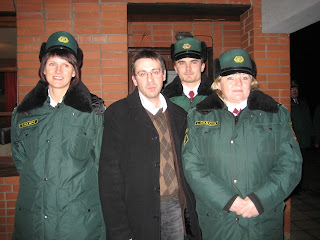
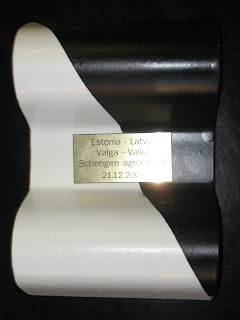
Thursday evening, I joined the inhabitants of the twin town of Valga-Valka, sitting smack on the Estonian-Latvian border, to celebrate their entry into the Schengen treaty. Ever since I first crossed the border there on a roadtrip from Tallinn to Fallingbostel, in year 2001, I knew I would have to return and, sure enough, I briefly passed through during last summer with an Estonian friend, on our way to an acquaintance's birthday party. Still, that told me nothing of the town's life and left me wanting for more. Upon hearing that year 2004 EU accession countries would join Schengen in December 2007, I immediately promised myself to show up and join the crowd. As it turns out, I missed Aleks Tapin of the All About Latvia blog by very little, having I caught his last-minute e-mail the next afternoon. Aleks blogged a great article depicting the Latvian side of life and providing some background info on the town, if you're curious. I arrived late-evening on Thursday via the Tallinn-Viljandi-Valga bus and checked into my hotel, then proceeded to checkpoint Valga II around 23:30, with the intention of grabbing a drink on the Latvian side and returning just before midnight for the celebrations. Hardly anyone was in sight, except for Latvian officer abana who was completing the inspection of a Russian car with three noisy passengers. Upon presenting her with my passport, officer abana cheerfully lead me to the office and slid my passport through a slot to officer Bukss, who was visibly surprised to have any tourist show up on the last day of his job to get their passport stamped. Upon explaining to him the reasons for my presence, he pointed me to a nearby bar where I could have a drink, visibly amused by the situation. I spent the next few minutes in a local casino in the company of three hilarious Latvian truck drivers, Zintars and Aivars, two Latvians with limited English language skills and Yuri, an ethnic Russian living in Ireland who was born stateless on the Latvian side of the town and who later acquired Estonian citizenship by claiming ancestral land on the Estonian side. Upon returning to the border, just minutes before midnight, I found myself in the middle of a huge crowd of villagers, police officers, border guards and politicians from both countries - barely getting noticed by anyone. I handed my passport to an Estonian border guard who emotionally commented to a civilian friend of his nearby that, "Wow! That was the last one!", handing me my passport back just as the midnight bells rang and the mayor of the Estonian side started his speech amidst pyrotechnics lining the road. I then had a chance to chat with the Estonian mayor, who promptly handed me a bilingual certificate, signed by the mayors of both towns, attesting that I was the first to cross the open border, while introducing me to his two young daughters with whom he was about to take a stroll on the Latvian side. The next morning, an even bigger and more symbolic event took place: the demolition of the fence that had been cutting the S prus/Rai a street in half. You can see a picture of what the street looked like before on Aleks' blog article [edit: or on Jens-Olaf's blog article]. After the fence was removed, it instead looked like this: The crowd then proceeded to checkpoint Valga III, where a stage had been setup for the politicians to make their speeches. An interesting fact is that, because of the way the border was drawn, along a creek leading to Pedeli river, an Estonian main road was technically on the Latvian border and thus aptly named "Raja" (border) street. The Estonian mayor commented in his speech that the the brand new supermarket standing behind us was also technically on borderland and could not have possibly been built earlier, weren't it for the Schengen treaty matter-of-factedly eliminating borders between participating EU countries. The speeches were closed by a youth group whose choreography featured six break-dancing boys, dressed as Estonian and Latvian border guards and as border posts. The choreography ended with the teenage border guards carrying away the human posts on their shoulders, just as a choir of young girls replaced them with songs in either languages. Before catching my bus back to Tallinn, I dropped by the Valga tourist info, only to face a nervous-looking Kapo officer in plain clothes. Upon mumbling something about the tourist info and wanting to grab maps, I noticed that a press conference was taking place behind. As he finally let me pass to the tourist info side of the building, a familiar voice said to me, "Hey! Weren't you at our place last summer with Martin Ranna?" Yup, the wife of the acquaintance whose birthday party I had attended last summer is working there and greeted with me refreshments and munchies she had cooked in prevision for the presidential visit! As was my luck, she had one of the commemorative plaques that had been given to the politicians at Valga III on hand: I was glad to see the town becoming one again, even though it is ethnically divided. There are already signs of people on both sides learning one another's languages and shopping on either side of town, not to mention plans of merging the municipal bus operations of the Estonian and Latvian halves of the town, so I'm sure that they'll get there in due course. For me, Schengen brought a much more practical and quite welcome change: the end of messy border crossing stamps that were rapidly filling my almost new passport, every time I visited the head office of our company in Tallinn. While Estonian border guards mostly stamp passports in an orderly fashion, being careful to fit exactly 8 stamps in a single page and to put entry and exit stamps side-by-side, Finnish border guards apparently are incapable of doing so, instead systematically wasting pages by either stamping sloppily in a way that makes it impossible for more than 4 stamps to appear on a given page or by flipping to a brand new page, every time I had to cross the border. In case anyone ever wondered why I'm currently representing Estonian interests abroad, despite living in Finland, this example is one of the many reasons: Finnish authorities routinely display arrogant carelessness towards the population and doubly so towards immigrants. It amounts to an accumulation of idiocy that has costly consequences on people's lives. For some, it's about being denied the public institutions' support when they need it the most and their life forever going downhill thereafter. For me, it has been about countless missed opportunities (jobs, love affairs, travel plans), plus very costly passport and residence permit renewals. Given this, I simply don't see myself ever representing Finnish interests ever again. Faith no more. Besides, the Estonians are fun and easy-going people. Siski ma m tlen, kas ma peaksen n d Eestisse kolima v i?

Russell Coker: Contract Pay Rates

In a comment on my post about Bad Project Management [1] Don Marti [2] says “the more money you charge, the less of your time people waste, and the more seriously they take you” and “you can affect the client more, whether you’re peddling idiocy or wisdom“. That’s a nice theory, however I don’t recall seeing an example of it anywhere that I have worked. There are two broad categories of employers, large and small. Large companies have HR departments etc who decide on rough pay scales. Once the budget is approved (by senior management and HR) for someone’s contract fees or salary the amount of money seems to be of little concern to the line manager. They have a group of N people reporting to them who are all paid by money that comes from some mysterious place (with no direct connection to the quality or quantity of work done) and therefore the amount of money paid is not very relevant. Often team-leaders don’t even know how much the people who report to them are being paid! Note that this applies to people who have a similar job title, if I am paid twice as much as another sys-admin in a corporate environment I don’t expect to get more attention, but someone who has a more senior job title (or in the case of the UK has been to a more prestigious school or has a better accent) may get more attention. Small companies are rarely in a position to be silly in this way. This doesn’t mean that the most highly paid person gets the most attention, it’s more a matter of making a logical case. Most of the small companies I have worked for have been run in a sensible manner, and my ideas have often received more attention than those of others because I have had a better technical background than my colleagues. However in some cases my suggestions have received less attention because I was receiving a higher pay rate. The reason is that I was being paid a rate that the company could not afford in the long-term and therefore the people who would work there in future years would have to maintain the systems in question which meant that their ability to do such maintenance was often considered to be more important than my ideas about the best way to design the system. I have worked for a small company that had no financial pressure to do sensible things (they had some sweet deals going with major corporations which essentially gave them money for nothing). They had chaotic management which they could get away with because there were no immediate consequences for doing silly things (such as not forcing their clients to have a method of backing up servers that they installed). I can’t claim that Don’s advice in this regard never applies, but my observations of situations where it didn’t apply lead me to believe that it’s applicable to some situations in limited areas and is not a general rule. Don also refers to “a high number that you would quote to a client you didn’t want in order to get them to go away“. This is an issue that causes a lot of disagreement. One consultant I respect advises people to never make such quotes, if you don’t want a job then say that you are not available - one reason is that if a position is so bad that you want the potential client to go away then you don’t want to be tempted to reconsider if they agree to pay you a silly amount of money, another is that it may be considered ethically wrong to make an offer is not genuine. Another consultant I respect claims that his greatest career success was when he turned up to an interview in casual clothes, explained to the potential client that he would never wear a suit and demanded an excessive amount of money. The client agreed to such terms and he then went on to charge other clients similar amounts of money and continued to refuse to wear a suit. I won’t claim that it’s wrong to demand excessive amounts of money to make an unwanted potential client go away and I will not rule out the possibility of doing so at some future time. But I think it should be noted that the practice is controversial and not referred to as something that anyone might do. It is something that I don’t recall doing at any previous time in my career (so I haven’t done it in a formal manner at least - I may have done so at the informal discussion phase and forgotten). Please note that I encourage you to read my previous post with Don’s comment in it’s original context to avoid any risk of misinterpretation. The purpose of this post is not to disagree with Don (I agree with him almost all of the time) but to disagree with some very commonly held beliefs which Don represented in his comment.

Christoph Berg: Datamining

I'm just digging through OFTC's nickserv database to do some cleaning. We have a bit over 20k nicknames in the database on 18k accounts which means about 10% of registered nicks are linked to other master nicks. By the power of sql, here's some statistics on the domain names of the email addresses our users:
com  9144
net  2241
org  1778
de   1016
uk    392
nl    288
fr    223
edu   217
au    203
it    193
br    190
ru    174
ca    165
se     88
dk     74
at     70
fi     62
cx     59
info   58
gmail.com             3997
hotmail.com           1405
yahoo.com              843
gmx.de                 221
gmx.net                201
web.de                 156
debian.org             148
free.fr                 94
aol.com                 90
msn.com                 73
comcast.net             72
gentoo.org              71
mail.ru                 65
xs4all.nl               59
linuxmail.org           58
verizon.net             57
yahoo.co.uk             54
yahoo.com.br            45
googlemail.com          45
student.uq.edu.au       44
sbcglobal.net           36
earthlink.net           33
users.sourceforge.net   32
The numbers could use some aggregation as some providers use zillions of TLDs (yahoo, gmx). My personal favorite in there is root@localhorst :-)

22 December 2007

Raphael Geissert: Holidays holidays holidays

Tomorrow I'll travel to Mexico city for holidays.

My plans include going to the BSP tomorrow at least to say hi and exchange key signatures, the rest is a private story ;)
DEHS seems to be working just fine so I don't expect any failure to occur within the week (+ a few more days) I'll be out :)
And as for my packages I've already wrote down my name in the LowThresholdNMU list so my packages shouldn't be a problem either :D.

So I guess it's time to say merry christmas (in case you celebrate it) and happy new year (same as for christmas) to everybody :cheers:

Next.

Previous.