Aigars Mahinovs: Gnome thumbnails size
I wonder am I the only one who feels that Gnome default thumbnail size is way too small? See the bug report for the background, motivation and a comparison screenshot
I started trying to maintain a "to read" list on my website, but instead
I've signed up for goodreads and started to
feed my lists into there. Feel free to recommend me things!
For some time, we use Pootle as online translation tool for phpMyAdmin. It is indeed great tool, but somehow we seem to be hitting more and more issues with it and I feel it really won't fit nicely once we will want to support translations on two divergent branches. Also it's code base is not something easy to understand so that I would be able to fix bugs myself without major effort.
So this is when I started to look for alternatives. Unfortunately there is nothing I could find what would work in way I want. I've looked at Transifex, Translatewiki, Crowdin and others whose names I've forgotten and I still haven't found what I'm looking for.
The key feature I want from such system is full integration with git. This means that whatever is changed should be committed to local git branch and merging translations back should be as easy as merging remote branch. I've hacked such thing into Pootle (in quite dirty way), so this is basically workflow we have right now and I'm pretty much happy with that.
Another thing (which seems to be existing in some tools) is support for simultaneous translation of more branches - if same string exists in more branches, it should be translated in all of them. And last but not least, it should support import of po files allowing users offline translation.
Thinking about this I'm starting to thing that it should be pretty easy to implement something what I want using existing pieces of software without major effort. I'll probably start to play with Django, translate-tookit and GitPython to see if I can come up with something working reasonably well in few days...
PS: Anybody working on updated GitPython packages for Debian, looks like I will need them soon :-).
Filed under: English Phpmyadmin Weblate 10 comments Flattr this!
I ve just started to use it. Next time I m able to show you how stable is Zenbook under Linux.
Right now it s not helpful:
fenio@zenbook ~ $ downtimes
Maybe the system has not been down yet?
downtimes: can not open /var/lib/downtimed/downtimedb: No such file or directory
fenio@zenbook ~ $
Next time it will really
Soile, my fiancee, has had a successful Kickstarter

campaign.
The minimum requirement has been met. There's a couple more days
to go still, so maybe it will go beyond the minimum, even.
<iframe allowfullscreen="allowFullScreen" frameborder="0" height="220" mozallowfullscreen="mozallowfullscreen" src="http://player.vimeo.com/video/36767480?title=0&byline=0&portrait=0" webkitallowfullscreen="webkitAllowFullScreen" width="400"></iframe>
Maria Eveliina's Valentine from Soile Mottisenkangas on Vimeo.
(See https://vimeo.com/36767480 if the embedded video doesn't work.)
She's also created some designs for
merchandise.
Exciting times.
Also this year the Debian Project is running a booth at Chemnitzer Linux-Tage.
Unfortunately this year we are lacking a bit manpower compared to the last years. Actually we have 6 persons at our wiki without knowing how much time everybody will be present at the booth. It would be really cool, if we can prevent us from having a D j vu.
Just got mail about it:
Accepted:Now let s see how portable is it
reaver_1.4-2.debian.tar.gz
to main/r/reaver/reaver_1.4-2.debian.tar.gz
reaver_1.4-2.dsc
to main/r/reaver/reaver_1.4-2.dsc
reaver_1.4-2_amd64.deb
to main/r/reaver/reaver_1.4-2_amd64.deb
reaver_1.4.orig.tar.gz
to main/r/reaver/reaver_1.4.orig.tar.gz Override entries for your package:
reaver_1.4-2.dsc extra net
reaver_1.4-2_amd64.deb extra net Announcing to debian-devel-changes@lists.debian.org
Closing bugs: 653758 Thank you for your contribution to Debian.
Is that the new Garmin? Yes, it is, just got it last evening. (showing me his identical watch) Ha! Me too, I got this only two days ago!So yes, I think a few people were happy to get their new toy before the race. I also have now a heartbeat sensor, but as I never used one before, I didn't want to try it the first time during a race; so I skipped on that. The foot pod on the other hand is practically ignorable, so I took that along (sometime I think I run just because there are nice running toys ). As to accuracy, it was quite OK; it measured 10.86 km instead of the official 11 km, but most/all of the difference was in the first km of the run (inaccuracy while starting to run? who knows). I'll have to see how the watch performs while cycling (uh, I didn't do that in a long while) or swimming ( I didn't do that in an even longer while), but for running it's a good upgrade from my old watch. Results My normal run pace is about 6min/km, which is quite slow. So I didn't expect anything of the race, except to finish it. There were lots of people participating (> 2,600 in the main 11km category). I started slow, because I know I usually start too fast and get tired quickly. This allowed me to not feel the first, and only, significant hill, and after that it was or seemed all downhill (literally, I mean, not figuratively), so in the end I had (for me) a very good time. By the Garmin, I run 10.86 km in 59:01, to an average 5.26 min/km. By the official results, I had 11 km in 58:56, with a pace of 5.21 min/km. I have never before run 10k faster than 5:30, so I was very very happy. As for individual laps (1 km) as recorded by the Garmin:
debian/copyright files. The format (as DEP-5) has been in
widespread use for some time, but there have been multiple versions of the
format and multiple transitional versioned URLs. Everyone can now update
to the same version of the document and use a stable format URL.
Below is the text of the annoucement that I just sent to
debian-devel-announce.
Version 1.0 of the machine-readable format for debian/copyright files (the
culmination of the DEP-5 process) has now been published. The canonical
URL (and also the URL to use in the Format field in such files) is:
http://www.debian.org/doc/packaging-manuals/copyright-format/1.0/For those who have adopted various iterations of the DEP-5 format for your packages, please consider updating to this format the next time you revise your package. Use of this format in Debian packages is optional. Thanks to all of the people who have contributed to this work over its long evolution. Particular thanks go to Steve Langasek, Charles Plessy, and Lars Wirzenius, who kept this document moving through its extended DEP discussion process, and Sam Hocevar, who started this work in 2007. The copyright format specification is now being maintained as part of the debian-policy package and will follow the same update process that's used for other parts of Policy. See:
http://wiki.debian.org/PolicyChangesProcessfor that process. For this specification, we're trying something new for Debian technical policies. This document is versioned, and older versions of the specification will be maintained to not invalidate older references in copyright files that have not been moved to newer versions. This is similar to the way that specifications are handled by some other projects, particularly the freedesktop.org standards. The plan, going forward, is that informative changes (changes that do not change the requirements or the contents of compliant copyright files) will be made following the same relaxed procedure as other informative changes to Policy, and new versions will only informative changes will be published with the same version number. So the existing 1.0 document may receive further improvements in wording, examples, or similar changes that don't modify its meaning. Normative changes (changes that change requirements for compliant files, which includes addition of new standardized license short names) will follow the normative Policy change process, including formal seconds. Once normative changes are accepted, the next release of this specification will receive a new version number (1.1, for example). The previous version, prior to the normative changes, will be frozen, and from that point forward will not be changed except as required to continue to publish it. This includes further informative changes. We will continue publishing these frozen older versions of the standard on www.debian.org and in the debian-policy package for some time: possibly forever, and at least as long as they're still referred to by packages distributed by the project. The hope is that this will provide a good balance between specification stability, editing for clarity, and specification changes to meet changing requirements, while not invalidating the URLs in older files and while continuing to provide the information required to interpret older files.
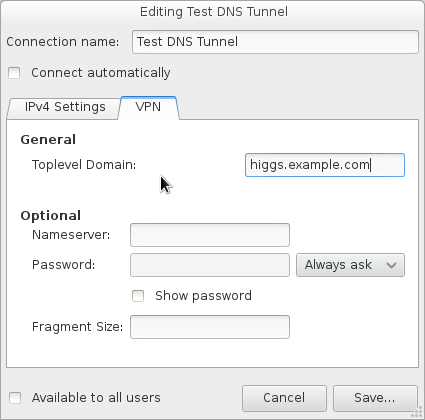
During FOSDEM I finally got around to hack on a iodine plugin for
network manager. Given a suitably prepared server on the other end
this allows you to tunnel connections over DNS when all other traffic is
firewalled. The basic configuration only needs the domain name set:
You can grab the sources from git.gnome.org, a Debian package is also
available.
This blog is flattr enabled.
There is an alternative to using C-c, and that is M-#. This adds a '#' to the start of the line, commenting it out, and then behaves as if you pressed Return. The result is that the command is cancelled but still remains on-screen and in your history. You can then copy the command later using the mouse or keyboard.Naturally, there is a zsh equivalent for this (there always is...): pound-insert. Quoth the manpage:
pound-insertSo if you want the same for zsh, a simple
If there is no # character at the beginning of the buffer, add one to the beginning of each line. If there is one, remove a # from each line that has one. In either case, accept the current line. The INTERACTIVE_COMMENTS option must be set for this to have any usefulness.
bindkey '^[#' pound-insert
is all you need.
Update:
Clint Adams noted another way to do
(almost) the same.
We, the undersigned, hereby state that we expressly and unequivocally oppose the advertising of proprietary software products on government websites. Such advertising breaches impartiality and encourages citizens to employ technologies that unnecessarily restrict their freedom. The role of government is not to support certain market participants and not others, particularly when doing so works to maintain the monopolies of global software companies. In explanations of how to use digital resources that they provide, government agencies should clarify that multiple methods are available, and favour technologies which do not restrict users digital rights; by linking to PDFreaders.org, for example. Free Software guarantees the users right to use (for any purpose), study (without secrets), share (with anyone), and improve the software that they use. Public institutions should publish their documents in formats that can be read with Free Software. Indeed, many Free Software applications exist for reading such documents. Governments should lead citizens to freedom, and encourage them to make use of these applications. Sincerely,Our co-op and 56 other businesses, 69 organisations and over 2200 individuals so far. How about adding your signature? Surely it s time for our governments to stop giving free adverts to Adobe? It was particularly annoying in the Digital Britain report, I thought.
For hurried readers: do not give your main email address to Moneybookers or to
deviantART, since they may give it (unintentionally, I hope) to spammers.Dedicated addresses
Since I have set up my own email server, when a company or an unknown
individual asks for an address I give it a dedicated one. For instance, to make
a payment I had to give an address to Moneybookers: instead of giving them my
main address <tanguy@>, I used
<tanguy+moneybookers@>.
Thanks to Postfix's address extension feature (look for
recipient_delimiter in postconf(5) manpage),
these <tanguy+whatever@> are all implicit aliases to my main
address. This practice has several benefits, since it allows me to:
<tanguy+moneybookers@>;<tanguy-2012@>, which I simply drop after a year
to replace it by a new one.
Two years report
After two years collecting spam, the first noticeable thing is that, among
5.5k spams I received, only 78 are the result of an information leak from an
organization. I excluded from that count the addresses I use in public
mailing-lists, for instance <tanguy+debian@>.
So, after some fine exclusion and checking of messages, these are the only two
organizations that somehow gave my address to spammers:
Some sponsors are evil and pedanticOr on the command-line:
$ lintian -EvIL +pedantic ...It works for Lintian 2.5.5 (and newer), which handles pedantic like other severities. If you need help understanding the tags, you can add an extra i (-i) to evil . That being said, remember that experimental (-E) and pedantic (-L +pedantic) tags are what they are for a reason. Also quite a few people will probably find verbose (-v) too noisy. However, leaving any of them out would have ruined the mnemonic.
display-info = yes # or no display-experimental = yes # or no pedantic = yes # or no verbose = yes # or no
Architecture field in *.dsc files may now contain
the value any all for source packages building both
architecture-independent and architecture-dependent packages.
/run is allowed as an exception to the FHS and replaces
/var/run. /run/lock replaces /var/lock. The FHS
requirements for the older directories apply to these directories as
well. Backward compatibility links will be maintained and packages
need not switch to referencing /run directly yet. Files in
/run should be stored in a temporary file system.
/run, /var/run, or /var/lock. This
generalizes information previously only in 9.3.2.
debian/copyright is no longer required to list the Debian
maintainers involved in the creation of the package (although note
that the requirement to list copyright information is unchanged).
debian/copyright file"
specification is included.
ttf-japanese- mincho,gothic have been renamed to
fonts-japanese- mincho,gothic .
Nagios or Icinga users probably know the problem that neither the default plugin packages (nagios-plugins-basic and -standard)
nor the few other plugin packages ship all the plugins you need to monitor your hardware and software properly. And unless you
have puppet, cfengine or some other automation software, you probably just start searching plugins on

Nagios Exchange, MonitoringExchange or some other machines you are monitoring already.
Your problem shall be solved! nagios-plugins-contrib passed NEW today. It is a collection of various useful plugins,
maintained within the Debian Nagios Maintainer Group. So far it contains only 6 plugins (check_email_delivery, check_ipmi_sensor, check_lm_sensors, check_memcached, check_raid, check_rbl),
but more are going to come.
To have your favorite plugins added to the package we would like to encourage you to send pull requests, either using github,
alioth or your personal repository. Please keep in mind that you'll be added to the Uploaders
of the package automatically to ensure that you keep your plugin updated and in a good shape.
See debian/README.source for some instructions on adding new plugins.
Unmaintained plugins will be removed!
Of course you can also submit bug reports to
have a new plugin added, but you have to convince somebody to maintain it for you (or that he wants to use the plugin and needs to maintain it therefore
).
We might also also have a similar package in contrib as a lot of commonly used plugins require non-free software, so don't hesitate to prepare plugins for inclusion in such a package and let us know!
Suggestions and ideas for improvement are always welcome. And so is help to maintain the packages!
One of the most popular backup solution under Linux is Bacula, but it s quite complicated to setup. The same for Amanda.backup ~ # burp -a b 2012-02-22 17:53:03: burp[30584] Listing configured paths: 2012-02-22 17:53:03: burp[30584] include: /home 2012-02-22 17:53:03: burp[30584] Listing starting paths: 2012-02-22 17:53:03: burp[30584] /home 2012-02-22 17:53:03: burp[30584] before client 2012-02-22 17:53:03: burp[30584] begin client 2012-02-22 17:53:03: burp[30584] auth ok 2012-02-22 17:53:03: burp[30584] Compression level: 9 2012-02-22 17:53:03: burp[30584] do backup client 2012-02-22 17:53:03: burp[30584] Phase 1 begin (file system scan) ddwdffffddffdfdfdddfffffdddfffffffdfffdfdfffffdfdfdffdddddfffddff 64 [...a lot of output...] 2012-02-22 17:53:03: burp[30584] Phase 1 end (file system scan) 2012-02-22 17:53:03: burp[30584] Phase 2 begin (send file data) ffffffffffffffffffffffffffffffffffffffffffffffffffffffffffffffff 64 [...a lot of output...] -------------------------------------------------------------------------------- Start time: 2012-02-22 17:53:03 End time: 2012-02-22 17:53:07 Time taken: 00:04 New Changed Unchanged Total Scanned -------------------------------------------------- Files: 100 0 - 100 100 Directories: - - - - 76 Soft links: - - - - 1 Grand total: 100 0 - 100 177 -------------------------------------------------- Warnings: 1 Bytes estimated: 17628946 (16.81 MB) Bytes in backup: 17628946 (16.81 MB) Bytes received: 0 Bytes sent: 17628946 (16.81 MB) -------------------------------------------------------------------------------- 2012-02-22 17:53:07: burp[30584] Phase 2 end (send file data) 2012-02-22 17:53:07: burp[30584] backup finished ok 2012-02-22 17:53:07: burp[30584] after client backup ~ #
phpMyAdmin is quite popular software (to give some numbers let's mention 10000 downloads daily on SourceForge.net or 122685 reports in Debian's popcon) and as such is quite attractive target for various scripted attacks. If you run phpMyAdmin installation somewhere you should really make sure it is enough secured, so that these script kiddies don't get through.
In past month I've looked at what kind of attacks are these guys trying and in all cases these are pretty old vulnerabilities, some of them fixed years ago. So the first thing you should do is to update. It is always good to run latest stable version, but in case you can not for whatever reason, try at least taking the most important fixes and using them.
In ideal world your distribution would do this job for you, but in case it did not, you can for example take patches from Debian, which is pretty good at taking our patches (surprisingly it is not much related to my involvement there). To check which patches they have applied you can use excellent patch-tracker tool, which exposes patches from all released packages.
To give you overview of which issues are mostly being attempted to exploit by script kiddies right now, here is the list:
setup directory from phpMyAdmin, you will probably not use it after initial setuplibraries directory from browser, as it is not needed, supplied .htaccess file does thiscookie is probably the best choice for shared hostingFiled under: Debian English Phpmyadmin Suse 0 comments Flattr this!
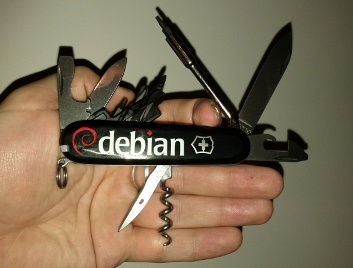
Thanks to the nice
Debian Swiss Knives
initiative!
Fixing software
Besides trying to maintain the whole X stack as usual, and preparing
the funky
wayland,
mesa,
and
weston
trio for experimental, I got myself into other areas.
Debugging gzip
Jakup Wilk noticed
a while ago that some multiarchified packages couldn t be co-installed
due to gzipped files being different between architectures. That was
reported as #647522 against the
gzip package.
While some developers consider the lack of determinism (as in: it s
not in the gzip specification, and the current implementation
generates different packages anyway!) as a dead-end for the multiarch
experiment, it didn t look like undebuggable or unfixable. And indeed,
as confirmed by a
quick
analysis:
a lack of clean-up when several files are processed at once can lead
to different results, depending on the order in which files are specified
on the command line; the patch for that is trivial, and was later
made smaller
and the need for it was
explained.
Working in the Release Team
I reviewed/approved a few packages for squeeze, but also took care
of handling or finishing a few transitions (as seen in my
hints file), among
which the funny iceweasel9/libmozjs ones; release tools are nice,
but one gets to learn lots of stuff at once (which isn t a negative
aspect). I hacked a tiny
collision detector
so that packages involved in several transitions can be easily
spotted. Given the huge number of ongoing transitions we had lately,
that didn t look overkill.
Squashing bugs
It had been a very long time since my last working on totally random
RC bugs. The Bug Squashing Party organized at
IRILL was a very nice opportunity to get back
to totally crazy bugs in unknown packages, but also to meet with other
Debian contributors; sponsoring maintainers with good patches on their
first try was nice, but walking other contributors through their first
patches sent to the BTS or through their first NMUs was nice too.
Waving good bye to yada
Back in the M rida QA meeting I attended in 2007, there were already
jokes about how bad yada was, and how it should die in a fire
etc. When I started looking at the RC bug list, I quickly switched to
scrolling it backwards, and I wondered how much work was left. The
details can be seen in #660548, and
the result is:
yada is gone!
sanity++;
packages.debian.org
Both long descriptions and translations for packages in some suites
disappeared after the
switch to Description-md5. Thanks
to a quick and reduced packages.debian.org setup (mostly: en+de
for squeeze+sid+experimental), I managed to find my way through
Perl and DB files to propose patches for
#657557. I m still waiting for a
confirmation, but in case it works fine, we could even get a fix for
DDTP/DDTSS.
Next.