Search Results: "pa"

29 December 2015

Stefano Zacchiroli: Shuttleworth Foundation Flash Grant - 2015 report

1 year of Shuttleworth Foundation Flash Grant As announced last year, starting January 2015 I've benefited from a "Flash Grant" kindly awarded to me by the Shuttleworth Foundation. This post reports publicly about how I've used the money to promote Free Software via my own activism, over the period January-December 2015. I'm lucky to have a full-time academic job that provides me with a salary and basic computer hardware. But Free Software not being the only focus of my job, it gets difficult at times to get travel funding to specific Free Software events. So that is what I've mostly used the grant money for: attend Free Software events that I wouldn't have been able to attend otherwise. On grant money I've attended LibrePlanet 2015 (2015-03-19-boston-libreplanet label in the financial reports below), where I've given the talk Distributions and the Free "Cloud", and FSFE's LLW 2015 (2015-04-15-barcelona-fsfe-legal) workshop. Furthermore I've used the grant to reimburse otherwise not reimbursed out of pocket expenses in a trip to San Francisco (2015-11-06-san-francisco-gsoc+osi) that have been otherwise sponsored by Google (to attend the Summer of Code Mentor Summit) and OSI (to attend a F2F meeting of the Board of Directors). Finally, I've used grant money to offer lunch to invited lecturers in my master-level Free Software class at the university (label 2015-foss-class). Actual financial reports are reported below, in ledger format. It should be noted that, contrary to the usual expected 6-month duration of flash grants, I've used only about half the grant amount over a 12-month period; I do not plan to pocket what remains, but rather keep on using it over the next year, reporting again publicly at the end of the period. Also, I did not breakdown further out of pocket expenses, but they invariably stand for public transport tickets and meals. Balance sheet Overall:
         1966,11 EUR  Assets:Funds
        -4052,52 EUR  Equity:Opening balances
         2086,41 EUR  Expenses
           15,90 EUR    Bank:Commissions
          424,00 EUR    Conference:Registration
           56,50 EUR    Teaching:Speaker-invitation
         1590,01 EUR    Travel
          249,02 EUR      Lodgement
          562,51 EUR      Out-of-pocket
          778,48 EUR      Plane
--------------------
                   0

Breakdown by purpose: Journal
2014-12-03 Shuttleworth Foundation flash grant                                    Equity:Opening balances                     -4052,52 EUR    -4052,52 EUR
                                                                                  Assets:Funds                                 4052,52 EUR               0
2014-12-04 bank commissions on incoming transfer                                  Expenses:Bank:Commissions                      15,90 EUR       15,90 EUR
                                                                                  Assets:Funds                                  -15,90 EUR               0
2014-12-24 plane tickets Paris-Boston round trip to attend LibrePlanet 2015       Expenses:Travel:Plane                         627,84 EUR      627,84 EUR
                                                                                  Assets:Funds                                 -627,84 EUR               0
2015-01-02 LibrePlanet 2015 registration + travel fund contribution               Expenses:Conference:Registration              424,00 EUR      424,00 EUR
                                                                                  Assets:Funds                                 -424,00 EUR               0
2015-03-02 plane tickets Paris-Barcelona round trip to attend LLW 2015            Expenses:Travel:Plane                         150,64 EUR      150,64 EUR
                                                                                  Assets:Funds                                 -150,64 EUR               0
2015-03-19 lunch with invited speaker for lecture about FOSS release management   Expenses:Teaching:Speaker-invitation           28,00 EUR       28,00 EUR
                                                                                  Assets:Funds                                  -28,00 EUR               0
2015-03-25 lunch with invited speaker for lecture about FOSS business models      Expenses:Teaching:Speaker-invitation           28,50 EUR       28,50 EUR
                                                                                  Assets:Funds                                  -28,50 EUR               0
2015-04-03 LibrePlanet 2015 out of pocket expenses                                Expenses:Travel:Out-of-pocket                 213,38 EUR      213,38 EUR
                                                                                  Assets:Funds                                 -213,38 EUR               0
2015-04-15 LLW 2015 out of pocket expenses                                        Expenses:Travel:Out-of-pocket                  80,00 EUR       80,00 EUR
                                                                                  Assets:Funds                                  -80,00 EUR               0
2015-05-06 hotel in Barcelona for LLW 2015 (3 nights)                             Expenses:Travel:Lodgement                     249,02 EUR      249,02 EUR
                                                                                  Assets:Funds                                 -249,02 EUR               0
2015-11-29 OSI F2F Fall 2015 out of pocket expenses                               Expenses:Travel:Out-of-pocket                 269,13 EUR      269,13 EUR
                                                                                  Assets:Funds                                 -269,13 EUR               0

Antoine Beaupr : Bridging Ikiwiki and Twitter with Python and feed2tweet

Typical:
  1. find new interesting software (feed2tweet)
  2. try it out, file two issues:
  3. itch enough that i need to scratch it and file 3 pull requests to ask for forgiveness:
All fairly trivial, but it allowed me to make a simple cronjob to post my Ikiwiki blog posts straight out to my Twitter account. It's basically abusing my RSS feed to bridge with Twitter: the most boring and annoying part is setting up a new app, pasting the credentials in the config file and then running the thing in a cron job. But in the end, I really ended up spending one more hour at a time when I should be really sleeping, scratching an itch that I didn't have before I started working on this thing in the first place. Coincidentally, I requested to be added to Python Planet, looks like a fun place...

Norbert Preining: CafeOBJ 1.5.5 released

Yesterday we have released CafeOBJ 1.5.5 with a long list of changes, and many more internal changes. Documentation pages have been updated with the latest reference manual (PDF, Html) as well as some new docs on CITP (in Japanese for now) and tutorials. cafeobj-logo To quote from our README:
CafeOBJ is a new generation algebraic specification and programming language. As a direct successor of OBJ, it inherits all its features (flexible mix-fix syntax, powerful typing system with sub-types, and sophisticated module composition system featuring various kinds of imports, parameterised modules, views for instantiating the parameters, module expressions, etc.) but it also implements new paradigms such as rewriting logic and hidden algebra, as well as their combination.
Changes Availability Binary packages for Windows, MacOS, and Linux have been built, and can be found at the CafeOBJ download page. The source code can also be found on the download page, or directly from here: cafeobj-1.5.5.tar.gz. The CafeOBJ Debian package will be updated soon. Macports file has also been updated, please see the above download/install page for details how to add our sources to your macport. Bug reports If you find a bug, have suggestions, or complains, please open an issue at the issue tracker for CafeOBJ. For other inquiries, please use info@cafeobj.org

28 December 2015

Dirk Eddelbuettel: BH 1.60.0-1

A new release of BH is now on CRAN. BH provides a large part of the Boost C++ libraries as a set of template headers for use by R, possibly with Rcpp as well as other packages. This release both upgrades the version of Boost to the recently-released upstream version Boost 1.60.0 and also adds Boost Phoenix. A brief summary of changes from the NEWS file is below.
Changes in version 1.60.0-1 (2015-12-24)
  • Upgraded to Boost 1.60 installed directly from upstream source
  • Added Boost phoenix as discussed in GH ticket #19
Courtesy of CRANberries, there is also a diffstat report for the most recent release. Comments and suggestions are welcome via the mailing list or the issue tracker at the GitHubGitHub repo.

Edited on 2015-12-30: Typo in titled corrected, it is BH 1.60.0-1

This post by Dirk Eddelbuettel originated on his Thinking inside the box blog. Please report excessive re-aggregation in third-party for-profit settings.

Carl Chenet: Parse your rss feed and post to Twitter with feed2tweet

What s more important today for a website than relaying your new blog posts to the social networks, especially Twitter ? Lots of unmaintained or unreliable third-parties web services offer this feature. I tried and was really disappointed using them. Feed2tweet, forked from rss2twitter, now offer a self-hosted, documented, easy-to-read Python application to automatically transfer the new posts in your RSS feed to the social network Twitter. Have a look at the official documentation on Readthedocs in order to install, configure and use Feed2tweet. It is as easy as creating a Twitter app, then writing a feed2tweet.ini file with the following lines:
[twitter]
consumer_key=ml9jaiBnf3pmU9uIrKNIxAr3v
consumer_secret=8Cmljklzerkhfer4hlj3ljl2hfvc123rezrfsdctpokaelzerp
access_token=213416590-jgJnrJG5gz132nzerl5zerwi0ahmnwkfJFN9nr3j
access_token_secret=3janlPMqDKlunJ4Hnr90k2bnfk3jfnwkFjeriFZERj32Z
  • Une erreur est survenue ; le flux est probablement indisponible. Veuillez r essayer plus tard.
uri: https://www.mycoolwebsite.com/rss [hashtaglist] several_words_hashtags_list: severalwordshashtaglist.txt
Then just launch feed2tweet:
$ feed2tweet -c /path/to/feed2tweet.ini
The first version 0.1 is now available from Github. If it helps you, Github stars are appreciated :)

Aigars Mahinovs: Moving to Germany

After a long contemplation about what I want to do with my life and just as long a negotiation, I have accepted a job offer at BMW and will be moving from Latvia to Ulm, Germany in January 2016. It is going to be a big change and a big shake-up in my life, but the change should be for the better, eventually. I am going to move there using my car, loading a single car load of essential stuff and leaving the rest behind. My cat will be amond the essentials, so I have already started training him for car rides. The cat is not thrilled about it. I'll be renting out my current apartment - I wish to find someone that I know to rent to, but if noone comes up, then I'll have to give it to a renting company to rent out for me. There should be little change for my online activities, but this means that I will be less available for parties in Riga for the forseable future. Wish me luck!


Alessio Treglia: Pallinux: Olly Olly Oxen Free!

Pallinux: Artwork by Fabio "Pixel" Colinelli

Pallinux: Artwork by Fabio Pixel Colinelli

In a world far away, in the dark Land of Digitos only populated by machines and computers, the evil Mister Woo was ruling over all. Over time, this terrible dictator was becoming a horrendous fire-eyed giant, walking the whole day by vibrating the heavy steps into his Kingdom, leaving behind him a trail of smoke and terror. Mr. Woo always wore a long, shabby and dirty top hat that had once been white, so old and ragged that he could not even keep it up straight on his head. Throughout the Land of Digitos, the inhabitants computers were scattered, each <Read more >

Hideki Yamane: How about "grooming" outdated packages?

Lucas's good article: DEBIAN PACKAGES WITH /OUTDATED/ PACKAGING STYLE

Okay, then what's next? Action.

How about do "grooming" for those packages with contributors? Well experienced DDs become mentors and help to make those packages modern and put it to repo.


Packages become simple and modern, contributors can get packaging experience.
Isn't it a good idea? (Meow!)

27 December 2015

Ben Hutchings: What's new in initramfs-tools

I spent much of my Debian time in the last few weeks triaging and fixing bugs in initramfs-tools. All of the important bugs should be fixed, except for two where I needed more information from the submitter. Due to the scope of these changes and potential for regressions, I've made a release candidate, version 0.121~rc2, rather than a full release. This is now available in experimental, and I would appreciate real-world testing feedback in the next few weeks. (If you're wondering what happened to rc1, that had 'unstable' as the distribution, which I didn't notice until after pushing the tag.) From the release announcement, the major changes are: Thanks to Andy Whitcroft, Boris Egorov, Laurent Bigonville, Roger Leigh, Roger Shimizu and Salvatore Bonaccorso for their patches which I applied in this version.

Gregor Herrmann: RC bugs 2015/51-52

the upload of perl 5.22 to unstable some days ago provided ample opportunity to fix some new RC bugs. here's the list of my work:

Gregor Herrmann: RC bugs 2015/51-52

the upload of perl 5.22 to unstable some days ago provided ample opportunity to fix some new RC bugs. here's the list of my work:

Vincent Sanders: The only pleasure I get from moving house is stumbling across books I had forgotton I owned

I have to agree with John Burnside on that statement, after having recently moved house again rediscovering our book collection has been a salve for an otherwise exhausting undertaking. I returned to Cambridge four years ago, initially on my own and then subsequently the family moved down to be with me.

We rented a house but, with two growing teenagers, the accommodation was becoming a little crowded. Melodie and I decided the relocation was permanent and started looking for our own property, eventually finding something to our liking in Cottenham village.

Melodie took the opportunity to have the house cleaned and decorated while empty because of overlapping time with our rental property. This meant we had to be a little careful while moving in as there was still wet paint in places.

Some of our books
Moving weekend was made bearable by Steve, Jonathan and Jo lending a hand especially on the trips to Yorkshire to retrieve, amongst other things, the aforementioned book collection. We were also fortunate to have Andy and Jane doing many other important jobs around the place while the rest of us were messing about in vans.

The desk in the study
The seemingly obligatory trip to IKEA to acquire furniture was made much more fun by trying to park a luton van which was only possible because Steve and Jonathan helped me. Though it turns out IKEA ship mattresses rolled up so tight they can be moved in an estate car so taking the van was unnecessary.

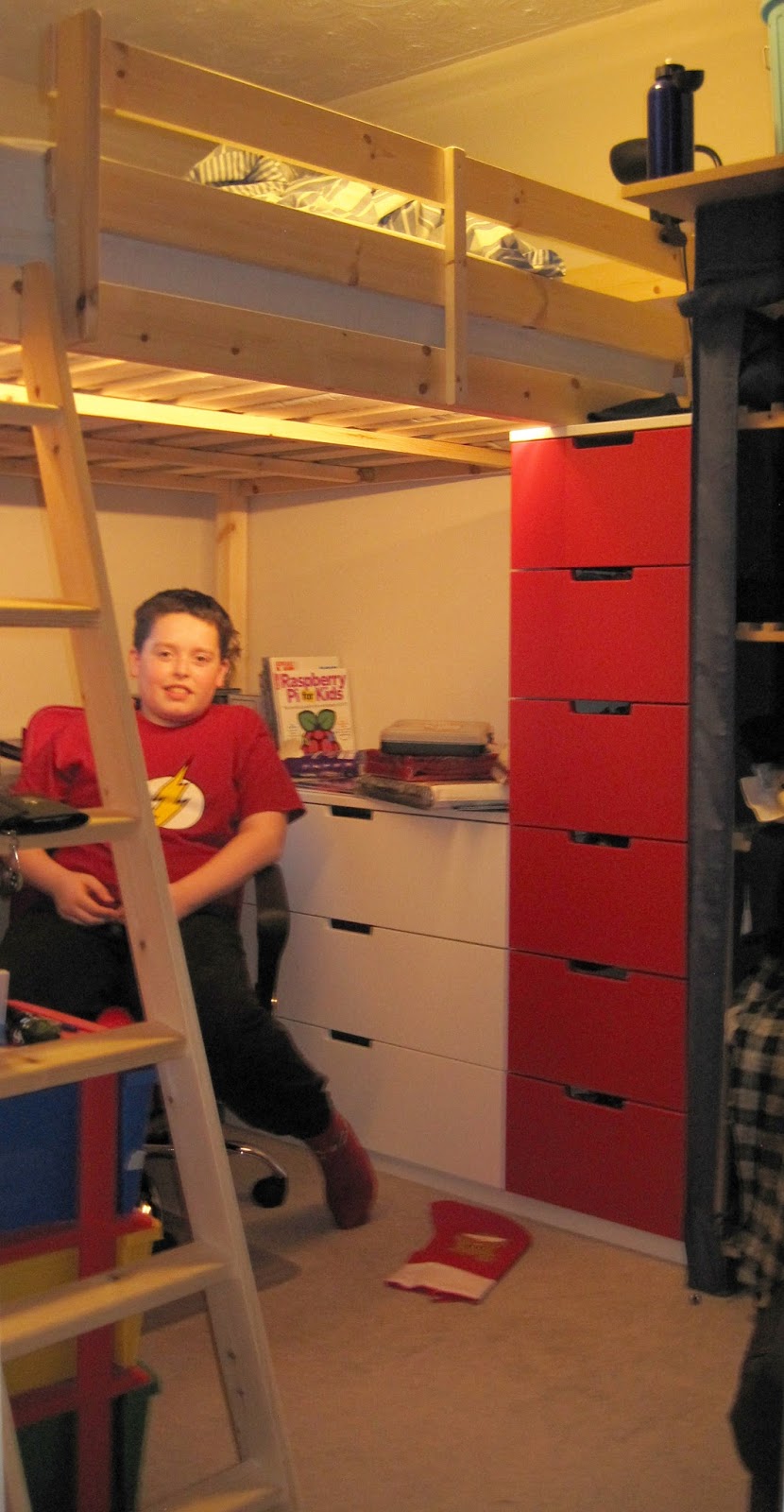
Alex under his loft bed
Having moved in it seems like every weekend is filled with a never ending "todo" list of jobs. From clearing gutters to building a desk in the study. Eight weeks on and the list seems to be slowly shrinking meaning I can even do some lower priority things like the server rack which was actually a fun project.


Joshua in his completed roomThe holidays this year afforded me some time to finish the boys bedrooms. They both got loft beds with a substantial area underneath. This allows them both to have double beds along with a desk and plenty of storage. Completing the rooms required the construction of some flat pack furniture which rather than simply do myself I supervised the boys doing it themselves.

Alexander building flat pack furniture
Teaching them by letting them get on with it was a surprisingly effective and both of them got the hang of the construction method pretty quickly. There was only a couple of errors from which they learned immediately and did not repeat (draw bottoms having a finished side and front becomes back when you are constructing upside down)

Joshua assembling flat pack furniture
The house is starting to feel like home and soon all the problems will fade from memory while the good will remain. Certainly our first holiday season has been comfortable here and I look forward to many more re-reading our books.

Steve Kemp: Some things are universal?

I don't often do retrospectives, but this year has been an unusual one for me, as I moved to Finland almost six months ago. The topic has come up in conversation a lot over the past few months, so when people ask me what I think I can give some simple answers without too much thought. Here's a brief summary. There are some obvious changes:
The Traffic
The traffic drives on the right-hand side of the roads, which took a bit of getting used to, but isn't a huge surprise as I've travelled in Europe in the past. There aren't so many countries that drive on the left after all so most people probably wouldn't even notice this as odd. When it comes to traffic one thing nice about Helsinki is that most junctions are "zebra crossings". Sure they don't have flashing lights, but they have shaded areas, and pedestrians have right of way. As for transport the city of Helsinki has local trains, trams, buses and taxis. The trams and buses all use the same card for payment so transport is integrated very well. I buy a time-based card, spending about 50 for a month of unlimited travel. If you prefer you may add euros to your card and pay for distinct journeys - but that works out more expensive if you travel twice, or more, a day.
The Money
Finland uses the Euro these days, having switched from the Finnish markka in 2002. Enough said. Costs are largely in line with what I'd expect: Cigarettes are cheap, beer is expensive. Some things are very expensive, some things are very cheap. Largely the expensive things are those that are imported. It is a very small country after all.
The Language
Finnish is .. complex. But I've not struggled too much. Mostly I can buy what I want without difficulty. There are weird exceptions though for example I went out to buy soup one day and had to return carrying only shame and disappointment: I can't read the language on the tins and what I thought was soup turned out to be a can of chopped tomatoes. Food is good though, and available easily (!!). The only significant surprise when it comes to shopping is that loose goods must be weighed yourself. You pick up a bunch of bananas, take it to the scales, press the button that has a picture of a banana on it, and it prints out a label you attach to them - at the till the cashier will scan the label and charge you. If you forget, or don't know how to do it they'll tut and complain. In daily life I use two phrases frequently and they are sufficient for communcation:
  • "minua haluan ... kahvi kakku olut"
    • "I want ... coffee cake beer".
  • "kiitos"
    • "Thanks"
Usually people speak to me in English, which is a little annoying as it means I'm not learning as much as I could. But that said over the past few months I've had proper conversations entirely in Finnish with shop-keepers, and similar. So I'm getting better.
The Culture
Finnish people are friendly, but terse. That's the reputation. The Finnish people are alcoholics, and have high rates of suicide. Also the reputation. Finally we know that the Finnish people consume more coffee than the rest of the world. All those things are true, but they're not enough by far to describe the people. Obviously they're all different, and we have a lot of people from other parts of the world here too - Russians, Asians, Somalians. So culture is complex .. but markedly different than in the UK. I could write more about this, but I think for the moment I'll just draw a line under culture and say that I'm enjoying the interactions with people here, and while many things are slightly "off", it's not bad. Just different. Also saunas are fun. I've never had any qualms about being naked with strangers, so I don't really understand why Americans, and others, find this so difficult/surprising. But yeah, saunas are great. Things that Finland is known for internationally: The invention of the molotov cocktail, rally-driving, hockey, world's strongest man, Moomins, Tom of Finland, Salmiakki.
The Weather
Not too hot. Not too cold. But that's largely because I'm one of those "hot" people who doesn't really get cold even at the best of times. My ideal temperatures are about 13 C. My wife prefers 15 C, or more. We don't fight any more. Mostly. Winter is apparently full of snow, but this year has been poor. We had the first snowfall yesterday, here in Helsinki, and we woke this morning a blanket of snow about two inches high. It looks pretty. The biggest thing about weather in Finland is the constant darkness in winter, and the constant sun in Summer. In Summer there were like 22 hours of sunlight a day which made sleeping hard when we moved into our flat - with no curtains. In winter it feels like there is 20 minutes of sunlight a day. It's not that bad here in the south, although I think it is something like five hours and less in the north. I've never had any real issues with depression, or similar: People have good days and bad days, I'd generally be "OK" or "great". In the darkness? I've been grumpy at colleagues, I've made bad choices, I've lapsed attention. I'm not sure I can blame it on the weather, or my reaction to the weather, but I know I've not been as "happy" as I "should". It requires effort to be enthusiastic in a way I've never experienced before. Thankfully once I (slowly) realized this I took action and I think I'm good now. Unlike the UK the buildings here are relatively modern. I think that's the biggest contributing factor to how houses are "warm". Houses have all been built in the last 50-100 years, so you have proper insulation. Even though it might be very very cold outdoors indoors you can be naked without heating. Try that in the UK and you might freeze in some of the older leakier houses! You do have to laugh, though, when people point out "the oldest pub" in the city though. Where I come from if I pub isn't 500+ years old you wouldn't give it a seconds thought - places like The Golden Fleece, etc.
I could write more. I probably should. But it has been an interesting year, and although there are things I miss about the UK, and Edinburgh specifically, I have no regrets. I'm glad I came. What triggered this post? I said "Some things are universal" to my wife, when I saw a child riding a bicycle they'd obviously just received for Christmas. Her reaction "No Finnish person would buy a bicycle at Christmas - they'd expect too much snow!". So perhaps it was another immigrant family. Christmas bicycles universal, or not, it doesn't really matter.

Russ Allbery: Review: The Outskirter's Secret

Review: The Outskirter's Secret, by Rosemary Kirstein
Series: Steerswomen #2
Publisher: Del Rey
Copyright: 1992, 2001
Printing: 2001
ISBN: 0-345-46105-3
Format: Trade paperback
Pages: 389
This is a direct sequel to The Steerswoman, and I don't recommend starting here. I read this novel as part of The Steerswoman's Road omnibus, which is the edition reflected in the metadata (except for the page count, which is just this novel). There are a few plot constructs that occur depressingly often in SFF and almost always annoy me. One is books where nearly all of the book is just a journey from one place to another, without much interesting landscape along the way. Subtract additional points if the land is hostile and there are constant worries about food. Another is illness, or being unable to trust one's senses, or, worse, both. Somehow, this book manages to do both of those things and was still thoroughly enjoyable. This is exceptionally rare. After the conclusions reached in the previous book, Rowan and Bel are even more determined to reach the origin of the jewels on Bel's belt and gather more information. This means travel into the Outskirts, where Rowan has never been (and where people from the Inner Land almost never go). It also means close contact with Bel's people, who have an entirely different set of social rituals and who are notoriously prickly. Nearly all of The Outskirter's Secret is travel through the Outskirts while navigating Outskirter society, politics, and customs. It's anthropological fiction of a sort, particularly given the inquisitive and analytical mindset that Rowan brings to anything new. Anthropological SFF is another one of those things that normally leaves me cold, but which totally worked for me in this book. I rarely remember being this engaged in, or caring this much about, the customs and traditions of an invented and relatively primitive culture. Partly this is because Rowan's mindset continues to be fascinating and contagious. I kind of want to compare this series to Neal Stephenson's Anathem, but where Stephenson's novel was about the practice of organized science, the Steerswomen series is about the individual scholar and scientist. This could go badly in the hands of a lesser author, but Kirstein brilliantly balances analysis and theories with Rowan's child-like wonder in learning, peculiar and determined ethics, and emotional growth. She isn't a disinterested observer or an engineer with a wrench. She lets the world change her, works hard at finding her place and her own strength, and engages with it emotionally as much as she does intellectually. She's a wonderfully compelling character. Another significant factor to this book's success is the slow and deliberate way Kirstein mixes world-building revelations with the day-to-day struggles of the characters. There's much more to that than just the target of Rowan's investigations, and far more complexity and significance to the Outskirters than showed in first appearances. The world is also set up in a way that lets the readers guess various details before the characters, with their more limited knowledge, can work out: another tricky technique that Kirstein gets almost perfect. I never wanted to shake the characters for being dumb; usually, both Rowan and Bel leap to correct conclusions just shortly after the reader, and long before the reader is tired of following their thought processes. There was only one bit of world-building that took Rowan most of the book to figure out despite being obvious to me early in this novel, and I think that one was fair. She didn't have anywhere near enough information to work it out. Bel continues to be wonderful in numerous ways. But even better, Kirstein introduces us to Bel's people and highlights both similarities and differences. It's an excellent job of building a complex culture that feels human: varied, tradition-laden, practical, but also well-adapted to their environment and situation, and far more sophisticated than they might appear. I'm normally a hard sell for this sort of thing, but Kirstein got me thoroughly invested. One scene late in this novel where a tribe welcomes a newcomer is masterful and probably my favorite single moment of the series so far. Once again, unfortunately, the conclusion is a bit less than satisfying. The characters come away knowing more, planning more, but still with numerous unanswered questions. This is not a series that's in a hurry to get to major plot payoffs. Instead, it's a series that takes a close look at the cultures, relationships, emotions, and lives that it touches, and describes them in deft and engaging ways. The Outskirter's Secret is even better than The Steerswoman. Recommended. I bought the third and fourth books while only a little ways into this one and am eager to read them. Followed by The Lost Steersman. Rating: 9 out of 10

Benjamin Mako Hill: Trust your technolust.

"Trust your technolust." from Hackers (1995)If you ve ever lusted for a Trust your technolust. poster like the one seen in background of the climactic sequence in the 1995 film Hackers, you re in luck. Just print this PDF template (also an SVG) onto a piece of yellow US letter paper. Although I m not even the first person I know to reproduce the poster, I did spend some time making sure that I got the typeface, kerning, wordspacing, and placement on the page just right. I figured I would share.

26 December 2015

Norbert Preining: Debian/TeX Live 2015.20151226-1

Before I disappear into the Japanese winter holidays, here the Christmas update of all TeX Live packages. Nothing spectacular here, just the usual bunch of updates of loads of packages. There is a bug with respect to a file move from one package to another, will be fixed in an upload soon. Debian - TeX Live 2015 Updated packages apnum, appendix, archaeologie, babel, babel-french, babel-greek, babel-hungarian, bangorcsthesis, beamer-verona, bhcexam, bibarts, bidi, bxjscls, chemfig, commado, comprehensive, context, cslatex, csplain, ctanify, doclicense, dvips, ejpecp, exsheets, fbb, fibeamer, fithesis, fontools, francais-bst, gitinfo2, glossaries, gnuplottex, greek-fontenc, hyph-utf8, indextools, ksp-thesis, l3build, l3experimental, l3kernel, l3packages, latexcourse-rug, lollipop, lstbayes, lualibs, luaotfload, luatexja, luatexko, luatodonotes, make4ht, mcf2graph, media9, mex, mfirstuc, mhchem, mptopdf, nameauth, nevelok, newtx, nicetext, nucleardata, ocgx2, pageslts, petri-nets, phonrule, pkuthss, powerdot, proofread, proposal, pst-labo, pst-solides3d, reledmac, sapthesis, serbian-lig, showlabels, t2, tcolorbox, tempora, testhyphens, tetex, tex4ebook, tex4ht, texlive-scripts, texsis, thuthesis, toptesi, tudscr, ucharcat, versonotes, xcharter, xepersian, xifthen, xindy, xint. New packages beamertheme-detlevcm, beamertheme-metropolis, beamertheme-phnompenh, beamer-verona, bitpattern, carbohydrates, delimseasy, drawmatrix, einfuehrung2, ellipse, ffslides, gitlog, greektonoi, ksp-thesis, longfbox, options, simpler-wick, unicode-data. Enjoy.

Julian Andres Klode: Much faster incremental apt updates

APT s performance in applying the Pdiffs files, which are the diff format used for Packages, Sources, and other files in the archive has been slow. Improving performance for uncompressed files The reason for this is that our I/O is unbuffered, and we were reading one byte at a time in order to read lines. This changed on December 24, by adding read buffering for reading lines, vastly improving the performance of rred. But it was still slow, so today I profiled using gperftools the rred method running on a 430MB uncompressed Contents file with a 75 KB large patch. I noticed that our ReadLine() method was calling some method which took a long time (google-pprof told me it was some _nss method, but that was wrong [thank you, addr2line]). After some further look into the code, I noticed that we set the length of the buffer using the length of the line. And whenever we moved some data out of the buffer, we called memmove() to move the remaining data to the front of the buffer. So, I tried to use a fixed buffer size of 4096 (commit). Now memmove() would spend less time moving memory around inside the buffer. This helped a lot, bringing the run time on my example file down from 46 seconds to about 2 seconds. Later on, I rewrote the code to not use memmove() at all opting for start and end variables instead; and increasing the start variable when reading from the buffer (commit). This in turn further improved things, bringing it down to about 1.6 seconds. We could now increase the buffer size again, without any negative effect. Effects on apt-get update I measured the run-time of apt-get update, excluding appstream and apt-file files, for the update from todays 07:52 to the 13:52 dinstall run. Configured sources are unstable and experimental with amd64 and i386 architectures. appstream and apt-file indexes are disabled for testing, so only Packages and Sources indexes are fetched. The results are impressive: That s a tenfold increase in performance. By the way, running without PDiffs took 20 seconds, so there s no reason not to use them. Future work Writes are still unbuffered, and account for about 75% to 80% of our runtime. That s an obvious area for improvements. rred-profile Performance for patching compressed files Contents files are usually compressed with gzip, and kept compressed locally because they are about 500 MB uncompressed and only 30MB compressed. I profiled this, and it turns out there is not much we can do about it: The majority of the time is spent inside zlib, mostly combining CRC checksums: rred-gz-profile Going forward, I think a reasonable option might be to recompress Contents files using lzo they will be a bit bigger (50MB instead of 30MB), but lzo is about 6 times as fast (compressing a 430MB Contents file took 1 second instead of 6).
Filed under: Debian, Uncategorized

Lucas Nussbaum: Debian packages with /outdated/ packaging style

(This is just a copy of this debian-devel@ email) Following my blog post yesterday with graphs about Debian packaging evolution, I prepared lists of packages for each kind of outdatedness. Of course not all practices highlighted below are deprecated, and there are good reasons to continue to do some of them. But still, given that they all represent a clear minority of packages, I thought that it would be useful to list the related packages. (I honestly didn t know if some of my packages would show up in the lists!) The lists are available at https://people.debian.org/~lucas/qa-20151226/ I also pushed them to alioth, so you can either do:
ssh people.debian.org 'grep -A 10 YOURNAME ~lucas/public_html/qa-20151226/*ddlist'
or:
ssh alioth.debian.org 'grep -A 10 YOURNAME ~lucas/qa-20151226/*ddlist' the meaning of the lists is: If you don t understand why your package is listed, you can have a look at allpackages-20151226.yaml that provides more details. If you still don t understand, just ask me. Excluding duplicates, a total of 5469 packages are listed. The dd-list output for the merged list is also available (which isn t very useful, except to know if you are listed).

Russ Allbery: Review: The Steerswoman

Review: The Steerswoman, by Rosemary Kirstein
Series: Steerswomen #1
Publisher: Del Rey
Copyright: 1989, 2003
Printing: 2003
ISBN: 0-345-46105-3
Format: Trade paperback
Pages: 264
I read this novel as part of The Steerswoman's Road omnibus, which is the edition reflected in the metadata (except for the page count, which is just this novel). Rowan is a steerswoman, a member of an order of traveling scholars in a world of generally medieval customs. This is a world of small villages and town blacksmiths, of swords, sailing ships, and lots of walking. Steerswomen (the order does include some men, but only rarely; the gender balance is left delightfully unexplained and unremarked) mostly travel routes through the Inner Lands until they decide to retire and do research and study. Sometimes, though, they get on the trail of something unexplained, and are driven to explain it. That's the case for Rowan at the start of this book: she's run across several peculiar flat jewels. No one seems to know what they are, their pattern of distribution is odd, and they're discovered in some decidedly strange places, such as embedded deep in a tree. It's a puzzle, and Rowan is determined to understand it. The Steerswoman opens with Rowan investigating a jewel owned by an innkeeper, and a chance meeting in his inn with an Outskirter who wears a whole belt of the same jewels. The Outskirters are nomadic tribes from the far west known for their prickly attitude, their ability in warfare, and their occasional raids. Those who live in the Inner Lands consider them barbarians. But Bel is curious, thoughtful, and happy to tell Rowan of the origin of her belt: her father found a huge number of the jewels embedded in the side of a cliff, far into the Outskirts. Rowan is immediately tempted to go there, but she has to report to the Archives first. Much to her surprise, Bel asks to accompany her. And then wizards start trying to kill them. The steerswomen are Kirstein's best bit of world-building and the anchor around which the rest of the story is told. Steerswomen have to answer all questions they're asked, truthfully. In return, they can ask a question of anyone and have to be answered truthfully. If anyone refuses to answer, or tells a deliberate lie, they're placed under the steerswomen's ban, and no steerswoman will answer their questions. This is woven deep into the culture of the Inner Lands... except for the wizards, who refuse to explain what they're doing or how to anyone, are under the ban, and don't care. They protect cities from dragons, build magical lighting, and occasionally start wars with other wizards in which numerous people die. They're effectively the rulers of this world insofar as it has rulers, and they're apparently quite interested in Rowan's search for these unexplained jewels. Rowan is a wonderful character. At the start of the book, she's the only steerswoman that the reader knows, so much of her early behavior is also world-building, showing us steerswomen. But as the story develops, we meet other steerswomen and Rowan develops into her own character: innocent in a way, but determined, ethical, and with a very deep store of self-knowledge and inner contemplation. I found the middle part of the book somewhat frustrating for the same reasons Rowan did. The ending lets her shine, in her own way, and it's deeply satisfying. The Steerswoman does pick up a third character along the way, a young boy named Will who hopes to become a wizard's apprentice, and to whom I never warmed. Part of the problem was structural: he's very suspicious of characters that the reader knows are entirely honorable. This is a difficult tone to pull off without irritating me, and Kirstein doesn't quite manage. She also shifts the story to the Will's perspective from time to time, and I never found his viewpoint very interesting. I warmed to him a bit by the climax, but I still don't think he added much to the story. Bel, though... Bel competes with Rowan as best character of this book. The other characters all have roles to play: Rowan is the steerswoman, integral to the world-building, and Will exemplifies another corner of the analytical process so central to this book and represents the appeal of the wizards. But Bel is just herself: irreverent, curious, loyal, dangerous, decisive, and adventurous. Rowan is the heart of the book and the primary protagonist, but I think Bel is its soul. I haven't said too much about the themes of this book, intentionally. Kirstein is doing something very interesting and subtle with the reader's expectations of a medieval world with wizards, and I think it's better experienced without spoilers. But it's also a character-driven story, a story of unlikely friendship between two very different women, and a story about the value of being true to yourself even when it's exceptionally dangerous. Rowan delighted me immediately, Bel grew on me over the course of the story, and the rough patches in the middle of the book faded in comparison to an excellent ending. Unfortunately, this is only part of a story. There is a climax, and we do know what the jewels are by the end of the book. But the journey has raised many more questions, most of which are not solved. The world has become far more complicated. Rowan has a lot left to learn and investigate. I recommend the omnibus, or getting the ebooks from Amazon where you can quickly get more, because you'll probably want to immediately start the second book. Followed by The Outskirter's Secret. Rating: 8 out of 10

Russ Allbery: kstart 4.2

kstart is a collection of two utilities for managing Kerberos tickets, particularly focused on the needs of long-running commands or daemons. This release has taken embarassingly long to release, given that the last release was in January of 2012. Sorry about that, particularly those who were stuck on various bugs! This code base, particularly the test suite, is in dire need of significant refactoring, which reduces my desire to work on it, and then I ran very, very short on free software time. This release is important because I think I've finally worked through all the various tricky complexity of startup when running a command under k5start. The core problem: the original k5start exited when authentication failed. However, it's very nice to start daemons that need a Kerberos ticket by running them via k5start. But if this is done during system startup, the network may not be up yet, and one may not be able to contact the KDC. It's very difficult to get the timing right just by adjusting init scripts. The core fix in this release is that k5start run as a daemon or with a command, and krenew run with the -i option, now keeps retrying the authentication or renewal until it succeeds. It's retried immediately and then with exponential backoff, starting with a delay of a second, until intervals of one minute, and then retried at a delay of one minute until it succeeds. Any command isn't run until the authentication works, so (unlike previous versions) k5start won't start the command without a Kerberos ticket. That should fix various problems people are having. There are also some new options to tweak the renewal behavior. -H can now be used in combination with -K to specify how long of a minimum ticket lifetime k5start or krenew should try to maintain. Alternately, there's now a -a flag that tells both to attempt an authentication or renewal every time they wake up (at the interval specified with -K). This probably should have been the default for -K originally, but I didn't change the original behavior for backwards compatibility. There are also a couple of bug fixes: the temporary ticket cache created by k5start is cleaned up properly, and the programs no longer incorrectly reject the combination of -b and -K or a command. You can get the latest version from the kstart distribution page.

Next.

Previous.