Search Results: "ina"

17 October 2011

Peter Makholm: Splicing two sockets in Perl (request for help)

A couple of times I have written code which basically does this:
  1. accept() an incoming connection
  2. do some magic to get another socket
  3. start passing bit between the two sockets
  4. perform a correct close down sequence
An example use case of this is a proxy implementing the HTTP CONNECT method, but in for some known hostnames it will log a message and mangle the hostname before proceeding. This has been used as a legacy fall back solution while changing a network setup. But my uses are not restricted to HTTP proxies I have done the same for a few legacy protocols where the magic has been of different complexities. The two final steps are quite general and it would be nice to have a module doing just that. Take two sockets and make it easy (or even automatic) to pass bytes between them. The na ve non-blocking solution would use a scalar string buffer for each direction and perform a select loop while maintaining the write vector depending on which buffers contain data. I have written this code multiple times. In development this is usually quite successful, in production less so. While Perl might be quite suited for the magic in step 2, the na ve way of passing bytes have quite an overhead for the buffer management. A less na ve way would use a array of strings for buffers, but I m not quite sure if this would be a win in all cases. You might be able to get away with some string operations on the read side of the buffer, but it might be more expensive on the write side. I have not benchmarked this. Most of the time I don t care about Perl level IO handles. I know that there is a real C level file descriptor beneath. So an even better POSIX compliant solution might be to use XS to have plain C strings and use readv()/writev() and a iovec structure as buffer. Can we do even better? At least on Linux we can. With the Linux splice() specific system call it is possible to us a pipe as buffer and never to have to copy data from and to user space. I have not been able to find any off the shelf solution on CPAN. So I think I need to write it myself, but what would the nice and general API be? I guess the basic interface would be something like:
    my $chain = IO::Splice->new($fh1, $fh2);
    $chain->pump(); # read and write from both handles if possible and needed
    $chain->read($fh1);  # read to buffer from one specific handle
    $chain->write($fh2); # write from buffer to one specific handle
    $chain->can_write(); # returns the handles it needs to write to
but it might be simpler to have two callbacks for setting a file handle in write or no-write state:
    my $readset  = IO::Select->new( $fh1, $fh2);
    my $writeset = IO::Select->new();
    my $chain = IO::Splice->new( $fh1, $fh2,
        writable => sub    $writeset->add( shift )  ,
        unwritable => sub   $writeset->remove( shift )  
    );
    while ( ... select ... )  
        $chain->pump();
     
As said, I think I have plenty of implementations of the na ve way but before releasing some code it would be nice to get some input on the API. But the best feedback would be a module that already have a usable API but might not implement the Linux specific way. That would allow me to steal the interface

Raphaël Hertzog: GNOME 3 transition happening in Debian unstable

The few articles I wrote that explained how to install GNOME 3 from Debian experimental have been very popular. So I figured out that a small update would be welcome. The Debian GNOME team started uploading a mix of GNOME 3.0 and 3.2 packages to Debian unstable because the release team is ready to take care of this transition. This means that as soon as the packages are ready in Debian unstable, the release team will ensure that they also reach wheezy (aka the current testing distribution). So if you re a Debian unstable/testing user with a GNOME Desktop, expect some important changes by the way my experience with GNOME 3 was recently plagued by some rendering issues resulting in parts of the screen not being properly refreshed. While trying to track this down (and investigating clutter as a possible culprit) I came upon this mail on the clutter-devel mailing list. I recompiled mutter with the indicated patch and it fixed my issue. I immediately uploaded mutter 3.0.2.1-4 with the fix so this issue should be gone for the many people who are going to experience GNOME 3 for the first time in the coming days. It s also worth noting that contrary to how upstream handles it (they hide the fallback mode and the user has to enable an option to use it in place of the GNOME Shell), Debian has a dedicated session for the GNOME 3 fallback mode so you decide what you get right from the login screen. This will be appreciated by the people who do not see GNOME 3 as a step in the right direction. Unless they switch to XFCE as some did. As far I am concerned, I m already used to GNOME 3. I spend most of my time in terminals, browsers and an IRC application and the whole Shell does not fundamentally changes my work habits.

21 comments Liked this article? Click here. My blog is Flattr-enabled.

15 October 2011

Joachim Breitner: Help wanted maintaining link-monitor-applet

Jean-Yves Lefort s link-monitor-applet, an applet for the GNOME panel, is a great tool for those with often-changing and possibly unreliable network connection. It allows me to see, at one glance, whether I can reach the router, the internet and/or my VPN. Furthermore, the latency display tells me whether there is a point in working over SSH right now. I often observe other people, e.g. on conferences, to stare for a while at a non-loading web page, then fire up a terminal window and run random ping commands, while I immediately see that the network is down and can relax.
Unfortunately, Jean-Yves seems to have stopped working on link-monitor-applet and does not reply to bug reports. This was not a big deal as long as I could use the last released version with minor patches of mine, but now gnome-panel 3 is coming up and all applets need porting to GTK3. Yesterday and today I worked on that, and got it so far that the applet is fully functional, although the visual styling is not perfect yet, because I m not sure how to do what Jean-Yves did with GtkStyle and GdkGC now with GtkStyleContext and Cairo. The code is in the gnome3 branch of my git repository.
For this issue, and any further maintenance work, I m looking for someone who is willing to take upstream responsibility for link-monitor-applet, e.g. making sure it works with the latest GNOME (well, GNOME in fallback mode) and that bug reports are handled. The code base is not too big, and both the non-standard build system and the gob-enhanced C code are fine to work with. I ll still be happy to serve as the maintainer of the Debian package of link-monitor-applet.

Flattr this post

14 October 2011

John Goerzen: Greece part 2: History (and sauntering up to guys with machine guns)

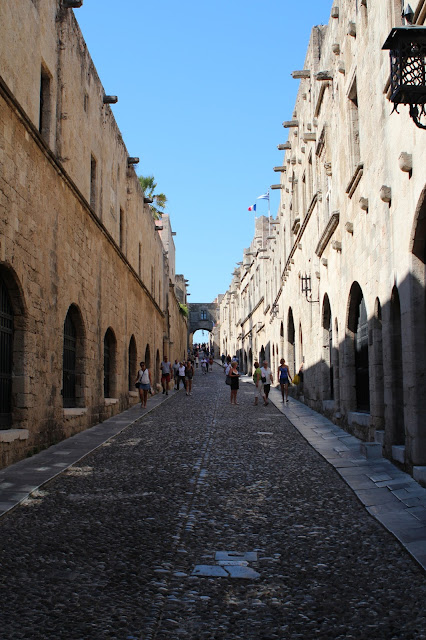
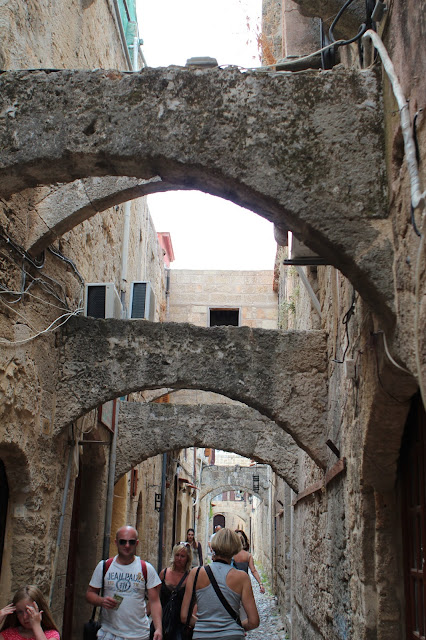
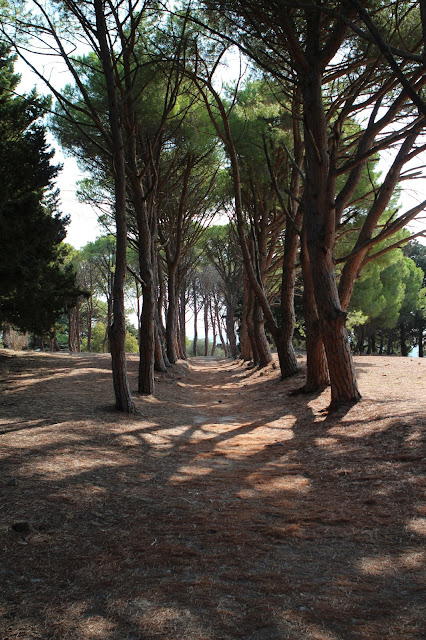
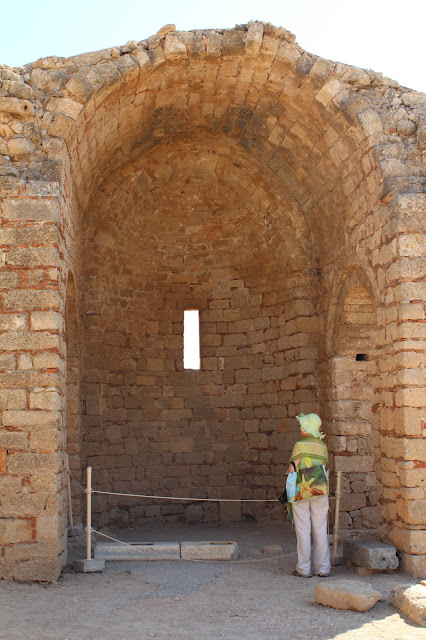
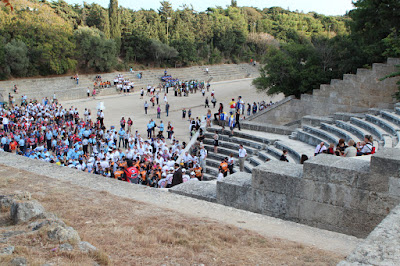
Terah and I went to the Greek island Rhodes recently. This is the second in a series about it. I am one to enjoy history. There is something deeply, well, connecting, about standing in an old place. There is a timeless quality to it a feeling of being connected to so many people of the past, and yet still being connected to change, visible in things such as weathering of stones. To gaze at pottery that s 300 years old, walk past 700-year-old walls, or pass through what remains of the grand portico of an ancient temple to Athena stirs a feeling I can barely explain, of timelessness. Although Rhodes doesn t have the famous Greek sites such as the Parthenon or Delphi, I can t help but wonder why the Rhodes sites aren t better known. They were incredible and it is hard to condense all that we saw into a short blog post. I have to start with the medieval Rhodes Old Town. We got off the bus a few blocks from it one bright morning, and our first task was to find a gate across the moat. Oh yes, A GATE ACROSS THE MOAT. It s a dry moat, and that bridge off in the distance is the gate we were headed to. Outside of the outer wall is a nice quiet walking area. The moat and walls completely surround Old Town and, for the most part, date back about 500 years. The round stones you see on that picture, we were told, were likely surplus from catapults and other projectile weapons. Cross one line of walls and you come to another, with original canons still present. The Knights Hospitaller of St. John, which held Rhodes for a few centuries until the Ottomans captured it, sure knew how to build to impress. The gate we happened to use was Amboise, the Grand Master s Gate. Right there is the stunningly rebuilt landmark Palace of the Grand Master. It is absolutely impossible for any photograph to begin to do this building justice. Between its imported Greek and Roman floors, to the grand nature of everything in it, and the archaeological museum in one corner, it was a fitting start to a visit to Old Town. Here s one of the main staircases. Just near the Palace is quiet courtyard with an old door. Pass through that door and suddenly you re in the midst of the busy Old Town. And among the landmarks in Old Town, the most prominent is Ippoton, the Avenue of the Knights. Along this avenue are the buildings built by the various nationalities of knights, many of which are historical sites in their own. Taken together, it is quite clear why Rhodes is said to be one of the world s best-preserved medieval cities. Down at the other end of Ippoton is the Knights Hospital, which is now part of the archaeological museum. Step off the Avenue a few blocks and you get to some quieter narrow streets just as old, in many cases. On Sunday morning, we were able to visit Mount Filerimos. In contrast to the busy Rhodes, Filerimos had an air of quiet and still to it. It was the site of a monastery, two historic churches, and a landmark Italian cross on the mountaintop. We arrived, and begin our visit with a walk up the quiet stone path. When we got to the top, we walked past this peaceful church. As we walked past the outside, we heard the beautiful music of chant from indoors. We got to step in and listen to mass for a few minutes. In typical fashion, directly in front of the church are two much older sites: one, the ruins of a temple to Athena, and the other a 4th-century Christian bapistery. Rhodes is a popular tourist destination, and of course we saw plenty of popular sites (such as the grandmaster s palace). Filerimos had a few tourists too, but not as many. I frequently like to operate on the plan of going wherever all the tourists aren t. And so, on Filerimos, that meant seeing what was behind the monastery. It started with this peaceful tree-lined path. And the deserted, but intentionally open, gate led to the remains of a Byzantine fortress, which had been a staging area for both the Knights and the Ottomans before their campaigns to capture Rhodes. It also provided incredible views of the surrounding countryside. The first historic site we had visited on our trip was the Acropolis of Lindos, parts of which are 2300 years old. Here s a view of the mountain from the rooftop of the Kalypso, our favorite restaurant in Lindos. The columns of the temple to Athena Lindia are visible, and of course so are the walls. The road up to the acropolis is accessible only on foot or by donkey. It is apparently the only road that has ever been used to get to the acropolis. Here is the partially-restored grand portico to the temple. There s an old Christian church (4th century, if memory serves) at the Acropolis too. The Acropolis makes some pretty good use of natural defenses too. Here s a view from one level of it. There s a manmade wall up there at the very top. And, of course, the beautiful Aegean always in the background. There are lots of cats on Rhodes. Here is a kitten napping at the top of the Lindos Acropolis: Lindos itself is a beautiful town. Here s one of the quieter streets: Notice the pebble steps leading into the houses those intricate pieces of artwork are all over. This post won t be complete without the story of our visit to the Acropolis of Rhodes. We walked there from Old Town. At the Acropolis, there are the remains of a temple to Apollo, an ancient theater, and an ancient stadium where qualifying matches for the Olympics were held. As we got closer to the area, we were repeatedly passed by people dressed in uniforms of various types. And as we got there, we joined a stream of people entering the area. The ancient stadium had apparently thousands of people in it, country names were being read off over the loudspeakers, policemen wielding machine guns were standing by, and we had absolutely no idea what was going on. At this point, you can appreciate the difference between Terah and me. Terah thought that we have no idea what is happening, she was tired from the walk, and so thought we should just leave. I thought that we have no idea what is happening, which is a great reason to stay. So Terah opted to sit and read a bit under some trees while I explored. Here s a view of the stadium as it was emptying out, seen from the theater: I explored the temple and theater, and eventually we were ready to head back. We knew there was a bus back to the New Market (from where we could get a bus back to our hotel), but didn t know where the bus stop was. The obvious place to ask were the policemen, which I thought I would do. Terah thought she would just stay sitting under the trees, on the grounds that the policemen nearest us were all carrying machine guns and perhaps wouldn t like to be disturbed. This led to my cryptic tweet:
Only ONE of us is the kind of person that goes up to guys with machine guns to ask what s happening. Me to Terah today
They told me that it was the preparations for the opening ceremony for a global shooting contest, and also gave me directions to the bus stop.

Alastair McKinstry: Irony, part 2. #physics, #irony https://www.technologyreview.com/blog/arxiv/27260/ It turns out that the 'superluminal' neutrinos effect spotted by the OPERA experiment in CERN/ Gran Sasso was probably due to an error in neglecting to account for relativistic effects in the GPS satellite movement. Far from debunking relativity, it proves it.

Irony, part 2. #physics, #irony https://www.technologyreview.com/blog/arxiv/27260/ It turns out that the 'superluminal' neutrinos effect spotted by the OPERA experiment in CERN/ Gran Sasso was probably due to an error in neglecting to account for relativistic effects in the GPS satellite movement. Far from debunking relativity, it proves it.

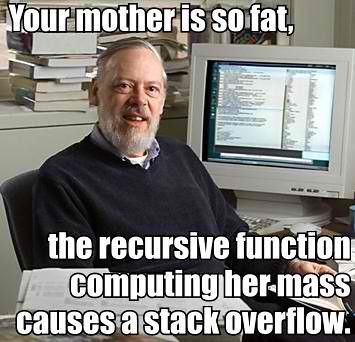
Biella Coleman: Jobs vs Ritchie

Denis! Best said here Let not make the final statement and not a single newspaper cares " into a reality. PS: Do check out Against Nostalgia, a great jab at Jobs.

13 October 2011

Yves-Alexis Perez: Fun with network cards

The issue This morning (while I was running late for an appointement) I had a very weird stuff happening on my Thinkpad T61 laptop. Since I recently offered myself a shiny Thinkpad x201s, I have to admit I don't use much my T61 anymore. But this morning I had to print a page (for this appointement) and, as I didn't yet configured my printer on the x201s, I went to the T61. But I noticed that the network was down. I've tried quickly on wireless but, bad luck, my current wifi setup selects the channel automatically and it prefers choosing channels which aren't available in the US. Guess what, my T61 comes from the US and has those channels completely disabled, so no wireless available either. The investigation I first tried to

modprobe -r e1000e
modprobe e1000e to see if it fixed the problem, but it didn't. Worse, the interface disappeared and never reappeared. I tried to reboot but it didn't fix the problem, the link was still down. Running really late, I put the file on a usb key and printed it from the powerbook and postponed the fix for later. Now, this evening, I tried to investigate a bit more. Symptoms weren't only that the nic wasn't working, but there was a high load on the system (1-2 at idle), unresponsiveness every second or so, and watching top I could see spikes of high cpu usage for the kworker kernel thread. Typing that on google you can find a lot of people running on this issue, usually starting around kernel 2.6.36 or 2.6.37. Now, I might have upgraded the kernel recently to 3.0.0-4, but that didn't look related since the problem first appeared when the laptop was up and running. And I tried to reboot under 2.6.39, 2.6.38 and even 2.6.32 and the problem was still present. Each time, unloading the module would fix the problem, but loading it again wouldn't make the interface reappear. People advised to boot with pcie_ports=compat but that didn't do anything. I tried to boot without intel_iommu=force (disable Intel Vt-d) and pcie_aspm (Active State Power Management) but nothing either. Considering a userland issue, I've tried to boot a grml live distro (always keep a grml.iso in your /boot, extlinux-update will even put it in your menu automatically), and the problem was still present. So not a Debian kernel issue, not a userland issue, only thing left was the laptop. I didn't update the Bios recently, so I wondered exactly what could be the problem. I started to feel a little bad, since I still really like that laptop, and that I already decided to lend it to my sister since her own T61 is sitting with a dead system board in my shelf. I know she might have some negative waves, but she was not even landed when the problem first appear. The fix Then I had a flash. It's not mystery that I'm used to break network cards, and I had the bright idea to shutdown the laptop, disconnect AC and battery, then let it idle a bit. I even tried the secret Thinkpad power button code but I think it's unrelated. Then I re-plugged the battery, booted to grml and the issue was gone. I rebooted on the standard Debian and the link was up, network was working. So what happenned? The (tentative) explanation My guess is that, somehow, the network card firmware has an issue and choked on something (a network frame or an attack exactly like the one we demonstrated on ASF firmware). In fact, no, I don't think it's the e1000e firmware. My T61 comes with Intel vPro, which includes AMT (Active Management Technology), a remote management solution a bit like ASF but more advanced. As far as I know, AMT firmware always runs, even when it's disabled, it's just completely idle. Idle, but in this case I think it choked on something, and a reboot isn't enough to restart the AMT firmware. But a real hard reset without any power seems to do the trick. What next? Well, a part of me is pretty scared, but another is just bored. I mean, we know about that, that's exactly the kind of issue we are warning people of. I have no idea what exactly happened, and there's no way I'll be able to reproduce that, but I'm pretty sure it's something lying at a pretty low level in the platform, and which can severely disable your workstation. Now if it happens again I won't lose too much time on this. TL;DR: helping other people In case you came here because you searched on google terms like kworker cpu usage , e1000e, interrupts, it might be a good idea to first reboot on a live CD to eliminate installation issues, then shutdown the laptop, remove the battery and let it few seconds idle. This might be enough to reset something inside and fix the situation.

Alastair McKinstry: #### [WATER FRACTIONS IN EXTRASOLAR PLANETESIMALS](http://arxiv.org/PS_cache/arxiv/pdf/1110/1110.1774v1.pdf) #### Jura & Xu, Arxiv.org. #exoplanets, #water, #phd > Abstract: With the goal of using externally-polluted white dwarfs to investigate the water fractions of extrasolar planetesimals, we assemble from the literature a sample that we estimate to be more than 60% complete of DB white dwarfs warmer than 13,000 K, more luminous than 3 10 3 L and within 80 pc of the Sun. When considering all the stars together, we find the summed mass accretion rate of heavy atoms exceeds that of hydrogen by over a factor of 1000. If so, this sub-population of extrasolar asteroids treated as an ensemble has little water and is at least a factor of 20 drier than CI chondrites, the most primitive meteorites. In contrast, while an apparent excess of oxygen in a single DB can be interpreted as evidence that the accreted material originated in a water-rich parent body, we show that at least in some cases, there can be sufficient uncertainties in the time history of the accretion rate that such an argument may be ambiguous. Regardless of the difficulty associated with interpreting the results from an individual object, our analysis of the population of polluted DBs provides indirect observational support for the theoretical view that a snow line is important in disks where rocky planetesimals form. Ok, so we now have a way of estimating how wet planetary systems *were*, at the time they fell into the white dwarf star. Not very representative of the time they before the planet got roasted to a crisp by the stars Red Giant stage, however. Recovering the hydrogenation state of serpentinized minerals might be possible and useful.

#### [WATER FRACTIONS IN EXTRASOLAR PLANETESIMALS](http://arxiv.org/PS_cache/arxiv/pdf/1110/1110.1774v1.pdf) #### Jura & Xu, Arxiv.org. #exoplanets, #water, #phd > Abstract: With the goal of using externally-polluted white dwarfs to investigate the water fractions of extrasolar planetesimals, we assemble from the literature a sample that we estimate to be more than 60% complete of DB white dwarfs warmer than 13,000 K, more luminous than 3 10 3 L and within 80 pc of the Sun. When considering all the stars together, we find the summed mass accretion rate of heavy atoms exceeds that of hydrogen by over a factor of 1000. If so, this sub-population of extrasolar asteroids treated as an ensemble has little water and is at least a factor of 20 drier than CI chondrites, the most primitive meteorites. In contrast, while an apparent excess of oxygen in a single DB can be interpreted as evidence that the accreted material originated in a water-rich parent body, we show that at least in some cases, there can be sufficient uncertainties in the time history of the accretion rate that such an argument may be ambiguous. Regardless of the difficulty associated with interpreting the results from an individual object, our analysis of the population of polluted DBs provides indirect observational support for the theoretical view that a snow line is important in disks where rocky planetesimals form. Ok, so we now have a way of estimating how wet planetary systems *were*, at the time they fell into the white dwarf star. Not very representative of the time they before the planet got roasted to a crisp by the stars Red Giant stage, however. Recovering the hydrogenation state of serpentinized minerals might be possible and useful.

11 October 2011

Vincent Sanders: Sometimes I am just dumb

I have recently been working on some code for NetSurf which builds up an output buffer by repeatedly calling snprintf(); No great shock there, well understood trivial pattern that has been used repeatedly for ages.

Of course I discovered a buffer overflow, which to be fair had already been pointed out to me by another developer and I just failed to see it...Can I blame my old age? no? bah, get off my lawn!

Basically it boils down to me simply not seeing where C helpfully let me subtract one size_t typed value from another for a length and me completely forgetting that a negative result would simply become a large positive value...

I (erroneously) beleived snprintf took a (signed) int as the buffer length, of course it returns one, but it takes a size_t which is, of course unsigned.
Gosh I feel silly now, in fact I was so convinced I was right I wrote a program to "prove" it.
1 /* snprintf.c
2 *
3 * snprintf example
4 *
5 * Public domain (really I do not think its even copyrightable anyway)
6 *
7 * cc -Wall -o snprintf-ex snprintf-ex.c
8 */

9
10 #include <stdio.h>
11 #include <string.h>
12
13 #define SHOW printf("%3ld %.*s*%s\n", string_len - slen, (int)slen, string, string + strlen(string) + 1 )
14
15
16 int main(int argc, char**argv)
17
18 char string[64];
19 size_t string_len = sizeof(string) / 2;
20 int bloop;
21 size_t slen = 0;
22
23 /* initialise string */
24 for (bloop = 0; bloop < (sizeof(string) - 1); bloop++)
25 string[bloop] = '0' + (bloop % 10);
26
27 string[bloop] = 0; /* null terminate */
28
29 printf("%3ld %s\n", string_len, string);
30
31 /* try an empty string */
32 slen += snprintf(string + slen, string_len - slen, "%s", "");
33
34 SHOW;
35
36 /* blah blah */
37 slen += snprintf(string + slen, string_len - slen, "Lorem ipsum dolor");
38
39 SHOW;
40
41 /* this one should exceed the allowed length */
42 slen += snprintf(string + slen, string_len - slen, "Lorem ipsum dolor");
43
44 SHOW;
45
46 /* should not call snprintf up if slen exceeds string_len as the
47 * subtraction results in a negative length and snprintf takes a unisigned
48 * size!
49 */

50
51 /* this one starts exceeding the allowed length */
52 slen += snprintf(string + slen, string_len - slen, "Lorem ipsum dolor");
53
54 SHOW;
55
56 return 0;
57

Of course all this really proved was that I was wrong and I needed to clean up the original code as soon as possible.

A good lesson to learn here is that no matter how experienced you are, you can be mistaken and that, perhaps, some redemption I can take from this is I have matured enough as a programmer to write a test program to prove myself wrong!

Simon Josefsson: Unattended SSH with Smartcard

I have several backup servers that run the excellent rsnapshot software, which uses Secure Shell (SSH) for remote access. The SSH private key of the backup server can be a weak link in the overall security. To see how it can be a problem, consider if someone breaks into your backup server and manages to copy your SSH private key, they will now have the ability to login to all machines that you take backups off (and that should be all of your machines, right?). The traditional way to mitigate SSH private key theft is by password protecting the private key. This works poorly in an unattended server environment because either the decryption password needs to be stored in disk (where the attacker can read it) or the decrypted private key has to be available in decrypted form in memory (where attacker can read it). A better way to deal with the problem is to move the SSH private key to a smartcard. The idea is that the private key cannot be copied by an attacker who roots your backup server. (Careful readers may have spotted a flaw here, and I need to explain one weakness with my solution: an attacker will still be able to login to all your systems by going through your backup server, however it will require an open inbound network connection to your backup server and the attacker will never know what your private key is. What this does is to allow you to more easily do damage control by removing the smartcard from the backup server.) In this writeup, I ll explain how to accomplish all this on a Debian/Ubuntu-system using a OpenPGP smartcard, a Gemalto USB Shell Token v2 with gpg-agent/scdaemon from GnuPG together with OpenSSH.


First we need to install some packages. The goal is to configure OpenSSH to talk to the gpg-agent which will start and talk to scdaemon which in turn talks to pcscd which talks to the smart card reader. For some strange reason, the scdaemon binary is shipped with GnuPG s S/MIME interface in the gpgsm package.
# apt-get install pcscd gnupg-agent gpgsm
The above command should install and start pcscd and if all works well, you should be able to check the status of the smartcard using GnuPG.
# gpg --card-status
You need to initialize the smartcard and generate a private key on it, again using GnuPG. If you trust GnuPG more than the smartcard to generate a good private key, you may generate the private key using GnuPG and then move it onto the smartcard (hint: use the keytocard command). Make sure you don t leave a copy of the private key on the same machine!
# gpg --card-edit
gpg: detected reader  Gemalto GemPC Key 00 00'
...
gpg/card> admin
Admin commands are allowed
gpg/card> name
Cardholder's surname:
Cardholder's given name: host.example.org
gpg: 3 Admin PIN attempts remaining before card is permanently locked
Please enter the Admin PIN
gpg: gpg-agent is not available in this session
gpg/card> lang
Language preferences: en
gpg/card> generate
Make off-card backup of encryption key? (Y/n) n
Please enter the PIN
What keysize do you want for the Signature key? (2048)
What keysize do you want for the Encryption key? (2048)
What keysize do you want for the Authentication key? (2048)
Please specify how long the key should be valid.
         0 = key does not expire
      <n>  = key expires in n days
      <n>w = key expires in n weeks
      <n>m = key expires in n months
      <n>y = key expires in n years
Key is valid for? (0)
Key does not expire at all
Is this correct? (y/N) y
You need a user ID to identify your key; the software constructs the user ID
from the Real Name, Comment and Email Address in this form:
    "Heinrich Heine (Der Dichter) <heinrichh@duesseldorf.de>"
Real name: host.example.org
Email address:
Comment:
You selected this USER-ID:
    "host.example.org"
Change (N)ame, (C)omment, (E)mail or (O)kay/(Q)uit? o
gpg: existing key will be replaced
gpg: please wait while key is being generated ...
gpg: key generation completed (33 seconds)
gpg: signatures created so far: 0
gpg: existing key will be replaced
gpg: please wait while key is being generated ...
gpg: key generation completed (18 seconds)
gpg: signatures created so far: 1
gpg: signatures created so far: 2
gpg: existing key will be replaced
gpg: please wait while key is being generated ...
gpg: key generation completed (23 seconds)
gpg: signatures created so far: 3
gpg: signatures created so far: 4
gpg: key 12345678 marked as ultimately trusted
public and secret key created and signed.
gpg: checking the trustdb
gpg: 3 marginal(s) needed, 1 complete(s) needed, PGP trust model
gpg: depth: 0  valid:   1  signed:   0  trust: 0-, 0q, 0n, 0m, 0f, 1u
pub   2048R/12345678 2011-09-19
      Key fingerprint = 1234 5678 1234 5678 1234  5678 1234 5678 1234 5678
uid                  host.example.org
sub   2048R/23456789 2011-09-19
sub   2048R/34567890 2011-09-19
gpg/card> quit
#
Now for the interesting part. OpenSSH talks to an agent for private key handling, and GnuPG s gpg-agent supports this protocol when the --enable-ssh-support parameter is given. During startup, gpg-agent will print some environment variables that needs to be set when ssh is run. Normally gpg-agent is invoked by the Xsession.d login scripts, so that the environment variables are inherited by all your processes. However, for an unattended machine without any normal login process, we need to write a script to start gpg-agent. First do these manual steps, to confirm that everything works.
# gpg-agent --daemon --enable-ssh-support > /var/run/gpg-agent-info.env
# . /var/run/gpg-agent-info.env
# ssh-add -L
ssh-rsa AAAAB3N... cardno:000500000BD8
#
If the final step printed a SSH public id, the (sometimes) tricky part in getting the hardware to work is (hopefully) complete. What remains is to script things so that gpg-agent is started on boot and to make sure that your backup scripts has the proper environment variables before launching whatever processes will launch ssh. Further, since we will be running unattended, we need a mechanism to unlock the smartcard using a PIN interactively once on each boot of the machine. I prefer manually entering the PIN on every boot over having the PIN stored in a file on the disk. I will use the /etc/rc.local mechanism to start gpg-agent, like this:
# cat> /etc/rc.local
#!/bin/sh -e
exec gpg-agent --daemon --enable-ssh-support \
    --pinentry-program /usr/local/sbin/pinentry-unattended \
    --write-env-file /var/run/gpg-agent-info.env
^D
The astute reader will now ask what /usr/local/sbin/pinentry-unattended is and why it is needed. Now here is the situation. scdaemon will normally query the user for a PIN using a tool called pinentry which reads and write to the user s TTY directly. This won t work in unattended mode, so we want the scdaemon to signal failure here unless we are actually unlocking the smartcard manually. Here is the entire script:
#!/bin/sh
# /usr/local/sbin/pinentry-unattended -- by Simon Josefsson
if test x"$PINENTRY_USER_DATA" = xinteractive; then
    exec pinentry "$@"
fi
exit 1
What remains is a script to unlock the smartcard by providing the PIN. This is typically invoked manually if the server has restarted for some reason. Don t worry, any ssh sessions invoked by cron until you have managed to unlock the smartcard will fail with an authentication error it won t hang waiting for a PIN to be entered.
#!/bin/sh
# /usr/local/sbin/unlock-smartcard -- by Simon Josefsson.
. /var/run/gpg-agent-info.env; export GPG_AGENT_INFO SSH_AUTH_SOCK SSH_AGENT_PID
gpg-connect-agent 'scd killscd' /bye > /dev/null
while ! gpg-connect-agent 'scd serialno' /bye   grep -q SERIALNO; do
    sleep 1
done
PINENTRY_USER_DATA=interactive
export PINENTRY_USER_DATA
checkpin
And the script checkpin is as follows:
#!/bin/sh
# /usr/local/sbin/checkpin -- by Simon Josefsson.
id= gpg-connect-agent 'scd serialno' /bye   head -1   cut -d\  -f3 
gpg-connect-agent "scd checkpin $id" /bye   grep -q OK
At this point, you should have everything configured and installed. Don t forget to chmod +x the scripts. The typical use-pattern is as follows. After the machine has been started, gpg-agent is running but the smartcard is not unlocked with the PIN. You need to manually login to the machine and run unlock-smartcard and enter the PIN. In the script that runs the backup jobs, invoked via cron, make sure that the first line of the scripts reads (assuming Bourne shell script syntax):
. /var/run/gpg-agent-info.env; export GPG_AGENT_INFO SSH_AUTH_SOCK SSH_AGENT_PID
To avoid needlessly attempting ssh connections if the smartcard is not unlocked, your backup script can also call the checkpin code and abort if it doesn t return true.
checkpin   exit 1
Some final words about debugging. A basic command to run to check that the GnuPG side is working is gpg --card-status, it should print some information about the smartcard if successful. To check that the SSH agent part is working, use ssh-add -L. If you get error messages, try killing the scdaemon process by running killall -9 scdaemon and let gpg-agent respawn a new scdaemon process. That s it! If you like my writeup, please flattr it. :)

flattr this!

Thomas Koch: Gemeinsam f r globalen Wandel

english abstract: call to assembly on October 15th in Constance (Germany).

ATTAC Konstanz und www.echte-demokratie-jetzt.de laden ein zur Versammlung "Gemeinsam f r globalen Wandel" am 15. Oktober 2011 um 15:10 Uhr auf die Marktst tte (in Bankenn he)
  • United for global change
  • Wir sind die 99%!
  • Wir zahlen nicht f r Eure Krise!
  • Echte Demokratie jetzt!
Weltweit gehen an diesem Tag Menschen auf die Stra e, um dar ber ins Gespr ch zu kommen, in welcher Gesellschaft sie leben wollen. Mit ihnen gemeinsam emp ren wir uns dar ber, dass heute die Interessen von Banken und Konzernen vielfach ber die Interessen der Menschen gestellt werden, und die Kluft zwischen Arm und Reich immer gr er wird. Wir sehen uns durch Politik und Wirtschaft nicht mehr repr sentiert und wollen selbst f r grundlegende Ver nderungen eintreten. Wir engagieren uns f r neue Wege aus der Krise, jenseits von Parteien, Gewerkschaften und anderen Gruppeninteressen.Dar ber wollen wir auch in Konstanz auf der Marktst tte miteinander reden. Zur Information, wie sich Menschen in anderen L ndern f r ihre Anliegen einsetzen, wird es einen Informationsstand ber die Protestbewegungen in Spanien, Griechenland, Israel, Chile und den USA geben.Weitere Informationen:

Christian Perrier: RWC 2011 : after 1/4 finals

I was expecting to write more about the 7th Rugby World Cup, but real life, Debian work and running activities prevented me to do so.. Still, I watched several games and I can share my feelings now. First of all, this is a tremendous organization from New Zealand. It seems that about the entire country is working on making this even a great success and I really appreciate to see a place I certainly have to visit some day receiving such wordlwide attention (OK, admitedly, mostly in the part of the world that understands rugby). First round already gave several surprises even if the 1/4 finals were after all kinda expected (at least, the list of countries). Which lead us to the following 1/4 finals (in parenthesis are my bets): If you know about the results, you know I screwed it nearly completely..:-) The Welsh team played a great game against an uninspired Irish team. It has certainly been the best 1/4 final and they certainly deserve their win. Even though I usually tend to be supprotive of Ireland, I was very balanced here, and finally turned out to be in favor of the Welsh. We really have to fear them in semi-finals. Australia-South Africa was theoretically the most exciting 1/4 final but finally turned out to be quite boring. Both teams insisted on playing mostly to occupy their opponents part of the field, more than trying to score, then relying on penalties to score. That was apparently the good tactics for Australia ad they also deserve their win against a South-African team where forward players were not as decisive as they sometimes are. Argentina was again there and really there. It has been the only team up to now who lead score against New Zealand. And that was deserved. What a wonderful 1st halftime! Obviously, it was impossible for them to resist during second halftime and it slowly became obvious that the Blacks (saved during 1st half by the kicks of a very inspired Kiri Weepu) would finally manage to score tries. But, still, our argentinian friends, for instance the inoxydable "Super Mario" Ledesma, or the tireless Felipe Contepomi, were not here as a sacrificial victim. What to say about England-France? First half was astonishing for us, of course. This is what we love (and hate) with our beloved French team. Definitely the team that can make surprises and, imho, the only one that can beat New Zealand if that has to happen (but also the only one that can be entirely crushed by them). The defeat against Tonga and the week that followed completely transformed them. A stunning 3rd row, defending each and every single bit of England trying to invade "la patrie en danger". Rear lanes with the magicians of Toulouse (Clerc and M dard) as the ideal finishers of magic play by Parra, Trinh Duc, Mermoz, Palisson (the good surprise of this world cup, Alexis). And, during second half, a trilling resistance to assaults of the British White Knights, concluded by this delivering drop-goal by Trinh Duc. For sure, with games like this, they can beat everybody and by everybody, I mean everybody. Remember Millenium Stadium in 2007..:-) So, well. Australia-New Zealand and France-Wales. I know where my heart is balancing for both games. The Blacks and Les Bleus in final, thi is what we hope (and fear...), but both teams, particularly France, will have to first climb a quite big wall before reaching this.

10 October 2011

Vincent Bernat: SSL termination: stunnel, nginx & stud, round 2

A month ago, I published an article on the compared performances of stunnel, nginx and stud as SSL terminators. The conclusion was to use stud on a 64-bit system, with session caching and AES. stunnel was unable to scale properly and nginx exhibited important latency issues. I got constructive comments on many aspects. Therefore, here is the second round. The protagonists are the same but both the conditions and the conclusions have changed a bit.

Benchmarks The hardware platform remains unchanged: We focus on the following environment:
  • Ubuntu Lucid, featuring a patched version of OpenSSL 0.9.8k with AES-NI builtin and enabled by default
  • 2.6.39 kernel (250 HZ)
  • 64-bit
  • 1 core for HAProxy, 2 cores for network cards1, 4 cores for SSL, 1 core for the system
  • system limit of 100,000 file descriptors per process
On the SSL side, the main components are:
  • 2048-bit certificates
  • AES128-SHA cipher suite
  • 8 HTTP/1.0 requests per client
  • HTTP response payload of 1024 bytes
If you are interested in different conditions (32-bit, number of cores, 1024-bit certificates, proportion of session reuses), have a look at the previous article whose results on the matter are still valid. I only consider 2048-bit certificates because most certificates issued today are 2048-bit. In SP800-57, NIST advises that 1024-bit RSA keys will no longer be viable after 2010 and advises moving to 2048-bit RSA keys:
If information is initially signed in 2009 and needs to remain secure for a maximum of ten years (i.e., from 2009 to 2019), a 1024-bit RSA key would not provide sufficient protection between 2011 and 2019 and, therefore, it is not recommended that 1024-bit RSA be used in this case.
And the protagonists are: UPDATED: Configuration of nginx has been updated to switch to off both multi_accept and accept_mutex thanks to the feedback of Maxim Dounin on latency issues that were present in the previous article (and still present in the early version of this article). HAProxy (configuration) is used for stunnel and stud to add load-balancing. For each test, we want to maximize the number of HTTP transactions per second (TPS) while minimizing latency and unsucessful transactions. The maximum number of allowed failed transactions is set at 1 transaction out of 1000. The maximum allowed average latency is 100 ms2.

Control case Below is the first comparison between stud, nginx and stunnel on plain Ubuntu Lucid. Like in previous benchs, stunnel is not able to scale, with a maximum of 400 TPS. However, early latency issues of nginx has been solved, thanks to the change in configuration. stud and nginx gets similar performance but, as you can see on the bottom plot (whose scale is logarithmic) stud starts with an initial latency of 40 ms. This is pretty annoying. I have tried some micro optimization to solve this issue but without luck. If latency matters for you, stick with stunnel or nginx (or find where the problem lies in stud). UPDATED: After reporting this issue, a fix has been commited. The culprit was Nagle s algorithm which improves bandwidth at the expense of latency. With the fix, performances are mostly the same but there is no latency penalty any more. stud, nginx, stunnel on Ubuntu Lucid

OpenSSL 1.0.0e When I published the first round of benchmarks, Micha Trojnara was dubious about the bad results of stunnel. He told me on Twitter:
I solved it! You compiled stunnel against a 4 years old OpenSSL with MT-unsafe SSL_accept. Upgrade OpenSSL and rebuild stunnel. This bug was fixed in OpenSSL 1.0.0b. I implemented a (slow) workaround, so stunnel doesn t crash with earlier versions of OpenSSL.
Therefore, I backported Ubuntu Oneiric OpenSSL 1.0.0e to Ubuntu Lucid3 and, as you can see yourself on the plot below, there is a huge performance boost for stunnel: about 400%! stud features a slight improvement too (about 8%) but still starts with a latency of 40 ms while nginx does not improve. stud, nginx, stunnel with OpenSSL 1.0.0e

Intel Accelerator Engine Most Linux distributions are still using OpenSSL 0.9.8. For example, Debian Squeeze ships with OpenSSL 0.9.8o, Ubuntu Lucid with 0.9.8k and RHEL 5.7 with 0.9.8e. Therefore, they are not eligible to recent performance improvements. To solve this, Intel released Intel Accelerator Engine, which also brings, among other things, AES-NI support:
This is essentially a collection of assembler modules from development OpenSSL branch, packed together as a standalone engine. Standalone means that it can be compiled outside OpenSSL source tree without patching the latter. Idea is to provide a way to utilize new code in already released OpenSSL versions constrained by support and release policies limiting their evolvement to genuine bug fixes.
Alas, in my tests, there was no improvement compared to OpenSSL 1.0.0e (already patched with AES-NI support). stunnel comes with out-of-the-box support for additional engines. Just add something like this to your stunnel.conf:
engine=dynamic
engineCtrl=SO_PATH:/WOO/intel-accel-1.4/libintel-accel.so
engineCtrl=ID:intel-accel
engineCtrl=LIST_ADD:1
engineCtrl=LOAD
engineCtrl=INIT
For stud, you should grab support for engine selection from GitHub and for nginx, just specify the engine with ssl_engine.

Intel Performance Primitives In his great article Accelerated SSL , Simon Kuhn shows huge performance improvements by using Intel s IPP library, a library aimed at leveraging power of multi-core processors and including some cryptographic primitives and a patch to make use of them in OpenSSL. Unfortunately, this library is not free, not even as in free beer . The patch provided by Intel only applies on OpenSSL 0.9.8j. Simon updated it for OpenSSL 1.0.0d. It also applies with a slight modification to OpenSSL 1.0.0e. Look at Simon s article for instructions on how to compile OpenSSL with IPP. Simon measured 220% improvement on RSA 1024-bit private key operations by using this library. Unfortunately, we don t get such a performance burst with stud which exhibits a 15% improvement (but remember that private key operations only happen once every 8 transactions thanks to session reuse). Worst, with stunnel, performances are reduced by one third and nginx just segfaults. I think such a library is risky to use in production. stud and stunnel with IPP

Hyperthreading During the previous tests, only half the capacity of each core were used. For stud, adding more workers per core only slightly improves this situation (less than 10% with 4 workers per core). Therefore, I thought using hyperthreading could rectify the situation here. In this case, stud, stunnel and nginx are allocated 8 virtual cores instead of 4. stud only got a small improvement of 5%, nginx a moderate improvement of 11% while stunnel got a significant improvement of 26%. stud, stunnel and nginx with hyperthreading

Conclusion Here is a quick recap of the maximum TPS reached on each tests (while keeping average response time below 100 ms). All tests were run on 4 physical cores with 2048-bit certificates, AES128-SHA cipher suite. Each client makes 8 HTTP requests and reuse the first SSL session.
Context nginx 1.1.4 stunnel 4.44 stud @e207dbc5a3
OpenSSL 0.9.8k 1489 TPS 400 TPS 1492 TPS
OpenSSL 1.0.0e 1501 TPS 1561 TPS 1609 TPS
OpenSSL 1.0.0e + IPP - 1101 TPS 1857 TPS
OpenSSL 1.0.0e + HT 1718 TPS 1973 TPS 1694 TPS
I also would like to stress that below 1500 TPS, stunnel adds an overhead of a few milliseconds while stud adds 40 milliseconds. With OpenSSL 1.0.0e and hyperthreading enabled, stunnel has both good performance and low latency on low loads to moderate loads. You may just want to limit the number of allowed connections to avoid collapsing on high loads. While in the previous round, stud was the champion and stunnel lagged behind, the situation is now reversed : stunnel is on top! UPDATED: As said earlier, the latency issue with stud has been solved. Performances remain mostly the same.

  1. HAProxy and network cards don t need dedicated core for this kind of load. However, if you also want to handle non SSL traffic, those dedicated cores can get busy.
  2. The real condition is more complex. Each point is considered valid if the corresponding average latency is less than 100 ms or if the average on the next 8 points is less than 100 ms. Temporary latency bursts are therefore allowed. We are not so forgiveful with failed transactions.
  3. This is pretty straighforward: I just dropped multiarch support. I chose to use Ubuntu version of OpenSSL instead of upstream because there are some interesting patches, like automatic support of AES-NI.

9 October 2011

Emanuele Rocca: A neat VLC extension to download subtitles

As somebody who often watches movies and TV shows I have the recurring problem of finding the right English subtitles for the video I am about to enjoy. Now, that is really a tedious thing to do. You go on a website such as opensubtitles.org and type the title of what you are looking for. Then you usually have to choose from a plethora of results, download the archive, unzip it, fire up VLC, go to Video Subtitles Track Open File, and finally open your subtitles file. And what you typically find out at that point is that the subtitles are completely out of sync with the audio, but rather than doing the whole process again you prefer to just sync them with a bit of VLC-fu. Which always takes longer than you thought, but hey. Now, what if there was an extremely simple way to just choose the subtitles for a given movie directly from VLC? The good news is that somebody wrote a beautiful VLC extension that does exactly that. He also wrote an introductory article about VLC extensions. Thank you, Jean-Philippe Andr . Installing the thing is as simple as downloading the subtitles extension and putting it in the VLC scripts folder. On Linux machines, the extensions folder can be found at ~/.local/share/vlc/lua/extensions/, on Windows APPDATA\VLC\lua\extensions. But seriously, don t use Windows. Once the extension is installed you can start watching a movie and then click View Subtitles to open the subtitles search interface. This is how it looks like: Now that the practical problem is solved, please take some time to look at the source code. VLC uses Lua as the language for writing extensions. I certainly cannot say that the web is full of resources about how to extend VLC using Lua, but the piece of code I wrote about in this post is certainly a good way to start hacking, and maybe scratch yet another itch.

Andrew Pollock: [life] There's something to be said for a destination wedding

Our friends Andrew and Janice finally tied the knot last Sunday, in Langkawi, Malaysia. They're Aussies currently living in New York, and Janice is of Malaysian descent, so I think part of the reason was to accommodate some Malaysian relatives that wouldn't be able to travel, and the other reason was that it was going to mean a bunch of people had to travel anyway, so why not travel somewhere a bit exotic? As my sister is getting married later this month in Brisbane, we decided to spare Zoe two massive international flights in close succession, and Sarah and Zoe flew out a few days ahead of me, and went to Brisbane, and then Zoe, Sarah and her mum flew to Langkawi from there, and I flew there from San Francisco, with the plan being for Sarah and Zoe to hang out in Brisbane for the 4 weeks in between weddings. It was the longest amount of travel I think I've ever done. I hadn't sat down and calculated what the travel time was beforehand, and when I got on the flight from San Francisco to Hong Kong, and they said it was going to be nearly 14 hours just to Hong Kong, I nearly wept. The only good thing about it was I didn't have to wrangle a toddler as well. From there, I had to get to Singapore, with a several hour layover, and then another flight from Singapore to Langkawi. I left SFO at 1:20am on Monday morning, and finally arrived at about 7am (San Francisco time) the following day. I didn't even bother getting off the plane in Hong Kong, it was only an hour and a half layover. I think the layover in Singapore was 5 hours, and it was a separate flight. Singapore airport at least was pretty good to kill time in. It was funny, I was reading Wired while I was killing time in Singapore, and they had an article, which included a side bar on 10 Best Airports to Get Stuck In, and I observed that getting to Langkawi and back involved using 4 of them. The flight into Langkawi was more eventful than usual. I was dozing a bit as we were coming in to land, and I woke up to the sensation of taking off again. I wondered if we'd had an aborted landing? Sure enough, soon after, the captain got on the public address and said that they'd had to abort the landing due to bad weather in Langkawi. He had pretty bad Engrish, thanking us for our frustration and saying something about fuel, so I didn't get a lot of the details. We proceeded to circle for a while before finally landing. I think the flight ended up landing something like an hour or more later than scheduled. So that was mildly exciting. Langkawi airport was one of those little "walk across the tarmac" places. I think I stood the closest to an operating jet engine that I ever have, as another aeroplane taxied in to a stop between my plane and the terminal while I was walking to it. Loud. Anyway, that was all just me getting there. Sarah had a bit of fun getting to Brisbane on her own with Zoe. She's now too long to sleep in an in-flight bassinet, and doesn't seem to like sleeping vertically in the Ergo Baby Carrier (possibly she was too hot in it). I think she got a bit of sleep lying across Sarah's lap, but Sarah didn't get much sleep. I think there was similar fun for the Brisbane to Kuala Lumpur flight, but at least she had two laps to lie across for that one. Sarah, Zoe and Sarah's mum arrived in Langkawi earlier in the day on Tuesday, and I made it to the resort at about 10pm (local time) and pretty much immediately crashed for the night. The Westin Langkawi was just fabulous. I don't think we've stayed at a resort since our honeymoon, and this resort was a whole other level compared to Heron Island. The rooms were very comfortable, and the resort was very accommodating of a toddler. Their Kids Club menu was excellent. The breakfast buffet (included in our room rate) was the most comprehensive breakfast buffet I have ever seen in a hotel. The only thing missing was bacon, being a Muslim country, but I can live without that. It was pretty easy to just fill up on breakfast, skip lunch and just have a light dinner. The on-resort dining prices were also very reasonable. The off-resort prices were even cheaper. The resort facilities in general were very comprehensive. Three pools. A children's play room. A well equipped gym and recreational area including squash courts. An extremely nice day spa. The thing I liked best about the whole destination wedding thing was all of the activities leading up to the actual wedding. The wedding was on the Sunday, and we had the Hen's and Buck's parties on Friday. Apparently Australia is the only place that calls it a Buck's party. The rest of the world calls it a Stag party, how about that? There was some last-minute changes to the Buck's party, and we ended up chartering this huge $2 million yacht for 4 hours and going for a cruise and doing some jetskiing and water sports. The captain was Aussie, so we all had a good chat with him. Apparently it's a corporate vessel, with an exclusive chartering arrangement with the Westin. On Friday night, we all went out to a seafood buffet dinner at the Yellow Cafe over at Cenang Beach. Most of the guys and girls already knew each other courtesy of the day's activities, so dinner involved a lot of meeting the other halves. What I really liked about all of the pre-wedding stuff was that by the time the wedding rolled around, you really felt like you knew a bunch of Andrew and Janice's family and friends, which I think made the whole thing feel a lot more intimate. Saturday was a recovery day. Sarah's aunties Glenda (who was in Singapore on business) and Vicki (who lives in Thailand) had joined us at the resort by this stage, so we were all knocking around together checking out the island. We took the cable car to the top, but unfortunately the sky bridge was closed due to the inclement weather. There was a lot of touristy stuff at the bottom of where the cable car was, and Zoe got to have an encounter with a very large python. She even tried to give it a kiss. One of the things that was surprising was how popular Zoe was with all of the locals and other Asian tourists. We could probably have charged for photographs. There was a little girl, who I thought was possibly a similar age to Zoe (turned out she was two and a half) and I asked her parents if I could take a photo of the two girls together, and no sooner had they sat down together and a virtual paparazzi materialised out of nowhere taking photographs. Similarly, all of the staff at the Westin were totally taken by Zoe, and wanted to touch her. To her credit, Zoe handled all of the extra attention pretty well. The wedding wasn't until 6pm on Sunday, so we did a 4 hour island hopping boat tour in the morning. That was a bit of an experience. It was nothing short of sheer bedlam trying to board the right boat at the wharf (I use the term lightly) and then the boat's captain had to arrange the passengers appropriately so as to keep the boat on an even keel. It was a narrow motor boat with a canopy cover over the back two thirds of it. First stop was Dayang Bunting Island, home of Pregnant Maiden Lake, where we stopped for 45 minutes. More bedlam ensued getting off the boat at the wharf there (there was veritable flotilla of tour boats all trying to load and unload at the same time). Monkeys abounded. They seemed incredibly tame. We were practically tripping over them. Zoe didn't seem to be as taken by the monkeys as I thought she would. It was a short walk up a reasonable flight of stairs to get to the lake, though some incredibly humid jungle, and once we got there, there wasn't a huge amount to do in the time we had available. So we dunked Zoe's feet in the lake a few times and then made our way back to the chaos at the wharf and got back on our boat. We stopped for a similar amount of time at another island with a pretty nice beach, and Zoe had enough time to a quick swim in the ocean with Sarah, and then we made our way back to the boat again to another spot where we watched sea eagle feeding. Heaps of eagles circling overhead would take turns to swoop down and grab fish and fly off again. It was impressive. I think I managed to snap some good action shots with the long lens. Then we had the wedding itself. It was on the beach out the front of the Heavenly Spa on the resort. Let me say, the Westin knows how to put a wedding together. The ceremony was as lovely as the location. For the reception, the one 5 bedroom villa on the resort was booked for the night. Dinner was a buffet on the lawn out the front (briefly delayed thanks to a rain shower) and then speeches and general partying happened around the terrace out the back of the villa. There were some beautiful speeches. Janice's brought a tear to my eye. Part of the whole package included something like a 10 person video crew that were running around capturing everything. It felt a bit surreal. It was definitely the most high-end wedding I've ever been to (sorry Scott and Julie, your "Wedding of the Century" has been eclipsed by the "Wedding of the Millennium"). Monday was a wind down day. Zoe mercifully gave us a sleep in until 8am. Our flights didn't leave until the evening on Tuesday, so after we checked out we went for a drive around the island to try and get Zoe to take a nap in the car. We ended up at the fruit farm, which to the best of my understanding is run by the government. Zoe had fallen asleep by this stage, and Sarah said she'd stay behind in the car and have a nap too. So her mum and I went on the tour. It was a fun little tour. There were only four of us on it. They drive you around the farm on the back of a truck and show you the various crops they have. They stop at a few places and give you a bunch of fruit samples, attempt to answer your questions, and take funny pictures of you. The favourite seemed to be to dangle a fruit on a knife up close in front of the camera while having the subject(s) in the background look like they're carrying an enormous fruit. We got back to the car to an upset Sarah and small group of locals milling around. Sarah had managed to lock Zoe in the car for about 30 minutes when she got out to make her a sandwich after Zoe had woken up from her nap. Fortunately the engine was running and the air conditioning was on, so there was no risk of Zoe overheating (on the contrary, she was a bit on the cool side). Some kind locals had somehow figured out which car rental company to call (it's possible there's only one) and someone came out with a spare key, so the crisis was averted just before we got back to the car. It's the first time Zoe's been locked in the car (it's pretty much impossible in the Prius) and it was just our luck that it'd happen in a foreign country! One of the saddest things about Langkawi was the amount of garbage floating around in the ocean, and washing up on the beaches. I was swimming in the ocean off the yacht while we were out on the Buck's party, and it was disgusting. The jetski was temporarily disabled due to sucking in something. We visited Black Sand Beach, which was supposed to be something of a tourist attraction. Covered in trash. Ian Kiernan would be sad. The captain of the yacht we were on for the Buck's party said it was all from Thailand and got flushed out of all the rivers and streams by the recent rain. Just goes to show how connected everything is. The house is very quiet without Sarah and Zoe, but my friend Liam is visiting from Zurich for a couple of weeks, so that's helping break the silence. I'm using the time to get a heap of things done that I don't otherwise get time to get done. Unfortunately the photos from the trip are only available on Facebook at the moment, but they'll eventually get uploaded here.

Axel Beckert: Git Snapshot of GNU Screen in Debian Experimental

I just uploaded a snapshot of GNU Screen to Debian Experimental. The package (4.1.0~20110819git450e8f3-1) is based on upstream s HEAD whose most recent commit currently dates to the 19th of August 2011. While the upload fixes tons of bugs which accumulated over the past two years in Debian s, Ubuntu s and upstream s bug tracker, I don t yet regard it as suitable for the next stable release (and hence for Debian Unstable) since there s one not so nice issue about it: Nevertheless it fixes a lot of open issues (of which the oldest is a wishlist bug report dating back to 1998 :-) and I didn t want to withhold it from the rest of the Debian community so I uploaded it to Debian Experimental. Issues closed in Debian ExperimentalIssues which will be closed in UbuntuPlease test the version from Experimental If you are affected by one of the issues mentioned above, please try the version from Debian Experimental and check if they re resolved for you, too. Thanks to all who contributed! A lot of the fixes have been made or applied upstream by Sadrul Habib Chowdhury who also industriously tagged Debian bug reports as fixed-upstream . Thanks! Thanks also to Brian P Kroth who gave the initial spark to this upload by packaging Fedora 15 s git snapshot for Debian and filing bug although the upload is based on the current HEAD version of GNU Screen as this fixes some more important issues than the snapshot Fedora 15 includes. That way also two patches from Fedora/RedHat s screen package are included in this upload. (Co-) Maintainer wanted! Oh, and if you care about the state of GNU Screen in Debian, I d really appreciate if you d join in and contribute to our collab-maint git repository there are still a lot of issues unresolved and I know that I won t be able to fix all of them myself. And since Hessophanes unfortunately currently has not enough time for the package, we definitely need more people maintaining this package. P.S. Yes, I know about tmux and tried to get some of my setups working with it, too. But I still prefer screen over tmux. :-)

8 October 2011

Steve Langasek: Free as in flickers

Ubuntu has had an explicit goal for several cycles now to achieve flicker-free booting: smooth graphical boot all the way through from bootloader to the desktop, with no messy modeswitches or cuts between text and graphics mode on the console. This is no small task, to be sure; even getting flicker-free transitions between plymouth and X for the KMS-capable video cards was a handful for 10.04 LTS. So I was suitably impressed when in the course of testing for the upcoming Ubuntu 11.10 release I found that on a laptop with the nouveau driver, we had achieved 100% flicker-free boot all the way from grub to X. And then I was astonished to find the grub-kernel transition was flicker-free when using the binary nvidia driver too! This is in large part thanks to Colin Watson's work upstream implementing VBE support in GRUB2, and Andy Whitcroft's adding proper support for a vesafb fallback when no KMS video driver is found. The architecture of how this all hangs together is now documented in the Ubuntu wiki. The irony is that, while nouveau gives a perfect flicker-free boot, and the nvidia binary drivers give a boot with just one modeswitch, both of my Intel systems show two modeswitches on boot - one between grub and the kernel, another between the kernel and X. Something to work on cleaning up next month, I think...

7 October 2011

Matt Zimmerman: Ada Lovelace Day 2011: Dr. Marian C. Diamond

For Ada Lovelace Day this year, I want to share my appreciation for Dr. Marian C. Diamond. In years past, I ve saluted women in the field of computing, which is my field as well. Dr. Diamond, however, is a biologist. Her research includes neuroanatomy, environment, immune functions, and hormones. In particular, she is interested in studying the effects of the external environment, aging, and immune responses on the cerebral neocortex. She has, in her words, had a love affair with the brain for about 70 years. I know very little about biology. The content and methods of her research are, frankly, beyond me, though some of her results have garnered popular attention. She has inspired me by demonstrating that rare combination of gifts: a deep understanding of a technical subject, and the ability to explain it to other people in an accessible way. In her interviews, articles and lectures, many of which are available online, Dr. Diamond displays these gifts in abundance. Her skill and enthusiasm for both learning and teaching is unmistakable. After applying her gifts in the classroom for many years, digital distribution has now enabled many more people to see and hear her, through millions of YouTube views. In 1960, she became the first female graduate student in UC Berkeley s anatomy department, and was apparently given the job of sewing a cover for a magnifying machine. I can only imagine the persistence required to continue from there to become a recognized leader in her field. She has gone on to help many other students along their way, and was named an unsung, everyday hero for the support she provided to students outside of the classroom or lab. As if that weren t enough, she has also traveled to Cambodia to apply her expertise in helping children injured by land mines. She still teaches today, just across the bay from where I write this, and will turn 85 next month.

Matthew Garrett: Margaret Dayhoff

It's become kind of a clich for me to claim that the reason I'm happy working on ACPI and UEFI and similarly arcane pieces of convoluted functionality is that no matter how bad things are there's at least some form of documentation and there's a well-understood language at the heart of them. My PhD was in biology, working on fruitflies. They're a poorly documented set of layering violations which only work because of side-effects at the quantum level, and they tend to die at inconvenient times. They're made up of 165 million bases of a byte code language that's almost impossible to bootstrap[1] and which passes through an intermediate representations before it does anything useful[2]. It's an awful field to try to do rigorous work in because your attempts to impose any kind of meaningful order on what you're looking at are pretty much guaranteed to be sufficiently naive that your results bear a resemblance to reality more by accident than design.

The field of bioinformatics is a fairly young one, and because of that it's very easy to be ignorant of its history. Crick and Watson (and those other people) determined the structure of DNA. Sanger worked out how to sequence proteins and nucleic acids. Some other people made all of these things faster and better and now we have huge sequence databases that mean we can get hold of an intractable quantity of data faster than we could ever plausibly need to, and what else is there to know?

Margaret Dayhoff graduated with a PhD in quantum chemistry from Columbia, where she'd performed computational analysis of various molecules to calculate their resonance energies[3]. The next few years involved plenty of worthwhile research that aren't relevant to the story, so we'll (entirely unfairly) skip forward to the early 60s and the problem of turning a set of sequence fragments into a single sequence. Dayhoff worked on a suite of applications called "Comprotein". The original paper can be downloaded here, and it's a charming look back at a rigorous analysis of a problem that anyone in the field would take for granted these days. Modern fragment assembly involves taking millions of DNA sequence reads and assembling them into an entire genome. In 1960, we were still at the point where it was only just getting impractical to do everything by hand.

This single piece of software was arguably the birth of modern bioinformatics, the creation of a computational method for taking sequence data and turning it into something more useful. But Dayhoff didn't stop there. The 60s brought a growing realisation that small sequence differences between the same protein in related species could give insight into their evolutionary past. In 1965 Dayhoff released the first edition of the Atlas of Protein Sequence and Structure, containing all 65 protein sequences that had been determined by then. Around the same time she developed computational methods for analysing the evolutionary relationship of these sequences, helping produce the first computationally generated phylogenetic tree. Her single-letter representation of amino acids was born of necessity[4] but remains the standard for protein sequences. And the atlas of 65 protein sequences developed into the Protein Information Resource, a dial-up database that allowed researchers to download the sequences they were interested in. It's now part of UniProt, the world's largest protein database.

Her contributions to the field were immense. Every aspect of her work on bioinformatics is present in the modern day larger, faster and more capable, but still very much tied to the techniques and concepts she pioneered. And so it still puzzles me that I only heard of her for the first time when I went back to write the introduction to my thesis. She's remembered today in the form of the Margaret Oakley Dayhoff award for women showing high promise in biophysics, having died of a heart attack at only 57.

I don't work on fruitflies any more, and to be honest I'm not terribly upset by that. But it's still somewhat disconcerting that I spent almost 10 years working in a field so defined by one person that I knew so little about. So my contribution to Ada Lovelace day is to highlight a pivotal woman in science who heavily influenced my life without me even knowing.

[1] You think it's difficult bringing up a compiler on a new architecture? Try bringing up a fruitfly from scratch.
[2] Except for the cases where the low-level language itself is functionally significant, and the cases where the intermediate representation is functionally significant.
[3] Something that seems to have involved a lot of putting punch cards through a set of machines, getting new cards out, and repeating. I'm glad I live in the future.
[4] The three-letter representation took up too much space on punch cards

comment count unavailable comments

Rapha&#235;l Hertzog: My Debian activities in September 2011

This is my monthly summary of my Debian related activities. If you re among the people who made a donation to support my work (144.3 , thanks everybody!), then you can learn how I spent your money. Otherwise it s just an interesting status update on my various projects. Dpkg work While taking care of the last details for the hardening feature in dpkg 1.16.1, I have mailed debian-devel to find volunteers to handle a hardening release goal. The objective is to ensure a large number of packages have been converted/rebuilt to actually use the new hardening build flags. Then I prepared the draft of the announce of the dpkg 1.16.1 upload (aka Bits of dpkg maintainers sent to debian-devel-announce) which got expanded by Guillem to also cover new features since dpkg 1.15.7. update-alternatives got some refactoring by Guillem which resulted in a regression that has been fortunately discovered by Sven Joachim. I fixed that regression and did some further cleanup inspired by the root cause of this regression (see top 4 commits here). Note that Sven is one of the few persons who are running the git version of dpkg. Hopefully the number of tester will increase since I recently documented the APT repositories with autobuilt versions of dpkg in the wiki. At the end of the month, I started working on a bugfix release (what s going to be 1.16.1.1) by fixing some of the unavoidable problems discovered after an upload that accumulated more than 4 months worth of work (see top 4 commits here). The Debian Administrator s Handbook I spent countless hours finalizing the launch of the crowdfunding campaign for the Debian Administrator s Handbook and it went live on September 27th. So far it s on good track with more than 63% of the base funding already secured. But we still have a long way to go to reach the liberation goal (we re at 21%). It s still worth nothing that more than 55% of the money raised has been put in the liberation fund so there are many persons who care about getting the book freed. More than 250 persons are supporting the project currently with an average contribution of 38 EUR. I would have expected much less for the average contribution but many more supporters. I still hope we can get more people on board with the perspective of a good DFSG-free Debian ebook. Did you order your copy? If not, click here and fix this! ;-) By the way Paypal used to be required but it s no longer the case, you can support the project just with your usual credit card. Misc blog updates Over time, I have written many useful articles for Debian users and Debian contributors. But scattered in the history, they are somewhat difficult to find. To fix this I have created some index pages listing them. Check them out: Two new articles joined those pages this month: How to triage bugs in the Debian Bug Tracking System and Understand dpkg and don t get stuck with a maintainer script failure. While writing the first article, I noticed we lacked a good page showing the most buggy packages so I quickly created it (with the help of UDD): http://qa.debian.org/cgi-bin/bugs-by-source Misc packaging work I did a small update to the developer s reference. Luca Falavigna submitted a patch to clarify how one is supposed to deal with meta-packages (cf #569219), I improved it and integrated the result in the SVN repository. I upgraded nautilus-dropbox to version 0.6.9 and while doing this I discovered a bug in mergechanges (filed as #640782). I uploaded a new release of quilt mainly to add the Multi-Arch: foreign field so that it can satisfy dependencies of foreign packages (i.e. packages of a different architecture). Django released some security advisories (tracked in #641405) and since the maintainer did not deal with the issue, I stepped up to the task (I m a backup maintainer) and released the fixed version 1.3.1 to unstable. I took the opportunity to switch from python-support to dh_python2, and do some misc improvements to the packaging (see changelog). I wanted to update publican to a newer version but it turned out to be not possible because Debian doesn t have the latest version of docbook-xsl yet. I also discovered some bugs in the test suite and forwarded upstream the patch I created (see upstream bug). On top of this, fop was failing due to some java problem related to the introduction of multiarch. After having reported the bug, the java maintainers quickly released a fixed version. So now publican is ready in the git repository but it s waiting on the docbook-xsl update. I got in touch with the maintainer who said he would have the time to take care of it by mid-october. Thanks See you next month for a new summary of my activities.

One comment Liked this article? Click here. My blog is Flattr-enabled.

Next.

Previous.