Search Results: "ina"

24 October 2011

Thorsten Glaser: benz wedding, fun before

My dear MirBSD co-developer Benny did not only get his Doctor title but also recently married. There will be another post detailing this, including better photos of the two Doctors and the cake (with a D mon she made herself) on the wlog, but this is some fun beforehand: No GPL cars! Apparently, it is forbidden in France to drive GPL cars. (Without safety valve but you have to admit the picture was fun. And we were like since the thing actually meant is LPG in German. Just like UTC is CUT (Coordinated Universal Time) in English, TUC (Temps Universel Coordonn ) in French )

Steve Kemp: So I've been creating more things

I realise it has been nearly two months since I last posted anything here. The good news is I'm still alive! Mostly the past couple of months has been full of cute victims to take pictures of, which has helped me setup a simplified portfolio site; I still continue to prefer images of people and I was recently pleased with the delivery of my first "photobook". Over the past couple of years I've slowly decorated my flat with prints (4"x6" - A2) of my pictures, but seeing the pictures in a nicely bound book makes them feel so much more real. I've also been doing a little more software development, mostly relating to the archiving of images and the workflow of taking RAW images, converting them, and finally uploading via rsync. I suspect the tools I've put together are Steve-specific, but I did have some fun with duplicate image detection and eilimination - something I've written about in the past. ObQuote: "Better to write for yourself and have no public than to write for the public and have no self" - Cyril Connolly.

Biella Coleman: Occupy S o Paulo Under Threat

Occupy Sao Paulo Under Threat I was in Brazil last week and had the pleasure of participating in a teach-in at Occupy S o Paulo, a vibrant camp set up last week in the heart of the old down town. There are now under threat, please see below for details and spread the word. *** On October 15, a group of nearly 300 activists began an occupation of S o Paulo in the Valley of Anhagabau, one of the sites of the first rallies for direct elections during the end of the Brazilian military dictatorship in the 1980s. After a week of peaceful encampment, educational and cultural programs, and creating a sustainable community for not just themselves but many homeless people in downtown S o Paulo, the Occupy S o Paulo movement is coming under increased police threat. Today, Monday October 24, the governor of the state of S o Paulo, Geraldo Alckmin is holding two special events. First, he is hosting Florida Governor Rick Scott (R). Second, Alckmin has decided to hold a parade of 3000 military police right next to the encampment (see photo above). After a week of police harrassment and a pending court case for them to hold the right to pitch their tents, the Occupy S o Paulo movement sees this as an escalation of the harassment they have already faced by city police. Further, the presence of 3000 military police next to 300 occupiers is clearly meant to intimidate both occupiers and members of the public who have been coming up to the encampment and learning about the movement. Please take the time to call or email the governor and the secretary of public security of the state of S o Paulo to condemn this action. You can also send messages of solidarity to the S o Paulo occupation at occupysampaenglish@googlegroups.com. To contact Governor Geraldo Alckmin s office of citizen and organizational relations: Fill out a comment form at: http://www.saopaulo.sp.gov.br/en/fale/fale.php
Phone: 55-11-2193-8463 To contact the Secretary of Public Security, Ant nio Ferreiro Pinto:
Email: seguranca@sp.gov.br
Phone: 55-11-3291-8500

Colin Watson: Quality in Ubuntu 12.04 LTS

As is natural for an LTS cycle, lots of people are thinking and talking about work focused on quality rather than features. With Canonical extending LTS support to five years on the desktop for 12.04, much of this is quite rightly focused on the desktop. I'm really not a desktop hacker in any way, shape, or form, though. I spent my first few years in Ubuntu working mainly on the installer - I still do, although I do some other things now too - and I used to say only half-jokingly that my job was done once X started. Of course there are plenty of bugs I can fix, but I wanted to see if I could do something with a bit more structure, so I got to thinking about projects we could work on at the foundations level that would make a big difference. Image build pipeline One difficulty we have is that quite a few of our bugs - especially installer bugs, although this goes for some other things too - are only really caught when people are doing coordinated image testing just before a milestone release. Now, it takes a while to do all the builds and then it takes a while to test them. The excellent work of the QA team has meant that testing is much quicker now than it used to be, and a certain amount of smoke-testing is automated (particularly for server images). On the other hand, the build phase has only got longer as we've added more flavours and architectures, particularly as some parts of the process are still serialised per architecture or subarchitecture so ARM builds in particular take a very long time indeed. Exact timings are a bit difficult to get for various reasons, but I think the minimum time between a developer uploading a fix and us having a full set of candidate images on all architectures including that fix is currently somewhere north of eight hours, and that's with people cutting corners and pulling strings which is a suboptimal thing to have to do around release time. This obviously makes us reluctant to respin for anything short of showstopper bugs. If we could get things down to something closer to two hours, respins would be a much less horrible proposition and so we might be able to fix a few bugs that are serious but not showstoppers, not to mention that the release team would feel less burned out. We discussed this problem at the release sprint, and came up with a laundry list of improvements; I've scheduled this for discussion at UDS in case we can think of any more. Please come along if you're interested! One thing in particular that I'm working on is refactoring Germinate, a tool which dates right back to our first meeting before Ubuntu was even called Ubuntu and whose job is to expand dependencies starting from our lists of "seed" packages; we use this, among other things, to generate Task fields in the archive and to decide which packages to copy into our images. This was acceptably quick in 2004, but now that we run it forty times (eight flavours multiplied by five architectures) at the end of every publisher run it's actually become rather a serious performance problem: cron.germinate takes about ten minutes, which is over a third of the typical publisher runtime. It parses Packages files eight times as often as it needs to, Sources files forty times as often as it needs to, and recalculates the dependency tree of the base system five times as often as it needs to. I am confident that we can significantly reduce the runtime here, and I think there's some hope that we might be able to move the publisher back to a 30-minute cycle, which would increase the velocity of Ubuntu development in general. Maintaining the development release Our release cycle always starts with syncing and merging packages from Debian unstable (or testing in the case of LTS cycles). The vast majority of packages in Ubuntu arrive this way, and generally speaking if we didn't do this we would fall behind in ways that would be difficult to recover from later. However, this does mean that we get a "big bang" of changes at the start of the cycle, and it takes a while for the archive to be usable again. Furthermore, even once we've taken care of this, we have a long-established rhythm where the first part of the cycle is mainly about feature development and the second part of the cycle is mainly about stabilisation. As a result, we've got used to the archive being fairly broken for the first few months, and we even tell people that they shouldn't expect things to work reliably until somewhere approaching beta. This makes some kind of sense from the inside. But how are you supposed to do feature development that relies on other things in the development release? In the first few years of Ubuntu, this question didn't matter very much. Nearly all the people doing serious feature development were themselves serious Ubuntu developers; they were capable of fixing problems in the development release as they went along, and while it got in their way a little bit it wasn't all that big a deal. Now, though, we have people focusing on things like Unity development, and we shouldn't assume that just because somebody is (say) an OpenGL expert or a window management expert that they should be able to recover from arbitrary failures in development release upgrades. One of the best things we could do to help the 12.04 desktop be more stable is to have the entire system be less unstable as we go along, so that developers further up the stack don't have to be distracted by things wobbling underneath them. Plus, it's just good software engineering to keep the basics working as you go along: it should always build, it should always install, it should always upgrade. Ubuntu is too big to do something like having everyone stop any time the build breaks, the way you might do in a smaller project, but we shouldn't let things slide for months either. I've been talking to Rick Spencer and the other Ubuntu engineering leads at Canonical about this. Canonical has a system of "rotations", where you can go off to another team for a while if you're in need of a change or want to branch out a bit; so I proposed that we allow our engineers to spend a month or two at a time on what I'm calling the +1 Maintenance Team, whose job is simply to keep the development release buildable, installable, and upgradeable at all times. Rick has been very receptive to this, and we're going to be running this as a trial throughout the 12.04 cycle, with probably about three people at a time. As well as being professional archive gardeners, these people will also work on developing infrastructure to help us keep better track of what we need to do. For instance, we could deploy better tools from Debian QA to help us track uninstallable packages, or we could enhance some of our many existing reports to have bug links and/or comment facilities, or we could spruce up the weather report; there are lots of things we could do to make our own lives easier. By 12.04, I would like, in no particular order: Of course, this overlaps to a certain extent with the kinds of things that the MOTU team have been doing for years, not to mention with what all developers should be doing to keep their own houses in reasonable order, and I'd like us to work together on this; we're trying to provide some extra hands here to make Ubuntu better for everyone, not take over! I would love this to be an opportunity to re-energise MOTU and bring some new people on board. I've registered a couple of blueprints (priorities, infrastructure) for discussion at UDS. These are deliberately open-ended skeleton sessions, and I'll try to make sure they're scheduled fairly early in the week, so that we have time for break-out sessions later on. If you're interested, please come along and give your feedback!

Russell Coker: Stop HRL

Today I attended the Stop HRL demonstration [1]. The government plans to spend $100,000,000 of federal money and $50,000,000 of Victorian state money to build a new coal power station. The state government has imposed some unreasonable restrictions on renewable energy which includes allowing a single person who objects within 2Km of a wind turbine to block the project while also not allowing anyone to object to coal power plants or fracking (both of which have proven health implications). Today VCAT had a hearing about this issue, HRL wants to double the size of the proposed coal power plant while Environment Victoria, Doctors for the Environment Australia, local climate action group Locals Into Victoria s Environment Martin Shield from Climate Action Moreland are opposing the plan. What the government should be doing is permitting (if not encouraging) renewable energy production, particularly wind power which will drive down energy prices by undercutting the energy auctions due to it s almost zero marginal cost. The government should not be spending tax payer money on new coal projects due to climate change and air pollution in addition to the fact that coal is simply more expensive in the long term. As usual it s disappointing that the National party which supposedly represents farmers is supporting the government in such things. The pollution caused by coal power and fracking ends up damaging farmland. The Liberal party doesn t have a majority on it s own in either house of the state government, so this proposed coal power plant could be stopped immediately if the National party supported renewable power, or even if they merely opposed giving $50,000,000 of state tax money to HRL. The demonstration went reasonably well, there was about 80 people there when I arrived and by the time it ended there were more than 150 people. I took the above picture at the start and it missed many people who were off to the right. I think that s a good result for a demonstration that had little publicity and was held in business hours with really bad weather. Update: On Sunday the 13th of November at 13:00-14:30 there is a Going Backwards Under Baillieu demonstration at Parliament House. This is to mark the negative affects that the Liberal state government has had on the environment of Victoria.

23 October 2011

Niels Thykier: Testing testing migration

If you have been following Lintian s development closely, you will probably have noticed that I have not really done anything there for the past week. Instead I have turned my focus on our testing migration script, britney2. First, I have created a minimal test suite[1]. It started as 4 simple tests and by now it contains about 30 tests. The size of each test is rather small; the largest tests are about 1600 binary packages in total[2], but most are 2-20 binary packages in total. Thus the test suite is rather fast compared to a live data sample , which easily takes more than 10 minutes for a single run. Unfortunately, hand-crafting the test data is somewhat annoying and easy to get wrong. The test suite has a somewhat unfair focus on auto-hint [3] cases, so the current britney2 fails up to 14 tests. Some of these appears to fail because the auto-hinter (for some reason) receives incomplete information about the situation. To my knowledge we not been able to debug the situation, but Adam has a refactor branch that does not seem to have this issue. Personally I am hoping it will soon be merged into the master branch, especially because it seems to simplify a lot of common operations. Joachim Breitner (who has been working on a SAT-solver based britney) also contributed a couple of test cases[4]. Allegedly, SAT-britney does rather well on the test suite, failing only 2 tests as far as I can tell[5]. On the other hand, it does solve a some of the more interesting cases britney2 does not solve. On a more mathematical note, the britney2 implementation behaves like a function[6] with an attractive fixed point[7]. This is interesting, because for some cases it may take britney2 a couple of iterations to reach the right solution. This fixed point is somewhat simple to find by using the following steps (pseudo-code):
// Runtime complexity O(n * br * diff), where "n" is the number of iterations until
// a fixed point is reached, "br" is the complexity of "run_britney" and "diff" is
// the runtime of the "last != current" comparison.
function find_fixed_point(initial);
    last = run_britney(initial)
    current = run_britney(last)
    while last != current ; do
        last = current
        current = run_britney(last)
    od
    return current
end
This gives us a simple way to test if britney will eventually solve the issue herself (and when she will do it). Currently britney2 is automatically run twice a day, so for every 2 iterations (beyond the first) roughly translates to a 24-hours delay. So far the test suite does not have a lot of problems that requires more than one iteration. Personally I would be pleased if it turned out to stay that way as the test suite coverage grows. If you are interested in playing around with this, you can get sources from: Footnotes: [1] http://lists.debian.org/debian-release/2011/10/msg00178.html [2] These tests are auto-generated, so it is merely an up-scaled pattern . [3] Basically if two (or more) packages needs to migrate into testing at the exact same time, they need to be hinted in. [4] Not to mention all the copy-waste errors he pointed out in mine. Apparently, SAT-britney has stricter requirements to the data than britney2. :P [5] I assume the test called sat-britney-death (created by Joachim) was named that way for a reason. The second failure is caused by SAT britney not reading hints (yet?), so the approve tpu package test case should fail. [6] A function that maps an archive into another archive erh, I mean, it maps a set of packages into another set of packages :P [7] http://en.wikipedia.org/wiki/Fixed_point_%28mathematics%29 Assuming my claim to be true, the function will have more than one fixed point. The obtained fixed point depends on the initial state of testing. As an example:
y depends on x
x in testing has RC bugs If x is not in testing, it cannot migrate to testing (due to its RC bugs). If x is not in testing, then y cannot migrate into testing. But if x starts in testing, then y may be able to migrate. This can happen if x migrated to testing before an RC bug was filed against it. (Dis-)Proving my claim is an exercise left for the reader.

22 October 2011

Francois Marier: Reducing the size of Apache 301 and 302 responses

Looking through the Libravatar access logs, I found that most of the traffic we currently serve consists of 302 redirects to Gravatar. Optimising that path is therefore very important.

While Apache allows admins to provide custom error pages for things like 404 or 500, it's not quite that straightforward for 30x return codes.

Standard 301 / 302 responsesBy default, Apache (and most web servers out there) returns a fairly large HTML page along with a 30x redirection. Try it for yourself by disabling automatic redirections in Firefox (Preferences Advanced General Accessibility) or by installing the Request Policy add-on.

The 302 responses sent by Libravatar looked like this:
$ curl -i http://cdn.libravatar.org/avatar/12345678901234567890123456789012
HTTP/1.1 302 Found
Date: Wed, 21 Sep 2011 01:51:52 GMT
Server: Apache
Cache-Control: max-age=86400
Location: http://www.gravatar.com/avatar/12345678901234567890123456789012.jpg?r=g&s=80&d=http://cdn.libravatar.org/nobody/80.png
Vary: Accept-Encoding
Content-Length: 310
Content-Type: text/html; charset=iso-8859-1

<!DOCTYPE HTML PUBLIC "-//IETF//DTD HTML 2.0//EN">
<html><head>
<title>302 Found</title>
</head><body>
<h1>Found</h1>
<p>The document has moved <a href="http://www.gravatar.com/avatar/12345678901234567890123456789012.jpg?r=g&s=80&d=http://cdn.libravatar.org/nobody/80.png">here</a>.</p>
</body></html>
As you can see, the body of the response is just as large as the headers and isn't really necessary.

Body-less 301 responsesAfter reading about the ErrorDocument directive, I created an empty file called 302 in the root of the web server and included this directive in my vhost configuration file:
ErrorDocument 302 /302
which made the responses look like this:
$ curl -i http://example.com/redir
HTTP/1.1 302 Found
Date: Wed, 21 Sep 2011 03:39:26 GMT
Server: Apache
Last-Modified: Wed, 21 Sep 2011 03:39:17 GMT
ETag: "8024d-0-4ad6b52201036"
Accept-Ranges: bytes
Content-Length: 0
Content-Type: text/plain

This one does have a completely empty body, however, there's an important problem with this solution: the Location header is missing! Not much point in reducing the size of the redirect if it's no longer working.

Custom 302 response pageThe next thing I tried (and ended up settling on) is this:
ErrorDocument 302 " "
which results in a 1-byte response (a single space) in the body:
$ curl -i http://example.com/redir
HTTP/1.1 302 Found
Date: Wed, 21 Sep 2011 03:37:50 GMT
Server: Apache
Location: http://www.example.com
Vary: Accept-Encoding
Content-Length: 1
Content-Type: text/html; charset=iso-8859-1

There is still a little bit of unnecessary information in this response (character set, Vary and Server headers), but it's a major improvement over the original.

If you know of any other ways to reduce this further, please leave a comment!

Vincent Sanders: I do not want anything NASty to happen

I have a lot of digital data to store, like most people I have photos, music, home movies, email and lots of other random data. Being a programmer I also tend to have huge piles of source code and builds lying about. If all that was not enough I work from home so I have copious mountains of work data too.

Many years ago I decided I wanted a single robust, backed up, file server for all of this. So I slapped together a machine from leftovers stuffed some drives in a software RAID array, served over NFS and CIFS and never looked back.

Over time the hardware has changed and the system upgraded but the basic approach of a custom built server has remained. When I needed a build engine to churn out hundreds of kernels a day for the ARM Linux autobuilder the system was expanded to cope and mid 2009 the current instantiation was created.

Current full height tower fileserverThe current system is a huge tower case (courtesy of Mark Hymers) containing a Core 2 Quad 2.33GHz (8 threads) with 8Gigabytes of memory and 13 drives across four SATA controllers split into several RAID arrays. Despite buying new drives at higher capacities I have tended to keep the old drives around for extra storage resulting in what you see here.

I recently looked at the power usage of this monster and realised I was paying a lot of money to spin rust which was simply uneconomic. Seriously, why did I have six sub 200Gigabyte drives running when a single 2T to replace them would pay for itself in power saved in under a month! In addition I no longer required the compute power available either, most definitely time for a downsize!

Several friends suggested a HP micro server might be just the thing. After examining and evaluating some other options (Thecus and QNAP NAS) I decided the HP route was most definitely the best value for money.

The HP Proliant micro server is a dual core Athlon II 1.3GHz system with a Gigabyte of memory, space for four SATA hard drives and a single 5 inch bay for an optical drive. All this in a roughly 250mm on a side cube.

My HP proliant microserverI went out and bought the server from ebuyer for 235 with free shipping and 100 cashback. I Immediately sent off the cash back paperwork so I would not forget(what an odd way to get discount) so total cost for the unit was 135. I then used Crucial to select a suitable memory upgrade to take the total to 2 Gigabytes of RAM for 14

The final piece of the solution was the drives for the storage. I decided the best capacity to cost ratio could be had from 2 TB drives and with four bays available would give a raw capacity of 8 TB or more usefully for this discussion 7.8 TiB

I did an experiment with 3x1 TB 7200 RPM drives from the existing server and determined that The overall system would not really benefit enough to justify the 50% price premium of 7200 RPM drives over 5400 RPM devices. I ended up getting four Samsung Spinpoint F4EG 2 TB drives for 230.

I also bought a black LG DVD-RW drive for 16 I would have also required a SATA data cable and a molex to SATA power cable if I had not already got them.

My HP microserver with the front door openPutting the components together was really simple. The internal layout and design of the enclosure mean it is easy to work with and has the feel of build quality I usually associate with HP and IBM server kit not something this small and inexpensive.

The provided documentation is good but unnecessary as most operations are obvious. They even provide the bolts to attach all the drives along with a wrench in the lockable front door, how thoughtful is that!

I then installed the system with Debian squeeze from the optical drive. Principally because I happened to have a network installer CD to hand although the BIOS does have network boot capability.

I used the installer to put the whole initial system together and did not have to resort to the command line even once, very impressed with how far D-I has come.

After asking several people for advice the general consensus was that I should create two partitions on each drive one for a RAID 1 /boot and one for a RAID 5 LVM area.

I did have to perform the entire install a second time because there is a gotcha with GUID Partition Table, RAID 1 boot drives and GRUB. You must have a small "BIOS" partition on the front of the drive or GRUB cannot install in the MBR and your system will not boot!

The partition layout I ended up with looks like:
Model: ATA SAMSUNG HD204UI (scsi)
Disk /dev/sda: 2000GB
Sector size (logical/physical): 512B/512B
Partition Table: gpt

Number Start End Size File system Name Flags
1 17.4kB 32.0MB 32.0MB bios_grub
3 32.0MB 1000MB 968MB raid
2 1000MB 2000GB 1999GB raid

The small Gigabyte partition was configured as a RAID 1 across all four drives and formatted with ext2 and mount point of /boot. The large space was configured as RAID 5 across all four drives with LVM on top. Logical volumes were allocated formatted ext3 (on advice from seevral people about ext4 instability they had observed) for 50 GiB root, 4 GiB swap and 1 TiB home space.

The normal Debian install proceeded and after the post install reboot I was presented with a login prompt. Absolutely no surprises at all no additional drivers required and a correctly running system.

Over the next few days I did the usual sysadmin stuff, rsynced data from the old fileserver including creating logical volumes for the various arrays from the old server none of which presented much of a problem. The 5.5TiB Raid 5 did however take a day or so to sync!

I used the microservers eSATA port to attach external drives I use for backup purposes which has also not been an issue so far.

I am currently running both the new and old systems for a few days and rsyncing data to the microserver until I am sure of it. Actually I will make the switch this weekend and shut the old system down and leave it till next weekend before I scrub the old drives.

Before I made it live I decided to run some benchmarks and gather some data just for interest.
Bonnie (Version 1.96) was run in the root logical volume (I repeated the tests in other volumes, there is sub 1% variation) the test used a 4GiB size and 16 files

Sequential OutputSequential InputRandom SeeksSequential CreateRandom Create
Per ChrBlockRewritePer ChrBlockCreateReadDeleteCreateReadDelete
/sec378K41M37M2216K330M412.811697+++++1833014246+++++14371
%CPU9711891301524+++2829+++22
Latency109ms681ms324ms116ms93389 s250ms29021 s814 s842 s362 s51 s61 s

Does not seem to be any notable issues there, the write speeds are a little lower than I might like but that is the cost of RAID 5 and 5400 RPM drives.

The rsync operations used to sync up the live data seem to manage just short of 20MiB/s for the home partition comprising of 250GiB in two and a half million files with the expected mix of file sizes. The video partition managed 33MiB/s on 1TiB of data in nine thousand files.

The bonnie tests were performed accessing the server over NFS with 24GiB size and 16 files.
Sequential OutputSequential InputRandom SeeksSequential CreateRandom Create
Per ChrBlockRewritePer ChrBlockCreateReadDeleteCreateReadDelete
/sec1733K29M19M4608K106M358.3146537142402157640821529
%CPU98249310108109997
Latency10894 s23242ms69159ms49772 s224ms250ms148ms24821 s157ms108ms2074 s719ms

or alternatively as percentages against the previous direct access values

Sequential OutputSequential InputRandom SeeksSequential CreateRandom Create
Per ChrBlockRewritePer ChrBlockCreateReadDeleteCreateReadDelete
/sec4646851213328712+++1311+++10
CPU1011850104347133+++3231+++31
Latency925121324893227795093049186462983440661178688

Not that that tells us much aside from that write is a bit slower over the network, read is gigabit network bandwidth limited and latency of disc over the network is generally poorer than direct.

In summary the total cost was 395 for a complete ready to use system with 5.5TiB of RAID 5 storage which can be NFS served at nearly 900Mbit/s. Overall I am happy with the result, my only real issue is the write performance is a little disappointing but it is good enough for what I need.

Adnan Hodzic: My DebConf11 summary and its after effects

Even though some three months have passed since DebConf11 has successfully ended, I still wanted to give you just a glimpse on how some parts were played through the eyes of a lunatic (read: organizer). Of course, blog post can t come close near of explaining anything but at least it should give some insight and hopefully some pointers to the future DebConf organizers. If you don t feel like reading this much text you can listen to last episode of This Week In Debian podcast and after it just head to Beginning of the end part. DebConf11 First of all I d like to apologize if I offended or hurt anyone in this whole process as it wasn t my intention and during DebConf organization this is nothing irregular, for you to get hurt or you hurting somebody else. One thing that got stuck with me this whole time is when Mart n Ferrari approached me after I did bid proposal of Bosnia/Herzegovina for DebConf11 back on DebConf9 and told me you have no idea what you just got yourself into I played cool and said something along the line of coure I do and boy did I lie. During DebConf organization you re bound to make some of your decisions instantaneously in which you ll lose something, the most you can do is assess what s the thing you can cut the cord on, even though if that thing or a person for that matter might have meant something to you. You ll lose things, relationships, friendships, contacts at the times sense of humor and maybe even common logic. Some of it comes back to you, some the very next day and for some it may take longer. Some of it was lost irreversibly, but even in that case it wasn t lost and could even be traced to some other cause. One thing that I m thankful for is that I didn t lose, not lose but even get distanced from those close to me, and that I didn t lose guy who was with me in this from very first day, my right hand, my partner in crime Velimir ( aroundthfur ). It s not even losing I m talking about here, because even by losing you re gaining something and this is part of your everyday life, it s just that your life frame kinda gets stuck on fast forward button. So once the ride s over you may feel bit dizzy asking yourself what just happened. During this time I was also contacted by Google recruiter regrading software engineer internship but to make a long story short I didn t make it due to my heavy involvement and my lack of time (read: fail). But I don t find this as losing either, first time I was contacted by them, next time they ll be contacted by me maybe even for different position this time (project manager? Big Smile. Even this DebConf wasn t our first bid we lost DebConf7 bid to Edinburgh, but it is perseverance that got us here. The moral I m trying to tell here is if you have a goal never back down from it. What I found to be our biggest problem and what I personally found as most painstaking in all of this was having and reporting to so many different sides and different groups while trying to keep them in same communication channel. Even my right hand (Velimir) was apart from me (Vienna), then place where two of us are coming from is not the place where DebConf is getting organized in. As in the end we ended up having all the parties separated and pulling to their own side, from Government of Republika Srpska to NGO to Debian to local team and to those who remained as undeclared . Option of cutting the cord in this case was missing as these were the components that DebCon11 was made of. Of course this meant you ll be missing workforce and there were days you d wake up driving >= 200 km/h (literally) with one hand on the wheel, other on the phone and your other right hand (Velimir) holding your RedBull. But you wouldn t do this just because you had to and there was no one else to do it, you d do it because you re responsible for the sake of the project and won t be just sitting there because by some unwritten hierarchy rules you re supposed to sit and supervise things. I d advise you do the same thing when you see there s no one else to do something, even if it means making coffee for one of the teams. I m not trying to scare you away from organizing your own DebConf, on the contrary after all I ve been through in past two years if someone asked me would I do it if I knew it was like this, without a doubt my answer would still be fsck yea . All the previous DebConf organizers told me about all of this, but why didn t I give up? For the same reason you won t give up and for the same reason why we believe in the same goal. If anything this is one of the stories you ll want to tell your kids about so When I was your age I used to sleep naked in the snow would turn to When I was your age I organized DebConf11 in Maybe this blog post wasn t even necessary and some things weren t supposed to be said, I guess sometimes I just can t shut up Smile For those who were on DebConf11 I hope you enjoyed and had a great time, otherwise I m saying all of this in vein. As organizer all you see is problems and you miss most of the confrence, but by what I know there are 11 candidate bids for DebConf13 and for me hearing that tells me the results of our efforts. DebConf11 after effects I could write a whole novel about this, but to keep it as short as possible, for last two years as a side project I was working on an idea of Government or some of its institutions migrating to Linux. At first I was somewhat loud about it, then after Microsoft heard about it and after they tried stopping the idea by trying to scare me by trying to interfere with my private life; as that didn t work its lobbyist came even near of obstructing the whole conference within the Government. For the sake of the conference, I convinced the Government that by supporting DebConf it doesn t mean they need to move to Linux and publicly stopped talking about it. I also convinced them that our only goal was to have successful conference and promote alternative options and open ideas. I wasn t lying as I saw this as new opportunity of them concluding on their own why they should or shouldn t not move, the better conference was the more chances of success we had. That s why I tried pushing as many representatives from various companies as in this case we would use reverse psychology where basically no one or few know what Linux or Debian for that matter is, but everybody knows who Google is, so if you have participants from i.e: Google or Austrian E-Health care system talking about how they are using your technology is better way to explain what s it all about really. Eventually Microsoft even had their first ever conference in Bosnia/Herzegovina and you wanna take a wild guess where it was held? Smile In the end we had a great conference, after the conference we were the ones that were approached by some big local companies interested in future co-operation and in the end a meeting with Mark Shuttleworth and President along with the core of Government was scheduled. Topic? Migration to Linux. For me personally this meeting went better then I could possibly even picture it, many topics were discussed and basically it was up to us/me to make a draft of the project plan and submit request for proposal to the Government. There was still some lobbying but it seemed as it all disappeared, runway was clear and open for the lift off. Necessary contacts with potential future partners were made and before any meetings were scheduled I announced I ll be taking a short break. I missed this years vacation, for matter of a fact I missed going to a vacation for last two years. I decided going to Dubrovnik for few days, just to recollect my thoughts, recompile my kernel and switch to lower gear as I was stuck in 6th gear for way too long. Beginning of the end Being on this vacation , even if it was only for few days this gave me an opportunity to look at it all from a different prospective, different angle and that s when it came to me. I realized that even before I was finished with one project without even realizing I was already involved with another one, one that would take much more time and one that might leave me wondering ~5 years later with question what if? After all if get involved with something I m not going to back out, it s either failure is not an option or I won t start doing it at all. Even if it brought me everything I wanted, how would you know if that s what you wanted if you haven t thought about it first? Having DebConf for the first time in this region already showed some (positive) results, but for seeing the actual results it may take a bit longer. We sowed the seeds now the best thing we can do is leave them as it is and see if anything grows out. Of course I could lean over them and protect them from any natural or any other type of hazards, this would also mean when I m not around it wouldn t know how to protect itself on its own. Besides all, interfering with natures way of doing things is rarely a good option. I consider myself to still be relatively young and threatening my well being over safe keeping some seeds and watching over if they grow into something or not doesn t really seem that attractive to me. Maybe one day I ll decide to leave the land, maybe I won t even get to see if anything grows out after all. Maybe some day someone will find this fruit, recognize its worth and claim it as it s own, maybe over time everybody forgets everything and even that this land once was a fertile ground. Maybe, maybe not. I m still a student, I was supposed to graduate last year but I took less classes last year so I wouldn t snap under all the pressure. That s why this year I have less classes and am supposed to graduate in May, that s less then a year until then and I just want to devote some time to myself, figure out what I want with me life, learn the things I want to learn, do the things I want to do. I want to turn back to working on Eclipse, I have some good plans for Eclipse and Android developers, lately I ve been slacking off way too much but I think I have a good excuse Smile In the end, all I know is that I still want to change the world, whether it s doing that inside of Google or in my own company, or some third place; or I ll just be laughing at this statement only time will show. I m hoping that now with all of this out of me I can finally finish the DebConf11 chapter of my life.

Russell Coker: Desks

Lindsay Holmwood has written about the benefits of a standing desk and how to buy one [1]. The case for avoiding sitting is strong, but I couldn t stand up all day. One thing that s been on my list of things to do if I had an unreasonably large amount of spare time or money is to make a reclining computer station. The idea would be to take a bed and mount a TFT display above it so that it can be viewed while lying down. Then a split keyboard would be required so that each hand can be used for half the keys (this would be difficult or expensive). If the keyboard halves were aligned correctly then it would reduce the carpal tunnel problems associated with computer use (which has been a big problem for me in the past and is something that I will probably never fully recover from [2]). As far as I am aware the risk of back problems is eliminated when lying down, so two of the major problems with regular computer desks would be avoided. I don t think that lying down all day would be that great and it wouldn t work for collaborative projects. But as monitors are so cheap nowadays it would be viable to have a second monitor at a desk connected to the same computer. Then I could spend about half my computer time lying down.

21 October 2011

Russell Coker: Occupy Main Street

The Occupy Wall St blog has an informative summary of attempts to reclaim the American political process which has been pwned badly by financiers in recent times [1]. The basic concept is that people who represent the 99% of the population who aren t super rich have protests in Wall St and now other business areas. Care2 has an interesting article about US marines opposing the brutal actions of police against Occupy Wall St protesters [2], apparently they treated Iraqis better than US police are treating Americans. The movement has spread to other locations, the OccupyTogether.org site has information on related events all around the world [3]. We have an ongoing event in Melbourne, Australia. It s been going for a week and yesterday Robert Doyle (the Mayor of Melbourne) ordered police to disperse the protest, so riot police and mounted police forced the protesters out of the city square [4]. According to the news reports there were only 100 people there at the time, here is a Google Maps link to the location, as you can see 100 people would not take up much of that space, not even with banners etc. The smart move would have been for the government to ignore it all until the protesters got bored. Now of course we will have more and bigger protests. The use of riot police will probably be considered as a good thing by some of the more aggressive protesters, but anyone who doesn t want to make the government (and the corporations that control it) look bad would consider it a gross error. Robert Doyle needs to be replaced, the liberal reason for replacing him is that we just don t want unnecessary force used against peaceful protesters. The conservative reason for replacing him is that he s grossly incompetent, he transformed a small protest that wasn t getting much media attention and appeared to be losing interest into a large protest with a lot of media attention. It will be interesting to see what happens next.

Russell Coker: Dedicated vs Virtual Servers

A common question about hosting is whether to use a dedicated server or a virtual server. Dedicated Servers If you use a dedicated server then you will face the risk of problems which interrupt the boot process. It seems that all the affordable dedicated server offerings lack any good remote management, so when the server doesn t boot you either have to raise a trouble ticket with the company running the Data-Center (DC) or use some sort of hack. Hetzner is a dedicated server company that I have had good experiences with [1], when a server in their DC fails to boot you can use their web based interface (at no extra charge or delay) to boot a Linux recovery environment which can then be used to fix whatever the problem may be. They also charge extra for hands-on support which could be used if the Linux recovery environment revealed no errors but the system just didn t work. This isn t nearly as good as using something like IPMI which permits remote console access to see error messages and more direct control of rebooting. The up-side of a dedicated server is performance. Some people think that avoiding virtualisation improves performance, but in practice most virtual servers use virtualisation technologies that have little overhead. A bigger performance issue than the virtualisation overhead is the fact that most companies running DCs have a range of hardware in their DC and your system (whether a virtual server or a dedicated server) will be on a random system from their DC. I have observed hosting companies to give different speed CPUs and for dedicated servers different amounts of RAM for the same price. I expect that the disk IO performance also varies a lot but I have no evidence. As long as the hosting company provides everything that they offered before you sign the contract you can t complain. It s worth noting that CPU performance is either poorly specified or absent in most offers and disk IO performance is almost never specified. One advantage of dedicated servers in this regard is that you get to know the details of the hardware and can therefore refuse certain low spec hardware. The real performance benefit of a dedicated server is that disk IO performance won t be hurt by other users of the same system. Disk IO is the real issue as CPU and RAM are easy to share fairly but disk performance is difficult to share and is also a significant bottleneck on many servers. Dedicated servers also have a higher minimum price due to the fact that a real server is being used which involves hardware purchase and rack space. Hetzner s offers which start at E29 per month are about as cheap as it s possible to get. But it appears that the E29 offer is for an old server new hardware starts at E49 per month which is still quite cheap. But no dedicated server compares to the virtual servers which can be rented for prices less than $10 per month. Virtual Servers A virtual server will typically have an effective management interface. You should expect to get web based access to the system console as well as ssh console access. If console access is not sufficient to recover the system then there is an option to boot from a recovery device. This allows you to avoid many situations that could potentially result in down-time and when things go wrong it allows you to recover faster. Linode is an example of a company that provides virtual servers and provides a great management interface [2]. It would take a lot of work with performance monitoring and graphing tools to give the performance overview that comes for free with the Linode interface. Disk IO performance can suck badly on virtual servers and it can happen suddenly and semi-randomly. If someone else who is using a virtual server on the same hardware is the target of a DoS attack then your performance can disappear. Performance for CPU is generally fairly reliable though. So a CPU bound server would be a better fit on the typical virtual server options than a disk IO bound server. Virtual servers are a lot cheaper at the low end so if you don t need the hardware capabilities of a minimal dedicated server (with 1G of RAM for Hetzner and a minimum of 8G of RAM for some other providers) then you can save a lot of money by getting a virtual server. Finally the options for running a virtual machine under a virtual machine aren t good, AFAIK the only options that would work on a commercial VPS offering are QEMU (an x86 CPU instruction emulator), Hercules (a S/370 S/390, and Z series IBM mainframe emulator), and similar CPU emulators. Please let me know if there are any other good options for running a virtual machine on a VPS. Now while these emulators are apparently good for debugging OS development they aren t something that are generally useful for running a virtual machine. I knew someone who ran his important servers under Hercules so that x86 exploits couldn t be used for attacking them, but apart from that CPU emulation isn t generally useful for servers. Summary If you want to have entire control of the hardware or if you want to run your own virtual machines that suit your needs (EG one with lots of RAM and another with lots of disk space) then a dedicated server is required. If you want to have minimal expense or the greatest ease of sysadmin use then a virtual server is a better option. But the cheapest option for virtual hosting is to rent a server from Hetzner, run Xen on it, and then rent out DomUs to other people. Apart from the inevitable pain that you experience if anything goes wrong with the Dom0 this is a great option. As an aside, if anyone knows of a reliable company that offers some benefits over Hetzner then please let me know. What I would Like to See There is no technical reason why a company like Linode couldn t make an offer which was a single DomU on a server taking up all available RAM, CPU, and disk space. Such an offer would be really compelling if it wasn t excessively expensive. That would give Linode ease of management and also a guarantee that no-one else could disrupt your system by doing a lot of disk IO. This would be really easy for Linode (or any virtual server provider) to implement. There is also no technical reason why a company like Linode couldn t allow their customers to rent all the capacity of a physical system and then subdivide it among DomUs as they wish. I have a few clients who would be better suited by Linode DomUs that are configured for their needs rather than stock Linode offerings (which never seem to offer the exact amounts of RAM, disk, or CPU that are required). Also if I had a Linode physical server that only had DomUs for my clients then I could make sure that none of them had excessive disk IO that affected the others. This would require many extra features in the Linode management web pages, so it seems unlikely that they will do it. Please let me know if there is someone doing this, it s obvious enough that someone must be doing it. Update: A Rimuhosting employee pointed out that they offer virtual servers on dedicated hardware which meets this criteria [3]. Rimuhosting allows you to use their VPS management system for running all the resources in a single server (so no-one else can slow your VM down) and also allow custom partitioning of a server into as many VMs as you desire.

20 October 2011

Kai Wasserb ch: WEB.DE offers Phish

[UPDATE 2011-10-26] The story has developed.[/UPDATE] Recently I was talking with somebody about the WEB.DE toolbar, and today I finally got around to look something up I was told then. And while I searched for the information on the download page for the WEB.DE toolbar, I stumbled over the download URL for the installer:
http://wa.ui-portal.de/webde/webde/s?produkte.browserdownload.link.download.ff7&bd_mc=undef_undef&ns_type=pdf&ns_url=http://dl.web.de/browser/firefox/WEB.DE_MFF7_Setup.exe
There I was magically attracted by the ns_url parameter, because it smelled like something where you could just pass any URL along. And indeed you can: http://wa.ui-portal.de/webde/webde/s?produkte.browserdownload.link.download.ff7&bd_mc=undef_undef&ns_type=pdf&ns_url=http://bundestrojaner.net/inhalt-bundestrojaner-gratis-download-3.html. That should redirect you to http://bundestrojaner.net/inhalt-bundestrojaner-gratis-download-3.html instead of http://dl.web.de/browser/firefox/WEB.DE_MFF7_Setup.exe. This is a serious flaw, as it might allow an attacker to request a username and password combination from an unsuspecting user. With a harvest page designed to look like another WEB.DE page you should have a high return rate. This is, by the way, a flaw on the OWASP Top 10 (2010 edition). I've informed somebody working for United Internet and expect the bug to be resolved pretty soon, hopefully it won't work anylonger when you read this.

Pau Garcia i Quiles: The Secure Boot controversy

Red Hat s Matthew Garrett let the cat out of the bag about a month ago: when UEFI Secure Boot is adopted by mainboard manufacturers to satisfy Microsoft Windows 8 requirements, it may very well be the case that Linux and others (BSD, Haiku, Minix, OS/2, etc) will no longer boot. Matthew has written about it extensively and seems to know very well what the issues are (part I, part II), the details about signing binaries and why Linux does not support Secure Boot yet. The Free Software Foundation has also released a statement and started a campaign, which is, as usually, anti-Microsoft instead of pro-solutions. Now let me express my opinion on this matter: this is not Microsoft s fault. Facts Let s see what are the facts in this controversy: Problem The problem stems from the fact that most Linux vendors do not have the power to get their certificates in UEFI BIOS. Red Hat and Suse will for sure get their certificates bundled in server UEFI BIOS. Debian and Ubuntu? Maybe. NetBSD, OpenIndiana, Slackware, etc? No way. This is, in my humble opinion, a serious defect in the standard. A huge omission. Apparently while developing the Secure Boot specification everybody was busy talking about signed binaries, yet nobody thought for a second how the certificates will get into the UEFI BIOS. What should have been done The UEFI secure boot standard should have defined an organization (a Secure Boot Certification Authority ) that would issue and/or receive certificates from organizations/companies (Red Hat, Oracle, Ubuntu, Microsoft, Apple, etc) that want their binaries signed. This SBCA would also be in charge of verifying the background of those organizations. There is actually no need for a new organization: just use an existing one, such as Verisign, that carries on with this task for Microsoft for kernel-level binaries (AuthentiCode). Given that there is no Secure Boot Certification Authority, Microsoft asked BIOS (UEFI) developers and manufacturers to include their certificates, which looks 100% logical to me. The fact that Linux distributions do not have such power is unfortunate, but it is not Microsoft s fault at all. What can we do? Given its strong ties with Intel, AMD and others, maybe the Linux Foundation could start a task force and a Temporary Secure Boot Certification Authority to deal with UEFI BIOS manufacturers and developers. This task force and TSBCA would act as a proxy for minorities such as Linux, BSD, etc distributions. I am convinced this is our best chance to get something done in a reasonable amount of time. Complaining will not get us anything. Screaming at Microsoft will not get us anything. We need to propose solutions. Wait! Non-Microsoft certificates? Why? In addition to the missing Secure Boot Certification Authority, there is a second problem apparently nobody is talking about: what is the advantage mainboard manufacturers get from including non-Microsoft certificates? For instance: why would Gigabyte (or any other mainboard manufacturer) include the certificate for, say, Haiku? The benefit for Gigabyte would be negligible and if someone with ill-intentions gets Haiku s certificate, that piece of malware will be installable on all Gigabyte s mainboards.This would lead to manufacturer-targetted malware, which would be fatal to Gigabyte: oh, want to be immune to the-grandchild-of-Stuxnet? Buy (a computer with) an MSI mainboard, which does not include Haiku s certificate Given that 99% of desktops and laptops only run Windows, the result of this (yet unresolved) problem would be that manufacturers will only install Microsoft certificates, therefore they would be immune to malware signed with a Slackware certificate in the wild. If we are lucky, mainboard manufacturers will give us an utility to install more certificates under your own risk. The solution to the first problem looks easy to me. The solution to the second looks much more worrying to me.

19 October 2011

Yves-Alexis Perez: Debian grsec kernels

I received recently a mail about my attempt to provide Grsecurity kernels in Debian. The sender found the bug by accident, and asked me why I didn't do some more publicity here. So here we are. I won't go into details on what grsecurity is, it's fairly complex. But it's basically a hardening patch for the Linux kernel, with three main components: A lot of this touches low level stuff in the kernel, especially memory management. Ideally this patch would be pushed upstream, but Brad Spengler (grsecurity main developper) already said he wasn't interested in upstreaming it and upstream already said the patch was too huge and invasive to include it like that (especially since the original authors aren't interested in maintaining it upstream). There's an ongoing effort to split the patch and merge things little by little, but in the meanwhile having a mid-term solution would be nice. I know Debian users rebuilding grsecurity-patched kernels themselves, and I know some of them would appreciate having them included in the Debian kernel. Fortunately, the linux-2.6 source package has a nice feature which is called featureset. Basically it's a way to build some (binary) packages using a different set of patches and a different config. For example this was used to provide xen/openvz/vserver patchsets, and is now used to provide rt kernels. So I though it'd be nice to provide a grsec featureset, and starting doing the work. I have a working setup for producing those kernels, so I've opened a wishlist bug against the kernel (#605090) to have this merged. Those packages follow the sid kernel. There's an ongoing work for Squeeze, but it's a bit harder there because both the grsecurity patchset and the Debian kernel ship a whole lot of backports to the Linux kernel, meaning the grsecurity patch doesn't apply directly to the Debian source package. Basically I need to remove some of the hunks (since they are already applied to the source) and port some others (since there are some backported code not present in the vanilla 2.6.32, for example the drm code). Until the patches are merged and the bug is closed, I host some of the built packages at:

deb http://molly.corsac.net/~corsac/debian/kernel-grsec/packages/ sid/ The repository is signed by my key which you can add to your apt setup using apt-key add. If you want to rebuild the packages yourself, here's the method:

mkdir kernel-grsec
cd kernel-grsec
svn checkout svn://svn.debian.org/svn/kernel/dists/sid/linux-2.6
git clone git://anonscm.debian.org/users/corsac/grsec-patches.git
wget http://www.kernel.org/pub/linux/kernel/v3.0/linux-3.0.tar.bz2
wget http://www.kernel.org/pub/linux/kernel/v3.0/linux-3.0.tar.bz2.sign
gpg --verify linux-3.0.tar.bz2
cd linux-2.6
apt-get build-dep linux-2.6
export QUILT_PATCHES=../grsec-patches
quilt push -a
python debian/bin/genorig.py ../linux-3.0.tar.bz2
debian/rules orig
fakeroot debian/rules source
fakeroot make -f debian/rules.gen binary-arch_amd64_grsec_amd64 You could also do dpkg-buildpackage, pdebuild or whatever. Kernel handbook is a nice reading too if you want more information on how to rebuild Debian kernels. The quilt push -a may fail if you checkout an svn version more recent than mine. I try to keep patches up to date but I usually have some delay. Note that installing the kernel will require installing linux-grsec-base package. Binary is not yet available on my mirror but you can easily build it. Source can be found on git.debian.org. If you're interested by this, don't hesitate to mail me or the bug.

Julien Valroff: Openbox 3.5 & xdg autostart

Since the 3.5.0 release, Openbox automatically starts applications with .desktop files in /etc/xdg/autostart. This was already the case with previous releases when setting the . $GLOBALAUTOSTART instruction in the autostart script. This instruction is now deprecated. This has puzzled me as some applications were started twice in my Openbox session: those launched via my ~/.config/openbox/autostart script which are also launched through xdg autostart. I also like to use notify-osd when in openbox, but it seems the new gnome-fallback session requires notification-daemon. In my Openbox session, I have noticed that notification-daemon was launched whereas my autostart script specifies to use notify-osd. I then discovered that /etc/xdg/autostart/notification-daemon.desktop was the cause of this. I had to drop a notification-daemon.desktop file in my ~/.config/autostart/ directory with the following contents:
[Desktop Entry]
Name=Notification Daemon
Comment=Display notifications
Exec=/usr/lib/notification-daemon/notification-daemon
Terminal=false
Type=Application
NoDisplay=true
OnlyShowIn=LXDE;OPENBOX;GNOME;
AutostartCondition=GNOME3 unless-session gnome
X-GNOME-Autostart-enabled=true
X-OPENBOX-Autostart-enabled=false
The last two lines allow me to not start notification-daemon only when using Openbox ie. it still starts automatically when launching a GNOME session. You can check what applications are automatically started through xdg with:
/usr/lib/openbox/openbox-xdg-autostart --list
The results are quite amazing, most applications being only configured to start in GNOME or KDE, but nothing seems to be very coordinated amongst maintainers. I find this quite misleading, and would prefer openbox to stick with the previous default behaviour. Who said diehard ?!

Matthew Garrett: Management of UEFI secure booting

This post is made in a personal capacity. While it represents the outcome of multiple discussions on the topic with a variety of people, nothing written below should be construed as Red Hat's corporate position

The FSF have released a statement on UEFI secure boot. It explains the fundamental issue here, which isn't something as simple as "will OEMs let me install Linux". It's "Does the end user have the ability to manage their own keys".

Secure boot is a valuable feature. It does neatly deal with the growing threat of pre-OS malware. There is an incentive for it to be supported under Linux. I discussed the technical aspects of implementing support for it here - it's not a huge deal of work, and it is being worked on. So let's not worry about that side of things. The problem is with the keys.

Secure boot is implemented in a straightforward way. Each section of a PE-COFF file is added together and a hash taken[1]. This hash is signed with the private half of a signing key and embedded into the binary. When you attempt to execute a file under UEFI, the firmware attempts to decrypt the embedded hash. This requires that the firmware have a either a copy of the public half of the signing key in its key database, or for there to be a chain of trust from the signing key to a key in its key database. Once it has the decrypted hash, it generates its own hash of the binary and compares them. If they match, the binary is executed.

What happens if it doesn't match? Per the UEFI specification, the firmware can then prompt the user and ask if they want to execute it anyway. If the user accepts then the hash of the binary is remembered[4] and can continue to be executed in future. This is similar to what you get when you visit a self-signed https site, or when you connect to an ssh server for the first time - the user must explicitly state that they trust the software that is being booted.

This is a little awkward for a couple of reasons. First, it means that any updates to the bootloader would require the user to manually accept the binary again. Second, as we've seen with https, there's the risk of uesrs just blindly accepting things. If it's acceptable to do this off internal media[5] then malware could just rely on some number of users saying "yes". And thirdly, we've been told that Microsoft's Windows logo requirements forbid this option.

The first is problematic but manageable with appropriate documentation. The second is a real risk that makes this approach far less compelling. And the third is probably a showstopper.

So signed but untrusted binaries are probably out, on technological, UI and policy grounds. What else?

We can sign binaries with a trusted key. This gets us interoperability, but comes at a cost. The first issue here is that we still don't know what the process for getting a trusted key is going to be. One option is for something like a generic Linux key that's provided by all firmware vendors. As long as the OEM doesn't remove it, then that Linux key could be used to sign other keys that are used by individual Linux vendors. The main difficulty involved in this is having the Linux key be managed by an authority that OEMs can trust to only provide keys to trustworthy organisations and maintain control of the private half of the key. Remember, if any malware is signed with any of these keys, it'll boot on any machine carrying this key. It's a lot of trust. It's not obvious that there's an organisation with sufficient trust at the moment.

The second approach is for each Linux vendor to generate their own key and get every OEM to carry it. Let's rule this out on the basis that it's an approach that doesn't scale at all. Red Hat could probably get its key into a bunch of OEM systems. Canonical too. Oracle? Probably for the vendors they care about. It's likely to be much harder for everyone else, and you still end up with the risk that you've just bought a computer that'll boot Red Hat but not Ubuntu.

The third approach is for each Linux vendor to obtain a key from someone who's already trusted. The most obvious authority here is Microsoft. Ignoring the PR unpleasantness involved with Linux vendors having to do business with Microsoft to get signed, so far Microsoft haven't given us any indication that this will be possible.

So every approach that involves us signing with a trusted key comes with associated problems. There's also a common problem with all of them - you only get to play if you have your own trusted key. Corporate Linux vendors can probably find a way to manage this. Everyone else (volunteer or hobbyist vendors, end users who want to run their own OS, anyone who wants to use a modified bootloader or kernel) is shut out.

The obvious workaround is for them to just turn off secure boot. Ignoring the arguments over whether or not OEMs will provide that option[6], it benefits nobody for Linux installation to require disabling a legitimate security feature. It's also not likely to be in a standard location on all systems and may have different naming. It's a support nightmare. Let's focus on trying to find a solution that provides the security and doesn't have obvious scaling issues.

There's a pretty simple one. If the problem centres around installing signing keys, why not have a standardised way of installing signing keys?

What we've proposed for this is an extension of the current UEFI standard for booting off removable media. There's a standardised location for putting the bootloader for USB sticks or optical media. For 32-bit PCs, it's EFI/BOOT/BOOTIA32.EFI. For 64-bit, it's EFI/BOOT/BOOTX64.EFI. Our proposal is to specify a path for key storage on the media. If the user attempts to boot off an item of removable media and finds a key file, we would like the firmware to prompt the user to install the key. Once the key is installed, the firmware will attempt to boot the bootloader on the removable media.

How does this avoid the problems associated with prompting the user to boot untrusted binaries? The first is that there's no problem with updates. Because a key has been imported, as long as future bootloader updates are signed with the same key, they'll boot without prompting the user. The second is that it can be limited to removable media. If malware infects the system and installs itself onto the hard drive, the firmware won't prompt for key installation. It'll just refuse to boot and fall back on whatever recovery procedures the OEM has implemented. The only way it could get on the system would involve the user explicitly booting off removable media, which would be a significant hurdle. If you're at that stage then you can also convince the user to disable secure boot entirely.

This proposal has been brought up with the UEFI standards working group, and with the UEFI plugfest taking place next week we're hoping it'll be discussed. It seems to satisfy the dual requirements of maintaining system security and ensuring that users have the flexibility to choose what they run on their system. But as with all technical proposals, feedback is entirely welcome.

[1] Hilariously, Microsoft's signing tool gets this wrong by also adding the contents of gaps between sections in direct contravention of their own specification. This is fine for binaries generated by Microsoft's toolchain because they don't have any gaps, but since our binaries do contain gaps[2] and since the standard firmware implementation[3] does implement the specification correctly, any Linux-generated binaries signed with the Microsoft tool fail validation. Go team.
[2] Something that is, as far as we can tell, permitted by the PE-COFF specification
[3] Written by Intel, not Microsoft
[4] Note that this means that only the specific binary is considered trusted. No key is imported, and any other binaries signed with the same key will also need to be manually trusted in the same way.
[5] As would be required if you ever want to be able to update your bootloader
[6] And to forestall panic, at this point we expect that most OEMs will provide this option on most hardware, if only because customers will still want to boot Windows 7. We do know that some hardware will ship without it. It's not implausible that some OEMs will remove it in order to reduce their support burden. But for the foreseeable future, you'll be able to buy hardware that runs Linux.

comment count unavailable comments

Lior Kaplan: LibreOffice Conference 2011

I ve recently been to the LibreOffice Conference 2011 in Paris. It s very nice to finally meet in person all those names from the malinglist and the bug reports. Although meeting most people for the first time, I left the conference with a strong feeling of a community (which I m proud to be a member of), this is a very motivating feeling. During the conference I had the chance to work on LibreOffice related issues: The 3 patches began when I noticed a few weird strings to translate in the context of installation media good luck to those who will try to install LibreOffice from 5.25 disk, 3.5 disk or a tape drive. These 3 strings are now removed from the code with other 36 unused strings. So translators please take the strings to translate with a grain of salt. Post conference tasks (always ending up with more stuff to do after a conference):
Filed under: LibreOffice, Openoffice.org

Andrew Pollock: [life] Found Smudge!

I'm indescribably happy to be able to say that I found Smudge alive and well this morning. I was getting ready to head out the door to work, and I opened the shutters in the kitchen and saw that the trap that I had outside by the front door was closed. The trap itself was wrapped in a sheet, so I couldn't immediately see what I'd caught. I quickly went outside, half-expecting to find a raccoon in there, and I was pleasantly surprised to find Smudge in there! I brought the trap inside and got Smudge out and raced her over to the food and water, where she had a long drink of water and something to eat. She's definitely lost some weight, but otherwise doesn't seem any worse for wear. She's currently sitting in my lap as I write this, so I don't think she's too traumatised by her ordeal. Lily was a bit standoffish this morning, hissing and growling at her, but I suspect that's because she didn't smell right. If she keeps that up, I'll put a drop of vanilla essence on both of them so they smell the same. Yesterday, I'd received a report of a possible sighting three streets over (houses on one side of the street back onto the Hetch Hetchy trail, where there were also reported sightings), so last night I placed the other trap in the backyard of one of the houses where there'd been a sighting. A couple of hours after that, I got another report of a possible sighting from someone else on the same street, further down. So I was pretty keen to substantiate all of these sightings on this particular street. Unfortunately, after two trips up there, I didn't see any black cats, so we'll never know if it was her or not. The night before last, I'd upgraded the food in the traps to some sardines, tuna and some fresh wet cat food, to try and lure her in. I have no idea if that helped or not, or she just finally found her way home, but it was such a relief to find her in the trap this morning. It turns out I caught an opossum in the other trap. Those are the funniest animals. They have a totally broken fight or flight reflex. This one would not leave the trap when I opened it. I ended up having to upend the trap and shake it out, and even then it just lay there playing dead - even when I shoved a bowl of food in its mouth. I've just done the rounds of the neighbourhood and taken down all the posters I'd put up. It had been suggested that I might want to update the posters and say that I'd found her, but I honestly don't want to do the extra trip to then take them all down again after that.

18 October 2011

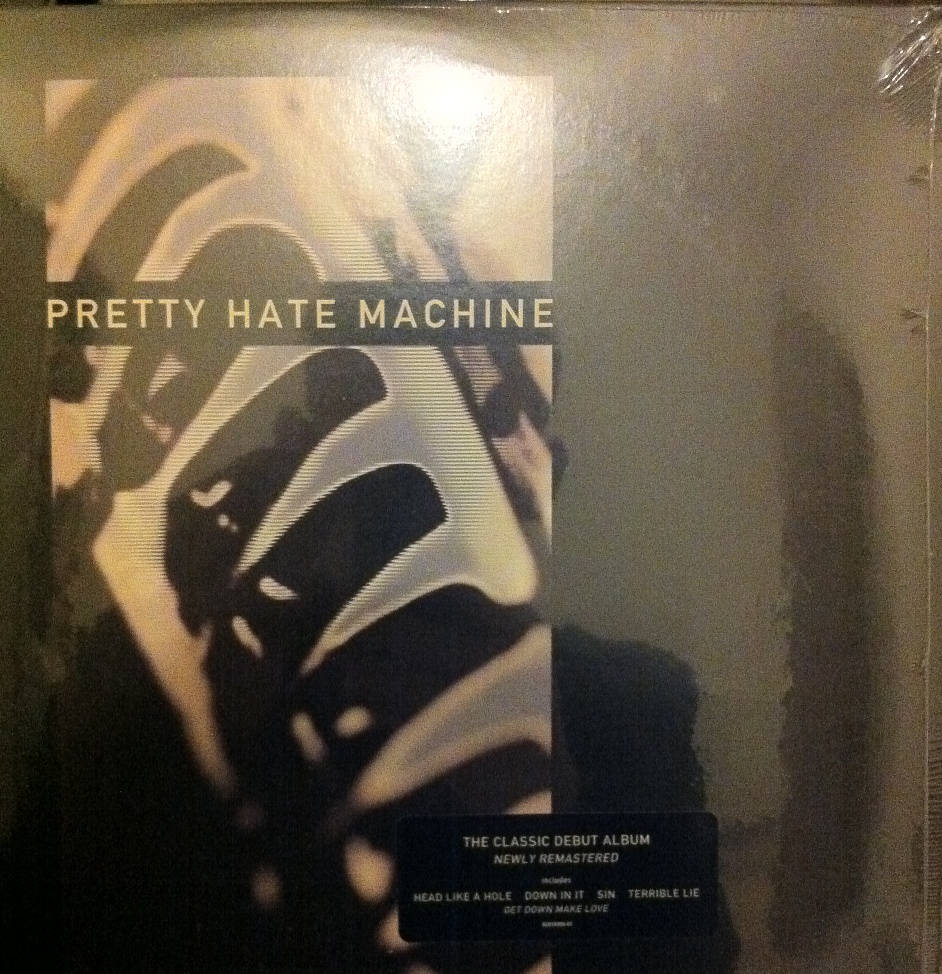
Jon Dowland: NIN album collection now complete

[pic]
With this, my NIN vinyl album collection is now complete. I don't have a comprehensive NIN vinyl collection by any account: I don't have all the singles nor the remix albums, rarities, etc., but I do have all the albums. This is the newly-remastered version of "Pretty Hate Machine", which sites proudly next to an original. I'm still waiting for the much-anticipated remaster of The Fragile, which turned 12 last month. It appears to have been sidelined by movie soundtrack work.

Next.

Previous.