Search Results: "ema"

7 July 2007

Martin F. Krafft: Bircher M esli

Due to popular demand and a related story, I am herewith sharing my recipe for what I consider to be among the best types of food available: the Bircher M esli. As you'll see shortly, I am talking about mush, about a creamy, cereal-and-fruit-based mix of all kinds of ingredients. Its creator, Mr. Bircher designed this M esli to release the contained energy into the body very slowly. Thus, with some M esli in the morning hours, I can easily make it through to dinner without losing blood sugar or feeling down. And from the recipe, you'll be able to conclude that it's also, in fact, quite healthy. My recipe started out from a recipe by Aline's mother, but it bears little resemblance to the original, I've spent two years experimenting on it. No kidding. This also means that you don't have to copy the recipe, but you can freely replace, add, or leave out ingredients to your liking. Especially the ginger, kardamon, and chili aren't exactly what the Swiss would put in there (I almost never use ginger or chili anymore, but kardamon works really well). Without further ado:
martin's M esli
Ingredients (4-6 servings)
  • 1 large banana, mushed
  • 2 apple (not too sour) or pear, grated, but not too fine
  • 1-2 kiwi fruits, cut, not too fine.
  • Optionally a mango or papaya, mushed or cut to small pieces
  • 175g frozen raspberries
  • 125g frozen blueberries
  • 30g ground hazelnuts
  • 30g ground walnuts
  • 500g single-fruit or plain yoghurt (can be low fat; alternatively quark, fromage blanc, cottage cheese)
  • 100-150ml milk or cream (can be low fat)
  • 200g oat flakes, fine
  • several squirts of lemon juice
  • a bit of lemon peel, ground
  • a slush of orange juice
  • kardamon, ginger, grated; chili powder
Preparation
  1. Combine mushed banana and grated apple into tuppaware container, squirt lemon juice and mix to prevent discolouring.
  2. Add yoghurt, kiwi fruits, nuts, lemon peel, frozen berries, and mix.
  3. Stir in oat flakes, use milk/cream and orange juice to balance viscosity, which should be a bit thicker than the fruit yoghurt. Keep in mind that you can always add a bit of milk when eating it, but you can't really make it less viscous later. Also, the oats soak up a bunch of liquid, so it'll be more solid the next morning anyway.
  4. Add kardamon, ginger, chili powder according to taste.
  5. Seal tuppaware container and leave in fridge for several hours.
Now enjoy; the M esli is best if consumed within 3-4 days. NP: Dream Theater: Octavarium Update: because licences suck, I am releasing the recipe to the public domain. Yet, if you make any worthwhile changes, I'd appreciate if you fed them back to me, and if your M esli wins a price, at least note my name in the acknowledgements of your biography.

6 July 2007

Russell Coker: Terrorism Foolishness

The Age has published a remarkably stupid article about terrorism titled “It’s hard to prevent the hard to imagine” which contains some amusing statements such as “a plan to use liquid explosives hidden in soft-drink bottles and destroy commercial jets crossing the Atlantic. The scale of this plot, combined with the innovative bomb design, threatened to kill thousands of people and cause massive disruption to global commerce“. This however has been debunked by many chemists, here is one of the many expert analysis of the claims. Here’s another inane claim from The Age “So the perpetrators in the UK looked elsewhere and compiled a crude yet potentially deadly bomb from materials available in everyday life a mix of gas cylinders, petrol and nails. Finding a way to govern access to such otherwise mundane items will be expensive, and perhaps ultimately, impossible.“. It’s surprising that The Age editorial team were unable to find someone who knows the basics of chemistry or who has ever had a need to start a fire to review the article. Everyone should know that an oxidising agent is necessary for combustion - and a huge quantity of an oxidising agent is needed for an explosion. Petrol vapour won’t ignite if it’s too concentrated (it can displace enough oxygen to prevent combustion). When a gas cylinder is damaged and set alight you get a fireball surrounding it which may be several meters wide (the one occasion that I witnessed a damaged gas cylinder on fire the fire-ball was about 4 meters wide). But no explosion. To propell nails or other solid objects you need the combustion to be rapid and only on one side of the object. Combustion on all sides (IE a 4 meter wide fire-ball) will not propell nails. Here’s what a British Army bomb-disposal operator has to say about it in The Register. If you want to talk about dangerous items that are difficult to control how about cars? A terrorist who drove a 4WD along the footpath of Oxford St could potentially kill more people than the London bombings and would take almost no preparation. The article inevitably concludes with claims about the efforts that al Qaeda operatives are supposedly making to recruit people for terrorist missions. Naturally it ignores the best recruiting method of al Qaeda - the huge civilian death toll in Iraq since the US led invasion. The best available medical research (by researchers from Johns Hopkins University and published in The Lancet - the most reputable and prestigious medical journal) estimates that there were 655,000 “excess deaths” as a result of the invasion in the period up to July 2006. Over the last year the best available reports suggest that the violence in Iraq has got worse (among other things the number of US air-strikes is twice what it was last year). For more analysis of the fear-mongering being done by much of the media (including The Age) here’s another article from The Register. It’s interesting to read The Age’s article Truth first casualty of the internet?. Maybe they should publish an article titled Intelligence first casualty of print media?.

Biella Coleman: Blue Cross Blue Shield Internal Memos Leaked

Don’t you just love leaked corporate memos? I do. They are a window into that which we KNOW exists, yet we are not privvy to very often. Because corporations like to keep their dark, dirty secrets well hidden. Memos give us access to what I call in High Academic Jargonese “Corporate Psychological Interiority,” or to put in simpler language: memos allow us to see corporations crapping in their pants. Gross, but pleasant to see from time to time. I just got word of leaked memos from the Insurance Company I love to hate: Blue Cross Blue Shield. The four pages are chock full of interesting stuff, so take a read for yourself. Here, I will only highlight two things:
* Horizon BlueCross/BlueShield is picked out early in the film in a collage of stories citing bad
treatment of members.
And well, as most readers here know, I concur. Well at least
Blue Cross Blue Shield of New Jersey/Horizon can be proud for being one of the worst. In their concluding talking point sections, they say:
2) The Blues recognize the need for improvement of both the coverage and delivery of healthcare.
But the divisive tone set forth by Michael Moore and his movie “Sicko” is not helpful. Positive
change to our healthcare system can be best achieved through shared responsibility, not
recrimination. To ensure Americans have access to the best healthcare that is both timely,
efficient, and of high quality, requires the collective contribution of all stakeholders
consumers, providers, employers and the government.
Try NOT being angry at a 4,000 dollar bill or worse, an 80,000 dollar bill, or even worse a death. It is near to impossible to stop the rumblings of anger. We are human beings, after all. We are born with the capacity to think and feel, passionately and deeply. And some of the best change comes from the fire that is anger and I hope that enough Americans are finally feeling the fire.

Biella Coleman: Happy B-day SC

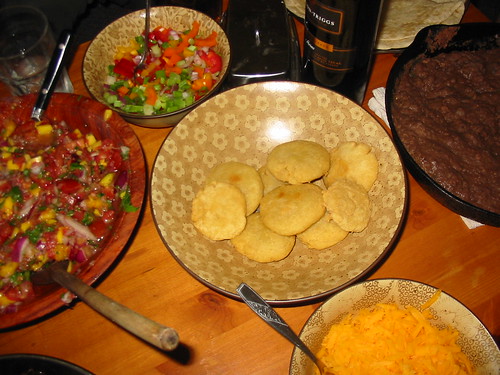
arepa So, we did manage to have some pancakes to celebrate Debian’s Big 10 (Social Contract) anniversary, though albeit, they are not your traditional sort of pancake, but certainly close enough and really tasty.

MJ Ray: One-eyed iPlayer

So iPlayer, the BBC's on-demand 7-days TV download service, launched as Microsoft-only, despite the feedback to the trial service. They come along to events like hackday pretending to be our friends, but they're really not. It's more BBC Backdoor than BBC Backstage. My IMDB-listed friend Martyn Drake estimates the cost of using iPlayer as at least 215 for GNU/Linux users and you can't do it with free software. It seems to be even more expensive for a Mac.
"The BBC should remain impartial, but they're currently having hot patootie with Bill Gate and his chums in Redmond. They continue to use OUR license fee regardless of our objections to their dimwitted decision to use DRM, and now say they'll review the situation is six months. Thanks, BBC. Thanks a lot. Can I get some of my license fee back to afford these additional costs, please?"
No wonder the Open Source Consortium says they'll complain to the European Commission - it's blatent bundled sales. TV has got away with worse in the past (for example, Channel4-satellite requires you to buy Sky), but the BBC's TV-tax-funded services had been getting progressively freer. This latest reversal of that makes me wonder whether Freesat will be fully-viewable with free software. Also, they're up against another big problem: given a choice between the expensive and inconvenient legal iPlayer and the free and easy illegal torrents (which I'm told have US imported shows earlier), which will users choose? Surely not even the BBC's advertising power will overcome iPlayer's 200 quid bundled sale and auto-delete? Let them know it won't: petition the Prime Minister to open iPlayer. The BBC is a Royal Charter Corporation and should act in the public interest.

Rob Taylor: Introduction to Codethink

As those of you who’ve been a bit more observant may have noticed, I now have a new company - Codethink Ltd. It’s really just starting up, but so far we’ve been doing work on HAL, OHM and Tinymail and it’s been good fun. However I don’t want to go the normal contracting house route of taking on employees to supply demand. This inevitably leads to static power structures and static role assignments which generally seems to lead to inefficiency, conflict and boredom as a company grows. Where I want to take Codethink: In business, I believe the future lies in loosely connected individual contractors, dynamically coming together to attack a project or idea, much as was described a few years ago in the seminal article ‘The Dawn of the E-lance Economy’ by Malone and Laubacher (Though I have to admit I hate the term ‘E-lance’..). Back then a few businesses were started up to try to facilitate this, like guru.com and elance.com, but I think these fail fundamentally as they don’t represent the knowledge of the network - that requires real people who actually know each other. Of course here in open source we implicitly understand the importance of knowing each other’s strengths, the importance of introducing new people to our community and building new expertise. This can only happen in loosely-bound structures, where cost of entry is negligible - quite the opposite of the standard large-corporation model. So with Codethink I propose to act as an agent of change. I plan to provide support and help to groups and individuals who want to strike out on their own. I will use my knowledge of the management, architectural and coding expertise of these individuals to provide the service of assembling teams to attack projects for clients. There needs to be another side to the equation. For this to scale, I also need to invest in bringing new people into our open source world and training them as experts able to strike out on their own. So that means taking on employees of a kind - but with the covenant that I will be expecting each employee to be looking at becoming her own boss in time. So my cards are on the table now - for this plan to work it needs to be transparent by default. It may turn out to be a crazy idea that’ll never work in practice, but lets see. If anyone wants to chat with me about these plans, you can find me at rob.taylor@codethink.co.uk on email and XMPP and I’m always around as robtaylor on Freenode and GIMPNet.

Wouter Verhelst: Beid issues: survey

I've been receiving a number of bugreports, both formal bugreports through the BTS and just people contacting me through regular mail or otherwise, about the packages for the Belgian Electronic ID card that I maintain for Debian. I think I'm starting to see a pattern in the bugs, but I'd like to be sure; and in order to be sure, I'd like for people who use beid on Linux to please send me the following information: I'd appreciate it if people willing to help me out could send me an email with their answers to the above at wouter+beid@grep.be. Thanks. The pattern that I'm seeing currently is that people using the ACR38u chipset (as in the eID cardreaders sold by Zetes and the government) on amd64- or em64t-based machines cannot get it to work. What I'd like to find out is whether it works on other 64bit architectures, and/or whether it is acr38u-specific. Of course, I'm not doing this on a for-pay basis (I 'simply' maintain the Debian packages), so there's no guarantees of me fixing these issues here. Your cooperation is greatly appreciated.

Russell Coker: Robots vs Sheep

Mark Greenaway writes about writes about robots being designed to remove weeds from farms. This seems like a bad idea given that we currently have an energy crisis due to CO2 emissions from power plants causing environment change (including reduced water supplies), and coal and nuclear power plants requiring water to produce electricity (pity about the reduced water supply). Introducing robots that require either electricity of petrol for operation and also maintenance (which probably requires plastic parts on occasion) seems to be more of a problem than a solution. Fortunately there is already work in progress on training sheep to eat weeds. Given that we already raise sheep for wool and food it makes more sense for them to eat unwanted vegetation (weeds in a vineyard is the example given) than to grow grass specially for them. Also Mark says that the recent increase in oil price is not good news. What would be ideal is a slow steady increase in petrol prices that allows individuals and companies to change to more efficient vehicles (smaller and slower vehicles, hybrid vehicles, and more use of public transport) and also allows governments to make changes (such as building new public transport infrastructure). Having the oil remain cheap until it starts to run out doesn’t do anyone any good (apart from the short-term interests of oil companies).

Anthony Towns: GPLv3 and Debian

So with the GPLv3 and LGPLv3 finally out (hurray!) it’s time to actually pay attention to the practical consequences of an upgrade to the world’s premier copyleft licenses. One of the things I hadn’t noticed, though I should have, is that the LGPLv3 is not compatible with the GPLv2 – that is, GPLv2 programs that used LGPLv2 libraries cannot make use of new versions of those libraries released under the LGPLv3 without also updating their license to GPLv3 (or “GPLv2 or above”, or LGPLv2 or LGPLv3 or something similar). Fortunately one of the major LGPLv2 libraries out there – glibc – is reportedly going to remain available under the LGPL v2.1 but for other libraries, it could become a problem, and it’s something GPLv2 authors will need to pay attention to. Also fortunately the opposite problem – GPLv3 apps using LGPLv2 libraries isn’t a problem, because the LGPLv2 explicitly allows redistribution and modification under the terms of GPLv2 or later, so you can take an LGPLv2 library and incorporate it in a GPLv3 application and just release the whole thing under the GPLv3. Unfortunately, the LGPLv3 doesn’t have a similar clause, so when the GPLv4 comes out, if it ever does, we could easily find the GPLv4 apps can’t use LGPLv3 libraries, and GPLv3 apps can’t use LGPLv4 libraries. Really these are side-effects of a fundamental change: up until now, almost everything we’ve distributed – and certainly all the low level stuff: the kernel, the C library, the compiler, the shell and basic tools – have all been under a GPLv2 compatible license. Some of them have been more flexible than that, due to being under a BSD or MIT license, or being under the LGPL or having a “GPLv2 or later” clause, but we’ve been essentially able to ignore all that and just treat everything as GPLv2. There are a few exceptions that we have to deal with – the occassional app that’s not GPL compatible doesn’t cause much of a problem, because things that depend on it don’t usually create copyleft issues, which just leaves checking that it doesn’t use any GPL-only libs, such as gnutls or libreadline. Openssl is a nuisance, in that it’s a popular, GPL-incompatible library, but it’s also reasonably easy to deal with on a case by case basis. But with the GPLv3, that changes: as GPLv3 apps and LGPLv3 libraries get uploaded, the assumption that more or less everything is GPLv2 compatible goes out the window, and while some things are GPLv2 only (such as the kernel!) we also can’t assume everything is GPLv3 compatible. Fortunately, both the GPLv2 and GPLv3 have what is known as the “system library” exception, which allows you to not bother distributing the source to your C compiler or C library or kernel with your app, because everyone’s assumed to have one of those already. Unfortunately, the GPLv2 version of that exception includes the phrase “unless that component itself accompanies the executable”, so Debian has always cautiously assumed the exception doesn’t apply to us, because everything we distribute in main “accompanies” everything else in main – kernel, C library, C compiler, etc. Equally unfortunately, while the GPLv3 avoids that problem, but ends up with a clause that’s not terribly comprehensible, despite a couple of rewrites during the drafting process. What’s all that mean? The big thing is that it means Debian’s going to have to put a bit more attention into the system library exception, both for GPLv2 and GPLv3 apps, because our current policy of trying to avoid needing it is probably not going to be sustainable. I’m not sure how in depth we’ll need to go for that; we’ve already contacted the FSF licensing folks for an explanation of the GPLv2 clause in relation to the CDDL, but it’s possible the FSF might prefer to be ambiguous in responding so as to keep their options open for defending or enforcing the GPL later, in which case we might need to get legal advice of our own as to what we should do. The second thing is that in reviewing our understanding of the system library exception, we might be in a position to have a Debian GNU/OpenSolaris port, making use of the exception for the CDDL-licensed OpenSolaris kernel and libc, as Nexenta do. That seems to me to be almost certainly possible for GPLv3 (or “GPLv2 or above”) applications, and probably possible for GPLv2 apps as well. If so, that’ll let us expand Debian to supporting four kernels in the near future: Linux, Hurd, FreeBSD and OpenSolaris, which will be pretty fun, in my book. The downside, is that if we find an interpretation of the system library exception that lets us mix and match licenses comfortably, that same interpretation might be able to be used to let propietary software vendors mix and match GPLed software with non-free software, rather than just free software with different copyleft licenses – and thus defeat the entire point of copyleft. What’s worse, is that by following Debian’s lead, they’d have some moral authority in doing that, beyond just having a legal argument as to why it’s okay. And that’s the rub. (My thoughts on the license texts as posted to -legal are here, here, here and here.)

5 July 2007

Aigars Mahinovs: Photos, photos, photos

Finally I took my time and uploaded all my good Debconf7 photos to Flickr, 193 photos in total. Most interestingly I have created a much improved version of the group photo.
Debconf 7 Group Photo
Please do note that these photos are under Creative Commons Attribution licence, so please do give credit where it is due. And I also would love if you would send me an email telling where you have used my photos of the event. Links to other photos (and mugshots) can be found via the corresponding wiki page.

Russell Coker: Fragmenting Information about Jobs

A comment on my previous post about my Linux Jobs Blog suggested that I shouldn’t fragment the information. However I believe that fragmenting the information is ideal due to the ability of RSS syndication to drive the cost of coalescing the information to almost zero! Currently there is a Linux job web site run by Linux Australia. It doesn’t have many adverts and isn’t even linked from the main Linux Australia web site. I believe that we can do better for the people who want Linux jobs and the people who have such jobs to advertise. If you have a central site the jobs have to be moderated (which takes work and delays listing), the larger the area that the site covers the greater the work is to do this. The solution is to have a distributed system with different people running listings for various regions and a syndication service to aggregate them. To start this I have created a blog which will have categories for the states and territories of Australia. Someone who is only interested in one region can visit the category for that region. Then recruiting agencies and companies which regularly hire Linux people can start their own RSS feeds to be syndicated in a planet instance for each state and territory. This gives a faster and more efficient response (adverts will appear quickly, can be changed or removed at any time, and less effort for moderation. I expect that recruiting agencies will occasionally post off-topic entries - but when their feed gets removed from the Planet installation they will probably make a commitment to do the right thing in future. Planet installations can syndicate other Planet installations, so we can easily have a Linux jobs Planet for Australia (possibly run by Linux Australia) that syndicates the feeds from each state and territory. In the long term I think that the best way of running this is to have Linux Australia run the central Planet instance and a LUG in each region run the local site. I started running it myself because I didn’t get a positive response when suggesting it to the relevant people in Linux Australia and LUV. That didn’t deter me, so I decided to set it up myself. If the idea takes off and if Linux Australia and the LUGs want to take it over I’ll be happy to use HTTP redirects to send the traffic to them - and help them with the sys-admin work if asked. Also there is nothing specific to Australia in this idea. I am only interested in Australia because if I was to attempt to do it in a larger area (such as the EU) then I could spend all my time on it without gaining a critical mass in any region. If you are interested in running this in your region then you need to set up a blog (for adverts that are sent to you via email) and a Planet installation that feeds from your blog and any other Linux job advert blogs in your region. If your country doesn’t already have a central Planet for jobs then creating a separate Planet installation for your country would be a good idea too. I will be happy to run a Planet installation for world-wide Linux job adverts (at least until I can convince an organization such as Linux International to run it) if this idea takes off in other countries. Some people have asked what the benefit of a Planet is over a mailing list. You have to subscribe to a mailing list while with a Planet you can immediately visit it if you suddenly decide to find a new job. Subscribing to mailing lists for jobs from all countries would never work, but visiting a Planet for Linux jobs world-wide and then visiting a sub-planet for regional jobs would be quick and easy.

Peter Makholm: Aniversaries

Principia Mathematica 320 years, Spam 70 years and Debian Social Contract 10 years. Things that changed the world?

MJ Ray: New (or new style) memberships and blog groups

I was accepted as ODP Editor: slef for the Weston-super-Mare Business and Economy listings a while ago, but I forgot to mention it here until now. I've just done a bit of basic tidying there so far and I'm finding my feet. ODP seems rather more structured and process-y than WWWVL ever was. I'm not sure whether that's good or not. I've also gained a LinkedIn Profile: MJ Ray after an invitation (and real email) from Richard Smedley of M6-IT, if that interests anyone. LinkedIn seems to work even without Javascript (ignoring the odd layout bug), but it really seems to get much slower in the English afternoons - America waking up? I've done a bit of CSS-tidying on my main site, my debian site, and OtherWayUp - I'm also looking to launch new groups on OtherWayUp. If you have a blog from or about Somerset or Cooperatives that you'd like to appear there, please leave me a comment or email.

MJ Ray: Music Skill Share Day in Bristol

Ben Green writes:
"All welcome to demo or watch, or get stuck in. 10am-4pm at the Trinity Centre Radio Studio BS2 0NW this Sunday 8th July. Please bring laptops and pluggable linux compatible sound kit. Small sets of speakers an headphones also good. We'll have access to 3 AMD64 machines with 64Studio installed. Please ask if you have any question, contact me through email or call Bristol Wireless to get other contact details, such as my mobile number. Entrance to the trinity will be through the back door, please be patient once you have rung as it's a long way from the radio studio to the back door. Ooo, and it's free. Cheers all, see you there."
(Seen on BBLUG)

4 July 2007

Mike O'Connor: Celebrating Freedom

My wife was very excited to hear that debian will be celebrating the 10th anniversary of the Social Contract with a virtual pancake party. She could care less about the social contract, she's just happy to have an excuse to have me make her pancakes again. In any case, I thought I'd share my favorite recipe for pancake batter:
Oatmeal Pancakes	
2 eggs
4 T. veg. oil
1 3/4 cup buttermilk
1 cup all-purpose flour
1 cup rolled oats
3 Tbl. brown sugar
1/2  tsp. cinnamon
2 tsp. baking powder
1/2 tsp. baking soda
1/2 tsp. salt
Beat eggs in medium-sized bowl.  Beat in vegetable oil until well mixed, then stir in buttermilk.  Add remaining ingredients and stir to blend. 

Russell Coker: Linux Job Ads

It seems to me that we need to have syndicated feeds for Linux job adverts. To start this I have created a new blog for Linux job adverts, it will have categories for the states and territories of Australia (with a feed for each category) and I will also create Planet installations that take feeds from the blog as well as any other Linux jobs RSS feeds. I will create the Planet installations when I have feeds to add. If your company regularly advertises Linux jobs in Australia then please create an RSS feed of the adverts and I will syndicate it. If your company occasionally advertises Linux jobs then you can email them to me. As of this moment there are no positions advertised, but I hope that to change soon.

3 July 2007

MJ Ray: Comments on coverage of the Tour de France

I asked for any other free-to-air satellite coverage of the Tour de France and Bernie S commented:
"RAI 3 on Hotbird"
and there's an online schedule on the RAI 3 site. Neville Emerson wrote:
"Can't wait. Cycling is the best and coverage is getting better and better every year."
Yes, at long last. There's now a full itv coverage listing on the CTC site but I still don't understand why itv are so late at launching their tdf site! Speckled Hen asks:
"Anyone know if there's any live coverage online? Can't see anything on either Eurosport or ITV web sites. I know the Beeb usually do it with rugby internationals."
I heard of some recorded items from ASO (Amury Sport Organisation, the tour's managers) on YouTube, but nothing about live video feeds yet. I've had audio in the past from both Radio France and Eurosport but I've not even found those details for this year yet (I'm slow at reading French and the new Yahoo Eurosport site is terribly hard to navigate). Keep watching Cycling Fans and TdFBlog (who kindly linked this item in their coverage summary ) for news of video coverage. Unless anyone would like to leave me details of live online coverage in a comment on my site, please?

2 July 2007

Romain Francoise: Emacs 22 in Ubuntu Gutsy

News from the other side of the fence: Mike Olson has prepared Emacs 22 packages for Ubuntu Gutsy, based on my emacs-snapshot packages for Debian. Go Mike!

Ingo Juergensmann: Alice ist nicht die nette Dame aus der Werbung

Wie ich bereits letztens beklagt habe, sind Callcenter die Pest des 21. Jahrhunderts.
Heute allerdings wurde dem Ganzen noch die Krone aufgesetzt.

Heute mittag rief mich der Vater meiner Freundin an, da die bei der Telekom-Hotline nichts von einer Bestellung w ssten und der Port ja sowieso noch gar nicht freigegeben w re. Also rief ich (mal wieder) nach Feierabend bei der Alice Hotline an. Komischerweise habe ich da eigentlich auch fast nur Frauen an der Leitung. Aber die heissen in keinster Weise alle Alice, auch wenn Ariane ebenfalls ein sch ner Name ist. Noch st rker bezweifle ich, da die Damen so h bsch aussehen, wie die Alice in der Werbung. Das w rde allerdings die Unf higkeit der Alice Hotline erkl ren, warum die nichts auf die Reihe bekommen. Man kennt ja durchaus den Spruch, wo der Intellekt in ein entsprechendes Verh ltnis zur Qualit t etwaigen Geschlechtsverkehrs gestellt wird. Sei's drum...

Nachdem ich ber geschlagene 10 Minuten a 14 /min auf die Weiterverbindung von der allgemeinen Hotline zur Abteiligung f r die K ndigungen warten musste, erz hlte mir die eher weniger als mehr nette Dame von der Alice Kundenbetreuung, da ja die K ndigungsbest tigung schon l ngst rausgegangen w re. Auf meinen Einwand, da diese noch in keinster Weise bei uns angekommen sei, meinte sie dann, da sie die gerne noch einmal rausschicken k nnte - so wie die gute Dame am letzten Dienstag dies auch schon machen wollte und wo die Best tigung ja dann am n chsten oder bern chsten Tag da sein sollte.
Dieses Mal hatte Alice, ehm, die Kundenveruntreuerin allerdings wohl dazu gelernt, was sie wohl auch aus der allgemeinen Hotline-T tigkeit zu h heren Weihen bef rdert hat - oder war das vielleicht doch nur die Best tigung f r obiges Sprichwort? Na jedenfalls meinte diese "Dame" dann auf meine Nachfrage, wann wir denn wohl mit dem Eingang der K ndigungsbest tigung rechnen k nnten, da sie das blo ins System eintr gt und der Brief dann wohl gegen Ende der Woche verschickt werden w rde.

Nun sollte man sich ja eigentlich als unbedarfter Kunde freuen, wenn ich blo nicht den Fehler gemacht h tte zu fragen, wann denn der Port abgeschaltet werden w rde. Denn das passiert auch gegen Ende der Woche.
Mit anderen Worten: wenn wir die K ndigungsbest tigung von Alice bekommen, brauchen wir sie gar nicht mehr, weil der Port eh schon freigegeben wurde.

Ohja, manchmal f hle ich mich bei Alice auch wie im Wunderland... seufz

Gunnar Wolf: Keep rolling!

It seems that I've held up -at least for half a year- what I stated back in January - I come by bike to work almost every day, and really enjoy the time spent on two wheels. My times have -of course- improved, as has my dominion of the bike - I make ~10 minutes each way (must be a bit more on my way to work than on my way back, as it is uphill).
My city's government seems to be seriously promoting people to consider using the bicycle as means for regular transport and not just as a recreational device - I see some of its measures as quite silly, but some are just perfect. One week ago, while I was on the plane from Edinburgh, we had the first Ciclot n, a 32Km ride open to everybody (and of course, Nadezhda was among them). Over 70,000 people took part, reportedly, and it seems it will be held monthly. Besides that, yesterday we had the paseo dominical in Coyoac n very close to my house - What's that? Something similar to the ciclot n, only much smaller (14Km), much less publicized, and in a different place of the city every Sunday. Well, we started up the day at 8 AM by cycling from Metro Copilco to Miguel ngel de Quevedo, Av. Universidad, R o Churubusco, Divisi n del Norte and Henriquez Ure a back to Metro Copilco. We later learnt that around 10,000 people took part. 14 Km, 30 minutes - not bad, and quite enjoyable!
We didn't go for the second round, because we wanted to be by ~10 AM at Reforma, probably the city's most emblematic avenue, to be part of the demonstration marking one year of the electoral fraud. But... Well, we didn't want to just leave the bikes at home and go by metro - What can we do? Yes, take the open streets. We followed a bit of the path we had taken a bit earlier, then took Minerva, Insurgentes until Reforma (~45 minutes). And once we got to the meeting point, we didn't want to step down and crawl the bikes along... So we both found out that not only we dared take the main streets where people are not really used to cyclists and where taxi drivers will often try to make a point that if you don't own a car you should use a taxi and not a bike - We were able to cycle most of our way to Z calo, going slowly and moving through people, in what seemed to be almost an unthinkable feat for me just a couple of months ago. We can now control the bike, we can even be almost still while riding it, and not crash into anybody!
Of course, the way back was similar - We took our bikes across Obrera, Doctores, Algar n and lamos, then took Av. Universidad all the way down to Copilco, and -after some three hours riding, with my arms quite red and of course somewhat dehydrated and sore-butted- got home.
It feels great to have a well-deserved siesta! And... Well, biking is just too enjoyable. I guess we had ~45Km yesterday, plus some ~5 extra zig-zagging through the crowd. It rules.

Next.

Previous.