Search Results: "ana"

18 February 2008

Michal Čihař: Network manager not working?

For a long time I had problems on my work computers with Network manager still thinking that it is not connected. And I was really lazy to debug it. But as more and more application take online/offline settings from it, this became more and more annoying. After some googling I found out that the problem might be in /etc/network/interfaces file, which is parsed by Network manager. Some "complex" things might confuse it. Well in my case the complex thing was calling of some script in post-up. Commenting this out magically fixes everything. Moving script to /etc/network/if-up.d/ also is not a big problem, but why the hell the Network manager thing does not tell where the problem is?

Remi Vanicat: Who is playing with my cpufreq parameter?

I’ve a problem for some time: something seem to be changing my cpu frequency behind my back, and I don’t know what is doing it. It happen when the computer is doing cpu intensive mostly non interactive thing, as watching certain .avi with some codec. The change of cpufreq is relay a problem because then the cpu became to slow to decode the film at the speed I need to see it. So, what happen ?
If I use the ondemand governor, it seem that it will eventually believe that I do not demand cpu anymore, slow down to 800Mhz, and one cannot look at the film anymore…
If I use the userspace governor, setting the frequency to the max available value, well, the frequency will eventually change to something smaller. It will even lower the max frequency… Worst still, cpufreq setting won’t change to what I want if I ask for it:
# cpufreq-info && echo && cpufreq-set --max 2GHz && cpufreq-set -f 2GHz && LC_ALL=C cpufreq-info
cpufrequtils 002: cpufreq-info (C) Dominik Brodowski 2004-2006
Report errors and bugs to linux@brodo.de, please.
analyzing CPU 0:
  driver: powernow-k8
  CPUs which need to switch frequency at the same time: 0
  hardware limits: 800 MHz - 2.00 GHz
  available frequency steps: 2.00 GHz, 1.80 GHz, 1.60 GHz, 800 MHz
  available cpufreq governors: userspace, powersave, ondemand, conservative, performance
  current policy: frequency should be within 800 MHz and 1.20 GHz.
                  The governor "userspace" may decide which speed to use
                  within this range.
  current CPU frequency is 800 MHz (asserted by call to hardware).
Not only my setting have been changed, But they won’t change back to what I want. I have to wait sometime, before demanding cpufreq-set to change my setting if I want them obeyed.

Russell Coker: Oracle Unbreakable Linux

Matt Bottrell writes about the Oracle Linux offerings presented at LCA 2008 [1] The one thing that Oracle does which I really object to is the “unbreakable” part of their advertising. They have pictures of penguins in armour and the only reasonable assumption is that their system is more secure in some way. As far as I am aware they offer no security features other than those which are available in Red Hat Enterprise Linux, CentOS, and Fedora. The unbreakable claims were also made before Oracle even had their own Linux distribution, which gave them even less reason for the claims. If someone is going to be given credit for making Linux unbreakable then the contributors list for the SE Linux project [2] is one possible starting point. Another possibility is that credit could be given to Red Hat for introducing so many security features to the mainstream Linux users before any other distribution. In terms of improving the security of databases it’s probably best to give credit to Kaigai Kohei and the PostgreSQL team for Security Enhanced PostgreSQL [3]. I believe that NEC also deserves some credit for sponsoring Kaigai’s work, I am not sure whether NEC directly sponsored his recent work on SE-PostgreSQL but they certainly sponsored his past work (and are credited on the NSA web site for this). Oracle’s Linux distribution is based on CentOS and/or Red Hat Enterprise Linux (RHEL). The situation with RHEL is that the source is freely available to everyone but binaries are only available to people who pay for support. CentOS is a free recompile of RHEL and a good choice of a distribution if you want a server with long-term support and don’t want to pay Red Hat (I run many servers on CentOS). While Matt gets most things right in his post there is one statement that I believe to be wrong, he writes “One of the craziest statements I heard during the talk was that Oracle will only support their products running under a VM if it’s within Oracle VM“. My knowledge of Xen causes me to have great concerns about reliability. My conversations with MySQL people about how intensive database servers are and how they can reveal bugs in the OS and hardware are backed up by my own experience in benchmarking systems. Therefore I think it’s quite reasonable to decline to support software running under someone else’s Xen build in the same way as you might refuse to support software running under a different kernel version (for exactly the same reasons). Matt however goes on to make some very reasonable requests of Oracle. The demand for native packages of Oracle is significant, I can’t imagine official Debian package support appearing in the near future, but RPM support for RHEL etc would make things easier for everyone (including Oracle). A better installation process for Oracle would also be a good thing. My observation is that most Oracle installations are not used for intensive work and use database features that are a sub-set of what MySQL offers. I’ve seen a few Oracle installations which have no more than three tables! The installation and management of Oracle is a significant cost factor. For example I used to work for a company that employed a full-time Oracle DBA for a database with only a few tables and very small amounts of access (he spent most of his time watching videos of fights and car crashes that he downloaded from the net). Adding one extra salary for a database is a significant expense (although the huge Oracle license fees may make it seem insignificant).

17 February 2008

Russell Coker: Laptop vs Book Weight

Matt Bottrell wrote an interesting and informative post about laptops for school kids [1]. His conclusion is that based on technical features the OLPC machine is best suited for primary school children and one of the ASUS EeePC, the Intel Classmate, and the Everex Cloudbook would be best suited for high-school students. The Asus EeePC [2] is a good option, it runs a variant of Debian and the Debian Eeepc Team are active in getting full Debian support for it [3]. The Intel Classmate [4] has a choice of Windows XP, Mandriva, and Metasys Classmate. The web page says that it’s designed “for primary students (ages 5-14)“, so I think that Matt made a mistake in listing this as a possibility for high-schools, of course when running Mandriva it could have software installed for any age group but the hardware design may be better suited to younger children. The Everex Cloudbook [5] runs the GOS Rocket [6] OS which seems to be an Ubuntu variant with an Enlightenment based GUI and a configuration aimed at using Google services (blogger, gmail, etc). Configuring Ubuntu to suit your needs is easy enough (it’s based on Debian). Note that Matt did not mention where one might purchase a Cloudbook in Australia and I don’t recall seeing one on any of my many window-shopping expeditions to Australian consumer electronics stores, while the EeePC is widely available (except when sold out). But I’m sure that if the government wanted to place an order for a couple of million units then Everex would ramp up production quickly enough. Matt made one statement that I strongly disagree with, he wrote “A traditional notebook is far too heavy for high-school kids to lug around“. To test this theory I searched for some high-school text books and a set of scales. A year 11 Maths A text book from ~1988 weighed 600g and the pair of year 12 Maths A and Maths B texts weighed 1.6Kg. When I was at high-school the day was divided into seven “periods”, some classes took two periods so four different classes which required text books (or other books) was typical. Carrying 3Kg of books to school would not be uncommon for year 12 students. The Lenovo T series (advertised as “premier performance” and the model I personally prefer) is listed as having a starting weight of 2.1Kg (which presumably doesn’t include the power pack). My Thinkpad T series (from about 2004) weighs about 2.4Kg according to my kitchen scales and has a battery weighing just over 400g. My practice for a long time was to own a spare power pack for my Thinkpad so that I could leave it at work (saving 400g when travelling to and from work). I have also had the practice of buying a spare battery when I buy a Thinkpad (you need a spare battery for a long trip). So if I had really wanted to save weight I could have left a battery at work and reduced by travel weight by another 400g (with the cost being that I couldn’t use it when on a train or bus). A spare power pack is not overly expensive. In the usual case students would only need a battery when at school (it’s a little known fact that Thinkpads work perfectly without a battery plugged in). So if a student had a power pack at home as well as one at school and if they left their battery at school and they owned one of the latest Thinkpad T series (listed with a starting weight of 2.1Kg) then their travel weight might be about 1.7Kg. If the majority of school texts could be stored on their laptop then the result of using a Thinkpad T series would be a significant weight reduction! If the students were using a Thinkpad X series (more expensive so maybe not a good option) then the list weight is 1.57Kg and the travel weight might be as low as 1.3Kg (at a rough estimate). The EeePC offers significant benefits for school use, it is light, cheap (children tend to break or lose things more frequently than adults so you should budget for buying two of anything that they use), and having no hard drive (flash storage) it should cope well with being dropped. The screen on the EeePC is unreasonably small buy Asus could release a new model with a bigger screen (they may do this in the future anyway or a government contract could encourage them to do it sooner). I agree that the EeePC or the Everex Cloudbook is probably the best option for high-school students, but I can’t agree with any claim about a traditional laptop being too heavy, the only reason for excluding a traditional laptop is that those new ultra-lights are better. Another reason that might be cited for not using laptops is the cost. While prices of $1000 or more for a traditional laptop are rather expensive, the $500 for an EeePC is not that expensive - and the government could surely negotiate a better deal, I would be surprised if they couldn’t get the price down to $350 by some bargaining and by removing the middle-man. A careful child could use the same laptop for the entire duration of high-school and their parents would incur less expense than they currently would spend on text books. As for the current lack of electronic text books. Currently when the education department selects a book it’s a license to print money for the author and publisher. All that the education department has to do is to declare that they will do a deal with the first company to release their books under a creative commons license. The idea would be that an author (or publishing company) would get paid a fixed sum of money for a CC release of a text book which would then be available for use by anyone anywhere in the world. World-wide free distribution would be no loss to the author (each country tends to have unique books anyway) but would be a good act of charity from our government to developing countries. Once books were available under a creative commons license (without the “no modifications” clause) they could be freely improved by anyone. Improving text books for younger students could be a good school project. Update: Thanks to Steve Walsh for pointing out that the Classmate can run Linux. It’s a pity that he didn’t link to my post so that his readers could see what he was referring to. I take it as a good sign of the quality of my posts that such small errors get pointed out.

Matthew Garrett: Boston

Back in the US, crashing with [info]kernelslacker and marvelling at the fact that Snoop Dogg has a reality TV show on bringing up kids. It also seems that the cosmetics industry has solved the cancer problem, based on the number of adverts that show magic moisturiser molecules appearing to repair DNA.

Leaving on Tuesday, some potential for booze on Monday. I'll be at FOSDEM from Friday, and ought to be at Bossa next month. April sees LRL US and power management or laptops or some sort of hangover-inspired song and dance interpretation of the driver model.

(Edited: cancer problem, not cancer industry. Sometimes I wonder about myself)

Martin F. Krafft: The Penny & Martin adventure: phase 2

Following the first phase, the second and final phase of the Penny and Martin adventure ended last Friday at Wellington airport. I am now 11 500 metres high on my way from Bangkok to Zurich, looking back at seven days on the New Zealand South Island, another in Wellington, and a night in Melbourne. Here s the summary of the 2200km we travelled, with selected photos inline. Penny has more pictures in her Flickr album. My New Zealand beer top-ten, in reverse order: Monteith s Original, Monteith s Black, Mac s Great White, Monteith s Golden, Monteith s Celtic, Monteith s Pilsener, Emerson s Pilsener, Mac s Hop Rocker, Emerson s 1812 India Pale Ale, and (drum-roll): Mac s Sassy Red. Yum! The Emerson beers get no links because the brewery website uses Flash. Thanks, Penny, for a fabulous two weeks! NP: The Flower Kings: Back in the World of Adventures

15 February 2008

MJ Ray: No Good FOSS Membership Management Web App?

A not-for-profit club has asked me to recommend a web-based membership manager that can do two main tasks:-
  1. email members when their renewal date is approaching;
  2. control access to some web pages.
(In addition, they want a web forum, but that doesn't need to be connected and they're fairly easy to find.) I'm somewhat surprised to say that I haven't found a good free software one. There's CiviCRM, but it's under an activated Affero GPL and I don't see why this non-software club should be a distributor (which is why I don't see activated-Affero software as free software). There's eZpublish (as used by FSFE) but it looks like overkill for this task and will cause more problems than it solves. Other FOSS organisations seem to be using bespoke apps. The VCS FOSS ICT wiki page is pretty bare. What would you recommend? Where should I be looking? Who to ask? If I have to write one, I'll try to make it reusable.

Andrew Pollock: [life] Worst. Recovery. Ever.

I wonder if things could go any worse if we actively tried? So despite going back to see the cardiologist on Monday afternoon, concerned about there possibly being still some sort of infection, and being told there wasn't, on Thursday morning, the top part of the incision was looking swollen. It looked even more so by the evening when I got home from work, and Sarah emailed a photo to the cardiologist, and he agreed it didn't look too crash hot, so he phoned a prescription for another, longer course of antibiotics through to the pharmacy, but too late to get filled last night. By bedtime it was looking even more ready to blow, and sure enough, around 1am (it's always 1am) it erupted everywhere. Fortunately (for me), I missed all the gory details, but I think there was a fair bit of fluid built up in there. So we went back to the clinic this morning, and they decided that they needed to open up part of the incision to let it drain and heal properly. They took another swab to run another culture, and then got a physician's assistant to take to her with a scalpel. I've seen my poor wife go through too many painful things in the last six months. Today's was no better. Most of the problem was the local anaesthetic injections, but watching them open up the incision again wasn't much fun either. No one should have to go through as much shit in a short time as what Sarah has had to. It's just not fair. She now has a gaping hole in her chest with some gauze packed in it, which has to be changed twice a day (by lucky old me). The idea is to let it heal from the bottom up, rather than the top down, as it seems an abscess had formed in the wound, and that was were all the trouble was. So by leaving it all open, it can drain properly, and heal from the bottom up. $DEITY only knows what sort of mess it's going to make of the incision area, but we can deal with that later. They reckon it'll take another 4-6 weeks to heal. I'm really hoping now that with it draining, and another course of antibiotics, Sarah will be in much less pain. I just did the evening gauze change. Fun. The opening in the incision is longer than I remembered them making this morning. It's about an inch long, and a centimetre deep, and there's a small hole in the bottom that presumably leads to the "interior". It's not as bad looking as I thought it might be. Packing the gauze in didn't seem to hurt Sarah too much, which is just as well. This really is the pits. I really hope this is the end of this, and the infection goes away for good, and the incision heals quickly. In terms of recovery, this is a pretty major setback in my opinion. From now on, we won't be relying on the cardiologist for surgical opinions, we'll be insisting a member of the surgical team checks Sarah out.

MJ Ray: Current Issues / Transport: if you tolerate this, then your green space will be next...

Looks like the Bristol Airport-M5 Link Road is in the news again.  See the Mercury news story

Meeting at Wrington on 26 February.  One of the proposed routes is through Wrington Vale.  It's disappointing that the shuttle bus services from Weston-super-Mare and Nailsea (both possible connections to the M5 and rail services from the south-west) are still pretty terrible and there seems to be few improvements in the airport's masterplan.  As a result, there's this demand for road-building and it looks like The Powers That Be may build the road instead of managing the demand.  Ouch.

In more positive transport news, there's lots of new cycle route improvements (parking, signs, bugfixes, bypasses and blessedly few new-build cycle farcilities) listed in http://www.n-somerset.gov.uk/cairo/docs/doc16354.htm

MJ Ray: The Phone Coop: Annual Meeting

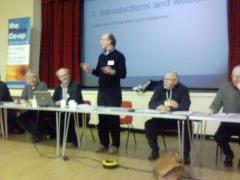
agmphoto Saturday 2 February 2008 was the annual meeting of the Phone Coop (agent link). I travelled to Chipping Norton for it and took a few abbreviated notes, which I've expanded slightly here. Ask questions if you want, but it's already fading in my memory:- Local Loop Unbundling workshop: 20 years of calls for it. 1999 ofcom announced 01 eu announced. 05 threat to breakup BT. 06 openreach split. By 2007-04 there were 2million unbundled. Distribution points and cabinets. Exchange may make even cheaper faster video. TPC LLU should launch this summer. Should take minutes to transfer. Equivalence problems - want evidence of when BT is preferred. Alarm lines: coop unable to take some. Broadband workshop: at year 2000 launch was a .5M service for GBP 40pcm. Now charge represents use. The coop has 4 ADSL specialists and it accounts for 15pc of income. Bought in three parts: tails are the links to the customers, bandwidth is then 155 or 622M fused 60m base plus extra. Home contention is 50:1, business is 20:1. Available in bundles. My.phone.coop offers a usage view with only a day's delay - might be a first for retail broadband. Ambassadors workshop: Harness cooperative difference. Customers can help to get more customers. Possibly give half our local adverts to our phone agency. Interaction with agent scheme unknown yet. Someone asked about running cinema ads. AGM: intros apologies evaluations mugs window stickers 1b 565m mins. Directors report record sales and growth. Profit again. Service progress: 2nd of 19 in Which surveys. Sven is new manager. Midcounties. Sustainability fund. Finances. Highest dividend. Sales mix changed kind rental growth. Costs down 200k. 9k postage saving. Record balance sheet. Recruiting membership manager and secretary. Currently 6735 members. Negotiating .5k sales acquisition - no info to members yet as commercially sensitive. Shortlisted for green business awards on 12 march. Questions: Mobiles? high volume only economic. What is cws? Cooperative Wholesale Society, part of the Cooperative Group. Member profile. Coop purchases. Diversity. Southern acquisitions? Regulator Dependent. Name. Biodiesel. Satisfaction, corp members, large corp custs. Miles travelled. Walking payments. Group promotion of AOL is annoying. Third party card discouraged? Member-account links. Larger affinity. Works bus. 1 against scrutineer. Directors spend on average 4 hours a week on the coop.

14 February 2008

Jordi Mallach: La Ruta del Carrilet

As Josep asks for it every now and then, and we really enjoyed this trip, it's time to write about the four days we spent cycling from Ripoll to Girona, through the Ruta del Carrilet, a Catalan via verda similar to the one we completed a year ago. I spent this year's 9 d'Octubre cycling trip with totally different trip mates, not related to my triathlon team. The extensive group was formed by Sabri, Mar, B rbara, Carles, Desi, Adela, N ria, Amador and myself. We started our journey by car from Val ncia to Mollet de Mar, where we parked the cars and take a regional train to Ripoll with our bikes, where the real journey would start.


Arrival at Ripoll When we got to Ripoll, it was quite late and dark, but we managed to find the start of the Ruta del Ferro rail trail which would take us to Sant Joan de les Abadesses. It was quite cold, but especially really humid, so we had to think twice before settling on a place to camp and setup our tents. We had to take special care of covering the bicycles as the air was really wet, and anything we left uncovered would appear soaking next morning. In part, my shoes suffered from this.

Early next morning we had breakfast on the wet grass and then started our way to Sant Joan through a deliciously well equipped and maintained cycling track, which unfortunately only lasts for 12 kilometres through a splendind landscape. After having breakfast in the old railway station in Sant Joan, we abandoned the Ruta del Ferro to take a road to Olot via Sant Pau de Seguries, where we had to climb a small mountain and then descend through the Vall de Bianya until we got to Olot.


Sant Joan de les Abadesses' railway station Asking the locals for the start of the Ruta del Carrilet was fun due to the strong oriental accent in the area and we sometimes wouldn't get a word of what we were told. An old man recommended us finding a big park in the outskirts of the town, where we prepared our entrepans for lunch, and after a little rest, we started cycling up the Carrilet, which would take us to Girona in two stages. This Catalan area is of volcanic origin, and there are several natural parks dedicated to the phenomenon. There are many mountains covered with forests and impossible peak shapes, which due to the time of the year were starting to go from green to brown and yellow, making fantastic colour schemes in the landscape.


Under a green ceiling in Olot Just after the few first kilometres, the railroad track starts to descend most of the way, which makes it easy for people who aren't too trained, and easier to enjoy your way chatting with people while you cycle. As we consumed the daylight, we came across a parish church party with lots of old and young people from the nearby town of Sant Miquel de Pineda. Amador and I were lagging behind a bit at that point, and when we got there, we found the rest of the group were already off their bikes and either having a curious look over the party, or directly following suit and dancing like the others. We had a peek into the small church and also into a small graveyard in the back, where I was surprised to find the enemies of my Catalan grandmother: Fam lia Matabosch , as one of the headstones revealed.


Partying at Sant Miquel de Pineda As it was getting late, we eventually started off again, but luckily B rbara spotted what seemed a good sleeping place for that night. To the right of the trail there was a hermitage (devoted to Santa Cec lia) up on the hill which, for bonus points, had a porch with a recently renewed roof which would help cover ourselves from humidity and rain, as we found soon after starting cooking dinner. While the cooks prepared our soup, some others went down to the Carrilet in order to find out if the next town was close so we could get some driking water for the dinner. Luckily, Sant Feliu was close enough, and we found a bar where we got some water... and two bottles of wine, which made some people back at the hermitage very happy. We were quite tired though, so we eventually went to sleep after reading some stories from a great tale book, with the sound of rain hitting the grass outside the porch. The rain was still with us when we started waking up, so we had breakfast and packed our stuff very slowly, in an attempt to avoid getting wet. But rain didn't stop, so we made a few hacks on our bicycle bagpacks to minimise the amount of rain wetting them. When we were finally ready to set off and had cycled around 3 kilometres under the light rain, it finally stopped raining, making the rest of the journey very pleasant.


Sleeping under the porch of Santa Cec lia's hermitage This part of the route is again quite beautiful, with impressive amounts of green vegetation at both sides of the track. There's a lot of water presence in the land, which makes the type of trees and bushes quite different to the ones we are used to find in the Valencian Country. After going by a few small towns, we arrived in the old railway station of Amer, hometown of the Puigdemonts. Even if it was a bit early, we decided to have lunch there, so a few of us went down to the centre of the town to buy bread and some other details to eat. Being in my friend Josep's town for the first time, I wanted to visit his family's bakery, but unfortunately it is closed on Mondays. We had lunch back at the cute station, and eventually kept going on our way to Girona. Outside Amer, the Carrilet was temporarily cut by the road, and there were two possible alternatives: using the road, with heavy lorry traffic, or diverting through a very steep track with very hard slopes. Most of the group preferred the road, but Mar, Amador and I went up that track, which was hard to climb and really fun to descend. Apparently, Amer locals call those 1.5 kilometres the Tourmalet . It's probably not so bad, though. :)


Amer's railway station Unfortunately, the Ruta del Carrilet starts getting uglier after Amer, and as you approach the more industrialised towns near the capital Girona. The area around Angl s wasn't that fun, with the track continuously being invaded by cars and other vehicles. Soon after we were in the farmland area surrounding Girona and its Devesa. Jonathan was waiting for us in the city, after his two month stay in Scotland, and we were all happy to meet him. We discarded continuing our way to the coast, which was the initial plan, and instead dropped our stuff in the house of one of Adela's friends, and went out to have dinner to a Wok restaurant, where the poor people running it suffered our childish behaviour involving the rotating central dish on our table and custard sucking contests. Jonathan guided us through the Cathedal and city wall areas of the town centre, which are impressive, and we climbed all of the wall towers to have great looks over the dark and quiet city. Eventually, we went to sleep, as Adela had to leave early, and we had to pack to get our train back to Barcelona. Back in Mollet, we cooked our last camping-gaz lunch in the park right next to the station, before noticing the place stinked of dog poo. After the careful operation of filling the three cars with 9 bicycles, we were finally on our way back to Val ncia, completing another great cycling journey. If you like bicycle tourism and can travel to this area in Catalonia, I highly recommend it, as there's many great places to visit, all of them accessible with bikes.


Having lunch in Mollet

Romain Francoise: So what's wrong with 1975 programming?

I enjoyed reading the ArchitectNotes on the Varnish wiki:
Take Squid for instance, a 1975 program if I ever saw one: You tell it how much RAM it can use and how much disk it can use. It will then spend inordinate amounts of time keeping track of what HTTP objects are in RAM and which are on disk and it will move them forth and back depending on traffic patterns.

Well, today computers really only have one kind of storage, and it is usually some sort of disk, the operating system and the virtual memory management hardware has converted the RAM to a cache for the disk storage.

So what happens with squid's elaborate memory management is that it gets into fights with the kernel's elaborate memory management, and like any civil war, that never gets anything done.
Varnish was designed by FreeBSD developer Poul-Henning Kamp. There is something to be said about user-space apps designed by kernel developers: they're always super fast because kernel developers know how to make the most of the system, having spent hours optimizing the kernel itself for some usage patterns.

This is why git (designed by Linus Torvalds, for those of you who've lived under a rock for the past three years) is so much faster than other comparable systems, for example. It uses tricks such as giving the O_NOATIME flag to open() to avoid updating access times on files where it knows that they don't matter, and it's a "huge time-saver". (Of course, you can also just mount your partitions with noatime and enjoy a similar performance boost in all applications!)

13 February 2008

Kartik Mistry: kartikm


* Its pretty dead now. I should have understand that there is no things like Free hosting. Thanks to all who supported and bear my variable blog URL. This is now STABLE and FINAL. * News: I have done nothing much in Debian except regular maintenance of my packages. Regarding KDE-Gujarati localization, I just got commit access! Thanks to kool KDE-In team and specially to aacid and nicolas for solving my dumb queries. * Once again, I am going to Ahemdabad, and this time 2Ks are with me!! * My tooth is almost fine now except I have to visit Dentist daily. The root canal surgery is done and it wasn’t that much scary as I had some myth about it. I need to take picture of my beautiful teeth and upload it to flickr yet :P

Biella Coleman: Health Care Probes

This is just one problem with a profit logic ruling our health care. It is good to see this investigation start but it feels a little like a kitten fighting a 100 pound gorilla. A little to little and too late.

Neil Williams: b43 on iBook G4 and kernel 2.6.24

OK, I may not have wireless yet on my HP laptop but I have managed to get wireless networking running with the new b43 native kernel driver for this iBook G4 laptop.
0001:10:12.0 Network controller: Broadcom Corporation BCM4306 802.11b/g Wireless LAN Controller (rev 03) (that's the Apple internal card).
Linux fergus 2.6.24-1-powerpc #1 Mon Feb 11 12:53:42 CET 2008 ppc GNU/Linux
linux-image-2.6-powerpc 2.6.24+13
I needed:
b43-fwcutter-011.tar.bz2
broadcom-wl-4.80.53.0.tar.bz2
(Note the versions - older versions don't work, newer versions give errors from the kernel and don't work either.)
www locations and full instructions available at http://linuxwireless.org/en/users/Drivers/b43.
The best bit is that because this is a native driver, network-manager is able to find it and use it so that I don't have to waste time with detailed settings in /etc/network/interfaces etc. The worst bit is that it still needs a second internet connection to download the firmware from Broadcom and compile the firmware cutter from source.
As I've only just got it working, I've yet to test it with suspend etc. but at least I no longer have to use bcm43xx (which is deprecated by b43 anyway).
It also appears that this will work with the HP laptop, once the device in that laptop is recognised by the kernel. Just such a pain that Broadcom don't open up the licence for the firmware so that we can have a sensible package that can be installed ready and working without all the work.

Update - it continues working after suspend. :-)

12 February 2008

Eddy Petrișor: wpa2-psk with aes on a broadcom wlan0 (2.6.24)

Update: I managed to find out why the wpa_action stuff was needed. Please ignore the lines written like this; they are there just for reference.

One more update: it seems that the firmware needs to be in sync. I ended up using the wireless-2.6 kernel from the everything branch.


I just managed to get my wlan from my laptop to work with WPA2-PSK with AES with the free Broadcom driver (now named b43, formerly bcm43xx).

0b:00.0 Network controller: Broadcom Corporation BCM94311MCG wlan mini-PCI (rev 01)

0b:00.0 0280: 14e4:4311 (rev 01)

In order to do this I needed linux 2.6.24-1 from unstable and the b43 driver.
bounty:/home/eddy# lsmod   grep b43
b43 119976 0
rfkill 12816 3 rfkill_input,b43
mac80211 132236 1 b43
led_class 10120 1 b43
input_polldev 9872 1 b43
ssb 39428 2 b43,b44
pcmcia 45720 2 b43,ssb
pcmcia_core 46500 2 b43,pcmcia
firmware_class 15232 2 b43,pcmcia

The final trick was to convince wpasupplicat to reload the config with:
bounty:/home/eddy# wpa_action wlan0 reload
wpa_action: reloading wpa_supplicant configuration file via HUP signal

This is the wpasupplicant.conf file that I used:
bounty:/home/eddy# cat /etc/wpa_supplicant/wpasupplicant.conf   grep -v '^\s*#'   sed 's/psk=.*/psk=aaabbb___ENCRIPTED_SEE_wpa_password___cccddd/'
ctrl_interface=/var/run/wpa_supplicant
ap_scan=1
network=
ssid="toblerone"
scan_ssid=1
proto=RSN
key_mgmt=WPA-PSK
pairwise=CCMP
group=CCMP
psk=aaabbb___ENCRIPTED_SEE_wpa_password___cccddd


and this is the relevant interfaces area:
auto wlan0
allow-hotplug wlan0
iface wlan0 inet dhcp
wpa-driver wext
wpa-conf /etc/wpa_supplicant/wpasupplicant.conf
wpa-ap-scan 2


This is what it looks like when is working:

bounty:/home/eddy# iwconfig wlan0
wlan0 IEEE 802.11g ESSID:"toblerone"
Mode:Managed Frequency:2.412 GHz Access Point: 00:1B:FC:45:33:70
Bit Rate=48 Mb/s Tx-Power=27 dBm
Retry min limit:7 RTS thr:off Fragment thr=2346 B
Encryption key:1337-0000-C121-d73D-0207-RE41-0000-3210 [2]
Link Quality=98/100 Signal level=-36 dBm Noise level=-68 dBm
Rx invalid nwid:0 Rx invalid crypt:0 Rx invalid frag:0
Tx excessive retries:0 Invalid misc:0 Missed beacon:0
And here's the result of a scan (relevant section):
  Cell 02 - Address: 00:1B:FC:45:33:70
ESSID:"toblerone"
Mode:Master
Channel:1
Frequency:2.412 GHz (Channel 1)
Quality=93/100 Signal level=-42 dBm Noise level=-68 dBm
Encryption key:on
IE: IEEE 802.11i/WPA2 Version 1
Group Cipher : CCMP
Pairwise Ciphers (1) : CCMP
Authentication Suites (1) : PSK
Bit Rates:1 Mb/s; 2 Mb/s; 5.5 Mb/s; 11 Mb/s; 18 Mb/s
24 Mb/s; 36 Mb/s; 54 Mb/s; 6 Mb/s; 9 Mb/s
12 Mb/s; 48 Mb/s
Extra:tsf=0000000072ff542d
and here is proof it works:
bounty:/home/eddy# route -n
Kernel IP routing table
Destination Gateway Genmask Flags Metric Ref Use Iface
192.168.77.0 0.0.0.0 255.255.255.0 U 0 0 0 wlan0
0.0.0.0 192.168.77.254 0.0.0.0 UG 0 0 0 wlan0

bounty:/home/eddy# ping debian.org
PING debian.org (192.25.206.10) 56(84) bytes of data.
64 bytes from gluck.debian.org (192.25.206.10): icmp_seq=1 ttl=36 time=201 ms
64 bytes from gluck.debian.org (192.25.206.10): icmp_seq=2 ttl=36 time=199 ms
64 bytes from gluck.debian.org (192.25.206.10): icmp_seq=3 ttl=36 time=200 ms

--- debian.org ping statistics ---
3 packets transmitted, 3 received, 0% packet loss, time 1999ms
rtt min/avg/max/mdev = 199.691/200.519/201.046/0.786 ms

Woooohooo! :-)

Thanks to all people involved in b43 development and all the ones made this possible (Debian developers).

Posted from bed, via wlan.


Update: You need the firmware blob, which can be extracted from a Windows driver with bcm43xx-fwcutter (now called b43-fwcutter); I already had it from my previous attempts to configure wlan with bcm43xx. I am not sure if I should use the new tool. You really need the firmware and driver to be in sync.

Update: it seems the b43 driver page (the entire linuxwireless.org site) went down sometime yesterday evening, since yesterday afternoon I was browsing through the site without any issues. (Note: I live in Europe, for reference)

Anand Kumria: Hiss. Hiss.

Like most people I like good company. Good company and free booze is even better. If you are in London, you missed out, as last week was when flag and bell was on. If you are going be around for their next event – 4th March 2008 – drop Megan a line. Yes, people, it really is good company. And free beer. Speaking of beer, those of you when a penchant for all things Python may want to come along to the London Python booze-up.

11 February 2008

Anand Kumria: GRUB disturbs me

Something else that bothers me about Jordi's GRUB2 screen shot is that it is all localised. I've had to assist people using foreign versions of Windows which had no way to present the English version of the interface. Sometimes I've been lucky enough to figure out the text but, just as often, I've had to shrug my shoulders and give up. Which leads me to suggest that there should be some mechanism — it need not be the default, it need not even be displayed until a specific keypress occurs (or something) — to get an English version of the boot loader screens so you can assist someone knowing there is a common baseline.

Anand Kumria: No so grubby.

Wanting to help along GRUB2 adoption as per Jordi's suggestion. I tried out apt-get install grub-pc. I'm not so sure that a bugreport entitled Installing grub-pc achieves nothing would be so useful. Here is what seemed to happen:
eve:[~]% diff -u /boot/grub/menu.lst_backup_by_grub2_postinst /boot/grub/menu.lst
--- /boot/grub/menu.lst_backup_by_grub2_postinst        2008-02-09 18:59:46.000000000 +0000
+++ /boot/grub/menu.lst 2008-02-09 18:59:47.000000000 +0000
@@ -9,7 +9,7 @@
 #
 # You can specify 'saved' instead of a number. In this case, the default entry
 # is the entry saved with the command 'savedefault'.
-default                saved
+default         0saved
 ## timeout sec
 # Set a timeout, in SEC seconds, before automatically booting the default entry
@@ -113,6 +113,11 @@
 ## ## End Default Options ##
+title		Chainload into GRUB 2
+root		(hd0,0)
+kernel		/boot/grub/core.img
+savedefault
+
 title		Debian GNU/Linux, kernel 2.6.24-1-686
 root		(hd0,0)
 kernel		/boot/vmlinuz-2.6.24-1-686 quiet root=/dev/hda1 ro resume=/dev/hda5 usbcore.autosuspend=1
Booting into the chain loaded GRUB2 and I get a nice prompt with no idea what to do next.

Julien Danjou: Holidays and projects

Long story short: I'm busy. These days are quite busy. I'm working (you know, I need to eat so I've a job), to the point that I have many vacation days to take. So I'll be in holidays and offline from friday for 10 days. I'm still working on awesome developement. Code base is quite good now, so I don't do 30 commits/day anymore, and update are less frequent. It's very nice that the users base is increasing every day, without polluting the mailing list and the BTS with bug reports and request for documentation. That means we at least achieve to do a not-so-bad code with a not-so-bad documentation. The feature requests list is still a bit long, but I think it will decrease in the next weeks. On a human side, that's the biggest project I ever managed and it's very pleasant to have so many users and contributors. I've some more project I'd like to work too. I plan to write a small git stats generator in Python when I'll have some more spare time. I'd also like to do some developement work around LDAP and Python for my servers, but I did not find the courage to do it neither the good library to handle LDAP object correctly (a DB_Object way would be good). I'm always following Debian developement with one eye, so I'm not totally out. I really hope I could to some bug squashing like I did with several Debian buddies 2 years ago for the etch release. Stay tuned.

Next.

Previous.