Search Results: freedom

14 April 2008

MJ Ray: I Can't Dance

My legs hurt. It hurts to sit. It hurts to stand. It hurts to walk. $DEITY knows what it will feel like to ride my bike. How did I do this? It wasn't some bizarre biking accident. I was laying cables under the floor between the two offices at the opposite corners of my building yesterday. I lifted three floorboards and four carpets and drilled one hole. Afterwards, I rebuilt some shelves. How did that hurt my legs??? Today is Blogger Appreciation Day [UNOFFICIAL] so I'd like to thank Steve for Chronicle which is now powering this blog instead of the old homebrew. Meanwhile, messages that came in while I was AFK included a strange one from Paul, Steve being elected as Debian Project Leader (well done!), 'Free Software in Ethics and Practice' - Richard Stallman, Thursday 1st May, Interview: How a hacker became a freedom fighter From New Scientist Print Edition, Understanding Design & Computers: Notes from an Introduction to OpenMoko, by Ole Tange for UKUUG Finally, in a cycling and cooperatives cross-over, this article on Hammond's crash also mentions the other two Brits, who ride for cooperative teams. I watched the race, but didn't see much of them.

9 April 2008

Lars Wirzenius: Toy Story 3 is coming

Just when Debian thought it was running out of release names... IMDb lists Toy Story 3. There's no list of characters yet and the movie will only come out in 2010, but if Debian wants to continue using Toy Story characters for release names, it will have some more in about two years. (I wouldn't mind another naming scheme, myself, since I don't like the way Disney does business and stomps on freedoms.)

8 April 2008

Russell Coker: Olympics and Politics

The latest news related to the Beijing Olympic games is that Kevin Rudd (our Prime Minister) has said “It is absolutely clear that there are human rights abuses in Tibet. That’s clear-cut; we need to be upfront and absolutely straight about what’s going on,” - stating the obvious really. If that was all that happened then it wouldn’t be particularly interesting. The paper version of “The Age” quotes George Bush as seconding Kevin Rudd’s statement. I believe that this is quite significant. Bush is well known for being stupid, the fact that he is now following the example of someone else who is doing good things is a very positive thing for the world. When John Howard was our Prime Minister we had an idiot (Howard) following an even bigger idiot (Bush) and the result was not good. Kevan Gosper (an Australian IOC board member) said “They just take their hate out on whatever the issues are at the time, and that hate against the host country is being taken out on our torch“. People who are totally corrupt sometimes seem confused when other people are motivated by moral principles, maybe we have a culture clash between the corrupt IOC board and the attitudes of most people in the rest of the world (I can’t think of any other way to map Kevan’s statement to reality). Mr Rudd has confirmed that Chinese “security guards” (soldiers) will not be permitted to operate in Australia to protect the Olympic torch from protesters, but the “security guards” have been operating in the UK. I read about this on the web site of The Age, but I won’t link to them because they have a lot of broken links with the following explanation - I am not going to link to sites that are so transient in nature (linking to The Age would lower the quality of my blog). Incidentally does anyone know of a news service in Australia that has reliable pages which stay online? We could not find the page you requested. This is often because older content has been removed from our site. In most cases you can still find the item via our archive service, News Store, where you can buy articles for a small fee. It also has the following text which indicates that the most visible problem is probably transient, but the fact that they deliberately break links is unacceptable to me: If you reached this page from a link on our site, please contact the webmaster (choose Technical faults) and tell us the address of the faulty page and the address shown for this page. The MSN article about the meeting between Bush and Rudd also had an interesting quote from Nancy Pelosi (speaker of the house in the US congress) [1]. She said “As I said in India last week where I met with His Holiness the Dalai Lama, if freedom-loving people throughout the world do not speak out against China’s oppression in Tibet, we have lost our moral authority to speak out on behalf of human rights anywhere in the world” and that the IOC made a mistake in awarding the games to China. Pelosi is not known for being left-wing (the US Democratic party is centrist/right by the standards of most democracies) so it’s interesting to see her take a stand on this issue. Erich Schubert has written about this, he points out that the Olympics are not about sports [2]. Well of course the Olympics are about money, drugs, and sports-science! I’m not sure that I agree with Schubert and Pelosi, the Chinese Olympics has focussed a lot of international attention on what China is doing - this has to be good for human rights. The Olympic games are a white elephant, running them costs a huge amount of money and there is no evidence that they actually make money for the host country once the opportunity costs are taken into account. Maybe we should give the Olympics to Zimbabwe or the Sudan next?

27 March 2008

Aigars Mahinovs: More of a good thing?

There is one particular aspect of Microsoft’s document format going through ISO process that I had a hard time to find a counter-argument against: “Well it is better to have multiple open formats, isn’t it?”. Last night when I was presenting in a Document Freedom Day event, I finally got one. When multiple standards exist in the same area, two options can exist:
  1. Cooperative standards - providing similar functionality in different ways that can coexist in the same medium without a significant overhead. An example of this are the credit cards - they have multiple ways that the card information can be transferred to the bank: visual writing down of the data, imprint, magnetic strip and the chip. Any of these ways can be used and all of the are equally valid;
  2. Conflicting standards - providing the same functionality in incompatible ways. The example here is the power adaptors - the form of the power plug is an open and public standard (AFAIK), but so many of them exist in different places that it creates all sorts of problems both for companies producing electronic equipment and for frequent travellers.
What Microsoft proposes is much worse than the power plug mess, because the power plug standards are at least restricted by region. But imagine going to another country and having to be ready that you hotel could have any one of 8 power plug types at random. And while electricity is rather easy to convert looselesly, complex documents are far more .. complex. It is like having to buy 8 different power bricks for each of your electrical devices to be prepared for all possible voltages, frequencies, waveforms, polarities and whatnot. Having more than one ISO document standard in a horrifying idea for any programmer that will have to ever work on software that will need to support both of them - twice the work for no etra benefit whatsoever. If Microsoft can prove (in technical terms) that their file formats present capabilities that Open Document can not, then the only sane way to implement those in the ISO format is to add those capabilities as an extension of the existing Open Document format and not to reinvent the wheel. Microsoft also has a habit of pointing to JPEG and PNG being “competing”. Well, they are not - those are complimentary standards, because JPEG is designed for compression of photographic details while PNG is designed for the compression of bitmapped vector images. Something like DejaVu could be seen as a superset of the two formats. So, if you ever need an argument against more standards - remember about the power plugs.

Stefano Zacchiroli: galax 1.1

Galax 1.1: released ... and in Debian/unstable! After a long release cycle, a couple of days ago Galax 1.1 (the first release of the 1.x series) was finally released. Galax is a free (as in freedom) implementation of XQuery, the XML Query language. Galax is Schema-aware, statically typed, and really fast. The release enjoyed a good synergy among the Debian packagers (erm ... /me) and upstream authors which were happy to exchange patches and let me test drive the release before making it public, to check whether everything was fine for Debian or not. Thank you Jerome and Mary! Thanks to these efforts Galax 1.1 is now available in Debian/unstable. Enjoy your XQueries!

21 March 2008

Adrian von Bidder: Educated Artists

Many artists use the problems of current society for inspiration. I am therefore optimistic in the sense that if artists are seeing freedom as a serious problem in the post 9/11 world, others outside of tech-oriented circles will finally notice as well. Bruce Schneier pointed out TSA Gangstaz a few weeks ago and now Frontalot's Secrets From The Future (the latter is even offered as an Ogg file, and the lyrics shows surprisingly deep technical understanding, so these guys seem to really care about this issue.) Anybody working on art related to patent or copyright law? (Not a rethorical question, this blog does have a comments feature!)

Adam Rosi-Kessel: The Onion Video is the New SNL

Growing up for the most part in the 1980’s, Saturday Night Live was the funniest regularly scheduled part of my week. It’s either gotten less funny over the years, or I’ve changed. Probably both. One of the biggest problems SNL faces is that it must fill ninety minutes every week, although these days if you subtract out ads, music, and other filler/transitional material, I expect it’s only thirty to forty minutes of actual comedy. Either way, a lot of SNL skits go on longer than necessary to deliver their comic payload. I expect this was actually true in the 1980’s as well, but I didn’t notice it so much. Enter The Onion and its video content. Freed from the confines of the television programming schedule, the Onion can make its online video clips just exactly as long as the writers want, and release them on their own schedule. In recent months, they’ve been batting in the high 800s. E.g., Diebold Accidentally Leaks Results of 2008 Election Early (on a serious note, see Ed Felten’s recent Sequoia discovery and followup); Army Holds Annual ‘Bring Your Daughter to War’ Day. Or any of them, really.
White House Press Secretary Spins Wife’s Tragic Death As A Positive
Army Holds Annual ‘Bring Your Daughter To War’ Day My only complaint about The Onion video content is that they have only one sponsor at any given time, and they make you watch the same exact ad (both as a short pre-mercial and a longer post-mercial) every time you watch a video. The repetition isn’t effective and I can’t imagine it’s the best use of the Onion’s advertising revenue. I suggest at least rotation ads — or better yet, only forcing an ad on the viewer after every nth video. Thanks to Steve and Flour for the key insight about clip-length. Technorati Tags: ,

13 March 2008

Lars Wirzenius: Libc is broken. What now?

Today I woke up and read the news that the Ubuntu hardy C library (libc6) had been broken. The bug is so bad that the system no longer boots. Tempers are running high. What to do? There is a discussion thread on the ubuntu-devel mailing list, where someone flames the person who did the broken upload, and someone else flames the first flamer, and then other people flame the second flamer. It's a regular flamefest. It's not the most constructive reaction from any of the involved people (which is why I'm not linking to it). This is not Ubuntu specific in any way. Any system that is being developed is going to have bugs of various sorts, some really bad like this. When that happens, people are going to be annoyed. I'd like to offer the following as lessons to be learned from these kinds of episodes:
  • Developers must have the freedom to make mistakes without retaliation. Flaming counts as retaliation. Fear makes people less productive.
  • People who suffer from the bug need to vent. Preferably they will do this in private rather than in public, and without aiming it at specific people, but the need is real, and suppressing it won't improve things. Back in the old days, alt.flame worked pretty well for Usenet, perhaps that's a model that could still apply.
  • Many problems can be found via automatic testing. Perhaps testing all uploads with, say, piuparts, before they are installed into the package archive could catch some future problems. (Disclaimer: piuparts can't currently test libc or other essential packages.)
  • Even with rigorous testing, there will be catastrophic bugs. Linux could benefit from a way to recover from them that is easier than fiddling with installation media and tweaking stuff manually. There's various approaches that could apply, perhaps we should pick one and push it. "We" being not just Ubuntu, but also Debian and other distributions.

7 March 2008

David Welton: iPhone - nice, but not for me

Being fairly interested in this whole mobile phone software thing, it's pretty hard not to sit up and take notice of the iPhone SDK that was just announced. A few thoughts: I'm an open source guy at heart. I love openness and source code and the freedom to tinker... and while I'll certainly give Apple their due for making some fine products, closed and controlled is simply not for me. Others may feel differently - it's a matter of taste and preferences. So for the moment, my efforts will be focused on Android, which I see as the best, most open thing out there at the moment.

3 March 2008

Benjamin Mako Hill: Ending Software Patents

Last week, the Free Software Foundation announced an important new initiative called End Software Patents whose goals are pretty evident from the project's name. So far, the initiative is backed by the FSF, the Public Patent Foundation, and the Software Freedom Law Center. There are several organizations who are taking on specific bad patents but ESP is unique in that it is activitely working toward the abolition of software patents in the United States. While the organization is focused on work in the US, it's deeply important globally -- much of the world's patent law is "exported" from the US. The FSF is stretching extremely limited resources in backing ESP to help it get off the ground because we believe two things: Please read the new ESP report on the state of software patents written by the ESP Executive Director Ben Klemens to understand why we are optimistic. And please, support ESP financially in this fight. ESP's continued work is not ensured past the immediate future. Your support will help endow a bright future for the next generation of software developers and users.

1 March 2008

Anthony Towns: Been a while...

So, sometime over the past few weeks I clocked up ten years as a Debian developer:
From: Anthony Towns <aj@humbug.org.au>
Subject: Wannabe maintainer.
Date: Sun, 8 Feb 1998 18:35:28 +1000 (EST)
To: new-maintainer@debian.org
Hello world,
I'd like to become a debian maintainer.
I'd like an account on master, and for it to be subscribed to the
debian-private list.
My preferred login on master would have been aj, but as that's taken
ajt or atowns would be great.
I've run a debian system at home for half a year, and a system at work
for about two months. I've run Linux for two and a half years at home,
two years at work. I've been active in my local linux users' group for
just over a year. I've written a few programs, and am part way through
packaging the distributed.net personal proxy for Debian (pending
approval for non-free distribution from distributed.net).
I've read the Debian Social Contract.
My PGP public key is attached, and also available as
<http://azure.humbug.org.au/~aj/aj_key.asc>.
If there's anything more you need to know, please email me.
Thanks in advance.
Cheers,
aj
-- 
Anthony Towns <aj@humbug.org.au> <http://azure.humbug.org.au/~aj/>
I don't speak for anyone save myself. PGP encrypted mail preferred.
On Netscape GPLing their browser:  How can you trust a browser that
ANYONE can hack? For the secure choice, choose Microsoft.''
        -- <oryx@pobox.com> in a comment on slashdot.org
Apparently that also means I’ve clocked up ten and a half years as a Debian user; I think my previous two years of Linux (mid-95 to mid-97) were split between Slackware and Red Hat, though I couldn’t say for sure at this point. There’s already been a few other grand ten-year reviews, such as Joey Hess’s twenty-part serial, or LWN’s week-by-week review, or ONLamp’s interview with Bruce Perens, Eric Raymond and Michael Tiemann on ten years of “open source”. I don’t think I’m going to try matching that sort of depth though, so here are some of my highlights (after the break).
Hrm, this is going on longer than I’d hoped. Oh well, to be continued!

28 February 2008

Erich Schubert: Vote Green, please.

There are communal elections in my region this weekend.Green campaignI'm a supporter and member of the Greens. Please support us by voting for us.Don't vote for CSU. Ever. Just think of what they've been doing towards spying on citizens, data retention and such. They fight against your freedom by blaming the "terrorists".We could use up to 20% greens, and there is no way we're going to reach that anytime soon. So it's save to vote for the Greens. Even with your vote, they'll probably just reach 10%, and that definitely is a good thing for democracy. Nobody is talking about the Greens becoming the strongest party, you know... but we could use more Greens than we currently have in the parliaments. If we have 4-5 reasonably strong parties and changing coalitions, that helps fighting corruption.

Erich Schubert: Vote Green, please.

There are communal elections in my region this weekend.Green campaignI'm a supporter and member of the Greens. Please support us by voting for us.Don't vote for CSU. Ever. Just think of what they've been doing towards spying on citizens, data retention and such. They fight against your freedom by blaming the "terrorists".[Yes, I am aware that these topics are national, not communal topics. But in communal topics it's the same thing. CSU wants to waste billions of money on a train which is 10 minutes faster at the airport, and which nobody is going to use because it's quite a bit more expensive. The money could be used for much better purposes, but I guess they owe some construction companies ... It is a fact that they have introduced study fees, despite the need for more high-qualified people; they should be putting more money into our universities instead of driving people away from higher education.]We could use up to 20% greens, and there is no way we're going to reach that anytime soon. So it's save to vote for the Greens. Even with your vote, they'll probably just reach 10%, and that definitely is a good thing for democracy. Nobody is talking about the Greens becoming the strongest party, you know... but we could use more Greens than we currently have in the parliaments. If we have 4-5 reasonably strong parties and changing coalitions, that helps fighting corruption.

25 February 2008

Uwe Hermann: Lest We Remember: Cold Boot Attacks on Encryption Keys

Just in case you haven't already read about this... Some researchers from Princeton have published a paper about methods which can be used to attack full-disk-encryption (FDE) schemes. They have demonstrated that at least BitLocker (Windows Vista), FileVault (MacOS X) and dm-crypt (Linux) are vulnerable to this type of (partly hardware-based) attack scenarios. Quite likely lots of similar other solutions are vulnerable as well. The main problem is that (contrary to popular belief) RAM does indeed retain its data for a non-trivial amount of time after power is cut (seconds, even minutes or hours if it's cooled down enough), so you can mount some new attacks such as: Yes, all attacks assume that the attacker has physical access to your PC/RAM, in which case you already have several other problems. Still, the new thing about this is that even full-disk-encryption doesn't help much in some cases. You probably shouldn't depend too much on it (but you shouldn't stop using disk encryption either, of course!). Full paper: coldboot.pdf. There are also some demo videos and pictures. More coverage at Boing Boing, Bruce Schneier's weblog, Freedom to Tinker, Slashdot, Heise (German), and many more... Make sure to read the comments of the various articles for more scenarios and possible ideas for how to prevent such attacks. Some ideas include enabling the BIOS RAM checks (which might explicitly erase RAM contents on reboot; that doesn't help in all cases, though) or using coreboot (previously LinuxBIOS) to erase RAM contents at boot-up and/or shutdown. It's a highly non-trivial issue, though, there's no easy and complete fix so far. The only sure way is to not have your laptop or PC stolen and to not give attackers physical access to your computers.

21 February 2008

Benjamin Mako Hill: Creative Commons and the Freedom Definition

Creative Common Seal for Free Cultural Works Yesterday witnessed the most important step forward for the Definition of Free Cultural Works (DFCW) since its adoption and endorsement by the Wikimedia Foundation a year ago. Although I might have wished things otherwise, Creative Commons is not a social movement fighting for essential freedom or the essential freedoms at the core of the DFCW in particular. From the movement's perspective, CC is more like a law and advocacy firm that works for us -- a very sympathetic one. CC writes, hosts, and supports a variety of licenses. Some are free. Some are not. Last year they took steps to explicitly limit the extent of restrictions they are willing to tolerate in their licenses. Yet, while CC has resisted taking a stand in favor of the Definition of Free Cultural Works, they continue to produce some of the best free licenses, tools, and metadata available and they seem honestly interested in helping users interested in social movements based around these definitions organize more effectively. In perhaps its most important move to date in this area, Creative Commons announced yesterday that it was placing a seal on each of its licenses that provide the essential freedoms laid out in the Definition of Free Cultural Works. The seal links to the definition over at freedomdefined.org. In Creative Commons' words:
This seal and approval signals an important delineation between less and more restrictive licenses, one that creators and users of content should be aware of. A very practical reason users should be aware of these distinctions is that some important projects accept only freely (as defined) licensed or public domain content, in particular Wikipedia and Wikimedia sites, which use the Definition of Free Cultural Works in their licensing guidelines.
The seal is currently on two CC licenses that provide for essential freedom (Attribution and Attribution-ShareAlike) and their public domain dedication. Thanks go to Erik Moeller at the Wikimedia Foundation and everyone at Creative Commons to helped make this happen.

16 February 2008

Ben Armstrong: Bits from the Debian Eee PC team

In the past few months in the Debian-EeePC team, a number of interesting things have been happening. Progress has been made to ensure the Eee’s drivers get merged upstream. Chris Snook from Red Hat has taken over atl2 upstream and has started merging it with the atl1 driver to make a unified atlx driver that will be suitable for inclusion in the kernel. As well, there is continued progress on the madwifi driver, with a patch now included to support version 2.6.24 of the Linux kernel. In the meantime, the Debian Eee PC Install HowTo has been under constant revision, even gaining recently the beginnings of translations in French and German. ACPI, another important piece of infrastructure for the Eee, is now supported in lenny and sid through Eric Cooper’s eeepc-acpi kernel module. This is a fork of the asus-acpi module renamed so that it won’t conflict with the in-tree version. It turns out that asus-acpi is deprecated, having been replaced by asus-laptop. Eric has been in touch with the asus-laptop maintainer to ensure the Eee-specific bits are merged so that we can eventually retire our forked version. There still remains at the top of our Todo list the issue of ACPI scripts to go with the kernel module. Having at first considered patching acpi-support, we have decided instead to start with Eric’s own scripts which will be packaged shortly for Debian. This gives us more freedom to tinker before considering submitting patches to more general laptop support packages like acpi-support. Finally, after Brendan M. had to send his Eee back to Asus for repairs, work stopped for a while on the custom debian-eeepc installer. Fortunately, he just got his system back from the shop as good as new and has returned with renewed vigor to that task. He has produced a new version of the installer which we are now testing. Thanks to the efforts of numerous users and developers who are being added to our ranks daily, we expect by the time Lenny releases we will be well on our way to providing a pure Debian solution for the Eee. Whether or not everything needed for the Eee is in Lenny at that time remains to be seen. We need to allow for how long it takes to get new drivers into the kernel. But if we miss the release, we will certainly provide backports and look forward to full support in the following release.

15 February 2008

MJ Ray: A Redway Question

Mrs Taylor asked:
"are the council allowed to reroute a redway or are they right of way and if so can you help me to prove that they are??"
I don't know. Do you? If no-one knows, I'd probably start by looking at the detailed OS maps for the area (which I think mark rights of way) and maybe make Freedom of Information Act requests for the order that established a particular redway. However, even if they are a right of way, a council could reroute it through the usual transport planning process, although a member of the public and any affected councillors should be able to speak against it at a hearing.

8 February 2008

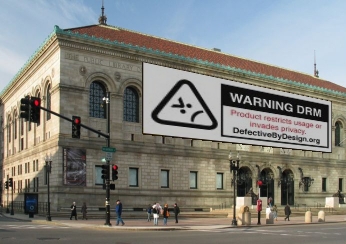
Benjamin Mako Hill: Protest DRM at the Boston Public Library

/copyrighteous/images/bpl_drm.jpg On Saturday February 9th, at 13:00, I'm going to be joining free software and anti-DRM activists to protest the use of DRM by the Boston Public Library on parts of its electronic collection. Those of us protesting are unhappy because the BPL has launched a new service powered by a company called OverDrive. The system gives BPL patrons access to books, music, and movies online -- but only if they use a Microsoft DRM system. There are lots of problems with the introduction of this system: it bars access to users of GNU/Linux and MacOS and creates a dependence on a single technology vendor for access. These are important issues, certainly. The worst problem, however, is much more fundamental. By adopting a DRM system for library content, the BPL is giving OverDrive, copyright holders, and Microsoft the ability to decide what, when, and how its patrons can and cannot read, listen, and watch these parts of the BPL collection. They are giving these companies veto power over the BPL's own ability to access this data -- both now and in the future. Cryptographically, BPL is quite literally handing over the keys to their collection. In the process, they are not only providing a disservice to their patrons. They are providing a disservice to themselves. The first-sale doctrine says that libraries can do essentially whatever they like with copies of books they purchase short of duplication, modification, or performance. Of course, copyright holders would prefer to charge a toll every time someone checks out a book. Public libraries were possible in spite of this desire because they were able to exploit power over the possession and control of their books in the interests of their patrons. With DRM, libraries will reduced to powerlessness. Of course, times have changed. As media and the ways we interact with it is increasingly digital, libraries have changed and will need to change more. But if public libraries are to succeed at their fundamental mission of spreading knowledge and serving communities, this change can't be at the expense of patrons' ability to control their own technology and libraries' ability to control their own collections. I've supported my academic library, MIT Libraries, as they took a risk and stood up to DRM when other institutions did not. And they won. BPL is the largest municipal library in the US and the third largest US library overall. It is the first library to be supported publicly, to be open to the public in the US, and to allow patrons to take home books to read and use them. BPL has an opportunity now to continue this history of leadership, of access, and of patron empowerment. If BPL stands up against DRM and in favor of its patrons' freedom and its own control of its technical destiny and collection, it may set an important precedent. If you're in or near Boston, please join me in Copley Square on Saturday to help make this happen. If you're not near Boston, please help put pressure on similar efforts in your own communities.

7 February 2008

Biella Coleman: On Confidence, Geekdom, and Desire

So a few folks left some interesting comments in response to my link to the article on the rise of the alpha-girl based on the research of Harvard psychologist, Dan Kindlon. My response to both Joe and Karl is that it is worthy to lower the barriers to entry not because girls will change the cultural ecology of geekdom in positive ways (though they may) or because geekdom is inherently “omg totally awesome!!!!!!!!!!!!!!!!!!!!” but for a much more mundane reason: it may allow girls to follow interests and eventually discover a passion. I think it is a great idea if more women were involved in geekdom and open source development not because it is inherently great but because I am sure there a lot of women out there who would enjoy it (and by extension, I am sure a lot who would not). By highlighting this article I am not advocating some forced hacker-female-labor-migration-policy but pointing to the fact that social conditions outside of geekdom play a role in ensuring more participation among women. But let me explain a few things before I argue my position a little further. First a little clarification, especially now that I have read the article. By alpha the author does not mean dominant, aggressive, and totally jerky, which is what might immediately come to mind when you read/hear alpha (especially if one knows any alpha-geeks or alpha-lawyers for that matter, who are much worse, imho). And I certainly don’t want any more alpha-anything (alpha-women, alpha-dogs, alpha-cats, alpha-hamsters ) given our world is already chock-full of alpha-jerks. By using the term, the author basically means confidence, which apparently is on the rise among girls, leaving them much more likely to be go-getters, undaunted by explicit and implicit barriers and obstacles and thus more likely then ever to enter arenas that have been thought of as traditionally male or in fact totally dominated by males. If this trend is indeed in place, I think it is great and I hope that this eventually translates into more girls/women populating traditionally male areas whether it is neurology, movie directing, hacking, or surfing. What I appreciate about the article is that his research can help us question the idea that women are naturally averse to competition due to their estrogenic hormones while boys, brimming with testosterone, just love it and exude it. I never identified with that conventional well-worn script, in part because I guess I am fairly confident and somewhat competitive. Being in academia for the last 10 years, I have witnessed a lot of really confident women that have helped inspire me and keep me going, especially when times got rough. What is fascinating about the article (and by extension probably his book) is that gender parity and equity and changes in the psychological makeup of women have not changed overnight but have taken a much longer time to settle in place. We are only now bearing the fruits of structural and educational changes first instituted decades ago and that tackled some serious forms of discrimination. As a result, we are seeing girls and women donning a deeper confidence that may help them participate with more success in the arenas they want to whether it be sports or in the workplaces (though there are certainly still major barriers and issues, which are addressed in the article). So why would someone want to participate in the world of free software and hacking in particular? My first answer is there may be any number of reasons why anyone, female or male or transgender or whatever, may want to do so for the love of technology, to feel an intense belonging to a community who share your passions and who work together to create something with a lot of value, to enjoy the challenge of learning, to spread freedom to every corner of the earth, etc… It is not that geekdom is inherently fun and exciting but that it will be interesting to some slice of the population men or women (or other) and what is the harm in lowering the barriers to entry, especially if it brings enjoyment and frankly a lot of economic security too? There are a number of girls/women who already find it worthwhile and I am sure many more who would. And the point is not to create some policy to make sure that we shuttle women into hackerdom but as a society we should equip them with the necessary psychological tools so that if they think this is worthwhile, and discover that they love it, etc, they will dare to venture in there and more importantly, stay if they want to. In terms of Karls point that a lot of people are professional geeks in part because they d have trouble being anything else; like being gay, it s not a choice, I think that is far too narrow of an assessment, not to mention an outdated caricature of geeks. While there is certainly a class of socially awkward geeks (if that is what you mean??), I would say they are in the minority though they may certainly stand out precisely because they are the odd ducks and because the stereotype is so entrenched. Many geeks I have met, while they may pretty darn focused on geekdom, also have full and rich lives/personalities that cannot be easily collapsed into one immutable personality type. Yes they may be obsessed with tech but aren’t doctors, academics, musicians, lawyers sort of fanatical too? I spend like my whole week working on academic stuff (part of necessity, part out of love). And at least hacking has way better conferences and economic perks, which may help explain why people stay :-) Finally, I think you assume a little to strongly that we do what we do because we have a pre-formed existing desired to do so. While I think this is the case for many things (and I knew the minute I learned about anthropology, I wanted to be one, which was odd but it proved to be correct), I think desire is also formed as much through experience and hence the importance of exposure to different worlds and experiences. I know that there are many things I could have never imagined I would have loved–karoake and sailing are two things that come to mind—until I tried them about both took some degree of courage. In the later case, it took a lot of guts to move onto some ship at the age of 18 instead of going to college and I am so glad I did. This is an instance where confidence and an initial curiosity led to discovering a love and passion I never knew I had. So if desire can be formed and not just expressed, I think it is key to make sure people have all sorts of opportunities to cultivate the passions they never knew they had.

25 January 2008

MJ Ray: Links for 2008-01-25

Nick Leeson: The financial storm is not over yet
Surreal to see his byline on an article the same day as a rogue trader comes to light... "Cutting interest rates has stemmed the flow for now, but 2008 will see higher energy costs, higher food costs and higher importing costs which will damage consumer confidence. Right now we can only look to Davos and hope that the global economic leaders can keep positive and stop the markets from spiralling further downwards"
SFinfo TV Schedule for Sunday
SFinfo is carrying some of the Davos meeting live again (where corporations tell governments how to direct their populations). Only interesting thing left in my opinion is the Climate Change forum on Sunday morning. Watch and see where our glorious overlords will be taking us.
How to block all Facebook application and message spam
Practical freedom from Matt Lee's Exploring Freedom.
Valuing Users by Allowing Comments : David Lee King
It makes sense - you know it does.
Internet Psychology: Podcasting? That's old-fashioned - video is the online future by Graham Jones, Internet Psychologist
Maybe I just forgot the obvious, or maybe we haven't really seen what people can do with podcasting yet.
Gaba en San Pancho Blog Archive what things to check when buying an used car
Worst used car I ever saw had a split hose leaking petrol from the carb feed onto the engine block - switching that one off when I asked was the fastest I ever saw a car salesman move!
Modern Communicator: Imarco Activ-Media have been acquired
Personally, I find one of the benefits of working in cooperatives is that it's very difficult for us to be acquired and good collaboration is much more common than merging.
sab39 ... O noes, somebody I don't like did something I agree with!
I feel the point about the bozo bit is well-made. Is one of the few features of my weak memory a low probability that I keep the bozo bit set in the long term?
How You Can Fine-Tune Your Blogger Personality Perception
How do you repair a broken perception? Can you repair it, or is it time to delete the blog and start again at a new address? Can you start again, or does web.archive mean past mistakes will hurt you forever?
robmyers - My Ogg Player
I never succeeded in accessing anything besides basic file upload/removal on my YP-U2 and Samsung Support broke promises they made to me.
another blog is possible Give cyclists a break
"Those of you drive should read this article and change your behavior towards cyclists. You may not like cyclists in the road, but they have every right to be there."

Next.

Previous.