Search Results: "sto"

15 December 2024

Russell Coker: Hisense 65U80G 65 Inch 8K ULED Android TV (2021)

The Aim I just bought a Hisense 65U80G 65 Inch 8K ULED Android TV (2021 model) for $1,568 including delivery. I got that deal by googling refurbished 8K TVs and finding the cheapest one I could buy. Amazon and eBay didn t have any good prices on second hand 8K TVs and new ones start at $3,000 on special. I didn t assess how Hisense compares to other TVs, as far as I could determine there was only one model of 8K TV on sale in Australia in the price range I was prepared to pay. So I won t review how this TV compares to other models but how refurbished TVs compare to other display options. I bought this because the highest resolution monitor in my price range is 5120*2160 [1]. While I could get a 5128*2880 monitor for around $1,500 paying 3* the money for 33% more pixels is bad value for money. Getting 4* the pixels for under 3* the price is good value even when it s a TV with the lower display quality that involves. Before buying this TV I read this blog post by Daniel Lawrence about using an 8K TV as a primary monitor [2]. While he has an interesting setup with a 65 TV on a large desk it s not what I plan to do at this time. My Plans for Use I don t plan to make it a main monitor. While 5120*2160 isn t as good as I like on my desk it s bearable and the quality of the display is high. High resolution isn t needed for all tasks, for example I m writing this blog post on my laptop while watching a movie on the 8K TV. One thing I d like to do with the 8K TV when I get it working as a monitor is to share the screen for team programming projects. I don t have any specific plans other than team coding projects at the moment. But it will be interesting to experiment with it when I get it working. Technical Issues with High Resolution Monitors Hardware Needed A lot of the graphic hardware out there don t support resolutions higher than 5120*2880. It seems that most laptops don t support resolutions higher than that and higher resolutions than 4K are difficult. Only quite recent and high end video cards will do 8K. Apparently the RTX 2080 is one of the oldest ones that does and that s $400 on ebay. Strangely the GPU chipset spec pages don t list the maximum resolution and there s the additional complication that the other chips might not support the resolutions that the GPU itself can support. As an aside I don t use NVidia cards for regular workstations due to reliability problems. But they are good for ML work and for special purpose systems. Interface Versions To do 8K video it seems that you need HDMI 2.1 (or maybe 2.0 with 4:2:0 chroma subsampling) or DisplayPort 1.3 for 30Hz with 24bit color and 2.0 for higher refresh rates. But using a particular version of the interface doesn t require supporting all the resolutions that it might support. This TV has HDMI 2.1 inputs, I ve bought an adaptor cable that does DisplayPort 1.4 to HDMI 2.1 at 8K resolution. So I need a video card that does DisplayPort 1.4 or HDMI 2.1 output. That doesn t mean that the card will work, but it could work. It s a pity that no-one has made a USB-C video controller that has a basic frame-buffer supporting 8K and the minimal GPU capabilities. The consensus of opinion is that no games will run well at 8K at this time so anyone using 8K resolution doesn t need GPU power unless it s for ML stuff. I m thinking of making a system that can be used as a ML server and X/Wayland server so a GPU with a decent amount of RAM and compute power would be good. I m not particularly interested in spending $1,500+ to get a GPU that can drive a $1,568 TV. I m looking into getting a RTX A2000 with 12G of RAM which should be adequate for ML experiments and can handle 8K@60Hz output. I ve ordered a DisplayPort to HDMI converter cable so if I get a DisplayPort card it will work. Software Support When I first got started with 4K monitors I had significant problems in adjusting the UI to be usable. The support for scaling software is much better now than it was then and 8K 65 has a lower DPI than 4K 32 . So I hope this won t be an issue. Progress So Far My first Hisense 8K TV stopped working properly. It would change to a mostly white screen after being used for some time. The screen would change in ways that correlate to changes in what should appear, but not in a way that was usable. It was just a different pattern of white blobs when I changed to a menu view not anything that allowed using it. I presume that this was the problem that drove a need for refurbishment as when I first got the TV it was still signed in to Google accounts for YouTube and to NetFlix. Best Buy Electrical was good about providing a quick replacement, they took away the old TV and delivered a new one on the same visit and it s now working well. I ve obtained a NVidia card that can allegedly do 8K output and a combination of cables that might be able to carry an 8K signal. Now I just need to get the NVidia drivers to not cause a kernel panic to get things to work.


13 December 2024

Emanuele Rocca: Murder Mystery: GCC Builds Failing After sbuild Refactoring

This is the story of an investigation conducted by Jochen Sprickerhof, Helmut Grohne, and myself. It was true teamwork, and we would have not reached the bottom of the issue working individually. We think you will find it as interesting and fun as we did, so here is a brief writeup. A few of the steps mentioned here took several days, others just a few minutes. What is described as a natural progression of events did not always look very obvious at the moment at all.
Let us go through the Six Stages of Debugging together.

Stage 1: That cannot happen
Official Debian GCC builds start failing on multiple architectures in late November.
The build error happens on the build servers when running the testuite, but we know this cannot happen. GCC builds are not meant to fail in case of testsuite failures! Return codes are not making the build fail, make is being called with -k, it just cannot happen.
A lot of the GCC tests are always failing in fact, and an extensive log of the results is posted to the debian-gcc mailing list, but the packages always build fine regardless.
On the build daemons, build failures take several hours.

Stage 2: That does not happen on my machine
Building on my machine running Bookworm is just fine. The Build Daemons run Bookworm and use a Sid chroot for the build environment, just like I am. Same kernel.
The only obvious difference between my setup and the Debian buildds is that I am using sbuild 0.85.0 from bookworm, and the buildds have 0.86.3~bpo12+1 from bookworm-backports. Trying again with 0.86.3~bpo12+1, the build fails on my system too. The build daemons were updated to the bookworm-backports version of sbuild at some point in late November. Ha.

Stage 3: That should not happen
There are quite a few sbuild versions in between 0.85.0 and 0.86.3~bpo12+1, but looking at recent sbuild bugs shows that sbuild 0.86.0 was breaking "quite a number of packages". Indeed, with 0.86.0 the build still fails. Trying the version immediately before, 0.85.11, the build finishes correctly. This took more time than it sounds, one run including the tests takes several hours. We need a way to shorten this somehow.
The Debian packaging of GCC allows to specify which languages you may want to skip, and by default it builds Ada, Go, C, C++, D, Fortran, Objective C, Objective C++, M2, and Rust. When running the tests sequentially, the build logs stop roughly around the tests of a runtime library for D, libphobos. So can we still reproduce the failure by skipping everything except for D? With DEB_BUILD_OPTIONS=nolang=ada,go,c,c++,fortran,objc,obj-c++,m2,rust the build still fails, and it fails faster than before. Several minutes, not hours. This is progress, and time to file a bug. The report contains massive spoilers, so no link. :-)

Stage 4: Why does that happen?
Something is causing the build to end prematurely. It s not the OOM killer, and the kernel does not have anything useful to say in the logs. Can it be that the D language tests are sending signals to some process, and that is what s killing make ? We start tracing signals sent with bpftrace by writing the following script, signals.bt:
tracepoint:signal:signal_generate  
    printf("%s PID %d (%s) sent signal %d to PID %d\n", comm, pid, args->sig, args->pid);
 
And executing it with sudo bpftrace signals.bt.
The build takes its sweet time, and it fails. Looking at the trace output there s a suspicious process.exe terminating stuff.
process.exe (PID: 2868133) sent signal 15 to PID 711826
That looks interesting, but we have no clue what PID 711826 may be. Let s change the script a bit, and trace signals received as well.
tracepoint:signal:signal_generate  
    printf("PID %d (%s) sent signal %d to %d\n", pid, comm, args->sig, args->pid);
 
tracepoint:signal:signal_deliver  
    printf("PID %d (%s) received signal %d\n", pid, comm, args->sig);
 
The working version of sbuild was using dumb-init, whereas the new one features a little init in perl. We patch the current version of sbuild by making it use dumb-init instead, and trace two builds: one with the perl init, one with dumb-init.
Here are the signals observed when building with dumb-init.
PID 3590011 (process.exe) sent signal 2 to 3590014
PID 3590014 (sleep) received signal 9
PID 3590011 (process.exe) sent signal 15 to 3590063
PID 3590063 (std.process tem) received signal 9
PID 3590011 (process.exe) sent signal 9 to 3590065
PID 3590065 (std.process tem) received signal 9
And this is what happens with the new init in perl:
PID 3589274 (process.exe) sent signal 2 to 3589291
PID 3589291 (sleep) received signal 9
PID 3589274 (process.exe) sent signal 15 to 3589338
PID 3589338 (std.process tem) received signal 9
PID 3589274 (process.exe) sent signal 9 to 3589340
PID 3589340 (std.process tem) received signal 9
PID 3589274 (process.exe) sent signal 15 to 3589341
PID 3589274 (process.exe) sent signal 15 to 3589323
PID 3589274 (process.exe) sent signal 15 to 3589320
PID 3589274 (process.exe) sent signal 15 to 3589274
PID 3589274 (process.exe) received signal 9
PID 3589341 (sleep) received signal 9
PID 3589273 (sbuild-usernsex) sent signal 9 to 3589320
PID 3589273 (sbuild-usernsex) sent signal 9 to 3589323
There are a few additional SIGTERM being sent when using the perl init, that s helpful. At this point we are fairly convinced that process.exe is worth additional inspection. The source code of process.d shows something interesting:
1221 @system unittest
1222  
[...]
1247     auto pid = spawnProcess(["sleep", "10000"],
[...]
1260     // kill the spawned process with SIGINT
1261     // and send its return code
1262     spawn((shared Pid pid)  
1263         auto p = cast() pid;
1264         kill(p, SIGINT);
So yes, there s our sleep and the SIGINT (signal 2) right in the unit tests of process.d, just like we have observed in the bpftrace output.
Can we study the behavior of process.exe in isolation, separatedly from the build? Indeed we can. Let s take the executable from a failed build, and try running it under /usr/libexec/sbuild-usernsexec.
First, we prepare a chroot inside a suitable user namespace:
unshare --map-auto --setuid 0 --setgid 0 mkdir /tmp/rootfs
cd /tmp/rootfs
cat /home/ema/.cache/sbuild/unstable-arm64.tar   unshare --map-auto --setuid 0 --setgid 0 tar xf  -
unshare --map-auto --setuid 0 --setgid 0 mkdir /tmp/rootfs/whatever
unshare --map-auto --setuid 0 --setgid 0 cp process.exe /tmp/rootfs/
Now we can run process.exe on its own using the perl init, and trace signals at will:
/usr/libexec/sbuild-usernsexec --pivotroot --nonet u:0:100000:65536  g:0:100000:65536 /tmp/rootfs ema /whatever -- /process.exe
We can compare the behavior of the perl init vis-a-vis the one using dumb-init in milliseconds instead of minutes.

Stage 5: Oh, I see.
Why does process.exe send more SIGTERMs when using the perl init is now the big question. We have a simple reproducer, so this is where using strace becomes possible.
sudo strace --user ema --follow-forks -o sbuild-dumb-init.strace ./sbuild-usernsexec-dumb-init --pivotroot --nonet u:0:100000:65536  g:0:100000:65536 /tmp/dumbroot ema /whatever -- /process.exe
We start comparing the strace output of dumb-init with that of perl-init, looking in particular for different calls to kill.
Here is what process.exe does under dumb-init:
3593883 kill(-2, SIGTERM)               = -1 ESRCH (No such process)
No such process. Under perl-init instead:
3593777 kill(-2, SIGTERM <unfinished ...>
The process is there under perl-init!
That is a kill with negative pid. From the kill(2) man page:
If pid is less than -1, then sig is sent to every process in the process group whose ID is -pid.
It would have been very useful to see this kill with negative pid in the output of bpftrace, why didn t we? The tracepoint used, tracepoint:signal:signal_generate, shows when signals are actually being sent, and not the syscall being called. To confirm, one can trace tracepoint:syscalls:sys_enter_kill and see the negative PIDs, for example:
PID 312719 (bash) sent signal 2 to -312728
The obvious question at this point is: why is there no process group 2 when using dumb-init?

Stage 6: How did that ever work?
We know that process.exe sends a SIGTERM to every process in the process group with ID 2. To find out what this process group may be, we spawn a shell with dumb-init and observe under /proc PIDs 1, 16, and 17. With perl-init we have 1, 2, and 17. When running dumb-init, there are a few forks before launching the program, explaining the difference. Looking at /proc/2/cmdline we see that it s bash, ie. the program we are running under perl-init. When building a package, that is dpkg-buildpackage itself.
The test is accidentally killing its own process group.
Now where does this -2 come from in the test?
2363     // Special values for _processID.
2364     enum invalid = -1, terminated = -2;
Oh. -2 is used as a special value for PID, meaning "terminated". And there s a call to kill() later on:
2694     do   s = tryWait(pid);   while (!s.terminated);
[...]
2697     assertThrown!ProcessException(kill(pid));
What sets pid to terminated you ask?
Here is tryWait:
2568 auto tryWait(Pid pid) @safe
2569  
2570     import std.typecons : Tuple;
2571     assert(pid !is null, "Called tryWait on a null Pid.");
2572     auto code = pid.performWait(false);
And performWait:
2306         _processID = terminated;
The solution, dear reader, is not to kill.
PS: the bug report with spoilers for those interested is #1089007.

Freexian Collaborators: Monthly report about Debian Long Term Support, November 2024 (by Roberto C. S nchez)

Like each month, have a look at the work funded by Freexian s Debian LTS offering.

Debian LTS contributors In November, 20 contributors have been paid to work on Debian LTS, their reports are available:
  • Abhijith PA did 14.0h (out of 6.0h assigned and 8.0h from previous period).
  • Adrian Bunk did 53.0h (out of 15.0h assigned and 85.0h from previous period), thus carrying over 47.0h to the next month.
  • Andrej Shadura did 7.0h (out of 7.0h assigned).
  • Arturo Borrero Gonzalez did 1.0h (out of 10.0h assigned), thus carrying over 9.0h to the next month.
  • Bastien Roucari s did 20.0h (out of 20.0h assigned).
  • Ben Hutchings did 0.0h (out of 24.0h assigned), thus carrying over 24.0h to the next month.
  • Chris Lamb did 18.0h (out of 18.0h assigned).
  • Daniel Leidert did 17.0h (out of 26.0h assigned), thus carrying over 9.0h to the next month.
  • Emilio Pozuelo Monfort did 40.5h (out of 60.0h assigned), thus carrying over 19.5h to the next month.
  • Guilhem Moulin did 7.25h (out of 7.5h assigned and 12.5h from previous period), thus carrying over 12.75h to the next month.
  • Jochen Sprickerhof did 3.5h (out of 10.0h assigned), thus carrying over 6.5h to the next month.
  • Lee Garrett did 14.75h (out of 15.25h assigned and 44.75h from previous period), thus carrying over 45.25h to the next month.
  • Lucas Kanashiro did 10.0h (out of 54.0h assigned and 10.0h from previous period), thus carrying over 54.0h to the next month.
  • Markus Koschany did 20.0h (out of 40.0h assigned), thus carrying over 20.0h to the next month.
  • Roberto C. S nchez did 6.75h (out of 9.75h assigned and 14.25h from previous period), thus carrying over 17.25h to the next month.
  • Santiago Ruano Rinc n did 24.75h (out of 23.5h assigned and 1.5h from previous period), thus carrying over 0.25h to the next month.
  • Sean Whitton did 2.0h (out of 6.0h assigned), thus carrying over 4.0h to the next month.
  • Sylvain Beucler did 21.5h (out of 9.5h assigned and 50.5h from previous period), thus carrying over 38.5h to the next month.
  • Thorsten Alteholz did 11.0h (out of 11.0h assigned).
  • Tobias Frost did 12.0h (out of 10.5h assigned and 1.5h from previous period).

Evolution of the situation In November, we have released 38 DLAs. The LTS coordinators, Roberto and Santiago, delivered a talk at the Mini-DebConf event in Toulouse, France. The title of the talk was How LTS goes beyond LTS . The talk covered work done by the LTS Team during the past year. This included contributions related to individual packages in Debian (such as tomcat, jetty, radius, samba, apache2, ruby, and many others); improvements to tooling and documentation useful to the Debian project as a whole; and contributions to upstream work (apache2, freeimage, node-dompurify, samba, and more). Additionally, several contributors external to the LTS Team were highlighted for their contributions to LTS. Readers are encouraged to watch the video of the presentation for a more detailed review of various ways in which the LTS team has contributed more broadly to the Debian project and to the free software community during the past year. We wish to specifically thank Salvatore (of the Debian Security Team) for swiftly handling during November the updates of needrestart and libmodule-scandeps-perl, both of which involved arbitrary code execution vulnerabilities. We are happy to see increased involvement in LTS work by contributors from outside the formal LTS Team. The work of the LTS Team in November was otherwise unremarkable, encompassing the customary triage, development, testing, and release of numerous DLAs, along with some associated contributions to related packages in stable and unstable.

Thanks to our sponsors Sponsors that joined recently are in bold.

12 December 2024

Matthew Garrett: When should we require that firmware be free?

The distinction between hardware and software has historically been relatively easy to understand - hardware is the physical object that software runs on. This is made more complicated by the existence of programmable logic like FPGAs, but by and large things tend to fall into fairly neat categories if we're drawing that distinction.

Conversations usually become more complicated when we introduce firmware, but should they? According to Wikipedia, Firmware is software that provides low-level control of computing device hardware, and basically anything that's generally described as firmware certainly fits into the "software" side of the above hardware/software binary. From a software freedom perspective, this seems like something where the obvious answer to "Should this be free" is "yes", but it's worth thinking about why the answer is yes - the goal of free software isn't freedom for freedom's sake, but because the freedoms embodied in the Free Software Definition (and by proxy the DFSG) are grounded in real world practicalities.

How do these line up for firmware? Firmware can fit into two main classes - it can be something that's responsible for initialisation of the hardware (such as, historically, BIOS, which is involved in initialisation and boot and then largely irrelevant for runtime[1]) or it can be something that makes the hardware work at runtime (wifi card firmware being an obvious example). The role of free software in the latter case feels fairly intuitive, since the interface and functionality the hardware offers to the operating system is frequently largely defined by the firmware running on it. Your wifi chipset is, these days, largely a software defined radio, and what you can do with it is determined by what the firmware it's running allows you to do. Sometimes those restrictions may be required by law, but other times they're simply because the people writing the firmware aren't interested in supporting a feature - they may see no reason to allow raw radio packets to be provided to the OS, for instance. We also shouldn't ignore the fact that sufficiently complicated firmware exposed to untrusted input (as is the case in most wifi scenarios) may contain exploitable vulnerabilities allowing attackers to gain arbitrary code execution on the wifi chipset - and potentially use that as a way to gain control of the host OS (see this writeup for an example). Vendors being in a unique position to update that firmware means users may never receive security updates, leaving them with a choice between discarding hardware that otherwise works perfectly or leaving themselves vulnerable to known security issues.

But even the cases where firmware does nothing other than initialise the hardware cause problems. A lot of hardware has functionality controlled by registers that can be locked during the boot process. Vendor firmware may choose to disable (or, rather, never to enable) functionality that may be beneficial to a user, and then lock out the ability to reconfigure the hardware later. Without any ability to modify that firmware, the user lacks the freedom to choose what functionality their hardware makes available to them. Again, the ability to inspect this firmware and modify it has a distinct benefit to the user.

So, from a practical perspective, I think there's a strong argument that users would benefit from most (if not all) firmware being free software, and I don't think that's an especially controversial argument. So I think this is less of a philosophical discussion, and more of a strategic one - is spending time focused on ensuring firmware is free worthwhile, and if so what's an appropriate way of achieving this?

I think there's two consistent ways to view this. One is to view free firmware as desirable but not necessary. This approach basically argues that code that's running on hardware that isn't the main CPU would benefit from being free, in the same way that code running on a remote network service would benefit from being free, but that this is much less important than ensuring that all the code running in the context of the OS on the primary CPU is free. The maximalist position is not to compromise at all - all software on a system, whether it's running at boot or during runtime, and whether it's running on the primary CPU or any other component on the board, should be free.

Personally, I lean towards the former and think there's a reasonably coherent argument here. I think users would benefit from the ability to modify the code running on hardware that their OS talks to, in the same way that I think users would benefit from the ability to modify the code running on hardware the other side of a network link that their browser talks to. I also think that there's enough that remains to be done in terms of what's running on the host CPU that it's not worth having that fight yet. But I think the latter is absolutely intellectually consistent, and while I don't agree with it from a pragmatic perspective I think things would undeniably be better if we lived in that world.

This feels like a thing you'd expect the Free Software Foundation to have opinions on, and it does! There are two primarily relevant things - the Respects your Freedoms campaign focused on ensuring that certified hardware meets certain requirements (including around firmware), and the Free System Distribution Guidelines, which define a baseline for an OS to be considered free by the FSF (including requirements around firmware).

RYF requires that all software on a piece of hardware be free other than under one specific set of circumstances. If software runs on (a) a secondary processor and (b) within which software installation is not intended after the user obtains the product, then the software does not need to be free. (b) effectively means that the firmware has to be in ROM, since any runtime interface that allows the firmware to be loaded or updated is intended to allow software installation after the user obtains the product.

The Free System Distribution Guidelines require that all non-free firmware be removed from the OS before it can be considered free. The recommended mechanism to achieve this is via linux-libre, a project that produces tooling to remove anything that looks plausibly like a non-free firmware blob from the Linux source code, along with any incitement to the user to load firmware - including even removing suggestions to update CPU microcode in order to mitigate CPU vulnerabilities.

For hardware that requires non-free firmware to be loaded at runtime in order to work, linux-libre doesn't do anything to work around this - the hardware will simply not work. In this respect, linux-libre reduces the amount of non-free firmware running on a system in the same way that removing the hardware would. This presumably encourages users to purchase RYF compliant hardware.

But does that actually improve things? RYF doesn't require that a piece of hardware have no non-free firmware, it simply requires that any non-free firmware be hidden from the user. CPU microcode is an instructive example here. At the time of writing, every laptop listed here has an Intel CPU. Every Intel CPU has microcode in ROM, typically an early revision that is known to have many bugs. The expectation is that this microcode is updated in the field by either the firmware or the OS at boot time - the updated version is loaded into RAM on the CPU, and vanishes if power is cut. The combination of RYF and linux-libre doesn't reduce the amount of non-free code running inside the CPU, it just means that the user (a) is more likely to hit since-fixed bugs (including security ones!), and (b) has less guidance on how to avoid them.

As long as RYF permits hardware that makes use of non-free firmware I think it hurts more than it helps. In many cases users aren't guided away from non-free firmware - instead it's hidden away from them, leaving them less aware that their freedom is constrained. Linux-libre goes further, refusing to even inform the user that the non-free firmware that their hardware depends on can be upgraded to improve their security.

Out of sight shouldn't mean out of mind. If non-free firmware is a threat to user freedom then allowing it to exist in ROM doesn't do anything to solve that problem. And if it isn't a threat to user freedom, then what's the point of requiring linux-libre for a Linux distribution to be considered free by the FSF? We seem to have ended up in the worst case scenario, where nothing is being done to actually replace any of the non-free firmware running on people's systems and where users may even end up with a reduced awareness that the non-free firmware even exists.

[1] Yes yes SMM

comment count unavailable comments

Matthew Garrett: Android privacy improvements break key attestation

Sometimes you want to restrict access to something to a specific set of devices - for instance, you might want your corporate VPN to only be reachable from devices owned by your company. You can't really trust a device that self attests to its identity, for instance by reporting its MAC address or serial number, for a couple of reasons:
If we want a high degree of confidence that the device we're talking to really is the device it claims to be, we need something that's much harder to spoof. For devices with a TPM this is the TPM itself. Every TPM has an Endorsement Key (EK) that's associated with a certificate that chains back to the TPM manufacturer. By verifying that certificate path and having the TPM prove that it's in posession of the private half of the EK, we know that we're communicating with a genuine TPM[1].

Android has a broadly equivalent thing called ID Attestation. Android devices can generate a signed attestation that they have certain characteristics and identifiers, and this can be chained back to the manufacturer. Obviously providing signed proof of the device identifier is kind of problematic from a privacy perspective, so the short version[2] is that only apps installed using a corporate account rather than a normal user account are able to do this.

But that's still not ideal - the device identifiers involved included the IMEI and serial number of the device, and those could potentially be used to correlate devices across privacy boundaries since they're static[3] identifiers that are the same both inside a corporate work profile and in the normal user profile, and also remains static if you move between different employers and use the same phone[4]. So, since Android 12, ID Attestation includes an "Enterprise Specific ID" or ESID. The ESID is based on a hash of device-specific data plus the enterprise that the corporate work profile is associated with. If a device is enrolled with the same enterprise then this ID will remain static, if it's enrolled with a different enterprise it'll change, and it just doesn't exist outside the work profile at all. The other device identifiers are no longer exposed.

But device ID verification isn't enough to solve the underlying problem here. When we receive a device ID attestation we know that someone at the far end has posession of a device with that ID, but we don't know that that device is where the packets are originating. If our VPN simply has an API that asks for an attestation from a trusted device before routing packets, we could pass that on to said trusted device and then simply forward the attestation to the VPN server[5]. We need some way to prove that the the device trying to authenticate is actually that device.

The answer to this is key provenance attestation. If we can prove that an encryption key was generated on a trusted device, and that the private half of that key is stored in hardware and can't be exported, then using that key to establish a connection proves that we're actually communicating with a trusted device. TPMs are able to do this using the attestation keys generated in the Credential Activation process, giving us proof that a specific keypair was generated on a TPM that we've previously established is trusted.

Android again has an equivalent called Key Attestation. This doesn't quite work the same way as the TPM process - rather than being tied back to the same unique cryptographic identity, Android key attestation chains back through a separate cryptographic certificate chain but contains a statement about the device identity - including the IMEI and serial number. By comparing those to the values in the device ID attestation we know that the key is associated with a trusted device and we can now establish trust in that key.

"But Matthew", those of you who've been paying close attention may be saying, "Didn't Android 12 remove the IMEI and serial number from the device ID attestation?" And, well, congratulations, you were apparently paying more attention than Google. The key attestation no longer contains enough information to tie back to the device ID attestation, making it impossible to prove that a hardware-backed key is associated with a specific device ID attestation and its enterprise enrollment.

I don't think this was any sort of deliberate breakage, and it's probably more an example of shipping the org chart - my understanding is that device ID attestation and key attestation are implemented by different parts of the Android organisation and the impact of the ESID change (something that appears to be a legitimate improvement in privacy!) on key attestation was probably just not realised. But it's still a pain.

[1] Those of you paying attention may realise that what we're doing here is proving the identity of the TPM, not the identity of device it's associated with. Typically the TPM identity won't vary over the lifetime of the device, so having a one-time binding of those two identities (such as when a device is initially being provisioned) is sufficient. There's actually a spec for distributing Platform Certificates that allows device manufacturers to bind these together during manufacturing, but I last worked on those a few years back and don't know what the current state of the art there is

[2] Android has a bewildering array of different profile mechanisms, some of which are apparently deprecated, and I can never remember how any of this works, so you're not getting the long version

[3] Nominally, anyway. Cough.

[4] I wholeheartedly encourage people not to put work accounts on their personal phones, but I am a filthy hypocrite here

[5] Obviously if we have the ability to ask for attestation from a trusted device, we have access to a trusted device. Why not simply use the trusted device? The answer there may be that we've compromised one and want to do as little as possible on it in order to reduce the probability of triggering any sort of endpoint detection agent, or it may be because we want to run on a device with different security properties than those enforced on the trusted device.

comment count unavailable comments

10 December 2024

Stephan Lachnit: Creating a bootable USB stick that can still be used as normal storage

As someone who daily drives rolling release operating systems, having a bootable USB stick with a live install of Debian is essential. It has saved reverting broken packages and making my device bootable again at least a couple of times. However, creating a bootable USB stick usually uses the entire storage of the USB stick, which seems unnecessary given that USB sticks easily have 64GiB or more these days while live ISOs still don t use more than 8GiB. In this how-to, I will explain how to create a bootable USB stick, that also holds a FAT32 partition, which allows the USB stick used as usual.

Creating the partition partble The first step is to create the partition table on the new drive. There are several tools to do this, I recommend the ArchWiki page on this topic for details. For best compatibility, MBR should be used instead of the more modern GPT. For simplicity I just went with the GParted since it has an easy GUI, but feel free to use any other tool. The layout should look like this:
Type    Partition   Suggested size
 
EFI     /dev/sda1             8GiB
FAT32   /dev/sda2        remainder
Notes:
  • The disk names are just an example and have to be adjusted for your system.
  • Don t set disk labels, they don t appear on the new install anyway and some UEFIs might not like it on your boot partition.
  • If you used GParted, create the EFI partition as FAT32 and set the esp flag.

Mounting the ISO and USB stick The next step is to download your ISO and mount it. I personally use a Debian Live ISO for this. To mount the ISO, use the loop mounting option:
mkdir -p /tmp/mnt/iso
sudo mount -o loop /path/to/image.iso /tmp/mnt/iso
Similarily, mount your USB stick:
mkdir -p /tmp/mnt/usb
sudo mount /dev/sda1 /tmp/mnt/usb

Copy the ISO contents To copy the contents from the ISO to the USB stick, use this command:
sudo cp -r -L /tmp/mnt/iso/. /tmp/mnt/usb
The -L option is required to deference the symbolic links present in the ISO, since FAT32 does not support symbolic links. Note that you might get warning about cyclic symbolic links. Nothing can be done to fix those, except hoping that they won t cause a problem. For me this never was a problem though.

Finishing touches Umnount the ISO and USB stick:
sudo umount /tmp/mnt/usb
sudo umount /tmp/mnt/iso
Now the USB stick should be bootable and have a usable data partition that can be used on essentially every operating system. I recommend testing that the stick is bootable to make sure it actually works in case of an emergency.

Emmanuel Kasper: Too many open files in Minikube Pod

Right now playing with minikube, to run a three nodes highly available Kubernetes control plane. I am using the docker driver of minikube, so each Kubernetes node component is running inside a docker container, instead of using full blown VMs. In my experience this works better than Kind, as using Kind you cannot correctly restart a cluster deployed in highly available mode. This is the topology of the cluster:
$ minikube node list 
minikube        192.168.49.2
minikube-m02    192.168.49.3
minikube-m03    192.168.49.4
Each kubernetes node is actually a docker container:
$ docker ps
CONTAINER ID   IMAGE                                 COMMAND                  CREATED          STATUS         PORTS                                                                                                                                  NAMES
977046487e5e   gcr.io/k8s-minikube/kicbase:v0.0.45   "/usr/local/bin/entr "   31 minutes ago   Up 6 minutes   127.0.0.1:32812->22/tcp, 127.0.0.1:32811->2376/tcp, 127.0.0.1:32810->5000/tcp, 127.0.0.1:32809->8443/tcp, 127.0.0.1:32808->32443/tcp   minikube-m03
8be3549f0c4c   gcr.io/k8s-minikube/kicbase:v0.0.45   "/usr/local/bin/entr "   31 minutes ago   Up 6 minutes   127.0.0.1:32807->22/tcp, 127.0.0.1:32806->2376/tcp, 127.0.0.1:32805->5000/tcp, 127.0.0.1:32804->8443/tcp, 127.0.0.1:32803->32443/tcp   minikube-m02
4b39f1c47c23   gcr.io/k8s-minikube/kicbase:v0.0.45   "/usr/local/bin/entr "   31 minutes ago   Up 6 minutes   127.0.0.1:32802->22/tcp, 127.0.0.1:32801->2376/tcp, 127.0.0.1:32800->5000/tcp, 127.0.0.1:32799->8443/tcp, 127.0.0.1:32798->32443/tcp   minikube
The whole list of pods running in the cluster is as this:
$ minikube kubectl -- get pods --all-namespaces
kube-system   coredns-6f6b679f8f-85n9l               0/1     Running   1 (44s ago)   3m32s
kube-system   coredns-6f6b679f8f-pnhxv               0/1     Running   1 (44s ago)   3m32s
kube-system   etcd-minikube                          1/1     Running   1 (44s ago)   3m37s
kube-system   etcd-minikube-m02                      1/1     Running   1 (42s ago)   3m21s
...
kube-system   kube-proxy-84gm6                       0/1     Error     1 (31s ago)   3m4s
There is this container in Error status, let us check the logs
$ minikube kubectl -- logs -n kube-system kube-proxy-84gm6
E1210 11:50:42.117036       1 run.go:72] "command failed" err="failed complete: too many open files"
This can be fixed by increasing the number of inotify watchers:
# cat > /etc/sysctl.d/minikube.conf <<EOF
fs.inotify.max_user_watches = 524288
fs.inotify.max_user_instances = 512
EOF
# sysctl --system
...
* Applying /etc/sysctl.d/minikube.conf ...
* Applying /etc/sysctl.conf ...
...
fs.inotify.max_user_watches = 524288
fs.inotify.max_user_instances = 512
Restart the cluster
$ minikube stop
$ minikube start 
$ minikube kubectl -- get pods --all-namespaces   grep Error
$

Russ Allbery: 2024 book haul

I haven't made one of these posts since... last year? Good lord. I've therefore already read and reviewed a lot of these books. Kemi Ashing-Giwa The Splinter in the Sky (sff)
Moniquill Blackgoose To Shape a Dragon's Breath (sff)
Ashley Herring Blake Delilah Green Doesn't Care (romance)
Ashley Herring Blake Astrid Parker Doesn't Fail (romance)
Ashley Herring Blake Iris Kelly Doesn't Date (romance)
Molly J. Bragg Scatter (sff)
Sarah Rees Breenan Long Live Evil (sff)
Michelle Browne And the Stars Will Sing (sff)
Steven Brust Lyorn (sff)
Miles Cameron Beyond the Fringe (sff)
Miles Cameron Deep Black (sff)
Haley Cass Those Who Wait (romance)
Sylvie Cathrall A Letter to the Luminous Deep (sff)
Ta-Nehisi Coates The Message (non-fiction)
Julie E. Czerneda To Each This World (sff)
Brigid Delaney Reasons Not to Worry (non-fiction)
Mar Delaney Moose Madness (sff)
Jerusalem Demsas On the Housing Crisis (non-fiction)
Michelle Diener Dark Horse (sff)
Michelle Diener Dark Deeds (sff)
Michelle Diener Dark Minds (sff)
Michelle Diener Dark Matters (sff)
Elaine Gallagher Unexploded Remnants (sff)
Bethany Jacobs These Burning Stars (sff)
Bethany Jacobs On Vicious Worlds (sff)
Micaiah Johnson Those Beyond the Wall (sff)
T. Kingfisher Paladin's Faith (sff)
T.J. Klune Somewhere Beyond the Sea (sff)
Mark Lawrence The Book That Wouldn't Burn (sff)
Mark Lawrence The Book That Broke the World (sff)
Mark Lawrence Overdue (sff)
Mark Lawrence Returns (sff collection)
Malinda Lo Last Night at the Telegraph Club (historical)
Jessie Mihalik Hunt the Stars (sff)
Samantha Mills The Wings Upon Her Back (sff)
Lyda Morehouse Welcome to Boy.net (sff)
Cal Newport Slow Productivity (non-fiction)
Naomi Novik Buried Deep and Other Stories (sff collection)
Claire O'Dell The Hound of Justice (sff)
Keanu Reeves & China Mi ville The Book of Elsewhere (sff)
Kit Rocha Beyond Temptation (sff)
Kit Rocha Beyond Jealousy (sff)
Kit Rocha Beyond Solitude (sff)
Kit Rocha Beyond Addiction (sff)
Kit Rocha Beyond Possession (sff)
Kit Rocha Beyond Innocence (sff)
Kit Rocha Beyond Ruin (sff)
Kit Rocha Beyond Ecstasy (sff)
Kit Rocha Beyond Surrender (sff)
Kit Rocha Consort of Fire (sff)
Geoff Ryman HIM (sff)
Melissa Scott Finders (sff)
Rob Wilkins Terry Pratchett: A Life with Footnotes (non-fiction)
Gabrielle Zevin Tomorrow, and Tomorrow, and Tomorrow (mainstream)
That's a lot of books, although I think I've already read maybe a third of them? Which is better than I usually do.

9 December 2024

Gunnar Wolf: Some tips for those who still administer Drupal7-based sites

A bit of history: Drupal at my workplace (and in Debian) My main day-to-day responsibility in my workplace is, and has been for 20 years, to take care of the network infrastructure for UNAM s Economics Research Institute. One of the most visible parts of this responsibility is to ensure we have a working Web presence, and that it caters for the needs of our academic community. I joined the Institute in January 2005. Back then, our designer pushed static versions of our webpage, completely built in her computer. This was standard practice at the time, and lasted through some redesigns, but I soon started advocating for the adoption of a Content Management System. After evaluating some alternatives, I recommended adopting Drupal. It took us quite a bit to do the change: even though I clearly recall starting work toward adopting it as early as 2006, according to the Internet Archive, we switched to a Drupal-backed site around June 2010. We started using it somewhere in the version 6 s lifecycle. As for my Debian work, by late 2012 I started getting involved in the maintenance of the drupal7 package, and by April 2013 I became its primary maintainer. I kept the drupal7 package up to date in Debian until 2018; the supported build methods for Drupal 8 are not compatible with Debian (mainly, bundling third-party libraries and updating them without coordination with the rest of the ecosystem), so towards the end of 2016, I announced I would not package Drupal 8 for Debian. By March 2016, we migrated our main page to Drupal 7. By then, we already had several other sites for our academics projects, but my narrative follows our main Web site. I did manage to migrate several Drupal 6 (D6) sites to Drupal 7 (D7); it was quite involved process, never transparent to the user, and we did have the backlash of long downtimes (or partial downtimes, with sites half-available only) with many of our users. For our main site, we took the opportunity to do a complete redesign and deployed a fully new site. You might note that March 2016 is after the release of D8 (November 2015). I don t recall many of the specifics for this decision, but if I m not mistaken, building the new site was a several months long process not only for the technical work of setting it up, but for the legwork of getting all of the needed information from the different areas that need to be represented in the Institute. Not only that: Drupal sites often include tens of contributed themes and modules; the technological shift the project underwent between its 7 and 8 releases was too deep, and modules took a long time (if at all many themes and modules were outright dumped) to become available for the new release. Naturally, the Drupal Foundation wanted to evolve and deprecate the old codebase. But the pain to migrate from D7 to D8 is too big, and many sites have remained under version 7 Eight years after D8 s release, almost 40% of Drupal installs are for version 7, and a similar proportion runs a currently-supported release (10 or 11). And while the Drupal Foundation made a great job at providing very-long-term support for D7, I understand the burden is becoming too much, so close to a year ago (and after pushing several times the D7, they finally announced support will finish this upcoming January 5.

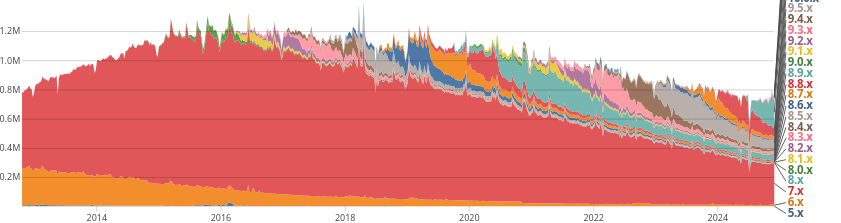
Drupal 7 must go! I found the following usage graphs quite interesting: the usage statistics for all Drupal versions follows a very positive slope, peaking around 2014 during the best years of D7, and somewhat stagnating afterwards, staying since 2015 at the 25000 28000 sites mark (I m very tempted to copy the graphs, but builtwith s terms of use are very clear in not allowing it). There is a sharp drop in the last year I attribute it to the people that are leaving D7 for other technologies after its end-of-life announcement. This becomes clearer looking only at D7 s usage statistics: D7 peaks at 15000 installs in 2016 stays there for close to 5 years, and has a sharp drop to under 7500 sites in the span of one year. D8 has a more regular rise, peak and fall peaking at ~8500 between 2020 and 2021, and down to close to 2500 for some months already; D9 has a very brief peak of almost 9000 sites in 2023 and is now close to half of it. Currently, the Drupal king appears to be D10, still on a positive slope and with over 9000 sites. Drupal 11 is still just a blip in builtwith s radar, with 3 registered sites as of September 2024 :- After writing this last paragraph, I came across the statistics found in the Drupal webpage; the methodology for acquiring its data is completely different: while builtwith s methodology is their trade secret, you can read more about how Drupal s data is gathered (and agree or disagree with it , but at least you have a page detailing 12 years so far of reported data, producing the following graph (which can be shared under the CC BY-SA license ): Drupal usage statistics by version 2013 2024 This graph is disgregated into minor versions, and I don t want to come up with yet another graph for it but it supports (most of) the narrative I presented above although I do miss the recent drop builtwith reported in D7 s numbers!

And what about Backdrop? During the D8 release cycle, a group of Drupal developers were not happy with the depth of the architectural changes that were being adopted, particularly the transition to the Symfony PHP component framework, and forked the D7 codebase to create the Backdrop CMS, a modern version of Drupal, without dropping the known and tested architecture it had. The Backdrop developers keep working closely together with the Drupal community, and although its usage numbers are way smaller than Drupal s, seems to be sustainable and lively. Of course, as I presented their numbers in the previous section, you can see Backdrop s numbers in builtwith are way, way lower. I have found it to be a very warm and welcoming community, eager to receive new members. And, thanks to its contributed D2B Migrate module, I found it is quite easy to migrate a live site from Drupal 7 to Backdrop.

Migration by playbook! So Well, I m an academic. And (if it s not obvious to you after reading so far ), one of the things I must do in my job is to write. So I decided to write an article to invite my colleagues to consider Backdrop for their D7 sites in Cuadernos T cnicos Universitarios de la DGTIC, a young journal in our university for showcasing technical academical work. And now that my article got accepted and published, I m happy to share it with you of course, if you can read Spanish But anyway Given I have several sites to migrate, and that I m trying to get my colleagues to follow suite, I decided to automatize the migration by writing an Ansible playbook to do the heavy lifting. Of course, the playbook s users will probably need to tweak it a bit to their personal needs. I m also far from an Ansible expert, so I m sure there is ample room fo improvement in my style. But it works. Quite well, I must add.

But with this size of database I did stumble across a big pebble, though. I am working on the migration of one of my users sites, and found that its database is huge. I checked the mysqldump output, and it got me close to 3GB of data. And given the D2B_migrate is meant to work via a Web interface (my playbook works around it by using a client I wrote with Perl s WWW::Mechanize), I repeatedly stumbled with PHP s maximum POST size, maximum upload size, maximum memory size I asked for help in Backdrop s Zulip chat site, and my attention was taken off fixing PHP to something more obvious: Why is the database so large? So I took a quick look at the database (or rather: my first look was at the database server s filesystem usage). MariaDB stores each table as a separate file on disk, so I looked for the nine largest tables:
# ls -lhS head
total 3.8G
-rw-rw---- 1 mysql mysql 2.4G Dec 10 12:09 accesslog.ibd
-rw-rw---- 1 mysql mysql 224M Dec  2 16:43 search_index.ibd
-rw-rw---- 1 mysql mysql 220M Dec 10 12:09 watchdog.ibd
-rw-rw---- 1 mysql mysql 148M Dec  6 14:45 cache_field.ibd
-rw-rw---- 1 mysql mysql  92M Dec  9 05:08 aggregator_item.ibd
-rw-rw---- 1 mysql mysql  80M Dec 10 12:15 cache_path.ibd
-rw-rw---- 1 mysql mysql  72M Dec  2 16:39 search_dataset.ibd
-rw-rw---- 1 mysql mysql  68M Dec  2 13:16 field_revision_field_idea_principal_articulo.ibd
-rw-rw---- 1 mysql mysql  60M Dec  9 13:19 cache_menu.ibd
A single table, the access log, is over 2.4GB long. The three following tables are, cache tables. I can perfectly live without their data in our new site! But I don t want to touch the slightest bit of this site until I m satisfied with the migration process, so I found a way to exclude those tables in a non-destructive way: given D2B_migrate works with a mysqldump output, and given that mysqldump locks each table before starting to modify it and unlocks it after its job is done, I can just do the following:
$ perl -e '$output = 1; while (<>)   $output=0 if /^LOCK TABLES  (accesslog search_index watchdog cache_field cache_path) /; $output=1 if /^UNLOCK TABLES/; print if $output ' < /tmp/d7_backup.sql  > /tmp/d7_backup.eviscerated.sql; ls -hl /tmp/d7_backup.sql /tmp/d7_backup.eviscerated.sql
-rw-rw-r-- 1 gwolf gwolf 216M Dec 10 12:22 /tmp/d7_backup.eviscerated.sql
-rw------- 1 gwolf gwolf 2.1G Dec  6 18:14 /tmp/d7_backup.sql
Five seconds later, I m done! The database is now a tenth of its size, and D2B_migrate is happy to take it. And I m a big step closer to finishing my reliance on (this bit of) legacy code for my highly-visible sites

8 December 2024

Paulo Henrique de Lima Santana: Bits from MiniDebConf Toulouse 2024

Intro I always find it amazing the opportunities I have thanks to my contributions to the Debian Project. I am happy to receive this recognition through the help I receive with travel to attend events in other countries. This year, two MiniDebConfs were scheduled for the second half of the year in Europe: the traditional edition in Cambridge in UK and a new edition in Toulouse in France. After weighing the difficulties and advantages that I would have to attend one of them, I decided to choose Toulouse, mainly because it was cheaper and because it was in November, giving me more time to plan the trip. I contacted the current DPL Andreas Tille explaining my desire to attend the event and he kindly approved my request for Debian to pay for the tickets. Thanks again to Andreas! MiniDebConf Toulouse 2024 was held in November 16th and 17th (Saturday and Sunday) and took place in one of the rooms of a traditional Free Software event in the city named Capitole du Libre. Before MiniDebConf, the team organized a MiniDebCamp in November 14th and 15th at a coworking space. The whole experience promised to be incredible, and it was! From visiting a city in France for the first time, to attending a local Free Software event, and sharing four days with people from the Debian community from various countries.

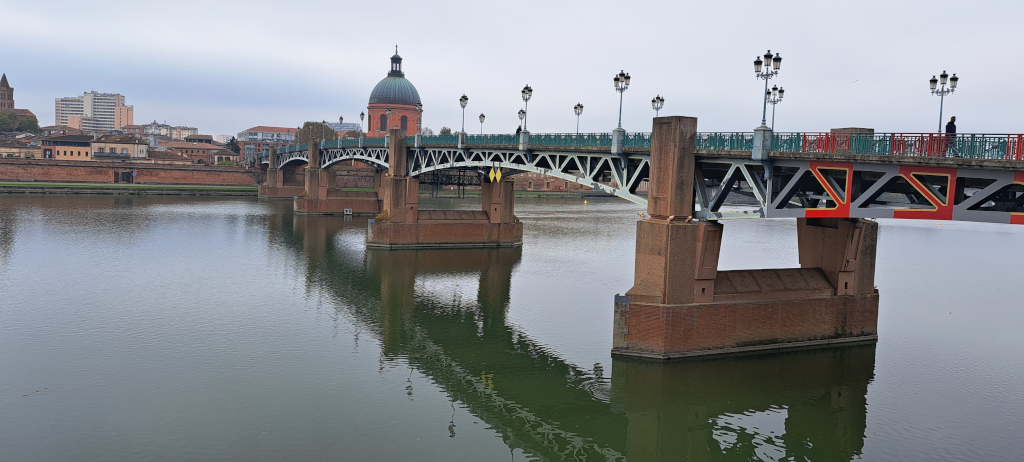
Travel and the city My plan was to leave Belo Horizonte on Monday, pass through S o Paulo, and arrive in Toulouse on Tuesday night. I was going to spend the whole of Wednesday walking around the city and then participate in the MiniDebCamp on Thursday. But the flight that was supposed to leave S o Paulo in the early hours of Monday to Tuesday was cancelled due to a problem with the airplane and I had spent all Tuesday waiting. I was rebooked on another flight that left in the evening and arrived in Toulouse on Wednesday afternoon. Even though I was very tired from the trip, I still took advantage of the end of the day to walk around the city. But it was a shame to have lost an entire day of sightseeing. On Thursday I left early in the morning to walk around a little more before going to the MiniDebCamp venue. I walked around a lot and saw several tourist attractions. The city is really very beautiful, as they say, especially the houses and buildings made of pink bricks. I was impressed by the narrow and winding streets; at one point it seemed like I was walking through a maze. I arrived to a corner and there would be 5 streets crossing in different directions. The riverbank that runs through the city is very beautiful and people spend their evenings there just hanging out. There was a lot of history around there. I stayed in an airbnb 25 minutes walking from the coworking space and only 10 minutes from the event venue. It was a very spacious apartment that was much cheaper than a hotel. MiniDebConf Toulouse 2024

MiniDebConf Toulouse 2024

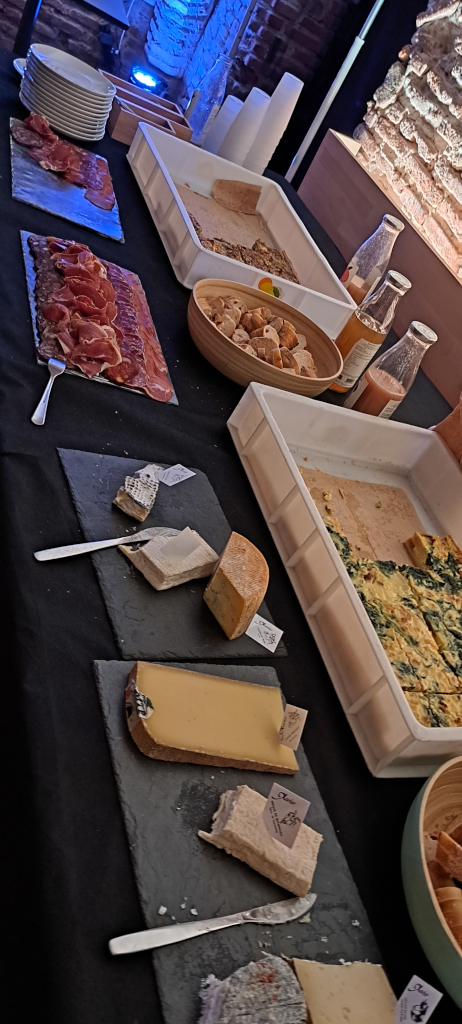
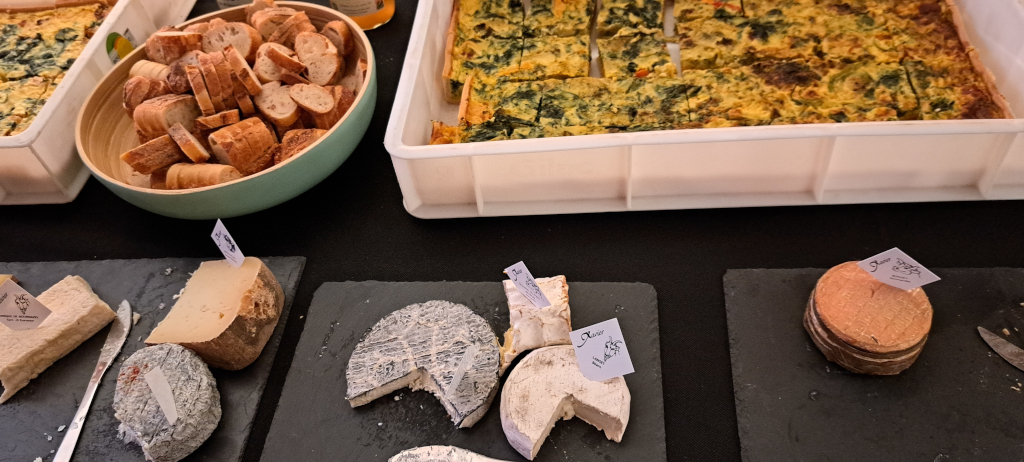
MiniDebCamp I arrived at the coworking space where the MiniDebCamp was being held and met up with several friends. I also met some new people, talked about the translation work we do in Brazil, and other topics. We already knew that the organization would pay for lunch for everyone during the two days of MiniDebCamp, and at a certain point they told us that we could go to the room (which was downstairs from the coworking space) to have lunch. They set up a table with quiches, breads, charcuterie and LOTS of cheese :-) There were several types of cheese and they were all very good. I just found it a little strange because I m not used to having cheese for lunch, but the experience was amazing anyway :-) MiniDebConf Toulouse 2024

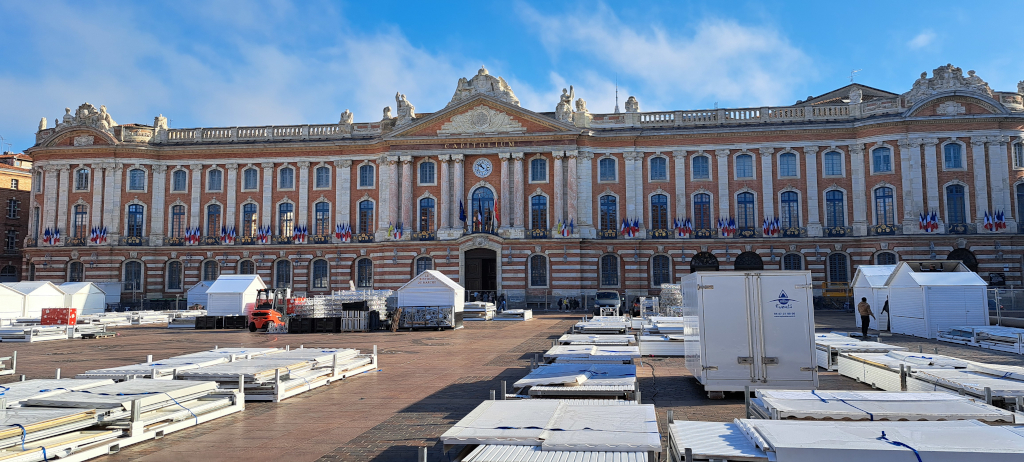
MiniDebConf Toulouse 2024 In the evening, we went as a group to dinner at a restaurant in front of the Capitolium, the city s main tourist attraction. On the second day, in the morning, I walked around the city a bit more, then went to the coworking space and had another incredible cheese table for lunch.
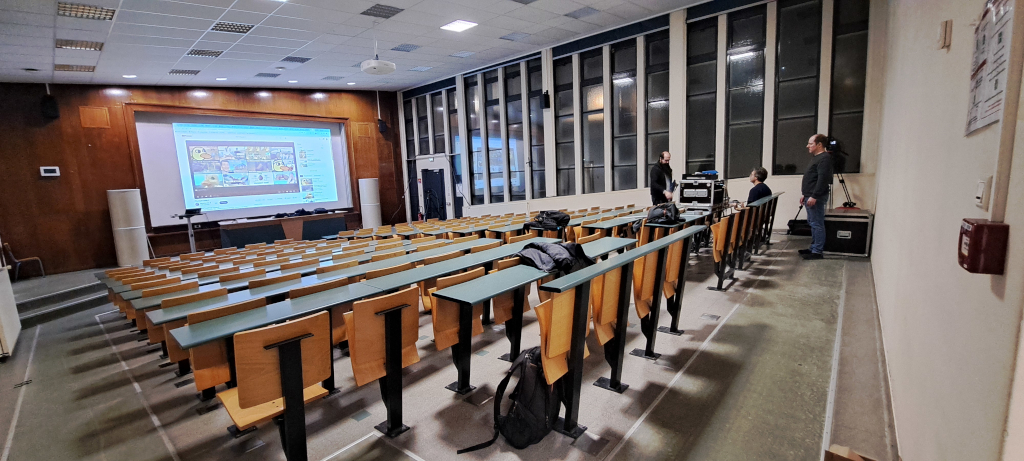

Video Team One of my ideas for going to Toulouse was to be able to help the video team in setting up the equipment for broadcasting and recording the talks. I wanted to follow this work from the beginning and learn some details, something I can t do before the DebConfs because I always arrive after the people have already set up the infrastructure. And later reproduce this work in the MiniDebConfs in Brazil, such as the one in Macei that is already scheduled for May 1-4, 2025. As I had agreed with the people from the video team that I would help set up the equipment, on Friday night we went to the University and stayed in the room working. I asked several questions about what they were doing, about the equipment, and I was able to clear up several doubts. Over the next two days I was handling one of the cameras during the talks. And on Sunday night I helped put everything away. Thanks to olasd, tumbleweed and ivodd for their guidance and patience. MiniDebConf Toulouse 2024

The event in general There was also a meeting with some members of the publicity team who were there with the DPL. We went to a cafeteria and talked mainly about areas that could be improved in the team. The talks at MiniDebConf were very good and the recordings are also available here. I ended up not watching any of the talks from the general schedule at Capitole du Libre because they were in French. It s always great to see free software events abroad to learn how they are done there and to bring some of those experiences to our events in Brazil. I hope that MiniDebConf in Toulouse will continue to take place every year, or that the French community will hold the next edition in another city and I will be able to join again :-) If everything goes well, in July next year I will return to France to join DebConf25 in Brest. MiniDebConf Toulouse 2024 More photos

Russ Allbery: Review: Why Buildings Fall Down

Review: Why Buildings Fall Down, by Matthys Levy & Mario Salvadori
Illustrator: Kevin Woest
Publisher: W.W. Norton
Copyright: 1992
Printing: 1994
ISBN: 0-393-31152-X
Format: Trade paperback
Pages: 314
Why Buildings Fall Down is a non-fiction survey of the causes of structure collapses, along with some related topics. It is a sequel of sorts to Why Buildings Stand Up by Mario Salvadori, which I have not read. Salvadori was, at the time of writing, Professor Emeritus of Architecture at Columbia University (he died in 1997). Levy is an award-winning architectural engineer, and both authors were principals at the structural engineering firm Weidlinger Associates. There is a revised and updated 2002 edition, but this review is of the original 1992 edition. This is one of those reviews that comes with a small snapshot of how my brain works. I got fascinated by the analysis of the collapse of Champlain Towers South in Surfside, Florida in 2021, thanks largely to a random YouTube series on the tiny channel of a structural engineer. Somewhere in there (I don't remember where, possibly from that channel, possibly not) I saw a recommendation for this book and grabbed a used copy in 2022 with the intent of reading it while my interest was piqued. The book arrived, I didn't read it right away, I got distracted by other things, and it migrated to my shelves and sat there until I picked it up on an "I haven't read nonfiction in a while" whim. Two years is a pretty short time frame for a book to sit on my shelf waiting for me to notice it again. The number of books that have been doing that for several decades is, uh, not small. Why Buildings Fall Down is a non-technical survey of structure failures. These are mostly buildings, but also include dams, bridges, and other structures. It's divided into 18 fairly short chapters, and the discussion of each disaster is brisk and to the point. Most of the structures discussed are relatively recent, but the authors talk about the Meidum Pyramid, the Parthenon (in the chapter on intentional destruction by humans), and the Pavia Civic Tower (in the chapter about building death from old age). If you are someone who has already been down the structural failure rabbit hole, you will find chapters on the expected disasters like the Tacoma Narrows Bridge collapse and the Hyatt Regency walkway collapse, but there are a lot of incidents here, including a short but interesting discussion of the Leaning Tower of Pisa in the chapter on problems caused by soil properties. What you're going to get, in other words, is a tour of ways in which structures can fail, which is precisely what was promised by the title. This wasn't quite what I was expecting, but now I'm not sure why I was expecting something different. There is no real unifying theme here; sometimes the failure was an oversight, sometimes it was a bad design, sometimes it was a last-minute change, and sometimes it was something unanticipated. There are a lot of factors involved in structure design and any of them can fail. The closest there is to a common pattern is a lack of redundancy and sufficient safety factors, but that lack of redundancy was generally not deliberate and therefore this is not a guide to preventing a collapse. The result is a book that feels a bit like a grab-bag of structural trivia that is individually interesting but only occasionally memorable. The writing style I suspect will be a matter of taste, but once I got used to it, I rather enjoyed it. In a co-written book, it's hard to separate the voices of the authors, but Salvadori wrote most of the chapter on the law in the first person and he's clearly a character. (That chapter is largely the story of two trials he testified in, which, from his account, involved him verbally fencing with lawyers who attempted to claim his degrees from the University of Rome didn't count as real degrees.) If this translates to his speaking style, I suspect he was a popular lecturer at Columbia. The explanations of the structural failures are concise and relatively clear, although even with Kevin Woest's diagrams, it's hard to capture the stresses and movement in a written description. (I've found from watching YouTube videos that animations, or even annotations drawn while someone is talking, help a lot.) The framing discussion, well, sometimes that is bombastic in a way that I found amusing:
But we, children of a different era, do not want our lives to be enclosed, to be shielded from the mystery. We are eager to participate in it, to gather with our brothers and sisters in a community of thought that will lift us above the mundane. We need to be together in sorrow and in joy. Thus we rarely build monolithic monuments. Instead, we build domes.
It helps that passages like this are always short and thus don't wear out their welcome. My favorite line in the whole book is a throwaway sentence in a discussion of building failures due to explosions:
With a similar approach, it can be estimated that the chance of an explosion like that at Forty-fifth Street was at most one in thirty million, and probably much less. But this is why life is dangerous and always ends in death.
Going hard, structural engineering book! It's often appealing to learn about things from their failures because the failures are inherently more dramatic and thus more interesting, but if you were hoping for an introduction to structural engineering, this is probably not the book you want. There is an excellent and surprisingly engaging appendix that covers the basics of structural analysis in 45 pages, but you would probably be better off with Why Buildings Stand Up or another architecture or structural engineering textbook (or maybe a video course). The problem with learning by failure case study is that all the case studies tend to blend together, despite the authors' engaging prose, and nearly every collapse introduces a new structural element with new properties and new failure modes and only the briefest of explanations. This book might make you a slightly more informed consumer of the news, but for most readers I suspect it will be a collection of forgettable trivia told in an occasionally entertaining style. I think the book I wanted to read was something that went deeper into the process of forensic engineering, not just the outcomes. It's interesting to know what the cause of a failure was, but I'm more interested in how one goes about investigating a failure. What is the process, how do you organize the investigation, and how does the legal system around engineering failures work? There are tidbits and asides here, but this book is primarily focused on the structural analysis and elides most of the work done to arrive at those conclusions. That said, I was entertained. Why Buildings Fall Down is a bit dated the opening chapter on airplanes hitting buildings reads much differently now than when it was written in 1992, and I'm sure it was updated in the 2002 edition but it succeeds in being clear without being soulless or sounding like a textbook. I appreciate an occasional rant about nuclear weapons in a book about architecture. I'm not sure I really recommend this, but I had a good time with it. Also, I'm now looking for opportunities to say "this is why life is dangerous and always ends in death," so there is that. Rating: 6 out of 10

7 December 2024

Russ Allbery: Review: Dark Minds

Review: Dark Minds, by Michelle Diener
Series: Class 5 #3
Publisher: Eclipse
Copyright: 2016
ISBN: 0-6454658-5-2
Format: Kindle
Pages: 328
Dark Minds is the third book in the self-published Class 5 science-fiction romance series. It is a sequel to Dark Deeds and should not be read out of order, but as with the other books of the series, it follows new protagonists. Imogen, like another Earth woman before her, was kidnapped by a Class 5 for experimentation by the Tecran. She was subsequently transferred to a research facility and has been held in cages and secret military bases for over three months. As the story opens, she had been imprisoned in a Tecran transport for a couple of weeks when the transport is taken by the Krik who kill all of the Tecran crew. Next stop: another Class 5. That same Class 5 is where the Krik are taking Camlar Kalor and his team. Cam is a Grih investigator from the United Council, sent to look into reports of a second Earth woman rescued from a Garmman ship. (The series reader will recognize this as the plot of Dark Deeds.) Now he's trapped with the crews of a bunch of other random ships in the cargo hold of a Class 5 with Krik instead of Tecran roaming the halls, apparently at the behest of the ship's banned AI, and a mysterious third Earth woman already appears to be befriending it. Imogen is the woman Fiona saw signs of in Dark Deeds. She's had a rougher time than the protagonists of the previous two books in this series, and she's been dropped into a less stable situation. The Class 5 she's brought to at the start of the story is far more suspicious (with quite a lot of cause) and somewhat more hostile than the AIs we've encountered previously. The rest of the story formula is roughly the same, though: hunky Grih officer with a personality completely indistinguishable from the hunky Grih officers in the previous two books, an AI with a sketchy concept of morality that desperately needs an ally, the Grih obsession with singing, the eventual discovery of useful armor and weaponry that Imogen can use to surprise people, and more political maneuvering over the Sentient Beings Agreement. This entry in the series mostly abandons the Grih shock and horror at how badly the Earth women have been treated. This makes sense, given how dangerous Earth women have proven over the course of this series, and I like that Diener is changing the political dynamics as the story develops. I do sometimes miss that appalled anger of Dark Horse, but Dark Minds focuses more on the politics and corridor fighting of a tense multi-sided stand-off. I found the action more gripping in Dark Minds than in Dark Deeds, and I liked Imogen more as a character than Fiona. She doesn't have the delightfully calm competence of Rose from Dark Horse, but she's a bit more hardened, a bit more canny, and is better at taking control of situations. I also like that Diener avoids simplistically pairing Earth women off with Class 5s. The series plot is progressing faster than I had expected, and that gives this book a somewhat different shape than the previous ones. Cam is probably the least interesting of the men in this series so far and appears to exist solely to take up the man-shaped hole in the plot. This is not a great series for gender roles; thankfully, the romance is a small part of the plot and largely ignorable. The story is about the women and the AIs, and all of the women and most of the AIs of the previous books make an appearance. It's clear they're forming an alliance whether the Grih like it or not, and that part of the story was very satisfying. Up to this book, this series had been all feel-good happy endings. I will risk the small spoiler and warn that this is not true to the same degree here, so you may not want to read this one if you want something entirely fluffy, light, and positive (inasmuch as a series involving off-screen experimentation on humans can be fluffy, light, and positive). That caught me by surprise in a way I didn't entirely like, and I wish Diener had stuck with the entirely positive tone. Other than that, though, this was fun, light, readable entertainment. It's not going to win any literary awards, it's formulaic, the male protagonist comes from central casting, and the emphasis by paragraph break is still a bit grating in places, but I will probably pick up the next book when I'm in the mood for something light. Dark Minds is an improvement over book two, which bodes well for the rest of the series. Followed by Dark Matters. Rating: 7 out of 10

Louis-Philippe V ronneau: lintian.debian.org: Episode IV A New Hope

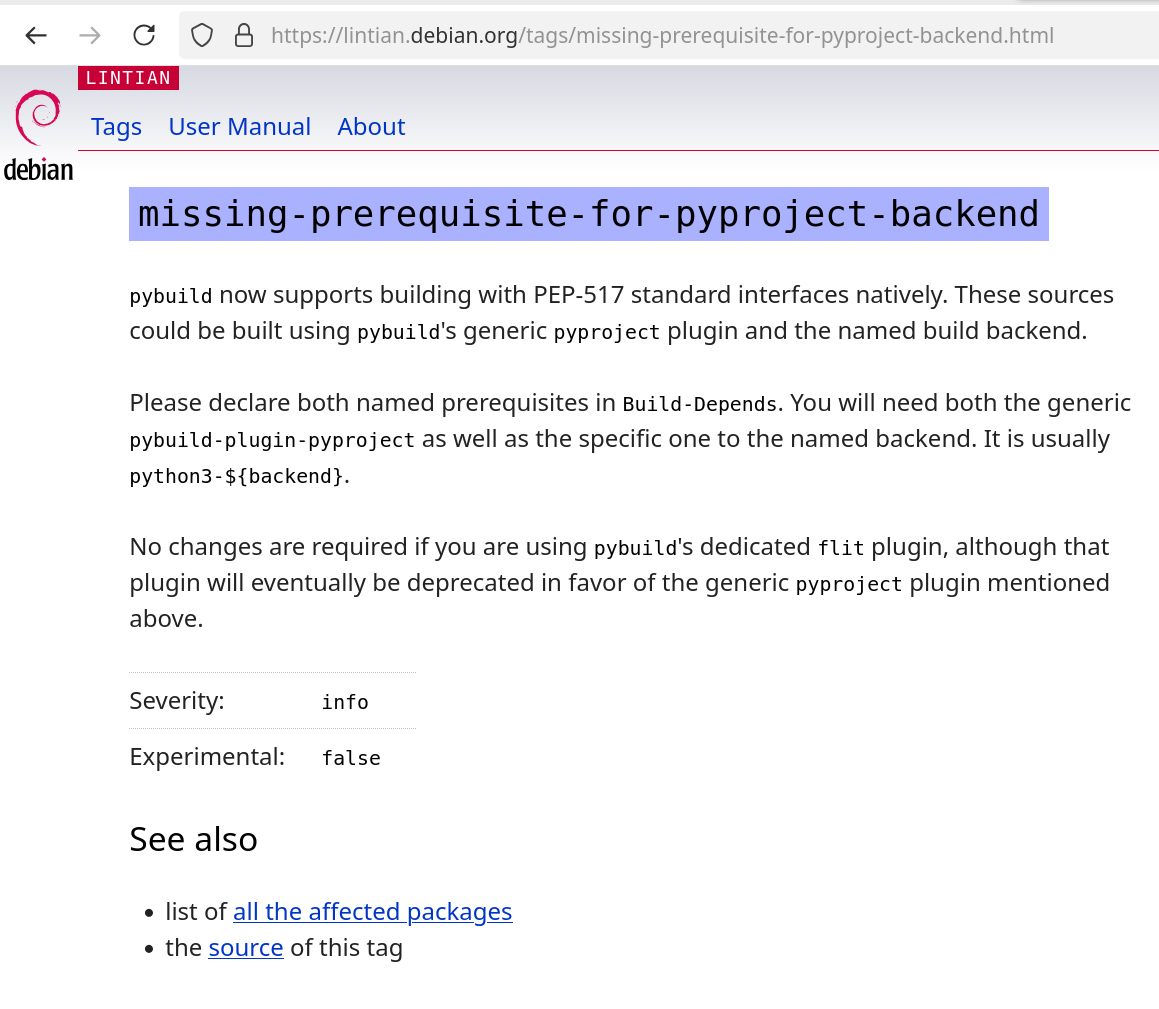
After weeks dare I say months of work, it is finally done. lintian.debian.org is back online! Screenshot of the new lintian.debian.org website Many, many thanks to everyone who worked hard to make this possible: All in all, I did very little (mostly coordinating these fine folks) and they should get the credit for this very useful service being back.
6 December 2024

B lint R czey: Firebuild 0.8.3 is out with 100+ fixes and experimental macOS support!

The new Firebuild release contains plenty of small fixes and a few notable improvements.

Experimental macOS support The most frequently asked question from people getting to know Firebuild was if it worked on their Mac and the answer sadly used to be that well, it did, but only in a Linux VM. This was far from what they were looking for. Linux and macOS have common UNIX roots, but porting Firebuild to macOS included bigger challenges, like ensuring that dyld(1), macOS s dynamic loader initializes the preloaded interceptor library early enough to catch all interesting calls, and avoid using anything that uses malloc() or thread local variables which are not yet set up then. Preloading libraries on Linux is really easy, running LD_PRELOAD=my_lib.so ls just works if the library exports the symbols to be interposed, while macOS employs multiple lines of defense to prevent applications from using unknown libraries. Firebuild s guide for making DYLD_INSERT_LIBRARIES honored on Macs can be helpful with other projects as well that rely on injecting libraries. Since GitHub s Arm64 macOS runners don t allow intercepting binaries with arm64e ABI yet, Firebuild s Apple Silicon tests are run at Bitrise, who are proud to be first to provide the latest Xcode stacks and were also quick to make the needed changes to their infrastructure to support Firebuild (thanks!  ). Firebuild on macOS can already accelerate simple projects and rebuild itself with Xcode. Since Xcode introduces a lot of nondeterminism to the build, Firebuild can t shine in acceleration with Xcode yet, but can provide nice reports to show which part of the build is the most time consuming and how each sub-command is called. If you would like to try Firebuild on macOS please compile it from the GitHub repository for now. Precompiled binaries will be distributed on the Mac App Store and via CI providers. Contact us to get notified when those channels become available.

Dealing with the Epochalypse Glibc s API provides many functions with time parameters and some of those functions are intercepted by Firebuild. Time parameters used to be passed as 32-bit values on 32-bit systems, preventing them to accurately represent timestamps after year 2038, which is known as the Y2038 problem or the Epochalypse. To deal with the problem glibc 2.34 started providing new function symbol variants with 64-bit time parameters, e.g clock_gettime64() in addition to clock_gettime(). The new 64-bit variants are used when compiling consumers of the API with _TIME_BITS=64 defined. Processes intercepted by Firebuild may have been compiled with or without _TIME_BITS=64, thus libfirebuild now provides both variants on affected systems running glibc >= 34 to work safely with binaries using 64-bit and 32-bit time representation. Many Linux distributions already stopped supporting 32-bit architectures, but Debian and Ubuntu still supports armhf, for example, where the Y2038 problem still applies. Both Debian and Ubuntu performed a transition rebuilding every library (and their reverse dependencies) with -D_FILE_OFFSET_BITS=64 set where the libraries exported symbols that changed when switching to 64-bit time representation (thanks to Steve Langasek for driving this!) . Thanks to the transition most programs are ready for 2038, but interposer libraries are trickier to fix and if you maintain one it might be a good idea to check if it works well both 32-bit and 64-bit libraries. Faketime, for example is not fixed yet, see #1064555.

Select passed through environment variables with regular expressions Firebuild filters out most of the environment variables set when starting a build to make the build more reproducible and achieve higher cache hit rate. Extra environment variables to pass through can be specified on the command line one by one, but with many similarly named variables this may become hard to maintain. With regular expressions this just became easier:
firebuild -o 'env_vars.pass_through += "MY_VARS_.*"' my_build_command
If you are not interested in acceleration just would like to explore what the build does by generating a report you can simply pass all variables:
firebuild -r -o 'env_vars.pass_through += ".*"' my_build_command

Other highlights from the 0.8.3 release
  • Fixed and nicer report in Chrome and other WebKit based browsers
  • Support GLibc 2.39 by intercepting pidfd_spawn() and pidfd_spawnp()
  • Even faster Rust build acceleration
For all the changes please check out the release page on GitHub!  (This post is also published on The Firebuild blog.)

5 December 2024

Reproducible Builds: Reproducible Builds in November 2024

Welcome to the November 2024 report from the Reproducible Builds project! Our monthly reports outline what we ve been up to over the past month and highlight items of news from elsewhere in the world of software supply-chain security where relevant. As ever, if you are interested in contributing to the Reproducible Builds project, please visit our Contribute page on our website. Table of contents:
  1. Reproducible Builds mourns the passing of Lunar
  2. Introducing reproduce.debian.net
  3. New landing page design
  4. SBOMs for Python packages
  5. Debian updates
  6. Reproducible builds by default in Maven 4
  7. PyPI now supports digital attestations
  8. Dependency Challenges in OSS Package Registries
  9. Zig programming language demonstrated reproducible
  10. Website updates
  11. Upstream patches
  12. Misc development news
  13. Reproducibility testing framework

Reproducible Builds mourns the passing of Lunar The Reproducible Builds community sadly announced it has lost its founding member, Lunar. J r my Bobbio aka Lunar passed away on Friday November 8th in palliative care in Rennes, France. Lunar was instrumental in starting the Reproducible Builds project in 2013 as a loose initiative within the Debian project. He was the author of our earliest status reports and many of our key tools in use today are based on his design. Lunar s creativity, insight and kindness were often noted. You can view our full tribute elsewhere on our website. He will be greatly missed.

Introducing reproduce.debian.net In happier news, this month saw the introduction of reproduce.debian.net. Announced at the recent Debian MiniDebConf in Toulouse, reproduce.debian.net is an instance of rebuilderd operated by the Reproducible Builds project. rebuilderd is our server designed monitor the official package repositories of Linux distributions and attempts to reproduce the observed results there. In November, reproduce.debian.net began rebuilding Debian unstable on the amd64 architecture, but throughout the MiniDebConf, it had attempted to rebuild 66% of the official archive. From this, it could be determined that it is currently possible to bit-for-bit reproduce and corroborate approximately 78% of the actual binaries distributed by Debian that is, using the .buildinfo files hosted by Debian itself. reproduce.debian.net also contains instructions how to setup one s own rebuilderd instance, and we very much invite everyone with a machine to spare to setup their own version and to share the results. Whilst rebuilderd is still in development, it has been used to reproduce Arch Linux since 2019. We are especially looking for installations targeting Debian architectures other than i386 and amd64.

New landing page design As part of a very productive partnership with the Sovereign Tech Fund and Neighbourhoodie, we are pleased to unveil our new homepage/landing page. We are very happy with our collaboration with both STF and Neighbourhoodie (including many changes not directly related to the website), and look forward to working with them in the future.

SBOMs for Python packages The Python Software Foundation has announced a new cross-functional project for SBOMs and Python packages . Seth Michael Larson writes that the project is specifically looking to solve these issues :
  • Enable Python users that require SBOM documents (likely due to regulations like CRA or SSDF) to self-serve using existing SBOM generation tools.
  • Solve the phantom dependency problem, where non-Python software is bundled in Python packages but not recorded in any metadata. This makes the job of software composition analysis (SCA) tools difficult or impossible.
  • Make the adoption work by relevant projects such as build backends, auditwheel-esque tools, as minimal as possible. Empower users who are interested in having better SBOM data for the Python projects they are using to be able to contribute engineering time towards that goal.
A GitHub repository for the initiative is available, and there are a number of queries, comments and remarks on Seth s Discourse forum post.

Debian updates There was significant development within Debian this month. Firstly, at the recent MiniDebConf in Toulouse, France, Holger Levsen gave a Debian-specific talk on rebuilding packages distributed from ftp.debian.org that is to say, how to reproduce the results from the official Debian build servers: Holger described the talk as follows:
For more than ten years, the Reproducible Builds project has worked towards reproducible builds of many projects, and for ten years now we have build Debian packages twice with maximal variations applied to see if they can be build reproducible still. Since about a month, we ve also been rebuilding trying to exactly match the builds being distributed via ftp.debian.org. This talk will describe the setup and the lessons learned so far, and why the results currently are what they are (spoiler: they are less than 30% reproducible), and what we can do to fix that.
The Debian Project Leader, Andreas Tille, was present at the talk and remarked later in his Bits from the DPL update that:
It might be unfair to single out a specific talk from Toulouse, but I d like to highlight the one on reproducible builds. Beyond its technical focus, the talk also addressed the recent loss of Lunar, whom we mourn deeply. It served as a tribute to Lunar s contributions and legacy. Personally, I ve encountered packages maintained by Lunar and bugs he had filed. I believe that taking over his packages and addressing the bugs he reported is a meaningful way to honor his memory and acknowledge the value of his work.
Holger s slides and video in .webm format are available.
Next, rebuilderd is the server to monitor package repositories of Linux distributions and attempt to reproduce the observed results. This month, version 0.21.0 released, most notably with improved support for binNMUs by Jochen Sprickerhof and updating the rebuilderd-debian.sh integration to the latest debrebuild version by Holger Levsen. There has also been significant work to get the rebuilderd package into the Debian archive, in particular, both rust-rebuilderd-common version 0.20.0-1 and rust-rust-lzma version 0.6.0-1 were packaged by kpcyrd and uploaded by Holger Levsen. Related to this, Holger Levsen submitted three additional issues against rebuilderd as well:
  • rebuildctl should be more verbose when encountering issues. [ ]
  • Please add an option to used randomised queues. [ ]
  • Scheduling and re-scheduling multiple packages at once. [ ]
and lastly, Jochen Sprickerhof submitted one an issue requested that rebuilderd downloads the source package in addition to the .buildinfo file [ ] and kpcyrd also submitted and fixed an issue surrounding dependencies and clarifying the license [ ]
Separate to this, back in 2018, Chris Lamb filed a bug report against the sphinx-gallery package as it generates unreproducible content in various ways. This month, however, Dmitry Shachnev finally closed the bug, listing the multiple sub-issues that were part of the problem and how they were resolved.
Elsewhere, Roland Clobus posted to our mailing list this month, asking for input on a bug in Debian s ca-certificates-java package. The issue is that the Java key management tools embed timestamps in its output, and this output ends up in the /etc/ssl/certs/java/cacerts file on the generated ISO images. A discussion resulted from Roland s post suggesting some short- and medium-term solutions to the problem.
Holger Levsen uploaded some packages with reproducibility-related changes:
Lastly, 12 reviews of Debian packages were added, 5 were updated and 21 were removed this month adding to our knowledge about identified issues in Debian.

Reproducible builds by default in Maven 4 On our mailing list this month, Herv Boutemy reported the latest release of Maven (4.0.0-beta-5) has reproducible builds enabled by default. In his mailing list post, Herv mentions that this story started during our Reproducible Builds summit in Hamburg , where he created the upstream issue that builds on a multi-year effort to have Maven builds configured for reproducibility.

PyPI now supports digital attestations Elsewhere in the Python ecosystem and as reported on LWN and elsewhere, the Python Package Index (PyPI) has announced that it has finalised support for PEP 740 ( Index support for digital attestations ). Trail of Bits, who performed much of the development work, has an in-depth blog post about the work and its adoption, as well as what is left undone:
One thing is notably missing from all of this work: downstream verification. [ ] This isn t an acceptable end state (cryptographic attestations have defensive properties only insofar as they re actually verified), so we re looking into ways to bring verification to individual installing clients. In particular, we re currently working on a plugin architecture for pip that will enable users to load verification logic directly into their pip install flows.
There was an in-depth discussion on LWN s announcement page, as well as on Hacker News.

Dependency Challenges in OSS Package Registries At BENEVOL, the Belgium-Netherlands Software Evolution workshop in Namur, Belgium, Tom Mens and Alexandre Decan presented their paper, An Overview and Catalogue of Dependency Challenges in Open Source Software Package Registries . The abstract of their paper is as follows:
While open-source software has enabled significant levels of reuse to speed up software development, it has also given rise to the dreadful dependency hell that all software practitioners face on a regular basis. This article provides a catalogue of dependency-related challenges that come with relying on OSS packages or libraries. The catalogue is based on the scientific literature on empirical research that has been conducted to understand, quantify and overcome these challenges. [ ]
A PDF of the paper is available online.

Zig programming language demonstrated reproducible Motiejus Jak ty posted an interesting and practical blog post on his successful attempt to reproduce the Zig programming language without using the pre-compiled binaries checked into the repository, and despite the circular dependency inherent in its bootstrapping process. As a summary, Motiejus concludes that:
I can now confidently say (and you can also check, you don t need to trust me) that there is nothing hiding in zig1.wasm [the checked-in binary] that hasn t been checked-in as a source file.
The full post is full of practical details, and includes a few open questions.

Website updates Notwithstanding the significant change to the landing page (screenshot above), there were an enormous number of changes made to our website this month. This included:
  • Alex Feyerke and Mariano Gim nez:
    • Dramatically overhaul the website s landing page with new benefit cards tailored to the expected visitors to our website and a reworking of the visual hierarchy and design. [ ][ ][ ][ ][ ][ ][ ][ ][ ][ ]
  • Bernhard M. Wiedemann:
    • Update the System images page to document the e2fsprogs approach. [ ]
  • Chris Lamb:
  • FC (Fay) Stegerman:
    • Replace more inline markdown with HTML on the Success stories page. [ ]
    • Add some links, fix some other links and correct some spelling errors on the Tools page. [ ]
  • Holger Levsen:
    • Add a historical presentation ( Reproducible builds everywhere eg. in Debian, OpenWrt and LEDE ) from October 2016. [ ]
    • Add jochensp and Oejet to the list of known contributors. [ ][ ]
  • Julia Kr ger:
  • Ninette Adhikari & hulkoba:
    • Add/rework the list of success stories into a new page that clearly shows milestones in Reproducible Builds. [ ][ ][ ][ ][ ][ ]
  • Philip Rinn:
    • Import 47 historical weekly reports. [ ]
  • hulkoba:
    • Add alt text to almost all images (!). [ ][ ]
    • Fix a number of links on the Talks . [ ][ ]
    • Avoid so-called ghost buttons by not using <button> elements as links, as the affordance of a <button> implies an action with (potentially) a side effect. [ ][ ]
    • Center the sponsor logos on the homepage. [ ]
    • Move publications and generate them instead from a data.yml file with an improved layout. [ ][ ]
    • Make a large number of small but impactful stylisting changes. [ ][ ][ ][ ]
    • Expand the Tools to include a number of missing tools, fix some styling issues and fix a number of stale/broken links. [ ][ ][ ][ ][ ][ ]

Upstream patches The Reproducible Builds project detects, dissects and attempts to fix as many currently-unreproducible packages as possible. We endeavour to send all of our patches upstream where appropriate. This month, we wrote a large number of such patches, including:

Misc development news

Reproducibility testing framework The Reproducible Builds project operates a comprehensive testing framework running primarily at tests.reproducible-builds.org in order to check packages and other artifacts for reproducibility. In November, a number of changes were made by Holger Levsen, including:
  • reproduce.debian.net-related changes:
    • Create and introduce a new reproduce.debian.net service and subdomain [ ]
    • Make a large number of documentation changes relevant to rebuilderd. [ ][ ][ ][ ][ ]
    • Explain a temporary workaround for a specific issue in rebuilderd. [ ]
    • Setup another rebuilderd instance on the o4 node and update installation documentation to match. [ ][ ]
    • Make a number of helpful/cosmetic changes to the interface, such as clarifying terms and adding links. [ ][ ][ ][ ][ ]
    • Deploy configuration to the /opt and /var directories. [ ][ ]
    • Add an infancy (or alpha ) disclaimer. [ ][ ]
    • Add more notes to the temporary rebuilderd documentation. [ ]
    • Commit an nginx configuration file for reproduce.debian.net s Stats page. [ ]
    • Commit a rebuilder-worker.conf configuration for the o5 node. [ ]
  • Debian-related changes:
    • Grant jspricke and jochensp access to the o5 node. [ ][ ]
    • Build the qemu package with the nocheck build flag. [ ]
  • Misc changes:
    • Adapt the update_jdn.sh script for new Debian trixie systems. [ ]
    • Stop installing the PostgreSQL database engine on the o4 and o5 nodes. [ ]
    • Prevent accidental reboots of the o4 node because of a long-running job owned by josch. [ ][ ]
In addition, Mattia Rizzolo addressed a number of issues with reproduce.debian.net [ ][ ][ ][ ]. And lastly, both Holger Levsen [ ][ ][ ][ ] and Vagrant Cascadian [ ][ ][ ][ ] performed node maintenance.
If you are interested in contributing to the Reproducible Builds project, please visit our Contribute page on our website. However, you can get in touch with us via:

4 December 2024

Sven Hoexter: Looking at x509 Certificate Chains

Sometimes you've to look at the content of x509 certificate chains. Usually one finds them pem encoded and concatenated in a text file. Since the openssl x509 subcommand only decodes the first certificate it will find in a file, I did something like this:
csplit -z -f 'cert' fullchain.pem '/-----BEGIN CERTIFICATE-----/' ' * '
for x in cert*; do openssl x509 -in $x -noout -text; done
Apparently that's the "wrong" way and the more appropriate way is using the openssl crl2pkcs7 subcommand albeit we do not try to parse a revocation list here.
  openssl crl2pkcs7 -nocrl -certfile fullchain.pem   \
  openssl pkcs7 -print_certs -noout
Learned that one in a webinar presented by Victor Dukhovni. If you're new to the topic worth watching.

Bits from Debian: "Ceratopsian" will be the default theme for Debian 13

The theme "Ceratopsian" by Elise Couper has been selected as the default theme for Debian 13 "trixie". The theme is inspired by Trixie's (the fictional character from Toy Story) frill and is also influenced by a previously used theme called "futurePrototype" by Alex Makas. Ceratopsian wallpaper. Click to see the whole theme proposal Ceratopsian Website banner. Click to see the whole theme proposal After the Debian Desktop Team made the call for proposing themes, a total of six choices were submitted. The desktop artwork poll was open to the public, and we received 2817 responses ranking the different choices, of which Ceratopsian has been ranked as the winner among them. We'd like to thank all the designers that have participated and have submitted their excellent work in the form of wallpapers and artwork for Debian 13. Congratulations, Elise, and thank you very much for your contribution to Debian!

3 December 2024

Russ Allbery: Review: Astrid Parker Doesn't Fail

Review: Astrid Parker Doesn't Fail, by Ashley Herring Blake
Series: Bright Falls #2
Publisher: Berkley Romance
Copyright: November 2022
ISBN: 0-593-33644-5
Format: Kindle
Pages: 365
Astrid Parker Doesn't Fail is a sapphic romance novel and a sequel to Delilah Green Doesn't Care. This is a romance style of sequel, which means that it spoils the previous book but involves a different set of protagonists, one of whom was a supporting character in the previous novel. I suppose the title is a minor spoiler for Delilah Green Doesn't Care, but not one that really matters. Astrid Parker's interior design business is in trouble. The small town of Bright Falls doesn't generate a lot of business, and there are limits to how many dentist office renovations that she's willing to do. The Everwood Inn is her big break: Pru Everwood has finally agreed to remodel and, even better, Innside America wants to feature the project. The show always works with local designers, and that means Astrid. National TV exposure is just what she needs to turn her business around and avoid an unpleasant confrontation with her domineering, perfectionist mother. Jordan Everwood is an out-of-work carpenter and professional fuck-up. Ever since she lost her wife, nothing has gone right either inside or outside of her head. Now her grandmother is renovating the favorite place of her childhood, and her novelist brother had the bright idea of bringing her to Bright Falls to help with the carpentry work. The remodel and the HGTV show are the last chance for the inn to stay in business and stay in the family, and Jordan is terrified that she's going to fuck that up too. And then she dumps coffee all over the expensive dress of a furious woman in a designer dress because she wasn't watching where she was going, and that woman turns out to be the designer of the Everwood Inn renovation. A design that Jordan absolutely loathes. The reader met Astrid in Delilah Green Doesn't Care (which you definitely want to read first). She's a bit better than she was there, but she's still uptight and unhappy and determined not to think too hard about why. When Jordan spills coffee down her favorite dress in their first encounter, shattering her fragile professional calm, it's not a meet-cute. Astrid is awful to her. Her subsequent regret, combined with immediately having to work with her and the degree to which she finds Jordan surprisingly attractive (surprising in part because Astrid thinks she's straight), slowly crack open Astrid's too-controlled life. This book was, once again, just compulsively readable. I read most of it the same day that I started it, staying up much too late, and then finished it the next day. It also once again made me laugh in delight at multiple points. I am a sucker for stories about someone learning how to become a better person, particularly when it involves a release of anxiety, and oh my does Blake ever deliver on that. Jordan's arc is more straightforward than Astrid's she just needs to get her confidence back but her backstory is a lot more complex than it first appears, including a morally ambiguous character who I would hate in person but who I admired as a deft and tricky bit of characterization. The characters from Delilah Green Doesn't Care of course play a significant role. Delilah in particular is just as much of a delight here as she was in the first book, and I enjoyed seeing the development of her relationship with her step-sister. But the new characters, both the HGTV film crew and the Everwoods, are also great. I think Blake has a real knack for memorable, distinct supporting characters that add a lot of depth to the main romance plot. I thought this book was substantially more sex-forward than Delilah Green Doesn't Care, with some lust at first or second sight, a bit more physical description of bodies, and an extended section in the middle of the book that's mostly about sex. If this is or is not your thing in romance novels, you may have a different reaction to this book than the previous one. There is, unfortunately, another third-act break-up, and this one annoyed me more than the one in Delilah Green Doesn't Care because it felt more unnecessary and openly self-destructive. The characters felt like they were headed towards a more sensible and less dramatic resolution, and then that plot twist caught me by surprise in an unpleasant way. After two books, I'm getting the sense that Blake has a preferred plot arc, at least in this series, and I wish she'd varied the story structure a bit more. Still, the third-act conflict was somewhat believable and the resolution was satisfying enough to salvage it. If it weren't for some sour feelings about the shape of that plot climax, I would have said that I liked this book even better than Delilah Green Doesn't Care, and that's a high bar. This series is great, and I will definitely be reading the third one. I'm going to be curious how that goes since it's about Iris, who so far has worked better for me as a supporting character than a protagonist. But Blake has delivered compulsively readable and thoroughly enjoyable books twice now, so I'm definitely here for the duration. If you like this sort of thing, I highly recommend this whole series. Followed by Iris Kelly Doesn't Date in the romance series sense, but as before this book is a complete story with a satisfying ending. Rating: 9 out of 10

2 December 2024

Russ Allbery: Review: Long Live Evil

Review: Long Live Evil, by Sarah Rees Brennan
Series: Time of Iron #1
Publisher: Orbit
Copyright: July 2024
ISBN: 0-316-56872-4
Format: Kindle
Pages: 433
Long Live Evil is a portal fantasy (or, arguably more precisely, a western take on an isekai villainess fantasy) and the first book of a series. If the author's name sounds familiar, it's possibly because of In Other Lands, which got a bunch of award nominations in 2018, She has also written a lot of other YA fantasy, but this is her first adult epic fantasy novel. Rae is in the hospital, dying of cancer. Everything about that experience, from the obvious to the collapse of her friendships, absolutely fucking sucks. One of the few bright points is her sister's favorite fantasy series, Time of Iron, which her sister started reading to her during chemo sessions. Rae mostly failed to pay attention until the end of the first book and the rise of the Emperor. She fell in love with the brooding, dangerous anti-hero and devoured the next two books. The first book was still a bit hazy, though, even with the help of a second dramatic reading after she was too sick to read on her own. This will be important later. After one of those reading sessions, Rae wakes up to a strange woman in her hospital room who offers her an option. Rather than die a miserable death that bankrupts her family, she can go through a door to Eyam, the world of Time of Iron, and become the character who suits her best. If she can steal the Flower of Life and Death from the imperial greenhouse on the one day a year that it blooms, she will wake up, cured. If not, she will die. Rae of course goes through, and wakes in the body of Lady Rahela, the Beauty Dipped in Blood, the evil stepsister. One of the villains, on the night before she is scheduled to be executed. Rae's initial panic slowly turns to a desperate glee. She knows all of these characters. She knows how the story will turn out. And she has a healthy body that's not racked with pain. Maybe she's not the heroine, but who cares, the villains are always more interesting anyway. If she's going to be cast as the villain, she's going to play it to the hilt. It's not like any of these characters are real. Stories in which the protagonists are the villains are not new (Nimona and Hench come to mind just among books I've reviewed), but they are having a moment. Assistant to the Villain by Hannah Nicole Maehrer came out last year, and this book and Django Wexler's How to Become the Dark Lord and Die Trying both came out this year. This batch of villain books all take different angles on the idea, but they lean heavily on humor. In Long Live Evil, that takes the form of Rae's giddy embrace of villainous scheming, flouncing, and blatant plot manipulation, along with her running commentary on the various characters and their in-story fates. The setup here is great. Rae is not only aware that she's in a story, she knows it's full of cliches and tropes. Some of them she loves, some of them she thinks are ridiculous, and she isn't shy about expressing both of those opinions. Rae is a naturally dramatic person, and it doesn't take her long to lean into the opportunities for making dramatic monologues and villainous quips, most of which involve modern language and pop culture references that the story characters find baffling and disconcerting. Unfortunately, the base Time of Iron story is, well, bad. It's absurd grimdark epic fantasy with paper-thin characters and angst as a central character trait. This is clearly intentional for both in-story and structural reasons. Rae enjoys it precisely because it's full of blood and battles and over-the-top brooding, malevolent anti-heroes, and Rae's sister likes the impossibly pure heroes who suffer horrible fates while refusing to compromise their ideals. Rae is also about to turn the story on its head and start smashing its structure to try to get herself into position to steal the Flower of Life and Death, and the story has to have a simple enough structure that it doesn't get horribly confusing once smashed. But the original story is such a grimdark parody, and so not my style of fantasy, that I struggled with it at the start of the book. This does get better eventually, as Rae introduces more and more complications and discovers some surprising things about the other characters. There are several delightful twists concerning the impossibly pure heroine of the original story that I will not spoil but that I thought retroactively made the story far more interesting. But that leads to the other problem: Rae is both not very good at scheming, and is flippant and dismissive of the characters around her. These are both realistic; Rae is a young woman with cancer, not some sort of genius mastermind, and her whole frame for interacting with the story is fandom discussions and arguments with her sister. Early in the book, it's rather funny. But as the characters around her start becoming more fleshed out and complex, Rae's inability to take them seriously starts to grate. The grand revelation to Rae that these people have their own independent existence comes so late in the book that it's arguably a spoiler, but it was painfully obvious to everyone except Rae for hundreds of pages before it got through Rae's skull. Those are my main complaints, but there was a lot about this book that I liked. The Cobra, who starts off as a minor villain in the story, is by far the best character of the book. He's not only more interesting than Rae, he makes everyone else in the book, including Rae, more interesting characters through their interactions. The twists around the putative heroine, Lady Rahela's stepsister, are a bit too long in coming but are an absolute delight. And Key, the palace guard that Rae befriends at the start of the story, is the one place where Rae's character dynamic unquestionably works. Key anchors a lot of Rae's scenes, giving them a sense of emotional heft that Rae herself would otherwise undermine. The narrator in this book does not stick with Rae. We also get viewpoint chapters from the Cobra, the Last Hope, and Emer, Lady Rahela's maid. The viewpoints from the Time of Iron characters can be a bit eye-roll-inducing at the start because of how deeply they follow the grimdark aesthetic of the original story, but by the middle of the book I was really enjoying the viewpoint shifts. This story benefited immensely from being seen from more angles than Rae's chaotic manipulation. By the end of the book, I was fully invested in the plot line following Cobra and the Last Hope, to the extent that I was a bit disappointed when the story would switch back to Rae. I'm not sure this was a great book, but it was fun. It's funny in places, but I ended up preferring the heartfelt parts to the funny parts. It is a fascinating merger of gleeful fandom chaos and rather heavy emotional portrayals of both inequality and the experience of terminal illness. Rees Brennan is a stage four cancer survivor and that really shows; there's a depth, nuance, and internal complexity to Rae's reactions to illness, health, and hope that feels very real. It is the kind of book that can give you emotional whiplash; sometimes it doesn't work, but sometimes it does. One major warning: this book ends on a ridiculous cliffhanger and does not in any sense resolve its main plot arc. I found this annoying, not so much because of the wait for the second volume, but because I thought this book was about the right length for the amount of time I wanted to spend in this world and wish Rees Brennan had found a way to wrap up the story in one book. Instead, it looks like there will be three books. I'm in for at least one more, since the story was steadily getting better towards the end of Long Live Evil, but I hope the narrative arc survives being stretched out across that many words. This one's hard to classify, since it's humorous fantasy on the cover and in the marketing, and that element is definitely present, but I thought the best parts of the book were when it finally started taking itself seriously. It's metafictional, trope-subverting portal fantasy full of intentional anachronisms that sometimes fall flat and sometimes work brilliantly. I thought the main appeal of it would be watching Rae embrace being a proper villain, but then the apparent side characters stole the show. Recommended, but you may have to be in just the right mood. Content notes: Cancer, terminal illness, resurrected corpses, wasting disease, lots of fantasy violence and gore, and a general grimdark aesthetic. Rating: 7 out of 10

1 December 2024

Russ Allbery: Review: Unexploded Remnants

Review: Unexploded Remnants, by Elaine Gallagher
Publisher: Tordotcom
Copyright: 2024
ISBN: 1-250-32522-6
Format: Kindle
Pages: 111
Unexploded Remnants is a science fiction adventure novella. The protagonist and world background would support an episodic series, but as of this writing it stands alone. It is Elaine Gallagher's first professional publication. Alice is the last survivor of Earth: an explorer, information trader, and occasional associate of the Archive. She scouts interesting places, looks for inconsistencies in the stories the galactic civilizations tell themselves, and pokes around ruins for treasure. As this story opens, she finds a supposedly broken computer core in the Alta Sidoie bazaar that is definitely not what the trader thinks it is. Very shortly thereafter, she's being hunted by a clan of dangerous Delosi while trying to decide what to do with a possibly malevolent AI with frightening intrusion abilities. This is one of those stories where all the individual pieces sounded great, but the way they were assembled didn't click for me. Unusually, I'm not entirely sure why. Often it's the characters, but I liked Alice well enough. The Lewis Carroll allusions were there but not overdone, her computer agent Bugs is a little too much of a Warner Brothers cartoon but still interesting, and the world building has plenty of interesting hooks. I certainly can't complain about the pacing: the plot moves briskly along to a somewhat predictable but still adequate conclusion. The writing is smooth and competent, and the world is memorable enough that I'm still thinking about it. And yet, I never connected with this story. I think it may be because both Alice and the tight third-person narrator tend towards breezy confidence and matter-of-fact descriptions. Alice does, at times, get scared or angry, but I never felt those emotions. They were just events that were described to me. There wasn't an emotional hook, a place where the character grabbed me, and so it felt like everything was happening at an odd remove. The advantage of this approach is that there are no overwrought emotional meltdowns or brooding angstful protagonists, just an adventure story about a competent and thoughtful character, but I think I wanted a bit more emotional involvement than I got. The world background is the best part and feels like it could be part of a larger series. The Milky Way is connected by an old, vast, and only partly understood network of teleportation portals, which had cut off Earth for unknown reasons and then just as mysteriously reactivated when Alice, then Andrew, drunkenly poked at a standing stone while muttering an old prayer in Gaelic. The Archive spent a year sorting out her intellectual diseases (capitalism was particularly alarming) and giving her a fresh start with a new body. Humanity subsequently destroyed itself in a paroxysm of reactionary violence, leaving Alice a free agent, one of a kind in a galaxy of dizzying variety and forgotten history. Gallagher makes great use of the weirdness of the portal network to create a Star Wars style of universe: the focus is more on the diversity of the planets and alien species than on a coherent unifying structure. The settings of this book are not prone to Planet of the Hats problems. They instead have the contrasts that one would get if one dropped portals near current or former Earth population centers and then took a random walk through them (or, in other words, what playing GeoGuessr on a world map feels like). I liked this effect, but I have to admit that it also added to that sense of sliding off the surface of the story. The place descriptions were great bits of atmosphere, but I never cared about them. There isn't enough emotional coherence to make them memorable. One of the more notable quirks of this story is the description of ideologies and prejudices as viral memes that can be cataloged, cured, and deployed like weapons. This is a theme of the world-building as well: this society, or at least the Archive-affiliated parts of it, classifies some patterns of thought as potentially dangerous but treatable contagious diseases. I'm not going to object too much to this as a bit of background and characterization in a fairly short novella stuffed with a lot of other world-building and plot, but there's was something about treating ethical systems like diseases that bugged me in much the same way that medicalization of neurodiversity bugs me. I think some people will find that sense of moral clarity relaxing and others will find it vaguely irritating, and I seem to have ended up in the second group. Overall, I would classify this as an interesting not-quite-success. It felt like a side story in a larger universe, like a story that would work better if I already knew Alice from other novels and had an established emotional connection with her. As is, I would not really recommend it, but there are enough good pieces here that I would be interested to see what Gallagher does next. Rating: 6 out of 10

Next.

Previous.