Search Results: "sf"

30 May 2022

Bits from Debian: Debian welcomes its new Outreachy interns

Outreachy logo Debian continues participating in Outreachy, and we're excited to announce that Debian has selected two interns for the Outreachy May 2022 - August 2022 round. Israel Galadima and Michael Ikwuegbu will work on Improve yarn package manager integration with Debian, mentored by Akshay S Dinesh and Pirate Praveen.
Congratulations and welcome to Israel Galadima and Michael Ikwuegbu! From the official website: Outreachy provides three-month internships for people from groups traditionally underrepresented in tech. Interns work remotely with mentors from Free and Open Source Software (FOSS) communities on projects ranging from programming, user experience, documentation, illustration and graphical design, to data science. The Outreachy programme is possible in Debian thanks to the efforts of Debian developers and contributors who dedicate their free time to mentor students and outreach tasks, and the Software Freedom Conservancy's administrative support, as well as the continued support of Debian's donors, who provide funding for the internships. Join us and help extend Debian! You can follow the work of the Outreachy interns reading their blogs (they are syndicated in Planet Debian), and chat with us in the #debian-outreach IRC channel and mailing list.

Russ Allbery: Review: Steles of the Sky

Review: Steles of the Sky, by Elizabeth Bear
Series: Eternal Sky #3
Publisher: Tor
Copyright: April 2014
ISBN: 0-7653-2756-2
Format: Hardcover
Pages: 429
Steles of the Sky is the third book of the Eternal Sky trilogy and a direct sequel to Shattered Pillars. You should not start here, and ideally you should read all three books close together. They form a single story, and Elizabeth Bear is somewhat notorious for not adding extra explanation to her novels. By the end of Shattered Pillars, Bear was (mostly) finished adding new factions to this story. Temur is returning home to fight for his people and his clan. His allies are mostly in place, as are his enemies. The hissable villain has remained hissable and boring, but several of his allies are more ambiguous and therefore more interesting (and get considerably more page time). All that remains is to see how Bear will end the story, and what last-minute twists will be thrown in. Well, that and getting the characters into the right positions, which occupies roughly the first half of the book and dragged a bit. There is an important and long-awaited reunion, Brother Hsiung gets his moment of focus, and the dowager empress gets some valuable character development, all of which did add to the story. But there's also a lot of plodding across the countryside. I also have no idea why the extended detour to Kyiv, began in Shattered Pillars and completed here, is even in this story. It tells us a few new scraps about Erem and its implications, but nothing vital. I felt like everything that happened there could have been done elsewhere or skipped entirely without much loss. The rest of the book is build-up to the epic conclusion, which is, somewhat unsurprisingly, a giant battle. It was okay, as giant battles go, but it also felt a bit like a fireworks display. Bear makes sure all the guns on the mantle go off by the end of the series, but a lot of them go off at the same time. It robs the plot construction of some of its power. There's nothing objectionable about this book. It's well-written, does what it sets out to do, brings the story to a relatively satisfying conclusion, provides some memorable set pieces, and is full of women making significant decisions that shape the plot. And yet, when I finished it, my reaction was "huh, okay" and then "oh, good, I can start another book now." Shattered Pillars won me over during the book. Steles of the Sky largely did not. I think my biggest complaint is one I've had about Bear's world-building before. She hints at some fascinating ideas: curious dragons, skies that vary with the political power currently in control, evil ancient magic, humanoid tigers with their own beliefs and magical system independent from humans, and a sky with a sun so hot that it would burn everything. Over the course of the series, she intrigued me with these ideas and left me eagerly awaiting an explanation. That explanation never comes. The history is never filled in, the tiger society is still only hints, Erem remains a vast mystery, the dragons appear only fleetingly to hint at connections with Erem... and then the book ends. I'm not sure whether Bear did explain some details and I wasn't paying close enough attention, or if she never intended detailed explanations. (Both are possible! Bear's books are often subtle.) But I wanted so much more. For me, half the fun of SFF world-building is the explanation. I love the hints and the mystery and the sense of lost knowledge and hidden depths... but then I want the characters to find the knowledge and plumb the depths, not just solve their immediate conflict. This is as good of a book as the first two books of the series on its own merits, but I enjoyed it less because I was hoping for more revelations before the story ended. The characters are all fine, but only a few of them stood out. Hrahima stole every scene she was in, and I would happily read a whole trilogy about her tiger people. Edene came into her own and had some great moments, but they didn't come with the revelations about Erem that I was hungry for. The rest of the large cast is varied and well-written and features a refreshing number of older women, and it wouldn't surprise me to hear that other readers had favorite characters who carried the series for them. But for me the characters weren't compelling enough to overcome my disappointment in the lack of world-building revelations. The series sadly didn't deliver the payoff that I was looking for, and I can't recommend it given the wealth of excellent fantasy being written today. But if you like Bear's understated writing style and don't need as much world-building payoff as I do, it may still be worth considering. Rating: 6 out of 10

29 May 2022

John Goerzen: Fast, Ordered Unixy Queues over NNCP and Syncthing with Filespooler

It seems that lately I ve written several shell implementations of a simple queue that enforces ordered execution of jobs that may arrive out of order. After writing this for the nth time in bash, I decided it was time to do it properly. But first, a word on the why of it all.

Why did I bother? My needs arose primarily from handling Backups over Asynchronous Communication methods in this case, NNCP. When backups contain incrementals that are unpacked on the destination, they must be applied in the correct order. In some cases, like ZFS, the receiving side will detect an out-of-order backup file and exit with an error. In those cases, processing in random order is acceptable but can be slow if, say, hundreds or thousands of hourly backups have stacked up over a period of time. The same goes for using gitsync-nncp to synchronize git repositories. In both cases, a best effort based on creation date is sufficient to produce a significant performance improvement. With other cases, such as tar or dar backups, the receiving cannot detect out of order incrementals. In those situations, the incrementals absolutely must be applied with strict ordering. There are many other situations that arise with these needs also. Filespooler is the answer to these.

Existing Work Before writing my own program, I of course looked at what was out there already. I looked at celeary, gearman, nq, rq, cctools work queue, ts/tsp (task spooler), filequeue, dramatiq, GNU parallel, and so forth. Unfortunately, none of these met my needs at all. They all tended to have properties like:
  • An extremely complicated client/server system that was incompatible with piping data over existing asynchronous tools
  • A large bias to processing of small web requests, resulting in terrible inefficiency or outright incompatibility with jobs in the TB range
  • An inability to enforce strict ordering of jobs, especially if they arrive in a different order from how they were queued
Many also lacked some nice-to-haves that I implemented for Filespooler:
  • Support for the encryption and cryptographic authentication of jobs, including metadata
  • First-class support for arbitrary compressors
  • Ability to use both stream transports (pipes) and filesystem-like transports (eg, rclone mount, S3, Syncthing, or Dropbox)

Introducing Filespooler Filespooler is a tool in the Unix tradition: that is, do one thing well, and integrate nicely with other tools using the fundamental Unix building blocks of files and pipes. Filespooler itself doesn t provide transport for jobs, but instead is designed to cooperate extremely easily with transports that can be written to as a filesystem or piped to which is to say, almost anything of interest. Filespooler is written in Rust and has an extensive Filespooler Reference as well as many tutorials on its homepage. To give you a few examples, here are some links:

Basics of How it Works Filespooler is intentionally simple:
  • The sender maintains a sequence file that includes a number for the next job packet to be created.
  • The receiver also maintains a sequence file that includes a number for the next job to be processed.
  • fspl prepare creates a Filespooler job packet and emits it to stdout. It includes a small header (<100 bytes in most cases) that includes the sequence number, creation timestamp, and some other useful metadata.
  • You get to transport this job packet to the receiver in any of many simple ways, which may or may not involve Filespooler s assistance.
  • On the receiver, Filespooler (when running in the default strict ordering mode) will simply look at the sequence file and process jobs in incremental order until it runs out of jobs to process.
The name of job files on-disk matches a pattern for identification, but the content of them is not significant; only the header matters. You can send job data in three ways:
  1. By piping it to fspl prepare
  2. By setting certain environment variables when calling fspl prepare
  3. By passing additional command-line arguments to fspl prepare, which can optionally be passed to the processing command at the receiver.
Data piped in is added to the job payload , while environment variables and command-line parameters are encoded in the header.

Basic usage Here I will excerpt part of the Using Filespooler over Syncthing tutorial; consult it for further detail. As a bit of background, Syncthing is a FLOSS decentralized directory synchronization tool akin to Dropbox (but with a much richer feature set in many ways).

Preparation First, on the receiver, you create the queue (passing the directory name to -q):
sender$ fspl queue-init -q ~/sync/b64queue
Now, we can send a job like this:
sender$ echo Hi   fspl prepare -s ~/b64seq -i -   fspl queue-write -q ~/sync/b64queue
Let s break that down:
  • First, we pipe Hi to fspl prepare.
  • fspl prepare takes two parameters:
    • -s seqfile gives the path to a sequence file used on the sender side. This file has a simple number in it that increments a unique counter for every generated job file. It is matched with the nextseq file within the queue to make sure that the receiver processes jobs in the correct order. It MUST be separate from the file that is in the queue and should NOT be placed within the queue. There is no need to sync this file, and it would be ideal to not sync it.
    • The -i option tells fspl prepare to read a file for the packet payload. -i - tells it to read stdin for this purpose. So, the payload will consist of three bytes: Hi\n (that is, including the terminating newline that echo wrote)
  • Now, fspl prepare writes the packet to its stdout. We pipe that into fspl queue-write:
    • fspl queue-write reads stdin and writes it to a file in the queue directory in a safe manner. The file will ultimately match the fspl-*.fspl pattern and have a random string in the middle.
At this point, wait a few seconds (or however long it takes) for the queue files to be synced over to the recipient. On the receiver, we can see if any jobs have arrived yet:
receiver$ fspl queue-ls -q ~/sync/b64queue
ID                   creation timestamp          filename
1                    2022-05-16T20:29:32-05:00   fspl-7b85df4e-4df9-448d-9437-5a24b92904a4.fspl
Let s say we d like some information about the job. Try this:
receiver$ $ fspl queue-info -q ~/sync/b64queue -j 1
FSPL_SEQ=1
FSPL_CTIME_SECS=1652940172
FSPL_CTIME_NANOS=94106744
FSPL_CTIME_RFC3339_UTC=2022-05-17T01:29:32Z
FSPL_CTIME_RFC3339_LOCAL=2022-05-16T20:29:32-05:00
FSPL_JOB_FILENAME=fspl-7b85df4e-4df9-448d-9437-5a24b92904a4.fspl
FSPL_JOB_QUEUEDIR=/home/jgoerzen/sync/b64queue
FSPL_JOB_FULLPATH=/home/jgoerzen/sync/b64queue/jobs/fspl-7b85df4e-4df9-448d-9437-5a24b92904a4.fspl
This information is intentionally emitted in a format convenient for parsing. Now let s run the job!
receiver$ fspl queue-process -q ~/sync/b64queue --allow-job-params base64
SGkK
There are two new parameters here:
  • --allow-job-params says that the sender is trusted to supply additional parameters for the command we will be running.
  • base64 is the name of the command that we will run for every job. It will:
    • Have environment variables set as we just saw in queue-info
    • Have the text we previously prepared Hi\n piped to it
By default, fspl queue-process doesn t do anything special with the output; see Handling Filespooler Command Output for details on other options. So, the base64-encoded version of our string is SGkK . We successfully sent a packet using Syncthing as a transport mechanism! At this point, if you do a fspl queue-ls again, you ll see the queue is empty. By default, fspl queue-process deletes jobs that have been successfully processed.

For more See the Filespooler homepage.
This blog post is also available as a permanent, periodically-updated page.

Russ Allbery: Review: Kleptopia

Review: Kleptopia, by Tom Burgis
Publisher: Harper
Copyright: 2020
Printing: September 2021
ISBN: 0-06-323613-3
Format: Kindle
Pages: 340
Kleptopia is a nonfiction chronicle of international financial corruption and money laundering told via a focus on the former Soviet republic of Kazakhstan. The primary characters are a British banker named Nigel Wilkins (at the start of the story, the head of compliance in the London office of the Swiss bank BSI), a group of businessmen from Kyrgyzstan and Uzbekistan called the Trio, and a Kazakh oligarch and later political dissident named Mukhtar Ablyazov, although the story spreads beyond them. It is partly a detailed example of what money laundering looks like in practice: where the money comes from, who has it, what they want to do with it, who they hire to move it, and what countries welcome it. But it is more broadly about the use of politics for financial plunder, and what stories we tell about the results. The title of this book feels a bit like clickbait, and I was worried it would be mostly opinion and policy discussion. It is the exact opposite. Tom Burgis is an investigations correspondent at the Financial Times, and this is a detailed piece of investigative journalism (backed by a hundred pages of notes and detailed attributions). Burgis has a clear viewpoint and expresses it when it seems relevant, but the vast majority of this book is the sort of specific account of people, dates, times, and events that one would expect from a full-length investigative magazine piece, except maintained at book length. Even aside from the subject matter, I love that writing like this exists. It's often best in magazines, newspapers, and on-line articles for timeliness, since book publishing is slow, but some subjects require the length of a book. Burgis is the sort of reporter who travels the world to meet with sources in person, and who, before publication, presents his conclusions to everyone mentioned for their rebuttals (many of which are summarized or quoted in detail in the notes so that the reader can draw their own credibility conclusions). Whether or not one agrees with his specific conclusions or emphasis, we need more of this sort of journalism in the world. I knew essentially nothing about Kazakhstan or its politics before reading this book. I also had not appreciated the degree to which exploitation of natural resources is the original source of the money for international money laundering. In both Kazakhstan and Africa (a secondary setting for this book), people get rich largely because of things dug or pumped out of the ground. That money, predictably, does not go to the people doing the hard work of digging and pumping, who work in appalling conditions and are put down with violence if they try to force change. (In one chapter, Burgis tells the harrowing and nightmarish story of Roza Tuletayeva, a striker at the oil field in Zhanaozen.) It's gathered up by the already rich and politically connected, who gained control of former state facilities during the post-Soviet collapse and then maintained their power with violence and corruption. And once they have money, they try to convert it into holdings in European banks, London real estate, and western corporations. The primary thing I will remember from this book is the degree to which oligarchs rely on being able to move between two systems. They make their money in unstable or authoritarian countries with high degrees of political corruption and violence, and are adept at navigating that world (although sometimes it turns on them; more on that in a moment). But they don't want to leave their money in that world. Someone else could betray them, undermine them, or gain the ear of the local dictator. They rely instead on western countries with strong property rights, stable financial institutions, and vast legal systems devoted to protecting the wealth of people who are already rich. In essence, they play both rule sets against each other: make money through techniques that would be illegal in London, and then move their money to London so that the British government and legal system will protect it against others who are trying to do the same. What they get out of this is obvious. What London gets out of it is another theme of this book: it's a way for a lot of people to share the wealth without doing any of the crimes. Money laundering is a very lossy activity. Lots of money falls out of the cart along the way, where it is happily scooped up by bankers, lawyers, accountants, public relations consultants, and the rest of the vast machinery of theoretically legitimate business. Everyone wins, except the people the money is being stolen from in the first place. (And the planet; Burgis doesn't talk much about the environment, but I found the image of one-way extraction of irreplaceable natural resources haunting and disturbing.) Donald Trump does make an appearance here, although not as significant of one as I was expecting given the prominent appearance of Trump crony Felix Sater. Trump is part of the machinery that allows oligarch money to become legally-protected business investment, but it's also clear from Burgis's telling that he is (at least among the money flows Burgis is focused on) a second-tier player with delusions of grandeur. He's more notable for his political acumen and ability to craft media stories than his money-laundering skills. The story-telling is a third theme of this book. The electorate of the societies into which oligarchs try to move their money aren't fond of crime, mob activity, political corruption, or authoritarian exploitation of workers. If public opinion turns sufficiently strongly against specific oligarchs, the normally friendly mechanisms of law and business regulation may have to take action. The primary defense of laundered money is hiding its origins sufficiently that it's too hard to investigate or explain to a jury, but there are limits to how completely the money can hide given that oligarchs still want to spend it. They need to tell a story about how they are modernizing businessmen, aghast at the lingering poor conditions of their home countries but working earnestly to slowly improve them. And they need to defend those stories against people who might try to draw a clearer link between them and criminal activity. The competing stories between dissident oligarch Mukhtar Ablyazov and the Kazakh government led by Nursultan Nazarbayev are a centerpiece of this book. Ablyazov is in some sense a hero of the story, someone who attempted to expose the corruption of Nazerbayev's government and was jailed by Nazerbayev for corruption in retaliation. But Burgis makes clear the tricky fact that Ablyazov likely is guilty of at least some (and possibly a lot) of the money laundering of which he was accused. It's a great illustration of the perils of simple good or bad labels when trying to understand this world from the outside. All of these men are playing similar games, and all of them are trying to tell stories where they are heroes and their opponents are corrupt thieves. And yet, there is not a moral equivalency. Ablyazov is not a good person, but what Nazerbayev attempted to do to his family is appalling, far worse than anything Ablyazov did, and the stories about Ablyazov that have prevailed to date in British courts are not an attempt to reach the truth. The major complaint that I have about Kleptopia is that this is a highly complex story with a large number of characters, but Burgis doesn't tell it in chronological order. He jumps forward and backward in time to introduce new angles of the story, and I'm not sure that was the right structural choice. Maybe a more linear story would have been even more confusing, but I got lost in the chronology at several points. Be prepared to put in some work as a reader in keeping the timeline straight. I also have to warn that this is not in any way a hopeful book. Burgis introduces Nigel Wilkins and his quixotic quest to expose the money laundering activities of European banks early in the book. In a novel that would set up a happy ending in which Wilkins brings down the edifice, or at least substantial portions of it. We do not live in a novel, sadly. Kleptopia is not purely depressing, but by and large the bad guys win. This is not a history of corruption that we've exposed and overcome. It's a chronicle of a problem that is getting worse, and that the US and British governments are failing to address. Burgis's publishers successfully defended a libel suit in British courts brought by the Eurasian Natural Resources Corporation, the primary corporate entity of the Trio who are the primary villains of this book. I obviously haven't done my own independent research, but after reading this book, including the thorough notes, this looks to me like the type of libel suit that should serve as an advertisement for its target. I can't say I enjoyed reading this, particularly at the end when the arc becomes clear. Understanding how little governments and institutions care about stopping money laundering is not a pleasant experience. But it's an important book, well and vividly told (except for the chronology), and grounded in solid investigative journalism. Recommended; I'm glad I read it. Rating: 7 out of 10

26 May 2022

Sergio Talens-Oliag: New Blog Config

As promised, on this post I m going to explain how I ve configured this blog using hugo, asciidoctor and the papermod theme, how I publish it using nginx, how I ve integrated the remark42 comment system and how I ve automated its publication using gitea and json2file-go. It is a long post, but I hope that at least parts of it can be interesting for some, feel free to ignore it if that is not your case

Hugo Configuration

Theme settingsThe site is using the PaperMod theme and as I m using asciidoctor to publish my content I ve adjusted the settings to improve how things are shown with it. The current config.yml file is the one shown below (probably some of the settings are not required nor being used right now, but I m including the current file, so this post will have always the latest version of it):
config.yml
baseURL: https://blogops.mixinet.net/
title: Mixinet BlogOps
paginate: 5
theme: PaperMod
destination: public/
enableInlineShortcodes: true
enableRobotsTXT: true
buildDrafts: false
buildFuture: false
buildExpired: false
enableEmoji: true
pygmentsUseClasses: true
minify:
  disableXML: true
  minifyOutput: true
languages:
  en:
    languageName: "English"
    description: "Mixinet BlogOps - https://blogops.mixinet.net/"
    author: "Sergio Talens-Oliag"
    weight: 1
    title: Mixinet BlogOps
    homeInfoParams:
      Title: "Sergio Talens-Oliag Technical Blog"
      Content: >
        ![Mixinet BlogOps](/images/mixinet-blogops.png)
    taxonomies:
      category: categories
      tag: tags
      series: series
    menu:
      main:
        - name: Archive
          url: archives
          weight: 5
        - name: Categories
          url: categories/
          weight: 10
        - name: Tags
          url: tags/
          weight: 10
        - name: Search
          url: search/
          weight: 15
outputs:
  home:
    - HTML
    - RSS
    - JSON
params:
  env: production
  defaultTheme: light
  disableThemeToggle: false
  ShowShareButtons: true
  ShowReadingTime: true
  disableSpecial1stPost: true
  disableHLJS: true
  displayFullLangName: true
  ShowPostNavLinks: true
  ShowBreadCrumbs: true
  ShowCodeCopyButtons: true
  ShowRssButtonInSectionTermList: true
  ShowFullTextinRSS: true
  ShowToc: true
  TocOpen: false
  comments: true
  remark42SiteID: "blogops"
  remark42Url: "/remark42"
  profileMode:
    enabled: false
    title: Sergio Talens-Oliag Technical Blog
    imageUrl: "/images/mixinet-blogops.png"
    imageTitle: Mixinet BlogOps
    buttons:
      - name: Archives
        url: archives
      - name: Categories
        url: categories
      - name: Tags
        url: tags
  socialIcons:
    - name: CV
      url: "https://www.uv.es/~sto/cv/"
    - name: Debian
      url: "https://people.debian.org/~sto/"
    - name: GitHub
      url: "https://github.com/sto/"
    - name: GitLab
      url: "https://gitlab.com/stalens/"
    - name: Linkedin
      url: "https://www.linkedin.com/in/sergio-talens-oliag/"
    - name: RSS
      url: "index.xml"
  assets:
    disableHLJS: true
    favicon: "/favicon.ico"
    favicon16x16:  "/favicon-16x16.png"
    favicon32x32:  "/favicon-32x32.png"
    apple_touch_icon:  "/apple-touch-icon.png"
    safari_pinned_tab:  "/safari-pinned-tab.svg"
  fuseOpts:
    isCaseSensitive: false
    shouldSort: true
    location: 0
    distance: 1000
    threshold: 0.4
    minMatchCharLength: 0
    keys: ["title", "permalink", "summary", "content"]
markup:
  asciidocExt:
    attributes:  
    backend: html5s
    extensions: ['asciidoctor-html5s','asciidoctor-diagram']
    failureLevel: fatal
    noHeaderOrFooter: true
    preserveTOC: false
    safeMode: unsafe
    sectionNumbers: false
    trace: false
    verbose: false
    workingFolderCurrent: true
privacy:
  vimeo:
    disabled: false
    simple: true
  twitter:
    disabled: false
    enableDNT: true
    simple: true
  instagram:
    disabled: false
    simple: true
  youtube:
    disabled: false
    privacyEnhanced: true
services:
  instagram:
    disableInlineCSS: true
  twitter:
    disableInlineCSS: true
security:
  exec:
    allow:
      - '^asciidoctor$'
      - '^dart-sass-embedded$'
      - '^go$'
      - '^npx$'
      - '^postcss$'
Some notes about the settings:
  • disableHLJS and assets.disableHLJS are set to true; we plan to use rouge on adoc and the inclusion of the hljs assets adds styles that collide with the ones used by rouge.
  • ShowToc is set to true and the TocOpen setting is set to false to make the ToC appear collapsed initially. My plan was to use the asciidoctor ToC, but after trying I believe that the theme one looks nice and I don t need to adjust styles, although it has some issues with the html5s processor (the admonition titles use <h6> and they are shown on the ToC, which is weird), to fix it I ve copied the layouts/partial/toc.html to my site repository and replaced the range of headings to end at 5 instead of 6 (in fact 5 still seems a lot, but as I don t think I ll use that heading level on the posts it doesn t really matter).
  • params.profileMode values are adjusted, but for now I ve left it disabled setting params.profileMode.enabled to false and I ve set the homeInfoParams to show more or less the same content with the latest posts under it (I ve added some styles to my custom.css style sheet to center the text and image of the first post to match the look and feel of the profile).
  • On the asciidocExt section I ve adjusted the backend to use html5s, I ve added the asciidoctor-html5s and asciidoctor-diagram extensions to asciidoctor and adjusted the workingFolderCurrent to true to make asciidoctor-diagram work right (haven t tested it yet).

Theme customisationsTo write in asciidoctor using the html5s processor I ve added some files to the assets/css/extended directory:
  1. As said before, I ve added the file assets/css/extended/custom.css to make the homeInfoParams look like the profile page and I ve also changed a little bit some theme styles to make things look better with the html5s output:
    custom.css
    /* Fix first entry alignment to make it look like the profile */
    .first-entry   text-align: center;  
    .first-entry img   display: inline;  
    /**
     * Remove margin for .post-content code and reduce padding to make it look
     * better with the asciidoctor html5s output.
     **/
    .post-content code   margin: auto 0; padding: 4px;  
  2. I ve also added the file assets/css/extended/adoc.css with some styles taken from the asciidoctor-default.css, see this blog post about the original file; mine is the same after formatting it with css-beautify and editing it to use variables for the colors to support light and dark themes:
    adoc.css
    /* AsciiDoctor*/
    table  
        border-collapse: collapse;
        border-spacing: 0
     
    .admonitionblock>table  
        border-collapse: separate;
        border: 0;
        background: none;
        width: 100%
     
    .admonitionblock>table td.icon  
        text-align: center;
        width: 80px
     
    .admonitionblock>table td.icon img  
        max-width: none
     
    .admonitionblock>table td.icon .title  
        font-weight: bold;
        font-family: "Open Sans", "DejaVu Sans", sans-serif;
        text-transform: uppercase
     
    .admonitionblock>table td.content  
        padding-left: 1.125em;
        padding-right: 1.25em;
        border-left: 1px solid #ddddd8;
        color: var(--primary)
     
    .admonitionblock>table td.content>:last-child>:last-child  
        margin-bottom: 0
     
    .admonitionblock td.icon [class^="fa icon-"]  
        font-size: 2.5em;
        text-shadow: 1px 1px 2px var(--secondary);
        cursor: default
     
    .admonitionblock td.icon .icon-note::before  
        content: "\f05a";
        color: var(--icon-note-color)
     
    .admonitionblock td.icon .icon-tip::before  
        content: "\f0eb";
        color: var(--icon-tip-color)
     
    .admonitionblock td.icon .icon-warning::before  
        content: "\f071";
        color: var(--icon-warning-color)
     
    .admonitionblock td.icon .icon-caution::before  
        content: "\f06d";
        color: var(--icon-caution-color)
     
    .admonitionblock td.icon .icon-important::before  
        content: "\f06a";
        color: var(--icon-important-color)
     
    .conum[data-value]  
        display: inline-block;
        color: #fff !important;
        background-color: rgba(100, 100, 0, .8);
        -webkit-border-radius: 100px;
        border-radius: 100px;
        text-align: center;
        font-size: .75em;
        width: 1.67em;
        height: 1.67em;
        line-height: 1.67em;
        font-family: "Open Sans", "DejaVu Sans", sans-serif;
        font-style: normal;
        font-weight: bold
     
    .conum[data-value] *  
        color: #fff !important
     
    .conum[data-value]+b  
        display: none
     
    .conum[data-value]::after  
        content: attr(data-value)
     
    pre .conum[data-value]  
        position: relative;
        top: -.125em
     
    b.conum *  
        color: inherit !important
     
    .conum:not([data-value]):empty  
        display: none
     
  3. The previous file uses variables from a partial copy of the theme-vars.css file that changes the highlighted code background color and adds the color definitions used by the admonitions:
    theme-vars.css
    :root  
        /* Solarized base2 */
        /* --hljs-bg: rgb(238, 232, 213); */
        /* Solarized base3 */
        /* --hljs-bg: rgb(253, 246, 227); */
        /* Solarized base02 */
        --hljs-bg: rgb(7, 54, 66);
        /* Solarized base03 */
        /* --hljs-bg: rgb(0, 43, 54); */
        /* Default asciidoctor theme colors */
        --icon-note-color: #19407c;
        --icon-tip-color: var(--primary);
        --icon-warning-color: #bf6900;
        --icon-caution-color: #bf3400;
        --icon-important-color: #bf0000
     
    .dark  
        --hljs-bg: rgb(7, 54, 66);
        /* Asciidoctor theme colors with tint for dark background */
        --icon-note-color: #3e7bd7;
        --icon-tip-color: var(--primary);
        --icon-warning-color: #ff8d03;
        --icon-caution-color: #ff7847;
        --icon-important-color: #ff3030
     
  4. The previous styles use font-awesome, so I ve downloaded its resources for version 4.7.0 (the one used by asciidoctor) storing the font-awesome.css into on the assets/css/extended dir (that way it is merged with the rest of .css files) and copying the fonts to the static/assets/fonts/ dir (will be served directly):
    FA_BASE_URL="https://cdnjs.cloudflare.com/ajax/libs/font-awesome/4.7.0"
    curl "$FA_BASE_URL/css/font-awesome.css" \
      > assets/css/extended/font-awesome.css
    for f in FontAwesome.otf fontawesome-webfont.eot \
      fontawesome-webfont.svg fontawesome-webfont.ttf \
      fontawesome-webfont.woff fontawesome-webfont.woff2; do
        curl "$FA_BASE_URL/fonts/$f" > "static/assets/fonts/$f"
    done
  5. As already said the default highlighter is disabled (it provided a css compatible with rouge) so we need a css to do the highlight styling; as rouge provides a way to export them, I ve created the assets/css/extended/rouge.css file with the thankful_eyes theme:
    rougify style thankful_eyes > assets/css/extended/rouge.css
  6. To support the use of the html5s backend with admonitions I ve added a variation of the example found on this blog post to assets/js/adoc-admonitions.js:
    adoc-admonitions.js
    // replace the default admonitions block with a table that uses a format
    // similar to the standard asciidoctor ... as we are using fa-icons here there
    // is no need to add the icons: font entry on the document.
    window.addEventListener('load', function ()  
      const admonitions = document.getElementsByClassName('admonition-block')
      for (let i = admonitions.length - 1; i >= 0; i--)  
        const elm = admonitions[i]
        const type = elm.classList[1]
        const title = elm.getElementsByClassName('block-title')[0];
    	const label = title.getElementsByClassName('title-label')[0]
    		.innerHTML.slice(0, -1);
        elm.removeChild(elm.getElementsByClassName('block-title')[0]);
        const text = elm.innerHTML
        const parent = elm.parentNode
        const tempDiv = document.createElement('div')
        tempDiv.innerHTML =  <div class="admonitionblock $ type ">
        <table>
          <tbody>
            <tr>
              <td class="icon">
                <i class="fa icon-$ type " title="$ label "></i>
              </td>
              <td class="content">
                $ text 
              </td>
            </tr>
          </tbody>
        </table>
      </div> 
        const input = tempDiv.childNodes[0]
        parent.replaceChild(input, elm)
       
     )
    and enabled its minified use on the layouts/partials/extend_footer.html file adding the following lines to it:
     - $admonitions := slice (resources.Get "js/adoc-admonitions.js")
        resources.Concat "assets/js/adoc-admonitions.js"   minify   fingerprint  
    <script defer crossorigin="anonymous" src="  $admonitions.RelPermalink  "
      integrity="  $admonitions.Data.Integrity  "></script>

Remark42 configurationTo integrate Remark42 with the PaperMod theme I ve created the file layouts/partials/comments.html with the following content based on the remark42 documentation, including extra code to sync the dark/light setting with the one set on the site:
comments.html
<div id="remark42"></div>
<script>
  var remark_config =  
    host:   .Site.Params.remark42Url  ,
    site_id:   .Site.Params.remark42SiteID  ,
    url:   .Permalink  ,
    locale:   .Site.Language.Lang  
   ;
  (function(c)  
    /* Adjust the theme using the local-storage pref-theme if set */
    if (localStorage.getItem("pref-theme") === "dark")  
      remark_config.theme = "dark";
      else if (localStorage.getItem("pref-theme") === "light")  
      remark_config.theme = "light";
     
    /* Add remark42 widget */
    for(var i = 0; i < c.length; i++) 
      var d = document, s = d.createElement('script');
      s.src = remark_config.host + '/web/' + c[i] +'.js';
      s.defer = true;
      (d.head   d.body).appendChild(s);
     
   )(remark_config.components   ['embed']);
</script>
In development I use it with anonymous comments enabled, but to avoid SPAM the production site uses social logins (for now I ve only enabled Github & Google, if someone requests additional services I ll check them, but those were the easy ones for me initially). To support theme switching with remark42 I ve also added the following inside the layouts/partials/extend_footer.html file:
 - if (not site.Params.disableThemeToggle)  
<script>
/* Function to change theme when the toggle button is pressed */
document.getElementById("theme-toggle").addEventListener("click", () =>  
  if (typeof window.REMARK42 != "undefined")  
    if (document.body.className.includes('dark'))  
      window.REMARK42.changeTheme('light');
      else  
      window.REMARK42.changeTheme('dark');
     
   
 );
</script>
 - end  
With this code if the theme-toggle button is pressed we change the remark42 theme before the PaperMod one (that s needed here only, on page loads the remark42 theme is synced with the main one using the code from the layouts/partials/comments.html shown earlier).

Development setupTo preview the site on my laptop I m using docker-compose with the following configuration:
docker-compose.yaml
version: "2"
services:
  hugo:
    build:
      context: ./docker/hugo-adoc
      dockerfile: ./Dockerfile
    image: sto/hugo-adoc
    container_name: hugo-adoc-blogops
    restart: always
    volumes:
      - .:/documents
    command: server --bind 0.0.0.0 -D -F
    user: $ APP_UID :$ APP_GID 
  nginx:
    image: nginx:latest
    container_name: nginx-blogops
    restart: always
    volumes:
      - ./nginx/default.conf:/etc/nginx/conf.d/default.conf
    ports:
      -  1313:1313
  remark42:
    build:
      context: ./docker/remark42
      dockerfile: ./Dockerfile
    image: sto/remark42
    container_name: remark42-blogops
    restart: always
    env_file:
      - ./.env
      - ./remark42/env.dev
    volumes:
      - ./remark42/var.dev:/srv/var
To run it properly we have to create the .env file with the current user ID and GID on the variables APP_UID and APP_GID (if we don t do it the files can end up being owned by a user that is not the same as the one running the services):
$ echo "APP_UID=$(id -u)\nAPP_GID=$(id -g)" > .env
The Dockerfile used to generate the sto/hugo-adoc is:
Dockerfile
FROM asciidoctor/docker-asciidoctor:latest
RUN gem install --no-document asciidoctor-html5s &&\
 apk update && apk add --no-cache curl libc6-compat &&\
 repo_path="gohugoio/hugo" &&\
 api_url="https://api.github.com/repos/$repo_path/releases/latest" &&\
 download_url="$(\
  curl -sL "$api_url"  \
  sed -n "s/^.*download_url\": \"\\(.*.extended.*Linux-64bit.tar.gz\)\"/\1/p"\
 )" &&\
 curl -sL "$download_url" -o /tmp/hugo.tgz &&\
 tar xf /tmp/hugo.tgz hugo &&\
 install hugo /usr/bin/ &&\
 rm -f hugo /tmp/hugo.tgz &&\
 /usr/bin/hugo version &&\
 apk del curl && rm -rf /var/cache/apk/*
# Expose port for live server
EXPOSE 1313
ENTRYPOINT ["/usr/bin/hugo"]
CMD [""]
If you review it you will see that I m using the docker-asciidoctor image as the base; the idea is that this image has all I need to work with asciidoctor and to use hugo I only need to download the binary from their latest release at github (as we are using an image based on alpine we also need to install the libc6-compat package, but once that is done things are working fine for me so far). The image does not launch the server by default because I don t want it to; in fact I use the same docker-compose.yml file to publish the site in production simply calling the container without the arguments passed on the docker-compose.yml file (see later). When running the containers with docker-compose up (or docker compose up if you have the docker-compose-plugin package installed) we also launch a nginx container and the remark42 service so we can test everything together. The Dockerfile for the remark42 image is the original one with an updated version of the init.sh script:
Dockerfile
FROM umputun/remark42:latest
COPY init.sh /init.sh
The updated init.sh is similar to the original, but allows us to use an APP_GID variable and updates the /etc/group file of the container so the files get the right user and group (with the original script the group is always 1001):
init.sh
#!/sbin/dinit /bin/sh
uid="$(id -u)"
if [ "$ uid " -eq "0" ]; then
  echo "init container"
  # set container's time zone
  cp "/usr/share/zoneinfo/$ TIME_ZONE " /etc/localtime
  echo "$ TIME_ZONE " >/etc/timezone
  echo "set timezone $ TIME_ZONE  ($(date))"
  # set UID & GID for the app
  if [ "$ APP_UID " ]   [ "$ APP_GID " ]; then
    [ "$ APP_UID " ]   APP_UID="1001"
    [ "$ APP_GID " ]   APP_GID="$ APP_UID "
    echo "set custom APP_UID=$ APP_UID  & APP_GID=$ APP_GID "
    sed -i "s/^app:x:1001:1001:/app:x:$ APP_UID :$ APP_GID :/" /etc/passwd
    sed -i "s/^app:x:1001:/app:x:$ APP_GID :/" /etc/group
  else
    echo "custom APP_UID and/or APP_GID not defined, using 1001:1001"
  fi
  chown -R app:app /srv /home/app
fi
echo "prepare environment"
# replace  % REMARK_URL %  by content of REMARK_URL variable
find /srv -regex '.*\.\(html\ js\ mjs\)$' -print \
  -exec sed -i "s % REMARK_URL % $ REMARK_URL  g"   \;
if [ -n "$ SITE_ID " ]; then
  #replace "site_id: 'remark'" by SITE_ID
  sed -i "s 'remark' '$ SITE_ID ' g" /srv/web/*.html
fi
echo "execute \"$*\""
if [ "$ uid " -eq "0" ]; then
  exec su-exec app "$@"
else
  exec "$@"
fi
The environment file used with remark42 for development is quite minimal:
env.dev
TIME_ZONE=Europe/Madrid
REMARK_URL=http://localhost:1313/remark42
SITE=blogops
SECRET=123456
ADMIN_SHARED_ID=sto
AUTH_ANON=true
EMOJI=true
And the nginx/default.conf file used to publish the service locally is simple too:
default.conf
server   
 listen 1313;
 server_name localhost;
 location /  
    proxy_pass http://hugo:1313;
    proxy_set_header Host $http_host;
    proxy_set_header X-Real-IP $remote_addr;
    proxy_set_header X-Forwarded-For $proxy_add_x_forwarded_for;
    proxy_set_header X-Forwarded-Proto $scheme;
    proxy_set_header Upgrade $http_upgrade;
    proxy_set_header Connection "upgrade";
  
 location /remark42/  
    rewrite /remark42/(.*) /$1 break;
    proxy_pass http://remark42:8080/;
    proxy_set_header Host $http_host;
    proxy_set_header X-Real-IP $remote_addr;
    proxy_set_header X-Forwarded-For $proxy_add_x_forwarded_for;
    proxy_set_header X-Forwarded-Proto $scheme;


Production setupThe VM where I m publishing the blog runs Debian GNU/Linux and uses binaries from local packages and applications packaged inside containers. To run the containers I m using docker-ce (I could have used podman instead, but I already had it installed on the machine, so I stayed with it). The binaries used on this project are included on the following packages from the main Debian repository:
  • git to clone & pull the repository,
  • jq to parse json files from shell scripts,
  • json2file-go to save the webhook messages to files,
  • inotify-tools to detect when new files are stored by json2file-go and launch scripts to process them,
  • nginx to publish the site using HTTPS and work as proxy for json2file-go and remark42 (I run it using a container),
  • task-spool to queue the scripts that update the deployment.
And I m using docker and docker compose from the debian packages on the docker repository:
  • docker-ce to run the containers,
  • docker-compose-plugin to run docker compose (it is a plugin, so no - in the name).

Repository checkoutTo manage the git repository I ve created a deploy key, added it to gitea and cloned the project on the /srv/blogops PATH (that route is owned by a regular user that has permissions to run docker, as I said before).

Compiling the site with hugoTo compile the site we are using the docker-compose.yml file seen before, to be able to run it first we build the container images and once we have them we launch hugo using docker compose run:
$ cd /srv/blogops
$ git pull
$ docker compose build
$ if [ -d "./public" ]; then rm -rf ./public; fi
$ docker compose run hugo --
The compilation leaves the static HTML on /srv/blogops/public (we remove the directory first because hugo does not clean the destination folder as jekyll does). The deploy script re-generates the site as described and moves the public directory to its final place for publishing.

Running remark42 with dockerOn the /srv/blogops/remark42 folder I have the following docker-compose.yml:
docker-compose.yml
version: "2"
services:
  remark42:
    build:
      context: ../docker/remark42
      dockerfile: ./Dockerfile
    image: sto/remark42
    env_file:
      - ../.env
      - ./env.prod
    container_name: remark42
    restart: always
    volumes:
      - ./var.prod:/srv/var
    ports:
      - 127.0.0.1:8042:8080
The ../.env file is loaded to get the APP_UID and APP_GID variables that are used by my version of the init.sh script to adjust file permissions and the env.prod file contains the rest of the settings for remark42, including the social network tokens (see the remark42 documentation for the available parameters, I don t include my configuration here because some of them are secrets).

Nginx configurationThe nginx configuration for the blogops.mixinet.net site is as simple as:
server  
  listen 443 ssl http2;
  server_name blogops.mixinet.net;
  ssl_certificate /etc/letsencrypt/live/blogops.mixinet.net/fullchain.pem;
  ssl_certificate_key /etc/letsencrypt/live/blogops.mixinet.net/privkey.pem;
  include /etc/letsencrypt/options-ssl-nginx.conf;
  ssl_dhparam /etc/letsencrypt/ssl-dhparams.pem;
  access_log /var/log/nginx/blogops.mixinet.net-443.access.log;
  error_log  /var/log/nginx/blogops.mixinet.net-443.error.log;
  root /srv/blogops/nginx/public_html;
  location /  
    try_files $uri $uri/ =404;
   
  include /srv/blogops/nginx/remark42.conf;
 
server  
  listen 80 ;
  listen [::]:80 ;
  server_name blogops.mixinet.net;
  access_log /var/log/nginx/blogops.mixinet.net-80.access.log;
  error_log  /var/log/nginx/blogops.mixinet.net-80.error.log;
  if ($host = blogops.mixinet.net)  
    return 301 https://$host$request_uri;
   
  return 404;
 
On this configuration the certificates are managed by certbot and the server root directory is on /srv/blogops/nginx/public_html and not on /srv/blogops/public; the reason for that is that I want to be able to compile without affecting the running site, the deployment script generates the site on /srv/blogops/public and if all works well we rename folders to do the switch, making the change feel almost atomic.

json2file-go configurationAs I have a working WireGuard VPN between the machine running gitea at my home and the VM where the blog is served, I m going to configure the json2file-go to listen for connections on a high port using a self signed certificate and listening on IP addresses only reachable through the VPN. To do it we create a systemd socket to run json2file-go and adjust its configuration to listen on a private IP (we use the FreeBind option on its definition to be able to launch the service even when the IP is not available, that is, when the VPN is down). The following script can be used to set up the json2file-go configuration:
setup-json2file.sh
#!/bin/sh
set -e
# ---------
# VARIABLES
# ---------
BASE_DIR="/srv/blogops/webhook"
J2F_DIR="$BASE_DIR/json2file"
TLS_DIR="$BASE_DIR/tls"
J2F_SERVICE_NAME="json2file-go"
J2F_SERVICE_DIR="/etc/systemd/system/json2file-go.service.d"
J2F_SERVICE_OVERRIDE="$J2F_SERVICE_DIR/override.conf"
J2F_SOCKET_DIR="/etc/systemd/system/json2file-go.socket.d"
J2F_SOCKET_OVERRIDE="$J2F_SOCKET_DIR/override.conf"
J2F_BASEDIR_FILE="/etc/json2file-go/basedir"
J2F_DIRLIST_FILE="/etc/json2file-go/dirlist"
J2F_CRT_FILE="/etc/json2file-go/certfile"
J2F_KEY_FILE="/etc/json2file-go/keyfile"
J2F_CRT_PATH="$TLS_DIR/crt.pem"
J2F_KEY_PATH="$TLS_DIR/key.pem"
# ----
# MAIN
# ----
# Install packages used with json2file for the blogops site
sudo apt update
sudo apt install -y json2file-go uuid
if [ -z "$(type mkcert)" ]; then
  sudo apt install -y mkcert
fi
sudo apt clean
# Configuration file values
J2F_USER="$(id -u)"
J2F_GROUP="$(id -g)"
J2F_DIRLIST="blogops:$(uuid)"
J2F_LISTEN_STREAM="172.31.31.1:4443"
# Configure json2file
[ -d "$J2F_DIR" ]   mkdir "$J2F_DIR"
sudo sh -c "echo '$J2F_DIR' >'$J2F_BASEDIR_FILE'"
[ -d "$TLS_DIR" ]   mkdir "$TLS_DIR"
if [ ! -f "$J2F_CRT_PATH" ]   [ ! -f "$J2F_KEY_PATH" ]; then
  mkcert -cert-file "$J2F_CRT_PATH" -key-file "$J2F_KEY_PATH" "$(hostname -f)"
fi
sudo sh -c "echo '$J2F_CRT_PATH' >'$J2F_CRT_FILE'"
sudo sh -c "echo '$J2F_KEY_PATH' >'$J2F_KEY_FILE'"
sudo sh -c "cat >'$J2F_DIRLIST_FILE'" <<EOF
$(echo "$J2F_DIRLIST"   tr ';' '\n')
EOF
# Service override
[ -d "$J2F_SERVICE_DIR" ]   sudo mkdir "$J2F_SERVICE_DIR"
sudo sh -c "cat >'$J2F_SERVICE_OVERRIDE'" <<EOF
[Service]
User=$J2F_USER
Group=$J2F_GROUP
EOF
# Socket override
[ -d "$J2F_SOCKET_DIR" ]   sudo mkdir "$J2F_SOCKET_DIR"
sudo sh -c "cat >'$J2F_SOCKET_OVERRIDE'" <<EOF
[Socket]
# Set FreeBind to listen on missing addresses (the VPN can be down sometimes)
FreeBind=true
# Set ListenStream to nothing to clear its value and add the new value later
ListenStream=
ListenStream=$J2F_LISTEN_STREAM
EOF
# Restart and enable service
sudo systemctl daemon-reload
sudo systemctl stop "$J2F_SERVICE_NAME"
sudo systemctl start "$J2F_SERVICE_NAME"
sudo systemctl enable "$J2F_SERVICE_NAME"
# ----
# vim: ts=2:sw=2:et:ai:sts=2
Warning: The script uses mkcert to create the temporary certificates, to install the package on bullseye the backports repository must be available.

Gitea configurationTo make gitea use our json2file-go server we go to the project and enter into the hooks/gitea/new page, once there we create a new webhook of type gitea and set the target URL to https://172.31.31.1:4443/blogops and on the secret field we put the token generated with uuid by the setup script:
sed -n -e 's/blogops://p' /etc/json2file-go/dirlist
The rest of the settings can be left as they are:
  • Trigger on: Push events
  • Branch filter: *
Warning: We are using an internal IP and a self signed certificate, that means that we have to review that the webhook section of the app.ini of our gitea server allows us to call the IP and skips the TLS verification (you can see the available options on the gitea documentation). The [webhook] section of my server looks like this:
[webhook]
ALLOWED_HOST_LIST=private
SKIP_TLS_VERIFY=true
Once we have the webhook configured we can try it and if it works our json2file server will store the file on the /srv/blogops/webhook/json2file/blogops/ folder.

The json2file spooler scriptWith the previous configuration our system is ready to receive webhook calls from gitea and store the messages on files, but we have to do something to process those files once they are saved in our machine. An option could be to use a cronjob to look for new files, but we can do better on Linux using inotify we will use the inotifywait command from inotify-tools to watch the json2file output directory and execute a script each time a new file is moved inside it or closed after writing (IN_CLOSE_WRITE and IN_MOVED_TO events). To avoid concurrency problems we are going to use task-spooler to launch the scripts that process the webhooks using a queue of length 1, so they are executed one by one in a FIFO queue. The spooler script is this:
blogops-spooler.sh
#!/bin/sh
set -e
# ---------
# VARIABLES
# ---------
BASE_DIR="/srv/blogops/webhook"
BIN_DIR="$BASE_DIR/bin"
TSP_DIR="$BASE_DIR/tsp"
WEBHOOK_COMMAND="$BIN_DIR/blogops-webhook.sh"
# ---------
# FUNCTIONS
# ---------
queue_job()  
  echo "Queuing job to process file '$1'"
  TMPDIR="$TSP_DIR" TS_SLOTS="1" TS_MAXFINISHED="10" \
    tsp -n "$WEBHOOK_COMMAND" "$1"
 
# ----
# MAIN
# ----
INPUT_DIR="$1"
if [ ! -d "$INPUT_DIR" ]; then
  echo "Input directory '$INPUT_DIR' does not exist, aborting!"
  exit 1
fi
[ -d "$TSP_DIR" ]   mkdir "$TSP_DIR"
echo "Processing existing files under '$INPUT_DIR'"
find "$INPUT_DIR" -type f   sort   while read -r _filename; do
  queue_job "$_filename"
done
# Use inotifywatch to process new files
echo "Watching for new files under '$INPUT_DIR'"
inotifywait -q -m -e close_write,moved_to --format "%w%f" -r "$INPUT_DIR"  
  while read -r _filename; do
    queue_job "$_filename"
  done
# ----
# vim: ts=2:sw=2:et:ai:sts=2
To run it as a daemon we install it as a systemd service using the following script:
setup-spooler.sh
#!/bin/sh
set -e
# ---------
# VARIABLES
# ---------
BASE_DIR="/srv/blogops/webhook"
BIN_DIR="$BASE_DIR/bin"
J2F_DIR="$BASE_DIR/json2file"
SPOOLER_COMMAND="$BIN_DIR/blogops-spooler.sh '$J2F_DIR'"
SPOOLER_SERVICE_NAME="blogops-j2f-spooler"
SPOOLER_SERVICE_FILE="/etc/systemd/system/$SPOOLER_SERVICE_NAME.service"
# Configuration file values
J2F_USER="$(id -u)"
J2F_GROUP="$(id -g)"
# ----
# MAIN
# ----
# Install packages used with the webhook processor
sudo apt update
sudo apt install -y inotify-tools jq task-spooler
sudo apt clean
# Configure process service
sudo sh -c "cat > $SPOOLER_SERVICE_FILE" <<EOF
[Install]
WantedBy=multi-user.target
[Unit]
Description=json2file processor for $J2F_USER
After=docker.service
[Service]
Type=simple
User=$J2F_USER
Group=$J2F_GROUP
ExecStart=$SPOOLER_COMMAND
EOF
# Restart and enable service
sudo systemctl daemon-reload
sudo systemctl stop "$SPOOLER_SERVICE_NAME"   true
sudo systemctl start "$SPOOLER_SERVICE_NAME"
sudo systemctl enable "$SPOOLER_SERVICE_NAME"
# ----
# vim: ts=2:sw=2:et:ai:sts=2

The gitea webhook processorFinally, the script that processes the JSON files does the following:
  1. First, it checks if the repository and branch are right,
  2. Then, it fetches and checks out the commit referenced on the JSON file,
  3. Once the files are updated, compiles the site using hugo with docker compose,
  4. If the compilation succeeds the script renames directories to swap the old version of the site by the new one.
If there is a failure the script aborts but before doing it or if the swap succeeded the system sends an email to the configured address and/or the user that pushed updates to the repository with a log of what happened. The current script is this one:
blogops-webhook.sh
#!/bin/sh
set -e
# ---------
# VARIABLES
# ---------
# Values
REPO_REF="refs/heads/main"
REPO_CLONE_URL="https://gitea.mixinet.net/mixinet/blogops.git"
MAIL_PREFIX="[BLOGOPS-WEBHOOK] "
# Address that gets all messages, leave it empty if not wanted
MAIL_TO_ADDR="blogops@mixinet.net"
# If the following variable is set to 'true' the pusher gets mail on failures
MAIL_ERRFILE="false"
# If the following variable is set to 'true' the pusher gets mail on success
MAIL_LOGFILE="false"
# gitea's conf/app.ini value of NO_REPLY_ADDRESS, it is used for email domains
# when the KeepEmailPrivate option is enabled for a user
NO_REPLY_ADDRESS="noreply.example.org"
# Directories
BASE_DIR="/srv/blogops"
PUBLIC_DIR="$BASE_DIR/public"
NGINX_BASE_DIR="$BASE_DIR/nginx"
PUBLIC_HTML_DIR="$NGINX_BASE_DIR/public_html"
WEBHOOK_BASE_DIR="$BASE_DIR/webhook"
WEBHOOK_SPOOL_DIR="$WEBHOOK_BASE_DIR/spool"
WEBHOOK_ACCEPTED="$WEBHOOK_SPOOL_DIR/accepted"
WEBHOOK_DEPLOYED="$WEBHOOK_SPOOL_DIR/deployed"
WEBHOOK_REJECTED="$WEBHOOK_SPOOL_DIR/rejected"
WEBHOOK_TROUBLED="$WEBHOOK_SPOOL_DIR/troubled"
WEBHOOK_LOG_DIR="$WEBHOOK_SPOOL_DIR/log"
# Files
TODAY="$(date +%Y%m%d)"
OUTPUT_BASENAME="$(date +%Y%m%d-%H%M%S.%N)"
WEBHOOK_LOGFILE_PATH="$WEBHOOK_LOG_DIR/$OUTPUT_BASENAME.log"
WEBHOOK_ACCEPTED_JSON="$WEBHOOK_ACCEPTED/$OUTPUT_BASENAME.json"
WEBHOOK_ACCEPTED_LOGF="$WEBHOOK_ACCEPTED/$OUTPUT_BASENAME.log"
WEBHOOK_REJECTED_TODAY="$WEBHOOK_REJECTED/$TODAY"
WEBHOOK_REJECTED_JSON="$WEBHOOK_REJECTED_TODAY/$OUTPUT_BASENAME.json"
WEBHOOK_REJECTED_LOGF="$WEBHOOK_REJECTED_TODAY/$OUTPUT_BASENAME.log"
WEBHOOK_DEPLOYED_TODAY="$WEBHOOK_DEPLOYED/$TODAY"
WEBHOOK_DEPLOYED_JSON="$WEBHOOK_DEPLOYED_TODAY/$OUTPUT_BASENAME.json"
WEBHOOK_DEPLOYED_LOGF="$WEBHOOK_DEPLOYED_TODAY/$OUTPUT_BASENAME.log"
WEBHOOK_TROUBLED_TODAY="$WEBHOOK_TROUBLED/$TODAY"
WEBHOOK_TROUBLED_JSON="$WEBHOOK_TROUBLED_TODAY/$OUTPUT_BASENAME.json"
WEBHOOK_TROUBLED_LOGF="$WEBHOOK_TROUBLED_TODAY/$OUTPUT_BASENAME.log"
# Query to get variables from a gitea webhook json
ENV_VARS_QUERY="$(
  printf "%s" \
    '(.             @sh "gt_ref=\(.ref);"),' \
    '(.             @sh "gt_after=\(.after);"),' \
    '(.repository   @sh "gt_repo_clone_url=\(.clone_url);"),' \
    '(.repository   @sh "gt_repo_name=\(.name);"),' \
    '(.pusher       @sh "gt_pusher_full_name=\(.full_name);"),' \
    '(.pusher       @sh "gt_pusher_email=\(.email);")'
)"
# ---------
# Functions
# ---------
webhook_log()  
  echo "$(date -R) $*" >>"$WEBHOOK_LOGFILE_PATH"
 
webhook_check_directories()  
  for _d in "$WEBHOOK_SPOOL_DIR" "$WEBHOOK_ACCEPTED" "$WEBHOOK_DEPLOYED" \
    "$WEBHOOK_REJECTED" "$WEBHOOK_TROUBLED" "$WEBHOOK_LOG_DIR"; do
    [ -d "$_d" ]   mkdir "$_d"
  done
 
webhook_clean_directories()  
  # Try to remove empty dirs
  for _d in "$WEBHOOK_ACCEPTED" "$WEBHOOK_DEPLOYED" "$WEBHOOK_REJECTED" \
    "$WEBHOOK_TROUBLED" "$WEBHOOK_LOG_DIR" "$WEBHOOK_SPOOL_DIR"; do
    if [ -d "$_d" ]; then
      rmdir "$_d" 2>/dev/null   true
    fi
  done
 
webhook_accept()  
  webhook_log "Accepted: $*"
  mv "$WEBHOOK_JSON_INPUT_FILE" "$WEBHOOK_ACCEPTED_JSON"
  mv "$WEBHOOK_LOGFILE_PATH" "$WEBHOOK_ACCEPTED_LOGF"
  WEBHOOK_LOGFILE_PATH="$WEBHOOK_ACCEPTED_LOGF"
 
webhook_reject()  
  [ -d "$WEBHOOK_REJECTED_TODAY" ]   mkdir "$WEBHOOK_REJECTED_TODAY"
  webhook_log "Rejected: $*"
  if [ -f "$WEBHOOK_JSON_INPUT_FILE" ]; then
    mv "$WEBHOOK_JSON_INPUT_FILE" "$WEBHOOK_REJECTED_JSON"
  fi
  mv "$WEBHOOK_LOGFILE_PATH" "$WEBHOOK_REJECTED_LOGF"
  exit 0
 
webhook_deployed()  
  [ -d "$WEBHOOK_DEPLOYED_TODAY" ]   mkdir "$WEBHOOK_DEPLOYED_TODAY"
  webhook_log "Deployed: $*"
  mv "$WEBHOOK_ACCEPTED_JSON" "$WEBHOOK_DEPLOYED_JSON"
  mv "$WEBHOOK_ACCEPTED_LOGF" "$WEBHOOK_DEPLOYED_LOGF"
  WEBHOOK_LOGFILE_PATH="$WEBHOOK_DEPLOYED_LOGF"
 
webhook_troubled()  
  [ -d "$WEBHOOK_TROUBLED_TODAY" ]   mkdir "$WEBHOOK_TROUBLED_TODAY"
  webhook_log "Troubled: $*"
  mv "$WEBHOOK_ACCEPTED_JSON" "$WEBHOOK_TROUBLED_JSON"
  mv "$WEBHOOK_ACCEPTED_LOGF" "$WEBHOOK_TROUBLED_LOGF"
  WEBHOOK_LOGFILE_PATH="$WEBHOOK_TROUBLED_LOGF"
 
print_mailto()  
  _addr="$1"
  _user_email=""
  # Add the pusher email address unless it is from the domain NO_REPLY_ADDRESS,
  # which should match the value of that variable on the gitea 'app.ini' (it
  # is the domain used for emails when the user hides it).
  # shellcheck disable=SC2154
  if [ -n "$ gt_pusher_email##*@"$ NO_REPLY_ADDRESS " " ] &&
    [ -z "$ gt_pusher_email##*@* " ]; then
    _user_email="\"$gt_pusher_full_name <$gt_pusher_email>\""
  fi
  if [ "$_addr" ] && [ "$_user_email" ]; then
    echo "$_addr,$_user_email"
  elif [ "$_user_email" ]; then
    echo "$_user_email"
  elif [ "$_addr" ]; then
    echo "$_addr"
  fi
 
mail_success()  
  to_addr="$MAIL_TO_ADDR"
  if [ "$MAIL_LOGFILE" = "true" ]; then
    to_addr="$(print_mailto "$to_addr")"
  fi
  if [ "$to_addr" ]; then
    # shellcheck disable=SC2154
    subject="OK - $gt_repo_name updated to commit '$gt_after'"
    mail -s "$ MAIL_PREFIX $ subject " "$to_addr" \
      <"$WEBHOOK_LOGFILE_PATH"
  fi
 
mail_failure()  
  to_addr="$MAIL_TO_ADDR"
  if [ "$MAIL_ERRFILE" = true ]; then
    to_addr="$(print_mailto "$to_addr")"
  fi
  if [ "$to_addr" ]; then
    # shellcheck disable=SC2154
    subject="KO - $gt_repo_name update FAILED for commit '$gt_after'"
    mail -s "$ MAIL_PREFIX $ subject " "$to_addr" \
      <"$WEBHOOK_LOGFILE_PATH"
  fi
 
# ----
# MAIN
# ----
# Check directories
webhook_check_directories
# Go to the base directory
cd "$BASE_DIR"
# Check if the file exists
WEBHOOK_JSON_INPUT_FILE="$1"
if [ ! -f "$WEBHOOK_JSON_INPUT_FILE" ]; then
  webhook_reject "Input arg '$1' is not a file, aborting"
fi
# Parse the file
webhook_log "Processing file '$WEBHOOK_JSON_INPUT_FILE'"
eval "$(jq -r "$ENV_VARS_QUERY" "$WEBHOOK_JSON_INPUT_FILE")"
# Check that the repository clone url is right
# shellcheck disable=SC2154
if [ "$gt_repo_clone_url" != "$REPO_CLONE_URL" ]; then
  webhook_reject "Wrong repository: '$gt_clone_url'"
fi
# Check that the branch is the right one
# shellcheck disable=SC2154
if [ "$gt_ref" != "$REPO_REF" ]; then
  webhook_reject "Wrong repository ref: '$gt_ref'"
fi
# Accept the file
# shellcheck disable=SC2154
webhook_accept "Processing '$gt_repo_name'"
# Update the checkout
ret="0"
git fetch >>"$WEBHOOK_LOGFILE_PATH" 2>&1   ret="$?"
if [ "$ret" -ne "0" ]; then
  webhook_troubled "Repository fetch failed"
  mail_failure
fi
# shellcheck disable=SC2154
git checkout "$gt_after" >>"$WEBHOOK_LOGFILE_PATH" 2>&1   ret="$?"
if [ "$ret" -ne "0" ]; then
  webhook_troubled "Repository checkout failed"
  mail_failure
fi
# Remove the build dir if present
if [ -d "$PUBLIC_DIR" ]; then
  rm -rf "$PUBLIC_DIR"
fi
# Build site
docker compose run hugo -- >>"$WEBHOOK_LOGFILE_PATH" 2>&1   ret="$?"
# go back to the main branch
git switch main && git pull
# Fail if public dir was missing
if [ "$ret" -ne "0" ]   [ ! -d "$PUBLIC_DIR" ]; then
  webhook_troubled "Site build failed"
  mail_failure
fi
# Remove old public_html copies
webhook_log 'Removing old site versions, if present'
find $NGINX_BASE_DIR -mindepth 1 -maxdepth 1 -name 'public_html-*' -type d \
  -exec rm -rf   \; >>"$WEBHOOK_LOGFILE_PATH" 2>&1   ret="$?"
if [ "$ret" -ne "0" ]; then
  webhook_troubled "Removal of old site versions failed"
  mail_failure
fi
# Switch site directory
TS="$(date +%Y%m%d-%H%M%S)"
if [ -d "$PUBLIC_HTML_DIR" ]; then
  webhook_log "Moving '$PUBLIC_HTML_DIR' to '$PUBLIC_HTML_DIR-$TS'"
  mv "$PUBLIC_HTML_DIR" "$PUBLIC_HTML_DIR-$TS" >>"$WEBHOOK_LOGFILE_PATH" 2>&1  
    ret="$?"
fi
if [ "$ret" -eq "0" ]; then
  webhook_log "Moving '$PUBLIC_DIR' to '$PUBLIC_HTML_DIR'"
  mv "$PUBLIC_DIR" "$PUBLIC_HTML_DIR" >>"$WEBHOOK_LOGFILE_PATH" 2>&1  
    ret="$?"
fi
if [ "$ret" -ne "0" ]; then
  webhook_troubled "Site switch failed"
  mail_failure
else
  webhook_deployed "Site deployed successfully"
  mail_success
fi
# ----
# vim: ts=2:sw=2:et:ai:sts=2

20 May 2022

Wouter Verhelst: Faster tar

I have a new laptop. The new one is a Dell Latitude 5521, whereas the old one was a Dell Latitude 5590. As both the old and the new laptops are owned by the people who pay my paycheck, I'm supposed to copy all my data off the old laptop and then return it to the IT department. A simple way of doing this (and what I'd usually use) is to just rsync the home directory (and other relevant locations) to the new machine. However, for various reasons I didn't want to do that this time around; for one, my home directory on the old laptop is a bit of a mess, and a new laptop is an ideal moment in time to clean that up. If I were to just rsync over the new home directory, then, well. So instead, I'm creating a tar ball. The first attempt was quite slow:
tar cvpzf wouter@new-laptop:old-laptop.tar.gz /home /var /etc
The problem here is that the default compression algorithm, gzip, is quite slow, especially if you use the default non-parallel implementation. So we tried something else:
tar cvpf wouter@new-laptop:old-laptop.tar.gz -Ipigz /home /var /etc
Better, but not quite great yet. The old laptop now has bursts of maxing out CPU, but it doesn't even come close to maxing out the gigabit network cable between the two. Tar can compress to the LZ4 algorithm. That algorithm doesn't compress very well, but it's the best algorithm if "speed" is the most important consideration. So I could do that:
tar cvpf wouter@new-laptop:old-laptop.tar.gz -Ilz4 /home /var /etc
The trouble with that, however, is that the tarball will then be quite big. So why not use the CPU power of the new laptop?
tar cvpf - /home /var /etc   ssh new-laptop "pigz > old-laptop.tar.gz"
Yeah, that's much faster. Except, now the network speed becomes the limiting factor. We can do better.
tar cvpf - -Ilz4 /home /var /etc   ssh new-laptop "lz4 -d   pigz > old-laptop.tar.gz"
This uses about 70% of the link speed, just over one core on the old laptop, and 60% of CPU time on the new laptop. After also adding a bit of --exclude="*cache*", to avoid files we don't care about, things go quite quickly now: somewhere between 200 and 250G (uncompressed) was transferred into a 74G file, in 20 minutes. My first attempt hadn't even done 10G after an hour!

16 May 2022

Matthew Garrett: Can we fix bearer tokens?

Last month I wrote about how bearer tokens are just awful, and a week later Github announced that someone had managed to exfiltrate bearer tokens from Heroku that gave them access to, well, a lot of Github repositories. This has inevitably resulted in a whole bunch of discussion about a number of things, but people seem to be largely ignoring the fundamental issue that maybe we just shouldn't have magical blobs that grant you access to basically everything even if you've copied them from a legitimate holder to Honest John's Totally Legitimate API Consumer.

To make it clearer what the problem is here, let's use an analogy. You have a safety deposit box. To gain access to it, you simply need to be able to open it with a key you were given. Anyone who turns up with the key can open the box and do whatever they want with the contents. Unfortunately, the key is extremely easy to copy - anyone who is able to get hold of your keyring for a moment is in a position to duplicate it, and then they have access to the box. Wouldn't it be better if something could be done to ensure that whoever showed up with a working key was someone who was actually authorised to have that key?

To achieve that we need some way to verify the identity of the person holding the key. In the physical world we have a range of ways to achieve this, from simply checking whether someone has a piece of ID that associates them with the safety deposit box all the way up to invasive biometric measurements that supposedly verify that they're definitely the same person. But computers don't have passports or fingerprints, so we need another way to identify them.

When you open a browser and try to connect to your bank, the bank's website provides a TLS certificate that lets your browser know that you're talking to your bank instead of someone pretending to be your bank. The spec allows this to be a bi-directional transaction - you can also prove your identity to the remote website. This is referred to as "mutual TLS", or mTLS, and a successful mTLS transaction ends up with both ends knowing who they're talking to, as long as they have a reason to trust the certificate they were presented with.

That's actually a pretty big constraint! We have a reasonable model for the server - it's something that's issued by a trusted third party and it's tied to the DNS name for the server in question. Clients don't tend to have stable DNS identity, and that makes the entire thing sort of awkward. But, thankfully, maybe we don't need to? We don't need the client to be able to prove its identity to arbitrary third party sites here - we just need the client to be able to prove it's a legitimate holder of whichever bearer token it's presenting to that site. And that's a much easier problem.

Here's the simple solution - clients generate a TLS cert. This can be self-signed, because all we want to do here is be able to verify whether the machine talking to us is the same one that had a token issued to it. The client contacts a service that's going to give it a bearer token. The service requests mTLS auth without being picky about the certificate that's presented. The service embeds a hash of that certificate in the token before handing it back to the client. Whenever the client presents that token to any other service, the service ensures that the mTLS cert the client presented matches the hash in the bearer token. Copy the token without copying the mTLS certificate and the token gets rejected. Hurrah hurrah hats for everyone.

Well except for the obvious problem that if you're in a position to exfiltrate the bearer tokens you can probably just steal the client certificates and keys as well, and now you can pretend to be the original client and this is not adding much additional security. Fortunately pretty much everything we care about has the ability to store the private half of an asymmetric key in hardware (TPMs on Linux and Windows systems, the Secure Enclave on Macs and iPhones, either a piece of magical hardware or Trustzone on Android) in a way that avoids anyone being able to just steal the key.

How do we know that the key is actually in hardware? Here's the fun bit - it doesn't matter. If you're issuing a bearer token to a system then you're already asserting that the system is trusted. If the system is lying to you about whether or not the key it's presenting is hardware-backed then you've already lost. If it lied and the system is later compromised then sure all your apes get stolen, but maybe don't run systems that lie and avoid that situation as a result?

Anyway. This is covered in RFC 8705 so why aren't we all doing this already? From the client side, the largest generic issue is that TPMs are astonishingly slow in comparison to doing a TLS handshake on the CPU. RSA signing operations on TPMs can take around half a second, which doesn't sound too bad, except your browser is probably establishing multiple TLS connections to subdomains on the site it's connecting to and performance is going to tank. Fixing this involves doing whatever's necessary to convince the browser to pipe everything over a single TLS connection, and that's just not really where the web is right at the moment. Using EC keys instead helps a lot (~0.1 seconds per signature on modern TPMs), but it's still going to be a bottleneck.

The other problem, of course, is that ecosystem support for hardware-backed certificates is just awful. Windows lets you stick them into the standard platform certificate store, but the docs for this are hidden in a random PDF in a Github repo. Macs require you to do some weird bridging between the Secure Enclave API and the keychain API. Linux? Well, the standard answer is to do PKCS#11, and I have literally never met anybody who likes PKCS#11 and I have spent a bunch of time in standards meetings with the sort of people you might expect to like PKCS#11 and even they don't like it. It turns out that loading a bunch of random C bullshit that has strong feelings about function pointers into your security critical process is not necessarily something that is going to improve your quality of life, so instead you should use something like this and just have enough C to bridge to a language that isn't secretly plotting to kill your pets the moment you turn your back.

And, uh, obviously none of this matters at all unless people actually support it. Github has no support at all for validating the identity of whoever holds a bearer token. Most issuers of bearer tokens have no support for embedding holder identity into the token. This is not good! As of last week, all three of the big cloud providers support virtualised TPMs in their VMs - we should be running CI on systems that can do that, and tying any issued tokens to the VMs that are supposed to be making use of them.

So sure this isn't trivial. But it's also not impossible, and making this stuff work would improve the security of, well, everything. We literally have the technology to prevent attacks like Github suffered. What do we have to do to get people to actually start working on implementing that?

comment count unavailable comments

13 May 2022

Arturo Borrero Gonz lez: Toolforge GridEngine Debian 10 Buster migration

Toolforge logo, a circle with an anvil in the middle This post was originally published in the Wikimedia Tech blog, authored by Arturo Borrero Gonzalez. In accordance with our operating system upgrade policy, we should migrate our servers to Debian Buster. As discussed in the previous post, one of the most important and successful services provided by the Wikimedia Cloud Services team at the Wikimedia Foundation is Toolforge. Toolforge is a platform that allows users and developers to run and use a variety of applications with the ultimate goal of helping the Wikimedia mission from the technical side. As you may know already, all Wikimedia Foundation servers are powered by Debian, and this includes Toolforge and Cloud VPS. The Debian Project mostly follows a two year cadence for releases, and Toolforge has been using Debian Stretch for some years now, which nowadays is considered old-old-stable . In accordance with our operating system upgrade policy, we should migrate our servers to Debian Buster. Toolforge s two different backend engines, Kubernetes and Grid Engine, are impacted by this upgrade policy. Grid Engine is notably tied to the underlying Debian release, and the execution environment offered to tools running in the grid is limited to what the Debian archive contains for a given release. This is unlike in Kubernetes, where tool developers can leverage container images and decouple the runtime environment selection from the base operating system. Since the Toolforge grid original conception, we have been doing the same operation over and over again: We ve done this type of migration several times before. The last few ones were Ubuntu Precise to Ubuntu Trusty and Ubuntu Trusty to Debian Stretch. But this time around we had some special angles to consider.
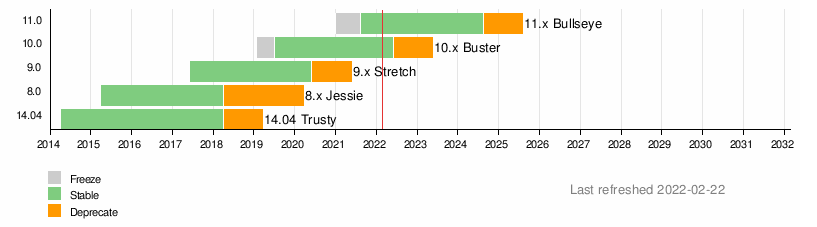
So, you are upgrading the Debian release
  • You are migrating to Debian 11 Bullseye, no?
  • No, we re migrating to Debian 10 Buster
  • Wait, but Debian 11 Bullseye exists!
  • Yes, we know! Let me explain
We re migrating the grid from Debian 9 Stretch to Debian 10 Buster, but perhaps we should be migrating from Debian 9 Stretch to Debian 11 Bullseye directly. This is a legitimate concern, and we discussed it in September 2021. A timeline showing Debian versions since 2014 Back then, our reasoning was that skipping to Debian 11 Bullseye would be more difficult for our users, especially because greater jump in version numbers for the underlying runtimes. Additionally, all the migration work started before Debian 11 Bullseye was released. Our original intention was for the migration to be completed before the release. For a couple of reasons the project was delayed, and when it was time to restart the project we decided to continue with the original idea. We had some work done to get Debian 10 Buster working correctly with the grid, and supporting Debian 11 Bullseye would require an additional effort. We didn t even check if Grid Engine could be installed in the latest Debian release. For the grid, in general, the engineering effort to do a N+1 upgrade is lower than doing a N+2 upgrade. If we had tried a N+2 upgrade directly, things would have been much slower and difficult for us, and for our users. In that sense, our conclusion was to not skip Debian 10 Buster.

We no longer want to run Grid Engine In a previous blog post we shared information about our desired future for Grid Engine in Toolforge. Our intention is to discontinue our usage of this technology.

No grid? What about my tools? Toolforge logo, a circle with an anvil in the middle Traditionally there have been two main workflows or use cases that were supported in the grid, but not in our Kubernetes backend:
  • Running jobs, long-running bots and other scheduled tasks.
  • Mixing runtime environments (for example, a nodejs app that runs some python code).
The good news is that work to handle the continuity of such use cases has already started. This takes the form of two main efforts:
  • The Toolforge buildpacks project to support arbitrary runtime environments.
  • The Toolforge Jobs Framework to support jobs, scheduled tasks, etc.
In particular, the Toolforge Jobs Framework has been available for a while in an open beta phase. We did some initial design and implementation, then deployed it in Toolforge for some users to try it and report bugs, report missing features, etc. These are complex, and feature-rich projects, and they deserve a dedicated blog post. More information on each will be shared in the future. For now, it is worth noting that both initiatives have some degree of development already. The conclusion Knowing all the moving parts, we were faced with a few hard questions when deciding how to approach the Debian 9 Stretch deprecation:
  • Should we not upgrade the grid, and focus on Kubernetes instead? Let Debian 9 Stretch be the last supported version on the grid?
  • What is the impact of these decisions on the technical community? What is best for our users?
The choices we made are already known in the community. A couple of weeks ago we announced the Debian 9 Stretch Grid Engine deprecation. In parallel to this migration, we decided to promote the new Toolforge Jobs Framework, even if it s still in beta phase. This new option should help users to future-proof their tool, and reduce maintenance effort. An early migration to Kubernetes now will avoid any more future grid problems. We truly hope that Debian 10 Buster is the last version we have for the grid, but as they say, hope is not a good strategy when it comes to engineering. What we will do is to work really hard in bringing Toolforge to the service level we want, and that means to keep developing and enabling more Kubernetes-based functionalities. Stay tuned for more upcoming blog posts with additional information about Toolforge. This post was originally published in the Wikimedia Tech blog, authored by Arturo Borrero Gonzalez.

5 May 2022

Reproducible Builds: Reproducible Builds in April 2022

Welcome to the April 2022 report from the Reproducible Builds project! In these reports, we try to summarise the most important things that we have been up to over the past month. If you are interested in contributing to the project, please take a few moments to visit our Contribute page on our website.

News Cory Doctorow published an interesting article this month about the possibility of Undetectable backdoors for machine learning models. Given that machine learning models can provide unpredictably incorrect results, Doctorow recounts that there exists another category of adversarial examples that comprise a gimmicked machine-learning input that, to the human eye, seems totally normal but which causes the ML system to misfire dramatically that permit the possibility of planting undetectable back doors into any machine learning system at training time .
Chris Lamb published two supporter spotlights on our blog: the first about Amateur Radio Digital Communications (ARDC) and the second about the Google Open Source Security Team (GOSST).
Piergiorgio Ladisa, Henrik Plate, Matias Martinez and Olivier Barais published a new academic paper titled A Taxonomy of Attacks on Open-Source Software Supply Chains (PDF):
This work proposes a general taxonomy for attacks on open-source supply chains, independent of specific programming languages or ecosystems, and covering all supply chain stages from code contributions to package distribution. Taking the form of an attack tree, it covers 107 unique vectors, linked to 94 real-world incidents, and mapped to 33 mitigating safeguards.

Elsewhere in academia, Ly Vu Duc published his PhD thesis. Titled Towards Understanding and Securing the OSS Supply Chain (PDF), Duc s abstract reads as follows:
This dissertation starts from the first link in the software supply chain, developers . Since many developers do not update their vulnerable software libraries, thus exposing the user of their code to security risks. To understand how they choose, manage and update the libraries, packages, and other Open-Source Software (OSS) that become the building blocks of companies completed products consumed by end-users, twenty-five semi-structured interviews were conducted with developers of both large and small-medium enterprises in nine countries. All interviews were transcribed, coded, and analyzed according to applied thematic analysis

Upstream news Filippo Valsorda published an informative blog post recently called How Go Mitigates Supply Chain Attacks outlining the high-level features of the Go ecosystem that helps prevent various supply-chain attacks.
There was new/further activity on a pull request filed against openssl by Sebastian Andrzej Siewior in order to prevent saved CFLAGS (which may contain the -fdebug-prefix-map=<PATH> flag that is used to strip an arbitrary the build path from the debug info if this information remains recorded then the binary is no longer reproducible if the build directory changes.

Events The Linux Foundation s SupplyChainSecurityCon, will take place June 21st 24th 2022, both virtually and in Austin, Texas. Long-time Reproducible Builds and openSUSE contributor Bernhard M. Wiedemann learned that he had his talk accepted, and will speak on Reproducible Builds: Unexpected Benefits and Problems on June 21st.
There will be an in-person Debian Reunion in Hamburg, Germany later this year, taking place from 23 30 May. Although this is a Debian event, there will be some folks from the broader Reproducible Builds community and, of course, everyone is welcome. Please see the event page on the Debian wiki for more information. 41 people have registered so far, and there s approx 10 on-site beds still left.
The minutes and logs from our April 2022 IRC meeting have been published. In case you missed this one, our next IRC meeting will take place on May 31st at 15:00 UTC on #reproducible-builds on the OFTC network.

Debian Roland Clobus wrote another in-depth status update about the status of live Debian images, summarising the current situation that all major desktops build reproducibly with bullseye, bookworm and sid, including the Cinnamon desktop on bookworm and sid, but at a small functionality cost: 14 words will be incorrectly abbreviated . This work incorporated:
  • Reporting an issue about unnecessarily modified timestamps in the daily Debian installer images. [ ]
  • Reporting a bug against the debian-installer: in order to use a suitable kernel version. (#1006800)
  • Reporting a bug in: texlive-binaries regarding the unreproducible content of .fmt files. (#1009196)
  • Adding hacks to make the Cinnamon desktop image reproducible in bookworm and sid. [ ]
  • Added a script to rebuild a live-build ISO image from a given timestamp. [
  • etc.
On our mailing list, Venkata Pyla started a thread on the Debian debconf cache is non-reproducible issue while creating system images and Vagrant Cascadian posted an excellent summary of the reproducibility status of core package sets in Debian and solicited for similar information from other distributions.
Lastly, 122 reviews of Debian packages were added, 44 were updated and 193 were removed this month adding to our extensive knowledge about identified issues. A number of issue types have been updated as well, including timestamps_generated_by_hevea, randomness_in_ocaml_preprocessed_files, build_path_captured_in_emacs_el_file, golang_compiler_captures_build_path_in_binary and build_path_captured_in_assembly_objects,

Other distributions Happy birthday to GNU Guix, which recently turned 10 years old! People have been sharing their stories, in which reproducible builds and bootstrappable builds are a recurring theme as a feature important to its users and developers. The experiences are available on the GNU Guix blog as well as a post on fossandcrafts.org
In openSUSE, Bernhard M. Wiedemann posted his usual monthly reproducible builds status report.

Upstream patches The Reproducible Builds project detects, dissects and attempts to fix as many currently-unreproducible packages as possible. We endeavour to send all of our patches upstream where appropriate. This month, we wrote a large number of such patches, including:

diffoscope diffoscope is our in-depth and content-aware diff utility. Not only can it locate and diagnose reproducibility issues, it can provide human-readable diffs from many kinds of binary formats. This month, Chris Lamb prepared and uploaded versions 210 and 211 to Debian unstable, as well as noticed that some Python .pyc files are reported as data, so we should support .pyc as a fallback filename extension [ ]. In addition, Mattia Rizzolo disabled the Gnumeric tests in Debian as the package is not currently available [ ] and dropped mplayer from Build-Depends too [ ]. In addition, Mattia fixed an issue to ensure that the PATH environment variable is properly modified for all actions, not just when running the comparator. [ ]

Testing framework The Reproducible Builds project runs a significant testing framework at tests.reproducible-builds.org, to check packages and other artifacts for reproducibility. This month, the following changes were made:
  • Daniel Golle:
    • Prefer a different solution to avoid building all OpenWrt packages; skip packages from optional community feeds. [ ]
  • Holger Levsen:
    • Detect Python deprecation warnings in the node health check. [ ]
    • Detect failure to build the Debian Installer. [ ]
  • Mattia Rizzolo:
    • Install disorderfs for building OpenWrt packages. [ ]
  • Paul Spooren (OpenWrt-related changes):
    • Don t build all packages whilst the core packages are not yet reproducible. [ ]
    • Add a missing RUN directive to node_cleanup. [ ]
    • Be less verbose during a toolchain build. [ ]
    • Use disorderfs for rebuilds and update the documentation to match. [ ][ ][ ]
  • Roland Clobus:
    • Publish the last reproducible Debian ISO image. [ ]
    • Use the rebuild.sh script from the live-build package. [ ]
Lastly, node maintenance was also performed by Holger Levsen [ ][ ].
If you are interested in contributing to the Reproducible Builds project, please visit our Contribute page on our website. However, you can get in touch with us via:

26 April 2022

Reproducible Builds: Supporter spotlight: Google Open Source Security Team (GOSST)

The Reproducible Builds project relies on several projects, supporters and sponsors for financial support, but they are also valued as ambassadors who spread the word about our project and the work that we do. This is the fourth instalment in a series featuring the projects, companies and individuals who support the Reproducible Builds project. If you are a supporter of the Reproducible Builds project (of whatever size) and would like to be featured here, please let get in touch with us at contact@reproducible-builds.org. We started this series by featuring the Civil Infrastructure Platform project and followed this up with a post about the Ford Foundation as well as a recent one about ARDC. However, today, we ll be talking with Meder Kydyraliev of the Google Open Source Security Team (GOSST).
Chris Lamb: Hi Meder, thanks for taking the time to talk to us today. So, for someone who has not heard of the Google Open Source Security Team (GOSST) before, could you tell us what your team is about? Meder: Of course. The Google Open Source Security Team (or GOSST ) was created in 2020 to work with the open source community at large, with the goal of making the open source software that everyone relies on more secure.
Chris: What kinds of activities is the GOSST involved in? Meder: The range of initiatives that the team is involved in recognizes the diversity of the ecosystem and unique challenges that projects face on their security journey. For example, our sponsorship of sos.dev ensures that developers are rewarded for security improvements to open source projects, whilst the long term work on improving Linux kernel security tackles specific kernel-related vulnerability classes. Many of the projects GOSST is involved with aim to make it easier for developers to improve security through automated assessment (Scorecards and Allstar) and vulnerability discovery tools (OSS-Fuzz, ClusterFuzzLite, FuzzIntrospector), in addition to contributing to infrastructure to make adopting certain best practices easier. Two great examples of best practice efforts are Sigstore for artifact signing and OSV for automated vulnerability management.
Chris: The usage of open source software has exploded in the last decade, but supply-chain hygiene and best practices has seemingly not kept up. How does GOSST see this issue and what approaches is it taking to ensure that past and future systems are resilient? Meder: Every open source ecosystem is a complex environment and that awareness informs our approaches in this space. There are, of course, no silver bullets , and long-lasting and material supply-chain improvements requires infrastructure and tools that will make lives of open source developers easier, all whilst improving the state of the wider software supply chain. As part of a broader effort, we created the Supply-chain Levels for Software Artifacts framework that has been used internally at Google to protect production workloads. This framework describes the best practices for source code and binary artifact integrity, and we are engaging with the community on its refinement and adoption. Here, package managers (such as PyPI, Maven Central, Debian, etc.) are an essential link in the software supply chain due to their near-universal adoption; users do not download and compile their own software anymore. GOSST is starting to work with package managers to explore ways to collaborate together on improving the state of the supply chain and helping package maintainers and application developers do better all with the understanding that many open source projects are developed in spare time as a hobby! Solutions like this, which are the result of collaboration between GOSST and GitHub, are very encouraging as they demonstrate a way to materially strengthen software supply chain security with readily available tools, while also improving development workflows. For GOSST, the problem of supply chain security also covers vulnerability management and solutions to make it easier for everyone to discover known vulnerabilities in open source packages in a scalable and automated way. This has been difficult in the past due to lack of consistently high-quality data in an easily-consumable format. To address this, we re working on infrastructure (OSV.dev) to make vulnerability data more easily accessible as well as a widely adopted and automation friendly data format.
Chris: How does the Reproducible Builds effort help GOSST achieve its goals? Meder: Build reproducibility has a lot of attributes that are attractive as part of generally good build hygiene . As an example, hermeticity, one of requirements to meet SLSA level 4, makes it much easier to reason about the dependencies of a piece of software. This is an enormous benefit during vulnerability or supply chain incident response. On a higher level, however, we always think about reproducibility from the viewpoint of a user and the threats that reproducibility protects them from. Here, a lot of progress has been made, of course, but a lot of work remains to make reproducibility part of everyone s software consumption practices.
Chris: So if someone wanted to know more about GOSST or follow the team s work, where might they go to look? Meder: We post regular updates on Google s Security Blog and on the Linux hardening mailing list. We also welcome community participation in the projects we work on! See any of the projects linked above or OpenSSF s GitHub projects page for a list of efforts you can contribute to directly if you want to get involved in strengthening the open source ecosystem.
Chris: Thanks for taking the time to talk to us today. Meder: No problem. :)


For more information about the Reproducible Builds project, please see our website at reproducible-builds.org. If you are interested in ensuring the ongoing security of the software that underpins our civilisation and wish to sponsor the Reproducible Builds project, please reach out to the project by emailing contact@reproducible-builds.org.

22 April 2022

Andrej Shadura: To England by train (part 1)

This post was written in August 2021. Just as I was going to publish it, I received an email from BB stating that due to a railway strike in Germany my night train would be cancelled. Since the rest of the trip has already been booked well in advance, I had to take a plane to Charleroi and a bus to Brussels to catch my Eurostar. Ultimately, I ended up publishing it in April 2022, just as I m about to leave for a fully train-powered trip to the UK once again. Before the pandemic started, I planned to use the last months of my then-expiring UK visa and go to England by train. I ve completed two train long journeys by that time already, to Brussels and to Belarus and Ukraine, but this would be something quite different, as I wanted to have multiple stops on my way, use night trains where it made sense, and to go through the Channel Tunnel. The Channel Tunnel fascinated me since my childhood; I first read about it in the Soviet Science and Life magazine ( ) when I was seven. I ve never had the chance to use it though, since to board any train going though it I d first need to get to France, Belgium or the Netherlands, making it significantly more expensive than the cheap 30 Ryanair flights to Stansted. As the coronavirus spread across the world, all of my travel plans along with plans for a sabbatical had to be cancelled. During 2020, I only managed to go on two weekend trips to Prague and Budapest, followed by a two-weeks holiday on Crete (we returned just a couple of weeks before the infection numbers rose and lockdowns started). I do realise that a lot of people couldn t even have this much because the situation in their countries was much worse we were lucky to have had at least some travel. Fast forward to August 2021, I m fully vaccinated, I once again have a UK visa for five years, and the UK finally recognises the EU vaccination passports yay! I can finally go to Devon to see my mother and sister again. By train, of course. Compared to my original plan, this journey will be different: about the same or even more expensive than I originally planned, but shorter and with fewer stops on the way. My original plan would be to take multiple trains from Bratislava to France or Belgium and complete this segment of the trip in about three days, enjoying my stay in a couple of cities on the way. Instead, I m taking a direct NightJet from Vienna to Brussels, not stopping anywhere on the way.
Map: train route from Bratislava to BrusselsTrain route from Bratislava to Brussels
Since I was booking my trip just two weeks ahead, the price of the ticket is not that I hoped for, but much higher: 109 for the ticket itself and 60 for the berth (advance bookings could be about twice as cheap). Next, to London! Eurostar is still on a very much reduced schedule, running one train only from Amsterdam through Brussels and Lille to London each day. This means, of course, higher ticket prices (I paid about 100 for the ticket) and longer waiting time in Brussels my sleeper arrives about 10 am, but the Eurostar train is scheduled to depart at 3 pm.
Map: train route from Brussels to LondonTrain route from Brussels to London
The train makes a stop in Lille, which I initially suspected to be risky as at the time when I booked my tickets, as at the time France was on the amber plus list for the UK, requiring a quarantine upon arrival. However, Eurostar announced that they will assign travellers from Lille to a different carriage to avoid other passengers having to go to quarantine, but recently France was taken off the amber plus list. The train fare system in the UK is something I don t quite understand, as sometimes split tickets are cheaper, sometimes they re expensive, sometimes prices for the same service at different times can be vastly different, off-peak tickets don t say what exactly off-peak means (very few people in the UK are asked were able to tell me when exactly off-peak hours are). Curiously, transfers between train stations using London Underground services can be included into railway tickets, but some last mile connection like Exeter to Honiton cannot (but this used to be possible). Both GWR.com and TrainLine refused to sell me a single ticket from London to Honiton through Exeter, insisting I split the ticket at Exeter St Davids or take the slower South Western train to Honiton via Salisbury and Yeovil. I ended up buying a 57 ticket from Paddington to Exeter St Davids with the first segment being the London Underground from St Pancras, and a separate 7.70 ticket to Honiton.
Map: arrival at St Pancras, the underground, departure from PaddingtonChange of trains in London
Map: arrival at Exeter St Davids, change to a South Western train, arrival at HonitonChange of trains in Exeter
Date Station Arrival Departure Train
12.8 Bratislava-Petr alka 18:15 REX 7756
Wien Hbf 19:15 19:53 NJ 50490
13.8 Bruxelles-Midi 9:55 15:06 EST 9145
London St Pancras 16:03 16:34 TfL
London Paddington 16:49 17:04 GWR 59231
Exeter St Davids 19:19 19:25 SWR 52706
Honiton 19:54
Unfortunately, due to the price of the tickets, I m taking a 15 Ryanair flight back Update after the journey Since I flew to Charleroi instead of comfortably sleeping in a night train, I had to put up with inconveniences of airports, including cumbersome connections to the nearby cities. The only reasonable way of getting from Charleroi to Brussels is an overcrowded bus which takes almost an hour to arrive. I used to take this bus when I tried to save money on my way to FOSDEM, and I must admit it s not something I missed. Boarding the Eurostar train went fine, my vaccination passport and Covid test wasn t really checked, just glanced at. The waiting room was a bit of a disappointment, with bars closed and vending machines broken. Since it was underground, I couldn t even see the trains until the very last moment when we were finally allowed on the platform. The train itself, while comfortable, disappointed me with the bistro carriage: standing only, instant coffee, poor selection of food and drinks. I m glad I bought some food at Carrefour at the Midi station! When I arrived in Exeter, I soon found out why the system refused to sell me a through ticket: 6 minutes is not enough to change trains at Exeter St Davids! Or, it might have been if I took the right footbridge but I took the one which led into a very talkative (and slow!) lift. I ended up running to the train just as it closed the doors and departed, leaving me tin Exeter for an hour until. I used this chance and walked to Exeter Central, and had a pint in a conveniently located pub around the corner. P.S. The maps in this and other posts were created using uMap; the map data come from OpenStreetMap. The train route visualisation was generated with help of the Raildar.fr OSRM instance.

20 April 2022

Russell Coker: Android Without Play

A while ago I was given a few reasonably high-end Android phones to give away. I gave two very nice phones to someone who looks after refugees so a couple of refugee families could make video calls to relatives. The third phone is a Huawei Nova 7i [1] which doesn t have the Google Play Store. The Nova 7i is a ridiculously powerful computer (8G of RAM in a phone!!!) but without the Google Play Store it s not much use to the average phone user. It has the HuaWei App Gallery which isn t as bad as most of the proprietary app stores of small players in the Android world, it has SnapChat, TikTok, Telegram, Alibaba, WeChat, and Grays auction (an app I didn t even know existed) along with many others. It also links to ApkPure (apparently a 3rd party app installer that obtains APK files for major commercial apps) for Facebook among others. The ApkPure thing might be Huawei outsourcing the violation of Facebook terms of service. For the moment I ve decided to only use free software on this phone and use my old phone for non-free stuff (Facebook, LinkedIn, etc). The eventual aim is that I can only carry a phone with free software for normal use and carry a second phone if I m active on LinkedIn or something. My recollection is that when I first got the phone (almost 2 years ago) it didn t have such a range of apps. The first thing to install was f-droid [2] as the app repository. F-droid has a repository of thousands of free software Android apps as well as some apps that are slightly less free which are tagged appropriately. You can install the F-Droid app from the web site. As an aside I had to go to settings and enable force old index format to get the list of packages, I don t know why as other phones had worked without it. Here are the F-Droid apps I installed: Future Plans The current main things I m missing are a calendar, a contact list, and a shared note taking system (like Google Keep). For calendaring and a contact list the CalDAV and CardDAV protocols seem best. The most common implementation on the server side appears to be DAViCal [5]. The Nextcloud system supports CalDAV, CardDAV, web editing of notes and documents (including LibreOffice if you install that plugin) [6]. But it is huge and demands write access to all it s own code (bad for security), and it s not packaged for Debian. Also in my tests it gave me an error 401 when I tried to authenticate to it from the Android Nextcloud client. I ve seen a positive review about Radicale, a simple CalDAV and CardDAV server that doesn t need a database [7]. I prefer the Unix philosophy of keeping things simple with file storage unless there s a real need for anything else. I don t think that anything I ever do with calendaring will require the PostgreSQL database that DAViCal uses. I ll give Radicale a go for CalDAV and CardDAV, but I still need something for shared notes (shopping lists etc). Suggestions welcome. Current Status Lack of a contacts list is a major loss of functionality in a phone. I could store contacts in the phone memory or on the SIM, but I would still have to get all my old contacts in there and also getting something half working reduces motivation for getting it working properly. Lack of a calendar is also a problem, again I could work around that by exporting all my Google calendars as iCal URLs but I d rather get it working correctly. The lack of shared notes may be a harder problem to solve given the failure of Nextcloud. For that I would consider just having the keep.google.com web site always open in Mozilla at least in the short term. At the moment I require two phones, my new Android phone without Google and the old one for my contacts list etc. Hopefully in a week or so I ll have my new phone doing contacts, calendaring, and notes. Then my old phone will just be for proprietary apps which I don t need most of the time and I can leave it at home when I don t need that sort of thing.

19 April 2022

Bits from Debian: ITP Prizren Platinum Sponsor of DebConf22

itplogo We are very pleased to announce that ITP - Innovation and Training Park Prizren has committed to supporting DebConf22 as a Platinum sponsor. Also, ITP Prizren will host the Conference for all 15 days! The ITP Prizren intends to be a changing and boosting element in the area of ICT, agro-food and creatives industries, through the creation and management of a favourable environment and efficient services for SMEs, exploiting different kinds of innovations that can contribute to Kosovo to improve its level of development in industry and research, bringing benefits to the economy and society of the country as a whole. ITP Prizren is a focal point in the Balkan region for innovation, business and skills development, and a source of innovative and successful ideas. With this commitment as Platinum Sponsor, ITP Prizren is contributing to make possible our annual conference, and directly supporting the progress of Debian and Free Software, helping to strengthen the community that continues to collaborate on Debian projects throughout the rest of the year. Thank you very much ITP Prizren, for your support of DebConf22! Become a sponsor too! DebConf22 will take place from July 17th to 24th, 2022 at the Innovation and Training Park (ITP) in Prizren, Kosovo, and will be preceded by DebCamp, from July 10th to 16th. And DebConf22 is still accepting sponsors! Interested companies and organizations may contact the DebConf team through sponsors@debconf.org, and visit the DebConf22 website at https://debconf22.debconf.org/sponsors/become-a-sponsor. DebConf22 banner open registration

17 April 2022

Russ Allbery: First 2022 haul post

I haven't posted one of these in a while. Here's the (mostly new) stuff that's come out that caught my interest in the past few months. Some of these I've already read and reviewed. Tom Burgis Kleptopia (non-fiction)
Angela Chen Ace (non-fiction)
P. Dj l Clark A Dead Djinn in Cairo (sff)
P. Dj l Clark The Haunting of Tram Car 015 (sff)
P. Dj l Clark A Master of Djinn (sff)
Brittney C. Cooper Eloquent Rage (non-fiction)
Madeleine Dore I Didn't Do the Thing Today (non-fiction)
Saad Z. Hossain The Gurkha and the Lord of Tuesday (sff)
George F. Kennan Memoirs, 1925-1950 (non-fiction)
Kiese Laymon How to Slowly Kill Yourself and Others in America (non-fiction)
Adam Minter Secondhand (non-fiction)
Amanda Oliver Overdue (non-fiction)
Laurie Penny Sexual Revolution (non-fiction)
Scott A. Snook Friendly Fire (non-fiction)
Adrian Tchaikovsky Elder Race (sff)
Adrian Tchaikovsky Shards of Earth (sff)
Tor.com (ed.) Some of the Best of Tor.com: 2021 (sff anthology)
Charlie Warzel & Anne Helen Petersen Out of Office (non-fiction)
Robert Wears Still Not Safe (non-fiction)
Max Weber The Vocation Lectures (non-fiction) Lots and lots of non-fiction in this mix. Maybe a tiny bit better than normal at not buying tons of books that I don't have time to read, although my reading (and particularly my reviewing) rate has been a bit slow lately.

14 April 2022

Jonathan Dowland: hledger

This year I've decided to bite the bullet and properly try out hledger for personal accounting. It seems I need to commit to it properly if I'm to figure out whether it will work for me or not. Up until now I'd been strictly separating my finances into two buckets: family and personal. I'd been using GNUCash for a couple of years for my personal finances, initially to evaluate it for use for the family, but I had not managed to adopt it for that. I set up a new git repository to track the ledger file, as well as a notes.txt "diary" that documents my planning around its structure and how to use it, and a import.txt which documents what account data I have imported and confirmed that the resulting balances match those reported on monthly statements. For this evaluation, I decided to bite the bullet and track both family and personal finances at the same time. I'm still keeping them conceptually very separate. To reflect that I've organised my account names around that: all accounts relating to family are prefixed family:, and likewise personal jon:.1 Some example accounts:
family:assets:shared    - shared bank account
family:dues:jon         - I owe to family
family:expenses:cat     - budget category for the cat
income                  - where money enters this universe
jon:assets:current      - my personal account
jon:dues:peter          - money Peter owes me
jon:expenses:snacks     - budget category for coffees etc
jon:liabilities:amex    - a personal credit card
I decided to make the calendar year a strict cut-over point: my personal opening balances in hledger are determined by what GNUCash reports. It's possible those will change over this year, as adjustments are made to last year's data: but it's easy enough to go in and update the opening balances in hledger to reflect that. Credit cards are a small exception. January's credit card bills are paid in January but cover transactions from mid-December. I import those transactions into hledger to balance the credit card payment. As a consequence, the "spend per month" view of my data is a bit skewed: All the transactions in December should be thought of as in January since that's when they were paid. I need to explore options to fix this. When I had family and personal managed separately, occasionally something would be paid for on the wrong card and end up in the wrong data. The solution I used last year was to keep an account dues:family to which I posted those and periodically I'd settle it with a real-world bank transfer. I've realised that this doesn't work so well when I manage both together: I can't track both dues and expense categorisation with just one posting. The solution I'm using for now is hledger's unbalanced virtual postings: a third posting for the transaction to the budget category, which is not balanced, e.g.:
2022-01-02 ZTL*RELISH
    family:liabilities:creditcard        -3.00
    family:dues:jon                       3.00
    (jon:expenses:snacks)                 3.00
This works, but it completely side-steps double-entry book keeping, which is the whole point of using a double-entry system. There's also no check and balance that the figure I put in the virtual posting ( 3) matches the figure in the rest of the transaction. I'm therefore open to other ideas.

  1. there are a couple of places in hledger where default account names are used, such as the default place that expenses are posted to during CSV imports: expenses:unknown, that obviously don't fit my family/jon: prefix scheme. The solution is to make sure I specify a default posting-to account in all my CSV import rules.

8 April 2022

Jacob Adams: The Unexpected Importance of the Trailing Slash

For many using Unix-derived systems today, we take for granted that /some/path and /some/path/ are the same. Most shells will even add a trailing slash for you when you press the Tab key after the name of a directory or a symbolic link to one. However, many programs treat these two paths as subtly different in certain cases, which I outline below, as all three have tripped me up in various ways1.

POSIX and Coreutils Perhaps the trickiest use of the trailing slash in a distinguishing way is in POSIX2 which states:
When the final component of a pathname is a symbolic link, the standard requires that a trailing <slash> causes the link to be followed. This is the behavior of historical implementations3. For example, for /a/b and /a/b/, if /a/b is a symbolic link to a directory, then /a/b refers to the symbolic link, and /a/b/ refers to the directory to which the symbolic link points.
This leads to some unexpected behavior. For example, if you have the following structure of a directory dir containing a file dirfile with a symbolic link link pointing to dir. (which will be used in all shell examples throughout this article):
$ ls -lR
.:
total 4
drwxr-xr-x 2 jacob jacob 4096 Apr  3 00:00 dir
lrwxrwxrwx 1 jacob jacob    3 Apr  3 00:00 link -> dir
./dir:
total 0
-rw-r--r-- 1 jacob jacob 0 Apr  3 00:12 dirfile
On Unixes such as MacOS, FreeBSD or Illumos4, you can move a directory through a symbolic link by using a trailing slash:
$ mv link/ otherdir
$ ls
link	otherdir
On Linux5, mv will not rename the indirectly referenced directory and not the symbolic link, when given a symbolic link with a trailing slash as the source to be renamed. despite the coreutils documentation s claims to the contrary6, instead failing with Not a directory:
$ mv link/ other
mv: cannot move 'link/' to 'other': Not a directory
$ mkdir otherdir
$ mv link/ otherdir
mv: cannot move 'link/' to 'otherdir/link': Not a directory
$ mv link/ otherdir/
mv: cannot move 'link/' to 'otherdir/link': Not a directory
$ mv link otherdirlink
$ ls -l otherdirlink
lrwxrwxrwx 1 jacob jacob 3 Apr  3 00:13 otherdirlink -> dir
This is probably for the best, as it is very confusing behavior. There is still one advantage the trailing slash has when using mv, even on Linux, in that is it does not allow you to move a file to a non-existent directory, or move a file that you expect to be a directory that isn t.
$ mv dir/dirfile nonedir/
mv: cannot move 'dir/dirfile' to 'nonedir/': Not a directory
$ touch otherfile
$ mv otherfile/ dir
mv: cannot stat 'otherfile/': Not a directory
$ mv otherfile dir
$ ls dir
dirfile  otherfile
However, Linux still exhibits some confusing behavior of its own, like when you attempt to remove link recursively with a trailing slash:
rm -rvf link/
Neither link nor dir are removed, but the contents of dir are removed:
removed 'link/dirfile'
Whereas if you remove the trailing slash, you just remove the symbolic link:
$ rm -rvf link
removed 'link'
While on MacOS, FreeBSD or Illumos4, rm will also remove the source directory:
$ rm -rvf link
link/dirfile
link/
$ ls
link
The find and ls commands, in contrast, behave the same on all three operating systems. The find command only searches the contents of the directory a symbolic link points to if the trailing slash is added:
$ find link -name dirfile
$ find link/ -name dirfile
link/dirfile
The ls command acts similarly, showing information on just a symbolic link by itself unless a trailing slash is added, at which point it shows the contents of the directory that it links to:
$ ls -l link
lrwxrwxrwx 1 jacob jacob 3 Apr  3 00:13 link -> dir
$ ls -l link/
total 0
-rw-r--r-- 1 jacob jacob 0 Apr  3 00:13 dirfile

rsync The command rsync handles a trailing slash in an unusual way that trips up many new users. The rsync man page notes:
You can think of a trailing / on a source as meaning copy the contents of this directory as opposed to copy the directory by name , but in both cases the attributes of the containing directory are transferred to the containing directory on the destination.
That is to say, if we had two folders a and b each of which contained some files:
$ ls -R .
.:
a  b
./a:
a1  a2
./b:
b1  b2
Running rsync -av a b moves the entire directory a to directory b:
$ rsync -av a b
sending incremental file list
a/
a/a1
a/a2
sent 181 bytes  received 58 bytes  478.00 bytes/sec
total size is 0  speedup is 0.00
$ ls -R b
b:
a  b1  b2
b/a:
a1  a2
While running rsync -av a/ b moves the contents of directory a to b:
$ rsync -av a/ b
sending incremental file list
./
a1
a2
sent 170 bytes  received 57 bytes  454.00 bytes/sec
total size is 0  speedup is 0.00
$ ls b
a1  a2	b1  b2

Dockerfile COPY The Dockerfile COPY command also cares about the presence of the trailing slash, using it to determine whether the destination should be considered a file or directory. The Docker documentation explains the rules of the command thusly:
COPY [--chown=<user>:<group>] <src>... <dest>
If <src> is a directory, the entire contents of the directory are copied, including filesystem metadata. Note: The directory itself is not copied, just its contents. If <src> is any other kind of file, it is copied individually along with its metadata. In this case, if <dest> ends with a trailing slash /, it will be considered a directory and the contents of <src> will be written at <dest>/base(<src>). If multiple <src> resources are specified, either directly or due to the use of a wildcard, then <dest> must be a directory, and it must end with a slash /. If <dest> does not end with a trailing slash, it will be considered a regular file and the contents of <src> will be written at <dest>. If <dest> doesn t exist, it is created along with all missing directories in its path.
This means if you had a COPY command that moved file to a nonexistent containerfile without the slash, it would create containerfile as a file with the contents of file.
COPY file /containerfile
container$ stat -c %F containerfile
regular empty file
Whereas if you add a trailing slash, then file will be added as a file under the new directory containerdir:
COPY file /containerdir/
container$ stat -c %F containerdir
directory
Interestingly, at no point can you copy a directory completely, only its contents. Thus if you wanted to make a directory in the new container, you need to specify its name in both the source and the destination:
COPY dir /dirincontainer
container$ stat -c %F /dirincontainer
directory
Dockerfiles do also make good use of the trailing slash to ensure they re doing what you mean by requiring a trailing slash on the destination of multiple files:
COPY file otherfile /othercontainerdir
results in the following error:
When using COPY with more than one source file, the destination must be a directory and end with a /
  1. I m sure there are probably more than just these three cases, but these are the three I m familiar with. If you know of more, please tell me about them!.
  2. Some additional relevant sections are the Path Resolution Appendix and the section on Symbolic Links.
  3. The sentence This is the behavior of historical implementations implies that this probably originated in some ancient Unix derivative, possibly BSD or even the original Unix. I don t really have a source on that though, so please reach out if you happen to have any more knowledge on what this refers to.
  4. I tested on MacOS 11.6.5, FreeBSD 12.0 and OmniOS 5.11 2
  5. unless the source is a directory trailing slashes give -ENOTDIR
  6. In fairness to the coreutils maintainers, it seems to be true on all other Unix platforms, but it probably deserves a mention in the documentation when Linux is the most common platform on which coreutils is used. I should submit a patch.

5 April 2022

Kees Cook: security things in Linux v5.10

Previously: v5.9 Linux v5.10 was released in December, 2020. Here s my summary of various security things that I found interesting: AMD SEV-ES
While guest VM memory encryption with AMD SEV has been supported for a while, Joerg Roedel, Thomas Lendacky, and others added register state encryption (SEV-ES). This means it s even harder for a VM host to reconstruct a guest VM s state. x86 static calls
Josh Poimboeuf and Peter Zijlstra implemented static calls for x86, which operates very similarly to the static branch infrastructure in the kernel. With static branches, an if/else choice can be hard-coded, instead of being run-time evaluated every time. Such branches can be updated too (the kernel just rewrites the code to switch around the branch ). All these principles apply to static calls as well, but they re for replacing indirect function calls (i.e. a call through a function pointer) with a direct call (i.e. a hard-coded call address). This eliminates the need for Spectre mitigations (e.g. RETPOLINE) for these indirect calls, and avoids a memory lookup for the pointer. For hot-path code (like the scheduler), this has a measurable performance impact. It also serves as a kind of Control Flow Integrity implementation: an indirect call got removed, and the potential destinations have been explicitly identified at compile-time. network RNG improvements
In an effort to improve the pseudo-random number generator used by the network subsystem (for things like port numbers and packet sequence numbers), Linux s home-grown pRNG has been replaced by the SipHash round function, and perturbed by (hopefully) hard-to-predict internal kernel states. This should make it very hard to brute force the internal state of the pRNG and make predictions about future random numbers just from examining network traffic. Similarly, ICMP s global rate limiter was adjusted to avoid leaking details of network state, as a start to fixing recent DNS Cache Poisoning attacks. SafeSetID handles GID
Thomas Cedeno improved the SafeSetID LSM to handle group IDs (which required teaching the kernel about which syscalls were actually performing setgid.) Like the earlier setuid policy, this lets the system owner define an explicit list of allowed group ID transitions under CAP_SETGID (instead of to just any group), providing a way to keep the power of granting this capability much more limited. (This isn t complete yet, though, since handling setgroups() is still needed.) improve kernel s internal checking of file contents
The kernel provides LSMs (like the Integrity subsystem) with details about files as they re loaded. (For example, loading modules, new kernel images for kexec, and firmware.) There wasn t very good coverage for cases where the contents were coming from things that weren t files. To deal with this, new hooks were added that allow the LSMs to introspect the contents directly, and to do partial reads. This will give the LSMs much finer grain visibility into these kinds of operations. set_fs removal continues
With the earlier work landed to free the core kernel code from set_fs(), Christoph Hellwig made it possible for set_fs() to be optional for an architecture. Subsequently, he then removed set_fs() entirely for x86, riscv, and powerpc. These architectures will now be free from the entire class of kernel address limit attacks that only needed to corrupt a single value in struct thead_info. sysfs_emit() replaces sprintf() in /sys
Joe Perches tackled one of the most common bug classes with sprintf() and snprintf() in /sys handlers by creating a new helper, sysfs_emit(). This will handle the cases where kernel code was not correctly dealing with the length results from sprintf() calls, which might lead to buffer overflows in the PAGE_SIZE buffer that /sys handlers operate on. With the helper in place, it was possible to start the refactoring of the many sprintf() callers. nosymfollow mount option
Mattias Nissler and Ross Zwisler implemented the nosymfollow mount option. This entirely disables symlink resolution for the given filesystem, similar to other mount options where noexec disallows execve(), nosuid disallows setid bits, and nodev disallows device files. Quoting the patch, it is useful as a defensive measure for systems that need to deal with untrusted file systems in privileged contexts. (i.e. for when /proc/sys/fs/protected_symlinks isn t a big enough hammer.) Chrome OS uses this option for its stateful filesystem, as symlink traversal as been a common attack-persistence vector. ARMv8.5 Memory Tagging Extension support
Vincenzo Frascino added support to arm64 for the coming Memory Tagging Extension, which will be available for ARMv8.5 and later chips. It provides 4 bits of tags (covering multiples of 16 byte spans of the address space). This is enough to deterministically eliminate all linear heap buffer overflow flaws (1 tag for free , and then rotate even values and odd values for neighboring allocations), which is probably one of the most common bugs being currently exploited. It also makes use-after-free and over/under indexing much more difficult for attackers (but still possible if the target s tag bits can be exposed). Maybe some day we can switch to 128 bit virtual memory addresses and have fully versioned allocations. But for now, 16 tag values is better than none, though we do still need to wait for anyone to actually be shipping ARMv8.5 hardware. fixes for flaws found by UBSAN
The work to make UBSAN generally usable under syzkaller continues to bear fruit, with various fixes all over the kernel for stuff like shift-out-of-bounds, divide-by-zero, and integer overflow. Seeing these kinds of patches land reinforces the the rationale of shifting the burden of these kinds of checks to the toolchain: these run-time bugs continue to pop up. flexible array conversions
The work on flexible array conversions continues. Gustavo A. R. Silva and others continued to grind on the conversions, getting the kernel ever closer to being able to enable the -Warray-bounds compiler flag and clear the path for saner bounds checking of array indexes and memcpy() usage. That s it for now! Please let me know if you think anything else needs some attention. Next up is Linux v5.11.

2022, Kees Cook. This work is licensed under a Creative Commons Attribution-ShareAlike 4.0 License.
CC BY-SA 4.0

4 April 2022

Arturo Borrero Gonz lez: Wikimedia Toolforge and Grid Engine

Logos This post was originally published in the Wikimedia Tech blog, authored by Arturo Borrero Gonzalez. One of the most important and successful products provided by the Wikimedia Cloud Services team at the Wikimedia Foundation is Toolforge, a hosting service commonly known in the industry as Platform as a Service (PaaS). In particular, it is a platform that allows users and developers to run and use a variety of applications with the ultimate goal of helping the Wikimedia mission from the technical side. Toolforge is powered by two different backend engines, Kubernetes and Grid Engine. The two backends have traditionally offered different features for tool developers. But as time moves forward we ve learnt that Kubernetes is the future. Explaining why is the purpose of this blog post: we want to share more information and reasoning behind this mindset. There are a number of reasons that make Grid Engine poorly suitable to remain as execution backend in Toolforge:
  • There has not been a new Grid Engine release (bug fixes, security patches, or otherwise) since 2016. This doesn t feel like a project being actively developed or maintained.
  • The grid has poor support and controls for important aspects such as high availability, fault tolerance and self-recovery.
  • Maintaining a healthy grid requires plenty of manual operations, like manual queue cleanups in case of failures, hand-crafted scripts for pooling/depooling nodes, etc.
  • There is no good or modern monitoring support for the grid, and we need to craft and maintain several monitoring pieces for proper observability, and to be able to do proper maintenance.
  • The grid is also strongly tied to the underlying operating system release version. Migrating from one Debian version to the next is painful (a dedicated blog post about this will follow shortly).
  • The grid imposes a strong dependency on NFS, another old technology. We would like to reduce dependency on NFS overall, and in the future we will explore NFS-free approaches for Toolforge.
  • In general, Grid Engine is old software, old technology, which can be replaced by more modern approaches for providing an equivalent or better service.
As mentioned above, our desire is to cover all our grid-like needs with Kubernetes, a technology which has several benefits:
  • Good high availability, fault tolerance and self-recovery semantics, constructs and facilities.
  • Maintaining a running Kubernetes cluster requires little manual operations.
  • There are good monitoring and observability options for Kubernetes deployments, including seamless integration with industry standards like prometheus.
  • Our current approach to deploying and upgrading Kubernetes is independent of the underlying operating system.
  • While our current Kubernetes deployment uses NFS as a central component, there is support for using other, more modern, approaches for the kind of shared storage needs we have in Toolforge.
  • In general, Kubernetes is a modern technology, with a vibrant and healthy community, that enables new use cases and has enough flexibility to adapt legacy ones.
The relationship between Toolforge and Grid Engine has been interesting over the years. The grid has been used for quite a lot of time, we have plenty of documentation and established good practices. On the other hand, the grid is hard to maintain, imposes a heavy burden on the WMCS team and is a technology we must eventually discontinue. How to accommodate the two realities is a refreshing challenge, one that we hope to tackle together in the near future. A tradeoff exists here, but it is clear to us which option is best. So we will work on deprecating and removing Grid Engine and migrating use cases into Kubernetes. This deprecation, however, will be done with care, as we know our technical community relies on the grid for some import Toolforge tools. And some of these workflows will need some adaptation in order to be fully supported on Kubernetes. Stay tuned for more information on present and next works surrounding the Wikimedia Toolforge service. The next blog post will share more concrete details. This post was originally published in the Wikimedia Tech blog, authored by Arturo Borrero Gonzalez.

1 April 2022

Russ Allbery: Review: Princess Floralinda and the Forty-Flight Tower

Review: Princess Floralinda and the Forty-Flight Tower, by Tamsyn Muir
Publisher: Subterranean Press
Copyright: 2020
ISBN: 1-59606-992-9
Format: Kindle
Pages: 111
A witch put Princess Floralinda at the top of a forty-flight tower, but it wasn't personal. This is just what witches do, particularly with princesses with butter-coloured curls and sapphire-blue eyes. Princes would come from miles around to battle up the floors of the tower and rescue the princess. The witch even helpfully provided a golden sword, in case a prince didn't care that much about princesses. Floralinda was provided with water and milk, two loaves of bread, and an orange, all of them magically renewing, to sustain her while she waited. In retrospect, the dragon with diamond-encrusted scales on the first floor may have been a mistake. None of the princely endeavors ever saw the second floor. The diary that Floralinda found in her room indicated that she may not be the first princess to have failed to be rescued from this tower. Floralinda finally reaches the rather astonishing conclusion that she might have to venture down the tower herself, despite the goblins she was warned were on the 39th floor (not to mention all the other monsters). The result of that short adventure, after some fast thinking, a great deal of luck, and an unforeseen assist from her magical food, is a surprising number of dead goblins. Also seriously infected hand wounds, because it wouldn't be a Tamsyn Muir story without wasting illness and body horror. That probably would have been the end of Floralinda, except a storm blew a bottom-of-the-garden fairy in through the window, sufficiently injured that she and Floralinda were stuck with each other, at least temporarily. Cobweb, the fairy, is neither kind nor inclined to help Floralinda (particularly given that Floralinda is not a child whose mother is currently in hospital), but it is an amateur chemist and finds both Floralinda's tears and magical food intriguing. Cobweb's magic is also based on wishes, and after a few failed attempts, Floralinda manages to make a wish that takes hold. Whether she'll regret the results is another question. This is a fairly short novella by the same author as Gideon the Ninth, but it's in a different universe and quite different in tone. This summary doesn't capture the writing style, which is a hard-to-describe mix of fairy tale, children's story, and slightly archaic and long-winded sentence construction. This is probably easier to show with a quote:
"You are displaying a very small-minded attitude," said the fairy, who seemed genuinely grieved by this. "Consider the orange-peel, which by itself has many very nice properties. Now, if you had a more educated brain (I cannot consider myself educated; I have only attempted to better my situation) you would have immediately said, 'Why, if I had some liquor, or even very hot water, I could extract some oil from this orange-peel, which as everyone knows is antibacterial; that may well do my hands some good,' and you wouldn't be in such a stupid predicament."
On balance, I think this style worked. It occasionally annoyed me, but it has some charm. About halfway through, I was finding the story lightly entertaining, although I would have preferred a bit less grime, illness, and physical injury. Unfortunately, the rest of the story didn't work for me. The dynamic between Floralinda and Cobweb turns into a sort of D&D progression through monster fights, and while there are some creative twists to those fights, they become all of a sameness. And while I won't spoil the ending, it didn't work for me. I think I see what Muir was trying to do, and I have some intellectual appreciation for the idea, but it wasn't emotionally satisfying. I think my root problem with this story is that Muir sets up a rather interesting world, one in which witches artistically imprison princesses, and particularly bright princesses (with the help of amateur chemist fairies) can use the trappings of a magical tower in ways the witch never intended. I liked that; it has a lot of potential. But I didn't feel like that potential went anywhere satisfying. There is some relationship and characterization work, and it reached some resolution, but it didn't go as far as I wanted. And, most significantly, I found the end point the characters reached in relation to the world to be deeply unsatisfying and vaguely irritating. I wanted to like this more than I did. I think there's a story idea in here that I would have enjoyed more. Unfortunately, it's not the one that Muir wrote, and since so much of my problem is with the ending, I can't provide much guidance on whether someone else would like this story better (and why). But if the idea of taking apart a fairy-tale tower and repurposing the pieces sounds appealing, and if you get along better with Muir's illness motif than I do, you may enjoy this more than I did. Rating: 5 out of 10

31 March 2022

Matthew Garrett: ZTA doesn't solve all problems, but partial implementations solve fewer

Traditional network access controls work by assuming that something is trustworthy based on some other factor - for example, if a computer is on your office network, it's trustworthy because only trustworthy people should be able to gain physical access to plug something in. If you restrict access to your services to requests coming from trusted networks, then you can assert that it's coming from a trusted device.

Of course, this isn't necessarily true. A machine on your office network may be compromised. An attacker may obtain valid VPN credentials. Someone could leave a hostile device plugged in under a desk in a meeting room. Trust is being placed in devices that may not be trustworthy.

A Zero Trust Architecture (ZTA) is one where a device is granted no inherent trust. Instead, each access to a service is validated against some policy - if the policy is satisfied, the access is permitted. A typical implementation involves granting each device some sort of cryptographic identity (typically a TLS client certificate) and placing the protected services behind a proxy. The proxy verifies the device identity, queries another service to obtain the current device state (we'll come back to that in a moment), compares the state against a policy and either pass the request through to the service or reject it. Different services can have different policies (eg, you probably want a lax policy around whatever's hosting the documentation for how to fix your system if it's being refused access to something for being in the wrong state), and if you want you can also tie it to proof of user identity in some way.

From a user perspective, this is entirely transparent. The proxy is made available on the public internet, DNS for the services points to the proxy, and every time your users try to access the service they hit the proxy instead and (if everything's ok) gain access to it no matter which network they're on. There's no need to connect to a VPN first, and there's no worries about accidentally leaking information over the public internet instead of over a secure link.

It's also notable that traditional solutions tend to be all-or-nothing. If I have some services that are more sensitive than others, the only way I can really enforce this is by having multiple different VPNs and only granting access to sensitive services from specific VPNs. This obviously risks combinatorial explosion once I have more than a couple of policies, and it's a terrible user experience.

Overall, ZTA approaches provide more security and an improved user experience. So why are we still using VPNs? Primarily because this is all extremely difficult. Let's take a look at an extremely recent scenario. A device used by customer support technicians was compromised. The vendor in question has a solution that can tie authentication decisions to whether or not a device has a cryptographic identity. If this was in use, and if the cryptographic identity was tied to the device hardware (eg, by being generated in a TPM), the attacker would not simply be able to obtain the user credentials and log in from their own device. This is good - if the attacker wanted to maintain access to the service, they needed to stay on the device in question. This increases the probability of the monitoring tooling on the compromised device noticing them.

Unfortunately, the attacker simply disabled the monitoring tooling on the compromised device. If device state was being verified on each access then this would be noticed before too long - the last data received from the device would be flagged as too old, and the requests would no longer satisfy any reasonable access control policy. Instead, the device was assumed to be trustworthy simply because it could demonstrate its identity. There's an important point here: just because a device belongs to you doesn't mean it's a trustworthy device.

So, if ZTA approaches are so powerful and user-friendly, why aren't we all using one? There's a few problems, but the single biggest is that there's no standardised way to verify device state in any meaningful way. Remote Attestation can both prove device identity and the device boot state, but the only product on the market that does much with this is Microsoft's Device Health Attestation. DHA doesn't solve the broader problem of also reporting runtime state - it may be able to verify that endpoint monitoring was launched, but it doesn't make assertions about whether it's still running. Right now, people are left trying to scrape this information from whatever tooling they're running. The absence of any standardised approach to this problem means anyone who wants to deploy a strong ZTA has to integrate with whatever tooling they're already running, and that then increases the cost of migrating to any other tooling later.

But even device identity is hard! Knowing whether a machine should be given a certificate or not depends on knowing whether or not you own it, and inventory control is a surprisingly difficult problem in a lot of environments. It's not even just a matter of whether a machine should be given a certificate in the first place - if a machine is reported as lost or stolen, its trust should be revoked. Your inventory system needs to tie into your device state store in order to ensure that your proxies drop access.

And, worse, all of this depends on you being able to put stuff behind a proxy in the first place! If you're using third-party hosted services, that's a problem. In the absence of a proxy, trust decisions are probably made at login time. It's possible to tie user auth decisions to device identity and state (eg, a self-hosted SAML endpoint could do that before passing through to the actual ID provider), but that's still going to end up providing a bearer token of some sort that can potentially be exfiltrated, and will continue to be trusted even if the device state becomes invalid.

ZTA doesn't solve all problems, and there isn't a clear path to it doing so without significantly greater industry support. But a complete ZTA solution is significantly more powerful than a partial one. Verifying device identity is a step on the path to ZTA, but in the absence of device state verification it's only a step.

comment count unavailable comments

Next.

Previous.