Search Results: "rul"

14 June 2017

Steve Kemp: Porting pfctl to Linux

If you have a bunch of machines running OpenBSD for firewalling purposes, which is pretty standard, you might start to use source-control to maintain the rulesets. You might go further, and use some kind of integration testing to deploy changes from your revision control system into production. Of course before you deploy any pf.conf file you need to test that the file contents are valid/correct. If your integration system doesn't run on OpenBSD though you have a couple of choices: I looked at this last year and got pretty far, but then got distracted. So the other day I picked it up again. It turns out that if you're patient it's not hard to use bison to generate some C code, then glue it together such that you can validate your firewall rules on a Linux system.
  deagol ~/pf.ctl $ ./pfctl ./pf.conf
  ./pf.conf:298: macro 'undefined_variable' not defined
  ./pf.conf:298: syntax error
Unfortunately I had to remove quite a lot of code to get the tool to compile, which means that while some failures like that above are caught others are missed. The example above reads:
vlans=" vlan1,vlan2 "
..
pass out on $vlans proto udp from $undefined_variable
Unfortunately the following line does not raise an error:
pass out on vlan12 inet proto tcp from <unknown> to $http_server port  80,443 
That comes about because looking up the value of the table named unknown just silently fails. In slowly removing more and more code to make it compile I lost the ability to keep track of table definitions - both their names and their values - Thus the fetching of a table by name has become a NOP, and a bogus name will result in no error. Now it is possible, with more care, that you could use a hashtable library, or similar, to simulate these things. But I kinda stalled, again. (Similar things happen with fetching a proto by name, I just hardcoded inet, gre, icmp, icmp6, etc. Things that I'd actually use.) Might be a fun project for somebody with some time anyway! Download the OpenBSD source, e.g. from a github mirror - yeah, yeah, but still. CVS? No thanks! - Then poke around beneath sbin/pfctl/. The main file you'll want to grab is parse.y, although you'll need to setup a bunch of headers too, and write yourself a Makefile. Here's a hint:
  deagol ~/pf.ctl $ tree
  .
    inc
      net
        pfvar.h
      queue.h
      sys
          _null.h
          refcnt.h
          tree.h
    Makefile
    parse.y
    pf.conf
    pfctl.h
    pfctl_parser.h
    y.tab.c
  3 directories, 11 files

Antoine Beaupr : Alioth moving toward pagure

Since 2003, the Debian project has been running a server called Alioth to host source code version control systems. The server will hit the end of life of the Debian LTS release (Wheezy) next year; that deadline raised some questions regarding the plans for the server over the coming years. Naturally, that led to a discussion regarding possible replacements. In response, the current Alioth maintainer, Alexander Wirt, announced a sprint to migrate to pagure, a free-software "Git-centered forge" written in Python for the Fedora project, which LWN covered last year. Alioth currently runs FusionForge, previously known as GForge, which is the free-software fork of the SourceForge code base when that service closed its source in 2001. Alioth hosts source code repositories, mainly Git and Subversion (SVN) and, like other "forge" sites, also offers forums, issue trackers, and mailing list services. While other alternatives are still being evaluated, a consensus has emerged on a migration plan from FusionForage to a more modern and minimal platform based on pagure.

Why not GitLab? While this may come as a surprise to some who would expect Debian to use the more popular GitLab project, the discussion and decision actually took place a while back. During a lengthy debate last year, Debian contributors discussed the relative merits of different code-hosting platforms, following the initiative of Debian Developer "Pirate" Praveen Arimbrathodiyil to package GitLab for Debian. At that time, Praveen also got a public GitLab instance running for Debian (gitlab.debian.net), which was sponsored by GitLab B.V. the commercial entity behind the GitLab project. The sponsorship was originally offered in 2015 by the GitLab CEO, presumably to counter a possible move to GitHub, as there was a discussion about creating a GitHub Organization for Debian at the time. The deployment of a Debian-specific GitLab instance then raised the question of the overlap with the already existing git.debian.org service, which is backed by Alioth's FusionForge deployment. It then seemed natural that the new GitLab instance would replace Alioth. But when Praveen directly proposed to move to GitLab, Wirt stepped in and explained that a migration plan was already in progress. The plan then was to migrate to a simpler gitolite-based setup, a decision that was apparently made in corridor discussions surrounding the Alioth Git replacement BoF held during Debconf 2015. The first objection raised by Wirt against GitLab was its "huge number of dependencies". Another issue Wirt identified was the "open core / enterprise model", preferring a "real open source system", an opinion which seems shared by other participants on the mailing list. Wirt backed his concerns with an hypothetical example:
Debian needs feature X but it is already in the enterprise version. We make a patch and, for commercial reasons, it never gets merged (they already sell it in the enterprise version). Which means we will have to fork the software and keep those patches forever. Been there done that. For me, that isn't acceptable.
This concern was further deepened when GitLab's Director of Strategic Partnerships, Eliran Mesika, explained the company's stewardship policy that explains how GitLab decides which features end up in the proprietary version. Praveen pointed out that:
[...] basically it boils down to features that they consider important for organizations with less than 100 developers may get accepted. I see that as a red flag for a big community like debian.
Since there are over 600 Debian Developers, the community seems to fall within the needs of "enterprise" users. The features the Debian community may need are, by definition, appropriate only to the "Enterprise Edition" (GitLab EE), the non-free version, and are therefore unlikely to end up in the "Community Edition" (GitLab CE), the free-software version. Interestingly, Mesika asked for clarification on which features were missing, explaining that GitLab is actually open to adding features to GitLab CE. The response from Debian Developer Holger Levsen was categorical: "It's not about a specific patch. Free GitLab and we can talk again." But beyond the practical and ethical concerns, some specific features Debian needs are currently only in GitLab EE. For example, debian.org systems use LDAP for authentication, which would obviously be useful in a GitLab deployment; GitLab CE supports basic LDAP authentication, but advanced features, like group or SSH-key synchronization, are only available in GitLab EE. Wirt also expressed concern about the Contributor License Agreement that GitLab B.V. requires contributors to sign when they send patches, which forces users to allow the release of their code under a non-free license. The debate then went on going through a exhaustive inventory of different free-software alternatives:
  • GitLab, a Ruby-based GitHub replacement, dual-licensed MIT/Commercial
  • Gogs, Go, MIT
  • Gitblit, Java, Apache-licensed
  • Kallithea, in Python, also supports Mercurial, GPLv3
  • and finally, pagure, also written Python, GPLv2
A feature comparison between each project was created in the Debian wiki as well. In the end, however, Praveen gave up on replacing Alioth with GitLab because of the controversy and moved on to support the pagure migration, which resolved the discussion in July 2016. More recently, Wirt admitted in an IRC conversation that "on the technical side I like GitLab a lot more than pagure" and that "as a user, GitLab is much nicer than pagure and it has those nice CI [continuous integration] features". However, as he explained in his blog "GitLab is Opencore, [and] that it is not entirely opensource. I don't think we should use software licensed under such a model for one of our core services" which leaves pagure as the only stable candidate. Other candidates were excluded on technical grounds, according to Wirt: Gogs "doesn't scale well" and a quick security check didn't yield satisfactory results; "Gitblit is Java" and Kallithea doesn't have support for accessing repositories over SSH (although there is a pending pull request to add the feature). In an email interview, Sid Sijbrandij, CEO of GitLab, did say that "we want to make sure that our open source edition can be used by open source projects". He gave examples of features liberated following requests by the community, such as branded login pages for the VLC project and GitLab Pages after popular demand. He stressed that "There are no artificial limits in our open source edition and some organizations use it with more than 20.000 users." So if the concern of the Debian community is that features may be missing from GitLab CE, there is definitely an opening from GitLab to add those features. If, however, the concern is purely ethical, it's hard to see how an agreement could be reached. As Sijbrandij put it:
On the mailinglist it seemed that some Debian maintainers do not agree with our open core business model and demand that there is no proprietary version. We respect that position but we don't think we can compete with the purely proprietary software like GitHub with this model.

Working toward a pagure migration The issue of Alioth maintenance came up again last month when Boyuan Yang asked what would happen to Alioth when support for Debian LTS (Wheezy) ends next year. Wirt brought up the pagure migration proposal and the community tried to make a plan for the migration. One of the issues raised was the question of the non-Git repositories hosted on Alioth, as pagure, like GitLab, only supports Git. Indeed, Ben Hutchings calculated that while 90% (\~19,000) of the repositories currently on Alioth are Git, there are 2,400 SVN repositories and a handful of Mercurial, Bazaar (bzr), Darcs, Arch, and even CVS repositories. As part of an informal survey, however, most packaging teams explained they either had already migrated away from SVN to Git or were in the process of doing so. The largest CVS user, the web site team, also explained it was progressively migrating to Git. Mattia Rizzolo then proposed that older repository services like SVN could continue running even if FusionForge goes down, as FusionForge is, after all, just a web interface to manage those back-end services. Repository creation would be disabled, but older repositories would stay operational until they migrate to Git. This would, effectively, mean the end of non-Git repository support for new projects in the Debian community, at least officially. Another issue is the creation of a Debian package for pagure. Ironically, while Praveen and other Debian maintainers have been working for 5 years to package GitLab for Debian, pagure isn't packaged yet. Antonio Terceiro, another Debian Developer, explained this isn't actually a large problem for debian.org services: "note that DSA [Debian System Administrator team] does not need/want the service software itself packaged, only its dependencies". Indeed, for Debian-specific code bases like ci.debian.net or tracker.debian.org, it may not make sense to have the overhead of maintaining Debian packages since those tools have limited use outside of the Debian project directly. While Debian derivatives and other distributions could reuse them, what usually happens is that other distributions roll their own software, like Ubuntu did with the Launchpad project. Still, Paul Wise, a member of the DSA team, reasoned that it was better, in the long term, to have Debian packages for debian.org services:
Personally I'm leaning towards the feeling that all configuration, code and dependencies for Debian services should be packaged and subjected to the usual Debian QA activities but I acknowledge that the current archive setup (testing migration plus backporting etc) doesn't necessarily make this easy.
Wise did say that "DSA doesn't have any hard rules/policy written down, just evaluation on a case-by-case basis" which probably means that pagure packaging will not be a blocker for deployment. The last pending issue is the question of the mailing lists hosted on Alioth, as pagure doesn't offer mailing list management (nor does GitLab). In fact, there are three different mailing list services for the Debian project: Wirt, with his "list-master hat" on, explained that the main mailing list service is "not really suited as a self-service" and expressed concern at the idea of migrating the large number mailing lists hosted on Alioth. Indeed, there are around 1,400 lists on Alioth while the main service has a set of 300 lists selected by the list masters. No solution for those mailing lists was found at the time of this writing. In the end, it seems like the Debian project has chosen pagure, the simpler, less featureful, but also less controversial, solution and will use the same hosting software as their fellow Linux distribution, Fedora. Wirt is also considering using FreeIPA for account management on top of pagure. The plan is to migrate away from FusionForge one bit at a time, and pagure is the solution for the first step: the Git repositories. Lists, other repositories, and additional features of FusionForge will be dealt with later on, but Wirt expects a plan to come out of the upcoming sprint. It will also be interesting to see how the interoperability promises of pagure will play out in the Debian world. Even though the federation features of pagure are still at the early stages, one can already clone issues and pull requests as Git repositories, which allows for a crude federation mechanism. In any case, given the long history and the wide variety of workflows in the Debian project, it is unlikely that a single tool will solve all problems. Alioth itself has significant overlap with other Debian services; not only does it handle mailing lists and forums, but it also has its own issue tracker that overlaps with the Debian bug tracking system (BTS). This is just the way things are in Debian: it is an old project with lots of moving part. As Jonathan Dowland put it: "The nature of the project is loosely-coupled, some redundancy, lots of legacy cruft, and sadly more than one way to do it." Hopefully, pagure will not become part of that "legacy redundant cruft". But at this point, the focus is on keeping the services running in a simpler, more maintainable way. The discussions between Debian and GitLab are still going on as we speak, but given how controversial the "open core" model used by GitLab is for the Debian community, pagure does seem like a more logical alternative.
Note: this article first appeared in the Linux Weekly News.

Dirk Eddelbuettel: #7: C++14, R and Travis -- A useful hack

Welcome to the seventh post in the rarely relevant R ramblings series, or R4 for short. We took a short break as several conferences and other events interfered during the month of May, keeping us busy and away from this series. But we are back now with a short and useful hack I came up with this weekend. The topic is C++14, i.e. the newest formally approved language standard for C++, and its support in R and on Travis CI. With release R 3.4.0 of a few weeks ago, R now formally supports C++14. Which is great. But there be devils. A little known fact is that R hangs on to its configuration settings from its own compile time. That matters in cases such as the one we are looking at here: Travis CI. Travis is a tremendously useful and widely-deployed service, most commonly connected to GitHub driving "continuous integration" (the 'CI') testing after each commit. But Travis CI, for as useful as it is, is also maddingly conservative still forcing everybody to live and die by [Ubuntu 14.04]http://releases.ubuntu.com/14.04/). So while we all benefit from the fine work by Michael who faithfully provides Ubuntu binaries for distribution via CRAN (based on the Debian builds provided by yours truly), we are stuck with Ubuntu 14.04. Which means that while Michael can provide us with current R 3.4.0 it will be built on ancient Ubuntu 14.04. Why does this matter, you ask? Well, if you just try to turn the very C++14 support added to R 3.4.0 on in the binary running on Travis, you get this error:
** libs
Error in .shlib_internal(args) : 
  C++14 standard requested but CXX14 is not defined
And you get it whether or not you define CXX14 in the session. So R (in version 3.4.0) may want to use C++14 (because a package we submitted requests it), but having been built on the dreaded Ubuntu 14.04, it just can't oblige. Even when we supply a newer compiler. Because R hangs on to its compile-time settings rather than current environment variables. And that means no C++14 as its compile-time compiler was too ancient. Trust me, I tried: adding not only g++-6 (from a suitable repo) but also adding C++14 as the value for CXX_STD. Alas, no mas. The trick to overcome this is twofold, and fairly straightforward. First off, we just rely on the fact that g++ version 6 defaults to C++14. So by supplying g++-6, we are in the green. We have C++14 by default without requiring extra options. Sweet. The remainder is to tell R to not try to enable C++14 even though we are using it. How? By removing CXX_STD=C++14 on the fly and just for Travis. And this can be done easily with a small script configure which conditions on being on Travis by checking two environment variables:
#!/bin/bash
## Travis can let us run R 3.4.0 (from CRAN and the PPAs) but this R version
## does not know about C++14.  Even though we can select CXX_STD = C++14, R
## will fail as the version we use there was built in too old an environment,
## namely Ubuntu "trusty" 14.04.
##
## So we install g++-6 from another repo and rely on the fact that is
## defaults to C++14.  Sadly, we need R to not fail and hence, just on
## Travis, remove the C++14 instruction
if [[ "$ CI " == "true" ]]; then
    if [[ "$ TRAVIS " == "true" ]]; then 
        echo "** Overriding src/Makevars and removing C++14 on Travis only"
        sed -i 's CXX_STD = CXX14 ' src/Makevars
    fi
fi
I have deployed this now for two sets of builds in two distinct repositories for two "under-development" packages not yet on CRAN, and it just works. In case you turn on C++14 via SystemRequirements: in the file DESCRIPTION, you need to modify it here. So to sum up, there it is: C++14 with R 3.4.0 on Travis. Only takes a quick Travis-only modification.

11 June 2017

Benjamin Mako Hill: The Wikipedia Adventure

I recently finished a paper that presents a novel social computing system called the Wikipedia Adventure. The system was a gamified tutorial for new Wikipedia editors. Working with the tutorial creators, we conducted both a survey of its users and a randomized field experiment testing its effectiveness in encouraging subsequent contributions. We found that although users loved it, it did not affect subsequent participation rates.
Start screen for the Wikipedia Adventure.
A major concern that many online communities face is how to attract and retain new contributors. Despite it s success, Wikipedia is no different. In fact, researchers have shown that after experiencing a massive initial surge in activity, the number of active editors on Wikipedia has been in slow decline since 2007.
The number of active, registered editors ( 5 edits per month) to Wikipedia over time. From Halfaker, Geiger, and Morgan 2012.
Research has attributed a large part of this decline to the hostile environment that newcomers experience when begin contributing. New editors often attempt to make contributions which are subsequently reverted by more experienced editors for not following Wikipedia s increasingly long list of rules and guidelines for effective participation. This problem has led many researchers and Wikipedians to wonder how to more effectively onboard newcomers to the community. How do you ensure that new editors Wikipedia quickly gain the knowledge they need in order to make contributions that are in line with community norms? To this end, Jake Orlowitz and Jonathan Morgan from the Wikimedia Foundation worked with a team of Wikipedians to create a structured, interactive tutorial called The Wikipedia Adventure. The idea behind this system was that new editors would be invited to use it shortly after creating a new account on Wikipedia, and it would provide a step-by-step overview of the basics of editing.

The Wikipedia Adventure was designed to address issues that new editors frequently encountered while learning how to contribute to Wikipedia. It is structured into different missions that guide users through various aspects of participation on Wikipedia, including how to communicate with other editors, how to cite sources, and how to ensure that edits present a neutral point of view. The sequence of the missions gives newbies an overview of what they need to know instead of having to figure everything out themselves. Additionally, the theme and tone of the tutorial sought to engage new users, rather than just redirecting them to the troves of policy pages. Those who play the tutorial receive automated badges on their user page for every mission they complete. This signals to veteran editors that the user is acting in good-faith by attempting to learn the norms of Wikipedia.

An example of a badge that a user receives after demonstrating the skills to communicate with other users on Wikipedia.
Once the system was built, we were interested in knowing whether people enjoyed using it and found it helpful. So we conducted a survey asking editors who played the Wikipedia Adventure a number of questions about its design and educational effectiveness. Overall, we found that users had a very favorable opinion of the system and found it useful.
Survey responses about how users felt about TWA.
Survey responses about what users learned through TWA.
We were heartened by these results. We d sought to build an orientation system that was engaging and educational, and our survey responses suggested that we succeeded on that front. This led us to ask the question could an intervention like the Wikipedia Adventure help reverse the trend of a declining editor base on Wikipedia? In particular, would exposing new editors to the Wikipedia Adventure lead them to make more contributions to the community? To find out, we conducted a field experiment on a population of new editors on Wikipedia. We identified 1,967 newly created accounts that passed a basic test of making good-faith edits. We then randomly invited 1,751 of these users via their talk page to play the Wikipedia Adventure. The rest were sent no invitation. Out of those who were invited, 386 completed at least some portion of the tutorial. We were interested in knowing whether those we invited to play the tutorial (our treatment group) and those we didn t (our control group) contributed differently in the first six months after they created accounts on Wikipedia. Specifically, we wanted to know whether there was a difference in the total number of edits they made to Wikipedia, the number of edits they made to talk pages, and the average quality of their edits as measured by content persistence. We conducted two kinds of analyses on our dataset. First, we estimated the effect of inviting users to play the Wikipedia Adventure on our three outcomes of interest. Second, we estimated the effect of playing the Wikipedia Adventure, conditional on having been invited to do so, on those same outcomes. To our surprise, we found that in both cases there were no significant effects on any of the outcomes of interest. Being invited to play the Wikipedia Adventure therefore had no effect on new users volume of participation either on Wikipedia in general, or on talk pages specifically, nor did it have any effect on the average quality of edits made by the users in our study. Despite the very positive feedback that the system received in the survey evaluation stage, it did not produce a significant change in newcomer contribution behavior. We concluded that the system by itself could not reverse the trend of newcomer attrition on Wikipedia. Why would a system that was received so positively ultimately produce no aggregate effect on newcomer participation? We ve identified a few possible reasons. One is that perhaps a tutorial by itself would not be sufficient to counter hostile behavior that newcomers might experience from experienced editors. Indeed, the friendly, welcoming tone of the Wikipedia Adventure might contrast with strongly worded messages that new editors receive from veteran editors or bots. Another explanation might be that users enjoyed playing the Wikipedia Adventure, but did not enjoy editing Wikipedia. After all, the two activities draw on different kinds of motivations. Finally, the system required new users to choose to play the tutorial. Maybe people who chose to play would have gone on to edit in similar ways without the tutorial. Ultimately, this work shows us the importance of testing systems outside of lab studies. The Wikipedia Adventure was built by community members to address known gaps in the onboarding process, and our survey showed that users responded well to its design. While it would have been easy to declare victory at that stage, the field deployment study painted a different picture. Systems like the Wikipedia Adventure may inform the design of future orientation systems. That said, more profound changes to the interface or modes of interaction between editors might also be needed to increase contributions from newcomers.

This blog post, and the open access paper that it describes, is a collaborative project with Sneha Narayan, Jake Orlowitz, Jonathan Morgan, and Aaron Shaw. Financial support came from the US National Science Foundation (grants IIS-1617129 and IIS-1617468), Northwestern University, and the University of Washington. We also published all the data and code necessary to reproduce our analysis in a repository in the Harvard Dataverse. Sneha posted the material in this blog post over on the Community Data Science Collective Blog.

9 June 2017

John Goerzen: Fixing the Problems with Docker Images

I recently wrote about the challenges in securing Docker container contents, and in particular with keeping up-to-date with security patches from all over the Internet. Today I want to fix that. Besides security, there is a second problem: the common way of running things in Docker pretends to provide a traditional POSIX API and environment, but really doesn t. This is a big deal. Before diving into that, I want to explain something: I have often heard it said the Docker provides single-process containers. This is unambiguously false in almost every case. Any time you have a shell script inside Docker that calls cp or even ls, you are running a second process. Web servers from Apache to whatever else use processes or threads of various types to service multiple connections at once. Many Docker containers are single-application, but a process is a core part of the POSIX API, and very little software would work if it was limited to a single process. So this is my little plea for more precise language. OK, soapbox mode off. Now then, in a traditional Linux environment, besides your application, there are other key components of the system. These are usually missing in Docker containers. So today, I will fix this also. In my docker-debian-base images, I have prepared a system that still has only 11MB RAM overhead, makes minimal changes on top of Debian, and yet provides a very complete environment and API. Here s what you get: The above goes into my minimal image. Additional images add layers on top of it, and here are some of the features they add: All of the above, including the optional features, has an 11MB overhead on start. Not bad for so much, right? From here, you can layer on top all your usual Dockery things. You can still run one application per container. But you can now make sure your disk doesn t fill up from logs, run your database vacuuming commands at will, have your blog download its RSS feeds every few minutes, etc all from within the container, as it should be. Furthermore, you don t have to reinvent the wheel, because Debian already ships with things to take care of a lot of this out of the box and now those tools will just work. There is some popular work done in this area already by phusion s baseimage-docker. However, I made my own for these reasons: Finally a word on the choice to use sysvinit. It would have been simpler to use systemd here, since it is the default in Debian these days. Unfortunately, systemd requires you to poke some holes in the Docker security model, as well as mount a cgroups filesystem from the host. I didn t consider this acceptable, and sysvinit ran without these workarounds, so I went with it. With all this, Docker becomes a viable replacement for KVM for various services on my internal networks. I ll be writing about that later.

3 June 2017

Holger Levsen: 20170603-stretch

Stretch So I have done my (hopefully) last uploads for Stretch (r0) today and want to share how pleased I've been with this release cycle. It was the smoothest freeze I've witnessed so far, I really liked the clear and documented rules from the Release Team, their regular release infos on d-d-a and publically logged IRC meetings plus the easy-to-remember URL http://release.debian.org (nicely redirecting to https), where one can easily find those relevant dates, emails and rules. Plus, useful bug views via https://udd.debian.org. There is more, but to me the last (and probably most important) factor to all this has been that most of this actually hasn't been new in this release cycle, but rather that by now a significant number of developers are aware of this and mostly have acted accordingly and communicated this further. Kudos and many thanks to the Release team, you have been amazing! Many thanks also to everyone who has contributed nicely to those 24838 source packages! You rock as well. And then I'll also like the upcoming quieter two weeks, also to prepare the Debian Edu Stretch announcement :) And then, finally, I really really look forward to the next development cycle and being able to meaningful start working on reproducible Buster!

Ingo Juergensmann: Back to the roots: FidoNet - I'm back!

Last month I blogged about Fidonet. This month I can report that I'm back in FidoNet. While I was 2:2449/413 back then, my new node number is now 2:2452/413@fidonet. The old network 2:2449 is still listed in the Fidonet nodelist, but no longer active, but maybe I can revive that network at a later time. Who knows. The other problem I complained last month about was missing software in Debian. There is binkd and ifcico as mailer software and crashmail and ifmail as a tosser, but no reader software. So how did I get started again? First, I got into mood by watching all parts of the BBS documentary about BBSes: It's a nice watch, so even when you don't plan to start a BBS or join Fidonet like I did, you can see Tom Jennings and others talking about BBSes in general and Fidonet. It's somewhat a nice way-back machine and it made me to actually start my comeback to Fidonet. I tried to compile some projects from Sourceforge like fidoip or GoldEdPlus, but all projects were in a state where they didn't compile without additional work under Debian. At least with those included debian/rules that have. So I decided to reactivate my old Fidonet software on my Amiga. Instead of GMS_Mailer I found AmiBinkd on Aminet which runs quite well. With that setup I was able to call to other Fidonet nodes and do some filerequests. That way I found out that 2:2452/250 is one of the still reachable Fidonet boxes in Germany and soon I became 2:2452/413. Still running on my Amiga with Mailmanager as Tosser and Reader and AmiBinkd as a mailer. Using Fidonet is quite different nowadays as you don't need to call out via phone line anymore, but use Internet connections instead. Although this is nice and much faster and with no additional costs and you can use "crash mail", it's not the same fun as dialing into a mailbox by modem and hear the typical sqeaking sound of a modem connecting. So I bought a Zyxel U-1496E modem on Ebay for 5.50 and connected it to my FritzBox 7490. This works quite well and I could place calls via the modem using TrapDoor as a mailer on my Amiga. Anyway, using my Amiga was only a temporary solution to get me up & running again. The goal is to run a full featured Fidonet node on Debian on my colocated server in the datacenter and in the meanwhile I was able to switch the DNS record from my Amiga to the server in the datacenter, running with binkd from Debian and Husky suite as tosser. Husky is complete Fidonet suite, including tosser, areafix, filefix, tic-file processor, etc. However there are no Debian packages available - at least not easily to find. Philipp Giebel pointed me in an Fidonet echoarea to his own personal repository for Debian and Raspbian:
https://www.kuehlbox.wtf/index.php#repo
He was very helpful in getting me started on Linux with Husky and shared many of his config files with me. Big thanks for that! He also used our discussions to write a blog article about this. Although it's German only you can find the necessary config files. You can find that on:
https://www.stimpyrama.org/blog/17-computer/138-ftnsetup
It covers nearly all necessary aspects:
  • how to setup his repo in your apt sources
  • install the necessary packages
  • configuration of husky, binkd and goldedplus with example configs
  • some tips & tricks like some keyboard shortcuts for goldedplus, etc.
So, this is really helpful for everyone that wants to join Fidonet as well. You can use goldedplus as a reader for Fidonet, or when you just want to be a point and not a full node, you might want to try OpenXP on Linux. OpenXP includes everything you'll need for a point, like a mailer, reader and tosser. You can even use it as a mail reader via POP3/IMAP or to read Internet News (aka newsgroups). It's still possible to run a Fidonet node on Amiga, on Linux and of course other operations systems like Windows and even OS/2. And with HotdogEd there is even Fidonet software available on your Android smartphone! But why Fidonet if you already have the Internet at your fingertips? Well, this is something you need to decide for yourself, but for me there are several reasons why I joined Fidonet after 17 years of inactivity again:
  • It's not the Internet! :-) This means basically no spam mails. At least I didn't experience any spam so far.
  • It's a small and welcoming community.
  • There is not only Fidonet itself (with zone 1:* to 5:*), but other zones as well, like for example AmigaNet with zone 39:* or fsxNet with zone 21:*. FTN technology makes it easy to setup a own network based on a certain topic.
  • It's a technology that enabled people to communicate worldwide with each other, long before the Internet was available for everyone! This is some kind of technical heritage I find worthwhile to preserve.
  • Although most people of us can enjoy a free and open Internet, this is not valid for everyone in the world. Nowadays some regimes decide to block and censor the Internet for their citizens. Fidonet or FTN technology can enable those citizens to still communicate free and without censorship when even Tor is not working anymore because the Internet at all has been taken down in a country. Often enough you can still use phone lines and therefor you can use modems to connect to mailboxes and exchange mails and files. FTN is optimized for this kind of dialup connections and this is one of the main reasons why I don't want to only offer connections via Internet but also by modem to my Fidonet node.
So, be invited to join Fidonet as well!
Kategorie:

31 May 2017

Chris Lamb: Free software activities in May 2017

Here is my monthly update covering what I have been doing in the free software world (previous month):
Reproducible builds

Whilst anyone can inspect the source code of free software for malicious flaws, most software is distributed pre-compiled to end users. The motivation behind the Reproducible Builds effort is to permit verification that no flaws have been introduced either maliciously or accidentally during this compilation process by promising identical results are always generated from a given source, thus allowing multiple third-parties to come to a consensus on whether a build was compromised. (I have generously been awarded a grant from the Core Infrastructure Initiative to fund my work in this area.) This month I:
I also made the following changes to our tooling:
diffoscope

diffoscope is our in-depth and content-aware diff utility that can locate and diagnose reproducibility issues.

  • Don't fail when run under perversely-recursive input files. (#780761).

strip-nondeterminism

strip-nondeterminism is our tool to remove specific non-deterministic results from a completed build.

  • Move from verbose_print to nonquiet_print so we print when normalising a file. This is so we can start to target the removal of strip-nondeterminism itself.
  • Only print log messages by default if the file was actually modified. (#863033)
  • Update package long descriptions to clarify that the tool itself is a temporary workaround. (#862029)


Debian My activities as the current Debian Project Leader are covered in my "Bits from the DPL" email to the debian-devel-announce list. However, I:
  • Represented Debian at the OSCAL 2017 in Tirana, Albania.
  • Attended the Reproducible Builds hackathon in Hamburg, Germany. (Report)
  • Finally, I attended Debian SunCamp 2017 in Lloret de Mar in Catalonia, Spain.

Patches contributed
  • xarchiver: Adding files to .tar.xz deletes existing content. (#862593)
  • screen-message: Please invert the default colours. (#862056)
  • fontconfig: fc-cache returns with exit code 0 on 256 errors. (#863427)
  • quadrapassel: Segfaults when unpausing a paused finished game. (#863106)
  • camping: Broken symlink. (#861040)
  • dns-root-data: Does not build if /bin/sh is Bash. (#862252)
  • dh-python: bit.ly link doesn't work anymore. (#863074)

Debian LTS

This month I have been paid to work 18 hours on Debian Long Term Support (LTS). In that time I did the following:
  • "Frontdesk" duties, triaging CVEs, adding links to upstream patches, etc.
  • Issued DLA 930-1 fixing a remote application crash vulnerability in libxstream-java, a Java library to serialize objects to XML and back again
  • Issued DLA 935-1 correcting a local denial of service vulnerability in lxterminal, the terminal emulator for the LXDE desktop environment.
  • Issued DLA 940-1 to remedy an issue in sane-backends which allowed remote attackers to obtain sensitive memory information via a crafted SANE_NET_CONTROL_OPTION packet.
  • Issued DLA 943-1 for the deluge bittorrent client to fix a directory traversal attack vulnerability in the web user interface.
  • Issued DLA 949-1 fixing an integer signedness error in the miniupnpc UPnP client that could allow remote attackers to cause a denial of service attack.
  • Issued DLA 959-1 for the libical calendaring library. A use-after-free vulnerability could allow remote attackers could cause a denial of service and possibly read heap memory via a specially crafted .ICS file.

Uploads
  • redis (3:3.2.9-1) New upstream release.
  • python-django:
    • 1:1.11.1-1 New upstream minor release.
    • 1:1.11.1-2 & 1:1.11.1-3 Add missing Build-Depends on libgdal-dev due to new GIS tests.
  • docbook-to-man:
    • 1:2.0.0-36 Adopt package. Apply a patch to prevent undefined behaviour caused by a memcpy(3) parameter overlap. (#842635, #858389)
    • 1:2.0.0-37 Install manpages using debian/docbook-to-man.manpages over manual calls.
  • installation-birthday Initial upload and misc. subsequent fixes.
  • bfs:
    • 1.0-3 Fix FTBFS on hurd-i386. (#861569)
    • 1.0.1-1 New upstream release & correct debian/watch file.

I also made the following non-maintainer uploads (NMUs):
  • ca-certificates (20161130+nmu1) Remove StartCom and WoSign certificates as they are now untrusted by the major browser vendors. (#858539)
  • sane-backends (1.0.25-4.1) Correct missing error handler in (generated) prerm script. (#862334)
  • seqan2 (2.3.1+dfsg-3.1) Fix broken /usr/bin/splazers symlink on 32-bit architectures. (#863669)
  • jackeq (0.5.9-2.1) Fix a segmentation fault caused by passing a truncated pointer instead of a GtkType. (#863416)
  • kluppe (0.6.20-1.1) Fix segmentation fault at startup. (#863421)
  • coyim (0.3.7-2.1) Skip tests that require internet access to avoid FTBFS. (#863414)
  • pavuk (0.9.35-6.1) Fix segmentation fault when opening "Limitations" window. (#863492)
  • porg (2:0.10-1.1) Fix broken LD_PRELOAD path. (#863495)
  • timemachine (0.3.3-2.1) Fix two segmentation faults caused by truncated pointers. (#863420)

Debian bugs filed
  • acct: Docs incorrectly installed to "accounting.html" directory. (#862180)
  • git-hub: Does not work with 2FA-enabled accounts. (#863265)
  • libwibble: Homepage and Vcs-Darcs fields are outdated. (#861673)


I additionally filed 2 bugs for packages that access the internet during build against flower and r-bioc-gviz.


I also filed 6 FTBFS bugs against cronutils, isoquery, libgnupg-interface-perl, maven-plugin-tools, node-dateformat, password-store & simple-tpm-pk11.

FTP Team

As a Debian FTP assistant I ACCEPTed 105 packages: boinc-app-eah-brp, debug-me, e-mem, etcd, fdroidcl, firejail, gcc-6-cross-ports, gcc-7-cross-ports, gcc-defaults, gl2ps, gnome-software, gnupg2, golang-github-dlclark-regexp2, golang-github-dop251-goja, golang-github-nebulouslabs-fastrand, golang-github-pkg-profile, haskell-call-stack, haskell-foundation, haskell-nanospec, haskell-parallel-tree-search, haskell-posix-pty, haskell-protobuf, htmlmin, iannix, libarchive-cpio-perl, libexternalsortinginjava-java, libgetdata, libpll, libtgvoip, mariadb-10.3, maven-resolver, mysql-transitional, network-manager, node-async-each, node-aws-sign2, node-bcrypt-pbkdf, node-browserify-rsa, node-builtin-status-codes, node-caseless, node-chokidar, node-concat-with-sourcemaps, node-console-control-strings, node-create-ecdh, node-create-hash, node-create-hmac, node-cryptiles, node-dot, node-ecc-jsbn, node-elliptic, node-evp-bytestokey, node-extsprintf, node-getpass, node-gulp-coffee, node-har-schema, node-har-validator, node-hawk, node-jsprim, node-memory-fs, node-pbkdf2, node-performance-now, node-set-immediate-shim, node-sinon-chai, node-source-list-map, node-stream-array, node-string-decoder, node-stringstream, node-verror, node-vinyl-sourcemaps-apply, node-vm-browserify, node-webpack-sources, node-wide-align, odil, onionshare, opensvc, otb, perl, petsc4py, pglogical, postgresql-10, psortb, purl, pymodbus, pymssql, python-decouple, python-django-rules, python-glob2, python-ncclient, python-parse-type, python-prctl, python-sparse, quoin-clojure, quorum, r-bioc-genomeinfodbdata, radlib, reprounzip, rustc, sbt-test-interface, slepc4py, slick-greeter, sparse, te923con, trabucco, traildb, typescript-types & writegood-mode. I additionally filed 6 RC bugs against packages that had incomplete debian/copyright files against: libgetdata, odil, opensvc, python-ncclient, radlib and reprounzip.

30 May 2017

Sean Whitton: Corbyn and May

Since arriving back in the UK I ve found myself appreciating Sheffield, and indeed British life more generally, far more than I expected, and far more than I have on any previous return, during the time I ve been working and now studying abroad. On Sunday, John Prescott came to give a speech to those of us campaigning for Labour, before we set to work. A heckler came over and shouted at Prescott: how could he vote for Labour with Corbyn in charge? Prescott did not break his stride, shouting something in response to the man and then returning to his speech, and someone went to the man and said, he came here to speak to us, please don t interrupt, come over here and let s talk about Corbyn. And the man did. Real democracy on a street corner, where people are able to fully express themselves without watching their words, or being told they re being uncivil, and without any hint of police or security (note, for those outside the UK reading this post, that John Prescott was the Deputy Prime Minister for 8 years he arrived in a squat people carrier). I think that living in the US had made me believe that this kind of engagement with politics was over. Since I value these battles for ideas so highly, it makes me want to leave Arizona sooner rather than later. In last night s Corbyn vs. May , in which each of the two answered audience questions and were then interviewed by the aggressive Jeremy Paxman May has refused to engage in a head-to-head debate we saw Corbyn at his best. I don t think that there was a clear loser, but there was an opportunity to see that Corbyn is quite capable of oratory. For me, there were two highlights. A small businessman asked Corbyn how he could vote for someone who was raising both corporation tax and the minimum wage. Without showing a grain of disrespect, Corbyn challenged him to reconsider his position on the grounds that we are all better off if everyone is better off. The second highlight was Corbyn s firm response to Paxman going on and on about why abolishing the monarchy was not in the manifesto, while Corbyn is a known republican: we re not going to abolish the monarchy because I m fighting this election for social justice (paraphrased). This is the slightly old-fashioned sense of social justice : truly universal entitlement to health and education, because that is the mark of a civilised nation. What a privilege it is to be able to both campaign and vote for such a man. I ve been thinking about the responses we should make to neo-liberals who say that pouring money into health and education for those who can already afford it results in inefficiency and waste, rendering everyone worse off. There are many such people in the Arizona philosophy department. I do not believe that this economic argument has yet been won by the neo-liberals. A different response, though, is to think about the opportunities for the development of virtue that are lost when we introduce markets. I think that fear is one of the greatest barriers to the development of the virtues. It closes us down. Fundamentally, social justice is about the removal of fear, so that people are able to flourish. The neo-liberals would rather encourage and exploit fear, in all stratas of society (they want themselves to be afraid of being a bit less rich, and respond accordingly).

18 May 2017

Alessio Treglia: Digital Ipseity: Which Identity?

Within the next three years, more than seven billion people and businesses will be connected to the Internet. During this time of dramatic increases in access to the Internet, networks have seen an interesting proliferation of systems for digital identity management (i.e. our SPID in Italy). But what is really meant by digital identity ? All these systems are implemented in order to have the utmost certainty that the data entered by the subscriber (address, name, birth, telephone, email, etc.) is directly coincident with that of the physical person. In other words, data are certified to be identical to those of the user; there is a perfect overlap between the digital page and the authentic user certificate: an idem , that is, an identity.

This identity is our personal records reflected on the net, nothing more than that. Obviously, this data needs to be appropriately protected from malicious attacks by means of strict privacy rules, as it contains so-called sensitive information, but this data itself is not sufficiently interesting for the commercial market, except for statistical purposes on homogeneous population groups. What may be a real goldmine for the web company is another type of information: user s ipseity. It is important to immediately remove the strong semantic ambiguity that weighs on the notion of identity. There are two distinct meanings <Read More [by Fabio Marzocca]>

17 May 2017

Jamie McClelland: Late to the Raspberry Pi party

I finally bought my first raspberry pi to setup as a router and wifi access point. It wasn't easy. I first had to figure out what to buy. I think that was the hardest part. I ended up with: I already have a cable matters USB to ethernet device, which will provide the second ethernet connection so this device can actually work as a router. I studiously followed the directions to download the raspbian image and copy it to my micro sd card. I also touched a file on the boot partition called ssh so ssh would start automatically. Note: I first touched the ssh file on the root partition (sdb2) before realizing it belonged on the boot partition (sdb1). And, despite ambiguous directions found on the Internet, lowercase 'ssh' for the filename seems to do the trick. Then, I found the IP address with the help of NMAP (sudo nmap -sn 192.168.69.*) and tried to ssh in but alas...
Connection reset by 192.168.69.116 port 22
No dice. So, I re-mounted the sdb2 partition of the micro sd card and looked in var/log/auth.log and found:
May  5 19:23:00 raspberrypi sshd[760]: error: Could not load host key: /etc/ssh/ssh_host_ed25519_key
May  5 19:23:00 raspberrypi sshd[760]: fatal: No supported key exchange algorithms [preauth]
May  5 19:23:07 raspberrypi sshd[762]: error: key_load_public: invalid format
May  5 19:23:07 raspberrypi sshd[762]: error: Could not load host key: /etc/ssh/ssh_host_rsa_key
May  5 19:23:07 raspberrypi sshd[762]: error: key_load_public: invalid format
May  5 19:23:07 raspberrypi sshd[762]: error: Could not load host key: /etc/ssh/ssh_host_dsa_key
May  5 19:23:07 raspberrypi sshd[762]: error: key_load_public: invalid format
May  5 19:23:07 raspberrypi sshd[762]: error: Could not load host key: /etc/ssh/ssh_host_ecdsa_key
May  5 19:23:07 raspberrypi sshd[762]: error: key_load_public: invalid format
How did that happen? And wait a minute...
0 jamie@turkey:~$ ls -l /mnt/etc/ssh/ssh_host_ecdsa_key
-rw------- 1 root root 0 Apr 10 05:58 /mnt/etc/ssh/ssh_host_ecdsa_key
0 jamie@turkey:~$ date
Fri May  5 15:44:15 EDT 2017
0 jamie@turkey:~$
Are the keys embedded in the image? Isn't that wrong? I fixed with:
0 jamie@turkey:mnt$ sudo rm /mnt/etc/ssh/ssh_host_*
0 jamie@turkey:mnt$ sudo ssh-keygen -q -f /mnt/etc/ssh/ssh_host_rsa_key -N '' -t rsa
0 jamie@turkey:mnt$ sudo ssh-keygen -q -f /mnt/etc/ssh/ssh_host_dsa_key -N '' -t dsa
0 jamie@turkey:mnt$ sudo ssh-keygen -q -f /mnt/etc/ssh/ssh_host_ecdsa_key -N '' -t ecdsa
0 jamie@turkey:mnt$ sudo ssh-keygen -q -f /mnt/etc/ssh/ssh_host_ed25519_key -N '' -t ed25519
0 jamie@turkey:mnt$
NOTE: I just did a second installation and this didn't happen. Maybe something went wrong as I experiment with SSH vs ssh on the boot partition? Then I could ssh in. I removed the pi user account and added my ssh key to /root/.ssh/authorized_keys and put a new name "mondragon" in the /etc/hostname file. And... I upgraded to Debian stretch and rebooted. Then, I followed these instructions for fixing the wifi (replacing the firmware does still work for me). I plugged my cable matters USB/Ethernet adapter into the device so it would be recognized, but left it dis-connected. Next I started to configure the device to be a wifi access point using this excellend tutorial, but decided I wanted to setup my networks using systemd-networkd instead. Since /etc/network/interaces already had eth0 set to manual (because apparently it is controlled by dhcpcd instead), I didn't need any modifications there. However, I wanted to use the dhcp client built-in to systemd-networkd, so to prevent dhcpcd from obtaining an IP address, I purged dhcpcd:
apt-get purge dhcpcd5
I was planning to also use systemd-networkd to name the devices (using *.link files) but nothing I could do could convince systemd to rename them, so I gave up and added /etc/udev/rules.d/70-persistent-net.rules:
    SUBSYSTEM=="net", ACTION=="add", DRIVERS=="?*", ATTR address =="b8:27:eb:ce:b5:c3", ATTR dev_id =="0x0", ATTR type =="1", NAME:="wan"
    SUBSYSTEM=="net", ACTION=="add", DRIVERS=="?*", ATTR address =="a0:ce:c8:01:20:7d", ATTR dev_id =="0x0", ATTR type =="1", NAME:="lan"
    SUBSYSTEM=="net", ACTION=="add", DRIVERS=="?*", ATTR address =="b8:27:eb:9b:e0:96", ATTR dev_id =="0x0", ATTR type =="1", NAME:="wlan"
(If you are copying and pasting the mac addresses will have to change.) Then I added the following files:
root@mondragon:~# head /etc/systemd/network/*
==> /etc/systemd/network/50-lan.network <==
[Match]
Name=lan
[Network]
Address=192.168.69.1/24
==> /etc/systemd/network/55-wlan.network <==
[Match]
Name=wlan
[Network]
Address=10.0.69.1/24
==> /etc/systemd/network/60-wan.network <==
[Match]
Name=wan
[Network]
DHCP=v4
IPForward=yes
IPMasquerade=yes
root@mondragon:~#
Sadly, IPMasquerade doesn't seem to work either for some reason, so...
root@mondragon:~# cat /etc/systemd/system/masquerade.service 
[Unit]
Description=Start masquerading because Masquerade=yes not working in wan.network.
[Service]
Type=oneshot
ExecStart=/sbin/iptables -t nat -A POSTROUTING -o wan -j MASQUERADE
[Install]
WantedBy=network.target
root@mondragon:~#
And, systemd DHCPServer worked, but then it didn't and I couldn't figure out how to debug, so...
apt-get install dnsmasq
Followed by:
root@mondragon:~# cat /etc/dnsmasq.d/mondragon.conf 
# Don't provide DNS services (unbound does that).
port=0
interface=lan
interface=wlan
# Only provide dhcp services since systemd-networkd dhcpserver seems
# flakey.
dhcp-range=set:cable,192.168.69.100,192.168.69.150,255.255.255.0,4h
dhcp-option=tag:cable,option:dns-server,192.168.69.1
dhcp-option=tag:cable,option:router,192.168.69.1
dhcp-range=set:wifi,10.0.69.100,10.0.69.150,255.255.255.0,4h
dhcp-option=tag:wifi,option:dns-server,10.0.69.1
dhcp-option=tag:wifi,option:router,10.0.69.1
root@mondragon:~#
It would probably be simpler to have dnsmasq provide DNS service also, but I happen to like unbound:
apt-get install unbound
And...
root@mondragon:~# cat /etc/unbound/unbound.conf.d/server.conf 
server:
    interface: 127.0.0.1
    interface: 192.168.69.1
    interface: 10.0.69.1
    access-control: 192.168.69.0/24 allow
    access-control: 10.0.69.0/24 allow
    # We do query localhost for our stub zone: loc.cx
    do-not-query-localhost: no
    # Up this level when debugging.
    log-queries: no
    logfile: ""
    #verbosity: 1
    # Settings to work better with systemcd
    do-daemonize: no
    pidfile: ""
root@mondragon:~# 
Now on to the wifi access point.
apt-get install hostapd
And the configuration file:
root@mondragon:~# cat /etc/hostapd/hostapd.conf
# This is the name of the WiFi interface we configured above
interface=wlan
# Use the nl80211 driver with the brcmfmac driver
driver=nl80211
# This is the name of the network
ssid=peacock
# Use the 2.4GHz band
hw_mode=g
# Use channel 6
channel=6
# Enable 802.11n
ieee80211n=1
# Enable WMM
wmm_enabled=1
# Enable 40MHz channels with 20ns guard interval
ht_capab=[HT40][SHORT-GI-20][DSSS_CCK-40]
# Accept all MAC addresses
macaddr_acl=0
# Use WPA authentication
auth_algs=1
# Require clients to know the network name
ignore_broadcast_ssid=0
# Use WPA2
wpa=2
# Use a pre-shared key
wpa_key_mgmt=WPA-PSK
# The network passphrase
wpa_passphrase=xxxxxxxxxxxx
# Use AES, instead of TKIP
rsn_pairwise=CCMP
root@mondragon:~#
The hostapd package doesn't have a systemd start up file so I added one:
root@mondragon:~# cat /etc/systemd/system/hostapd.service 
[Unit]
Description=Hostapd IEEE 802.11 AP, IEEE 802.1X/WPA/WPA2/EAP/RADIUS Authenticator
Wants=network.target
Before=network.target
Before=network.service
[Service]
ExecStart=/usr/sbin/hostapd /etc/hostapd/hostapd.conf
[Install]
WantedBy=multi-user.target
root@mondragon:~#
My last step was to modify /etc/ssh/sshd_config so it only listens on the lan and wlan interfaces (listening on wlan is a bit of a risk, but also useful when mucking with the lan network settings to ensure I don't get locked out).

13 May 2017

Vincent Fourmond: Run QSoas complely non-interactively

QSoas can run scripts, and, since version 2.0, it can be run completely without user interaction from the command-line (though an interface may be briefly displayed). This possibility relies on the following command-line options:If you create a script.cmds file containing the following commands:
generate-buffer -10 10 sin(x)
save sin.dat
and run the following command from your favorite command-line interpreter:
~ QSoas --stdout --run '@ script.cmds' --exit-after-running
This will create a sin.dat file containing a sinusoid. However, if you run it twice, a Overwrite file 'sin.dat' ? dialog box will pop up. You can prevent that by adding the /overwrite=true option to save. As a general rule, you should avoid all commands that may ask questions in the scripts; a /overwrite=true option is also available for save-buffers for instance.I use this possibility massively because I don't like to store processed files, I prefer to store the original data files and run a script to generate the processed data when I want to plot or to further process them. It can also be used to generate fitted data from saved parameters files. I use this to run automatic tests on Linux, Windows and Mac for every single build, in order to quickly spot platform-specific regressions.To help you make use of this possibility, here is a shell function (Linux/Mac users only, add to your $HOME/.bashrc file or equivalent, and restart a terminal) to run directly on QSoas command files:
qs-run ()  
        QSoas --stdout --run "@ $1" --exit-after-running
 
To run the script.cmds script above, just run
~ qs-run script.cmds

About QSoasQSoas is a powerful open source data analysis program that focuses on flexibility and powerful fitting capacities. It is described in Fourmond, Anal. Chem., 2016, 88 (10), pp 5050 5052. Current version is 2.1

12 May 2017

Norbert Preining: Gaisi Takeuti, 1926-2017

Two days ago one of the most influential logician of the 20th century has passed away, Gaisi Takeuti ( ). I had the pleasure to meet this excellent man, teacher, writer, thinker several times while he was the president of the Kurt G del Society. I don t want to recall his achievements in mathematical logic, in particular proof theory, because I am not worth to write about such a genius. I want to recall a few personal stories from my own experience. I came into contact with Prof. Takeuti via is famous book Proof Theory, which my then Professor, now colleague and friend Matthias Baaz used for teaching us students proof theory. Together with Shoenfield s Mathematical Logic these two books became the foundation of my whole logic education. Now again in print, back then the Proof Theory was a rare precious. Few prints did remain in the library, and over the years one by one disappeared, until the last copy we had access to was my copy where I had scribbled pages and pages of notes and proofs. Matthias later on used these copies for his lectures, I should have written on the back-side! I remember well my first meeting with Prof. Takeuti: I was on the Conference on Internationalization in 2003 in Tsukuba, long before I moved to Japan. Back then I was just finishing my PhD and without much experience. When I arrived in the hotel, without fail there was a message of Prof. Takeuti inviting me for dinner the following day. We had dinner in a specialty restaurant of his area, together with is lovely wife. I was soo nervous about Japanese manners and stuttered Japanese phrases just to be stopped by Prof. Takeuti pouring himself a glass of sake and telling me: Relax, and forget the rules and fill your own glass when you want to. I am well aware that this liberal attitude didn t extend to Japanese colleagues, where he, descendant from a Samurai family, was at times very, extremely strict. The dinner was decided upon already, not easy since I was still strict vegetarian back than (now I would have enjoyed the dinner much more!), but for the last course we could decide. I remember with a smile how Prof. Takeuti suggested in Japanese various sweets, just to be interrupted by his wife with No Gaisi, no! . I asked what is going on and she explained that he wants to order a Japanese sweet for me I agreed, and that was probably the worst dish I had in Japan. Slippy noodles swimming in a cold broth, to be picked with chopsticks and put into a semi-sweet soja-sauce. I finished it, but it wasn t good. I should have thought twice when Prof. Takeuti s wife ordered a normal fruit salad. Scientifically he was simply a genius and famous for not reading a lot but reinventing everything. One of my research areas, G del logics, was reinvented by him as Intuitionistic Fuzzy Logic (for an overview see my talk at the Collegium Logicum 2016: G del Logics a short survey). But I want to recall one of my favorite articles of him: A Conservative Extension of Peano Arithmetic . This was published as part 2 of Volume 17 of Publications of the Mathematical Society of Japan, retypeset pdf is available here, JSTOR page. Therein he develops classical (real and complex) analysis over Peano s arithmetic. He shows that any arithmetical theorem proved in analytic number theory is a theorem in Peano s arithmetic. The proof uses Gentzen s cut elimination theorem, the center piece of modern proof theory. With Georg Kreisel having passed away in 2015, and now Gaisi Takeuti, we loose two of the greatest, if not the greatest minds in logic.

9 May 2017

Benjamin Mako Hill: Surviving an Eternal September: How an Online Community Managed a Surge of Newcomers

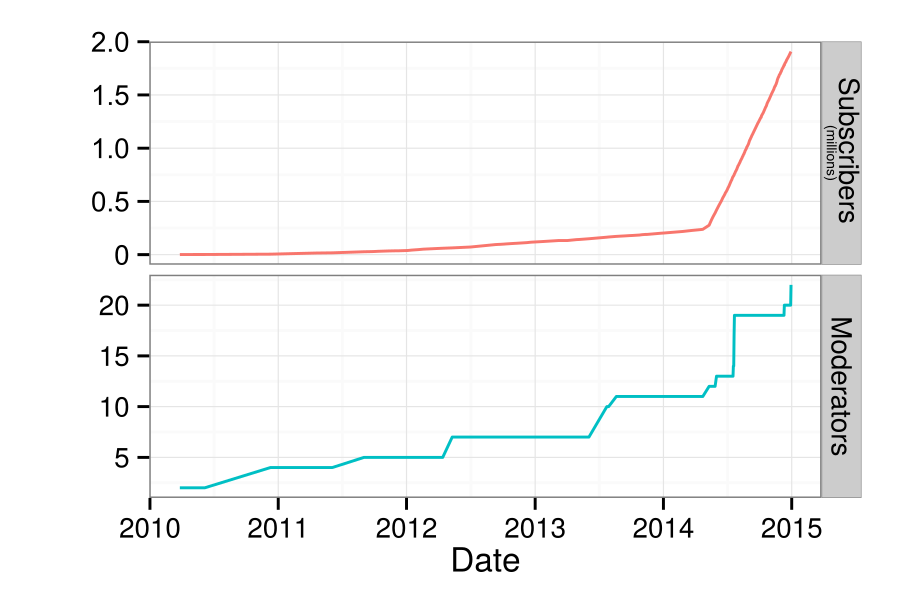
Attracting newcomers is among the most widely studied problems in online community research. However, with all the attention paid to challenge of getting new users, much less research has studied the flip side of that coin: large influxes of newcomers can pose major problems as well! The most widely known example of problems caused by an influx of newcomers into an online community occurred in Usenet. Every September, new university students connecting to the Internet for the first time would wreak havoc in the Usenet discussion forums. When AOL connected its users to the Usenet in 1994, it disrupted the community for so long that it became widely known as The September that never ended . Our study considered a similar influx in NoSleep an online community within Reddit where writers share original horror stories and readers comment and vote on them. With strict rules requiring that all members of the community suspend disbelief, NoSleep thrives off the fact that readers experience an immersive storytelling environment. Breaking the rules is as easy as questioning the truth of someone s story. Socializing newcomers represents a major challenge for NoSleep.
Number of subscribers and moderators on /r/NoSleep over time.
On May 7th, 2014, NoSleep became a default subreddit i.e., every new user to Reddit automatically joined NoSleep. After gradually accumulating roughly 240,000 members from 2010 to 2014, the NoSleep community grew to over 2 million subscribers in a year. That said, NoSleep appeared to largely hold things together. This reflects the major question that motivated our study: How did NoSleep withstand such a massive influx of newcomers without enduring their own Eternal September? To answer this question, we interviewed a number of NoSleep participants, writers, moderators, and admins. After transcribing, coding, and analyzing the results, we proposed that NoSleep survived because of three inter-connected systems that helped protect the community s norms and overall immersive environment. First, there was a strong and organized team of moderators who enforced the rules no matter what. They recruited new moderators knowing the community s population was going to surge. They utilized a private subreddit for NoSleep s staff. They were able to socialize and educate new moderators effectively. Although issuing sanctions against community members was often difficult, our interviewees explained that NoSleep s moderators were deeply committed and largely uncompromising. That commitment resonates within the second system that protected NoSleep: regulation by normal community members. From our interviews, we found that the participants felt a shared sense of community that motivated them both to socialize newcomers themselves as well as to report inappropriate comments and downvote people who violate the community s norms. Finally, we found that the technological systems protected the community as well. For instance, post-throttling was instituted to limit the frequency at which a writer could post their stories. Additionally, Reddit s Automoderator , a programmable AI bot, was used to issue sanctions against obvious norm violators while running in the background. Participants also pointed to the tools available to them the report feature and voting system in particular to explain how easy it was for them to report and regulate the community s disruptors.

This blog post was written with Charlie Kiene. The paper and work this post describes is collaborative work with Charlie Kiene and Andr s Monroy-Hern ndez. The paper was published in the Proceedings of CHI 2016 and is released as open access so anyone can read the entire paper here. A version of this post was published on the Community Data Science Collective blog.

5 May 2017

Arturo Borrero Gonz lez: New in Debian stable Stretch: nftables

Debian Openvpn Debian Stretch stable includes the nftables framework, ready to use. Created by the Netfilter project itself, nftables is the firewalling tool that replaces the old iptables, giving the users a powerful tool. Back in October 2016, I wrote a small post about the status of ntables in Debian Stretch. Since then, several things have improved even further, so this clearly deserves a new small post :-) Yes, nftables replaces iptables. You are highly encouraged to migrate from iptables to nftables. The version of nftables in Debian stable Stretch is v0.7, and the kernel couterpart is v4.9. This is clearly a very recent release of both components. In the case of nftables, is the last released version by the time of this writting. Also, after the Debian stable release, both kernel and nftables will likely get backports of future releases. Yes, you will be able to easily run a newer release of the framework after the stable release. In case you are migrating from iptables, you should know that there are some tools in place to help you in this task. Please read the official netfilter docs: Moving from iptables to nftables. By the way, the nftables docs are extensive, check the whole wiki. In case you don t know about nftables yet, here is a quick reference: To run nftables in Debian Stretch you need several components:
  1. nft: the command line interface
  2. libnftnl: the nftables-netlink library
  3. linux kernel: a least 4.9 is recommended
A simple aptitude run will put your system ready to go, out of the box, with nftables:
root@debian:~# aptitude install nftables
Once installed, you can start using the nft command:
root@debian:~# nft list ruleset
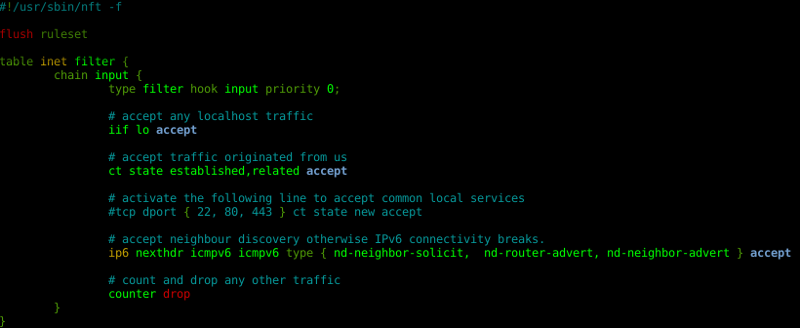
A good starting point is to copy a simple workstation firewall configuration:
root@debian:~# cp /usr/share/doc/nftables/examples/syntax/workstation /etc/nftables.conf
And load it:
root@debian:~# nft -f /etc/nftables.conf
Your nftables ruleset is now firewalling your network:
root@debian:~# nft list ruleset
table inet filter  
        chain input  
                type filter hook input priority 0;
                iif lo accept
                ct state established,related accept
                ip6 nexthdr icmpv6 icmpv6 type   nd-neighbor-solicit,  nd-router-advert, nd-neighbor-advert   accept
                counter drop
         
 
Several examples can be found at /usr/share/doc/nftables/examples/. A simple systemd service is included to load your ruleset at boot time, which is disabled by default. nft Did you know that the nano editor includes nft syntax highlighting? Starting with Debian stable Stretch and nftables, packet filtering and network policing will never be the same.

2 May 2017

Clint Adams: Ezra's legacy

Good, he said. I d like to see that white females number go down though. Let s work on that. We agree on something, she said. Do white women look down on you for being Mexican? They look down on everyone for being anything, he snorted. How do you feel about progessive female SJWs who claim to defend your interests as an ethnic minority while at the same time secretly hating you for being the scum of the earth? she asked. White saviorism is pretty obnoxious, he replied, but so is calling people SJWs because they give a fuck about other human beings. Do you think they truly give a fuck? she asked. I m sure they do, to an extent, but like anyone they are self-serving, he said. I just don t get going out of your way to further judge them. They do judge people all the time, she said. Usually it s people who are problematic, he said, which I m okay with, though sadly, as with anything, people go too far, like policing language or making an issue of something that doesn t need to be one. That s the very heart of activism as a surrogate activity: faking concern about other people s problems in order to promote themselves in some way, she explained. For example SJW is way better than Meninist, he continued. Pick your poison, I guess. What s a Meninist? she asked. Red-pill assholes who think the world is out to subjugate men in favor of women, he explained. Those guys always talk about lifting, she laughed. They lift their way through life and lift problems away. To be fair you re pretty apathetic about people s concerns or you don t seem to care aobut other people s problems, he observed. Maybe I have enough problems of my own, she said, problems that have a social dimension, but I just bother trying to fix them in as much as they affect me. That s fine, he said, some just want to care about problems affecting others. To each their own. I don t think it s inherently selfish. For example, she said, I have problems with my Emacs setup. Emacs always seems more trouble than what it s worth, he said, but so do you.
Posted on 2017-05-02
Tags: umismu

Russ Allbery: Review: Ninefox Gambit

Review: Ninefox Gambit, by Yoon Ha Lee
Series: The Machineries of Empire #1
Publisher: Solaris
Copyright: 2016
ISBN: 1-84997-992-8
Format: Kindle
Pages: 384
Charis is a Kel, which means that she's a soldier of the Hexarchate. A captain, to be precise: Captain Kel Charis of Heron Company, commanding infantry forces to stamp out heresy. The heresy she's stamping out at the start of the book are the Eels, or the Society of the Flourish as they call themselves, and they're strong enough that they can also command heretical technology. Charis manages to win through, but only because she has enough flexibility and quick thinking to adjust to the presence of a heresy and reach beyond the Lexicon Primary, improvising formations on the spot to adjust for the affects of the rebel calendar. Military victory is prized among the Kel, but stepping outside the bounds of Doctrine to achieve it is not. Charis is not particularly surprised when her company is disbanded for re-education after the battle. She is very surprised when she personally is tapped to offer a solution to a far greater attack on the Hexarchate. I first encountered Yoon Ha Lee's fiction in the short story "The Unstrung Zither", was blown away by the creativity and delightfully weird twist on science fiction war, and have been following his writing ever since. Most of it is short fiction, though, and I'm not much of a short fiction reader, so there haven't been many reviews. Ninefox Gambit is his first, and much-anticipated, full-length novel. It's probably not too surprising for someone from the generation that grew up with Star Wars, but I have a soft spot in my heart for magitech. Hard science fiction has its merits, as does the softer sort that takes standard, if impossible, genre tropes for granted. But something about a far-future, space-faring society based on magic that straddles the rules of technology, physics, affinities, and beliefs calls to that part of me that spent hours thinking about the nature of the Force. It has to be good magitech, though: something odd and different but well-thought-out, full of implications and twisty consequences that reshape society and that inspire a whole new type of engineering and science. Magic that's not physics as we know it, but that's knowable, researchable, and something that a society can reshape itself around. This is the good magitech. In the world of the Hexarchate, calendrical systems are more than just a mutual agreement for conveying time. They order and structure the laws of the universe as much as they structure society. What technological devices, and what weapons, are possible is influenced by the calendar in observance, which in turn is based on what calendar people believe in and follow. Close adherence to a calendrical regime enables exotics: weapons with incredibly powerful and often horrific effects, such as the threshold winnower that plays a repeated, nightmarish role in this story. Invariant weapons, ones that will work in any calendar system, are much weaker. The Hexarchate is called that because it is a society formed by six factions, who divide the work of ruling its scattered planets according to the expertise and tendencies of each faction. Together, they impose the high calendar, and maintain it against heresies with an iron fist lest their power be undermined or transformed and their exotics fail to function. The Kel is their military faction, a key component of that fist, and their specialty is formations: specific arrangements of humans or ships that channel the power of the calendar to defend against or attack with exotics. Formations have to be held exactly to hold their power and yet have to be flexible enough to change based on fast-changing battlefield conditions. To assist in this, Kel are programmed with formation instinct: psychological conditioning that helps them obediently take and hold formations. And, not coincidentally, offer nearly absolute obedience to their chain of command. I just finished reading another book that attempted to use math as a key component of its world-building. I think Lee was far more successful. The math here is realistic for its purpose, obviously necessary given the formation structures built into the world's physics, and a lovely nod to the importance of calendars. A single calendar might involve only simple arithmetic, but the formation and technological implications of a calendar, let alone the fuzzy boundaries between two calendars each partially in force, would naturally require tricky advanced mathematics to work out. For someone in Charis's position, mathematical training is a rare but vitally important tactical advantage. As you might have guessed from the amount that I'm talking about combat, Ninefox Gambit is military SF. Charis is a military officer, and a comfortable majority of this book is combat of one kind or another. That's not normally my thing, and I did wish there was a bit more non-military social development. But my normal problem with military SF is that I lack the interest in battlefield tactics and strategy to stay fully engaged by description of battle after battle. Ninefox Gambit is the story of Charis attempting to retake a stronghold of the Hexarchate that's fallen to heretical forces, but Lee adds an important twist that does keep me engaged: Jedao. General Shuos Jedao was the greatest general the Hexarchate had ever seen. He never lost a battle. The only catch is that, in the middle of a highly successful campaign against heretics, he went mad, slaughtering both the heretics and his own troops with a horrific weapon while simultaneously murdering all of his command staff. He's much too dangerous and insane to leave alive, but he was also much too valuable and skillful to lose as a weapon, so for the subsequent centuries he's been kept in a threshold state, an undead ghost. A ghost that the Hexarchate can put into Charis's head, a constant advisor as she's placed in charge of the swarm sent to retake the Fortress of Scattered Needles. A brilliant tactician, sociopath, and mass murderer whose advice can never be trusted. The heart of Ninefox Gambit isn't the combat. It's the interplay of power, analysis, and guesswork under the combat, as Charis attempts to use Jedao's brilliance while not losing her own sense of identity or letting him mess too badly with her head. At the start, she's way out of her depth. But she's thoughtful, careful, has a strong internal sense of identity, and learns fast. And the story of Jedao's past is accurate, but incomplete. For those who are familiar with the often-ornate language and prose style of Yoon Ha Lee's short fiction and who are worried it wouldn't hold up at longer length, note that his style here is much different. There are a few touches of ornate description, but most of the book is written in a straightforward and easily-understandable narrative style. Thankfully, because the layers of tactical thrust and counter-thrust are complicated enough that I would have lost them entirely beneath too-complex prose. There's a lot of brutal death in this book. I got a bit tired of both that and the tactical maneuvering, although that's less the fault of the book and more my own mild antipathy towards military SF. But the unique universe background held my interest long enough to become intrigued by Charis's slow but determined probing at Jedao's secrets and the politics of the Hexarchate. I still would have preferred the story to have a somewhat lower body count, but as long as one can read past some gore, there's plenty here to appeal to someone who normally gives military SF a pass. I think its biggest drawback is that, although it has a narrative arc that comes to a clear conclusion, Ninefox Gambit raises a lot of important questions about its world and mostly doesn't answer them. There are more books coming, and I hope they contain more definitive answers. Followed by Raven Stratagem. Rating: 7 out of 10

1 May 2017

Russ Allbery: Review: Survival

Review: Survival, by Julie E. Czerneda
Series: Species Imperative #1
Publisher: DAW
Copyright: May 2004
ISBN: 0-7564-0180-1
Format: Hardcover
Pages: 401
Dr. Mackenzie Connor, Mac to everyone she works with, is a biodiversity researcher specializing in salmon. In her future United States, humanity seems to have caught on to the importance of preserving wild places and learning about them, and is willing to invest in good equipment and a semi-permanent research installation. This comes with some occasional drawbacks, since she has to fight to get access to the salmon runs inside a nature preserve, but she wouldn't have it any other way. She wins enough of those fights, won the latest, and is now in position to monitor a run in a way that she's never been able to before. She was not expecting an alien to go diving in the middle of her salmon run. She was certainly not expecting that alien to be accompanied by a bureaucrat insisting that this alien's curiosity is more important than her research (hah). But the accompanying letter she receives is scarily persuasive, if maddeningly unhelpful. Much like the apparently jovial, earnest, eager, and very odd alien. Mac's continued hopes that she can quickly put this bizarre intrusion to rest and go back to her salmon are dashed by an impossible power outage, an alien visitor, and a violent kidnapping. Now her best friend and colleague is missing, the bureaucrat is not who he appears to be, and Mac is getting caught up in something that feels way over her head. SF novels feature a lot of science, but not a lot of scientific research. The research that does appear is often impulsive, wildly compressed, or far too focused on the breakthroughs of single people. The SF novel that everyone points to for accurate portrayal of real scientific research is Benford's Timescape, which I found deeply unexciting. Now I have a new novel to point to for a better treatment, although (somewhat disappointingly) Mac's research gets sidelined relatively early in the story and left behind for the conclusion. Czerneda gives us not just a few scientists and an imaginary research project, but an entire operational field station with a history. The Norcoast Salmon Research Facility is located just off-shore in carefully-designed domes to provide easy access to the sea with minimal intrusion into the local ecology. It's a bustling mix of research scientists, engineers, and the ever-present seasonal grad students, who come and go in all their immature enthusiasm and are viewed with a motherly bemusement that I immediately recognized from years of working at a university. Mac splits administrative duties with another scientist in an arrangement that will be familiar to academics everywhere, and the book opens with a mutually suspicious but mostly scripted turf fight with the guardian of the neighboring wildlife trust, the same fight they've been having every six months for years. I know Czerneda is herself a biologist by training; I'm not sure what her other academic background is, but if she hasn't spent years around academics and field studies, she's at least done some excellent research. A lot of novels have a quotidian background that's interrupted by the arrival of the plot. At the start of the story, the characters often care more about their day-to-day lives than the plot, and are dragged into it reluctantly. But one sign of an excellent writer is their ability to get the reader to care about that quotidian background alongside the character, and to sympathize with the character's reluctance to get pulled into the promised (and generally more exciting) novel plot. Czerneda succeeds in this about as well as any writer I've read since Robin McKinley's Sunshine, and that's high praise. I cared about Mac's salmon, I was nearly as irritated as she was when her research was interrupted, and I still want to go back and see more of the experiments and studies she was hoping to run. Interstellar drama and threats to multiple species are all well and good, but the salmon are running! The actual plot is a mysterious threat that turns into a combination of a biological and cultural puzzle and a sort of first-contact story. Mac is not truly the first human to encounter the Dhryn, but she's certainly the first person they've explained anything to, and the first human to go where she goes. Sadly, it also shares some of the characteristics that sour me a bit on biological SF for personal reasons: a bit too much description of food, eating habits, squishy body parts, digestive processes, and biological discomfort. This is mostly a personal gripe, and won't bother other people as much as it does me, but I could have done without bits like the descriptions of Mac's attempts to figure out how to survive on alien cuisine. I'm also dubious of some of the biology of the Dhryn; given the startling bizarreness of Earth biology, maybe I shouldn't be, but I still think there are a few problems with the square-cube law here. But Mac's irrepressible grumpy curiosity makes this story, even in the bits that made me squeamish. I think I'd read any book in which she's the main character. I will warn that the ending is surprisingly dark and wasn't what I was expecting, and Survival doesn't resolve its central mysteries. This is clearly the first book of a trilogy and should be read with that expectation. But I thoroughly enjoyed it, and hopefully the next book will have more salmon. Followed by Migration. Rating: 8 out of 10

29 April 2017

John Goerzen: Is there any way to truly secure Docker container contents?

There is much to like about Docker. Much has been written about it, and about how secure the containerization is. This post isn t about that. This is about keeping what s inside each container secure. I believe we have a fundamental problem here. Earlier this month, a study on security vulnerabilities on Docker Hub came out, and the picture isn t pretty. One key finding:
Over 80% of the :latest versions of official images contained at least on high severity vulnerability!
And it s not the only one raising questions. Let s dive in and see how we got here. It s hard to be secure, but Debian makes it easier Let s say you want to run a PHP application like WordPress under Apache. Here are the things you need to keep secure: On Debian (and most of its best-known derivatives), we are extremely lucky to have a wonderful security support system. If you run a Debian system, the combination of unattended-updates, needrestart, debsecan, and debian-security-support will help one keep a Debian system secure and verify it is. When the latest OpenSSL bug comes out, generally speaking by the time I wake up, unattended-updates has already patched it, needrestart has already restarted any server that uses it, and I m protected. Debian s security team generally backports fixes rather than just say here s the new version , making it very safe to automatically apply patches. As long as I use what s in Debian stable, all layers mentioned above will be protected using this scheme. This picture is much nicer than what we see in Docker. Problems We have a lot of problems in the Docker ecosystem:
  1. No built-in way to know when a base needs to be updated, or to automatically update it
  2. Diverse and complicated vendor security picture
  3. No way to detect when intermediate libraries need to be updated
  4. Complicated final application security picture
Let s look at them individually. Problem #1: No built-in way to know when a base needs to be updated, or to automatically update it First of all, there is nothing in Docker like unattended-updates. Although a few people have suggested ways to run unattended-updates inside containers, there are many reasons that approach doesn t work well. The standard advice is to update/rebuild containers. So how do you know when to do that? It is not all that obvious. Theoretically, official OS base images will be updated when needed, and then other Docker hub images will detect the base update and be rebuilt. So, if a bug in a base image is found, and if the vendors work properly, and if you are somehow watching, then you could be protected. There is work in this area; tools such as watchtower help here. But this can lead to a false sense of security, because: Problem #2: Diverse and complicated vendor security picture Different images can use different operating system bases. Consider just these official images, and the bases they use: (tracking latest tag on each) And how about a few unofficial images? The good news is that Debian jessie seems to be pretty popular here. The bad news is that you see everything from Oracle Linux, to Ubuntu, to Debian testing, to Debian oldstable in just this list. Go a little further, and you ll see Alpine Linux, CentOS, and many more represented. Here s the question: what do you know about the security practices of each of these organizations? How well updated are their base images? Even if it s Debian, how well updated is, for instance, the oldstable or the testing image? The attack surface here is a lot larger than if you were just using a single OS. But wait, it gets worse: Problem #3: No way to detect when intermediate libraries need to be updated Let s say your Docker image is using a base that is updated immediately when a security problem is found. Let s further assume that your software package (WordPress, MySQL, whatever) is also being updated. What about the intermediate dependencies? Let s look at the build process for nginx. The Dockerfile for it begins with Debian:stretch-slim. But then it does a natural thing: it runs an apt-get install, pulling in packages from both Debian and an nginx repo. I ran the docker build across this. Of course, the apt-get command brings in not just the specified packages, but also their dependencies. Here are the ones nginx brought in: fontconfig-config fonts-dejavu-core gettext-base libbsd0 libexpat1 libfontconfig1 libfreetype6 libgd3 libgeoip1 libicu57 libjbig0 libjpeg62-turbo libpng16-16 libssl1.1 libtiff5 libwebp6 libx11-6 libx11-data libxau6 libxcb1 libxdmcp6 libxml2 libxpm4 libxslt1.1 nginx nginx-module-geoip nginx-module-image-filter nginx-module-njs nginx-module-xslt ucf Now, what is going to trigger a rebuild if there s a security fix to libssl1.1 or libicu57? (Both of these have a history of security holes.) The answer, for the vast majority of Docker images, seems to be: nothing automatic. Problem #4: Complicated final application security picture And that brings us to the last problem: Let s say you want to run an application in Docker. exim, PostgreSQL, Drupal, or maybe something more obscure. Who is watching for security holes in it? If you re using Debian packages, the Debian security team is. If you re using a Docker image, well, maybe it s the random person that contributed it, maybe it s the vendor, maybe it s Docker, maybe it s nobody. You have to take this burden on yourself, to validate the security support picture for each image you use. Conclusion All this adds up to a lot of work, which is not taken care of for you by default in Docker. It is no surprise that many Docker images are insecure, given this picture. The unfortunate reality is that many Docker containers are running with known vulnerabilities that have known fixes, but just aren t, and that s sad. I wonder if there are any practices people are using that can mitigate this better than what the current best-practice recommendations seem to be?

Russ Allbery: Review: Neverness

Review: Neverness, by David Zindell
Publisher: Bantam Spectra
Copyright: May 1988
Printing: July 1989
ISBN: 0-553-27903-3
Format: Mass market
Pages: 552
Mallory Ringess is a Pilot, one of the people who can guide a lightship through interstellar space from inside the dark cocoon and biotech interface that allows visualization of the mathematics of interstellar travel. At the start of the book, he's young, arrogant, impulsive, and has a deeply unhealthy relationship with Leopold Soli, the Lord Pilot and supposedly his uncle by marriage (although they share a remarkable physical resemblance). An encounter with his uncle in a bar provokes a rash promise, and Ringess finds himself promising to attempt to map the Solid State Entity in search of the Elder Eddas, a secret of life from the mythical Ieldra that might lead to mankind's immortality. The opening of Neverness is Ringess's initial voyage and brash search, in which he proves to be a capable mathematician who can navigate a region of space twisted and deformed by becoming part of a transcendent machine intelligence. The knowledge he comes away with, though, is scarcely more coherent than the hints Soli relates at the start of the story: the secret of mankind is somehow hidden in its deepest past. That, in turn, provokes a deeply bizarre trip into the ice surrounding his home city of Neverness to attempt to steal biological material from people who have recreated themselves as Neanderthals. Beyond that point, I would say that things get even weirder, but weird still implies some emotional connection with the story. I think a more accurate description is that the book gets more incoherently mystical, more hopelessly pretentious, and more depressingly enthralled by childish drama. It's the sort of thing that one writes if one is convinced that the Oedipal complex is the height of subtle characterization. I loathed this book. I started loathing this book partway through Ringess's trip through the Solid State Entity, when Zindell's prose reached for transcendent complexity, tripped over its own shoelaces, and fell headlong into overwrought babbling. I continued reading every page because there's a perverse pleasure in hate-reading a book one dislikes this intensely, and because I wanted to write a review on the firm foundation of having endured the entire experience. The paperback edition I have has a pull quote from Orson Scott Card on the cover, which includes the phrase "excellent hard science fiction." I'm not sure what book Card read, because if this is hard science fiction, Lord of the Rings is paranormal romance. Even putting aside the idea that one travels through interstellar space by proving mathematical theorems in artificially dilated time (I don't think Zindell really understands what a proof is or why you write one), there's the whole business with stopping time with one's mind, reading other people's minds, and remembering one's own DNA. The technology, such as it is, makes considerably less sense than Star Wars. The hard SF requirement to keep technology consistent with extrapolated science is nowhere to be found here. The back-cover quote from the St. Louis Post-Dispatch is a bit more on-target: "Reminiscent of Gene Wolfe's New Sun novels... really comes to life among the intrigues of Neverness." This is indeed reminiscent of Gene Wolfe, in that it wouldn't surprise me at all if Zindell fell in love with the sense of antiquity, strangeness, and hints of understood technology that Wolfe successfully creates and attempted to emulate Wolfe in his first novel. Sadly, Zindell isn't Wolfe. Almost no one is, which is why attempting to emulate the extremely difficult feat Wolfe pulls off in the Book of the New Sun in your first novel is not a good idea. The results aren't pretty. There is something to be said for resplendent descriptions, rich with detail and ornamental prose. That something is "please use sparingly and with an eye to the emotional swings of the novel." Wolfe does not try to write most of a novel that way, which is what makes those moments of description so effective. Wolfe is also much better at making his mysteries and allusions subtle and unobtrusive, rather than having the first-person protagonist beat the reader over the head with them for pages at a time. This is a case where showing is probably better than telling. Let me quote a bit of description from the start of the book:
She shimmers, my city, she shimmers. She is said to be the most beautiful of all the cities of the Civilized Worlds, more beautiful even than Parpallaix or the cathedral cities of Vesper. To the west, pushing into the green sea like a huge, jewel-studded sleeve of city, the fragile obsidian cloisters and hospices of the Farsider's Quarter gleamed like black glass mirrors. Straight ahead as we skated, I saw the frothy churn of the Sound and their whitecaps of breakers crashing against the cliffs of North Beach and above the entire city, veined with purple and glazed with snow and ice, Waaskel and Attakel rose up like vast pyramids against the sky. Beneath the half-ring of extinct volcanoes (Urkel, I should mention, is the southernmost peak, and though less magnificent than the others, it has a conical symmetry that some find pleasing) the towers and spires of the Academy scattered the dazzling false winter light so that the whole of the Old City sparkled.
That's less than half of that paragraph, and the entire book is written like that, even in the middle of conversations. Endless, constant words piled on words about absolutely everything, whether important or not, whether emotionally significant or not. And much of it isn't even description, but philosophical ponderings that are desperately trying to seem profound. Here's another bit:
Although I knew I had never seen her before, I felt as if I had known her all my life. I was instantly in love with her, not, of course, as one loves another human being, but as a wanderer might love a new ocean or a gorgeous snowy peak he has glimpsed for the first time. I was practically struck dumb by her calmness and her beauty, so I said the first stupid thing which came to mind. "Welcome to Neverness," I told her.
Now, I should be fair: some people like this kind of description, or at least have more tolerance for it than I do. But that brings me to the second problem: there isn't a single truly likable character in this entire novel. Ringess, the person telling us this whole story, is a spoiled man-child, the sort of deeply immature and insecure person who attempts to compensate through bluster, impetuousness, and refusing to ever admit that he made a mistake or needed to learn something. He spends a good portion of the book, particularly the deeply bizarre and off-putting sections with the fake Neanderthals, attempting to act out some sort of stereotyped toxic masculinity and wallowing in negative emotions. Soli is an arrogant, abusive asshole from start to finish. Katherine, Ringess's love interest, is a seer who has had her eyes removed to see the future (I cannot express how disturbing I found Zindell's descriptions of this), has bizarre and weirdly sexualized reactions to the future she never explains, and leaves off the ends of all of her sentences, which might be be the most pointlessly irritating dialogue quirk I've seen in a novel. And Ringess's mother is a man-hating feminist from a separatist culture who turns into a master manipulator (I'm starting to see why Card liked this book). I at least really wanted to like Bardo, Ringess's closest friend, who has a sort of crude loyalty and unwillingness to get pulled too deep into the philosophical quicksand lurking underneath everything in this novel. Alas, Zindell insists on constantly describing Bardo's odious eating, belching, and sexual habits every time he's on the page, thus reducing him to the disgusting buffoon who gets drunk a lot and has irritating verbal ticks. About the only person I could stand by the end of the book was Justine, who at least seems vaguely sensible (and who leaves the person who abuses her), but she's too much of a non-entity to carry sustained interest. (There is potential here for a deeply scathing and vicious retelling of this story from Justine's point of view, focusing on the ways she was belittled, abused, and ignored, but I think Zindell was entirely unaware of why that would be so effective.) Oh, and there's lots of gore and horrific injury and lovingly-described torture, because of course there is. And that brings me back to the second half of that St. Louis Post-Dispatch review quote: "... really comes to life among the intrigues of Neverness." I would love to know what was hiding behind the ellipses in this pull quote, because this half-sentence is not wrong. Insofar as Neverness has any real appeal, it's in the intrigues of the city of Neverness and in the political structure that rules it. What this quote omits is that these intrigues start around page 317, more than halfway through the novel. That's about the point where faux-Wolfe starts mixing with late-career Frank Herbert and we get poet-assassins, some revelations about the leader of the Pilot culture, and some more concrete explanations of what this mess of a book is about. Unfortunately, you have to read through the huge and essentially meaningless Neanderthal scenes to get there, scenes that have essentially nothing to do with the interesting content of this book. (Everything that motivates them turns out to be completely irrelevant to the plot and useless for the characters.) The last 40% of the book is almost passable, and characters I cared about might have even made it enjoyable. Still, a couple of remaining problems detract heavily, chief among them the lack of connection of the great revelation of the story to, well, anything in the story. We learn at the very start of the novel that the stars of the Vild are mysteriously exploding, and much of the novel is driven by uncovering an explanation and solution. The characters do find an explanation, but not through any investigation. Ringess is simply told what is happening, in a wad of exposition, as a reward for something else entirely. It's weirdly disconnected from and irrelevant to everything else in the story. (There are some faint connections to the odd technological rules that the Pilot society lives under, but Zindell doesn't even draw attention to those.) The political intrigue in Neverness is similar: it appears out of nowhere more than halfway through the book, with no dramatic foundation for the motives of the person who has been keeping most of the secrets. And the final climax of the political machinations involves a bunch of mystical nonsense masquerading as science, and more of the Neanderthal bullshit that ruins the first half of the book. This is a thoroughly bad book: poorly plotted, poorly written, clotted and pretentious in style, and full of sociopaths and emotionally stunted children. I read the whole thing because I'm immensely stubborn and make poor life choices, but I was saying the eight deadly words ("I don't care what happens to these people") by a hundred pages in. Don't emulate my bad decisions. (Somehow, this novel was shortlisted for the Arthur C. Clarke award in 1990. What on earth could they possibly have been thinking?) Neverness is a stand-alone novel, but the ending sets up a subsequent trilogy that I have no intention of reading. Followed by The Broken God. Rating: 2 out of 10

Next.

Previous.