Search Results: "pm"

5 March 2022

Reproducible Builds: Reproducible Builds in February 2022

Welcome to the February 2022 report from the Reproducible Builds project. In these reports, we try to round-up the important things we and others have been up to over the past month. As ever, if you are interested in contributing to the project, please visit our Contribute page on our website.
Jiawen Xiong, Yong Shi, Boyuan Chen, Filipe R. Cogo and Zhen Ming Jiang have published a new paper titled Towards Build Verifiability for Java-based Systems (PDF). The abstract of the paper contains the following:
Various efforts towards build verifiability have been made to C/C++-based systems, yet the techniques for Java-based systems are not systematic and are often specific to a particular build tool (eg. Maven). In this study, we present a systematic approach towards build verifiability on Java-based systems.

GitBOM is a flexible scheme to track the source code used to generate build artifacts via Git-like unique identifiers. Although the project has been active for a while, the community around GitBOM has now started running weekly community meetings.

The paper Chris Lamb and Stefano Zacchiroli is now available in the March/April 2022 issue of IEEE Software. Titled Reproducible Builds: Increasing the Integrity of Software Supply Chains (PDF), the abstract of the paper contains the following:
We first define the problem, and then provide insight into the challenges of making real-world software build in a reproducible manner-this is, when every build generates bit-for-bit identical results. Through the experience of the Reproducible Builds project making the Debian Linux distribution reproducible, we also describe the affinity between reproducibility and quality assurance (QA).

In openSUSE, Bernhard M. Wiedemann posted his monthly reproducible builds status report.
On our mailing list this month, Thomas Schmitt started a thread around the SOURCE_DATE_EPOCH specification related to formats that cannot help embedding potentially timezone-specific timestamp. (Full thread index.)

The Yocto Project is pleased to report that it s core metadata (OpenEmbedded-Core) is now reproducible for all recipes (100% coverage) after issues with newer languages such as Golang were resolved. This was announced in their recent Year in Review publication. It is of particular interest for security updates so that systems can have specific components updated but reducing the risk of other unintended changes and making the sections of the system changing very clear for audit. The project is now also making heavy use of equivalence of build output to determine whether further items in builds need to be rebuilt or whether cached previously built items can be used. As mentioned in the article above, there are now public servers sharing this equivalence information. Reproducibility is key in making this possible and effective to reduce build times/costs/resource usage.

diffoscope diffoscope is our in-depth and content-aware diff utility. Not only can it locate and diagnose reproducibility issues, it can provide human-readable diffs from many kinds of binary formats. This month, Chris Lamb prepared and uploaded versions 203, 204, 205 and 206 to Debian unstable, as well as made the following changes to the code itself:
  • Bug fixes:
    • Fix a file(1)-related regression where Debian .changes files that contained non-ASCII text were not identified as such, therefore resulting in seemingly arbitrary packages not actually comparing the nested files themselves. The non-ASCII parts were typically in the Maintainer or in the changelog text. [ ][ ]
    • Fix a regression when comparing directories against non-directories. [ ][ ]
    • If we fail to scan using binwalk, return False from BinwalkFile.recognizes. [ ]
    • If we fail to import binwalk, don t report that we are missing the Python rpm module! [ ]
  • Testsuite improvements:
    • Add a test for recent file(1) issue regarding .changes files. [ ]
    • Use our assert_diff utility where we can within the test_directory.py set of tests. [ ]
    • Don t run our binwalk-related tests as root or fakeroot. The latest version of binwalk has some new security protection against this. [ ]
  • Codebase improvements:
    • Drop the _PATH suffix from module-level globals that are not paths. [ ]
    • Tidy some control flow in Difference._reverse_self. [ ]
    • Don t print a warning to the console regarding NT_GNU_BUILD_ID changes. [ ]
In addition, Mattia Rizzolo updated the Debian packaging to ensure that diffoscope and diffoscope-minimal packages have the same version. [ ]

Website updates There were quite a few changes to the Reproducible Builds website and documentation this month as well, including:
  • Chris Lamb:
    • Considerably rework the Who is involved? page. [ ][ ]
    • Move the contributors.sh Bash/shell script into a Python script. [ ][ ][ ]
  • Daniel Shahaf:
    • Try a different Markdown footnote content syntax to work around a rendering issue. [ ][ ][ ]
  • Holger Levsen:
    • Make a huge number of changes to the Who is involved? page, including pre-populating a large number of contributors who cannot be identified from the metadata of the website itself. [ ][ ][ ][ ][ ]
    • Improve linking to sponsors in sidebar navigation. [ ]
    • drop sponsors paragraph as the navigation is clearer now. [ ]
    • Add Mullvad VPN as a bronze-level sponsor . [ ][ ]
  • Vagrant Cascadian:

Upstream patches The Reproducible Builds project attempts to fix as many currently-unreproducible packages as possible. February s patches included the following:

Testing framework The Reproducible Builds project runs a significant testing framework at tests.reproducible-builds.org, to check packages and other artifacts for reproducibility. This month, the following changes were made:
  • Daniel Golle:
    • Update the OpenWrt configuration to not depend on the host LLVM, adding lines to the .config seed to build LLVM for eBPF from source. [ ]
    • Preserve more OpenWrt-related build artifacts. [ ]
  • Holger Levsen:
  • Temporary use a different Git tree when building OpenWrt as our tests had been broken since September 2020. This was reverted after the patch in question was accepted by Paul Spooren into the canonical openwrt.git repository the next day.
    • Various improvements to debugging OpenWrt reproducibility. [ ][ ][ ][ ][ ]
    • Ignore useradd warnings when building packages. [ ]
    • Update the script to powercycle armhf architecture nodes to add a hint to where nodes named virt-*. [ ]
    • Update the node health check to also fix failed logrotate and man-db services. [ ]
  • Mattia Rizzolo:
    • Update the website job after contributors.sh script was rewritten in Python. [ ]
    • Make sure to set the DIFFOSCOPE environment variable when available. [ ]
  • Vagrant Cascadian:
    • Various updates to the diffoscope timeouts. [ ][ ][ ]
Node maintenance was also performed by Holger Levsen [ ] and Vagrant Cascadian [ ].

Finally If you are interested in contributing to the Reproducible Builds project, please visit our Contribute page on our website. However, you can get in touch with us via:

4 March 2022

Abiola Ajadi: Outreachy-And it s a wrap!

Outreachy Wrap-up Project Improve Debian Continuous Integration UX
Project Link: https://www.outreachy.org/outreachy-december-2021-internship-round/communities/debian/#improve-debian-continuous-integration-ux
Code Repository: https://salsa.debian.org/ci-team/debci
Mentors: Antonio Terceiro, Paul Gevers and Pavit Kaur

About the project Debci exist to make sure packages work currently after an update, How it does this is by testing all of the packages that have tests written in them to make sure it works and nothing is broken This project entails making improvements to the platform to make it easier to use and maintain.

Deliverables of the project:
  • Package landing page displaying pending jobs
  • web frontend: centralize job listings in a single template
  • self-service: request test form forgets values when validation fails
  • Improvement to status

Work done

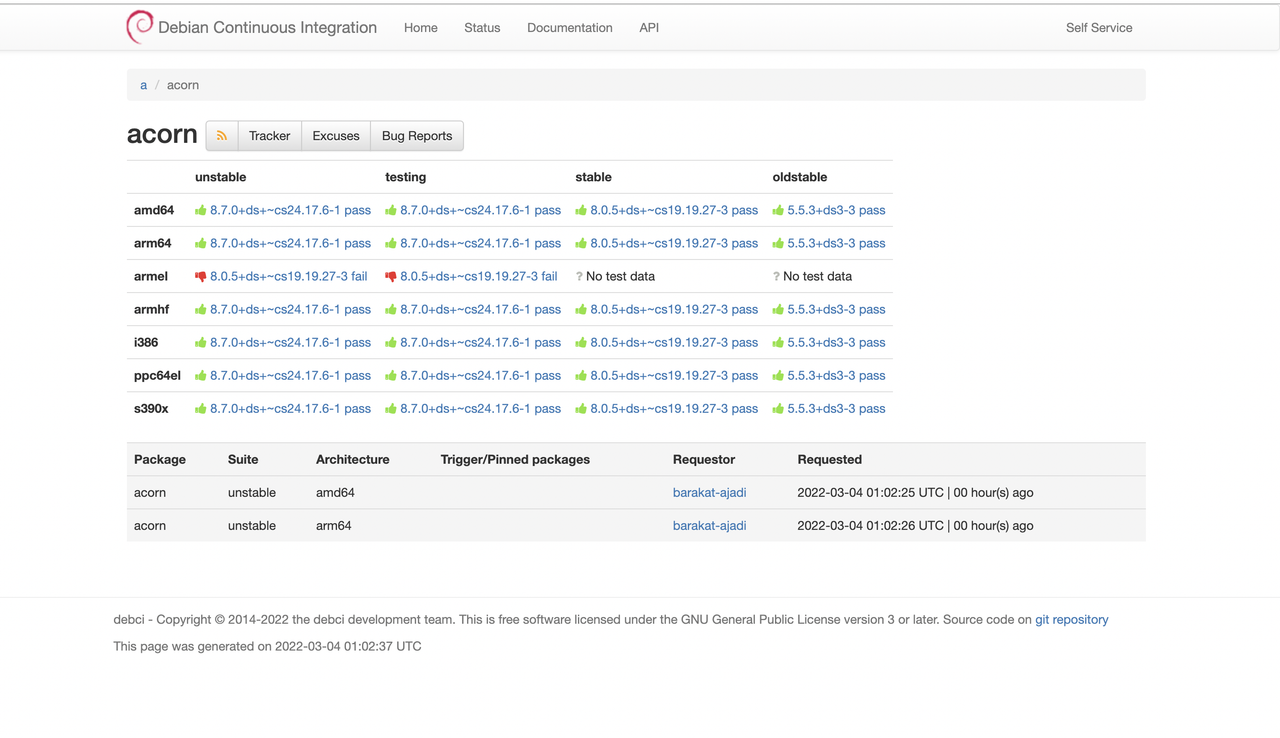
Package landing page displaying pending jobs Previously, Jobs that were pending were not displayed on the package page. Working on this added a feature to display pending jobs on package landing. Working on this task made it known that the same block of codes was repeated in different files which led to the next task Screenshot-2022-03-04-at-02-03-06.png Merge request
web frontend: centralize job listings in a single template Jobs are listed in various landings such as status packages, Status alerts, status failing, History, and so on. The same Code was repeated in these pages to list the jobs, I worked on refactoring it and created a single template for job listing so it can be used anywhere it s needed. I also wrote a test for the feature I added.
Merge request
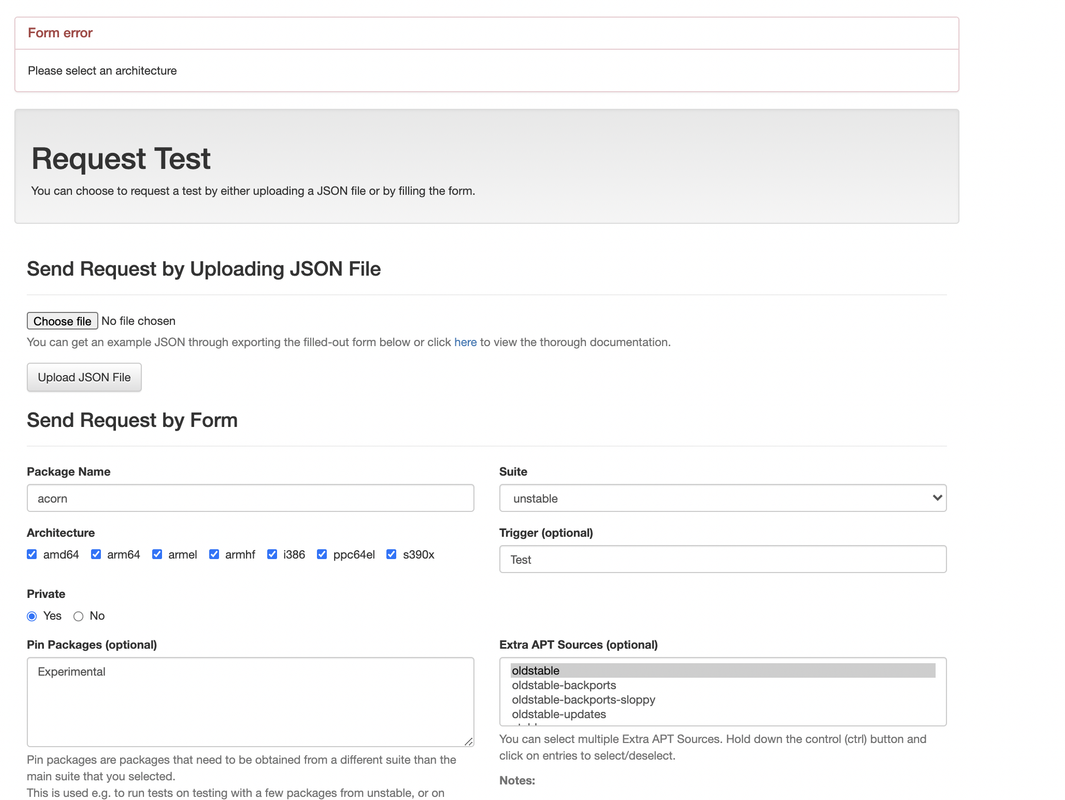
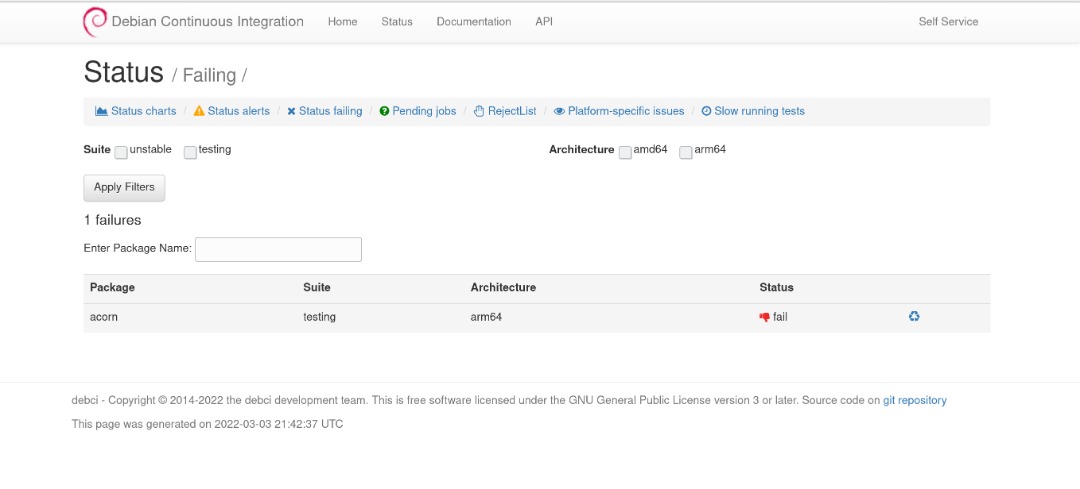
self service: request test form forgets values when validation fails When one tries to request for a test and it fails with an error, originally the form does not remember the values that were typed in the package name, suite field et. c. This fix ensures the form remembers the values inputted even when it throws an error. Image of request test page N/B: The form checks all architecture on the load of the page
merge request
Improvement to status Originally the Status pages were rendered as static HTML pages but I converted these pages to be generated dynamically, I wrote endpoints for each page. Since most of the status pages have a list of jobs I modified it to use the template I created for job-listing. Previously, the status pages had a mechanism to filter such as All, Latest 50 et.c which wasn t paginated. I removed this mechanism added a filter by architecture and suites to these pages and also add pagination. Last but not the least, I wrote tests for these implementations carried out on the status page. Image of Status failing page merge request:
first task
second task

Major take-aways I learnt a lot during my internship but most importantly I learnt how to:
  • write Tests in Ruby and how writing tests is an important aspect of software development
  • maintain good coding practice, Paying attending to commit messages, Indentation et.c are good areas I developed in writing code.
  • make contributions in Ruby Programming Language.

Acknowledgement I can not end this without saying thank you to my mentors Antonio Terceiro, Paul Gevers, and Pavit Kaur for their constant support and guidance throughout the entire duration of this Internship. It has been a pleasure Interacting and learning from everyone.

Review Outreachy has helped me feel more confident about open-source, especially during the application phase. I had to reach out to the community I was interested in and ask questions on how to get started. The informal chats week was awesome I was able to build my network and have interesting conversations with amazing individuals in open-source. To round up, Always ask questions and do not be afraid of making a mistake, as one of the outreachy blog post topics says Everyone struggles!, but never give up!

2 March 2022

Antoine Beaupr : procmail considered harmful

TL;DR: procmail is a security liability and has been abandoned upstream for the last two decades. If you are still using it, you should probably drop everything and at least remove its SUID flag. There are plenty of alternatives to chose from, and conversion is a one-time, acceptable trade-off.

Procmail is unmaintained procmail is unmaintained. The "Final release", according to Wikipedia, dates back to September 10, 2001 (3.22). That release was shipped in Debian since then, all the way back from Debian 3.0 "woody", twenty years ago. Debian also ships 25 uploads on top of this, with 3.22-21 shipping the "3.23pre" release that has been rumored since at least the November 2001, according to debian/changelog at least:
procmail (3.22-1) unstable; urgency=low
  * New upstream release, which uses the  standard' format for Maildir
    filenames and retries on name collision. It also contains some
    bug fixes from the 3.23pre snapshot dated 2001-09-13.
  * Removed  sendmail' from the Recommends field, since we already
    have  exim' (the default Debian MTA) and  mail-transport-agent'.
  * Removed suidmanager support. Conflicts: suidmanager (<< 0.50).
  * Added support for DEB_BUILD_OPTIONS in the source package.
  * README.Maildir: Do not use locking on the example recipe,
    since it's wrong to do so in this case.
 -- Santiago Vila <sanvila@debian.org>  Wed, 21 Nov 2001 09:40:20 +0100
All Debian suites from buster onwards ship the 3.22-26 release, although the maintainer just pushed a 3.22-27 release to fix a seven year old null pointer dereference, after this article was drafted. Procmail is also shipped in all major distributions: Fedora and its derivatives, Debian derivatives, Gentoo, Arch, FreeBSD, OpenBSD. We all seem to be ignoring this problem. The upstream website (http://procmail.org/) has been down since about 2015, according to Debian bug #805864, with no change since. In effect, every distribution is currently maintaining its fork of this dead program. Note that, after filing a bug to keep Debian from shipping procmail in a stable release again, I was told that the Debian maintainer is apparently in contact with the upstream. And, surprise! they still plan to release that fabled 3.23 release, which has been now in "pre-release" for all those twenty years. In fact, it turns out that 3.23 is considered released already, and that the procmail author actually pushed a 3.24 release, codenamed "Two decades of fixes". That amounts to 25 commits since 3.23pre some of which address serious security issues, but none of which address fundamental issues with the code base.

Procmail is insecure By default, procmail is installed SUID root:mail in Debian. There's no debconf or pre-seed setting that can change this. There has been two bug reports against the Debian to make this configurable (298058, 264011), but both were closed to say that, basically, you should use dpkg-statoverride to change the permissions on the binary. So if anything, you should immediately run this command on any host that you have procmail installed on:
dpkg-statoverride --update --add root root 0755 /usr/bin/procmail
Note that this might break email delivery. It might also not work at all, thanks to usrmerge. Not sure. Yes, everything is on fire. This is fine. In my opinion, even assuming we keep procmail in Debian, that default should be reversed. It should be up to people installing procmail to assign it those dangerous permissions, after careful consideration of the risk involved. The last maintainer of procmail explicitly advised us (in that null pointer dereference bug) and other projects (e.g. OpenBSD, in [2]) to stop shipping it, back in 2014. Quote:
Executive summary: delete the procmail port; the code is not safe and should not be used as a basis for any further work.
I just read some of the code again this morning, after the original author claimed that procmail was active again. It's still littered with bizarre macros like:
#define bit_set(name,which,value) \
  (value?(name[bit_index(which)] =bit_mask(which)):\
  (name[bit_index(which)]&=~bit_mask(which)))
... from regexp.c, line 66 (yes, that's a custom regex engine). Or this one:
#define jj  (aleps.au.sopc)
It uses insecure functions like strcpy extensively. malloc() is thrown around gotos like it's 1984 all over again. (To be fair, it has been feeling like 1984 a lot lately, but that's another matter entirely.) That null pointer deref bug? It's fixed upstream now, in this commit merged a few hours ago, which I presume might be in response to my request to remove procmail from Debian. So while that's nice, this is the just tip of the iceberg. I speculate that one could easily find an exploitable crash in procmail if only by running it through a fuzzer. But I don't need to speculate: procmail had, for years, serious security issues that could possibly lead to root privilege escalation, remotely exploitable if procmail is (as it's designed to do) exposed to the network. Maybe I'm overreacting. Maybe the procmail author will go through the code base and do a proper rewrite. But I don't think that's what is in the cards right now. What I expect will happen next is that people will start fuzzing procmail, throw an uncountable number of bug reports at it which will get fixed in a trickle while never fixing the underlying, serious design flaws behind procmail.

Procmail has better alternatives The reason this is so frustrating is that there are plenty of modern alternatives to procmail which do not suffer from those problems. Alternatives to procmail(1) itself are typically part of mail servers. For example, Dovecot has its own LDA which implements the standard Sieve language (RFC 5228). (Interestingly, Sieve was published as RFC 3028 in 2001, before procmail was formally abandoned.) Courier also has "maildrop" which has its own filtering mechanism, and there is fdm (2007) which is a fetchmail and procmail replacement. Update: there's also mailprocessing, which is not an LDA, but processing an existing folder. It was, however, specifically designed to replace complex Procmail rules. But procmail, of course, doesn't just ship procmail; that would just be too easy. It ships mailstat(1) which we could probably ignore because it only parses procmail log files. But more importantly, it also ships:
  • lockfile(1) - conditional semaphore-file creator
  • formail(1) - mail (re)formatter
lockfile(1) already has a somewhat acceptable replacement in the form of flock(1), part of util-linux (which is Essential, so installed on any normal Debian system). It might not be a direct drop-in replacement, but it should be close enough. formail(1) is similar: the courier maildrop package ships reformail(1) which is, presumably, a rewrite of formail. It's unclear if it's a drop-in replacement, but it should probably possible to port uses of formail to it easily.
Update: the maildrop package ships a SUID root binary (two, even). So if you want only reformail(1), you might want to disable that with:
dpkg-statoverride --update --add root root 0755 /usr/bin/lockmail.maildrop 
dpkg-statoverride --update --add root root 0755 /usr/bin/maildrop
It would be perhaps better to have reformail(1) as a separate package, see bug 1006903 for that discussion.
The real challenge is, of course, migrating those old .procmailrc recipes to Sieve (basically). I added a few examples in the appendix below. You might notice the Sieve examples are easier to read, which is a nice added bonus.

Conclusion There is really, absolutely, no reason to keep procmail in Debian, nor should it be used anywhere at this point. It's a great part of our computing history. May it be kept forever in our museums and historical archives, but not in Debian, and certainly not in actual release. It's just a bomb waiting to go off. It is irresponsible for distributions to keep shipping obsolete and insecure software like this for unsuspecting users. Note that I am grateful to the author, I really am: I used procmail for decades and it served me well. But now, it's time to move, not bring it back from the dead.

Appendix

Previous work It's really weird to have to write this blog post. Back in 2016, I rebuilt my mail setup at home and, to my horror, discovered that procmail had been abandoned for 15 years at that point, thanks to that LWN article from 2010. I would have thought that I was the only weirdo still running procmail after all those years and felt kind of embarrassed to only "now" switch to the more modern (and, honestly, awesome) Sieve language. But no. Since then, Debian shipped three major releases (stretch, buster, and bullseye), all with the same vulnerable procmail release. Then, in early 2022, I found that, at work, we actually had procmail installed everywhere, possibly because userdir-ldap was using it for lockfile until 2019. I sent a patch to fix that and scrambled to remove get rid of procmail everywhere. That took about a day. But many other sites are now in that situation, possibly not imagining they have this glaring security hole in their infrastructure.

Procmail to Sieve recipes I'll collect a few Sieve equivalents to procmail recipes here. If you have any additions, do contact me. All Sieve examples below assume you drop the file in ~/.dovecot.sieve.

deliver mail to "plus" extension folder Say you want to deliver user+foo@example.com to the folder foo. You might write something like this in procmail:
MAILDIR=$HOME/Maildir/
DEFAULT=$MAILDIR
LOGFILE=$HOME/.procmail.log
VERBOSE=off
EXTENSION=$1            # Need to rename it - ?? does not like $1 nor 1
:0
* EXTENSION ?? [a-zA-Z0-9]+
        .$EXTENSION/
That, in sieve language, would be:
require ["variables", "envelope", "fileinto", "subaddress"];
########################################################################
# wildcard +extension
# https://doc.dovecot.org/configuration_manual/sieve/examples/#plus-addressed-mail-filtering
if envelope :matches :detail "to" "*"  
  # Save name in $ name  in all lowercase
  set :lower "name" "$ 1 ";
  fileinto "$ name ";
  stop;
 

Subject into folder This would file all mails with a Subject: line having FreshPorts in it into the freshports folder, and mails from alternc.org mailing lists into the alternc folder:
:0
## mailing list freshports
* ^Subject.*FreshPorts.*
.freshports/
:0
## mailing list alternc
* ^List-Post.*mailto:.*@alternc.org.*
.alternc/
Equivalent Sieve:
if header :contains "subject" "FreshPorts"  
    fileinto "freshports";
  elsif header :contains "List-Id" "alternc.org"  
    fileinto "alternc";
 

Mail sent to root to a reports folder This double rule:
:0
* ^Subject: Cron
* ^From: .*root@
.rapports/
Would look something like this in Sieve:
if header :comparator "i;octet" :contains "Subject" "Cron"  
  if header :regex :comparator "i;octet"  "From" ".*root@"  
        fileinto "rapports";
   
 
Note that this is what the automated converted does (below). It's not very readable, but it works.

Bulk email I didn't have an equivalent of this in procmail, but that's something I did in Sieve:
if header :contains "Precedence" "bulk"  
    fileinto "bulk";
 

Any mailing list This is another rule I didn't have in procmail but I found handy and easy to do in Sieve:
if exists "List-Id"  
    fileinto "lists";
 

This or that I wouldn't remember how to do this in procmail either, but that's an easy one in Sieve:
if anyof (header :contains "from" "example.com",
           header :contains ["to", "cc"] "anarcat@example.com")  
    fileinto "example";
 
You can even pile up a bunch of options together to have one big rule with multiple patterns:
if anyof (exists "X-Cron-Env",
          header :contains ["subject"] ["security run output",
                                        "monthly run output",
                                        "daily run output",
                                        "weekly run output",
                                        "Debian Package Updates",
                                        "Debian package update",
                                        "daily mail stats",
                                        "Anacron job",
                                        "nagios",
                                        "changes report",
                                        "run output",
                                        "[Systraq]",
                                        "Undelivered mail",
                                        "Postfix SMTP server: errors from",
                                        "backupninja",
                                        "DenyHosts report",
                                        "Debian security status",
                                        "apt-listchanges"
                                        ],
           header :contains "Auto-Submitted" "auto-generated",
           envelope :contains "from" ["nagios@",
                                      "logcheck@",
                                      "root@"])
     
    fileinto "rapports";
 

Automated script There is a procmail2sieve.pl script floating around, and mentioned in the dovecot documentation. It didn't work very well for me: I could use it for small things, but I mostly wrote the sieve file from scratch.

Progressive migration Enrico Zini has progressively migrated his procmail setup to Sieve using a clever way: he hooked procmail inside sieve so that he could deliver to the Dovecot LDA and progressively migrate rules one by one, without having a "flag day". See this explanatory blog post for the details, which also shows how to configure Dovecot as an LMTP server with Postfix.

Other examples The Dovecot sieve examples are numerous and also quite useful. At the time of writing, they include virus scanning and spam filtering, vacation auto-replies, includes, archival, and flags.

Harmful considered harmful I am aware that the "considered harmful" title has a long and controversial history, being considered harmful in itself (by some people who are obviously not afraid of contradictions). I have nevertheless deliberately chosen that title, partly to make sure this article gets maximum visibility, but more specifically because I do not have doubts at this moment that procmail is, clearly, a bad idea at this moment in history.

Developing story I must also add that, incredibly, this story has changed while writing it. This article is derived from this bug I filed in Debian to, quite frankly, kick procmail out of Debian. But filing the bug had the interesting effect of pushing the upstream into action: as mentioned above, they have apparently made a new release and merged a bunch of patches in a new git repository. This doesn't change much of the above, at this moment. If anything significant comes out of this effort, I will try to update this article to reflect the situation. I am actually happy to retract the claims in this article if it turns out that procmail is a stellar example of defensive programming and survives fuzzing attacks. But at this moment, I'm pretty confident that will not happen, at least not in scope of the next Debian release cycle.

Petter Reinholdtsen: Run your industrial metal working machine using Debian?

After many months of hard work by the good people involved in LinuxCNC, the system was accepted Sunday into Debian. Once it was available from Debian, I was surprised to discover from its popularity-contest numbers that people have been reporting its use since 2012. Its project site might be a good place to check out, but sadly is not working when visiting via Tor. But what is LinuxCNC, you are probably wondering? Perhaps a Wikipedia quote is in place?
"LinuxCNC is a software system for numerical control of machines such as milling machines, lathes, plasma cutters, routers, cutting machines, robots and hexapods. It can control up to 9 axes or joints of a CNC machine using G-code (RS-274NGC) as input. It has several GUIs suited to specific kinds of usage (touch screen, interactive development)."
It can even control 3D printers. And even though the Wikipedia page indicate that it can only work with hard real time kernel features, it can also work with the user space soft real time features provided by the Debian kernel. The source code is available from Github. The last few months I've been involved in the translation setup for the program and documentation. Translators are most welcome to join the effort using Weblate. As usual, if you use Bitcoin and want to show your support of my activities, please send Bitcoin donations to my address 15oWEoG9dUPovwmUL9KWAnYRtNJEkP1u1b.

1 March 2022

Abiola Ajadi: Career Interest!

Hi, Welcome back. In this blog, I will be discussing my career interests and what I plan to pursue after my internship.

What comes next after the internship After working a while with Debci project, I was able to learn better software development practices and love the open source community. I will love to build my career path around open-source.

What I am looking for Prior to starting my internship, I have worked as a front-end developer with react and javascript. During my internship with Debci I learn Ruby and also how to write tests . I am also passionate about community which is one of my core-values, I build and organize communities. I am looking for opportunities in areas of front-end development, Ruby, React. i am also open to opportunities in developer relations/community management where i can be part of building or managing a community, Interacting with developers, meeting new people. I am based in lagos, Nigeria and can work remotely, but also open to relocation. You can connect with me on linkedin

26 February 2022

Daniel Silverstone: Subplot and FOSDEM 2022 talk

As many of you may be aware, I work with Lars Wirzenius on a project we call Subplot which is a tool for writing documentation which helps all stakeholders involved with a proejct to understand how the project meets its requirements. At the start of February we had FOSDEM which was once again online, and I decided to give a talk in the Safety and open source devroom to introduce the concepts of safety argumentation and to bring some attention to how I feel that Subplot could be used in that arena. You can view the talk on the FOSDEM website at some point in the future when they manage to finish transcoding all the amazing talks from the weekend, or if you are more impatient, on Youtube, whichever you prefer. If, after watching the talk, or indeed just reading about Subplot on our website, you are interested in learning more about Subplot, or talking with us about how it might fit into your development flow, then you can find Lars and myself in the Subplot Matrix Room or else on any number of IRC networks where I hang around as kinnison.

Russ Allbery: INN 2.6.5

This is a bit of a sneak preview announcement since I'm waiting for the ISC mirror to update before sending the official announcement to the normal channels, but INN 2.6.5 has been released. (The release was finalized a few days ago, and I'm a bit behind in posting it.) This is a bug fix and minor feature release over INN 2.6.4, and the upgrade should be painless. You can download the new release from ftp.isc.org (once it updates) or my personal INN pages. The latter also has links to the full changelog and the other INN documentation. As always, thanks to Julien LIE for preparing this release and doing most of the maintenance work on INN! Changes in this release:

23 February 2022

Joey Hess: announcing zephyr-copilot

I recently learned about the Zephyr Project which is a rather neat embedded OS for devices too small to run Linux. This led me to wondering if I could adapt arduino-copilot to target Zephyr, and so be able to program any of the 350+ boards it supports using Haskell. At the same time I had an opportunity to give a talk at the Houston Functional Programmers group. On February 1st I decided to give that talk, about arduino-copilot. That left 2 weeks to buy some hardware supported by Zephyr and port arduino-copilot to it. The result is zephyr-copilot, and I was able to demo it during my talk. This example can be used with any of 293 different boards, and will blink an on-board LED:
module Examples.Blink.Demo where
import Copilot.Zephyr.Board.Generic
main :: IO ()
main = zephyr $ do
        led0 =: blinking
        delay =: MilliSeconds (constant 100)
Doing much more than that needs a board specific module to set up GPIO pins etc. So far I only have written those for a couple of boards I have, but they are fairly easy to write. I'd be happy to help anyone who wants to contribute one. Due to the time constraints I have not implemented serial port support, or PWM or ADC yet, although all should be fairly easy. Zephyr also has no end of other capabilities, from networking to file systems to sensors, that could perhaps be supported in zephyr-copilot. My talk has now been published on youtube. I really enjoyed presenting again for the first time in 4 years(!), and to a very nice group of people. Thanks to Claude Rubinson for his persistence in getting me to give a talk.
Development of zephyr-copilot was sponsored by Mark Reidenbach, Erik Bj reholt, Jake Vosloo, and Graham Spencer on Patreon.

Russ Allbery: Review: Elder Race

Review: Elder Race, by Adrian Tchaikovsky
Publisher: Tordotcom
Copyright: November 2021
ISBN: 1-250-76871-3
Format: Kindle
Pages: 199
(It's a shame that a lot of people will be reading this novella on a black-and-white ebook reader, since the Emmanuel Shiu cover is absolutely spectacular. There's a larger image without the words at the bottom of that article.) When reports arrive at the court about demons deep in the forest that are taking over animals and humans and bending them to their will, the queen doesn't care. It's probably some unknown animal, and regardless, the forest kingdom is a rival anyway. Lynesse Fourth Daughter disagrees vehemently, but she has no power at court. Even apart from her lack of seniority, her love of stories and daring and adventures is a source of endless frustration to her mother. That is why this novella opens with her climbing the mountain path to the Tower of Nyrgoth Elder, the last of the ancient wizards, to seek his help. Nyr Illim Tevitch is an anthropologist second class of Earth's Explorer Corps, part of the second wave of Earth's outward expansion through the galaxy. In the first wave, colonies were seeded on habitable planets, only to be left stranded when Earth's civilization collapsed in an ecological crisis. Nyr was a member of a team of four, sent to make careful and limited contact with one of those lost colonies as part of Earth's second flourishing with more advanced technology. When the team lost contact with Earth, the other three went back while Nyr stayed to keep their field observations going. It's now 291 years of intermittent suspended animation later. Nyr's colleagues never came back, and there have been no messages from Earth. Elder Race is a Prime Directive anthropology story, a subgenre so long-standing that it has its own conventions and variations. Variations of the theme have been written by everyone from Eleanor Arnason to Iain M. Banks (linking to the book I have in mind is arguably a spoiler). Per the dedication, Tchaikovsky's take is based on Gene Wolfe's story "Trip, Trap," which I have not read but whose plot looks very similar. To that story structure, Tchaikovsky brings two major twists. First, Nyr is cut off from his advanced civilization, and has considerable reason to believe that civilization no longer exists. Do noninterference rules still have any meaning if Nyr is stranded and the civilization that made the rules is gone? Second, Nyr has already broken those rules rather spectacularly. More than a hundred years previously, he had ridden with Astresse Regent, a warrior queen and Lynesse's ancestor, to defeat a local warlord who had found control codes for abandoned advanced machinery and was using it as weaponry. In the process, he fell in love and made a rash promise to come to the aid of any of her descendants if he were needed. Lynesse has come to collect on the promise. Elder Race is told in alternating chapters between Nyr and Lynesse's viewpoints: first person for Nyr and tight third person for Lynesse. The core of the story is this doubled perspective, one from a young woman who wants to live in a fantasy novel and one from a deeply depressed anthropologist torn between wanting human contact, wanting to follow the rules of his profession, and wanting to explain to Lynesse that he is not a wizard. Nyr talks himself into helping with another misuse of advanced technology using the same logic he used a hundred years earlier: he's protecting Lynesse's pre-industrial society from interference rather than causing it. But the demons Lynesse wants him to fight are something entirely unexpected. This parallel understanding is a great story structure. What worked less for me was Tchaikovsky's reliance on linguistic barriers to prevent shared understanding. Whenever Nyr tries to explain something, Lynesse hears it in terms of magic and high fantasy, and often exactly backwards from how Nyr intended it. This is where my suspension of disbelief failed me, even though I normally don't have suspension of disbelief problems in SF stories. I was unable to map Lynesse's misunderstandings to any realistic linguistic model. Lynesse's language is highly complex (a realistic development within an isolated population), and Nyr complains about his inability to speak it properly given it's blizzard of complex modifiers. This is entirely believable. What is far less believable is that Lynesse perceives him as fluent in her language, but often saying the precise opposite of what he's trying to say. One chapter in the middle of the book gives Nyr's intended story side-by-side with Lynesse's understanding. This is a brilliant way to show the divide, but I found the translation errors unbelievable. If Nyr is failing that profoundly to communicate his meaning, he should be making more egregious sentence-level errors, occasionally saying something bizarre or entirely nonsensical, referring to a person as an animal or a baby, or otherwise not fluently telling a coherent story that's fundamentally different than the one he thinks he's telling. If you can put that aside, though, this is a fun story. Nyr has serious anxiety and depression made worse by his isolation, and copes by using an implanted device called a Dissociative Cognition System that lets him temporarily turn off his emotions at the cost of letting them snowball. He has a wealth of other augments and implants, including horns, which Lynesse sees as evidence that he's a different species of magical being and which he sees as occasionally irritating field equipment with annoying visual menus. The key to writing a story like this is for both perspectives to be correct given their own assumptions, and to offer insight that the other perspective is missing. I thought the linguistic part of that was unsuccessful, but the rest of it works. One of the best parts of novellas is that they don't wear out their welcome. This is a fun spin on well-trodden ground that tells a complete story in under 200 pages. I wish the ending had been a bit more satisfying and the linguistics had been more believable, but I enjoyed the time I spent in this world. Content warning for some body horror. Rating: 7 out of 10

21 February 2022

Rapha&#235;l Hertzog: Freexian s report about Debian Long Term Support, January 2022

A Debian LTS logo
Every month we review the work funded by Freexian s Debian LTS offering. Please find the report for January below. Debian project funding We continue to looking forward to hearing about Debian project proposals from various Debian stakeholders. This month has seen work on a survey that will go out to Debian Developers to gather feedback on what they think should be the priorities for funding in the project. Learn more about the rationale behind this initiative in this article. Debian LTS contributors In January, 13 contributors were paid to work on Debian LTS, their reports are available below. If you re interested in participating in the LTS or ELTS teams, we welcome participation from the Debian community. Simply get in touch with Jeremiah or Rapha l. Evolution of the situation In January we released 34 DLAs. The security tracker currently lists 39 packages with a known CVE and the dla-needed.txt file has 20 packages still needing an update. Thanks to our sponsors Sponsors that joined recently are in bold.

17 February 2022

Abiola Ajadi: Modifying expectations!

Hi everyone! In today s blog post I will be talking about the progress i have made , the hurdles I encountered and how my current progress differs from my original expectations. I applied to Debian community with a particular timeline and expected it to go that way, but after starting out i realized i had alot to learn in Ruby and the codebase. So far i have worked on issues i am proud of and when i use Debci i see some of the changes i added for example the self-service form remembering values that was filled after an error message / it reloads. Another milestone for me is writing test cases, I learnt about test driven development which is an awesome process is developing software. Looking back at the beginning before the internship started I can see how much experience i have gained and also improvement I made.

Road block Some tasks took longer than expected for example writing the test cases as i was new to this way of building and also i had to refactor some code, I was very careful doing this as i wanted to make sure i do it the right way.

The journey continues I had to modify my initial expectations and my mentors have been so supportive. I hope to add more features to Debci and also write more tests. So far, it has been a great experience. Till next time!

16 February 2022

Robert McQueen: Forward the Foundation

Earlier this week, Neil McGovern announced that he is due to be stepping down as the Executive Director as the GNOME Foundation later this year. As the President of the board and Neil s effective manager together with the Executive Committee, I wanted to take a moment to reflect on his achievements in the past 5 years and explain a little about what the next steps would be. Since joining in 2017, Neil has overseen a productive period of growth and maturity for the Foundation, increasing our influence both within the GNOME project and the wider Free and Open Source Software community. Here s a few highlights of what he s achieved together with the Foundation team and the community: Recognizing and appreciating the amazing progress that GNOME has made with Neil s support, the search for a new Executive Director provides the opportunity for the Foundation board to set the agenda and next high-level goals we d like to achieve together with our new Executive Director. In terms of the desktop, applications, technology, design and development processes, whilst there are always improvements to be made, the board s general feeling is that thanks to the work of our amazing community of contributors, GNOME is doing very well in terms of what we produce and publish. Recent desktop releases have looked great, highly polished and well-received, and the application ecosystem is growing and improving through new developers and applications bringing great energy at the moment. From here, our largest opportunity in terms of growing the community and our user base is being able to articulate the benefits of what we ve produced to a wider public audience, and deliver impact which allows us to secure and grow new and sustainable sources of funding. For individuals, we are able to offer an exceedingly high quality desktop experience and a broad range of powerful applications which are affordable to all, backed by a nonprofit which can be trusted to look after your data, digital security and your best interests as an individual. From the perspective of being a public charity in the US, we also have the opportunity to establish programs that draw upon our community, technology and products to deliver impact such as developing employable skills, incubating new Open Source contributors, learning to program and more. For our next Executive Director, we will be looking for an individual with existing experience in that nonprofit landscape, ideally with prior experience establishing and raising funds for programs that deliver impact through technology, and appreciation for the values that bring people to Free, Open Source and other Open Culture organizations. Working closely with the existing members, contributors, volunteers and whole GNOME community, and managing our relationships with the Advisory Board and other key partners, we hope to find a candidate that can build public awareness and help people learn about, use and benefit from what GNOME has built over the past two decades. Neil has agreed to stay in his position for a 6 month transition period, during which he will support the board in our search for a new Executive Director and support a smooth hand-over. Over the coming weeks we will publish the job description for the new ED, and establish a search committee who will be responsible for sourcing and interviewing candidates to make a recommendation to the board for Neil s successor a hard act to follow! I m confident the community will join me and the board in personally thanking Neil for his 5 years of dedicated service in support of GNOME and the Foundation. Should you have any queries regarding the process, or offers of assistance in the coming hiring process, please don t hesitate to join the discussion or reach out directly to the board.

14 February 2022

Neil McGovern: Handing over

In 2017, I was attending FOSDEM when GNOME announced that I was to become the new Executive Director of the Foundation. Now, nearly 5 years later, I ve decided the timing is right for me to step back and for GNOME to start looking for its next leader. I ve been working closely with Rob and the rest of the board to ensure that there s an extended and smooth transition, and that GNOME can continue to go from strength to strength. GNOME has changed a lot in the last 5 years, and a lot has happened in that time. As a Foundation, we ve gone from a small team of 3, to employing people to work on marketing, investment in technical frameworks, conference organisation and much more beyond. We ve become the default desktop on all major Linux distributions. We ve launched Flathub to help connect application developers directly to their users. We ve dealt with patent suits, trademarks, and bylaw changes. We ve moved our entire development platform to GitLab. We released 10 new GNOME releases, GTK 4 and GNOME 40. We ve reset our relationships with external community partners and forged our way towards that future we all dream of where everyone is empowered by technology they can trust. For that future, we now need to build on that work. We need to look beyond the traditional role that desktop Linux has held and this is something that GNOME has always been able to do. I ve shown that the Foundation can be more than just a bank account for the project, and I believe that this is vital in our efforts to build a diverse and sustainable free software personal computing ecosystem. For this, we need to establish programs that align not only with the unique community and technology of the project, but also deliver those benefits to the wider world and drive real impact. 5 years has been the longest that the Foundation has had an ED for, and certainly the longest that I ve held a single post for. I remember my first GUADEC as ED. As you may know, like many of you, I m used to giving talks at conferences and yet I have never been so nervous as when I walked out on that stage. However, the welcome and genuine warmth that I received that day, and the continued support throughout the last 5 years makes me proud of what a welcoming and amazing community GNOME is. Thank you all.


12 February 2022

Ritesh Raj Sarraf: apt-offline 1.8.4

apt-offline 1.8.4 apt-offline version 1.8.4 has been released. This release includes many bug fixes but the important ones are:
  • Better GPG signature handling
  • Support for verifying InRelease files

Changelog
apt-offline (1.8.4-1) unstable; urgency=medium
  [ Debian Janitor ]
  * Update standards version to 4.5.0, no changes needed.
  [ Paul Wise ]
  * Clarify file type in unknown file message
  * Fix typos
  * Remove trailing whitespace
  * Update LICENSE file to match official GNU version
  * Complain when there are no valid keyrings instead of missing keyrings
  * Make all syncrhronised files world readable
  * Fix usage of indefinite articles
  * Only show the APT Offline GUI once in the menu
  * Update out of date URLs
  * Fix date and whitespace issues in the manual page
  * Replace stereotyping with an appropriate word
  * Switch more Python shebangs to Python 3
  * Correct usage of the /tmp/ directory
  * Fix YAML files
  * Fix usage of the log API
  * Make the copying of changelog lines less brittle
  * Do not split keyring paths on whitespace
  [ Ritesh Raj Sarraf ]
  * Drop the redundant import of the apt module.
    Thanks to github/dandelionred
  * Fix deprecation of get_bugs() in debianbts
  * Drop the unused IgnoredBugTypes
  * Set encoding for files when opening
  * Better error logging when apt fails
  * Don't mandate a default option
  * Demote metadata errors to verbose
  * Also log an error message for every failed .deb url
  * Check hard for the url type
  * Check for ascii armored signature files.
    Thanks to David Klnischkies
  * Add MIME type for InRelease files
  * Drop patch 0001-Drop-the-redundant-import-of-the-apt-module.patch.
    Now part of the 1.8.4 release
  * Prepare release 1.8.3
  * Prepare release 1.8.4
  * debian packaging
    + Bump debhelper compatibility to 13
    + Update install files
  [ Dean Anderson ]
  * [#143] Added support for verifying InRelease files
 -- Ritesh Raj Sarraf <rrs@debian.org>  Sat, 12 Feb 2022 18:52:58 +0530

Resources
  • Tarball and Zip archive for apt-offline are available here
  • Packages should be available in Debian.
  • Development for apt-offline is currently hosted here

11 February 2022

Reproducible Builds (diffoscope): diffoscope 204 released

The diffoscope maintainers are pleased to announce the release of diffoscope version 204. This version includes the following changes:
[ Chris Lamb ]
* Don't run the binwalk comparator tests as root (or fakeroot) as the
  latest version of binwalk has some security protection against doing
  precisely this.
* If we fail to scan a file using binwalk, return 'False' from
  BinwalkFile.recognizes rather than raise a traceback.
* If we fail to import the Python "binwalk" module, don't accidentally report
  that we are missing the "rpm" module instead.
[ Mattia Rizzolo ]
* Use dependencies to ensure that "diffoscope" and "diffoscope-minimal"
  packages always have the precise same version.
You find out more by visiting the project homepage.

6 February 2022

Jonathan McDowell: Free Software Activities for 2021

About a month later than I probably should have posted it, here s a recap of my Free Software activities in 2021. For previous years see 2019 + 2020. Again, this year had fewer contributions than I d like thanks to continuing fatigue about the state of the world, and trying to work on separation between work and leisure while working from home. I ve made some effort to improve that balance but it s still a work in progress.

Conferences No surprise, I didn t attend any in-person conferences in 2021. I find virtual conferences don t do a lot for me (a combination of my not carving time out for them in the same way, because not being at the conference means other things will inevitably intrude, and the lack of the social side) but I did get to attend a few of the DebConf21 talks, which was nice. I m hoping to make it to DebConf22 this year in person.

Debian Most of my contributions to Free software continue to happen within Debian. As part of the Data Protection Team I responded to various inbound queries to that team. Some of this involved chasing up other project teams who had been slow to respond - folks, if you re running a service that stores personal data about people then you need to be responsive to requests about it. Some of this was dealing with what look like automated scraping tools which send no information about the person making the request, and in all the cases we ve seen so far there s been no indication of any data about that person on any systems we have access to. Further team time was wasted dealing with the Princeton-Radboud Study on Privacy Law Implementation (though Matthew did the majority of the work on this). The Debian Keyring was possibly my largest single point of contribution. We re in a roughly 3 month rotation of who handles the keyring updates, and I handled 2021.03.24, 2021.04.09, 2021.06.25, 2021.09.25 + 2021.12.24 For Debian New Members I m mostly inactive as an application manager - we generally seem to have enough available recently. If that changes I ll look at stepping in to help, but I don t see that happening. I continue to be involved in Front Desk, having various conversations throughout the year with the rest of the team, but there s no doubt Mattia and Pierre-Elliott are the real doers at present. I did take part in an NM Committee appeals process. In terms of package uploads I continued to work on gcc-xtensa-lx106, largely doing uploads to deal with updates to the GCC version or packaging (8 + 9). sigrok had a few minor updates, libsigkrok 0.5.2-3, pulseview 0.4.2-3 as well as a new upstream release of sigrok CLI 0.7.2-1. There was a last minute pre-release upload of libserialport 0.1.1-4 thanks to a kernel change in v5.10.37 which removed termiox support. Despite still not writing any VHDL these days I continue to keep an eye on ghdl, because I found it a useful tool in the past. Last year that was just a build fix for LLVM 11.1.0 - 1.0.0+dfsg+5. Andreas Bombe has largely taken over more proactive maintenance, which is nice to see. I uploaded OpenOCD 0.11.0~rc1-2, cleaning up some packaging / dependency issues. This was followed by 0.11.0~rc2-1 as a newer release candidate. Sadly 0.11.0 did not make it in time for bullseye, but rc2 was fairly close and I uploaded 0.11.0-1 once bullseye was released. Finally I did a drive-by upload for garmin-forerunner-tools 0.10repacked-12, cleaning up some packaging issues and uploading it to salsa. My Forerunner 305 has died (after 11 years of sterling service) and the Forerunner 45 I ve replaced it with uses a different set of tools, so I decided it didn t make sense to pick up longer term ownership of the package.

Linux My Linux contributions continued to revolve around pushing MikroTik RB3011 support upstream. There was a minor code change to Set FIFO sizes for ipq806x (which fixed up the allowed MTU for the internal switch + VLANs). The rest was DTS related - adding ADM DMA + NAND definitions now that the ADM driver was merged, adding tsens details, adding USB port info and adding the L2CC and RPM details for IPQ8064. Finally I was able to update the RB3011 DTS to enable NAND + USB. With all those in I m down to 4 local patches against a mainline kernel, all of which are hacks that aren t suitable for submission upstream. 2 are for patching in details of the root device and ethernet MAC addresses, one is dealing with the fact the IPQ8064 has some reserved memory that doesn t play well with AUTO_ZRELADDR (there keeps being efforts to add some support for this via devicetree, but unfortunately it gets shot down every time), and the final one is a hack to turn off the LCD backlight by treating it as an LED (actually supporting the LCD properly is on my TODO list).

Personal projects 2021 didn t see any releases of onak. It s not dead, just resting, but Sequoia PGP is probably where you should be looking for a modern OpenPGP implementation. I continued work on my Desk Viking project, which is an STM32F103 based debug tool inspired by the Bus Pirate. The main addtion was some CCLib support (forking it in the process to move to Python 3 and add some speed ups) to allow me to program my Zigbee dongles, but I also added some 1-Wire search logic and some support for Linux emulation mode with VCD output to allow for a faster development cycle. I really want to try and get OpenOCD JTAG mode supported at some point, and have vague plans for an STM32F4 based version that have suffered from a combination of a silicon shortage and a lack of time. That wraps up 2021. I d like to say I m hoping to make more Free Software contributions this year, but I don t have a concrete plan yet for how that might happen, so I ll have to wait and see.

5 February 2022

Thorsten Alteholz: My Debian Activities in January 2022

FTP master This month I accepted 342 and rejected 57 packages. The overall number of packages that got accepted was 366. Lately I was asked: Is it ftpmaster s opinion and policy that there is no difference in NEW queue review process between bin and src? This is a yes/no-question and in this generality the answer is clearly: Every package in NEW needs a full review. Of course there are circumstances with exceptions. For example after an upload of -1, which would get a full review, the upload of -2 afterwards, introducing a new binary package, would get a much faster review. In this case it would make sense to ping on IRC and draw attention to this. Nevertheless the evaluation of a light review might differ between the maintainer and the person doing the review. Debian LTS This was my ninety-first month that I did some work for the Debian LTS initiative, started by Raphael Hertzog at Freexian. This month my all in all workload has been 40h. During that time I did LTS and normal security uploads of: I also started to work on security support for golang packages. Though this sounds like an easy task, the devel is in the details.
As CVEs need to be fixed in unstable first, at the moment it looks like this is the most time consuming task. I will report later on my journey to fix open CVEs in golang-github-russellhaering-goxmldsig Further I worked on packages in NEW on security-master and injected missing sources. Last but not least I did some days of frontdesk duties and attended an LTS meeting on IRC. Debian ELTS This month was the forty-third ELTS month. During my allocated time I uploaded: Further I worked on an update for apache2 Last but not least I did some days of frontdesk duties. Debian Printing I was finally able to upload a new version of hplip and Ubuntu is now able to build new snaps for their next release.
Altogether I uploaded new upstream versions or improved packaging of: Now the dashboard looks rather good and my next task for February is an update of cups. Debian Astro As there was a release of version 1.9.4 of INDI and indi-3rdparty, I also uploaded the new version of all INDI drivers and releated libs from indi-3rdparty. Other stuff This month I uploaded lots of new upstream releases of golang packages.

4 February 2022

Ian Jackson: EUDCC QR codes vs NHS Travel barcodes vs TAC Verify

The EU Digital Covid Certificate scheme is a format for (digitally signed) vaccination status certificates. Not only EU countries participate - the UK is now a participant in this scheme. I am currently on my way to go skiing in the French Alps. So I needed a certificate that would be accepted in France. AFAICT the official way to do this is to get the international certificate from the NHS, and take it to a French pharmacy who will convert it into something suitably French. (AIUI the NHS international barcode is the same regardless of whether you get it via the NHS website, the NHS app, or a paper letter. NB that there is one barcode per vaccine dose so you have to get the right one - probably that means your booster since there s a 9 month rule!) I read on an forum somewhere that you could use the French TousAntiCovid app to convert the barcode. So I thought I would try that. The TousAntiCovid is Free Softare and on F-Droid, so I was happy to install and use it for this. I also used the French TAC Verify app to check to see what barcodes were accepted. (I found an official document addressed to French professionals recommending this as an option for verifying the status of visitors to one s establishment.) Unfortunately this involves a googlified phone, but one could use a burner phone or ask a friend who s bitten that bullet already. I discovered that, indeed: This made me curious. I used a QR code reader to decode both barcodes. The decodings were identical! A long string of guff starting HC1:. AIUI it is an encoded JWT. But there was a difference in the framing: Binary Eye reported that the NHS barcode used error correction level M (medium, aka 15%). The TousAntiCovid barcode used level L (low, 7%). I had my QR code software regenerate a QR code at level M for the data from the TousAntiCovid code. The result was a QR code which is identical (pixel-wise) to the one from the NHS. So the only difference is the error correction level. Curiously, both L (low, generated by TousAntiCovid, accepted by TAC Verify) and M (medium, generated by NHS, rejected by TAC Verify) are lower than the Q (25") recommended by what I think is the specification. This is all very odd. But the upshot is that I think you can convert the NHS international barcode into something that should work in France simply by passing it through any QR code software to re-encode it at error correction level L (7%). But if you re happy to use the TousAntiCovid app it s probably a good way to store them. I guess I ll find out when I get to France if the converted NHS barcodes work in real establishments. Thanks to the folks behind sanipasse.fr for publishing some helpful backround info and operating a Free Software backed public verification service. Footnote To compare the QR codes pixelwise, I roughly cropped the NHS PDF image using a GUI tool, and then on each of the two images used pnmcrop (to trim the border), pnmscale (to rescale the one-pixel-per-pixel output from Binary Eye) and pnmarith -difference to compare them (producing a pretty squirgly image showing just the pixel edges due to antialiasing).

comment count unavailable comments

1 February 2022

Paul Wise: FLOSS Activities January 2022

Focus This month I didn't have any particular focus. I just worked on issues in my info bubble.

Changes

Issues

Review

Administration
  • Debian BTS: unarchive/reopen/triage bugs for reintroduced packages
  • Debian servers: ping folks about mail forwarding issues
  • Debian wiki: unblock IP addresses, approve accounts

Communication
  • Respond to queries from Debian users and contributors on the mailing lists and IRC

Sponsors The oci-cli, oci-python-sdk, circuitbreaker, autoconf-archive, libpst, purple-discord, sptag work was sponsored. All other work was done on a volunteer basis.

Next.

Previous.