Search Results: "jam"

1 February 2010

Peter Van Eynde: CLC v7

With a lot of help from Far and James Y Knight we have now the incredible disappearing common-lisp-controller v7. We went from 617 to 267 lines which in fact are only 193 lines excluding comments and empty lines...

Using the new features of cl-asdf version 1.500 and higher the implementation of CLC is now merely setting a few variables and putting a few files into place. As an added bonus I added clbuild integration, so now people can download and update libraries with ease.

Still todo: .

Still a nice improvement, I hope to find some time at fosdem to work on the other issues...

28 January 2010

James Morrison: Apple

Is it me or does Apple leave out obvious features from v1 product launches? 3G on a phone, a camera on a tablet... It's like they don't want them to sell.

21 January 2010

Benjamin Mako Hill: Annual Free Software Foundation Membership Drive Appeal

I wrote this for the FSF's annual membership drive where it was originally published. I am reposting it here.
At its core, I think of free software as about the ability of computer users to take control of their technology. Insofar as our software defines our experience of the world and each other, software freedom is an important part of what allows us to determine the way we live, work, and communicate. Free software is not really about software in this fundamental sense; it's about bringing freedom to users through software. In free software's incredible success over the last two decades, many people have lost sight of this simple fact. We have created an incredible array of applications, libraries, and tools. We have created vibrant development and support communities. We have created new development methodologies, powerful copyleft licenses, and massive collaborative projects. But these are all how we give users freedom. They are not freedom itself. They are not what we were trying to achieve. They are our instruments, not our goal. This distinction becomes central in a world where technology is in flux. Indeed, we live in such a world. We can see signs of this in how, as most users' primary computers become mobile phones and new types of network services make up most of many users' interactions with computers, the free software movement's old applications, communities, development methodologies, and licenses can become ill-suited to, or ineffective at, protecting user freedoms. And indeed, in the next few years, bringing freedom to computer users will need to involve new software and new forms of advocacy. It will need to involve new licenses and new techniques for their enforcement. It will need to involve new forms of collaboration and organization. If the free software movement is to succeed, it must stay focused on computer users' freedom -- on the question of why we do what we do -- and then work creatively on how to best respect and protect the freedom we are working toward. If we are overly focused on how we've done things in the past, we may lose sight of the most fundamental goal of supporting users' control over their technology in general. There are many organizations that support the how of today's free software in various ways -- they are law firms and companies and nonprofit organizations supporting various free software projects. The Free Software Foundation is, by far, the most important organization focused on why --- on the underlying principle of software freedom. As such, it plays an essential role in keeping our broader community focused on the key issues, threats, and challenges that will affect the success of every free software project, and every computer user, in the present and in the future. In this period of rapid change in computer technology, its role is more vital than ever. The consequence of any failure is more dire. Here are some of the ways that I will be encouraging the FSF to serve the free software movement in the coming year: Mobile Phones In a short essay I wrote earlier this year, I pointed out that there are now billions of mobile phones and that, although these phones are increasingly powerful computers, they represent one of the most locked-down, proprietary, and unfree technologies in wide use. The implications of this fact for users' control over their technology are dire. Although some widely used phones make extensive use of free software, most free phones are locked down and Tivoized and their users remain fettered, divided, and helpless. We must raise awareness of free software issues among users of phones, communicate to users that phones are powerful general purpose computers, and explain that control over these devices has critical implications for individual autonomy in the future. Toward this end, the FSF staff will launch an advocacy campaign around mobile phones and software freedom in the coming year. Network Services As network services -- like those built by Facebook, Google, and others -- have continued to grow both in scope and penetration over the last year, the importance of a meaningful free software responses grows as well. The launch of products like Google's network-centric ChromeOS offers one glimpse of what a future computing platform may look like. The implications for user freedom, and for the effectiveness of traditional free software approaches, are frightening. The fact that many network services are built using free software does not make the effect of these services on users' autonomy and freedom any less catastrophic. In the next year, the FSF is planning to release the first of what I hope will be several statements on software freedom and network services. Building off the work of the FSF-supported group Autonomous, the Foundation will help provide guidelines for those implementing network services, for users deciding whether to use services, and for developers trying to build services that go further to respect their users' freedom. Reaching beyond our traditional communities Successfully fighting for user freedom is going to mean successfully reaching out to users outside the FSF's historical base . The FSF continues to do so with its Defective By Design anti-DRM campaign and its End Software Patents work. In the last year, the FSF has also reached out to younger users through its "GNU Generation" campaign run by and for high school students. Additionally, the FSF convened a summit this year on women in free software. The FSF plans to build on these successes in the coming year and to expand similar outreach projects. Of course, fighting for and promoting software freedom is more work than today's FSF has the resources to accomplish. Each of my three points above represents an ambitious undertaking, and yet just a portion of the items on the plate of the FSF's small but dedicated staff. Even just continuing its existing projects will require that the FSF adds hundreds of new members by the end of this period. Your membership and donations help make goals like this possible. A strong free software movement focused on the principled issues of software freedom -- and a strong FSF in particular -- will determine what freedoms the next generation of computer users will enjoy. At stake is no less than that next generation's autonomy. I know that this is not the first fundraising appeal you've read this season and I know that the weakened economy makes giving difficult for many. I understand that the cost of a membership or donation may be less easy to afford this year. But we also cannot afford a weakened FSF at this important point of technological transition. If you are not an FSF associate member, now is the time to become one. If you've read my appeal the last two years and decided to wait, now is the time to take the plunge. Membership is $120 per year ($60 for students) and payable monthly. If you are already a member, please join me in giving generously through a tax-deductible donation, or encourage a friend to sign up. The FSF is a small, humble organization of passionate individuals working tirelessly for our software freedom. I've seen firsthand that even small gifts make a difference.

Join now with a $10 monthly donation

14 January 2010

Russell Coker: Links January 2010

Magnus Larsson gave an interesting TED talk about using bacteria to transform dunes into architecture [1]. The concept of making a wall across Africa to stop sand dunes from overtaking farm land is obviously a good one, the idea of using bacteria to convert sand into sandstone to do so cheaply is also good. But making that into houses seems a little risky. I wouldn t want to live under shifting sand with only bacteria generated sandstone to protect me. Cory Doctorow gave an interesting speech titled How to Destroy the Book , here is the transcript [2]. He talks about how much he loves books and described his opposition to the DRM people who want to destroy the book culture. Sendmail has a DKIM Wizard for generating ADSP (Domain Signing Policy) records [3]. If I knew that ADSP records were so easy to implement then I would have used them a year ago! Loretta Napoleoni gave an insightful TED talk about the economics of terrorism [4]. Apparently the US dollar used to be THE currency for international crime, when the PATRIOT act was passed it s anti-money-laundering provisions encouraged many shady people to invest in Euros instead and thus led to the devaluation of the US currency. It s also interesting to note that terrorist organisations are driven by economics, if only we could prevent them from making money Ryan Lobo gave an interesting TED talk about his photographic work [5]. The effectiveness of the all-women peace-keeping force is noteworthy. The part about the Liberian war criminal who has become an evangelical Christian and who now tours Liberia begging forgiveness from his victims (and their relatives in the case of the people he murdered). Should someone like that be permitted to remain free if his victims forgive him? Charles Stross has an appealing vision for how Apple and Google can destroy the current mobile telephony market [6]. I can t wait for the mobile phone market to be entirely replaced by mobile VOIP devices! James Geary gave an interesting TED talk about metaphors [7]. The benefits of metaphors in poetry are well known (particularly in lyrics), but the impact of metaphors in influencing stock market predictions surprised me. Shaffi Mather gave an interesting TED talk about his company that makes money from fighting corruption [8]. Instead of paying a bribe you can pay his company to force the official(s) in question to do the right thing. Apparently the cost of doing so tends to be less than 10% the cost of the bribe if you know what you are doing. His previous company was an ambulance service that charges what the patient can afford is also interesting. John Robb wrote an interesting article about lottery winners and griefers [9]. He suggests that publishing the names, addresses, etc of rich people will be a new trend in Griefing. One thing I ve been wondering about is the value of the HR database at a typical corporation. A single database typically contains the home addresses, phone numbers, and salaries of all the employees. It would be very easy to do an SQL dump and store it on a USB flash device to carry out of the office. Then it could be sold to the highest bidder. They could probably make a market in the private data about rich people in the same way that there is currently a market for credit card data maybe they have already done this but it s kept quiet to stop others from implementing the same idea. Michael Smith wrote an interesting article for the Washington Times about home schooling and socialisation [10]. It seems that people who were home schooled as children tend to be more academically successful and involved in civic life as well as being happier and having career success. Richard Seager wrote an interesting article for American Scientist about ocean currents and heat transfer from the tropics [11]. It seems that when the ocean currents shut down the UK and other parts of northern Europe won t be getting a mini ice-age. Ian Lance Taylor (most known for the gold linker) has written a good summary of the situation in regard to climate change and what must be done about it [12]. The Wrath of the Killdozer article about how one angry man converted a bulldozer into a tank [13]. This wasn t a big bulldozer (every mining company has bigger ones) and he didn t have any serious weapons (only rifles). Imagine what terrorists could do if they started with a mining vehicle and serious weapons Simon Singh has written about being sued for libel by the British Chiropractic Association [14]. The BCA didn t like his article criticising chiropractors for claiming to be able to treat many conditions unrelated to the spine. Remember, chiropractors are not doctors all they can do is alleviate some back problems. See a GP if you have any medical condition that doesn t involve a sore back or neck. Avoid uppity chiropracters who claim to be able to cure all ills. Nicholas D. Kristof wrote an interesting article for the New York times about how happy the people in Costa Rica are [15]. He claims that the Costa Rican government s decision in 1949 to dissolve it s armed forces and invest the money in education is the root cause of the happy population. Maybe if the US government would scale back military spending the US population could be as happy as the Costa Ricans. While there are good arguments for having some sort of military, there are no good arguments for spending more money on the military than the rest of the world combined (as the US does).

31 December 2009

John Goerzen: My Reading List for 2010

I can hear the question now: What kind of guy puts The Iliad and War and Peace on a list of things to read for fun? Well, me. I think that reading things by authors I ve never read before, people that take positions I haven t heard of before or don t agree with, or works that are challenging, will teach me something. And learning is fun. My entire list for 2010 is at Goodreads. I ve highlighted a few below. I don t expect to read all 34 books on the Goodreads list necessarily, but there is the chance. The Iliad by Homer, 750BC, trans. by Alexander Pope, 704 pages. A recent NPR story kindled my interest in this work. I m looking forward to it. The Oxford History of the Classical World by Boardman, Griffin, and Murray, 1986, 882 pages. It covers ancient Greece and Rome up through the fall of the Roman empire. The Fires of Heaven (Wheel of Time #5) by Robert Jordan, 1994, 912 pages. I ve read books 1 through 4 already, and would like to continue on the series. War and Peace by Lev Leo Nikolayevich Tolstoy, 1869, 1392 pages. Been on my list for way too long. Time to get to it. Haven t read anything by Tolstoy before. The Politics of Jesus by John Howard Yoder, 1972, 2nd ed., 270 pages. Aims to dispel the notion of Jesus as apolitical. An Intimate History of Humanity by Theodore Zeldin, 1996, 496 pages. Picked this up at Powell s in Portland on a whim, and it s about time I get to it. The Myth of a Christian Nation: How the Quest for Political Power Is Destroying the Church by Gregory A. Boyd, 2007, 224 pages. An argument that the American evangelical church allowed itself to be co-opted by the political right (and some on the left) and argues this is harmful to the church. Also challenges the notion that America ever was a Christian nation. Daily Life in Ancient Rome: The People and the City at the Height of the Empire, by Jerome Carcopino, 2003, 368 pages. I ve always been fascinated with how things were on the ground rather than at the perspective of generals and kings, and this promises to be interesting. Slavery, Sabbath, War, and Women: Case Issues in Biblical Interpretation (Conrad Grebel Lectures) by Willard M. Swartley, 1983, 368 pages. Looking at how people have argued from different Biblical perspectives about various issues over the years. To the Lighthouse by Virginia Woolf, 1927, 252 pages. I can t believe I ve never read Woolf before. Yet another one I m really looking forward to. Tales of the Jazz Age by F. Scott Fitzgerald, 1922, 319 pages. Per Goodreads: This book of five confessional essays from the 1930s follows Fitzgerald and his wife Zelda from the height of their celebrity as the darlings of the 1920s to years of rapid decline leading to the self-proclaimed Crack Up in 1936. Ulysses by James Joyce, 1922 (1961 unabridged version), 783 pages. The Future of Faith by Harvey Cox, 2009, 256 pages. Per Goodreads, Cox explains why Christian beliefs and dogma are giving way to new grassroots movements rooted in social justice and spiritual experience. Heard about this one in an interview with Diane Rehm. Being There by Jerzy Kosi ski, 1970, 128 pages. Jesus: Uncovering the Life, Teachings, and Relevance of a Religious Revolutionary by Marcus Borg, 2006, 352 pages. Whether or not you agree with Borg, this has got to be a thought-provoking title. The Three Musketeers by Alexandre Dumas, 1844, 640 pages. The Book of Tea by Kakuzo Okakura, 1906, 154 pages. Per Goodreads: In 1906 in turn-of-the century Boston, a small, esoteric book about tea was written with the intention of being read aloud in the famous salon of Isabella Gardner. It was authored by Okakura Kakuzo, a Japanese philosopher, art expert, and curator. Little known at the time, Kakuzo would emerge as one of the great thinkers of the early 20th century, a genius who was insightful, witty and greatly responsible for bridging Western and Eastern cultures. Nearly a century later, Kakuzo s The Book of Tea is still beloved the world over. Interwoven with a rich history of tea and its place in Japanese society is poignant commentary on Eastern culture and our ongoing fascination with it, as well as illuminating essays on art, spirituality, poetry, and more. More of my list is at Goodreads.

30 December 2009

Christine Spang: Coders at Work

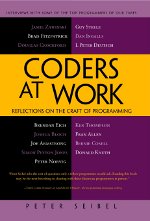
On the train to my parents' house for Christmas I finished up a wild run through the book Coders at Work. The book isn't even mine, but I'd been borrowing it very often, sometimes to the chagrin of its owner, because I could barely put it down. Coders at Work book cover The book is a collection of interviews with 15 great programmers of our time, starting with Jamie Zawinsky and ending with Donald Knuth. It's written in an interview style each interview starts with a brief introduction to the person being interviewed, summarizing what the person is known for and what he or she has accomplished and a few of the highlights of the interview, and then a transcript of the interview follows, with the author/editor, Peter Siebel, will saying something or asking a question, and the interviewee responding. I was skeptical about this format at first because I feel like it can be an easy way out of good editing and make the reader have to do the work of the editor, but on finishing I think that Siebel uses the format to his advantage in this case. For one, the speech format allows the reader to really form a picture of how the person being interviewed speaks and would act in a conversation. Jamie is somewhat bitter and pretty informal. Brad Fitzpatrick is flippant and energetic, his speech littered with profanity and colloquialisms. Others seem more stately and verbose Joe Armstrong's responses can go on for a page or more. In this way, not only do readers learn something about what these greats have learned about programming, but we also feel a bit more like we've met or know them, and can connect to them more as people. I always have this problem where I want to read computer books, but often computer books seem inextricably tied to the computer, so there's this dynamic of reading a bit and then wanting to get on a machine and try something out, write some code, play around especially with books focused on a specific language. Coders at Work retains some of this computer-book dynamic in that I constantly encountered things that I want to investigate or play around with more: Erlang, OCaml, various papers and essays, Knuth's literate programs, and books such as Higher Order Perl and others. Siebel makes a point to ask each person what her short-list of books and papers programmers should read are, so this book is a great source of pointers to other reading material. Unlike a more specific book, however, keeping a list in a notebook was enough to settle the mind to read away-from-a-computer for chapters at a time. It's obvious that despite the interview format, Siebel has done some serious editing. None of the prose is boring to read, and I can't imagine that the text is a straight transcript of how the interviews went. He also has arranged the interviews in an order such that different interviews play off each other. In Branden Eich's interview, for example, he disparages the book Design Patterns:
I never bought the Gamma book. Some people at Netscape did, some of Jamie Zawinski's and my nemeses from another acquisition, they waved it around like the Bible and they were kind of insufferable because they weren't the best programmers.
In the next chapter, Joshua Bloch names it as a book he thinks programmers should read:
Another one, which I have slightly mixed feelings about but I still think everyone should read, is Design Patterns. It gives us a common vocabulary. There are a lot of good ideas in there.
Similar plays, such as Ken Thompson and Fran Allen disagreeing on the badness of C, happen in later chapters, tieing together the different chapters and illustrating how even really good programmers disagree on the Right Thing all the time. Clearly the craft of programming is no settled thing. Besides the general structure of the book being well thought-out, the material is generally thought-provoking and interesting. One thing that stood out to me was Joshua Bloch describing what he called the "empathy gene", which is what a programmer has to have if he's going to be able to design good APIs and programming languages he has to be able to put himself in the shoes of the person who will be using the language or API. This is one thing that differentiates how different programmers can be good at different things. Another thing that stood out to me is that many of those interviewed stated that they don't use much in the way of modern tools and IDEs Joshua Bloch and Simon Peyton-Jones both touch on this, just to name a couple examples, even though some say that they think using these tools would make them more productive, especially when it comes to refactoring. This is a testament to the power of inertia sometimes there is just no chance to be unproductive now in order to be more productive later. Or perhaps just a sign that a programmable text-editor can stand on the same level as a heavier tool in terms of productivity in the right hands. I could go on with examples, but the conclusion here is that I thoroughly enjoyed Coders at Work, and I think it is a book that is well-worth the time spent reading the entire thing.

23 December 2009

Benjamin Mako Hill: What's in a name?

Over the summer, there was a bit of a tussle at the highest level of Ubuntu governance over whether or not Canonical Ltd., the company that funds the majority of work done directly in Ubuntu, should name its file syncing and backup service Ubuntu One. Canonical's service involved a freely licensed client included in the Ubuntu distribution but, as a network service running on Canonical servers, it was not clearly a part of Ubuntu (the GNU/Linux distribution) or Ubuntu (the community) in the way the term was usually used within the community. Although the network service itself was not Franklin Street Statement free, this was not the most important issue for everyone who objected to the name. The major issue for many seemed to boil down to the fact that, free or not, Ubuntu One is a service run entirely by Canonical outside the reaches of the Ubuntu governance structures. Decisions were made and not everybody -- and maybe not anybody -- was absolutely happy with the outcome. My goal is not try to revive old arguments here. As far as I'm concerned, the issues are settled and the service is called Ubuntu One. That said, the questions raised during the episode are fundamental to Ubuntu and to other firm-sponsored FLOSS projects. Now that the dust has settled, they are worth reflecting on. From a legal perspective, there never was any ambiguity. Canonical "owns" the Ubuntu trademark. In this important sense, "Ubuntu" means whatever Canonical says it means. This is hardly new. As just one example, the Official Ubuntu Book (of which I am an author) was written by community members but became official because Canonical blessed it. But despite the fact that they don't need to, Canonical has often consulted with the community and its governance structures about trademark licensing policy. This was also not a case of Canonical not listening to the community. Canonical employees approached the Ubuntu Community Council (Ubuntu's highest governance board of which I am a member), listened carefully to concerns, and responded thoughtfully. The question was not even about a clash between what Canonical and the CC thought about the issue. An unambiguous majority of the board, including all the Canonical employees and several of the community members, supported the idea of Canonical using the trademark. The question was one about who gets to make the decisions about the Ubuntu name and about what role the community and Canonical would each play. Despite the fact that a majority of the Ubuntu community council was likely to support the proposed name, the CC was told by Canonical CEO Mark Shuttleworth that a vote was irrelevant. Canonical made it clear that decisions about the Ubuntu trademark were simply not in the CC's purview. The decision on how the name was to be used was something that Canonical was not willing to delegate to an "outside" (the firm) governance body. Few businesses would. And although I don't agree with the decision as a community representative, I might have even made the same call from Canonical's shoes. In traditional firms, it's usually pretty clear where the organization's boundary lies. In FLOSS projects -- and especially in FLOSS project like Ubuntu who are sponsored in very large part by a single for-profit company -- boundaries are fuzzier. The conversation about "Ubuntu One" can be seen as a fight over what "Ubuntu" refers to, and, more importantly, who gets to answer that question. In deciding whether to call a service "Ubuntu", a decision is made on what Ubuntu is. Names are powerful. Is Ubuntu just a Canonical project? Are Ubuntu's contributors really just Canonical contributors by proxy? I think the answer to both questions is "no" but the boundary issues involved are complicated and under constant negotiation. Every time Canonical uses the Ubuntu name itself or grants others the ability to do so, these boundary issues are negotiated, one way or another. This boundary setting work reveals an important tension that firms releasing FLOSS must all struggle with. To what extent and in what ways do communities get to decide what a FLOSS project is and to what extent do sponsoring firms get to do so? How should projects and firms do this most effectively? What should we even be optimizing for? I think that any resulting balance has a huge effect on whether a FLOSS project is, on one hand, released under a free license but run like any old corporate project or, on the other, a true "bazaar" style project where no single firm dominates -- or where they fall on that spectrum. Names and trademarks are one way that projects define their own identities and act as an important frontier in this balancing act. As every firm/project negotiates their own answers to questions of names and boundaries, there are important implications for the project's ability to attract volunteers, solicit contributions from other firms, and more. The confusion around conversations about Ubuntu One shows that we still have a lot to learn.

22 December 2009

Benjamin Mako Hill: Center For Future Irony

My sister just got a lower back tattoo that says "No Regrets." She does not seem to appreciate the potential for irony. That's too bad. In my book, that potential is the best reason to get such a tattoo.

Gustavo Noronha Silva: WebKitGTK+ HackFest!

The WebKit hackfest is now over, and I think it was a very productive week. Thank you very much to all who attended, to Igalia for organizing the hackfest, and hosting us so well, to Collabora for having sponsored the event, and allowed me to spend the week working on it, and to the GNOME foundation for having payed all of my costs!
Xan blogged about day 0, and also a summary of all that was done, so I ll focus on the stuff he forgot to mention ;D. The hackfest, for me, started on day -1 with me not allowing Xan to go sleep before he had reviewed a couple patches of mine to fix DOM context menu handling. It always bothered me that Epiphany failed to open right-click menus in some pages, or let pages handle the right click. Well, this is fixed now, and Zimbra users can now have their right click menus, and WoW players can remove talent points from their calculators =P. It turns out that many of the attendees don t like pages messing with their context menus, though, and they had some good points to back up their positions (like pages making it hard to save images, for instance), so I implemented a way to force openning the custom menu: Ctrl-rightclick. We wanted to use a GtkInfoBar to display questions regarding the form saving - our initial implementation always saved all credentials, but that didn t sound good enough. Xan and I thought it would be very complicated to make this work, because there were assumptions in the code regarding which widget contains which, but it turned out to be quite trivial - making EphyEmbed a descendant of GtkVBox instead of GtkScrolledWindow, fixing a small number of assumptions, and that was it. The passwords are saved in the GNOME Keyring. It s interesting to point out that GNOME Keyring seems to be unhappy with the number of passwords a browser stores - Xan s daemon was hanging, crashing, and spawning a large number of threads. My daemon decided to take up some 300MB of RAM at one point. It s somewhat funny to see how much a browser pushes the limits of our platform. We are hoping this will improve with the new keyring APIs, and the rewrite that is ongoing. It s nice to see my browser form passwords in seahorse, though, and be able to manage them like any other. One more thing worth of notice, although this post is already a bit too big: one of the main concerns people had during the Hackfest was on making build time smaller. Touching a single file in WebCore causes a debug build of 10 minutes on my laptop. Evan Martin and Benjamin Otte made a push at removing unnecessary includes from WebCore, and WebKitGTK+ files, which brough the build time down a bit. They end up inspiring Aroben, from Apple, to go even further into this, and remove many includes from files all over WebKit. Evan was also able to bring linking time down by making it possible to link libwebkit without having to build all the intermediate libraries, which brought build time down to 1 minute, when touching a single file in WebCore. Behdad and I also started looking into breaking WebCore up into lots of shared libraries for Debug builds, since we don t care too much about speed penalties in those. None of these experiments got committed yet, but I am hoping we will be having a better time hacking on WebKitGTK+ in the near future. It was awesome meeting everyone, by the way! See you around =).

21 December 2009

Benjamin Mako Hill: Center for Future Names of Media Lab Centers

A few years ago, the MIT Media Lab, working with the Comparative Media Studies program at MIT, created the Center for Future Civic Media. It's a great project and one I've been involved in since the beginning. Not too long after, the lab announced the Center for Future Banking through a partnership with Bank of America. One couldn't help but notice the similarity between the names. The meme became further entrenched when, not too long after, the lab announced the Center for Future Storytelling in collaboration with Plymouth Rock Studios. But perhaps the very first in the pattern is the the Okawa Center for Future Children announced in 1998 as a way of bringing together and supporting the labs work with kids. And no, it has nothing to do with zygotes.

13 December 2009

Benjamin Mako Hill: Upcoming Travel

As is becoming my custom, I'm planning to spend much of December and January on the road. This time I'll be in Seattle, Japan and Wellington, New Zealand. Here's the rough schedule: Mika will also be around for everything but the NZ leg and SJ seems likely to make an appearance in Japan during the first week of January. Feel free to get in contact if you'd like to meet up in any of the places above for a coffee or beer. I'm also open to hanging out with giving talks at LUGs, GLUGs, Wikipedia groups, free culture groups, colleges or Universities along the way. Most of my time in Japan is still basically unstructured so I'm quite open to suggestions during the first couple weeks of January.

12 December 2009

Benjamin Mako Hill: FLOSS Wins

Very often, folks want to refer to both the free and open source software communities in a way that is inclusive of and respectful of groups who identify with either term. Saying "free and open source software" is a mouthful. That said, there was no been consensus on what we should do instead. The Wikipedia article on alternative terms for free software suggests that FOSS, F/OSS, FLOSS, and "software libre" are contenders. I've heard all. Of course, the choice of 4+ competing alternative terms is probably worse than the problem we were seeking to solve. In academic circles, the big debate seems to be between FOSS and FLOSS. I was always a FOSS partisan. But I've seen increased momentum on the FLOSS side and I'm ready to declare that FLOSS has won. I know it makes you think of dental hygiene and I agree that it is unfortunate. It wasn't my first choice either. But I can see where things are going. FLOSS Manuals and the folks at the FLOSS Research Group at Syracuse who launched the FLOSSHub and the associated FLOSS Papers deserve some of the credit. If we can get over the irony of having spent so much time arguing over what was intended to be compromise terminology in the first place, lets see if we actually start talking to each other.

2 December 2009

Benjamin Mako Hill: Introducing Between the Bars

I've been working with Charlie DeTar and the Center for Future Civic Media on a project called Between the Bars which is a blogging platform for prisoners. The current platform is essentially a snail-mail to web gateway: prisoners send letters which semi-automatically scanned and posted to the site; comments are printed and mailed back. As we plan the launch of the project, we are trying to talk to as many stakeholders as possible -- this includes ex-prisoners, families and friends of people who are or have been in prison, non-profits working with prisoners, victims of people in prison, people who work in prisons or in corrections, probation officers, or almost anyone else with a perspective or set of experience that might help us understand the difficult space our project is trying to negotiate and who might be able to help influence the design. At the moment, we're not talking to current prisoners due to rules regulating research involving prisoners, but almost anyone else would be someone we'd love to connect with. We're interested in hearing from people about their experience with prisons or prisoners, about staying connected to families and friends while behind bars, and, ultimately, about how we might design, deploy, and support technology to help folks out. If you or someone you know are stakeholders and would be willing to talk about your experience and opinions with prisons, communication, and technology, please drop us a line at betweenthebars@mit.edu.

27 November 2009

Benjamin Mako Hill: Principles, Social Science, and Free Software

Earlier this summer, I wrote a blog post on taking a principled position on software freedom where I argued that advocates of free/libre and open source software (FLOSS) should take a principled position because the pragmatic benefits associated with open source --- "better quality, higher reliability, more flexibility [and] lower cost" in OSI's words --- are simply not always present. More often than not, FLOSS projects fail. When they survive, they are often not as good as their proprietary competitors. Over the last year, I've been back at MIT taking classes, reading extensively, and otherwise learning how to act like a social scientist. My research goals, which I'm now beginning to focus on, are to help build a stronger understanding of the social dynamics in free software and free culture communities. With a slightly skeptical view toward my involvement with groups like the FSF and my work in the FLOSS community, at least one academic tried to suggest that taking a principled position in favor of software freedom might compromise the positivist social science research program in which I am engaged. "An advocate is too biased," they said. After many months of thinking seriously about this warning, I believe that this criticism can be addressed. After all, a principled position in favor of software freedom is a statement of how things should be, not a description of how they are. OSI will argue that open source leads to inherently better software. This statement, of course, is one that can be empirically tested and, in fact, there seems to be plenty of evidence that it is often wrong. On the other hand, the FSF's position that software should be free is ethical in nature. One can disagree with it, just like one can disagree with any other ethical position, but it can not be proved either right or wrong --- only convincing or unconvincing, logical or illogical in the context a certain set of other values that others might or might not share. Research has shown that the vast majority of FLOSS projects fizzle. A advocate who argues that FLOSS is inherently better is left trying to explain this fact and make excuses. As a result, OSI-style beliefs can certainly be a source of problematic bias in a social scientist. However, a person who believes that software should be free is welcome to recognize that it both fails and succeeds and to ask why. A principled idealist can argue in favor of behaviors that may be disruptive, difficult, or inefficient. Indeed, Stallman has never suggested that free software will be easier or better. Indeed, he routinely asks people to sacrifice their convenience for freedom. My goal, as a social scientist, is to understand why some FLOSS and free culture projects succeed and why many fail. I never take FLOSS's success for granted and, in fact, believe that proprietary software may often leads to better software in OSI's terms. Unlike an advocate who tows the OSI line, embracing evidence of the effectiveness of proprietary software is no way in conflict with my belief that software should be free. In fact, my desire to see software freedom grow becomes the driving force between trying to understand FLOSS's shortcomings! I am no more biased --- which is not to say completely unbiased --- than the person who both thinks that crime is wrong and who wants to study criminal behavior. In an analogous sense, starting out with the belief that all people are naturally law-abiding may be a problem in a way that beginning with the belief that people should be law-abiding is not. Starting from the fomer assumption, one has to explain away evidence to the contrary. Starting from the latter assumption, one can build an understanding of what drives people to obey or violate laws which, in turn, can help build a stronger society. To me, the question is not why FLOSS will succeed. Indeed, I believe its success is an empirical matter that remains very much up in the air. For me, the question is how it might. Embracing a principled position lets us face the facts and puts advocates and practitioners in a position to devise laws, social structures, and technologies to insure that it does.

Stefano Zacchiroli: RC bugs of the week - week 12

RCBW - week #12 Here is this week squashes, by yours truly: The funniest part of this RCBW issue is probably that Luk has started handing over RC bugs to me: from time to time I just get a /query from him with bug numbers :-) In fact, this is more useful than one can imagine, because a considerable amount of time in periodic RC squashing is taken by triaging the RC bug list to choose your targets. Of course there is no guarantee that I'll be willing/able to fix handed-over bugs but, as a RM, Luk has evidently well-trained feelings about how hard would be to fix a given bug. All in all, for this week it worked well: 4 of the above 7 came from SchindlerLuk's list. ... and of course, let's welcome Simon on board! He is definitely doing a better job at spotting packages that should be removed from the archive rather than resurrected (potential negative effect that a NMU can indeed have on a package, de facto "saving" it from testing/release exclusion). In fact, the dilemma of "NMU vs Request Removal" raises various tricky questions. For instance, while we currently have pretty clear guidelines on how and, more importantly, when doing NMUs, we are more stringent on "Non-Maintainer Removals". Quoting from the Package Removal Requests wiki page:
    In all cases, if there is a maintainer and it's not you, mention the
    maintainer's opinion or, if you don't know it, mention how and when you
    tried to contact him.

It is of course reasonable to be more stringent on a measure that is way more invasive than a "simple" NMU. But if we start to rely on NMU-time as an important trigger for removal requests, then we could probably use a more aggressive and more distributed process for removals.

25 November 2009

Benjamin Mako Hill: Zimmermanhosen Confessions

Between second and seventh grade, I went to a school that required that I wear grey corduroys. Every day. I loathed them. When I left that school, at twelve years old, I swore to myself that I would never wear a pair of corduroys again. And I kept that vow until earlier this year when, in Germany, I came across a couple carpenters in Germany on their one-year traveling post-apprenticeship waltz. As it turns out, journeyman German carpenters wear some pretty wild bellbottom corduroys --- zimmermanhosen. Although I tried, I couldn't resist acquiring a pair at a local work clothing store. http://farm4.static.flickr.com/3306/3519720780_bb9ca7f3c5.jpg A year and a couple more trips to Germany later, I now own several pair of zimmermanhosen and wear them nearly every day. They are tough, distinctive, and have pretty awesome double-zipper flies. And although I love them, I still feel a little conflicted every time I put them on.

24 November 2009

Benjamin Mako Hill: A. Dehqan, man of inquiry

Due entirely to the efforts of one inquisitive and indefatigable A. Dehqan, a web search for the phrase "In The Name Of God The compassionate merciful" now almost exclusively turns up hits to a wide variety of free software mailing lists, forums, and IRC channels with questions on everything from what is a kernel (in a minimum of half a line, no less), to how to send a FAX, to the intersection between Islam and copyright and much more! I've now run across in five distinct projects. Maybe you have too!

Lucas Nussbaum: UDS Lucid

I m back from Dallas, where I was invited at the Ubuntu Developer Summit for Lucid. I spent a great week there ; the event was extremely well organized (by organizing them every 6 months, you are probably able to gather a lot of experience!). Of course, after all I had heard about people hugging each other all the time in the Ubuntu community, I was a bit worried, especially with the flu spreading! But there are lots of fantastic people around Ubuntu, and it was a very nice opportunity to be able to meet them all. Since it was my first UDS (I was at FOSSCAMP in Prague a few years ago, but didn t stay for UDS back then), I was not really sure of what to expect. I was very pleasantly surprised. UDS vs Debconf UDS is very different from Debconf. In Debconf, we do three different kind of things: In UDS, the main focus is on the third point: most of the sessions are about discussing what will be implemented for the next release. All of the relevant developers are in the same room to discuss possible problems, and the outcome of each session is usually a detailed plan, with a list of action items. It s a very nice way to ensure that changes are well thought, and allows making large-scale changes in Ubuntu very easily (you don t spend weeks arguing about them on mailing lists). Of course, it s probably also helped by the fact that there s a company behind Ubuntu, with a set of large teams (kernel, foundations, desktop, etc), which helps transfering trust (not everybody feel like they have to participate in each discussion, even when they affect the whole distribution: the team in charge is trusted by the rest of the project). On the other hand (yeah, let s be negative for a while) it doesn t really help spreading information between Ubuntu developers: it s often a bit difficult to get the global view of what is happening inside Ubuntu, especially since lots of things are discussed on IRC. Collaboration between Debian and Ubuntu During the week, I mainly was interested on collaboration between Debian and Ubuntu. There s a strong focus on doing the right thing wrt Debian (and also other upstreams). Then, of course, Ubuntu also has an agenda, which sometimes requires moving very fast on some things, or making compromises between technical purity and pragmatism. But the willingness to have common foundations between Debian Squeeze and Ubuntu Lucid will surely benefit both distros. Quality Assurance On the QA front, I am planning to do archive rebuilds for Ubuntu as well (fixing FTBFS is an easy way to start contributing to Ubuntu or Debian, and having those bugs fixed in Lucid would benefit Debian as well, by having patches already prepared). I also had a session with the QA team, where I gave an overview of what we are doing in the Debian QA group, to discuss opportunities for collaboration. The Ubuntu QA team focuses more on testing (with automated or manual testing) and bug triaging than archive quality that part is left to the MOTUs and the release managers. (About MOTUs, I liked how what they do was described as long-tail maintenance, landscape gardening or terraforming. That gives a good idea of what it s about). Ultimate Debian Database On the Ultimate Debian Database front, I did a plenary talk to try to demonstrate how UDD could be useful to Ubuntu as well, and, with Jorge Castro, we examined some metrics of Ubuntu s giving back to Debian. I also talked with the Launchpad team to try to resolve my long standing pretty please provide an export of Ubuntu bugs, so I can easily import them in UDD! issue. Ubuntu and ARM ARM netbooks and smartbooks (mix between netbooks and smartphones) are coming, and Ubuntu is clearly very well positioned to play an important role on that market. There was a whole track about ARM support, with lots of changes that will be done for Lucid. Let s all hope that Ubuntu-powered ARM netbooks win that market, so we don t reproduce the failures of the non-ARM netbooks. Distributed Development James Westby has been working on a set of tools to be able to work on Ubuntu packaging using bzr. The point is not to store the canonical source for Ubuntu packages in bzr (well, at least it s not the plan yet), but to provide a set of branches to make it easier to merge or cherry-pick from Debian. The resulting workflow looks extremely nice, with lots of syntaxic sugar. And even better, he assured me that his code is portable to Git ;)
Using his work, merging Ubuntu-specific changes in a new version of a Debian package basically means pulling from lp:ubuntu/foopkg, merging from lp:debian/sid/foopkg, and you are done!
As a bonus, we (Debian) would get bzr branches with the history of packages (kind of bzr-powered snapshots.debian.org).
James project is not completely ready yet, but should be very soon. It s already basically usable, apparently. Conclusion Ubuntu has clearly gone a very long way since 2004. Everything looks very well organized and polished, and gives the impression of a big machine that nothing can stop. With Cloud Computing and now ARM netbooks, Ubuntu has proven to be able to adapt to the current trends and attract a lot of visibility. It is great news for Free Software, but also proposes an interesting challenge to Debian: of course, it s nice that a Debian-based distro is in that position, but will Debian manage to stay relevant, or are we just going to be the technically-pure distro without many users that serves as a package supermarket for Ubuntu?

23 November 2009

Benjamin Mako Hill: Wikireaders

My friend Sean from OpenMoko recently gave me one of OM's new WikiReaders. It's essentially a touchscreen-based device dedicated to displaying Wikipedia articles offline. And while I'll never forgive the thing for not having an Edit button, I've got to admit the device is pretty cool. Not only does it make it possible to bring WP to a bunch of places that are otherwise impossible or impractical, the thing is built entirely with free software. One of my colleagues at the Center for Future Civic Media suggested we should put one in every bar to help settle drunken arguments. Think of the lives we might save! I hope the device becomes successful but I'm worried about what success will mean for the already indefensibly large gap between the number of readers and editors on Wikipedia. After all, the ability to change and contribute is the thing that makes Wikipedia interesting, empowering, and successful; cutting this functionality out kind of misses much of the point. I think it is important to start implementing a simple method to allow users of these types of devices to contribute back. Over the last few years, Sj and I have talked repeatedly about a simple method for contributing back from offline devices that would even be possible from devices like the Om Wikireader where editing the articles is probably impractical. Perhaps the device could be extended so that people could write short comments about articles from their reader --- there's an on screen keyboard after all --- which could be saved to a log on the SD card. When the data on the card is updated, messages from this log could be uploaded somewhere --- perhaps the talk pages of the articles in question or some dedicated page or ticketing queue. Editors could help merge these changes back into the articles.

Benjamin Mako Hill: All-In-One

I know it's old news but I couldn't resist pointing out this item from the "all the things my software freedom advocacy and activism has been based around recently" department:
Apparently, Apple filed for an software patent on an antifeature that uses a DRM-like system and a proprietary network services to lock down people's mobile phones.
If someone can figure out how to work in a revealing error, I think I can make it a sweep.

Next.

Previous.
