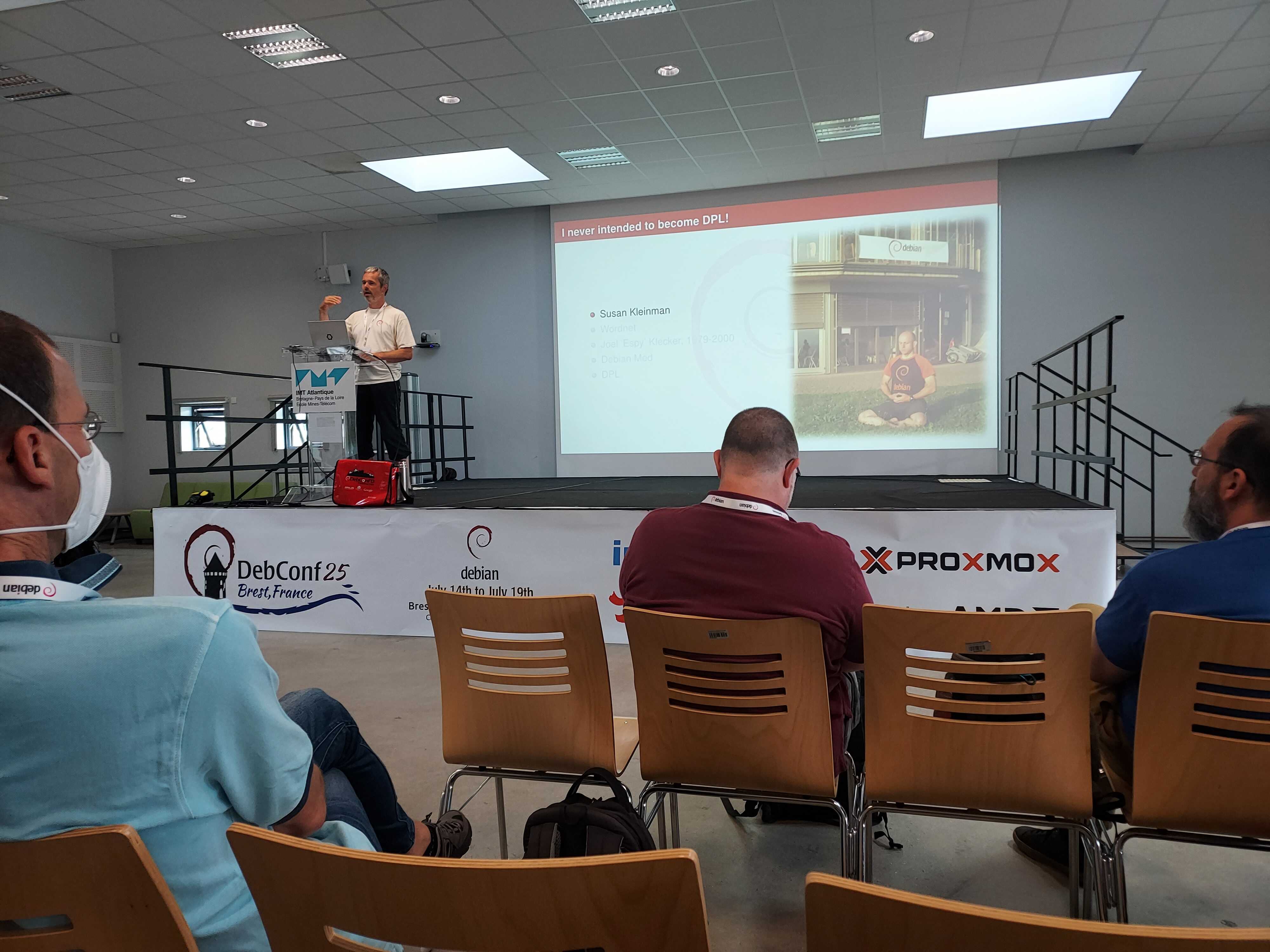
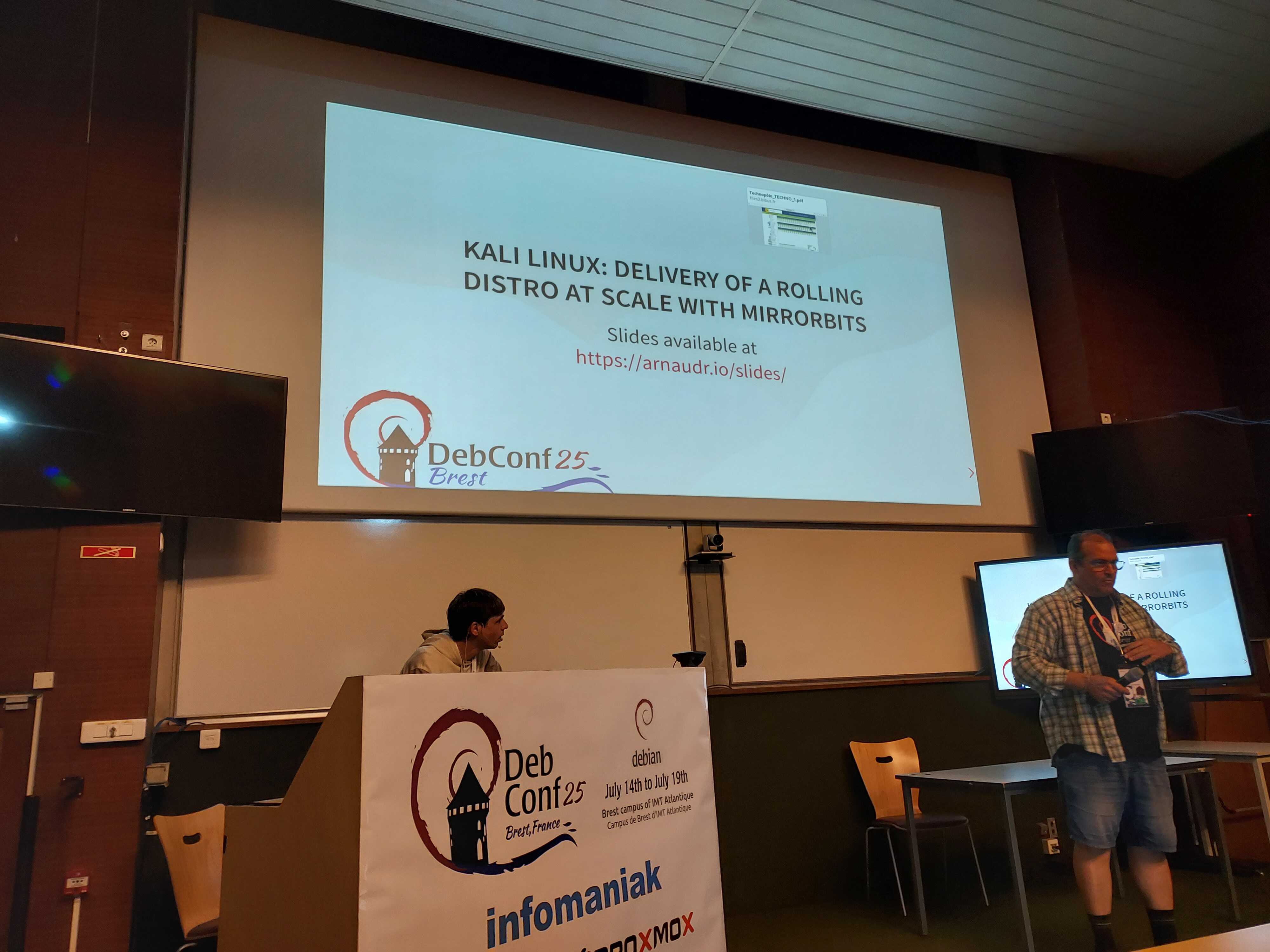
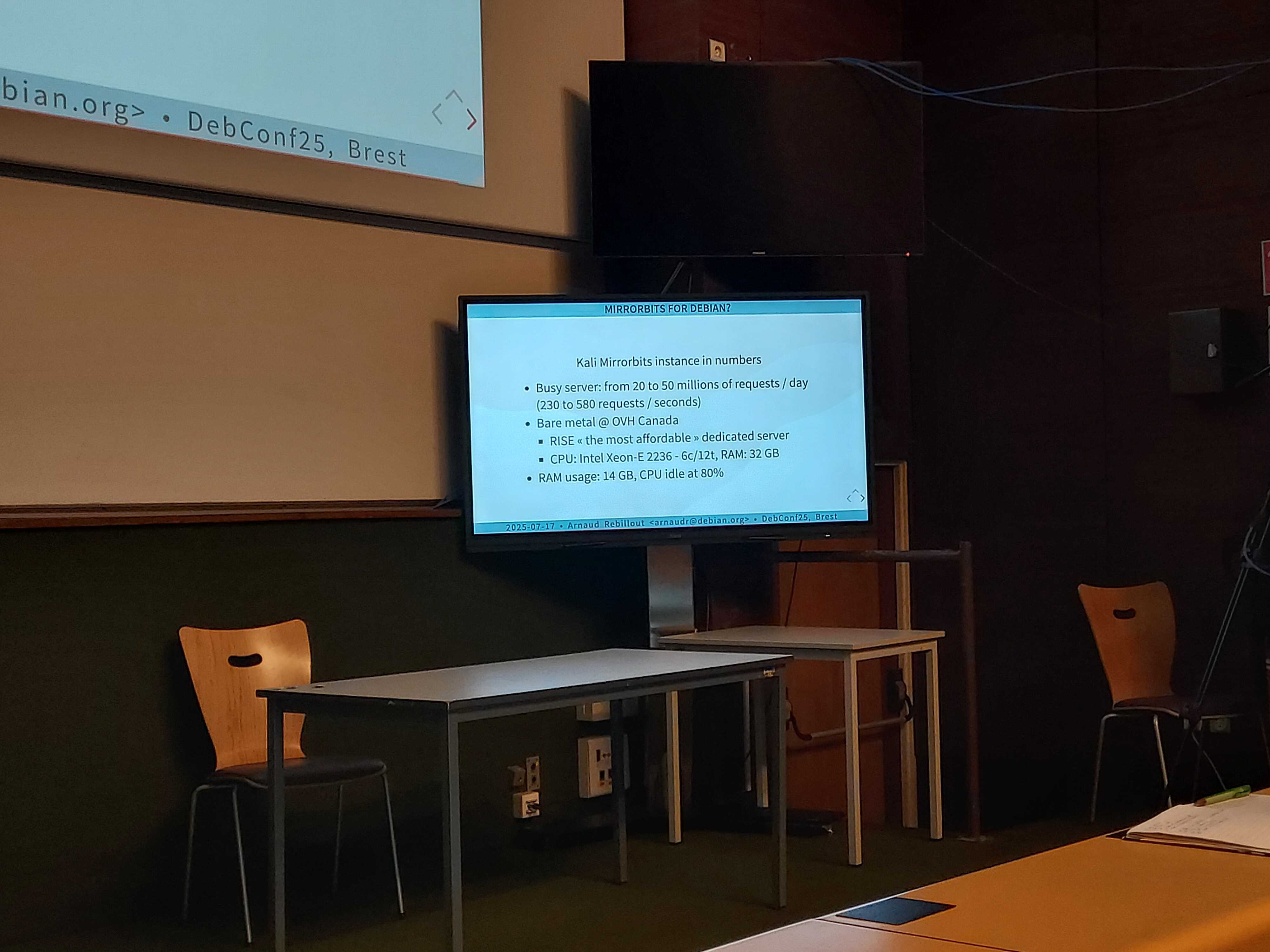
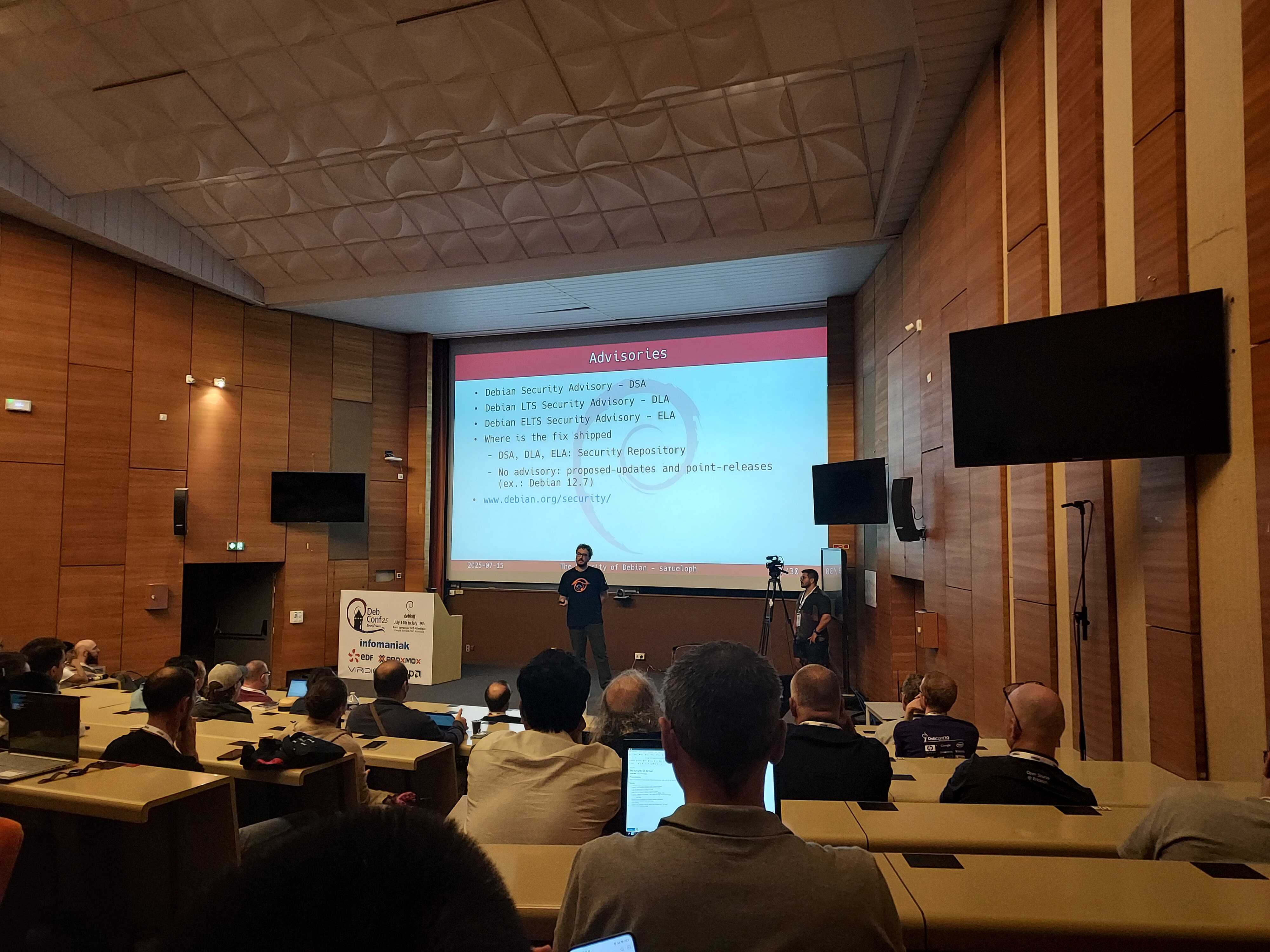
xev to gather lowlevel input from the mouse. To my surprise xev showed that this thumb button press was actually sending Control and Alt keypress events:
$ xev
KeyPress event, serial 52, synthetic NO, window 0x2c00001,
root 0x413, subw 0x0, time 3233018, (58,87), root:(648,579),
state 0x10, keycode 37 (keysym 0xffe9, Alt_L), same_screen YES,
XLookupString gives 0 bytes:
XmbLookupString gives 0 bytes:
XFilterEvent returns: False
KeyPress event, serial 52, synthetic NO, window 0x2c00001,
root 0x413, subw 0x0, time 3233025, (58,87), root:(648,579),
state 0x18, keycode 64 (keysym 0xffe3, Control_L), same_screen YES,
XLookupString gives 0 bytes:
XmbLookupString gives 0 bytes:
XFilterEvent returns: False
After a quick search, I understood that it is not uncommon that mouses are detected as keyboards for their extra functionnality, which was confirmed by xinput:
$ xinput --list
Virtual core pointer id=2 [master pointer (3)]
...
Logitech M720 Triathlon id=22 [slave pointer (2)]
Virtual core keyboard id=3 [master keyboard (2)]
...
Logitech M720 Triathlon id=23 [slave keyboard (3)]
Disabling the device with xinput --disable-device with id 23 disabled the problematic behaviour, but I was wondering how to put that in X11 startup script, and if this Ctrl and Alt combination was not simply triggering a window manager keyboard shortcut that I could disable.
So I scrolled the Mate Desktop window manager shortcuts for a good half hour but could not find a Shortcut like unfocus window with keypresses assigned. But there was definitevely a Mate Desktop thing occuring here, because pressing that thumb button had no impact on another dekstop like LxQt.
Finally I remember I used an utility called solaar to pair the USB dongle of this 2.4Ghz wireless mouse. I could maybe use it to inspect the mouse profile.
Then bingo !
$ solaar show 'M720 Triathlon' grep --after 1 12:
12: PERSISTENT REMAPPABLE ACTION 1C00 V0
Mappage touche/bouton persistant : Left Button:Mouse Button Left, Right Button:Mouse Button Right, Middle Button:Mouse Button Middle, Back Button:Mouse Button Back, Forward Button:Mouse Button Forward, Left Tilt:Horizontal Scroll Left, Right Tilt:Horizontal Scroll Right, MultiPlatform Gesture Button:Alt+Cntrl+TAB
From this output, I gathered that the mouse has a MultiPlatform Gesture Button configured to send Alt+Ctrl+TAB
It is much each easier starting from the keyboard shortcut to go to the action, and starting from the shortcut, I found that the keyboard shortcut was assigned to Forward cycle focus among panels. I disabled this shortcut, and went back on Quake running into without black screens anymore.
If you read the above title, you might wonder how the switch to wayland (yes, the graphical stack replacing the venerable X11) can possibly relate to SSH agents. The answer is easy.
For as long as I can remember, as a long time user of gpg-agent as SSH agent (because my SSH key is a GPG sub-key) I relied on /etc/X11/Xsession.d/90gpg-agent that would configure the SSH_AUTH_SOCK environment variable (pointing to gpg-agent s socket) provided that I added enable-ssh-support in ~/.gnupg/gpg-agent.conf.
Now when I switched to Wayland, that shell script used in the startup sequence of Xorg was no longer used. During a while I cheated a bit by setting SSH_AUTH_SOCK directly in my ~/.bashrc. But that only works for terminals, and not for other applications that are started by the session manager (which is basically systemd --user).
So how is that supposed to work out of the box nowadays? The SSH agents (as packaged in Debian) have all adopted the same trick, their .socket unit have an ExecStartPost setting which runs systemctl --user set-environment SSH_AUTH_SOCK=some-value. This command dynamically modifies the environment of the running systemd daemon and thus influences the environment for the future units started. Putting this in a socket unit ensures an early run, before most of the applications are started so it s a good choice. They tend to also explicitly ensure this with a directive like Before=graphical-session-pre.target.
However, in a typical installation you end up with multiple SSH agents (right now I have ssh-agent, gpg-agent, and gcr-ssh-agent), which one is the one that the user ends up using? Well, that is not clearly defined, the one that wins is the one that runs last because each of them overwrites the value in the systemd environment.
Some of them fight to have that place (cf #1079246 for gcr-ssh-agent) by setting explicit After directives. In the above bug I argue that we should let gpg-agent.socket have the priority since that s the only one that is not enabled by default and that requires the user to opt-in. However, ultimately there will always be cases where you will want to be explicit about the SSH agent that should win.
You could rely on systemd overrides to add/remove ordering directives but that s pretty fragile. Instead the right way to deal with this is to mask the socket units of the SSH agents that you don t want. Note that disabling (i.e. systemctl --user disable) either will not work[1] or will not be sufficient[2]. In my case, I wanted to keep gpg-agent.socket so I masked gcr-ssh-agent.socket and ssh-agent.socket:
$ systemctl --user mask ssh-agent.socket gcr-ssh-agent.socket
Created symlink '/home/rhertzog/.config/systemd/user/ssh-agent.socket' '/dev/null'.
Created symlink '/home/rhertzog/.config/systemd/user/gcr-ssh-agent.socket' '/dev/null'.
Note that if you want that behaviour to apply to all users of your computer, you can use sudo systemctl --global mask ssh-agent.socket gcr-ssh-agent.socket. Now on next login, you will only get a single ssh agent socket unit that runs and the SSH_AUTH_SOCK value will thus be predictable again!
Hopefully you will find that useful as it s already the second time that I stumble upon this either for me or for a relative. Next time, I will know where to look it up.
[1]: If you try to run systemctl --user disable gcr-ssh-agent.socket, you will get a message saying that it will not work because the unit is enabled for all users at the global level. You can do it with --global instead of --user but it doesn t help, cf below.
[2]: Disabling an unit basically means stopping to explicitely schedule its startup as part of a desired target. However, the unit can still be started as a dependency of other units and that s the case here because a socket unit will typically be pulled in by its corresponding service unit.
About 95% of my Debian contributions this month were
sponsored by Freexian.
You can also support my work directly via
Liberapay or GitHub
Sponsors.
OpenSSH
OpenSSH upstream released
10.1p1 this month, so I
upgraded to that. In the process, I reverted a Debian patch that changed IP
quality-of-service defaults, which made sense at the
time but has since been reworked upstream
anyway, so it makes sense to find out whether we still have similar
problems. So far I haven t heard anything bad in this area.
10.1p1 caused a regression in the ssh-agent-filter package s tests, which I
bisected and chased up with
upstream.
10.1p1 also had a few other user-visible regressions
(#1117574,
#1117594,
#1117638,
#1117720); I upgraded to
10.2p1 which fixed some of
these, and contributed some upstream debugging
help to clear up the
rest. While I was there, I also fixed ssh-session-cleanup: fails due to
wrong $ssh_session_pattern in our packaging.
Finally, I got all this into trixie-backports, which I intend to keep up to
date throughout the forky development cycle.
Python packaging
For some time, ansible-core has had occasional autopkgtest failures that
usually go away before anyone has a chance to look into them properly. I
ran into these via openssh recently and decided to track them down. It
turns out that they only happened when the libpython3.13-stdlib package
had different versions in testing and unstable, because an integration test
setup script made a change that would be reverted if that package was ever
upgraded in the testbed, and one of the integration tests accidentally
failed to disable system apt sources comprehensively enough while testing
the behaviour of the ansible.builtin.apt module. I fixed this in
Debian
and contributed the relevant part
upstream.
We ve started working on enabling Python 3.14 as a supported version in
Debian. I fixed or helped to fix a number of packages for this:
nocheck build
profile, and I fixed several of
these (generally just a matter of adjusting build-dependencies):
/usr/bin/env: 'python': No such file or
directory
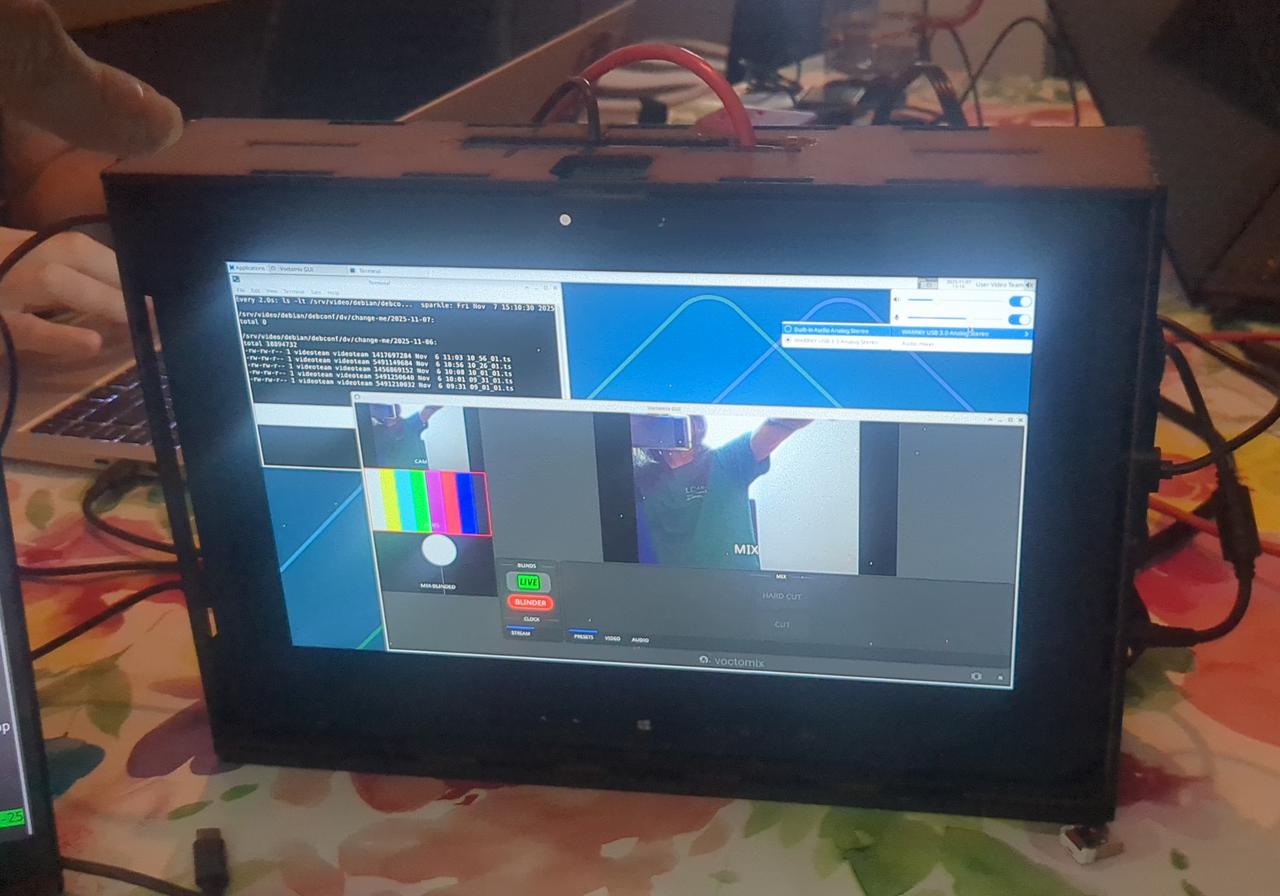
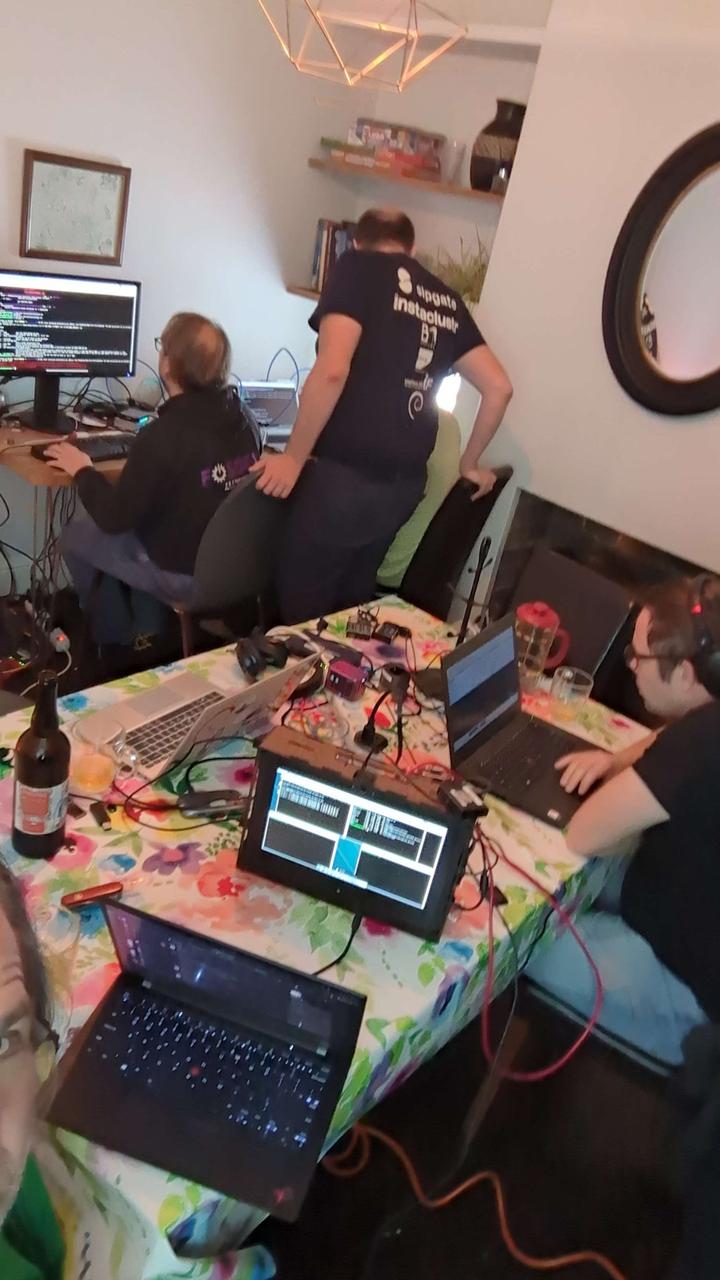
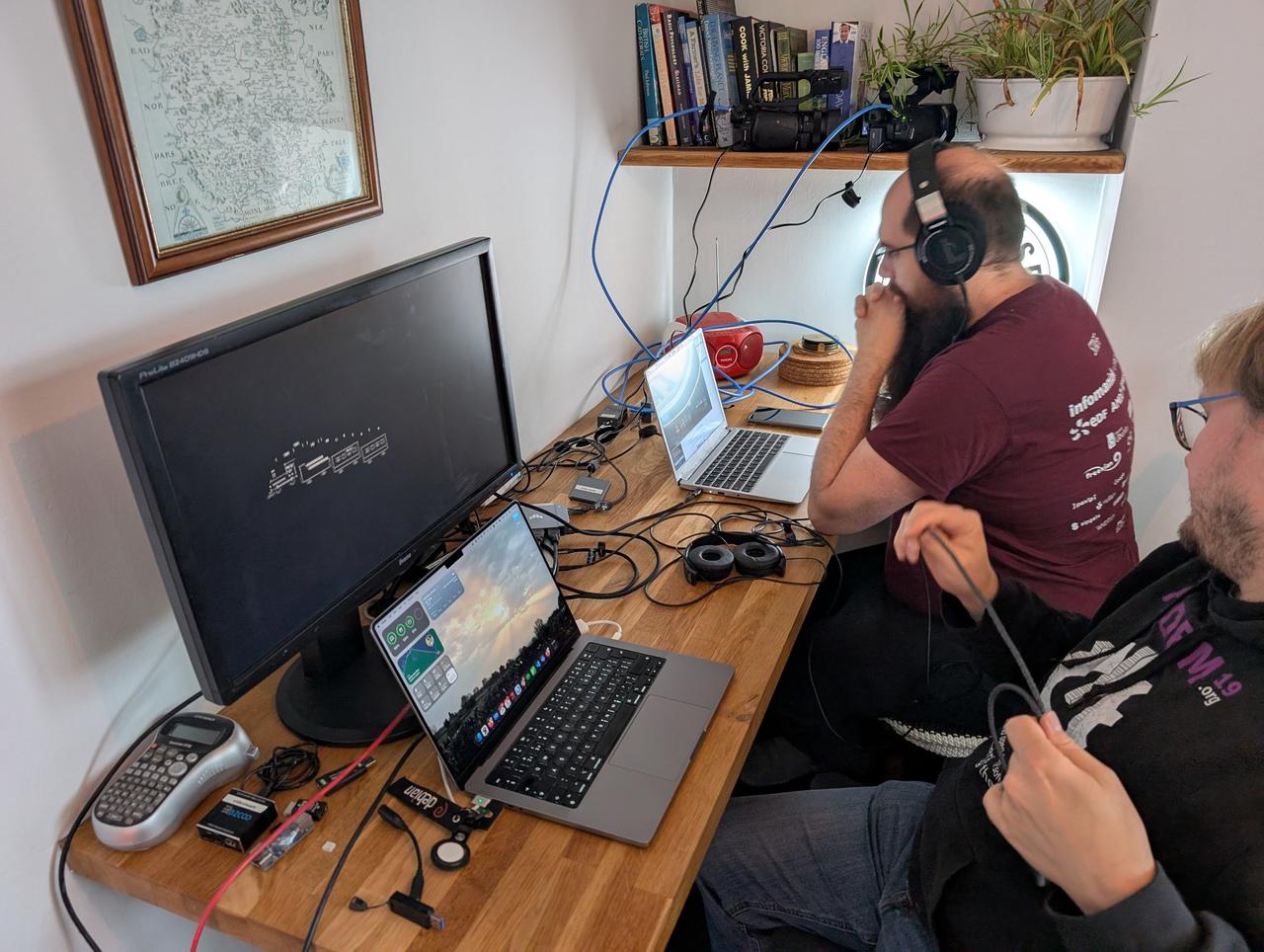
This week, some of the DebConf Video Team
met in Herefordshire (UK) for a
sprint. We didn't have
a sprint in 2024, and it was sorely needed, now.
At the sprint we made good progress towards using Voctomix 2 more
reliably, and made plans for our future hardware needs.
Attendees
gst-fallbacksrc
Carl's box's needs lead to looking at
gstfallbacksrc.
This should let Voctomix 2 survive cameras (or network sources) going
away for a moment.
Matthias Geiger packaged it for us,
and it's now in Debian NEW. Thanks!
voctomix-outcasts
Carl cut a release of
voctomix-outcasts and
Stefano uploaded it to unstable.
Ansible Configuration
The videoteam's stack is deployed with Ansible, and almost everything we
do involves work on this stack. Carl upstreamed some of his features to
us, and we updated our voctomix2 configuration to take
advantage
of our experiments at the sprint.
Miscellaneous Voctomix contributions
We fixed a couple of minor
bugs in voctomix.
More Nageru experimentation
In 2023, we tried to configure Nageru
(another live video mixer) for the video team's needs. Like voctomix
it needs some configuration and scaffolding to adapt it to your needs.
Practically, this means writing a "theme" in Lua that controls the
mixer.
The team still has a preference for Voctomix (as we're all very familiar
with it), but would like to have Nageru available as an option when we
need it. We
fixed
some minor issues in our theme, enough to get it running again, on the
Framework laptop. Much more work is needed to really make it a useable
option.
Thank you
Thanks to the Debian project for funding the costs of the sprint, and
Chris Boot's extended family for providing us with a no-cost sprint
venue.
Thanks to c3voc for developing and maintaining
voctomix, and helping us to debug issues in it.
Thank you to everyone in the videoteam who attended or helped out
remotely! And to employers who let us work on Debian on company time.
We'll likely need to keep working on our stack remotely, in the leadup
to DebConf 26, and/or have another sprint before then.
kernel: amdgpu 0000:02:00.0: [drm] *ERROR* [CRTC:58:crtc-0] flip_done timed outThen I got the following errors from kwin_wayland:
kwin_wayland_wrapper[19598]: kwin_wayland_drm: Pageflip timed out! This is a bug in the amdgpu kernel driver kwin_wayland_wrapper[19598]: kwin_wayland_drm: Please report this at https://gitlab.freedesktop.org/drm/amd/-/issues kwin_wayland_wrapper[19598]: kwin_wayland_drm: With the output of 'sudo dmesg' and 'journalctl --user-unit plasma-kwin_wayland --boot 0'In another instance running Debian kernel 6.12.48+deb13 I got the kernel errors at the bottom of the post (not in the RSS feed). A google result suggested putting the following on the kernel command line which has the downside of increasing the idle power, but given that it s a low power GPU (that I selected when I was using a system without a PCIe power cable) a bit of extra power use shouldn t matter much. But it didn t seem to change anything.
amdgpu.runpm=0 amdgpu.dcdebugmask=0x10I had tried out the Debian/Unstable kernel 6.16.12-2 which didn t work with my USB speakers and had problems with the HDMI sound through my monitor but still had AMD GPU issues. This all seemed to start with the PCIe errors being reported on this system [1]. So I m now wondering if the PCIe errors were from the GPU not the socket/motherboard. The GPU in question is a Radeon RX560 4G which cost $246.75 back in about 2021 [2]. I could buy a new one of those on ebay for $149 or one of the faster AMD cards like Radeon RX570 that are around the same price. I probably have a Radeon R7 260X in my collection of spare parts that would do the job too (2G of VRAM is more than sufficient for my desktop computing needs). Any suggestions on how I should proceed from here?
[419976.222647] amdgpu 0000:02:00.0: amdgpu: GPU fault detected: 146 0x0138482c [419976.222659] amdgpu 0000:02:00.0: amdgpu: for process mpv pid 141328 thread vo pid 141346 [419976.222662] amdgpu 0000:02:00.0: amdgpu: VM_CONTEXT1_PROTECTION_FAULT_ADDR 0x00101427 [419976.222664] amdgpu 0000:02:00.0: amdgpu: VM_CONTEXT1_PROTECTION_FAULT_STATUS 0x0404802C [419976.222666] amdgpu 0000:02:00.0: amdgpu: VM fault (0x2c, vmid 2, pasid 32810) at page 1053735, read from 'TC0' (0x54433000) (72) [419986.245051] amdgpu 0000:02:00.0: amdgpu: Dumping IP State [419986.245061] amdgpu 0000:02:00.0: amdgpu: Dumping IP State Completed [419986.255152] amdgpu 0000:02:00.0: amdgpu: ring gfx timeout, signaled seq=11839646, emitted seq=11839648 [419986.255158] amdgpu 0000:02:00.0: amdgpu: Process information: process mpv pid 141328 thread vo pid 141346 [419986.255209] amdgpu 0000:02:00.0: amdgpu: GPU reset begin! [419986.503030] amdgpu: cp is busy, skip halt cp [419986.658198] amdgpu: rlc is busy, skip halt rlc [419986.659270] amdgpu 0000:02:00.0: amdgpu: BACO reset [419986.884672] amdgpu 0000:02:00.0: amdgpu: GPU reset succeeded, trying to resume [419986.885398] [drm] PCIE GART of 256M enabled (table at 0x000000F402000000). [419986.885413] [drm] VRAM is lost due to GPU reset! [419987.021051] [drm] UVD and UVD ENC initialized successfully. [419987.120999] [drm] VCE initialized successfully. [419987.193302] amdgpu 0000:02:00.0: amdgpu: GPU reset(1) succeeded! [419987.194117] [drm:amdgpu_cs_ioctl [amdgpu]] *ERROR* Failed to initialize parser -125! [419997.509120] amdgpu 0000:02:00.0: amdgpu: Dumping IP State [419997.509131] amdgpu 0000:02:00.0: amdgpu: Dumping IP State Completed [419997.519145] amdgpu 0000:02:00.0: amdgpu: ring gfx timeout, signaled seq=11839650, emitted seq=11839652 [419997.519152] amdgpu 0000:02:00.0: amdgpu: Process information: process kwin_wayland pid 3577 thread kwin_wayla:cs0 pid 3615 [419997.519158] amdgpu 0000:02:00.0: amdgpu: GPU reset begin! [419997.772966] amdgpu: cp is busy, skip halt cp [419997.928138] amdgpu: rlc is busy, skip halt rlc [419997.929165] amdgpu 0000:02:00.0: amdgpu: BACO reset [419998.164705] amdgpu 0000:02:00.0: amdgpu: GPU reset succeeded, trying to resume [419998.165412] [drm] PCIE GART of 256M enabled (table at 0x000000F402000000). [419998.165427] [drm] VRAM is lost due to GPU reset! [419998.311054] [drm] UVD and UVD ENC initialized successfully. [419998.411006] [drm] VCE initialized successfully. [419998.476272] amdgpu 0000:02:00.0: amdgpu: GPU reset(2) succeeded! [419998.476363] [drm:amdgpu_cs_ioctl [amdgpu]] *ERROR* Failed to initialize parser -125! [420008.773202] amdgpu 0000:02:00.0: amdgpu: Dumping IP State [420008.773212] amdgpu 0000:02:00.0: amdgpu: Dumping IP State Completed [420008.773240] amdgpu 0000:02:00.0: amdgpu: ring gfx timeout, but soft recovered === the above sequence of 3 repeated many times (narrator's voice "but it did not recover") === [420130.933612] rfkill: input handler disabled [420135.594195] rfkill: input handler enabled [420145.734076] amdgpu 0000:02:00.0: amdgpu: Dumping IP State [420145.734085] amdgpu 0000:02:00.0: amdgpu: Dumping IP State Completed [420145.744099] amdgpu 0000:02:00.0: amdgpu: ring gfx timeout, signaled seq=11839790, emitted seq=11839792 [420145.744105] amdgpu 0000:02:00.0: amdgpu: Process information: process kwin_wayland pid 3577 thread kwin_wayla:cs0 pid 3615 [420145.744111] amdgpu 0000:02:00.0: amdgpu: GPU reset begin!There were more kernel messages, but they were just repeats and after a certain stage there probably isn t any more data worth getting.
| Item | Price (Malaysian ringgits) | Conversion to Indian rupees | Comments |
|---|---|---|---|
| Nescafe Tarik | 2.50 | 50 | Coffee |
| Ais Kosong | 0.50 | 10 | Water |
| Telur Dadar | 2.00 | 40 | Omelet |
| SST Tax (6%) | 0.30 | 6 | |
| Total | 5.30 | 106 |
308. This version includes the following changes:
[ Chris Lamb ]
* Attempt to fix automatic deployment to PyPi:
- Separate out deploy-tag and deploy-pypi into different stages, and base
the latter on debian:unstable.
- Call apt-get update prior to attempting installing twine.
It occurred to me recently that one of the attractions of vinyl, or more
generally physical media, could be that it's inert, safe: the music is a
groove cut into some plastic. That's it. The record can't do anything
unexpected to you1: it just contains music.
There's so much exploitation of attention, and so much of what we interact
with in a computing context (social media) etc has been weaponised against
us, that having something some matter-of-fact is a relief. I know that
sometimes, I prefer to put a record on than to dial up the very same album
from any number of (ostensibly more convenient) digital sources, partly
because I don't need to spend any of my attention spoons to do so, I can
save them for the task at hand.
The same is perhaps not true for audio CDs. That might depend on your own
relationship with them, of course. For me they're inexorably tied up with
computing and a certain amount of faff (ripping, encoding, metadata). And
long dead it might be (hopefully), but I can still remember Sony's CD
rootkit scandal:
CDs could be a trojan horse. Beware!
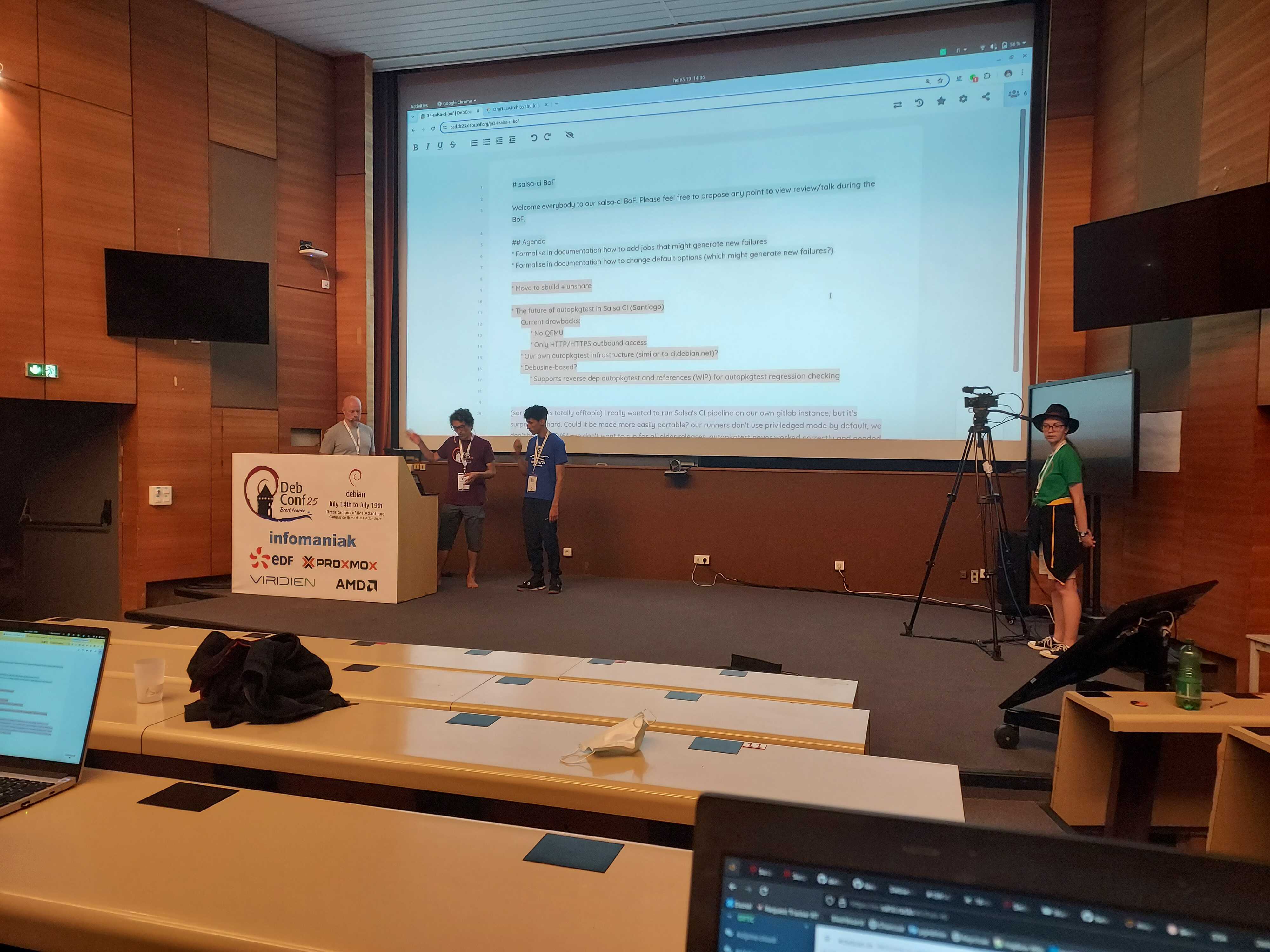
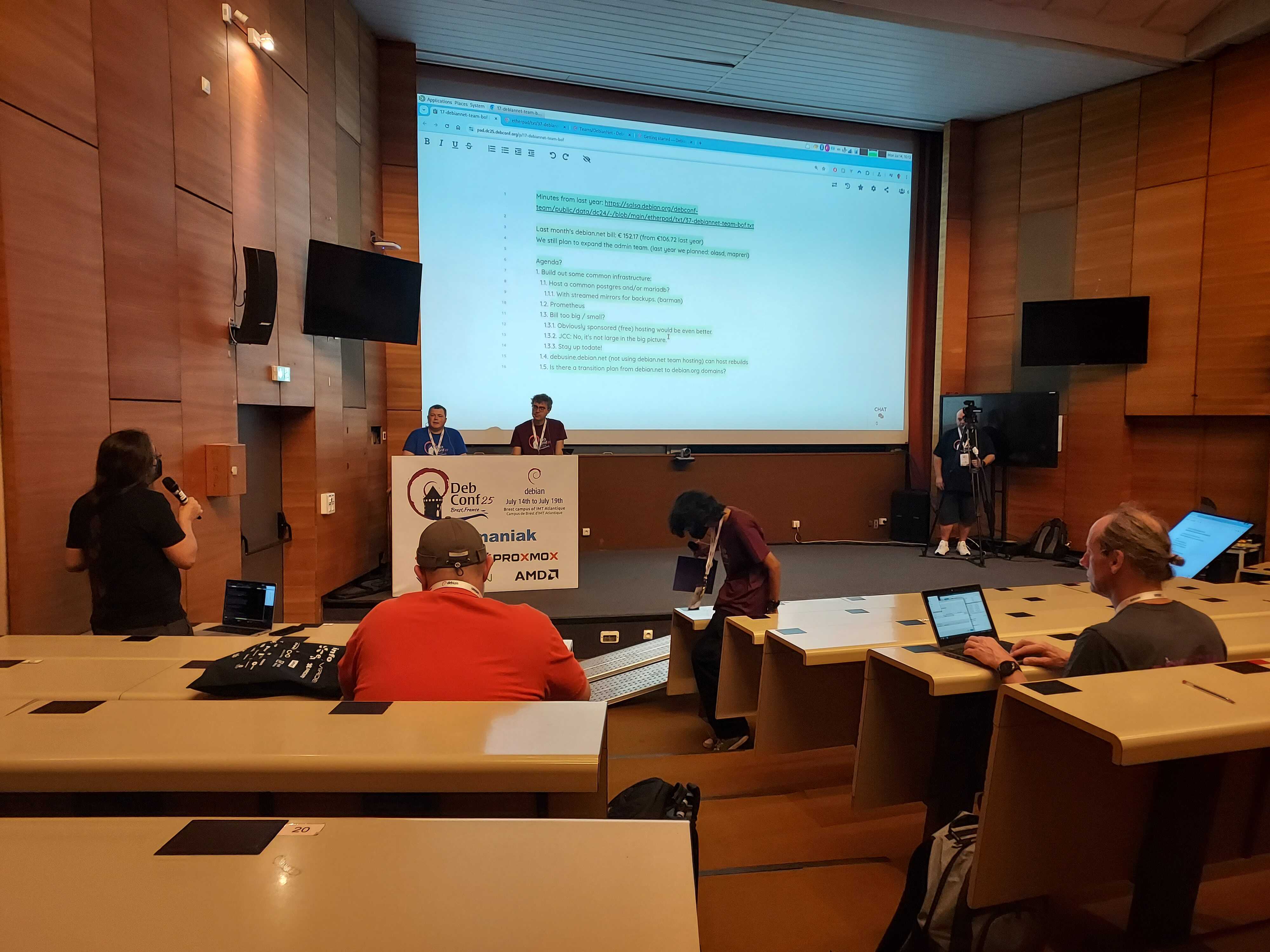
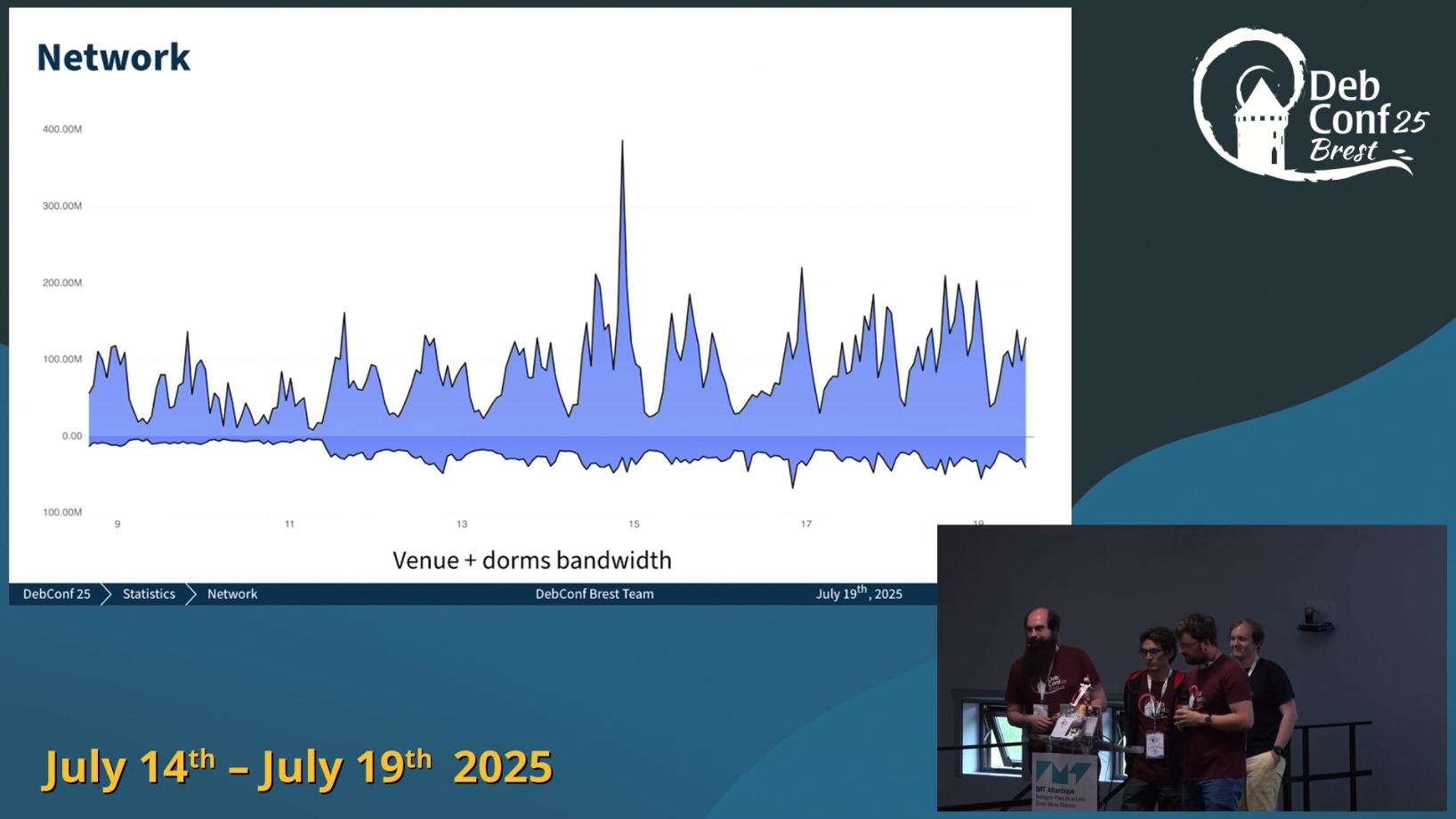
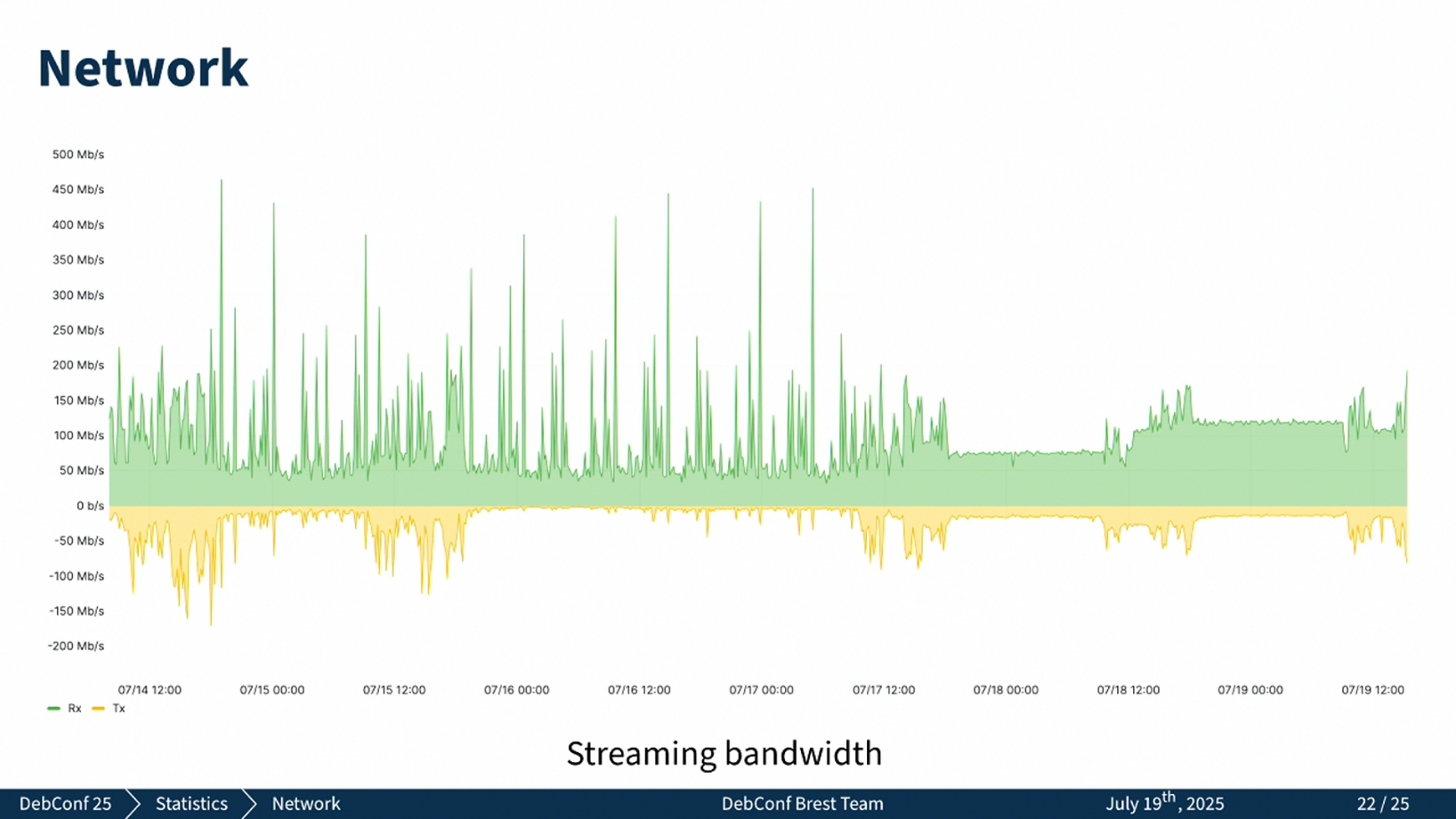
DC25 network usage graphs. Click to enlarge.
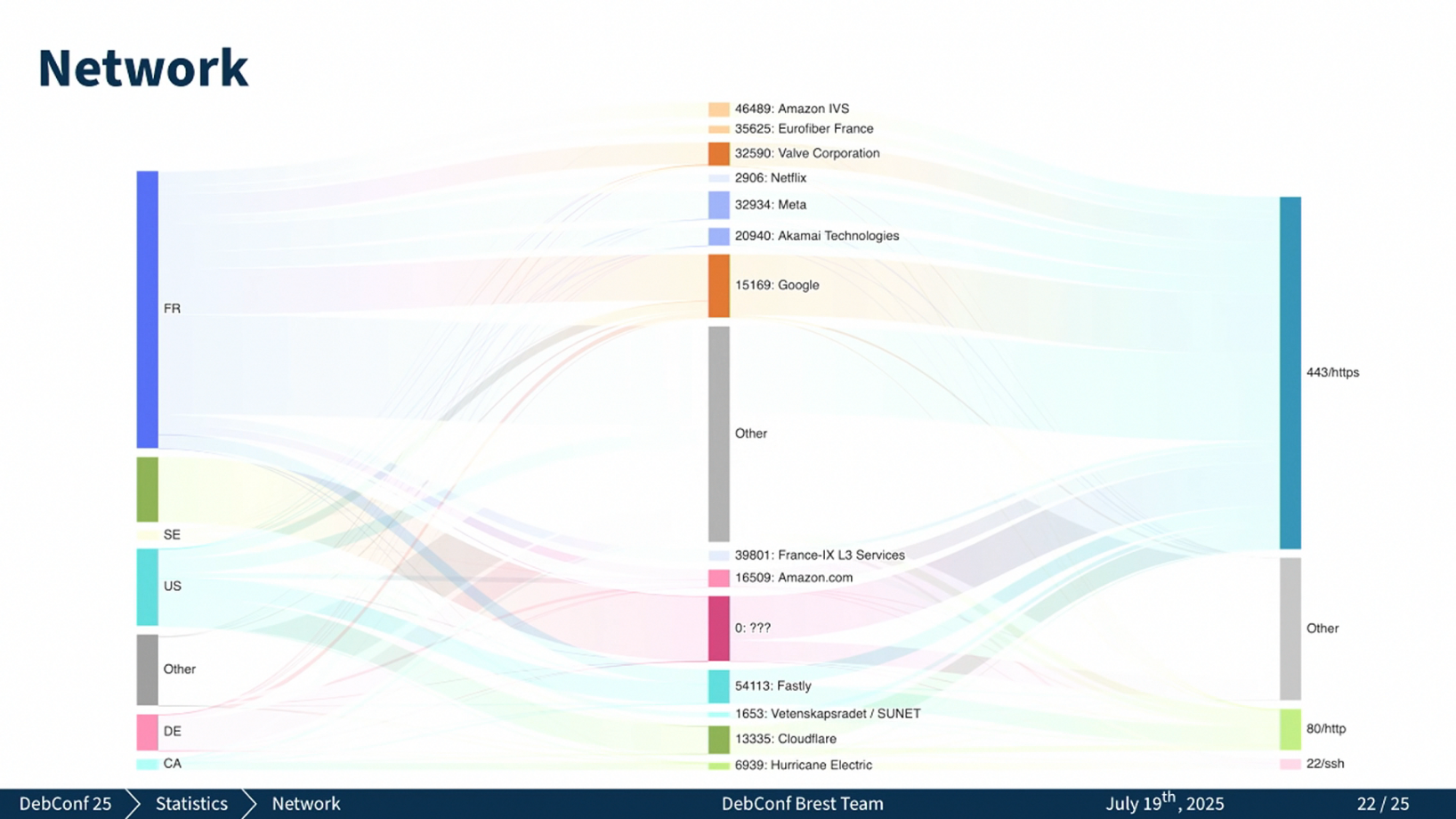
Flow diagrams. Click to enlarge.
Streaming bandwidth graph. Click to enlarge.

PS - Talks are available on Debian media server.
Welcome to the October 2025 report from the Reproducible Builds project!
Welcome to the very latest report from the Reproducible Builds project. Our monthly reports outline what we ve been up to over the past month, and highlight items of news from elsewhere in the increasingly-important area of software supply-chain security. As ever, if you are interested in contributing to the Reproducible Builds project, please see the Contribute page on our website.
In this report:
We were thrilled to host the eighth edition of this exciting event, following the success of previous summits in various iconic locations around the world, including Venice, Marrakesh, Paris, Berlin, Hamburg and Athens. During this event, participants had the opportunity to engage in discussions, establish connections and exchange ideas to drive progress in this vital field. Our aim was to create an inclusive space that fosters collaboration, innovation and problem-solving.
The agenda of the three main days is available online however, some working sessions may still lack notes at time of publication.
One tangible outcome of the summit is that Johannes Starosta finished their rebuilderd tutorial, which is now available online and Johannes is actively seeking feedback.
On the issue tracker for the popular Signal messenger app, developer Greyson Parrelli reports that updates to the Google Play store have, in effect, broken reproducible builds:
The most recent issues have to do with changes to the APKs that are made by the Play Store. Specifically, they add some attributes to some .xml files around languages are resources, which is not unexpected because of how the whole bundle system works. This is trickier to resolve, because unlike current expected differences (like signing information), we can t just exclude a whole file from the comparison. We have to take a more nuanced look at the diff. I ve been hesitant to do that because it ll complicate our currently-very-readable comparison script, but I don t think there s any other reasonable option here.
The full thread with additional context is available on GitHub.
malloc are used to determine some order of execution.
.buildinfo files).
xfsprogs 6.17.0 which specifically includes a commit that implements the functionality to populate a newly created XFS filesystem directly from an existing directory structure which makes it easier to create populated filesystems
without having to mount them [and thus is] particularly useful for reproducible builds . Luca asked the list how they might contribute to the docs of the System images page.
Popular YouTuber @laurewired published a video this month with an engaging take on the Trusting Trust problem. Titled The Original Sin of Computing that no one can fix, the video touches on David A. Wheeler s Diverse Double-Compiling dissertation.
GNU developer Janneke Nieuwenhuizen followed-up with an email (additionally sent to our mailing list) as well, underscoring that GNU Mes s current solution [to this issue] uses ancient softwares in its bootstrap path, such as gcc-2.95.3 and glibc-2.2.5 . (According to Colby Russell, the GNU Mes bootstrapping sequence is shown at 18m54s in the video.)
Holger Levsen gave a talk at this year s Transparency.dev summit in Gothenburg, Sweden, outlining the achievements of the Reproducible Builds project in the last 12 years, covering both upstream developments as well as some distribution-specific details. As mentioned on the talk s page, Holger s presentation concluded with an outlook into the future and an invitation to collaborate to bring transparency logs into Reproducible Builds projects .
The slides of the talk are available, although a video has yet to be released. Nevertheless, as a result of the discussions at Transparency.dev there is a new page on the Debian wiki with the aim of describing a potential transparency log setup for Debian.
Andrew Ayer has setup a new service at sourcespotter.com that aims to monitor the supply chain security for Go releases. It consists of four separate trackers:
go command.
Julien Malka of the Institut Polytechnique de Paris published an exciting paper this month on How NixOS could have detected the XZ supply-chain attack for the benefit of all thanks to reproducible-builds. Julien outlines his paper as follows:
In March 2024, a sophisticated backdoor was discovered in xz, a core compression library in Linux distributions, covertly inserted over three years by a malicious maintainer, Jia Tan. The attack, which enabled remote code execution via ssh, was only uncovered by chance when Andres Freund investigated a minor performance issue. This incident highlights the vulnerability of the open-source supply chain and the effort attackers are willing to invest in gaining trust and access. In this article, I analyze the backdoor s mechanics and explore how bitwise build reproducibility could have helped detect it.A PDF of the paper is available online.
Iy n M ndez Veiga and Esther H nggi (of the Lucerne University of Applied Sciences and Arts and ETH Zurich) published a paper this month on the topic of Reproducible Builds for Quantum Computing. The abstract of their paper mentions the following:
Although quantum computing is a rapidly evolving field of research, it can already benefit from adopting reproducible builds. This paper aims to bridge the gap between the quantum computing and reproducible builds communities. We propose a generalization of the definition of reproducible builds in the quantum setting, motivated by two threat models: one targeting the confidentiality of end users data during circuit preparation and submission to a quantum computer, and another compromising the integrity of quantum computation results. This work presents three examples that show how classical information can be hidden in transpiled quantum circuits, and two cases illustrating how even minimal modifications to these circuits can lead to incorrect quantum computation results.A full PDF of their paper is available.
Congratulations to Georg Kofler who submitted their Master s thesis for the Johannes Kepler University of Linz, Austria on the topic of Reproducible builds of E2EE-messengers for Android using Nix hermetic builds:
The thesis focuses on providing a reproducible build process for two open-source E2EE messaging applications: Signal and Wire. The motivation to ensure reproducibility and thereby the integrity of E2EE messaging applications stems from their central role as essential tools for modern digital privacy. These applications provide confidentiality for private and sensitive communications, and their compromise could undermine encryption mechanisms, potentially leaking sensitive data to third parties.A full PDF of their thesis is available online.
Shawkot Hossain of Aalto University, Finland has also submitted their Master s thesis on the The Role of SBOM in Modern Development with a focus on the extant tooling:
Currently, there are numerous solutions and techniques available in the market to tackle supply chain security, and all claim to be the best solution. This thesis delves deeper by implementing those solutions and evaluates them for better understanding. Some of the tools that this thesis implemented are Syft, Trivy, Grype, FOSSA, dependency-check, and Gemnasium. Software dependencies are generated in a Software Bill of Materials (SBOM) format by using these open-source tools, and the corresponding results have been analyzed. Among these tools, Syft and Trivy outperform others as they provide relevant and accurate information on software dependencies.A PDF of the thesis is also available.
Michael Plura published an interesting article on Heise.de on the topic of Trust is good, reproducibility is better:
In the wake of growing supply chain attacks, the FreeBSD developers are relying on a transparent build concept in the form of Zero-Trust Builds. The approach builds on the established Reproducible Builds, where binary files can be rebuilt bit-for-bit from the published source code. While reproducible builds primarily ensure verifiability, the zero-trust model goes a step further and removes trust from the build process itself. No single server, maintainer, or compiler can be considered more than potentially trustworthy.The article mentions that this goal has now been achieved with a slight delay and can be used in the current development branch for FreeBSD 15 .
In Debian this month, 7 reviews of Debian packages were added, 5 were updated and 11 were removed this month adding to our knowledge about identified issues.
For the Debian CI tests Holger fixed #786644 and set nocheck in DEB_BUILD_OPTIONS for the 2nd build..
python-can.rsbackup.mobilitydb.pyraf.ne.qt6-lottie, plasma6-print-manager, plasma6-nm (avoid race in qmlcachegen)xfishtank (date, regression)gstreamer-plugins-rsgpg2 (FTBFS-2038)rocclr (PID)kf6-breeze-icons (parallelism)opencloud-server (random tmp path)python-awscrt (FTBFS-j1)glib-macros/contrast/fractal/Fragments/identity/mousai/loupe/gstreamer-plugins-rs (rust HashMap)deno (rust order)
Once again, there were a number of improvements made to our website this month including:
git archive to the Archive metadata page. [ ]
307 was uploaded to Debian unstable by Chris Lamb, who made a number of changes including fixing compatibility with LLVM version 21 [ ], an attempt to automatically attempt to deploy to PyPI by liaising with the PyPI developers/maintainers (with this experimental feature). [ ] In addition, Vagrant Cascadian updated diffoscope in GNU Guix to version 307.
#reproducible-builds on irc.oftc.net.
rb-general@lists.reproducible-builds.org
Another (again somewhat minor) maintenance release of the RcppCNPy

package arrived on CRAN just
now. RcppCNPy
provides R with read and write access to NumPy files thanks to the cnpy library by Carl Rogers
along with Rcpp for the glue to R.
The changes are all minor chores. As R now checks usage of packages
in demos, we added the rbenchmark to
Suggests: in DESCRIPTION. We refreshed the main continuous
integration script for a minor update, and also replaced one URL in a
badge to avoid a timeout during checks at CRAN. So nothing user-facing
this time! Full details are below.
CRANberries also provides a diffstat report for the latest release. As always, feedback is welcome and the best place to start a discussion may be the GitHub issue tickets page. If you like this or other open-source work I do, you can now sponsor me at GitHub.Changes in version 0.2.14 (2024-11-03)
- The rbenchmark package is now a Suggests: as it appears in
demo- The continuous integration setup now uses
r-ciwith its embedded setup step- The URL used for the GPL-2 is now the R Project copy
This post by Dirk Eddelbuettel originated on his Thinking inside the box blog. Please report excessive re-aggregation in third-party for-profit settings.
This was the first year I attended Kernel
Recipes and I have nothing but say how
much I enjoyed it and how grateful I m for the opportunity to talk more about
kworkflow to very experienced kernel developers. What
I mostly like about Kernel Recipes is its intimate format, with only one track
and many moments to get closer to experts and people that you commonly talk
online during your whole year.
In the beginning of this year, I gave the talk Don t let your motivation go,
save time with kworkflow at
FOSDEM,
introducing kworkflow to a more diversified audience, with different levels of
involvement in the Linux kernel development.
At this year s Kernel Recipes I presented
the second talk of the first day: Kworkflow - mix & match kernel recipes end-to-end.
The Kernel Recipes audience is a bit different from FOSDEM, with mostly
long-term kernel developers, so I decided to just go directly to the point. I
showed kworkflow being part of the daily life of a typical kernel developer
from the local setup to install a custom kernel in different target machines to
the point of sending and applying patches to/from the mailing list. In short, I
showed how to mix and match kernel workflow recipes end-to-end.
As I was a bit fast when showing some features during my presentation, in this
blog post I explain each slide from my speaker notes. You can see a summary of
this presentation in the Kernel Recipe Live Blog Day 1: morning.
Hi, I m Melissa Wen from Igalia. As we already started sharing kernel recipes
and even more is coming in the next three days, in this presentation I ll talk
about kworkflow: a cookbook to mix & match kernel recipes end-to-end.
This is my first time attending Kernel Recipes, so lemme introduce myself
briefly.
And what s this cookbook called kworkflow?
Kworkflow is a tool created by Rodrigo Siqueira, my colleague at Igalia. It s a
single platform that combines software and tools to:
It s mostly done by volunteers, kernel developers using their spare time. Its
features cover real use cases according to kernel developer needs.

Basically it s mixing and matching the daily life of a typical kernel developer
with kernel workflow recipes with some secret sauces.

So, it s time to start the first recipe: A good GPU driver for my AMD laptop.
Before starting any recipe we need to check the necessary ingredients and
tools. So, let s check what you have at home.
With kworkflow, you can use:
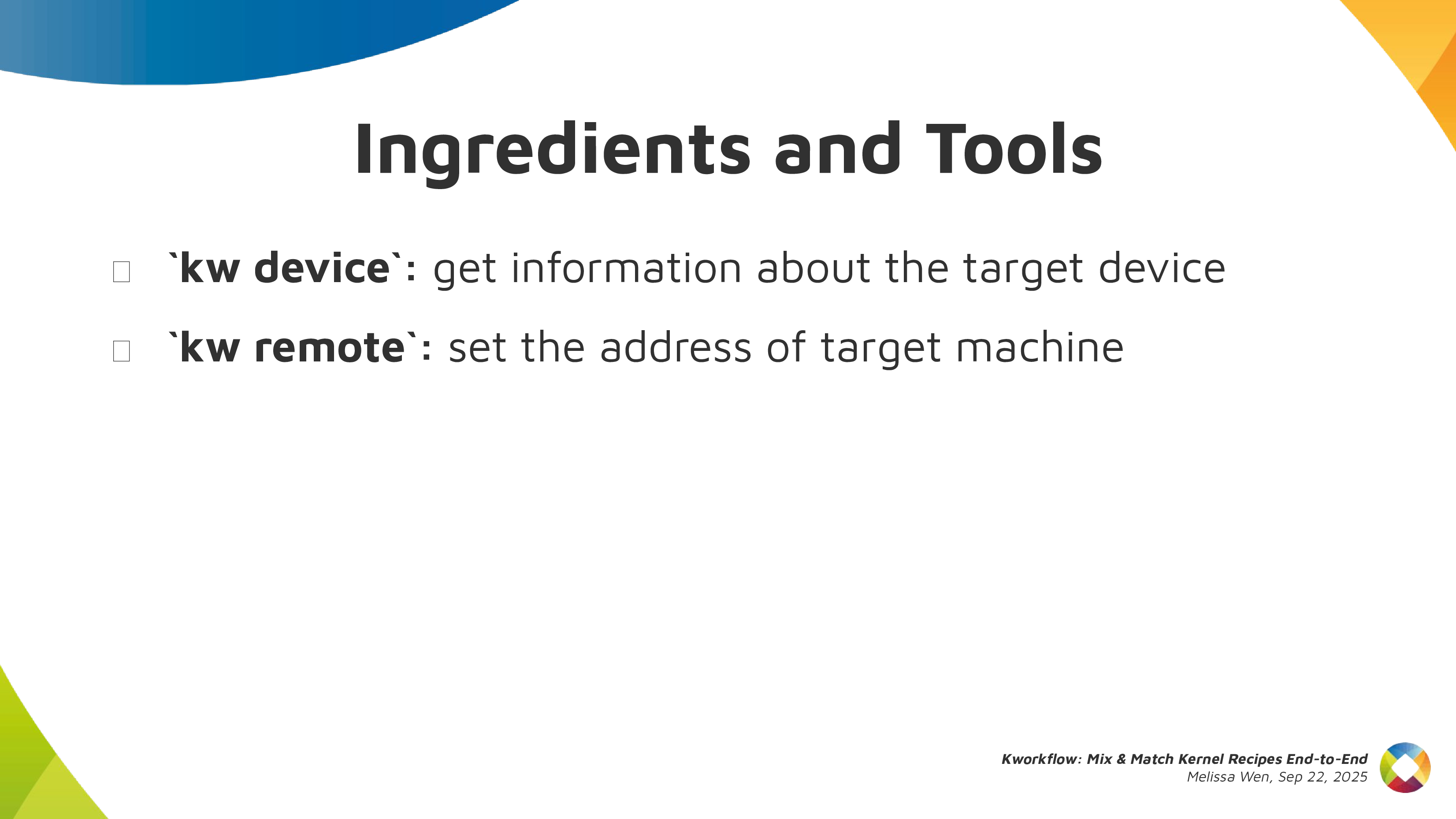
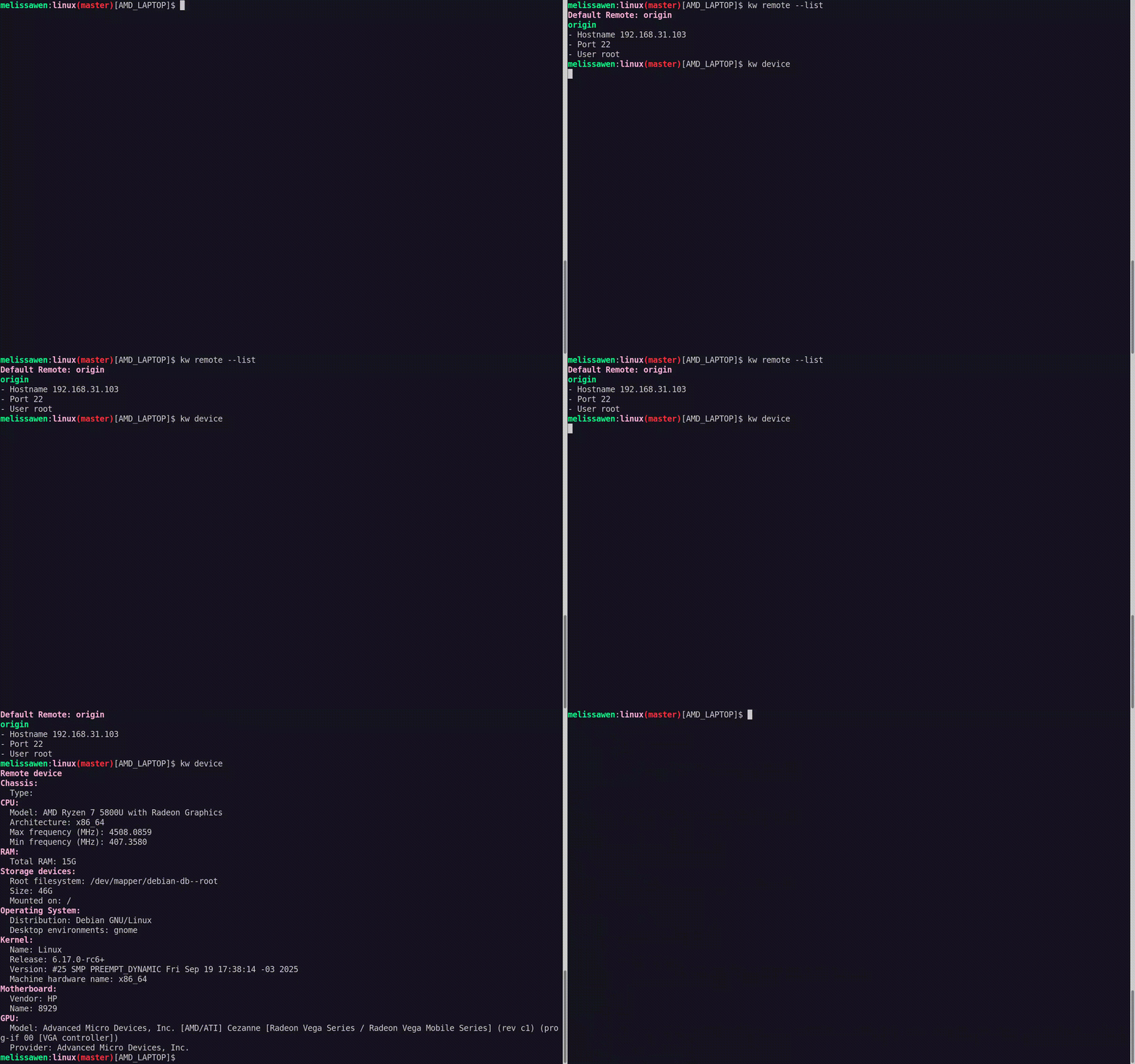
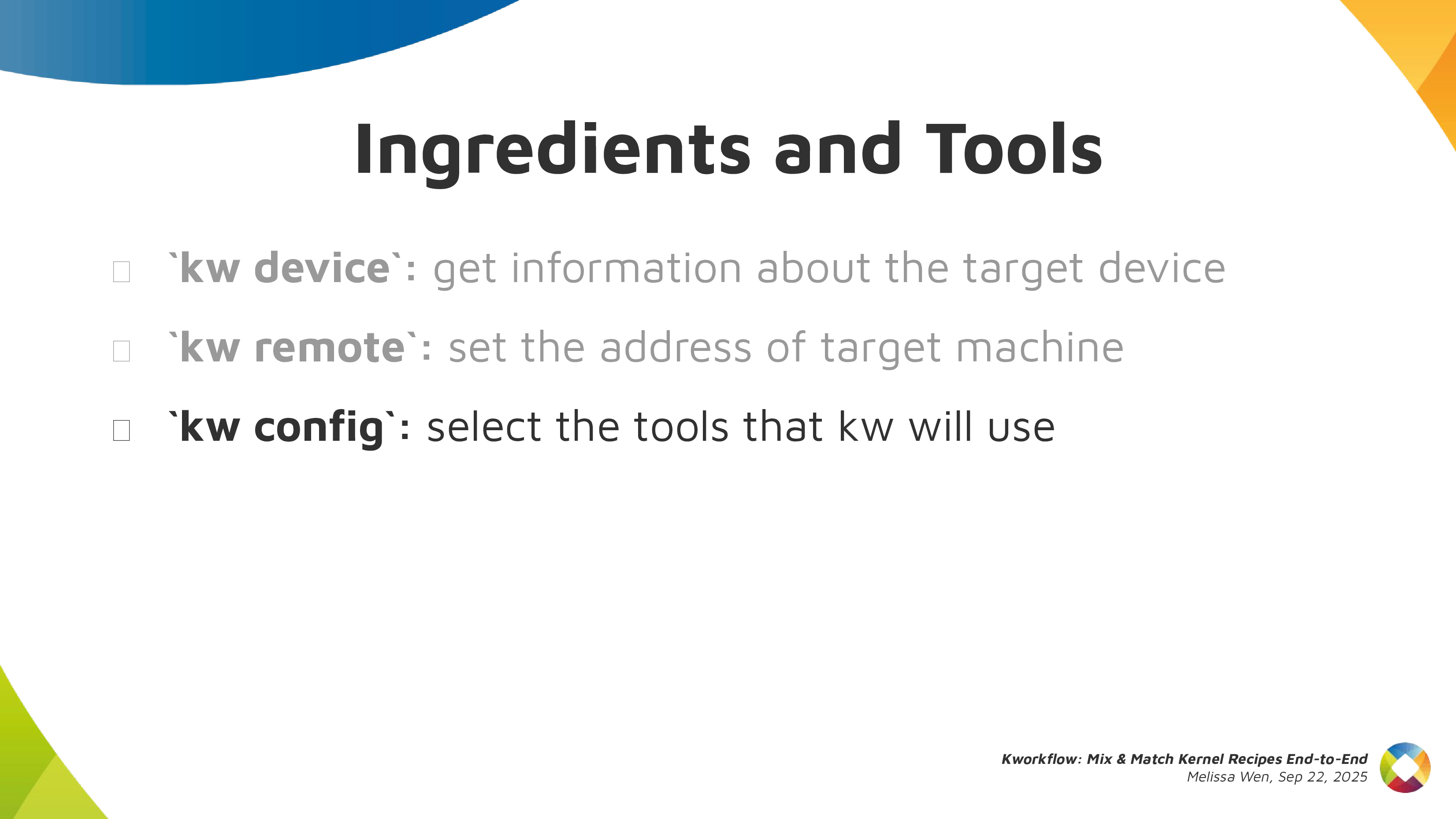
kw device: to get information about the target machine, such as: CPU model,
kernel version, distribution, GPU model,
kw remote: to set the address of this machine for remote access
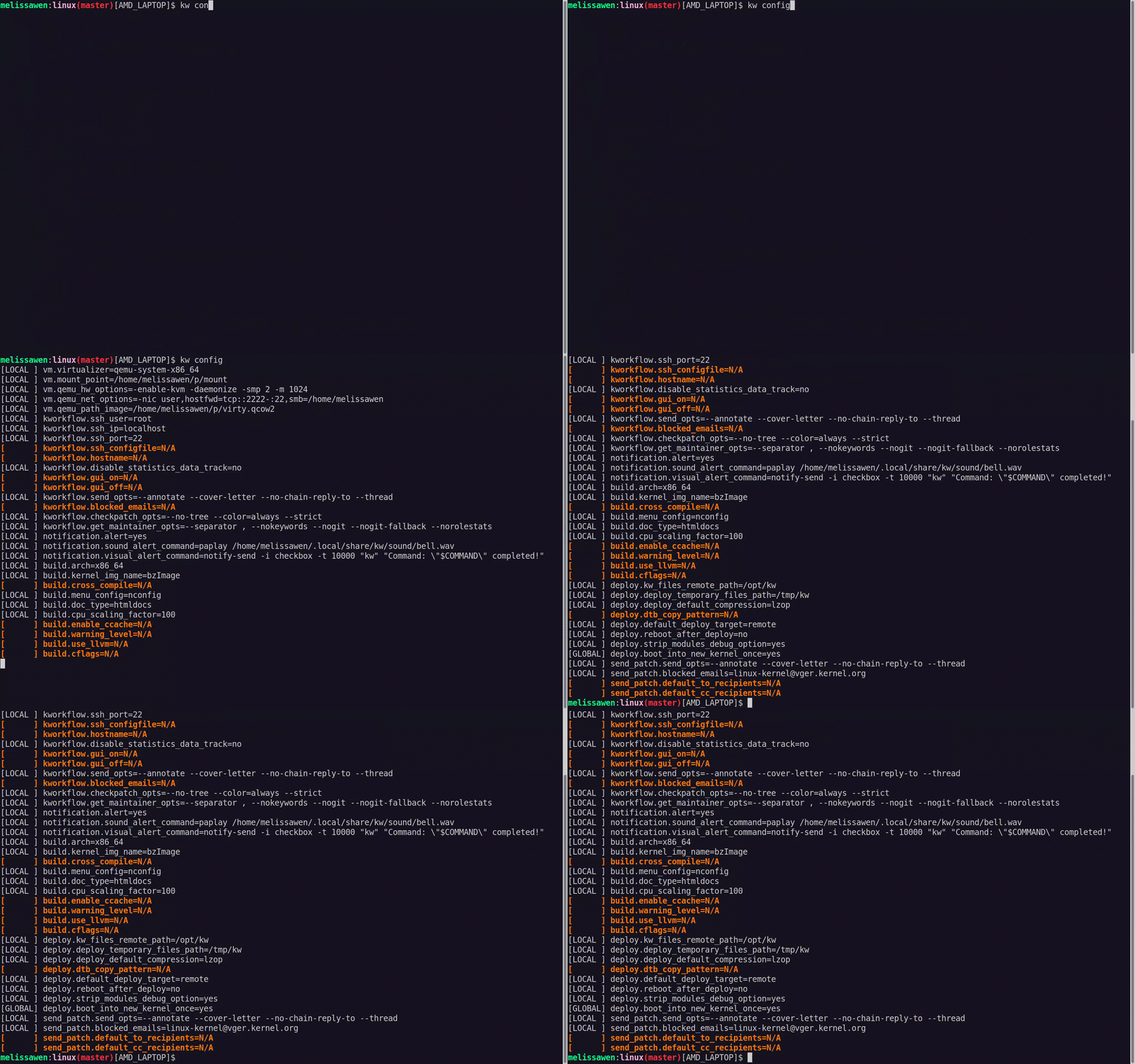
kw config: you can configure kw with kw config. With this command you can
basically select the tools, flags and preferences that kw will use to build
and deploy a custom kernel in a target machine. You can also define recipients
of your patches when sending it using kw send-patch. I ll explain more about
each feature later in this presentation.
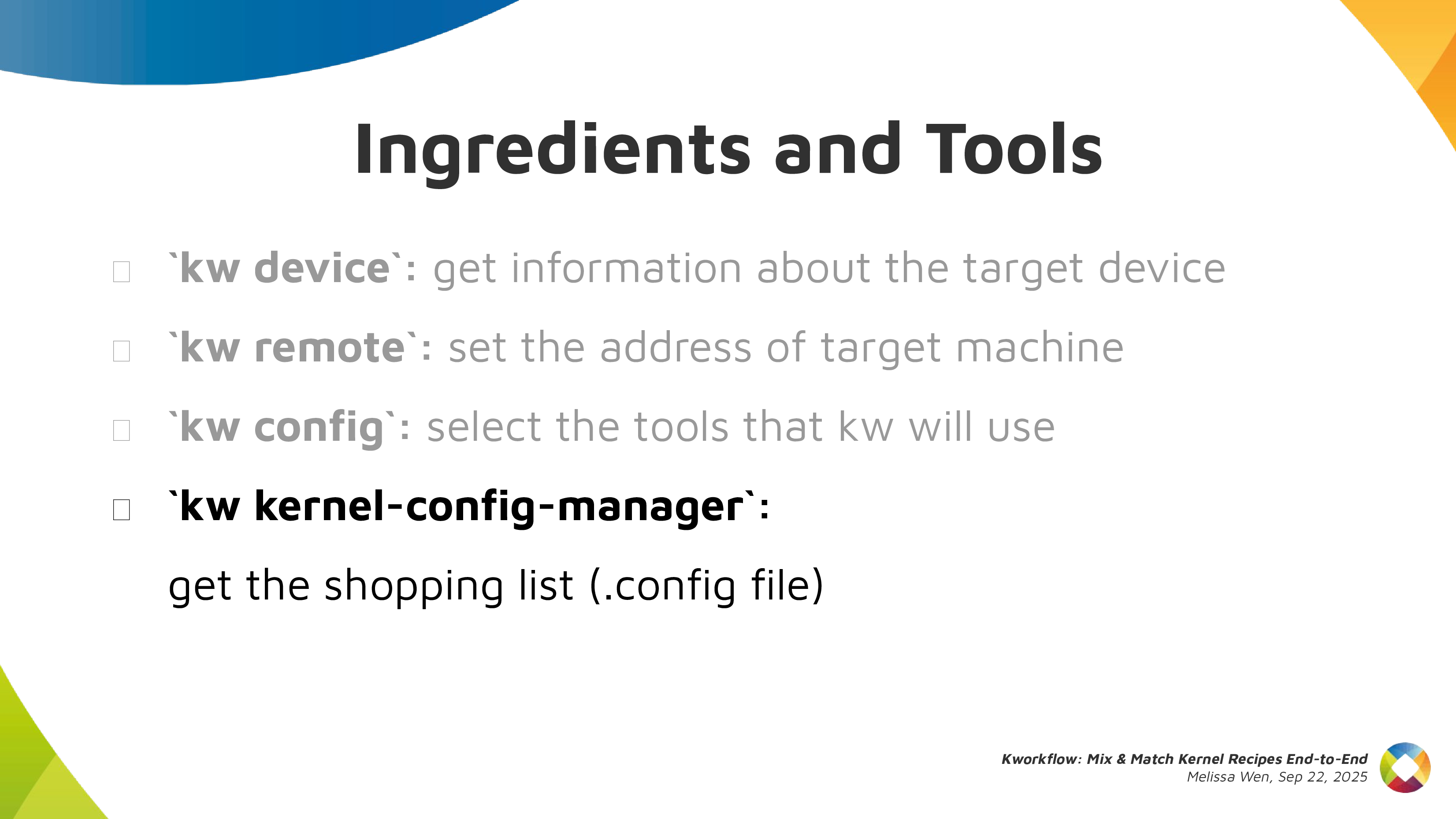
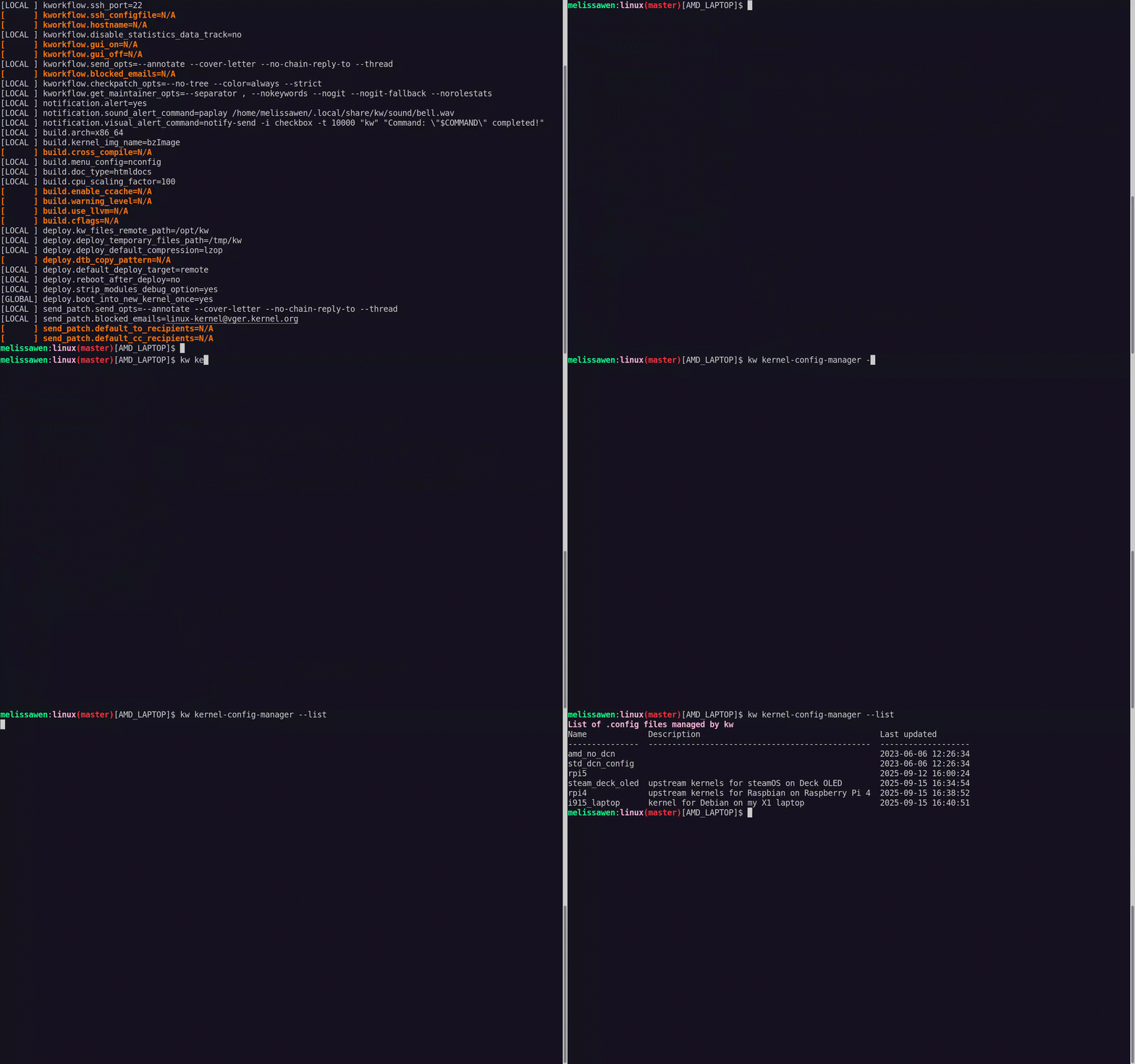
kw kernel-config manager (or just kw k): to fetch the kernel .config file
from a given machine, store multiple .config files, list and retrieve them
according to your needs.
Now, with all ingredients and tools selected and well portioned, follow the
right steps to prepare your custom kernel!
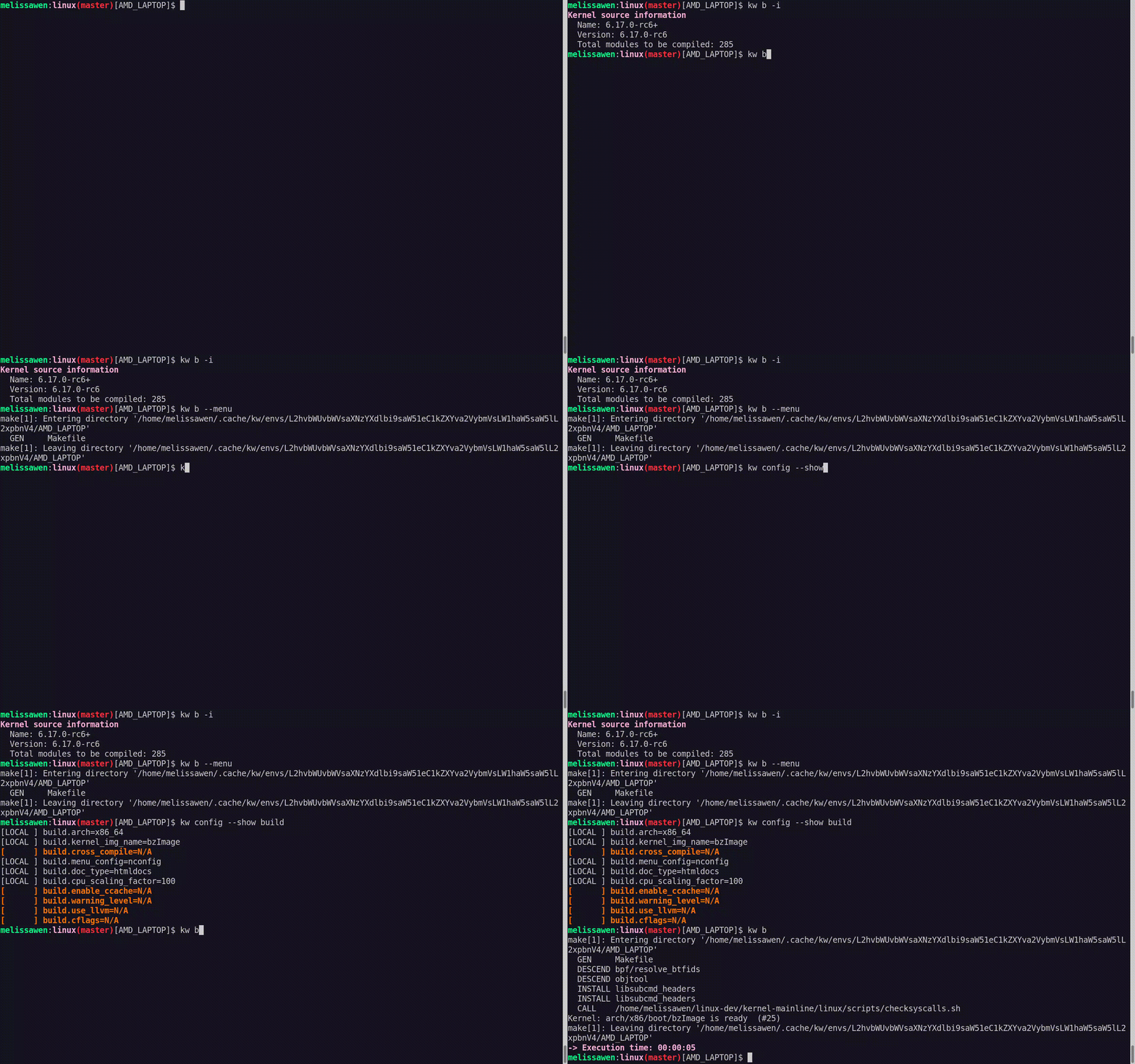
First step: Mix ingredients with kw build or just kw b
kw b and its options wrap many routines of compiling a custom kernel.
kw b -i to check the name and kernel version and the number
of modules that will be compiled and kw b --menu to change kernel
configurations.kw b to compile the custom kernel for a target
machine.kw deploy or just kw d
After compiling the custom kernel, we want to install it in the target machine.
Check the name of the custom kernel built: 6.17.0-rc6 and with kw s SSH
access the target machine and see it s running the kernel from the Debian
distribution 6.16.7+deb14-amd64.
As with building settings, you can also pre-configure some deployment settings,
such as compression type, path to device tree binaries, target machine (remote,
local, vm), if you want to reboot the target machine just after deploying your
custom kernel, and if you want to boot in the custom kernel when restarting the
system after deployment.
If you didn t pre-configured some options, you can still customize as a command
option, for example: kw d --reboot will reboot the system after deployment,
even if I didn t set this in my preference.
With just running kw d --reboot I have installed the kernel in a given target
machine and rebooted it. So when accessing the system again I can see it was
booted in my custom kernel.
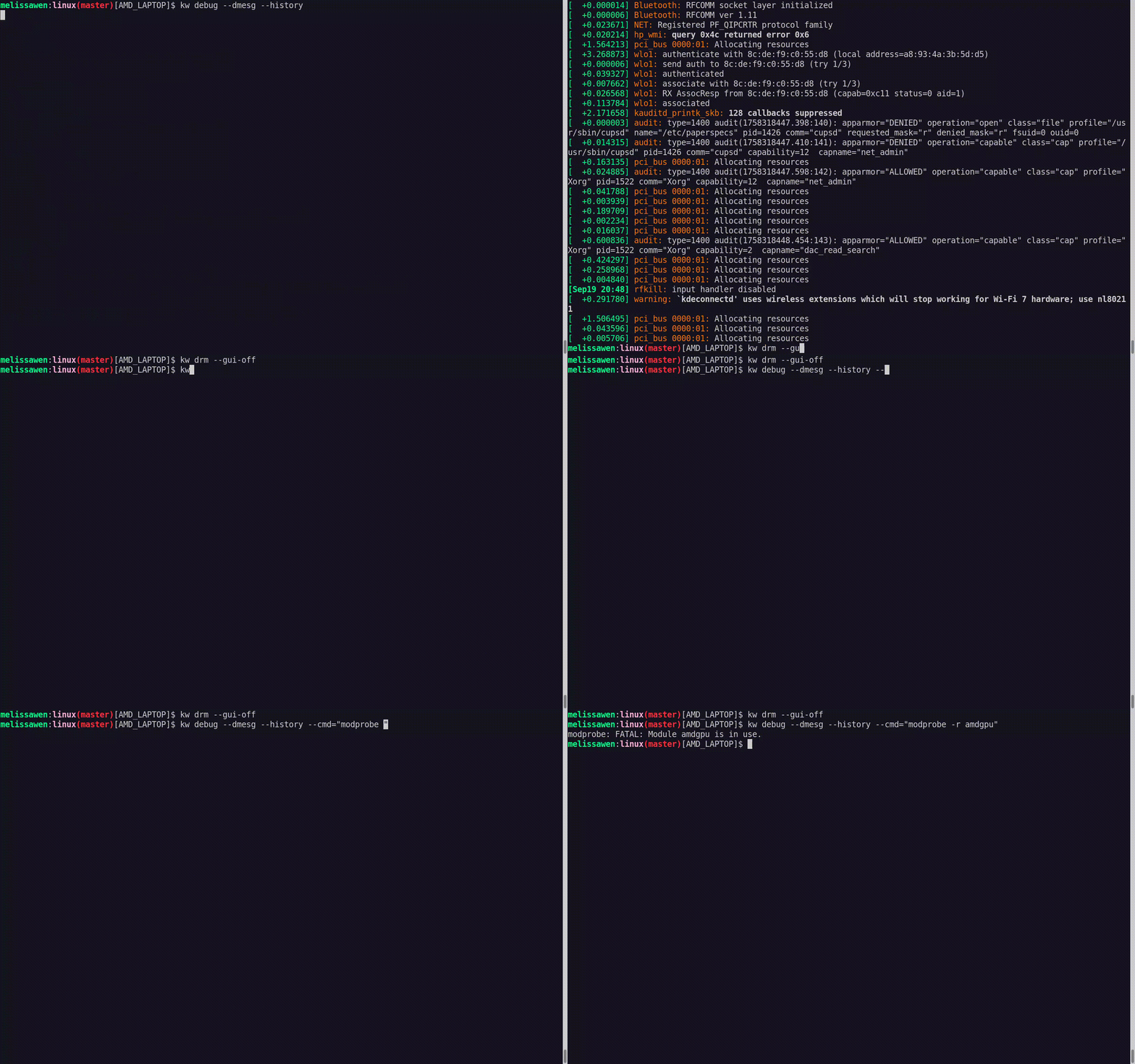
Third step: Time to taste with kw debug
kw debug wraps many tools for validating a kernel in a target machine. We
can log basic dmesg info but also tracking events and ftrace.
kw debug --dmesg --history we can grab the full dmesg log from a
remote machine, if you use the --follow option, you will monitor dmesg
outputs. You can also run a command with kw debug --dmesg --cmd="<my
command>" and just collect the dmesg output related to this specific execution
period.kw drm
--gui-off to drop the graphical interface and release the amdgpu for
unloading it. So I run kw debug --dmesg --cmd="modprobe -r amdgpu" to unload
the amdgpu driver, but it fails and I couldn t unload it.
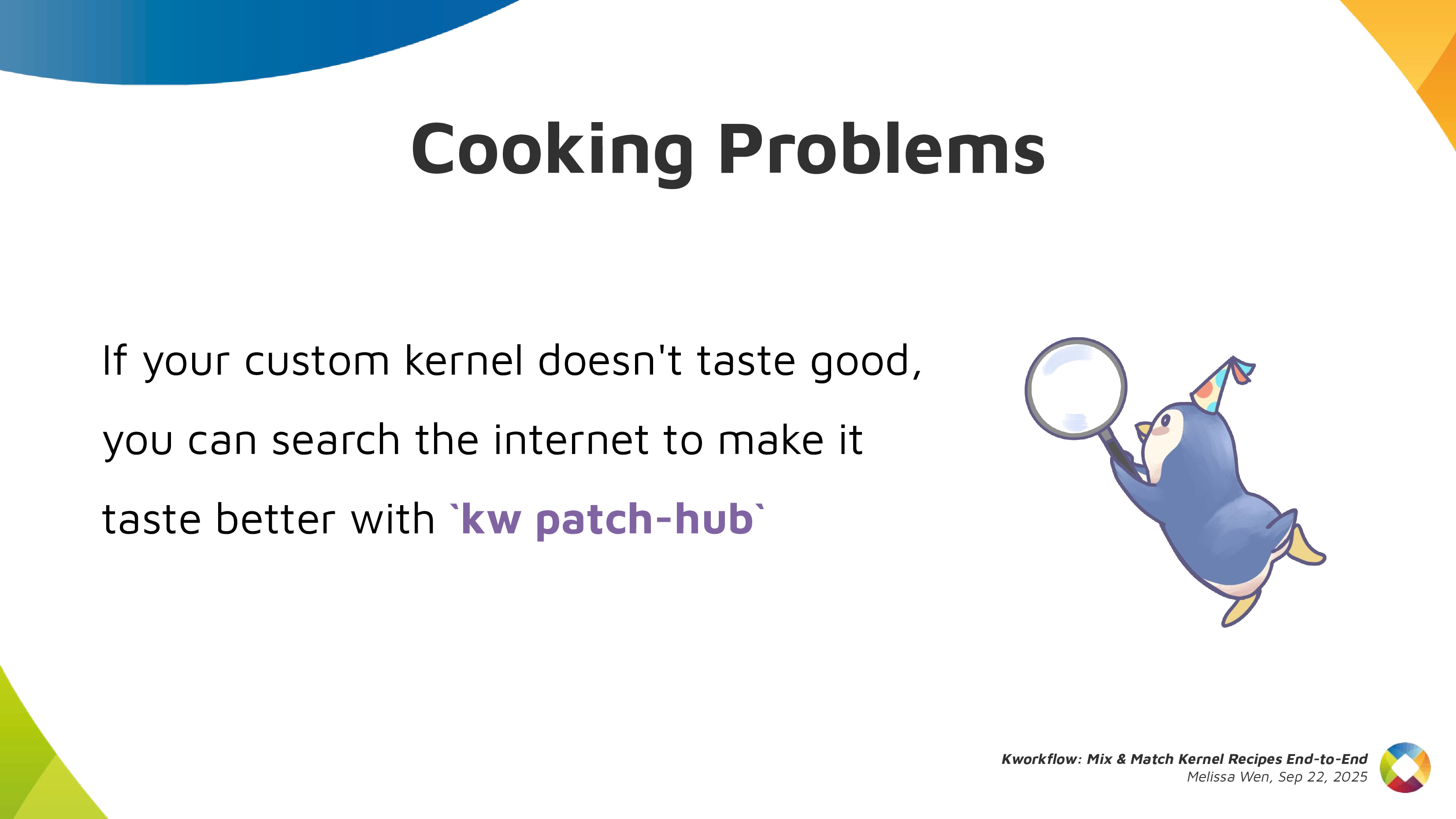
Oh no! That custom kernel isn t tasting good. Don t worry, as in many recipes
preparations, we can search on the internet to find suggestions on how to make
it tasteful, alternative ingredients and other flavours according to your
taste.
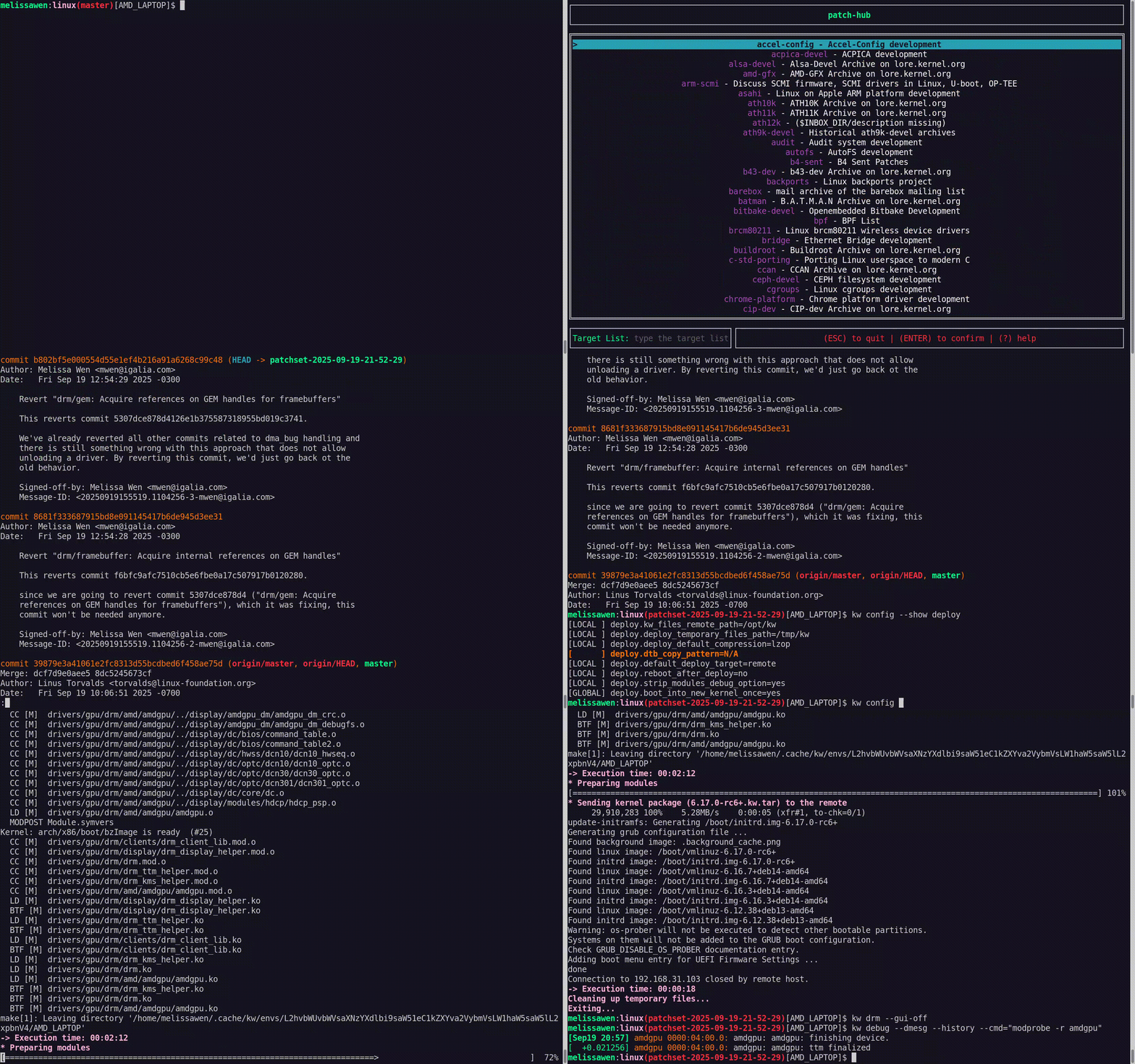
With kw patch-hub you can search on the lore kernel mailing list for possible
patches that can fix your kernel issue. You can navigate in the mailing lists,
check series, bookmark it if you find it relevant and apply it in your local
kernel tree, creating a different branch for tasting oops, for testing. In
this example, I m opening the amd-gfx mailing list where I can find
contributions related to the AMD GPU driver, bookmark and/or just apply the
series to my work tree and with kw bd I can compile & install the custom kernel
with this possible bug fix in one shot.
As I changed my kw config to reboot after deployment, I just need to wait for
the system to boot to try again unloading the amdgpu driver with kw debug
--dmesg --cm=modprobe -r amdgpu. From the dmesg output retrieved by kw for
this command, the driver was unloaded, the problem is fixed by this series and
the kernel tastes good now.
If I m satisfied with the solution, I can even use kw patch-hub to access the
bookmarked series and marking the checkbox that will reply the patch thread
with a Reviewed-by tag for me.
As in all recipes, we need ingredients and tools, but with kworkflow you can
get everything set as when changing scenarios in a TV show. We can use kw env
to change to a different environment with all kw and kernel configuration set
and also with the latest compiled kernel cached.
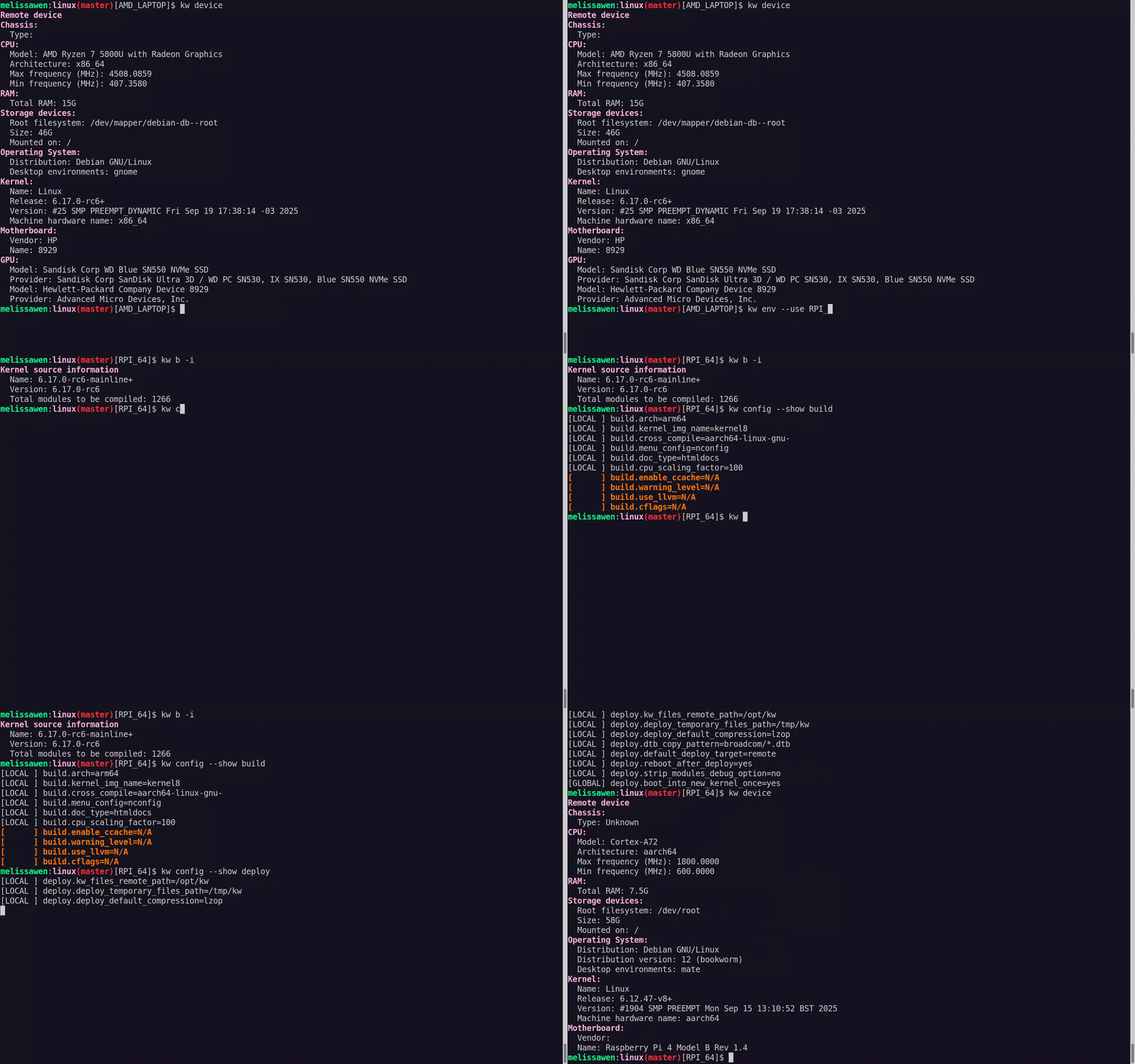
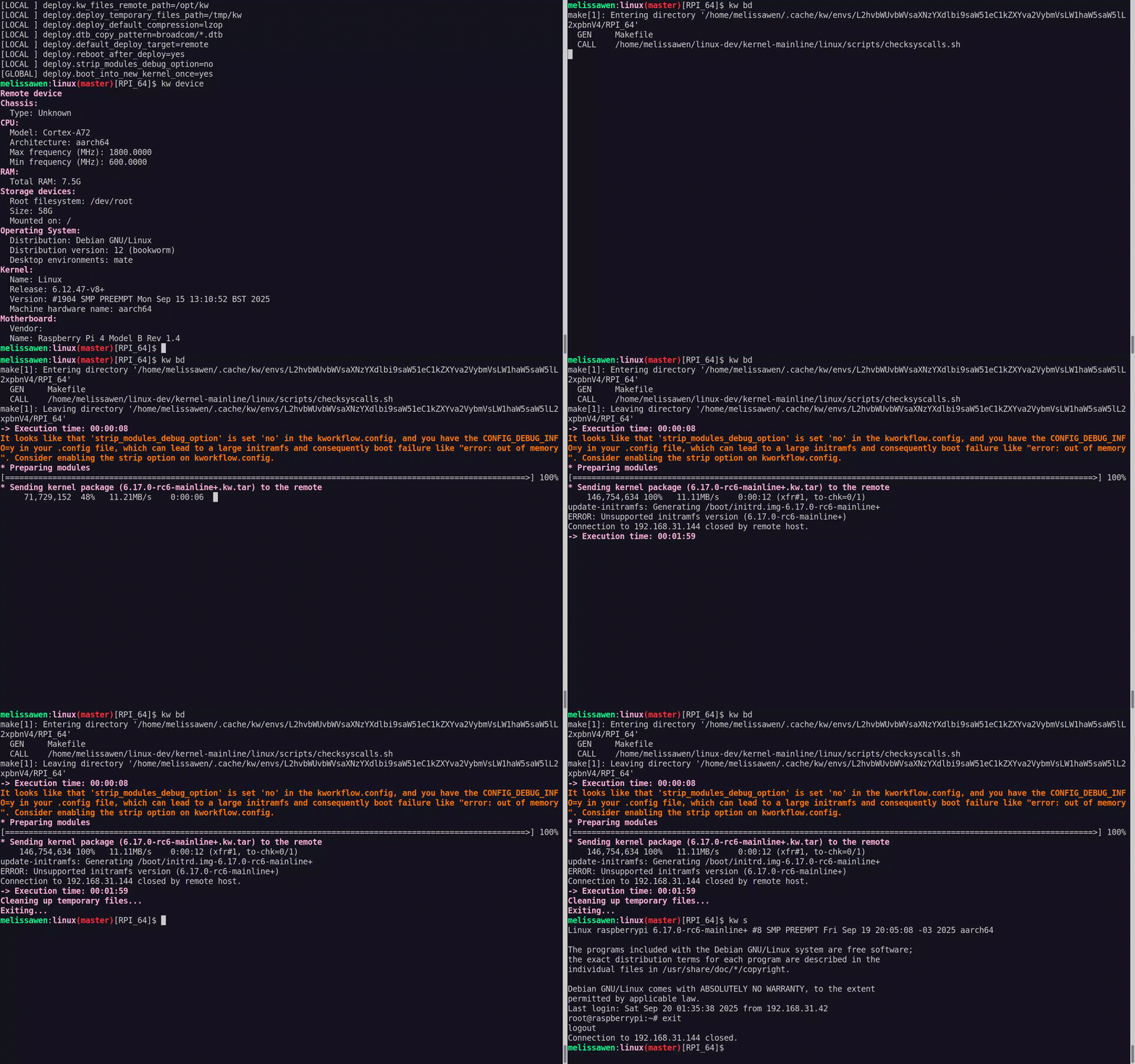
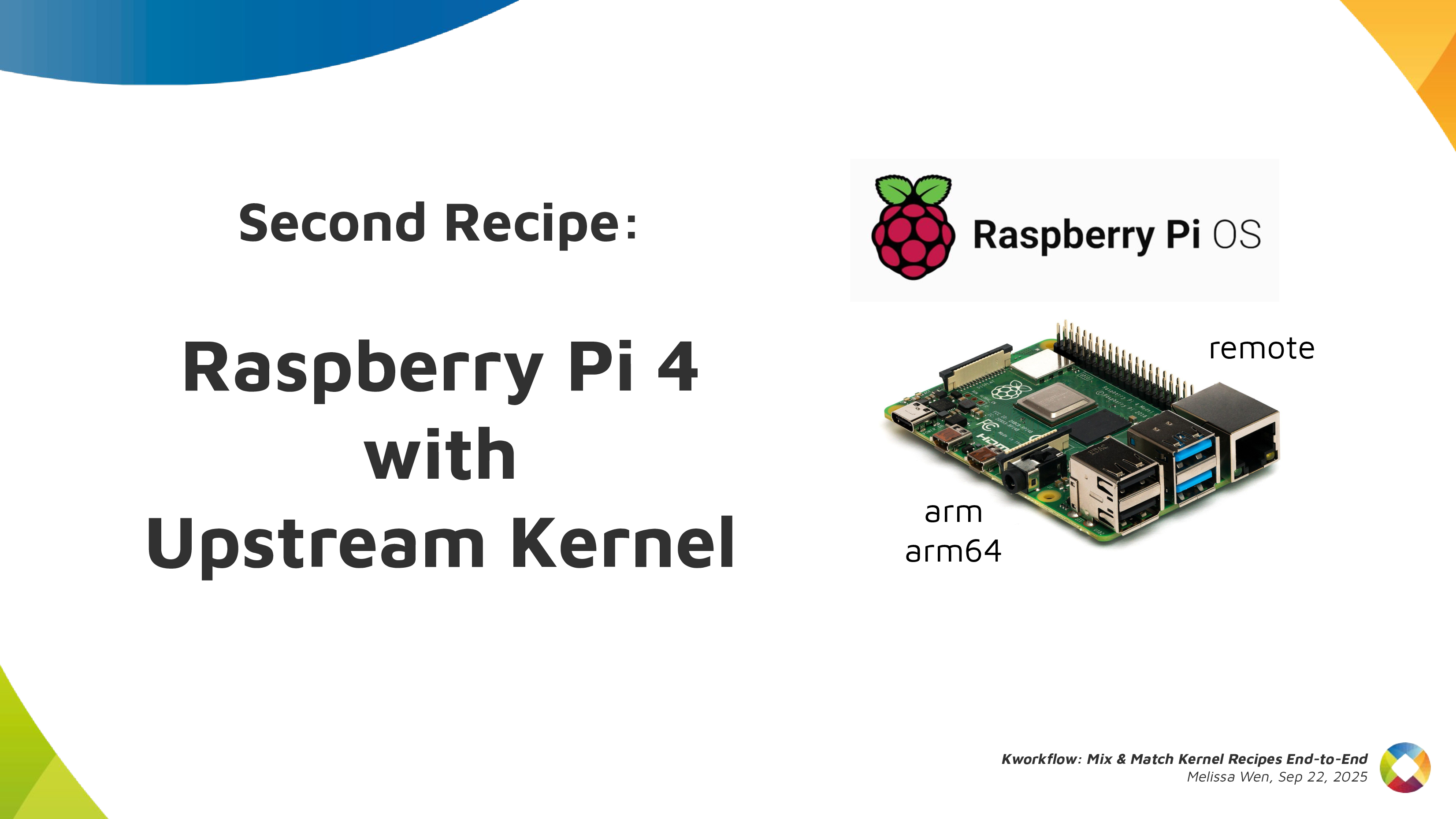
I was preparing the first recipe for a x86 AMD laptop and with kw env --use
RPI_64 I use the same worktree but moved to a different kernel workflow, now
for Raspberry Pi 4 64 bits. The previous compiled kernel 6.17.0-rc6-mainline+
is there with 1266 modules, not the 6.17.0-rc6 kernel with 285 modules that I
just built&deployed. kw build settings are also different, now I m targeting
a arm64 architecture with a cross-compiled kernel using aarch64-linu-gnu-
cross-compilation tool and my kernel image calls kernel8 now.
If you didn t plan for this recipe in advance, don t worry. You can create a
new environment with kw env --create RPI_64_V2 and run kw init --template
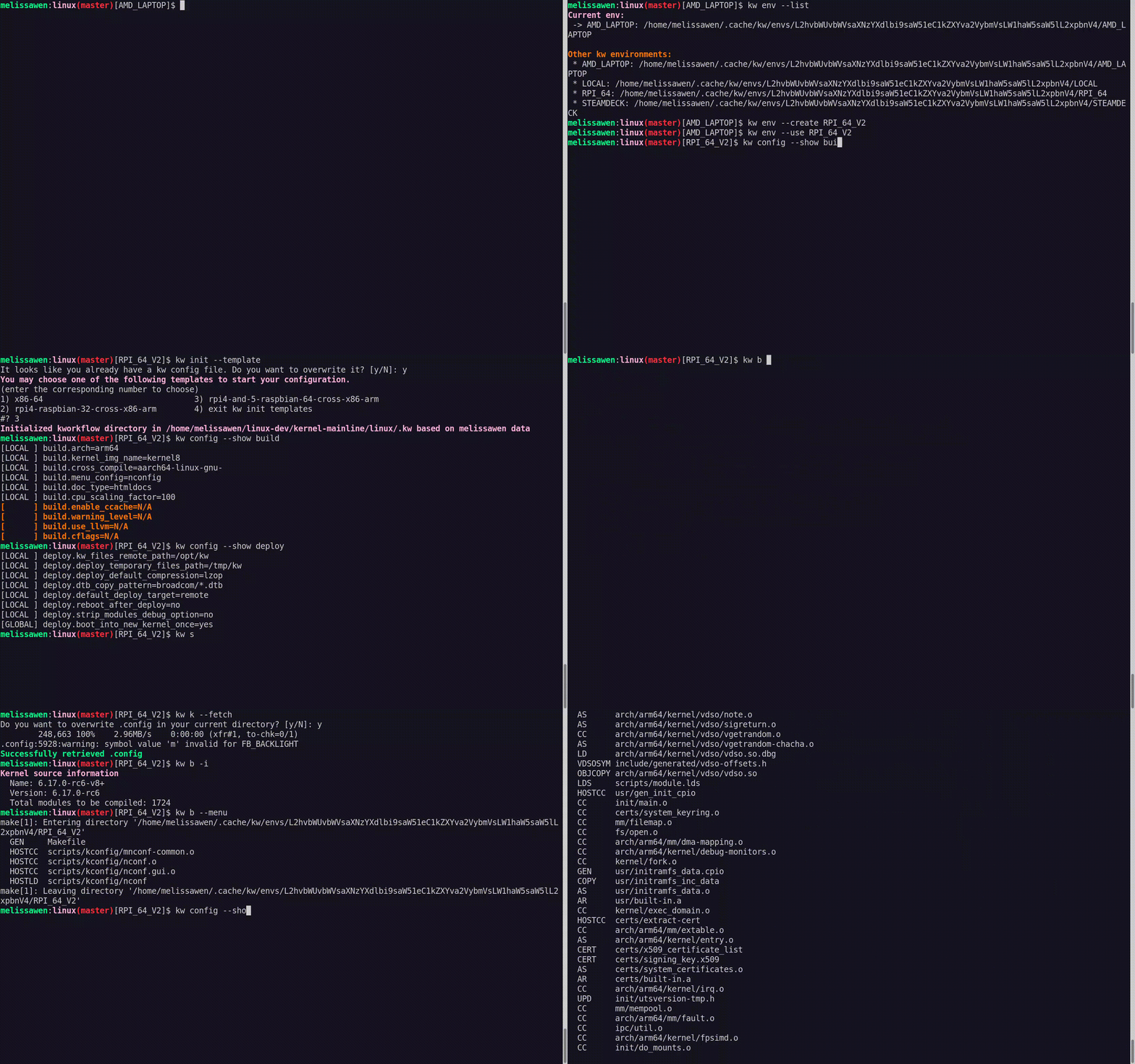
to start preparing your kernel recipe with the mirepoix ready.
I mean, with the basic ingredients already cut
I mean, with the kw configuration set from a template.
And you can use kw remote to set the IP address of your target machine and
kw kernel-config-manager to fetch/retrieve the .config file from your target
machine. So just run kw bd to compile and install a upstream kernel for
Raspberry Pi 4.
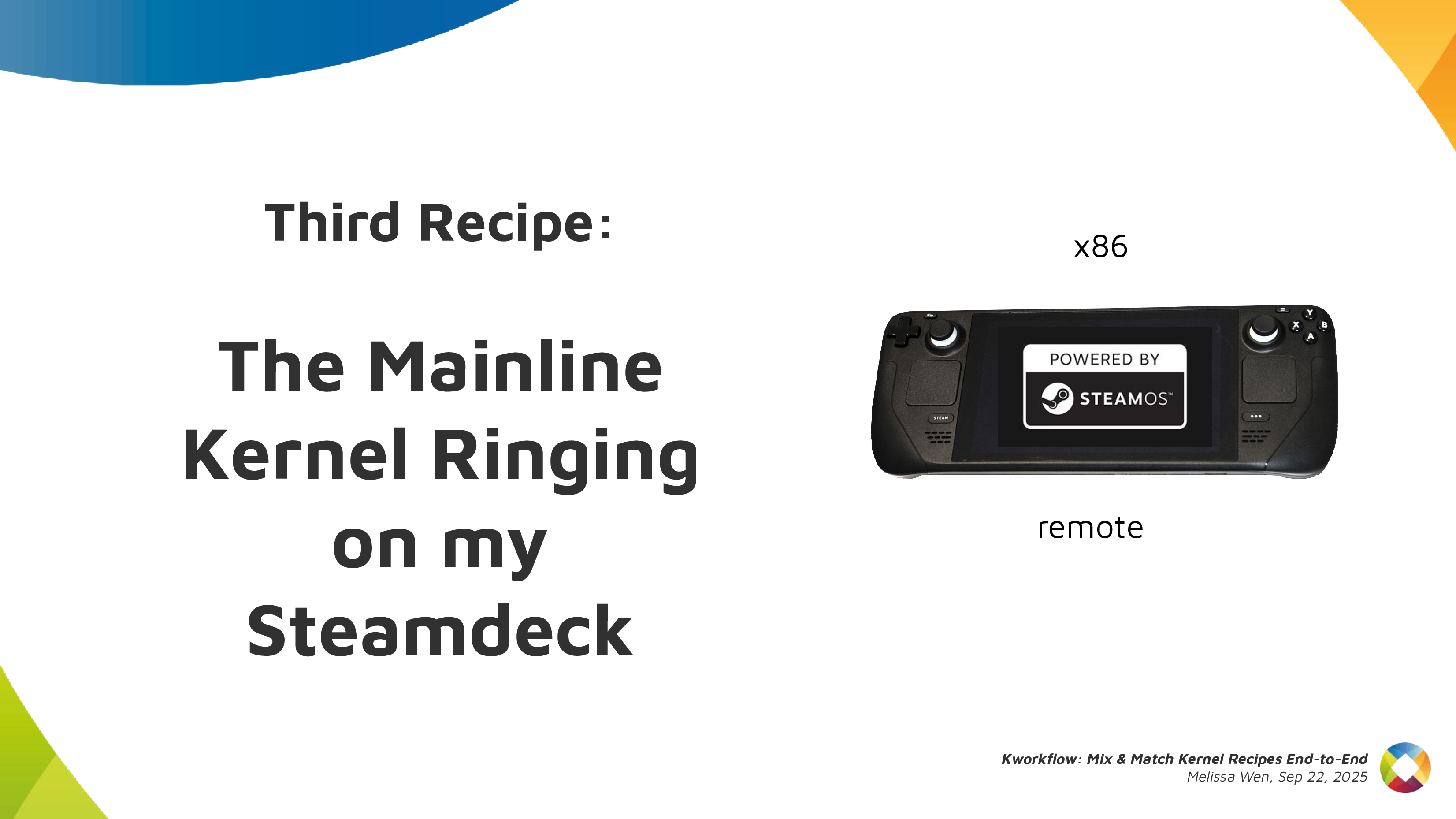
Let s show you how easy is to build, install and test a custom kernel for Steam
Deck with Kworkflow. It s a live demo, but I also recorded it because I know
the risks I m exposed to and something can go very wrong just because of
reasons :)
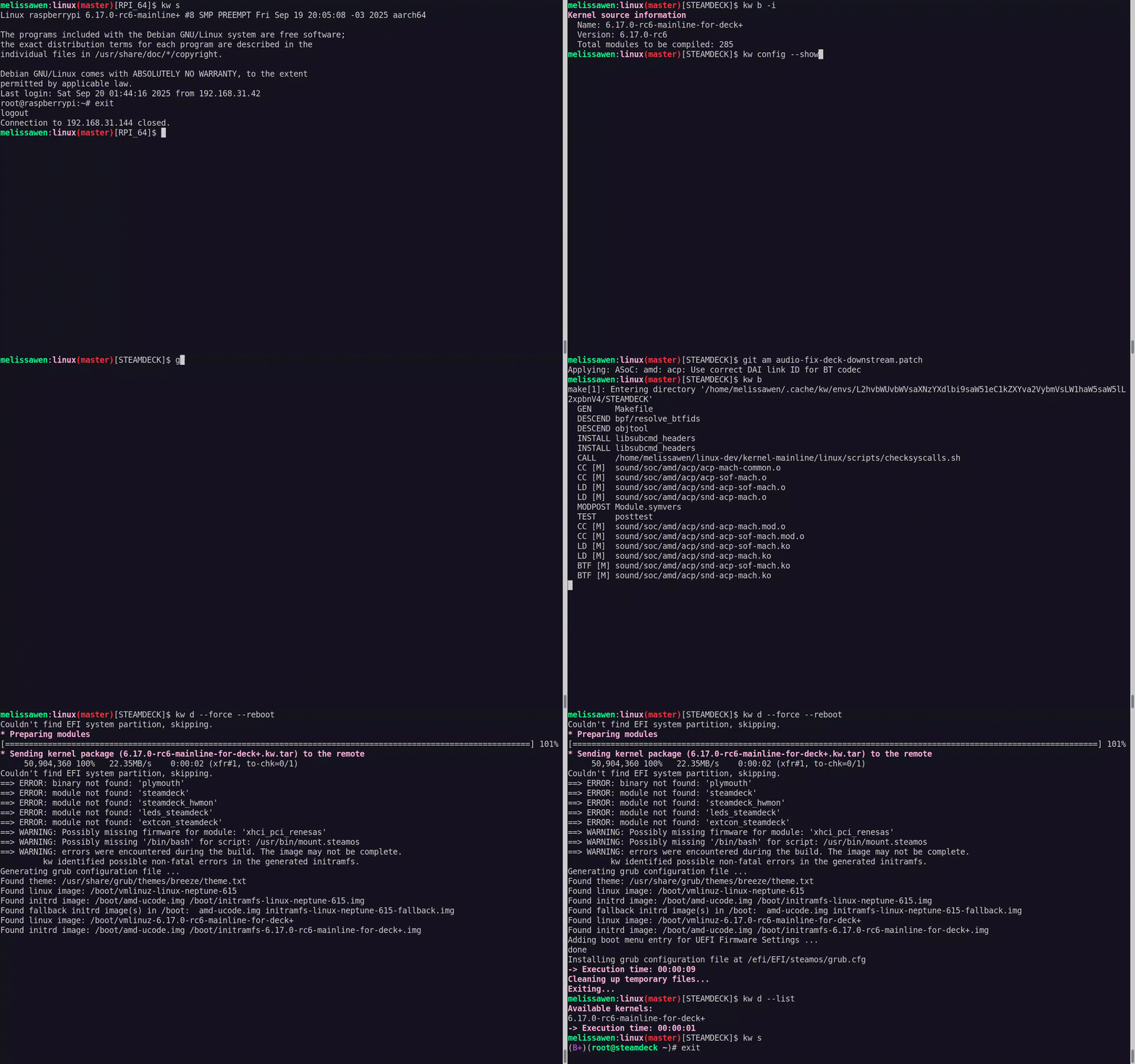
As I started the demo in the kw environment for Raspberry Pi 4, I first moved
to another environment previously used for Steam Deck. In this STEAMDECK
environment, the mainline kernel was already compiled and cached, and all
settings for accessing the target machine, compiling and installing a custom
kernel were retrieved automatically.
My live demo followed these steps:
kw env --use STEAMDECK, switch to a kworkflow environment for Steam
Deck kernel development.
kw b -i, shows that kw will compile and install a kernel with 285
modules named 6.17.0-rc6-mainline-for-deck.
kw config to show that, in this environment, kw configuration changes
to x86 architecture and without cross-compilation.
kw device to display information about the Steam Deck device, i.e. the
target machine. It also proves that the remote access - user and IP - for
this Steam Deck was already configured when using the STEAMDECK environment, as
expected.
git am, as usual, apply a hot fix on top of the mainline kernel.
This hot fix makes the audio play again on Steam Deck.
kw b, build the kernel with the audio change. It will be fast because
we are only compiling the affected files since everything was previously
done and cached. Compiled kernel, kw configuration and kernel configuration is
retrieved by just moving to the STEAMDECK environment.
kw d --force --reboot to deploy the new custom kernel to the target
machine. The --force option enables us to install the mainline kernel even
if mkinitcpio complains about missing support for downstream packages when
generating initramfs. The --reboot option makes the device reboot the Steam
Deck automatically, just after the deployment completion.
kw send-patch and kw would automatically add
subsystem maintainers, reviewers and mailing lists for the affected files as
recipients, and send the patch to the upstream community assessment. As I
didn t want to create unnecessary noise, I just did a dry-run with kw
send-patch -s --simulate to explain how it looks.
A littler two weeks a short
post announced the duckdb-mlpack
as ML quacks : combining the powerful C++
machine learning library mlpack with the amazing analytical database engine duckdb. About
a week ago another
short post covered first extensions. We actually followed-up with
release 0.0.3 days later, and never posted about it so this short note
catches up.
In release 0.0.3, we provide macOS binaries: following a known issue
with one of the components, we apply a simple patch to enable the build.
Next up are wasm and windows, if you know your way around these
platforms please get in touch. Release 0.0.3 also added first unit
tests, serializes the coefficients from the (regularized) linear
regression into the output table.
See see two previous posts linked above for details and background,
the repo for
code, issues and more, and the extension
page for more about this duckdb community
extension.
This post by Dirk Eddelbuettel originated on his Thinking inside the box blog. If you like this or other open-source work I do, you can sponsor me at GitHub.
ERROR deprecated: .Site.IsMultiLingual was deprecated in Hugo v0.124.0 and subsequently removed. Use hugo.IsMultilingual instead. Total in 21 msIt seems that hugo-theme-learn is not compatible with recent Hugo anymore.
diff --git a/website/config.toml b/website/config.toml index 702d4da..99ddf03 100644 --- a/website/config.toml +++ b/website/config.toml @@ -3,7 +3,7 @@ languageCode = "en-US" defaultContentLanguage = "en" -theme = "hugo-theme-learn" +theme = "hugo-theme-relearn" themesdir = "themes" metaDataFormat = "yaml" defaultContentLanguageInSubdir= true @@ -16,6 +16,7 @@ defaultContentLanguageInSubdir= true disableNextPrev = true disableSearch = true disableShortcutsTitle = true + themeVariant = 'learn' [markup] [markup.goldmark]It was sad that hugo-theme-learn is not maintained actively, but many thank to this greateful hugo theme. And also thanks the effort to fork it as hugo-theme-relearn.
drag_lock
to disabled.
I also uploaded new releases of cage (a
kiosk for Wayland), labwc, the
window-stacking Wayland compositor that is inspired by Openbox, and
wf-recorder, a tool for creating
screen recordings of wlroots-based Wayland compositors.
If I don t forget I try to update the watch file of the packages I touch to the
new version 5
format.
Simon Ser announced
vali, a C library for
Varlink. The blog post also mentions that this will be
a dependency of the next version of the kanshi Wayland output management
daemon and the PR to do so is now already merged. So I created ITP: vali A
Varlink C implementation and code
generator, packaged
the library and it is now waiting in NEW. In addition to libscfg this is now
the second dependency of kanshi that is in NEW.
On the Rust side of things I fixed a
bug in
carl. The fix introduces new date
properties which can be use to highlight a calendar date. I also updated
all the dependencies and plan to create a new release soon.
Later I dug up a Rust project that I started a couple of years ago, where I try
to use wasm-bindgen to
implement interactive web components. There is a lot I have to refactor in this
code base, but I will work on that and try to publish something in the next few
months.
<dialog>,
which made the case for using standardized HTML elements instead of resorting
to JavaScript libraries.
I finally managed to update my shell Server to Debian 13.
I created an issue for the nextcloud-news android
client because I moved
to a new phone and my starred articles did not show up in the news app, which
is a bit annoying.
I got my ticket for 39C3.
In my dayjob I continued to work on the refactoring of the import logic of our
apis-core-rdf app. I released version 0.56 which also introduced the
#snackbar as the container for the toast message, as described in the
<dialog> block post. At the end of the month I released version 0.57
of apis-core-rdf, which got rid of the remaining leftovers of the old
import logic.
A couple of interesting articles I stumbled upon (or finally had the time to read):
| Series: | Eternal Path Trilogy #1 |
| Publisher: | Orbit |
| Copyright: | April 2025 |
| ISBN: | 0-316-57723-5 |
| Format: | Kindle |
| Pages: | 651 |
As the last chime fades we drop neatly on to the balcony's rusting hand rail, folding our wings with a soft shuffle. Noon, on the ninth day of the eighth month, 1531. Neema Kraa's lodgings. We are here, exactly where we should be, at exactly the right moment, because we are the Raven, and we are magnificent.The Raven Scholar is a rather good epic fantasy, with some caveats that I'll get to in a moment, but I found it even more fascinating as a genre artifact. I've read my share of epic fantasy over the years, although most of my familiarity of the current wave of new adult fairy epics comes from reviews rather than personal experience. The Raven Scholar is epic fantasy, through and through. There is court intrigue, a main character who is a court functionary unexpectedly thrown into the middle of some problem, civilization-wide stakes, dramatic political alliances, detailed magic and mythological systems, and gods. There were moments that reminded me of a Guy Gavriel Kay novel, although Hodgson's characters tend more towards disarming moments of humanization instead of Kay's operatic scenes of emotional intensity. But The Raven Scholar is also a murder mystery, complete with a crime scene, clues, suspects, evidence, an investigation, a possibly compromised detective, and a morass of possible motives and red herrings. I'm not much of a mystery reader, but this didn't feel like sort of ancillary mystery that might crop up in the course of a typical epic fantasy. It felt like a full-fledged investigation with an amateur detective; one can tell that Hodgson's previous four books were historical mysteries. And then there's the Trials, which are the centerpiece of the book. This book helped me notice that people (okay, me, I'm the people) have been sleeping on the influence of The Hunger Games, Battle Royale, and reality TV (specifically Survivor) on genre fiction, possibly because the more obvious riffs on the idea (Powerless, The Selection) have been young adult or new adult. Once I started looking, I realized this idea is everywhere now: Throne of Glass, Fourth Wing, even The Night Circus to some extent. Competitions with consequences are having a moment. I suspect having a competition to decide the next emperor is going to strike some traditional fantasy readers as sufficiently absurd and unbelievable that it will kick them out of the book. I had a moment of "okay, this is weird, why would anyone stick with this system for so long" myself. But I would encourage such readers to interrogate whether that's only a response from unfamiliarity; after all, strange women lying in ponds distributing swords is no basis for a system of government either. This is hardly the most unrealistic epic fantasy trope, and it has the advantage of being a hell of a plot generator when handled well. Hodgson handles it well. Society in this novel is structured around the anats and the eight Guardians, gods who, according to myth, had returned seven times previously to save the world, but who will destroy the world when they return again. Each Guardian represents a group of characteristics and useful societal functions: the Ox is trustworthy, competent and hard-working; the Fox is a trickster and a rule-bender; the Raven is shrewd and careful and is the Guardian of scholars and lawyers. Each Trial is organized by one of the anats and tests the contenders for the skills most valued by that Guardian, often in subtle and rather ingenious ways. There are flaws here that you could poke at if you wanted to, but I was charmed and thoroughly entertained by how well Hodgson weaves the story around the Trials and uses the conflicting values to create character conflict, unexpected alliances, and engrossing plot. Most importantly for a book of this sort, I liked Neema. She has a charming combination of competence, quirks (she is almost physically unable to not correct people's factual errors), insecurity, imposter syndrome, and determination. She is way out of her depth and knows it, but she has an ethical core and an insatiable curiosity that won't let her leave the central mysteries of the book alone. And the character dynamics are great; there are a lot of characters, including the competition problem of having to juggle eight contenders and give them all sufficient characterization to be meaningful, but this book uses its length to give each character some room to breathe. This is a long book, well over 600 pages, but it felt packed with events and plot twists. After every chapter I had to fight the urge to read just one more. The biggest drawback of this book is that it is very much the first book of a trilogy, none of the other volumes are out yet, and the ending is rather nasty. This is the sort of trilogy that opens with a whole lot of bad things happening, and while I am thoroughly hooked and will purchase the next volume as soon as it's available, I wish Hodgson had found a way to end the book on a somewhat more positive or hopeful note. The middle of the book was great; the end was a bit of an emotional slog, alas. The writing is good enough here that I'm fairly sure the depression will be worth it, but if you need your endings to be triumphant (and who could blame you in this moment in history), you may want to wait on this one until more volumes are out. Apart from that, though, this was a lot of fun. The Guardians felt like they came from a different strand of fantasy than you usually see in epic, more of a traditional folk tale vibe, which adds an intriguing twist to the epic fantasy setting. The characters all work, and Hodgson even pulls off some Game of Thrones style twists that make you sympathetic to characters you previously hated. The magic system apart from the Guardians felt underbaked, but the politics had more depth than a lot of fantasy novels. If you want the truly complex and twisty politics you would get from one of Guy Gavriel Kay's historical rewrites, you will come away disappointed, but it was good enough for me. And I did enjoy the Raven.
Respect, that's all we demand. Recognition of our magnificence. Offerings. Love. Fear. Trembling awe. Worship. Shiny things. Blood sacrifice, some of us very much enjoy blood sacrifice. Truly, we ask for so little.Followed by an as-yet untitled sequel that I hope will materialize. Rating: 7 out of 10
Quiete some things made progress last month: We put out

Phosh 0.50 release, got
closer to enabling media roles for audio by default in Phosh (see related
post) and reworked
our images builds. You should also (hopefully) notice some nice
quality of life improvements once changes land in a distro near you
and you're using Phosh. See below for details:
phosh
Recommends: (MR)RequiredComponents is now gone (MR)
Next.