Search Results: "edd"

17 December 2020

Dirk Eddelbuettel: RcppEigen 0.3.3.9.1: New upstream

A new release 0.3.3.9.1 of RcppEigen arrived on CRAN today (and just went to Debian too) bringing support for Eigen 3.3.9 to R. Eigen is a C++ template library for linear algebra: matrices, vectors, numerical solvers, and related algorithms. The release started with a gentle nudge from the Stan team to package Eigen 3.3.8. And once I got around to it and sat down, Eigen 3.3.9 had just been released the previous day. The freshly prepared release 0.3.3.9.0 was then announced on Twitter (and the rcpp-devel mailing list) along with a request for testing alongside the usual extended reverse dependency checking we do (just like CRAN asks us to). And it turns out that Eigen 3.3.9 required an update to StanHeaders, a CRAN package that is itself quite widely used. This took a couple of days and its round of testing, but Ben Goodrich shipped it to CRAN last night, so we were able to ship RcppEigen in turn today. So this release once again bring few required changes to Eigen (see this directory for details). As we said for the previous three releases:
One additional and recent change was the accomodation of a recent CRAN Policy change to not allow gcc or clang to mess with diagnostic messages. A word of caution: this may make your compilation of packages using RcppEigen very noisy so consider adding -Wno-ignored-attributes to the compiler flags added in your ~/.R/Makevars.
I actually find this requirement rather annoying. Eigen is then only usable if you set, say,
-Wno-deprecated-declarations -Wno-parentheses -Wno-ignored-attributes -Wno-unused-function
as g++ options in ~/.R/Makevars. But CRAN makes the rules. Maybe if a few of us gently and politely nudge them they may relent one day. One can only hope. The complete NEWS file entry follows.

Changes in RcppEigen version 0.3.3.9.1 (2020-12-17)
  • Upgraded to Eigen 3.3.9 (Dirk in #92 fixing #91).
  • Added GitHub Actions CI using run.sh from r-ci (Dirk)

Courtesy of CRANberries, there is also a diffstat report for the most recent release. If you like this or other open-source work I do, you can sponsor me at GitHub.

This post by Dirk Eddelbuettel originated on his Thinking inside the box blog. Please report excessive re-aggregation in third-party for-profit settings.

16 December 2020

John Goerzen: Non-Creepy Technology Purchasing & Gifting Guides

This time of year, a lot of people are thinking of buying gadgets and phones as gifts. But there are a lot of tech companies that have unethical practices, from terrible working conditions in their factories to spying on their users. Here are some buying guides to help you find gadgets that are fun and not creepy. The Free Software Foundation s Ethical Tech Giving Guide is a fantastic resource from what s probably the pickiest organization out there when it comes to tech. Not only do they highlight good devices, they also explain why and why you should, for instance, avoid the iPhone (their history of silencing political activists and spying on users). The FSF also has a Guide to DRM-Free Living talks about books, video, audio, and software that respects your freedom by letting you make your own backups, move it to other devices, and continue to use your purchases even if you have no Internet or the company you bought them from goes bankrupt. This is a fantastic and HUGE resource; there are hundreds of organizations out there that provide content in a way that respects your rights and many of them do it for free, legally, as well. PrivacyTools has a fantastic series of guides on everything from email providers to operating systems, as well as links to a number of other guides. The DeGoogle wiki on Reddit (as well as the sidebar) has a lot of fantastic alternatives to things like Chromebooks, Chrome, Gmail, etc. Related resources Here are some resources for education (what the issues are) and information about what companies and products to avoid. In addition to the FSF s other fantastic resources above, they also have a list of proprietary malware. It lists things, practices, and companies to avoid, and talks about the reasons why. Their addictions page is particularly good and relevant to my recent post on the problems of the attention economy. The Surveillance Self-Defense site from the Electronic Frontier Foundation is a fantastic introduction into how corporate surveillance works and how to defend against it. Use with a grain of salt: Mozilla, the people behind Firefox, have a site called Privacy Not Included that rates products by how creepy they are. They focus more narrowly on privacy than the more expansive set of freedoms the FSF considers (privacy is one of a number of things the FSF looks at), and in some cases I would say Mozilla is too generous (eg, with the Amazon Kindle, a number of their data points are just incorrect.)

Dirk Eddelbuettel: RcppAnnoy 0.0.18: Tweaks

annoy image A new maintenance release, now at version 0.0.18, of RcppAnnoy is now on CRAN. RcppAnnoy is the Rcpp-based R integration of the nifty Annoy library by Erik Bernhardsson. Annoy is a small and lightweight C++ template header library for very fast approximate nearest neighbours originally developed to drive the famous Spotify music discovery algorithm. This release is follow-up to release 0.0.17 which was made four weeks ago, and which brought the new upstream release 1.17 of Annoy. We now have an updated upstream with a PR by Aaron aiming for improved control of RNG seeding to ensure better reproducibility, along with extended tests and new helpers for RcppAnnoy and Annoy version numbers. The release was once again coordinated with Annoy and James whose BiocNeighbors and uwot packages both consume the Annoy header library shipped here. Detailed changes follow below.

Changes in version 0.0.18 (2020-12-15)
  • Small tweaks to threading policy header defines (Dirk closing #65)
  • Vignette code is again compiled during testing (Aaron Lum and Dirk in #66 addressing #64)
  • Upstream code (with Aaron's PR) was synchronized once more (Dirk in #67)
  • A new helper function was added to report the Annoy version (Aaron in #68)

Courtesy of my CRANberries, there is also a diffstat report for this release. If you like this or other open-source work I do, you can sponsor me at GitHub.

This post by Dirk Eddelbuettel originated on his Thinking inside the box blog. Please report excessive re-aggregation in third-party for-profit settings.

11 December 2020

Dirk Eddelbuettel: RcppSpdlog 0.0.4: New upstream

Not quite two months after the last release, we are happy to announce version 0.0.4 of RcppSpdlog. It contains release 1.8.2 of spdlog made today, along with version 7.1.3 of fmt. RcppSpdlog bundles spdlog, a wonderful header-only C++ logging library with all the bells and whistles you would want that was written by Gabi Melman, and also includes fmt by Victor Zverovich. The NEWS entry for this release follows.

Changes in RcppSpdlog version 0.0.4 (2020-12-11)
  • Upgraded to upstream release spdlog 1.8.2
  • Added GitHub Actions CI using run.sh from r-ci

Courtesy of my CRANberries, there is also a diffstat report. More detailed information is on the RcppSpdlog page. If you like this or other open-source work I do, you can sponsor me at GitHub.

This post by Dirk Eddelbuettel originated on his Thinking inside the box blog. Please report excessive re-aggregation in third-party for-profit settings.

10 December 2020

John Goerzen: How the Attention Economy Hurts You via Social Media Sites like Facebook

There is a whole science to manipulating our attention. And because there is a lot of money to be made by doing this well, it means we all encounter attempts to manipulate what we pay attention to each day. What is this, and how is it harmful? This post will be the first on a series on the topic. Why is attention so important? When people use Facebook, they use it for free. Facebook generally doesn t even try to sell them anything, yet has billions in revenues. What, then, is Facebook s product? Well, really, it s you. Or, more specifically, your attention. Facebook sells your attention to advertisers. Everything they do is in service to that. They want you to spend more time on the site so they can show you more ads. (I should say here that I m using Facebook as an example, but this applies to other social media companies too.) Seeking to maximize attention So if your attention is so important to their profit, it follows naturally that they would seek ways to get people to spend more time on their site. And they do. They track all sorts of metrics, including engagement (if you click like , comment, share, or otherwise interact with content). They know which sorts of things are likely to capture your (and I mean you in specific!) attention and show you that. Your neighbor may have different interests and Facebook judges different things are likely to capture their attention. Manipulating your attention Attention turning into money isn t unique for social media. In fact, in the article If It Bleeds, It Leads: Understanding Fear-Based Media, Psychology Today writes:
In previous decades, the journalistic mission was to report the news as it actually happened, with fairness, balance, and integrity. However, capitalistic motives associated with journalism have forced much of today s television news to look to the spectacular, the stirring, and the controversial as news stories. It s no longer a race to break the story first or get the facts right. Instead, it s to acquire good ratings in order to get advertisers, so that profits soar. News programming uses a hierarchy of if it bleeds, it leads. Fear-based news programming has two aims. The first is to grab the viewer s attention. In the news media, this is called the teaser. The second aim is to persuade the viewer that the solution for reducing the identified fear will be in the news story. If a teaser asks, What s in your tap water that YOU need to know about? a viewer will likely tune in to get the up-to-date information to ensure safety.
You ve probably seen fear-based messages a lot on Facebook. They will highlight messages to liberals about being afraid of what Trump is doing, and to conservatives about being afraid of what Biden is doing. They may or may not even intentionally be doing this; it is their algorithm predicts that those would maximize time and engagement for certain people, so that s what they see. Fear leads to controversy It s not just fear, though. Social media also loves controversy. There s nothing that makes people really want to stay on Facebook like anger. See something controversial and you ll see hundreds or thousands of people are there arguing about it and in the process, giving Facebook their attention. A quick Internet search will show you numerous articles on how marketing companes can leverage controvery to get attention and engagement with their campaigns. Consequences of maximizing fear and controversy What does it mean to society at large and to you personally that large companies make a lot of money by maximizing fear and controversy? The most obvious way is it leads to less common ground. If the posts and reactions that show common ground are never seen because they don t drive engagement, it poisons the well; left and right hate each other with ever more vigor a profitable outcome to Facebook, but a poisonous one to all of us. I have had several friendships lost because I a liberal in agreement with these friends on political matters still talk to Trump voters. On the other side, we ve seen people storm the Michigan statehouse with weapons. How did that level of disagreement and even fear behind it get so firmly embedded in our society? Surely the fact that social media shows us things designed to stimulate fear and anger must play a role. What does it do to our ability to have empathy for, and understand, others? The Facebook groups I ve been in for like-minded people have largely been flooded with memes calling the President rump and other things clearly designed to make people angry or fearful. It s a worthless experience, and not just that, but it s a harmful experience. When our major media TV and social networks all are optimizing for fear, anger, and controvesry, we have a society beholden to fear, anger, and controvesy. In my next installment, I m going to talk about what to do about this, including the decentralized social networks of the Fediverse that are specifically designed to put you back in charge of your attention. Update 2020-12-16: There are two followup articles for this: how to join the Fediverse and non-creepy technology purchasing and gifting guides. The latter references the FSF s page on software manipulation towards addiction, which is particularly relevant to this topic.

4 December 2020

Dirk Eddelbuettel: #31: Test your R package against bleeding-edge gcc

Welcome to the 31th post in the rapturously rampant R recommendations series, or R4 for short. This post will once again feature Docker for use with R. Earlier this week, I received a note from CRAN about how my RcppTOML package was no longer building with the (as of right now of course unreleased) version 11 of the GNU C++ compiler, i.e. g++-11. And very kindly even included a hint about the likely fix (which was of course correct). CRAN, and one of its maintainers in particular, is extremely forward-looking in terms of toolchain changes. A year ago we were asked to updated possible use of global variables in C code as gcc-10 tightened the rules. This changes is a C++ one, and a fairly simple one of simply being more explicit with include headers. Previous g++ release had done the same. The question now was about the least painful way to get g++-11 onto my machine, with the least amount of side-effects. Regular readers of this blog will know where this is headed, but even use of Docker requires binaries. A look at g++-11 within packages.debian.org comes up empty. No Debian means no Ubuntu. But there is a PPA for Ubuntu with toolchain builds we have used before. And voil there we have it: within the PPA for Ubuntu Toolchain repository is the volatile packages PPA with both g++-10 and g++-11. Here Ubuntu 20.10 works with g++-10, but g++-11 requires Ubuntu 21.04. Docker containers are there for either. So with the preliminaries sorted out, the key steps are fairly straightforward: And that is it! RcppTOML is fairly minimal and could be a member of the tinyverse so no other dependencies are needed if your package has any you could just use the standard steps to install from source, or binary (including using RSPM or bspm). You can see the resulting Dockerfile which contains a minimal amount of extra stuff to deal with some environment variables and related settings. Nothing critical, but it smoothes the experience somewhat. This container is now built (under label rocker/r-edge with tags latest and gcc-11), and you can download it from Docker Hub. With that the proof of the (now fixed and uploaded) package building becomes as easy as
edd@rob:~/git/rcpptoml(master)$ docker run --rm -ti -v $PWD:/mnt -w /mnt rocker/r-edge:gcc-11 g++ --version
g++ (Ubuntu 11-20201128-0ubuntu2) 11.0.0 20201128 (experimental) [master revision fb6b29c85c4:a331ca6194a:e87559d202d90e614315203f38f9aa2f5881d36e]
Copyright (C) 2020 Free Software Foundation, Inc.
This is free software; see the source for copying conditions.  There is NO
warranty; not even for MERCHANTABILITY or FITNESS FOR A PARTICULAR PURPOSE.

edd@rob:~/git/rcpptoml(master)$ 
edd@rob:~/git/rcpptoml(master)$ docker run --rm -ti -v $PWD:/mnt -w /mnt rocker/r-edge:gcc-11 R CMD INSTALL RcppTOML_0.1.7.tar.gz
* installing to library  /usr/local/lib/R/site-library 
* installing *source* package  RcppTOML  ...
** using staged installation
** libs
g++ -std=gnu++11 -I"/usr/share/R/include" -DNDEBUG -I../inst/include/ -DCPPTOML_USE_MAP -I'/usr/lib/R/site-library/Rcpp/include'    -fpic  -g -O2 -fdebug-prefix-map=/build/r-base-Fuvi9C/r-base-4.0.3=. -fstack-protector-strong -Wformat -Werror=format-security -Wdate-time -D_FORTIFY_SOURCE=2 -g  -c RcppExports.cpp -o RcppExports.o
g++ -std=gnu++11 -I"/usr/share/R/include" -DNDEBUG -I../inst/include/ -DCPPTOML_USE_MAP -I'/usr/lib/R/site-library/Rcpp/include'    -fpic  -g -O2 -fdebug-prefix-map=/build/r-base-Fuvi9C/r-base-4.0.3=. -fstack-protector-strong -Wformat -Werror=format-security -Wdate-time -D_FORTIFY_SOURCE=2 -g  -c parse.cpp -o parse.o
g++ -std=gnu++11 -shared -L/usr/lib/R/lib -Wl,-Bsymbolic-functions -Wl,-z,relro -o RcppTOML.so RcppExports.o parse.o -L/usr/lib/R/lib -lR
installing to /usr/local/lib/R/site-library/00LOCK-RcppTOML/00new/RcppTOML/libs
** R
** inst
** byte-compile and prepare package for lazy loading
** help
*** installing help indices
** building package indices
** testing if installed package can be loaded from temporary location
** checking absolute paths in shared objects and dynamic libraries
** testing if installed package can be loaded from final location
** testing if installed package keeps a record of temporary installation path
* DONE (RcppTOML)
edd@rob:~/git/rcpptoml(master)$ 
I hope both the availability of such a base container with gcc-11 (and g++-11 and gfortran-11) as well as a recipe for building similar containers with newer clang version will help other developers. If you like this or other open-source work I do, you can sponsor me at GitHub.

This post by Dirk Eddelbuettel originated on his Thinking inside the box blog. Please report excessive re-aggregation in third-party for-profit settings.

3 December 2020

Dirk Eddelbuettel: RcppTOML 0.1.7: Support for g++-11, Minor Updates

A new RcppTOML release arrived on CRAN earlier today evening. RcppTOML brings TOML to R. TOML is a file format that is most suitable for configurations, as it is meant to be edited by humans but read by computers. It emphasizes strong readability for humans while at the same time supporting strong typing as well as immediate and clear error reports. On small typos you get parse errors, rather than silently corrupted garbage. Much preferable to any and all of XML, JSON or YAML though sadly these may be too ubiquitous now. TOML has been making inroads with projects such as the Hugo static blog compiler, or the Cargo system of Crates (aka packages ) for the Rust language. CRAN had sent us a note that the package no longer compiled under the [unreleased, of course, never change, BDR ;-) ] g++-11 compiler, but were kind enough to hint that it was only lacking an #include <limits>. These things happen: newer compilers are generally more strict, and that is generally a good things. (Last year this time we prepped code for the more stringent view on global variables under gcc-10. Earlier g++ version had similar demands to clarify include headers.) I set up a simple Docker contain with on Ubuntu 21.04 with g++-11, R, and Rcpp to build the package and make this change (which was of course also PR ed upstream at cpptoml), plus some other small ones that update the package since the last release roughly 18 months ago. We also switched CI use to the r-ci setup I should blog about a little more, removed a bashism and updated a few URLs. The bulleted list of changes in this version follows.

Changes in version 0.1.7 (2020-12-01)
  • Add #include <limits> to header file, also contributed upstream, to permit compilation under the (unreleased) g++-11.
  • Switch the simple cleanup script to sh.
  • Switch CI use to r-ci for focal and bspm.
  • Update several TOML URLs to https://toml.io/en/.

Courtesy of my CRANberries, there is a diffstat report for this release. More information is on the RcppTOML page page. Please use the GitHub issue tracker for issues and bugreports. If you like this or other open-source work I do, you can sponsor me at GitHub.

This post by Dirk Eddelbuettel originated on his Thinking inside the box blog. Please report excessive re-aggregation in third-party for-profit settings.

1 December 2020

Dirk Eddelbuettel: inline 0.3.17: Refactored and New Tests

A new release of the inline package arrived on CRAN this evening and has already been shipped to Debian as well. inline facilitates writing code in-line in simple string expressions or short files. The package was used quite extensively by Rcpp in the days before Rcpp Attributes arrived on the scene proving an even better alternative for its use cases. inline is still use by rstan and a number of other packages. One of those other packages is mkin, and its author Johannes Ranke overhauled the saving and re-loading of C functions part with a really well-done set of contributions. In the process we also added unit testing via the lovely tinytest, and changed to continuous integration setup to r-ci. See below for a detailed list of changes extracted from the NEWS file.

Changes in inline version 0.3.17 (2020-11-30)
  • Unit testing is now supported via tinytest (Johannes in #15 addressing #14).
  • CI was updated to use focal and run.sh from r-ci on Travis and GitHub Actions (Dirk)
  • The writing and reading of compiled code was refactored and extended (Johannes in #16 fixing #13).
  • Some minor problems related to CRAN checks and tests were corrected (Johannes and Dirk in #17, Johannes in #18, #19, #20).
  • Small stylistic updates have been applied to some R and Rd files (Dirk).

Courtesy of my CRANberries, there is a comparison to the previous release. If you like this or other open-source work I do, you can now sponsor me at GitHub. For the first year, GitHub will match your contributions.

This post by Dirk Eddelbuettel originated on his Thinking inside the box blog. Please report excessive re-aggregation in third-party for-profit settings.

20 November 2020

Shirish Agarwal: Rights, Press freedom and India

In some ways it is sad and interesting to see how personal liberty is viewed in India. And how it differs from those having the highest fame and power can get a different kind of justice then the rest cannot.

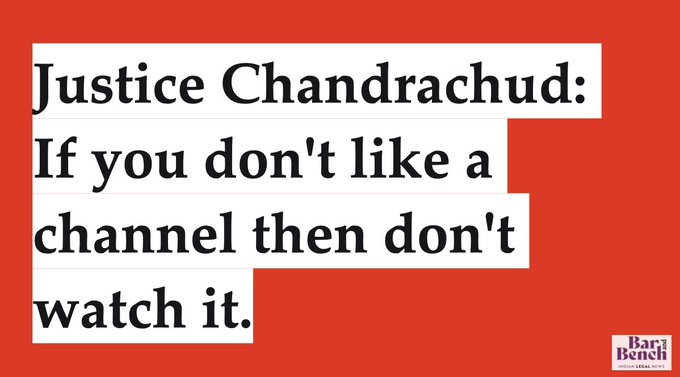
Arnab Goswami This particular gentleman is a class apart. He is the editor as well as Republic TV, a right-leaning channel which demonizes the minority, women whatever is antithesis to the Central Govt. of India. As a result there have been a spate of cases against him in the past few months. But surprisingly, in each of them he got hearing the day after the suit was filed. This is unique in Indian legal history so much so that a popular legal site which publishes on-going cases put up a post sharing how he was getting prompt hearings. That post itself needs to be updated as there have been 3 more hearings which have been done back to back for him. This is unusual as there have been so many cases pending for the SC attention, some arguably more important than this gentleman . So many precedents have been set which will send a wrong message. The biggest one, that even though a trial is taking place in the sessions court (below High Court) the SC can interject on matters. What this will do to the morale of both lawyers as well as judges of the various Sessions Court is a matter of speculation and yet as shared unprecedented. The saddest part was when Justice Chandrachud said
Justice Chandrachud If you don t like a channel then don t watch it. 11th November 2020 .
This is basically giving a free rope to hate speech. How can a SC say like that ? And this is the Same Supreme Court which could not take two tweets from Shri Prashant Bhushan when he made remarks against the judiciary .

J&K pleas in Supreme Court pending since August 2019 (Abrogation 370) After abrogation of 370, citizens of Jammu and Kashmir, the population of which is 13.6 million people including 4 million Hindus have been stuck with reduced rights and their land being taken away due to new laws. Many of the Hindus which regionally are a minority now rue the fact that they supported the abrogation of 370A . Imagine, a whole state whose answers and prayers have not been heard by the Supreme Court and the people need to move a prayer stating the same.

100 Journalists, activists languishing in Jail without even a hearing 55 Journalists alone have been threatened, booked and in jail for reporting of pandemic . Their fault, they were bring the irregularities, corruption made during the pandemic early months. Activists such as Sudha Bharadwaj, who giving up her American citizenship and settling to fight for tribals is in jail for 2 years without any charges. There are many like her, There are several more petitions lying in the Supreme Court, for e.g. Varavara Rao, not a single hearing from last couple of years, even though he has taken part in so many national movements including the emergency as well as part-responsible for creation of Telengana state out of Andhra Pradesh .

Then there is Devangana kalita who works for gender rights. Similar to Sudha Bharadwaj, she had an opportunity to go to UK and settle here. She did her master s and came back. And now she is in jail for the things that she studied. While she took part in Anti-CAA sittings, none of her speeches were incendiary but she still is locked up under UAPA (Unlawful Practises Act) . I could go on and on but at the moment these should suffice.

Petitions for Hate Speech which resulted in riots in Delhi are pending, Citizen s Amendment Act (controversial) no hearings till date. All of the best has been explained in a newspaper article which articulates perhaps all that I wanted to articulate and more. It is and was amazing to see how in certain cases Article 32 is valid and in many it is not. Also a fair reading of Justice Bobde s article tells you a lot how the SC is functioning. I would like to point out that barandbench along with livelawindia makes it easier for never non-lawyers and public to know how arguments are done in court, what evidences are taken as well as give some clue about judicial orders and judgements. Both of these resources are providing an invaluable service and more often than not, free of charge.

Student Suicide and High Cost of Education
For quite sometime now, the cost of education has been shooting up. While I have visited this topic earlier as well, recently a young girl committed suicide because she was unable to pay the fees as well as additional costs due to pandemic. Further investigations show that this is the case with many of the students who are unable to buy laptops. Now while one could think it is limited to one college then it would be wrong. It is almost across all India and this will continue for months and years. People do know that the pandemic is going to last a significant time and it would be a long time before R value becomes zero . Even the promising vaccine from Pfizer need constant refrigeration which is sort of next to impossible in India. It is going to make things very costly.

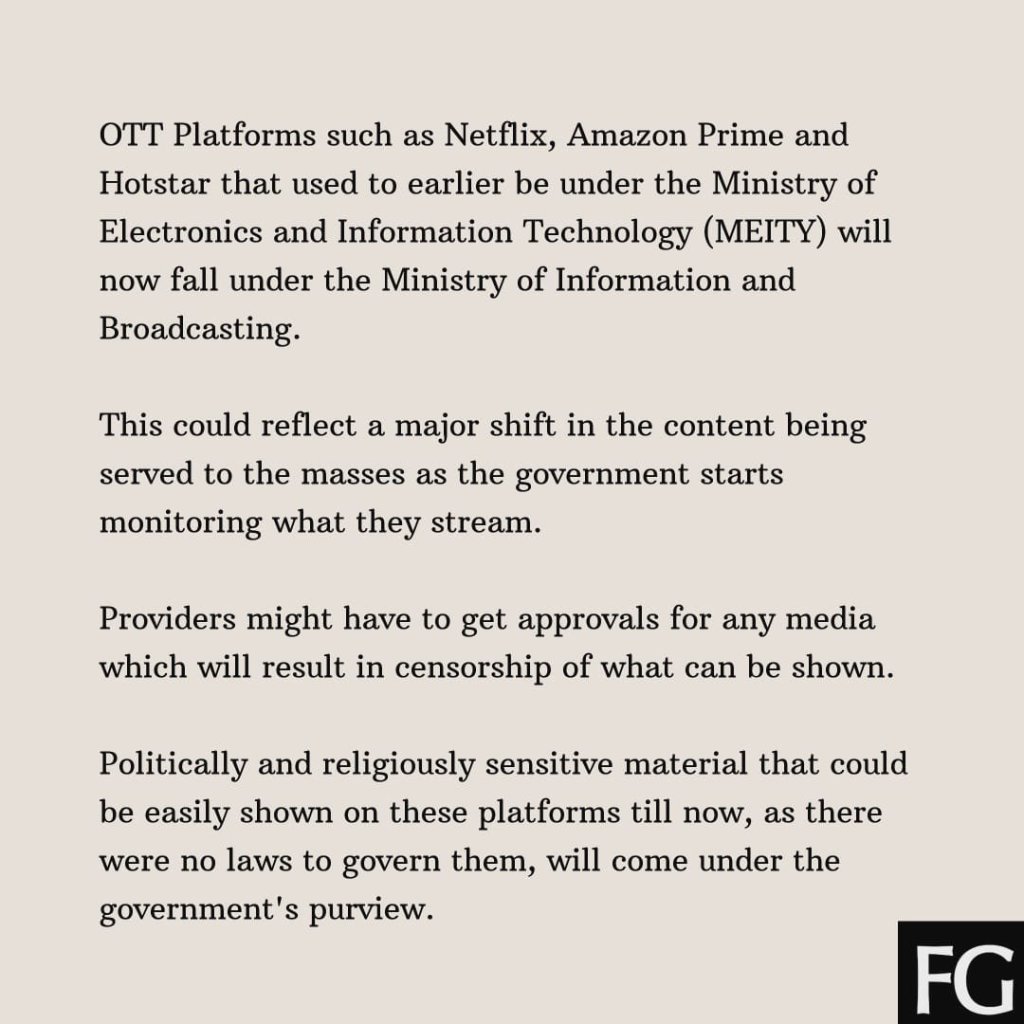
Last Nail on Indian Media Just today the last nail on India has been put. Thankfully Freedom Gazette India did a much better job so just pasting that
Information and Broadcasting Ministry bringing OTT services as well as news within its ambit.
With this, projects like Scam 1992, The Harshad Mehta Story or Bad Boy Billionaires:India, Test Case, Delhi Crime, Laakhon Mein Ek etc. etc. such kind of series, investigative journalism would be still-births. Many of these web-series also shared tales of woman empowerment while at the same time showed some of the hard choices that women had to contend to live with. Even western media may be censored where it finds the political discourse not to its liking. There had been so many accounts of Mr. Ravish Kumar, the winner of Ramon Magsaysay, how in his shows the electricity was cut in many places. I too have been the victim when the BJP governed in Maharashtra as almost all Puneities experienced it. Light would go for just half or 45 minutes at the exact time. There is another aspect to it. The U.S. elections showed how independent media was able to counter Mr. Trump s various falsehoods and give rise to alternative ideas which lead the team of Bernie Sanders, Joe Biden and Kamala Harris, Biden now being the President-elect while Kamala Harris being the vice-president elect. Although the journey to the white house seems as tough as before. Let s see what happens. Hopefully 2021 will bring in some good news. Update On 27th November 2020 Martin who runs the planet got an e-mail/notice by a Mr. Nikhil Sethi who runs the wikibio.com property. Mr. Sethi asked to remove the link pointing Devangana Kalita from my blog post to his site as he has used the no follow link. On inquiring further, the gentleman stated that it is an Updated mandate (his exact quote) from Google algorithm. To further understand the issue, I went to SERP as they are one of the more known ones on the subject. I also looked it up on Google as well. Found that the gentleman was BSing the whole time. The page basically talks about weightage of a page/site and authoritativeness which is known and yet highly contested ideas. In any case, the point for me was for whatever reason (could be fear, could be something else entirely), Mr. Sethi did not want me to link the content. Hence, I have complied above. I could have dragged it out but I do not wish Mr. Sethi any ill-being or/and further harm unduly and unintentionally caused by me. Hence, have taken down the link.

17 November 2020

Dirk Eddelbuettel: RcppArmadillo 0.10.1.2.0

armadillo image Armadillo is a powerful and expressive C++ template library for linear algebra aiming towards a good balance between speed and ease of use with a syntax deliberately close to a Matlab. RcppArmadillo integrates this library with the R environment and language and is widely used by (currently) 779 other packages on CRAN. This release ties up a few loose ends from the recent 0.10.1.0.0.

Changes in RcppArmadillo version 0.10.1.2.0 (2020-11-15)
  • Upgraded to Armadillo release 10.1.2 (Orchid Ambush)
  • Remove three unused int constants (#313)
  • Include main armadillo header using quotes instead of brackets
  • Rewrite version number use in old-school mode because gcc 4.8.5
  • Skipping parts of sparse conversion on Windows as win-builder fails

Courtesy of my CRANberries, there is a diffstat report relative to previous release. More detailed information is on the RcppArmadillo page. Questions, comments etc should go to the rcpp-devel mailing list off the R-Forge page. If you like this or other open-source work I do, you can now sponsor me at GitHub. For the first year, GitHub will match your contributions.

This post by Dirk Eddelbuettel originated on his Thinking inside the box blog. Please report excessive re-aggregation in third-party for-profit settings.

Dirk Eddelbuettel: RcppAnnoy 0.0.17

annoy image A new release 0.0.17 of RcppAnnoy is now on CRAN. RcppAnnoy is the Rcpp-based R integration of the nifty Annoy library by Erik Bernhardsson. Annoy is a small and lightweight C++ template header library for very fast approximate nearest neighbours originally developed to drive the famous Spotify music discovery algorithm. This release brings a new upstream version 1.17, released a few weeks ago, which adds multithreaded index building. This changes the API by adding a new threading policy parameter requiring code using the main Annoy header to update. For this reason we waited a little for the dust to settle on the BioConductor 3.12 release before bringing the changes to BiocNeighbors via this commit and to uwot via this simple PR. Aaron and James updated their packages accordingly so by the time I uploaded RcppAnnoy it made for very smooth sailing as we all had done our homework with proper conditional builds, and the package had no other issue preventing automated processing at CRAN. Yay. I also added a (somewhat overdue one may argue) header file RcppAnnoy.h regrouping defines and includes which should help going forward. Detailed changes follow below.

Changes in version 0.0.17 (2020-11-15)
  • Upgrade to Annoy 1.17, but default to serial use.
  • Add new header file to regroup includes and defines.
  • Upgrade CI script to use R with bspm on focal.

Courtesy of my CRANberries, there is also a diffstat report for this release. If you like this or other open-source work I do, you can now sponsor me at GitHub. For the first year, GitHub will match your contributions.

This post by Dirk Eddelbuettel originated on his Thinking inside the box blog. Please report excessive re-aggregation in third-party for-profit settings.

12 November 2020

Dirk Eddelbuettel: tidyCpp 0.0.2: More documentation and features

A first update of the still fairly new package tidyCpp is now on CRAN. The packages offers a C++ layer on top of the C API for R which aims to make its use a little easier and more consistent. The vignette has been extended with a new examples, a new section and some general editing. A few new defines have been added mostly from the Rinternals.h header. We also replaced the Shield class with a simpler yet updated version class Protect. The name better represent the core functionality of offering a simpler alternative to the PROTECT and UNPROTECT macro pairing. We also added a short discussion to the vignette of a gotcha one has to be mindful of, and that we fell for ourselves in version 0.0.1. We also added a typedef so that code using Shield can still be used. The NEWS entry follows.

Changes in tidyCpp version 0.0.2 (2020-11-12)
  • Expanded definitions in internals.h to support new example.
  • The vignette has been extended with an example based on package uchardet.
  • Class Shield has been replaced by an new class Protect; a compatibility typdef has been added.
  • The examples and vignette have been clarified with respect to proper ownership of protected objects; a new vignette section was added.

Thanks to my CRANberries, there is also a diffstat report for this release. For questions, suggestions, or issues please use the issue tracker at the GitHub repo. If you like this or other open-source work I do, you can now sponsor me at GitHub. For the first year, GitHub will match your contributions.

This post by Dirk Eddelbuettel originated on his Thinking inside the box blog. Please report excessive re-aggregation in third-party for-profit settings.

11 November 2020

Reproducible Builds: Reproducible Builds in October 2020

Welcome to the October 2020 report from the Reproducible Builds project. In our monthly reports, we outline the major things that we have been up to over the past month. As a brief reminder, the motivation behind the Reproducible Builds effort is to ensure flaws have not been introduced in the binaries we install on our systems. If you are interested in contributing to the project, please visit our main website.

General On Saturday 10th October, Morten Linderud gave a talk at Arch Conf Online 2020 on The State of Reproducible Builds in Arch. The video should be available later this month, but as a teaser:
The previous year has seen great progress in Arch Linux to get reproducible builds in the hands of the users and developers. In this talk we will explore the current tooling that allows users to reproduce packages, the rebuilder software that has been written to check packages and the current issues in this space.
During the Reproducible Builds summit in Marrakesh in 2019, developers from the GNU Guix, NixOS and Debian distributions were able to produce a bit-for-bit identical GNU Mes binary despite using three different versions of GCC. Since this summit, additional work resulted in a bit-for-bit identical Mes binary using tcc, and last month a fuller update was posted to this effect by the individuals involved. This month, however, David Wheeler updated his extensive page on Fully Countering Trusting Trust through Diverse Double-Compiling, remarking that:
GNU Mes rebuild is definitely an application of [Diverse Double-Compiling]. [..] This is an awesome application of DDC, and I believe it s the first publicly acknowledged use of DDC on a binary
There was a small, followup discussion on our mailing list. In openSUSE, Bernhard M. Wiedemann published his monthly Reproducible Builds status update. This month, the Reproducible Builds project restarted our IRC meetings, managing to convene twice: the first time on October 12th (summary & logs), and later on the 26th (logs). As mentioned in previous reports, due to the unprecedented events throughout 2020, there will be no in-person summit event this year. On our mailing list this month El as Alejandro posted a request for help with a local configuration

Software development This month, we tried to fix a large number of currently-unreproducible packages, including: Bernhard M. Wiedemann also reported three issues against bison, ibus and postgresql12.

Tools diffoscope is our in-depth and content-aware diff utility. Not only could you locate and diagnose reproducibility issues, it provides human-readable diffs of all kinds too. This month, Chris Lamb uploaded version 161 to Debian (later backported by Mattia Rizzolo), as well as made the following changes:
  • Move test_ocaml to the assert_diff helper. [ ]
  • Update tests to support OCaml version 4.11.1. Thanks to Sebastian Ramacher for the report. (#972518)
  • Bump minimum version of the Black source code formatter to 20.8b1. (#972518)
In addition, Jean-Romain Garnier temporarily updated the dependency on radare2 to ensure our test pipelines continue to work [ ], and for the GNU Guix distribution Vagrant Cascadian diffoscope to version 161 [ ]. In related development, trydiffoscope is the web-based version of diffoscope. This month, Chris Lamb made the following changes:
  • Mark a --help-only test as being a superficial test. (#971506)
  • Add a real, albeit flaky, test that interacts with the try.diffoscope.org service. [ ]
  • Bump debhelper compatibility level to 13 [ ] and bump Standards-Version to 4.5.0 [ ].
Lastly, disorderfs version 0.5.10-2 was uploaded to Debian unstable by Holger Levsen, which enabled security hardening via DEB_BUILD_MAINT_OPTIONS [ ] and dropped debian/disorderfs.lintian-overrides [ ].

Website and documentation This month, a number of updates to the main Reproducible Builds website and related documentation were made by Chris Lamb:
  • Add a citation link to the academic article regarding dettrace [ ], and added yet another supply-chain security attack publication [ ].
  • Reformatted the Jekyll s Liquid templating language and CSS formatting to be consistent [ ] as well as expand a number of tab characters [ ].
  • Used relative_url to fix missing translation icon on various pages. [ ]
  • Published two announcement blog posts regarding the restarting of our IRC meetings. [ ][ ]
  • Added an explicit note regarding the lack of an in-person summit in 2020 to our events page. [ ]

Testing framework The Reproducible Builds project operates a Jenkins-based testing framework that powers tests.reproducible-builds.org. This month, Holger Levsen made the following changes:
  • Debian-related changes:
    • Refactor and improve the Debian dashboard. [ ][ ][ ]
    • Track bugs which are usertagged as filesystem , fixfilepath , etc.. [ ][ ][ ]
    • Make a number of changes to package index pages. [ ][ ][ ]
  • System health checks:
    • Relax disk space warning levels. [ ]
    • Specifically detect build failures reported by dpkg-buildpackage. [ ]
    • Fix a regular expression to detect outdated package sets. [ ]
    • Detect Lintian issues in diffoscope. [ ]
  • Misc:
    • Make a number of updates to reflect that our sponsor Profitbricks has renamed itself to IONOS. [ ][ ][ ][ ]
    • Run a F-Droid maintenance routine twice a month to utilise its cleanup features. [ ]
    • Fix the target name in OpenWrt builds to ath79 from ath97. [ ]
    • Add a missing Postfix configuration for a node. [ ]
    • Temporarily disable Arch Linux builds until a core node is back. [ ]
    • Make a number of changes to our thanks page. [ ][ ][ ]
Build node maintenance was performed by both Holger Levsen [ ][ ] and Vagrant Cascadian [ ][ ][ ], Vagrant Cascadian also updated the page listing the variations made when testing to reflect changes for in build paths [ ] and Hans-Christoph Steiner made a number of changes for F-Droid, the free software app repository for Android devices, including:
  • Do not fail reproducibility jobs when their cleanup tasks fail. [ ]
  • Skip libvirt-related sudo command if we are not actually running libvirt. [ ]
  • Use direct URLs in order to eliminate a useless HTTP redirect. [ ]

If you are interested in contributing to the Reproducible Builds project, please visit the Contribute page on our website. However, you can also get in touch with us via:

2 November 2020

Dirk Eddelbuettel: RcppSimdJson 0.1.2: New Upstream, New Utilities

A new RcppSimdJson release arrived on CRAN late yesterday bringing along the one recently updated simdjson release 0.6.0. RcppSimdJson wraps the fantastic and genuinely impressive simdjson library by Daniel Lemire and collaborators. Via very clever algorithmic engineering to obtain largely branch-free code, coupled with modern C++ and newer compiler instructions, it results in parsing gigabytes of JSON parsed per second which is quite mindboggling. The best-case performance is faster than CPU speed as use of parallel SIMD instructions and careful branch avoidance can lead to less than one cpu cycle per byte parsed; see the video of the talk by Daniel Lemire at QCon (also voted best talk). Other than the upstream update, Brendan added some new utilities to check for valid utf-8 or json format, and to minify json plus a small workaround for a clang-9 bug we encountered. We can confirm Daniel s statement on ridiculously fast utf-8 validattion. It is so cool to work with amazing tools. The NEWS entry follows.

Changes in version 0.1.3 (2020-11-01)
  • Added URLs to DESCRIPTION (Dirk closing #50).
  • Upgraded to simdjson 0.6.0 (Dirk in #52).
  • New policy option to always convert integers to int64_t (Brendan in #55 closing #54).
  • Added workaround for odd clang-9 bug (Brendan in #57).
  • New utility functions is_valid_utf8(), is_valid_json() and fminify() (Brendan in #58).

Courtesy of my CRANberries, there is also a diffstat report for this release. For questions, suggestions, or issues please use the issue tracker at the GitHub repo. If you like this or other open-source work I do, you can now sponsor me at GitHub. For the first year, GitHub will match your contributions.

This post by Dirk Eddelbuettel originated on his Thinking inside the box blog. Please report excessive re-aggregation in third-party for-profit settings.

Sandro Knau : Bugzilla integration for KDE Project API

The KDE Bugzilla handles a lot of projects and they often match with the repo name, but not always. For instance we have ancient products and components at Bugzilla, as projects have a lifecycle from playground into Release Service, or Frameworks, sometimes with a change of name. So you may end up searching Bugzilla quite awhile for the correct product and component to be able to confirm or create bug reports against an application. Let's have a look at KPeople, and see why the situation is complicated. You find two products in KDE Bugzilla: kpeople (the repository's name) and on the other hand Frameworks have the scheme of a "frameworks-" prefix: frameworks-kpeople. From the data displayed even I as a developer am unable to tell which is the correct product to add new bug reports. Both have bug reports this year that got fixed and the number of bug reports is too low to get a clear picture of which to choose. This is not only a problem of KDE; it is a general problem in different communities that it is hard for newcomers to find the correct place to search and add new bug reports. That's why Debian added the bug report information for every package. This should help users to search the upstream bug reports or create new ones (Bug-Submit and Bug-Database): https://wiki.debian.org/UpstreamMetadata#Fields While I was collecting this information for Frameworks and KDE PIM, I wondered why KDE does not have links between each project and Bugzilla. After some searching and discussions it became obvious, that KDE does not have this information that can be processed. Okay let's fix this. The obvious place to reach this information is the Project API available under https://projects.kde.org/api/. To reach this goal I began adding Bugzilla information to the data source of the Project API named Git Repo Metadata. Then a merge request later the Project API is able to generate the links to Bugzilla invent:sysadmin/projects-api!2. Where you should search for bugs in kontact? Go to https://projects.kde.org/api/v1/identifier/kontact: After implementing the needed bits I found out that Nicolas Alvarez had the same idea, to store Bugzilla information in Git Repo Metadata invent:sysadmin/repo-metadata@085d878ea. Fortunately I can say that since June the information are used by Project API. So now, back to my task to add upstream metadata to Debian packages. After I filled the needed information to Repo Metadata I created a script to update the links in Debian salsa:qt-kde-team/pkg-kde-dev-scripts/function_collection/functions_plasma.py:addMissingBugMetadatafields. This should hopefully help to always point to the correct Bugzilla links in future. A random list came to my mind of places that may benefit from the Bugzilla information in Git Metadata Repository: The truth is, that Nicolas is right that adding the Bugzilla links are a manual task. But on the other hand, let's add this information once at one place and than we can use it at several places. Please help adding this information; it is simple a yaml file. If you see the data missing example commit and create a merge request. Or you can also give me the data and I'll add it.

1 November 2020

Paul Wise: FLOSS Activities October 2020

Focus This month I didn't have any particular focus. I just worked on issues in my info bubble.

Changes

Issues

Review
  • Spam: reported 2 Debian bug reports and 147 Debian mailing list posts
  • Patches: merged libicns patches
  • Debian packages: sponsored iotop-c
  • Debian wiki: RecentChanges for the month
  • Debian screenshots:

Administration
  • Debian: get us removed from an RBL
  • Debian wiki: reset email addresses, approve accounts

Communication

Sponsors The pytest-rerunfailures/pyemd/morfessor work was sponsored by my employer. All other work was done on a volunteer basis.

24 October 2020

Dirk Eddelbuettel: digest 0.6.27: Build fix

Exactly one week after the previous release 0.6.26 of digest, a minor cleanup release 0.6.27 just arrived on CRAN and will go to Debian shortly. digest creates hash digests of arbitrary R objects (using the md5, sha-1, sha-256, sha-512, crc32, xxhash32, xxhash64, murmur32, spookyhash, and blake3 algorithms) permitting easy comparison of R language objects. It is a fairly widely-used package (currently listed at one million monthly downloads, 282 direct reverse dependencies and 8068 indirect reverse dependencies, or just under half of CRAN) as many tasks may involve caching of objects for which it provides convenient general-purpose hash key generation. Release 0.6.26 brought support for the (nice, even cryptographic) blake3 hash algorithm. In the interest of broader buildability we had already (with a sad face) disabled a few very hardware-specific implementation aspects using intrinsic ops. But to our chagrin, we left one #error define that raised its head on everybody s favourite CRAN build platform. Darn. So 0.6.27 cleans that up and also removes the check and #error as all the actual code was already commented out. If you read this and tears start running down your cheeks, then by all means come and help us bring blake3 to its full (hardware-accelerated) potential. This (probably) only needs a little bit of patient work with the build options and configurations. You know where to find us My CRANberries provides the usual summary of changes to the previous version. For questions or comments use the issue tracker off the GitHub repo. If you like this or other open-source work I do, you can now sponsor me at GitHub. For the first year, GitHub will match your contributions.

This post by Dirk Eddelbuettel originated on his Thinking inside the box blog. Please report excessive re-aggregation in third-party for-profit settings.

23 October 2020

Dirk Eddelbuettel: RcppSpdlog 0.0.3: New features and much more docs

A good month after the initial two releases, we are thrilled to announce relase 0.0.3 of RcppSpdlog. This brings us release 1.8.1 of spdlog as well as a few local changes (more below). RcppSpdlog bundles spdlog, a wonderful header-only C++ logging library with all the bells and whistles you would want that was written by Gabi Melman, and also includes fmt by Victor Zverovic. This version of RcppSpdlog brings a new top-level function setLogLevel to control what events get logged, updates the main example to show this and to also make the R-aware logger the default logger, and adds both an extended vignette showing several key features and a new (external) package documentation site. The NEWS entry for this release follows.

Changes in RcppSpdlog version 0.0.3 (2020-10-23)
  • New function setLogLevel with R accessor in exampleRsink example
  • Updated exampleRsink to use default logger instance
  • Upgraded to upstream release 1.8.1 which contains finalised upstream use to switch to REprintf() if R compilation detected
  • Added new vignette with extensive usage examples, added compile-time logging switch example
  • A package documentation website was added

Courtesy of my CRANberries, there is also a diffstat report. More detailed information is on the RcppSpdlog page. If you like this or other open-source work I do, you can now sponsor me at GitHub. For the first year, GitHub will match your contributions.

This post by Dirk Eddelbuettel originated on his Thinking inside the box blog. Please report excessive re-aggregation in third-party for-profit settings.

21 October 2020

Dirk Eddelbuettel: RcppZiggurat 0.1.6

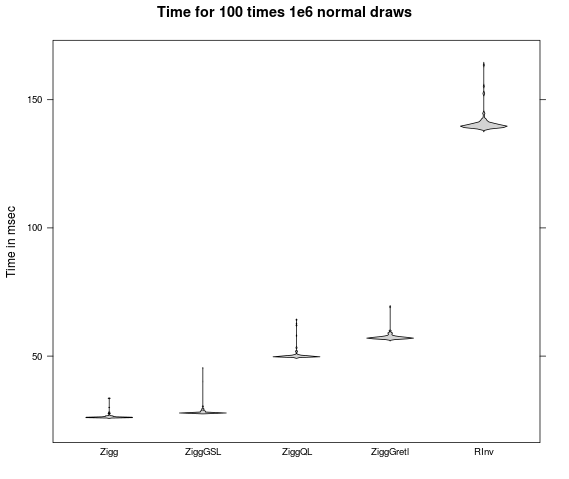
ziggurats A new release, now at version 0.1.6, of RcppZiggurat is now on the CRAN network for R. The RcppZiggurat package updates the code for the Ziggurat generator by Marsaglia and other which provides very fast draws from a Normal distribution. The package provides a simple C++ wrapper class for the generator improving on the very basic macros, and permits comparison among several existing Ziggurat implementations. This can be seen in the figure where Ziggurat from this package dominates accessing the implementations from the GSL, QuantLib and Gretl all of which are still way faster than the default Normal generator in R (which is of course of higher code complexity). This release brings a corrected seed setter and getter which now correctly take care of all four state variables, and not just one. It also corrects a few typos in the vignette. Both were fixed quite a while back, but we somehow managed to not ship this to CRAN for two years. The NEWS file entry below lists all changes.

Changes in version 0.1.6 (2020-10-18)
  • Several typos were corrected in the vignette (Blagoje Ivanovic in #9).
  • New getters and setters for internal state were added to resume simulations (Dirk in #11 fixing #10).
  • Minor updates to cleanup script and Travis CI setup (Dirk).

Courtesy of my CRANberries, there is a diffstat report for this release. More information is on the RcppZiggurat page. If you like this or other open-source work I do, you can now sponsor me at GitHub. For the first year, GitHub will match your contributions.

This post by Dirk Eddelbuettel originated on his Thinking inside the box blog. Please report excessive re-aggregation in third-party for-profit settings.

Reproducible Builds: Supporter spotlight: Civil Infrastructure Platform

The Reproducible Builds project depends on our many projects, supporters and sponsors. We rely on their financial support, but they are also valued ambassadors who spread the word about the Reproducible Builds project and the work that we do. This is the first installment in a series featuring the projects, companies and individuals who support the Reproducible Builds project. If you are a supporter of the Reproducible Builds project (of whatever size) and would like to be featured here, please let get in touch with us at contact@reproducible-builds.org. However, we are kicking off this series by featuring Urs Gleim and Yoshi Kobayashi of the Civil Infrastructure Platform (CIP) project.
Chris Lamb: Hi Urs and Yoshi, great to meet you. How might you relate the importance of the Civil Infrastructure Platform to a user who is non-technical? A: The Civil Infrastructure Platform (CIP) project is focused on establishing an open source base layer of industrial-grade software that acts as building blocks in civil infrastructure projects. End-users of this critical code include systems for electric power generation and energy distribution, oil and gas, water and wastewater, healthcare, communications, transportation, and community management. These systems deliver essential services, provide shelter, and support social interactions and economic development. They are society s lifelines, and CIP aims to contribute to and support these important pillars of modern society.
Chris: We have entered an age where our civilisations have become reliant on technology to keep us alive. Does the CIP believe that the software that underlies our own safety (and the safety of our loved ones) receives enough scrutiny today? A: For companies developing systems running our infrastructure and keeping our factories working, it is part of their business to ensure the availability, uptime, and security of these very systems. However, software complexity continues to increase, and the efforts spent on those systems is now exploding. What is missing is a common way of achieving this through refining the same tools, and cooperating on the hardening and maintenance of standard components such as the Linux operating system.
Chris: How does the Reproducible Builds effort help the Civil Infrastructure Platform achieve its goals? A: Reproducibility helps a great deal in software maintenance. We have a number of use-cases that should have long-term support of more than 10 years. During this period, we encounter issues that need to be fixed in the original source code. But before we make changes to the source code, we need to check whether it is actually the original source code or not. If we can reproduce exactly the same binary from the source code even after 10 years, we can start to invest time and energy into making these fixes.
Chris: Can you give us a brief history of the Civil Infrastructure Platform? Are there any specific success stories that the CIP is particularly proud of? A: The CIP Project formed in 2016 as a project hosted by Linux Foundation. It was launched out of necessity to establish an open source framework and the subsequent software foundation delivers services for civil infrastructure and economic development on a global scale. Some key milestones we have achieved as a project include our collaboration with Debian, where we are helping with the Debian Long Term Support (LTS) initiative, which aims to extend the lifetime of all Debian stable releases to at least 5 years. This is critical because most control systems for transportation, power plants, healthcare and telecommunications run on Debian-based embedded systems. In addition, CIP is focused on IEC 62443, a standards-based approach to counter security vulnerabilities in industrial automation and control systems. Our belief is that this work will help mitigate the risk of cyber attacks, but in order to deal with evolving attacks of this kind, all of the layers that make up these complex systems (such as system services and component functions, in addition to the countless operational layers) must be kept secure. For this reason, the IEC 62443 series is attracting attention as the de facto cyber-security standard.

Chris: The Civil Infrastructure Platform project comprises a number of project members from different industries, with stakeholders across multiple countries and continents. How does working together with a broad group of interests help in your effectiveness and efficiency? A: Although the members have different products, they share the requirements and issues when developing sustainable products. In the end, we are driven by common goals. For the project members, working internationally is simply daily business. We see this as an advantage over regional or efforts that focus on narrower domains or markets.
Chris: The Civil Infrastructure Platform supports a number of other existing projects and initiatives in the open source world too. How much do you feel being a part of the broader free software community helps you achieve your aims? A: Collaboration with other projects is an essential part of how CIP operates we want to enable commonly-used software components. It would not make sense to re-invent solutions that are already established and widely used in product development. To this end, we have an upstream first policy which means that, if existing projects need to be modified to our needs or are already working on issues that we also need, we work directly with them.
Chris: Open source software in desktop or user-facing contexts receives a significant amount of publicity in the media. However, how do you see the future of free software from an industrial-oriented context? A: Open source software has already become an essential part of the industry and civil infrastructure, and the importance of open source software there is still increasing. Without open source software, we cannot achieve, run and maintain future complex systems, such as smart cities and other key pieces of civil infrastructure.
Chris: If someone wanted to know more about the Civil Infrastructure Platform (or even to get involved) where should they go to look? A: We have many avenues to participate and learn more! We have a website, a wiki and you can even follow us on Twitter.

For more about the Reproducible Builds project, please see our website at reproducible-builds.org. If you are interested in ensuring the ongoing security of the software that underpins our civilisation and wish to sponsor the Reproducible Builds project, please reach out to the project by emailing contact@reproducible-builds.org.

Next.

Previous.