Search Results: "bod"

2 November 2020

Joerg Jaspert: Debian NEW Queue, Rust packaging

Debian NEW Queue So for some reason I got myself motivated again to deal with some packages in Debians NEW Queue. We had 420 source packages waiting for some kind of processing when I started, now we are down to something around 10. (Silly, people keep uploading stuff ) That s not entirely my own work, others from the team have been active too, but for those few days I went through a lot of stuff waiting. And must say it still feels mostly like it did when I somehow stopped doing much in NEW. Except - well, I feel that maintainers are much better in preparing their packages, especially that dreaded task of getting the copyright file written seems to be one that is handled much better. Now, thats not supported by any real numbers, just a feeling, but a good one, I think.

Rust Dealing with NEW meant I got in contact with one part that currently generates some friction between the FTP Team and one group of package maintainers - the Rust team. Note: this is, of course, entirely written from my point of view. Though with the intention of presenting it as objective as possible. Also, I know what rust is, and have tried a Hello world in it, but that s about my deep knowledge of it

The problem Libraries in rust are bundled/shipped/whatever in something called crates, and you manage what your stuff needs and provides with a tool called cargo. A library (one per crate) can provide multiple features, say a TLS lib can link against gnutls or openssl or some other random implementation. Such features may even be combinable in various different ways, so one can have a high number of possible feature combinations for one crate. There is a tool called debcargo which helps creating a Debian package out of a crate. And that tool generates so-called feature-packages, one per feature / combination thereof. Those feature packages are empty packages, only containing a symlink for their /usr/share/doc/ directory, so their size is smaller than the metadata they will produce. Inside the archive and the files generated by it, stuff that every user everywhere has to download and their apt has to process. Additionally, any change of those feature sets means one round through NEW, which is also not ideal. So, naturally, the FTP Team dislikes those empty feature packages. Really, a lot. There appears to be a different way. Not having the feature packages, but putting all the combinations into a Provides header. That sometimes works, but has two problems:
  • It can generate really long Provides: lines. I mean, REALLY REALLY REALLY long. Somewhat around 250kb is the current record. Thats long enough that a tool (not dak itself) broke on it. Sure, that tool needs to be fixed, but still, that s not nice. Currently preferred from us, though.
  • Some of the features may need different dependencies (say, gnutls vs openssl), should those conflict with each other, you can not combine them into one package.

Solutions Currently we do not have a good one. The rust maintainers and the ftp team are talking, exploring various ideas, we will see what will come out.

Devel archive / Component One of the possible solutions for the feature package problem would be something that another set of packages could also make good use of, I think. The introduction of a new archive or component, meant only for packages that are needed to build something, but where users are discouraged from ever using them. What? Well, take golang as an example. While we have a load of golang-something packages in Debian, and they are used for building applications written in go - none of those golang-something are meant to be installed by users. If you use the language and develop in it, the go get way is the one you are expected to use. So having an archive (or maybe component like main or contrib) that, by default, won t be activated for users, but only for things like buildds or archive rebuilds, will make one problem (hated metadata bloat) be evaluated wildly different. It may also allow a more relaxed processing of binary-NEW (easier additions of new feature packages).

But but but Yes, it is not the most perfect solution. Without taking much energy to think about, it requires
  • an adjustment in how main is handled. Right now we have the golden rule that main is self contained, that is, things in it may not need anything outside it for building or running. That would need to be adjusted for building. (Go as well as currently rust are always building static binaries, so no library dependencies there).
  • It would need handling for the release, that is, the release team would need to deal with that archive/component too. We haven t, yet, talked to them (still, slowly, discussing inside FTP Team). So, no idea how many rusty knives they want to sink into our nice bodies for that idea

Final Well, it is still very much open. Had an IRC meeting with the rust people, will have another end of November, it will slowly go forward. And maybe someone comes up with an entire new idea that we all love. Don t know, time will tell.

1 November 2020

Enrico Zini: Gender and pop culture links

Growing up framed as a somewhat nerdy male, I was exposed to a horrible mainstream narrative for relationships. I really like how these two links take some of it apart and make its serious problems visible: The narrative for mainstream-desirable males also needs questioning: And since I posted a link about unreasonable expectations towards male bodies:

Steve Kemp: Archiving Debian-Administration.org, for real

Back in 2017 I announced that the https://Debian-Administration.org website was being made read-only, and archived. At the time I wrote a quick update to save each requested page as a flat-file, hashed beneath /tmp, with the expectation that after a few months I'd have a complete HTML-only archive of the site which I could serve as a static-website, instead of keeping the database and pile of CGI scripts running. Unfortunately I never got round to archiving the pages in a git-repository, or some other store, and I usually only remembered this local tree of content was available a few minutes after I'd rebooted the server and lost the stuff - as the reboot would reap the contents of /tmp! Thinking about it today I figured I probably didn't even need to do that, instead I just need to redirect to the wayback machine. Working on the assumption that the site has been around for "a while" it should have all the pages mirrored by now I've made a "final update" to Apache:
 RewriteEngine on
 RewriteRule   ^/(.*)  "http://web.archive.org/web/https://debian-administration.org/$1"  [R,L]
Assuming nobody reports a problem in the next month I'll retire the server and make a simple docker container to handle the appropriate TLS certificate renewal, and hardwire the redirection(s) for the sites involved.

27 October 2020

Noah Meyerhans: Debian STS: Short Term Support

In another of my frequent late-night bouts with insomnia, I started thinking about the intersection of a number of different issues facing Debian today, both from a user point of view and a developer point of view. Debian has a reputation for shipping stale software. Versions in the stable branch are often significantly behind the latest development upstream. Debian s policy here has been that this is fine, our goal is to ship something stable, not something bleeding edge. Unofficially, our response to users is: If you need bleeding edge software, Debian may not be for you. Officially, we have no response to users who want fresher software. Debian also has a problem with a lack of manpower. I believe that part of why we have a hard time attracting contributors is our reputation for stale software. It might be worth it for us to consider changes to our approach to releases.

What about running testing? People who want newer software often look to Debian s testing branch as a possible solution. It s tempting, as it s a dynamically generated release based on unstable, so it should be quite current. In practice, it s not at all uncommon to find people running testing, and in fact I m running it right now on the ThinkPad on which this is being typed. However, testing comes with a glaring issue: a lack of timely security support. Security updates must still propagate through unstable, and this can take some time. They can be held up by dependencies, library transitions, or other factors. Nearly every list of best practices for computer security lists keeping software up-to-date at or near the top of most important steps to take to safely use networked computer. Debian s testing branch makes this very difficult, especially when faced with a zero-day with potential for real-world exploit.

What about stable-backports? Stable backports is both better and worse than testing. It s better in that it allows you to run a system comprised mainly of packages from the stable branch, which receive updates from the security team in a timely manner. However, it s worse in that the packages from the backports repository incur an additional delay. The expectation around backports is that a package migrates naturally from unstable to testing, and then requires a maintainer to upload a new package based on the version in testing specifically targeted at stable backports. The migration can potentially be bypassed, and we used to have a mechanism for announcing the availability of security updates for the stable backports archive, but it has gone unused for several years now. The documentation describes a workflow for posting security updates that involves creating a ticket in Debian s RT system, which is going to be quite foreign to most people. News from mid 2019 suggests that this process might change, but nothing appears to have come of this in over a year, and we still haven t seen a proper security advisory for stable backports in years.

Looking to LTS for ideas The Long-Term Support project is an alternative branch of Debian, maintained outside the normal stable release infrastructure. It s stable, and expected to behave that way, but it s not supported by the stable security team or release team. LTS provides a framework for providing security updates via targeted uploads by a team of interested individuals working outside the structure of the existing stable releases. This project seems to be quite active (how much of this is because at least some members are being paid?), and as of this writing has actually published more security advisories in the past month than the stable security team has published for the current stable branch. This is also interesting in that the software in LTS is quite old, first appearing in a Debian stable release in 2017. LTS is particularly interesting here as it s an example an initiative within the Debian community taken specifically to address user needs. For some of our users, remaining on an old release is a perfectly valid thing for them to do, and we recognize this and support them in doing so.

Debian Short-Term Support So, what would it take to create an LTS-like initiative in the other direction? Instead of providing ongoing support for ancient versions of software that previously comprised a stable release, could we build a distribution branch based on something that hasn t yet reached stable? What would that look like? How would it fit in the existing unstable testing migration process? What impact would it have on the size of the archive? Would we want a rolling release, or discrete releases? If the latter, how many would we want between proper stable releases? The security tracker already tracks outstanding issues in unstable and testing, and can even show issues that have been fixed in unstable but haven t yet propagated to testing. If we want a rolling release, maybe we could just open up the testing-security repository more broadly? There was once a testing security team, which IIRC was chartered to publish updated packages directly to testing security, along with associated security advisory. Based on the mailing list history, that effort seems to have shut down around the time of the squeeze (Debian 6.0) release in early 2011. Would it be worth resurrecting it? We ve probably got much of the infrastructure required in place already, since it previously existed. Personally I m not really a fan of a pure rolling release. I d rather see a light-weight release. Maybe a snapshot of testing that gets just a date, not a Toy Story codename. Probably skip building a dedicated installer for it. Upgrade from stable or use a d-i snapshot from testing if needed. This mini release is supported until the next one comes out, maybe 6 or 8 months later. By supported, I mean that the Short Term Release team is responsible for it. They can upload security or other critical bug fixes directly to a dedicated repository. When the next STS snapshot is released, packages in the updates repository are either archived, if they re a lower version than the one in the new mini release, or rebuilt against the new mini release and preserved. Using some of the same mechanisms as the LTS release, we d need
  1. Something to take the place of oldstable, that is the base release against which updates are released. This could be something that effectively maps to a date snapshot served by http://snapshot.debian.org/. (Snapshot itself could not currently handle the increased load, as I understand it, but conceptually it s similar.)
  2. Something to take the place of the dist/updates apt repository that hosts the packages that are updated.
In theory, if the infrastructure could support hose things, then we could in effect generate a mini release at any time based on a snapshot. I wonder if this could start as something totally unofficial; mirror an arbitrary testing snapshot and provide a place for interested people to publish package updates.

Not a proposal, nor a criticism To be clear, I don t really intend this as a proposal; It s really half-baked. Maybe these ideas have already been considered and dismissed. I don t know if people would be interested in working on such a project, and I m not nearly familiar enough with the Debian archive tooling to even make a guess as to how hard it would be to implement much of it. I m just posting some ideas that I came up with while pondering something that, from my perspective, is an area where Debian is clearly failing to meet the needs of some of our users. We know Debian is a popular and respected Linux distribution, and we know people value our stability. However, we also know that people like running Fedora and Ubuntu s non-LTS releases. People like Arch Linux. Not just end-users , but also the people developing the software shipped by the distros themselves. There are a lot of potential contributors to Debian who are kept away by our unwillingness to provide a distro offering both fresh software and security support. I think that we could attract more people to the Debian community if we could provide a solution for these people, and that would ultimately be good for everybody. Also, please don t interpret this as being critical of the release team, the stable security team, or any other team or individual in Debian. I m sharing this because I think there are opportunities for Debian to improve how we serve our users, not because I think anybody is doing anything wrong. With all that said, though, let me know if you find the ideas interesting. If you think they re crazy, you can tell me that, too. I ll probably agree with you.

26 October 2020

Molly de Blanc: Digital Self

When we talk about the digital self, we are talking about the self as it exists within digital spaces. This holds differently for different people, as some of us prefer to live within an pseudonymous or anonymous identity online, divested from our physical selves, while others consider the digital a more holistic identity that extends from the physical. Your digital self is gestalt, in that it exists across whatever mediums, web sites, and services you use. These bits are pieces together to form a whole picture of what it means to be you, or some aspect of you. This may be carefully curated, or it may be an emergent property of who you are. The way your physical self has rights, so too does your digital self. Or, perhaps, it would be more accurate to say that your rights extend to your digital self. I do not personally consider that there is a separation between these selves when it comes to rights, as both are aspects of you and you have rights. I am explicitly not going to list what these rights are, because I have my own ideas about them and yours may differ. Instead, I will briefly talk about consent. I think it is essential that we genuinely consent to how others interact with us to maintain the sanctity of our selves. Consent is necessary to the protection and expression of our rights, as it ensures we are able to rely on our rights and creates a space where we are able to express our rights in comfort and safety. We may classically think of consent as it relates to sex and sexual consent: only we have the right to determine what happens to our bodies; no one else has the right to that determination. We are able to give sexual consent, and we are able to revoke it. Sexual consent, in order to be in good faith, must be requested and given from a place of openness and transparency. For this, we discuss with our partners the things about ourselves that may impact their decision to consent: we are sober; we are not ill; we are using (or not) protection as we agree is appropriate; we are making this decision because it is a thing we desire, rather than a thing we feel we ought to do or are being forced to do; as well as other topics. These things also all hold true for technology and the digital spaces in which we reside. Our digital autonomy is not the only thing at stake when we look at digital consent. The ways we interact in digital spaces impact our whole selves, and exploitation of our consent too impacts our whole selves. Private information appearing online can have material consequences it can directly lead to safety issues, like stalking or threats, and it can lead to a loss of psychic safety and have a chilling effect. These are in addition to the threats posed to digital safety and well being. Consent must be actively sought, what one is consenting to is transparent, and the potential consequences must be known and understood. In order to protect and empower the digital self, to treat everyone justly and with respect, we must hold the digital self be as sacrosanct as other aspects of the self and treat it accordingly.

24 October 2020

Dirk Eddelbuettel: digest 0.6.27: Build fix

Exactly one week after the previous release 0.6.26 of digest, a minor cleanup release 0.6.27 just arrived on CRAN and will go to Debian shortly. digest creates hash digests of arbitrary R objects (using the md5, sha-1, sha-256, sha-512, crc32, xxhash32, xxhash64, murmur32, spookyhash, and blake3 algorithms) permitting easy comparison of R language objects. It is a fairly widely-used package (currently listed at one million monthly downloads, 282 direct reverse dependencies and 8068 indirect reverse dependencies, or just under half of CRAN) as many tasks may involve caching of objects for which it provides convenient general-purpose hash key generation. Release 0.6.26 brought support for the (nice, even cryptographic) blake3 hash algorithm. In the interest of broader buildability we had already (with a sad face) disabled a few very hardware-specific implementation aspects using intrinsic ops. But to our chagrin, we left one #error define that raised its head on everybody s favourite CRAN build platform. Darn. So 0.6.27 cleans that up and also removes the check and #error as all the actual code was already commented out. If you read this and tears start running down your cheeks, then by all means come and help us bring blake3 to its full (hardware-accelerated) potential. This (probably) only needs a little bit of patient work with the build options and configurations. You know where to find us My CRANberries provides the usual summary of changes to the previous version. For questions or comments use the issue tracker off the GitHub repo. If you like this or other open-source work I do, you can now sponsor me at GitHub. For the first year, GitHub will match your contributions.

This post by Dirk Eddelbuettel originated on his Thinking inside the box blog. Please report excessive re-aggregation in third-party for-profit settings.

Jelmer Vernooij: Debian Janitor: Hosters used by Debian packages

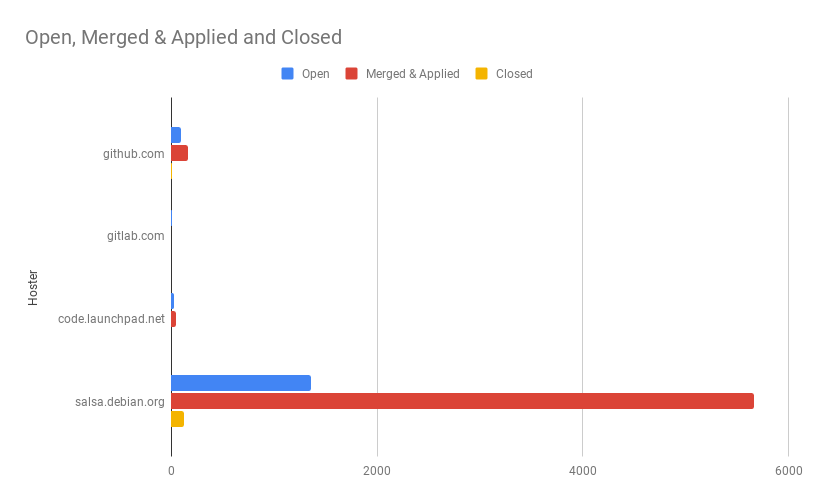
The Debian Janitor is an automated system that commits fixes for (minor) issues in Debian packages that can be fixed by software. It gradually started proposing merges in early December. The first set of changes sent out ran lintian-brush on sid packages maintained in Git. This post is part of a series about the progress of the Janitor. The Janitor knows how to talk to different hosting platforms. For each hosting platform, it needs to support the platform- specific API for creating and managing merge proposals. For each hoster it also needs to have credentials. At the moment, it supports the GitHub API, Launchpad API and GitLab API. Both GitHub and Launchpad have only a single instance; the GitLab instances it supports are gitlab.com and salsa.debian.org. This provides coverage for the vast majority of Debian packages that can be accessed using Git. More than 75% of all packages are available on salsa - although in some cases, the Vcs-Git header has not yet been updated. Of the other 25%, the majority either does not declare where it is hosted using a Vcs-* header (10.5%), or have not yet migrated from alioth to another hosting platform (9.7%). A further 2.3% are hosted somewhere on GitHub (2%), Launchpad (0.18%) or GitLab.com (0.15%), in many cases in the same repository as the upstream code. The remaining 1.6% are hosted on many other hosts, primarily people s personal servers (which usually don t have an API for creating pull requests). Packages per hoster

Outdated Vcs-* headers It is possible that the 20% of packages that do not have a Vcs-* header or have a Vcs header that say there on alioth are actually hosted elsewhere. However, it is hard to know where they are until a version with an updated Vcs-Git header is uploaded. The Janitor primarily relies on vcswatch to find the correct locations of repositories. vcswatch looks at Vcs-* headers but has its own heuristics as well. For about 2,000 packages (6%) that still have Vcs-* headers that point to alioth, vcswatch successfully finds their new home on salsa.
Merge Proposals by Hoster These proportions are also visible in the number of pull requests created by the Janitor on various hosters. The vast majority so far has been created on Salsa.
Hoster Open Merged & Applied Closed
github.com921685
gitlab.com1230
code.launchpad.net24511
salsa.debian.org1,3605,657126
Merge Proposal statistics In this graph, Open means that the pull request has been created but likely nobody has looked at it yet. Merged means that the pull request has been marked as merged on the hoster, and applied means that the changes have ended up in the packaging branch but via a different route (e.g. cherry-picked or manually applied). Closed means that the pull request was closed without the changes being incorporated. Note that this excludes ~5,600 direct pushes, all of which were to salsa-hosted repositories. See also:

For more information about the Janitor's lintian-fixes efforts, see the landing page.

21 October 2020

Christian Kastner: RStudio is a refreshingly intuitive IDE

I currently need to dabble with R for a smallish thing. I have previously dabbled with R only once, for an afternoon, and that was about a decade ago, so I had no prior experience to speak of regarding the language and its surrounding ecosystem. Somebody recommended that I try out RStudio, a popular IDE for R. I was happy to see that an open-source community edition exists, in the form of a .deb package no less, so I installed it and gave it a try. It's remarkable how intuitive this IDE is. My first guess at doing something has so far been correct every. single. time. I didn't have to open the help, or search the web, for any solutions, either -- they just seem to offer themselves up. And it's not just my inputs; it's the output, too. The RStudio window has multiple tiles, and each tile has multiple tabs. I found this quite confusing and intimidating on first impression, but once I started doing some work, I was surprised to see that whenever I did something that produced output in one or more of the tabs, it was (again) always in an intuitive manner. There's a fine line between informing with relevant context and distracting with irrelevant context, but RStudio seems to have placed itself on the right side of it. This, and many other features that pop up here and there, like the live-rendering of LaTeX equations, contributed to what has to be one of the most positive experiences with an IDE that I've had so far.

19 October 2020

Russell Coker: Video Decoding

I ve had a saga of getting 4K monitors to work well. My latest issue has been video playing, the dreaded mplayer error about the system being too slow. My previous post about 4K was about using DisplayPort to get more than 30Hz scan rate at 4K [1]. I now have a nice 60Hz scan rate which makes WW2 documentaries display nicely among other things. But when running a 4K monitor on a 3.3GHz i5-2500 quad-core CPU I can t get a FullHD video to display properly. Part of the process of decoding the video and scaling it to 4K resolution is too slow, so action scenes in movies lag. When running a 2560*1440 monitor on a 2.4GHz E5-2440 hex-core CPU with the mplayer option -lavdopts threads=3 everything is great (but it fails if mplayer is run with no parameters). In doing tests with apparent performance it seemed that the E5-2440 CPU gains more from the threaded mplayer code than the i5-2500, maybe the E5-2440 is more designed for server use (it s in a Dell PowerEdge T320 while the i5-2500 is in a random white-box system) or maybe it s just because it s newer. I haven t tested whether the i5-2500 system could perform adequately at 2560*1440 resolution. The E5-2440 system has an ATI HD 6570 video card which is old, slow, and only does PCIe 2.1 which gives 5GT/s or 8GB/s. The i5-2500 system has a newer ATI video card that is capable of PCIe 3.0, but lspci -vv as root says LnkCap: Port #0, Speed 8GT/s, Width x16 and LnkSta: Speed 5GT/s (downgraded), Width x16 (ok) . So for reasons unknown to me the system with a faster PCIe 3.0 video card is being downgraded to PCIe 2.1 speed. A quick check of the web site for my local computer store shows that all ATI video cards costing less than $300 have PCI3 3.0 interfaces and the sole ATI card with PCIe 4.0 (which gives double the PCIe speed if the motherboard supports it) costs almost $500. I m not inclined to spend $500 on a new video card and then a greater amount of money on a motherboard supporting PCIe 4.0 and CPU and RAM to go in it. According to my calculations 3840*2160 resolution at 24bpp (probably 32bpp data transfers) at 30 frames/sec means 3840*2160*4*30/1024/1024=950MB/s. PCIe 2.1 can do 8GB/s so that probably isn t a significant problem. I d been planning on buying a new video card for the E5-2440 system, but due to some combination of having a better CPU and lower screen resolution it is working well for video playing so I can save my money. As an aside the T320 is a server class system that had been running for years in a corporate DC. When I replaced the high speed SAS disks with SSDs SATA disks it became quiet enough for a home workstation. It works very well at that task but the BIOS is quite determined to keep the motherboard video running due to the remote console support. So swapping monitors around was more pain than I felt like going through, I just got it working and left it. I ordered a special GPU power cable but found that the older video card that doesn t need an extra power cable performs adequately before the cable arrived. Here is a table comparing the systems.
2560*1440 works well 3840*2160 goes slow
System Dell PowerEdge T320 White Box PC from rubbish
CPU 2.4GHz E5-2440 3.3GHz i5-2500
Video Card ATI Radeon HD 6570 ATI Radeon R7 260X
PCIe Speed PCIe 2.1 8GB/s PCIe 3.0 downgraded to PCIe 2.1 8GB/s
Conclusion The ATI Radeon HD 6570 video card is one that I had previously tested and found inadequate for 4K support, I can t remember if it didn t work at that resolution or didn t support more than 30Hz scan rate. If the 2560*1440 monitor dies then it wouldn t make sense to buy anything less than a 4K monitor to replace it which means that I d need to get a new video card to match. But for the moment 2560*1440 is working well enough so I won t upgrade it any time soon. I ve already got the special power cable (specified as being for a Dell PowerEdge R610 for anyone else who wants to buy one) so it will be easy to install a powerful video card in a hurry.

18 October 2020

Iustin Pop: Serendipity

To start off, let me say it again: I hate light pollution. I really, really hate it. I love the night sky where you look up and see thousands of stars, and constellations besides Ursa Major. As somebody said once, You haven t lived until you ve seen your shadow by the light of the Milky Way . But, ahem, I live in a large city, and despite my attempts using star trackers, special filters, etc. you simply can t escape it. So, whenever we go on vacation in the mountains, I m trying to think if I can do a bit of astro-photography (not that I m good at it). Which bring me to our recent vacation up in the mountains. I was looking forward to it, until in the week before, when the weather prognosis was switching between snow, rain and overcast for the entire week. No actual day or night with clear skies, so I didn t take a tripod, I didn t take a wide lens, and put night photography out of my mind. Vacation itself was good, especially the quietness of the place, so I usually went to be early-ish and didn t look outside. The weather was as forecasted - no new snow (but there was enough up in the mountains), but heavy clouds all the time, and the sun only showed itself for a few minutes at a time. One night I was up a bit longer than usual, working on the laptop and being very annoyed by a buzzing sound. At first I thought maybe I was imagining it, but from time to time it was stopping briefly, so it was a real noise; I started hunting for the source. Not my laptop, not the fridge, not the TV but it was getting stronger near the window. I open the door to the balcony, and bam! Very loud noise, from the hotel nearby, where at midnight the pool was being cleaned. I look at the people doing the work, trying to estimate how long it ll be until they finish, but it was looking like a long time. Fortunately with the door closed the noise was not bad enough to impact my sleep, so I debate getting angry or just resigned, and since it was late, I just sigh, roll my eyes not metaphorically, but actually roll my eyes and look up, and I can t believe my eyes. Completely clear sky, no trace of clouds anywhere, and stars. Lots of starts. I sit there, looking at the sky and enjoying the view, and I think to myself that it won t look that nice on the camera, for sure. Especially without a real trip, and without a fast lens. Nevertheless, I grab my camera and just for kicks take one handheld picture. To my surprise (and almost disbelief), blurry pixels aside, the photo does look like what I was seeing, so I grab my tiny tripod that I carried along, and (with only a 24-70 zoom lens), grab a photo. And another, and another and then I realise that if I can make the composition work, and find a good shutter speed, this can turn out a good picture. I didn t have a remote release, the tripod was not very stable and it cannot point the camera upwards (it s basically an emergency tripod), so it was quite sub-optimal; still, I try multiple shots (different compositions, different shutter speeds); they look on the camera screen and on the phone pretty good, so just for safety I take a few more, and, very happy, go to bed. Coming back from vacation, on the large monitor, it turns out that the first 28 out of the 30 pictures were either blurry or not well focused (as I was focusing manually), and the 29th was almost OK but still not very good. Only the last, the really last picture, was technically good and also composition-wise OK. Luck? Foresight? Don t know, but it was worth deleting 28 pictures to get this one. One of my best night shots, despite being so unprepared
Stars! Lots of stars! And mountains Stars! Lots of stars! And mountains
Of course, compared to other people s pictures, this is not special. But for me, it will be a keepsake of how a real night sky should look like. If you want to zoom in, higher resolution on flickr. Technically, the challenges for the picture were two-fold: Next time when travelling by car, I ll surely take a proper tripod Until next time, clear and dark skies

15 October 2020

Gunnar Wolf: I am who I am and that's all that I am

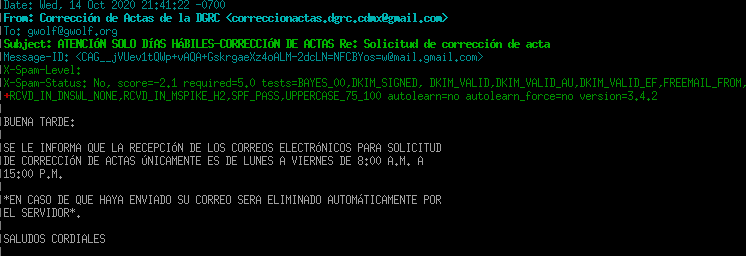
Mexico was one of the first countries in the world to set up a national population registry in the late 1850s, as part of the church-state separation that was for long years one of the national sources of pride. Forty four years ago, when I was born, keeping track of the population was still mostly a manual task. When my parents registered me, my data was stored in page 161 of book 22, year 1976, of the 20th Civil Registration office in Mexico City. Faithful to the legal tradition, everything is handwritten and specified in full. Because, why would they write 1976.04.27 (or even 27 de abril de 1976) when they could spell out d a veintisiete de abril de mil novecientos setenta y seis? Numbers seem to appear only for addresses. So, the State had record of a child being born, and we knew where to look if we came to need this information. But, many years later, a very sensible tecnification happened: all records (after a certain date, I guess) were digitized. Great news! I can now get my birth certificate without moving from my desk, paying a quite reasonable fee (~US$4). What s there not to like? Digitally certified and all! So great! But But Oh, there s a problem. Of course Making sense of the handwriting as you can see is somewhat prone to failure. And I cannot blame anybody for failing to understand the details of my record. So, my mother s first family name is Iszaevich. It was digitized as Iszaerich. Fortunately, they do acknowledge some errors could have made it into the process, and there is a process to report and correct errors. What s there not to like? Oh That they do their best to emulate a public office using online tools. I followed some links in that link to get the address to contact and yesterday night sent them the needed documents. Quite immediately, I got an answer that I must share with the world: Yes, the mailing contact is in the @gmail.com domain. I could care about them not using a @ .gob.mx address, but I ll let it slip. The mail I got says (uppercase and all):
GOOD EVENING,
WE INFORM YOU THAT THE RECEPTION OF E-MAILS FOR REQUESTING
CORRECTIONS IN CERTIFICATES IS ONLY ACTIVE MONDAY THROUGH FRIDAY,
8:00 TO 15:00.
*IN CASE YOU SENT A MAIL OUTSIDE THE WORKING HOURS, IT WILL BE
AUTOMATICALLY DELETED BY THE SERVER*
CORDIAL GREETINGS,
I would only be half-surprised if they were paying the salary of somebody to spend the wee hours of the night receiving and deleting mails from their GMail account.

12 October 2020

Russ Allbery: Review: Hand to Mouth

Review: Hand to Mouth, by Linda Tirado
Publisher: G.P. Putnam's Sons
Copyright: October 2014
ISBN: 0-698-17528-X
Format: Kindle
Pages: 194
The first time Linda Tirado came to the viral attention of the Internet was in 2013 when she responded to a forum question: "Why do poor people do things that seem so self-destructive?" Here are some excerpts from her virally popular five-page response, which is included in the first chapter:
I know how to cook. I had to take Home Ec. to graduate high school. Most people on my level didn't. Broccoli is intimidating. You have to have a working stove, and pots, and spices, and you'll have to do the dishes no matter how tired you are or they'll attract bugs. It is a huge new skill for a lot of people. That's not great, but it's true. And if you fuck it up, you could make your family sick. We have learned not to try too hard to be middle class. It never works out well and always makes you feel worse for having tried and failed yet again. Better not to try. It makes more sense to get food that you know will be palatable and cheap and that keeps well. Junk food is a pleasure that we are allowed to have; why would we give that up? We have very few of them.
and
I smoke. It's expensive. It's also the best option. You see, I am always, always exhausted. It's a stimulant. When I am too tired to walk one more step, I can smoke and go for another hour. When I am enraged and beaten down and incapable of accomplishing one more thing, I can smoke and I feel a little better, just for a minute. It is the only relaxation I am allowed. It is not a good decision, but it is the only one that I have access to. It is the only thing I have found that keeps me from collapsing or exploding.
This book is an expansion on that essay. It's an entry in a growing genre of examinations of what it means to be poor in the United States in the 21st century. Unlike most of those examinations, it isn't written by an outsider performing essentially anthropological field work. It's one of the rare books written by someone who is herself poor and had the combination of skill and viral fame required to get an opportunity to talk about it in her own words.
I haven't had it worse than anyone else, and actually, that's kind of the point. This is just what life is for roughly a third of the country. We all handle it in our own ways, but we all work in the same jobs, live in the same places, feel the same sense of never quite catching up. We're not any happier about the exploding welfare rolls than anyone else is, believe me. It's not like everyone grows up and dreams of working two essentially meaningless part-time jobs while collecting food stamps. It's just that there aren't many other options for a lot of people.
I didn't find this book back in 2014 when it was published. I found it in 2020 during Tirado's second round of Internet fame: when the police shot out her eye with "non-lethal" rounds while she was covering the George Floyd protests as a photojournalist. In characteristic fashion, she subsequently reached out to the other people who had been blinded by the police, used her temporary fame to organize crowdfunded support for others, and is planning on having "try again" tattooed over the scar. That will give you a feel for the style of this book. Tirado is blunt, opinionated, honest, and full speed ahead. It feels weird to call this book delightful since it's fundamentally about the degree to which the United States is failing a huge group of its citizens and making their lives miserable, but there is something so refreshing and clear-headed about Tirado's willingness to tell you the straight truth about her life. It's empathy delivered with the subtlety of a brick, but also with about as much self-pity as a brick. Tirado is not interested in making you feel sorry for her; she's interested in you paying attention.
I don't get much of my own time, and I am vicious about protecting it. For the most part, I am paid to pretend that I am inhuman, paid to cater to both the reasonable and unreasonable demands of the general public. So when I'm off work, feel free to go fuck yourself. The times that I am off work, awake, and not taking care of life's details are few and far between. It's the only time I have any autonomy. I do not choose to waste that precious time worrying about how you feel. Worrying about you is something they pay me for; I don't work for free.
If you've read other books on this topic (Emily Guendelsberger's On the Clock is still the best of those I've read), you probably won't get many new facts from Hand to Mouth. I think this book is less important for the policy specifics than it is for who is writing it (someone who is living that life and can be honest about it) and the depth of emotional specifics that Tirado brings to the description. If you have never been poor, you will learn the details of what life is like, but more significantly you'll get a feel for how Tirado feels about it, and while this is one individual perspective (as Tirado stresses, including the fact that, as a white person, there are other aspects of poverty she's not experienced), I think that perspective is incredibly valuable. That said, Hand to Mouth provides even more reinforcement of the importance of universal medical care, the absurdity of not including dental care in even some of the more progressive policy proposals, and the difficulties in the way of universal medical care even if we solve the basic coverage problem. Tirado has significant dental problems due to unrepaired damage from a car accident, and her account reinforces my belief that we woefully underestimate how important good dental care is to quality of life. But providing universal insurance or access is only the start of the problem.
There is a price point for good health in America, and I have rarely been able to meet it. I choose not to pursue treatment if it will cost me more than it will gain me, and my cost-benefit is done in more than dollars. I have to think of whether I can afford any potential treatment emotionally, financially, and timewise. I have to sort out whether I can afford to change my life enough to make any treatment worth it I've been told by more than one therapist that I'd be fine if I simply reduced the amount of stress in my life. It's true, albeit unhelpful. Doctors are fans of telling you to sleep and eat properly, as though that were a thing one can simply do.
That excerpt also illustrates one of the best qualities of this book. So much writing about "the poor" treats them as an abstract problem that the implicitly not-poor audience needs to solve, and this leads rather directly to the endless moralizing as "we" attempt to solve that problem by telling poor people what they need to do. Tirado is unremitting in fighting for her own agency. She has a shitty set of options, but within those options she makes her own decisions. She wants better options and more space in which to choose them, which I think is a much more productive way to frame the moral argument than the endless hand-wringing over how to help "those poor people." This is so much of why I support universal basic income. Just give people money. It's not all of the solution UBI doesn't solve the problem of universal medical care, and we desperately need to find a way to make work less awful but it's the most effective thing we can do immediately. Poor people are, if anything, much better at making consequential financial decisions than rich people because they have so much more practice. Bad decisions are less often due to bad decision-making than bad options and the balancing of objectives that those of us who are not poor don't understand. Hand to Mouth is short, clear, refreshing, bracing, and, as you might have noticed, very quotable. I think there are other books in this genre that offer more breadth or policy insight, but none that have the same feel of someone cutting through the bullshit of lazy beliefs and laying down some truth. If any of the above excerpts sound like the sort of book you would enjoy reading, pick this one up. Rating: 8 out of 10

6 October 2020

Iustin Pop: Late report for Nationalpark Bike Marathon 2020

I don t have to mention that 2020 is a special year, so all the normal race plan was out the window, and I was very happy and fortunate to be able to do even one race. And only delayed 3 weeks to write this race report :/ So, here s the story

Preparing for the race Because it was a special year, and everything was crazy, I actually managed to do more sports than usual, at least up to end of July. So my fitness, and even body weight, was relatively fine, so I subscribed to the mid-distance race (official numbers: 78km distance, 1570 meters altitude), and then off it went to a proper summer vacation in a hotel, even. And while I did do some bike rides during that vacation, from then on my training regime went just off? I did train, I did ride, I did get significant PRs, but it didn t click anymore. Plus, due to well, actually not sure what, work or coffee or something my sleep regime also got completely ruined On top of that, I didn t think about the fact that the race was going to be mid-September, and that high up in the mountains, the weather could have be bad enough (I mean, in 2018 the weather was really bad even in August ) such that I d need to seriously think about clothing.

Race week I arrive in Scuol two days before the race, very tired (I think I got only 6 hours of sleep the night before), and definitely not in a good shape. I was feeling bad enough that I was not quite sure I was going to race. At least weather was OK, such that normal summer clothing would suffice. But the race info was mentioning dangerous segments, to be very careful, etc. etc. so I was quite anxious. Note 1: my wife says, this was not the first time, and likely not the last time that two days before the race I feel like quitting. And as I m currently on-and-off reading the interesting The Brave Athlete: Calm the Fuck Down and Rise to the Occasion book (by Lesley Paterson and Simon Marshall; it s an interesting book, not sure if I recommend it or not), I am beginning to think that this is my reaction to races where I have overshot my usual distance. Or, in general, races where I fear the altitude gain. Not quite sure, but I think it is indeed the actual cause. So I spend Thursday evening feeling unwell, and thinking I ll see how Friday goes. Friday comes, and having slept reasonably well entire night, I pick up my race number, then I take another nap in the afternoon - in total, I ve slept around 13 hours that day. So I felt much better, and was looking forward to the race. Saturday morning comes, I manage to wake up early, and get ready in time; almost didn t panic at all that I m going to be late. Note 2: my wife also says that this is the usual way I behave. Hence, it must be most of it a mental issue, rather than real physical one

Race I reach the train station in time, I get on the train, and by the time the train reached Zernez, I fully calm down. There was am entire hour wait though before the race, and it was quite chilly. Of course I didn t bring anything beside what I was wearing, relying on temperature getting better later in the day. During the wait, there were two interesting things happening. First, we actually got there (in Zernez) before the first people from the long distance passed by, both men and women. Seeing them pass by was cool, thinking they already had ~1 200m altitude in just 30-ish kilometres. The second thing was, as this was the middle and not the shortest distance, the people in the group looked differently than in previous years. More precisely, they were looking very fit, and I was feeling fat. Well, I am overweight, so it was expected, but I was feeling it even more than usual. I think only one or two in ten people were looking as fit as me or less And of course, the pictures post-race show me even less fit-looking than I thought. Ah, self-deception is a sweet thing And yes, we all had to wear masks, up until the last minute. It was interesting, but not actually annoying - and small enough price for being able to race! Then the race starts, and as opposed to many other years, it starts slow. I didn t feel that rush of people starting fast, it was reasonable?

First part of the race (good) Thus started the first part of the race, on a new route that I was unfamiliar with. There was not too much climbing, to be honest, and there was some tricky single-trail through the woods, with lots of the roots. I actually had to get off the bike and push it, since it was too difficult to pedal uphill on that path. Other than that, I was managing so far to adjust my efforts well enough that my usual problems related to climbing (lower back pain) didn t yet appear, even as the overall climbed meters were increasing. I was quite happy at that, and had lots of reserves. To my (pleasant) surprise, two positive things happened:
  • I was never alone, a sign that I wasn t too far back.
  • I was passing/being passed by people, both on climbs but also on descents! It s rare, but I did overtake a few people on a difficult trail downhill.
With all the back and forth, a few people became familiar (or at least their kit), and it was fun seeing who is better uphill vs. downhill.

And second part (not so good) I finally get to (around) S-chanf, on a very nice but small descent, and on flat roads, and start the normal route for the short race. Something was off though - I knew from past years that these last ~47km have around 700-800m altitude, but I had already done around 1000m. So the promised 1571m were likely to be off, by at least 100-150m. I set myself a new target of 1700m, and adjust my efforts based on that. And then, like clockwork on the 3:00:00 mark, the route exited the forest, the sun got out of the clouds, and the temperature started to increase from 16-17 C to 26 +, with peaks of 31 C. I m not joking: at 2:58:43, temp was 16 , at 3:00:00, it was 18 , at 3:05:45, it was 26 . Heat and climbing are my two nemeses, and after having a pretty good race for the first 3 hours and almost exactly 1200m of climbing, I started feeling quite miserable. Well, it was not all bad. There were some nice stretches of flat, where I knew I can pedal strongly and keep up with other people, until my chain dropped, so I had to stop, re-set it, and lose 2 minutes. Sigh. But, at least, I was familiar with this race, or so I thought. I completely mis-remembered the last ~20km as a two-punch climb, Guarda and Ftan, whereas it is actually a three-punch one: Guarda, Ardez, and only then Ftan. Doesn t help that Ardez has the nice ruins that I was remembering and which threw me off. The saddest part of the day was here, on one of the last climbs - not sure if to Guarda or to Arddez, where a guy overtakes me, and tells me he s glad he finally caught up with me, he almost got me five or six times (!), but I always managed to break off. Always, until now. Now, this was sad (I was huffing and puffing like a steam locomotive now), but also positive, as I never had that before. One good, one bad? And of course, it was more than 1 700m altitude, it was 1 816m. And the descent to Scuol shorter and it didn t end as usual with the small but sharp climb which I just love, due to Covid changes. But, I finished, and without any actual issues, and no dangerous segments as far as I saw. I was anxious for no good reason

Conclusion (or confusion?) So this race was interesting: three hours (to the minute) in which I went 43.5km, climbed 1200m, felt great, and was able to push and push. And then the second part, only ~32km, climbed only 600m, but which felt quite miserable. I don t know if it was mainly heat, mainly my body giving up after that much climbing (or time?), or both. But it s clear that I can t reliably race for more than around these numbers: 3 hours, ~1000+m altitude, in >20 C temperature. One thing that I managed to achieve though: except due to the technically complex trail at the beginning where I pushed the bike, I did not ever stop and push the bike uphill because I was too tired. Instead, I managed (badly) to do the switch sitting/standing as much as I could motivate myself, and thus continue pushing uphill. This is an achievement for me, since mentally it s oh so easy to stop and push the bike, so I was quite glad. As to the race results, they were quite atrocious:
  • age category (men), 38 out of 52 finishers, 4h54m, with first finisher doing 3h09m, so 50% slower (!)
  • overall (men), 138 out of 173 finishers, with first finisher 2h53m.
These results clearly don t align with my feeling of a good first half of the race, so either it was purely subjective, or maybe in this special year, only really strong people registered for the race, or something else One positive aspect though, compared to most other years, was the consistency of my placement (age and overall):
  • Zuoz: 38 / 141
  • S-Chanf: 39 / 141
  • Zernez: 39 / 141
  • Guarda: 38 / 138
  • Ftan: 38 / 138
  • ( next - whatever this is): 38 / 138
  • Finish: 38 / 138
So despite all my ranting above, and all the stats I m pulling out of my own race, it looks like my position in the race was fully settled in the really first part, and I didn t gain nor lose practically anything afterwards. I did dip one place but then gained it back (on the climb to Guarda, even). The split times (per-segment rankings) are a bit more variable, and show that I was actually fast on the climbs but losing speed on the descents, which I really don t understand anymore:
  • Zernez-Zuoz (unclear type): 38 / 141
  • Zuoz-S-Chanf (unclear type): 40 / 141
  • S-Chanf-Zernez (mostly downhill): 39 / 143
  • Zernez-Guarda (mostly uphill): 37 / 136
  • Guarda-Ftan (mostly uphill): 37 / 131
  • Ftan-Scuol (mostly downhill): 43 / 156
The difference at the end is striking. I m visually matching the map positions to km and then use VeloViewer for computing the altitude gain, but Zernez to Guarda is 420m altitude, and Guarda to Ftan is 200m altitude gain, and yet on both, I was faster than my final place, and by quite a few places on overall, only to lose that on the descent (Ftan-Scuol), and by a large margin. So, amongst all the confusion here, I think the story overall is:
  • indeed I was quite fit for me, so the climbs were better than my place in the race (if that makes sense).
  • however, I m not actually good at climbing nor fit (watts/kg), so I m still way back in the pack (oops!).
  • and I do suck at descending, both me (skills) and possible my bike setup as well (too high tyre pressure, etc.) so I lose even more time here
As usual, the final take-away points are: lose the extra weight that is not needed, get better skills, get better core to be better at climbing. I ll finish here with one pic, taken in Guarda (4 hours into the race, more or less):
Climbing in Guarda Climbing in Guarda
Until next year!

3 October 2020

Julian Andres Klode: Google Pixel 4a: Initial Impressions

Yesterday I got a fresh new Pixel 4a, to replace my dying OnePlus 6. The OnePlus had developed some faults over time: It repeatedly loses connection to the AP and the network, and it got a bunch of scratches and scuffs from falling on various surfaces without any protection over the past year.

Why get a Pixel? Camera: OnePlus focuses on stuffing as many sensors as it can into a phone, rather than a good main sensor, resulting in pictures that are mediocre blurry messes - the dreaded oil painting effect. Pixel have some of the best camera in the smartphone world. Sure, other hardware is far more capable, but the Pixels manage consistent results, so you need to take less pictures because they don t come out blurry half the time, and the post processing is so good that the pictures you get are just great. Other phones can shoot better pictures, sure - on a tripod. Security updates: Pixels provide 3 years of monthly updates, with security updates being published on the 5th of each month. OnePlus only provides updates every 2 months, and then the updates they do release are almost a month out of date, not counting that they are only 1st-of-month patches, meaning vendor blob updates included in the 5th-of-month updates are even a month older. Given that all my banking runs on the phone, I don t want it to be constantly behind. Feature updates: Of course, Pixels also get Beta Android releases and the newest Android release faster than any other phone, which is advantageous for Android development and being nerdy. Size and weight: OnePlus phones keep getting bigger and bigger. By today s standards, the OnePlus 6 at 6.18" and 177g is a small an lightweight device. Their latest phone, the Nord, has 6.44" and weighs 184g, the OnePlus 8 comes in at 180g with a 6.55" display. This is becoming unwieldy. Eschewing glass and aluminium for plastic, the Pixel 4a comes in at 144g.

First impressions

Accessories The Pixel 4a comes in a small box with a charger, USB-C to USB-C cable, a USB-OTG adapter, sim tray ejector. No pre-installed screen protector or bumper are provided, as we ve grown accustomed to from Chinese manufacturers like OnePlus or Xiaomi. The sim tray ejector has a circular end instead of the standard oval one - I assume so it looks like the o in Google? Google sells you fabric cases for 45 . That seems a bit excessive, although I like that a lot of it is recycled.

Haptics Coming from a 6.18" phablet, the Pixel 4a with its 5.81" feels tiny. In fact, it s so tiny my thumb and my index finger can touch while holding it. Cute! Bezels are a bit bigger, resulting in slightly less screen to body. The bottom chin is probably impracticably small, this was already a problem on the OnePlus 6, but this one is even smaller. Oh well, form over function. The buttons on the side are very loud and clicky. As is the vibration motor. I wonder if this Pixel thinks it s a Model M. It just feels great. The plastic back feels really good, it s that sort of high quality smooth plastic you used to see on those high-end Nokia devices. The finger print reader, is super fast. Setup just takes a few seconds per finger, and it works reliably. Other phones (OnePlus 6, Mi A1/A2) take like half a minute or a minute to set up.

Software The software - stock Android 11 - is fairly similar to OnePlus' OxygenOS. It s a clean experience, without a ton of added bloatware (even OnePlus now ships Facebook out of box, eww). It s cleaner than OxygenOS in some way - there are no duplicate photos apps, for example. On the other hand, it also has quite a bunch of Google stuff I could not care less about like YT Music. To be fair, those are minor noise once all 130 apps were transferred from the old phone. There are various things I miss coming from OnePlus such as off-screen gestures, network transfer rate indicator in quick settings, or a circular battery icon. But the Pixel has an always on display, which is kind of nice. Most of the cool Pixel features, like call screening or live transcriptions are unfortunately not available in Germany. The display is set to display the same amount of content as my 6.18" OnePlus 6 did, so everything is a bit tinier. This usually takes me a week or two to adjust too, and then when I look at the OnePlus again I ll be like Oh the font is huge , but right now, it feels a bit small on the Pixel. You can configure three colour profiles for the Pixel 4a: Natural, Boosted, and Adaptive. I have mine set to adaptive. I d love to see stock Android learn what OnePlus has here: the ability to adjust the colour temperature manually, as I prefer to keep my devices closer to 5500K than 6500K, as I feel it s a bit easier on the eyes. Or well, just give me the ability to load a ICM profile (though, I d need to calibrate the screen then - work!).

Migration experience Restoring the apps from my old phone only restore settings for a few handful out of 130, which is disappointing. I had to spent an hour or two logging in to all the other apps, and I had to fiddle far too long with openScale to get it to take its data over. It s a mystery to me why people do not allow their apps to be backed up, especially something innocent like a weight tracking app. One of my banking apps restored its logins, which I did not really like. KeePass2Android settings were restored as well, but at least the key file was not restored. I did not opt in to restoring my device settings, as I feel that restoring device settings when changing manufactures is bound to mess up some things. For example, I remember people migrating to OnePlus phones and getting their old DND schedule without any way to change it, because OnePlus had hidden the DND stuff. I assume that s the reason some accounts, like my work GSuite account were not migrated (it said it would migrate accounts during setup). I ve setup Bitwarden as my auto-fill service, so I could login into most of my apps and websites using the stored credentials. I found that often that did not work. Like Chrome does autofill fine once, but if I then want to autofill again, I have to kill and restart it, otherwise I don t get the auto-fill menu. Other apps did not allow any auto-fill at all, and only gave me the option to copy and paste. Yikes - auto-fill on Android still needs a lot of work.

Performance It hangs a bit sometimes, but this was likely due to me having set 2 million iterations on my Bitwarden KDF and using Bitwarden a lot, and then opening up all 130 apps to log into them which overwhelmed the phone a bit. Apart from that, it does not feel worse than the OnePlus 6 which was to be expected, given that the benchmarks only show a slight loss in performance. Photos do take a few seconds to process after taking them, which is annoying, but understandable given how much Google relies on computation to provide decent pictures.

Audio The Pixel has dual speakers, with the earpiece delivering a tiny sound and the bottom firing speaker doing most of the work. Still, it s better than just having the bottom firing speaker, as it does provide a more immersive experience. Bass makes this thing vibrate a lot. It does not feel like a resonance sort of thing, but you can feel the bass in your hands. I ve never had this before, and it will take some time getting used to.

Final thoughts This is a boring phone. There s no wow factor at all. It s neither huge, nor does it have high-res 48 or 64 MP cameras, nor does it have a ton of sensors. But everything it does, it does well. It does not pretend to be a flagship like its competition, it doesn t want to wow you, it just wants to be the perfect phone for you. The build is solid, the buttons make you think of a Model M, the camera is one of the best in any smartphone, and you of course get the latest updates before anyone else. It does not feel like a only 350 phone, but yet it is. 128GB storage is plenty, 1080p resolution is plenty, 12.2MP is you guessed it, plenty. The same applies to the other two Pixel phones - the 4a 5G and 5. Neither are particularly exciting phones, and I personally find it hard to justify spending 620 on the Pixel 5 when the Pixel 4a does job for me, but the 4a 5G might appeal to users looking for larger phones. As to 5G, I wouldn t get much use out of it, seeing as its not available anywhere I am. Because I m on Vodafone. If you have a Telekom contract or live outside of Germany, you might just have good 5G coverage already and it might make sense to get a 5G phone rather than sticking to the budget choice.

Outlook The big question for me is whether I ll be able to adjust to the smaller display. I now have a tablet, so I m less often using the phone (which my hands thank me for), which means that a smaller phone is probably a good call. Oh while we re talking about calls - I only have a data-only SIM in it, so I could not test calling. I m transferring to a new phone contract this month, and I ll give it a go then. This will be the first time I get VoLTE and WiFi calling, although it is Vodafone, so quality might just be worse than Telekom on 2G, who knows. A big shoutout to congstar for letting me cancel with a simple button click, and to @vodafoneservice on twitter for quickly setting up my benefits of additional 5GB per month and 10 discount for being an existing cable customer. I m also looking forward to playing around with the camera (especially night sight), and eSIM. And I m getting a case from China, which was handed over to the Airline on Sep 17 according to Aliexpress, so I guess it should arrive in the next weeks. Oh, and screen protector is not here yet, so I can t really judge the screen quality much, as I still have the factory protection film on it, and that s just a blurry mess - but good enough for setting it up. Please Google, pre-apply a screen protector on future phones and include a simple bumper case. I might report back in two weeks when I have spent some more time with the device.

2 October 2020

Ian Jackson: Mailman vs DKIM - a novel solution

tl;dr: Do not configure Mailman to replace the mail domains in From: headers. Instead, try out my small new program which can make your Mailman transparent, so that DKIM signatures survive. Background and narrative DKIM NB: This explanation is going to be somewhat simplified. I am going to gloss over some details and make some slightly approximate statements. DKIM is a new anti-spoofing mechanism for Internet email, intended to help fight spam. DKIM, paired with the DMARC policy system, has been remarkably successful at stemming the flood of joe-job spams. As usually deployed, DKIM works like this: When a message is originally sent, the author's MUA sends it to the MTA for their From: domain for outward delivery. The From: domain mailserver calculates a cryptographic signature of the message, and puts the signature in the headers of the message. Obviously not the whole message can be signed, since at the very least additional headers need to be added in transit, and sometimes headers need to be modified too. The signing MTA gets to decide what parts of the message are covered by the signature: they nominate the header fields that are covered by the signature, and specify how to handle the body. A recipient MTA looks up the public key for the From: domain in the DNS, and checks the signature. If the signature doesn't match, depending on policy (originator's policy, in the DNS, and recipient's policy of course), typically the message will be treated as spam. The originating site has a lot of control over what happens in practice. They get to publish a formal (DMARC) policy in the DNS which advises recipients what they should do with mails claiming to be from their site. As mentioned, they can say which headers are covered by the signature - including the ability to sign the absence of a particular headers - so they can control which headers downstreams can get away with adding or modifying. And they can set a normalisation policy, which controls how precisely the message must match the one that they sent. Mailman Mailman is, of course, the extremely popular mailing list manager. There are a lot of things to like about it. I choose to run it myself not just because it's popular but also because it provides a relatively competent web UI and a relatively competent email (un)subscription interfaces, decent bounce handling, and a pretty good set of moderation and posting access controls. The Xen Project mailing lists also run on mailman. Recently we had some difficulties with messages sent by Citrix staff (including myself), to Xen mailing lists, being treated as spam. Recipient mail systems were saying the DKIM signatures were invalid. This was in fact true. Citrix has chosen a fairly strict DKIM policy; in particular, they have chosen "simple" normalisation - meaning that signed message headers must precisely match in syntax as well as in a semantic sense. Examining the the failing-DKIM messages showed that this was definitely a factor. Applying my Opinions about email My Bayesian priors tend to suggest that a mail problem involving corporate email is the fault of the corporate email. However in this case that doesn't seem true to me. My starting point is that I think mail systems should not not modify messages unnecessarily. None of the DKIM-breaking modifications made by Mailman seemed necessary to me. I have on previous occasions gone to corporate IT and requested quite firmly that things I felt were broken should be changed. But it seemed wrong to go to corporate IT and ask them to change their published DKIM/DMARC policy to accomodate a behaviour in Mailman which I didn't agree with myself. I felt that instead I shoud put (with my Xen Project hat on) my own house in order. Getting Mailman not to modify messages So, I needed our Mailman to stop modifying the headers. I needed it to not even reformat them. A brief look at the source code to Mailman showed that this was not going to be so easy. Mailman has a lot of features whose very purpose is to modify messages. Personally, as I say, I don't much like these features. I think the subject line tags, CC list manipulations, and so on, are a nuisance and not really Proper. But they are definitely part of why Mailman has become so popular and I can definitely see why the Mailman authors have done things this way. But these features mean Mailman has to disassemble incoming messages, and then reassemble them again on output. It is very difficult to do that and still faithfully reassemble the original headers byte-for-byte in the case where nothing actually wanted to modify them. There are existing bug reports[1] [2] [3] [4]; I can see why they are still open. Rejected approach: From:-mangling This situation is hardly unique to the Xen lists. Many other have struggled with it. The best that seems to have been come up with so far is to turn on a new Mailman feature which rewrites the From: header of the messages that go through it, to contain the list's domain name instead of the originator's. I think this is really pretty nasty. It breaks normal use of email, such as reply-to-author. It is having Mailman do additional mangling of the message in order to solve the problems caused by other undesirable manglings! Solution! As you can see, I asked myself: I want Mailman not modify messages at all; how can I get it to do that? Given the existing structure of Mailman - with a lot of message-modifying functionality - that would really mean adding a bypass mode. It would have to spot, presumably depending on config settings, that messages were not to be edited; and then, it would avoid disassembling and reassembling the message at at all, and bypass the message modification stages. The message would still have to be parsed of course - it's just that the copy send out ought to be pretty much the incoming message. When I put it to myself like that I had a thought: couldn't I implement this outside Mailman? What if I took a copy of every incoming message, and then post-process Mailman's output to restore the original? It turns out that this is quite easy and works rather well! outflank-mailman outflank-mailman is a 233-line script, plus documentation, installation instructions, etc. It is designed to run from your MTA, on all messages going into, and coming from, Mailman. On input, it saves a copy of the message in a sqlite database, and leaves a note in a new Outflank-Mailman-Id header. On output, it does some checks, finds the original message, and then combines the original incoming message with carefully-selected headers from the version that Mailman decided should be sent. This was deployed for the Xen Project lists on Tuesday morning and it seems to be working well so far. If you administer Mailman lists, and fancy some new software to address this problem, please do try it out. Matters arising - Mail filtering, DKIM Overall I think DKIM is a helpful contribution to the fight against spam (unlike SPF, which is fundamentally misdirected and also broken). Spam is an extremely serious problem; most receiving mail servers experience more attempts to deliver spam than real mail, by orders of magnitude. But DKIM is not without downsides. Inherent in the design of anything like DKIM is that arbitrary modification of messages by list servers is no longer possible. In principle it might be possible to design a system which tolerated modifications reasonable for mailing lists but it would be quite complicated and have to somehow not tolerate similar modifications in other contexts. So DKIM means that lists can no longer add those unsubscribe footers to mailing list messages. The "new way" (RFC2369, July 1998), to do this is with the List-Unsubscribe header. Hopefully a good MUA will be able to deal with unsubscription semiautomatically, and I think by now an adequate MUA should at least display these headers by default. Sender: There are implications for recipient-side filtering too. The "traditional" correct way to spot mailing list mail was to look for Resent-To:, which can be added without breaking DKIM; the "new" (RFC2919, March 2001) correct way is List-Id:, likewise fine. But during the initial deployment of outflank-mailman I discovered that many subscribers were detecting that a message was list traffic by looking at the Sender: header. I'm told that some mail systems (apparently Microsoft's included) make it inconvenient to filter on List-Id. Really, I think a mailing list ought not to be modifying Sender:. Given Sender:'s original definition and semantics, there might well be reasonable reasons for a mailing list posting to have different From: and and then the original Sender: ought not to be lost. And a mailing list's operation does not fit well into the original definition of Sender:. I suspect that list software likes to put in Sender mostly for historical reasons; notably, a long time ago it was not uncommon for broken mail systems to send bounces to the Sender: header rather than the envelope sender (SMTP MAIL FROM). DKIM makes this more of a problem. Unfortunately the DKIM specifications are vague about what headers one should sign, but they pretty much definitely include Sender: if it is present, and some materials encourage signing the absence of Sender:. The latter is Exim's default configuration when DKIM-signing is enabled. Franky there seems little excuse for systems to not readily support and encourage filtering on List-Id, 20 years later, but I don't want to make life hard for my users. For now we are running a compromise configuration: if there wasn't a Sender: in the original, take Mailman's added one. This will result in (i) misfiltering for some messages whose poster put in a Sender:, and (ii) DKIM failures for messages whose originating system signed the absence of a Sender:. I'm going to mine the db for some stats after it's been deployed for a week or so, to see which of these problems is worst and decide what to do about it. Mail routing For DKIM to work, messages being sent From: a particular mail domain must go through a system trusted by that domain, so they can be signed. Most users tend to do this anyway: their mail provider gives them an IMAP server and an authenticated SMTP submission server, and they configure those details in their MUA. The MUA has a notion of "accounts" and according to the user's selection for an outgoing message, connects to the authenticated submission service (usually using TLS over the global internet). Trad unix systems where messages are sent using the local sendmail or localhost SMTP submission (perhaps by automated systems, or perhaps by human users) are fine too. The smarthost can do the DKIM signing. But this solution is awkward for a user of a trad MUA in what I'll call "alias account" setups: where a user has an address at a mail domain belonging to different people to the system on which they run their MUA (perhaps even several such aliases for different hats). Traditionally this worked by the mail domain forwarding incoming the mail, and the user simply self-declaring their identity at the alias domain. Without DKIM there is nothing stopping anyone self-declaring their own From: line. If DKIM is to be enabled for such a user (preventing people forging mail as that user), the user will have to somehow arrange that their trad unix MUA's outbound mail stream goes via their mail alias provider. For a single-user sending unix system this can be done with tolerably complex configuration in an MTA like Exim. For shared systems this gets more awkward and might require some hairy shell scripting etc.
edited 2020-10-01 21:22 and 21:35 and -02 10:50 +0100 to fix typos and 21:28 to linkify "my small program" in the tl;dr


comment count unavailable comments

1 October 2020

Russ Allbery: Review: Harrow the Ninth

Review: Harrow the Ninth, by Tamsyn Muir
Series: The Locked Tomb #2
Publisher: Tor
Copyright: 2020
ISBN: 1-250-31320-1
Format: Kindle
Pages: 510
Harrow the Ninth is a direct sequel to Gideon the Ninth and under absolutely no circumstances should you start reading here. You would be so lost. If you plan on reading this series, read the books as closely together as you can so that you can remember the details of the previous book. You may still resort to re-reading or searching through parts of the previous book as you go. Muir is doing some complex structural work with Harrow the Ninth, so it's hard to know how much to say about it without spoiling some aspect of it for someone. I think it's safe to say this much: As advertised by the title, we do get a protagonist switch to Harrowhark. However, unlike Gideon the Ninth, it's not a single linear story. The storyline that picks up after the conclusion of Gideon is interwoven with apparent flashbacks retelling the story of the previous book from Harrowhark's perspective. Or at least it might have been the story of the previous book, except that Ortus is Harrowhark's cavalier, Gideon does not appear, and other divergences from the story we previously read become obvious early on. (You can see why memory of Gideon the Ninth is important.) Oh, and one of those storylines is written in the second person. Unlike some books that use this as a gimmick, this is for reasons that are eventually justified and partly explained in the story, but it's another example of the narrative complexity. Harrow the Ninth is dropping a lot of clues (and later revelations) in both story events and story structure, many of which are likely to upend reader expectations from the first book. I have rarely read a novel that is this good at fulfilling the tricky role of the second book of a trilogy. Gideon the Ninth was, at least on the surface, a highly entertaining, linear, and relatively straightforward escape room mystery, set against a dying-world SF background that was more hinted at than fleshed out. Harrow the Ninth revisits and reinterprets that book in ways that add significant depth without feeling artificial. Bits of scenery in the first book take on new meaning and intention. Characters we saw only in passing get a much larger role (and Abigail is worth the wait). And we get a whole ton of answers: about the God Emperor, about Lyctors, about the world, about Gideon and Harrowhark's own pasts and backgrounds, and about the locked tomb that is at the center of the Ninth House. But there is still more than enough for a third book, including a truly intriguing triple cliffhanger ending. Harrow the Ninth is both satisfying in its own right and raises new questions that I'm desperate to see answered in the third book. Also, to respond to my earlier self on setting, this world is not a Warhammer 40K universe, no matter how much it may have appeared in the glimpses we got in Gideon. The God Emperor appears directly in this book and was not at all what I was expecting, if perhaps even more disturbing. Muir is intentionally playing against type, drawing a sharp contrast between the God Emperor and the dramatic goth feel of the rest of the universe and many of the characters, and it's creepily effective and goes in a much different ethical direction than I had thought. (That said, I will warn that properly untangling the ethical dilemmas of this universe is clearly left to the third book.) I mentioned in my review of Gideon the Ninth that I was happy to see more SF pulling unapologetically from fanfic. I'm going to keep beating that drum in this review in part because I think the influence may be less obvious to the uninitiated. Harrow the Ninth is playing with voice, structure, memory, and chronology in ways that I suspect the average reader unfamiliar with fanfic may associate more with literary fiction, but they would be wrongly underestimating fanfic if they did so. If anything, the callouts to fanfic are even clearer. There are three classic fanfic alternate universe premises that appear in passing, the story relies on the reader's ability to hold a canonical narrative and an alternate narrative in mind simultaneously, and the genre inspiration was obvious enough to me that about halfway through the novel I correctly guessed one of the fanfic universes in which Muir has written. (I'm not naming it here since I think it's a bit of a spoiler.) And of course there's the irreverence. There are some structural reasons why the narrative voice isn't quite as good as Gideon the Ninth at the start, but rest assured that Muir makes up for that by the end of the book. My favorite scenes in the series so far happen at the end of Harrow the Ninth: world-building, revelations, crunchy metaphysics, and irreverent snark all woven beautifully together. Muir has her characters use Internet meme references like teenagers, which is a beautiful bit of characterization because they are teenagers. In a world that's heavy on viscera, skeletons, death, and horrific monsters, it's a much needed contrast and a central part of how the characters show defiance and courage. I don't think this will work for everyone, but it very much works for me. There's a Twitter meme reference late in the book that had me laughing out loud in delight. Harrow the Ninth is an almost perfect second book, in that if you liked Gideon the Ninth, you will probably love Harrow the Ninth and it will make you like Gideon the Ninth even more. It does have one major flaw, though: pacing. This was also my major complaint about Gideon, primarily around the ending. I think Harrow the Ninth is a bit better, but the problem has a different shape. The start of the book is a strong "what the hell is going on" experience, which is very effective, and the revelations are worth the build-up once they start happening. In between, though, the story drags on a bit too long. Harrow is sick and nauseated at the start of the book for rather longer than I wanted to read about, there is one too many Lyctor banquets than I think were necessary to establish the characters, and I think there's a touch too much wandering the halls. Muir also interwove two narrative threads and tried to bring them to a conclusion at the same time, but I think she had more material for one than the other. There are moments near the end of the book where one thread is producing all the payoff revelations the reader has been waiting for, and the other thread is following another interminable and rather uninteresting fight scene. You don't want your reader saying "argh, no" each time you cut away to the other scene. It's better than Gideon the Ninth, where the last fifth of the book is mostly a running battle that went on way longer than it needed to, but I still wish Muir had tightened the story throughout and balanced the two threads so that we could stay with the most interesting one when it mattered. That said, I mostly noticed the pacing issues in retrospect and in talking about them with a friend who was more annoyed than I was. In the moment, there was so much going on here, so many new things to think about, and so much added depth that I devoured Harrow the Ninth over the course of two days and then spent the next day talking to other people who had read it, trading theories about what happened and what will happen in the third book. It was the most enjoyable reading experience I've had so far this year. Gideon the Ninth was fun; Harrow the Ninth was both fun and on the verge of turning this series into something truly great. I can hardly wait for Alecto the Ninth (which doesn't yet have a release date, argh). As with Gideon the Ninth, content warning for lots and lots of gore, rather too detailed descriptions of people's skeletons, restructuring bits of the body that shouldn't be restructured, and more about bone than you ever wanted to know. Rating: 9 out of 10

28 September 2020

Vincent Bernat: Syncing RIPE, ARIN and APNIC objects with a custom Ansible module

Internet is split into five regional Internet registry: AFRINIC, ARIN, APNIC, LACNIC and RIPE. Each RIR maintains an Internet Routing Registry. An IRR allows one to publish information about the routing of Internet number resources.1 Operators use this to determine the owner of an IP address and to construct and maintain routing filters. To ensure your routes are widely accepted, it is important to keep the prefixes you announce up-to-date in an IRR. There are two common tools to query this database: whois and bgpq4. The first one allows you to do a query with the WHOIS protocol:
$ whois -BrG 2a0a:e805:400::/40
[ ]
inet6num:       2a0a:e805:400::/40
netname:        FR-BLADE-CUSTOMERS-DE
country:        DE
geoloc:         50.1109 8.6821
admin-c:        BN2763-RIPE
tech-c:         BN2763-RIPE
status:         ASSIGNED
mnt-by:         fr-blade-1-mnt
remarks:        synced with cmdb
created:        2020-05-19T08:04:58Z
last-modified:  2020-05-19T08:04:58Z
source:         RIPE
route6:         2a0a:e805:400::/40
descr:          Blade IPv6 - AMS1
origin:         AS64476
mnt-by:         fr-blade-1-mnt
remarks:        synced with cmdb
created:        2019-10-01T08:19:34Z
last-modified:  2020-05-19T08:05:00Z
source:         RIPE
The second one allows you to build route filters using the information contained in the IRR database:
$ bgpq4 -6 -S RIPE -b AS64476
NN = [
    2a0a:e805::/40,
    2a0a:e805:100::/40,
    2a0a:e805:300::/40,
    2a0a:e805:400::/40,
    2a0a:e805:500::/40
];
There is no module available on Ansible Galaxy to manage these objects. Each IRR has different ways of being updated. Some RIRs propose an API but some don t. If we restrict ourselves to RIPE, ARIN and APNIC, the only common method to update objects is email updates, authenticated with a password or a GPG signature.2 Let s write a custom Ansible module for this purpose!

Notice I recommend that you read Writing a custom Ansible module as an introduction, as well as Syncing MySQL tables for a more instructive example.

Code The module takes a list of RPSL objects to synchronize and returns the body of an email update if a change is needed:
- name: prepare RIPE objects
  irr_sync:
    irr: RIPE
    mntner: fr-blade-1-mnt
    source: whois-ripe.txt
  register: irr

Prerequisites The source file should be a set of objects to sync using the RPSL language. This would be the same content you would send manually by email. All objects should be managed by the same maintainer, which is also provided as a parameter. Signing and sending the result is not the responsibility of this module. You need two additional tasks for this purpose:
- name: sign RIPE objects
  shell:
    cmd: gpg --batch --user noc@example.com --clearsign
    stdin: "  irr.objects  "
  register: signed
  check_mode: false
  changed_when: false
- name: update RIPE objects by email
  mail:
    subject: "NEW: update for RIPE"
    from: noc@example.com
    to: "auto-dbm@ripe.net"
    cc: noc@example.com
    host: smtp.example.com
    port: 25
    charset: us-ascii
    body: "  signed.stdout  "
You also need to authorize the PGP keys used to sign the updates by creating a key-cert object and adding it as a valid authentication method for the corresponding mntner object:
key-cert:  PGPKEY-A791AAAB
certif:    -----BEGIN PGP PUBLIC KEY BLOCK-----
certif:    
certif:    mQGNBF8TLY8BDADEwP3a6/vRhEERBIaPUAFnr23zKCNt5YhWRZyt50mKq1RmQBBY
[ ]
certif:    -----END PGP PUBLIC KEY BLOCK-----
mnt-by:    fr-blade-1-mnt
source:    RIPE
mntner:    fr-blade-1-mnt
[ ]
auth:      PGPKEY-A791AAAB
mnt-by:    fr-blade-1-mnt
source:    RIPE

Module definition Starting from the skeleton described in the previous article, we define the module:
module_args = dict(
    irr=dict(type='str', required=True),
    mntner=dict(type='str', required=True),
    source=dict(type='path', required=True),
)
result = dict(
    changed=False,
)
module = AnsibleModule(
    argument_spec=module_args,
    supports_check_mode=True
)

Getting existing objects To grab existing objects, we use the whois command to retrieve all the objects from the provided maintainer.
# Per-IRR variations:
# - whois server
whois =  
    'ARIN': 'rr.arin.net',
    'RIPE': 'whois.ripe.net',
    'APNIC': 'whois.apnic.net'
 
# - whois options
options =  
    'ARIN': ['-r'],
    'RIPE': ['-BrG'],
    'APNIC': ['-BrG']
 
# - objects excluded from synchronization
excluded = ["domain"]
if irr == "ARIN":
    # ARIN does not return these objects
    excluded.extend([
        "key-cert",
        "mntner",
    ])
# Grab existing objects
args = ["-h", whois[irr],
        "-s", irr,
        *options[irr],
        "-i", "mnt-by",
        module.params['mntner']]
proc = subprocess.run("whois", *args, capture_output=True)
if proc.returncode != 0:
    raise AnsibleError(
        f"unable to query whois:  args ")
output = proc.stdout.decode('ascii')
got = extract(output, excluded)
The first part of the code setup some IRR-specific constants: the server to query, the options to provide to the whois command and the objects to exclude from synchronization. The second part invokes the whois command, requesting all objects whose mnt-by field is the provided maintainer. Here is an example of output:
$ whois -h whois.ripe.net -s RIPE -BrG -i mnt-by fr-blade-1-mnt
[ ]
inet6num:       2a0a:e805:300::/40
netname:        FR-BLADE-CUSTOMERS-FR
country:        FR
geoloc:         48.8566 2.3522
admin-c:        BN2763-RIPE
tech-c:         BN2763-RIPE
status:         ASSIGNED
mnt-by:         fr-blade-1-mnt
remarks:        synced with cmdb
created:        2020-05-19T08:04:59Z
last-modified:  2020-05-19T08:04:59Z
source:         RIPE
[ ]
route6:         2a0a:e805:300::/40
descr:          Blade IPv6 - PA1
origin:         AS64476
mnt-by:         fr-blade-1-mnt
remarks:        synced with cmdb
created:        2019-10-01T08:19:34Z
last-modified:  2020-05-19T08:05:00Z
source:         RIPE
[ ]
The result is passed to the extract() function. It parses and normalizes the results into a dictionary mapping object names to objects. We store the result in the got variable.
def extract(raw, excluded):
    """Extract objects."""
    # First step, remove comments and unwanted lines
    objects = "\n".join([obj
                         for obj in raw.split("\n")
                         if not obj.startswith((
                                 "#",
                                 "%",
                         ))])
    # Second step, split objects
    objects = [RPSLObject(obj.strip())
               for obj in re.split(r"\n\n+", objects)
               if obj.strip()
               and not obj.startswith(
                   tuple(f" x :" for x in excluded))]
    # Last step, put objects in a dict
    objects =  repr(obj): obj
               for obj in objects 
    return objects
RPSLObject() is a class enabling normalization and comparison of objects. Look at the module code for more details.
>>> output="""
... inet6num:       2a0a:e805:300::/40
... [ ]
... """
>>> pprint( k: str(v) for k,v in extract(output, excluded=[]) )
 '<Object:inet6num:2a0a:e805:300::/40>':
   'inet6num:       2a0a:e805:300::/40\n'
   'netname:        FR-BLADE-CUSTOMERS-FR\n'
   'country:        FR\n'
   'geoloc:         48.8566 2.3522\n'
   'admin-c:        BN2763-RIPE\n'
   'tech-c:         BN2763-RIPE\n'
   'status:         ASSIGNED\n'
   'mnt-by:         fr-blade-1-mnt\n'
   'remarks:        synced with cmdb\n'
   'source:         RIPE',
 '<Object:route6:2a0a:e805:300::/40>':
   'route6:         2a0a:e805:300::/40\n'
   'descr:          Blade IPv6 - PA1\n'
   'origin:         AS64476\n'
   'mnt-by:         fr-blade-1-mnt\n'
   'remarks:        synced with cmdb\n'
   'source:         RIPE' 

Comparing with wanted objects Let s build the wanted dictionary using the same structure, thanks to the extract() function we can use verbatim:
with open(module.params['source']) as f:
    source = f.read()
wanted = extract(source, excluded)
The next step is to compare got and wanted to build the diff object:
if got != wanted:
    result['changed'] = True
    if module._diff:
        result['diff'] = [
            dict(before_header=k,
                 after_header=k,
                 before=str(got.get(k, "")),
                 after=str(wanted.get(k, "")))
            for k in set((*wanted.keys(), *got.keys()))
            if k not in wanted or k not in got or wanted[k] != got[k]]

Returning updates The module does not have a side effect. If there is a difference, we return the updates to send by email. We choose to include all wanted objects in the updates (contained in the source variable) and let the IRR ignore unmodified objects. We also append the objects to be deleted by adding a delete: attribute to each them them.
# We send all source objects and deleted objects.
deleted_mark = f" 'delete:':16 deleted by CMDB"
deleted = "\n\n".join([f" got[k].raw \n deleted_mark "
                       for k in got
                       if k not in wanted])
result['objects'] = f" source \n\n deleted "
module.exit_json(**result)

The complete code is available on GitHub. The module supports both --diff and --check flags. It does not return anything if no change is detected. It can work with APNIC, RIPE and ARIN. It is not perfect: it may not detect some changes,3 it is not able to modify objects not owned by the provided maintainer4 and some attributes cannot be modified, requiring to manually delete and recreate the updated object.5 However, this module should automate 95% of your needs.

  1. Other IRRs exist without being attached to a RIR. The most notable one is RADb.
  2. ARIN is phasing out this method in favor of IRR-online. RIPE has an API available, but email updates are still supported and not planned to be deprecated. APNIC plans to expose an API.
  3. For ARIN, we cannot query key-cert and mntner objects and therefore we cannot detect changes in them. It is also not possible to detect changes to the auth mechanisms of a mntner object.
  4. APNIC do not assign top-level objects to the maintainer associated with the owner.
  5. Changing the status of an inetnum object requires deleting and recreating the object.

25 September 2020

Colin Watson: Porting Launchpad to Python 3: progress report

Launchpad still requires Python 2, which in 2020 is a bit of a problem. Unlike a lot of the rest of 2020, though, there s good reason to be optimistic about progress. I ve been porting Python 2 code to Python 3 on and off for a long time, from back when I was on the Ubuntu Foundations team and maintaining things like the Ubiquity installer. When I moved to Launchpad in 2015 it was certainly on my mind that this was a large body of code still stuck on Python 2. One option would have been to just accept that and leave it as it is, maybe doing more backporting work over time as support for Python 2 fades away. I ve long been of the opinion that this would doom Launchpad to being unmaintainable in the long run, and since I genuinely love working on Launchpad - I find it an incredibly rewarding project - this wasn t something I was willing to accept. We re already seeing some of our important dependencies dropping support for Python 2, which is perfectly reasonable on their terms but which is starting to become a genuine obstacle to delivering important features when we need new features from newer versions of those dependencies. It also looks as though it may be difficult for us to run on Ubuntu 20.04 LTS (we re currently on 16.04, with an upgrade to 18.04 in progress) as long as we still require Python 2, since we have some system dependencies that 20.04 no longer provides. And then there are exciting new features like type hints and async/await that we d like to be able to use. However, until last year there were so many blockers that even considering a port was barely conceivable. What changed in 2019 was sorting out a trifecta of core dependencies. We ported our database layer, Storm. We upgraded to modern versions of our Zope Toolkit dependencies (after contributing various fixes upstream, including some substantial changes to Zope s test runner that we d carried as local patches for some years). And we ported our Bazaar code hosting infrastructure to Breezy. With all that in place, a port seemed more of a realistic possibility. Still, even with this, it was never going to be a matter of just following some standard porting advice and calling it good. Launchpad has almost a million lines of Python code in its main git tree, and around 250 dependencies of which a number are quite Launchpad-specific. In a project that size, not only is following standard porting advice an extremely time-consuming task in its own right, but just about every strange corner case is going to show up somewhere. (Did you know that StringIO.StringIO(None) and io.StringIO(None) do different things even after you account for the native string vs. Unicode text difference? How about the behaviour of .union() on a subclass of frozenset?) Launchpad s test suite is fortunately extremely thorough, but even just starting up the test suite involves importing most of the data model code, so before you can start taking advantage of it you have to make a large fraction of the codebase be at least syntactically-correct Python 3 code and use only modules that exist in Python 3 while still working in Python 2; in a project this size that turns out to be a large effort on its own, and can be quite risky in places. Canonical s product engineering teams work on a six-month cycle, but it just isn t possible to cram this sort of thing into six months unless you do literally nothing else, and please can we put all feature development on hold while we run to stand still is a pretty tough sell to even the most understanding management. Fortunately, we ve been able to grow the Launchpad team in the last year or so, and so it s been possible to put Python 3 on our roadmap on the understanding that we aren t going to get all the way there in one cycle, while still being able to do other substantial feature development work as well. So, with all that preamble, what have we done this cycle? We ve taken a two-pronged approach. From one end, we identified 147 classes that needed to be ported away from some compatibility code in our database layer that was substantially less friendly to Python 3: we ve ported 38 of those, so there s clearly a fair bit more to do, but we were able to distribute this work out among the team quite effectively. From the other end, it was clear that it would be very inefficient to do general porting work when any attempt to even run the test suite would run straight into the same crashes in the same order, so I set myself a target of getting the test suite to start up, and started hacking on an enormous git branch that I never expected to try to land directly: instead, I felt free to commit just about anything that looked reasonable and moved things forward even if it was very rough, and every so often went back to tidy things up and cherry-pick individual commits into a form that included some kind of explanation and passed existing tests so that I could propose them for review. This strategy has been dramatically more successful than anything I ve tried before at this scale. So far this cycle, considering only Launchpad s main git tree, we ve landed 137 Python-3-relevant merge proposals for a total of 39552 lines of git diff output, keeping our existing tests passing along the way and deploying incrementally to production. We have about 27000 more lines of patch at varying degrees of quality to tidy up and merge. Our main development branch is only perhaps 10 or 20 more patches away from the test suite being able to start up, at which point we ll be able to get a buildbot running so that multiple developers can work on this much more easily and see the effect of their work. With the full unlanded patch stack, about 75% of the test suite passes on Python 3! This still leaves a long tail of several thousand tests to figure out and fix, but it s a much more incrementally-tractable kind of problem than where we started. Finally: the funniest (to me) bug I ve encountered in this effort was the one I encountered in the test runner and fixed in zopefoundation/zope.testrunner#106: IDs of failing tests were written to a pipe, so if you have a test suite that s large enough and broken enough then eventually that pipe would reach its capacity and your test runner would just give up and hang. Pretty annoying when it meant an overnight test run didn t give useful results, but also eloquent commentary of sorts.

22 September 2020

Russ Allbery: Review: Unconquerable Sun

Review: Unconquerable Sun, by Kate Elliott
Series: Sun Chronicles #1
Publisher: Tor
Copyright: 2020
ISBN: 1-250-19725-2
Format: Kindle
Pages: 526
Sun is the daughter and heir of the mercurial Queen-Marshal Eirene, ruler of the Republic of Chaonia. Chaonia, thanks to Eirene and her ancestors, has carved out a fiercely independent position between the Yele League and the Phene Empire. Sun's father, Prince Jo o, is one of Eirene's three consorts, all chosen for political alliances to shore up that fragile position. Jo o is Gatoi, a civilization of feared fighters and supposed barbarians from outside Chaonia who normally ally with the Phene, which complicates Sun's position as heir. Sun attempts to compensate for that by winning battles for the Republic, following in the martial footsteps of her mother. The publisher's summary of this book is not great (I'm a huge fan of Princess Leia, but that is... not the analogy that comes to mind), so let me try to help. This is gender-swapped Alexander the Great in space. However, it is gender-swapped Alexander the Great in space with her Companions, which means the DNA of this novel is half space opera and half heist story (without, to be clear, an actual heist, although there are some heist-like maneuvers). It's also worth mentioning that Sun, like Alexander, is not heterosexual. The other critical thing to know before reading, mostly because it will get you through the rather painful start, is that the most interesting viewpoint character in this book is not Sun, the Alexander analogue. It's Persephone, who isn't introduced until chapter seven. Significant disclaimer up front: I got a reasonably typical US grade school history of Alexander the Great, which means I was taught that he succeeded his father, conquered a whole swath of the middle of the Eurasian land mass at a very young age, and then died and left his empire to his four generals who promptly divided it into four uninteresting empires that no one's ever heard of, and that's why Rome is more important than Greece. (I put in that last bit to troll one specific person.) I am therefore not the person to judge the parallels between this story and known history, or to notice any damage done to Greek pride, or to pick up on elements that might cause someone with a better grasp of that history to break out in hives. I did enough research to know that one scene in this book is lifted directly out of Alexander's life, but I'm not sure how closely the other parallels track. Yele is probably southern Greece and Phene is probably Persia, but I'm not certain even of that, and some of the details don't line up. If I had to hazard a guess, I'd say that Elliott has probably mangled history sufficiently to make it clear that this isn't intended to be a retelling, but if the historical parallels are likely to bother you, you may want to do more research before reading. What I can say is that the space opera setup, while a bit stock, has all the necessary elements to make me happy. Unconquerable Sun is firmly in the "lost Earth" tradition: The Argosy fleet fled the now-mythical Celestial Empire and founded a new starfaring civilization without any contact with their original home. Eventually, they invented (or discovered; the characters don't know) the beacons, which allow for instantaneous travel between specific systems without the long (but still faster-than-light) journeys of the knnu drive. More recently, the beacon network has partly collapsed, cutting off the characters' known world from the civilization that was responsible for the beacons and guarded their secrets. It's a fun space opera history with lots of lost knowledge to reference and possibly discover, and with plot-enabling military choke points at the surviving beacons that link multiple worlds. This is all background to the story, which is the ongoing war between Chaonia and the Phene Empire mixed with cutthroat political maneuvering between the great houses of the Chaonian Republic. This is where the heist aspects come in. Each house sends one representative to join the household of the Queen-Marshal and (more to the point for this story) another to join her heir. Sun has encouraged the individual and divergent talents of her Companions and their cee-cees (an unfortunate term that I suspect is short for Companion's Companion) and forged them into a good working team. A team that's about to be disrupted by the maneuverings of a rival house and the introduction of a new team member whom no one wants. A problem with writing tactical geniuses is that they often aren't good viewpoint characters. Sun's tight third-person chapters, which is a little less than half the book, advance the plot and provide analysis of the interpersonal dynamics of the characters, but aren't the strength of the story. That lies with the interwoven first-person sections that follow Persephone, an altogether more interesting character. Persephone is the scion of the house that is Sun's chief rival, but she has no interest in being part of that house or its maneuverings. When the story opens, she's a cadet in a military academy for recruits from the commoners, having run away from home, hidden her identity, and won a position through the open entrance exams. She of course doesn't stay there; her past catches up with her and she gets assigned to Sun, to a great deal of mutual suspicion. She also is assigned an impeccably dressed and stunningly beautiful cee-cee, Tiana, who has her own secrets and who was my favorite character in the book. Somewhat unusually for the space opera tradition, this is a book that knows that common people exist and have interesting lives. It's primarily focused on the ruling houses, but that focus is not exclusive and the rulers do not have a monopoly on competence. Elliott also avoids narrowing the political field too far; the Gatoi are separate from the three rival powers, and there are other groups with traditions older than the Chaonian Republic and their own agendas. Sun and her Companions are following a couple of political threads, but there is clearly more going on in this world than that single plot. This is exactly the kind of story I think of when I think space opera. It's not doing anything that original or groundbreaking, and it's not going to make any of my lists of great literature, but it's a fun romp with satisfyingly layered bits of lore, a large-scale setting with lots of plot potential, and (once we get through the confusing and somewhat tedious process of introducing rather too many characters in short succession) some great interpersonal dynamics. It's the kind of book in which the characters are in the middle of decisive military action in an interstellar war and are also near-teenagers competing for ratings in an ad hoc reality TV show, primarily as an excuse to create tactical distractions for Sun's latest scheme. The writing is okay but not great, and the first few chapters have some serious infodumping problems, but I thoroughly enjoyed the whole book and will pre-order the sequel. One Amazon review complained that Unconquerable Sun is not a space opera like Hyperion or Use of Weapons. That is entirely true, but if that's your standard for space opera, the world may be a disappointing place. This is a solid entry in a subgenre I love, with some great characters, sarcasm, competence porn, plenty of pages to keep turning, a few twists, and the promise of more to come. Recommended. Followed by the not-yet-published Furious Heaven. Rating: 7 out of 10

21 September 2020

Russ Allbery: Review: Lower Ed

Review: Lower Ed, by Tressie McMillan Cottom
Publisher: The New Press
Copyright: 2017
Printing: 2018
ISBN: 1-62097-472-X
Format: Kindle
Pages: 217
Lower Ed (subtitled The Troubling Rise of For-Profit Colleges in the New Economy) is the first book by sociologist Tressie McMillan Cottom. (I previously reviewed her second book, the excellent essay collection Thick.) It is a deep look at the sociology of for-profit higher education in the United States based on interviews with students and executives, analysis of Wall Street filings, tests of the admissions process, and her own personal experiences working for two of the schools. One of the questions that McMillan Cottom tries to answer is why students choose to enroll in these institutions, particularly the newer type of institution funded by federal student loans and notorious for being more expensive and less valuable than non-profit colleges and universities. I was hesitant to read this book because I find for-profit schools depressing. I grew up with the ubiquitous commercials, watched the backlash develop, and have a strongly negative impression of the industry, partly influenced by having worked in traditional non-profit higher education for two decades. The prevailing opinion in my social group is that they're a con job. I was half-expecting a reinforcement of that opinion by example, and I don't like reading infuriating stories about people being defrauded. I need not have worried. This is not that sort of book (nor, in retrospect, do I think McMillan Cottom would approach a topic from that angle). Sociology is broader than reporting. Lower Ed positions for-profit colleges within a larger social structure of education, credentialing, and changes in workplace expectations; takes a deep look at why they are attractive to their students; and humanizes and complicates the motives and incentives of everyone involved, including administrators and employees of for-profit colleges as well as the students. McMillan Cottom does of course talk about the profit motive and the deceptions surrounding that, but the context is less that of fraud that people are unable to see through and more a balancing of the drawbacks of a set of poor choices embedded in institutional failures. One of my metrics for a good non-fiction book is whether it introduces me to a new idea that changes how I analyze the world. Lower Ed does that twice. The first idea is the view of higher education through the lens of risk shifting. It used to be common for employers to hire people without prior job-specific training and do the training in-house, possibly through an apprenticeship structure. More notably, once one was employed by a particular company, the company routinely arranged or provided ongoing training. This went hand-in-hand with a workplace culture of long tenure, internal promotion, attempts to avoid layoffs, and some degree of mutual loyalty. Companies expected to invest significantly in an employee over their career and thus also had an incentive to retain that employee rather than train someone for a competitor. However, from a purely financial perspective, this is a risk and an inefficiency, similar to the risk of carrying a large inventory of parts and components. Companies have responded to investor-driven focus on profits and efficiency by reducing overhead and shifting risk. This leads to the lean supply chain, where no one pays for parts to sit around in warehouses and companies aren't caught with large stockpiles of now-useless components, but which is more sensitive to any disruption (such as from a global pandemic). And, for employment, it leads to a desire to hire pre-trained workers, retain only enough workers to do the current amount of work, and replace them with new workers who already have appropriate training rather than retrain them. The effect of the corporate decision to only hire pre-trained employees is to shift the risk and expense of training from the company to the prospective employee. The individual has to seek out training at their own expense in the hope (not guarantee) that at the conclusion of that training they will get or retain a job. People therefore turn to higher education to both provide that training and to help them decide what type of training will eventually be valuable. This has a long history with certain professional fields (doctors and lawyers, for example), but the requirements for completing training in those fields are relatively clear (a professional license to practice) and the compensation reflects the risk. What's new is the shift of training risk to the individual in more mundane jobs, without any corresponding increase in compensation. This, McMillan Cottom explains, is the background for the growth in demand for higher education in general and the the type of education offered by for-profit colleges in particular. Workers who in previous eras would be trained by their employers are now responsible for their own training. That training is no longer judged by the standards of a specific workplace, but is instead evaluated by a hiring process that expects constant job-shifting. This leads to increased demand by both workers and employers for credentials: some simple-to-check certificate of completion of training that says that this person has the skills to immediately start doing some job. It also leads to a demand for more flexible class hours, since the student is now often someone older with a job and a family to balance. Their ongoing training used to be considered a cost of business and happen during their work hours; now it is something they have to fit around the contours of their life because their employer has shifted that risk to them. The risk-shifting frame makes sense of the "investment" language so common in for-profit education. In this job economy, education as investment is not a weird metaphor for the classic benefits of a liberal arts education: broadened perspective, deeper grounding in philosophy and ethics, or heightened aesthetic appreciation. It's an investment in the literal financial sense; it is money that you spend now in order to get a financial benefit (a job) in the future. People have to invest in their own training because employers are no longer doing so, but still require the outcome of that investment. And, worse, it's primarily a station-keeping investment. Rather than an optional expenditure that could reap greater benefits later, it's a mandatory expenditure to prevent, at best, stagnation in a job paying poverty wages, and at worst the disaster of unemployment. This explains renewed demand for higher education, but why for-profit colleges? We know they cost more and have a worse reputation (and therefore their credentials have less value) than traditional non-profit colleges. Flexible hours and class scheduling explains some of this but not all of it. That leads to the second perspective-shifting idea I got from Lower Ed: for-profit colleges are very good at what they focus time and resources on, and they focus on enrolling students. It is hard to enroll in a university! More precisely, enrolling in a university requires bureaucracy navigation skills, and those skills are class-coded. The people who need them the most are the least likely to have them. Universities do not reach out to you, nor do they guide you through the process. You have to go to them and discover how to apply, something that is often made harder by the confusing state of many university web sites. The language and process is opaque unless other people in your family have experience with universities and can explain it. There might be someone you can reach on the phone to ask questions, but they're highly unlikely to proactively guide you through the remaining steps. It's your responsibility to understand deadlines, timing, and sequence of operations, and if you miss any of the steps (due to, for example, the overscheduled life of someone in need of better education for better job prospects), the penalty in time and sometimes money can be substantial. And admission is just the start; navigating financial aid, which most students will need, is an order of magnitude more daunting. Community colleges are somewhat easier (and certainly cheaper) than universities, but still have similar obstacles (and often even worse web sites). It's easy for people like me, who have long professional expertise with bureaucracies, family experience with higher education, and a support network of people to nag me about deadlines, to underestimate this. But the application experience at a for-profit college is entirely different in ways far more profound than I had realized. McMillan Cottom documents this in detail from her own experience working for two different for-profit colleges and from an experiment where she indicated interest in multiple for-profit colleges and then stopped responding before signing admission paperwork. A for-profit college is fully invested in helping a student both apply and get financial aid, devotes someone to helping them through that process, does not expect them to understand how to navigate bureaucracies or decipher forms on their own, does not punish unexpected delays or missed appointments, and goes to considerable lengths to try to keep anyone from falling out of the process before they are enrolled. They do not expect their students to already have the skills that one learns from working in white-collar jobs or from being surrounded by people who do. They provide the kind of support that an educational institution should provide to people who, by definition, don't understand something and need to learn. Reading about this was infuriating. Obviously, this effort to help people enroll is largely for predatory reasons. For-profit schools make their money off federal loans and they don't get that money unless they can get someone to enroll and fill out financial paperwork (and to some extent keep them enrolled), so admissions is their cash cow and they act accordingly. But that's not why I found it infuriating; that's just predictable capitalism. What I think is inexcusable is that nothing they do is that difficult. We could being doing the same thing for prospective community college students but have made the societal choice not to. We believe that education is valuable, we constantly advocate that people get more job training and higher education, and yet we demand prospective students navigate an unnecessarily baroque and confusing application process with very little help, and then stereotype and blame them for failing to do so. This admission support is not a question of resources. For-profit colleges are funded almost entirely by federally-guaranteed student loans. We are paying them to help people apply. It is, in McMillan Cottom's term, a negative social insurance program. Rather than buffering people against the negative effects of risk-shifting of employers by helping them into the least-expensive and most-effective training programs (non-profit community colleges and universities), we are spending tax dollars to enrich the shareholders of for-profit colleges while underfunding the alternatives. We are choosing to create a gap that routes government support to the institution that provides worse training at higher cost but is very good at helping people apply. It's as if the unemployment system required one to use payday lenders to get one's unemployment check. There is more in this book I want to talk about, but this review is already long enough. Suffice it to say that McMillan Cottom's analysis does not stop with market forces and the admission process, and the parts of her analysis that touch on my own personal experience as someone with a somewhat unusual college path ring very true. Speaking as a former community college student, the discussion of class credit transfer policies and the way that institutional prestige gatekeeping and the desire to push back against low-quality instruction becomes a trap that keeps students in the for-profit system deserves another review this length. So do the implications of risk-shifting and credentialism on the morality of "cheating" on schoolwork. As one would expect from the author of the essay "Thick" about bringing context to sociology, Lower Ed is personal and grounded. McMillan Cottom doesn't shy away from including her own experiences and being explicit about her sources and research. This is backed up by one of the best methodological notes sections I've seen in a book. One of the things I love about McMillan Cottom's writing is that it's solidly academic, not in the sense of being opaque or full of jargon (the text can be a bit dense, but I rarely found it hard to follow), but in the sense of being clear about the sources of knowledge and her methods of extrapolation and analysis. She brings her receipts in a refreshingly concrete way. I do have a few caveats. First, I had trouble following a structure and line of reasoning through the whole book. Each individual point is meticulously argued and supported, but they are not always organized into a clear progression or framework. That made Lower Ed feel at times like a collection of high-quality but somewhat unrelated observations about credentials, higher education, for-profit colleges, their student populations, their business models, and their relationships with non-profit schools. Second, there are some related topics that McMillan Cottom touches on but doesn't expand sufficiently for me to be certain I understood them. One of the big ones is credentialism. This is apparently a hot topic in sociology and is obviously important to this book, but it's referenced somewhat glancingly and was not satisfyingly defined (at least for me). There are a few similar places where I almost but didn't quite follow a line of reasoning because the book structure didn't lay enough foundation. Caveats aside, though, this was meaty, thought-provoking, and eye-opening, and I'm very glad that I read it. This is a topic that I care more about than most people, but if you have watched for-profit colleges with distaste but without deep understanding, I highly recommend Lower Ed. Rating: 8 out of 10

Next.

Previous.