Search Results: "tar"

19 March 2012

Cosimo Alfarano: Facebook provider for GNOME Online Accounts

Following Xavier's steps, last week a new patch set has been commited to GNOME Online Account master repo, this time to add support for Facebook client-side auth flow, which does not require secret keys to work.

This means that since GNOME 3.4 it will be possible to enable Facebook support at configure time (yep, by default it's still disabled. Distributions will explicitly need to enable it for now). Currently only chat is supported.


The steps to enable it are easy:
Use --enable-facebook at configure time and compile+install as usual.A default FB application id is used, so you don't need to provide it.
Using the freshly updated goa-daemon (use --replace in case you're unsure) select online accounts from the control panel, add a facebook account (which should be now possible to select, along with at Google and Windows live if you've enabled it) and follow the on-screen instruction.
You'll need to authenticate yourself against Facebook and authorize the GNOME application.
Once your account has been created, set your presence to Available using Empathy or gnome-shell.
Now chat with your Facebook buddies \o/

It requires empathy (>=3.3.2), telepathy-gabble (>= 0.15.0) and of course gnome-online-accounts (the soon soon to be released 3.4.0, or directly git master)

Thanks to Xavier who backported to 3.4 my patches, originally meant for 3.6, and to Collabora who allowed us to improve Gnome Online Accounts!

Jan Wagner: Chemnitzer Linuxtage 2012

As announced 3 weeks ago, the Debian project was present at Chemnitzer Linuxtage. Several talks and workshops where held by people related to the Debian project. At the booth we had talks and discussions with exhibitors and visitors, unfortunately I didn t had much time to visit more than small parts of two lectures. Unfortunately (for the visitors) we didn t had any merchandising on board, while we received several requests. On Sunday Axel surprised us with some leftovers from fosdem of debian.ch merch. At the booth we had a demo machine running Babelbox and xpenguins, which attracted visitors very well. Booth Babelbox We received also more than one Just thank you by satisfied users. :) Four different talks and one workshop were held by Debian people, but they were not specific to the Debian. The workshop was about OpenStreetMap, lectures was about commandline helpers, grep everything, quality analyzing and team management in opensource projects and Conkeror and other keyboard based webbrowsers. Many thanks to Jan Dittberner, Andreas Tille, Christian Hoffmann, Florian Baumann, Christoph Egger, Axel Beckert, Adam Schmalhofer, Markus Schnalke, Sebastian Harl and Patrick Matth i for running the booth, answering a wide range of questions or just chatting with visitors . A special thank to TMT GmbH & Co. KG for providing the complete equipment and sponsoring it s transportation. At the end we have to send a big thank to the organizing team of the Chemnitzer Linuxtage. It was fun and a pleasure to find new friends and meet old ones of the Free Software community. A small sidenote was anybody aware that OpenSuSE Package search is using screenshots.debian.net?

Russell Coker: Long Term Adverts

I ve just seen a mailing list post from someone who needs an ancient printer to work with their old software. As the printer is no longer manufactured and changing the software is expensive this puts them in a difficult situation which can be profitable for someone who happens to own an ancient printer that still works. This sort of thing is not uncommon at all. Ebay is a nice auction and online store site but it doesn t cater for long term personal adverts. I ve got a lot of old computer equipment that I keep because it might be useful at some time and it s a shame to throw away working equipment. I d like to be able to list that stuff on a sale site and have the adverts stay online for years just in case someone wants to pay a decent amount of money for it. If there was such a site I would also list all the systems in my test network, I can test software just as well with different hardware if someone wants to pay decent money for what I ve currently got. Storage space is pretty cheap and searching for keywords isn t that difficult either. The cost of running an online personal sale site for items that sell every few years isn t going to be much greater than running one that sells items after 10 days. But the profit in many cases will be a lot greater, an old printer that sells for $10 on Ebay could go for $200 or more if the seller could wait for a buyer who had some enterprise software that absolutely depended on that particular printer. Does anyone know of such an online sale site? If not does anyone want to start one? Related posts:
  1. Dear Magazines Please Publish Your Adverts Online When reading a magazine I often see an advert for...
  2. Friends and Adverts For some time I have been running Google Adsense adverts...
  3. Used Car Prices There is an interesting article in The Age about the...

18 March 2012

Jan Wagner: Is using Octopress a good idea?

Octopress seems to become more popular these days. As it looks great at a first view, I see two problems. Ruby 1.9.2 All documentations and howtos requires to install ruby 1.9.2 via rvm. Maybe anybody can tell me, why I could not just install the ruby1.9.1 package which is in fact 1.9.2.0? Comments Optopress doesn t support comments itself. I found 2 solutions for this problem. The most used is just to use Disqus, the other one to live without comments. I dislike the idea to embed external resources for privacy reasons and to rely on stuff I don t have under my own control. Is there any alternative solution beside disqus which isn t hosted offside?

Pablo Lorenzzoni: Time to change Window Manager again?

Ten years ago I was a fan of NEXTSTEP desktops and a die hard user of Window Maker. I love dockapps, and used to collect them. Things changed, and, as I moved from Desktops to Laptops, I began using simpler Window Managers. The powerful keyboard-shortcuts Fluxbox along with its capability to join windows with tabbing won me over and I began using it in my Laptop, while preserving Window Maker in my Desktop. In time, Fluxbox were used in both sides. Then the netbooks came and I bought an EeePC. The screen was so small that even the non-obstructive nature of Fluxbox were not enough. I began to try tiling window managers and I settle for Awesome. I was using Fluxbox in my Desktop and my Laptop, but Awesome was running in my Netbook. Tiling was making a lot of more sense and I could be productive, even in a small Netbook. Eventually, I started using Bluetile in my Laptop. Also, Bluetile was written in Haskell, and I was interested in Functional Languages by that time Now I got a new Laptop, and, since it features a Realtek 8191SE Wi-fi card, I had to install Wheezy (in my laptop, I usually run stable). Wheezy comes with the new GNOME 3 desktop, of which I read a lot. I decided to give it a try. I am missing advanced tiling (it seems that GNOME3 tiling works just in the side-by-side approach) and I also think that creating custom launchers should be improved but so far I am not disliking it, which is a good step toward adopting it. I ll give it a week to convince me. Let s see how it works its charm on me :-)

Andrew Pollock: [life] Guantanamo: My Journey

I first learned that David Hicks had written an autobiography when I saw some press coverage of there being an attempt by the Australian Government to ban the sale of it, so I asked my sister if she could get me a copy for my birthday before any ban happened. The book doesn't appear to be available on Amazon. I sat down and tried to read it almost immediately, but at the time found his writing style to be rather inarticulate, so I put the book down for a month or so. When I next had a platelet donation to make, I took it along with me, and forced myself to read it for duration of the donation. On the second reading, I managed to engage with the book, and from that point on, once I made it through his early years in that initial forced reading session, it ended up being quite enthralling. I plugged my way through the 456 pages in a bit over a month I guess. We'll never truly know the full story of David Hicks, because I'm sure that unless there's some sort of inquiry (and even then, there's multiple country's governments involved), the full story won't come out. I was always sympathetic to Hicks' plight, since I don't believe that anyone should be held without due process let alone for anywhere near as long as he was. Certainly, the way the book reads, Hicks comes across as a very young, naive, but principled individual. Like many Australians, he got the travel bug, and by way of it, got to interact with some different cultures, which awakened a hunger for social justice in him (at least that's my interpretation of his portrayal). I guess I have a different mental image of torture than Hicks did, because I didn't really find any incidences of what I'd consider torture in his story. There was plenty of despicable, inhumane treatment though, so I can see how the line might get blurry, particularly if you're the one experiencing it. Specifically on the (mis)treatment of the detainees: it was pretty bad, based on the book. I'm surprised there haven't been more whistle blowers that have come out. I can't believe that the many soldiers who were stationed there could treat detainees the way Hicks says they were treated and then can look themselves in the mirror. The ICRC seemed well apprised of the detainees conditions (since they seemed to have the most access to them of any non-military people). I don't know what confidentiality is imposed on them in return for that access, though. The fact that he's able to string a sentence together at all after the treatment he describes for the length of time he received it, I think is pretty amazing. I couldn't imagine having to endure what he says he went through. I did feel quite appalled by my own country's complete disregard for his plight, and similarly in the way the US Government treated these detainees for as long as they did. Given there are still 171 detainees in Guantanamo today, it makes me wonder what the conditions and treatment are like there now. It certainly seems to have fallen out of the mainstream press. Overall, not the most well written book, but a fascinating and shocking account of what happened to one person. I think Hicks should be congratulated for the courage to relive his experiences to get them down on paper, and Random House should also be congratulated for publishing his work, which I'm sure put them under some political pressure. I have no idea how well the book has sold, or how widely it has been read, but I certainly recommend it.

Gregor Herrmann: RC bugs 2012/10-11

since I was travelling in the pre-ultimate week for a few days, there was no report about my RC bugs fixing activities. so here we go with an overview covering two weeks:

Charles Plessy: Debian-installer in a cloud.

Debian Med prepares a metapackage for multi-purpose image machines, containing packages for bioinformatics that can be used in command line or via scripts, and that do not depend on too many other packages. I would like to prepare such an image for the Amazon cloud in the most secure manner, and the simplest way is to build it automatically in order to not have to clean anything at the end of the process. I tried for months so use the Debian installer, but banged my head against walls repeatedly, as it was impossible to re-partition the volume on which the installer was started. In the end, I figured out that this was not necessary. For instance, one can start an image containing the installer on a micro instance (-t t1.micro), with an additional volume of one gibibyte (-b /dev/sdb=:1:false) to install Debian on, and preseed the installer via instance metadata (-f preseed.txt) using a file prepared in advance. When the installation finishes, the instance terminates instead of stopping (--instance-initiated-shutdown-behavior terminate), and its volumes disappear, except the one where Debian was installed (/dev/sdb=:1:false). Debian-installer in Stable is not often updated, and its size is very small. One can therefore think of releasing one machine image per zone and architecture. I did so for T ky (ap-northeast-1) on amd64. It contains the kernel, its initrd, and a GRUB 1 menu for pvgrub, that passes the following options: console=hvc0 auto=true priority=critical url=http://169.254.169.254/latest/user-data DEBIAN_FRONTEND=text. Two key pieces are missing in the resulting system. When the kernel is installed or updated, the GRUB 1 configuration file for pvgrub must be refreshed. Also, the system must be able to retrieve a public SSH key provided through the instance metadata, to allow one to log in without using a predefined password. These two functions are provided by the cloud-init package, available in Ubuntu and Fedora. I am looking for volunteers to maintain or co-maintain cloud-init in Debian.

17 March 2012

Matthew Garrett: More ways for firmware to screw you

Some of my recent time has been devoted to making our boot media more Mac friendly, which has entailed rather a lot of rebooting. This would have been fine, if tedious, except that some number of boots would fall over with either a clearly impossible kernel panic or userspace segfaulting in places that made no sense. Something was clearly wrong. Crashes that shouldn't happen are generally an indication of memory corruption. The question is how that corruption is being triggered. Hunting that down wasn't terribly easy.

My first thought was that we were possibly managing to load the kernel over a region used by UEFI code. UEFI defines two types of code - boot services and runtime services. While runtime services code and data must be preserved by the OS, in theory boot services code and data is available to the OS once the firmware has exited. In practice, that's not true. It seemed entirely possible that the kernel might be ending up on top of some of that boot services code or data and getting trodden on. Grub now has code to avoid putting the kernel on boot services, so testing the latest code seemed like a good plan. But no, crashes still happened.

That pretty much ruled out the bootloader. My next thought was that executing some of the firmware code was triggering a write to some other memory that contained the kernel. Josh Boyer suggested the next trick, which was to try marking the kernel read-only to see whether anything was hitting it. x86 lets you mark pages as read-only - any attempt to write to them should take a fault. UEFI functions are executed in the context of the kernel, so share the same page tables. That let me rule this out, since everything still went just as wrong and I wasn't taking an extra fault first.

However, at this point I was reasonably happy that it wasn't the kernel itself being overwritten - faults were occurring in userspace code as well. That was a pretty strong indication that what was happening was continuing to happen once userspace had started, so it wasn't a direct response to a firmware call. I made sure of that by stubbing out all the calls that could be triggered after kernel initialisation, and saw the same failures. Once all attempts to be clever have failed, it's time to just start using brute force. The kernel lets you reserve areas of RAM by passing arguments like memmap=0xlength$0xstart to block length bytes starting at start from being used. It took a while, but I finally found a 256MB range that made a difference - reserving it resulted in the machine booting reliably, letting the OS use it resulted in occasional crashes.

Definite progress. Comparing that memory range to the EFI memory map was helpful. There were several blocks of UEFI boot services data present there, which really seemed like too much of a coincidence. By reserving each of them in turn, I'd traced it down to a single 31MB region of boot service data - that is, memory reserved by the firmware for use by the UEFI boot services. Per spec, this is available to the OS once the boot environment has been exited. Nothing other than the OS should be touching this after boot, but something clearly was. Tracking down what was far easier than I expected, although the first attempt was a failure. Setting it read-only should have triggered a fault, but didn't. That was rather confusing. But, rather than give up, I patched the kernel to fill the region with 0xff at kernel init. Then I booted the system, read it back and looked for values that weren't 0xff. I got this:
00000000  ff ff ff ff ff ff ff ff  ff ff ff ff ff ff ff ff   ................ 
*
001568a0  ff ff ff ff ff ff ff ff  ff ff ff ff 84 00 00 00   ................ 
001568b0  00 20 a7 ac 46 00 00 00  00 00 00 00 00 00 06 01   . ..F........... 
001568c0  c2 0b 0c 00 ff ff ff ff  ff ff ff ff ff ff ff ff   ................ 
001568d0  ff ff 0a 04 f0 03 82 0d  40 00 00 00 ff ff ff ff   ........@....... 
001568e0  ff ff 00 21 00 36 9a 80  ff ff ff ff ff ff 00 7e   ...!.6.........~ 
001568f0  00 09 43 48 41 2d 47 75  65 73 74 01 04 02 04 0b   ..CHA-Guest..... 
00156900  16 32 08 0c 12 18 24 30  48 60 6c 2d 1a 0e 18 1a   .2....$0H l-.... 
00156910  ff ff 00 00 00 00 00 00  00 00 00 00 00 00 00 00   ................ 
00156920  00 00 00 00 00 00 00 dd  09 00 10 18 02 00 10 01   ................ 
00156930  00 00 dd 1e 00 90 4c 33  0e 18 1a ff ff 00 00 00   ......L3........ 
00156940  00 00 00 00 00 00 00 00  00 00 00 00 00 00 00 00   ................ 
00156950  00 00 bd ea f8 b3 ff ff  ff ff ff ff ff ff ff ff   ................ 
00156960  ff ff ff ff ff ff ff ff  ff ff ff ff ff ff ff ff   ................ 
*
022fb000
That's a lot of 0xffs (around 31MB of them) with one small section that contains an 802.11 probe packet with the SSID of the hospital across the road from my house. Apple support network booting off wireless networks. It seems that the firmware brought up the wireless card, associated with this network (it's the only public one nearby) and then left the card DMAing packets into RAM. The read-only page attribute only applies to CPU-initiated accesses, so it could do this without triggering a page fault. It also explained why it was so random - whether memory corruption occurred would depend on whether a packet appeared between that memory being used by the OS and the kernel reinitialising the wireless card. It certainly explains why I couldn't reproduce it when I left the machine repeatedly rebooting on the bus home.

How do we fix this? Unsure. With luck disconnecting the UEFI driver in the bootloader should quiesce the hardware, but without testing I'm not sure of that yet. For now it's just another example of firmware managing to break expectations in deeply strange ways.

comment count unavailable comments

DebConf team: Make DebConf12 a success: donate or become a sponsor (Posted by Leandro Gomez)

The Debian Project s annual conference is slowly coming closer. Visiting places around the world since 2000, DebConf will take place this year in Managua, Nicaragua, in July and will again provide an opportunity for people who contribute to Debian to meet in person for face-to-face collaboration and discussions. At DebConf we try to bring together as many Debian contributors as possible, including those who could not afford to attend from their own resources. You can help make DebConf12 a success by your organisation becoming a sponsor, or by donating money as an individual. Individual donations can be made online in either US dollars or euros. If you are interested in becoming a sponsor, you can find more information about DebConf12 sponsor page or directly contact <sponsors@debconf.org>. In addition to monetary donations, sponsorship can be provided in the form of in-kind donations, or by lending equipment for the conference period.

16 March 2012

Matt Brown: Kindle Reading Stats

I ve written before about my initial investigations into the Kindle, and I ve learnt much more about the software and how it communicates with the Amazon servers since then, but it all requires detailed technical explanation which I can never seem to find the motivation to write down. Extracting reading data out of the system log files is however comparatively simple. I m a big fan of measurement and data so my motivation and goal for the Kindle log files was to see if I could extract some useful information about my Kindle use and reading patterns. In particular, I m interested in tracking my pace of reading, and how much time I spend reading over time. You ll recall from the previous post that the Kindle keeps a fairly detailed syslog containing many events, including power state changes, and changes in the Booklet software system including opening and closing books and position information. You can eyeball any one of those logfiles and understand what is going on fairly quickly, so the analysis scripts are at the core just a set of regexps to extract the relevant lines and a small bit of logic to link them together and calculate time spent in each state/book. You can find the scripts on Github: https://github.com/mattbnz/kindle-utils Of course, they re not quite that simple. The Kindle doesn t seem to have a proper hardware clock (or mine has a broken hardware clock). My Kindle comes back from every reboot thinking it s either at the epoch or somewhere in the middle of 2010, the time doesn t get corrected until it can find a network connection and ping an Amazon server for an update, so if you have the network disabled it might be many days or weeks of reading before the system time is updated to reality. Once it has a network connection it uses the MCC reported by the 3G modem to infer what timezone it should be in, and switches the system clock to local time. Unfortunately the log entries all look like this:
110703:193542 cvm[7908]: I TimezoneService:MCCChanged:mcc=310,old=GB,new=US:
110703:193542 cvm[7908]: I TimezoneService:TimeZoneChange:offset=-25200,zone=America/Los_Angeles,country=US:
110703:193542 cvm[7908]: I LipcService:EventArrived:source=com.lab126.wan,name=localTimeOffsetChanged,arg0=-25200,arg1=1309689302:
110703:193542 cvm[7908]: I TimezoneService:LTOChanged:time=1309689302000,lto=-25200000:
110703:183542 system: I wancontrol:pc:processing "pppstart"
110703:193542 cvm[7908]: I LipcService:EventArrived:source=com.lab126.wan,name=dataStateChanged,arg0=2,arg1=:
110703:183542 cvm[7908]: I ConnectionService:LipcEventArrived:source=com.lab126.cmd,name=intfPropertiesChanged,arg0=
,arg1=wan:
110703:183542 cvm[7908]: W ConnectionService:UnhandledLipcEvent:event=intfPropertiesChanged:
110703:193542 wifid[2486]: I wmgr:event:handleWpasupNotify(<2>CTRL-EVENT-DISCONNECTED), state=Searching:
110703:113542 wifid[2486]: I spectator:conn-assoc-fail:t=374931.469106, bssid=00:00:00:00:00:00:
110703:113542 wifid[2486]: I sysev:dispatch:code=Conn failed:
110703:183542 cvm[7908]: I LipcService:EventArrived:source=com.lab126.wifid,name=cmConnectionFailed,arg0=Failed to connect to WiFi network,arg1=
:
Notice how there is no timezone information associated with the date/time information on each line. Worse still the different daemons are logging in at least 3 different timezones/DST offsets all interspersed within the same logfile. Argh!! So our simple script that just extracts a few regexps and links them together nearly doubles in size to handle the various time and date convolutions that the logs present. Really, the world should just use UTC everywhere. Life would be so much simpler. The end result is a script that spits out information like:

B000FC1PJI: Quicksilver: Read 1 times. Last Finished: Fri Mar 16 18:30:57 2012
- Tue Feb 21 11:06:24 2012 => Fri Mar 16 18:30:57 2012. Reading time 19 hours, 29 mins (p9 => p914)
... Read 51 books in total. 9 days, 2 hours, 29 mins of reading time
I haven t got to the point of actually calculating reading pace yet, but the necessary data is all there and I find the overall reading time stats interesting enough for now. If you have a jailbroken Kindle, I d love for you to have a play and let me know what you think. You ll probably find logs going back at least 2-3 weeks still on your Kindle to start with, and you can use the fetch-logs script to regularly pull them down to more permanent storage if you desire.

Christian Perrier: [life] Running update

We're now 2.5 months in 2012 and I'm indeed getting closer of my first big goal of the year : the 80km run of Paris Ecotrail. The race takes place next Saturday, March 24th, with a start at 12:00 in the South-West of Paris area (close to our place). The race is mostly a trail race in woods and forests in the neighbourhood of Paris, going up and down in our small hills and valleys, passing along pools and lakes and indeed showing the natural beauties we have less than 20km away from center Paris. The race ends at the Eiffel Tower. And they really mean it! The race ends at Eiffel Tower's *first floor* after climbing the steps there. Those of you who have been there can imagine the surprise of tourists from all over the world when hundreds of "road warriors" wearing water backpacks, head lamps and looking a bit tired come and climb the Old Lady's stairs. So, in case you happen to be touring in Paris on the week-end of March 24-25, just pop up at Eiffel Tower around 10-11pm (yes, at night) and try to spot a bubulle crawling up there to reach the finish line..:-) To prepare this, I already ran 538km in 2012, mostly done either with my daily commute runs...or with week-end long runs (up to 37km on march 4th, and many others above 20km). I ran two half-marathons as well: one in February, where I nearly broke my record, finishing it in 1h37'45" even though this is a quite though race with two hills. I was very in shape that day and was lucky to run with a friend setting the pace for me, which helps a lot. Another half-marathon last Sunday in Rambouillet was also a good race, though I was secretly hoping to break my record there (the race is flat, much more than the former one). I had however to slow down from a 4'35"/km pace to 4'50"/km in order to preserve my condition. And, finally, I completed the race in 1h39'53". So, two half-marathons in less than 1h40 again. That sounds promising for the Ecotrail (even if there nothing similar between a flat half-marathon and a hilly ultra-trail) and also for the next marathon, in June. I'll keep you posted about the Ecotrail race but I can announce in advance that I'll be using the Runtastic app on my brand new Android phone, and people will be able to follow my race live here. And you'll even be able to cheer at /me..:-) Next running update on Sunday 25th to give you the outcome....

James Morrison: Penance driven development

Recently, I got to try out working in a couple different environments. Working in these environments helped me formalize some of the things that I like and some of the things I don't like. With these new environments I've come to realize my style of development. It's called penance driven development. It's called this because there are two important things:
1) It's better to ask forgiveness than for permissions
2) You need to be deserving of forgiveness.

So the concept is simple, whenever you break something, you first fix the symptom, then you improve the infrastructure so similar breaks should be harder to do. The cost of the penance doesn't have to be huge, but the penance has to be done, otherwise technical debt accumulates and people believe there is no downside to breaking things.

What needs to be improved depends on what is missing. For example, if an engineer broke a feature, but that feature didn't have a test, the penance should be to write a test. Even if the one that broke the feature isn't the owner or the one that wrote the feature. If someone breaks the build and no one noticed because the continuous build didn't email, the fix could be setting up the continuous build to email out build failures, or even better, run each change on a build bot before allowing commits.

I think I'll have to start a penance of the day blog/twitter stream.

I've been practicing this style of development for most of my career, and it's similar if less precise than the 5 whys . As mentioned in the The Lean Startup, the cost of the penance should be proportional to the cost of the break.

Christian Perrier: [life] No more teens at home...

So, since Wednesday, we have no more teenagers among our children. Indeed, our youngest, Magali, turned 20 and we happily celebrated that in a japanese restaurant in Paris : Magali is living in a (very) small flat in Paris as she attends preparation courses for exams meant to enter physical therapist schools. She's currently working very hard to prepare these and is left with only one week before the first exam. We're 100% confident that she'll succeed. Really, the days where our little shrimp was crawling across her bed, turning clockwise and finally sleeping in the width of the bed....do not seem so far. And still, these folks we call "our kids" are now grown-up persons living their own lives : Jean-Baptiste (some of my friends reading this blog have met him at DebConf 10) will soon enter profesionnal life after graduating an engineering school in electronics, at 24. Sophie, now 22, will resume her social worker school in Bordeaux in September and will probably start working as social worker ("assistante sociale", in French) afterwards. And we hope that our little shrimp (which her sister calls "mini-poop") starts a physical therapist school next year. So, well, more and more, Elisabeth and I are old parents and weeks where we're indeed both alone at home are now common (not to mention weeks where only one of us is alone either because she has professionnal commitments on some other side of the planet or I have some free software event on another side of the planet). It is indeed really likely that this year's holidays will be the first ones where we have a distant travel...which we'll be doing alone. Holidays in Nicaragua (you probably guess why Nicaragua) are much awaited and will be enjoyed a lot, but still...:-) So, well, to all those of you who read this and are parents, or plan to become parents, be happy. The wonder that it is lasts for years and it's very hard to describe precisely the link that connects parents and their children. At least the one we have with our children, which both us and them are proud of. And that pride and this link have no price. I really wish you guys to develop the same with your newborns (particularly those of you who very very very recently became parents anbd, yes I mean you who know who you are...).

Dirk Eddelbuettel: digest 0.5.2

A new version of the digest package (which generates hash function summaries for arbitrary (and possibly nested) R objects using any of the standard md5, sha-1, sha-256 or crc32 algorithms) is now on CRAN. Murray Stokely noticed a corner case where a file that was inaccessible lead to a segmentation fault. Thanks to his patch, this is now caught and flagged. He even added a test for it and fixed another one of my idioms. Nice work, so keep the patches coming folks :) CRANberries provides the usual summary of changes to version 0.5.1. As usual, our package is available via the R-Forge page leading to svn and tarball access, my digest page and the local directory here.

15 March 2012

Andreas Barth: Traveling to DebConf 11 - Mostar to Sarajevo

During daytime, I finally bought a train ticket from Mostar to Sarajevo. The ticket for the 100 kilometers trip was 10 KM, which are 5 Euro.
Mostar train station Right on time the train entered the station. However, we had a 30 minutes delay there without any obvious cause or communications. This train was (as well as the previous in Hrvatska) between full and overcrowded, in spite of the bad connections. I however learned soon why these carriages shouldn't go to other parts of europe: The window in our compartment was replaced, so it couldn't be opened any more (and we had no means of fresh air). That wasn't as bad as it sounded, as the train doors weren't locked, so someone opened the door while the train was moving and "locked" it with paper so we could get fresh air (and this configuration stayed all the way to Sarajevo at least, so it was that way for about 4 hours). After leaving Mostar, there were soon signs between the train and the river that the area was mined, so one shouldn't go there. The train drives through beautiful landscape. After it got dark, the electric light within the train was not working, so we had (at best) our mobil phones to provide us with light (strange modern times).
Mine warning between the train tracks and the River Neretva In spite (or: because?) of these technical issues, I meet a few local people from Sarajevo and from all parts of Europe. So the train trip proved to be nice and entertaining, and I learned a bit about government issues there. Along the tracks, the signals were non-functional. The trains were directed only by flags (and hand-lights) from personal. On entering any station the train had to slow down till I got shown the relevant flag or hand-light that allowed it to leave the station again. Another heritage from the last war. With due delay, the train arrived in Sarajevo. Due to missing information at the tram stop, I didn't know that the trams to the train station didn't run that late (but I had the information that there would be trams if the train was on time). As it was late, I shortcut that by taking a taxi to the hotel (if I were to arrive in Sarajevo again, I would walk one tram station to the main line - but well, travelling is also about experiences). Unplanned that evening was also the Sarajevo film festival, with one stage opposite of the hotel window. As this was almost closing down when I arrived in Sarajevo, nothing to worry but to enjoy.

Debian Med: Bits from Debian Med team (Posted by Andreas Tille)

Hi,

in this bits:
  1. Debian Med Bug Squashing Advent Calendar 2011
  2. Anniversary of Debian Med
  3. Second Debian Med sprint (Southport, 27th-29th January 2012)
  4. Mentoring of Month (MoM)
  5. DDs who came to Debian because of Debian Med
  6. Future plans
  7. General lessons learned

Debian Med Bug Squashing Advent Calendar 2011In December last year Thorsten Alteholz has started a nice QA initiative which might be interesting for other teams next Advent. The Debian Med team was able to fix about 70 bugs in this time. Thanks to Thorsten for this nice piece of motivation and thanks to everybody who took part in the bug squashing.

Anniversary of Debian MedOn Mon, 7 Jan 2002 the Debian Med project was first officially announced. I submitted a short blog posting about this and perhaps you might like to see a long sequence of talks about this topic.

Second Debian Med sprint (Southport, 27th-29th January 2012)In end of January 2012 the Debian Med team has met to the second sprint. As last year I would call this a very successfull event and I would recommend other teams to instanciate such meetings as well. Feel free to read my more verbose report.

Mentoring of Month (MoM)I have started this project for the following reasons:
I made a short summary how the first MoM project worked (see at bottom).

DDs who came to Debian because of Debian MedAfter realising that several members of the Debian Med team finally became DDs I made a little survey to find out about their reasons to become DD / DM. I came to the conclusion that a Blend could be a nice entry point for people to join Debian because newcomers can identify themselves with a known topic (the scope of the Blend - in this case medicine and bioinformatics) first and learn Debian rules in a team with common interest. This perfectly fits my expectation which I had from the beginning 10 years ago and I would be very happy if other Blends would follow this example to be nice, inviting and try to *actively* ask people for cooperation (see some simple rules which I learned in this process below). In the teammetrics GSOC project some graphs were created where you can see the level of contribution of these people (and other team members).

Future plansCurrently some heavy work regarding bringing bibliographic references about packages straight into package information is going on. This topic is specifically interesting in Biology because programs are frequently connected to some publication about the methods used inside the code. This topic is as well relevant to Debian Science and DebiChem. Thanks to the patient work done by Charles Plessy we now have about 70 packages featuring debian/upstream files featuring bibliographic references and there is ongoing work to move these data to UDD to enable further usage. We are in the process of final polishing the format and finishing scripts for the import. If people are interested to join this effort this would be the right moment to raise their hand.

General lessons learned
  1. Do not let wait anybody who wants to do work.
  2. Newcomers are frequently shy - try to invite them kindly and patiently.
  3. Tell people verbosely about your project - it is astonishing how less people know and what wrong assumptions they make about your project.

Kind regards
Andreas.

14 March 2012

Stefano Zacchiroli: not a catchy headline

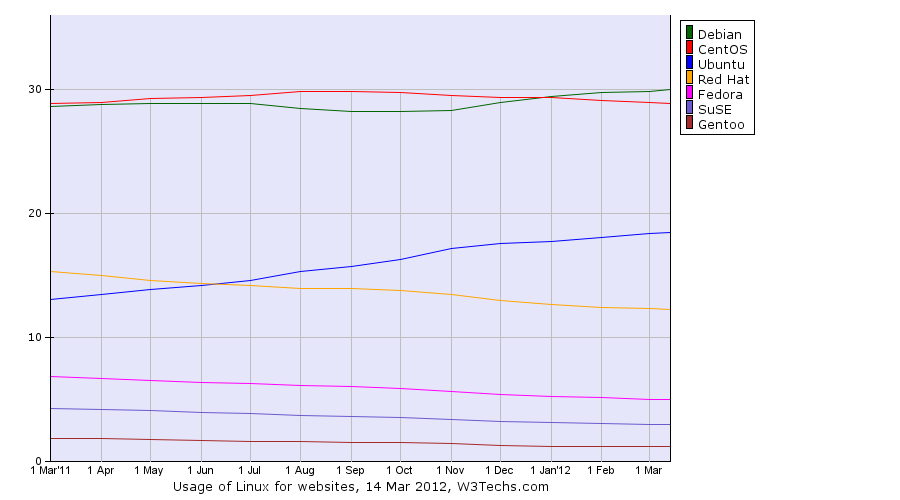
As we're doing trends today, I got curious about Debian. I don't particularly care about popularity contests other than popcon, and Debian choices surely aren't driven by them. But hey, curiosity is curiosity, right? So, here are today's w3techs trends for websites using GNU/Linux, with all lines shown:
Debian: 30%; CentOS: 28,9%; Ubuntu: 18,4%; Red Hat: 12,2%; Fedora: 5%; SuSE: 3%; Gentoo: 1,2%
(As thou shall always read methodologies before stats, here is the technologies overview page.) Debian is the top entrant with 30% of the websites using GNU/Linux. What I find interesting is that Debian has jumped at first place in January 2012, significantly after the release of our current stable release, Squeeze, that dates back to February 2011. It is also interesting to see community distros (Debian and CentOS) starkly ahead of commercially backed distros. That is what I find most fascinating about our projects. Whether that will remain the case or not is, for me, one of the big questions of the decade for the self-determination of Free Software communities.

Erich Schubert: Google Scholar, Mendeley and unreliable sources

Google Scholar and Mendeley need to do more quality control.
Take for example the article
A General Framework for Increasing the Robustness of PCA-Based Correlation Clustering Algorithms
Hans-Peter Kriegel, Peer Kr ger, Erich Schubert, Arthur Zimek
Scientific and Statistical Database Management (SSDBM 2008)
(part of my diploma thesis).
Apparently, someone screwed up entering the data into Mendeley and added the editors to the authors. Now Google happily imported this data into Google Scholar, and keeps on reporting the authors incorrectly, too. Of course, many people will again import this incorrect data into their bibtex files, upload it to Mendeley and others...
Yet, neither Google Scholar nor Mendeley has an option for reporting such an error. They don't even realize that maybe Springerlink - where the DOI points to - is the more reliable source.
On the contrary, Google Scholar just started suggesting to me that the editors are coauthors ...
They really need to add an option to fix such errors. There is nothing wrong with having errors in gathered data, but you need to have a way of fixing them.

Lisandro Dami&aacute;n Nicanor P&eacute;rez Meyer: QtSerialPort: a new hope

Some time ago I wrote about the status of Qt-based libs for using the serial port. Some days later I was pointed to the QtSerialPort project. The good news on this is that this is a project aimed to enter into Qt 5.

I have tested the lib with some apps that originally used QExtSerialPort. So far, so good. The license terms seems pretty OK (it wouldn't have got that far in the Qt code review if it weren't).

In the meantime, I received a reply to one of my messages from an upstream dev of QSerialPort (note that is Q and not Qt). He was very kind, but considering the effort to get QtSerialPort inside Qt itself, I think it's better to try to develop with this last lib.

Maybe I should try to package it and upload it to experimental.

Next.

Previous.