Search Results: "ina"

7 November 2011

Martín Ferrari: Oh, hai!

Ugh, in the last year and a half I've only posted once. With the move to Ireland, starting a new job, and then using too much Google+, I forgot about this blog thing. So, to start with something easy, I'll tell you about some films I watched recently. This weekend I had a marathon of films, after sometime without watching any, I watched two at home and two at my favourite cinema in Dublin: the IFI, which I recommend to anyone living here. First, on Friday, I watched Brazil, the 1985 classic from Terry Gilliam. It was a long overdue obligation to watch it, and some discussions with a friend about cinema made me finally do it. It was an amazing film. Among the many memorable scenes, and cinephile winks, I liked the one copying the famous Odessa steps sequence. The problems related to its US release reminded me a bit of the problems with the edition of Touch of evil, although in the case of Brazil, what the big studio did to the film was to butcher it. On Saturday I continued on the Gilliam streak and re-watched 12 Monkeys, which I had forgotten completely. Another great film, with a clearly bigger budget, it does not rely on the money but in the plot, art, and acting to be memorable. Also, I love the main theme, a tune from Astor Piazzolla called "Suite Punta del Este". Just after finishing the film, I read that some people from the local Couch Surfing group were meeting at the IFI to see one of the many features of the Polish film festival that took place this weekend. So I went and saw A short film about killing, a powerful and shocking movie about the death penalty. Considered by many to be one of the most horrifying depictions of a killing (two, in fact), it didn't shock me as much as some other films had done, maybe it was because of the cinema overdose... Anyway, it was another must-see. IMDB asserts that the Polish government suspended the death penalty in Poland for five years after the release of this film, but I could not find sources to confirm this. This morning I woke up pretty early, which is completely uncommon for me on a Sunday. So I decided to use the tickets offered by the IFI for a pre-screening that I had assumed I would not use, since I had to be in the cinema at 11! This time it was an Irish documentary about Bernadette Devlin, called Bernadette: Notes on a political journey. It was really interesting, even if I had never heard about this important figure of Ulster politics in the sixties. Sadly, because of my ignorance on the topic (and some northern accents that I have trouble understanding), I missed many parts of the film. In any case, it has increased my appetite to know more about the Troubles, which had started when I visited the Republican neighbourhood of Belfast, specially Falls road. Tags: Life, Planet Debian

6 November 2011

Gregor Herrmann: RC bugs 2011/44

this week showed an interesting mixture of RC bug fixes: applying patches from others, writing one on my one, adjusting build dependencies, & also closing some bugs that did not occur anymore during the last Grid'5000 run & are also unreproducible locally (thanks to Lucas for the hint).

Lucas Nussbaum: dash as /bin/sh, and now ld as-needed. Pattern?

I must admit that I ve never been a big fan of the dash as /bin/sh change. I have three main problems with the switch: POSIX compliance as an argument Complying to standards is a really good thing. But when everybody is ignoring the standard because they want the comfort of newer features, maybe it s a sign that the standard should be updated to include those newer features. Most of the bashims used everywhere in scripts were signifiant improvements, like the ability to write:
cp short1/path1,short2/path2 /very/long/common/path/to/a/file
instead of:
cp short1/path1/very/long/common/path/to/a/file short2/path2/very/long/common/path/to/a/file The option to improve bash was not fully explored We started with the premise that bash is bloated, slow, and cannot be improved. Maybe you can help me with that, but I could only find a few simplistic benchmarks comparing dash and bash, and I could not find any analysis of why bash is slow, and why it cannot be improved.
One of the obvious problems is that bash is also an interactive shell, and is linked to ncurses and terminfo, which increases the startup time. But have we investigated the possibility to have a /bin/bash-non-interactive binary that would not be linked to ncurses? The change was brought to users While it is OK for Debian (or Ubuntu, in that case, since that change was done in Ubuntu first) to force its developers to use POSIX-compliant scripts, the switch could have been made only to Debian-created scripts (by switching them from a /bin/sh shebang to a /bin/dash shebang, for example). I have trouble justifying that this change was forced on users as well. Next: linker changes and we are doing it again. A set of linker changes (see also the Ubuntu page) was already done in Ubuntu, and is very likely to be done in Debian as well. This switch requires deep changes in some buildsystems (it requires ordering of libraries and forbids indirect dependencies), and is rather painful (it was reverted before the Ubuntu 11.04 release because it was not possible to fix all the packages during the natty release cycle, but is done in the 11.10 release). Of course, there are justifications for this change. But I m not sure that it s worth all the trouble created for users.

5 November 2011

Christian Perrier: People behind Debian: Rapha l Hertzog, dpkg maintainer, book author

It's about time that Rapha l is interviewed in the "People behind Debian" series he initiated on his blog. Indeed, when he interviews people, Rapha l asks about other people they could suggest for next interviews. So, during mine, I suggested him to be a next "victim". As he couldn't interview himself, I volunteered for this. As you'll see below, Rapha l (who's a friend of mine as I'm a friend of his) likes to speak and that shows in the length of his answers :-) but you always know more about Debian when reading his blog posts, books, mails, etc. I personnally think that he is among the best promoters of the project for years and it was a pleasure for me to conduct this interview. My questions are in bold, the rest is by Rapha l. Who are you? Hi, Rapha l Hertzog, I'm a 32 years old French Debian developer who is married and who has a 2-year old son. I'm running my own company (Freexian) since 2005, I started it 3 years after the end of my computer science studies. I'm also a very proud author of the Cahier de l'Admin Debian, a French book about Debian. You often wrote about your attempts to make your living partly, if not completely, out of your Debian work. Can you describe the way you're trying to do this? My first try has been with Freexian. I always advertised this company as being specialized in Debian GNU/Linux. While Freexian is successful enough to provide me a decent income, I'm not really satisfied with the result because very few of my contracts are about improving Debian. I use Debian daily for the benefit of my customers, writing new customer specific (embedded) software, deploying a service on Debian servers, etc. But except for the occasional bugfix, all this work does not improve Debian (the only exception has been the dpkg multiarch implementation work sponsored by Linaro). The positive side is that I don't need to fill my entire schedule to earn enough money to live. So I'm regularly taking some days off work to be able to contribute to Debian. This is a freedom that I enjoy... My French book has also been a bestseller and depending on the years the royalties represented between 1 and 2 months of supplementary time that I can spend on Debian (that is between 2000 and 4000 EUR of income). Now since last year, I decided to actively work towards my goal of making a living out of my Debian work. I want to build on what has been most successful for me up to now, that is my book. My strategy has been to build an audience around my blog: with a direct contact with my readers I have the opportunity to sell e-books, and without any intermediary taking the biggest part of the price, I don't need a very large audience to be successful. I have also been experiencing micro-donations with Flattr, people who are enjoying my articles on my blog can use it to give a few cents for each article they find useful. With a large enough userbase, this could fund free documentation and would avoid the need for commercial e-books but we're not there currently and I don't know if it will ever reach the critical mass. Last but not least, I'm soliciting donations for my Debian work on the sidebar of my blog, and I have the chance to a have a few (regular) donators. You're a proud father since last year. How do you manage your commitment to the project with your family life? There are few things that I put above Debian in my life, but my family certainly is. I try to handle most of my Debian duties during work hours so that I can spend time with my family on evenings and during week-ends but in truth I never really disconnect from Debian. It happens quite often that I say to my wife I'll come in a few minutes, let me finish this and then I end up responding to a Debian mail, or an IRC query and take 30 minutes instead of the 5 expected ones. I try hard to avoid this but it's difficult. Luckily for me, my wife is very supportive of my Debian involvement and knows me well... By the way my wife is using Debian on her computer, and my son has already played with DoudouLinux (a Debian derivative!). Have you already been accused of self-promotion in your writings? If that would ever happen, what would you answer to that? Yes, more than once. I am proud of what I do for Debian, I enjoy sharing the result of my work. Because of this, some people believe that I'm selfish and egocentric. And this has somewhat increased since I have been soliciting donations: for me it's important to be transparent towards donators so that they see what I really do for Debian. But some people have the feeling that I'm getting undeserved attention and that I bring everything towards my own person. On the other side, as an author, I'm a public figure who is definitely seeking some attention... I don't have any miraculous answer, we are a large and diverse community, it's next to impossible to please everybody. I listen to all the concerns that people bring forward, I take them into account as much as possible, in particular when I believe they are reasonable/well justified, or when they come from people that I highly respect. But sometimes I have to plainly ignore them too... in particular when they are trying to impose their own political view on a topic that's not directly related to the only value that we all share: the social contract. Contributing to Debian is a challenge, we all have to make efforts to put aside our differences and to concentrate on the work that brings us closer to the best free software operating system ever built. You recently launched a campaign to free out the soon-to-be-published "Debian Administrator Handbook", an English version of your well-known book about Debian in French. Can you tell us more about this project? My French book has been very successful at helping people to get started with Debian, and like I already explained, it was also effective to fund a part of my Debian work. So I wanted to make it available world-wide by publishing an English translation of it. I tried to find an English-speaking editor willing to take on the challenge but I found none interested. Not put off by a setback, Roland (my co-author) and I decided to negotiate with our French editor Eyrolles to recuperate the necessary rights to translate the book into English. Handling everything ourselves represents a lot of work, but it also means that we have the freedom required to decide of the license of the resulting book. We would love to see it under a license compatible with the Debian Free Software Guidelines. But at the same time we firmly believe that we deserve a reasonable monetary compensation for the work on the book, so we conditioned its liberation to a predefined amount of money (25 K ) in what we call the "liberation fund". And since we wanted to be sure that we would have the required means to complete the translation, we used a crowfunding platform to seek support of people interested by the book. With such a platform you're only debited if the minimal requested amount is reached. Anyone can participate, pre-order the book and/or put some money in the liberation fund. As of today, we already reached the minimal funding goal (15 K ) so the book translation will happen. But the liberation target has not yet been reached so we don't know yet if the book will be free from the start... you can follow the progress right on the fundraising page or on the website dedicated to the book. PS: If you want to contribute to this project and also make a donation to Debian at the same time, you should check out this page. You're one of the main developers of dpkg, a critical tool for Debian systems. Can you tell us more about the current development challenges it is facing? What will be the new dpkg features for wheezy? The current challenges are not really technical. dpkg is a relatively mature piece of software and it will continue to work for the foreseeable future without needing much maintenance work. The real challenge is trying to setup a healthy developement community around it so that we can keep tackling new interesting problems (there are many listed in the roadmap and in the 225 wishlist bugs). There is a real problem of leadership and communication in the current team. We used to be three, and we're only two nowadays. Guillem is the legitimate leader since he's involved in dpkg's developement since early 2006 while I joined only in late 2007. But in the last 4 years, we did not manage to recruit anyone else on the team. Some persons tried to contribute significant new features (like Sean Finney with a rework of the way we handle configuration files) but they gave up frustrated after a while because we did not manage to review their work (and discuss the design) in any reasonable timeframe. Another famous case is Ian Jackson with his trigger work. His work got merged, but so late that in the mean time he blew up while trying to hijack the maintenance of dpkg. For a long time I was concentrating my work on the Perl part of dpkg (aka dpkg-dev mainly), so I did not feel qualified to review and merge work related to the C part and I was just a worried observator of this situation. I tried to improve it by setting up some basic review infrastructure, it should have brought some lisibility to the status of each change left to be reviewed... but it has not been used and it changed nothing. Over the years, I became much more interested in the C part. My first big contribution in C has been the rewrite of update-alternatives (from Perl to C). I made other small changes in between, but at the start of this year I had this great opportunity to work on the multiarch implementation (FYI, multiarch is the possibility to mix packages from several architectures on a single system). This really forced me to jump into the C codebase and learn a lot about how dpkg is implemented. Thanks to this I have been able to tackle other small projects (like the improved triggers). This would be all great if my multiarch work was already merged, but it's not. It's a large work, I do not mind waiting a bit in particular since Guillem is a highly skilled C programmer. His sharp analysis of new designs are invaluable, when he reviews code he always finds something to improve. I learnt a lot just by reviewing the code he wrote over the years. That said I have been waiting since April without almost no updates from him. With the release team asking us to hurry up, the situation is getting somewhat strained as I really want to see multiarch in Wheezy and I do not really want to short-circuit Guillem. Hum, I may have drifted a bit from your original question... what great new features can people expect? Well multiarch is supposed to be the big new feature, apart from that there aren't many things that matter to the end users. But there are already quite a few changes that are of interest to package maintainers (like hardened build flags, source package improvements, improved triggers, ). What's the biggest problem of Debian? Manicheism and a tendency to quickly polarize the discussions. In reality, there are very few situations where everything is all good or all bad. Ever since I have read The 7 Habits of Highly Effective People I try hard to put into practice the habits of interdependence . Instead of having only my point of view in mind, I try to understand the motivations from the other party ( Seek First to Understand, Then to be Understood ) in order to be able to put forward solutions acceptable to both parties ( Think Win-Win ). I highly recommend this book to anyone. And I invite everybody to at least try to follow those simple advices. Is there someone in Debian you admire for their contributions? There are many and I can't give an exhaustive list... here are some that I would like to highlight (in no particular order): Most of those people are working on improving Debian's infrastructure so that we can all be more effective and do an even better work. This kind of work is not always very visible but it's crucial to Debian's future. Thank you to Rapha l for the time spent answering my questions. I hope you enjoyed reading his answers as I did. And, anyway, it was fun to just play the game "the other way".

Ana Beatriz Guerrero Lopez: Help wanted for Google Code-in

Debian has applied to the Google code-in program as mentoring organization. In the Google code-in, pre-university students (ages 13-17), have the opportunity of contributing to Debian, trying to complete different tasks. We are hoping to get accepted and improve our outcome from last year. To achieve this, we need the help of more Debian contributors proposing and mentoring simple tasks for the students. Please take a take a look at the archives in the mailing list and join us with your proposals.
The list of tasks is at http://wiki.debian.org/GoogleCodeIn2011/Applying, we are specially missing translation and training tasks! You can also join us in the IRC channel #debian-soc (irc.oftc.net)

4 November 2011

Michael Prokop: FAI: switch from Subversion to Git

Revision one in the Subversion repository of the FAI project dates back to the 27th of June 2000. Over the last few months we were discussing the switch to Git. At the last FAI meeting we decided to finally switch to Git and I volunteered to drive the migration. Today I officially did the migration. I ve been using git-svn to handle the FAI svn repository for at least as long as I m wearing the FAI stable release manager hat. But the tags, author information, inside my git-svn checkout weren t ready for official publishing yet There are at least two different well known and referenced svn2git implementations out there. I decided to give the one hosted on github a shot because it s mentioned at http://help.github.com/import-from-subversion/. It basically uses git-svn and just does the few annoying steps for you that I d had to do manually otherwise. For more complex repositories the other svn2git implementation might be worth a try, especially since it s supported by the svneverever tool. svneverever supports more flexible rules regarding the repository layout (it was used for switching Gentoo s Portage from Subversion to Git). Luckily we didn t need it in our situation and I had experience with git-svn on the FAI repository already, so Converting the repository was as simple as running:

% svn2git svn://svn.debian.org/svn/fai --authors ../fai-svnauthors
The ../fai-svnauthors file contains all the svnuser = Realname <mail@example.org> mappings to get the author information right. Some 41 minutes later svn2git finished its work. Finally I pushed the result to the FAI repository at github. If you re interested in the repository size of svn vs. git:

Kai Wasserb ch: Greasemonkey scripts on dev.carbon-project.org

If you value your privacy, you might want to use a search engine like Ixquick which tries to protect your privacy. But if you value your privacy you probably have NoScript installed and have it hide <noscript> elements, as many pages hide tracking methods for users with deactivated JS in such tags. That makes every result page (but the first) inaccessible, because Ixquick has its non-JS navigation in noscript tags too. Now you could either activate JavaScript for Ixquick or work around this problem. Thanks to Greasemonkey and a little script I wrote, working around this issue is really easy. At this point, there is only this one script on dev.carbon-project.org, but in case I write another one, it'll end up there too. ;-)

Paul Wise: Migrating from Galeon to Iceweasel/Firefox

I have been a long-time user of the Galeon web browser, which, while powerful for its time, is getting a bit long in the teeth and has been abandoned for a long time. As a result I need to find something new. As Galeon uses the Mozilla engine I figure switching to Iceweasel/Firefox will be the least amount of pain since they share similar formats for lots of the user configuration and data (with the exception of history). Switching to Firefox also gives me access to a lot of configurability and a vast sea of extensions all written in RDF, JavaScript and zoooool (ahem, XUL). Another plus was that I was already using Firebug for the occasional web development project. Looking at the Mozilla addons site is like entering someone's shed. There will be the few beautiful unfinished projects still being worked on, one polished finished scuplture gathering dust but still admirable, things with power plugs from a bygone era, some things that have a coin slot on them, some cryptic machines with no visible screws or manuals, some spiders and their cobwebs and a few rats and mice chewing through things. A place where you can find some excellent, well documented, useful and Free Software extensions alongside lots of crud. Luckily for me the good stuff that I wanted to use was already in Debian or the friendly Debian Mozilla extension maintainers team was willing to package them for me. In my quest for freedom from Galeon I first noticed that there is no up button in Iceweasel. Bummer, I use that a lot so I went searching for extensions. I soon found one extension, but it hadn't kept up with the ever-changing Mozilla APIs so it fell by the wayside. Thanks to the leavers of breadcrumbs I picked up the trail to a new shiny and working extension. Lo-and-behold I found Uppity, which was all about going up and as it turns out, much better at that than Galeon. Thanks to MozExt team, thats solved, next! The next glaring problem was the lack of Galeon-style smart bookmarks. Before you ask, yes, Firefox smart keyword bookmarks are not the same thing. This was rediculously hard to search for due to the wording used by both projects being same same but different. Some folks switched to Epiphany to get the extra search boxes on their toolbars. Like this guy I was not interested in that, mainly due to the addons I would be missing out on. I tried a few different tacks, even searching for a way to have multiple search boxes in the Firefox toolbars. I soon gave up on finding an extension that would do this like Galeon does so I figured its time to roll up the sleeves and learn some zzzoooool. I already know a little bit about JavaScript and CSS so... First slap a dash of a tutorial about adding toolbar buttons, add a slither of adding extensions without installing them, stare down some Mozilla reference manuals, thrown in a pinch of favicons, give up on a wild goose chase or two, add a big fat blob of zoooool and sautee in fugly hacks. Soon enough you will have something hardcoded that works like Galeon smart bookmarks but looks even better. A screenshot of hacky galeon smart bookmarks in Iceweasel I may eventually turn this into a proper and functionally equivalent extension for Galeon-stlye smart bookmarks but for now it will remain a useful hack. If you want to get your hands dirty with zzzoooooool and try this out after modifying it to use your personal search URLs, please feel free to contact me. For now the only remaining issue I can see is that the forward/back buttons in Iceweasel don't have the explict menu buttons. This is a minor issue for me so now it is time for me to figure out how to migrate my data and config1 before permanently switching away from Galeon. Wish me luck! 1. Of course the data and config are fugly, but that is a something for another, much broader and more complicated hack

3 November 2011

Andrew Pollock: [life] Zoe at 18 months

Wow, a lot (of travel) has happened in the last three months. Zoe has been to Chicago, Langkawi, Brisbane, and is now back in Mountain View. I'm actually feeling really guilty about our carbon footprint for this year. She spent the last about 3.5 weeks in Brisbane with Sarah after the wedding in Langkawi, until I flew there last weekend for my sister's wedding. Losing and finding Smudge helped pass the time, as did having Liam stay with me while he was visiting from Zurich. I could have done without the former, but really appreciated the timing of the latter. There was quite a noticeable vocabulary difference when I finally saw Zoe again. I can't keep up with all the words she can say now, and she's starting to grasp concepts as well. For example, she opened a small cardboard box, and declared it "empty". Apparently we say "uh oh" a lot, as this is one of her favourite things to blurt out whenever anything happens, ranging from my sister's bridal train dragging on the ground at her wedding, to vomiting all over herself in the back of the car. She's definitely not going to be a girly girl. When the flight from Brisbane landed in Los Angeles she yelled out a big "WHOA!" and then "Again!" while furiously doing the baby sign language for "more". Fortunately we were able to oblige for the flight from LAX to San Jose, and she again enjoyed the landing (she got to sit in her own seat for this one) and did a loud "Wow!" and "Again!" I'm looking forward to taking her on her first roller coaster ride. Her canine teeth still haven't come through yet, but I think they've just started to make an appearance. We're still trying to de-jetlag her at the moment, so it's unclear if the wake-ups throughout the night are because of jetlag or teeth issues (or a combination of both). She handled all of the travel fairly well, although she's now too long for a aeroplane bassinet. She didn't get a lot of sleep on the 12.5 hour flight from Brisbane to Los Angeles (which meant we got none), but she was pretty well behaved for the bulk of it. She's good enough on her legs now that she can just tear up and down the aisles without incident, so we made countless laps of the plane to keep her occupied. The return flight was on Halloween, and the cabin crew had gotten into the spirit with temporary face tattoos, some cabin decorations and some "costumes". The trip back home was actually epic in that it was littered with minor annoyances, but I'll save that for a separate blog post. This Christmas should be a fun one, as she'll be old enough to be a bit more interactive about the whole thing. She may also freak out sitting on Santa's knee, so we may not get quite as nice a photo as we got last year.

Josselin Mouette: The lies of Merkozy

When George Papandreou announced its will to submit the European help program to the approbation of the Greek people, I don t know whether he wanted to scare people, but man, he really achieved something. From Wall Street to the Bundestag, through the lys e Palace, they are all in a state of advanced panic. There s a joke that s been circulating since: for next Hallowe en, disguise yourself as a referendum. Yes, these guys are afraid. Afraid of the people. They are afraid because it is now clear that their interests are not the same as the interests of the people. And what do you do when you are afraid? Well, you find yourself some way out, often by lying. And indeed, Mrs Merkel and Mr Sarkozy have been repeating over and over something that has been then repeated over and over by most so-called journalists: that Greeks can only choose between two endings:
  1. they pay their debts to banks and rich people, and stay in the Euro zone;
  2. they don t pay their debts to banks and rich people, and find themselves another currency.
That s it: Mrs Merkel and Mr Sarkozy are outrageous liars. There is another option for Greek people:
3. they don t pay their debts to banks and rich people, and they stay in the Euro zone.
It s as simple as that: nothing in European treaties can force a country to leave the Euro zone. And nothing in these treaties can force a country to honor their bonds. Greece is a sovereign state and, as such, can choose not to honor its sovereign debt. And choose to stay in the Euro zone: why would they want to go out? What does it have to do with the currency those bonds have been emitted in? If California were to cease payment of its public debt (something not likely to happen at all, hmm?), would it have to abandon the Dollar? But here is a thing that has been forbidden for a long time in European treaties: for a country to help financially another one to pay its debts. This rule was introduced by Jacques Delors (a man who knows what being European means) precisely in order to avoid the contagion we are facing currently because of stupid help plans all across Europe. Yes: the whole idea of Merkozy s grand plan to save Euro while helping Greece (a weird kind of help, starving people, really) is illegal. So in addition to being liars, Mrs Merkel and Mr Sarkozy are delinquents. So let Greece cease payment of its debt. A few banks will sink: so what? This will create less unemployment than letting our whole economy sink. European States will guarantee citizens savings up to 30 k , that s one of the other clever European rules (some countries guarantee more). Other people, rich people only, will lose their savings. Will that prevent you from sleeping? Not me. But that could prevent from sleeping a number of friends of Mrs Merkel s and Mr Sarkozy s. And wouldn t that be a good reason for lying and violating European treaties?

John Goerzen: Greece part 4: Food and Shopping

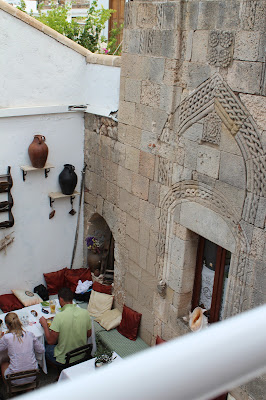
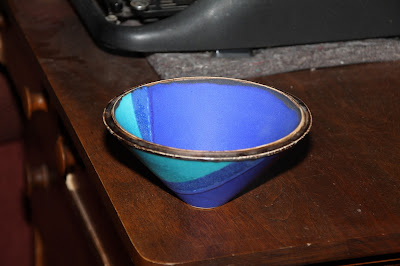
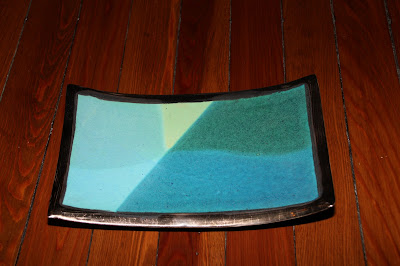
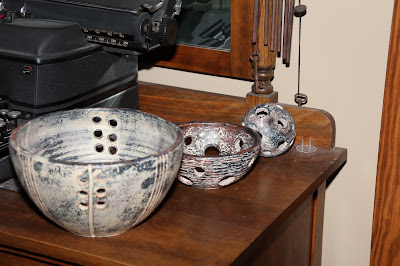
See also parts 1, 2, and 3. I am a person that enjoys food that s different from what s at home, and Rhodes didn t disappoint. Terah and I used to live close to an excellent Greek restaurant in Indianapolis, so we were already familiar in some way with the food. But there isn t any Greek restaurant at all in the Wichita area, so we missed it. Our favorite restaurant on Rhodes was Kalypso of Lindos. Everything there was just excellent, starting with the saganaki, one of my favorite Greek appetizers. I had yogurt with honey there for dessert both times we visited, a surprisingly tasty desert. Like many restaurants in Lindos, Kalypso had the option of eating on the rooftop, or at ground level. We ate on the roof, which had a nice view of the Lindos Acropolis. Being outdoors, there were sometimes cats around. This kitten enjoyed playing games with my shoestrings for awhile. Kalypso is at a 17th century captain s house. Here s a view of it from the rooftop: We, of course, had the chance to eat at quite a few different places during our visit, and I d go on way too long if I mentioned them all. Terah particularly enjoyed the gelaterie.gr ice cream shop in the square in Rhodes. We liked our lunch at Maria s Taverna in Lindos and enjoyed chatting with the staff there. I recently talked about shopping in Mexico, and perhaps learned a thing or two from that. I won t say we never buy them, but in general we don t buy souvenirs like t-shirts, plastic things made in China, etc. We prefer to buy local. Those items tend to be higher quality, more interesting, and we like to support the local economy. We also don t have lots of room for things, so we try to choose carefully. So it was something of a surprise to Terah, and perhaps even to me, when I suggested we go shopping one day. Terah typically enjoys shopping a lot more than I do. Anyhow, off we went to Lindos. One of the first things that had caught our eye in Lindos was the shop selling glass. But it wasn t just any glass; it appeared to be made with some sort of layered process, and has a distinctly three-dimensional feel to it. As you move around, it looks like the background shifts. We wound up with this item, which was made in Athens: By the time we visited Lindos specifically for shopping, we had a good feel for when the busy times of day were, so we could avoid them. It gave us the opportunity to visit with people and when they weren t busy, many shopkeepers liked to chat. I enjoy hearing people s stories and we heard several. One ceramics shop the Musa Shop -caught Terah s eye. They had such incredible and beautiful pieces outside that we just had to go in. We wound up with two pieces from there, both in shades of blue: Both remind me of the Aegean Sea and the deep blue sky of Rhodes. And then, as we were walking along, I pointed inside a shop and said to Terah, Hey, those look different. We went in, and eventually wound up buying these: The appearance, and even feel, of them is unlike anything I d seen. Quite interesting. And seeing those particular items in the Lakis Place shop led to making some new friends I ll write about it in the next post.

Michal &#268;iha&#345;: Photo gallery, finally

In last weeks, I've finally managed to create my personal gallery, where I could present selection of my photographs. This task was outstanding on my todo list for pretty long time, the major obstacle being selecting photos which to present there. During my sickness few weeks ago, I finally went through most of my photos and chosen the ones which I think are worth presenting. Still I did not manage to go through photos from half year spent in Japan, so these will be added sometimes later. Also most of the pictures miss descriptions, though I'm (slowly) fixing this. From technical side, the gallery is being generated using lazygal with custom theme. You can check the gallery on photos.cihar.com, I hope you will like it :-).

Filed under: English Photography 1 comments Flattr this!

Sandro Tosi: Print a NUL-terminated string with awk

I thought it would have been easier to print a NUL-terminated string in awk (mawk as it's the default in Debian), but after some trial-and-fail I was able to come up with this kinda ugly solution:


$ echo -e "123\n456" awk 'BEGIN ORS="" print $0 ; printf("%c", "") ' xargs -n1 -0 echo
123
456

That:

There's really no better way to do that?

Joey Hess: the Engelbart demo

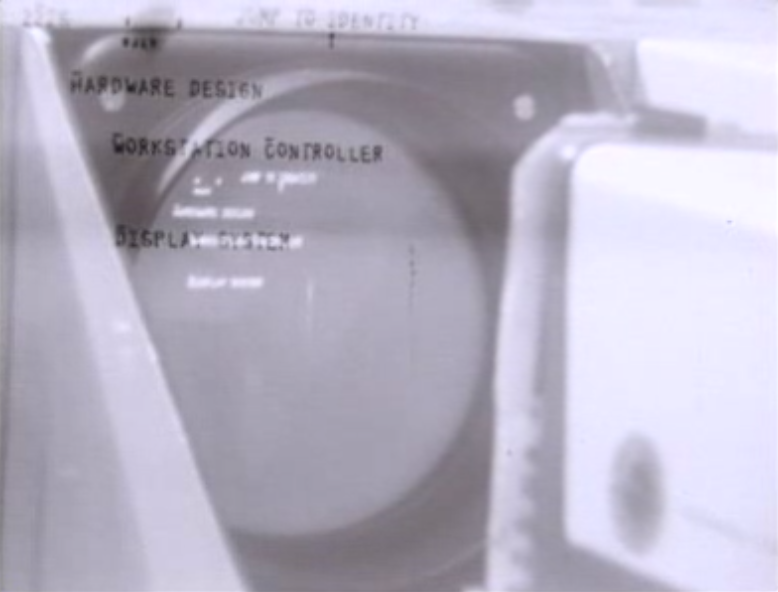
Just watched the whole Douglas Engelbart demo from 1968. Somehow I'd only heard of this as the first demo of the computer mouse, and only seen a brief clip on youtube. All three 30-minute reels of the film are available online, and well worth a watch in full. The mouse is the least of it, the demo includes an outlining text editor, model-view-controller, hypertext, wiki, domain specific programming languages, a precurser to email, bug tracking, version control(?), a chorded keyboard. (Ok, that last one didn't really take off.) Probably a dozen other things I've forgotten. All in a single interface, and all before I was born. Just like any tech demo, there are fumbles and mistakes, which is reassuring to anyone who has tried to give a tech demo. There's also the awesome crazy hack shown here. They could only afford these tiny, round CRTs, so they pointed a television camera at it, and the camera image was piped to their television console. (So add KVM switch to the list of firsts!) The demo was done in San Fransisco, with the computer system remote in Palo Alto, so in this image you see the text on the CRT overlaid with the video from the camera. Engelbart points out that the delay this added to the system acts as a short-term memory that filtered out flicker in the original display (and made the mouse have a mouse trail). To me it gives the whole demo a unique quality, as if it were underwater. Despite the piping around of audio and video signals, and the multiuser system, the glaring thing missing from the demo that we have these days is networking. Although there is this amusing bit at the end where they compile a regular expression and then apply it, in order to search for documents containing certain terms, and end up with a hyperlinked list of 10 results, ordered by relevance. Yes, think Google.

2 November 2011

Jon Dowland: Greece (Dodecanese islands)

private pool in Kos private pool in Kos
In August 2010, Sarah and I had a lovely (but short) week-long holiday in Rhodes, Greece. We thoroughly enjoyed it but I didn't document it here. When John Goerzen was looking for European holiday destinations earlier this year, I had no hesitation in recommending Rhodes. I am surprised and delighted that John took up my suggestion and loved it too! See John's holiday blogging for more on this beautiful place. This year we wanted to take a two-week holiday and have a similar experience again. We ended up choosing Kos, Greece. Kos was, perhaps not surprisingly, quite similar to Rhodes. We were based in "Hotel Oceanis" in Psalidi, on the north-east side, about ten minutes bus journey from Kos town. The hotel was very relaxing with plenty of space. It's based on the sea-side and has two public pools: the large main one and a smaller (but seemingly deeper) one adjacent to a snack bar. We were very lucky to find that the hotel had put is in a room with a private swimming pool! In total, we had four separate places to swim in the hotel. Kos town was similar to Rhodes town, but not quite as "historic" feeling. It was a bit larger/more spread-out. Some areas of the town are quite lively but we always managed to find pleasant and quiet places to eat and drink together. We had twice as much time and took advantage of that by hiring a car and visiting the rest of the island. In particular we loved the beach in Mastichari (middle-North), which had quite turbulent rolling waves. "Sunny beach" on the south coast was absolutely packed with holiday makers, but was none-the-less worth the look. All in all, my first two experiences of Greek islands were wonderful. One day, I'm sure we will return to (at least) Rhodes, but we may leave it for a while and see what the rest of the world has to offer in the mean time.

1 November 2011

Steve Kemp: Slaughter is at the cross-roads

There are many system administration and configuration management tools available, I've mentioned them in the past and we're probably all familiar with our pet favourites. The "biggies" include CFEngine, Puppet, Chef, BFG2. The "minis" are largely in-house tools, or abuses of existing software such as fabric. My own personal solution manages my home network, and three dedicated servers I pay for in various ways. Currently I've been setting up some configuration "stuff" for a friend and I've elected to manage some of the setup with this system of my own, and I guess I need to decide what I'm going to do going forward. slaughter is well maintained, largely by virtue of not doing too much. The things it does are genuinely useful and entirely sufficient to handle a lot of the common tasks - and because the server-side requirement is a HTTP server, and the only client-side requirement is CRON it is trivial to deploy. In the past I've thought of three alternatives that would make it more complex: Each approaches have their appeal. I like the idea of only executing GPG-signed policies, and that would be trivial if there was a real server in place. It could also use SSL because that's all you need for security (ha!). On the other hand using rsync allows me to trivially implement the only missing primitive I actually miss at times - the ability to recursively download and install a remote directory tree. (I solve this problem by downloading a .tar file and unpacking it. Not good. Doesn't cope with template expansion and is fiddlier than I like). In the lifetime of the project I think I've had 20-50 feature requests or comments, which suggests it might actually be used by 50-100 people. (Ha! Optimism) In the meantime I'll keep a careful eye on the number of people who download the tarball & the binary packages... ObQuote: "I have vermin to kill. " - Kill Bill

Sylvain Beucler: Build a SFML project with CMake

[Latest version of these instructions can be found at the SFML Wiki] CMake allows your project to be built in various environments, including command-line make, Code::Blocks project files, Eclipse project files, etc. It's used in SFML 2.0. In this tutorial we'll write a simple CMake configuration file with centralized version numbering, and see how to integrate SFML in it. The source files First, create a cmake_modules directory and copy FindSFML.cmake in it. FindXXXX is automatically searched by CMake's find_package command. Then create a main.cpp, for instance:
#include "config.h"
#include <iostream>
#include <SFML/Window.hpp>
using namespace std;
int main(int argc, char* argv[])  
  cout << "Version " << myproject_VERSION_MAJOR << "." << myproject_VERSION_MINOR << endl;
  sf::Window screen(sf::VideoMode(800, 600), "myproject");
  bool running = true;
  while (running)  
    screen.Display();
   
 
We use a config.h file that is built by CMake, let's also create a config.h.in file:
#define myproject_VERSION_MAJOR @myproject_VERSION_MAJOR@
#define myproject_VERSION_MINOR @myproject_VERSION_MINOR@
And place your project license (such as the GNU GPL) in a file named COPYING. CMake configuration Let's describe our project configuration in the CMakeLists.txt file:
cmake_minimum_required(VERSION 2.6)
project(myproject)
# Set version information in a config.h file
set(myproject_VERSION_MAJOR 1)
set(myproject_VERSION_MINOR 0)
configure_file(
  "$ PROJECT_SOURCE_DIR /config.h.in"
  "$ PROJECT_BINARY_DIR /config.h"
  )
include_directories("$ PROJECT_BINARY_DIR ")
# Define sources and executable
set(EXECUTABLE_NAME "myproject")
add_executable($ EXECUTABLE_NAME  main.cpp)
# Detect and add SFML
set(CMAKE_MODULE_PATH "$ CMAKE_SOURCE_DIR /cmake_modules" $ CMAKE_MODULE_PATH )
find_package(SFML 1.6 REQUIRED system window graphics network audio)
target_link_libraries($ EXECUTABLE_NAME  $ SFML_LIBRARIES )
# Install target
install(TARGETS $ EXECUTABLE_NAME  DESTINATION bin)
# CPack packaging
include(InstallRequiredSystemLibraries)
set(CPACK_RESOURCE_FILE_LICENSE "$ CMAKE_SOURCE_DIR /COPYING")
set(CPACK_PACKAGE_VERSION_MAJOR "$ myproject_VERSION_MAJOR ")
set(CPACK_PACKAGE_VERSION_MINOR "$ myproject_VERSION_MINOR ")
include(CPack)
The interesting part is:
# Detect and add SFML
set(CMAKE_MODULE_PATH "$ CMAKE_SOURCE_DIR /cmake_modules" $ CMAKE_MODULE_PATH )
find_package(SFML 1.6 REQUIRED system window graphics network audio)
target_link_libraries($ EXECUTABLE_NAME  $ SFML_LIBRARIES )
Compilation To build with Make and the GCC compiler on the command-line:
cd build/  # a separate directory so we can easily remove all the CMake work files
cmake ..  # generate Makefile's
make
To create Code::Blocks project files:
cmake .. -G "CodeBlocks - Unix Makefiles"
and open project.cbp with Code::Blocks. Installation CMake supports the classic:
make install
It also supports DESTDIR, useful in packaging:
make install DESTDIR= pwd /myworkdir
You can also define CMAKE_INSTALL_PREFIX when invoking cmake to change the default install path (/usr/local under Unix). DESTDIR would still override this setting. Packaging You then can use cpack to make a project release:
# Binary package:
cpack -C CPackConfig.cmake
# Source package:
cpack -C CPackSourceConfig.cmake
You will get a nice myproject-1.0.tar.gz, among others. Further information
$ cmake --help-variable CMAKE_SOURCE_DIR
cmake version 2.8.5
  CMAKE_SOURCE_DIR
       The path to the top level of the source tree.
       This is the full path to the top level of the current CMake source
       tree.  For an in-source build, this would be the same as
       CMAKE_BINARY_DIR.

Bernhard R. Link: File ownership and permissions in Debian packages

As you will know, every file on a unixoid system has some meta-data like owner, group and permission bits. This is of course also true for files part of some Debian package. And it is not very surprising that different files should have different permissions. Or even different owners or groups. Which file has which settings is of course for the package maintainer to decide and Debian would not be Debian if there were not ways for the user to give their own preferences and have them preserved. This post is thus about how those settings end up in the package and what is to be observed when doing it. As you will also have heard, a .deb file is simply a tar archive stored as part of an ar archive, as you can verify by unpacking a package manually:
$ ar t reprepro_4.8.1-1_amd64.deb
debian-binary
control.tar.gz
data.tar.gz
$ ar p reprepro_4.8.1-1_amd64.deb data.tar.gz   gunzip   tar -tvvf -
drwxr-xr-x root/root         0 2011-10-10 12:05 ./
drwxr-xr-x root/root         0 2011-10-10 12:05 ./etc/
drwxr-xr-x root/root         0 2011-10-10 12:05 ./etc/bash_completion.d/
-rw-r--r-- root/root     19823 2011-10-10 12:05 ./etc/bash_completion.d/reprepro
drwxr-xr-x root/root         0 2011-10-10 12:05 ./usr/
drwxr-xr-x root/root         0 2011-10-10 12:05 ./usr/share/
--More--
(For unpacking stuff from scripts, you should of course use dpkg-deb --fsys-tarfile instead of ar gunzip. Above example is about the format, not a recipe to unpack files). This already explains how the information is usually encoded in the package: A tar file contains that information for each contained file and dpkg is simply using that information. (As tar stores numeric owner and group information, that limits group and owner information to users and groups with fixed numbers, i.e. 0-99. Other cases will be covered later.) The question for the maintainer is now: Where is the information which file has which owner/group/permissions in the .tar inside the .deb, and the answer is simple: It's taken from the files to be put into the .deb. This means that package tools could simply be implemented first by simply calling tar and there is no imminent need to write you own tar generator. It also means that the maintainer has full control and does not have to learn new descriptive languages or tools to change permissions, but can simply put the usually shell commands into debian/rules. There are some disadvantages, though: A normal user cannot change ownership of files and one has to make sure all files have proper permissions and owners. This means that dpkg-deb -b (or the usually used wrapper dh_builddeb) must be run in some context where you could change the file ownership to root first. This means you either need to be root, or at least to fake being root by using fakeroot. (While this could be considered some ugly workaround, it also means upstream's make install is run believing to be root, which also avoids some -- for a packager -- quite annoying automatisms in upstream build scripts assuming a package is not installed system wide if not installed as root). Another problem are random build host characteristics changing how files are created in the directory later given to dpkg-deb -b. For example an umask which might make all files non-world-readable by default. The usual workaround is to first fix up all those permissions. Most packages use dh_fixperms for this, which also sets executable bits according to some simple rules and has some more special cases so that the overall majority of packages does not need to look at permissions at all. So using some debhelper setup, every special permissions and all owner/group information for owner groups with fixed numbers only needs to be set using the normal command line tools between dh_fixperms and dh_builddeb. Everything else happens automatically. Note that games is a group with fixed gid. So it is not necessary (and usually a bug) to change group-ownership of files withing the package to group games in maintainer scripts (postinst,...). If a user wants to change permissions or ownership of a file, dpkg allows this using the dpkg-statoverride command. This command essentially manages a list of files to get special treatment and ownership and permission information they should get. This way a user can specify that files should have different permissions and this setting is applied if a new version of this file is installed by dpkg. Being a user setting especially means, that packages (that means their maintainer scripts) should not usually use dpkg-statoverride. There are two exceptions, though: Different permissions based on interaction with the user (e.g. asking question with debconf) and dynamically allocated users/groups with dynamic id. In both cases one should note that settings to dpkg-statoverride are settings of the user, so the same care should be given as to files in /etc, especially one should never override something the user has set in there. (I can think of no example where calling dpkg-statoverride --add without dpkg-statoverride --list in some maintainer script is not a serious bug: Either you override user settings or you are using debconf as a registry. Moral To recap, your package is doing something wrong if:

Rapha&#235;l Hertzog: My Debian activities in October 2011

This is my monthly summary of my Debian related activities. If you re among the people who made a donation to support my work (130.30 , thanks everybody!), then you can learn how I spent your money. Otherwise it s just an interesting status update on my various projects. Dpkg work The month started with fixing newly reported bugs to prepare the 1.16.1.1 release: With the help of Guillem, we decided on a proper fix for a race condition sometimes triggered by parallel builds when 2 concurrent dpkg-gencontrol try to update debian/files (see #642608). This ended up requiring a new package (libfile-fcntllock-perl) that the Debian perl team kindly packaged for us. With all this sorted, it was a rather easy fix. Multiarch progress I also spent lots of time on multiarch. I fixed an old bug that requested to support the multi-arch paths in case of cross-building (see #595144), the discussion was not really conclusive on which of the two proposed patches was better so I ended up picking my own patch because it was closer to how we currently deal with cross-building. Then I fixed 2 issues that have been reported on Ubuntu s dpkg. The first one (LP #863675) was rather severe since an installed package ended being disappeared in favor of its foreign counterpart that was removed (but that had some config files left). The second one (LP #853679) only affected dselect users (apparently there are still some!) who had a self-conflicting library (Provides: foo, Conflicts: foo) installed for multiple architectures. But the bulk of the time spent on multiarch has been spent discussing with various parties on how to go forward with multiarch. The release team commented on the schedule of the merge to ensure it makes it into Wheezy, and the Debian project leader also commented on the problems encountered so far. While not the best course of action I could have hoped for, it certainly helped since Guillem started pushing some reviewed commits. Out of the 66 commits that were in my pu/multiarch/full branch one week ago, 20 have been merged in the master branch already. Python-django security update and RC bug Since python-django s maintainer did not manage to prepare the required security updates, I stepped in and prepared version 1.2.3-3+squeeze2 for Squeeze and 1.0.2-1+lenny3 for Lenny. Unfortunately this security update is an example of how an inactive maintainer is likely to result in a severe delay for the release of security updates. Furthermore in this specific case, the security team did not want to release the Squeeze security update until the Lenny one had been investigated (which required some time since upstream no longer supports the version in Lenny) but they did not make this very clear. Later another release critical bug had been filed against the package (#646634) but after investigation, it turned out to be a local configuration problem so I downgraded it. I still forwarded the test suite failure to upstream authors since the test could be enhanced. In any case, co-maintainers for python-django are welcome. I really preferred the situation where I can quietly sit down as backup maintainer :-) WordPress packaging WordPress sounds similar to python-django. I m also only a backup maintainer but Giuseppe has been inactive for many months and I had to step in August because I wanted the new upstream version. I discovered a bit late that I was not subscribed to wordpress bugs and thus the release critical bug #639733 (that I introduced with my new upstream version) went unattended for a rather long time. Once aware, though, I quickly fixed it. I also took the opportunity to start a discussion on debian-devel about how to deal with embedded javascript libraries and proposed a mechanism of opportunistic replacement with symlinks . WordPress is my testbed package for this mechanism, you can check out its debian/dh_linktree that implements the replacement logic. The discussion has not been very interesting but at least I learned that Debian now requires that each source package shipping minified javascript files includes the original files too. It s somewhat of a pain since it s not a license requirement in many cases (many of those libraries are not under the GPL), but just a Debian requirement that many upstreams are not complying with. WordPress is affected and Jakub Wilk thus opened #646729 which is going to be a long-standing RC bug. To give good measures, I spent several hours investigating the case of each javascript file in the WordPress source package and I filed a new ticket on the upstream bugtracker. Dropbox packaging work A few months after the introduction of nautilus-dropbox to Debian and Ubuntu, I can say that the decision to only support the download of dropbox in the postinst has been a mistake. Because of this decision I had to make the postinst fail if the download failed. Even if the error message is relatively clear, this lead to many (mostly automated) bug reports on the Ubuntu side. Various other problems cropped up on top of this (trying to start dropbox while the package was not configured would result in an error because the user did not have the required rights to install the software, reinstalling the package while dropbox was running would result in a failure too, etc.). I have fixed all those issues in the version 0.7.0-2 of the package. Now if the user has to install dropbox, it will use PolicyKit to request the root rights. The postinst will no longer fail if the dropbox download fails since it can be run later by the user. And I fixed the download code to remove the replaced file before unpacking a new file (insead of overwriting the existing file). All this work has been forwarded upstream. The Debian Administrator s Handbook Update I m glad to tell you that the translation will happen because we reached the minimal funding goal on October 22th with the help of 380 supporters. Now the fundraising continues, but this time the goal is the liberation of the resulting book. For this to happen, we need to reach 25000 EUR in the liberation fund. So far we re at 37% of this goal with 9400 EUR in the liberation fund (which means that 59% of the money raised has been put in the liberation fund).

Click here if you want to contribute towards the liberation of this book. With (less than) 27 days left, it s going to be a challenge to meet the goal, but we do like challenges, don t we? Misc work

Thanks See you next month for a new summary of my activities.

2 comments Liked this article? Click here. My blog is Flattr-enabled.

31 October 2011

Jon Dowland: Rage

Rage is the latest game by Id Software, a company whose prior work I have an immense fondness for. I picked it up at the same time as buying a refurbished Playstation 3 a few weeks ago. Sadly, I'm not too impressed. The graphics are very pretty, most of the time, but the PS3 suffers the same problem which has plagued the PC version, namely, texture pop-up: A noticeable delay for a low-resolution texture to be swapped in for a high-resolution one. I'm only about 45 minutes in but my experience mirrors that of Rock Paper Shotgun's: It's desperately trying to disguise it's own linearity. Finally, and most crucially, I'm suffering majorly from motion sickness after more than a few minutes of play. This might be related to the fact that Rage's framerate is apparently double that of most games at 60 frames per second. Whatever the explanation, I can't play it if it makes me sick to do so! I may trade it in for the similarly-themed Fallout: New Vegas, which I held off buying simply because I thought two post-apocalyptic FPS games was too many. I loved Fallout 3 (albeit on Xbox 360), logging perhaps 50+ hours of play with plenty more to do; but I don't think I could return to the beginning of that game.

Next.

Previous.