Search Results: "ag"

8 December 2015

Michal Čihař: Weekly phpMyAdmin contributions

As announced earlier, I will try to publish weekly reports on contributing to the phpMyAdmin. Here comes the first one. Last week I've focused on some pain points with deploying phpMyAdmin and improved these a bit. The installation using PHP Composer is now documented. It's far from being perfect (you have to add our repository), but it seems to work fine. What was more challenging for me is Docker support. I've never really used it so far, so I had to learn some things about the filesystem layering (to avoid too big image), but now it's there. You can get the sources from GitHub, it's available on Docker Hub and of course it is covered by our documentation. Bugs fixed:

Filed under: English phpMyAdmin 0 comments

Dirk Eddelbuettel: Rblpapi 0.3.2

The second update to the Rblpapi package (since the initial CRAN upload in August) is now available. Rblpapi connects R to the Bloomberg system, giving access to a truly vast array of time series data and custom calculations. This release brings a new subscribe() function for real-time data, written by Whit. Don't get too excited because R's single-threadedness places some limits of the usefulness of this--but it is still tremendously valuable for checking other data sources etc pp. Also included in this release are a ton of bug fixes, many contributed by Rademeyer -- see below for more details.
Changes in Rblpapi version 0.3.2 (2015-12-07)
  • A new subscribe() function supports live data subscription for a set of tickers and fields (#88).
  • In the beqs() example the correct date format is used (PR #85 by Rademeyer).
  • Both getTicks() and getBars() now check the start and end times for proper Datetime class.
  • The getBars() function now also return the value traded (request of #89).
  • An error in the documentation for bdh was corrected (PR #93 by Rademeyer closing #85).
  • The beqs() function is now more robust with respect to empty return columns (PR #100 by Rademeyer fixing ticket #99).
  • The getBars() function now uses a single (named) vector options to pass optional values to the underlying function (PR #105 updating PR #48 and fixing #47).
  • When R is built with libcurl support, it used to download the build-time library and headers; otherwise curl is used. This avoids an issue on OS X where curl is insufficient.
Courtesy of CRANberries, there is also a diffstat report for the this release. As always, more detailed information is on the Rblpapi page. Questions, comments etc should go to the issue tickets system at the GitHub repo.

This post by Dirk Eddelbuettel originated on his Thinking inside the box blog. Please report excessive re-aggregation in third-party for-profit settings.

7 December 2015

Francois Marier: Tweaking Cookies For Privacy in Firefox

Cookies are an important part of the Web since they are the primary mechanism that websites use to maintain user sessions. Unfortunately, they are also abused by surveillance marketing companies to follow you around the Web. Here are a few things you can do in Firefox to protect your privacy.

Cookie Expiry Cookies are sent from the website to your browser via a Set-Cookie HTTP header on the response. It looks like this:
HTTP/1.1 200 OK
Date: Mon, 07 Dec 2015 16:55:43 GMT
Server: Apache
Set-Cookie: SESSIONID=65576c6c64206e6f2c657920756f632061726b636465742065686320646f2165
Content-Length: 2036
Content-Type: text/html;charset=UTF-8
When your browser sees this, it saves that cookie for the given hostname and keeps it until you close the browser. Should a site want to persist their cookie for longer, they can add an Expires attribute:
Set-Cookie: SESSIONID=65576c...; expires=Tue, 06-Dec-2016 22:38:26 GMT
in which case the browser will retain the cookie until the server-provided expiry date (which could be in a few years). Of course, that's if you don't instruct your browser to do things differently.

Third-Party Cookies So far, we've only looked at first-party cookies: the ones set by the website you visit and which are typically used to synchronize your login state with the server. There is however another kind: third-party cookies. These ones are set by the third-party resources that a page loads. For example, if a page loads JavaScript from a third-party ad network, you can be pretty confident that they will set their own cookie in order to build a profile on you and serve you "better and more relevant ads".

Controlling Third-Party Cookies If you'd like to opt out of these, you have a couple of options. The first one is to turn off third-party cookies entirely by going back into the Privacy preferences and selecting "Never" next to the "Accept third-party cookies" setting (network.cookie.cookieBehavior = 1). Unfortunately, turning off third-party cookies entirely tends to break a number of sites which rely on this functionality (for example as part of their for login process). A more forgiving option is to accept third-party cookies only for sites which you have actually visited directly. For example, if you visit Facebook and login, you will get a cookie from them. Then when you visit other sites which include Facebook widgets they will not recognize you unless you allow cookies to be sent in a third-party context. To do that, choose the "From visited" option (network.cookie.cookieBehavior = 3). In addition to this setting, you can also choose to make all third-party cookies automatically expire when you close Firefox by setting the network.cookie.thirdparty.sessionOnly option to true in about:config.

Other Ways to Limit Third-Party Cookies Another way to limit undesirable third-party cookies is to tell the browser to avoid connecting to trackers in the first place. This functionality is now built into Private Browsing mode and enabled by default. To enable it outside of Private Browsing too, simply go into about:config and set privacy.trackingprotection.enabled to true. You could also install the EFF's Privacy Badger add-on which uses heuristics to detect and block trackers, unlike Firefox tracking protection which uses a blocklist of known trackers.

My Recommended Settings On my work computer I currently use the following:
network.cookie.cookieBehavior = 3
network.cookie.lifetimePolicy = 3
network.cookie.lifetime.days = 5
network.cookie.thirdparty.sessionOnly = true
privacy.trackingprotection.enabled = true
which allows me to stay logged into most sites for the whole week (no matter now often I restart Firefox Nightly) while limiting tracking and other undesirable cookies as much as possible.

Jonathan Dowland: Download codes are distinct copies of albums

In CDs should come with download codes, I argued that CDs should come with a coupon to obtain a digital copy of the album, much like a lot of modern vinyl releases do. What didn't occur to me at the time is that there's a difference in how we think about copies of albums that we obtain that way, versus ripping a CD. When we rip a CD, we are making a personal copy of the media. We've bought a physical "token" that represents our "ownership" of the music, and we've made a copy of that privately for our own convenience. If we decide to get rid of the CD, then morally we really should get rid of the digital copy, too, as we've transferred our "ownership" to someone else. Of course we don't really own the music on the CD in the first place and in the UK it's technically not legal to make a copy, even a private copy for personal use, but that's another story. With a download code, the situation is quite different. If you buy a record with a download code, you have (at least) two copies of the album. You don't make a second copy yourself, it has already been made. And if you decide to pass on the physical album, I don't think there is any moral expectation that you should delete your digital copy.

Russ Allbery: git-pbuilder 1.39

This update isn't anything particularly exciting, just some more documentation improvements (gbp buildpackage is now the standard invocation instead of git-buildpackage), so instead you get some explanation of this flurry of little software releases. Since the huge transition a year and a half ago, I've been doing lots of adjustment to a different employer, a different commute, a different schedule, different types of work (which has changed several times), different management chains (which have changed even more), and the political and social environment at a new place. Oh, and then moving for the first time in about fifteen years. All of that has meant a lot of distraction and disruption, and that, in turn, really torpedoed my free software work for a while. The silver lining is that it also gave me some distance from all the things I was working on, and an opportunity to think harder about what I want to do and how I want to allocate time. So, I did a bit of a prioritization exercise (although I should do a few more), thought about what I really wanted to focus on, and have been putting some more effort into making time for free software work, community things, and similar work that I'd been letting slip. I'm also doing less of a few things, particularly trying to stay up on random email (so expect me to not be as good of a correspondant), just because there aren't enough hours in the day. Anyway, hence the flurry. Not making any committments, as committment stress is something else I'm getting away from, but it was a fun and productive weekend. You can get the latest version of git-pbuilder from my script distribution page. (Still want to rewrite this in Python at some point.)

C.J. Adams-Collier: LLC-Technologies-Collier/Demo-SCCC-Byte-AngularJS

Hello dear readers and attendees, This is the post that I will be/ will have been referencing during my presentation to the Seattle Central Community College s Byte club on Thursday, December 10th at 1500-1630. I will begin with a bit of an autobio and find out what kind of students we have in attendance. Please feel free to comment if you d like to keep in touch before or after the presentation. I will discuss some of the bits and pieces of some industry standard platforms which I ve developed, deployed, maintained, managed, co-operated, administered and replaced. We can discuss some of the patterns that work well in the industry, and some that are a bit harder to tame. Once we have touched most of the areas of specialization represented at the meeting, I will dive in to an AngularJS demo I am developing in github here: https://github.com/LLC-Technologies-Collier/Demo-SCCC-Byte-AngularJS/tree/master To follow along with the presentation, please run these commands or something similar. My development environment is Debian stable. So yes, this means that we re not doing a demo of the state of the art. But it also means that the infrastructure has been exercised under load and in production. Install Debian package dependencies First, install the debian packages of nodejs and npm, the node package manager:
cjac@debian0:~$ sudo apt-get install nodejs nodejs-dev nodejs-legacy npm
Check out the git repository After this, check out the repository from github and create a branch for your work:
cjac@debian0:~$ mkdir -p /usr/src/git/github/LLC-Technologies-Collier
cjac@debian0:~$ cd /usr/src/git/github/LLC-Technologies-Collier
cjac@debian0:/usr/src/git/github/LLC-Technologies-Collier$ git clone git@github.com:LLC-Technologies-Collier/Demo-SCCC-Byte-AngularJS.git
...
cjac@debian0:/usr/src/git/github/LLC-Technologies-Collier$ cd Demo-SCCC-Byte-AngularJS
cjac@debian0:.../Demo-SCCC-Byte-AngularJS$ git checkout -b $USER
Upgrade to latest npm, install deps Once we have the git repository checked out, we ll grab the latest version of npm and the rest of the node modules
cjac@debian0:.../Demo-SCCC-Byte-AngularJS$ export PATH="$PWD/node_modules/.bin:$PATH"
cjac@debian0:.../Demo-SCCC-Byte-AngularJS$ npm install --save-exact npm@"2.1.0"
cjac@debian0:.../Demo-SCCC-Byte-AngularJS$ npm install --save-exact  cat pkgackage-list.txt 
This post and the associated git repository will be updated between now and the presentation on Thursday. Please chime in and feel free to get involved! C.J.

Russ Allbery: Term::ANSIColor 4.04

The recent work I've been doing on podlators taught me that the build system of my other core module, Term::ANSIColor, was also doing the wrong thing when installed on Perl versions older than 5.11, even though no one had reported it. While I was there, I also switched back to ExtUtils::MakeMaker for the build system so that I'm testing the same build system that's also used for Perl core. Since it had been more than a year since the last release, I also made some minor cleanup of new perlcritic warnings and fixed a place where coverage analysis was misanalyzing a bit of code. There are no significant code changes. You can get the latest version from the Term::ANSIColor distribution page.

6 December 2015

Russ Allbery: podlators 4.03

There was a bug in the test suite of the last few versions of podlators that caused the test for devising dates to fail if POD_MAN_DATE or SOURCE_DATE_EPOCH were already set. Since I needed to fix that anyway, I decided to poke at the test suite some more, and made some good progress towards refactoring it, breaking out common code, and making it easier to add new tests. It's still in the stage where I've added more code than I've removed, but a lot of that is comments and the new code is much better. It was tempting to keep going until I'd refactored the whole test suite, but that's how I go too long between releases, so here, have another small release. The only changes are in the test suite, not in the code. You can get the latest version from the podlators distribution page.

Guido G nther: Debian Fun in November 2015

Debian LTS November was the seventh month I contributed to Debian LTS under the Freexian umbrella. In total I spent ten hours working on: Other Debian stuff

Jose M. Calhariz: Taking over the development of at daemon.

I decided some time ago to take over the development of at daemon. Here is a new release of at v3.1.17 From the Changelog:
at 3.1.17 (2015-08-31):
  Jose M Calhariz:
        at.1.in: Document behaviour when using past time, thanks Kelly Price (Closes: #639900).
        Makefile.in: On distclean remove at.allow.5, auto generated file.

Elena 'valhalla' Grandi: Blocked by indiegogo because of blocked javascript?

Blocked by indiegogo because of blocked javascript?

I usually browse the web with javascript blocked, for obvious security reasons and slightly less obvious free software reasons https://www.gnu.org/philosophy/javascript-trap.html, adding sites to a temporary whitelist when absolutely needed.

I know that this hurts the revenue model of many websites, in some cases I'm sorry, in other cases I pay a subscription so that I don't have to be sorry, and in other cases I just don't care, depending on the service they provide.

One thing that I hate are websites that require javascript even to show their basic contents: I understand why some of them are doing it, but less so when they aren't getting money from ads, but from actually providing a paid service, such as indiegogo.

This morning I was browsing a campaign on that crowdfunding site, grudgingly allowed javascript from their domain to be able to see the campaign description and suddenly found this:

Immagine/fotohttp://social.gl-como.it/photo/dde1ddaa79d831ffbc2bee30110a2497.png

So ok, they want me to confirm I'm a human, ok, I'm fine with that, but asking for personal identification? just to be able to browse your site securely? No thanks. The support page linked in that says that this company also support just asking to fill a captcha, which is probably not as effective, but also much less intrusive.

I was browsing a campaign for an (apparently) open hardware encryption device, which is probably enough these days to get you somewhat under the radar (luckily, I am already, and I have a t-shirt to prove it :) ), so being asked to identify myself before I could even start considering whether the device was interesting enough to support (in a public-ish way) was expecially bad.

So, if you are working on something like that, maybe you could consider using a different crowdfunding website, one that respects more their users?

5 December 2015

Russ Allbery: git-pbuilder 1.38

A minor update to the builder glue script for git-buildpackage. This release just has documentation fixes. I had missed that you no longer need explicit gbp.conf configuration because git-buildpackage now has a --git-pbuilder flag, and, when using that, there are a variety of other command-line flags to use instead of environment variables. Thanks to Ken Dreyer for the fixes. You can get the latest version from scripts distribution page.

Lunar: Everyone can be a target

My flight from Athens where I had the pleasure to attend the first reproducible world summit landed at the scheduled time in Paris (CDG). While people were getting their bags and putting their coats on, one member of the cabin crew announced that a police control will take place outside the plane and that we should have ready identity documents. My seat was in the back of the plane, so I had time to wait in the cold of the jetway while all passengers were controlled one after the other. Three cops were set up right at the entrance of the terminal. One was taking cards or passports and looking at people's face. He then passed it to another cop in front of a suitcase that seemed to contain a scanner and a computer. The third one was just standing against the wall watching. When it was my turn, after scanning my passport, the cop had this nice gesture where she started to move her hand holding the passport toward me just like she had just did a hundred times before pulling it backward when the result appeared on the screen. I had the confirmation that I was registered as a dangerous political activist in 2012 when David Dufresne published Magasin G n ral. One report from the interior intelligence service from 2008 was leaked to promote the book. My name had not been properly redacted from the very first version that went online and was associated with a political self-organized space in Dijon. Some Debian Developers had the pleasure to visit that space in 2005, 2006, or 2007. The report was full of mistakes, like almost all police files, so I don't want to comment on it. The good news is that since then, I have stopped being paranoid. I knew, and thus could take appropriate precautions. Just like every time I have to approach an airport, all my (encrypted) electronic devices were turned off. I had shaved a couple hours before. I know a lawyer ready to represent me. I am fully aware that it's best to say as little as possible. Although it has been a while since I had such a blatant confirmation that I was still a registered anarchist. It should not be a surprise though. Once you are in, there's no way out. I was then asked to step aside while they proceeded with the rest of the queue. I put my backpack down and leaned against the wall. Once they were over, one of the cops asked me to follow him. We walked through the corridors to reach the office of the border police. While we were walking, they asked me a series of questions. I'm not mentioning the pauses in between, but here's what I can remember:
Do you have a connection?
No.
Are you going to Paris?
To my parents' in the suburbs.
How long have you been staying in Greece?
5 days.
flipping the pages of my passport And you come back from the U.S. in Feb. 2015?
No, that was the maximum stay. I was there in August 2014.
Why were you in Greece? Vacations?
Work. I was at a meeting.
What do you do?
Free software.
What is that?
I am a developper.
Oh, computers.
Yes.
Is that why you also were in the US?
Yes, it was another conference.
And so you travel because of that. That's nice.

Are you a freelancer?
I work with a coop, but yes.
The cop also commented that they had to do some simple checks and that they would then let me go as I was coming back. I did not trust this but said nothing. When then passed through a door where the cop had to use their badge to unlock it. I was asked to sit on a chair in the corridor between two offices (as far as I could see). I could hear one cop explaining the situation to the next: Il a une fiche. Ah, une fiche. They seemed quite puzzled that I was not controlled when I flew out on Monday. After some minutes, another cop came back asking me for my boarding pass. Some more minutes later, he came back asking me if the address on my passport was still valid. I replied no . They gave me a piece of paper asking me for my current address, a phone number and an email address. As these information are all easy to find, I thought it was easier to comply. I gave my @irq7.fr address that I use for all public administrations. When the cop saw it, he asked:
What is it?
I don't understand.
Is it your company?
It is a non-profit.
He gave me my passport back and showed me the way out. (I will spare you details on the discussion I had to listen while waiting between two cops about how one loved to build models of military weapons used in wars against communism because of his origins. And that he was pissed off because fucking Europe disallowed some (toxic) paints he was used to.) To the best of my understanding, what happened is that they made a phone call and were just asked to update my personal details by the intelligence service. I don't know, but I'm left to wonder if all these people might just have been controlled because I was on the flight. All-in-all this didn't take too long: one hour after leaving the plane I was on the platform for the regional trains. The cops stayed polite the whole time. I am privileged: French citizen, white, able to speak French with a teacher accent. I am pretty sure it would have not been that good if I had been displaying a long beard or a djellaba. I took the time to document this because I know too many people who think that what the French government is doing doesn't concern them. It does. It's been a couple of years now that antiterrorism is how governments keep people in check. But we are reaching a whole new level now. We are talking about cops keeping their guns while off duties, house searches at any hours without judge oversight, and the government wants to change the constitution to make the state of emergency permanent. We've seen so many abuses in just two weeks. It will not go well. Meanwhile, instead of asking themselves why young people are killing others and themselves, state officials prefer dropping bombs. Which will surely prevent people ready to die from using suicidal tactics, right? We are at the dawn of an environmental crisis that will end humanity. Every human on this planet is concerned. People get beaten up when they march to pressure governments to do something about it. We need to unite and resist. And yes, we are going to get hurt but freedom is not free.

Gunnar Wolf: Scientific resarch and a moral stand should go hand in hand

During the last few days, I found several references to a beautiful just-published paper, which I hope everybody reads: The Moral Character of Cryptographic Work, by Phillip Rogaway; Cryptology ePrint Report 2015/1162, published on December 1st this year. It is more an academic essay than most crypto-related papers, and a long one at that (46 pages, packed with references and anecdotal notes). But it is surprisingly easy to read. I am sitting in front of my computer while my students work on their final exam, and I have got over half way through the text; earlier today I looked at the quick presentation (as this work was presented by Rogaway at the Asiacrypt 2015 as an invited talk), and just loved it. Now, I know most of the people reading my blog have a moral stand on their work (after all, I expect most of you to be committed to Free Software just as I am, and that is a tremendous political statement). We are also more a practice community than an academic/scientific one. But many of us dwell on several projects and hold more than one hats in life through which we are defined. This paper/essay is really clicking with me, and it deeply resonates with the justification I presented when I joined the Masters on Security Engineering and Information Technologies program which I'm halfway through. Computer security does not exist in a void, and does not exist just for itself. As professionals, we have a mission to fulfill in society, and that will then shape how society evolves. So, I invite everybody to at least take a casual look at this paper. I hope you enjoy it as much as I did, and I hope it changes people's hearts and career decisions.

4 December 2015

Joachim Breitner: HaL 10

Today I had the honour to hold my first invited talk: I was the keynote speaker at the tenth Haskell in Leipzig workshop. I chose to present how I used the MonadFix type class to conveniently and by-construction-correctly calculate offsets while serialising to a binary data format in the implementation of tttool. Johannes Waldmann could not resist to point out that MonadFix was already a topic at the very first HaL meeting nine years ago, but nevertheless I think that my live-coded slide-less talk was quite suitable for the given audience of roughly 55 attendees. I have uploaded a transcript of this talk.

Joachim Breitner: Reproducible Builds World Summit

This week, I was attending the first Reproducible Builds World Summit in Athens. A while ago, I have fixed some reproducibility bugs in the Haskell compiler GHC (parts of #4012), and that got me a ticket to this fully sponsored and nicely organised event. This was the first event I attended that had a dedicated and professional moderator, Gunner from Aspiration, who came up with a suitable on-the-fly-schedule, ensured the time was structured by shorter plenary rounds with all ~40 attendees as well as longer working sessions in groups of usually at most 10 people, motivated people to run ( facilitate ) these working groups as well as ensured that any results were noted and collected. This definitely makes a difference to the otherwise unstructured let s all sit in a big circle and endlessly discuss things or let s all just hack on what we want to hack on right now structure of less professionally organised meetings. But after 1 days of talking, a certain desire to hack and get work done could be felt throughout the group, so most of us were happy to be allowed to make use of the laptop on Wednesday afternoon. At least as far as possible the wireless was not expecting this crowd, it seems. Besides the few patches above, my involvement in the project is rather rudimentary, so I tried to contribute as far as possible during the event itself. This was not always easy, as many of the working sessions were either self-reflecting or forward-facing: What problems do we see? What should we get done next? How do we talk to users/upstream/press/doners? Where possible, I tried to at least be helpful in the discussion. During the hacking sessions, I found it most useful to contribute to diffoscope, a program to recursively and deeply show the difference between files of any format, so there are now patches to implement a multi-file HTML output, to more efficiently include large diffs, and more importantly I assisted Lunar in making diffoscope multi-threaded. In Python this is not a very great experience; I guess I am spoiled by Haskell (as it is often the case). I enjoyed the group; a bit like DebConf but with many new faced from similarly-minded, but different projects. It was, however, again a Free Software event with an embarrassing low number of female participants. I liked discussing a proof of G del s first incompleteness theorem during a skill exchange session. Unfortunately, I had to leave very timely after the event on Thursday evening, in order to attend the Haskell in Leipzig workshop.

Ritesh Raj Sarraf: Freedom, Privacy and Our Choices

When I bought my Lenovo Yoga 2 13, I had great plans. I wanted a device, that I could use both, as a laptop, and also as a tablet. The path hasn't been easy. But then, no path in Free Software against Freedom and Privacy has been easy. The choice is left to us, the users. I had been a long time KDE User. With KDE's decision to have different UIs for different form factors (plasma active, plasma netbook, plasma desktop), it was now time to try something different. I had 2 choices to explore: Unity and GNOME. But given that Unity is not feasible in Debian, the obvious first option to explore was GNOME. And I guess my timing was perfect. I started with 3.14 which showed great promises about touch support, followed by 3.16 and now 3.18. There's still a long way to go, but GNOME definitely is in the right direction and improves impressively with each release. I would like to thank the Debian GNOME Team. You guys just are amazing. The pace at which the packages are prepared and pushed, it is a tough job. So, thank you. Now that I use GNOME, I also follow some GNOME development, file bugs and read User Feedback. While (many of) the design decisions that GNOME makes today is in line with what I desire, there are other users who aren't happy. Many don't like the new UI design GNOME is heading to, i.e. the fusion of the UI such that it is usable on both form factors: Desktop and Tablet. People find the Toolbars bloated. GNOME developer Allan Day has a good blog post showing the facts. But I think there's the other aspect which needs to be emphasized. By improving the same tools, the GNOME devs are making them capable to be used both, on Laptops and Tablets. This is important to me as a user. I still have the freedom of the tools I use.. And those tools don't sniff. By using the same tools in both modes, I also can reliably build a workflow. I remember when I was moving from IceDove to Evolution. It was painful, but once done, I now have an email client I can still use with basic touch workflow. If you take current GNOME out of the picture, what would a user do. Live with a Laptop and a Tablet, 2 separate device. The laptop running Debian and the Tablet ??? In the direction GNOME is in, it allows me to be liberated for both the use cases. My most valuable assets: data and time, both are efficient in use. And not to forget the reason for this blog entry: Freedom and Privacy. Sure you can choose not to buy/use a tablet at all, and live in a world 10yrs behind. By improving the same tools for both use cases, GNOME is also ensuring that they don't throw away learnings from the past. Today Gtk is touch ready and the same libs also are running when on Laptop. A feature addition/enhancement gets leveraged by both. The Search Bar addition into File Dialog is available both, in Laptop and Tablet mode. And the list could go on.... On the other hand, I'm not sure what the KDE User Experience is today. But if I have to log out of my plasma desktop session, to use in Tablet Mode (plasma active), that workflow is already a broken one. I do miss the flexibility KDE used to provide, where in a substantial part of the user flow could be heavily customized. This is one gripe I have with the GNOME Project in general. They just don't balance things at all. Elegance is not about cutting out features. There are simple things you'll miss in GNOME if you come from KDE. Like Ctrl+R in Kwrite. You can't do that in GEdit. Today, with companies like Google, who are developing tools that are cross-platform, stand as good examples as to what GNOME/KDE should do. Don't bloat the UI, but then again don't strip it off either. The Chromium Browser's UI is a great example. The Chromium UI Devs are pretty strict on what new visible field can be added. But under one Wrench button, they provide a world for everyone to be happy. Power Users can run through the option available, and Super Power Users can use things like chrome://settings and chrome://flags I the new world today, where without a proprietary stack running on your mobil device, it is literally useless; Efforts like that of from the GNOME Project, gives some hope.

Categories:

Keywords:

Like:

Steve Kemp: I jumped on the SSL-bandwagon

Like everybody else on the internet today was the day I started rolling out SSL certificates, via let's encrypt. The process wasn't too difficult, but I did have to make some changes. Pretty much every website I have runs under its own UID, and I use a proxy to pass content through to the right back-end. Running 15+ webservers feels like overkill, but it means that the code running start.steve.org.uk cannot read/modify/break the code that is running this blog - because they run as different UIDs. To start with I made sure that all requests to the top-level /.well-known directory were shunted to a local directory - via this in /etc/apache2/conf-enabled/well-known.conf:
Alias /.well-known/ /srv/well-known/
<Directory "/srv/well-known/">
    ForceType text/plain
    Options Indexes FollowSymLinks MultiViews
    AllowOverride all
    AuthType None
    Require all granted
</Directory>
Then configured each proxy to avoid forwarding that path to the back-ends, by adding this to each of the individual virtual-hosts that run proxying:
<Proxy *>
  Order allow,deny
  Allow from all
</Proxy>
ProxyPass /.well-known !
ProxyPass        / http://localhost:$port/
..
Then it came to be time to actually generate the certificates. Rather than using the official client I used a simpler one that allowed me to generate requests easily:
CSR=/etc/apache2/ssl/csr/
KEYS=/etc/apache2/ssl/keys/
CERTS=/etc/apache2/ssl/certs/
# generate a key
openssl genrsa 4096 > $KEYS/lumail.key
# make a CSR
openssl req -new -sha256 -key $KEYS/lumail.key -subj "/" -reqexts SAN \
   -config <(cat /etc/ssl/openssl.cnf \
   <(printf "[SAN]\nsubjectAltName=DNS:www.lumail.org,DNS:lumail.org")) \
   > $CSR/lumail.csr
# Do the validation
acme_tiny.py --account-key ./account.key --csr $CSR/lumail.csr \
  --acme-dir /srv/well-known/acme-challenge/ > $CERTS/lumail.crt.new
And then I was done. Along the way I found some niggles: The first issue is an annoyance. The second issue is a real pain. For example *.steve.org.uk listens on one machine except for webmail.steve.org.uk. Since there are no wildcards created a single certificate with Alt-names for a bunch of names such as: Then seperately create a certificate for the webmail host - which I've honestly not done yet. Still I wrote a nice little script to generate SSL for a number of domains, with different Alt-Names, wrapping around the acme_tiny.py script, and regenerating all my deployed certificates is now a two minute job. (People talk about renewing certificates. I don't see the gain. Just replace them utterly every two months and you'll be fine.)

Dirk Eddelbuettel: RcppArmadillo 0.6.200.3.0

armadillo image The regular monthly upstream Armadillo update gave us the second update in the 6.* series: version 6.300.2. This was rolled into RcppArmadillo 0.6.300.2 which was once again tested against all reverse-dependencies before being sent to CRAN and Debian where the new packages arrived yesterday. Besides the changes by Conrad, this version of RcppArmadillo also contains a really nice pull request by Nathan Russell which adds input conversion support for Armadillo Cube types, templated to all common inputs, and along with proper unit tests. Thanks! Armadillo is a powerful and expressive C++ template library for linear algebra aiming towards a good balance between speed and ease of use with a syntax deliberately close to a Matlab. This release brings the following changes:
Changes in RcppArmadillo version 0.6.300.2.0 (2015-12-03)
  • Upgraded to Armadillo 6.300.2 ("Flying Spaghetti Monster")
    • expanded solve() to find approximate solutions for rank-deficient systems
    • faster handling of non-contiguous submatrix views in compound expressions
    • added .for_each() to Mat, Row, Col, Cube and field classes
    • added rcond() for estimating the reciprocal condition number
    • fixes for spsolve(), eigs_sym(), eigs_gen(), svds()
  • Added support for Cube types via as<> converters (PR #64 by Nathan Russell, fixing #63 and #42)
Courtesy of CRANberries, there is also a diffstat report for the most recent CRAN release. As always, more detailed information is on the RcppArmadillo page. Questions, comments etc should go to the rcpp-devel mailing list off the R-Forge page.

This post by Dirk Eddelbuettel originated on his Thinking inside the box blog. Please report excessive re-aggregation in third-party for-profit settings.

Dirk Eddelbuettel: RQuantLib 0.4.2: Now with intra-day times

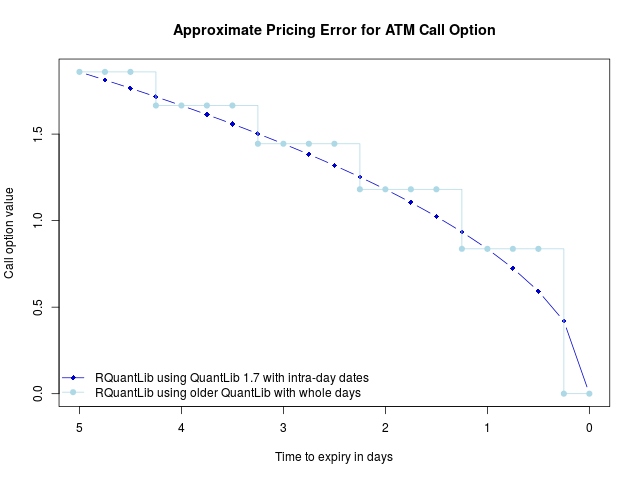
A new minor release of RQuantLib was released onto CRAN and into Debian. It takes advantages of some changes from last week's QuantLib release 1.7. 500 Rcpp packages Particularly noteworthy is the addition of support for intra-daily times in QuantLib based on work by Klaus Spanderen. If QuantLib was configured with the -enable-intraday option, we use the higher granularity of the time representation in all option pricers and implied volatility calculations. The impact of this feature is illustrated in the graph below. The graph shows the valuation of a Call option, European expiry, struck at the money with sensible short rate, dividend yield and volatility. We vary the time to expiry from five days to zero in steps of a quarter day. In darker blue is the correct valuation declining in parabolic shape. In lighter blue is what we get with QuantLib up to release 1.6, or newer releases configured without intra-day time support: an ugly step function that is off, and increasingly so we approach the expiration. Which leads to an appeal: a volunteer is needed to update the QuantLib 1.7 build for Windows. Jeroen tried, but ran into a snag and out of time. If you can help, please get in touch to Jeroen and myself. We suspect that the largest part of RQuantLib users relies on the prebuilt binaries from CRAN, and it would nice to have these updated to the current version of QuantLib. The full changes are detailed below.
Changes in RQuantLib version 0.4.2 (2015-12-03)
  • Changes in RQuantLib code:
    • Intra-day times are now available if QuantLib 1.7 or later is used, and has been configured with --enable-intraday
    • New helper functions getQuantLibVersion() and getQuantLibCapabilties()
    • New package startup code detects and warns about outdated QuantLib versions, or missing intra-day capability, unless not interactive.
    • The missing Monthly parameter has been added to matchFrequency (fixing issue ticket #19)
Courtesy of CRANberries, there is also a diffstat report for the this release. As always, more detailed information is on the RQuantLib page. Questions, comments etc should go to the rquantlib-devel mailing list off the R-Forge page. Issue tickets can be filed at the GitHub repo.

This post by Dirk Eddelbuettel originated on his Thinking inside the box blog. Please report excessive re-aggregation in third-party for-profit settings.

Next.

Previous.