Search Results: "sto"

1 September 2010

Petter Reinholdtsen: My first perl GUI application - controlling a Spykee robot

This evening I made my first Perl GUI application. The last few days I have worked on a Perl module for controlling my recently aquired Spykee robots, and the module is now getting complete enought that it is possible to use it to control the robot driving at least. It was now time to figure out how to use it to create some GUI to allow me to drive the robot around. I picked PerlQt as I have had positive experiences with the Qt API before, and spent a few minutes browsing the web for examples. Using Qt Designer seemed like a short cut, so I ended up writing the perl GUI using Qt Designer and compiling it into a perl program using the puic program from libqt-perl. Nothing fancy yet, but it got buttons to connect and drive around. The perl module I have written provide a object oriented API for controlling the robot. Here is an small example on how to use it:
use Spykee;
Spykee::discover(sub  $robot $_[0]  = $_[1] );
my $host = (keys %robot)[0];
my $spykee = Spykee->new();
$spykee->contact($host, "admin", "admin");
$spykee->left();
sleep 2;
$spykee->right();
sleep 2;
$spykee->forward();
sleep 2;
$spykee->back();
sleep 2;
$spykee->stop();
Thanks to the release of the source of the robot firmware, I could peek into the implementation at the other end to figure out how to implement the protocol used by the robot. I've implemented several of the commands the robot understand, but is still missing the camera support to make it possible to control the robot from remote. First I want to implement support for uploading new firmware and configuring the wireless network, to make it possible to bootstrap a Spykee robot without the producers Windows and MacOSX software (I only have Linux, so I had to ask a friend to come over to get the robot testing going. :). Will release the source to the public soon, but need to figure out where to make it available first. I will add a link to the NUUG wiki for those that want to check back later to find it.

31 August 2010

John Goerzen: Life snippets

#1: Dreams of a (almost) 4-year-old Yesterday, Terah had something going on in the evening, so it was just Jacob, Oliver, and me. Due to how the logistics worked out, she brought them to the office after work and I took them from there. We went to the post office, pharmacy, and a restaurant. Jacob and I had this conversation at the pharmacy. Jacob: Ooo! We are at the Goessel pharmacy! *claps happily* Me: Hmmm Actually Goessel doesn t have a pharmacy. This is the Hesston pharmacy. Jacob: *gets a serious look on his face* Dad, actually Goessel has a pharmacy . Look! A fire station! Me: That s right. And what can you see inside it? Jacob: FIRE TRUCKS! They are all still. Me: I guess there isn t a fire. Jacob: I think the Goessel pharmacy is on fire! Shall they go there now? Me: I hope it s not on fire. (what are you going to say to that?) Were you wanting to see a fire? Jacob: YEAH! I think it IS on fire. Shall we go see? So now he has an imaginary pharmacy with an imaginary fire and he wants to go see. Fortunately he was OK with just going inside Hesston Pharmacy instead. #2: The Songs on a Ceiling I read a book and sing a song to Jacob for bedtime every night. Over the weekends, sometimes I do that for him at nap time too. This weekend, he wanted us both to get on his bed, lie on our backs, and look at the imaginary songs on his ceiling. He gave me a whole tour, pointing to various (to me, nondescript) parts of the ceiling as he did so. Over there is a song about railroad tracks. There is one about trains. That train is upside down. That other one is stuck. There is a song about Word World. There is a song about preschool. There are the train tracks. There is a train on them. It might bump into the other train. Shall you sing a song about two trains on the tracks and they bump into the other train and go BLAM? He appeared to have a whole map in his head of his songs. The train songs were all at a specific place on the ceiling. #3: Younger Brother Oliver has really been changing lately. He occasionally will take a few steps by himself, and he has started to say a few parts of words. He communicates really well, though, especially with things he wants. He has a deep, vigorous nod to say yes, and sometimes it s accompanied by yesh for extra emphasis. His face is incredibly expressive too, and he has a distinctive Yoda-like expression at times. I almost expect to hear him say one day, Like that green bean I do not. Watermelon better is. Jacob, of course, is a lot bigger and sometimes is rough with Oliver. But they also have started to play together. Sometimes Jacob will put his head by Oliver s face. Oliver will grab fistfuls of Jacob s hair in both hands and pull. Both of them apparently find this hilarious and laugh on and on about it. #4: Viruses and Stomachs Sunday Jacob was complaining of a stomach ache. We were driving home, and shortly after we got home, he vomited on the driveway. Jacob really doesn t like throwing up. It s unpleasant and maybe a bit scary for him. He was about to start crying after vomiting, except One of our cats was hanging around. Claire came over, sniffed Jacob s vomit, and started eating it. Jacob was so fascinated by what was happening that he stopped sniffling and stood there staring at the cat, then gave an excited report of events to Terah and me. That evening, he was afraid he would throw up in bed. So we had a large bowl he held *directly* under his chin during story time. But then he didn t want to lie down, since he was afraid he d throw up in bed. Terah pointed out that he could have the bowl close while he slept. I went up and checked up on him an hour or two later, and he was sound asleep, face in the large bowl. #5: The Jukebox After the pharmacy, Jacob saw Skoops, a local 50s greasy spoon diner place across the street. He really wanted to eat there and get the birthday cake ice cream flavor. So we did. He was jabbering about getting a corn dog as we walked over, so that s what he had to eat. I don t know how he knew Skoops had them, as I don t think he s ever had a corn dog. Oh well. There s a jukebox inside Skoops, and every fifteen minutes or so, it ll spring to life and play a random song even if nobody put coins in it. This was very exciting for Oliver. He d twist all around in his highchair to watch it. And, most amusingly, he d start bopping his head. Not really in time with the music or anything, but it was cute to watch. Sometimes he d get really excited and pretty much his whole body was dancing. Well, as much dancing as you can do when you re 1 and strapped into a high chair, at any rate. One time, he heard the music, started dancing , and looked at me expectantly. So I started nodding in time with the music, and then Jacob saw us both and started sort of flailing about, somewhat in time with the music. All three of us wound up laughing after that.

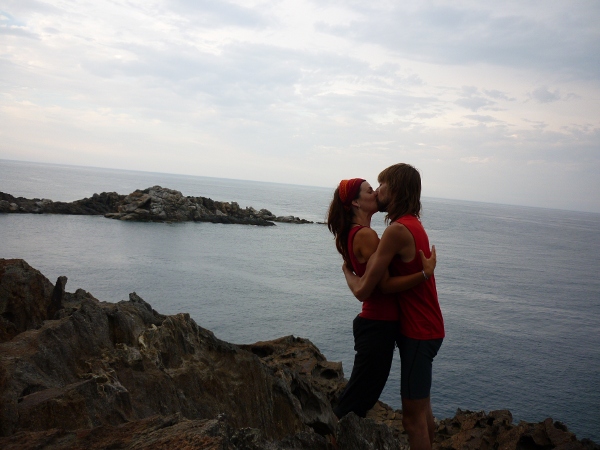
Jordi Mallach: De mar a mar, hiking across the Pyrenees

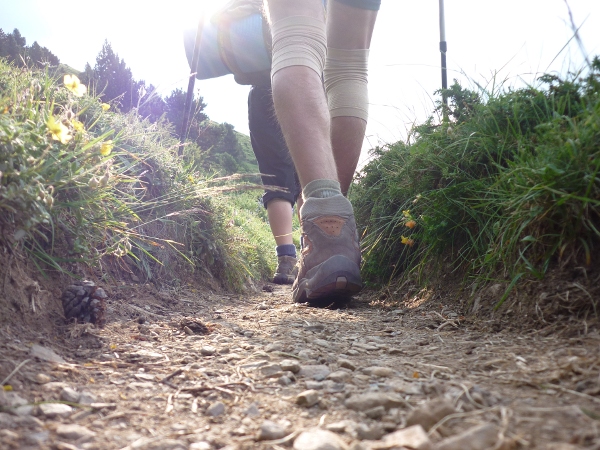
Two weeks ago, Maria and I completed one of our dreams when we arrived in Cap de Creus, where the Pyrenean range sinks in the Mediterranean. To get there, we walked hundreds of kilometres during a month, crossed dozens of steep valleys and enjoyed one of the richest experiences of our lives.

We managed to complete this challenge without facing major problems or pains, and after the first five our six days, our legs seemed to have gotten used to the daily effort and it started to be easier and easier. Our morale kept growing as days passed and we advanced east. When I started walking on a cold and rainy morning in Hondarribia, after barely no rest in the night bus to Ir n, I thought for myself that it was improbable that we'd manage to get anywhere near Catalunya, that one of us would get injuried way before, or we'd just give up and go for the easy beach vacation in the Basque Country.


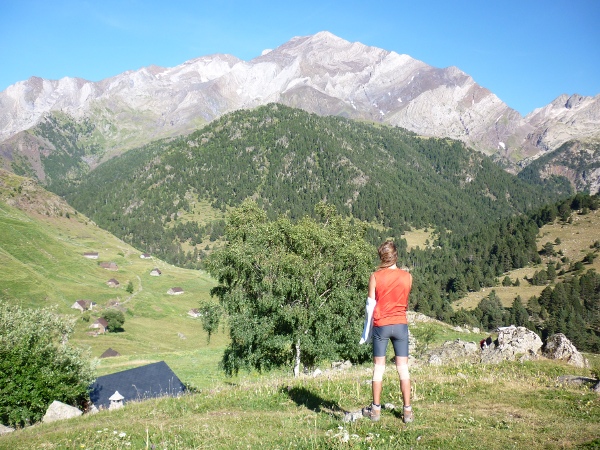
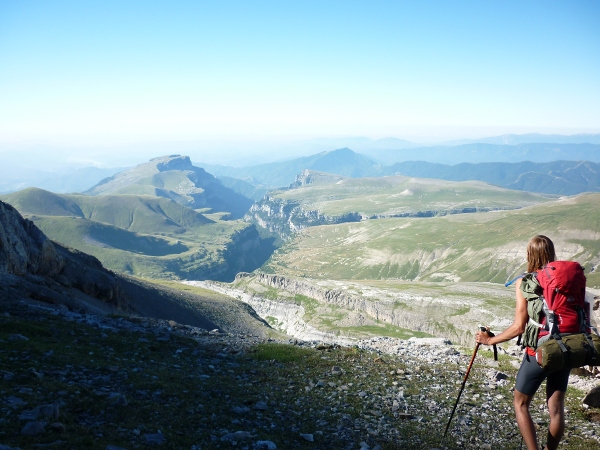
Biad s refuge, under Posets But we didn't, and after a somewhat painful start, with our boots soaking wet during the stages that crossed the enchanting Selva de Irati which ended up with me getting the biggest blister I've ever seen, we started to walk farther every day, extending the stages when we felt strong after reaching their official end. When we crossed from Nafarroa to Aragonese territory, the mental wall that I had built over the toughest stages in our quest started to fall apart. Days later, we found ourselves climbing down to Pineta, leaving Ordesa behind and enjoying a feeling that our adventure could not go better. The weather had been perfect for over a week and our legs and back were strong to go all over the way to the sea.


Ca n de A isclo, on our way to Pineta When we finally saw that huge blue stain on the horizon, the day before getting to the last mark, we got really excited. We had made it, but as we walked towards the cape, happiness slowly got mixed with melancholy. An unforgettable adventure was about to end, and we didn't want to face our return to the city and our routines. It had been many days surrounded only by awesome landscapes, and living without watches, with only sunlight and weariness marking the time to get in our sleeping bags.


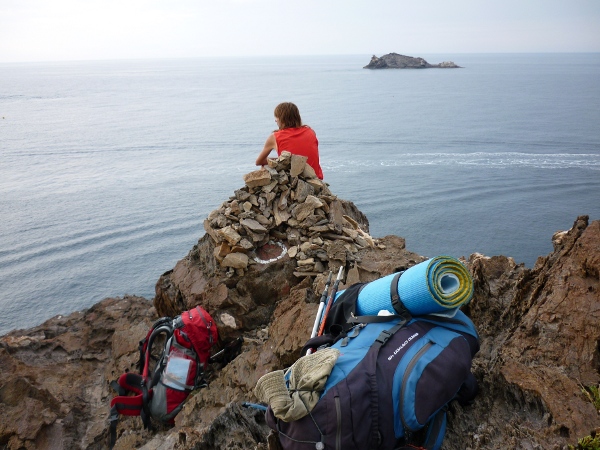
At the very last red and white mark of our journey We've had plenty of time to meet great people. Starting with the Navarrian brothers we met in the early stage, which provided us with a good pace to follow while our leg muscles were still building up; or Kike and Ana, who drove from Pamplona to visit us during the first Aragonese stages (thanks for the supplies!). Tom s and Roger, young hikers from Matar , surprised us with their maturity and experience as mountaineers; we had the pleasure to join forces during four days, walking a really cool variant through the Infiernos and Collado del Letrero which avoided going through the ghost city of Panticosa. Roger and Tom s, we really hope to meet you soon! Andreu, Manel, Ghandi and Ga la visited us at the Vall de N ria and were unlucky to suffer a frightening hail and thunder storm when they left our shelter on their way back to their car. Thanks! All of you have been a very special part of our experience!

This adventure through GR 11 has been incredibly positive for us for several reasons. We've learned a lot about ourselves and strengthened our relation, and now I know how powerful drive can be; to get somewhere, no matter how far, it's really easy if you just believe you can do it and desire to get there. Maria and I are proud of what we've done, and no wonder we're looking for new challenges. An obvious one would be repeating this experience, going through the French side of the Pyrenees, but for now, the Corsican GR 20 seems the most appealing. We'll see, next summer!

Joey Hess: swarmnation story

Swarmnation is a neat game, but I'm not sure if it's for the reasons its authors intended. It may be interesting mostly because of its bugs. Read on for spoilers and the story that developed from an apparently abstract time waster game. When I first saw the game, I saw a grid of squares moving around. I was obviously one: A (Blue) Square. There seemed to be no pattern to the movements. So, it seemed the game represented random passers-in-the-night on the net, unable to communicate except by dashing back and forth. Then after a few minutes, a geometric shape was highlighted in yellow from out of the mass of squares. Woah! I'd been missing something here. It turned out my display was too small, and I had not noticed that the gameboard scolled over to show a tetris-style "next shape" display. Which the other squares had been busily trying to make before time ran out. Now all their movements made sense. Now with a shared goal, we could communicate. Some of us were trolls and blocked shapes from forming. A few of us became leaders, boldly taking that center position in the hollow-square-with-spot-in-the-middle shape. Most of us herded into place as soon as a shape began to form, and stayed there, frantically hoping our neighbors would also conform and keep property values high. We were playing the game. We were accumulating scores. We split into two groups, both playing the game, and then some of us defected from one group to the other, which seemed to be doing better at making a particular shape, and there was no reason to go back to that first group, I felt strongly that I was part of the second, better, group. Then, as I was getting bored and feeling the neighbors all around stifling, I noticed my square highlighted yellow for a shape that I was not currently part of. Oh, this must be a bug I thought. I hacked around, and got it to happen again. I thought maybe it was just being a bit fuzzy in accepting shapes, but no, it turned out to be more interesting. The game didn't care if we stayed in the shape. Just being part of the shape for an instant was enough. With this realization, whole new ways to play the game opened up. Dash left and right, near a forming shape, and you'll probably, for an instant, be part of it. Hang back and have your fun, spot an instant to plug a hole, and then get out and let someone else also take part. Try to form the same shape in both groups. And so on. So a grid of squares hooked up to keyboards on the net has let me watch the invention of politics, rebel from conformity and hack the system, in an hour? That's what games are about!

Iustin Pop: Spooky harddrive

For a couple of weeks, one of the harddrives in my server has started to behave strangely. The RAID controller has started first reporting some drive timeouts (daily, when the drive runs a short or long smart test), and now it even kicks it out of the (RAID1) array. And yet, during normal operation, there's no read error or write error that I can trigger, and there are no reallocated sectors (according to smart). The only time when I can reproduce the error is: What happens when both these conditions are met? The the SMART query is taking ages (as in ~20-30 seconds). This might cause some such high delays that the drive itself will report a timeout error (if any I/O takes place at the same time), and log an error in its internal error log. Another harddrive (identical brand): ~3s for SMART query during selftest and I/O load, no issues whatsoever. For this harddrive, smartctl -a reads a while, and then:
Error SMART Error Self-Test Log Read failed: Input/output error
Smartctl: SMART Self Test Log Read Failed
 
real    0m39.029s
The timeout above also has generated lots of errors in the drive's error log. I don't know how to read these properly, but in any case they don't seem too scary:
Error 144 occurred at disk power-on lifetime: 13552 hours (564 days + 16 hours)
  When the command that caused the error occurred, the device was doing SMART Offline or Self-test.
  After command completion occurred, registers were:
  ER ST SC SN CL CH DH
  -- -- -- -- -- -- --
  10 51 00 80 ae 39 40
  Commands leading to the command that caused the error were:
  CR FR SC SN CL CH DH DC   Powered_Up_Time  Command/Feature_Name
  -- -- -- -- -- -- -- --  ----------------  --------------------
  61 80 70 80 ae 39 1c 08  41d+08:07:45.052  WRITE FPDMA QUEUED
  b0 d0 01 00 4f c2 00 08  41d+08:07:45.038  SMART READ DATA
  ec 00 01 00 00 00 00 08  41d+08:07:44.958  IDENTIFY DEVICE
  2f 00 01 10 00 00 00 08  41d+08:07:44.957  READ LOG EXT
  61 80 70 80 ae 39 1c 08  41d+08:07:37.960  WRITE FPDMA QUEUED
For some of the errors, all preceding commands are WRITE FPDMA QUEUED, but all are during a "SMART Offline or Self-test" phase. When a self-test is not being done, reading all the SMART data (smartctl -a) is very very quick, taking half a second. The only thing I can think of is that the drive's own area for storing SMART data is unhealthy, and reading it takes time, and a concurrent SMART test and I/O load makes it hard for the drive to do so. But again, I can't trigger any real I/O error, nor at the beginning of the drive neither at the end, so This also happens when the drives is connected to a plain SATA port, skipping the RAID controller, so it's not just the controller playing games on me. I'm really confused now. Given my previous experience, this drive will die, should already have died, and yet, no I/O errors, just some timeouts. Do I just need to wait a couple more weeks?

30 August 2010

Martín Ferrari: Some LaTeX stuff

The last few weeks I have been using LaTex a lot, to write the final report for my master's course. During that period I found a couple of LaTeX goodies that might be interesting to share: the memoir class, gnuplot integration, and some stuff to help preparing cover pages. The memoir class is a kind of all-in-one package. It is meant to be used in place of the book and report classes, but it can also replace simpler environments, such as article. It provides many ready-to-use templates, and loads of commands to easily customize them. It seems to be specially tailored for dead-tree publication, dedicating an entire chapter in the manual to page layout. It also aims at removing the usual cruft you have to add into any medium sized project, it is macro-compatible with: abstract, appendix, array, booktabs, ccaption, chngcntr, chngpage, dcolumn, delarray, enumerate, epigraph, framed, ifmtarg, ifpdf, index, makeidx, moreverb, needspace, newfile, nextpage, parskip, patchcmd, setspace, shortvrb, showidx, tabularx, titleref , titling, tocbibind, tocloft, verbatim, and verse. Furthermore, it provides functionality equivalent to the following packages: crop, fancyhdr, geometry, sidecap, subfigure, titlesec. In the end, you have a project that only needs a couple of packages, and a few customisation commands, which is nice and also eases distribution. Other nice thing I have found is that there is not one, but many ways of merging gnuplot graphs into your text while having LaTeX typeset all the labels. There is some LaTeX packages aimed at this, but I have more success using a special gnuplot terminal. Again, there is more than one option: eepic, epslatex, latex, lua, mp, pslatex, pstex, pstricks, texdraw, and tpic. While I could not try them all, I tried a few and the easiest and prettiest was epslatex. This terminal creates two files: a EPS file, as would have been created with the usual postscript terminal, except that it does not contain any text; and a LaTeX snippet meant to be included with \input foo . Finally, I could generate graphs that match the rest of the document! To end this post, a couple of things about creating the dreaded cover page. First, a suggestion: don't fret too much about finding a ready-made template, once you understood the basics of how to insert arbitrary spaces around text, it is quite easy to roll your own cover! Having said that, the memoir manual has some sample cover pages that can be useful to use as a base, and there is another really useful resource I have found: titlepages.pdf, a collection of 40 sample title pages with source code for you to choose. Tags: Planet Debian, Planet Lugfi, latex

Raphaël Hertzog: Understanding Membership Structures in Debian and Ubuntu

Debian and Ubuntu have a set of official membership roles that can be granted to regular contributors. Those roles come with rights that enable the contributors to do their work and to participate in the project governance (elections and other official decision-making processes). It s also a way for the distributions to acknowledge the work done: most contributors are proud of the status they reached. The membership structure plays an important role in the development of a distribution: it defines the kind of contributors that are welcome in the project, it sets expectations of the project towards its contributors and defines their rights. In the end, this shapes the project s ability to recruit new contributors to keep the project alive and kicking. This article introduces the existing statuses in Debian and Ubuntu, and defines the sometimes confusing jargon associated with them. The Debian Case Debian only has two types of official members: Debian Developers (DD) and Debian Maintainers (DM). The rights of the developers are codified in the Debian Constitution while those of the maintainers have been defined in a general resolution of 2007. The Debian Maintainer status is still mostly documented in a wiki page. The integration of this new status in Debian s official processes has been slow to come largely because it was introduced at that time without enough negotiation with the involved parties. Nowadays, it is preferred that people get the DM status before applying for DD. DM is a very limited role: maintainers can only upload packages that already have their name on them (either in the Maintainer or Uploaders field) and a specific flag (DM-Upload-Allowed: yes) that only Debian Developers can add. They have no other rights and limited access to Debian s resources. Besides those official roles, there are also maintainers of packages that have no official status within Debian except that they are listed in the Maintainer field of the package. They are doing the maintenance work but all uploads are done by a Debian Developer after verification of the work done (this is called sponsorship and is the only way to start with official packaging work). Once the DD trusts the maintainer, the developer will typically ask the maintainer to apply for DM status in order to be relieved from the sponsorship work. In the end, that makes three different kind of package maintainers and a lot of confusion when you discuss membership issues in particular when the New Maintainer process is the path that you follow to become a Debian Developer. Don t be fooled by the names when reading Debian s documentation! The Ubuntu Case Ubuntu had, from the start, an official Ubuntu Member status that includes all contributors: developers of course, but also documentation writers, artists, translators, etc. This status notably grants the right to vote in elections of the Community Council, the right to participate on Planet Ubuntu, and the @ubuntu.com email alias. For developers, the situation is more complicated: the wiki page lists no less than five different statuses. Initially, developers were split between Ubuntu Core Developers and the MOTU (Masters Of The Universe). The latter were responsible of the universe/multiverse sections of the archive while the former also had upload rights for the main/restricted sections. But, inspired by the Debian Maintainers concept and facing concrete problems in terms of archive management, they changed their infrastructure to offer more fine-grained control on package uploads. Ubuntu can now grant upload permissions on a package-per-package basis, but it can also delegate the right to grant upload permissions with the same granularity. This lead to the new Per-Package Uploader status which is simply an Ubuntu Member with upload rights on a limited set of packages where they have a specific expertise. The more generic Ubuntu Developers status now encompasses members of various development teams that have been delegated the right to manage upload permissions on a (usually large) package set (the current teams are Ubuntu Desktop, Mythubuntu, Kubuntu, and Edubuntu). Those teams can define their own policy to add new members provided they follow the basic rules defined by the Developer Membership Board (see this wiki page). Ubuntu Contributing Developer is an intermediate status for someone who is not yet ready for one of the other developer statuses but who has still shown enough commitment to be an Ubuntu Member. All those statuses can be obtained in a similar way: you prepare a wiki page listing your past contributions, you collect testimonials from existing members that you have worked with, you add yourself in the agenda of the next meeting of the board (or council) that grants the status that you seek, and you attend the meeting. The members of the board will decide whether you are ready for the status (or not) based on what you provided in the wiki, based on your answers during the meeting (and on a mailing-list for developers), and based on what others have to say about you. The most important boards are usually elected by the community while others are commonly appointed by the community council. Those governance bodies include Canonical employees but not as many as one would expect: two out of eight in the Developer Membership Board, two out of eight in the Community Council, but all six members of the Technical Board. The last figure, while not intended, is not surprising given the high expectations set on potential members of the technical board. Mark, as the founder, is the only person to have a permanent seat on both the Community Council and the Technical Board. Comparison of the Statuses Between Debian and Ubuntu The following table summarizes the rights given to each developer role in the two projects (Put the mouse over the abbreviations to know what they are referring to).
Rights Debian Ubuntu
DM DD UM PPU/UD MOTU UCD
Package maintenance via sponsorshipYN/AYYYN/A
Official email alias-YYYYY
Participate in votes for members-YYYYY
Participate in votes for developers-Y-YYY
Upload rights restricted to pre-approved packagesY--Y--
Upload rights restricted to a section of the archive----Y-
Unlimited upload rights-Y---Y
Number of contributors (as of 2010-07-27)117904462278563
Please note that the number of contributors are not 100% accurate for Ubuntu. A contributor can have multiple statuses (direct membership to a launchpad group) granted over time (while gaining experience). The problem has been mostly avoided by calculating differences between number of members of the various groups but it s not perfect and it can t be: some MOTU are also PPU for packages in main and it s legitimate (but I only counted them as MOTU and not as PPU). Another limitation is that members of some administrative teams are included indirectly in many teams and thus appear in the count while they should not. Anyway, this simple table makes it obvious that Ubuntu s structure offers a broader choice of statuses. They acknowledge the work of all contributors from the start while still giving the most critical rights only to those who have proven that they deserve them. Despite this difference, Debian still has a significant advantage in terms of number of developers. That number does not tell the whole story though: the Ubuntu contributors include many Canonical employees (e.g. 36 out of 63 core developers have a @canonical.com email registered on their launchpad account) that are likely to spend more time working on the distribution than the average Debian member. But even if comparing person-hours would be a challenging thought experiment, in practice it s of not much interest if both projects continue to cooperate and if more and more of the contributions flow in both directions. Debian is aware of the shortcomings of its structure. Changes to better accommodate non-packagers have been discussed several times already. The last efforts in that direction were unfortunately perceived as a solution ready to go rather than a proposal to be discussed, and the project got quickly buried by a general resolution (GR). Even if that resolution invited for further discussion and a new proposal, the truth is that when someone s initiative is corrected by way of GR, it usually kills any motivation to go forward. Possible Evolution? On the Ubuntu side, the infrastructural changes were completed recently and they don t expect any further change in the near future. They do plan, however, to expand usage of those new features so that more teams benefit from the possibility to control upload rights on packages that are relevant to them, and so that more individuals developers apply to become Per-Package Uploaders on packages that they know very well. On the Debian side, a recent discussion on the debian-project list brought back the topic of the bad terminology and it was agreed that the New Maintainer process should be renamed into something else ( New Developer process has been suggested). But Christoph Berg Debian Account Manager and hence heavily involved in the New Maintainer Team suggested that Debian would be better off implementing the long-awaited membership changes before trying to update all the documentation. It would certainly imply some more vocabulary updates. Later in the discussion, he confirmed that membership reform is on the top of the TODO list of the new maintainer team (just after the rewrite of the nm.debian.org website). What can be expected from this reform? The following answers are my own guesses based on my experience of Debian, but the project hasn t decided anything yet. Almost two years have elapsed since the previous efforts in that direction, the new maintainer team has recruited new members and is in a general better shape. Hopefully, the next episode of this saga will have a better outcome.
This article was first published in Linux Weekly News. In a comment, Mark Shuttleworth tried to explain how the Ubuntu community is being setup.
Flattr this Share/Bookmark 10 comments Support my work

Richard Darst: The DebConf registration process

The DebConf registration team has the hard job of coordinating accommodation, food, and payments for hundreds of people.There are two major dates here: the sponsored registration deadline, and the reconfirmation deadline. There is also the date of opening registration, but that's usually more a matter of "how soon can we?" than "when should we?"The sponsored registration deadline (April 15 for DC10) is the deadline for requesting sponsored accommodation, food, or travel. This allows us to figure out how much we'll have to pay for attendees - attendees who register after this point should pay enough to cover their own costs.The reconfirmation deadline (June 10th for DC10) is used as a ping for attendees, particularly the sponsored ones. Attendees must reconfirm they will attend, so that we don't waste money reserving more food/rooms than we will have people using them. This deadline usually depends on the date we must give firm numbers to our accommodations.Historically, registration hasn't ever closed, anyone can come, just if you register too late you won't necessarily get any free stuff (and definitely no free food/accommodation). The deadline for food and accommodation themselves has been based on the logistics of the conference itself - DC9, when we ran out of physical rooms for accommodation, and DC10, when we had to give firm housing numbers to Columbia. Food has tended to be easier as caterers could take updates on shorter notice, usually the day before.DebConf8 began a system where attendees could pay a registration fee if they desired. This was encouraged, for example, for attendees whom could get this fee reimbursed by their company, but was not required nor encouraged of sponsored attendees. DC8-9 had two classes of fees: Professional, covering the actual costs, and Corporate, covering about double of professional and for companies or registrants whom could provide extra financial support for DebConf. DebConf10 added an extra layer of "pay per day" on top of this.It's up to the registration team to pin down attendee numbers as early as possible, as this is usually the biggest cost. DebConf provides food and accommodations to a huge number of people, but the numbers are constantly changing. It's hard to know how many people will drop out at the last minute. It's hard to know how many people will actually pay a corporate or professional fee, as opposed to mistakingly selecting it when they'd rather something else. Our registration system can't support all the little intricacies of how much an attendee will cost us, or pay us. Without knowing how many people will attend, how can we accurately get the right number of meals and right number of rooms? Sponsored people may always choose to not eat some meals with us, possibly saving us money there. How many people with travel sponsorship will actually request their full reimbursement?The registration system, Pentabarf, is used to track attendance numbers, but it isn't completely reliable. Not everyone in it will attend all days, and most people who aren't staying with us don't have accurate dates of attendance. Thus, it can only be used as estimates, not for all decisions.
The difficulties above are challenges for the registration and budgeting teams, but are not too bad - they just require thought, time, and answering many questions from attendees.Tags: debconf

Russell Coker: Interesting Developments in Islamic Culture

Shereen El Feki gave an inspiring TED talk about Islamic youth culture [1]. She shows some interesting exerpts from the 4SHBAB TV network which is known as Islamic MTV , the music video from the US was of particularly high quality while I expect high quality videos to be made in the US I don t generally expect quality Islamic videos from the US (or anywhere else really). She also notes that the videos show a kinder gentler face of Islam . She contrasts that with a clip by Haifa Wehbe [2] a Lebanese pop star who appears to have a lot in common with Britney Spears (Shereen describes her as a pan-Arab pinup-girl ). She cites the comic The 99 which has Islamic super-heros who represent the 99 attributes of Allah. One thing that I found very interesting was that the 99 character Jemi is shown using what is obviously an OLPC. This seems to indicate some very positive trends for the interaction of Islamic culture with the European and American culture which is Christian and Atheist dominated. Kavita Ramdas gave an interesting TED talk about radical women embracing tradition [3]. She highlights a woman who teaches girls to read in Afghanistan based on the religious edict that every Muslim should read the Koran and a Croatian Lesbian choir that sings traditional folk songs. Naif al-Mutawa gave an interesting TED talk about the creation of The 99 [4]. He starts by comparing some of the characters in the Justice League of America to Christian traditions and then describes the back story behind his Islamic super-heroes. His major aim is to provide positive role models for Muslim children. Apparently a cross-over production involving characters from The 99 and the Justice League of America is being developed at the moment Wonder Woman wears clothing that is less revealing than usual though. It s worth noting that Naif is a practicing psychologist who s clients include victims of political torture, so he seems to have some insight into the problems that most people will never have.

28 August 2010

Ben Hutchings: Boot loader disruption in sid

IN UR DISTRO BRAKIN UR PACKAGEZ Something was bound to go wrong when changing the policy for boot loaders. Let me try that again.

Erich Schubert: Facebook closing up for third party developers?

It looks a lot as if Facebook is closing up on third party developers. Seems like they've cherry picked the features they want to copy, and now are no longer interested in third parties anymore:Expect once-famous Facebook applications such as SuperPoke to disappear on the long run - their integration hooks have been pulled. The API gets more and more limited for the cash cow use case: games. And of course marketing. Oh, I forgot one type of "applications". The one that basically embeds you regular web page within a Facebook tab. Wow. That's technology!If it was really about the users, Facebook would seriously fight Facebook spam, worms and fraud. They still don't have that under control (and none of them used either of the removed features!). They do even less to prevent users from clicking on such bad links such as the Free iPad scam, which has been around for at least a week now. Or the famous "dislike button" scam. They could not spell much more clearly that they do not care about their users - they just want your data to sell more directed advertising to you. Forget about privacy, too!Now that all my three Facebook applications are pretty much dead, this comes with a good side for me: I've been considering to disable/suspend/kill my Facebook account for quite some time. But I wasn't sure if that would also kill my applications for their users. Now that they're dead anyway, there is not much keeping me anymore.

27 August 2010

Colin Watson: Windows applications making GRUB 2 unbootable

If you find that running Windows makes a GRUB 2-based system unbootable (Debian bug, Ubuntu bug), then I'd like to hear from you. This is a bug in which some proprietary Windows-based software overwrites particular sectors in the gap between the master boot record and the first partition, sometimes called the "embedding area". GRUB Legacy and GRUB 2 both normally use this part of the disk to store one of their key components: GRUB Legacy calls this component Stage 1.5, while GRUB 2 calls it the core image (comparison). However, Stage 1.5 is less useful than the core image (for example, the latter provides a rescue shell which can be used to recover from some problems), and is therefore rather smaller: somewhere around 10KB vs. 24KB for the common case of ext[234] on plain block devices. It seems that the Windows-based software writes to a sector which is after the end of Stage 1.5, but before the end of the core image. This is why the problem appears to be new with GRUB 2. At least some occurrences of this are with software which writes a signature to the embedding area which hangs around even after uninstallation (even with one of those tools that tracks everything the installation process did and reverses it, I gather), so that you cannot uninstall and reinstall the application to defeat a trial period. This seems like a fine example of an antifeature, especially given its destructive consequences for free software, and is in general a poor piece of engineering; what happens if multiple such programs want to use the same sector, I wonder? They clearly aren't doing much checking that the sector is unused, not that that's really possible anyway. While I do not normally think that GRUB should go to any great lengths to accommodate proprietary software, this is a case where we need to defend ourselves against the predatory practices of some companies making us look bad: a relatively small number of people do enough detective work to realise that it's the fault of a particular Windows application, but many more simply blame our operating system because it won't start any more. I believe that it may be possible to assemble a collection of signatures of such software, and arrange to avoid the disk sectors they have stolen. Indeed, I have a first draft of the necessary code. This is not a particularly pleasant solution, but it seems to be the most practical way around the problem; I'm hoping that several of the programs at fault are using common "licence manager" code or something like that, so that we can address most of the problems with a relatively small number of signatures. In order to do this, I need to hear from as many people as possible who are affected by this problem. If you suffer from this problem, then please do the following: I hope that this will help me to assemble enough information to fix this bug at least for most people, and of course if you provide this information then I can make sure to fix your particular version of this problem. Thanks in advance!

Richard Darst: DebConf budgeting for a single conference

My last post discussed the year-to-year budgeting of DebConf. This post discusses what makes budgeting difficult within one particular DebConf. Since every DebConf is unique in its arrangements, the particular difficulties always vary year-to-year. For example, DebConf10 was easy in that Software in the Public Interest was in the same country so that we had easy access to bank accounts, but more difficult venue payment logistics. I'll use DebConf10 as an example below.
For DebConf10, we get our venue "for free" thanks to the support of the Columbia Computer Science department. However, we had to pay for guard costs after building hours, and custodial costs. For custodial costs at least, we had to go through many layers of bureaucracy, and people kept insisting it would be more than they quoted. (It ended up being about half, since DebConf attendees were so responsible!)DebConf sponsors many attendees. This means that all their food and accommodation costs are paid by us. We have sponsored registration and reconfirmation deadlines to set a maximum of the number of people we have to sponsor, but people are continually dropping out and it's hard to know just how many people to reserve for. Sponsored people won't always eat every meal with us, and usually won't decide until the day before - so figuring out food amounts is hard, too. Furthermore, we have unsponsored people who will want food and accommodations (paying themselves) which we must somehow plan for.Different venues operate on different payment rules. This year, CU Housing was fairly strict on asking for attendee counts and room assignments two weeks in advance. Then, as time gets closer, they got more flexible, and in the end told us that they will, in fact, only charge based on number of people actually attending - a huge win for us. Similarly with CU Dining, we had to go through great lengths to make sure that we would pay only for meals we ate. At CU, food had to be paid in advance, but accommodation and other costs are paid afterwards.We have to guess how much will be spent on miscellaneous supplies once DebConf starts. We have to then decide how much to spend on extras such as the day trip or conference dinner, and how to sponsor those, if possible.Debian (and thus DebConf) has money held in trust in many currencies in different accounts. Different sponsors will pay to different currencies, depending on what is convenient for them. This means that we need to consider fluctuating currency conversion rates, and decide if and when to transfer money. In general, DebConf hasn't transfer money just to make sure the DebConf-tagged money gets spent first. Some surpluses are best left in other countries to help pay future travel sponsorship since it is expensive to move money out of the country. Some conferences may result in a net movement of money from USA to Europe (more donors in one, more expenses in the other), some the other way around.Travel sponsorship is in the form of reimbursement. These can take many months to have the documentation received from attendees and the reimbursements all sent out, and thus finalizing the budget and surplus for next year.The overall principle we've tried to stick to is plan for a balanced budget in the worst case scenario, and then be happy when it ends up better than that.
At the DebConf&Debian BOF, someone mentioned how budgeting for any (free software) conference is hard. I think that's certainly true. Some of the registration fluctuations could be made easier by being less flexible, but DebConf wants to serve our attendees even if it is a bit of extra work for us. Each DebConf will have its own ways budgeting is difficult, but things have always work out, and usually with a bigger surplus than we were expecting.Tags: debconf

Russell Coker: Links August 2010

Urban Honking has an insightful article about the Arduino and suggests that it is one of the most important factors for the development of the computer industry in the near future [1]. It compares the Arduino to the Altair. Wired has an interesting article about a company that provides a satellite kit and a launch into low Earth orbit for $8000 [2]. Arduino in space? Linux Journal has an interesting article by David Rowe about the Mesh Potato which is a Wifi mesh router that also runs VOIP [3]. One particularly interesting aspect of this article is the explanation of the way they designed and tested it. Susan Shaw gave an informative TED talk about the toxic effects of the attempts to clean up the oil spill in the Gulf of Mexico [4]. It seems that trying to disperse the oil just makes it worse, and the chemical companies are refusing to disclose the chemicals that are being used. The New York Times has an interesting article by David Leonhardt about the value of pre-school teachers [5]. Some research on the difference that good teachers can make in economic terms suggests that the make an economic difference to the children to the value of $320,000 per annum (IE a class of 16 children who were taught for a year would on average each receive a benefit of $20,000 over their lifetime). Also there are social benefits which aren t counted by that study. While I can t imagine pre-school teachers getting paid $320,000 any time soon, it does seem obvious that good teachers deserve significantly better pay. Of course one problem is how to determine which teachers are good, better test results are not a reliable indication. Paul Krugman describes America as being on the unlit, unpaved road to nowhere due to the policies of saving money by cutting funding for schools, street-lights, and roads [6]. The Chive has an amusing post about how to quit a bad job [7]. It would be good if someone really did this, I m sure that there are enough creative people who don t like their job. Hell Pizza in New Zealand published a zombie themed choose your own adventure on Youtube [8]. Unfortunately the options to choose the next segment don t work on HTML5 with Chromium so if you don t have flash you miss out. AskThePilot.com has an informative essay about airline security written by a commercial pilot [9]. The anecdote about the pilot not being allowed to take the type of knife that is issued to first and business class passengers is rather amusing. FredOnEverything.net has an interesting analysis of Wikileaks and why the Pentagon and Fox News hate it [10]. Fred is a very skillful writer, while he s not the first person to say some of these things he may have said it best. The Wikipedia page on Borosilicate glass (which is best known under the trademark Pyrex) is really interesting [11]. Borsilicate glass was formerly known as Duran and it s main characteristic that makes it suitable for lab use is resistance to Thermal Shock, but it s also harder and has a higher melting point. Apparently you can get Pyrex drinking glasses, I want some! Eben Moglen gave an interesting talk Freedom in the Cloud about the development of free servers to manage personal data and replace Facebook etc (among many other things) [12]. The Debian Wiki has an articla about designing such a system [13]. The APNIC published an interesting paper on IPv4 background radiation [14]. Apparently some /24 s receive so much random traffic (from broken applications and viruses) that they can t be delegated. IPv6 will solve this problem by making it infeasible to scan all IP addresses. Also it s interesting to note the excessive amounts of traffic to 1.0.168.192 which is from applications too broken to correctly send data to 192.168.0.1 which have been installed by sysadmins who are too incompetent to watch what is being sent out of their network.

26 August 2010

Dirk Eddelbuettel: Louis: A Silent Film with Live Music

The Chicago Symphony hosted the world premiere of Louis last evening, and I had snatched the (literally) last available ticket. The film, which is written, directed and producted by Dan Pritzker, is based loosely on the early years of Louis Armstrong in New Orleans. The movie is shot beautifully by Vilmos Zsigmond in blend of colour and black-and-white which works very well for invoking the early days of film. A key part of the production is of course the score, and the live music with both a thirteen-piece orchestra featuring Wynton Marsalis as well as piano solo recitals by Cecile Licad with an emphasis on pieces by 19th-century composer Louis Moreau Gottschalk. The combination of a silent movie with a stong live band is something to behold -- if you can catch the movie and performance in a city nearby, go!

Petter Reinholdtsen: Broken umask handling with sshfs

My file system sematics program presented a few days ago is very useful to verify that a file system can work as a unix home directory,and today I had to extend it a bit. I'm looking into alternatives for home directory access here at the University of Oslo, and one of the options is sshfs. My friend Finn-Arne mentioned a while back that they had used sshfs with Debian Edu, but stopped because of problems. I asked today what the problems where, and he mentioned that sshfs failed to handle umask properly. Trying to detect the problem I wrote this addition to my fs testing script:
mode_t touch_get_mode(const char *name, mode_t mode)  
  mode_t retval = 0;
  int fd = open(name, O_RDWR O_CREAT O_LARGEFILE, mode);
  if (-1 != fd)  
    unlink(name);
    struct stat statbuf;
    if (-1 != fstat(fd, &statbuf))  
      retval = statbuf.st_mode & 0x1ff;
     
    close(fd);
   
  return retval;
 
/* Try to detect problem discovered using sshfs */
int test_umask(void)  
  printf("info: testing umask effect on file creation\n");
  mode_t orig_umask = umask(000);
  mode_t newmode;
  if (0666 != (newmode = touch_get_mode("foobar", 0666)))  
    printf("  error: Wrong file mode %o when creating using mode 666 and umask 000\n",
           newmode);
   
  umask(007);
  if (0660 != (newmode = touch_get_mode("foobar", 0666)))  
    printf("  error: Wrong file mode %o when creating using mode 666 and umask 007\n",
           newmode);
   
  umask (orig_umask);
  return 0;
 
int main(int argc, char **argv)  
  [...]
  test_umask();
  return 0;
 
Sure enough. On NFS to a netapp, I get this result:
Testing POSIX/Unix sematics on file system
info: testing symlink creation
info: testing subdirectory creation
info: testing fcntl locking
  Read-locking 1 byte from 1073741824
  Read-locking 510 byte from 1073741826
  Unlocking 1 byte from 1073741824
  Write-locking 1 byte from 1073741824
  Write-locking 510 byte from 1073741826
  Unlocking 2 byte from 1073741824
info: testing umask effect on file creation
When mounting the same directory using sshfs, I get this result:
Testing POSIX/Unix sematics on file system
info: testing symlink creation
info: testing subdirectory creation
info: testing fcntl locking
  Read-locking 1 byte from 1073741824
  Read-locking 510 byte from 1073741826
  Unlocking 1 byte from 1073741824
  Write-locking 1 byte from 1073741824
  Write-locking 510 byte from 1073741826
  Unlocking 2 byte from 1073741824
info: testing umask effect on file creation
  error: Wrong file mode 644 when creating using mode 666 and umask 000
  error: Wrong file mode 640 when creating using mode 666 and umask 007
So, I can conclude that sshfs is better than smb to a Netapp or a Windows server, but not good enough to be used as a home directory. Update 2010-08-26: Reported the issue in BTS report #594498 Update 2010-08-27: Michael Gebetsroither report that he found the script so useful that he created a GIT repository and stored it in http://github.com/gebi/fs-test.

Richard Darst: How DebConf manages money

One of the most debated points at the DebConf&Debian BOF was money management. Let's talk about how it works in an ideal world, and then how it tends to work in practice. This post only talks about year-to-year management, I hope for another post talking about the complexities of budgeting within a single year.In an ideal world, DebConf fundraises all the money it needs to go on. There is a DebConf sub-team for fundraising, since Debian doesn't have its own fundraising team. This team make brochures and solicits sponsors - there will be another post about this by someone on the fundraising team.We do our best to raise enough money to cover the conference, but it's long and hard work. In the months leading up to the conference, we are almost always running short. However, in the end, somehow, it comes through by a combination of cutting costs and continued fundraising work.The money is held by various nonprofits like SPI in the USA and FFIS in Europe. They hold it in trust for Debian. I think most people on the DebConf team agree that this money belongs to Debian, but is earmarked for DebConf since it was fundraised for DebConf. In the past, the DPL has not been asked for permission to use DebConf-fundraised money to put on a DebConf, since that's always been kind of obvious that it's for DebConf.Planning how much it will cost is hard. Venue costs aren't always known in advance, and we don't know our number of attendees until late. There are many uncertainties, which will be described later. These questions are hard to answer, but not impossible. Most of they time things work out in our favor.At the end of the conference, we tally everything up. Usually(=always, as far as I know), there is a surplus. This surplus is important, since DebConfN+1 usually needs a little seed money to get started before the new funds start rolling in. Historically, this seed money has been used for DebConfN+1, since it was raised earmarked for DebConf.In practice, it works out mostly like this. We keep track of the money, and try to stay within our budget, and cut things when we need to.For the last two years (coinciding with the recession), we have expected a deficit in the months and weeks leading up to DebConf. In these cases, we asked the DPL for some money to be given from Debian general funds for DebConf, and we provide background on our fundraising and budget status for use in making that decision. Both times, the Debian funds went to ensure that we could get travel sponsorship out. Debian general funds are not used without DPL approval.Also, keeping all the paperwork straight is a hard task. We have limited people, and the budget-trackers are always doing many other jobs, too. Personally, I'm not convinced that we always know how much the exact post-DebConf surplus is and where it is (SPI, FFIS, ...) each year. It sort of gets morphed into the general Debian money, and then we know "we have (about) XXX surplus" and then use that amount as our starting seed for the next year, taken from wherever is convenient. If Debian gives money to help make DebConf happen, it's usually as a loan. However, this loan isn't tracked carefully year to year. Someone looked up numbers during the BOF and reported that Debian has given/loaned 50,000 USD to DebConf over the years, but it's hard to know just how accurate that is. For comparison, the total DebConf budget over those years has been close to 1,000,000 USD, as best I can figure.We've tried various types of accounting software with mixed success. They are a lot of overhead, and we usually revert to keeping track of things in spreadsheets.
Our goals for budgeting (being self-sustaining) are good and well agreed on, but the implementation is hard.However, it's a place where it is easy for dedicated volunteers to get involved. If you wanted to help to make this better, you could do a lot of good by watching #debconf-team and lists, making careful records of our cash flow and where it comes from and goes to. All money we spend is announced and documented on the lists, so the information is there. To really do a complete job, this person would need to remain motivated in the months after DebConf and wrap up all of the final payments. Preferably, we'd have the same person year after year.There are many more suggestions that both others and I could make, but I'll save those for later.Tags: debconf

Wouter Verhelst: include povanim.mk

I was finding myself to be running the same povray command lines over and over again. And then ffmpeg2theora. And occasionally forget to update one or two .png files in the mean time, because I was trying and trying and trying some stuff all the time, and forgot that one frame in the final render. That's silly; that's why we have make. So I wrote me a makefile.
START := $(shell grep 'Initial_Frame' $(INIFILE)   cut -d'=' -f 2)
STOP := $(shell grep 'Final_Frame' $(INIFILE)   cut -d'=' -f 2)
NUMBERS := $(shell seq -w $(START) $(STOP) )
POVFILE := $(shell grep 'Input_File_Name' $(INIFILE)   cut -d'"' -f 2)
ifeq ($(OUTPUT),)
OUTPUT := $(basename $(shell grep 'Output_File_Name' $(INIFILE)   cut -d'"' -f 2))
endif
ifeq ($(OUTPUT),)
OUTPUT := $(basename $(INIFILE))_$(basename $(POVFILE))
endif
PNGFILES := $(foreach nr, $(NUMBERS), $(OUTPUT)$(nr).png)
LEN := $(shell echo "$(STOP)"   wc -m)
$(OUTPUT).ogv : PATTERN := $(OUTPUT)%$(LEN)d
$(OUTPUT).ogv : $(PNGFILES)
	ffmpeg2theora -f image2 -i '$(PATTERN)'.png -o $@
$(OUTPUT)%.png : ONAME := $(OUTPUT)
$(OUTPUT)%.png : INAME := $(INIFILE)
$(OUTPUT)%.png: $(POVFILE) $(INIFILE)
	povray $(INAME) -D +SF'$*' +EF'$*' +O$(ONAME)
ifeq ($(CLEANFILES),)
clean:
	$(RM) $(CLEANFILES)
endif
CLEANFILES := $(CLEANFILES) $(PNGFILES)
The first part, to just write the makefile so that it would work, was easy. The second bit, write it so that you can include it in the same Makefile several times and have it generate patterns for the files you need, without having them conflict with eachother, was... slightly harder. But not impossible, apparently, with GNU make. Use like this:
INIFILE=foo.ini
include povanim.mk
INIFILE=bar.ini
OUTPUT=bar
include povanim.mk
with povanim.mk containing the above Makefile Now just run 'make' or 'make bar.ogv', wait for the rendering and encoding to complete, and you have an animation film. You can even use make's '-j' option to speed up processing by using multiple processors. Which will no longer be useful when povray 3.7 comes out (since that uses multithreading to use all cores with a single povray instance, anyway), but it is for now.

25 August 2010

Jonathan Wiltshire: Taking good care of your keyring

Recently I was surprised to find that many of the rules I took for granted when dealing with an OpenPGP keyring, and the other activities associated with a web of trust, were new to some people I spoke to. These rules are born from a mixture of experience, accepted good practice, and wider reading, with a small dose of paranoia thrown in for good measure. And some rules about signing and signatures: Do you have other rules or guidelines that you use when dealing with keys and signatures?
Comments flattr this!

Mark Brown: Editor (and other) customisations

A discussion the other night suggested that I m quite unusual among geeks in doing vanishingly little customisation of my system most of my systems have something very close to their default configuration, individual programs are usually at most a very few tweaks away from their upstream settings. For Emacs all I tend to do is install revbufs, set Linux mode by default for C and turn on syntax highlighting and line number mode (sometimes the last two only get done when I start Emacs). For vim it s just configuring a 72 column word wrap if my main use for vi on the system will be writing e-mail. For GNOME it s putting a terminal launcher in one of the panels and setting focus follows mouse. All very trivial stuff done in five minutes. The theory here is partly that I just can t be bothered to spend more time on tweaking things (and the subsequent carrying around of those tweaks) and partly that it ensures that I m not confused when I end up using a new system or someone else s for whatever reason. I find it somewhat odd that this would be something you d want to spend any time on.

Next.

Previous.