Search Results: "ina"

15 November 2011

John Goerzen: A Parenting Dilemma

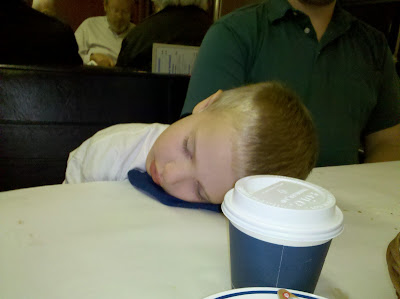
A few snippets so far from our train trip from Kansas to Portland. Terah, Jacob, Oliver, and I are on the trip, which is about 2.5 days on the train. The Parenting Dilemma So, if you are eating dinner, and your 5-year-old falls asleep with his head on the table, and you know he had been excitedly waiting for raspberry sorbet for dessert, and know there will be tears when he later realizes he missed it, what do you do? Let him sleep, or wake him up (with possible tears right then in the dining car?) As it turned out, I tried to quietly ask him if he wanted dessert. He woke up with a start, banged his head on the table, and then, yes, there were tears. I asked him if he wanted dessert or if he wanted to keep sleeping, and he gave a pathetic, sniffling, dessert. But by the time dessert arrived, he had fallen asleep again. I finally woke him up again, asked if he wanted to eat, and he just ignored me. I asked twice more and then he all of a sudden realized what he was being asked, sat bolt upright, and dug in. Graffiti Jacob noticed graffiti in Los Angeles. He called it silly words and kept commenting about it as we passed it. Bears Oliver always sleeps with a stuffed bear, which is his favorite comfort animal. But Oliver is 2, and when he says bear , it sounds more like beer . Plus, the boys still seem to be operating on Central Time. So at 4:15AM yesterday, Oliver awakened us saying: Beer! Beer! Beer! Where s beer? Where s beer? Need beer! Beeeeeer! Butterflies Jacob always sleeps with a stuffed butterfly, which he likes just like Oliver likes his bear. Jacob had this conversation with me this morning: Jacob: My butterfly knows all the people in the world. And all the animals, too! Me: Does butterfly even know Nash? (our cat) Jacob: Yeah, and he knows Sam and Edna too! (the cats across the road) Me: Wow. I think butterfly knows a lot more people and animals than I do. Jacob: *brief pause, then* Oh, silly dad! *collapses laughing*
Michal Čihař: GePeS 0.1.2

Yesterday, I finally took closer look at long standing GePeS bug on displaying speed and altitude wrongly (which I've mentioned in very first posts). For some reason I believed it is not my bug, but in QML bindings and let it be there. Receiving complain from Maarten ter Huurne, that this does not work made me look into it more deeply. Of course I found out it was caused by stupid typo and quickly fixed it. New release is now available on GePeS homepage and will be available shortly in Nokia store.

Filed under: English Meego 0 comments Flattr this!

Michal Čihař: QtSDK installation troubles

Recently my installation of Qt SDK I use for development of applications for Nokia N950 (N9) got broken. It happened by update some postinst script failed what caused almost no part of Harmattan SDK to be installed. I hoped this to be temporary error which will get fixed by later updates, but it turned out to persist even for 1.1.4 which has been released week ago. Yesterday I finally got time to look into it and after some debugging I found out that it was trying to install x86_64 version, which was not downloaded because I was using 32bit installer. I quickly realized this was caused by using 64-bit kernel, while running 32-bit userspace, for which the installer somehow was not prepared. Fortunately there is easy workaround for that:
linux32 ./Qt_SDK_Lin32_online_v1_1_4_en.run
What will run the binary in 32-bit personality and make kernel pretend it is compiled for 32-bit.

Filed under: English Meego 2 comments Flattr this!

14 November 2011

MJ Ray: Growing Your Co-operative, Bristol

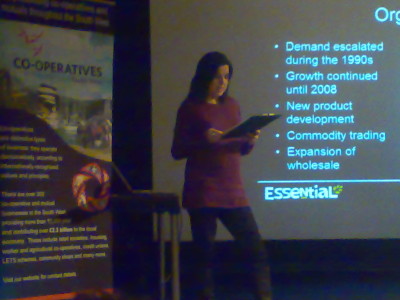
Photo of Eli Sarre

Eli Sarre from Essential Trading speaking at C-SW Annual Conference

Last Friday (11 November 2011), I was at the Cooperatives-SW annual conference at the Cube Cinema in Bristol, titled Growing Your Co-operative and sponsored by the Co-operative Membership South and West. It was another sold-out event, featuring headline talks from Co-op Party member and Labour MP Kerry McCarthy, Eli Sarre of Essential Trading worker co-op (pictured), Carole Theyer of Sparks Inc and Jim Pettipher from Co-operative Futures. There were also some great workshops I went to a finance workshop led by Ian Rothwell from Co-operative and Community Finance and a regulations one with Paul Martin of Kabin (details may appear on their event page) and a brilliant lunch from Runcible Spoon (and those of you who know me will know I have been livid with some co-op event lunches!) with some time to chat and network, although I also went to a fringe meeting about the RISE problems. The event concluded with the formal AGM of Co-operatives SW (electing a new chairperson and approving transfer to a new co-op corporation) as well as a bit more chat afterwards. I felt it was a great event and well worth my time being there. I m glad that some people from outside the co-op movement, from community businesses like the Strawberry Line Cafe and a few people considering joining or forming co-ops, were there and I hope it was good for them too.

Bdale Garbee: RF Immunity

We've had sporadic Altus Metrum customer reports about RF susceptibility issues with their TeleMetrum installations. In almost every case, these problems have been completely resolved by either making sure the system battery has sufficient charge before launch, or through the application of standard engineering techniques such as twisting wire pairs to reduce differential coupling. However, even when every technique we could think of had been applied, once in a while someone still had issues. Around the time of LDRS this year, the incidence of such reports seemed to increase. One customer, in particular, had an installation in which he virtually always saw continuous resets of the board once his 54mm airframe was put on a launch rail, and several customers reported seeing board resets during ejection charge firing. Keith and I saw a board reset during main charge firing happen in person at NCR's Oktoberfest, and with a couple days available to work together after that launch, we decided it was time to figure out what was really going on. Here's what we've learned. In bench testing, it quickly became clear that the problem was the 3.3 volt power supply rail getting pulled down far enough to reset the CPU. This most frequently happened during ejection charge firing, when the input of the LDO regulator is pulled down by the near-short presented by the e-match when a pyro FET is turned on. To keep the 3.3 volt rail voltage up during firing, we include a 100uF bulk capacitor on the regulator's output. In all of our prior bench testing, we never saw the 3.3 volt rail droop significantly. Clearly something had changed... or maybe several things had changed? The first thing I wondered about was whether the new Kalman filtering code, which requires more compute cycles from the processor, might be consuming enough more power to pull the rail down faster during charge firing. After poking around at it, though, we have no data to suggest the new code makes a measurable difference in power consumption. The next thing we pondered was that at least some of the e-matches we and others are using in the hobby now come from the fireworks industry, where it is apparently considered a feature for the match to retain continuity after firing. This means the input of the LDO gets held down for longer than with the e-matches we used to use and Quest Q2G2 igniters that open when fired. But that still didn't make sense as the root cause, as we chose the FET firing time such that even with a dead short across the igniter terminals, the 3.3 volt rail wouldn't be pulled down far enough to cause trouble during firing. One of the big changes between v1.0 and v1.1 on TeleMetrum was that the newer boards incorporate a better reset circuit. This helps ensure the GPS chip always comes up running at power on, which was a problem at temperature extremes with older boards. However, a side-effect of this change is that a v1.1 board will reset any time the 3.3 volt rail drops below 3.15 volts, whereas older boards didn't trip until a much lower voltage. So the recent increase in reports might just be related to more v1.1 boards being placed in service? While experimenting on the bench, we observed that injecting RF energy into the input of the LDO regulator had the effect of pulling down the output voltage, presumably because the internal reference source accumulates charge and is fooled into thinking the output is too high. Since our designs all have the power switch contacts ahead of the LDO, the wires going out to the switch and back are effectively an antenna... as are, to a lesser extent, the wires going to the e-matches. There is some variability from part to part in just how badly the LDO reacts. But by attaching a tuned length of wire as an antenna to the LDO input and playing around, we were finally able to reproduce the problem reliably on a test board at my bench! On further analysis, we realized that the output of the USB battery charger chip and the input of the LDO both expect a 1uF bypass cap to ground. At some point, those looked redundant and we eliminated one of the two. Unfortunately, we weren't internalizing the fact that the switch leads were between the two caps, and the one we left was on the output of the charger and not at the input of the LDO. Placing a suitable bypass cap right at the input of the LDO turns out to have a truly dramatic effect on RF immunity! Once we realized that RF getting into the LDO input was the problem, Keith pointed out that we used to see "noise" in the accelerometer data on earlier boards that was caused by the 3.3 volt rail moving slightly during radio transmit, which we fixed with a hardware change on v1.1. We are now convinced that this was at least partly related to RF coupling to the LDO input, not just the change in power consumption on the LDO output. We didn't realize what was going on in earlier testing because we often didn't have ematches wired up, so RF coupling was minimal. But going back to flights logged with v1.0 boards that included deployment, and studying the magnitude of the "steps" in acceleration data observed when the transmitter was on, Keith was able to compute the amount the 3.3 volt rail must have sagged if the real acceleration wasn't changing... which in some cases was as much as 180mV! We think this proves that RFI could cause the LDO to drop its output voltage below the reset controller set point on v1.1 boards. Based on these observations, I'm making two hardware changes for the next version of TeleMetrum (version 1.2), and Keith is also making a software change. We have tested all of these changes on real boards both on the bench and in test flights, and the net effect is a major improvement in the RF immunity of TeleMetrum. The first hardware change is moving to a slightly lower trip voltage on the reset controller. Instead of 3.15, the new part trips at 3.00 volts nominal. This gives us more "headroom" to tolerate 3.3 volt rail droop during charge firing, and will allow the board to operate longer on a given battery charge. This change is not relevant for v1.0 and prior. The second hardware change is adding an appropriate bypass capacitor right at the LDO input. This requires a PCB update, but it's possible for me to update existing production boards by adding an 0402 cap right across the appropriate pins on the regulator chip. The software change prevents our altimeters from turning on the radio transmitter while an ejection charge is firing. Since the RF transmitter draws substantial additional power, this should help keep the 3.3 volt rail from drooping. This may not really matter, but it feels like the right thing to do. This change will be part of our next stable firmware release. We think most TeleMetrum customers need not worry about these updates. But if you have seen odd resets on the rail or during ejection charge firing in flight with a TeleMetrum v1.1, feel free to contact me about updating your existing board to include these improvements.

13 November 2011

Benjamin Mako Hill: Famous in Scratch

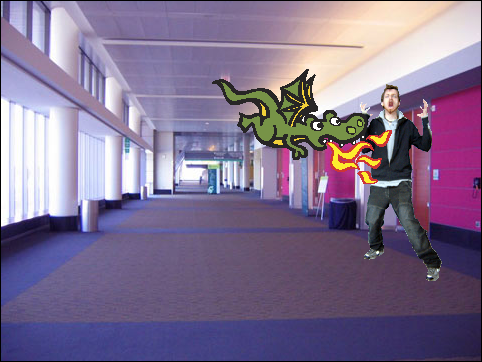
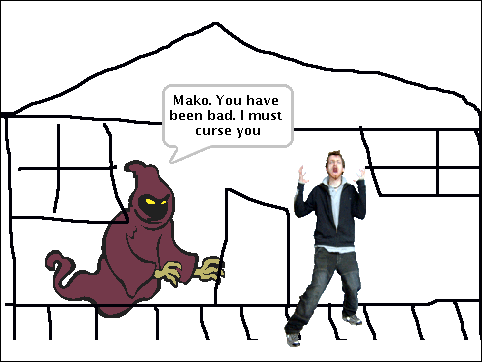
A few years ago, I ran into my friend Jay in the MIT Infinite Corridor. He was looking for volunteers to have their pictures taken and then added to the library of freely licensed and remixable media that would ship with every version of Scratch -- the graphical programming language built by Mitch Resnick's Lifelong Kindergarten group that is designed to let kids create animations and interactive games. Jay suggested I make some emotive faces and I posed for three images that made the final cut: /copyrighteous/images/scratchlib-mako-laughing.gif /copyrighteous/images/scratchlib-mako-screaming.gif /copyrighteous/images/scratchlib-mako-stop.gif But although I've spent quite a bit of time studying the Scratch community in the last few years as it is grown to include millions of participants and projects, I forgot about about Jay's photo shoot. A couple months ago, Acetarium resident Andres Lombana Bermudez pointed out that there was a mako tag on the Scratch website and that a whole bunch of users had been publishing projects using the pictures of me which, apparently, shipped in Scratch under my name. For example, in this project in which I dance in front of a enormous "MAKO" banner: /copyrighteous/images/scratchweb-dance.png That said, given the rather emotive nature of the pictures, I seem to usually end up being blown up shot, shrunk, set on fire by dragons, or meeting other similarly unfortunate ends. /copyrighteous/images/scratchweb-bad_mako.png /copyrighteous/images/scratchweb-looks_arent_everything.png There's quite many more entertaining examples under the tag and many more elsewhere on the Scratch website although they are a little trickier to track down. Jonathan Zittrain likes to say that the best technologies are generative in the sense that they encourage their users to make things with them that the designer never forsaw or anticipated. I feel generative.


Joachim Breitner: Running GNOME 3 and noone will notice

Two days ago, I finally brought my system up-to-date with regard to the GNOME packages that I use. I was very reluctant because I am using a heavily customized gnome-panel and I waited until all the applets that I use have been ported to gtk3 and the libgnome-applet library. I am the Debian maintainer of one of these applets, link-notification-daemon, and I have made the changes and tested them in a chroot before, but now that I am actually using it, I found and fixed more visual glitches. I think by now it is as usable as it was before on GNOME 2. I am still looking for someone to step up as the new upstream maintainer for it! I had some trouble with gnome-session and notification-daemon, thought I found the cause and reported it, but a day later I could not reproduce it anymore. Weird. Other problems, such as the busy cursor not disappearing after the session start, or evolution going into a freeze also have stopped occurring by themselves.

Other problems I found and fixed, for example the battery status applet was not visible until a major state change, or panel applets were not loaded due to a race condition, or tooltips not working (which called for a fix in gtk+ itself). I also added to the xmonad package the files required to allow the user to select GNOME with Xmonad in GDM, and found out how to have Galeon appear in the list of possible default browsers.
I don t really have to say much about GNOME3 itself. I disliked the default font, Cantarell, mostly because of the extra spacing that reduced the number of folders and mail I can see in evolution. (Also see what nekohayo has to say about that.) I also was under the impression that the font is much lighter, and I started to adjust the position of my laptop monitor to increase the contrast. So I switch back to DejaVu Sans.
I also disabled the sleep-on-lid-close feature I often run backups, or download stuff, or compile stuff, or calculate stuff, so I want better control over this. So, I guess, now that everything is almost as it was in GNOME2, I can say I like it...

Flattr this post

Guido G nther: Testing libvirt and KVM/QEMU with libvirt-tck

Debian's libvirt in unstable finally passes the Technology Compatibility Kit (libvirt-tck) for qemu:///system:
Files=59, Tests=1579, 315 wallclock secs ( 0.77 usr  1.02 sys + 31.40 cusr 10.14 csys = 43.33 CPU)
Result: PASS
We're running libvirt's internal test suite since 0.9.0 but this doesn't launch any real virtual machines to check things like suspend, resume, snapshotting, migration and it doesn't create storage pools and volumes or networks. This means a lot of testing was done manually with each release. libvirt-tck provides a framework to perform these kinds of integration testing between libvirt and it's drivers, comes with hundreds of testcases already and it's easy to set up since it's available in experimental:
apt-get install -t experimental libvirt-tck
Edit /etc/libvirt-tck/default.cfg if you don't want to use the default connection URI. Then just run libvirt-tck:
libvirt-tck
Since this is supposed to stress libvirtd and the hypervisor and since it creates and deletes storage pools, networks and virtual machines it's recommended to run this on a dedicated system to make sure the tests don't blow away any precious config. If a test fails one can debug that single test using:
LIBVIRT_TCK_CONFIG=/etc/libvirt-tck/default.cfg prove --verbose /usr/share/libvirt-tck/tests/hooks/051-daemon-hook.t
This already revealed errors in our package like a missing parted build dependency breaking the creation of disk based storage pools, bugs in libvirt, crashes in QEMU and minor errors in the test suite itself. We're currently cheating a bit since the tests for hooks and nwfilter are currently disabled due to license problems with the used Perl modules. libvirt-tck can easily be integrated into Jenkins since it can now use libtap-formatter-junit-perl to generate JUnit XML. To do so simply configure a free-style software project to execute these commands:
rm -f libvirt-tck.xml
sudo libvirt-tck --timer --format junit --force > libvirt-tck.xml
allow Jenkins to run libvirt-tck as root
jenkins ALL=(ALL) NOPASSWD: /usr/bin/libvirt-tck --timer --format junit --force
and configure it to publish a JUnit test result report. Currently I'm only running the tests for qemu:///system so any help running and debugging this for LXC, VirtualBox or XEN is very welcome. Many thanks go to Salvatore Bonaccorso for packaging the missing Perl modules needed by libvirt-tck.

12 November 2011

Peter Eisentraut: Switching desktop environments

So, like many people, I have received GNOME 3 in the latest upgrade on Debian testing, and switched away to Xfce very soon after. What's amazing (to me) about this whole experience, however, is how easy it is to switch desktop environments in Debian. Two years ago, I fled KDE in very similar circumstances. I have since used Openbox, LXDE, GNOME, Xfce, as well as a few more obscure window managers in short-lived experiments. All of this was easy to do and worked flawlessly. Most of my settings, my preferred programs, and startup applications were preserved, and if I didn't like it, I could switch back without a problem. (Ironically, the upgrades from KDE 3 to KDE 4 and from GNOME 2 to GNOME 3 lost far more settings than changes to other environments.) And of course you can mix and match applications from different environments, and these days this doesn't result in a visual crime. I don't know whom to thank for this, probably a combination of upstream developers, freedesktop.org guys, and Debian maintainers. Keep it up.

Kai Wasserb ch: New Greasemonkey script available for WotC's Magic section

No matter whether you're a professional or hobby player, if you play Magic: The Gathering, you certainly visit Wizards of the Coast's homepage from time to time. And while other parts of the WotC's page have been made unusable without ECMAScript enabled, the MTG part can be used without it mostly. The one part, that didn't work (and I needed) was card links. They have some ECMAScript to fetch the image from the Gatherer and overlay that on the current page, if you hover over a card link. If you click, it's again some script, that opens a Gatherer window. I just want all card links to be plain links pointing to the respective entries in the rather lightweight magiccards.info card search, which displays all relevant data in a compact layout. Today I finally got around to throw the ten or so lines of ECMAScript together, Greasemonkey needs to make that happen. If you like to give it a try, you can download it from my Greasemonkey script collection (direct link for the impatient: wotc_with_noscript_and_card_links.user.js). As an additional note: I'd like to point out, that there are other scripts available from userscripts.org which can do the same. But all those scripts did a lot else (like using jQuery to fetch the image on mouse over from magiccards.info).

11 November 2011

Niels Thykier: build-arch for everyone

The other day, I was asked if it was really possible to get build-arch support in Wheezy (as in, buildds using build-arch) by adding these optional targets. Lets have a look at the data that is available to us: To simplify my calculation I will assume we can fix packages over a course of 150 days (which is 5 months of ~30 days or every day in Dec to April). So 500/150 = 10/3 =~ 3.3 packages from the reduced set should be fixed every day. Erring on the side of caution, we should make that 4 packages every day. So if we fix 4 packages from the reduced set every day, we will definitely fix all of them before Wheezy. But the reduced set are only the source packages that could possibly benefit from having a build-arch target (it builds both arch:all and non-arch:all packages). There could (and probably will) still be sources building non-arch:all packages without a build-arch target. Furthermore, with the rate of 4 a day we will only have a month to get dpkg and buildd support In short, no. I do not expect us to get archive-wide build-arch support on buildds for Wheezy. But I will do my best to ensure that option #4 flip the switch becomes very attractive early in the Wheezy + 1 development schedule. I hope you will join us in this endeavour. Most of the time it is a trivial 3-4 line fix and often you can even throw in some hardening flags to spice it up a bit. The easiest way to help is to fix your (team s) packages listed in the reduced set . Once you are done with that you can look at the rest of your (team s) packages (see the full dd-list). The most important thing to remember is that Build-Depends-Indep is still broken! That is, you cannot rely on Build-Depends-Indep being installed on a buildd in the build target. So any existing workarounds have to stay for now (i.e. check for certain commands or deferring indep till binary-indep is called). If you are in doubt about how to fix a certain package feel free to ask for help. Note: I pull the data directly from lintian.d.o (full set) and UDD (reduced set). I try to remember to refresh it daily. The full set is basically (z)grep cut uniq on the lintian log, the reduced set is found using the UDD query from this script (based on a query done by Jakub Wilk). Since all data is (in)directly based on lintian.d.o only packages that are in sid are considered.

Felipe Sateler: Finding packages not directly depended upon

Today I was removing KDE from my laptop, when I realized that kde-window-manager would not go away (even when it was automatically installed) since it provides x-window-manager, which is needed by gdm. I manually removed it, but that got me thinking that maybe I had other packages that were in this situation. So I picked aptitude and tried to build some search-fu. Here is the resulting query:
aptitude search '?for x:
?x:installed
?x:automatic
?x:provides(?virtual ?reverse-depends(?installed))
?not(?x:reverse-depends(?installed(?depends(?=x))))'


Now, lets go over the query. The first part ?for x: allows us to refer to the package currently being matched. See the documentation for details. We'll see later why we need this. Basically we are saying: give me all packages x that match the following pattern. The second and third parts are trivial: we only want automatically installed packages.
The fourth part, ?x:provides(?virtual ?reverse-depends(?installed)) was easy: find all packages that provide a virtual package that is depended upon by some other installed package.
The fifth and final part, ?not(?x:reverse-depends(?installed(?depends(?=x)))) is why we needed the bound variable x. We want to filter out (hence the ?not) the packages that have some reverse dependency that depends directly on the package x. That way, in my case, metacity won't show up since gnome-core directly depends on it and is installed.

Unfortunately, this query doesn't grok alternative dependencies. For example, if gnome-core depended on metacity x-window-manager then this query wouldn't show metacity, since it is depended upon by a package. If someone can make this query understand that so that it only eliminates packages directly depended upon with no alternatives dependencies, please let me know!Tags: aptitude, cleaning, tip, tips

10 November 2011

Aigars Mahinovs: Well, this is now really on :)

http://lists.debconf.org/lurker/message/20111110.144615.333c5288.en.html Date: 2011-11-10 16:46 +200
To: DebConf Team
CC: debconf-discuss
Subject: [Debconf-team] Debconf13 in Riga, Latvia bid
Hello all, I will be concise and to the point. This email is a formal bid to organize Debconf13 in Riga, Latvia. You can find all the relevant information on the appropriate wiki page: http://wiki.debconf.org/wiki/DebConf13/Latvia All the plans have been solidified over the last few months and the backup options are there only for unforeseen disaster scenarios (like a big fire burning down the primary venue or something like that). The only details that are not nailed down are the final location for the day trip and formal dinner as the vendors did not want to give us such quotes and tentative reservations so far in advance, but even there we have primary and backup options planned already. We are trying to keep everything about this bid simple and predictable, so we hope you ll enjoy it.
Best regards,
Aigars Mahinovs

Michal Čihař: phpMyAdmin demo server updates

phpMyAdmin demo server got some updates recently. First of all I've updated MySQL and MariaDB version it uses (MySQL is now on 5.5.7 and MariaDB on 5.3.2). Later I've finally found time to make mentions of demo server less intrusive and fit more in existing interface. I've used jQuery to inject information about demo server to main page as one of standard boxes. It fits there nicely and puts information on main page where most users land anyway (you can see it for example here). With most important information on main page, the other pages could be reduced and now only mentions demo server and Git revision it is using. This brings user experience closer to real phpMyAdmin without intrusive information shown on top of every page. I hope you will like it :-).

Filed under: English Phpmyadmin 0 comments Flattr this!

Alberto Garc a: FileTea now available in Debian

In the past few weeks I ve been preparing the Debian packages of FileTea and its companion EventDance. They re finally available. FileTea is a free, web-based file sharing system that just works. It only requires a browser, and no user registration is needed. If you want to know more about it, you can read my previous blog post. For a more detailed description, read Nathan Willis s excellent article on LWN.net. There have been a few changes since that article (HTTPS support in particular) but it s still the best one you can find on the net. Igalia still provides a FileTea server at http://filetea.me/, that you can use to share your files and see how it works. We plan to keep offering this service, but you don t need to trust it/depend on it anymore: now you can apt-get install filetea and have your own.

9 November 2011

Jon Dowland: Minecraft

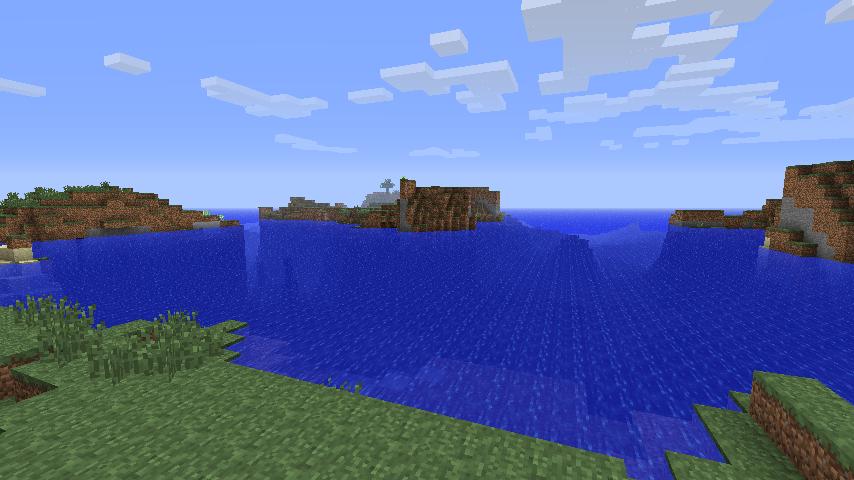
The Archipelago The Archipelago
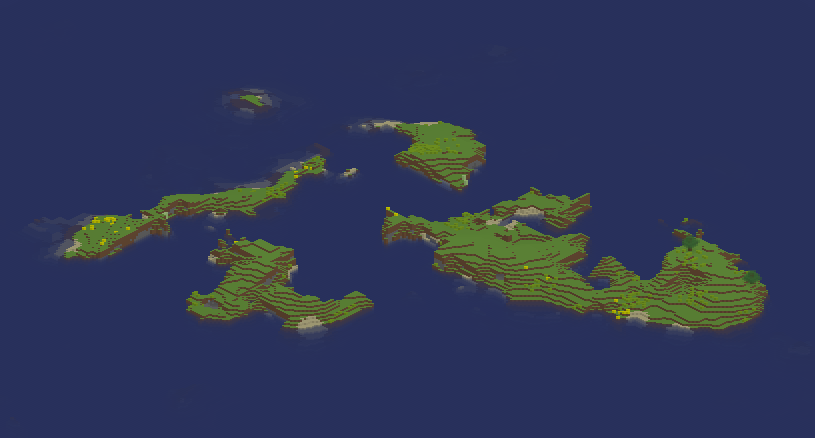
Bird's eye view Bird's eye view
You're on a small island in the middle of a vast ocean. There's nothing but dirt, stone and grass on the your island, which is part of a tiny archipelago. One of the nearby islands features a dark cave, with what looks like a coal seam near the entrance. You can glimps two small trees on another island nearby. All around your little clutch of islands is what appears to be vast, unending ocean in all directions. It's midday and you need to make yourself safe for the night. You can use the wood from the trees to craft a pickaxe. With this, you can fetch some coal from the seam. With the coal, you can create some torches, to see in the dark. You might have enough wood left over to make a door, if you're lucky. Or perhaps you should save it to craft a boat, or a sword. Groans from something unknown emanate worryingly closely from the darkness of the cave. You're lucky: one of your two trees has dropped a sapling. You eagerly plant it. In a few days time, you might be able to harvest some more wood. You've been granted a temporary reprieve, but the law of diminishing returns means at some point, and soon, you'll run out of wood. Swimming is time-consuming. By the time you have assembled a meagre supply of wood and coal, it's almost sunset. You nervously dig a burrow in the mud of your original island, light it with a torch and block the entrance back up. Night passes slowly as you listen to things crawling around in the darkness outside. I first learned about Minecraft from this blog post by Mike Watson last year. Mike did a great job of demonstrating the narrative power of the game and his post left a lasting impression on me. Every now and then I dip in to Minecraft to see what's new since the last time I played it. In the last few months version 1.8 was released and so I started a new map to check it out. I ended up with a corker of a randomly-generated map. Inspired by Mike's post, I thought I'd write a bit about it. In a follow-up post I will provide the map itself.

Michal Čihař: Back on track with Gammu

During summer, I somehow managed to collect huge backlog on Gammu. This consisted on few hundredths of emails to reply, bug reports, not reviewed records in phone database and so on. Today I can finally say this is mostly over and I should be able to react more quickly. Though this does not change anything on previous statements about limiting my involvement there. Processing emails went quite smoothly, luckily some of them resolved themselves or others have helped on mailing list. With bug reports it is more troublesome, because there are topic which I don't want to touch and thus looking for volunteers to work on that. Maintaining Gammu packages in Ubuntu PPA so that users would be able to install latest version easily is one of such tasks, which are waiting for somebody. Anyway I feel much better without those unread emails and I hope not to collect so huge pile of them again :-).

Filed under: English Gammu 0 comments Flattr this!

8 November 2011

Jan Hauke Rahm: On GNOME 3

Since there have been a few blog posts about GNOME 3 already, I m sure you don t mind me adding one. I m one of those who don t do any work, just lurk around and wait for stuff to be fixed or working in the first place. I also don t like compiling GNOME myself. I barely touched the already packaged stuff in the repository of our Debian GNOME packaging team. But I run unstable plus stuff from experimental. I ll thus have a bit of a different experience with GNOME 3 than current testing users who at least in parts don t seem to like what they re getting. That being said I love it. No, I don t mind running network manager on my systems, I even have it on my netbook (Atom processor). I used wicd for a long time because network manager really got nothing done back in the days (half a year ago or what :)). Nowadays, since version 0.9, it works fine for me. No fiddling around with config files, perfect integration in the desktop, and LAN and WLAN Just Work [tm]. No, I don t like if some weird dependencies dictate what tools to use. I usually used pidgin for messaging, for instance. Now I m using empathy, simply because it s best integrated in GNOME. And no, I won t switch from mutt to evolution. :-P And there are more such cases. Also, these weird accessibility tools that are stuck in the gnome-shell top panel , I don t need them. Still there. (There s an extension to remove it, by the way.) Also, I must say, GNOME 3.2 is a lot better than 3.0 already. And I think 3.4 might do the final trick for me. Fact is, with GNOME 3 I have a much cleaner desktop, there is more room for windows (which is nice on a netbook display), there are web apps which I already use a lot, and it has a professional, not too playful look (i.e. a few effects, clear and consistent theming, no bubbling windows). And the new notification stuff is just awesome, especially with the empathy integration. Oh, and too many mouse click to access an application? 1) Put your most used apps in the favorites bar (or whatever it is called); it s just one click then. 2) Press your meta-key (that way our name for the windows key, or was that the ESC key? Whatever, press your windows key), type in the first two or three letters of your application, and hit enter; you don t need a mouse at all. There. It had to be said. :)

Jonathan McDowell: The cost of progress

You should probably ignore this post. I'm just venting. I'll be better after a nice cup of tea. Things that are causing me to fume about the fact Gnome Shell just hit Debian/Testing: I update my testing boxes (work + home laptops) almost every day. It rarely breaks, and certainly when it does I accept that's what I get for doing rolling upgrades. I can't remember the last time I did an upgrade that actually made me angry. Also I suspect this thing is going to have a complete fit on my binary nVidia/hacked up DisplayLink configuration at work (the DisplayLink side refuses to do 3D for starters). Perhaps better not to upgrade there until I have a sufficient block of free time. Maybe it's time to go back to evilwm. I only stopped because I wanted a dock for wifi/bluetooth etc applets on my laptop that didn't get hidden when I fullscreened things. Implementing _NET_WM_STRUT might make that doable... (I'm sure some of this is just dealing with the change but it's a bit bloody difficult to deal with a complete change in user interface that hasn't even managed to carry across settings from the old one.)

7 November 2011

Jo Shields: Bansheegeddon

It s seeming increasingly likely that reports regarding the future of Banshee, Tomboy, and the rest of the Mono stack in the default Ubuntu desktop install are accurate. Ubuntu 12.04 will likely be the first Ubuntu release since 5.10 not to ship with any Mono apps in the default install ending a run of 12 releases over 6 years. The decision seems to have come about during the default apps session at the Ubuntu Developer Summit just ended in Orlando, Florida. Prior to heavy vandalism, the only reasons cited for the change in the UDS session log are Banshee not well maintained and porting music store to GTK3 is blocked on banshee ported to GTK3 . Other reasons mentioned but not in the session logs are complaints that it doesn t work on ARM. I m using a lot of conjecture in this first paragraph because the news about the decision appeared on the blogosphere before anywhere else. The first many Banshee or Tomboy developers read about it was reading a flurry of activity on the Tweetosphere from the anti-Mono activists declaring victory. So first, a word on the cited reasoning. Banshee works fine on ARM, since Mono works fine on ARM. Xamarin, the company behind most upstream Mono work, earns their income almost entirely from ARM versions of Mono, running on the varied ARM implementations found in smartphones. Every major Banshee release is personally tested on my Genesi EfikaMX, an ARM system with a Freescale i.mx51 processor. I ve also demonstrated Banshee running in an Ubuntu chroot on my HP Touchpad, an ARM-based tablet. What is known is that Banshee has some problems running on Texas Instruments OMAP4 processors the target ARM platform for Canonical s ARM work. None of the Banshee upstream developers, Mono upstream developers, or Mono Ubuntu team has ever been able to reproduce the cited problems, since problems specific to an exact ARM chip are impossible to reproduce without the requisite hardware and none of us owns an ARM system matching Canonical s target. That Banshee is still a GTK+2 app is true. A port to GTK+3 is almost complete, but blocking on a single technical bug deep within GTK# s guts, which could be fixed by someone with sufficient knowledge of GTK+ semantics. Nobody with the required GTK+ knowledge has stepped forward with a fix at this point in time. As for the final point, that Banshee is not well maintained, this seems like a directed personal insult against the active and responsive Banshee maintainer, Chow Loong Jin, and upstream bug triager David Nielsen, in addition to the immeasurable hours contributed free of charge for the benefit of Ubuntu users by various other members of related Mono app and library teams, including myself. I need to stress at this point that my annoyance with this decision has nothing to do with the actual app changes. Keeping Tomboy and gbrainy, at a cost of about 25 meg of unsquashed disk space, is a hard argument to make compared with those two plus Banshee for 40 meg. Dropping gbrainy and Tomboy, and switching to Rhythmbox, will save about 30 meg of unsquashed space, all told.I m unconvinced that Rhythmbox is a technically superior app to Banshee several features which were gained by the first app swap will be lost again but that s another long tedious argument to be had. No, what has me deeply angered is the shambolic way the changes were made and announced. Significant accommodations were made by Banshee upstream in order to make life easier for Canonical to integrate Banshee into their OS. For one thing, that s why the Ubuntu One Music Store support is a core Banshee feature, not part of the third-party community extensions package. If Banshee was being considered for replacement due to unresolved technical issues, then perhaps it would have been polite to, I don t know, inform upstream that it was on the cards? Or, if Canonical felt that problems specific to their own itches required scratching, then is it completely beyond the realm of possibility to imagine they might have spent developer resources on bug fixing their OS and sending those fixes upstream? Or even and call me crazy providing access for upstream to specialized hardware such as a $174 Pandaboard to empower upstream to isolate and fix unreproducible bugs specific to Canonical s target hardware? And here s where it gets more astonishing for me Canonical paid money to ship one of the community-based packagers responsible for the stack, Iain Lane, to Orlando for UDS, and didn t think it was worth bothering to perhaps inform him hey, the stuff you work on is in danger of being axed from the default install, maybe you should go to this session . So I m not cross that the stuff I work on has been removed from the default install. I intend to continue working on it as I have for the last 4 years, through my work in Debian. No, why I m cross that I heard about it from fucking Boycott Novell. Regardless of your opinions regarding Banshee or its stack, if you read the above and don t see it as an abysmal failure of community engagement by a company whose community manager wrote a book on the damn topic, then there s something seriously wrong with your understanding of how community labour should be seen as a resource. Maybe someone at Canonical should try reading Jono s book. It s not a first-time offence, and this mail from a PiTiVi developer regarding changes in 11.10 makes for useful further reading. [edit] There is some worthwhile discussion going on on the ubuntu-desktop mailing list covering the technical issues surrounding the decision, I would suggest it s a good place for ongoing technical discussion.

Next.

Previous.