Search Results: "tar"

29 March 2012

Kurt Roeckx: Getting frustrated by Google

I recently started working on a webshop called e-webshops which mainly sells e-books. If I want to attract customers there are various things to do so that people can actually find you. So I started using various services from Google, looking at my results in queries and things like that, and noticed that some queries didn't return the expected results. One of the problems is that I can spell and a lot people can't, and Google doesn't consider the words to be synonyms. The proper way to spell e-book in Dutch is either e-boek (preferred) or e-book, but lots of people write it as ebook (or eBook). I of course use the preferred spelling everywhere. So what do I do? I contact Google asking them to make them synonyms. Almost 2 weeks later I get a mail back from someone that doesn't seem to be getting what I'm asking for, so I reply back. Finally after an other month I get a mail back pointing me to a blog post, which suggest posting it to a forum or tweeting about it. I don't think either form is good way to contact a company about such a thing, which is why I contacted them by email in the first place. I have strong doubts that the right people would actually read all the forum posts. How hard can it be to forward an email to the right people? At the same time I have various other problems with Google, like things that don't work as advertised, broken documentation links, incorrect documentation, no way to contact them about the topic you want and you need to select a random other one, asking me to rate a help page I visited that day and then give an obviously broken URL, and a whole bunch more.

28 March 2012

Jordi Mallach: GNOME 3.4

The GNOME project released today GNOME 3.4, the second major update to the GNOME 3 platform. Congrats! I know there's lots of polish and improvements to some of the major rough edges in GNOME 3.2, but I think that of all changes in this release, Epiphany really stands out, as you can see in blog posts by Xan and Diego.

Work to bring GNOME 3.4 to Debian wheezy users has been underway for a few weeks already, and some bits and pieces have been hitting unstable since the tarballs were released a pair of days ago. We still need more base work to be done before some exciting components like GNOME Shell can hit our archive, and we want to fix as many FTBFS with GLib 2.32 bugs as possible before pushing it to unstable, but all in all, hopefully this time, shepherding a major GNOME release to Debian testing won't be as painful as it was not so long ago. However, we have already identified some fun bits involving clutter, cogl and mutter in our initial analysis, but nothing that hopefully can't be dealt with in a civilised way. As always, if you think you can help us, we're reachable at #debian-gnome at OFTC!

Andrew Pollock: [life/americania] Four days in New Orleans

Sarah's Mum had accrued too much annual leave and had to take some time off work, so Sarah did some (very mild) arm twisting and convinced her to come over for 3 weeks, and do a 5 day cruise to Mexico out of New Orleans. Unfortunately, my annual leave situation wasn't quite so abundant, and I had a lot going on at work, so regretfully I didn't join them on the cruise, and instead went to New Orleans for a four day weekend when they returned. From all reports, the cruise was very good. Zoe handled it well, although she did say "home" a lot. One of the two stops in Mexico was to check out some Mayan ruins, which looked awesome from the photos. The other stop involved a dolphin encounter. I was incredibly envious of all that they got to do, and would have loved to have gone with them, as I've never been on a cruise ship either. I can also report that no cats were lost during this bachelor stint. I had a night flight on the Wednesday evening to get there, which was scheduled to get in at around midnight, and I'd booked a motel room near the airport for that night, and we'd booked a vacation rental home for Thursday to Sunday nights. Unfortunately, my flight ended being delayed something like 2.5 hours, so I didn't get into New Orleans until around 2am. The house we rented did the trick nicely. It was a small "shotgun" duplex in what looked like a nice neighbourhood. It was advertised as being close to the street car line, but they were doing some work on the tracks, so the street car didn't seem to be running as far down the line as it usually did, so it ended up being a bit more of a trek to get to it. It was also extremely slow, and there was a marathon on the Sunday, which closed everything down for a long time, making it a generally pretty unreliable form the transport. We ended up renting a car for Saturday and Sunday, which was something of a saga in itself, as Enterprise didn't have any cars at the location we'd booked one, so after a couple of hours cooling our heels there (Zoe was incredibly well-behaved, all things considered), they shuttled us over to another location and we ended up with a minivan instead of a compact, which for the same price, allayed our concerns about being able to transport all of our luggage to the airport on Monday morning. We had a very early morning flight on Monday morning to come back, which got into SFO at around 9am, and I went directly to work from there. Thursday We all arrived at the house, separately. It ended up taking them 2 hours to disembark the ship when it came back into port, with Customs taking an eternity to process everyone. I think we went exploring the local area that afternoon, and took a street car into the city to check out Bourbon Street, having a Cajun dinner at Remoulade. Friday In the morning, we went to check out Lafayette Cemetery Number 2. Sarah took Zoe back to the house for a nap, and Sarah's Mum and I continued back to explore the French Quarter some more, walking down the length of Royal Street (which was vastly different from Bourbon Street, just one block over). We had lunch at the French Market. The cemetery was interesting, as pretty much all of the graves were these huge above ground tombs, that seemed to have multiple family members interred in them. Apparently the cemetery filled up quite quickly courtesy of a Yellow Fever outbreak. After lunch, Sarah's Mum and I continued wandering around the French Quarter. We went and took a look at the Mississippi River, and I had an encounter with a grifter who was so good at his job I couldn't bring myself to argue with him over the $20 he diddled me out of. We tried to get to the Civil War Museum, but it closed at 4pm. We looked at the Robert E. Lee Monument, which seemed to be draped in drunks, and then I think we rendezvoused with Sarah and Zoe back on Canal Street for dinner at The Court of Two Sisters (which apparently we were under-dressed for, as Sarah and her Mum said we were getting a lot of dirty looks from other patrons). Saturday On Saturday morning, we had the aforementioned car rental experience from hell, and by the time we had the car it was lunchtime, so Zoe napped in the car after lunch on the way out to Oak Alley Plantation, where we were introduced to the delightful beverage known as the mint julep, and took a tour of the house and wandered the grounds. Sunday On Sunday, Sarah and her Mum did a swamp tour, and Zoe and I went to the zoo. As I said earlier, there was a marathon that completely closed down Saint Charles Avenue, which is where the street cars run, so after walking down to where the street cars started operating (which ended up being most of the way down South Carrollton Avenue), the driver informed me that the street cars were queuing up at the corner of South Carrollton and Saint Charles, and I should get off her street car and get on the one at the front of the queue. I did this, but the driver of the front street car informed me that she wouldn't be leaving for an hour and half. At this point, I started considering a bus instead. Zoe and I went to check out the Mississippi River, which was quite close to where we were, and then I went back, and despite a street car having left (without any passengers) the driver of the current street car couldn't tell me when she'd be leaving, so I started walking down Saint Charles Avenue. Unfortunately, Zoe's going through a phase where she wants to be carried everywhere, so I was lugging her all over the place on my hip. Sarah didn't take a stroller with her, and instantly regretted it. Lesson learned. Eventually we managed to get onto a bus, which dropped us off at Audubon Park, which had Audubon Zoo at the other end of it. There was a playground near the Saint Charles Avenue end of the park, so Zoe had a bit of a play on that, and then we continued through the park to the zoo. Mercifully, the zoo had dodgy strollers for rent, and there was no way in the world I wasn't going to rent one of them, so that made getting around with Zoe a lot easier on my back. We had a really good time at the zoo. There was some sort of a music festival on in the parklands within the zoo grounds, and that included a jumping castle, which Zoe expressed a desire to have a go on. She had a fabulous time on it. I think she probably spent about 15 minutes in there, without any tears. I was very impressed. I took a brief video of some of her antics. It was getting close to Zoe's nap time, and she was getting tired, but fortunately Sarah and her Mum were able to pick us up from the zoo after their swamp tour and Zoe got to nap back at the house. Monday We had a very early start. Unfortunately, our flight (with United) was a couple of days after United and Continental officially merged, and despite having checked in online, we had to queue up with everyone else (for an extended period of time) to drop off our checked luggage. Then there was a 45 minute line for security screening. We pulled the "toddler going to melt down" card and jumped to the head of the line, but Sarah's Mum had to wait. The flight ended up being delayed because people were stuck in the security line. Overall impressions of New Orleans Fabulous architecture. There were so many gorgeous houses on Saint Charles Avenue and the surrounding area. I'd have loved to do an architecture tour. Crap (but cheap) public transport. $3 gets you a day pass. The street cars are cute, but slow and unpredictable. The drivers were remarkably unhelpful. The buses were okay. Great food. Zoe seemed to have a liking for the spicy stuff. I gave her some fresh alligator jerky, and after some initial coughing and spluttering at the spiciness of it, she came back for more. Post-Katrina recovery. We really only saw a very small part of the city, but there were still some houses with boarded up windows, and some vacant blocks where buildings had been demolished, but largely you'd not have been able to tell that large parts of the city had been underwater, from casual inspection. I really enjoyed the trip, even though it was brief, I feel like I got a good feel for the place. We were there just after Mardi Gras, and there were still beads everywhere. Draped all over fences. Over power lines. Trees on the parade route were absolutely covered in beads. I'd have loved to have been there for Mardi Gras. My friend Brandon, who is an excellent street photographer, took some great photos that capture some of it. Photos from Sarah's cruise and our time in New Orleans are here.

Dirk Eddelbuettel: RcppArmadillo 0.2.37 and 0.2.38 released, but not on CRAN

Conrad is readying his fabulous Armadillo C++ template library for linear algebra for a new 3.0.0 release, and started to make pre-releases. His version 2.99.1 came about a good week ago, it took us a few days to make a small required change in RcppArmadillo (which is our R package providing Armadillo to R via Rcpp) but our release 0.2.37 was ready last weekend. But then the good folks at CRAN did not want it. That is at the same time disappointing to us as developers / maintainers: work we do will not get pushed to largest number of users immediately. On the other hand, we do understand that CRAN is under a lot of strain. Years ago John Fox demonstrated exponential growth of packages at CRAN, the rate was then around 40% per year. Right now the number of packages exceeds 3600, and there are often several dozen daily updates (which you can follow with the CRANberries service for html and rss I had set up years ago). And the three CRAN maintainers all have full-time jobs as academics, and they also happen to be busy R Core members. Plus the new R version 2.15.0 is to be released at the end of the week, and this usually entails a number of package changes, putting extra strain on CRAN right now. For more on new or updated CRAN policies, see this long thread. Now, as I wrote on the rcpp-devel list, there is of course always install.packages("RcppArmadillo", repos="http://R-Forge.R-project.org") for a direct installation from R-Forge. But as I just put 0.2.38 there, it may take the running of the batch updates on the site so if you want it now, follow this link to my local Rcpp archive. All that said, here are the NEWS entries for these two last releases:
0.2.38  2012-03-28
    o   Upgraded to Armadillo release 2.99.2 "Antarctic Chilli Ranch (Beta 2)"
          * added .i()
          * much faster handling of .col() and .row()
          * expressions X=A.i()*B and X=inv(A)*B are automatically converted
            to X=solve(A,B) 
0.2.37  2012-03-19
    o   Upgraded to Armadillo release 2.99.1 "Antarctic Chilli Ranch (Beta 1)"
          * added non-contiguous submatrix views
          * added hist() and histc()
          * faster handling of submatrix views
          * faster generation of random numbers
          * faster element access in fixed size matrices
          * better detection of vector expressions by sum(), cumsum(),
            prod(), min(), max(), mean(), median(), stddev(), var() 
As always, more detailed information is on the RcppArmadillo page. Questions, comments etc should go to the rcpp-devel mailing list off the R-Forge page.

Roland Mas: FusionForge news, March 2012

The winter has been busy everywhere, and not much happened in FusionForge land. However, this is over, and we've started pushing again, with a focus on making our next 5.2 release ready. We've started a stabilisation branch and set up Jenkins jobs to run our various testsuites on it. Packages built from that branch have also been uploaded to the "experimental" suite in Debian (they need a manual approval before they actually appear there, but that shouldn't take too long). They should be installable and working even on Debian Squeeze (stable), although they focus mostly on Wheezy (testing). My personal goal is to have a solid 5.2 release and include it in Wheezy so it can be part of an official Debian system. What this all means is that we welcome tests and reports of breakage; users of 5.1 or earlier versions in particular are encouraged to test upgrades (in virtual machines or development environments, obviously, if the production server is sensitive). We also welcome translators; there are many new plugins, which means many new translatable strings. We'll probably do release candidates before the final release; I'll announce them here (in addition to the fusionforge.org website). Stay tuned!

27 March 2012

Wouter Verhelst: Bjorn Monnens on Debian

If this were twitter (and if I had a twitter account, which I don't), this post would start with "RT". As it is, you'll have to make do with this link: Bjorn Monnens on why he chose Debian testing over Fedora.

This weekend I switched again to Debian 6 testing as this is also Gnome 3. I had to do the same stuff as for Fedora but I noticed already that it s much more stable and it is also much faster than Fedora. Boot is really a difference of +30 seconds.
Go team! (with apologies to those who read this blog through Planet Grep, as Bjorn is there too)

Richard Hartmann: subtle bugs

This one confused me for a moment; iperf did not do what I wanted it to do. Quoth the manpage:
CLIENT SPECIFIC OPTIONS
       -d, --dualtest
              Do a bidirectional test simultaneously

Doeth the program:
host1:~% iperf -dc host2
WARNING: option -d is not valid for server mode
------------------------------------------------------------
Client connecting to host2, TCP port 5001
TCP window size: 16.0 KByte (default)
------------------------------------------------------------
[  3] local host1 port 42220 connected with host2 port 5001
[ ID] Interval       Transfer     Bandwidth
[  3]  0.0-10.0 sec    376 MBytes    315 Mbits/sec
host1:~% iperf -c host2 -d
------------------------------------------------------------
Server listening on TCP port 5001
TCP window size: 85.3 KByte (default)
------------------------------------------------------------
------------------------------------------------------------
Client connecting to host2, TCP port 5001
TCP window size: 63.1 KByte (default)
------------------------------------------------------------
[  5] local host1 port 42221 connected with host2 port 5001
[  4] local host1 port 5001 connected with host2 port 57550
[ ID] Interval       Transfer     Bandwidth
[  5]  0.0-10.0 sec  98.7 MBytes  82.8 Mbits/sec
[  4]  0.0-10.0 sec    978 MBytes    817 Mbits/sec
host1:~% 

Ignoring the transfer rates, I invite you to spot the premature,misguided optimization. This is quite subtle and probably non-obvious during implementation. The moral of the story is to collect all data before starting to evaluate it, at least if full information is needed for correct processing. Before anyone points out the obvious, yes I filed a bug.

Timo Jyrinki: On brands, marketing and technical details

I have a few thoughts based on the yet another round of debate where marketing clashes with free software advocation and technical details. Nothing new in the debate itself, but I'm adding a couple of insights.

Marketing is not highly respected by many technical people, and neither by the people wanting more advocating than the messing up with facts and feelings that the marketing does. I'm all for advocating free software, but it's currently not something you can use for marketing to win big markets. If we advance to a world where free software is as wanted as the green values today are, it can be used in marketing as well similar to all the ecological (according to the market department at least) products today, but alas the benefits of free software are not yet as universally known. Since it doesn't say much that touches the masses, advocating has a negative marketing effect since it takes space away from the potentially "hitting" marketing moves, in those cases where you target the big masses in the first place. "Open" this and that has some marketing power in it nowadays, but it's a mess of different meanings that probably doesn't advance libre software freedoms as such. Wikipedia has probably been the biggest contributor to advancing general knowledge of software and culture libre. Disclaimer: I'm not a proper marketing person, some more professional might have better insights in this area. If I'd be a proper marketing person, I'd decorate this blog post with fancy pictures so that more people would actually read it.

Some of the marketing can be done without sacrificing any of the advocation. The fabulous Fedora campaigns, graphics, slogans and materials are a great example of those and do an important job, even though Fedora isn't reaching the big masses with it (and Fedora isn't targeted for OEMs to ship to millions either). But they do hopefully reach a lot of level people on the grassroots level. I hope as a Debian Developer that more people valuing the freedoms of free software would help also Debian as a project to reach more of its advocation potential and developers from the more proprietary world. But I'm happy that at least some free software projects have nowadays true graphical and marketing talent. Even though not as widely known, freedoms of the software users including for example privacy aspects are a potential good marketing tool toward a portion of the developer pool.

Let's not forget that Android conquered the mobile market without using the brand power of Linux. The 30+ million people who know Linux a bit deeper than just "I've heard it" already run a Linux distribution like Ubuntu, but we need hotter brands than a project name of a kernel to reach the bigger masses. Call it Ubuntu, Fedora, or something, but no matter do what it needs to ship it to millions. AFAIK mostly Ubuntu and SUSE are shipping currently via desktop/notebook OEMs, and more Ubuntu than SUSE. Others aren't concentrating on the market, which is a very difficult one. Ubuntu is doing a lot more mass population advocating for free software than Android has ever done. Note for example the time any user tries to play a video for the first time in a non-free format - Ubuntu will tell the user about the problems related to those formats and asking a permission to install a free software player for those (or buy licensed codecs), and the Ubuntu Help texts describe a lot of details about restricted formats, DRM et cetera. Not to mention what happens if the person actually wanders into the community, discovering Debian, other free software projects, free software licenses and so on. Meanwhile Android users never notice anything being wrong while watching H.264 videos or watching DRM Flash videos. Granted, like Boot2Gecko debate shows, it may be a partially similar situation on shipping desktop Linux variants as well, in order to actually ship them via partners.

Anyway, the best example of brands is MeeGo. Even the LWN editor does not get into dissecting the meaning of MeeGo on Nokia N9, because "there has been no real agreement on that in the past", but just uses the brand name as is. That is the power of brands. Technical people debate that it's not really MeeGo, it's maemo GNU/Linux with a special permission from Linux Foundation to use the MeeGo brand name, and then counter-argument with that the MeeGo is an API and maemo matches the MeeGo 1.2 API which is actually just Qt 4.7 API. And actually, as proven by the LWN example, it's not even "technical people". For most of technical people Nokia N9 is MeeGo as well. Only the people who have actually worked on it plus the couple of other people migrated from maemo and MeeGo.com communities to Mer project understand the legacy, history and the complete difference between the Maemo Harmattan platform and what MeeGo.com was. Yet at the same time like all GNU/FreeDesktop.org/Linux distributions, they are 95% same code, just all the infrastructure and packaging and polishing and history is different.

For 99.9% of people who know what MeeGo is, MeeGo is the cool Nokia smartphone, one of its kind and not sold in some of the major western markets, and/or the colorful sweet characters of meego.com shown at one time on a couple of netbooks. That is the brand, and the technical details do not matter even to the technical people unless they actually get into working on the projects directly.

To most people, the Linux brand is a mess of a lot of things, while other brands have the possibility at least to have a more differentiating and unique appearance.

Diego Escalante Urrelo: All the new cool stuff in Epiphany, alias, Web

Today we released Epiphany 3.4. It includes all the fixes, enhancements and new cool features that we build since September 2011. That is 6 months of cool stuff! Xan already explained the bigger picture but I want to highlight some details in the spirit of Every Detail Matters. Improved location bar, and the new history backend The location bar suggestions now load extra-extra-fast, thanks to our new SQLite backend. Besides being extra fast, SQLite allows us to make complex queries to offer better results in the completion. Goal for 3.6: to successfully handle searches like that page, with the dog, you know, that one with the funny one . This also makes possible to have a cool Overview start page for 3.6. Much like Chrome or Opera do. An awesome UI: cleaner toolbar, loading progress That is all the chrome you are getting, kid! Less distractions, more web! All the usual tools are still available in the gear menu: Oh, and this other one is a pretty one. Check out the new load progress indicator: You might have already noticed the combined stop/reload button. Some other niceties like the new link tooltips are all over the place. I will not ruin the surprise :-) . Reliable download icons This is my friend Juanjo:
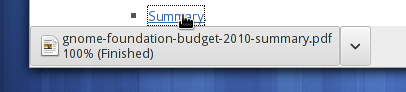
He is always happy. One day he said: Diego, my PDF documents are shown as boxes while downloading. It makes me mad! I want Juanjo to keep that happy hacker smile. So I decided to fix this. Downloads now have a better idea of the icon they should show: Page icons, now a WebKitGTK+ feature Do you notice something? Yeah, icons for every of the loaded pages. The support for this is now in WebKitGTK+, available to other applications. This means it is better supported and maintained! Redesigned about: pages For a time now we have had some geeky about: pages. One for memory (about:memory), one for plugins (about:plugins), and perhaps the most useful one, one to manage applications (about:applications): And, last but not least Less lines:
$ git diff --shortstat 3.2.0..3.4.0
328 files changed, 73211 insertions(+), 104528 deletions(-)
Unlike other browsers, Epiphany does not have dozens of engineers behind the project. This means that the more code we have to maintain, the less time we have to develop new features and to even maintain that code! Also, this makes Xan happy. But luckily Igalia has hackers like Martin Robinson who are willing to show us how hacking should be done: Epiphany 3.4.0, alias, Web. Is an awesome release. It will soon be in your distro of choice. Thanks Allan for the screenshot help!

26 March 2012

Vincent Sanders: NetSurf Developer Workshop

NetSurf DevelopersOver the weekend we held the NetSurf developer workshop. The event was kindly hosted by Collabora at their Cambridge offices. The provided facilities were agreed to be excellent and contributed to the success of the event.

Five developers managed to attend from around the UK John-Mark Bell, Vincent Sanders, Michael Drake, Daniel Silverstone and Rob Kendrick. In addition James Shaw, one of the project founders, made a special appearance on Saturday.

Starting from Friday afternoon we each put in over 25 hours of actual useful work and made almost 170 commits changing over 350 files, added 10,000 new lines of code and altered another 18,000.

The main aim of the event was to make the transition from using libxml2 to our own libdom library for the browser DOM tree. This was done to improve the browsers performance and size when manipulating the DOM but also gives us the ability to extend the browsers features to include dynamic rendering and Javascript

We also took the opportunity to discuss and plan other issues including:
  • User interface message handling and translation.
  • User preference handling.
  • Toolchain support.
  • Disc caching.
  • Javascript binding
  • Electronic book content handler.
Rob tackled the first parts of the messages conversion from numerous separate files into a single easy to handle file which will in future allow for easier translation and reduce message proliferation.

We made decisions on the ongoing rework of user preference handling which will be implemented in future.

The decision on the toolchain was slightly changed to be that any core or library code (non frontend/toolkit specific parts) are required to conform to the C99 standard. Frontends are permitted to recommend and use whatever tools their maintainer selects but they cannot enforce those restrictions on core code. This issue is principly because the BeOS maintainer is compiling NetSurf with g++ 2.95 which is missing several important language features we wish to use.

Developers at workThe recurring issue of disc caching was raised again and we have come up with what we hope is a reasonably elegant solution to be implemented over the forthcoming months.

Now there is a suitable DOM to bind against, the existing Javascript engine support will be properly integrated and should result in basic script support before the 3.0 release. This support will remain a build time option so NetSurf can continue to be used on platforms where the interpreter is too resource intensive to be used.

A short discussion about the possibility of integrating a basic page based content handler for epub and mobi type documents was discussed and while the idea was well received no decisions on implementation were made.

Overall the event was a resounding success and we are left with only a small handful of regressions which appear straightforward to solve. We also have a clear set of decisions on what we need to do to improve the browser.

25 March 2012

Steve Kemp: So I have a new camera. Again.

Until recently I've had a Canon EOS 1000D, my starter-camera, and a Canon EOS 40D which is my real-camera. The 40D is older, but it probably counts as a "semi-pro" body, albeit an old mid-range one. From an image size point of view there isn't too much to tell them apart - both produce 10MP images. But from a hardware and ease of use sense the 40D has several key features which made it a compelling upgrade: Anyway both these cameras have been my friends for the past year or two, although I did buy a toy camera for those times when I didn't want to carry the DLSR around. I've made sure I only bought "posh" lens, including the fabulous and horrifically expensive 70-200 f/2.8 MK 2 lens (Just short of 2000) and I'd been wanting to use those on a full-frame camera. Now it is upgrade time once more and I've just bought the EOS 5D MK II - a full-frame camera which means I don't have to worry about crop-factors any more. So far I've only had it a couple of days but I'm in love. The output images are 21MP so I get far fewer to a (CF) card. But the detail is sublime. Future portraits and photos of people will be wonderful - although I hope they already are to a large degree! This upgrade was a hard choice. The 5D is a full-frame, but a little slow. (Faster than my 40D by a hairs-bredth) The alternative would have been a 7D which is fast, and wonderful, but still uses a cropped sensor. Given that I have fast lenses and don't do sports (often) the 5D seemed like the sanest approach. For my reference - my Canon serial numbers:
EOS 1000D1780312242
EOS 40D1230734041
EOS 5D MK II4131916951
ObQuote: "Courage is only required when facing that which you fear. " -Stargate: The Ark Of Truth

Gregor Herrmann: RC bugs 2012/12

thanks to lucas' last archive rebuild, this week offered some new & easy additional RC bugs :) here's the list:

Mike Hommey: Announcing vmfs-tools version 0.2.5

The last release of vmfs-tools (0.2.1) was almost 2 years ago. It was about time to bring some of the changes that have been available in the git repository in an official tarball. So here it is. It brings some limited VMFS 5 support and experimental extent removal, as well as some deep changes to the debugvmfs tool and various fixes. Next release (0.2.6) will have a fixed fsck, which, while it still won t fix file system inconsistencies, should at least report actual inconsistencies (which is far from being true currently). I won t give any estimation as to when this will happen, though.

24 March 2012

Richard Hartmann: podcasts that don't suck

Funny, I had planned to use the same name for quite some time.. Good English German

Dirk Eddelbuettel: Initial release 0.1.0 of package RcppSMC

Hm, I realized that I announced this on Google+ (via Rcpp) as well as on Twitter, on the r-packages list, wrote a new and simple web page for it, but had not put it on my blog. So here is some catching up. Sequential Monte Carlo / Particle Filter is a (to quote the Wikipedia page I just linked to) sophisticated model estimation technique based on simulation. They are related to both Kalman Filters, and Markov Chain Monte Carlo methods. Adam Johansen has a rather nice set of C++ classes documentated in his 2009 paper in the Journal of Statistical Software (JSS). I started to play with these classes and realized that, once again, this would make perfect sense in an R extension built with the Rcpp package by Romain and myself (and in JSS too). So I put a first prototype onto R-Forge and emailed Adam who, to my pleasant surprise, was quite interested. And a couple of emails, and commits later, we are happy to present a very first release 0.1.0. I wrote a few words on a RcppSMC page on my website where you can find a few more details. But in short, we already have example functions demonstrating the backend classes by reproducing examples from
Johansen (2009)
and his example 5.1 via pfLineartBS() for a linear bootstrap example;
Doucet, Briers and Senecal (2006)
and their (optimal) block-sampling particle filter for a linear Gaussian model (serving as an illustration as the setup does of course have an analytical solution) via the function blockpfGaussianOpt()
Gordon, Salmond and Smith (1993)
and their ubiqitous nonlinear state space model via the function pfNonlinBS().
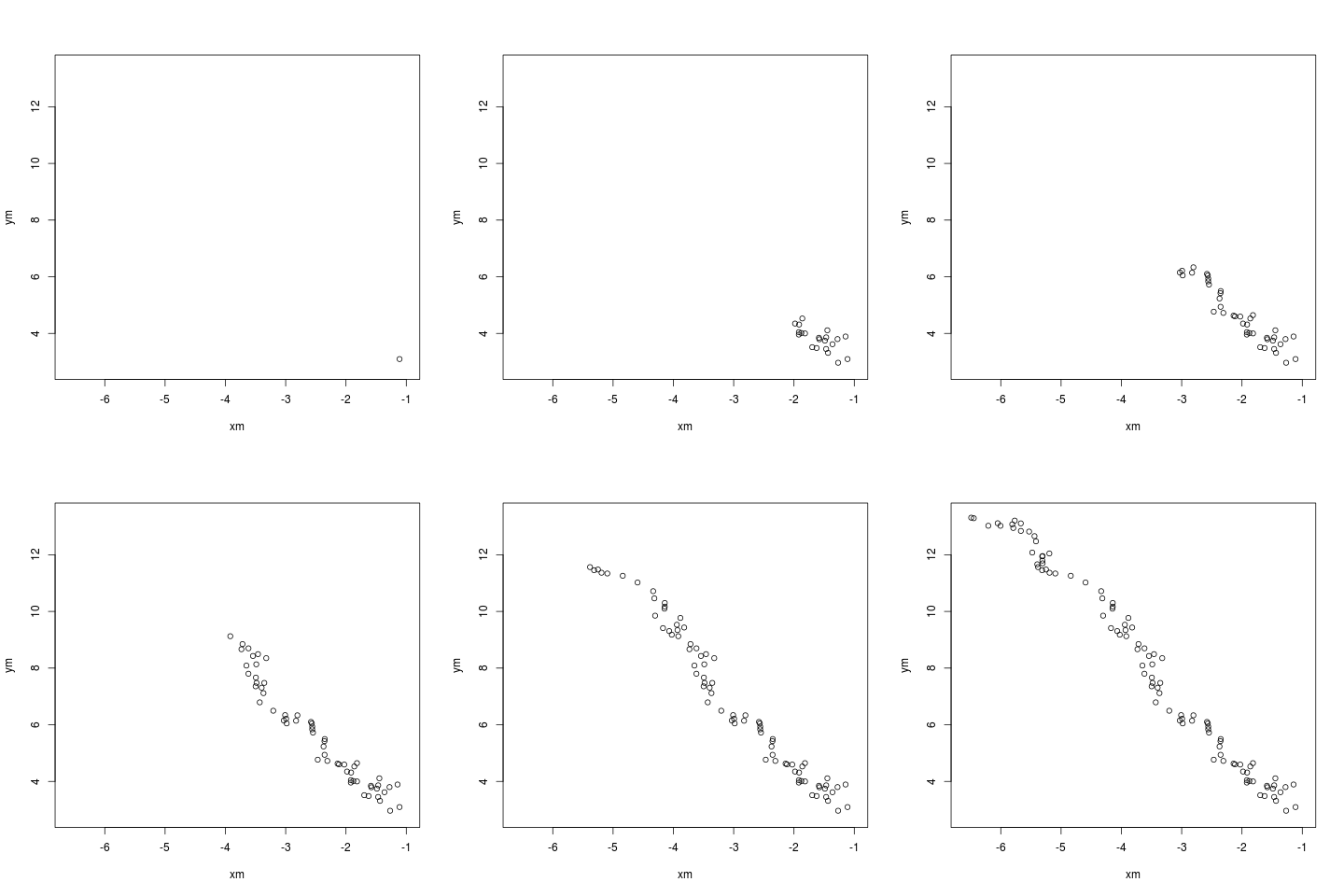
And to illustrate just why Rcpp is so cool for this, here is a little animation of a callback from the C++ code when doing the filtering on Adam's example 5.1. By passing a simple plotting function, written in R, to the C++ code, we can get a plot updated on every iteration. Here I cheated a little and used our old plot function with fixed ranges, the package now uses a more general function: Example of RcppSMC callback to R plot when estimation example 5.1 from Johansen (2009) The animation is of course due to ImageMagick glueing one hundred files into a single animated gif. More information about RcppSMC is on its page, and we intend to add more examples and extensions over time.

Paul Tagliamonte: Software that doesn't suck volume 1

As many of you know, I m highly critical of most software. Anyone that s met me in person has most likely heard my all-too-common tirades on why software makes my life worse. I figured, since I m so hard, and I ve recently found some software I feel good about using, I d start another one of my ongoing series on software I don t hate, or rather, software I might actually say I like. Out of nothing but pure luck (the author followed me on twitter, so I ended up checking out his profile, finding some stuff I liked, and checked out his github), I came across Github Notifier, which works on Chrome, Firefox and Opera. This plugin shows the octocat on the toolbar, with a count of the unread GitHub notifications. Octocat 1 The GitHub API (both V2 and V3) don t have support for getting notification counts, so this plugin / extension works by scraping the notification page. I feel OK about this because the code is pretty minimal and clean. Here s it in use (on my machine) Octocat 2 Thanks, @sindresorhus!

John Goerzen: German: Suprisingly Hilarious for a 2-Year-Old

The other night, I was tucking the boys into bed. I occasionally use a few German words with them (I don t know all that many myself, but hey). They d been rather bored with it, so I had dropped it for a few months. I said to Oliver, Gute Nacht, Oliver. That means good night in German. Oliver laughed. I said it a few more times. He laughed some more. Jacob peeked down from his top bunk to see what the fun was, and pretty soon was getting into it also. Apparently I m quite the comedian, because when I said Auf Wiedersehen, Oliver burst out laughing uncontrollably. Finally he d say, Say it again! AGAIN!! And I would, and he d laugh and laugh some more. And then, I happened to say tsch ss. Jacob loved that one. He said it over and over, much to Oliver s delight. Finally I closed the door, and heard the laughter still going on behind me, as Jacob would yell out a mangled German word, and Oliver would fill the room with laughter. I was a little surprised, but figured it d end there. Not so much. The next night, I tucked them into bed like usual. I left their room, and about 10 seconds later, I heard frantic yelling from the boys room. I went back in, and poor Oliver was so upset he couldn t even say what he wanted. I finally figured out he was pleading, DAD! Say gute Nacht again! So we went through some German words again, and I left the boys much relieved. Phew. The next night, I almost repeated my horrid mistake of no German at bedtime, but Jacob stopped me before I left their room. Dad! You forgot to say tsch ss! So I did, with the boys prompting me on what words they wanted to hear. Then Jacob started asking me how to say these things in other languages. He was rather disappointed, and I think also didn t really believe me, when I only knew a few of those phrases in Spanish and French. Though he was surprised that I could come up with them in Greek. (Kali sp ra / good evening) was a hit. By this point, another day or two later, Jacob says tsch ss when I leave. Oliver wishes me gute Nacht at breakfast time. We ll have to work on that one. So, if you ever walk in the door at our house some morning, don t be surprised if our 2-year-old wishes you good night, our 5-year-old says goodbye, and they both start laughing.

Alessio Treglia: LADI Tools: first stable release is out!

During the last month I worked as upstream maintainer of LADI Tools and now I m happy to introduce the first stable release! So, to answer the usual question What s new? , here is a short description of the changes introduced (taken from the NEWS file included in the release tarball): Laditools 1.0 Lady O Apart from wladi and g15ladi, most of ladi* tools have been renamed: Moreover, a new component has joined the LADI Tools suite: ladi-player. LADI Player is a convenient, graphical VLC-style application providing an all-in-one control interface to start, stop and monitor JACK as well as the session handler. It also provides basic controls for managing studios. Goodbye PyGTK! All the code was ported to GTK+ 3 and the new GObject Introspection mechanism. Code refactoring and cleanup The code has been reorganized in order to allow the use of Python objects by 3rd party applications. To start writing code using the classes provided by laditools, simply do the following: from laditools import * Two-in-one solution for LADI System Tray Formerly laditray was an implementation of GtkStatusIcon to put a nice right-clickable icon into the system tray to allow users access JACK controls easy way. It s been mostly rewritten and now it shows an AppIndicator icon (if the library is available), or fall back to the Freedesktop.org s old-fashioned System Tray Protocol Spec-compliant icon. Project s new homepage The project s homepage is now hosted by Launchpad.net, the code is hosted by repo.or.cz and it s available here for browsing.
Please use the following links to contact the development team: New up-to-date packages will hit both Debian and Ubuntu soon!

23 March 2012

Russell Coker: Cheap NAS Devices Suck

There are some really good Network Attached Storage (NAS) devices on the market. NetApp is one company that is known for making good products [1]. The advantage of a NAS is that you have a device with NVRAM for write-back caching, a filesystem that supports all the necessary features for best performance (NetApp developed their own filesystem WAFL to provide the features they needed), and a set of quality hardware that has been tested and certified to work together. If you want a cheap NAS then you end up with something running Linux with GPL filesystems. This isn t a bad thing as such, but some of the best performance and data integrity features are available in ZFS (which isn t GPL) and BTRFS (which isn t ready for production use). Not to mention WAFL which has been providing ZFS/BTRFS type features for more than a decade. A cheap NAS will generally be sold without disks as this is the best way to keep costs down. Selling with disks either means selling lots of different variations (which means it can t be sold off the shelf) or selling packages that don t quite suit some customers (thus causing people to buy the device and replace the disks which means extra costs). This means that the vendors can t provide the guarantees about disk quality and suitability that NetApp can provide. One major problem with a NAS is that you typically can t get shell access. Commands such as rm -rf and cp -rl which are typically rather quick when performed locally can take ages when run over NFS. Also commands such as grep -R which can perform reasonably well over NFS will always perform better when run locally. Also tasks such as compiling big programs which require good disk speed as well as some CPU time can be run locally if you have a file server system that also has local accounts (IE a typical multi-user Unix server configuration), but a dedicated NAS will prevent that. I have never used a NetApp device due to my clients deciding (sometimes correctly and sometimes incorrectly IMHO) that they are too expensive. But when considering what my clients do the down-sides of lacking local code execution on a NetApp would be more than compensated in many cases by the significant performance and reliability advantages that they offer (see my post about the reliability issues in standard RAID implementations [2]). A server class system (with ECC RAM as a minimum criteria) running RAID-6 can be a fairly decent file server. That requires hardware RAID with NVRAM for the write-back cache for decent write performance, but when write performance isn t required software RAID does the job quite well. A Dell tower system will typically hold at least 4 disks which means 6TB of RAID-6 storage and is quite cheap it can be under $2000. also such a system can be easily expanded with extra Ethernet ports etc. NetApp doesn t sell products directly and doesn t list prices, but they do have some adverts for products being under $7500 . That s not really cheap but not THAT expensive when you consider the features. A hidden cost in running a NAS is having someone perform sysadmin work on it. For a relatively expensive device that offers significant features such as a NetApp Filer this expense probably isn t too great. But for a device that does what any PC running Linux can do it s noteworthy that more training or experimenting time is required. There are some special cases where small and cheap NAS appliances really make sense, such as the Apple Time Capsule for home network backups. But apart from that I don t think that cheap NAS appliances make sense. It seems that cheap NAS devices provide the biggest down-sides of expensive NAS devices (in terms of lacking local access and having a different administration interface to servers) while also having the biggest down-sides of PC servers (lacking the advanced features of WAFL and performance of a NetApp). Earlier today I started a process of reorganising some backups which included backups to a cheap NAS. I have been very unimpressed by the time taken to copy and rm files over NFS. I m sure that the job would have been completed hours ago if I had local root access to the NAS. Related posts:
  1. big and cheap USB flash devices It s often the case with technology that serious changes occur...
  2. Insider Threats and Small Storage Devices Danny Angus writes about the potential threat posed by small...
  3. Some RAID Issues I just read an interesting paper titled An Analysis of...

Eshat Cekar: Hello Planet Debian

Since I am new on the debian planet, let me introduce myself in a quick sentence: I am Eshat Cakar, a yet 25 years old maths student and system administrator from Bielefeld/Germany. I ve started maintaining KDE-related packages about a year ago and got pulled inside the Debian Qt/KDE Team shortly after. I also enjoy working [...]

Next.

Previous.