Search Results: "pa"

12 January 2016

Antoine Beaupr : The Downloadable Internet

How corporations killed the web I have read with fascination what we would have called before a blog post, except it was featured on The Guardian: Iran's blogfather: Facebook, Instagram and Twitter are killing the web The "blogfather" is Hossein Derakshan or h0d3r, an author from Teheran that was jailed for almost a decade for his blogging. The article is very interesting both because it shows how fast things changed in the last few years, technology-wise, but more importantly, how content-free the web have become, where Facebook's last acquisition, Instagram, is not even censored by Iran. Those platforms have stopped being censored, not because of democratic progress but because they have become totally inoffensive (in the case of Iran) or become a tool of surveillance for the government and targeted advertisement for companies (in the case of, well, most of the world). This struck a chord, personally, at the political level: we are losing control of the internet (if we ever had it). The defeat isn't directly political: we have some institutions like ICANN and the IETF that we can still have an effect on, even if only at the technological level. The defeat is economic, and, of course, through economy comes enormous power. That defeat meant that we have first lost free and open access to the internet (yes, dialup used to be free) and then free hosting of our content (no, Google and Facebook are not free, you are the product). This marked a major change in the way content is treated online. H0d3r explains this as the shift from a link-based internet to a stream-based internet, a "deparure from a books-internet towards a television-internet". I have been warning about this "television-internet" in my talks and conversation for a while and with Netflix taking the crown off Youtube (and making you pay for it, of course), we can assuredly say that H0d3r is right and the television, far from disappearing, is finally being resurrected and taking over the internet.

The Downloadable internet and open standards But I would like to add to that: it is not merely that we had "links" before. We had, and still have, open standards. This made the internet "downloadable" (and by extension, uploadable) and decentralized. (In fact, I still remember my earlier days on the web when I would actually download images (as in "right-click" and "Save as..." images, not just have the browser download and display it on the fly). I would download images because they were big! It could take a minute or sometimes more to download images on older modems. Later, I would do the same with music: I would download WAV files before the rise of the MP3 format, of which I ended up building a significant collection (just fair use copies from friends and owned CDs, of course) and eventually video files.) The downloadable internet is what still allows me to type this article in a text editor, without internet access, while reading H0d3r's blog post on my e-reader, because I downloaded his article off an RSS feed. It is what makes it possible for anyone to download a full copy of this blog post and connected web pages as a git repository and this way get the full history of modifications on all the pages, but also be able to edit it offline and push modifications back in. Wikipedia is downloadable (there are even offline apps for your phone). Open standards like RSS feeds and HTML are downloadable. Heck, even the Internet Archive is downloadable (and I mean, all of it, not just the parts you want), surprisingly enough.

The app-based internet and proprietary software App-based websites like Google Plus and Facebook are not really downloadable. They are meant to be browsed through an app, so what you actually see through your web browser is really more an application, downloaded software than a downloaded piece of content. If you turn off Javascript, you will see that visiting Facebook actually shows no content: everything is downloaded on the fly by an application itself downloaded, on the fly, by your browser. In a way, your browser has become an operating system that runs proprietary, untrusted and unverified applications from the web. (The software is generally completely proprietary, except some frameworks that are published as free software in what looks like the lenient act of a godly king, but is actually more an economic decision of a clever corporation which outsources, for free, R&D and testing to the larger free software community. The real "secret sauce" is basically always proprietary, if only so that we don't freak out on stuff like PRISM that reports everything we do to the government.) Technology is political. This new "app design" is not a simple optimization or an cosmetic accident of a fancy engineer: by moving content through an application, Facebook, Twitter and the like can see exactly what you do on a web page, what you actually read (as opposed to what you click on) and how long. By adding a proprietary interface between you and the content online, the advertisement-surveillance complex can track every move you make online. This is a very fine-tuned surveillance system, and because of the App, you cannot escape it. You cannot share the content outside of Facebook, as you can't download it. Or at least, it's not obvious how you can. Projects like youtube-dl are doing an amazing job reverse-engineering what is becoming the proprietary Youtube streaming protocol, which is constantly changing and is not really documented. But it's a hack: it's a Sisyphus struggle which is bound to fail, and it does, all the time, until we figure out how to either turn those corporations into good netizens respecting and contributing to open standards (unlikely) or destroy those corporations (most likely). You are trapped in their walled garden. No wonder internet.org is Facebook only: for most people nowadays, the internet is the web, and the web is Facebook, Twitter and Google, or an iPad with a bunch of apps, each their own cute little walled garden, crafted just for you. If you think you like the Internet, you should really reconsider what you are watching, what you are consuming, or rather, how it is consuming you. There are alternatives. Facebook is a though nut to crack for free software activists because we lack the critical mass. But Facebook it is also an addiction for a lot of people, and spending less time on that spying machine could be a great improvement for you I am sure. For everything else, we have good free software alternatives and open standards, use them. "Big brother ain't watching you, you're watching him." - CRASS, Nineteen Eighty Bore (audio)

Michal Čihař: Weekly phpMyAdmin contributions 2016-W01

Going back to real weekly report, this time covering first week of 2016. The biggest task was focused on codebase cleanup. As Microsoft is ending support for old Internet Explorer version, we've decided to do same thing for next major release. This allowed us to remove some compatibility code and also upgrade jQuery to 2.x branch, which removes support for older browsers as well. To continue in the cleanup tasks, I've revisited most of array iterating places and removed not needed reset() calls or generally cleanup up related code. Besides working directly on the code, I've improved our infrastructure a bit as well and we now have developer documentation online at https://develdocs.phpmyadmin.net/. It is generated using phpdox, but suggestions to improve it are welcome. All handled issues:

Filed under: English phpMyAdmin 2 comments

Gunnar Wolf: Readying up for the second "Embedded Linux" diploma course

I am happy to share here a project I was a part of during last year, that ended up being a complete success and now stands to be repeated: The diploma course on embedded Linux, taught at Facultad de Ingenier a, UNAM, where I'm teaching my regular classes as well. Back in November, we held the graduation for our first 10 students. This photo shows only seven, as the remaining three have already relocated to Guadalajara, where they were hired by Continental, a company that promoted the creation of this specialization program. After this first excercise, we went over the program and made some adequations; future generations will have a shorter and more focused program (240 instead of 288 hours, leaving out several topics that were not deemed related to the topic or were thoroughly understood by students to begin with); we intend to start the semester-long course in early February. I will soon update here with the full program and promotional material, as soon as I receive it. update (01-19): You can download the promotional information, or go to an (unofficial) URL with the full information. We are close to starting the program, so hurry! I am specially glad that this course is taught by people I admire and recognize, and a very interesting mix between long-time academic and stemming from my free-software-related friends: From the academic side, Facultad de Ingenier a's professors Laura Sandoval, Karen S enz and Oscar Valdez, and from the free-software side, Sandino Araico, Iv n Chavero, C sar Y ez and Gabriel Salda a (and myself on both camps, of course )
AttachmentSize
OT401_nota.jpg75.82 KB
Linux Embebido - Folleto.pdf455.32 KB

Bits from Debian: New Debian Developers and Maintainers (November and December 2015)

The following contributors got their Debian Developer accounts in the last two months: The following contributors were added as Debian Maintainers in the last two months: Congratulations!

Russell Coker: Sociological Images 2015

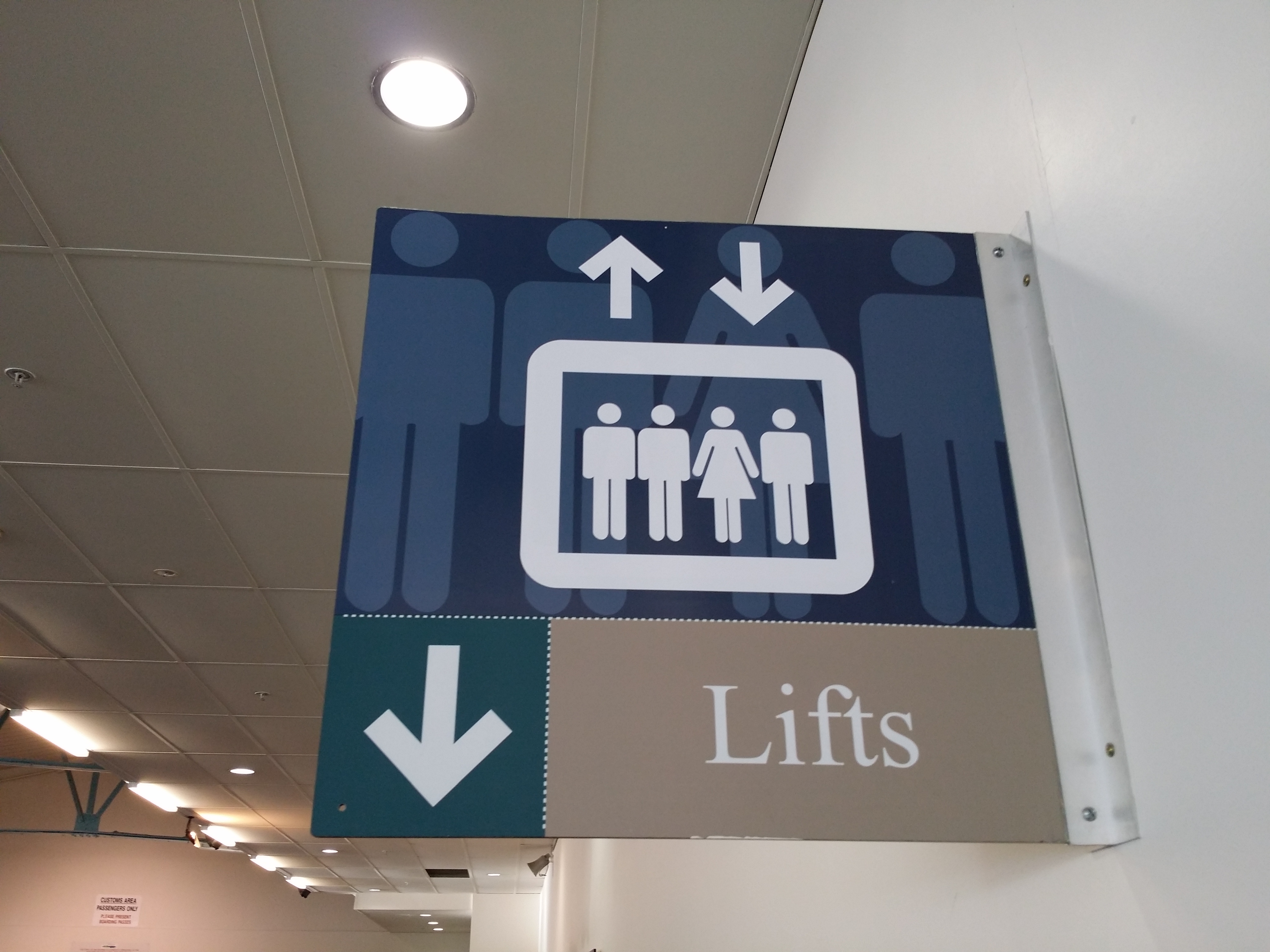
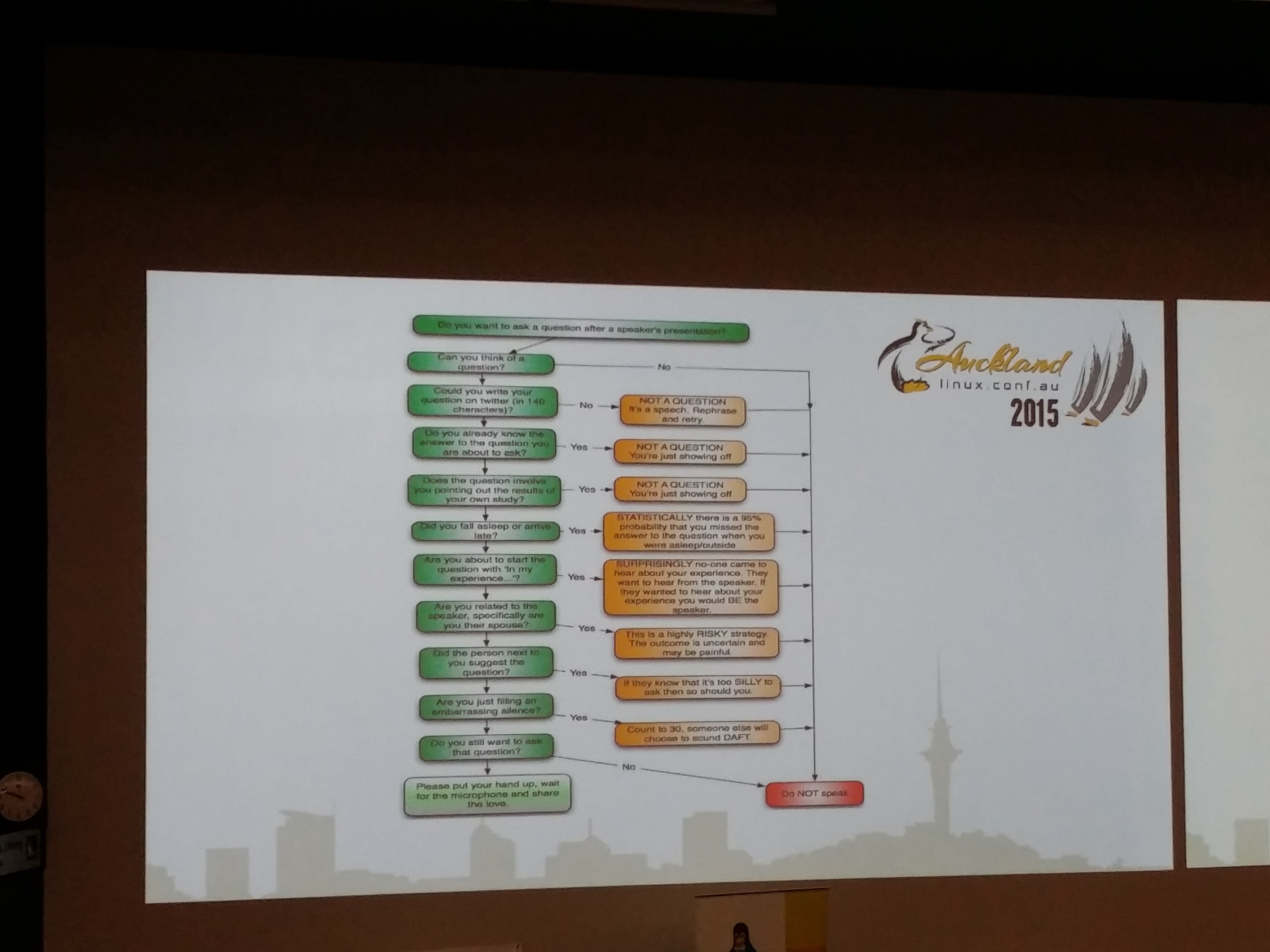
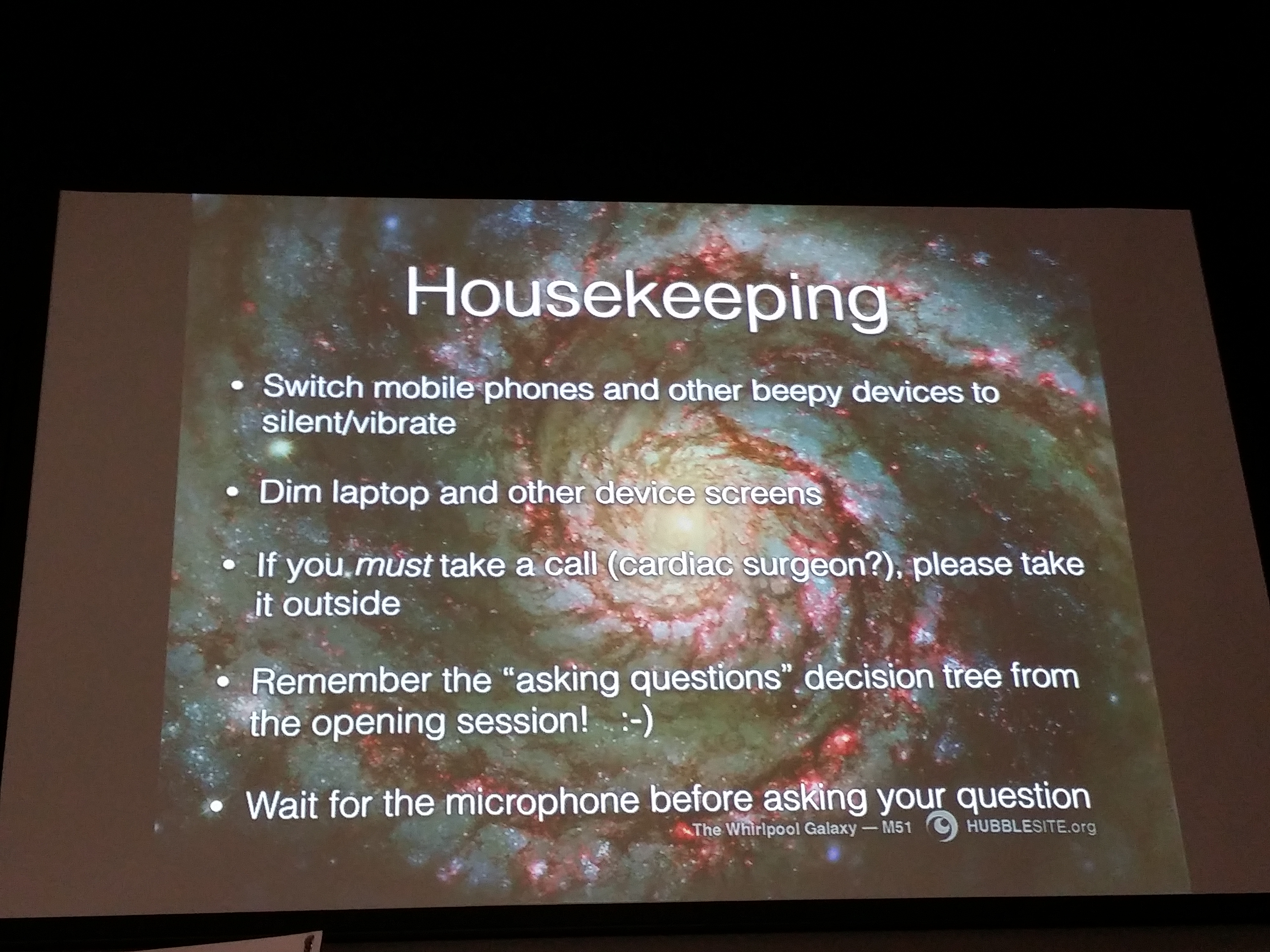
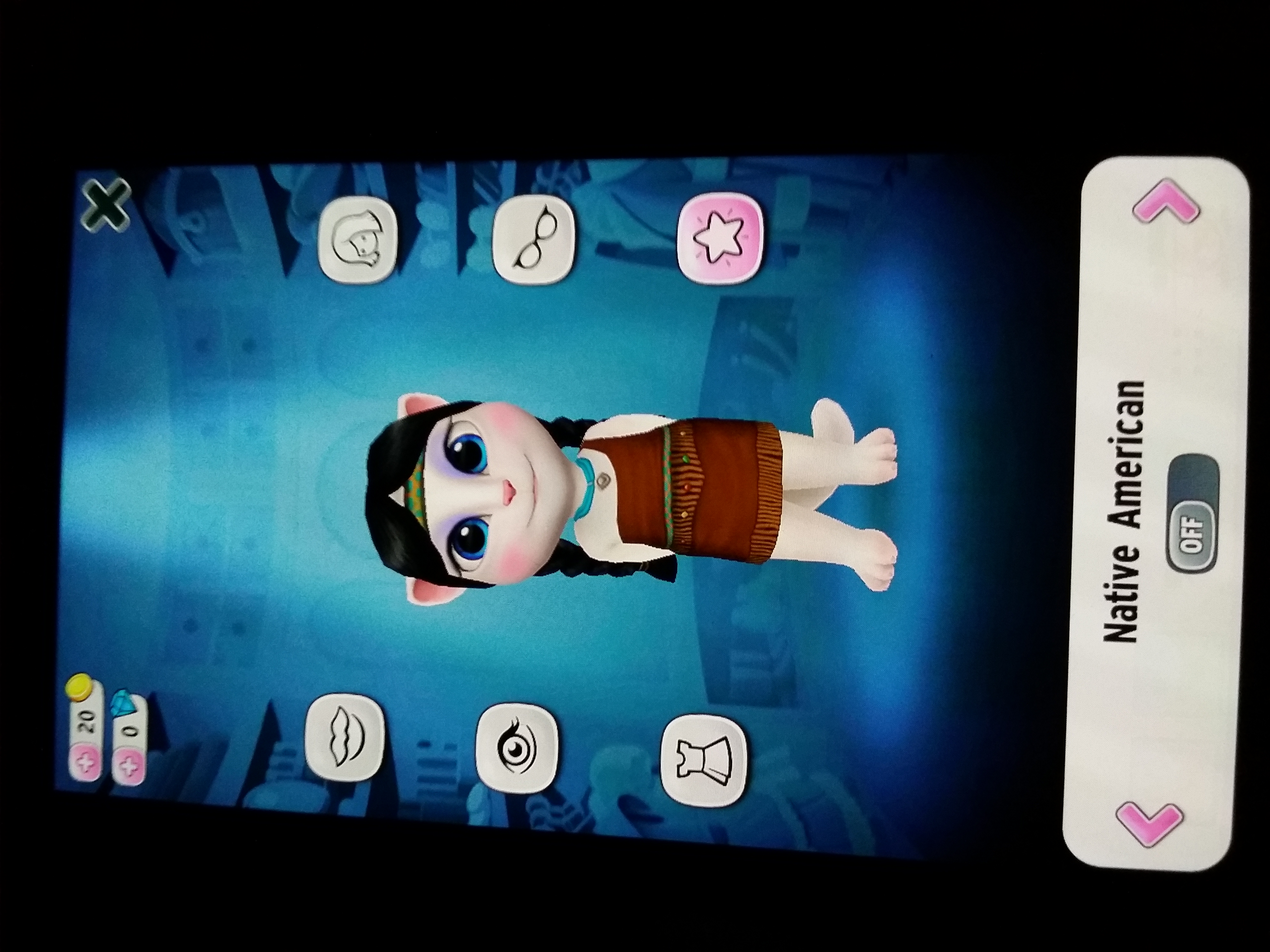
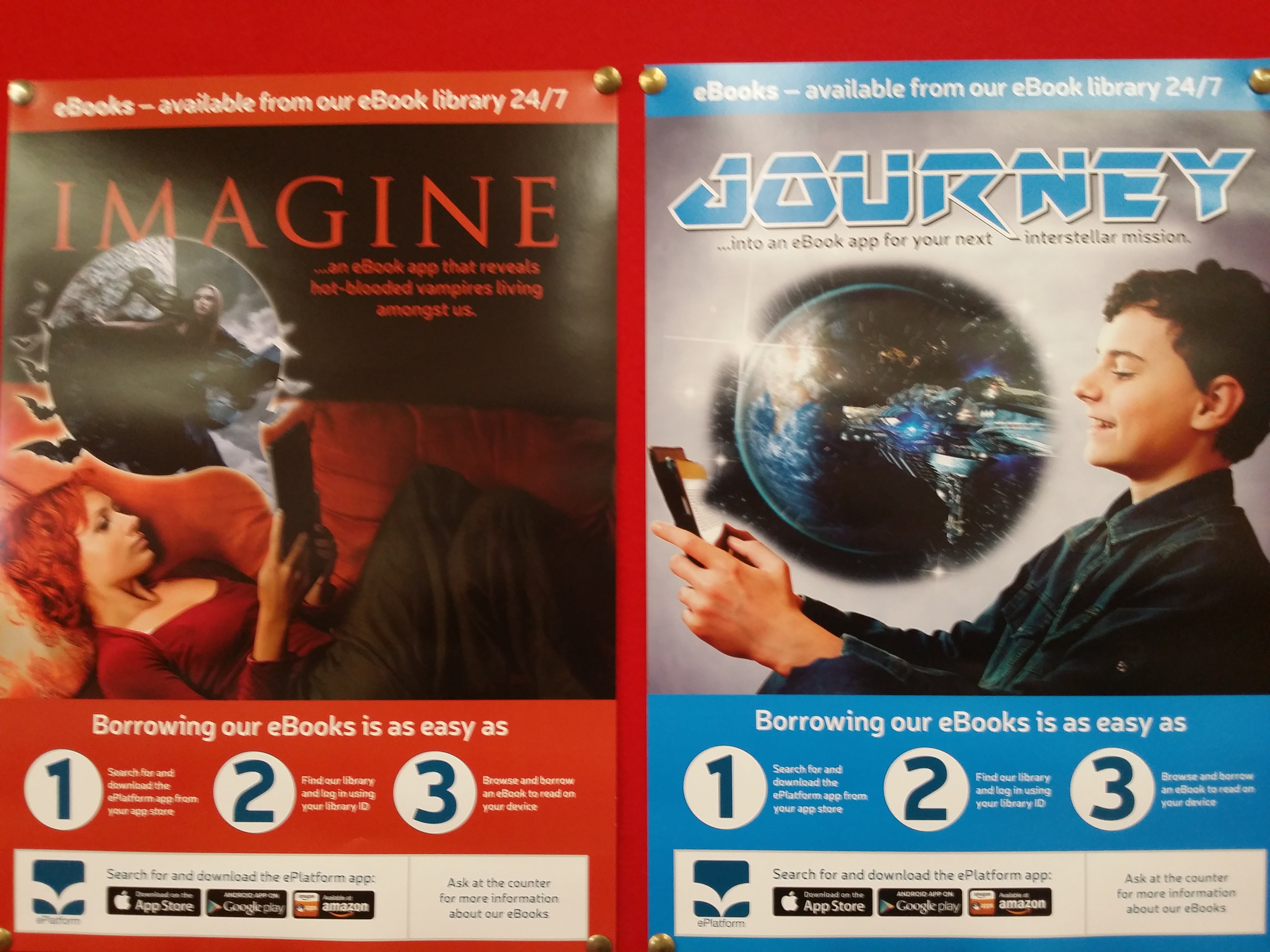
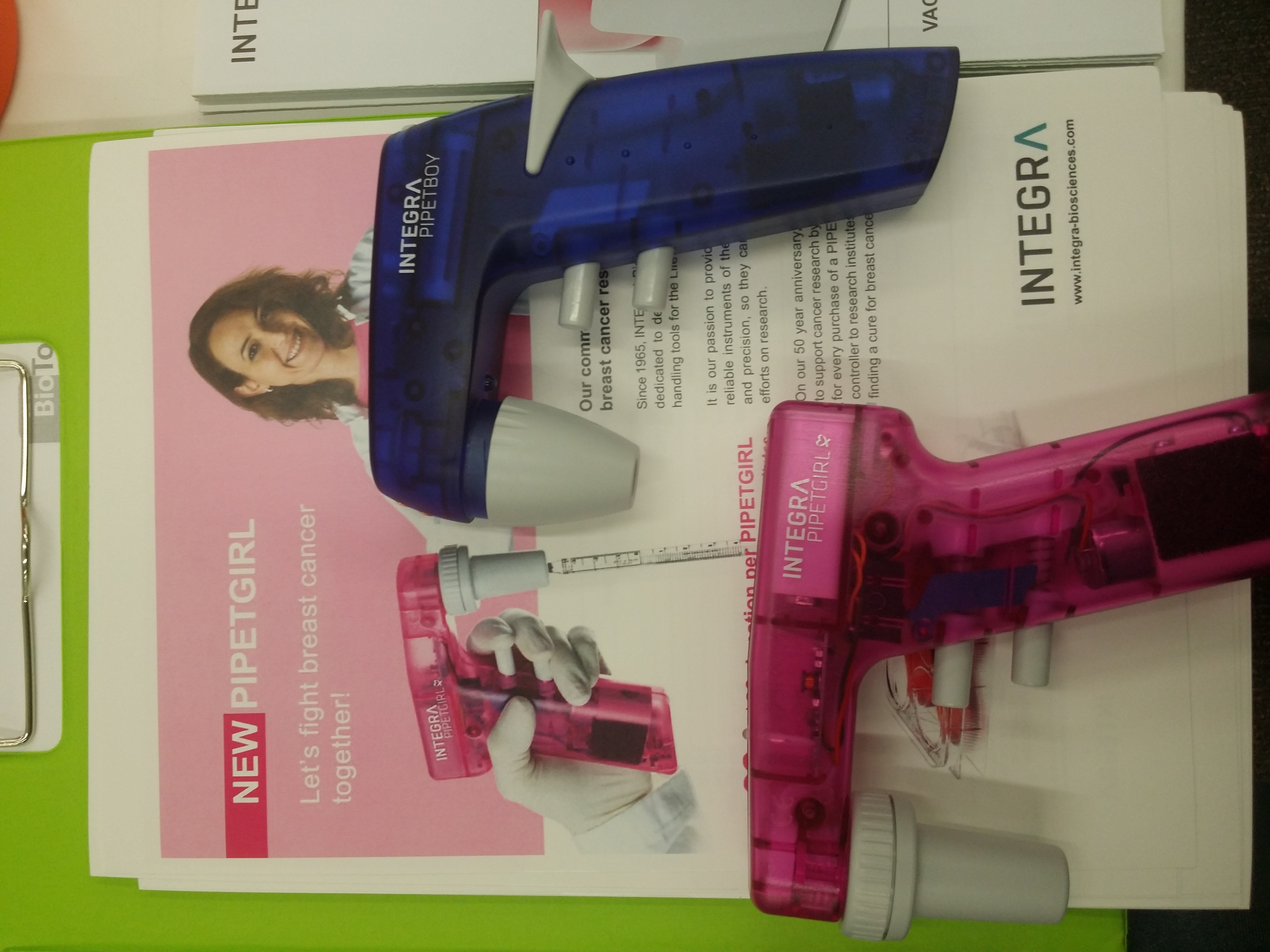
3 men 1 women on lift sign The above sign was at the Melbourne Docks in December 2014 when I was returning from a cruise. I have no idea why there are 3 men and 1 woman on the sign (and a dock worker was also surprised when I explained why I was photographing it). I wonder whether a sign that had 3 women and 1 man would ever have been installed or not noticed if it was installed. rules for asking questions at LCA2015 At the start of the first day of LCA 2015 the above was displayed at the keynote as a flow-chart for whether someone should ask a question at a lecture. Given that the first real item in the list is that a question should fit in a tweet I think it was inspired by my blog post about the length of conference questions [1]. Astronomy Miniconf suggestions for delegates At the introduction to the Astronomy Miniconf the above slide was displayed. In addition to referencing the flow-chart for asking questions it recommends dimming laptop screens (among other things). sign saying men to the left because women are always right The above sign was at a restaurant in Auckland in January 2015. I thought that sort of sexist joke went out of fashion a few decades ago. gendered nerf weaponary The above photo is from a Melbourne department store in February 2015. Why gender a nerf gun? That just doesn t make sense. Also it appeared that the only nerf crossbow was the purple/pink one, is a crossbow considered feminine nowadays? Picture of Angela appropriating Native American clothing The above picture is a screen-shot of one of the Talking Angela series of Android games from March. Appropriating the traditional clothing of marginalised groups is a bad thing. People of Native American heritage who want to wear their traditional clothing face discrimination when they do so, when white people play dress-up in clothing that is a parody of Native American style it s really offensive. The site Racialicious.com has a tag for articles about appropriation [2]. The above was in a library advertising an Ebook reader. In this case they didn t even have pointlessly gendered products they just had pointlessly gendered adverts for the same product. They also perpetuate the myth that only girls read vampire books and only boys read about space. Also why is the girl lying down to read while the boy is sitting up? Above is an Advent calendar on sale in a petrol station. Having end of year holiday presents that have nothing to do with religious festivals makes sense. But Advent is a religious observance. I think this would be a better candidate for war on Christmas paranoia than a coffee cup of the wrong colour. The above photo is of boys and girls pipette suckers. Pointlessly gendered recreational products like Nerf guns is one thing, but I think that doing it to scientific equipment is a bigger problem. Are scientists going to stop work if they can t find a pipette sucker of the desired gender? Is worrying about this going to distract them from their research (really bad if working with infectious or carcinogenic solutions). The Integra advertising claims to be doing this to promote breast cancer research which is also bogus. Here is a Sociological Images article about the problems of using pink to market breast cancer research [3] and the Sociological Images post about pinkwashing (boobies against breast cancer) is also worth reading [4]. As an aside I made a mistake in putting a pipette sucker over the woman s chest in that picture. The way that Integra portreyed her chest is relevant to analysis of this advert. But unfortunately I didn t photograph that. Here is a link to my sociological images post from 2014 [5].

11 January 2016

Norbert Preining: 10 years TeX Live in Debian

I recently dug through my history of involvement with TeX (Live), and found out that in January there are a lot of anniversaries I should celebrate: 14 years ago I started building binaries for TeX Live, 11 years ago I proposed the packaging TeX Live for Debian, 10 years ago the TeX Live packages entered Debian. There are other things to celebrate next year (2017), namely the 10 year anniversary of the (not so new anymore) infrastructure in short tlmgr of TeX Live packaging, but this will come later. In this blog post I want to concentrate on my involvement in TeX Live and Debian. TeX Live/Debian Those of you not interested in boring and melancholic look-back onto history can safely skip reading this one. For those a bit interested in the history of TeX in Debian, please read on. Debian releases and TeX systems The TeX system of choice has been for long years teTeX, curated by Thomas Esser. Digging through the Debian Archive and combining it with changelog entries as well as personal experiences since I joined Debian, here is a time line of TeX in Debian, all to my best knowledge.
Date Version Name teTeX/TeX Live Maintainers
1993-96 <1 ? ? Christoph Martin
6/1996 1.1 Buzz ?
12/1996 1.2 Rec ?
6/1997 1.3 Bo teTeX 0.4
7/1998 2.0 Ham teTeX 0.9
3/1999 2.1 Slink teTeX 0.9.9N
8/2000 2.2 Potato teTeX 1.0
7/2002 3.0 Woody teTeX 1.0
6/2005 3.1 Sarge teTeX 2.0 Atsuhito Kohda
4/2007 4.0 Etch teTeX 3.0, TeX Live 2005 Frank K ster, NP
2/2009 5.0 Lenny TeX Live 2007 NP
2/2011 6.0 Squeeze TeX Live 2009
5/2013 7.0 Whezzy TeX Live 2012
4/2015 8.0 Jessie TeX Live 2014
??? ??? Stretch TeX Live 2015
The history of TeX in Debian is thus split more or less in 10 years teTeX, and 10 years TeX Live. While I cannot check back to the origins, my guesses are that already in the very first releases (te)TeX was included. The first release I can confirm (via the Debian archive) shipping teTeX is the release Bo (June 1997). Maintainership during the first 10 years showed some fluctuation: The first years/releases (till about 2002) were dominated by Christoph Martin with Adrian Bunk and few others, who did most packaging work on teTeX version 1. After this Atsuhito Kohda with help from Hilmar Preusse and some people brought teTeX up to version 2, and from 2004 to 2007 Frank K ster, again with help of Hilmar Preusse and some other, took over most of the work on teTeX. Other names appearing throughout the changelog are (incomplete list) Julian Gilbey, Ralf Stubner, LaMont Jones, and C.M Connelly (and many more bug-reporters and fixers). Looking at the above table I have to mention the incredible amount of work that both Atsuhito Kohda and Frank K ster have put into the teTeX packages, and many of their contributions have been carried over into the TeX Live packages. While there haven t been many releases during their maintainership, their work has inspired and supported the packaging of TeX Live to a huge extend. Start of TeX Live I got involved in TeX Live back in 2002 when I started building binaries for the alpha-linux architecture. I can t remember when I first had the idea to package TeX Live for Debian, but here is a time line from my first email to the Debian Developers mailing list concerning TeX Live, to the first accepted upload:
Date Subject/Link Comment
2005-01-11 binaries for different architectures in debian packages The first question concerning packaging TeX Live, about including pre-built binaries
2005-01-25 Debian-TeXlive Proposal II A better proposal, but still including pre-built binaries
2005-05-17 Proposal for a tex-base package Proposal for tex-base, later tex-common, as basis for both teTeX and TeX live packages
2015-06-10 Bug#312897: ITP: texlive ITP bug for TeX Live
2005-09-17 Re: Take over of texinfo/info packages Taking over texinfo which was somehow orphaned started here
2005-11-28 Re: texlive-basic_2005-1_i386.changes REJECTED My answer to the rejection by ftp-master of the first upload. This email sparked a long discussion about packaging and helped improve the naming of packages (but not really the packaging itself).
2006-01-12 Upload of TeX Live 2005-1 to Debian The first successful upload
2006-01-22 Accepted texlive-base 2005-1 (source all) TeX Live packages accepted into Debian/experimental
One can see from the first emails that at that time I didn t have any idea about Debian packaging and proposed to ship the binaries built within the TeX Live system on Debian. What followed was first a long discussion about whether there is any need for just another TeX system. The then maintainer Frank K ster took a clear stance in favor of including TeX Live, and after several rounds of proposals, tests, rejections and improvements, the first successful upload of TeX Live packages to Debian/experimental happened on 12 January 2006, so exactly 10 years ago. Packaging Right from the beginning I used a meta-packaging approach. That is, instead of working directly with the source packages, I wrote (Perl) scripts that generated the source packages from a set of directives. There were several reasons why I choose to introduce this extra layer: Till now I am not 100% sure whether it was the best idea, but the scripts remain in place till now, only adapted to the new packaging paradigm in TeX Live (without xml) and adding new functionality. This allows me to just kick off one script that does do all the work, including building .orig.tar.gz, source packages, binary packages. For those interested to follow the frantic activity during the first years, there is a file CHANGES.packaging which for the years from 2005 to 2011 documents very extensively the changes I made in these years. I don t want to count the hours the went into all this  Development over the years TeX Live 2005 was just another TeX system but not the preferred one in Debian Etch and beyond. But then in May 2006, Thomas Esser announced the end of development of teTeX, which cleared the path for TeX Live as main TeX system in Debian (and the world!). The next release of Debian, Lenny (1/2009), already carried only TeX Live. Unfortunately it was only TeX Live 2007 and not 2008, mostly due to me having been involved in rewriting the upstream infrastructure based on Debian package files instead of the notorious xml files. This took quite a lot of attention and time from Debian away to upstream development, but this will be discussed in a different post. Similarly, the release of TeX Live included in Debian Squeeze (released 2/2011) was only TeX Live 2009 (instead of 2010), but since then (Wheezy and Jessie) the releases of TeX Live in Debian were always the latest released ones. Current status Since about 2013 I am trying to keep a regular schedule of new TeX Live packages every month. These helps me to keep up with the changes in upstream packaging and reduces the load of packaging a new release of TeX Live. It also bring to users of unstable and testing a very up-to-date TeX system, where packages at most lack 1 month of behind the TeX Live net updates. Future As most of the readers here know, besides caring for TeX (Live) and related packages in Debian, I am also responsible for the TeX Live Manager (tlmgr) and most of upstream s infrastructure including network distribution. Thus, my (spare, outside work) time needs to be distributed between all these projects (and some others) which leaves less and less time for Debian packaging. Fortunately the packaging is in a state that making regular updates once a month is less of a burden, since most steps are automatized. What is still a bit of a struggle is adapting the binary package (src:texlive-bin) to new releases. But also this has become simpler due to less invasive changes over the years. All in all, I don t have many plans for TeX Live in Debian besides keeping the current system running as it is. Search for and advise to future maintainers and collaborators I would be more than happy if new collaborators appear, with fresh ideas and some spare time. Unfortunately, my experience over these 10 years with people showing up and proposing changes (anyone remembers the guy proposing a complete rewrite in ML or so?) is that nobody really wants to invest time and energy, but search for quick solutions. This is not something that will work with a package like TeX Live, sized of several gigabyte (the biggest in the Debian archive), and complicated inner workings. I advise everyone being interested in helping to package TeX Live for Debian, to first install normal TeX Live from TUG, get used to what actions happen during updates (format rebuilds, hyphenation patters, map file updates). One does not need to have a perfect understanding of what exactly happens down there in the guts (I didn t have in the beginning, either), but if you want to help packaging and never heard about what format dumps or map files are, then this might be a slight obstacle. Conclusion TeX Live is the only TeX system in wide use across lots of architectures and operating systems, and the only comparable system, MikTeX, is Windows specific (also there are traces of ports to Unix). Backed by all the big user groups of TeX, TeX Live will remain the prime choice for the foreseeable future, and thus also TeX Live in Debian.

Carl Chenet: Extend your Twitter network with Retweet

Retweet is self-hosted app coded in Python 3 allowing to retweet all the statuses from a given Twitter account to another one. Lots of filters can be used to retweet only tweets matching given criterias. Retweet 0.8 is available on the PyPI repository and is already in the official Debian unstable repository. Retweet is in production already for Le Journal Du hacker , a French FOSS community website to share and relay news and LinuxJobs.fr , a job board for the French-speaking FOSS community. logo-journal-du-hacker linuxjobs-horizontale The new features of the 0.8 allow Retweet to manage the tweets given how old they are, retweeting only if : Retweet is extensively documented, have a look at the official documentation to understand how to install it, configure it and use it. What about you? does Retweet allow you to develop your Twitter account? Let your comments in this article.

Scott Kitterman: Python3.5 is default python3 in sid

As of today, python3 -> python3.5. There s a bit of a transition, but fortunately because most extensions are packaged to build for all supported python3 versions, we started this transition at about 80% done. Thank you do the maintainers that have done that. It makes these transitions much smoother. As part of getting ready for this transition, I reviewed all the packages that needed to be rebuilt for this stage of the transition to python3.5 and a few common errors stood out:
  1. For python3 it s python3:Depends not python:Depends .
  2. Do not use python3:Provides . This has never been used for python3 (go read the policy if you doubt me [1]).
  3. Almost for sure do not use python:Provides . The only time it should still be used is if some package depends on python2.7-$PACKAGE. It would surprise me if any of these are left in the archive. If so, since python2.7 is the last python2, then they should be adjusted. Work with the maintainer of such an rdepend and once it s removed, then drop the provides.
  4. Do not use XB-Python-Version. We no longer use this to manage transitions (there won t be any more python transitions).
  5. Do not use XB-Python3-Version. This was never used.
Now that we have robust transition trackers [2], the purpose for which XB-Python-Version is obsolete. In other news, pysupport was recently removed from the archive. This means that, following the previous removal of pycentral, we finally have one and only one python packaging helper (dh-python) that supports both python and python3. Thanks to everyone who made that possible. [1] https://www.debian.org/doc/packaging-manuals/python-policy/ [2] https://release.debian.org/transitions/html/python3.5.html

Sven Hoexter: grep wc -l

I did some musings on my way home about a line of shell scripting similar to
if [  grep foobar somefile    wc -l  -gt 0 ]; then ...
Yes it's obvious that silencing grep and working with the return code is way more elegant and the backticks are also deprecated, or at least discouraged, nowadays. For this special case "grep -c" is not the right replacement. Just in case. So I wanted to know how widespread the "grep wc -l" chaining actually is. codesearch.d.n to the rescue! At least in some codebases it seems to be rather widespread, so maybe "grep -c" is not POSIX compliant? Nope. Traveling back a few years and looking at a somewhat older manpage also lists a "-c" option. At least for now I doubt that this is some kind of backwards compatiblity thing. Even busybox supports it. As you can obviously deduce from the matching lines, and my rather fuzzy search pattern, there are valid cases among the result set where "grep" is just the first command and some "awk/sed/tr" (you name it) is in between the final "wc -l". But quite some " wc -l" could be replaced by a "-c" added to the "grep" invocation.

Vincent Fourmond: Ghost in the machine: faint remanence of screen contents across reboots in a Macbook pro retina

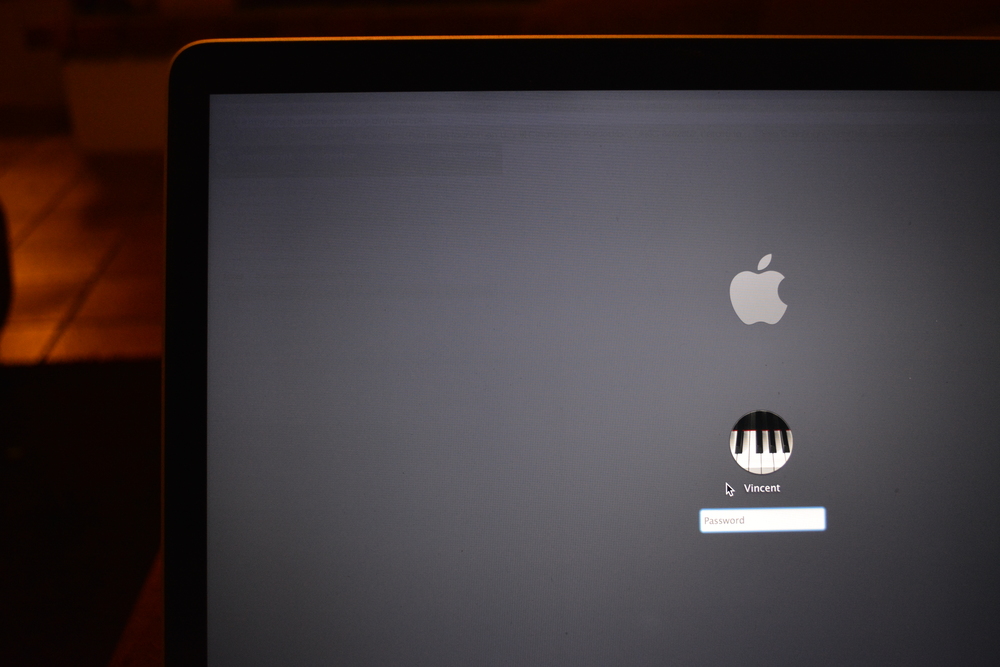
As was noted a few times before, I happen to own a Macbook Pro Retina laptop I mostly use under Linux. I had noticed from time to time weird mixes between two screens, i.e. I would be looking at a website, but, in some areas with uniform colors, I would see faint traces of other windows currently opened on another screen. These faint traces would not show up in a screenshot. It never really bothered me, and I attributed that to a weird specificity of the mac hardware (they often do that) that was not well handled by the nouveau driver, so I had simply dismissed that. Until, one day, I switch off the computer, switch back on, boot to MacOS and see this as a boot screen:
Here is a close-up view of the top-left corner of the screen:
If you look carefully, you can still see the contents of the page I was browsing just before switching off the computer ! So this problem is not Linux-specific, it also affects MacOS... To be honest, I don't have a clue about what's happening here, but it has to be a serious hardware malfunction. How can two video memory regions be composed upon display without the computer asking explicitly for it ? Why does that problem survives a reboot ? I mean, someone switches on my computer and can see the last thing I did on it ? I could actually read the address line without difficulty, although you'll have to take my word for it, since the picture does not show it that well. That's scary...

Thadeu Lima de Souza Cascardo: GNU on Smartphones (part II)

Some time ago, I wrote how to get GNU on a smartphone. This is going to be a long discussion on why and how we should work on more operating systems for more devices. On Android So, why should we bother if we already have Android, some might ask? If it's just because of some binary blobs, one could just use Replicant, right? Well, one of the problems is that Android development is done in hiding, and pushed downstream when a new version is launched. There is no community behind that anyone can join. Replicant ends up either following it or staying behind. It could do a fork and have its own innovations. And I am all for it. But the lack of manpower for supporting devices and keeping up with the latest versions and security fixes already takes most of the time for the one or two developers involved. Also, Android has a huge modularity problem, that I will discuss further below. But it's hard to replace many components in the system, unless you replace them all. And that also causes the problem that applications can hardly share extra components. I would rather see Debian running on my devices and supporting good environments and frameworks for all kinds of devices, like phones, tablets, TVs, cars, etc. It's developed by a community I can join, it allows a diverse set of frameworks and environments, and it's much easier to replace single components on such a system. On Copyleft Hardware I get it. Hardware is not free or libre. Its design is. I love the concept of copyleft hardware, where one applies the copyleft principles to a hardware design. Also, there is the concept of Hardware that Respects Your Freedom, that is, one that allows you to use it with only free software. Note that RYF hardware is not necessarily copyleft hardware. In fact, most of the time, the original vendor has not helped at all, and it required reverse engineering efforts by other people to be able to run free software on those systems. My point here is that we should not prevent people from running free software on hardware that does not RYF or that is not copyleft. We should continue the efforts of reverse engineering and of pushing hardware vendors to not only ship free software for their hardware, but also release their design under free licenses. But in the meantime, we need to make free software flourish in the plethora of devices on the hands of so many people around the world. On Diversity I won't go into details on this post about two things. One topic I love is retrocomputing and how Linux supported so many devices, and how many free or quasi-free operating systems ran on so many of them in the past. I could mention ucLinux, Familiar, PDAs, Palmtops, Motorolas, etc. But I will leave it to another time and go from Openmoko and Maemo forward. The other topic is application scalability. Even Debian with so many software available does not ship all free software there is available. And it doesn't support all third-party services out there. How can we solve that? It has to do with platforms, protocols, open protocols, etc. I will not go into that today. Because I believe that either way, it's healthy for our society to have diversity. I believe we should have other operating systems available for our devices. Even if application developers will not develop for all of them. That is already the case today. There are other ways to fix that, when that needs fixing. Sometimes, it's sufficient that you can have your own operating system on your device, that you can customize it, enhance it and share it with friends. And also, that would allow for innovation. It would make possible that some other operating system would have enough market share on some other niche. Other than Android and iOS, for example. But that requires that we can support that operating system on different devices. And that is the scalability that I want to talk about. How to support more devices with less effort. Options But before I go into that, let me write more about the alternatives we have out there. And some of the history around it. Openmoko Openmoko developed a set of devices that had some free design. And it has some free operating systems running on top. The community developed a lot of their own as well. Debian could (still can) run on it. There is SHR, which uses FSO, a mobile middleware based on D-Bus. It even spawned other devices to be developed, like GTA04, a successor board, that can be shipped inside a Neo Freerunner case. Maemo, Moblin, Meego and Tizen I remember the announcement of Nokia N770. During FISL in 2005, I even criticized a lot, because it shipped with proprietary drivers. And applications. But it was the first time we heard of Maemo. It was based on Debian and GNOME. The GNOME Mobile initiative was born from that, I believe, but died later on. But with the launch of N900, and later events, like the merge of Moblin with Maemo, to create Meego, we all had an operating system that was based on community developed components, that had some community participation, and was much more like the systems we were used to. You could run gcc on N900. You could install Das U-Boot and have other operating systems running there. But Nokia has gone a different path. Intel has started Tizen with Samsung. There is so much legacy there, that could still be developed upon. I am just sad that Jolla decided to put proprietary layers on top of that, to create SailfishOS. But we still have Mer, Nemo. But it looks like Cordia is gone. At least, (http://cordiahd.org) seems to have been registered by a domain seller. Not to forget, Neo900, a project to upgrade the board, in the same vein as GTA04. FirefoxOS and Ubuntu What can I say about FirefoxOS and Ubuntu Phone? In summary, I think we need more than Web, and Canonical has a history of not being too community oriented as we'd like. I won't go too much here in what I think about the Web as a platform. But I think we need a system that has more options for platforms. I haven't participated in projects directed by Mozilla either, so I can't say much about that. Ubuntu Phone should be a system more like what we are used to. But Canonical is going to set the directions to the project, it's not a community project. Nonetheless, I think they add to the diversity, and users should be able to try them, or their free parts or versions. But there are challenges there, that I think need to be discussed. So, both of these systems are based on Android. They don't use Dalvik or the application framework. But they use what is below that, which means device drivers in userspaces, like RIL, for the modem drivers, and EGL, for graphics drivers. The reason they do that is to build on top of all the existing vendor support for Android. If a SOC and phone vendor already supports Android, there should be not much needed to do to support FirefoxOS or Ubuntu Phone. In practice, this has not benefited the users or the projects. Porting should be as simple as getting a generic FirefoxOS or Ubuntu Phone image and run it on top of your Android or CyanogenMod port. Porting usually requires doing all the same work as porting Android. Even though one should be able to take advantage of existing ports, it still requires doing a lot of integration work and building an entire image, most of the time, including the upper layers, that should be equal in all devices. This process should require at most creating a new image based on other images and loading it on the device. I will discuss more about this below. I can't forget to mention the Matchstick TV project. It is based on FirefoxOS. I think it would have much more changes to succeed if it was easier for testers to have images available for all of their gadgets capable of running some form of Android. Replicant And then we have Replicant. It has a lot of the problems Android has. Even so, it's a tremendously important project. First, it offers a free version of Android, removing all proprietary pieces. This is very good for the community. But more than that, it tries to free the devices beyond that. What the project has been done is reverse engineer some of the pieces, mostly the modem drivers. That allows other projects to build upon that work, and support those modems. Without that, there is no telephony or celullar data available on any of these devices. Not without proprietary software, that is. They also have been working on free bootloaders, which is another important step for a completely free system. Next steps There are many challenges here, but I believe we should work on a set of steps that make it more palatable and produce intermediary results that can be used by users and other projects. One of the goals should be good modularity. The ability to replace some pieces with the least trouble necessary. The update of a single framework library should be just a package install, instead of building the entire framework again. If there is ABI breakage, users should still be able to have access to binaries (and accompanying source code) and only need to update the library and its reverse dependencies. If one layer does not have these properties, at least it should be possible to update this big chunk without interfering with the other layers. One example is FirefoxOS and Ubuntu Phone. Even if there is a big image with all system userspace and middleware, the porting, install and upgrade process should allow the user to keep the applications and to leverage porting already done by similar projects. Heck, these two projects should be able to share porting efforts without any trouble. So what follows is a quick discussion on Android builds, then suggestions on how to approach some of the challenges. On Android build The big problem with Android build is its non-modularity. You need to build the world and more to get a single image in the end. Instead of packages that could be built independently, that generated modular package images, that could be bundled in a single system image. Better yet would be the ability to pick only those components that matter. Certainly, portability would be just as interesting, being able to build certain components on top a GNU system with GNU libc. At times, it seems like this is done by design, to make it difficult for "fragmentation" and competition. Basically, making it difficult to exercise the freedom to modify the software and share your modifications with others. Imagine the possibilities of being able to: There are some dangers in promoting the use of Android like this. Since it promotes proprietary drivers, relying on such layers instead of better community oriented layers means giving an advantage to the first. So, the best plan would be to replace those layers, when they are used, for things like ofono and Wayland, for example. But, in the meantime, making it easier for users to experiment with FirefoxOS, Ubuntu Phone, Matchstick TV, Replicant on other devices, without resorting to building the entire Android system, would be a very nice thing. It is possible that there are some challenges with respect to API and ABI. That these layers are too intermingled that some changes present in one port would prevent FirefoxOS to run on top of it without changes in either of the layers. I can't confirm that is the case, but can't deny the possibility. Rooting One of the challenges we have that may have trouble in scaling is rooting devices. Unfortunately, most of the devices are owned by the vendor or carrier, not the user. The user is prevented from replacing software components in the system, by removing its permissions from replacing most of the files in the filesystem, or writing to block devices, or change boot parameters or write to the storage devices. Fortunately, there are many documents, guides, howtos, and whatnots out there instructing on how to root a lot of devices. In some cases, it depends on software bugs that can be patched by the users as instructed by vendors. Certainly, favoring devices that are built to allow rooting, hacking, etc, is a good thing. But we should still help those users out there who do not have such devices, and allow them to run free software on them. Booting Then, comes booting, which is a large discussion on its own, and also related to rooting, or how to allow users to replace their software. First, we have the topic of bootloaders, which are usually not free, and embedded in the chip, not on external storage. So, there are those pieces of the bootloader which we can replace more easily and those that we are not, because they would require changing a piece of ROM, for example. Das U-Boot would be one of the preferred options for a system. It supports a lot of hardware platforms out there, a lot of storage devices and filesystems, network booting, USB and serial booting, and a lot of other things. Porting is not an easy task, but it is possible. Meanwhile, using the bootloaders that ship with the system, when possible, would allow a path where other pieces of the system would be free. One of the challenges here is building single images that could boot everywhere. The lack of a single ARM boot environment is a curse and a blessing. It makes it hard to have this single boot image, but, on the other hand, it has allowed so much of the information for such systems to be free, to be embedded in copyleft software, instead of having blobs executed by our free systems, like ACPI encourages. Device trees have pushed this portability issue from the kernel to the bootloaders. Possibily encouraging vendors to now hide and copyright this information in the form of proprietary device trees. But it has made it easier for single images. In practice, we still need to see a lot of devices out there supporting this single kernel scenario. And this mechanism only brings us the possibility of a single kernel. We still need to ship bootable images that have pieces of bootloaders that are not as portable. This has caused lots of operating systems out there to be built for a single board. Or to support just a small set of boards. I struggle with the concept. Why are we not able to mix device-specific pieces with generic pieces and get a resulting image that will boot on our choice of board? Why does every project need to do all the porting work again, repeating the efforts? Or have one entier ISO image for every supported board? Check how Geexbox does it, for an example. Fortunately, I see Debian going in a good direction. Here, one can see how it instructs the user to combine a system-dependent part with a system-independent part. Installation Which brings us to the installation challenge. We should make this easy and also customizable by the user. Every project might have its own method, and that is part of the diversity that we should allow. The great challenge here is handling rooting and booting for the user. But it's also possible to leave that as separate efforts, as it would be nice to have good installers as we have in the desktop and server environments. Linux Linux is one of the most ported kernels out there. Of course, it would be healthy to the diversity I propose that other kernels and systems out there should work on those mobile devices. NetBSD, for example, has a reputation of being very portable and ported to many platforms. And GNU runs on many of them, either together with the original systems, or as the main system on top of other kernels, as proven by the Debian GNU/kFreeBSD port, which uses GNU libc. But, though I would love to see HURD running directly on those devices, Linux and its derivatives are already running on them. Easier to tackle is to get Linux-libre running on those systems. But though this looks like one of the easier tasks at hand, it is not. If you run a derivative version from Linux, provided by the vendor, things should go smooth. But most of the time, the vendor does not provide patches upstream, and leave their fork to rot, if you are lucky, in the earlier 3.x series. And some times, there is not even source code available. There are vendors out there who do not respect the GPL and that is one of the reasons why GPL enforcement is important. I take this opportunity to call attention to the work of Software Freedom Conservancy and its current efforts to raise funds to continue their work. Running an existing binary version of Linux on your device with a free userspace is part of the strategy of replacing pieces one at a time while allowing for good diversity and reaching more users. Drivers Then we have the matter of drivers. And in this case, it's not only Linux drivers, but drivers running in userspace. Though others exist, there are two important and common cases, which are modem and graphics drivers, both of which are usually provided by Android frameworks, and that other systems try to leverage, instead of using alternatives that are more community friendly. In the case of modem drivers, Android uses its RIL. Besides not using a Radio or Modem at all, there are two strategies for free versions. One is using free versions of the drivers for RIL. That's what Replicant does, because, well, it uses the other Android subsystems after all. The other one is using a system that is developed by the community. ofono is one that, even though it's an Intel iniative, looks more community governed or open to community participation than any Android subsystem ever was. As for Graphics, Canonical even built its Mir project with the goal of being able to use Android GPU drivers. Luckily, there has been a lot of reverse engineering efforts out there for a lot of those GPUs shipped with ARM SoCs. Then, we can use Mesa, Wayland and X.org. Other option, until then, is just using a framebuffer driver, possibly one that does not need any initialization, depending on one done by the bootloader, for example. Middleware and Shells Plasma Active, that I just found out now is Plasma Mobile, looks like a great system. Built by folks behind KDE, we can expect great freedom to come from it. Unfortunately, it suffers from what we have been discussing here, which is lack of good device support, or shipping images that run on top of single devices, without leveraging the porting that has come before of other systems. Fortunately, that is just what I want to accomplish with this effort. FSO, that I mentioned before, is a good middleware, that we should try to run on top of these devices. Running GNOME or Unity shell, and use rpm or deb based systems, that's all part of the plan on diversity. You could use systemd, or System V init systems, whatever gives you the kicks. It's not an easy task, since there are so many new things on these new kinds of devices. Besides touch, there is telephony, which as I mentioned, would be a good task for ofono. As for TV sets or dongles, I would love to see OpenFlint, created by the Matchstick TV guys, flourish out there and allow me to flint stuff from my mobile phone running Debian into my TV dongle running Debian. Project So, is there a project out there you can start contributing to? Well, I pointed out a lot of them. All of them make part of this plan. Contributing to reverse engineering GPUs, or to Plasma Mobile, ofono, GNOME, Linux-libre, bootloaders, Debian, and so many other projects. My plans are to contribute in the scope of Debian and make sure it works well on top of semi-liberated devices, and make sure there is a nice user interface and good applications when using either GNOME or Plasma. Integrating ofono is a good next step, but I am running ahead of myself. Right now, I don't think there is need for an integrated effort. If you think otherwise, please let me know. If you are doing something in this direction, I would love to know. Paul Wise reminded me to point out to the Debian Mobile, where I will probably contribute any documentation and other relevant results. Thanks There are some many people to thank, but I would like to remember Ian Murdock, who created Debian, one of the projects who inspires me the most. I think the best way to handle his passing is to celebrate what he has helped create, and move forward, taking more free software to more people in an easy and modular way. I have been wanting to write something like this for a long time, so I thank Chris Webber for inspiring me on doing it.

Arturo Borrero Gonz lez: Great Debian meeting!


Last week we finally ended with a proper Debian informal meeting at Seville.

A total amount of 9 people attended, 3 of them DDs (Aurelien Jarno, Guillem Jover, Ana Guerrero) and 1 DM (me).

The meeting started with the usual "personal references" round, and then topics ranged from how to get more people involved with Debian, to GSoC-like programs discussions, and some Debian anecdotes as well.

There were also talks about when and how future meetings should be.

This meeting was hosted by http://www.plan4d.eu/, thanks to Pablo Neira (Netfilter project head).

Some pics of the moment:


Alessio Treglia: Filling old bottles with new wine

They are filling old bottles with new wine! This is what the physicist Werner Heisenberg heard exclaiming by his friend and colleague Wolfgang Pauli who, criticizing the approach of the scientists of the time, believed that they had been forcibly glued the notion of quantum on the old theory of the planetary-model of Bohr s atom. Faced with the huge questions introduced by quantum physics, Pauli instead began to observe the new findings from a different point of view, from a new level of reality without the constraints imposed by previous theories.

Newton himself, once he theorized the law of the gravitational field, failing to place it in any of the physical realities of the time, he merely

<Read More...>

Daniel Pocock: FOSDEM RTC Dev-room schedule published

If you want to help make Free Real-time Communication (RTC) with free, open source software surpass proprietary solutions this year, a great place to start is the FOSDEM RTC dev-room. On Friday we published the list of 17 talks accepted in the dev-room (times are still provisional until the FOSDEM schedule is printed). They include a range of topics, including SIP, XMPP, WebRTC and peer-to-peer Real-time communication. RTC will be very prominent at FOSDEM this year with several talks on this topic, including my own, in the main track.

Keith Packard: Altos1.6.2

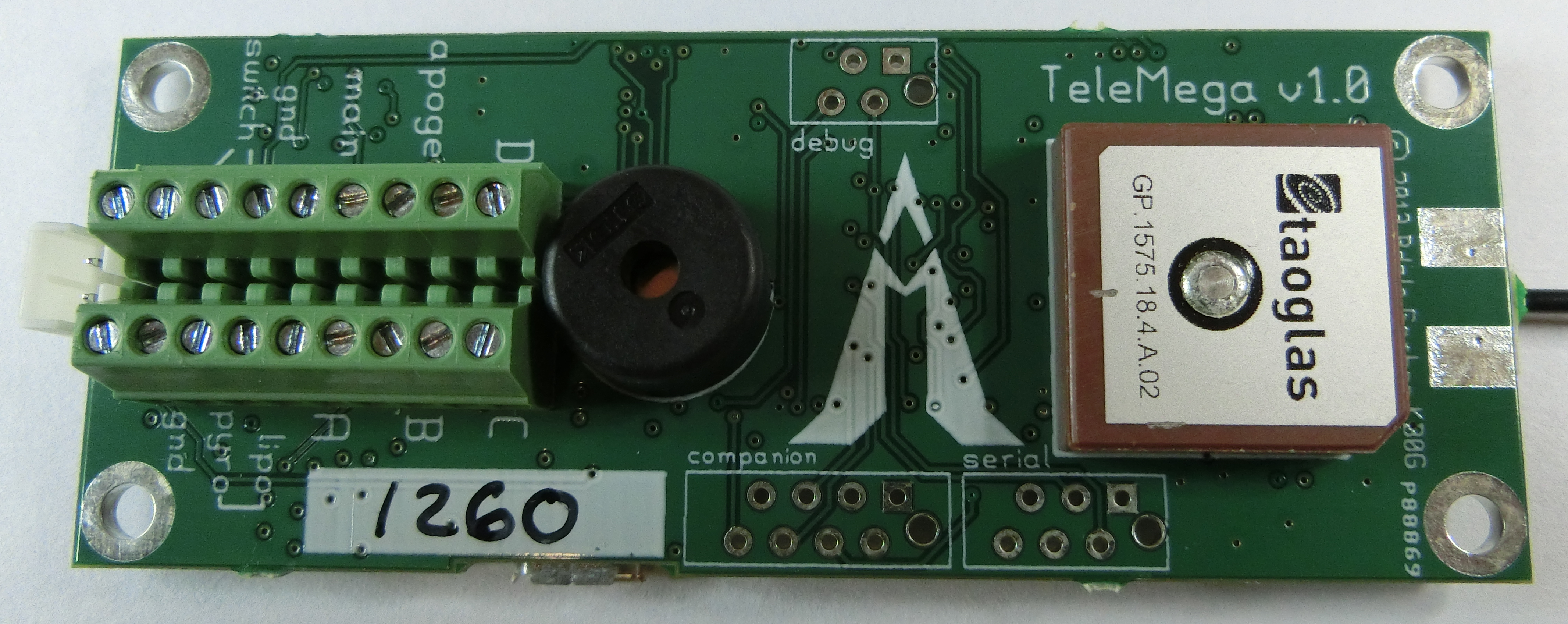
AltOS 1.6.2 TeleMega v2.0 support, bug fixes and documentation updates Bdale and I are pleased to announce the release of AltOS version 1.6.2. AltOS is the core of the software for all of the Altus Metrum products. It consists of firmware for our cc1111, STM32L151, STMF042, LPC11U14 and ATtiny85 based electronics and Java-based ground station software. This is a minor release of AltOS, including support for our new TeleMega v2.0 board, a small selection of bug fixes and a major update of the documentation AltOS Firmware TeleMega v2.0 added The updated six-channel flight computer, TeleMega v2.0, has a few changes from the v1.0 design: None of these change the basic functionality of the device, but they do change the firmware a bit so there's a new package. AltOS Bug Fixes We also worked around a ground station limitation in the firmware: AltosUI and TeleGPS applications A few minor new features are in this release Documentation I spent a good number of hours completely reformatting and restructuring the Altus Metrum documentation.
Ben Hutchings: Debian LTS work, December 2015

In December I carried over 15 hours from October/November and was assigned another 15 hours of work by Freexian's Debian LTS initiative. I worked a total of 20 hours despite the holidays. I uploaded a security and bug fix update to linux-2.6 early in December, and sent DLA-360-1. I also backported several more security fixes, released in the new year. I sent several of the fixes to Willy Tarreau for inclusion in Linux 2.6.32-longterm. I prepared an update to sudo to fix CVE-2015-5602. This turned out not to have been properly fixed upstream, so I finished the job and am now in the process of backporting and uploading fixes for all suites. I reviewed the packages affected by CVE-2015-8614 and the upstream fix in claws-mail, and found that that was also incomplete. This resulted in another CVE ID being issued. I had another week in the front desk role, over the new year, and triaged about 20 new issues. About half of them affected packages supported in squeeze-lts. Updated: I also found a bug in the contact-maintainers script used by the LTS front desk. It used apt-cache show to find out the maintainers of a source package, which may result in outdated information particularly if you configure APT to fetch squeeze sources in order to work on LTS! I modified the script to grab maintainer information out of the RDF description provided by packages.qa.debian.org (not yet implemented on tracker.debian.org). I feel there ought to be an easier way to do this, but at least I learned something about RDF.

Dirk Eddelbuettel: Rcpp 0.12.3: Keep rollin'

The third update in the 0.12.* series of Rcpp arrived on the CRAN network for GNU R earlier today, and has been pushed to Debian. It follows the 0.12.0 release from late July, the 0.12.1 release in September, and the 0.12.2 release in November making it the seventh release at the steady bi-montly release frequency. This release is somewhat more of a maintenance release addressing a number of small bugs and nuisances without adding any new features. Rcpp has become the most popular way of enhancing GNU R with C or C++ code. As of today, 553 packages on CRAN depend on Rcpp for making analytical code go faster and further. That is up by more than fourty packages from the last release in November. Once again, we have new first-time contributors. Kazuki Fukui corrected an issue he encountered when having CLion re-formatted some code for him. Joshua Pritikin corrected a constructor initialization. Of course, we also had several pull reports from regular contributors -- see below for a detailed list of changes extracted from the NEWS file.

Changes in Rcpp version 0.12.3 (2016-01-10)
  • Changes in Rcpp API:
    • Const iterators now CharacterVector now behave like regular iterators (PR #404 by Dan fixing #362).
    • Math operators between matrix and scalars type have been added (PR #406 by Qiang fixing #365).
    • A missing std::hash function interface for Rcpp::String has been addded (PR #408 by Qiang fixing #84).
  • Changes in Rcpp Attributes:
    • Avoid invalid function names when generating C++ interfaces (PR #403 by JJ fixing #402).
    • Insert additional space around & in function interface (PR #400 by Kazuki Fukui fixing #278).
  • Changes in Rcpp Modules:
    • The copy constructor now initialized the base class (PR #411 by Joshua Pritikin fixing #410)
  • Changes in Rcpp Repository:
    • Added a file Contributing.md providing some points to potential contributors (PR #414 closing issue #413)
Thanks to CRANberries, you can also look at a diff to the previous release. As always, even fuller details are on the Rcpp Changelog page and the Rcpp page which also leads to the downloads page, the browseable doxygen docs and zip files of doxygen output for the standard formats. A local directory has source and documentation too. Questions, comments etc should go to the rcpp-devel mailing list off the R-Forge page.

This post by Dirk Eddelbuettel originated on his Thinking inside the box blog. Please report excessive re-aggregation in third-party for-profit settings.

10 January 2016

Carl Chenet: Feed2tweet 0.2: power of the command line sending your Feed RSS to Twitter

Feed2tweet is a self-hosted Python app to send you RSS feed to Twitter. A long descriptions about why and how to use it is available in my last post about it. Feed2tweet is in production for Le Journal du hacker, a French Hacker News-style FOSS website. logo-journal-du-hacker Feed2tweet 0.2 brings a lot of new command line options, contributed by Antoine Beaupr @theanarcat. Taking a short extract of the Feed2tweet 0.2 changelog: Lots of issues from the previous project was also fixed. Using Feed2tweet? Send us bug reports/feature requests/push requests/comments about it!

Vasudev Kamath: Managing Virtual Network Devices with systemd-networkd

I've been using bridge networking and tap networking for containers and virtual machines on my system. Configuration for bridge network which I use to connect containers was configured using /etc/network/interfaces file as shown below.
auto natbr0
iface natbr0 inet static
   address 172.16.10.1
   netmask 255.255.255.0
   pre-up brctl addbr natbr0
   post-down brctl delbr natbr0
   post-down sysctl net.ipv4.ip_forward=0
   post-down sysctl net.ipv6.conf.all.forwarding=0
   post-up sysctl net.ipv4.ip_forward=1
   post-up sysctl net.ipv6.conf.all.forwarding=1
   post-up iptables -A POSTROUTING -t mangle -p udp --dport bootpc -s 172.16.0.0/16 -j CHECKSUM --checksum-fill
   pre-down iptables -D POSTROUTING -t mangle -p udp --dport bootpc -s 172.16.0.0/16 -j CHECKSUM --checksum-fill
Basically I setup masquerading and IP forwarding when network comes up using this, so all my containers and virtual machines can access internet. This can be simply done using systemd-networkd with couple of lines, yes couple of lines. For this to work first you need to enable systemd-networkd.
systemctl enable systemd-networkd.service
Now I need to write 2 configuration file for the above bridge interface under /etc/systemd/network. One file is natbr0.netdev which configures the bridge and the natbr0.network which configures IP address and other stuff for the bridge interface.
#natbr0.netdev
[NetDev]
Description=Bridge interface for containers/vms
Name=natbr0
Kind=bridge
#natbr0.network
[Match]
Name=natbr0
[Network]
Description=IP configuration for natbr0
Address=172.16.10.1/16
IPForward=yes
IPMasquerade=yes
The IPForward in above configuration is actually redundant, when I set IPMasquerade it automatically enables IPForward. So these configuration is equivalent of what I did in my interfaces file. It also avoids me doing additional iptables usage to add masquerading rules. This pretty much simplifies handling of virtual network devices. There are many other things which can you do with systemd-networkd, like running a DHCPServer on the interface and many other things. I suggest you to read manual pages on systemd.network(5) and systemd.netdev(5). systemd-networkd allows you configure all type of virtual networking devices and actual network interfaces. I've not myself used it to handle actual network interfaces yet.

Andrew Shadura: Public transport map of Managua

Holger Levsen writes about the public transport map of Managua, Nicaragua, which is, according to him, the first detailed map of Managua s bus network:
If you haven t been to Managua, you might not be able to immediatly appreciate the usefulness of this. Up until now, there has been no map nor timetable for the bus system, which as you can see now easily and from far away, is actually quite big and is used by 80% of the population in a city, where the streets still have no names.
Having had a look at the map they produced, I have to admit I quite liked it: MapaNica.net, Rutas de Managua y Ciudad Sandino MapaNica, the community behind said map, are raising funds to make lives of locals easier by publishing a printed version of the map and distributing it. They have already raised more than $3300 of their $7500 goal. Every further donation will help them print more maps. Please go to support.mapanica.net and support their initiative!

Next.

Previous.