Search Results: "ema"

2 August 2007

Russell Coker: Xen Saves

A couple of days ago the hardware that is used to host this blog was upgraded - doubling the amount of RAM in the machine. To do this the machine was halted, memtest86+ was run to ensure that the new RAM worked correctly, and then it was booted up again. During that process my ssh session was not stopped! I merely refrained from typing anything until the upgrade was complete. This is one feature I really like about Xen. It can save the memory image of a running domain to a file and then restart it later. TCP sessions remain open if timeouts have not elapsed. The command xm save can be used to save the state to a file and the command xm restore will restore it. In Debian the location of the save files is stored in the file /etc/default/xendomains with the variable name XENDOMAINS_SAVE and defaults to /var/lib/xen/save. A quick experiment with one test domain (running Debian/unstable in 128M of RAM and had just run apt-get dist-upgrade so the memory contents would not be all zeros) showed that gzip -9 would decrease the file to 35% of it’s size at a cost of just over 1 minute of CPU time on a Pentium-M 1.7GHz. But gzip -3 compresses it to 37% and only takes 9 seconds. 9 seconds of CPU time to save 80M of disk space seems a reasonable trade-off. In my particular case it saves CPU time as the encryption I use for my root filesystem takes more CPU time than gzip -3 so compressing the data saves time. But I don’t expect my case to be common. Now when Xen is used on a more modern machine with a faster CPU gzip -3 has the potential to save time as well as disk space. A machine with a CPU that is in aggregate 10x faster than my laptop (I think that means most 64bit multi-core CPUs) running with a single S-ATA disk (that will have a sustained contiguous read speed of 80MB/s and write speed that is less) will save time when saving multiple Xen DomU’s if it runs them in parallel and compresses them. Also gzip is not the fastest compression program. There may be other options that are better suited to the needs of Xen. I have filed a Debian bug 435406 requesting that compression be supported.
1 August 2007

Biella Coleman: Printers and air quality

Thinking of getting a new printer? Check this out first. Oh and if you have access to the original, can you please send to me??? My library does not have access to the journal and I may be getting a new printer soon so it is good to know which ones will not lodge particles into my lungs.

Lior Kaplan: 3rd (and last) reminder for the OO.org bug triage

Today, with the slogan “Please help the Debian oo.org team to help you”, I’ve sent the 3rd (and final) reminder to bug submitters which have bugs against open office in versions older than 2.0.0. In the last month, 22 bugs were reproduced with newer versions of open office, and 49 bugs were closed as fixed or not relevant any more. By mid August all the remaining will be closed as the submitter didn’t respond to 3 pings during a period of 6 weeks, and the bug is reported to an ancient version of open office. When version 2.2.x will propagate to testing, I’ll do another triage get updates for the rest of the bugs.

Lars Wirzenius: Obnam: Generating backup data sets

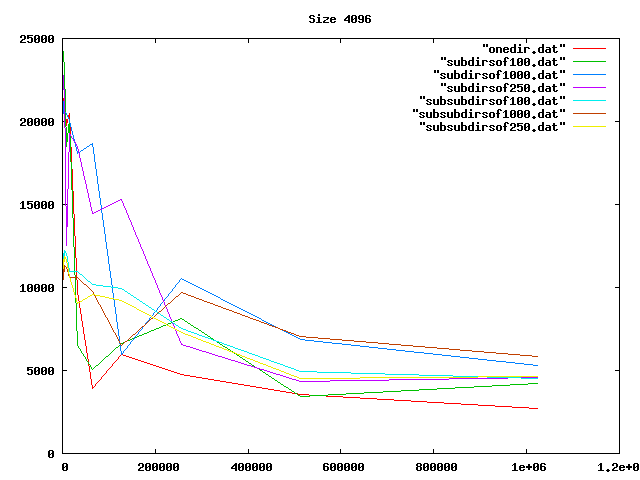
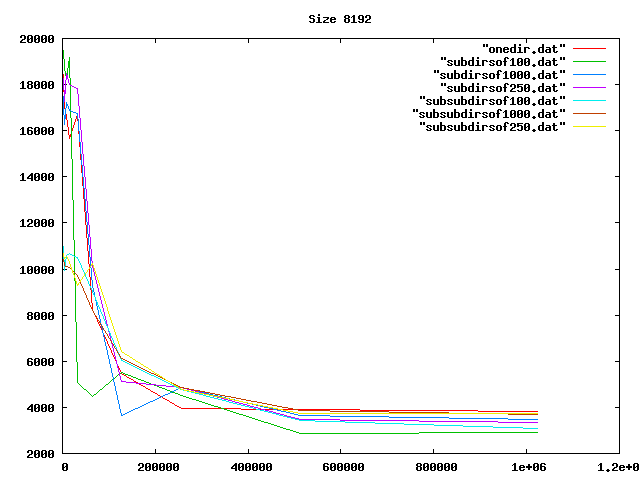
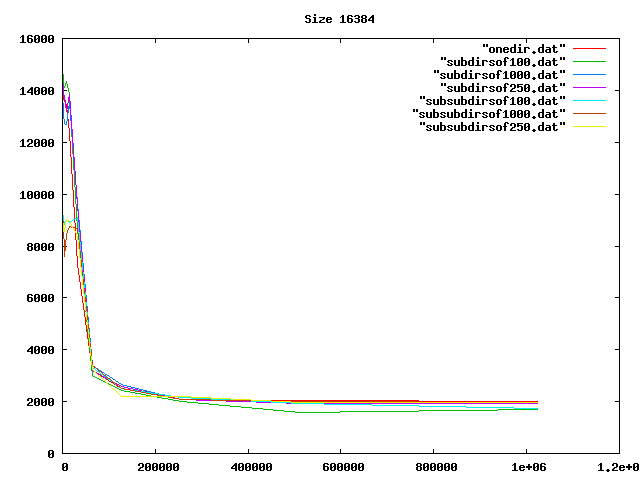
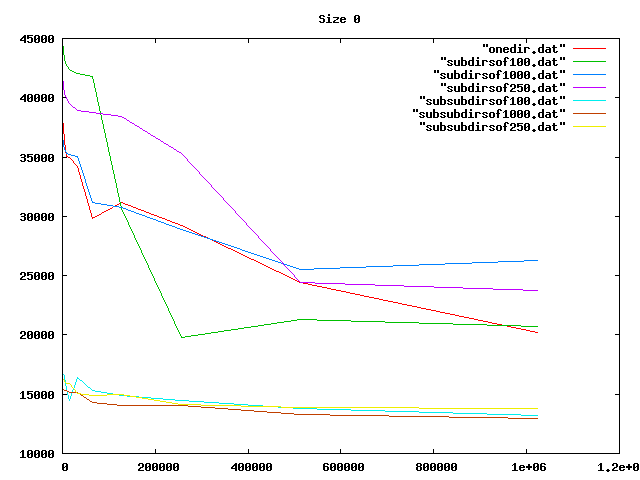
Sometimes in programming one gets to concentrate for a bit on a single, simple, pure program. A command line utility which is completely in batch mode, does not handle any kind of complicated data, does not need to deal with other programs, or the network, or anything nasty like that. Something where one can just look at the one or two interesting parts and not have to worry about anything else. This is the story of one such program. I need a program to generate test data sets for backup performance testing. The program needs to be reasonably efficient, since the simulated backups may be rather large. My first attempt was not fast enough. There were two reasons for this: the way I was generating random binary data, and the way I was generating filenames. The program generates random binary data to simulate large files, such as image, audio, or video files, and thus it needs to be uncompressible with the usual compression algorithms. My first attempt was to generate each output byte with the Python pseudo-random number generator (random.randint). This only results in about 0.1 megabyte/s (on my laptop), so I needed to improve it. After some iteration and advice, I landed on the following: I generate random bytes with the Python PRNG (random.getrandbits), and feed these to an MD5 checksum. After each byte, I get the current digest and append it to the output. This way, for each random byte, I get 16 bytes of output. It isn't completely random, but it satisfies the uncompressibility requirement. This resulted in about 2.5 MB/s. I then tweaked the code a bit, doing things like avoiding unnecessary arithmetic. I further decided to only feed the first few dozen bytes from the PRNG, and the rest as the same constant byte. The initial run of randomness is enough to make sure the output is unique for different files, so that compression doesn't find lots of duplicates of the big files. This resulted in a speed of about 6.6 MB/s on my laptop and about 13 MB/s on my server. This still didn't make the program fast enough, but the remaining problem was not that writing the contents of one file was too slow, but operations on directories were very, very slow. After benchmarking with zero-byte files, turns out that at the slowest, with file counts in the millions, it would create only a few tens of files per second. That's empty files, so only requiring an update of indoes and the creation of a new directory entry. Obviously, the problem was that I was putting too many files in directories, causing the filesystem to spend a lot time scanning them. I was creating up to 250 files per sub-directory, and then creating a new sub-directory. All of these sub-directories were going directly under the user's chosen output directory. To measure what the optimal size of a directory was, and whether to create two levels of sub-directories, I wrote a little benchmark program.
Graph, 0-byte files Graph, 4096-byte files Graph, 8196-byte files Graph, 16384-byte files Some graphs from the benchamrks: for 0, 4, 8, and 16 KiB files, for up to one million files of each size. onedir puts all files in the same directory, subdirsofN puts N files per directory, and subsubdirsofN has two levels of directories, the leaf directories getting N files each.
From the graphs I deduced that overall, having two levels of directories and up to 1000 files per sub-directory was the best option of those tested. On the other hand, the bigger the files, the less it mattered what the directory structure was. Perhaps the obvious reason for the slowness wasn't that, after all. Then I realized my code was slow because I was doing an os.listdir (listing all files in a directory) for every directory every time I creted a file. Fixing that idiocy made the code so fast that any overhead from the directory operations was no longer relevant. But at least I had some nice graphs. On the server I will be generating my test data the program is now happily generating just over 11 MB/s of test data. I wouldn't mind having it be a lot faster, but it's fast enough. It will take hours to generate hundreds of gigabytes, but I hopefully won't need to do that very often. Thus, further optimization isn't worth my time, right now. The program is genbackupdata, in case anyone else cares about it.

31 July 2007

Biella Coleman: Freedocumentaries.org

Get your documentary on.

Russell Coker: Praising Children vs Praising Programmers

In a comment on my blog post titled Childhood, Don Marti refers to an earlier blog post he wrote which refers to a New York Magazine article about the effects of praising children. The article does in some depth to describe scientific research into the issue of praising children for being “smart” vs praising them for working hard - with the conclusion being that it’s significantly better to praise them for working hard! One quote from that article that I find very significant is “Baumeister has come to believe the continued appeal of self-esteem is largely tied to parents pride in their children s achievements: It s so strong that ‘when they praise their kids, it s not that far from praising themselves’“. This matches my theory about people who subject their children to TV documentaries about gifted children. The conclusions regarding children seem quite clear and the article provides direct advice to parents and teachers as to how to avoid the problems. One issue I am wondering about after reading the NYM article is whether being exposed to smarter children hurts a child’s learning ability. The fact that there is no correlation between high self-esteem and learning ability has been proven, but the reports do not indicate whether there might be a correlation between a decreases in self-esteem and a decrease in learning ability. I recall pointing out to one the few good teachers at high-school that having some of the most capable and some of the least capable students in the same class was inefficient and led to excessive boredom for the more capable students and excessive difficulty in keeping up for the less capable students. I was told that “streaming” was considered bad because it was bad for the less capable students to know their status. I was also refused access to my results of the Westpac Maths contest for the same reason - which seems particularly strange, I was in the training program for the International Mathematical Olympiad so I doubt that releasing my score from one maths contest would change anyone’s opinion of my ability. I am also wondering about how this effects adults (apart from their education history). Should we try to praise work colleagues for their effort instead of being smart? Are adults discouraged from trying hard at their work when they see others succeeding with little apparent effort? One data point for this seems to be kernel coders in the Linux community. Everyone sees super-star Linux kernel coders on stage (on a pedestal) at conferences and it’s easy to believe that such people are significantly more intelligent than others (the well-known programmers are indeed very smart - but they also work a lot harder than most people believe) and that being so smart is a necessary pre-condition for submitting Linux kernel patches. I have met many people who appear to have the ability to be good at any type of coding but seem intimidated by kernel coding it for these reasons. Statements such as “I’ve been doing Linux coding for 10 years but I’m not a kernel coder” are often heard at Linux conferences. Also people who’s skills are respected are often regarded as kernel coders without any real reason. The Linux kernel is a large C program with limited options for a debugger, if you are good at C coding you should do OK! I know that I am trivialising the issues related to kernel coding, there are some tasks such as reverse-engineering device-drivers and debugging some of the tricky race conditions that require special skills - but no-one is born with such skills! I would not suggest that someone try a significant kernel coding task on their first attempt - as with all areas of programming it’s best to start with the easy things first. The web site kernelnewbies.org is a good source of information for people who are getting into kernel coding. I wonder whether a change in the attitudes towards such things could encourage more people to write free software, and more of the current programmers to attempt new challenges (such as kernel coding).

30 July 2007

Steve Kemp: That I can't show you how

Russell Coker has recently started posting random tech-tips and recipes in his blog :
To improve things in this regard I plan to increase the number of posts I write with solutions to random technical problems that I encounter with the aim of providing a resource for google searches and to randomly inform people who read my blog.
This is nice to see on Planet Debian - although I hope we continue to see the personal entries. For anybody else who is considering posting things like this I would be delighted if you'd copy them to the Debian Administration website. There have been numerous times when I've been just about to write something on a topic, seen it posted elsewhere and figured I shouldn't do so: (Notable examples off the top of my head: Introduction to OpenVZ, Introduction to GIT, several Xen pieces.) I don't get many submissions, which I'm getting resigned to, but it is easy and people really really are greatful for new posts. In other news linuxlinks.com are a bunch of spammers and will be reported as such. I utterly fail to care that they've added "my software" to their list; if I cared I'd join their site and agree to receive emails from them..

Russell Coker: Hot Water

A response to a post I wrote about things to do for the environment suggested that there would be a health risk to lowering the temperature of a home hot-water system to save power. I have just been reading about so-called tankless hot-water systems. The concept is that instead of keeping a tank of water hot (which means that you lose some energy due to the insulation not being perfect) you heat water when you need it. The down-side to this is that you need a moderate amount of power to heat water as rapidly as it’s used. The GoTankless.com products use between 11KW and 27KW of electricity. The early implementations of this idea used gas - the occasional carbon-monoxide problem with gas appliances makes me inclined to avoid them so it’s good that there’s an electric option. One of the benefits of the tankless system is that it runs the water at a lower temperature than a regular hot water system. For a tank storing hot water you have to run it at a temperature that kills bacteria (or at least dramatically inhibits their growth) - which means greater than 50C, but for on-demand water it’s safer to have it run at something close to the desired temperature (probably not much above 40C) and not use the cold tap. Lower temperature water avoids the risk of scalding for children and the elderly and if the “hot tap” is running at a good temperature for a shower then you can just turn it on, wait 30 seconds for the pipes to warm up, and jump in! Incidentally it really sucks the way most showers have the taps under or behind the flow of water, so if the water becomes too hot before you get in then you end up getting minor burns in the process of turning on the cold tap. I still think that solar hot water is the way to go. It apparently combines something like a tankless system on water that comes out of a tank heated by the sun. So during winter it operates like a tankless system but in summer you get more hot water than you can use. This web site about Solar hot water systems indicates that they have a similar technology to “boost” solar hot water, so if the Sun doesn’t make the water hot enough then it can use electric or gas systems to further heat the water. It’s also interesting to note that they offer Heat Pump hot-water systems, it’s a pity that they apparently don’t support combining this with solar heating. Another interesting feature is what they call the Water Guardian that pumps cold water from the pipes back into the water tank and avoids wasting the water that you might otherwise run down the sink while waiting for it to get hot.

Reinhard Tartler: revu

Scott Kitterman ubuntu@kitterman.com writes:
Why do REVU and mentors need to be separate?
I’ve been thinking about this as well. Here my thoughts: I never actively used mentors. To me, mentors is mainly an apt-get’able repository, where interested contributors can submit packages. It acts mainly as a hosting service for packages. There are quite some differences to REVU, but I think the most important one is that REVU lets you collect opinions on a contribution in the web application. In mentors.debian,net, this happens on the mailing list. Do we need this disctinction? I don’t think so. See e.g. Bundle Buggy (http://bundlebuggy.aaronbentley.com/), which is used on the bazaar development mailing list to collect and review contributions. It has got a new feature which allows Developers to vote on a submission via email commands on the mailing list, to which Bundle Buggy is subscribed. I think that ideally, we could join all three mediums: Mail, Web-app and IRC. REVU could look for comments and commands for a package on a mailing list. On the other hand, reviews and submissions could be announced on an IRC Channel. We could even think about giving comments/commands via irc. It mainly needs one: Someone to do it. I’m sorry to say that REVU isn’t really under development since some time. I’d be more than happy if some people would approach me and said: “I want to implement some of the ideas floating around REVU2”. I think this would perhaps force me to start again coding on it. ATM, REVU is in maintenance only mode. :(

Miriam Ruiz: Lets try Epiphany

Is it just my perception, or Firefox/Iceweasel crashes too much lately? At some point in the future I might consider switching to Konqueror, but for now I’d prefer making a smaller change and stick to Gecko. After having a look at the available options, and asking some people (thanks dudes, thanks Sam, thanks Tolimar), I’ve decided to give a chance to Epiphany. Lets see how it goes! :)

Michal Čihař: Testing gammu

I finally managed to learn CTest enough to be able to add some test cases to add some automatic testing to Gammu. Well there is not much to test until we have some fake driver for phones which can be used to feed custom data, but at least some parsers can receive testing. First thing I try to focus on is vCard parsing. I know this is currently tricky and I'm trying to collect as many problematic vCards as possible. For now I have collected some from issues in bug tracker and my emails when people reported some problems. So if you have some vCard which Gammu parses wrongly, please send then to me. For now 3 of 5 vCard tests fail, but I hope to resolve those problems until release will happen :-).

Bernhard R. Link: about the suggested "Debian maintainers"

As one of the most often made arguments for the current Debian General Resolution about the introduction of DMs seems to be that "finding a sponsor is hard", I want to shift discussion a bit in the other direction: How about more review instead of less?

Currently only sponsored people have the privilege of having a human looking at their packages before upload. We normal DDs only have some automated tools other people wrote for us (lintian, linda, piuparts) and some self written ones (checking diffs, comparing to previous revisions and so on) and have to hope we spot all problems not yet detectable by machines ourself. What do teams and people with comaintainers do? Any chance one of the other can look over the package you generated? Is there any chance to get something like that for the rest of us? (Ideally without drawing too much manpower from the sponsorees, though in my experience slowing that down might also help, there was more than one package I could not sponsor because someone already uploaded it before even being able to write half the list of obvious problems). Perhaps some ring to review each other packages (of course best with some classification. There is often not that much sense to have someone not liking it looking into cdbs packages or vice versa).

29 July 2007

Russell Coker: Blogs and Conversation (or Lack Therof)

I recently received an email from RSA inviting me to read their blog (after having requested an evaluation copy of one of their products). They invited me to “join the conversation“. Often blogs are described as a “conversation” and I’ve been considering whether that analogy is appropriate. The Collaborative International Dictionary of English v.0.48 has the following definition: Usage: Conversation , Talk . There is a looser sense of these words, in which they are synonymous; there is a stricter sense, in which they differ. Talk is usually broken, familiar, and versatile. Conversation is more continuous and sustained, and turns ordinarily upon topics or higher interest. Children talk to their parents or to their companions; men converse together in mixed assemblies. There are instances of blogging that can approximate conversation when bloggers cite each other’s articles in turn and leave comments on each other’s blogs. But it’s usually not that continuous and sustained. An occasional patterin is that blogger A writes a post, blogger B writes a post disagreeing with it, blogger A comments on blogger B’s post, and that’s usually the end of it. Usually it’s just a case of multiple bloggers writing posts representing their own opinions with occasional references to other blogs and no sustained interaction. The blogging interaction seems to more closely resemble academics presenting papers with alternate solutions to a problem than a conversation. One factor that I believe defines conversation but which isn’t mentioned in the dictionary is that the parties involved have an equal standing. The comments section of a blog is not such a forum, the blogger has a significantly more powerful voice (at least in connection with their own blog) than the people who comment. Someone who posts a comment may have it deleted, and it if is left then a rebuttal in another post will be seen by a significantly larger number of people (the number of people who read comments on a post is a tiny minority of the people who read the post). This doesn’t preclude conversation between bloggers who are of equal popularity in a community, for example most readers of my blog come from Planet Linux Australia and Planet Debian so any blogger who is also syndicated on those sites has an equal voice to me. Another factor in conversation is whether responses are even read. Many blogs don’t accept comments and it’s never certain that a blogger will see a track-back from a blog that references one of their posts. When one party ignores the other (or appears to do so) then there is no conversation. I’m not aware of whether a conversation with RSA people would be possible. While their blog refuses to send content to my Planet installation I guess I’m not going to find out… Is the lack of conversation a bad thing? One problem with conversation is that it often degenerates into what GCIDE defines as talk, while that is good for a friendly mailing list (EG your local LUG) it isn’t so good for the exchange of technical information. A compounding problem for mailing lists is the number of posts that can not be interpreted without the context of a thread of discussion. This often makes mailing lists unreasonably difficult to use in the search for answers to technical problems. When reading google search results I will usually read blog URLs before mailing list posts as a blog post will usually stand alone and either give me an answer or be obviously not related to my problem - sometimes I have to read a dozen messages in a list discussion to determine that it’s not going to help me! To improve things in this regard I plan to increase the number of posts I write with solutions to random technical problems that I encounter with the aim of providing a resource for google searches and to randomly inform people who read my blog. I find such posts by other people quite useful, I often get inspired to implement a technology after reading a blog post about it - there are many things that have a low priority in my todo list because they seem difficult, a blog post that reveals them to be easier than expected and advises how to avoid common problems can really make a difference!

Meike Reichle: A little comfort

Being in any reasonably large free software project one tends to be confronted with endless little annoyances, frustrations and letdowns. Often it happens that these little things keep growing in our perception the longer they last and the more they trouble us. In these times it is good to be reminded that the actual thing we invest so much time and energy in is not those little issues that often annoy us so much, but the overlying ideal of free software which is still a great thing, even in view of all the little frustrations that we have to deal with when working on it. Yesterday I had one of these little experiences that just remind you, just how good a thing free software is: ... and this is exactly why free software (and the people in it) is so great. Because if there is something you'd think would be useful, all you have to do is ask and maybe lend a little help in testing and you got it. And this is why it's worth to put up with all the little annoyances, frustrations and letdowns that working with humans brings with it. Even if they sometimes seem to be overwhelming. PS: I know that there are also enough examples where things didn't go as smooth as this one. But this just makes it more worth and important to highlight and appreciate these examples where everything just worked out perfectly and not just take them as granted. So, inbetween posting rants and fuming at all the things that tick you off, how about if you think of a nice FLOSS experience you had and share it with the rest of the world?

Alexander Sack: ITPs pending upload: iceowl + iceowl-extension (aka sunbird+lightning)

tags 388218 + pending
tags 270533 + pending
thanks Ladies and Gentleman, I am finally happy to mark this pending … upload should go to sid
today. iceowl is the unbranded sunbird standalone application. lightning, the sunbird based thunderbird extension will be called
iceowl-extension … and will be usable in icedove + thunderbird. I will announce on debian planet once those are uploaded. Have fun, – Alexander

Erinn Clark: web 2.0 is full of scary clowns

Because of the social networking and needing-to-be-registered of it all, I had to sign up for another website to keep track of one of my friends' goingses-onses. The sign-up process reminded me of a circus freakshow of the "Step on inside -- if you dare! And buy a bottle of our snake oil!" (insert knowing, taunting laugh) variety. Tell me how PUMPED you feel after reading the comments they added after I filled in the various fields:

Email address: Nicely put!
First name: So that's what they call you!
Last name: Classy last name, I have to admit!
Username: Creative!
I agree to the Terms of Service: ...I dare you to un-click that!
End of registration: To make sure you're as awesome as you claim, please visit your email's inbox for our verification email (I'm positive that more exclamation points were ejaculated all over my screen at this point but I closed the window too quickly to be sure.)
Activation confirmation emancipation proclamation: Wonderful, the hardest part is now over! Time to Enjoy! (With a capital E!!!!)
It might as well have been written by Dr. Bronner himself:

Email address: Godliness!
First name: If I'm not for me, who am I? Nobody!
Last name: Enlarge the positive!
Username: WE'RE ONE! ALL-ONE! EXCEPTIONS ETERNALLY? NONE! ABSOLUTE NONE!
I agree to the Terms of Service: Warning! Keep Out of Eyes! Wash Out with Water! Don't Drink Soap! Dilute! Dilute! or Wet Skin Well!
End of registration: Whatever unites mankind is better than whatever divides us!
Activation confirmation ALL-ONE! clean sensation: WELCOME TO SPACESHIP EARTH!!

28 July 2007

Ben Hutchings: Publication of DebConf 7 videos

The DebConf 7 videos needed some post-processing, mostly to recover missing pieces from tape. I've done a large part of that, but it's not yet complete. The video team to-do list has details of the recordings that still need work, and the sessions that we believe were not recorded. Please tell us if we did record some of these, and we will have another look through our tapes for them. The conversion to "publication" formats (i.e. small enough to offer for download) was started at the conference and I have continued this at home over the past 2 weeks. Unfortunately this has been interrupted by some hardware failures. It looks like the CPUs in two of my PCs were running hot enough to be damaged (slowly) but not hot enough to trigger an alarm or automatic shutdown. The remaining conversions will be running mostly on my laptop, which is pretty fast and should be able to finish conversion of the recordings that are in a good state in about 2 days. However, some of the converted files may be broken and need some manual attention. My upload bandwidth is only 448 kbit/s so the high-quality files will take about a week to upload. As ever, the video files are being published on meetings-archive.debian.net.

Patrick Winnertz: debian-edu 3.0 terra finally released

Hey folks, we released some minutes ago finally Debian-Edu/Skolelinux 3.0r0 ?Terra? which is based on Debian 4.0 with some modifications to work out-of-the box. Here are the releasenotes: Oslo - July 22., 2007 Skolelinux 3.0 is ready. This is an community release with comprehensive support from regional and national projects in Germany, Spain, France, Greece and Norway. The Skolelinux project is now a part of Debian under the name Debian-Edu. Several other projects have made additional functionality to Skolelinux tailored for national needs. Skolelinux now supports more than 50 countries. whats new in skolelinux 3.0: based on Debian 4.0 ?etch? and therefore compatible to LSB 3.1, using kernel 2.6.18 and KDE 3.5.5 Full support for networked Thin clients, ?LowFat (diskless) clients, Workstations and Laptops. With the ?LowFat clients users got full PC functionality with extremely low maintenance cost. The use of ?LowFat clients gives full support for sound, video, USB memory stick?s and DVDs without the need for a local installation. Skolelinux now got more than 80 applications selected for pedagogic uses, supporting more than 50 languages. Many new applications are introduced in addition to popular classic as GCompris, KDE-Edu, Iceweasel (unbranded version of Firefox) and ?OpenOffice.org. Installation is a breeze: Both the installation and source code for all software are now distributed on a single DVD now supporting three different processor platforms as i386, PowerPC and AMD64. This makes it more easy to choose hardware, and to study the recipes behind the software. Those interested can exercise their freedom to learn, participate and share knowledge more easily. Installation CDs are also available, but requires a working Internet connection for installation. about skolelinux Skolelinux is a complete tailored software solution for the needs of any educational institution or school. It is a ready computer system were the school does not need to piece together the components. Skolelinux is the result of the work of the Debian Edu project and Debian Edu is an official Debian subproject. It is installed in a great number of schools in Norway, Germany, France and other countries. Municipalities and Commercial Service Providers run Skolelinux across multiple schools, operated and maintained centrally. Service providers report that the ?lowfat clients? require half the maintenance cost of other desktop alternatives. The next milestone of Skolelinux development will be to merge the Debian-based ?LinEx distro into Debian Edu. Currently ?LinEx is used by more than 250,000 students and public employees in the region of Extremadura in Spain. in depth Lowfat clients is also known as Diskless workstations. They run applications locally on the client. All software comes from the server instead of locally from the client hard drive. Recommended minimum requirement for client machines is > 256 MB RAM and 800 MHz CPU. Skolelinux now got improved tools for system surveillance and maintenance. Roadmap for next merging of ?LinEx and Debian-Edu: * http://wiki.debian.org/DebianEdu/LinEx2DebianEdu-Roadmap Please note that the documentation for the 3.0 Terra release is only available in English at the moment and contains some rough edges. We have considered releasing before the end of the summer holidays more important and we will fix those rough edges in the coming weeks, when we also expect more translations to show up. Those fixes will be included in the upcoming 3.0 r1 release.

Christian Perrier: Bhutan: another step towards democracy

Some people reading this blog know that I'm growing a special link with the isolated kingdom of Bhutan in the Himalayas. This link is born with the DzongkhaLinux lanuch back in 2006 and the connections that were established then with the people working over there on their national Linux distribution at the Department of Information Technology. And more particularly with their lead developer in this, Pema Geyleg. In parallel to this, I developed a good "vibration" with that country and I realy plan to come back there in the future and visit it more deeply, including all friends I made there in very few days. The country is currently not what we, in the so-called western world, would call democratic. This is a monarchy and not, yet, a constitutional one. However, the former king, Jigme Singye Wangchuck, (who has been ranked among the 100 people who have more influence in the world, last year, by Time magazine) decided long ago that he would bring the country to democracy by following a long but probably needed process. He first resigned last year, surprising everybody in the country, in the favor of his son, Jigme Khesar Namgyel Wangchuck, who is currently the youngest head of state in the world. Democratic parliament elections are programmed for 2008. And, yesterday, as another step in this democratic process, the Prime Minister resigned along with 6 other ministers, to "enter politics" in preparation of these national elections in February/March 2008. Again, it's very interesting to watch this process from far and see whether the country will succeed in achieving this transition (Pema told me several times that, indeed, the majority of people in Bhutan are not particularly eager waiting for this transition, given the very special relation they have with the king (the buddhist religion playing of course a great role there). And, well, let's anyway hope that the future government and parliament will keep the push they're giving to the development of free software, currently.

27 July 2007

John Goerzen: OSCon Thursday Part 2: Linux on laptops

Matthew Garrett

A lot of background on the state of laptop support in Linux. It worked reasonably well in the 90s, but with the migration to ACPI, has become much more complicated and less reliable in general, especially with suspend/resume and video.

Emporer Linux and System 76 produce Linux supported laptops.

I wanted some more in-depth technical information and found Matthew later on at the Intel booth. Here's what I learned:

s2ram is little more than a wrapper around standard ACPI sleep that has options to do video mode save/restore

I asked him about all the many, many different userland laptop management tools. He recommends simple acpi-utils with the ondemand governor. laptop-mode-tools tries to do way too much, and there is little point to using a userland governor anymore.

I've been having a problem with my MacBook Pro (Core Duo) hanging on suspend about 10% of the time. I explained the symptoms and asked him how to go about debugging it. He suggested disabling console suspend and enabling PM debug in the kernel. I will give that a try and see what I get.

Next.

Previous.