Search Results: "mak"

14 July 2011

Asheesh Laroia: Open Source Bridge 2011: they love me (and gave me a scarf)!

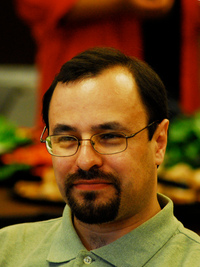
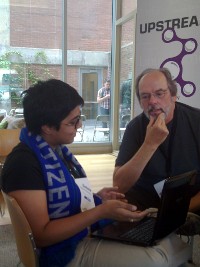
On Friday, June 24, the last day of Open Source Bridge, I won a scarf! It says, "Open Source Citizen." I wasn't the only one. The attendees nominated people who "made an extra effort to help others and share their knowledge," and the conference committee chose the three people they felt exemplified this. The winners were Sumana Harihareswara, Igal Koshevoy, and me. In case you don't know Sumana, she's the new Wikimedia Volunteer Development Coordinator, a friend, and a commenter here at Asheeshworld. In the photo of her and her new scarf, you can also see Ward Cunningham. I suggest reading her wrap-up about the conference, and checking out the notes from her talk. I haven't met Igal, but I've learned he's a fixture of the Portland tech scene. He's user number one on opensourcebridge.org and one of the original contributors to calagator, the most important event calendar in the Portland tech world. That's just a brief summary; follow him on Twitter to keep in touch. I started the conference a little shy, not wanting to introduce myself to people, so I hung out with Sumana. She talked to everyone she could find, and there I was standing next to her. On the first day, it was only because of Sumana's outgoingness that people knew who I was. On the second and third days, I was involved in two sessions: a panel on open source communities and a talk about the OpenHatch training missions. I was extremely honored to be chosen. There were so many other spectacular people I met for the first time, like Valerie Aurora, Jacinta Richardson, Brian Aker, and Alex Linsker. These are all people with three crucial traits: they're extremely knowledgeable, friendly, and opinionated. I'm glad I had a chance to attend and meet them! Photo credits: Thanks to Noah Swartz for the photo of me. Sumana's photo comes from her post to wikitech-l. Igal's comes from his Open Source Bridge user profile.

13 July 2011

Jordi Mallach: Not going to DebConf 11

3 months ago, I was positive I would be attending DebConf 11 in Banja Luka, but as the time to buy tickets and plan the trip came closer, I began to realise I don't have lots and lots of vacation, and I probably prefer spending them doing something that absolutely rocks my world. I've always enjoyed the Debian conferences when I've been lucky to be there, but last year's experience in the Pyrenees was nothing a DebConf can compare to, and I've decided to spend time seeking similar experiences this summer. With much regret, because I love meeting the wonderful people that make up Debian and DebConfs, I have to say that after all and once again, I won't make it.

Kai Wasserb ch: Vim: How to prevent trailing whitespaces

As the local geek I get all sorts of (Linux) questions asked, like "How can you delete the nth line with Sed?" or "Is there a way to search for the following in a file?" (the latter being a request to construct a regular expression for grep). And while I'm pretty sure, you can find answers for such questions quickly with $SEARCH_ENGINE I find myself generally typing the answer into the IM session. This, and just seeing Bernd's post about Vim on Planet Debian, prompted me to start a little, irregular series of posts, to which I can point people, whenever I get asked such questions. I start this off with a tip for Vim, a very powerful text editor. The problem is simple: you get (source code) files with trailing whitespaces (sometimes accumulated in "empty" lines). This makes diffing (and merging) difficult. Thus the question is: how do I prevent that from happening? How do I notice, that I have whitespaces at the end of a line? The solution consists of two lines in your .vimrc:
:highlight TrailWhitespace ctermbg=red guibg=red
:match TrailWhitespace /\s\+$\  \+\ze\t/
If you just want this functionality if syntax highlighting is also active, then you should use
:autocmd Syntax * syn match TrailWhitespace /\s\+$\  \+\ze\t/
instead of the :match line. The regular expression used in both cases matches trailing whitespaces and whitespaces in front of tabs. Of course there are several other options on how to do this or what you might want to highlight, but that would be beyond the scope of this little post.

Jaldhar Vyas: A Dance With Dragons (No Spoilers)

Somehow, even though I'd know about it for the longest time, I had never get around to reading George R.R. Martins A Song of Ice and Fire series until I heard about the Game of Thrones HBO series. Then I thought I had better hurry up and read the books as TV adaptations tend to be inferior. (I must say HBO did a pretty good job though.) I was instantly hooked and finished all four books in a week. Today the long-awaited fifth installment called A Dance with Dragons and I immediately got myself a copy. (Nowadays I mostly do my recreational reading with the Kindle app on my Android smartphone.) As before, I'm spellbound. I'm already about 25% through it and loving it. What I love about Martin is that he really gets how traditional, "pagan", "feudal" societies work. Take religion for instance. A lot of Sci-Fi/Fantasy authors if they deal with the subject at all usually give a cartoon version of polytheism that owes more to Christian canards and Dungeons & Dragons than any existing human religion. But in Westeros, one can be simultaneously devout, amoral, superstitious, and cynical in a way that makes a lot of sense to me as a Hindu. Or class. Being a peasant in Martins' world is horrible. Your life is completely at the mercy of Lords and Ladies and can end in an instant. But the upper class despite its wealth and power is trapped in its own way too. They must constantly protect their status from jealous competitors and a reversal of political or military fortune can destroy an ancient noble family just as suddenly as a bad harvest can destroy a family of farmers. Like the other books in the series, this one has a huge cast of characters whose stories weave in and out with each chapter told mainly from one characters viewpoint. This is a tactic which I for one found helpful to keep my attention from flagging but it means you can't really enjoy it unless you've read the previous volumes in order first. I definitely think it's worth the effort though.

12 July 2011

Gustavo Franco: Google+ and your data

Let's make it clear: Your data is yours and in Google+ official announcement there's the following "You and over a billion others trust Google, and we don t take this lightly. In fact we ve focused on the user for over a decade: liberating data, ...". John Goerzen is wrong.

I can understand people having problems to use a product during its field trial and demanding features. I won't sit and watch people spreading FUD in bold before asking though.

Last, but not least, the following link is easily visible in the Settings and is also listed in the Help pages:
https://plus.google.com/settings/exportdata


John Goerzen: First Look at Google Plus

Seems like everybody s writing Google+ reviews these days, but most of the ones I ve found seem to be fluff pieces. I haven t used it long, but have some initial impressions to share. First, an analogy. Facebook reminds me of the sleazy guy selling stuff from his car down the street. They do things like change privacy defaults when they think it s good for Facebook, rather than good for you. Google+ reminds me of an Apple product. It s beautiful, easy to learn, but locks everything down and is lacking some critical features. So here goes with the details. The good I think that this can be best summed up by: it s not Facebook. Facebook has, perhaps, set an incredibly low bar but still, this holds. Facebook is the only website I can ever remember using that changes things so much, so often, and so completely that I keep having this feeling of not knowing how to do things. Try maintaining a Facebook page or two and you ll especially feel my pain then. But even the basics: how many times have I accidentally posted a partial comment because I pressed Enter to start a new paragraph (that has only been the button used for that for, hmm, let s see now, decades), and instead it posted the comment. Principle of least surprise, anyone? Google+ has a simple and, on the surface anyway, intuitive interface. However, it does get muddy; more on that below. I m going to spend a lot more space on the bad below, but don t let that diminish my excitement about having a viable alternative to Facebook. I am keen to get rid of that monster. The Bad I ll start of this section with the fact that Google+ is a tightly-controlled walled garden. There is no way to take a copy of your status updates, comments, etc. and back them up with your own devices. If your Google account goes away, so do all your updates about your kids first words. Facebook does have this feature these days. It has broken half the time, but it exists, works, and I use it. Twitter doesn t have the feature built in, but its API makes it pretty easy; you could easily use my twidge program to do this, for instance. But whatever you put in G+ stays in G+. There is no autoposting it to twitter or Facebook, no backups, nothing. I m disappointed in that, given Google s prior attitude about openness to individual data ownership. (Update 7/12/2011: There is a way to get a backup, which I hadn t noticed; see comments below.) Almost as bad, there s also no way to get data in. So I now have identi.ca, twitter, Facebook, and now also G+ accounts. When I post an item in identi.ca, it autoposts to twitter, and then it autoposts from twitter to Facebook. Handy one place to notify people of my public activities. My uploads to Flickr and blog posts also auto-post to Facebook, so people I m friends with there get a picture of what I m doing outside of Facebook without me manually having to link it in. Not so with G+. There is no way to even add an RSS feed for my blog to auto-post to G+ as there is with Facebook. If you use G+, the only way to get stuff into it is with a keyboard. Poor integration with other Google apps is also an issue. G+ is nowhere near Google s first social app. They also have Blogger, Google Reader, Buzz, Gmail, etc. So here s the rub. These aren t integrated well, and when they have tried to integrate them, they ve done an exceedingly poor job of it. As an example: Buzz is a twitter-like service for posting updates. Very similar to what G+ does, right? Well, the best you can do is link your Buzz account to a separate tab on your profile. You can t even have your Buzz updates flow straight into G+, from what I can see. You have a separate list of followers in Buzz from G+. Reader is even worse; it has a sharing feature, but it s not G+ aware, so it goes to a reader inbox. But what takes the cake is the integration with Gmail Contacts. Sounds easy? Not entirely. When you add someone to G+, apparently it sometimes links the record with their entry in Contacts. And the help gives you the handy warning that when you remove them from G+, you have the option of removing them from Contacts, which could impact what you see on a mobile device. It is unclear what happens when it doesn t link the record, or how it decides which record to link (some people have more than one person in a family sharing phone numbers and email addresses, for instance.) One very nice feature of G+ is you can add email addresses, even if they aren t G+ members. Then when you post updates to the circle you ve added them to, G+ offers to send them an email with an update. Very handy. Except the undocumented part is that if you select Your circles (meaning all your circles), rather than individually ticking the box by each circle, they don t get the email. And they also don t get it if you set it Public. You have to select their specific circle, which is a significant difference from how people with G+ accounts are treated. And that s just an example. There are a ton of things that work one way 95% of the time, but have non-obvious exceptions. Some of these exceptions are documented in the help, and some aren t. I m still confused about the integration with Picasa. G+ help says that you can upload unlimited numbers of photos for free (though they will be downscaled at a certain point). Picasa has definite storage limits. But G+ uploads are showing up in Picasa. Do I really get free storage by uploading to the same place via a different tool? Very odd. And finally, a gripe about web standards. I ve been using Firefox/Iceweasel 3.5, which came out in Debian squeeze and is still supported there. It is also pretty darn new by corporate IT standards. And Google Plus refuses to let me log in with it, saying it s incompatible. Perhaps it can t do some fancy animation, but then again I don t really care. Seems Google has forgotten the old RFC adage: be liberal in what you accept and conservative in what you generate. If you can detect that my browser won t animate something right, then you could give me a stripped-down version of the page rather than an error message.

Jaldhar Vyas: Google^wBraincells Summer^wChaturmasa of Code

Barring a miracle, it looks like I won't be going to Debconf 11 this year which is a shame as that is a part of the world I have yet to visit. Anyway it got me thinking, I've neglected a lot of my Open Source activities this past year or so what with struggling to stay in good financial shape. As Chaturmasa started today in which we take up additional religious duties, I thought it might be a good time to recommit to getting all my projects up to speed again. So during the next four months I aim to (in no particular order) Hopefully by writing this down here in public, I will be able to shame myself into getting most if not all of this done.

Kees Cook: aliens hat-tip

Picked up a Doctor Who comic today and saw a nice hat-tip to (or composite ship design plagiarism of) Aliens. The Colonial Marines ship Sulaco , from Aliens, 1986:
aliens ship The Scavengers ship, from the Doctor Who Spam Filtered story, 2011:
drwho art Such a great ship. Not even remotely made to look aerodynamic. And to make this almost related to Ubuntu and Debian, here was my command line to remove exif data from the image I took with my phone: mogrify -strip spam-filtered.jpg

2011, Kees Cook. This work is licensed under a Creative Commons Attribution-ShareAlike 3.0 License.
Creative Commons License

11 July 2011

Michael Prokop: Creating 32bit Debian packages in 64bit environments

i386 systems are dying off and therefore building 32bit Debian packages in 64bit environments is important if you still need packages for i386. For some recent projects I had to set up 64bit-only environments with the need to provide 32bit packages for i386 as well as according i386 Linux kernel packages. 1) Common Debian packages Just prepend the linux32 command to the build commands and use the -a386 option of dpkg-buildpackage(1). So use linux32 dpkg-buildpackage -ai386 , linux32 git-buildpackage -ai386 , linux32 debuild -ai386 , or whatever build tool you prefer to work with. I personally like using git-buildpackage -S together with cowbuilder. When using cowbuilder it s easy to get i386 Debian packages:
# create initial cow base directory, needs to be executed just once:
cowbuilder --create --basepath /var/cache/pbuilder/wheezy32.cow \
   --architecture i386 --distribution wheezy --mirror http://ftp.de.debian.org/debian
# the "debbuildopts -b" says I want a binary-only build, see dpkg-buildpackage(1):
linux32 cowbuilder --build --basepath /var/cache/pbuilder/wheezy32.cow \
   ~/foobar_0.42.dsc --debbuildopts "-b"
2) Debian Kernel packages If you re building your own kernel images you might be aware of setting ARCH for the common make targets, like:
ARCH=i386 make oldconfig
To build a linux-image Debian package you can use upstream s deb-pkg target, like:
ARCH=i386 make deb-pkg
This should provide you according linux-headers, linux-firmware-image, linux-libc-dev and linux-image i386 Debian packages. But if you need the according source and doc packages as well you might prefer make-kpkg of kernel-package instead, using options like:
DEB_HOST_ARCH=i386 setarch i386 make-kpkg --revision "$KERNELVERSION" \
  --cross-compile - --arch=i386 --us --uc --initrd \
  --rootcmd fakeroot kernel-image kernel-headers kernel-doc kernel-source
3) Debian linux-2.6 kernel packages If you re interested in building Debian kernel images the same way as the Debian kernel team does (AKA linux-2.6) make sure to check out the kernel-handbook. After installing essential software packages I had to set up some symlinks for building:
apt-get install build-essential fakeroot devscripts fakeroot
apt-get build-dep linux-2.6
ln -s /usr/bin/gcc-4.4 /usr/bin/i486-linux-gnu-gcc-4.4
ln -s /usr/bin/ld /usr/bin/i486-linux-gnu-ld
ln -s /usr/bin/ar /usr/bin/i486-linux-gnu-ar
ln -s /usr/bin/objcopy /usr/bin/i486-linux-gnu-objcopy
ln -s /usr/bin/nm /usr/bin/i486-linux-gnu-nm
ln -s /usr/bin/objdump /usr/bin/i486-linux-gnu-objdump
ln -s /usr/bin/strip /usr/bin/i486-linux-gnu-strip
Then executing:
apt-get source linux-2.6
cd linux-2.6*
debuild -ai386 -us -uc
provided the according Debian packages (linux-doc, linux-headers, linux-image, linux-libc-dev, linux-manual, linux-patch-debian, linux-source, linux-support and linux-tools). 4) Out-of-tree kernel module packages If you want to build external modules which are available as $MODULENAME-source in Debian (e.g. tp-smapi-source) using module-assistant then use the DEB_HOST_ARCH environment variable, like:
DEB_HOST_ARCH=i386 m-a -v --text-mode -k /home/mika/linux-$KERNELVERSION -l $KERNELVERSION build tp-smapi
If the external module is not available for use with module-assistant then compile the module running:
make -C /lib/modules/$KERNELVERSION/build M=$(pwd)
whereas /lib/modules/$KERNELVERSION/build is pointing to the build directory of your 32bit kernel.

Raphaël Hertzog: 7 tips to file useful Debian bug reports and get your problem solved

Filing bug reports is the most common way for users to contribute. Even if it s not too difficult, I ll give you some advice to improve the quality of your reports. After all, when you go out of your way to report a bug, it is in the hope to see it fixed so let s see how we can make this more likely. 1. Try to reproduce the bug If you can t reproduce the bug, it s next to impossible to find the root cause and thus to fix it. In that case, I would suggest you to wait until you experienced the bug multiple times. Maybe you ll be able to find something that triggers it (or that makes it more likely to encounter it). If the application has a debug/verbose mode, it might be a good idea to enable it until you experience the bug a second time. The generated log might be helpful for the developer to understand what happens exactly. So don t file bug reports straight away unless you can reproduce it. The exception to the rule is when the application gives some useful information like a core-dump, a back-trace or an error message. Obviously if the bug happens during an upgrade, it s difficult to reproduce it (unless you have multiple computers) but you should still report it. Be sure to include all the relevant information (versions of packages before and after the upgrade, logs of the upgrade, etc.). 2. Do your best to identify the faulty package When you report a bug to Debian, you must assign it to a package. While there are pseudo-packages useful for problems which are not directly attributable to a real package, in most of the cases you should report a bug against the specific package that seems to be the cause of the problem you encountered. In turn this often requires you to attribute the problem to a file (for example the executable of the application that triggers the bug). Once you have a filename you can use dpkg -S to identify the corresponding package.
$ dpkg -S /usr/bin/hamster-time-tracker
hamster-applet: /usr/bin/hamster-time-tracker
Note that reportbug accepts a filename as parameter and will do the above conversion for you. If you only know the name of the application (but not the filename of the associated executable), you can use dpkg -S with a pattern to let it return all possible matches:
$ dpkg -S hamster
hamster-applet: /usr/share/applications/hamster-applet.desktop
hamster-applet: /usr/share/gnome/help/hamster-applet/es/statistics.page
[ ]
hamster-applet: /usr/bin/hamster-time-tracker
[ ]
Or you can also verify in the list of installed packages:
$ dpkg -l "*hamster*"
Desired=Unknown/Install/Remove/Purge/Hold
  Status=Not/Inst/Conf-files/Unpacked/halF-conf/Half-inst/trig-aWait/Trig-pend
 / Err?=(none)/Reinst-required (Status,Err: uppercase=bad)
 / Name            Version         Description
+++-===============-===============-==============================================
ii  hamster-applet  2.32.1-1        time tracking applet for GNOME
3. Verify that the bug is not already reported and/or fixed If there s a newer version of the software available, it s a good idea to try to reproduce the problem with this version too. Because the developers tend to care only about the latest version, they will want to reproduce it with this version, and they will be annoyed if the problem that you reported is already fixed. That s why bug reports of users of testing/unstable tend to be more useful than bug reports of stable users. In any case, you want to verify that the bug has not yet been reported: filing a duplicate bug is useless and only generates more work for the developers to merge both bugs together. On the opposite, it s highly appreciated to add supplementary information to an existing bug report, even a simple confirmation that the bug still exists on a newer version is useful. Note that reportbug will automatically show you the list of open bugs before allowing you to submit a new one. 4. Use reportbug While the Debian bug tracking system allows anyone to submit a new bug with a simple mail, you should really use a dedicated program like reportbug (or reportbug-ng) because it will automatically include lots of useful information in the generated report (version of dependencies, current architecture, etc.) and will assist you in all the steps. 5. Describe the problem so that the developer can reproduce it Ideally your report should include everything required so that the developer can reproduce the problem on his system. If a given document triggers the bug, attach it. Describe the steps required to reproduce the bug in great details just like you would explain it to your grand-ma. Explain how you expected the program to react and what happened instead. You can learn much more on how to draft a good bug report in this article: How to report bugs effectively. It s a bit long but well worth it if you intend to report bugs and thus interact with developers. 6. Be kind and willing to help When you draft a bug report, keep in mind that you re writing to a volunteer free software developer and not to a customer service. You should be respectful and follow the usual rules of courtesy. Developers attention is scarce and should not be wasted. Be willing to help, if the developer starts investigating your problem, he might need your help to get supplementary information (in particular if he can t reproduce it) and you should be ready to provide it. Thus it s important to keep whatever you need to reproduce the problem. In some cases, the Debian maintainer might be overworked and you can offer your help to forward the bug to the upstream bug tracker, it s always appreciated. If you re reasonably confident that the problem is not Debian-specific, you can do it straight away and set the forwarded field to the URL of the upstream bug report (for example with bts forwarded <bug> <url>). 7. Use the correct severity The Debian bug tracking system lets you set the initial severity of the bug report (in decreasing severity: critical, grave, serious, important, normal, minor, wishlist). Pick the correct severity according to the official definitions but don t misread them. In particular, don t over-inflate the severity: for instance if you lost some data due to a misuse of the software, it s not critical (i.e. rm -rf * doesn t warrant a critical bug against rm). If you use only a tiny part of a software, and that part doesn t work, the package might be unusable for you but it s not unusable for everybody, so it doesn t warrant the grave severity. The important severity is often a good choice in those cases. Do not under-estimate the severity either, if a problem is important enough that it must be fixed before the next stable release (for example a regression compared to the previous release), pick a release-critical severity (i.e. at least serious ). The maintainer and the release manager can always lower the severity if they do not agree with your initial judgment. And now, happy bug-reporting!
Follow me on Identi.ca, Twitter and Facebook. Or subscribe to this blog by RSS or by email.

6 comments Liked this article? Click here. My blog is Flattr-enabled.

Vincent Bernat: Rewriting my .zshrc

Ten years ago, I started to use ZSH, a shell designed for interactive use but which is also powerful for scripting usage. I had a fairly comprehensive .zshrc file splitted in several parts. I have decided to rewrite it for several reasons:
  1. I did not take advantage of several features of ZSH, like some advanced parameter expansion, arrays, arithmetic expressions and other built-in features. There were a lot of head, awk, sed that could be replaced by some ZSH machinery (something easier to read like $ $ (f)~~"$(</etc/hosts)" %%\#* ).
  2. It contained a lot of hacks to make things work on some odd/old setups. I was not really sure that those hacks are useful anymore. It also contained a lot of conditionals where some parts of the code were executed depending on the hostname.
I have discovered oh-my-zsh, a nice project trying to provide a generic and flexible ZSH configuration:
A community-driven framework for managing your zsh configuration. Includes 40+ optional plugins (rails, git, OSX, hub, capistrano, brew, ant, macports, etc), over 80 terminal themes to spice up your morning, and an auto-update tool so that makes it easy to keep up with the latest updates from the community.
The idea of such a project is to fork it and make the changes that you need. I was previously hacking around Phil! s ZSH Prompt for my prompt. oh-my-zsh contains a close theme (jonathan). Neat. However, I decided to write my .zshrc from scratch (but with some snippets stolen from oh-my-zsh). Why? Mostly because I want to precisely configure ZSH. Even with its plugin architecture and its override mechanism, oh-my-zsh provides some features (options, aliases, functions) that I do not want. Of course, thanks to git, you can fork and make any local changes you want but since I would have modified most of the files, it seemed easier to just start from scratch. I have published the result on GitHub. You can use it as is, fork it or (better) steal and adapt some snippets for your own usage. Here is the mandatory screenshot for the prompt (no much space left for the commands): My ZSH prompt Here is a short snippet used to select a sensible EDITOR depending on what is available. It uses anonymous functions (to restrict the scope of local variables), arrays and flags in parameter expansion. For another example, take a look on how I select a valid locale.
()  
    local -a editors
    local editor
    editors=(
        "emacs23 -Q -D -nw" # Fast emacs
        "jove" "mg" "jed"   # Emacs clone
        "vim" "vi"          # vi
        "editor")           # fallback
    for editor in $editors; do
        (( $+commands[$editor[(w)1]] )) &&  
            export EDITOR=$editor
            break
         
    done
 
Enjoy! UPDATED: Anonymous functions were introduced in ZSH 4.3.7. Older versions do not support them. A workaround is to use a classic function instead:
__()  
    local -a editors
    local editor
    ...
  && __

10 July 2011

NeuroDebian: NeuroDebian@HBM2011.ca

NeuroDebian@HBM2011.ca On June 26-30 the annual meeting of the Organization for Human Brain Mapping (HBM2011) took place in Quebec City, Canada. Encouraged by our positive experience at last year s SfN in San Diego and enthusiasm of our scientific adviser, James V. Haxby, we hosted another NeuroDebian booth. The setup was pretty much the same as last year: Some chairs and tables, lots of people, our tri-fold flyers, a Debian mirror and some virtual machine images to show Debian in action. This time we also had an LCD display attracting visitors with the package swarm, some demos, and our recent paper. We had many curious people have their first exposure to Debian, long-time users expressing their gratitude to Debian, and our upstream developers getting together to discuss various topics. Having registered the booth as NeuroDebian , we had the additional pleasure of explaining visitors the concept of a project inside Debian, in contrast to a derived distribution. But that is nothing new really, so let s talk about the differences from last year s booth. First of all, we had more people at the booth. Dominique Belhachemi volunteered to help us out and that was very much appreciated. Although HBM has only about a tenth of the attendees that SfN has, we had significantly more traffic. While last year people were primarily interested in knowing about the project, this time many of them wanted to give it a try immediately. People came with their laptops, got the VM images and started playing with Debian. After a day or so, some came back and asked for recommendations on particular software after having been exposed to the wealth of the Debian archive. What also had increased was the number of developers, or rather research labs developing neuroimaging software that came to the booth to discuss how to get their software into Debian and how to arrange ongoing maintenance of these future Debian packages. As we have our plates already quite full, we have been spending some time on mentoring interested developers to learn the art of Debian packaging and making them familiar with Debian s procedures and standards (e.g. working on #609820 with Yannick Schwartz, upstream, at the booth). ../../_images/BusyBooth216.jpg Two promising new developments need to be mentioned. First, we were approached by companies that develop hardware for brain-imaging and psychophysics research. They were curious to learn about Debian as an integrated platform that offers free software solutions that an increasing amount of their customers demands (e.g. PsychoPy). Apparently, the movement towards open research software has finally made it into the business plans of companies, as they seem to start perceiving compatibility with free software systems as a competitive advantage. We explained how software gets into Debian, and how its release cycle is managed. To foster their motivation we also pointed them to the existing open-source software that is already available or even present in Debian. Let s see whether we see more Debian-certified research products in the future. Lastly, we started talking with folks from the INCF to explore possibilities of collaborating on INCF projects using Debian as the integration and development platform. The INCF is an OECD-funded organization that develops collaborative neuroinformatics infrastructure and promotes the sharing of data and computing resources to the international research community. At least one INCF project is already relying on the efforts of the NeuroDebian project. We are going to continue this discussion during a workshop in September. A report will follow...
../../_images/DDs13.jpg

Debian people at the booth (f.l.t.r): Michael Hanke, Yaroslav Halchenko, Stephan Gerhard, Dominique Belhachemi. Not shown: Swaroop Guntupalli.

Acknowledgments This booth has been made possible by the generous support of Prof. James V. Haxby (Dartmouth College, New Hampshire, USA).

James Morrison: Code reviews

I'm reading through http://scientopia.org/blogs/goodmath/2011/07/06/things-everyone-should-do-code-review/. So, I'll make my comments here since I expect they will be long. As a caveat, I still work at Google and have done a lot of code reviews. I've made a lot of mistakes while code reviewing, I've had difficult code reviews, but my biggest problems were non-code reviews. The caveat is for most of the code reviews, I know the code being changed better than the person changing the code.

I'll reply to sections as I come across them: "Given a problem, there are usually a dozen different ways to solve it. Andgiven a solution, there's a million ways to render it as code. As a reviewer, your job isn't to make sure that the code is what you would have written - because it won't be.". I disagree with this. There are many times where code is first written in a (1) Ignorant way (2) Sloppy way (to try to save trivial amounts of work). I agree that the code probably won't be the way the reviewer wrote it, but it is good to comment on how it could have been written. Many times the reviewee isn't familiar (or ignores) with the idiomatic style of a larger bit of code.

"The second major pitfall of review is that people feel obligated to say something.". It's fine to say something, but if that's what you say most of the time then you are wasting the reviewee's time. If you do a first pass and don't find anything, you should go back and read the code and be sure that you understand it. Most times I've seen people say nothing is that they don't want to know what the new (or changed) code does.

The last section is about speed. For speed there are two types of code reviews, one which is quick, small and fixes something important. Those should only take one round and typically only need the reviewer to ask for tests. Then there is everything else, which includes small and unimportant. For those, it's ok to take more time to start the review, but each iteration should get smaller and faster.

For anyone that's gotten this far, I guess I can say my comments about Mark's blog post are purely bike shedding, but that's something with code reviews, it's ok to say you think the bike shed should be neon pink as long as you don't force the reviewee to paint the bike shed neon pink.

9 July 2011

Wouter Verhelst: Freedom, continued

Okay, so the story continues: Joe Brockmeier has posted a rebuttal to Nina Paley's post that I commented on earlier today. Basically, Joe says that Culture is not the same things as Software, and gives a lot of arguments as to why this would be true. But I can't agree with him. Let's see why. His first argument is "One of these things is not like the other". As in,
But it's far more reasonable and sensible to discuss Perl scripts and software written in assembler embedded on a chip together, and the rights that they come with, than to try to talk about rights to modify sculpture and essays.
I don't see how one could combine a perl script with an embedded assembler program, except perhaps over a network, or by using exec() two cases in which the FSF would consider that they are not even derivatives anymore, they are "at arm's length", and it would be legal to do something like this if one bit was released under the GPL while the other was not. At the same time, it's possible to engrave (part of) an essay into a statue, for example. Or make a technical apparatus which looks like a statue but which will play music if you come near it. Both would be valid cases of some artist combining two separate and (at first sight) distinct things into one work.
Sure, you could crowdsource sculpture, but I doubt it will have much practical application. (And certainly difficult over the Internet, but I digress...)
It's called RepRap, and it's very much possible over the Internet. Joe moves on, with 'Unintended consequences of forkable prose'.
Take the GNU Manifesto, for example. If you could "fork" the manifesto, I could easily see variant versions modified to justify open source instead of free software.
This argument had been brought forward during the discussions which Debian had on the GFDL vote, and has been seriously debunked there. In short: the ability and right to fork someone's prose does not, in any way, give you the right to misrepresent them. While I believe it should be okay for someone to base a theoretical Open Source Manifesto on the GNU Manifesto, I do not believe it should be okay for them to still keep calling it the GNU Manifesto. It's not the same thing anymore, so that should be clear. This is true within Free Software as well: if you fork, you give it a new name, so it becomes clear that you're not the original anymore. Moreover, I doubt the kind of prose found in the GNU Manifesto is the same kind of prose that Nina would like to see in a free culture movement. Not because the GNU Manifesto is a bad piece of writing it isn't but because Free Culture likely focuses on other things than manifestos. Next, we get "Solving a problem that doesn't exist"
The spark that fired off the GNU revolution was a legitimate problem because of non-free code, a user was unable to make use of hardware they (or their university) legitimately owned.
(...)
While Paley and others may want the same freedoms to go with cultural works, it is not a real problem in the same sense.
Pardon ye me? I am a musician. Not a very brilliant one, mind you, but I play the flute with much enthusiasm, and have done so in a number of places. If you've been to any debconf since 2007, surely you must've heard me play. Also, I've been singing in choirs since I was sixteen which, I just realized, means I've now been singing for more than half my lifetime. Time flies, it must be said. One of the orchestra that I've been playing in was an extended flute choir with a rather unusual instrumentarium: apart from 30-something flautists, the orchestra also had a piano and drummer, a number of guitar players, and a bass guitar. Such an unusual set of music means you have three options: you play original music, written specifically for your group; you play something written for a different set of instruments, without changing anything, and hope nobody notices that it doesn't actually sound very well; or you make modifications. You make a derivative work of the music, so you can actually play it. There, I've said the word. This isn't just true for music; I've yet to see the first theatre performance that is true, word-for-word, to the original script. Also, movies use music all the time. When they do, there are usually two options: either they have original pieces of music written specifically for their movie (as is the case for most Hollywood blockbusters), or they take a piece of existing music, and adapt it so it fits the events in the movie better. By, say, shortening it, so it doesn't run into the next scene. Or by repeating the refrain an extra time, so the words line up nicely with the action. Or by having a group of musicians record a version of that piece specifically for your movie, which is the same thing in everything except the speed so that the feet of the actor walking on the big screen hit the ground in sync with the music. Or... well. You get the idea. By claiming that artists have no need to modify and derive from others, the only thing Joe accomplishes is to show that he really, really, really doesn't know what the fuck he's talking about. Artists have a need to modify other artists' works all the time. The only difference with free software is that they either need to invoke the fair use clause, or need to pay big bucks to the original rightsholder. Sound familiar? Joe finishes up with stating that despite all of that, Free Culture is still possible. And:
That doesn't mean that free culture is impossible. It simply means that different standards apply.
Exactly: different standards apply. And why? There is no good reason for that. Because people make money from cultural works? Well, money is made from software, too, that has never been a good enough reason. Because Culture is not functional? How many in the Free Software movement would even be willing to only be doing software all the time, and not ever do anything remotely related to Culture? None, I would say. Culture is just as functional as Software, it just serves different functions. In the comments, Joe clarifies that he isn't against people preferring not to use the ND clause in the CC licenses they select, he's just against demanding that others do the same. That argument would make sense if not for the fact that the FSF demands, mostly, that Software Should Be Free!!1!. By not complaining about the GNU Manifesto, but complaining about Paley's "Rantifesto", which basically complains about the lack of such an environment in the free culture movement, Joe just makes a fool of himself. Anyway, 'nuff said.

Wouter Verhelst: On Software (and Cultural) Freedom

Nina Paley, author/actor/director/animatrist of the excellent sita sings the blues, blogs about the FSF's double standards when it comes to freedom. To the FSF, Software Should Be Free!!1!, and it is willing to go to great lengths to accomplish that. For example, the FSF will create dracionian requirements on their Hardware endorsement criteria, that will most likely render it unusable, just for the remote possibility that they might convert a single soul to their religion. They will add propaganda to their documentation, and slap on a license that makes it illegal for anyone to modify or remove that propaganda. They will claim to make an update to that license, just to make their friends happy, but then do not make any effort to finish the job. Most of all, the FSF is led by a person who deserves our respect for jumpstarting a movement that has made all this free software even possible, but whose atypical behaviour might be interfering with his message these days. I have stated before that I'm not a member of the FSF, and that 'I have my reasons'. In case you were wondering: the above are my reasons. I can't be a member of, or be supporting of, any organization that uses such double standards in anything. In the case of Debian, it took us a long time to come to the conclusion that the GNU FDL is a non-free license. And though we came to that conclusion through other arguments than "Culture should be free, too" (specifically, the arguments boiled down to "if it's digital, it's software, and software should be free"), I have since come to the conclusion that there is nothing special about 'digital stuff' that should mean it should be more free than 'non-digital stuff'. If I hand you a piece of music on a sheet of paper, why should you not have the right to redistribute and/or modify that, while you should have the exact same right if I were to hand you the exact same paper on a digital medium? That makes no sense. So, in short, I agree with you, Nina: there is no Free Culture movement, and that's a shame; and while it would be nice if the FSF were to take a lead role in guiding such a movement, I find it highly unlikely that they will. The FSF may claim they care about Freedom, that doesn't mean they do; they care about Software Freedom. And while that certainly was an issue thirty years ago, when the FSF was formed, it isn't so much anymore today. There can only be one conclusion: the FSF is obsolete.

8 July 2011

Julien Blache: Farewell, Space Shuttle Program

Well, today was the day and I ve just watched the last ever Space Shuttle launch. Let s just say there s something very, very wrong with this world and leave it at that. Hats off to all the men and women who dedicated their lives or part thereof to these magnificent birds over the past 30+ years, from the original design studies back in the days to the transition & retirement operations that will last for a year still. We ll most probably never get to see any other machine pushing boundaries like the Shuttle has done, and this is a gigantic loss for us all. One day people will realize If you aren t familiar with the challenges faced by the Shuttle, with the advances in science and countless engineering disciplines brought by Shuttle and more generally with Shuttle and facts about the Shuttle, go read Wings in Orbit; a book by the people who built and operated the Space Shuttle, available freely in PDF format from NASA. Did you know that the Space Shuttle Main Engines (SSME, RS-25) are the most powerful, most efficient engines ever built? They were designed 40 years ago. I won t make a list, but this is true of a number of other components. What the hell have we been doing all these years?

Russell Coker: Multiple Filesystems for Security

There is always been an ongoing debate about how to assign disk space into multiple partitions. I think that nowadays the best thing to do is to assign about 10G for the root filesystem for every desktop and server system because 10G is a small fraction of the disk space available (even the smallest laptops seem to all have disks larger than 100G nowadays). Even if 10G turns out not to be enough using separate filesystems for /var or /usr provides little benefit now that it s easy to resize the root filesystem with LVM and a separate /usr is known to be broken [1]. In a discussion on a private mailing list there was a suggestion that multiple filesystems should be used for security. DoS Attacks There are some minor security benefits in having multiple filesystems. If a critical program will fail when there is no free disk space then allowing an unprivileged process to use up all the space on that filesystem is a minor security issue, so having unprivileged processes not being permitted to write to important filesystems is a benefit. But most failures of this type are merely DoS attacks which usually aren t a big deal if you can control a local process there are usually lots of other ways of DoSing a system. Links Links have been the cause of many security issues in Unix over the years. Using different filesystems for different tasks can prevent the use of hard links in attacks aimed at exploiting race conditions. But even if you prevent hard links there are similar issues with symbolic links. SE Linux is one of many security improvements for Linux which allow restrictions on the creation of hard links. SE Linux also allows restricting the ability of processes to follow symbolic links, so a privileged process can be denied access to follow a sym-link that was created by an unprivileged process. NFS The subtree_check option in /etc/exports causes the NFS server to verify that file access is in the correct subtree. So if you export only one subdirectory of a filesystem to a given server then hostile code on that server (or on a network device which impersonates that server) can t access other subdirectories. This option is documented as having performance implications and working best for filesystems that are mostly read-only, for this reason it s turned off by default in recent versions of the NFS utilities. So if you want to NFS export /home then it s probably a good idea to have /home be on a separate filesystem to prevent attacks on the root filesystem. But of the systems with significant use of /home (IE anything other than accounts used solely for su - ) most of them have a separate filesystem for /home anyway so this shouldn t be an issue. SE Linux When mounting filesystems with SE Linux there is a context= mount option that allows specifying the context for all files on the filesystem. This can save a small amount of storage space for XATTRs and theoretically improve performance (although the difference is unlikely to show up on benchmarks for anything other than fsck). Generally the context mount option is only used for a filesystem that has a huge number of files with the same context, such as a mail spool that uses Maildir, Cyrus, or any of the other formats that involve one file per message. But again such data is generally stored on a separate filesystem for other reasons anyway. I found one interesting corner case in regard to SE Linux systems mounting files from an NFS server. When an NFS server exports multiple subdirectories of a filesystem mounted on /foo then if one NFS client running SE Linux is to mount two subdirectories of /foo with different contexts then the second mount attempt will give the error an incorrect mount option was specified . This is because as of kernel 2.6.18 by default it s not permitted to mount parts of the same filesystem with different mount options. The option nosharecache allows you to use different mount options, but does apparently permit some undesirable behavior in the case of hard links that cross between the subtrees. Thanks to Eric Paris for the tip about nosharecache. The best example I can think of for which you might want context mount options that differ among files that are used for the same purpose on an NFS mount is a web server which has data files and CGI-BIN scripts. So it seems that a SE Linux web server that mounts it s data over NFS and is at risk of having hard links between the CGI-BIN directory and the data directory is a corner case in which multiple filesystems is required for security. This seems to be a very unlikely case. Conclusion Servers that are deployed in the real world are complex enough that there are always systems with some unusual corner cases demanding configuration choices that aren t expected. There are some real corner cases for SE Linux where multiple filesystems are compelled for security or for a combination of security and best performance. But I wouldn t make a generic recommendation of using lots of filesystems for security. I think that the people who encounter the strange corner cases can usually work out that they need to do something different. So a small number of filesystems seems like a good general aim that doesn t conflict with security.

7 July 2011

Lars Wirzenius: Instapaper versus MAFF

I recently heard about Instapaper on the Stack Exchange podcast. It's a service that makes it easy (they say) to save web pages for reading later, possibly on another machine or device. I've been doing that for some years now, using the "File/Save" feature in my browser. Last year, this became lots better, when I found the MAFF add-on to Firefox. MAFF saves the page, and any images it includes, in a zipped file, which can later be viewed directly in Firefox. Or Iceweasel, in my case. It's much handier to have everything in one file, rather than a foo.html file plus a foo_files/ directory, which is what Firefox usually saves as. This does not make it possible to, for example, read the page on my phone, since I've saved the file on my laptop, but I can live with that. However, the complete autonomy of this solution is much to my liking. I have a "read and review" folder for things I need to read. After I'm done with something, I can easily delete it. If I want to keep it permanently, I can move it to an archive folder. I haven't got a solution for full text searching through my growing archive of MAFF files, but I'll figure that out some day, too, I'm sure.

Dirk Eddelbuettel: Rcpp 0.9.5

A maintenance release version 0.9.5 of Rcpp is now on CRAN and in Debian. This release comprises a number of minor fixes, extensions as well as small additions to the documentation and examples which have accumulated since the last release in April. The complete NEWS entry is below; more details are in the ChangeLog file in the package and on the Rcpp Changelog page.
0.9.5   2011-07-05
    o   New Rcpp-FAQ examples on using the plugin maker for inline's
        cxxfunction(), and on setting row and column names for matrices
        
    o   New sugar functions: mean, var, sd
    o   Minor correction and extension to STL documentation in Rcpp-quickref
    o   wrap() is now resilient to NULL pointers passed as in const char *
    
    o   loadRcppModules() gains a "direct" argument to expose the module instead
        of exposing what is inside it
    o   Suppress a spurious warning from R CMD check on packages created with
        Rcpp.package.skeleton(..., module=TRUE)
    o   Some fixes and improvements for Rcpp sugar function 'rlnorm()'
    o   Beginnings of new example using OpenMP and recognising user interrupts
Thanks to CRANberries, there is also a diff to the previous release 0.9.4:
 ChangeLog                                                 74
 DESCRIPTION                                               10
 R/00_classes.R                                             3
 R/Module.R                                                16
 R/loadRcppModules.R                                       10
 R/populate.R                                              10
 R/tools.R                                                 13
 R/zzz.R                                                    3
 cleanup                                                    2
 inst/NEWS                                                 21
 inst/doc/Rcpp-FAQ.pdf                                  binary
 inst/doc/Rcpp-FAQ/Rcpp-FAQ.Rnw                            62
 inst/doc/Rcpp-extending.pdf                            binary
 inst/doc/Rcpp-introduction.pdf                         binary
 inst/doc/Rcpp-modules.pdf                              binary
 inst/doc/Rcpp-modules/Rcpp-modules.Rnw                     7
 inst/doc/Rcpp-package.pdf                              binary
 inst/doc/Rcpp-quickref.pdf                             binary
 inst/doc/Rcpp-quickref/Rcpp-quickref.Rnw                  59
 inst/doc/Rcpp-sugar.pdf                                binary
 inst/doc/Rcpp-unitTests.pdf                            binary
 inst/doc/Rcpp.bib                                          4
 inst/doc/unitTests-results/Rcpp-unitTests.html            18
 inst/doc/unitTests-results/Rcpp-unitTests.txt             49
 inst/examples/OpenMP                                   only
 inst/include/Rcpp/Module.h                                33
 inst/include/Rcpp/config.h                                 2
 inst/include/Rcpp/internal/wrap.h                          5
 inst/include/Rcpp/module/Module_generated_CppMethod.h   2902  +++++++++++++++++-
 inst/include/Rcpp/stats/random/rlnorm.h                   14
 inst/include/Rcpp/stats/random/rnorm.h                     4
 inst/include/Rcpp/sugar/functions/functions.h              3
 inst/include/Rcpp/sugar/functions/mean.h               only
 inst/include/Rcpp/sugar/functions/sd.h                 only
 inst/include/Rcpp/sugar/functions/sum.h                    4
 inst/include/Rcpp/sugar/functions/var.h                only
 inst/include/Rcpp/vector/Vector.h                          4
 inst/skeleton/zzz.R                                        1
 inst/unitTests/runit.wrap.R                               25
 man/CppClass-class.Rd                                      2
 man/loadRcppModules.Rd                                     6
 src/Module.cpp                                             1
 42 files changed, 3252 insertions(+), 115 deletions(-)
As always, even fuller details are on the Rcpp Changelog page and the Rcpp page which also leads to the downloads, the browseable doxygen docs and zip files of doxygen output for the standard formats. A local directory has source and documentation too. Questions, comments etc should go to the rcpp-devel mailing list off the R-Forge page

6 July 2011

John Goerzen: Geeks, Hobbies, and Free/Open Source: Feedback Wanted

I ve been thinking lately about ways to improve ways in which I interact with Free Software projects, and ways in which they interact with me. Before I proceed to take steps or make suggestions, I d like to see if others share my traits and observations. Here are some questions I have been thinking of. If you d like to help give me anecdotal evidence, please post a comment below this post. Identify the question numbers you are answering. It helps me if you can give specific examples, but if you don t have the time or memory for that, no problem. I will post my own answers in a day or two, but the point of this post is listening, not talking, so I ll not post them immediately. Hobbies (General any geeks) Examples: video games might be a challenging hobby (depending on the person) but in most cases aren t educational. A hobby might be video game playing or being a Debian developer. A sub-hobby might be playing GTA IV , playing RPGs , or maintaining mutt . Free/Open Source Hobbies Examples on F9: If, say, you are a long-time Perl user and have gone to Perl conferences, but now you are interested in Ruby, would your involvement with the Perl community cause you to avoid taking up the Ruby programming hobby? Or would it cause you to cut your ties with Perl less quickly than your changing interest might dictate? (This is a completely arbitrary example and isn t meant to start a $LANGUAGE thread.) Changes over time

Next.

Previous.