Search Results: "ina"

6 December 2011

Dirk Eddelbuettel: RcppArmadillo 0.2.32

Conrad Sanderson made the official 2.4.0 release of Armadillo last evening. This was wrapped into RcppArmadillo release 0.2.32 which arrived on CRAN earlier today. The NEWS entries summarising the changes since the 2.2.* series, we already saw most of this with the two prerelease 0.2.30 and 0.2.31:
0.2.32  2011-12-04
    o   Upgraded to Armadillo test release 2.4.0 "Loco Lounge Lizard"
    o   Minimal changes relative to 0.2.31 based on 2.3.92, next section is
        relative to the previous stable release series 2.2.* of Armadillo
          * added shorter forms of transposes: .t() and .st()
          * added optional use of 64 bit indices, allowing matrices to have
            more than 4 billion elements 
          * added experimental support for C++11 initialiser lists
          * faster pinv()
          * faster inplace transpose
          * faster handling of expressions with diagonal views
          * fixes for handling expressions with aliasing and submatrices
          * fixes for linking on Ubuntu and Debian systems
          * fixes for inconsistencies in interactions between matrices and
            cubes 
          * refactored code to eliminate warnings when using the Clang C++
            compiler 
          * .print_trans() and .raw_print_trans() are deprecated
Courtesy of CRANberries, there is also a diffstat reports for 0.2.32 relative to 0.2.31 As always, more detailed information is on the RcppArmadillo page. Questions, comments etc should go to the rcpp-devel mailing list off the R-Forge page.

5 December 2011

Axel Beckert: automounter vs procmail

At work we use .procmailrc files generated by CGIpaf to let non-technical users create forwards, out-of-office mails, etc. and any combination thereof. This also has the advantage that we can filter out double bounces and spam (which also prevents us from being listed in spammer blacklists). Unfortunately autofs (seems independent if autofs4 or autofs5 is used) seems to be unreliable if there are bursts of mount or umount requests, resulting either in File or directory not found error message while trying to access the home directory of a user, or Directory not empty error messages if the automounter tries to remove the mount point after unmounting. In that case a not mounted directory owned by root is left over. In the end both cases lead to procmail behaving as if that user does not have a .procmailrc which looks like sporadically lost mails to those who forward all mails. (The mails then can be found in the local default INBOX for that user.) Additionally there are similar issues when the NFS servers are not available. The most effective countermeasure we found so far was adding tests to the global /etc/procmailrc to check if the user s home directory exists and belongs to the correct user:
# -----------------
# Global procmailrc
# -----------------
# For debugging, turn off if everything works well
VERBOSE=1
LOGFILE=/var/log/procmail.log
# This only works with bourne shells, $SHELL defaults to the user's
# login shell. And by experience dash seems not work, so we use bash.
OLDSHELL=$SHELL
SHELL=/bin/bash
# temporary failure (see EX_TEMPFAIL in /usr/include/sysexits.h) if
# $LOGNAME is not set for some reason. (Just to be sure our paths
# later on are not senseless.
:0
* ? test -z "$LOGNAME"
 
    LOG="Expected variable LOGNAME not set. "
    EXITCODE=75
    :0
    /dev/null
 
# temporary failure (see EX_TEMPFAIL in /usr/include/sysexits.h) if
# $HOME is not readable. ~$LOGNAME does not seem to work, so this uses
# a hard wired /home/.
:0
* ? test ! -r /home/$LOGNAME
 
    LOG="Home of user $LOGNAME not readable: /home/$LOGNAME "
    EXITCODE=75
    :0
    /dev/null
 
# temporary failure (see EX_TEMPFAIL in /usr/include/sysexits.h) if
# $HOME has wrong owner. ~$LOGNAME does not seem to work, so this uses
# a hard wired /home/.
:0
* ? test ! -O /home/$LOGNAME
 
    LOG="Home of user $LOGNAME has wrong owner: /home/$LOGNAME "
    EXITCODE=75
    :0
    /dev/null
 
[ ]
If you want to store a copy of these mails for debugging purposes on every delivery attempt, replace /dev/null with some Maildir or mbox only accessible for root. One small but important part was to explicitly declare bash as shell for executing the tests, otherwise mails for users with tcsh or zsh as login shell filled up the mail queue and never get delivered (if the SHELL variable never gets fixed). Only drawback so far: This leads to more lagging e-mail on e-mail bursts also for those users who have no .procmailrc because procmail can t check if there s really no .procmailrc. Extensive procmail documentation can be found online at the Procmail Documentation Project as well as in the man pages procmail(1), procmailrc(5) and procmailex(5).

Meike Reichle: Bug Squashing Party in Hildesheim is over

Alexander has already announced the final results of this weekend's BSP, but I'd like to add my personal thanks. So, kudos to all attendees, for helping to make the BSP such a success and also to my employer for the generous budget and my colleagues, especially Wolfram to whose initiative we owe this BSP, for helping out before, during and after the party. All in all it's been an event well worth repeating!

4 December 2011

Tanguy Ortolo: Concerning the good use of ITP

When someone wants to package a piece of software for Debian, he has to file an Intent to Package, by filing a special bug report against the pseudo-package wnpp (work-needing and prospective packages) with a title of ITP: software name . This way, we can synchronize our efforts, for instance if someone else wants to package the same piece of software. I have seen two recent examples of a misunderstanding of the correct use of such reports, so perhaps this reminder may be of some help for newcomers.While an Request for Package means that its author would like someone to package a piece of software, and ITP means that its author wants to package it himself and to have it integrated to Debian (in fact, an RFP also becomes an ITP when someone is willing to do the work). This means that the owner of an ITP bug is responsible for the corresponding work. Given that the ITP report is meant to inform others, that implies that he should document his progress by appending messages to the bug report. In particular, when something is blocking the work (typically a failure to find a sponsor), that should be indicated in the ITP report so that it does not appear as being abandoned. So, in a nutshell, when you have opened an ITP, do not expect someone to take it, to reply to it or whatever deus ex machina; you are now the owner of that bug, which means you are responsible of making it live and eventually closing it by sending your package to Debian. The progress of a packaging work should be documented, especially if it requires some specific help such as sponsoring, and the ITP report is the best place to do that since this is where interested people will look for status information.

Francois Marier: Optimising PNG files

I have written about using lossless optimisations techniques to reduce the size of images before, but I recently learned of a few other tools to further reduce the size of PNG images.

Basic optimisationWhile you could use Smush.it to manually optimise your images, if you want a single Open Source tool you can use in your scripts, optipng is the most effective one:
optipng -o9 image.png

Removing unnecessary chunksWhile not as effective as optipng in its basic optimisation mode, pngcrush can be used remove unnecessary chunks from PNG files:
pngcrush -q -rem gAMA -rem alla -rem text image.png image.crushed.png
Depending on the software used to produce the original PNG file, this can yield significant savings so I usually start with this.

Reducing the colour paletteWhen optimising images uploaded by users, it's not possible to know whether or not the palette size can be reduced without too much quality degradation. On the other hand, if you are optimising your own images, it might be worth trying this lossy optimisation technique.

For example, this image went from 7.2 kB to 5.2 kB after running it through pngnq:
pngnq -f -n 32 -s 3 image.png

Re-compressing final imageMost PNG writers use zlib to compress the final output but it turns out that there are better algorithms to do this.

Using AdvanceCOMP I was able to bring the same image as above from 5.1kB to 4.6kB:
advpng -z -4 image.png

When the source image is an SVGAnother thing I noticed while optimising PNG files is that rendering a PNG of the right size straight from an SVG file produces a smaller result than exporting a large PNG from that same SVG and then resizing the PNG to smaller sizes.

Here's how you can use Inkscape to generate an 80x80 PNG:
inkscape --without-gui --export-width=80 --export-height=80 --export-png=80.png image.svg

3 December 2011

Joachim Breitner: Some late recognition of metainit

Four years ago, during DebConf 7 in Edinburgh, I had the idea of creating init scripts not by hand, but rather describe them in a declarative way that handles most common cases and generate the real init scripts from them. Back than, this was partly motivated by the varying quality of init scripts and the advent of an alternative init system, upstart, for which proper service files could be generated as well. I implemented the idea and uploaded it as metainit to Debian, but it did not take off. Only one package uses it, and this package is not used much either. The project basically fell dormant. Yesterday, I got this mail:
Hi Joachim, I'm not very familiar with Debian ecosystem, however our company has recently switched to exclusively using Debian based servers, please forgive me if there exists a better channel for sending patches. We need (in house) to create a lot of trivial services and the sysv init system seems an ideal way to manage them, and metainit an great way to keep the config simple. However all our scripts require a heartbeat, the way we normally do this is with a bunch of checkers launched from cron. Metainit was ideal, but lacked the simple 'status' task found in most init scripts. This small patch adds that task, I hope you and others find it usefull. Regards,
together with the mentioned patch. So it turned out that the idea was a useful one after all, although it found its use on our user s machines, and not within the Debian packages, as I originally anticipated. Nice! During the recent discussions about the latest init system, systemd, there were more thoughts about generating init scripts/upstart service descriptions/systemd units from a declarative description, and if metainit had taken off back then, things would be easier now. So if anyone feels like reviving the project: Please do.

Flattr this post

Olly Betts: Debian RC Bugs Fixed for November 2011

Patrick Schoenfeld: Let me introduce DPKG::Log and dpkg-report

We have customers, which require a report about what we've done during maintenance windows. Usually this includes a report about upgrades, newly installed packages etc. and obviously everything we've done apart from that.
Till now we've prepared them manually. For a greater bunch of systems this is a big PITA, because to be somehow useful you have to collect the data for all systems and after that, prepare a report where you have:

Its also error-prone because humans make mistakes.

Perl to the rescue!
At least the part about generating a report about installed/upgraded/removed packages could be automated, because dpkg writes a well-formed logfile in /var/log/dpkg.log. But I noticed that there appearently is no library specialised at parsing that file. Its not a big deal, because the format of that file is really simple, but a proper library would be nice anyway.
And so I wrote such a library.
It basically takes a logfile, reads it line by line and stores each line parameterized into a generic object.

Its features include:

Based on that, I wrote another library DPKG::Log::Analyse, which takes a log, parses it with DPKG::Log and then extracts the more relevant information such as installed packages, upgraded packages, removed packages etc.

This, in turn, features:
- Info about newly installed packages
- Info about removed packages
- Info about upgraded packages
- Info about packages which got installed and removed again
- Info about packages which stayed halfinstalled or halfconfigured at the end of the logfile (or defined reporting period)


These libraries are already uploaded to CPAN and packaged for Debian.
They passed the NEW queue very quickly and are therefore available for Sid:

http://packages.debian.org/sid/libdpkg-log-perl

As an example use (and for my own use case, as stated above), I wrote dpkg-report, which uses the module and a Template::Toolkit based template to generate a report about what happened in the given logfile.
It currently misses some documentation, but it works somehow like this:

Report for a single host over the full log:
dpkg-report

Report for a single host for the last two days:
dpkg-report --last-two-days

Report for multiple hosts (and logfiles):
The script expects that each log file has the name <systemname>.dpkg.log so that it can guess the hostname from the system and can grab all such log files from a directory if a directory is specified as log-file arguments:</systemname>

dpkg-report --log-file /path/to/logs

This will generate a report about all systems without any merging.

Report for multiple hosts with merging:
dpkg-report --log-file /path/to/logs --merge

This will do the following:
A (fictive) report could look some what like this:

dpkg-Report for all:
------------------------
Newly Installed:
abc
Removed:
foo
Upgraded:
bar (0.99-12 - 1.00-1)
dpkg-Report for test*:
------------------------
Newly Installed:
blub
dpkg-Report for test1:
------------------------
Upgraded:
baz (1.0.0-1 -> 1.0.0-2)
dpkg-Report for test2:
------------------------
Upgraded:
zab (0.9.7 -> 0.9.8)

Currently this report generator is only included in the source package or in the git(hub) repository of the library. I wonder if it makes sense to let the source package build another binary package for it.
But its only a 238 lines perl script with a dependency on the perl library so I'm unsure if it warrants a new binary package. What do others think?

1 December 2011

Christian Perrier: Between 60 and 64 languages supported in Debian Installer

(including English!) The string freeze of Debian Installer officially ended at 23:59 yesterday (Sept. 20th). Indeed, this was extended a bit to today, with agreement by Otavio Salvador who I thank for this. That allowed Zak to "save" Tagalog and also the Welsh and Latvian translators to polish their work. We now have to decide about some of these languages: those that failed to meet the release criteria but were formerly activated in D-I. There are four such languages: Amharic, Welsh, Estonian and Northern Sami. Please find below the mail I just sent to debian-i18n and debian-boot. I promised that this discussion would happen in public. It will (but it will be short as we can't delay the release of the installer for ages....and I think that my proposals are reasonable!)
First of all, the numbers as of Sunday Sept. 21st 09:32 UTC (date of
the last commit with an l10n update):
Languages meeting the release criteria: 59
------------------------------------------
Already activated and complete for level 1: 51
 Arabic, Belarusian, Bulgarian, Bosnian, Catalan, Czech, Danish,
 German, Dzongkha, Greek, Esperanto, Spanish, Basque, Finnish, French,
 Galician, Gujarati, Hebrew, Hindi, Croatian, Hungarian, Indonesian,
 Italian, Japanese, Georgian, Khmer, Korean, Lithuanian, Latvian,
 Macedonian, Malayalam, Marathi, Norwegian Bokm l, Nepali, Dutch,
 Norwegian Nynorsk, Punjabi, Polish, Portuguese, Brazilian Portuguese,
 Romanian, Russian, Slovak, Albabian, Swedish, Tamil, Thai, Turkish,
 Vietnamese, Simplified Chinese, Traditional Chinese
Already activated and complete for sublevels 1 and 2: 6
Bengali, Kurdish, Slovenian, Tagalog, Ukrainian, Wolof
Not yet activated languages complete for sublevels 1 and 2: 2
 (the mail in -i18n and -boot says 3 but this is an error by me)
Irish, Serbian
Languages failing to meet the release criteria: 15
--------------------------------------------------
Activated languages: 4
Amharic, Welsh, Estonian, Northern Sami
Not yet activated languages: 11
Afrikaans, Persian, Armenian, Icelandic, Kazakh, Kannada,
Malagasy, Malay, Telugu, Urdu, Xhosa
Discussion
----------
(careful people will notice that I moved Welsh down to "failed to meet
the release criteria" as this is what is technically correct)
Nothing to discuss for the 57 already activated languages that meet
the defined criteria. They'll be kept or first activated in the RC1
release of Debian Installer.
Similarly, nothing to discuss for the 11 languages that were not
activated and haven't made it. They will remain unactivated.
Two languages should be activated as they have met the release
criteria for the first time during the string freeze: Irish and Serbian.
This adds more load (and size changes) to D-I but I really don't see
any reason to not follow our own rules there.
The discussion comes for the 4 languages that fail to meet the release
criteria. Here are my proposals with some rationale:
Amharic: 
  I would really dislike deactivating Amharic because it's highly
  symbolic to have the language of Ethiopia activated. We have so few
  African languages. Also, the translation is nearly complete and the
  translator was well coping with updates until July. The missing
  stuff for Amharic in sublevels 1 and 2 are messages about loading
  drivers or firmware from removable media, the rescue mode stuff for
  the graphical installer and some messages that briefly appear during
  finish-install. A little bit more important is the message warning
  that the boot partition is not ext2 or ext3, added in August by
  tbm. I think this is not enough to drop out one year of efforts for
  the translator
  As a consequence, I propose to KEEP Amharic.
Welsh:
  Only five strings are missing in sublevels 1 and 2 because of the
  small experience of PO files by the person who completed the
  translation during last week. One will make the regular user login
  name screen to be in English and others will make the GRUB password
  screen to be in English as well, that's all.
  Additionnally, we can safely assume that all potential users of
  Welsh have good skills in English...and will therefore very easily
  cope with these screens.
  As a consequence, I propose to KEEP Welsh.
Estonian:
  The translation had NO update since Etch. The last update is dated
  back to Feb. 17th 2007. I haven't got any sign of life from the
  translator and no Estonian users have volunteered to maintain the
  translation.
  Missing strings are in many places, including several screens that
  appear in default installs. Even though one can assume that the
  skills of the average Linux user in Estonia is fairly good, I think
  this is not enough to throw users in a big mix of English and
  Estonian.
  As a consequence, I propose to DROP Estonian.
Northern Sami:
  The translation is very incomplete. With about any other language,
  that would be a reason to drop the translation.
  However, a few reasons make me suggest keeping it:
   - Northern Sami is mostly used in Norway and D-I will fall back
     to Norwegian Bokm l which is understood by all potentials users
     as it is teached in all Norwegian schools. 
   - Users will be warned, *in Sami*, about this situation
   - The choice of Sami will be kept in localechooser even if the
     translations are dropped. This is on request of Debian Edu
     developers to avoid them to develop a special boot floppy
     to offer the choice of Sami (a requirement for Norwegian
     schools). I personnally think this is a reward to Debian Edu and
     its ancestor Skolelinux for their initial involvement in the
     development of D-I
  As a consequence, I propose to KEEP Northern Sami.
I understand that these choices may be debatable and some may sound
slightly subjective. I however think this is the best way to be fair
with translators' efforts without compromising the quality of D-I.
Please note that the final word on this will be by D-I release
managers...but advices are very much welcomed.

Dirk Eddelbuettel: Wicked Webapps with R, err, Wt

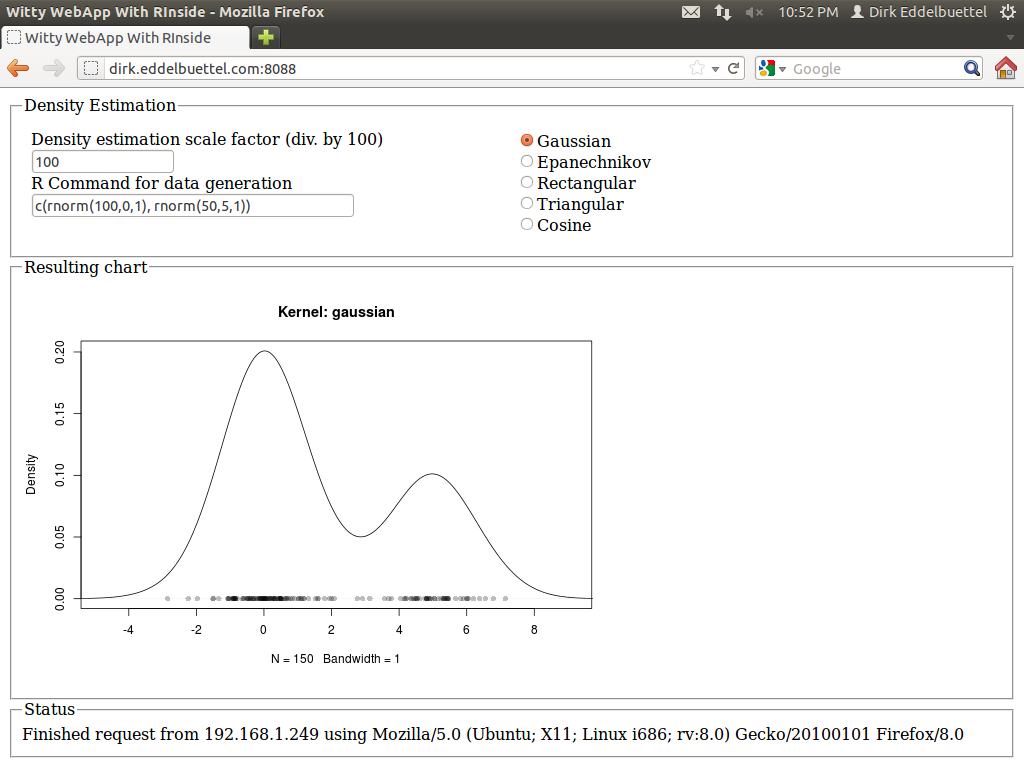
A few months ago, I had blogged about using R inside of Qt. This used our RInside package for embedding the statistical programming environment and language R inside of a C++ application, and further relies on our Rcpp package for R and C++ integration and object mapping. The example was simple yet powerful: a reimplementation of the standard GUI application of a standard density estimate. Here the user can pick a kernel density function from a selection, and also slide a bandwidth parameter. One nice addition was an entry field already populated with a simple expression for a mixture of Normals, allowing for arbitrary random distributions over which to estimate. The example is pretty (thanks to Qt), and was added to RInside with the last CRAN release 0.2.4. The blog post has a nice screenshot. I had long wondered how to do something similar 'on the web'. Web integration and application frameworks are of course a dime a dozen: Just about any language offers this, with more or less ease. But I wanted something simple yet powerful and fast. And I did not like the idea of a multi-tier app, or of a multi-language mix. I remember having seen something about a web-application framework not unlike Qt, and studying the very useful Wikipedia web application framework comparison I re-discovered Wt (pronounced "Witty"). So there it is, using C++ which brings us ample performance, the ability to connect to a number of libraries and applications (which is important in my quantitatively-minded workd) and avoid the whole multi-tier, multi-language combination. The Wt website has a few more good reason why this may be a suitable idea; the toolkit also offers a very decent amount of features and is amply documented with a fair number of examples. And after just a little bit poking around during two weekends, I now have the following webapp committed in the SVN repository of RInside, and it is all implemented in in less than two hundred (generously commented) lines of code. Example of embedding R via RInside into a Wt C++ application: density estimation for a mixture It is currently up and running at the address shown in the screenshot, so give it a go (though I may take it down at another point in time). I quite like it: The application is responsive: changes in the radio buttons (for the density), or the bandwidth, each trigger reestimation of the density, and a new and updated chart is displayed immediately with no noticeable delay---just like the desktop application did. Best of all, the code logic is essentially unchanged from the Qt-based app. Signals and slots related events to actions, the layout is in terms of standard GUI boxen and containers. And best of all, I did not have to write a line of html, javascript, css or ajax: it is all handled by the Wt toolkit. I was able to drive the app from an Android phone, my tablet, various computers around the house, and had a few friends poke a stick at it from afar. There is at one open issue. Wt launches new instances of the application object with each connection, which is a very clean model. That doesn't map perfectly with R (which is single-threaded) and RInside (which runs as a singleton for the same reason). So right now, each action sends its state back to the client. In other words, each clients own its parameters and well as vector of random numbers. Each new action sends these back to the app which passes it to R, launches the re-estimation and gets an updated chart back which is then shown by the the client. That is not perfect, and maybe a forking model as used by Simon's RServe would be better, though it would require a rewrite of RInside. Not sure if we get there anytime soon. And for simple applications not facing legions of concurrent users, the singleton should still work. It's a proof of concept at this point. Feedback welcome, and RInside and Rcpp questions should go to the rcpp-devel list as usual.

30 November 2011

Russell Coker: Links November 2011

Forbes has an interesting article about crowd-sourcing by criminals and law enforcement [1]. Ulissescastr0 made a Youtube video showing how to install SE Linux on Debian/Etch [2]. Probably no-one is using Etch nowadays so this video is outdated, but it s a good way of teaching people. It would be good if someone made a similar video showing how to do SE Linux things on Squeeze. I discovered the above SE Linux video through Explow which provides a neat interface to multiple searches and information sources [3]. I don t think I will be using Explow much in future as I could get the same result through Google video search. They also have a news portal but there are other sites for that. But it does seem that Explow would be useful for newbies. Eric Michael Johnson wrote an interesting article about the inherent bias in Psychological research based in the US [4]. People who live in urban environments think differently in some ways to people who live in different environments or who have different lifestyles. Therefore generalising from university students in the US to the entire human race is likely to get incorrect results. This is something to consider the next time you are tempted to generalise to the wider population from your own friends, colleagues, etc. The Daily Kos has a scary article about the TSA having a woman detained for reciting part of the US constitution [5]. The US will remain on my list of countries to avoid for the forseeable future. Vorlon has written an informative article about the use of hardening options when building Debian packages [6]. It s now even easier to do this, so every package that simultaneously deals with data of differing levels of integrity or sensitivity should be built this way. Bunker Roy gave an interesting TED talk about his Barefoot College that teaches useful skills to people in rural parts of India who don t have a traditional school education [7]. His talk really shows up some of the arrogance in the people who run traditional education. Justin Hall-Tipping gave an interesting TED talk about ways of solving the world energy problems [8]. He started with explaining the problems and why they need to be urgently solved and then described in detail some of the research that his group has done to solve the problems. This includes flexible photo-voltaic cells, infra-red vision to save on lighting, and a way of using carbon nano-tubes to control the thermal properties of windows.

Philipp Kern: How to install Debian within z/VM with just x3270

If you want to copy debian-installer for System z onto a z/VM user's CMS disk, you don't need access to FTP (and hence the host's TCP/IP stack). You can just use x3270 and transfer files with it. For odd reasons I forgot about this, so let's document it here:

Daniel Stone: some meaningless numbers

My current running Xorg server, built with -O0 -g3 -ggdb, having been through a few suspend cycles, hosting a full GNOME Shell session with several billion tabs in a long-running Chromium instance, a couple of terminals, and a freshly-opened gedit, is currently sitting at 20MB resident memory usage, of which 11MB is shared. The freshly-opened gedit instance has 25MB resident, of which 17MB is shared. Bloat is in the eye of the beholder, I guess.

(Those numbers are RES/SHR respectively in top. Correct me if I'm wrong about what they mean.)

29 November 2011

Gustavo Noronha Silva: Accelerated Compositing in webkit-clutter

For a while now my fellow Collaboran Joone Hur has been working on implementing the Accelerated Compositing infrastructure available in WebKit in webkit-clutter, so that we can use Clutter s powers for compositing separate layers and perform animations. This work is being done by Collabora and is sponsored by BOSCH, whom I d like to thank! What does all this mean, you ask? Let me tell me a bit about it. The way animations usually work in WebKit is by repainting parts of the page every few milliseconds. What that means in technical terms is that an area of the page gets invalidated, and since the whole page is one big image, all of the pieces that are in that part of the page have to be repainted: the background, any divs, images, text that are at that part of the page. What the accelerated compositing code paths allow is the creation of separate pieces to represent some of the layers, allowing the composition to happen on the GPU, removing the need to perform lots of cairo paint operations per second in many cases. So if we have a semi-transparent video moving around the page, we can have that video be a separate texture that is layered on top of the page, made transparent and animated by the GPU. In webkit-clutter s case this is done by having separate actors for each of the layers. I have been looking at this code on and off, and recently joined Joone in the implementation of some of the pieces. The accelerated compositing infrastructure was originally built by Apple and is, for that reason, works in a way that is very similar to Core Animation. The code is still a bit over the place as we work on figuring out how to best translate the concepts into clutter concepts and there are several bugs, but some cool demos are already possible! Bellow you have one of the CSS3 demos that were made by Apple to demo this new functionality running on our MxLauncher test browser. <video controls="controls" src="http://cafe.minaslivre.org/~kov/webkit/ac.webm" width="640"></video> You can also see that the non-Accelerated version is unable to represent the 3D space correctly. Also, can you guess which of the two MxLauncher instances is spending less CPU? ;) In this second video I show the debug borders being painted around the actors that were created to represent layers. <video controls="controls" src="http://cafe.minaslivre.org/~kov/webkit/debug-borders.webm" width="640"></video> The code, should you like to peek or test is available in the ac2 branch of our webkit-clutter repository: http://gitorious.org/webkit-clutter/webkit-clutter/commits/ac2 We still have plenty of work to do, so expect to hear more about it. During our annual hackfest in A Coru a we plan to discuss how this work could be integrated also in the WebKitGTK+ port, perhaps by taking advantage of clutter-gtk, which would benefit both ports, by sharing code and maintenance, and providing this great functionality to Epiphany users. Stay tuned!

Lior Kaplan: Translation status for LibreOffice 3.5.0 beta0

Following the good examples of Christian Perrier (Debian l10n leader), I m glad to publish translation status update for LibreOffice 3.5.0 beta0. Information is based on the documentation foundation pootle server. 9 languages at 100%: Catalan (ca), Danish (da), French (fr), Scottish Gaelic (gd), Portuguese (pt), Portuguese (Brazil) (pt_BR), Russian (ru), Slovenian (sl) and Chinese (China) (zh_CN). 15 languages at 99%: Asturian (ast), Bulgarian (bg), Breton (br), Welsh (cy), Belarusian (be), German (de), English (United Kingdom) (en_GB), Esperanto (eo), Estonian (et), Galician (gl), Latvian (lv), Norwegian Bokm l (nb), Polish (pl), Turkish (tr) and Slovak (sk). 1 languages at 98%: Hungarian (hu) 15 languages at 97%: Assamese (as), Czech (cs), Chinese (Taiwan) (ch_TW), Spanish (es), Basque (eu), Finnish (fi), Irish (ga), Gujarati (gu), Croatian (hr), Italian (it), Icelandic (is), Kannada (kn), Marathi (mr), Dutch (nl) andTelugu (te). 2 languages at 96%: Hebrew (he) and Japanese (ja). 1 languages at 95%: Vietnamese (vi) 5 languages at 94%: English (South Africa) (en_ZA), Indonesian (id), Khmer (km), Tamil (ta) and Uighur (ug). 4 languages at 93%: Arabic (ar), Bengali (bn), Catalan (Valencia) (ca_XV) and Korean (ko). 1 languages at 92%: Oriya (or). 1 languages at 91%: Swedish (sv). 1 languages at 90%: Greek (el). 11 languages between 80%-89%: Afrikaans (af), Bosnian (bs), Hindi (hi), Lithuanian (lt), Macedonian (mk), Burmese (my), Norwegian Nynorsk (nn), Occitan (oc), Oromo (om), Sinhala (si) and Ukrainian (uk). 11 languages between 70%-79%: (no list) 10 languages between 60%-69%: (no list) 13 languages between 50%-59%: (no list)
Filed under: LibreOffice

27 November 2011

Craig Sanders: some more reasons to hate gnome shell

  1. Non-resizable configuration windows. I have a 1920 1200 screen but the window manager provides no way to resize windows like the System Settings window. Result is that the window is quite small and, worse, has a scroll bar for no good reason when another hundred or so vertical pixels would easily display everything. Even another 30 or so horizontal pixels would allow more icons per line under Hardware, reducing the number of lines, and again allowing the entire list of available settings to be displayed without a scroll bar. Instead, to see all of the options I have to scroll down. And these people call themselves user-interface and usability experts. It's not up to the gnome developers to decide that I never need to resize certain windows or certain kinds of windows. It's up to me to decide that. They're not at my desktop, using my screen. I am.
  2. No way to disable a shell extenstion from the command line. I installed the gnome-shell-extensions package and was trying out various extensions to see if they made gnome shell tolerable. Enabling one of them (i forget exactly which one), immediately displayed some "Oh no! Something has gone wrong. A problem has occured and the system can't recover. Please log out and try again." leaving me no option but to log out. An absolutely fucking useless error message. "Something" has gone wrong. A little fucking detail might help me to diagnose the problem and fix it. Like a trace of whatever the fuck it was doing when "Something went wrong". When i logged back in, it crashed again, with the same useless error screen. So, now I can't even log in to Gnome Shell. I've tried logging in to Fallback mode, but the Extensions tab is empty in gnome-tweak-tool (because, of course, nobody would want to configure Shell Extensions from fallback mode, would they?). I can't even find any way of listing which shell extensions are enabled, let alone disable one of them. Hell, I'd settle for disabling all of them, and then carefully re-enabling them one-by-one until I rediscovered the culprit.
  3. Oh, wait. I finally found /org/gnome/shell/enabled-extensions in dconf-editor. it's a text field with an array of items. so far, so good. The "editor" (and i use that term very loosely) for text fields is garbage. It can't even wrap lines so that it displays the whole field without a horizontal scroll bar probably my all-time least favourite user-interface element. Have gnome devs never heard of multi-line text-edit fields? Rather than fuck around with a crappy GUI editor, it's far easier to:
    $ dconf read /org/gnome/shell/enabled-extensions > /tmp/extensions
    $ vi /tmp/extensions
    $ dconf write /org/gnome/shell/enabled-extensions "$(cat /tmp/extensions)"
    
    I guess now it's time to log out from fallback mode to find out if I can log back in to Gnome Shell again. [ nope. didn't work ]
  4. Add non-resizable user-interface elements to item 1. above. So far, Gnome devs are doing a great job of regressing to the crap usability of the Windows GUI here s a useful rule of thumb for things like that: Every single window, every single user-interface element should be resizable and tweakable by the user. And the system should remember all user changes so that they don t have to waste a few minutes every time they run an app resizing things to suit their requirements. Gnome 2 mostly had that. Gnome 3 seems to have lost a large part of it along the way Second rule of thumb: If the user happens to replace their monitor or run it in a mode too small for the current settings, then they should revert to some sane default. Even better, it should remember the settings for each resolution choosing either sane defaults or the user s settings for the nearest similar resolution if the user hasn t created custom settings for that resolution yet.
  5. Lack of documentation. here's a good example:
    $ gnome-shell-extension-tool help
    Usage: gnome-shell-extension-tool [options]
    $ man gnome-shell-extension-tool
    No manual entry for gnome-shell-extension-tool
    See 'man 7 undocumented' for help when manual pages are not available.
    What more needs to be said? At least /usr/bin/dconf has built-in help. Which is great, since it doesn't have a man page either.
Update: About three hours of stuffing around later, and I ve finally got Gnome Shell running again. I have NFI what actually fixed it, it could have any one of the dozens of settings I fucked around with. Nor do i have any idea what the actual problem was. And after all that, the extensions I tried still don t make Gnome Shell tolerable. They make it less *intolerable* (bottom-panel extension in particular), but that s still a long way from being tolerable i m really trying hard to find some way to come to terms with Gnome 3. I ve been trying for months now. But every time I give it another trial, I just end up hating it even more I m glad I have more than one desktop machine to use, so i can experiment with odious shit like Gnome Shell without fucking up my main working environment. So it s back to my main desktop machine and gnome2. Eventually I ll have to upgrade that, but xfce4 is looking to be my best option. I already switched to xfce4 on my desktop machine at work last week, and it s pretty good certainly far better than the Gnome 3 fallback mode i ve been using there for the last 5 or 6 months. Thanks, Gnome devs you re making a fantastic advertisement for XFCE. I wouldn t have bothered trying it again if I hadn t been forced to. ps: before anyone says wait for Gnome 3.2, it s much better . Todays waste of time *was* using Gnome 3.2 some more reasons to hate gnome shell is a post from: Errata

26 November 2011

Lars Wirzenius: Obnam 0.23 released (backup software)

I've released version 0.23 of Obnam, my backup application. USER VISIBLE CHANGES: DEVELOPER CHANGES: INTERNAL CHANGES:

Christian Perrier: [life] [running] How do you feel after running 70km?

Happy. This is how I feel after I ran the "Le Puy-Firminy" night race last Sunday. 70 kilometers (mixed roads and trails), 1500 meters positive slope, close to my birth town, St-Etienne (the track on Garmin Connect unfortunately has bugs for the profile, sorry for this....this is apparently a bug in Garmin Connect as pyTrainer shows the track very well. And running this by night, starting at midnight and arriving at....09:16 the next day. A full night running. Such "ultra" experience is completely different from marathon running. In marathons, you mostly try keeping a constant pace all along the race, running very close to your limits all along the race. Very long distances involve managing much more than keeping a constant pace. Being able to run (and walk) for many hours requires being very careful at the start of the race, controlling the pace and save energy for the last part of the race. Climbing is most of the time done by walking (except for the very first runners) and going down for kilometers is very hard for legs, even at slow paces. Night running is also making things a lot different. Particularly in a quite small race like this one, it means running alone most of the time. And, by alone, I really mean alone. You and your head lamp, that's all. I am very happy about the way I managed this race. I reached the 32km mark, where an important food/drink point was organised, in a little bit more than 3 hours 15 minutes, where I stopped about 7-8 minutes. That was followed by about 5 kilometers downhill, at 6%, on a paved road, which is really killing legs. The marathon distance was reached in about 5h05, more or less what I planned, but that race is known to be harder in its second half. And completing a marathon, *then* knowing that you still have 2/3 of a marathon to run is kinda challenging..:-) Another important moment of the race was the 55 kilometer mark. This, because this was the longest distance I ever ran in a single race (in March, for the Paris Ecotrail race). Of course, the longer you run, the harder are legs and what was expected happened to me: I had cramps in both legs, at the worst moment, around km 64, when the track brutally goes down for 150 meters in a small canyon, then goes up for about 200 meters. Indeed, I completed kilometer 66 in....22 minutes (I see my marathon runners friends laughing here). This is indeed where you know if you're strong and motivated enough : not abandoning, continue despite cramps, waiting for them to disappear...and finally complete the race. It was really worth it anyway : running by night is really magic. I still remember the though moments at 5am, in the moonlight, alone on a road...and so happy to be there..:-) That race was the last one for me this year. I followed my plans (the only regret being not beating my record at Berlin marathon). Next year plans include two marathons: probably Caen ("Les Routes de la Libert " along the D-Day beaches in Normandy) in June and another one during Fall. I'll also push my limits a bit further with the 80km race of Ecotrail, arriving at Eiffel Tower first floor after running through forests in the SW area of Paris....and probably again that 70km race in November. Once you've tried ultra races, you don't want to stop..:-) Until the end of the year....recovery...and training. After all, Ecotrail is only in 4 months..:-)

Andrew McMillan: CeBIT 2011 in (overdue) review

The German Linux Magazine runs a sponsored an "Open Source Lounge" at CeBIT each year. Last year I put in a proposal for DAViCal and it got accepted! With some airfare support from InternetNZ I got to showcase my Free Software project at the largest IT trade fair in the world.If you have an open source project to promote I can't recommend this highly enough. Below is a review of my experience at CeBIT early this year. This is long overdue for posting, and I'm prompted now because submissions are now open for the Open Source Project Lounge at CeBIT in 2012. Apply now.The German Linux Magazine runs a sponsored an "Open Source Lounge" at CeBIT each year. Last year I put in a proposal for DAViCal and it got accepted! With some airfare support from InternetNZ I got to showcase my Free Software project at the largest IT trade fair in the world. If you have an open source project to promote I can't recommend this highly enough. Below is a review of my experience at CeBIT early this year. This is long overdue for posting, and I'm prompted now because submissions are now open for the Open Source Project Lounge at CeBIT in 2012. Apply now.

CeBIT Hall 2 is an enormous space

DAViCal at CeBIT 2011 CeBIT in Hannover is said to be the largest trade fair in the world, attracting over 300,000 visitors during it's five days. Late last year a DAViCal user in Germany suggested that I apply for a free booth for DAViCal in the Linux New Media Open Source Project Lounge . When DAViCal was accepted, I realised I needed some funding to help me travel around the world to attend, so I applied for a grant from InternetNZ who were kind enough to agree to cover part of my travel costs, and I was on my way. Germany in March is cold, especially for me coming from Summer! My travel allowed for a couple of days in Germany before CeBIT because that was when I could get the cheapest flights, and I wanted to have a little time to recover from the journey. Everyone had warned me to pack my winter woollies, and they were definitely needed! I stayed with a friend in Hamburg for two days and on the the second day we walked through the frozen park, past the frozen lake and over the frozen streams to see the Attraktor Hackerspace in Hamburg Nord where the CCC also hold their meetings a very impressive hackerspace in a repurposed bank (including the vault :-) with several separated areas for talks, meetings and workplaces. The day before CeBIT I travelled to Hannover to take a look at my booth space, fetch exhibitor passes for myself and volunteers and generally prepare to do battle with the crowds. The following day the fair started and it was up at 6:30 to get ready and catch the 7:38 train out to the fairgrounds. Although the fair opens at 9:00 there was always something to do between eight o'clock or so when I arrived at my booth and when the attendees started wandering past.
I was fortunate to have two volunteers for my booth who were there all week, as well as a couple more who turned up on the first two days. Not only did this mean that I got to spend a few hours during the week actually wandering the fairgrounds, but that I had some knowledgeable native german speakers for the occasional visitor who could not speak English. DAViCal has been translated into a dozen languages, and there had been some extra work put in to update the German translation before CeBIT also. As well as showing DAViCal, I was also able to demonstrate a new project at the fair which was aCal - a CalDAV Calendar Client for Android which I had released into the market just a few days beforehand for a token sum (it is licensed GPL v3 or later and the source code is available on gitorious.org). Having the smartphone devices available was great for giving live demonstrations, and I used the timetable for events at the Open Source Forum across the aisle from the Open Source Lounge to populate a calendar that we shared among a variety of devices. The first day was really the calm before the storm, and we saw lots of people asking what we were about, and had some good conversations with people wanting to know more, or telling us they used the software and were very happy with it.
CeBIT closes the gates at 18:00 with the visitor supply drying up pretty quickly around then and the secret lives of the exhibitors are revealed with people starting to relax and joke, and beer or wine starting to come out and some booth parties kicking off... if you have the stamina! I didn't, so it was off back to the train, to Hildesheim, to dinner and to bed. That first day blurred into the next, and the next and by Friday I was starting to lose my voice with all the talking I had been doing. I was visited by a chap from Posnan University who are a DAViCal user and he invited me down to the Polish stand to tell me about what they do there, and he agreed that they would love to help get the Polish translation improved. Another DAViCal user turned up with some bavarian wheat beer and a special beer glass for it by way of thanks. In some spare moments I fixed a bug in aCal's handling of character sets and uploaded a new version, so that we could use umlauts in events. Many people came past to talk to us, some of whom want to help with them project or have ideas for interesting things to do with DAViCal, some were already users of DAViCal and some went away thinking that they would be in the future. The last day of CeBIT is a little different: it's a Saturday and the doors are opened to the public and the minimum age is lowered to allow children to attend the event. I had been warned that this day is a madhouse, and it did indeed seem to be so for many booths. For DAViCal it was probably quieter than the day before, I think perhaps because calendar server software is inherently less sexy than many of the other things on display. We still had plenty of great discussions with interested people nonetheless and to be honest I was fairly happy to be spared the further exhaustion that had been threatened. Sunday was spent recuperating: discovering that Hildesheim has a great little restaurant that does traditional german pancakes for breakfast and then wandering around the small city soaking in the sunshine that I'd seen through the windows outside all week. On Monday I caught the train to M nchengladbach to meet with an organisation that might provide support for DAViCal in Germany, but who hadn't been able to come to the fair to see me due to illness. I was encouraged to spend the night in Aachen a beautiful little city , which I did, arriving around sunset and I spent a couple more days before flying home being intensely antisocial to recover from the furious week beforehand. Is CeBIT worth it? CeBIT seemed to me to be quite a different business model, or perhaps on a different scale. I've seen trade fairs in New Zealand for other purposes, but not to showcase software and services in quite this way. To give an idea of it's scale, consider that I had a tiny booth in a hall that was probably four times the size of the TSB Arena, and CeBIT included around 20 such buildings , packed with exhibitors, with free buses to get around the campus, acres of multi-storey parking buildings, two train stations, and so on. The scale of the event is incredible.

Polish people are huge too, like these friendly DAViCal
users from Pozna University of Technology who
showed me all the cool toys they brought to CeBIT.

As a result of this scale, CeBIT boasts impressive visitor numbers, and while a visitor will usually attend with a specific area of interest in relation to their business they will also wander the fair to see other areas of more personal interest, or just to see what is around. Open Source is a specific area of interest to a significant percentage of business in Germany, and Deutsche Messe, the fair operators, recognise the value of having an open source area as a draw for visitors, with the primary open source area placed in Hall 2, directly off the main north entrance. Within the open source area, the Open Source Project Lounge , where DAViCal was located, is a series of booths sponsored by Linux New Media AG. Projects in the Open Source Lounge are selected by a jury of Linux New Media, Deutsche Messe and several community advisors, so as such there is a range of interesting projects on show and the draw of any given project has a flow-on effect to the others. As an example, at one point while briefly minding the adjacent stand for the OpenEmbedded project I was unable to help an inquiring visitor, but I was able to talk about DAViCal with him until the exhibitor returned to answer his question. His interest in DAViCal was definitely increased in this process, and I'm sure that many people came into our area of the lounge attracted by a specific exhibitor and moving on to see some of the others. Outside of this association with open source, however, CeBIT offers something which general free software events cannot: an association with mainstream software and services. This presentation of Open Source alongside IBM, SAP, HP, Oracle, Software AG, Apple, Microsoft and so forth makes inclusion at this event particularly valuable. Free software solutions can have good brand recognition within the open ecosystem itself and yet be practically unheard of outside it. Most traditional methods of communication with suppliers don't work well with Open Source projects: a request for proposal will sail silently by, unless noted by a related commercial entity. In general there is no sales department, and marketing is frequently a desultory hit or miss affair. The fair is different. The fair is about talking with people. While there is still plenty of collateral marketing with brochures, signs, presentations and giveaway knick-knacks those things are just there to bring people into range: the real action happens when you engage a person in conversation, and at that point a humble free software project can be on an equal footing with a larger booth staffed with eager young salesmen. Of course there are a number of places where free software can get a booth. Linuxtag is a German example where there are many booths for free software projects, linux.conf.au also offers booths to free software projects during it's more outreach Open Day and software freedom day events happen all around the world where booths are available, but the audience arriving at these events are all largely pre-sold on openness and free software. So in presenting this broad blend of people, in a way in which free software projects can present on a roughly equal footing with their commercial brethren, CeBIT is an opportunity not to be missed. The numbers speak for themselves, too: traffic to the DAViCal websites has increased by about 50% around CeBIT with 25% coming from Germany, but significant increases also from France, Netherlands, Italy, Switzerland and Poland. Traffic to the DAViCal wiki has doubled over the last 12 months in a steady increase to around 200,000 page views each month. This sudden increase to around 10000/day in March, with some days during CeBIT peaking at over 20000/day The Future I won't be returning to CeBIT to represent DAViCal in Hannover next year as the sponsored booth is pretty much a one-time thing and the costs involved in purchasing a booth for attendance at the fair are significant (around NZD$15000 for a small 3m x 2m stall). It's possible that I will return next year in a different capacity, as one of the larger stand organisers has confidentially indicated he will invite me to attend as part of an Open Source Apps area that he is considering running on his stand, somewhat along the lines of the Open Source Lounge . Time will tell, I guess, but if invited I think I would definitely go for that. I will definitely be suggesting to a few specific free software projects that they should apply for the Linux New Media opportunity when it comes around again. Koha is one project that immediately springs to mind, but of course there are many, many worthy free software projects and this opportunity seems to be little-understood outside of Germany.

Britta was unfailingly helpful and charming

If I do convince a project to apply, and they are successful, I will also try and give them some assistance and background knowledge to understand the fair, and how best they can take advantage of the opportunity it offers. Some basic tips would be: and finally... I would like to express my appreciation to InternetNZ for the grant to partially cover my travel costs to Hannover, making my attendance at this outstanding event much more achievable. My thanks also to Britta Wulfling who supported all of the projects in the Open Source Lounge. My friends Alexander & Meike in Hildesheim who supplied somewhere for me to recuperate, and accompanied me to the fair every day to run the Debian booth. Thanks also, of course, to the German Linux Magazine for selecting DAViCal for a free booth, and to Benny who pointed the opportunity out, encouraged me to apply, and came along and helped out for the whole week.

25 November 2011

Bernhard R. Link: checking buildd logs for common issues

Being tired of feeling embarrassed when noticing some warning in a buildd log only after having it uploaded and looking at the buildd logs of the other architectures, I've decided to write some little infrastructure to scan buildd logs for things that can be found in buildd logs. The result can be visited at https://buildd.debian.org/~brlink/. Note that it currently only has one real check (looking for E: Package builds NAME_all.deb when binary-indep target is not called.) yet and additionally two little warnings (dh_clean -k and dh_installmanpages deprecation output) which lintian could at catch just as well. The large size of the many logs to scan is a surprisingly small problem. (As some tests indicated it would only take a couple of minutes for a full scan, I couldn't help to run one full scan, only to learn afterwards that wb-team was doing the import of the new architectures at that time. Oops!) More surprising for me using small files to keep track of logs already scanned does not scale at all with the large number of source packages. File system overhead is gigantic and it makes the whole process needlessly IO bound. That problem was be easily solved using sqlite to track things done, though as buildd.debian.org doesn't have that installed yet, so no automatic updates yet. [Update: already installed, will be some semi-automatic days first, though anyway] The next thing to do is writing more checks, where I hope for some help from you: What kind of diagnostics do you know from buildd logs that you would like to be more prominently visible (hopefully soon on packages.qa.debian.org, wishlist item already filed)? Trivial target is everything that can be identified from regular expression applied to every line of the buildd log. For such cases the most complicated part is writing a short description of what this message means. (So if you sent me some suggestions, I'd be very happy to also get a short text suitable for that, together with the message to looks for and ideally some example package having that message in its buildd log). I'm also considering some more complicated tests. I'd really like to have something to test for packages being built multiple times to due Makefile errors and stuff like that.

Next.

Previous.