Search Results: "reg"

23 February 2007

Simon Law: DemoCamp Montr al 1


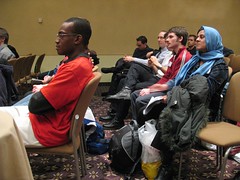
Audience
Originally uploaded by sfllaw.
There's less than a week before Montr al's next little technology un-conference. DemoCamp Montreal 1 (Fran ais) follows in the footsteps of Toronto's DemoCamp, bringing neat demonstrations to the spotlight. What is DemoCamp? It's a mini-conference where you show up and get to see people present the cool things that they're doing. Be it some software they wrote, a robot they built, or even a live tutorial, there's always something interesting happening. And you need to know. All you have to do is show up. We'll be at the Societ des arts technologiques which has been cool enough to donate their space for us. Just show up on Tuesday 27 February 2007 at 18:30, after putting your name down on the registration list. Don't be shy, it's free! Demonstrations are short, sweet, and PowerPoint slides are forbidden. You get to actually see something happen, which is a much more exciting than your usual conference lecture. In addition, we'll hang out afterwards to shoot the breeze and discuss what we saw. I'll be there with my camera, helping my friends [info]gorbash_dragon and [info]peaceful_dragon run the show. Jonathan Kopanas, who went to Concordia, is coming up to introduce the presenters and Austin Hill is drumming up publicity. DemoCamp Montr al 1
Tuesday 27 February 2007
18:30 20:30
Societ des arts technologiques
1195 boul. St-Laurent
Free admission
( Sign up Upcoming.org Google Maps ) I'll see you there!

Evan Prodromou: 3 Vent se CCXV

I was up late last night upgrading Wikitravel from MediaWiki 1.8.3 to the new 1.9.3. It took a long while, since the 404-handler caching extension that I built for MediaWiki a couple of years ago (which keeps Wikitravel running on a single, albeit quite big, server) is pretty invasive, and a lot of things had changed with the way users and stuff worked, so I had a lot of hacking to do. But it's stable now, even if some watchlist stuff is a little funky. Doing major upgrades is a real bear for me, but I'm happy when it's over. tags:

Home people Maj had her final oral exam in her French class tonight, which left me and Amita June home alone to fend for ourselves. We had a lot of fun. First, I had to do the day's dishes (lunch and breakfast) that were sitting in the sink. I brought the footstool around to the sink from our laundry room, and she stood on it and helped me with the dishes. After I'd finished washing a dish, she'd carefully fill it up with water, dump it out, then put the dish in the dishrack next to her. Pretty good for 18 months old. That went so well that I moved the stool over to the kitchen table where I cut tofu and vegetables for dinner. I gave her pieces of pepper, cabbage, and carrot while I was working, and she nibbled on them a bit and then practiced chopping them... with the handle of her mother's toothbrush, which she'd stolen out of the bathroom earlier in the day. After dinner, we had a bath, then we read some books, and then she went to sleep on my shoulder while I walked around her room and sang, like she's been doing for the last 2 months. It was another good night. tags:

Soft launch We launched two new Wikitravel versions overnight, too: Catalan Wikitravel and Finnish Wikitravel. Catalan recently, uh, catalyzed from a blog post by Carme Pla . Readers and the Catalan-speaking community rallied to our Catalan Wikitravel Expedition and got the project rolling. I got the site set up last night and they've started translating key help, style manual and policy guidelines already. Mean, Finnish had been simmering on the back burner for a while, so we got it launched at the same time. My friend and colleague Jani Patokallio is a Finn and a longtime and well-respected Wikitraveller; I'm glad he's taking leadership of the project. Finns have such disproportionate contributions to Free Software and Free Culture; I'm glad to have that Freedom Powerhouse Country all working together on Wikitravel now. And, y'know, I'm going to totally rack up a ton of HugAFinn points off of this. Actually, now that I think of it, I have no idea if "Carme Pla" is a real name or even a plausible personal name in Catalan. It sounds like it to me, though. tags:

coComment A couple of months ago Don Marti recommended that I check out coComment, and I made a mental note and then forgot to follow up. But I started using the system a few days ago, and now I wonder how I ever lived without it. coComment is a Firefox plugin that keeps track of when you post a comment on a blog or some other comment-handling system. It then keeps track of the conversation that happens after you comment. I have a lot of standing keyword searches on Technorati and Google Blog Search, and if people are talking about a subject I'm interested in, I'll usually jump in and talk about it. But sometimes I'll go back months later and see that people asked me questions and continued the conversation without me. So coComment is exactly the kind of cross-the-Internet aggregation service I need. tags:

Sage Speaking of keeping up with blogs, I've realized in the last week that I've outgrown Live Bookmarks for following RSS feeds. Rather than going with a Web-based RSS reader like Google Reader or Bloglines, I opted instead for the in-browser reader, Sage. It's simple, it does what I need it to do, and it supports OPML so I can move my subscriptions somewhere else if something better comes along. Good piece of software. My best candidate for something better coming along? Probably if I get my Netvibes home page customized well enough to handle my 50-60 feeds. And maybe when Netvibes gets smart and becomes and OpenID identity provider (or at least figures out a way that you can log into your ID when you start a browser session). tags:

21 February 2007

Benjamin Mako Hill: Trademark Violation and Greater Evils

Biella Coleman recently mentioned counterfeit drugs in a blog post:
A pirated movie carries little consequence, except for that the movie industry may lose some cash flow. A fake Rolex purchased on the bustling streets of NYC saves you a lot of money (and robs you of a warranty). But counterfeit drugs, the consequences and stakes are at a whole other, more serious, order of things.
Biella's intentions in drawing the analogy are harmless -- people really do lose their lives because of fake drugs while rock-off movies and Rolexes are relatively harmless. However, her aside reminds me of the much less harmless, fair, and honest analogies drawn by Pat Choate in Hot Property who used examples like counterfeit drugs and dishonestly labeled aircraft parts to support a high protectionist position on IP. Because of the arguments made by people like Choate, I believe that there is a subtle danger in the type of analogy that Biella draws that I think we should try to guard against in the future. The danger lies in the fact that these comparisons tend to conflate at least two very different kinds of illegal activity. Trademark violations are illegal. So it selling drugs without approval from regulatory bodies. So is manslaughter and murder -- both terms used in the Times article Biella links to to describe the actions of drug counterfeiters. Laws in most countries already prohibit all of these things and offer increasingly harsh punishments for each action. In fact, selling unlicensed drugs and killing people is much more illegal than violating trademark and making knockoffs. And it should be. When someone commit IP violations in the process of committing much worse crimes, we should focus on highlighting, condemning, and punishing the much worse crime, not the IP violation which in comparison is almost inconsequential. The punishment for counterfeiting drugs may only be a slap on the wrist and that's probably an appropriate punishment for the counterfeiting component of the crime. The other worse crimes that the counterfeiter is also committing should be punished much more harshly. If, as the Dr. Reggi quoted in the Times article complains, "counterfeiting a medicine can be [only] a misdemeanor," we need stronger laws against selling unregulated drugs -- not stronger IP laws. If we confuse and compare bootleg movies and knock-off Rolexes with fake malaria or AIDS drugs, we're likely to come to the opposite conclusion. Our reactions to such situations should be, "People are killing people with fake drugs! We need stronger laws against killing people in these ways." They should not be "People are killing people with fake drugs! Interesting to note that they are also violating trademark laws like other counterfeiters." The former reaction will frame the discussion in a way that lets us treat the bad components of the crime more harshly and will not help IP high protectionists argue for stronger IP through a disingenuous process of guilt by association.

Martin F. Krafft: Why we have not yet released my Skycon presentation

On Sunday, I gave a talk at the 1st Skycon titled "Debian etch: does that itch scratch yet" (it's far less funny now than I thought it was when I came up with it). I think it was a well-received talk and from first feedback, it provided a doog overview of our situation with etch to those who don't follow the project very closely. I would especially like to thank Steve Langasek, Sam Hocevar, Frans Pop, Brian May, Anthony Towns, Theodore Ts'o, Thomas Viehmann. and the other folks of #debian-devel for their input during preparation. And a big shout to everyone who showed up to the talk itself, which included a bunch of the chaps who showed me a "craic" time during my five week stay in Limerick ("craic" is an Irish way to vent enthusiasm). As I've come to expect, my (not-so-)lovely IBM laptop hardlocked whenever I tried to switch on the external VGA port, be it via ACPI, /proc, or the BIOS, even after a reboot. I also could not get a Wifi association and did not have a USB key on me, so I started to get comfortable with the fact that I'd be doing the talk based off an older set of slides. Fortunately, just when I was about to start, I restored the ACPI registers to proper working order using a uswsusp suspend cycle (of all things; did you hear that, Matthew?), even though Cathal's USB stick and Dave's laptop came to my rescue. Thanks guys, even though I ended up using my own laptop, mostly because of Firefox's Autohide extension. The slides are online under the CC by-sa-nc 2.5 licence. The source is a reStructured Text document (and a bunch of images), which rst2s5 translated for use with the sweet S5 presentation system (S6? Haha). Last but not least, I would like to thank everyone at Skynet and especially Laura for organising this event. It was very fun and the selection of talks as well as the attendants ranked above the likes of such "important" events like LinuxTag. I hope there will be another Skycon next year! NP: Amorphis / Elegy Update: Thanks, h01ger for pointing out that Sun Java is not actually in main, but in non-free. Slides updated.

Gunnar Wolf: Back from [VAC]?

On January 13, I sent a mail to debian-private saying I'd be on a semi-vacation until around February 10 - And yes, for over a month I've basically not touched my packaging, and for around three months my general profile in Debian has been really low. I sent this message because the Institute I work at moved, and I got the task of taking care of everything related with electrons flows carrying information (namely, voice and data networks).
It's not that I'm really-really-back now - Work is still too absorbing, users still come too often to me expecting me to solve their problems. I can often try to do so on the data network, but I'm far from even having access to the voice equipment (I've done my hardest effort not to get such access, because that'd instantly turn me into the phone operator for life). However, for the first time in many weeks, today I had some quiet time, I catched up with some mailing lists, and... Well, I expect to work on my QA page.
Boy, team-maintainership rules! pkg-perl friends, thanks for saving me from the creepy bugs sometimes too often. I expect to pick up work I haven't even looked at since I committed to doing so with the pkg-ruby-extras team as well, specifically, getting mongrel in shape and into Debian, despite our deep differences with its author. This will make Rails roll smoother and faster in Debian. And of course, there is Debconf. After last year's burnout, I think I recovered - I'm not a core organizator anymore, but I'm back to work my way to Edimburgh ;-)
As for my local activities (Mexican Free Software conferences, meetings and people): Partly because so I decided and partly because so it happened, I've been off the hook with the local community since before Debconf 6. Before, because I was too busy to think about anything besides it, and after, because I was burnt out and somewhat bitter at several facts. I've been to few regional or local conferences, also because I knew that between last October and today I'd be too tied up at work. But last week we had both CONSOL and BarCamp Mexico. Somehow I managed to be at both (well, at CONSOL I was only enough time to do my two talks, for which I miraculously managed to get prepared, and BarCamp was during the weekend). Both were very positive for me, and I'm willing again to find some time to devote to promoting and developing Free Software in our country.
Oh! One more note: Thanks to Sergio Mendoza for pushing me and for co-discussing on the subject, we are getting small but tangible results pointing to a Debian-UNAM project. Not much to see yet, besides having received the domain authority, which for now just means a nicer name for Nisamox, Mexico's main (and only long-running) full Debian mirror.

19 February 2007

Steve McIntyre: Again! Again!

I've decided to stand for DPL again this year. After (most of) a year of helping AJ as his 2IC, I've seen more of what the job entails and I still think I can do it well. But again, I'll be happy to continue working on Debian regardless of who wins the election in a few weeks time. May the best (or at least most popular - *grin*) DD win!

Evan Prodromou: 30 Pluvi se CCXV

Congratulations are in order to my friend Nicolas Ritoux. He's upgraded Hysterie to use a CMS and CSS. Hysterie is a venerable online magazine here in Quebec, and Niko's converted the site (formerly hand-coded in HTML) to use SPIP, a clever little CMS which seems to be working nicely for him. I think the principal reason he chose it was that it was made in France, however. Anyways, I know he's been working hard on it, since he wanted the site to match pixel-perfect with the hand-coded, table-based, old style. I'm glad he's done; it looks really good. tags:

FreeYourID.com I was pretty psyched to see on Scott Kveton's blog the story about the free OpenIDs from the .name registry. Apparently the FreeYourID.com site gives you a free 90-day trial of a .name registered domain, which you can use as an OpenID. I've been using my .name domain as my OpenID for quite some time. I think they're pretty cool. tags:

Read receipts I've been having a lot of trouble with email lately. There's been such a flood of stock fraud spam that many of my outgoing emails get caught in other people's spam traps, or lost in the crowd of UCE. I've started requesting read receipts on email that I send to individuals (not mailing lists). It's a simple way for me to make sure that email is getting through to people. I actually like read receipts a lot; I hate writing "I have received your message" messages, and read receipts are a quick and easy alternative. There are some folks who don't like read receipts, and that's fine; they'll just have to put up with me asking through other channels if they got my email. tags:

Andrew McMillan: Unexpected interaction between kernel config options

There was an interesting read the other week on LKML where someone or other was trying to say that no kernel config options should be hidden, and any that are should be turned into options that are linked, so that you can "see what you are doing". At the time Linus posted an excellent rant straight back, saying that more options should be hidden, and that the knobs and twiddles that people see should be obvious. I thought at the time that Linus response on this was extremely appropriate, but I didn't expect to be bitten by the opposite approach quite so immediately! I have been trying to build 2.6.20 for the last few days and wondering where in hell has the "Software Suspend" option gone. Well, today I found out that if you disable "Hot Pluggable CPUs" the option will never appear. If Linus has his way this problem would not happen, because the two knobs that people might want to twiddle, which appear superficially unrelated would actually have three settings in truth: The first setting would be a user-selectable knob, which would ensure that CONFIG_HOTPLUG_CPU was enabled, regardless of the state of software suspend. The last one would ensure that CONFIG_HOTPLUG_CPU and CONFIG_SOFTWARE_SUSPEND were enabled. The current approach is that iff I enable software suspend, then the hotplug CPU option disappears, and OTOH if I disable hotplug CPUs the software suspend option disappears. What I did was to start with a clean, unconfigured 2.6.20 kernel and go through all of the options starting at the top, which is something I tend to do with new hardware. The idea of hot plug CPUs seemed like something I didn't need, so I disabled it. With Linus' approach I would then have enabled Software Suspend a couple of minutes later, and the hidden config option would have been re-enabled behind the scenes. With the way things are at present, I built a good number of kernels and went through quite a bit of hardware blaming before I grepped .Kconfig for SUSPEND and found out what had happened, and which option I needed to enable. It is nice to know that their is such deep sanity at the heart of the kernel development process! Hopefully someone in a position to do so will notice this particular little gotcha and fix it soon, or perhaps someone wanting an "in" to start kernel hacking could go through the kernel configuration and clean up such gotchas. It certainly seems to me that Linus would accept patches for this as being rational.

18 February 2007

Evan Prodromou: 28 Pluvi se CCXV

Ugh. I have some blogging catching-up to do, which I'm going to try to take at a fast clip. I tend to get bogged down in the daily details, which can make getting my info down electronically kind of difficult.

Trip to New York City Maj, Amita June and I drove down through upstate New York for LinuxWorld OpenSolutions Summit. It was a good drive -- really pretty going through the Adirondacks in winter. There were icicles hanging dozens of meters from stone cliffs -- really dramatic. We spent Tuesday night with our friends Jen Bohner and Massoud Marzban. Jen is a friend of mine from high school, and Massoud is her husband. They live in Sunnyside, Queens now, after a year stint here in Montreal just before Amita was born. We miss having them around here, but they seem to have settled in well in NYC. Jen is working way too hard on a master's of education while teaching 5 classes during the day in New York public schools. Despite this, they found time to make us a great dinner, open a bottle of wine, and spend the evening chatting. Really decent people. tags:

LWOSS The next morning, Valentine's Day, I got up early to go into Manhattan for LWOSS. I called for a car service that Jen and Massoud use, but they failed to show up, and when I called back they hung up on me. Deborah's Car Service, there. Make sure to miss them if you're in the area. Anyways, I managed to flag down a cab and get into Manhattan anyways. It wasn't too much fun -- there'd been a big snowstorm the night before, and traffic was gnarled and bitter. Still, I got to the event hotel -- the New York Marriott Marquis on Times Square, got checked in, and registered for the event just fine. The keynote speaker was security expert Bruce Schneier, who gave an extremely insightful talk about economic laws as they apply to computer security. It was very interesting, if hard to follow at times -- it's not always easy to keep economic theories and security practices juggling in your brain at the same time. I met up with Don Marti, who'd invited me to participate at LWOSS, in the speakers' lounge. He had assembled a great team of interesting people who know a lot about Linux and Open Source: John Mark Walker, Jeremy Allison and Jerry Carter of the Samba project, and Jeremy Garcia of LinuxQuestions. Sadly, the snowstorm had canceled the flights of two more participants, Donald Becker and Sascha Chua. (Those weren't the only two people who couldn't come because of the flying problems. I overheard dozens of conversations on cell phones of people whose colleagues couldn't make it for the show. In retrospect, it's pretty surprising that we had the event at all. Schools and businesses were closed all across New York on the 14th and 15th.) Don's plan was simple: to hold an "unconference" at the heart of the conference. We took a section of the showroom floor, set up some chairs and a big monitor for demoing, plus a whiteboard, and just started some interesting conversations. I talked about Web APIs, since I wrote an article on Web APIs for LinuxWorld.com in December. Other people talked about their own projects, about Linux distros, about tools in the Open Source toolkit, about the process itself, and all kinds of things. It was really fun and productive. (I'm realizing now that I should put Don in touch with Ted Ernst, who's been instrumental in organizing three of the Open Space events I went to in the last year. It would be really interesting to have an Open Space event the day before or after the main conference... making mental note, here.) Otherwise, the event was really pretty good. I talked a lot with Jeremy Garcia, who started using MediaWiki about the same time we started using it for Wikitravel. LQ is a really great project, and a nice mix of different community platforms. I managed to luck into an LQ t-shirt, which I'll wear proudly. The other big news, for me, was getting a loaner Nokia N800 to use during the event. The N800 is an Internet tablet, about the size of a cell phone, but without phone features. I liked it so much that I asked the Nokia team to loan me the device for a long-term review, and they agreed. So I took it home with me. Meanwhile, Maj and Amita June had a nice time tooling around New York. They went to the American Museum of Natural History on Thursday, which was pretty great -- Amita loved looking at the animals. We had dinner on Wednesday at a pub off of Times Square called The Perfect Pint -- although the food was a little more upscale than pubby. Thursday night we got a babysitter through the hotel and had drinks at the Broadway Bar (in the hotel) and dinner at The View (also in the hotel). The View is a rotating restaurant at the top of the Marriott Marquis -- pretty fun to do. tags:

UbuCon On Friday, I went to the Google HQ in Manhattan for TheUbucon, another (!) unconference, this time about Ubuntu and the people who love it. I got to hear Mako talk about the Ubuntu community process, how it works, and how to get involved. It was pretty impressive. I also did some key-signings and talked to a lot of interesting people. Including Kevin Mark, who had lots of comments on my blog. Hi, Kevin! I had to take off just as the event was getting started, to go pick up Maj and Amita June at the hotel and check out. We took a cab back to Queens, where we'd stashed the car so we didn't have pay outrageous Manhattan parking fees. Sadly, someone had taken the opportunity to key our paint job. I love you back, New York. tags:

Drive home I wanted to drive back through Connecticut, Massachusetts and Vermont on the way back, for variety, so we turned east and headed up through Westchester County. It turned out to be a real mistake -- traffic on a Friday afternoon out of New York is apparently pretty miserable. We took 4 hours to get to Hartford, by which time the baby was miserable and the rest of us were feeling pretty punked out, too. We ended up in the Motel 6 in Enfield (Connecticut) where we ordered pizza, took showers, and just got our heads back together. Today we got up early and had a nice drive through Western Mass and Vermont. The little northern New England towns were pretty beautiful in the snow, and we passed a lot of barns and farmhouses that looked like movie sets. We stopped in Burlington for lunch, and had a leisurely drive over the border and back home. When we got to our house, I had to shovel drifted snow -- about 3-4 feet deep -- out of our parking space so I can pull the car in. But otherwise the house is in good order. I'm glad to be back. tags:

17 February 2007

Dirk Eddelbuettel: Dianne Reeves

We saw Dianne Reeves (wikipedia) earlier at the CSO. Looking the what I wrote in 2003 in one of the earliest entries here, I notice that she is touring with the same (excellent) band composed of Peter Martin (acoustic and electric piano), Reuben Rogers (acoustic and electric bass) and Greg Hutchinson on drums. This may explain some of the coherence on stage... Anyway, wonderful concert, wonderful artist and definitely highly recommended as a live performer.

16 February 2007

Eddy Petrișor: n?gettext usuall assumptions and problems

For those who care about i18n and especially to those that don't care, a mail that I wrote to the Wormux-dev mailing list might provide some insight on the regular issues that plague badly i18n-ed applications.

This is mostly not developers' fault, but the fact that many don't know the real capabilities of gettext.

The post is here.

Erich Schubert: What does your payphone run?

A few days ago, at the main train station in Munich, subway level: 'Crashed' payphone Windowmaker dock on payphone At least this series of payphones (there are different models with a touch screen in working height or with a camera) runs some form of Unix: they run WindowMaker which is only available for X11 as far as I know. (I don't know if it's Linux or some BSD; and most likely the display component is a separate system from the actual phone. Note that some payphones at least in Berlin may also be equipped with a wireless access point running Linux, that could be even another system in the same payphone.) Still it's amazing to see where Linux is today. Have a wireless router? Have a DSL modem (e.g. AVM Fritz)? Payphone? Bottle deposit machines (e.g. ALDI)? next generation of mobile phones? - Linux is just about everywhere where people are not exposed to the mouse. :-) [Update: Daniel sent me an older picture of the phone display booting, it looks like being a SuSE. Funny (though not surprising) to see that the display is run non-rotated during boot (regular VGA), and when the driver is loaded it turns to the Portrait view.]

15 February 2007

Pete Nuttall: Free Tshirt

Ages ago, I entered the IBM Mainframe contest. As with many things, I never got as far as I would like due to work presure, but today I got a free t-shirt and Certificate from them. Thanks!. As a random aside, why have tech companies started giving out white t-shirts? I can't really wash them, since I don't have that much white clothing. There is also the problem that the other one I have is from google and has "I'm feeling lucky" on the back, which I regard as the same as giving God the finger...

Thijs Kinkhorst: AB+

Yesterday I've made my 38th blood donation. I can heartily recommend it to (almost) everyone. Especially if you are a "simple" full blood donor, it will take at most half an hour, a couple of times a year, at a moment you choose within a two-week interval. Oh, it doesn't really hurt and you get free coffee and sandwiches. If you're in the Netherlands, you can register on line. I think it's an easy way to do some good for society. I'm not a full blood but a plasma donor myself. I have the most rare blood type (AB), which means I can receive all other types but my blood can only be given to the 3% of the population that also has AB. That makes it not quite useful for donation, but it is useful to make medicine out of. During the donation the blood is filtered and only the plasma is kept, all other parts are pumped back into my circulation. This allows for a larger volume of plasma to be donated at a time, but has as a drawback that it needs an appointment and takes longer. The most commonly asked question is whether you get paid. You're not. The reasoning is that this could motivate people to be a bit too positive about their health situation when they need money, and thus could hold back relevant risk information. The selection procedure depends on a reduction of chances. This also leads to homosexuals being completely excluded from donations. While sound from a purely statistical reasoning, it is debatable whether this is fair on an individual level.

Joey Hess: wikis out of disk

Today wiki.debian.org was briefly running on a full disk, and this MoinMoin based wiki failed pretty spectacularly: We're used to some unix programs not dealing with being out of disk space very well. But IMHO wikis should be in the same class as package management systems, revision control systems, or databases: running out of disk should be something they handle gracefully without data loss and with graceful degredation when possible. Course I wrote a wiki engine too, and it didn't fare much better. Possibly worse, although I tested it much harder than MoinMoin: Of course I've fixed all these problems, and it seems quite robust now on randomly failing disks. If a page edit fails, it will go as far as to bring you back to the edit form and let you try again. I'm interested in how well other wiki engines stack up.. Also, if anyone has some hints for good ways to write regression tests involving full disks, I haven't found an approach I like yet.

Andrew Stribblehill: Words and punctuation

I don’t generally post whilst annoyed — which could explain why my postings are generally of a whimsical nature and (hint hint) don’t get enough comments. However, this post is different. I am angry that people see fit to write things for public consumption or wide dissemination when they obviously have little regard for the language in which they are writing. As a general principle, if you don’t know the right spelling, punctuation or grammar, ask someone who does know! People who don’t know where apostrophes belong: this means you! Another hint: the word “momentary” does not mean, “in a moment”. It means “for a moment”. Big difference. If “the power will resume momentarily”, I’m going to unplug my delicate electronics. If it will resume shortly I will cheer and lo! there will be great rejoicing.

Jordi Mallach: Tunisia

Last month, Bel n and I managed to secure our trip to Tunisia on the very last moment. So, planning trips on the very last moment isn't nothing new around this place, but we made a big effort to take things to the limit. I can't remember why exactly, but on January 31 we were *so* close to fucking everything up before it started, when we packed our stuff just a pair of hours before having to leave to the train station. My luggage was prepared in a rush, so while I think I took everything I thought I'd need, I didn't really select my clothes too much. The idea was to have our suitcases mostly empty to bring back stuff from the markets: smoking cachimbas, lamps, leather stuff, etc. At that time I didn't know that would end up being a great strategy. Anyway, like 9 minutes before the train's departure we were stuck in Nuevo Centro without a taxi and at that point I really had lost hope about being on time. For some reason, there were no taxis in the area, when it's normally a place where there's tons of them. Suddenly one appeared, we rushed in and I asked the taxi driver to please fly to the station. Happily, we got an incredible green wave around the avenues, he drove us at like 80 Km/h and we even had to wait for a few minutes at the station. In Barcelona, we prepared our small New Year's Eve dinner with my cousin Laia and Marc, and while the plan was to go to sleep pretty early to be in good shape to go to the airport next morning, the bottles of wine and cava emptied quite fast, and around 4:30 we were quite drunk when we decided it was enough. When some annoying sound woke us up next morning, it was really late, so we again rushed out to the empty streets of Barcelona, sneaked into a regional train, without knowing it was the only way to get in time in El Prat airport, and after some initial confusion trying to find the travel's agency desk in the wrong terminal, we managed to check into our flight, being the very last to do so. With all the rush, I couldn't get some clothes from my suitcase transfered into my hand luggage, which I really wanted to do after my nice lost luggage experience during Debconf 5 in Helsinki. Anyway, chances are small that your luggage gets lost, right? But of course, Murphy is always vigilant, and this was a great opportunity to fuck me up. After a short but horrible (due to our really bad hangover) to Tunis/Carthage airport, we were in the long security/passport check. When Bel n picked up her bag and mine didn't appear, I tried to tell myself hey, it'll appear, no worries! . After 15 minutes, the stupid suitcase was nowhere to be found. Apparently, another two pieces of luggage had the same luck, which made us contact a group of four Uruguayans who were missing one of them. Nothing too terrible; it'll surely come on tomorrow's flight. After reclaiming our lost luggage, we went out to the parking where a bus was waiting for us, and on the way there, the six of us nearly fell into the first Tunisian scam, involving a dude selling jasmine flowers at 2 each. The bus took us down to Jasmine Hammamet, the most touristic place in Tunisia. Valencians might have an easy imagining the atrocity of the area by picturing what twice Marina d'Or plus Benidorm including Terra M tica would look like. Kilometres and kilometres of a disgusting Who can build the most horrible giant hotel right next to the beach contest. So it was pretty clear we had to spend as little time as possible in the area. We soon learned about how transport works in Tunisia. The cheapest is to use the public busses and the luagge collective taxis, we soon found out. Our first morning there, our guide Rejeb, working for Iberojet and Solplan touroperators, gave a talk where he advised us against travelling alone, specially around the South, while he offered organised trips around the country for every day of the week. Although we expected this danger! speech, we decided to book the two day trip to the South and Great South of the country, basically because it was the best way to see many places in a short time, even if it meant having limited time in each destination. We wandered around Jasmine Hammamet and discovered Carthage Land, sort of a Disneyland set in the age of Anibal and Carthage's empire, which was inside a newly built medina complex. This was a really bad place to practice the art of haggling, as the place was so desert, merchants really tried hard to get you buy something. Again, we were close to fucking up after our first negotiation, but we finally decided we weren't so interested. Lucky, we later found out the price was outrageous. Sadly, we spent way too much time in that tourist trap, and we found it was too late to go to the real Hammamet town to see a real medina and real stuff, so we had a long walk around the immense beach until sunset. On Wednesday, we did organise a bit with the Uruguayans and some others we had met: Mar a and Santi Kuchi Kuchy , Cristina and Pedro and an Argentinian family, and managed to hire a van driver to drive us all over the North. For quite a good price, we were taken to a few ruin sites in Carthago, now mostly a residential area, and it was really impressive. While the condition of many of the remainings is not optimal, it was exciting to see things which had been built by Phoenicians and Romans 2,000 years ago. I really enjoyed the remainings of the Antonine thermal baths of the city. It had been a huge building right next to the sea; one of the standing columns helps figuring out how big it had been. Right next to this site, the Presidential Palace dominated the whole gulf. Military places are treated zealously in Tunisia, and it is against the law to take pictures of any bit of it, not even a barbwire of the fence. The Palace had a great Tunisian flag waving over it, and many signs advised you against taking pictures in that direction. I couldn't resist.


The ruins of the Roman Antonine Baths After Carthage, we went to Sidi Bou Said, a small touristic town, which had the peculiarity and beauty of having all windows and doors painted in a beautiful light blue colour. Our last stop for the day was in Tunis, where we visited the most amazing medina of the whole week. Unlike the new medina in Jasmine Hammamet, this one was literally packed with people going up and down the maze of very narrow streets. Every few metres you'd come across a new, attractive smell coming from the few salons de th or spice, leather or perfume shops. Here we finally started developing our haggling skills, and managed to get a few items for reasonable amounts.


Streets of Sidi Bou Said Back at our hotel, everyone tried to get a quick dinner and go early to bed, as next morning we were taking a bus for our trip around the South. There was time to call yet another time to the Airport, to find out that one of the luggage pieces had been found. While there was no news about my suitcase, we shared a taxi to the airport to pick the found suitcase, and see if mine was actually there by any chance. Unluckily, it wasn't, so I wouldn't have any clothes for the desert visit. Some people in the group were kind enough to lend me some t-shirts and pants. For my underwear, I actually resorted to using some of Bel n's (no kidding, it was way too sexy :P), while mine dried up after some manual washing. The alarm clock went off at 5:15 or so, and soon after we were ready in the hall with our small bags. When the bus was ready to pick us up, the guide said we weren't allowed in, as we weren't on the list. WTF? We were nearly the first ones to book and pay for it! So he finally let us in, for a short while, until he realised there was no space for everyone, so he demanded that we got off. Of course, we didn't, and a long and very disgusting argument started between the guide, us and a few people who had seen us pay for our trip, and were trying to support us. To make a long story short, we ended up stepping down when I noticed the bus driver calling the police, and after Rejeb, our guide, told us the other bus would be waiting for us at the travel agency if we quickly took a taxi there. We of course knew that was a fantasy to get the bus moving, but dealing with the police at 6:30AM wasn't on my list of activities for the day, so we finally gave up to let the rest of the people get in time to their visits, as they were very tightly scheduled to make everything fit in two days. Nobody was waiting for us at the travel agency, but we were promised our money back, which did happen in the evening; our plans for Thursday and Friday were a bit broken though, and the rest of the morning was spent looking for alternatives. When we had managed to book a new trip in a different agency for Saturday, we took the bus to Nabeul, the capital of the province, well known for their medina specialised in pottery. In Nabeul, we lived a tourist trap which I found to be quite original. Not having walked 3 metres into the city walls, some young dude stops us and tells us that he knows us, as he works in the restaurant of our hotel . I totally didn't remember his face at all, but why not? So he quickly tells us Nabeul has good carpet workshops, and her sister is working in one which is regulated by the Government, and you can only visit two days a week. Coincidentally, Thursday is one of them! So he literally grabs us by the arm and takes us to one of the streets perpendicular to the main market street, and we enter a carpet shop. To the right, his sister probably being like 45 years older, is knitting a nice carpet on the loom. And a few seconds after, we're taken upstairs, where a Teletienda show starts before us. Without being asked if we want to buy a carpet, some other dude starts to unroll carpets and more carpets before us, talking in some very basic Spanish. While we're offered jasmine tea, which is really nice, Ali the brother quickly excuses himself and vanishes, leaving us with the salesman, which continues unrolling more and more before us, now helped by someone else. When 10 minutes later we convince them that we won't buy any carpet, he asks a donative for his young employee, who has unrolled and will now roll back a zillion carpets. Back in the hotel, we have dinner with a pair of Catalans from our flight, and when we tell us about the carpet place, they tell us they went over the same story like one hour before us! On Friday, we got some advice on other places to visit, and decided to go up to Cape Bon and visit Kerkuan, the only important remainings of a Punic city which, when conquered by the Romans, was destroyed to the grounds, but not rebuilt on top (they were busy with Carthage). Romans did an excellent job when destroying cities, and the result is a site which still lets you see perfectly how a small town (around 1,500) looked like 2,000 years ago.


Ruins of a Kerkuan neighbourhood, with their red bathrooms nearly intact To reach Kerkuan we had taken the bus up to Nabeul and then our first luagge to Kelibia, where we took a taxi (after no less than half an hour arguing in French with the taxi driver to settle on a rate for a ride to Kerkuan and then to the tip of the Cape in El Haouaria. Luagges are undoubtedly the best way to travel medium distances for very little money, while getting mixed with locals. During our ride up North, we chatted with a nursing student from Kelibia who was going back to her town for the weekend. She was really open, like most of the people we found in Tunisia, and we ended up exchanging our post addresses; we still need to send her a postcard from Val ncia soonish. This area wasn't so touristic, so the roads, while totally acceptable, weren't as good as the highway from Tunis to Sfax we were used to. We had seen some bits of the local driving skills , but the luagge driver performed some of the most extreme overtakings I've ever seen. These happened every three of four minutes, so after a while I was actually amused about what was going on. We would overtake two lorries on one go when there was absolutely no visibility; if things went too far, people would just slow down to let the overtaker get back into his lane on time, and those coming ahead would just use their headlamps to make them know it was just a bit too close. The taxi driver, annoyed at us, took us to Kerkuan but didn't wait for us; he immediately left, leaving us without any transportation in the middle of nowhere. After a visit at the site, we walked around 2.5 kilometres back to the main road, where we decided it was too late and risky to continue the journey up to El Haouaria, so we waited on the road gutter for a taxi. The first one which stopped was, to our surprise, the same bastard who left us one hour before, who stopped, laughing at us a little. Luckily some other taxi came by in the correct direction, and soon forgot about that man. After a taxi, luagge and bus ride, we were back in Hammamet, and the desert group had already got back from the two day trip. We were asked over and over what happened, what did we do, etc. People who hadn't talked to us before would come over and see; we were really surprised about the warm welcome we had. After dinner, we improvised a customes party, and many people managed to dress up in Tunisian/arabic fashions using bed sheets and so on. We had to wake up at 5AM next morning, but didn't go to bed until 2AM. Nothing could go wrong this time. We had our tickets, we had confirmed we would be going on Sunday the night before, so at 6:15, our new guide came in, and came straight towards me. He said something in German, and after I told him I spoke absolutely no German, he said huh, well you know the bus is full of Germans, and my indications will be in German? . Pretty incredible, but again a fuckup by the agency. My ticket said, clearly: Sahara safari. Bus + 4x4. (ALL). Turns out ALL meant Allemand, not everything included , although we had requested English pretty clearly. This was quite a minor problem though, after having no clothes for a whole week and having been left behind two days before. I think we were really lucky getting that German group, though. We were only 16 people on the minibus, making the stops a lot faster than the normal ones, where 55 persons need to get out and in of the bus. We had our own Routard guide for Tunisia, so we could read about the places we were about to visit before getting ther. Also, I surprisingly knew much of what our guide was talking about, just missing the details he talked about oil production in Tunisia compared to Spain's, among other topics . When the landscape was becoming drier and drier, Bel n and I spotted something dark far away ahead in the completely straight road. As it became bigger, I started thinking it might be the #1 place to visit for me in Tunisia: El Djem's impressive Roman amphitheatre. When we got off the bus, I was totally excited. Before me, the walls of an incredibly well preserved, huge Roman building; in fact, the best Roman ruins in the whole continent. El Djem's amphitheatre was the third biggest of the Roman empire with 35,000 seats, only surpased by Rome's and Capua's. It remained mostly intact until the 17th century, when some of its stones were used to build the city and some of the treasures taken to the Great Mosque of Kairouan, but when it took more damage was during two consequent wars, when the Turks didn't have many problems to blow part of the wall away using cannons to end up a siege of the city.


The Roman amphitheatre of El Djem The underground tunnels are intact, and it's difficult to not have flashes of Gladiator while walking under the arena's trapdoors. Sadly, there was little time to spend there, and we had to continue the journey after just 45 minutes. I would have spent half of the day there. From here, the landscape truly started to get drier and more desertic. The south of Tunisia is a giant olive field, until you reach the Great South, where it's dry enough that the only thing that grows in the land are rocks. Hours later we arrived in Matm ta, the very famous troglodyte village of small holes in the ground. Although I was curious about being there, watching how organised and massive tourism has destroyed these Berber's ways of life dissapointed me greatly. Our guide stopped the bus in one of the pits, which was decorated with white and light blue. In the first room, an old woman was grinding something in a small, stone mill. The dwellers of the few pits still used by their original inhabitants now make a living by letting people into their homes and getting dinar as a payment for taking photographs. What the woman was doing was just a bit of theatre, part of the show. After this first room, we got into the middle of the pit, which had a series of other passages to some rooms, some of which were simply open so we could get in and have a look. I felt a little bit like violating someone's privacy, and wondered how much the house had changed in the last years.


Inside a troglodyte underground house in Matm ta After our visit, we continued up the mountains of Matm ta, and after going by a giant "WELCOME TO MATMATA" sign drawn in white in the middle of a mountain, Hollywood style (!), we stopped for a brief photo-stop (sic). Indeed, the view was quite impressive, and is universally famous as one of the filming spots of Tatoonie scenes in Star Wars: A New Hope. Speaking of famous places, a few minutes later we stopped at the top of one of the hills, were we'd have lunch in the Hotel Sidi Driss, a place of pilgrimage for Star Wars fans, as it was the troglodyte pit which served as the Skywalker's home. The place is full of references to the film saga, and one of the open pits is full of set pieces stuck into the walls. We were served couscous, which wasn't bad, but was cooked and served in the most genuine fast-food fashion. Everyone there gets couscous to eat, apparently, and it's the same in many other touristic places in the area.


Matm ta's lunar landscape From here, our journey headed straight West, in the middle of the rocky desert, until after some time, you could start to see lines of palm tree branches planted here and there, a sign that rocks would soon disappear, being replaced by sand and dunes. As when we were approaching El Djem, at some point a huge, dark spot appeared on the horizon. Douz, probably named after some 12th French batallion which stayed there, is a small town in the very limit of the Sahara desert, built right next to a huge oasis, exclusively dedicated to palm tree plantations, making dates production a big source of income, along with, of course tourism. The travel agencies use Douz as the starting point for several-day trips into the desert, camel rides and stuff like this. Our guide offered us getting a camel and carriage ride in Tozeus for 20 dinar, but Bel n and I declined. He didn't seem to be too happy about it, and had no problem commenting this in German and Arab with the driver (Spanisch and Spanien were clear to me). We learned that the agency (or the guide) makes around 3 Dinar for everyone who contracts the camel rides, after speaking to one native young kid who worked in the camel place. While our German trip mates got dressed in berber fashion, we opted to walk into the desert and play around in the sand on our own. I discovered a few desert insects which were unlike anything I've seen anywhere, and their diminute trails were all over the dunes. Looking West, the view was astonishing, with only thousands of kilometres of yellow dunes ahead us.


The evening sun over the dunes After they came back, we were taken to our hotel, which was really impressive. After leaving our stuff in our room, we headed back to the desert, which was like 300 metres away, to see the sunset over the Great Dune . There's a street which literally serves as the frontier between the rocky ground and the sand desert. From there, you could see many lines of palm tree branches, which are planted by locals in a futile attempt to stop the inexorable advance of the desert. Women in Douz and other towns in the desert limit spend their days sweeping the entrances to their homes, as sand gets in really fast. A small village next to Douz even had to be abandoned and rebuilt in some other place, with the old one being finally devoured by the dunes. When it got dark, we still had some time to kill before dinner, and we discovered a hammam in our hotel. I got in, and saw there was a bored young man inside. He informed us about the prices, and after some short deliberation, we realised we'd spent half of the camel money in some Arab relaxation; while I got a really cool massage, Bel n enjoyed a Turkish bath. I spoke to the guy for a while, and he said not that many people used that hammam. He actually handed the list of services since 2002, which easily fitted in one piece of paper. People don't know what they are missing; he explained that most of the hotel's clients just showed no interest in the baths. I wonder how Fins or Norwegians would react, given their sauna culture. The dinner and breakfast in that hotel was absolutely awesome, and I actually ate too much to have an easy sleep. Next morning we had to be ready at 5:30. That's pushing my limits. The bus started crossing the Chott Jerid when it was still quite dark. The chotts are dry, salt lakes in the middle of the desert, which during some seasons do get some water, sometimes from the underground. The Chott Jerid is the biggest of the three chotts in the area, and the views are fantastic. It's like a giant, totally flat muddy sea which reflects light creating dangerous mirages of oasis-like dark patterns. Before the construction of the recent road that links Douz and Tozeur, crossing the chott was so risky that many people died in the attempt. We had the unique opportunity to see the sun rise over the salty horizon.


Sunrise at the Chott Jerid Again, on our way to Tozeur, we were offered a carriage ride for ten dinar, and again we declined. The guide then asked us if we had no money or what. So in Tozeur we basically wanted to walk around the oasis fields, and ended up talking most of the time with some old man who sold drums and desert roses. On a 4x4, we went up North to Chebika, a really cool town with a small oasis of thermal water, which I guess was around 40 C. The short walk to the wall where the oasis surfaced was packed with children who insistently begged for money or offered necklaces and other items. It was difficult to make them understand you didn't want anything. We then went up the mountain behind Chebika through a road which had its own piece of history. It seems that during WWII, Rommel suffered an Allied siege in Chebika, with a range of mountains behind their backs. The Allies gave him one month to surrender, and he took his time to answer. During that time, he ordered his engineers to design and build a road which would let them escape Chebika through the steep mountains, and they managed. When the ultimatum expired, the Allies apparently found out Chebika had been abandoned by the Germans, including tanks and most of their equipment. So, on the way up, a few kilometres away from the Algerian border, there was another typical visit to the biggest oasis waterfall in Tunisia, which was several metres high.


The oasis at Chebika Our Sahara trip would soon end, and after lunch we headed Northeast on our way to Hammamet. On our way back, we stopped in Kairouan, one of the key Islam pilgrimace spots, with the Great Mosque as the biggest attraction. Unluckily, as we arrived after lunch, we didn't had a chance to see it. Apparently it is really impressive. We haggled a bit for a pair of babouches and a small leather couch in the medina. We came back to our hotel around 7, and found most of the people around the hall. After the obligatory update on how it went, we went to bed as we were exhausted, and of course we had to get up really early to head to the airport. The airport was at that early time of the morning a total chaos, and while people stood in the checkin lines, I tried to find out what was going on with my still lost luggage. I went back to the lost luggage window, which would be closed for 5 more minutes. When they finally opened, they told me once again they had no clue about what was going on with my luggage. I finally understood they had no clue: my tracking number wasn't in their database. I asked them if I could have a look at the unreclaimed luggage storage room. They kindly opened a small door for me, and invited me to go inside and have a look. The view was gross: hundreds of lost bags all over the place. As I was in a bit of a hurry (I actually had to get back to Barcelona), I asked him where to find the bags of one week ago, and he nearly bursted into laugher. Okay, I had to look all over the place, scanning every piece of luggage in an attempt to spot mine. There were bags of absolutely every type in there. In one of the corridors, I sensed a disgusting smell, and figured out some poor guy may have food or something in one of their lost bags, which was rotting in that horrible room. So wrong: soon after I found myself nearly stepping on a puddle of shit, as if someone had literally dumped it right there. Oh my... luckily my search was nearly over and unsuccessful, and I got back to Barcelona with the hope of finding my bag in El Prat. After looking in their two storage rooms I realised I'd probably not see the luggage again, which is a real pain in the ass. A few hours of train later we were back in Val ncia, with a feeling of having spent 3 or 4 weeks in Tunisia, not just 8 days. Really a great place to visit, not only for their cultural treasures, both current and ancient, but for the openness of their people. I hope I'll be back at some point!

Erich Schubert: iCalendar is broken by design

Seriously, RFC2445 is on crack. No wonder that few apps handle recurrence rules properly. Let me give you some examples straight from the RFC:
RRULE:FREQ=YEARLY;INTERVAL=2;BYMONTH=1; BYDAY=SU;BYHOUR=8,9;BYMINUTE=30
These are tons of events: at 8:30 and 9:30 every other year, every sunday in january. That's not precisely what I'd call a yearly frequency... I mean, we're talking about every sunday in januar. I'd more call that like... weekly. And yes, this is the official solution:
"every Sunday in January at 8:30 AM and 9:30 AM, every other year"
Note that you can not do 8:30 AM and 9:00 AM. You could do 8:00 AM, 8:30 AM, 9:00 AM and 9:30 AM (using BYMINUTE=0,30). Pure crack.
Everyday in January, for 3 years:
DTSTART;TZID=US-Eastern:19980101T090000 RRULE:FREQ=YEARLY;UNTIL=20000131T090000Z; BYMONTH=1;BYDAY=SU,MO,TU,WE,TH,FR,SA or RRULE:FREQ=DAILY;UNTIL=20000131T090000Z;BYMONTH=1 Isn't that totally on crack? Using FREQ=YEARLY for everyday in january? Notice how the semantics of "BYMONTH" change? In the first case, it's creating multiple events (BYMONTH=1,2 would name january and february independently); in the second case it's used to filter out individual days. Let me explain that a bit more: FREQ=YEARLY;BYDAY=MO,WE means every Monday and Wednesday. See how the modifier makes about 104 recurrences out of a single year? FREQ=HOURLY;BYDAY=MO,WE means every hour, but only on Monday or Wednesday. In this case, the modifier reduces the hourly events by throwing out all that are on other weekdays, reducing the number of recurrences. Again, this is not my weird reading, but the RFC says:
BYxxx rule parts for a period of time which is the same or greater than the frequency generally reduce or limit the number of occurrences of the recurrence generated. [...] BYxxx rule parts for a period of time less than the frequency generally increase or expand the number of occurrences of the recurrence.
(Note that I didn't find any details on if they consider a week to be be "less" or "more" than a month, since there is no obvious subset relationship, but a week can overlap two months, and a month usually overlaps five weeks... So if I have FREQ=WEEKLY;BYMONTH=1;BYDAY=WE, is that Monday in every week overlapping January? Every week completely contained in January? If I'd want every Monday in January, I'd use FREQ=DAILY;BYMONTH=1;BYDAY=MO...) Intersecting or joining two RRULE specifications is usually impossible (try to write one rule that is 8:00 and 9:30 every day for convincing yourself that a join won't work, and try to intersect FREQ=DAILY;INTERVAL=3 and FREQ=YEARLY;INTERVAL=2...) Anyway, I'm truly not suprised that my mobile and probably many other applications don't handle recurring events completely (that is when importing from iCal they often just lose the repetitions). My own implementation is doing okay. There are still a few missing features (BYSETPOS e.g. which can be used to say "the second to last tuesday or thursday each month"; should be trivial to add however, just picking the appropriate indexes out of a list), and some odd corner cases to dig in the specs and resolve (e.g. "every other week on friday, starting saturday march 3" - are we talking in business weeks, or intervals of 7 days here? When talking in weeks, is it friday in the week containing march 3, or following march 3, since that day itself is not a friday!) Some of these details probably vary heavily from iCalendar-supporting application to another... e.g. FREQ=DAILY;BYHOUR=8;UNTIL=20070215T000000Z does this include a recurrence on 2007/02/15 at 8:00 (which is past the UNTIL time, however the hour of the UNTIL field is not used in presence of BYHOUR). If you ever design a language for specifying recurrences, please: Consider something like (intersect (repeat daily interval=3) (union (repeat weekly monday) (repeat monthly 1) ) ) (i.e. every 3 days, if they fall on the first of the month or on a monday) Also spend some time thinking about alignment: "Every monday in a week containing the 15th of a month." - months and weeks are not aligned; assuming a week being defined as Monday-Sunday, this can be any day between the 9th and 15th of the month (in fact you could specify this in iCalendar, but it's probably easy to come up with an example that is too difficult to represent in iCalendar RRULEs, albeit trivial to calculate.)

14 February 2007

Bastian Venthur: DPL 2007, Current Candidates

For those who don’t follow -vote regularly, it seems like we have currently four official nominations for this year’s DPL vote: and two pending ones: A totally unrelated note: If you want to get really frustrated and angry but don’t feel like participating in Debian’s infamous flamefests — try to learn to juggle a 5 ball cascade. This will keep you busy for several months without getting on everybody’s (well, everybody but your neighbor’s) nerves. Update: Ooops, I forgot Wouter — thanks Alexander.

13 February 2007

Simon Huggins: Use a redirect, Luke.

Ingo, why don't you just redirect people to the new location redirecting feeds to their new location. That way on some aggregators like rawdog you'll just get the updated URLs all set with no manual adjustments at all. This post is also a hint that after deliberations I moved from planet to rawdog. It's neat and in Debian. Might have to try to write a plugin so I can read friend's livejournal posts with it too soon.

Next.

Previous.