Search Results: "ed"

18 May 2016

Stig Sandbeck Mathisen: Puppet 4 uploaded to Debian experimental

I ve uploaded puppet 4.4.2-1 to Debian experimental. Please test with caution, and expect sharp corners. This is a new major version of Puppet in Debian, with many new features and potentially breaking changes, as well as a big rewrite of the .deb packaging. Bug reports for src:puppet are very welcome. As previously described in #798636, the new package names are: Lots of hugs to the authors, keepers and maintainers of autopkgtest, debci, piuparts and ruby-serverspec for their software. They helped me figure out when I had reached good enough for experimental . Some notes: I sincerely hope someone finds this useful. :)

Jonathan McDowell: First steps with the ATtiny45

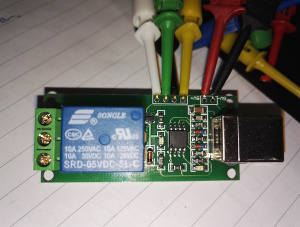
1 port USB Relay
These days the phrase embedded usually means no console (except, if you re lucky, console on a UART for debugging) and probably busybox for as much of userspace as you can get away with. You possibly have package management from OpenEmbedded or similar, though it might just be a horrible kludged together rootfs if someone hates you. Either way it s rare for it not to involve some sort of hardware and OS much more advanced than the 8 bit machines I started out programming on. That is, unless you re playing with Arduinos or other similar hardware. I m currently waiting on some ESP8266 dev boards to arrive, but even they re quite advanced, with wifi and a basic OS framework provided. A long time ago I meant to get around to playing with PICs but never managed to do so. What I realised recently was that I have a ready made USB relay board that is powered by an ATtiny45. First step was to figure out if there were suitable programming pins available, which turned out to be all brought out conveniently to the edge of the board. Next I got out my trusty Bus Pirate, installed avrdude and lo and behold:
$ avrdude -p attiny45 -c buspirate -P /dev/ttyUSB0
Attempting to initiate BusPirate binary mode...
avrdude: Paged flash write enabled.
avrdude: AVR device initialized and ready to accept instructions
Reading   ##################################################   100% 0.01s
avrdude: Device signature = 0x1e9206 (probably t45)
avrdude: safemode: Fuses OK (E:FF, H:DD, L:E1)
avrdude done.  Thank you.
Perfect. I then read the existing flash image off the device, disassembled it, worked out it was based on V-USB and then proceeded to work out that the only interesting extra bit was that the relay was hanging off pin 3 on IO port B. Which led to me knocking up what I thought should be a functionally equivalent version of the firmware, available locally or on GitHub. It s worked with my basic testing so far and has confirmed to me I understand how the board is set up, meaning I can start to think about what else I could do with it

Andy Simpkins: OpenTAC sprint, Cambridge

Last weekend saw a small group get togeather in Cambridge to hack on the OpenTAC. OpenTAC is an OpenHardware OpenSoftware test platform, designed specificly to aid automated testing and continious intergration. Aimed at small / mobile / embedded targets OpenTAC v1 provides all of the support infrastructure to drive up to 8 DUTs (Device Under Test) to your test or CI system.
Each of the 8 EUT ports provides: All ports on the EUT interface are relay issolated, this means that cables to your EUT can be unplugged under software control (we are aware of several SoC development boards that latch up if there is a serial port connected before power is applied). Additionly there are 8 GPIO lines that can be used as switch controls to any EUT (perhaps to put a specific EUT into a programming mode, reboot it or even start it) Anyway, back to the hacking weekend. .. Joining Steve McIntyre and myself were Mark Brown, and Michael Grzeschik (sorry Michael, I couldn t find a homepage). Mark traveled down from Scotland whilst Michael flew in from Germany for the weekend. Gents we greatly apprecate you taking the time and expence to join us this weekend. I should also thank my employer Toby Churchill Ltd. for allowing us to use the office to host the event. A lot of work got done, and I beleive we have now fully tested and debugged the hardware. We have also made great progress with the device tree and dvice drivers for the platform. Mark got the EUT power system working as proof of concept, and has taken an OpenTAC board back with him to turn this into suitable drivers and hopfully push them up stream. Meanwhile Michael spent his time working on the system portion of the device tree; OpenTAC s internal power sequancing, thermal managment subsystem, and USB hub control. Steve got to grips with the USB serial converters (including how to read and program their internal non-volatile settings). Finally I was able to explain hardware sequancing to everyone, and to modify boards to overcome some of my design mistakes (the biggest was by far the missing sence resistors for the EUT power managment)

Steve Kemp: Accidental data-store ..

A few months back I was looking over a lot of different object-storage systems, giving them mini-reviews, and trying them out in turn. While many were overly complex, some were simple. Simplicity is always appealing, providing it works. My review of camlistore was generally positive, because I like the design. Unfortunately it also highlighted a lack of documentation about how to use it to scale, replicate, and rebalance. How hard could it be to write something similar, but also paying attention to keep it as simple as possible? Well perhaps it was too easy.

Blob-Storage
First of all we write a blob-storage system. We allow three operations to be carried out:
  • Retrieve a chunk of data, given an ID.
  • Store the given chunk of data, with the specified ID.
  • Return a list of all known IDs.
API Server
We write a second server that consumers actually use, though it is implemented in terms of the blob-storage server listed previously. The public API is trivial:
  • Upload a new file, returning the ID which it was stored under.
  • Retrieve a previous upload, by ID.
Replication Support
The previous two services are sufficient to write an object storage system, but they don't necessarily provide replication. You could add immediate replication; an upload of a file could involve writing that data to N blob-servers, but in a perfect world servers don't crash, so why not replicate in the background? You save time if you only save uploaded-content to one blob-server. Replication can be implemented purely in terms of the blob-servers:
  • For each blob server, get the list of objects stored on it.
  • Look for that object on each of the other servers. If it is found on N of them we're good.
  • If there are fewer copies than we like, then download the data, and upload to another server.
  • Repeat until each object is stored on sufficient number of blob-servers.
My code is reliable, the implementation is almost painfully simple, and the only difference in my design is that rather than having an API-server which allows both "uploads" and "downloads" I split it into two - that means you can leave your "download" server open to the world, so that it can be useful, and your upload-server can be firewalled to only allow a few hosts to access it. The code is perl-based, because Perl is good, and available here on github: TODO: Rewrite the thing in #golang to be cool.

Bits from Debian: Imagination accelerates Debian development for 64-bit MIPS CPUs

Imagination Technologies recently donated several high-performance SDNA-7130 appliances to the Debian Project for the development and maintenance of the MIPS ports. The SDNA-7130 (Software Defined Network Appliance) platforms are developed by Rhino Labs, a leading provider of high-performance data security, networking, and data infrastructure solutions. With these new devices, the Debian project will have access to a wide range of 32- and 64-bit MIPS-based platforms. Debian MIPS ports are also possible thanks to donations from the aql hosting service provider, the Eaton remote controlled ePDU, and many other individual members of the Debian community. The Debian project would like to thank Imagination, Rhino Labs and aql for this coordinated donation. More details about GNU/Linux for MIPS CPUs can be found in the related press release at Imagination and their community site about MIPS.

17 May 2016

Reproducible builds folks: Reproducible builds: week 55 in Stretch cycle

What happened in the Reproducible Builds effort between May 8th and May 14th 2016: Documentation updates Toolchain fixes Packages fixed The following 28 packages have become newly reproducible due to changes in their build dependencies: actor-framework ask asterisk-prompt-fr-armelle asterisk-prompt-fr-proformatique coccinelle cwebx d-itg device-tree-compiler flann fortunes-es idlastro jabref konclude latexdiff libint minlog modplugtools mummer mwrap mxallowd mysql-mmm ocaml-atd ocamlviz postbooks pycorrfit pyscanfcs python-pcs weka The following 9 packages had older versions which were reproducible, and their latest versions are now reproducible again due to changes in their build dependencies: csync2 dune-common dune-localfunctions libcommons-jxpath-java libcommons-logging-java libstax-java libyanfs-java python-daemon yacas The following packages have become newly reproducible after being fixed: The following packages had older versions which were reproducible, and their latest versions are now reproducible again after being fixed: Some uploads have fixed some reproducibility issues, but not all of them: Patches submitted that have not made their way to the archive yet: Package reviews 344 reviews have been added, 125 have been updated and 20 have been removed in this week. 14 FTBFS bugs have been reported by Chris Lamb. tests.reproducible-builds.org Misc. Dan Kegel sent a mail to report about his experiments with a reproducible dpkg PPA for Ubuntu. According to him sudo add-apt-repository ppa:dank/dpkg && sudo apt-get update && sudo apt-get install dpkg should be enough to get reproducible builds on Ubuntu 16.04. This week's edition was written by Ximin Luo and Holger Levsen and reviewed by a bunch of Reproducible builds folks on IRC.

Mehdi Dogguy: Newmaint Call for help

The process leading to acceptation of new Debian Maintainers is mainly administrative today and is handled by the Newmaint team. In order to simplify this process further, the team wants to integrate their workflow into nm.debian.org's interface so that prospective maintainers can send their application online and the Newmaint team review it from within the website.

We need your help to implement the missing pieces into nm.debian.org. It is written in Python and using Django. If you have some experience with that, you should definitely join the newmaint-site mailing list and ask for the details. Enrico or someone else in the list will do their best to share their vision and explain the needed work in order to get this properly implemented!

It doesn't matter if you're already a Debian Developer to be able to contribute to this project. Anyone can step up and help!

Sean Whitton: seoulviasfo

I spent last night in San Francisco on my way from Tucson to Seoul. This morning as I headed to the airport, I caught the end of a shouted conversation between a down-and-out and a couple of middle school-aged girls, who ran away back to the Asian Art museum as the conversation ended. A security guard told the man that he needed him to go away. The wealth divide so visible here just isn t something you really see around Tucson. I m working on a new module for Propellor that s complicated enough that I need to think carefully about the Haskell in order to write produce a flexible and maintainable module. I ve only been doing an hour or so of work on it per day, but the past few days I wake up each day with an idea for restructuring yesterday s code. These ideas aren t anything new to me: I think I m just dredging up the understanding of Haskell I developed last year when I was studying it more actively. Hopefully this summer I can learn some new things about Haskell. Riding on the Bay Area Rapid Transit (BART) feels like stepping back in time to the years of Microsoft s ascendency, before we had a tech world dominated by Google and Facebook: the platform announcements are in a computerised voice that sounds like it was developed in the nineties. They ll eventually replace the old trains apparently some new ones are coming in 2017 so I feel privileged to have been able to ride the older ones. I feel the same about the Tube in London. I really appreciate old but supremely reliable and effective public transport. It reminds me of the Debian toolchain: a bit creaky, but maintained over a sufficiently long period that it serves everyone a lot better than newer offerings, which tend to be produced with ulterior corporate motives.

Mike Gabriel: NXv3 Rebase: Build nxagent against X.org 7.0

As already hinted in my previous blog post, here comes a short howto that explains how to test-build nxagent (v3) against a modularized X.org 7.0 source tree. WARNING: Please note that mixing NX code and X.org code partially turns the original X.org code base into GPL-2 code. We are aware of this situation and work on moving all NXv3 related GPL-2 code into the nxagent DDX code (xserver-xorg/hw/nxagent) or--if possible--dropping it completely. The result shall be a range of patches against X.org (licensable under the same license as the respective X.org files) and a GPL-2 licensed DDX (i.e. nxagent). How to build this project For the Brave and Playful
$ git clone https://git.arctica-project.org/nx-X11-rebase/build.git .
$ bash populate.sh sources.lst
$ ./buildit.sh
You can find the built tree in the _install/ sub-directory. Please note that cloning Git repositories over the https protocol can be considerably slow. If you want to speed things up, consider signing up with our GitLab server. For Developers... ... who have registered with our GitLab server.
$ git clone git@git.arctica-project.org:nx-X11-rebase/build.git .
$ bash populate.sh sources-devs.lst
$ ./buildit.sh
You will find the built tree in the _install/ sub-directory. The related git repositories are in the repos/ sub-directory. All repos modified for NX have been cloned from the Arctica Project's GitLab server via SSH. Thus, you as a developer can commit changes on those repos and push back your changes to the GitLab server. Required tools for building Debian/Ubuntu and alike In a one-liner command:
$ sudo apt-get install build-essential automake gawk git pkg-config libtool libz-dev libjpeg-dev libpng-dev
Fedora If someone tries this out in a clean Fedora chroot environment, please let us know about build dependent packages. openSUSE If someone tries this out in a clean openSUSE chroot environment, please let us know about build dependent packages. Testing the built nxagent and nxproxy The tests/ subdir contains some scripts which can be used to test the compile results. Notes on required X.org changes (NX_MODIFICATIONS) For this build workflow to work, we (i.e. mostly Ulrich Sibiller) had to work several NoMachine patches into original X.org 7.0 code. Here is a list of modified X11 components with URLs pointing to the branch containing those changes:
xkbdata                            xorg/data/xkbdata                       rebasenx  1.0.1     https://git.arctica-project.org/nx-X11-rebase/xkbdata.git
libfontenc                         xorg/lib/libfontenc                     rebasenx  1.0.1     https://git.arctica-project.org/nx-X11-rebase/libfontenc.git
libSM                              xorg/lib/libSM                          rebasenx  1.0.0     https://git.arctica-project.org/nx-X11-rebase/libSM.git
libX11                             xorg/lib/libX11                         rebasenx  1.0.0     https://git.arctica-project.org/nx-X11-rebase/libX11.git
libXau                             xorg/lib/libXau                         rebasenx  1.0.0     https://git.arctica-project.org/nx-X11-rebase/libXau.git
libXfont                           xorg/lib/libXfont                       rebasenx  1.3.1     https://git.arctica-project.org/nx-X11-rebase/libXfont.git
libXrender                         xorg/lib/libXrender                     rebasenx  0.9.0.2   https://git.arctica-project.org/nx-X11-rebase/libXrender.git
xtrans                             xorg/lib/libxtrans                      rebasenx  1.0.0     https://git.arctica-project.org/nx-X11-rebase/libxtrans.git
kbproto                            xorg/proto/kbproto                      rebasenx  1.0.2     https://git.arctica-project.org/nx-X11-rebase/kbproto.git
xproto                             xorg/proto/xproto                       rebasenx  7.0.4     https://git.arctica-project.org/nx-X11-rebase/xproto.git
xorg-server                        xorg/xserver                            rebasenx  1.0.1     https://git.arctica-project.org/nx-X11-rebase/xserver.git
mesa                               mesa/mesa                               rebasenx  6.4.1     https://git.arctica-project.org/nx-X11-rebase/mesa.git
Credits Nearly all of this has been achieved by Ulrich Sibiller. Thanks a lot for giving your time and energy to that. As the rebasing of NXv3 is currently a funded project supported by the Qindel Group, we are currently negotiating ways of monetarily appreciating Ulrich's intensive work on this. Thanks a lot, once more!!! Feedback If anyone of you feels like trying out the test build as described above, please consider signing up with the Arctica Project's GitLab server and reporting your issues there directly (against the repository nx-X11-rebase/build). Alternatively, feel free to contact us on IRC (Freenode): #arctica or subscribe to our developers' mailing list. Thank you. light+love
Mike Gabriel

Raphaël Hertzog: Freexian s report about Debian Long Term Support, April 2016

A Debian LTS logoLike each month, here comes a report about the work of paid contributors to Debian LTS. Individual reports In April, 116.75 work hours have been dispatched among 9 paid contributors. Their reports are available: Many contributors did not use all their allocated hours. This is partly explained by the fact that in April Wheezy was still under the responsibility of the security team and they were not able to drive updates from start to finish. In any case, this means that they have more hours available over May and since the LTS period started, they should hopefully be able to make a good dent in the backlog of security updates. Evolution of the situation The number of sponsored hours reached a new record with 132 hours per month, thanks to two new gold sponsors (Babiel GmbH and Plat Home). Plat Home s sponsorship was aimed to help us maintain Debian 7 Wheezy on armel and armhf (on top of already supported amd64 and i386). Hopefully the trend will continue so that we can reach our objective of funding the equivalent of a full-time position. The security tracker currently lists 45 packages with a known CVE and the dla-needed.txt file lists 44 packages awaiting an update. This is a bit more than the 15-20 open entries that we used to have at the end of the Debian 6 LTS period. Thanks to our sponsors New sponsors are in bold.

No comment Liked this article? Click here. My blog is Flattr-enabled.

16 May 2016

Steinar H. Gunderson: stretch on ODROID XU4

I recently acquired an ODROID XU4. Despite being 32-bit, it's currently at the upper end of cheap SoC-based devboards; it's based on Exynos 5422 (which sits in Samsung Galaxy S5), which means 2 GHz quadcore Cortex-A15 (plus four slower Cortex-A7, in a big.LITTLE configuration), 2 GB RAM, USB 3.0, gigabit Ethernet, a Mali-T628 GPU and eMMC/SD storage. (My one gripe about the hardware is that you can't put on the case lid while still getting access to the serial console.) Now, since I didn't want it for HTPC or something similar (I wanted a server/router I could carry with me), I didn't care much about the included Ubuntu derivative with all sorts of Samsung modifications, so instead, I went on to see if I could run Debian on it. (Spoiler alert: You can't exactly just download debian-installer and run it.) It turns out there are lots of people who make Debian images, but they're still filled with custom stuff here and there. In recent times, people have put down heroic efforts to make unified ARM kernels; servers et al can now enumerate hardware using ACPI, while SoCs (such as the XU4) have a device tree file (loaded by the bootloader) containing a functional description of what hardware exists and how it's hooked up. And lo and behold, the 4.5.0 armmp kernel from stretch boots and mostly works! Well except for that there's no HDMI output. :-) There are two goals I'd like to achieve by this exercise: First, it's usually much easier to upgrade things if they are close to mainline. (I wanted support for sch_fq, for instance, which isn't in 3.10, and the vendor kernel is 3.10.) Second, anything that doesn't work in Debian is suddenly exposed pretty harshly, and can be filed bugs for and fixed which benefits not only XU4 users (if nothing else, because the custom distros have to carry less delta), but usually also other boards as most issues are of a somewhat more generic nature. Yet, the ideal seems to puzzle some of the more seasoned people in the ODROID user groups; I guess sometimes it's nice to come in as a na ve new user. :-) So far, I've filed bugs or feature requests to the kernel (#823552, #824435), U-Boot (#824356), grub (#823955, #824399), and login (#824391) and yes, that includes for the aforemented lack of HDMI output. Some of them are already fixed; with some luck, maybe the XU4 can be added next to the other Exynos5 board at the compatibility list for the armmp kernels at some point. :-) You can get the image at http://storage.sesse.net/debian-xu4/. Be sure to read the README and the linked ODROID forum post.

Russ Allbery: Review: Gentleman Jole and the Red Queen

Review: Gentleman Jole and the Red Queen, by Lois McMaster Bujold
Series: Vorkosigan #15
Publisher: Baen
Copyright: 2015
Printing: February 2016
ISBN: 1-4767-8122-2
Format: Kindle
Pages: 352
This is very late in the Vorkosigan series, but it's also a return to a different protagonist and a change of gears to a very different type of story. Gentleman Jole and the Red Queen has Cordelia as a viewpoint character for, I believe, the first time since Barrayar, very early in the series. But you would still want to read the intermediate Miles books before this one given the nature of the story Bujold is telling here. It's a very character-centric, very quiet story that depends on the history of all the Vorkosigan characters and the connection the reader has built up with them. I think you have to be heavily invested in this series already to get that much out of this book. The protagonist shift has a mildly irritating effect: I've read the whole series, but I was still a bit adrift at times because of how long it's been since I read the books focused on Cordelia. I only barely remember the events of Shards of Honor and Barrayar, which lay most of the foundations of this story. Bujold does have the characters retell them a bit, enough to get vaguely oriented, but I'm pretty sure I missed some subtle details that I wouldn't have if the entire series were fresh in memory. (Oh for the free time to re-read all of the series I'd like to re-read.) Unlike recent entries in this series, Gentleman Jole and the Red Queen is not about politics, investigations, space (or ground) combat, war, or any of the other sources of drama that have shown up over the course series. It's not even about a wedding. The details (and sadly even the sub-genre) are all spoilers, both for this book and for the end of Cryoburn, so I can't go into many details. But I'm quite curious how the die-hard Baen fans would react to this book. It's a bit far afield from their interests. Gentleman Jole is all about characters: about deciding what one wants to do with one's life, about families and how to navigate them, about boundaries and choices. Choices about what to communicate and what not to communicate, and, partly, about how to maintain sufficient boundaries against Miles to keep his manic energy from bulldozing into things that legitimately aren't any of his business. Since most of the rest of the series is about Miles poking into things that appear to not be his business and finding ways to fix things, it's an interesting shift. It also cast Cordelia in a new light for me: a combination of stability, self-assurance, and careful and thoughtful navigation around others' feelings. Not a lot happens in the traditional plot sense, so one's enjoyment of this book lives or dies on one's investment in the mundane life of the viewpoint characters. It worked for me. There is also a substantial retcon or reveal about an aspect of Miles's family that hasn't previously been mentioned. (Which term you use depends on whether you think Bujold has had this in mind all along. My money is on reveal.) I suspect some will find this revelation jarring and difficult to believe, but it worked perfectly for me. It felt like exactly the sort of thing that would go unnoticed by the other characters, particularly Miles: something that falls neatly into his blind spots and assumptions, but reads much differently to Cordelia. In general, one of the joys of this book for me is seeing Miles a bit wrong-footed and maneuvered by someone who simply isn't willing to be pushed by him. One of the questions the Vorkosigan series has been asking since the start is whether anyone can out-maneuver Miles. Ekaterin only arguably managed it, but Gentleman Jole makes it clear that Miles is no match for his mother on her home turf. This is a quiet and slow book that doesn't feel much like the rest of the series, but it worked fairly well for me. It's not up in the ranks of my favorite books of this series, partly because the way it played out was largely predictable and I never quite warmed to Jole, but Cordelia is delightful and seeing Miles from an outside perspective is entertaining. An odd entry in the series, but still recommended. Rating: 7 out of 10

15 May 2016

Bits from Debian: What does it mean that ZFS is included in Debian?

Petter Reinholdtsen recently blogged about ZFS availability in Debian. Many people have worked hard on getting ZFS support available in Debian and we would like to thank everyone involved in getting to this point and explain what ZFS in Debian means. The landing of ZFS in the Debian archive was blocked for years due to licensing problems. Finally, the inclusion of ZFS was announced slightly more than a year ago, on April 2015 by the DPL at the time, Lucas Nussbaum who wrote "We received legal advice from Software Freedom Law Center about the inclusion of libdvdcss and ZFS in Debian, which should unblock the situation in both cases and enable us to ship them in Debian soon.". In January this year, the following DPL, Neil McGovern blogged with a lot of more details about the legal situation behind this and summarized it as "TLDR: It s going in contrib, as a source only dkms module." ZFS is not available exactly in Debian, since Debian is only what's included in the "main" section archive. What people really meant here is that ZFS code is now in included in "contrib" and it's available for users using DKMS. Many people also mixed this with Ubuntu now including ZFS. However, Debian and Ubuntu are not doing the same, Ubuntu is shipping directly pre-built kernel modules, something that is considered to be a GPL violation. As the Software Freedom Conservancy wrote "while licensed under an acceptable license for Debian's Free Software Guidelines, also has a default use that can cause licensing problems for downstream Debian users".

Sven Hoexter: Failing with F5: ASM default ruleset vs curl

Not sure what to say on days when the default ruleset of a "web application firewall" denies access for curl, and the circumvention is as complicated as:
alias curl-vs-asm="curl -A 'Mozilla'"
It starts to feel like wasting my lifetime when I see something like that. Otherwise I like my job (that's without irony!). Update: Turns out it's even worse. They specifically block curl. Even
curl -A 'A' https://wherever-asm-is-used.example
works.

Norbert Preining: Foreigners in Japan are evil

at least what Tokyo Shinjuku ward belives. They have put out a very nice brochure about how to behave as a foreigner in Japan: English (local copy) and Japanese (local copy). Nothing in there is really bad, but the tendency is so clear that it makes me think what on earth do you believe we are doing in this country?
foreigners Now what is so strange on that? And if you have never lived in Japan you will probably not understand. But reading through this pamphlet I felt like a criminal from the first page on. If you don t want to read through it, here a short summary: So if you count up, we have 23 pages of warnings, and 1 (as in *one*) page of practical information. Do I need to add more about how we foreigners are considered in Japan? Just a few points about details: I accept the good intention of the Shinjuku ward to bring forth a bit of warnings and guidance. But the way it was done it speaks volumes about how we foreigners are treated second class.

Jonathan Dowland: Announcement

It has become a bit traditional within Debian to announce these things in a geeky manner, so for now
# ed -p: /etc/exim4/virtual/dow.land
:a
holly: :fail: reserved for future use
.
:wq
99
More soon!

Dirk Eddelbuettel: Rcpp 0.12.5: Yet another one

The fifth update in the 0.12.* series of Rcpp has arrived on the CRAN network for GNU R a few hours ago, and was just pushed to Debian. This 0.12.5 release follows the 0.12.0 release from late July, the 0.12.1 release in September, the 0.12.2 release in November, the 0.12.3 release in January, and the 0.12.4 release in March --- making it the ninth release at the steady bi-montly release frequency. This release is one again more of a maintenance release addressing a number of small bugs, nuisances or documentation issues without adding any major new features. Rcpp has become the most popular way of enhancing GNU R with C or C++ code. As of today, 662 packages on CRAN depend on Rcpp for making analytical code go faster and further. That is up by almost fifty packages from the last release in late March! And as during the last few releases, we have first-time committers. we have new first-time contributors. Sergio Marques helped to enable compilation on Alpine Linux (with its smaller libc variant). Qin Wenfeng helped adapt for Windows builds under R 3.3.0 and the long-awaited new toolchain. Ben Goodrich fixed a (possibly ancient) Rcpp Modules bug he encountered when working with rstan. Other (recurrent) contributor Dan Dillon cleaned up an issue with Nullable and strings. Rcpp Core team members Kevin and JJ took care of small build nuisance on Windows, and I added in a new helper function, updated the skeleton generator and (finally) formally deprecated loadRcppModule() for which loadModule() has been preferred since around R 2.15 or so. More details and links are below.
Changes in Rcpp version 0.12.5 (2016-05-14)
  • Changes in Rcpp API:
    • The checks for different C library implementations now also check for Musl used by Alpine Linux (Sergio Marques in PR #449).
    • Rcpp::Nullable works better with Rcpp::String (Dan Dillon in PR #453).
  • Changes in Rcpp Attributes:
    • R 3.3.0 Windows with Rtools 3.3 is now supported (Qin Wenfeng in PR #451).
    • Correct handling of dependent file paths on Windows (use winslash = "/").
  • Changes in Rcpp Modules:
    • An apparent race condition in Module loading seen with R 3.3.0 was fixed (Ben Goodrich in #461 fixing #458).
    • The (older) loadRcppModules() is now deprecated in favour of loadModule() introduced around R 2.15.1 and Rcpp 0.9.11 (PR #470).
  • Changes in Rcpp support functions:
    • The Rcpp.package.skeleton() function was again updated in order to create a DESCRIPTION file which passes R CMD check without notes. warnings, or error under R-release and R-devel (PR #471).
    • A new function compilerCheck can test for minimal g++ versions (PR #474).
Thanks to CRANberries, you can also look at a diff to the previous release. As always, even fuller details are on the Rcpp Changelog page and the Rcpp page which also leads to the downloads page, the browseable doxygen docs and zip files of doxygen output for the standard formats. A local directory has source and documentation too. Questions, comments etc should go to the rcpp-devel mailing list off the R-Forge page.

This post by Dirk Eddelbuettel originated on his Thinking inside the box blog. Please report excessive re-aggregation in third-party for-profit settings.

14 May 2016

Antoine Beaupr : Long delays posting Debian Planet Venus

For the last few months, it seems that my posts haven't been reaching the Planet Debian aggregator correctly. I timed the last two posts and they both arrived roughly 10 days late in the feed.

SNI issues At first, I suspected I was a victim of the SNI bug in Planet Venus: since it is still running in Python 2.7 and uses httplib2 (as opposed to, say, Requests), it has trouble with sites running under SNI. In January, there were 9 blogs with that problem on Planet. When this was discussed elsewhere in February, there were now 18, and then 21 reported in March. With everyone enabling (like me) Let's Encrypt on their website, this number is bound to grow. I was able to reproduce the Debian Planet setup locally to do further tests and ended up sending two (unrelated) patches to the Debian bug tracker against Planet Venus, the software running Debian planet. In my local tests, I found 22 hosts with SNI problems. I also posted some pointers on how the code could be ported over to the more modern Requests and Cachecontrol modules.

Expiry issues However, some of those feeds were working fine on philp, the host I found was running as the Planet Master. Even more strange, my own website was working fine!
INFO:planet.runner:Feed https://anarc.at/tag/debian-planet/index.rss unchanged
Now that was strange: why was my feed fetched, but noted as unchanged? For that, I found that there was a FAQ question buried down in the PlanetDebian wikipage which explicitly said that Planet obeys Expires headers diligently and will not get new content again if the headers say they did. Skeptical, I looked my own headers and, ta-da! they were way off:
$ curl -v https://anarc.at/tag/debian-planet/index.rss 2>&1   egrep  '< (Expires Date)'
< Date: Sat, 14 May 2016 19:59:28 GMT
< Expires: Sat, 28 May 2016 19:59:28 GMT
So I lowered the expires timeout on my RSS feeds to 3 hours:
root@marcos:/etc/apache2# git diff
diff --git a/apache2/conf-available/expires.conf b/apache2/conf-available/expires.conf
index 214f3dd..a983738 100644
--- a/apache2/conf-available/expires.conf
+++ b/apache2/conf-available/expires.conf
@@ -3,8 +3,18 @@
   # Enable expirations.
   ExpiresActive On
-  # Cache all files for 2 weeks after access (A).
-  ExpiresDefault A1209600
+  # Cache all files 12 hours after access
+  ExpiresDefault "access plus 12 hours"
+
+  # RSS feeds should refresh more often
+  <FilesMatch \.(rss)$>
+    ExpiresDefault "modification plus 4 hours"
+  </FilesMatch> 
+
+  # images are *less* likely to change
+  <FilesMatch "\.(gif jpg png js css)$">
+    ExpiresDefault "access plus 1 month"
+  </FilesMatch>
   <FilesMatch \.(php cgi)$>
     # Do not allow scripts to be cached unless they explicitly send cache
I also lowered the general cache expiry, except for images, Javascript and CSS.

Planet Venus maintenance A small last word about all this: I'm surprised to see that Planet Debian is running a 6 year old software that hasn't seen a single official release yet, with local patches on top. It seems that Venus is well designed, I must give them that, but it's a little worrisome to see great software just rotting around like this. A good "planet" site seems like a resource a lot of FLOSS communities would need: is there another "Planet-like" aggregator out there that is well maintained and more reliable? In Python, preferably. PlanetPlanet, which Venus was forked from, is out of the question: it is even less maintained than the new fork, which itself seems to have died in 2011. There is a discussion about the state of Venus on Github which reflects some of the concerns expressed here, as well as on the mailing list. The general consensus seems to be that everyone should switch over to Planet Pluto, which is written in Ruby. I am not sure which planet Debian sits on - Pluto? Venus? Besides, Pluto is not even a planet anymore...

Mike check! So this is also a test to see if my posts reach Debian Planet correctly. I suspect no one will ever see this on the top of their feeds, since the posts do get there, but with a 10 days delay and with the original date, so they are "sunk" down. The above expiration fixes won't take effect until the 10 days delay is over... But if you did see this as noise, retroactive apologies in advance for the trouble. If you are reading this from somewhere else and wish to say hi, don't hesitate, it's always nice to hear from my readers.

Thadeu Lima de Souza Cascardo: Chromebook Trackpad

Three years ago, I wanted to get a new laptop. I wanted something that could run free software, preferably without blobs, with some good amount of RAM, good battery and very light, something I could carry along with a work laptop. And I didn't want to spend too much. I don't want to make this too long, so in the end, I asked in the store anything that didn't come with Windows installed, and before I was dragged into the Macbook section, I shouted "and no Apple!". That's how I got into the Chromebook section with two options before me. There was the Chromebook Pixel, too expensive for me, and the Samsung Chromebook, using ARM. Getting a laptop with an ARM processor was interesting for me, because I like playing with different stuff. I looked up if it would be possible to run something other than ChromeOS on it, got the sense that is, it would, and make a call. It does not have too much RAM, but it was cheap. I got an external HD to compensate for the lack of storage (only 16GB eMMC), and that was it. Wifi does require non-free firmware to be loaded, but booting was a nice surprise. It is not perfect, but I will see if I can get to that another day. I managed to get Fedora installed, downloading chunks of an image that I could write into the storage. After a while, I backed up home, and installed Debian using debootstrap. Recently, after an upgrade from wheezy to jessie, things stopped working. systemd would not mount the most basic partitions and would simply stop very early in the boot process. That's a story on my backlog as well, that I plan to tell soon, since I believe this connects with supporting Debian on mobile devices. After fixing some things, I decided to try libinput instead of synaptics for the Trackpad. The Chromebook uses a Cypress APA Trackpad. The driver was upstreamed in Linux 3.9. The Chrome OS ships with Linux 3.4, but had the driver in its branch. After changing to libinput, I realized clicking did not work. Neither did tapping. I moved back to synaptics, and was reminded things didn't work too well with that either. I always had to enable tapping. I have some experience with input devices. I wrote drivers, small applications reacting to some events, and some uinput userspace drivers as well. I like playing with that subsystem a lot. But I don't have too much experience with multitouch and libinput is kind of new for me too. I got my hands on the code and found out there is libinput-debug-events. It will show you how libinput translates evdev events. I clicked on the Trackpad and got nothing but some pointer movements. I tried evtest and there were some multitouch events I didn't understand too well, but it looked like there were important events there that I thought libinput should have recognized. I tried reading some of libinput code, but didn't get too far before I tried something else. But then, I had to let this exercise for another day. Today, I decided to do it again. Now, with some fresh eyes, I looked at the driver code. It showed support for left, right and middle buttons. But maybe my device doesn't support it, because I don't remember seeing it on evtest when clicking the Trackpad. I also understood better the other multitouch events, they were just saying how many fingers there were and what was the position of which one of them. In the case of a single finger, you still get an identifier. For better understanding of all this, reading Documentation/input/event-codes.txt and Documentation/input/multi-touch-protocol.txt is recommended. So, in trying to answer if libinput needs to handle my devices events properly, or handle my device specially, or if the driver requires changes, or what else I can do to have a better experience with this Trackpad, things were tending to the driver and device. Then, after running evtest, I noticed a BTN_LEFT event. OK, so the device and driver support it, what is libinput doing with that? Running evtest and libinput-debug-events at the same time, I found out the problem. libinput was handling BTN_LEFT correctly, but the driver was not reporting it all the time. By going through the driver, it looks like this is either a firmware or a hardware problem. When you get the click response, sound and everything, the drivers will not always report it. It could be pressure, eletrical contact, I can't tell for sure. But the driver does not check for anything but what the firmware has reported, so it's not the driver. A very interesting I found out is that you can read and write the firmware. I dumped it to a file, but still could not analyze what it is. There are some commands to put the driver into some bootloader state, so maybe it's possible to play with the firmware without bricking the device, though I am not sure yet. Even then, the problem might not be fixable by just changing the firmware. So, I left with the possibility of using tapping, which was not working with libinput. Grepping at the code, I found out by libinput documentation that tapping needs to be enabled. The libinput xorg driver supports that. Just set the Tapping option to true and that's it. So, now I am a happy libinput user, with some of the same issues I had before with synaptics, but something you get used to. And I have a new firmware in front of me that maybe we could tackle by some reverse engineering.

Russell Coker: Xen CPU Use per Domain again

8 years ago I wrote a script to summarise Xen CPU use per domain [1]. Since then changes to Xen required changes to the script. I have new versions for Debian/Wheezy (Xen 4.1) and Debian/Jessie (Xen 4.4). Here s a new script for Debian/Wheezy: #!/usr/bin/perl
use strict; open(LIST, "xm list --long ") or die "Can't get list"; my $name = "Dom0";
my $uptime = 0.0;
my $cpu_time = 0.0;
my $total_percent = 0.0;
my $cur_time = time(); open(UPTIME, "</proc/uptime") or die "Can't open /proc/uptime";
my @arr = split(/ /, <UPTIME>);
$uptime = $arr[0];
close(UPTIME); my %all_cpu; while(<LIST>)

chomp;
if($_ =~ /^\)/)

my $cpu = $cpu_time / $uptime * 100.0;
if($name =~ /Domain-0/)

printf("%s uses %.2f%% of one CPU\n", $name, $cpu);

else

$all_cpu $name = $cpu;

$total_percent += $cpu;
next;

$_ =~ s/\).*$//;
if($_ =~ /start_time /)

$_ =~ s/^.*start_time //;
$uptime = $cur_time $_;
next;

if($_ =~ /cpu_time /)

$_ =~ s/^.*cpu_time //;
$cpu_time = $_;
next;

if($_ =~ /\(name /)

$_ =~ s/^.*name //;
$name = $_;
next;


close(LIST); sub hashValueDescendingNum
$all_cpu $b <=> $all_cpu $a ;
my $key; foreach $key (sort hashValueDescendingNum (keys(%all_cpu)))

printf("%s uses %.2f%% of one CPU\n", $key, $all_cpu $key );
printf("Overall CPU use approximates %.1f%% of one CPU\n", $total_percent); Here s the script for Debian/Jessie: #!/usr/bin/perl use strict; open(UPTIME, "xl uptime ") or die "Can't get uptime";
open(LIST, "xl list ") or die "Can't get list"; my %all_uptimes; while(<UPTIME>)

chomp $_; next if($_ =~ /^Name/);
$_ =~ s/ +/ /g; my @split1 = split(/ /, $_);
my $dom = $split1[0];
my $uptime = 0;
my $time_ind = 2;
if($split1[3] eq "days,")

$uptime = $split1[2] * 24 * 3600;
$time_ind = 4;

my @split2 = split(/:/, $split1[$time_ind]);
$uptime += $split2[0] * 3600 + $split2[1] * 60 + $split2[2];
$all_uptimes $dom = $uptime;

close(UPTIME); my $total_percent = 0; while(<LIST>)

chomp $_; my $dom = $_;
$dom =~ s/ .*$//; if ( $_ =~ /(\d+)\.[0-9]$/ )

my $percent = $1 / $all_uptimes $dom * 100.0;
$total_percent += $percent;
printf("%s uses %.2f%% of one CPU\n", $dom, $percent);

else

next;

printf("Overall CPU use approximates %.1f%% of one CPU\n", $total_percent);

Next.

Previous.