Search Results: "tin"

30 August 2015

Russ Allbery: Review: Pound Foolish

Review: Pound Foolish, by Helaine Olen
Publisher: Penguin
Copyright: 2012, 2013
Printing: 2013
ISBN: 1-59184-679-X
Format: Trade paperback
Pages: 241
For at least the last six years, it's not been surprising news that the relationship between the average person and the US financial system is tense at best, and downright exploitative at worst. The collapse of the housing bubble revealed a morass of predatory lending practices, spectacularly poor (or spectacularly cynical) investment decisions, and out-of-control personal debt coupled with erosion of bankruptcy law. Despite this, there's always a second story in all discussions of the finances of the US population: the problem isn't with financial structures and products, but with us. We're too stupid, or naive, or emotional, or uninformed, or greedy, or unprincipled, or impatient. Finances are complicated, yes, but that just means we have to be more thoughtful. All of these complex financial products could have been used properly. Helaine Olen's Pound Foolish is a systemtic, biting, well-researched, and pointed counter to that second story. The short summary of this book is that it's not us. We're being set up for failure, and there is a large and lucrative industry profiting off of that failure. And many (although not all) people in that industry know exactly what they're doing. Pound Foolish is one of my favorite forms of non-fiction: long-form journalism. This is an investigative essay into the personal finance and investment industry, developed to book length. Readers of Michael Lewis will feel right at home. Olen doesn't have Lewis's skill with characterization and biography, but she makes up for it in big-picture clarity. She takes a wealth of individual facts about who is involved in personal finance, how they make money, what they recommend, and who profits, and develops it into a clear and coherent overview. If you have paid any attention to US financial issues, you'll know some of this already. Frontline has done a great job of covering administrative fees in mutual funds. Lots of people have warned about annuities. The spectacular collapse of the home mortgage is old news now. But Olen does a great job of finding the connections between these elements and adding some less familiar ones, including an insightful and damning analysis of financial literacy campaigns and the widespread belief that these problems are caused by lack of consumer understanding. I've read and watched a lot of related material, including several full-book treatments of the mortgage crisis, so I think it's telling that I never got bored in the middle of Olen's treatment. I find the deep US belief in the power of personal improvement fascinating. It feels like one of the defining characteristics of US culture, for both good and for ill. We're very good at writing compelling narratives of personal improvement, and sometimes act on them. We believe that everyone can and should improve themselves. But that comes coupled to a dislike and distrust of expertise, even when it is legitimate and earned (Hofstadter's Anti-Intellectualism in American Life develops this idea at length). And I believe we significantly overestimate the ability of individuals to act despite systems that are stacked against us, and significantly overestimate our responsibility for the inevitable results. This was the main message I took from Pound Foolish: we desperately want to believe in the myth of personal control. We want to believe that our financial troubles are something we can fix through personal education, more will power, better decisions, or just the right investment. And so, we turn to gurus like Suze Orman and buy their mix of muddled financial advice and "tough love" that completely ignores broader social factors. We're easy marks for psychologically-trained investment sellers who mix fear, pressure, and a fantasy of inside knowledge and personal control. We're fooled by a narrative of empowerment and stand by while a working retirement system (guaranteed benefit pensions) is undermined and destroyed in favor of much riskier investment schemes... riskier for us, at least, but loaded with guaranteed profits for the people who "advise" us. And we cling to financial literacy campaigns that are funded by exactly the same credit card companies who fight tooth and nail against regulations that would require they provide simple, comprehensible descriptions of loan terms. One wonders if they support them precisely because they know they don't work. Olen mentions, in passing, the Stanford marshmallow experiment, which is often used as a foundation for arguments about personal responsibility for financial outcomes, but she doesn't do a detailed critique. I wish she had, since I think it's such a good example of the theme of this book. The Stanford marshmallow experiment was a psychological experiment from the late 1960s and early 1970s in delayed gratification. Children were put in a room in front of some treat (marshmallows, cookies, pretzels) and told that they could eat it if they wished. But if they didn't eat the treat before the monitor came back, they would get two of the treat instead. Long-term follow-up studies found that the children who refrained from eating the treat and got the reward had better life outcomes along multiple metrics: SAT scores, educational attainment, and others. On the surface, this seems to support everything US culture loves to believe about the power of self-control, self-improvement, and the Protestant work ethic. People who can delay gratification and save for a future reward do better in the world. (The darker interpretation, also common since the experiment was performed on children, is that the ability to delay gratification has a genetic component, and some people are just doomed to make poor decisions due to their inability to exercise self-control.) However, I can call the traditional interpretation into question with one simple question that the experimenters appeared not to ask: under what circumstances would taking the treat immediately be the rational and best choice? One answer, of course, is when one does not trust the adult to produce the promised reward. If the adult might come back, take the treat away, and not give any treat, it's to the child's advantage to take the treat immediately. Even if the adult left the treat but wouldn't actually double it, it's to the child's advantage to take the treat immediately. The traditional interpretation assumes the child trusts the adults performing the experiment a logical assumption for those of us whose childhood experience was that adults could generally be trusted and that promised rewards would materialize. If the child instead came from a chaotic family where adults weren't reliable, or just one where frequent unexpected money problems meant that promised treats often didn't materialize, the most logical assumption may be much different. One has to ask if such a background may have more to do with the measured long-term life outcomes than the child's unwillingness to trust in a future reward. And this is one of the major themes of this book. Problems the personal finance industry attributes to our personal shortcomings (which they're happy to take our money to remedy) are often systematic, or at least largely outside of our control. We may already be making the most logical choices given our personal situations. We're in worse financial shape because we're making less money. Our retirements are in danger because our retirement systems were dismantled and replaced with risky and expensive alternatives. And where problems are attributed to our poor choices, one can find entire industries that focus on undermining our ability to make good choices: scaring us, confusing us, hiding vital information, and exploiting known weaknesses of human psychology to route our money to them. These are not problems that can be solved by watching Suze Orman yell at us to stop buying things. These are systematic social problems that demand a sweeping discussion about regulation, automatic savings systems, and social insurance programs to spread risk and minimize the weaknesses of human psychology. Exactly the kind of discussion that the personal finance industry doesn't want us to have. Those who are well-read in these topics probably won't find a lot new here. Those who aren't in the US will shake their heads at some of the ways that the US fails its citizens, although many of Olen's points apply even to countries with stronger social safety nets. But if you're interested in solid long-form journalism on this topic, backed by lots of data on just how badly a focus on personal accountability is working for us, I recommend Pound Foolish. Rating: 8 out of 10

29 August 2015

Tassia Camoes Araujo: Report from the MicroDebconf Bras lia 2015

This was an event organized due to a coincidental meeting of a few DD s in the city of Brasilia on May 31st 2015. What a good thing when we can mix vacations, friends and Debian ;-)

Group photo

We called it Micro due to its short duration and planning phase, to be fair with other Mini DebConfs that take a lot more of organization. We also ended up having a translation sprint inside the event that attracted contributors from other cities. Our main goal was to boost the local community and bring new contributors to Debian. And we definitely made it! The meeting happened at University of Brasilia (UnB Gama). It started with a short presentation where each DD and Debian contributor presented their involvement with Debian and plans for the hacking session. This was an invitation for new contributors to choose the activities they were willing to engage, taking advantage of being guided by more experienced people. Then we moved to smaller rooms where participants were split in different groups to work on each track: packaging, translation and community/contribution. We all came together later for the keysigning party. Some of the highlights of the day: For more details of what happened, you can read our full report. The MicroDebconf wouldn t be possible without the support of prof. Paulo Meirelles from UnB Gama and all the LAPPIS team for the local organization and students mobilization. We also need to thank to Debian donnors, who covered the travel costs of one of our contributors. Last but not least, thanks to our participants and the large Brazilian community who is giving a good example of team work. A similar meeting happened in July during the Free Software International Forum (FISL) and another one is already planned to happen in October as part of the LatinoWare. I hope I can join those folks again in the near future!

Francois Marier: Letting someone ssh into your laptop using Pagekite

In order to investigate a bug I was running into, I recently had to give my colleague ssh access to my laptop behind a firewall. The easiest way I found to do this was to create an account for him on my laptop and setup a pagekite frontend on my Linode server and a pagekite backend on my laptop.

Frontend setup Setting up my Linode server in order to make the ssh service accessible and proxy the traffic to my laptop was fairly straightforward. First, I had to install the pagekite package (already in Debian and Ubuntu) and open up a port on my firewall by adding the following to both /etc/network/iptables.up.rules and /etc/network/ip6tables.up.rules:
-A INPUT -p tcp --dport 10022 -j ACCEPT
Then I created a new CNAME for my server in DNS:
pagekite.fmarier.org.   3600    IN  CNAME   fmarier.org.
With that in place, I started the pagekite frontend using this command:
pagekite --clean --isfrontend --rawports=virtual --ports=10022 --domain=raw:pagekite.fmarier.org:Password1

Backend setup After installing the pagekite and openssh-server packages on my laptop and creating a new user account:
adduser roc
I used this command to connect my laptop to the pagekite frontend:
pagekite --clean --frontend=pagekite.fmarier.org:10022 --service_on=raw/22:pagekite.fmarier.org:localhost:22:Password1

Client setup Finally, my colleague needed to add the folowing entry to ~/.ssh/config:
Host pagekite.fmarier.org
  CheckHostIP no
  ProxyCommand /bin/nc -X connect -x %h:10022 %h %p
and install the netcat-openbsd package since other versions of netcat don't work. On Fedora, we used netcat-openbsd-1.89 successfully, but this newer package may also work. He was then able to ssh into my laptop via ssh roc@pagekite.fmarier.org.

Making settings permanent I was quite happy settings things up temporarily on the command-line, but it's also possible to persist these settings and to make both the pagekite frontend and backend start up automatically at boot. See the documentation for how to do this on Debian and Fedora.

Zlatan Todori : Interviews with FLOSS developers: Elena Grandi

One of fresh additions to Debian family, and thus wider FLOSS family is Elena Grandi. She is from realms of Valhalla and is setting her footprint into the community. A hacker mindset, a Free software lover and a 3D printing maker. Elena has big dedication to make the world free and better place for all. She tries to push limits on personal level with much care and love, and FLOSS community will benefit from her work and way of life in future. So what has the Viking lady to say about FLOSS? Meet Elena "of Valhalla" Grandi. Read more (12 min remaining to read)

Norbert Preining: Kobo Glo and GloHD firmware 3.17.3 mega update (KSM, nickel patch, ssh, fonts)

I have updated my mega-update for Kobo to the latest firmware 3.17.3. Additionally, I have not built (and tested) updates for both Mark4 hardware (Glo) and Mark6 hardware (GloHD). Please see the previous post for details on what is included. The only difference that is important is the update to KSM (Kobo Start Menu) version 8, which is still in testing phase (thus a warning: the layout and setup of KSM8 might change till release). This is an important update as all version up to V7 could create database corruptions (which I have seen several times!) when used with Calibre and the Kepub driver. Kobo Logo Other things that are included are as usual: Metazoa firmware patches for the Glo (non HD) version I have activated the compact layout patch; koreader, pbchess, coolreader, the ssh part of kobohack, custom dictionaries support, and some side-loaded fonts. Again, for details please see the previous post You can check for database corruption by selecting tools - nickel diverse.msh - db chk integrity.sh in the Kobo Start Menu. If it returns ok, then all is fine. Otherwise you might see problems. I solved the corruption of my database by first dumping the database to an sql file, and reloading it into a new database. Assuming that you have the file KoboReader.sqlite, what I did is:

$ sqlite3  KoboReader.sqlite 
SQLite version 3.8.11.1 2015-07-29 20:00:57
Enter ".help" for usage hints.
sqlite> PRAGMA integrity_check;
*** in database main ***
Page 5237: btreeInitPage() returns error code 11
On tree page 889 cell 1: 2nd reference to page 5237
Page 4913 is never used
Page 5009 is never used
Error: database disk image is malformed
sqlite> .output foo.sql
sqlite> .dump
sqlite> .quit
$ sqlite3 KoboReader.sqlite-NEW
SQLite version 3.8.11.1 2015-07-29 20:00:57
Enter ".help" for usage hints.
sqlite> .read foo.sql
sqlite> .quit
The first part shows that the database is corrupted. Fortunately dumping succeeded and then reloading it into a new database, too. Finally I replaced (after backup) the sqlite on the device with the new database. Download Mark6 Kobo GloHD firmware: Kobo 3.17.3 for GloHD Mega update: Kobo-3.17.3-combined/Mark6/KoboRoot.tgz Mark4 Kobo Glo, Auro HD firmware: Kobo 3.17.3 for Glo and AuroHD Mega update: Kobo-3.17.3-combined/Mark4/KoboRoot.tgz Enjoy.

28 August 2015

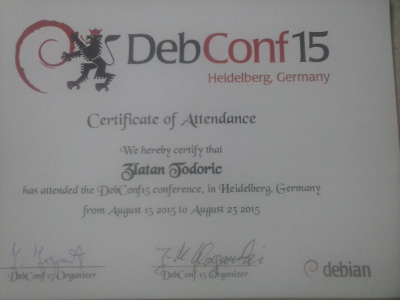
Zlatan Todori : The big life adventure called DebConf15

By the help of sponsorship I managed again to attend the conference where Debian family gathers. This is going to be a mix without any particular order of everything, anything and nothing else ;) attendance pic I arrived to Heidelberg Main Train Station around 9am on 15th August and almost right away found Debian people so it made my trip to hostel easier. After arrival I checked in but needed to wait for 3 hours to get the key (it seems that SA will not have that problem at all, which is already an improvement). Although waiting was 3 hours long, it wasn't actually difficult at all as I started hugging and saying hi to many old (the super old super friend of mine - moray, or how I call him, "doc") and new friends. I just must say - if you know or don't know Rhonda, try to get somehow into her hugs. With her hug I acknowledged that I really did arrive to reunion. Read more (14 min remaining to read)

Dimitri John Ledkov: Go enjoy Python3

Given a string, get a truncated string of length up to 12.

The task is ambiguous, as it doesn't say anything about whether or not 12 should include terminating null character or not. None the less, let's see how one would achieve this in various languages.
Let's start with python3

import sys
print(sys.argv[1][:12])

Simple enough, in essence given first argument, print it up to length 12. As an added this also deals with unicode correctly that is if passed arg is , it will correctly print . (note these are just random Unicode strings to me, no idea what they stand for).

In C things are slightly more verbose, but in essence, I am going to use strncpy function:

#include <stdio.h>
#include <string.h>
void main(int argc, char *argv[])
char res[12];
strncpy(res,argv[1],12);
printf("%s\n",res);

This treats things as byte-array instead of unicode, thus for unicode test it will end up printing just . But it is still simple enough.
Finally we have Go
package main

import "os"
import "fmt"
import "math"

func main()
fmt.Printf("%s\n", os.Args[1][:int(math.Min(12, float64(len(os.Args[1]))))])

This similarly treats argument as a byte array, and one needs to cast the argument to a rune to get unicode string handling. But there are quite a few caveats. One cannot take out of bounds slices. Thus a na ve os.Args[1][:12] can result in a runtime panic that slice bounds are out of range. Or if a string is known at compile time, a compile time error. Hence one needs to calculate length, and do a min comparison. And there lies the next caveat, math.Min() is only defined for float64 type, and slice indexes can only be integers and thus we end up writing ]))))])...

12 points for python3, 8 points for C, and Go receives nul points Eurovision style.

EDIT: Andreas R ssland and James Hunt are full of win. Both suggesting fmt.Printf("%.12s\n", os.Args[1]) for go. I like that a lot, as it gives simplicity & readability without compromising the default safety against out of bounds access. Hence the scores are now: 14 points for Go, 12 points for python3 and 8 points for C.

EDIT2: I was pointed out much better C implementation by Keith Thompson - http://pastebin.com/5i7rFmMQ in essence it uses strncat() which has much better null termination semantics. And Ben posted a C implementation which handles wide characters http://www.decadent.org.uk/ben/blog/truncating-a-string-in-c.html. I regret to inform you that this blog post got syndicated onto hacker news and has now become the top viewed post on my blog of all time, overnight. In retrospect, I regret awarding points at the end of the blog post, as that's just was merely an expression of opinion and is highly subjective measure. But this problem statement did originate from me reviewing go code that did "if/then/else" comparison and got it wrong to truncate a string and I thought surely one can just do [:12] which has lead me down the rabbit hole of discovering a lot about Go; it's compile and runtime out of bounds access safeguards; lack of universal Min() function; runes vs strings handling and so on. I'm only a beginner go programmer and I am very sorry for wasting everyone's time on this. I guess people didn't have much to do on a Throwback Thursday.

The postings on this site are my own and don't necessarily represent Intel s positions, strategies, or opinions.

Ben Hutchings: Securing git imap-send in Debian

I usually send patches from git via git imap-send, which gives me a chance to edit and save them through my regular mail client. Obviously I want to make a secure connection to the IMAP server. The upstream code now supports doing this with OpenSSL, but git is under GPL and it seems that not all relevant contributors have given the extra permission to link with OpenSSL. So in Debian you still need to use an external program to provide a TLS tunnel. The commonly used TLS tunnelling programs, openssl s_client and stunnel, do not validate server certificates in a useful way - at least by default. Here's how I've configured git imap-send and stunnel to properly validate the server certificate. If you use the PLAIN or LOGIN authentication method with the server, you will still see the warning:

*** IMAP Warning *** Password is being sent in the clear
The server does see the clear-text password, but it is encrypted on the wire and git imap-send just doesn't know that. ~/.gitconfig
[imap]
	user = ben
	folder = "drafts"
	tunnel = "stunnel ~/.git-imap-send/stunnel.conf"
~/.git-imap-send/stunnel.conf
debug = 3
foreground = yes
client = yes
connect = mail.decadent.org.uk:993
sslVersion = TLSv1.2
renegotiation = no
verify = 2
; Current CA for the IMAP server.
; If you don't want to pin to a specific CA certificate, use
; /etc/ssl/certs/ca-certificates.crt instead.
CAfile = /etc/ssl/certs/StartCom_Certification_Authority.pem
checkHost = mail.decadent.org.uk
If stunnel chokes on the checkHost variable, it doesn't support certificate name validation. Unfortunately no Debian stable release has this feature - only testing/unstable. I'm wondering whether it would be worthwhile to backport it or even to make a stable update to add this important security feature.

Ben Hutchings: Securing git imap-send in Debian

I usually send patches from git via git imap-send, which gives me a chance to edit and save them through my regular mail client. Obviously I want to make a secure connection to the IMAP server. The upstream code now supports doing this with OpenSSL, but git is under GPL and it seems that not all relevant contributors have given the extra permission to link with OpenSSL. So in Debian you still need to use an external program to provide a TLS tunnel. The commonly used TLS tunnelling programs, openssl s_client and stunnel, do not validate server certificates in a useful way - at least by default. Here's how I've configured git imap-send and stunnel to properly validate the server certificate. If you use the PLAIN or LOGIN authentication method with the server, you will still see the warning:
*** IMAP Warning *** Password is being sent in the clear
The server does see the clear-text password, but it is encrypted on the wire and git imap-send just doesn't know that. ~/.gitconfig
[imap]
	user = ben
	folder = "drafts"
	tunnel = "stunnel ~/.git-imap-send/stunnel.conf"
~/.git-imap-send/stunnel.conf
debug = 3
foreground = yes
client = yes
connect = mail.decadent.org.uk:993
sslVersion = TLSv1.2
renegotiation = no
verify = 2
; Current CA for the IMAP server.
; If you don't want to pin to a specific CA certificate, use
; /etc/ssl/certs/ca-certificates.crt instead.
CAfile = /etc/ssl/certs/StartCom_Certification_Authority.pem
checkHost = mail.decadent.org.uk
If stunnel chokes on the checkHost variable, it doesn't support certificate name validation. Unfortunately no Debian stable release has this feature - only testing/unstable. I'm wondering whether it would be worthwhile to backport it or even to make a stable update to add this important security feature.

27 August 2015

Norbert Preining: Kobo Japanese Dictionary Enhancer 1.1

Lots of releases in quick succession the new Kobo Japanese Dictionary Enhancer brings multi-dictionary support and merged translation support. Using the Wadoku project s edict2 database we can now add also German translations. kobo-japanese-dictionary-enhancer Looking at the numbers, we have now 326064 translated entries when using the English edict2, and 368943 translated entries when using the German Wadoku edict version. And more than that, as an extra feature it is now also possible to have merged translations, so to have both German and English translations added. kobo-dict-de-en Please head over to the main page of the project for details and download instructions. If you need my help in creating the updated dictionary, please feel free to contact me. Enjoy.

Ben Hutchings: Truncating a string in C

This version uses the proper APIs to work with the locale's multibyte encoding (with single-byte encodings being a trivial case of multibyte). It will fail if it encounters an invalid byte sequence (e.g. byte > 127 in the "C" locale), though it could be changed to treat each rejected byte as a single character.
#include <locale.h>
#include <stdio.h>
#include <stdlib.h>
#include <string.h>
#include <wchar.h>
int main(int argc, char **argv)
 
    size_t n = 12, totlen = 0, maxlen, chlen;
    setlocale(LC_ALL, "");
    if (argc != 2)
	return EXIT_FAILURE;
    maxlen = strlen(argv[1]);
    while (n--)  
	chlen = mbrlen(argv[1] + totlen, maxlen - totlen, NULL);
	if (chlen > MB_CUR_MAX)
	    return EXIT_FAILURE;
	totlen += chlen;
     
    printf("%.*s\n", (int)totlen, argv[1]);
    return 0;
 

Alexander Wirt: Basic support for SSO Client certificates on paste.debian.net

Sometimes waiting for a delayed flight helps to implement things. I added some basic support for the new Debian SSO Client Certificate feature to paste.debian.net. If you are using such a certificate most anti-spam restrictions, code limitations and so on won t count for you anymore.

Thorsten Glaser: Go enjoy shell

Dimitri, I personally enjoy shell

tglase@tglase:~ $ x= 
tglase@tglase:~ $ echo $ x::12 
 
tglase@tglase:~ $ printf '%s\n' 'import sys' 'print(sys.argv[1][:12])' >x.py
tglase@tglase:~ $ python x.py $x


much more than Python, actually. (Python is the language in which you do not want to write code dealing with strings, due to UnicodeDecodeError and all; even py3k is not much better.) I would have commented on your post if it allowed doing so without getting a proprietary Google+ account.

Joey Hess: then and now

It's 2004 and I'm in Oldenburg DE, working on the Debian Installer. Colin and I pair program on partman, its new partitioner, to get it into shape. We've somewhat reluctantly decided to use it. Partman is in some ways a beautful piece of work, a mass of semi-object-oriented, super extensible shell code that sprang fully formed from the brow of Anton. And in many ways, it's mad, full of sector alignment twiddling math implemented in tens of thousands of lines of shell script scattered amoung hundreds of tiny files that are impossible to keep straight. In the tiny Oldenburg Developers Meeting, full of obscure hardware and crazy intensity of ideas like porting Debian to VAXen, we hack late into the night, night after night, and crash on the floor. sepia toned hackers round a table It's 2015 and I'm at a Chinese bakery, then at the Berkeley pier, then in a SF food truck lot, catching half an hour here and there in my vacation to add some features to Propellor. Mostly writing down data types for things like filesystem formats, partition layouts, and then some small amount of haskell code to use them in generic ways. Putting these peices together and reusing stuff already in Propellor (like chroot creation). Before long I have this, which is only 2 undefined functions away from (probably) working:
let chroot d = Chroot.debootstrapped (System (Debian Unstable) "amd64") mempty d
        & Apt.installed ["openssh-server"]
        & ...
    partitions = fitChrootSize MSDOS
        [ (Just "/boot", mkPartiton EXT2)
        , (Just "/", mkPartition EXT4)
        , (Nothing, const (mkPartition LinuxSwap (MegaBytes 256)))
        ]
 in Diskimage.built chroot partitions (grubBooted PC)
This is at least a replication of vmdebootstrap, generating a bootable disk image from that config and 400 lines of code, with enormous customizability of the disk image contents, using all the abilities of Propellor. But is also, effectively, a replication of everything partman is used for (aside from UI and RAID/LVM). sailboat on the SF bay What a difference a decade and better choices of architecture make! In many ways, this is the loosely coupled, extensible, highly configurable system partman aspired to be. Plus elegance. And I'm writing it on a lark, because I have some spare half hours in my vacation. Past Debian Installer team lead Tollef stops by for lunch, I show him the code, and we have the conversation old d-i developers always have about partman. I can't say that partman was a failure, because it's been used by millions to install Debian and Ubuntu and etc for a decade. Anything that deletes that many Windows partitions is a success. But it's been an unhappy success. Nobody has ever had a good time writing partman recipes; the code has grown duplication and unmaintainability. I can't say that these extensions to Propellor will be a success; there's no plan here to replace Debian Installer (although with a few hundred more lines of code, propellor is d-i 2.0); indeed I'm just adding generic useful stuff and building further stuff out of it without any particular end goal. Perhaps that's the real difference.

26 August 2015

Holger Levsen: 20150826-jenkins-fourth-state

jenkins has a fourth state So, at the jenkins.debian.org BOF (very short summary: j.d.o will be coming soonish, long summary thanks to the awesome video team) I shared a trick I discovered almost a year ago, but had never really announced anywhere yet, which enables one to programatically use a fourth state to the existing three jenkins job states ("success", "unstable" and "failed"), which is "aborted". Common knowledge is that it's only possible to abort jobs manually, but it's also possible to do that like this:
TMPFILE=$(mktemp)
curl https://jenkins.debian.net/jnlpJars/jenkins-cli.jar -o $TMPFILE
java -jar $TMPFILE -s http://localhost:8080/ set-build-result aborted
rm $TMPFILE
exit
The nice thing about aborted job runs is that these don't cause any notifications (neither mail nor IRC), so I intend to use this for several cases: I've no idea when I'll get along to actually implement that, so help doing this is very much welcome and I'd also be glad to help hooking this into the existing jenkins.debian.net.git codebase. In related news, I'm back home since Monday and am thankful for having shared a very nice and productive DebConf15 with many old and new friends in Heidelberg. Many thanks to everyone involved in making this happen!

Rapha&#235;l Hertzog: Freexian s report about Debian Long Term Support, July 2015

A Debian LTS logoLike each month, here comes a report about the work of paid contributors to Debian LTS. Individual reports In July, 79.50 work hours have been dispatched among 7 paid contributors. Their reports are available: Evolution of the situation August has seen a small decrease in terms of sponsored hours (71.50 hours per month) because two sponsors did not pay their renewal invoice on time. That said they reconfirmed their willingness to support us and things should be fixed after the summer. And we should be able to reach our first milestone of funding the equivalent of a half-time position, in particular since a new platinum sponsor might join the project. DebConf 15 happened this month and Debian LTS was featured in a talk and in a work session. Have a look at the video recordings: In terms of security updates waiting to be handled, the situation is better than last month: the dla-needed.txt file lists 20 packages awaiting an update (4 less than last month), the list of open vulnerabilities in Squeeze shows about 22 affected packages in total (11 less than last month). The new LTS frontdesk ensures regular triage of CVE reports and the difference between both counts dropped significantly. That s good! Thanks to our sponsors Thanks to Sig-I/O, a new bronze sponsor, which joins our 35 other sponsors.

One comment Liked this article? Click here. My blog is Flattr-enabled.

Dirk Eddelbuettel: RProtoBuf 0.4.3

A new maintenance release 0.4.3 of RProtoBuf is now on CRAN. RProtoBuf provides R bindings for the Google Protocol Buffers ("Protobuf") data encoding library used and released by Google, and deployed as a language and operating-system agnostic protocol by numerous projects. This release comes upon the request of CRAN and adds additional import statements to the NAMESPACE file. While we were at it, a few more things got cleaned up and edited---but no new code was added. Full details are below.
Changes in RProtoBuf version 0.4.3 (2015-08-25)
  • Declare additional imports from methods in NAMESPACE.
  • Travis CI tests now run faster as all CRAN dependencies are installed as binaries.
  • The tools/winlibs.R script now tests for R (< 3.3.0) before calling the (soon-to-be phased out) setInternet2() function.
  • Several small edits were made to DESCRIPTION to clarify library dependencies, provide additonal references and conform to now-current R packaging standards.
CRANberries also provides a diff to the previous release. The RProtoBuf page has a package vignette, a a 'quick' overview vignette, and a unit test summary vignette. Questions, comments etc should go to the GitHub issue tracker off the GitHub repo.

This post by Dirk Eddelbuettel originated on his Thinking inside the box blog. Please report excessive re-aggregation in third-party for-profit settings.

Next.

Previous.