Search Results: "reg"

2 March 2007

Meike Reichle: Off to Chemnitz

In about half an hour I'll leave for Chemnitz in order to attend the Chemnitzer Linux-Tage 2007. I am very much looking forward to going there. Ever since the LinuxTag left Karlsruhe, the CLT are my favourite Linux event within Germany. Because of this I registered even two talks this year, one in the beginners section and of course the inevitable social talk. ;-) They're both new, so this CLT will feature two premieres. Giving new talks basically means that anything is possible. Very high rock and roll factor! New talks always have the highest risc for "accidents" but also they're usually most fun, because there's still some room (or need) for improvisation left. This is probably also why I tend to lose interest in a talk once I've given it a few times. Though, the BOFH one is of course a golden oldie! PS: Tolimar is a copycat!

Biella Coleman: On Edmonton, Place, and State of Mind

Recently, I got a comment on an older blog post on Edmonton that basically agreed with another comment that Edmonton was so not the cat’s meow. Despite the winter and many months later, I guess I still do think it is, although in saying so, it is not I think their assessments are wrong, I think my take has as much to do as what has come before (like NJ, which was not the high point o my life), my experiences here, and what is to come in the future. I tend to like Edmonton because there is enough stuff to do but not too much to do. It is that whole freedom from choice that I like because I often shut down in the face of too much choice. What also colors my experience in a positive light is that generally, Canadian politics, social policy, and way of life, are a step up or two (or maybe three) than that of the United States. So the worst of Canada (if you are even to call Edmonton that, which I would not), in this regard, beats out the best of the United States. And I have lived most of my life in the US so that is my point of comparison. Even if you are living in a fantastic American city, you always face the possibility of struggling in ways that will *never* happen in Canada. It makes for a calmer, less aggressive society. For example, I recently learned that Edmonton has the highest murder rate in Canada, at a whopping …. 36 people per year (population of Edmonton = 1 million). I grew up in a place, Puerto Rico where the yearly murder rate hovers at about 700-800 per year (population = 4 million). And yet people here are freaking out over the high rate of murder, which is a good thing because hopefully they can bring it down but this fact should make the US pause and think about what they are doing up north to keep the murder rate so darn low (and the answer I think is pretty easy to find). But perhaps a lot of my love of the place has as much to do or more with my state of mind. After a grueling year of finishing a dissertation under pressure as I had deadline, and then living in NJ where I was on the job market (which meant spending so much time churning out application after application and then flying around interviews), in addition to flying 7 times in one year to visit my mom, my life here just feels so much more sane than it has been in years. What sealed it all was that right before I moved here in August I was lucky enough to be offered a permanent job (which means this summer I will be moving to NYC to join this department and I will be back to the land of overwhelming choice), so that for the first time in 5 years I did not have to apply for anything in the fall that would guarantee my livelihood for the next academic year. I was not faced with a year of lots of travel (and actually traveling in out out Edmonton is really one of my least favorite things). With that firmly in place, I could just concentrate on things like my work, my friends, brewing kombucha and do things routinely, like exercise, which I had not consistently done for years. There are things about Edmonton that I find totally obnoxious like the cities inability to plow roads leaving a thick glaze of black ice on the roads so that when you drive in the city, you basically are at real risk for an accident (and this is despite a 6.6 BILLION government surplus). There are a tad too many strip malls in the outlaying areas, and of course there is the infamous winter. We are still deep in it. The cold temperatures have been with us steadily for months now and according to folks, there are still two more months to look forward to. The cold and the constant layering of clothes are getting to me a little, although I do appreciate that the cold is just not as cold as one would think with the actual temperatures. The lack of wind, the dry conditions, the cute as chubby-as-anything- bunnies that run through the snow, and the overpowering sun all help to make -6 F much more mild, so it is not as bad as you would or I would think it was. So while I am thrilled to join the department where I am moving too, I will be sad when I leave, though perhaps not as sad as Edmontons “darling” hockey player, Ryan Smith, who was just traded by the Oilers to the NY Islanders. The day he left, he literally was shedding tears at the airport. And I have to say, even though I have no attachment to hockey, I found the pictures endearing because there is nothing like seeing a grown Canadian man cry over hockey! : )

Russell Coker: spare tires

The following letter was published in the RACV Magazine. The Royal Automobile Club of Victoria is a driver advocacy organization that provides roadside assistance and insurance. The fact that they published my letter means that the idea can't be totally wacky so I'll blog it. ;)

There have been many mentions recently in RoyalAuto about space-saver spare tires. Some manufacturers claim that they are to save weight which seems to be a benefit for the driver.

I wonder if most drivers really need a spare tire. For my own driving I only have a flat tire about every second year and I almost never drive outside the metropolitan area. Given how rarely I call for road-side assistance I think I would be better off without a spare tire and with the option of having the RACV deliver one for me if I needed it.

I expect that the time taken to deliver a spare tire would be greater than that required for a regular road-side assistance call, and that it might count for more than a regular assistance call, but given that the cheapest roadside assistance package has 8 calls a year I expect that most years I would still use less than half my quota of calls.

Not having a spare tire would save some weight (and therefore fuel) and would provide a little extra cargo space.

Also it seems to me that small cars are unlikely to ever be driven outside the area that is serviced by the RACV and similar organizations. For a small car the lack of a spare tire in the car design would offer a significant improvement to cargo capacity. If the RACV and other organizations endorsed and supported cars without spare tires then the car manufacturers could design small vehicles with more cargo capacity and less fuel use.

1 March 2007

Enrico Zini: dpl-platform-keywords

Representative keywords of DPL platforms The DPL platforms are too long and you could use a very, very short executive summary? No problem, I have the technology for it. After the results you can find the kit to build yourself an extractor in the comfort of your home. The results Acquiring the data
for i in 93sam aigarius ajt hertzog sho sjr stratus svenl wouter
do
    wget http://www.debian.org/vote/2007/platforms/$i
done
Tokenizing
#!/bin/sh
for file in "$@"
do
    lynx -dump -stdin < $file   tr -c '[a-zA-Z]' ' '   tr '[A-Z]' '[a-z]'   sed -e 's/ /\n/g'   sed -e '/^$/d' > $file.tok
done
Extracting the most representative keywords
#!/usr/bin/python
import sys, math
def read_tokens(file):
    "Read all the tokens from one file"
    return [ line[:-1] for line in open(file) ]
# Read all the "documents"
docs = [ read_tokens(file) for file in sys.argv[1:] ]
# Aggregate token counts
aggregated =  
for d in docs:
    for t in d:
        if t in aggregated:
            aggregated[t] += 1
        else:
            aggregated[t] = 1
def tfidf(doc, tok):
    "Compute TFIDF score of a token in a document"
    return doc.count(tok) * math.log(float(len(docs)) / aggregated[tok])
# Output the top 5 tokens by TFIDF for every document
for name, doc in zip(sys.argv[1:], docs):
    print name, sorted(set(doc), key=lambda tok: tfidf(doc, tok), reverse=True)[:5]
Errata Jacobo suggests to use lynx -dump -nolist or w3m -dump for a more tokenizer-friendly text expansion.

Enrico Zini: suggestions-gz

Package suggestions I tried generating a list of 10 suggested packages for every package in the archive. You cat get it at http://people.debian.org/~enrico/Suggestions.gz and build nice things with it. Generation took two hours of a nice 18 process on the busy gluck, but it can be run in any faster/less busy machine that has a local copy of the unaggregated popcon data. This is (roughly) the generating algorithm:
  1. Take a package P.
  2. Query P on a Xapian index that indexes popcon submissions as documents and their packages as words.
  3. Get the first 20 resulting popcon votes.
  4. Score each package mentioned in those 20 results by a combination of how many votes mention it, its TFIDF scores in the various votes and the Xapian relevance score of the resulting votes.
  5. Take the top 10 packages as suggestions for P.
The code can be fetched with:
bzr branch http://people.debian.org/~enrico/2007-01/popcon/

28 February 2007

David Welton: Ruby's Mysql interface

I just like open source too much to not be constantly bumping into things that I would love to improve or fix... I have way too much fun getting my hands dirty with something new. Today's adventure regards my need to stream large quantities of data from a ruby on rails installation, covered previously here: http://journal.dedasys.com/articles/2006/06/08/streaming-programmatically-generated-content-from-rails The current block is that ActiveRecord doesn't deal with a "stream" of results, but rather, fetches everything into one big, fat array and then deals with that. Luckily, I'm not the only person to have found this suboptimal: http://dev.rubyonrails.org/ticket/6921 However, as I comment there, to truly make things work, some low level coding is required. For mysql, since it doesn't seem to support cursors to the degree that something more standards-compliant like Postgresql does, the answer lies in the C library and language interfaces built on top of it: http://dev.mysql.com/doc/refman/5.0/en/mysql-use-result.html Unfortunately, Ruby's C API, or at least the versions that I downloaded, don't properly support fetching things one record at a time. It didn't take more than a few minutes to whip this up: http://dedasys.com/freesoftware/patches/mysql-ruby.patch (although there's a good possibility it could be improved...) However, according to this posting, the upstream maintainer may not be terribly responsive, and the project isn't really run as much of an open source project, with a public mailing list, bug tracker, version control, and so forth. Perhaps it's time to create that infrastructure?

Evan Prodromou: 9 Vent se CCXV

Lots of short, sharp items today that I want to get down.

LinuxQuestions.org supports OpenID First, I'm psyched to see that LinuxQuestions Wiki now supports OpenID. Jeremy gave the scoop in The LQ Wiki Now Supports OpenID. I was glad to see that LQ's on the OpenID path. It's a really strong community site, and I think it'll benefit greatly from opening up the authentication process. tags:

Wikia and OpenID Angela Beesley had some comments on my Journal/7 Vent se CCXV posting about wikiHow's support of OpenID. In that posting, I said that I thought companies with lots of wikis, like Wikia or wiki farms, might have a disincentive to participate in the OpenID network. Angela put me straight on the issue in a post on WikiAngela about OpenID. I'm glad to hear that Wikia is considering supporting the protocol. Then again, it's hard to believe that an Open Content, Open Source company is really going to go out of its way to avoid open standards and open login. tags:

DemoCampMontreal1 I had a good time last night at DemoCampMontreal1. I gave the first demo -- on, of course, the MediaWiki OpenID extension -- and I had some technical difficulties that didn't let me show off all the functionality. Which was kind of a bummer, but there were lots of questions about it from the audience, so that kind of made up my time. The room was packed, by the way -- pretty much anyone who's anyone in Montreal tech was there. I'm looking forward to DemoCampMontreal2 on 29 March! tags:

certifi.ca One of the best ways to establish credentials on the Web is to use a signed SSL certificate in your browser. It's fast, incredibly secure, and once you get it set up you can just forget it. They're also practically immune to phishing. Unfortunately, most people don't even know what browser certificates are, how they work, or what to do with them. Consequently, most Web sites don't support browser certificate authentication. Vicious cycle. But, one of the cool things about OpenID is that you can disconnect the authentication method from the Web site you're using. Most OpenID identity providers still use username/password combos for authentication, which is why critics have said that the standard is vulnerable to phishing attacks. I wanted to see if it were possible to set up an OpenID identity provider that used browser certificates as the only authentication system. So, in my copious free time, I've hacked up certifi.ca. It's based on the cool PHP OpenID Server that JanRain made, but I've ripped out all the password stuff, and now it runs on luscious certificatey goodness. I'm going to be enhancing the service in the near future, but I wanted to get feedback from folks interested in OpenID as soon as possible. I'm using it for my primary OpenID delegate, and it seems to be working great. Please give it a try and let me know what you think (admin@certifi.ca). tags:

DemoCampMontreal1 on Montreal Poutine There's an article on DemoCampMontreal1 on Midnight Poutine. That's me up on the stage, in the photo! tags:

Nepean Hotspurs Selects win On Saturday, a Muslim girl named "Azzy" Mansour, from Ontario playing in a soccer tournament in Laval was ejected from the tournament (by a Muslim referee, notably) for wearing a hijab -- reportedly because it was a safety hazard. (Montreal Gazette story, registration required.) Admirably, her entire team forfeited the tournament in protest. I'm not excited about Quebec's reactionary activity around Muslim, Sikh, and other religious community's different clothing rules. However, I understand that Quebecois -- and French people -- have a different idea of personal freedom than Americans. I try to be understanding and put myself in the Quebec headspace for this kind of stuff. Mostly, though: I admire the soccer team, the Nepean Hotspurs Selects, for standing up for their teammate and their friend. A lot of teams might have gone ahead and played without her, and it took some courage to drop out of a tournament they'd had high hopes for. They're sixth-grade girls, but they've learned something about integrity that most adults never learn. Kudos to them. tags:

Adam Rosi-Kessel: More Espresso Art

Via Jamie, an interview with an amazing espresso artist. As I’ve wondered before, it would be interesting to know if anyone has ever attempted to protect their copyright in espresso art. On further reflection, I think espresso art should meet the “fixed in a tangible medium” requirement, at least as much as ice sculptures which also tend to lose their form over time. I assume ice sculptures can be protected, although could not find an example in a quick search. I suspect the copyright office would accept a photograph as “identifying material” for the purposes of a registration deposit on a cup of espresso, as in the case of sculptural works. Be sure to check out the embedded video — it eliminates any concern that the espresso art photographs might have been digitally enhanced.

27 February 2007

Meike Reichle: Deutsche Post - when fact beats fiction

Sometimes it happens, that items that are handeled by the German Mail (Deutsche Post) get damaged by their technical installations. When this happens, the item is put into a transparent plastic bag, together with a letter excusing the accident and telling the recipient how to file a request for investigation. So far so good. Unfortunately the envelope that got ripped in that case included two pendants that fell out and got lost. I didn't expect this to be much of a problem, but when I tried to file my request at the mail office it turned out, that there is no form for that kind of incident. The regular form used for requests for investigation assumes that the whole shipment got lost. There is no way to indicate, that it is not an envelope that is missing but merely its content. Trying to exlpain that to the lady there also wasn't successful. Except for repeatedly telling me that I had no right to claim compensation when posting things via regular mail (I know!!) she wasn't of much help. In the end I filled out the form as good as possiblei, gave comments where necessary and the lady promised me I would at least get a confirmation from the service centre. So today, after waiting for more then two weeks I finally got a letter from the service centre. Guess what it said:
"Dear Mister(!) Reichle.
The investigation can not be carried out at the moment, since the information you provided is not complete. Please complete and correct the information according the missing item ..."
And now, guess how I got it. Ripped, in a transparent plastic bag.

Sune Vuorela: aggregated on planet debian!

Thanks to Ana I am now on debian planet. I have ended up underneath Steve McIntyre, but as I am quite strong, I think I can handle it. Lately on the Debian devel maillist, there has been some flaming about maintainers and when to answer their bugs. I whined a bit about KDE team being a bit overloaded - and suddenly a guy started working on the KDE related bugs. Olivier Vitrat is my current hero for the next couple of days.

Simon Law: Reminder: DemoCamp Montr al 1

DemoCamp Montr al 1
Tuesday 27 February 2007
18:30 20:30
Societ des arts technologiques
1195 boul. St-Laurent
Free admission
( Sign up Upcoming.org Google Maps ) Just a reminder that Montr al's first DemoCamp is happening this evening! We've got five excellent demonstrations lined up, so do sign up and join the fun. You can just come and watch people talk, but it's also a great opportunity to meet people who are interesting and do exciting things. For more information, please see my original post.

Edd Dumbill: OpenID and microformats support on XTech site

Thanks in no small part to the advocacy of Simon Willison, I've just OpenID-enabled the XTech web site. OpenID log in box on Expectnation Users can now create their accounts using an OpenID, or associate an OpenID with an existing account. A single-sign on solution like OpenID solves an important problem for us, as most people tend to interact with our conference web sites in only one or two time periods each year. While we've gone to the trouble of making retrieving a password easy, there's still the mental burden on the user of setting up the account and noting it down somewhere. As a measure of the impact of this on me personally: I habitually save registration confirmation emails in a certain mail folder. Since 1997 I have collected no fewer than 572 of these, and I'm sure some have been missed! One other cool thing about OpenID is that finally I can get the identity I wish to have. No longer do I have to be a compulsive early adopter of every service just to get the name edd. (Well, as long as said service integrates OpenID of course!) Personal branding is an important attractive aspect of OpenID.ImplementationImplementing OpenID using the Ruby ruby-openid gem was quite straightforward, as was the logical integration into our user models. I've not been the only one following this path recently, as illustrated by this post on Rails OpenID integration from Dan Webb.The harder problem of deploying OpenID lies in making the user interface work well: ultimately that will have a huge influence over its uptake. We've made a decent first go of it in Expectnation, but I'm sure we'll evolve and improve it over time. The main puzzling thing is how obvious to make the OpenID facility, given its relatively small take-up right now. We don't want to confuse normal users too much by using it. Microformats When I did my behind-the-scenes piece on the building of the XTech schedule last week, one feature I didn't discuss was the support for microformats we have in the schedule and on the session pages. If you use a tool such as Operator, you can easily save talk times to your calendar while reading the schedule.

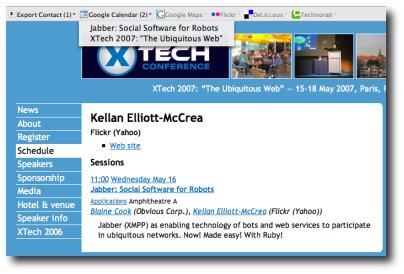
XTech schedule microformats I'm personally a little late to the microformats party. Being a fan of pragmatic RDF, I didn't see much need for microformats right away. However, with tools like Operator I can honestly say that the use of microformats does enhance the XTech schedule.My impressions of microformats (in particular hCalendar and hCard) from using them are mixed. One the plus side, it was very easy to do. On the negative side, I found them restrictive in the sense that for the metadata to be present in the hCalendar object, it needs to be part of the HTML presentation.So, while microformats are meant to be about making human readable data useful for computers, they can have a tail-wagging effect on the human markup. Let me elaborate. In the conference schedule there is a grid overview. For readability here we want to keep the details down to a minimum in each box. There is definitely no need to repeat the date of each presentation when you can see there's a grid per day.But also we want to have microformats available in the page so users can use the grid to pick off talks to add to their calendar. The only details you currently get from the microformat are those you physically include inside the div marked as vevent. This means we can't embed the full details, such as the talk description. It also means I indulge in some dubious markup practices (an empty abbr element) in order to get the date and time into each hCalendar object.It seems to me that this could be ameliorated by more intelligent user agent behaviour. Each of my hCalendar events is given a URL. At the end of that URL is a full description of the event, using microformats. So, as long as I reference the URL in a summary page, the user agent can beetle off and pull down the full information, in much the same sort of way that FOAF uses the rdfs:seeAlso property.So, remove the expectation that microformats provide complete data, and I'm sold.Other schedule features: iCal, Upcoming.org
Of course, we have iCalendar support in the XTech schedule, so you can subscribe conventionally using iCal, Evolution or a similar program. Aaron Straup Cope took the iCalendar, and uploaded each event into Upcoming.org. If you look at the upcoming events tagged xtech07, you see the results of his work.This foreshadows some of the social elements we plan to add to Expectnation itself: indicating your intent to attend a talk, and adding comments to it. As a program chair I'm finding this quite fascinating to watch.

26 February 2007

Junichi Uekawa: apache upgrade?

From the diffs of the apt-listbugs regression test log, I've noticed that the response from bugs.debian.org is now different. There was an upgrade from Apache 1.3 to 2.0, and it shows in the logs. I wonder what apps would break.

Annabelle Tully: FOSDEM

So its post-FOSDEM already… Time flies when you’re having fun.
I arrived Brussels at around 10AM friday, met Tulitar, who was just as clueless as me regarding where the hell we were going. We ended up meeting a nice group of people on the train who incidently neither knew where they were going, but were following someone who did. We eventually got off at the right place and met Dave, who also had no clue where the hostel was.
After being slightly lost and meeting some other Debian people, we finally got in at the hostel where we had to lock baggage in the basement as we could not check in before three. Tired as hell, we left out and met Jeroen and a few other people and headed for the chocolate museum. Belgian chocolate is /awesome/. They had solid dark chocolate sculptures and even chocolate CLOTHING.
After the chocolate museum, everyone left back for the hostel and passed out, except me, who was still eager for more city exploring and/or beer. I met up with Martin and left to get some asian foods before the famous beer gathering. I’m convinced we tried every beer on every page of every beer charter of every pub we visited. Belgian beer is by far the best I’ve ever had. ‘Duvel’ is one of my top favourites.
During the beer gathering we thought it’d be a really good idea to discretely throw coasters at the people sitting below, us hiding at the top of the pub. Ended not as discretely as it started, hundreds of coasters flying throughout the room. Pure entertainment gold, but seemed to piss off the organizers and bar-people, and Martin was noble enough to take the blame even if I blatantly started it all with my childish ways.
The next day was started with getting lost AGAIN, because I could in no way remember where the hostel was. Interesting start of the day. I think I’ve lost count on the amount of times I’ve gotten lost in Brussels at this point. On our way to the FOSDEM venues we also found an entire area of brussels where they just don’t sell sandwiches. The day ended with much delicious Belgian beer consumage.
All in all it was fun and interesting. I also discovered that they are way more lenient with airport security in Belgium. I had tons of liquids and creams in my bag, and they didn’t comment it at all OR put it in little plastic bags. Despite me happily not feeling like a terrorist, the flight back sucked. It was an hour delayed, and when I landed there was even more snow in Norway than there originally was when I left. Missing the green grass of Belgium.
Now please, people, upload pictures from FOSDEM and give me the URL! :-)

Dirk Eddelbuettel: RQuantLib 0.2.6

Version 0.4.0 of QuantLib was released a few days ago (and Debian packages for QuantLib are waiting to be added by the ftpmaster). This required some minor changes by Dominick in the Bermudan pricer, and we made some small updates in other place. All in all just a regular maintenance release. The new version 0.2.6 has now been uploaded to both R's master CRAN host and Debian, and is also available locally here.

25 February 2007

Uwe Hermann: LinuxBIOS talk video recording from FOSDEM 2007

LinuxBIOS logo Highly recommended for anybody who might be even remotely interested in LinuxBIOS: There's a video recording (OGG, 234 MB) of the LinuxBIOS talk at FOSDEM 2007 by LinuxBIOS-founder Ron Minnich. The talk is about LinuxBIOS, its history, how it works, what the main challenges are, where it's used today and what the future will likely hold. Watch it, you won't regret it. And if you want to know more, or maybe even consider contributing, head over to linuxbios.org or contact the mailing list.

Adam Rosi-Kessel: Grimmelmann and Kozinski on Law

I recently came across two old and unrelated writings about law, both of which are worth reading, especially for people with strong opinions but no formal training. The first is this piece, entitled Seven Ways in Which Code Equals Law (And One in Which It Does Not), by recently-appointed New York Law School professor James Grimmelmann and EFF Legal Director Cindy Cohn. Several observations are particularly appropriate for the slashdot crowd (and, to a lesser extent, certain members of the Debian community and others who grew up on a diet of BASIC, Pascal, and then C and later perl). I especially like this bit about “hacking the law”:
Some people, seeing this connection, and remembering the values of good code, try to improve the legal system by treating it as a computer. People come to me with ideas for hacking the law. The government says that cryptography is a weapon, they say, but the Bill of Rights says we have the right to bear arms. So that means we have a Constitutional right to use cryptography. But the legal system isn t a computer. If you can t convince a judge that what you re proposing is consistent with the values underlying a law, your argument will go nowhere. People go to jail every year because they think they ve found a way to hack the Sixteenth Amendment. The income tax is illegal, they say, or, The income tax is voluntary, see, it says so right here, and then they get convicted of tax evasion and sent to jail. We did convince several judges about the Constitutional dimension of cryptography, but the claim started from the values of the First Amendment, not a mechanical reading of its words. It s a category mistake to treat the legal system as just another architecture with its own specialized language. Code and law are different ways of regulating; they have different textures. All of those people who are required to make the legal system work leave their mark on its outcomes: they make a certain amount of drift and discretion almost inevitable. Code doesn t have such a limit: it can make perfectly hard-nosed bright-line rules and hold everyone in the world to them. Code is capable of a kind of regulatory clarity and intensity that law can only state, never really achieve.
I don’t entirely agree with the other article, entitled What I Ate For Breakfast and Other Mysteries of Judicial Decision Making by outspoken Ninth Circuit Judge Alex Kozinski (unofficial site maintained by Aaron Swartz, wikipedia entry). For example, I think critical legal studies has resulted in some interesting insights, some of which actually have practical applciation. Still, Judge Kozinski makes an important point about the numerous factors that act as a check on discretion in judicial decisionmaking:
It is popular in some circles to suppose that judicial decision making can be explained largely by frivolous factors, perhaps for example the relationship between what judges eat and what they decide. Answering questions about such relationships is quite simple - it is like being asked to write a scholarly essay on the snakes of Ireland: There are none. But as far back as I can remember in law school, the notion was advanced with some vigor that judicial decision making is a farce. Under this theory, what judges do is glance at a case and decide who should win - and they do this on the basis of their digestion (or how they slept the night before or some other variety of personal factors). If the judge has a good breakfast and a good night’s sleep, he might feel lenient and jolly, and sympathize with the downtrodden. If he had indigestion or a bad night’s sleep, he might be a grouch and take it out on the litigants. Of course, even judges can’t make both sides lose; I know, I’ve tried. So a grouchy mood, the theory went, is likely to cause the judge to take it out on the litigant he least identifies with, usually the guy who got run over by the railroad or is being foreclosed on by the bank. This theory immodestly called itself Legal Realism. Just to prove that even the silliest idea can be pursued to its illogical conclusion, Legal Realism spawned Critical Legal Studies. As I understand this so-called theory, the notion is that because legal rules don’t mean much anyway, and judges can reach any result they wish by invoking the right incantation, they should engraft their own political philosophy onto the decision-making process and use their power to change the way our society works. So, if you accept that what a judge has for breakfast affects his decisions that day, judges should be encouraged to have a consistent diet so their decisions will consistently favor one set of litigants over the other. I am here to tell you that this is all horse manure. And, like all horse manure, it contains little seeds of truth from which tiny birds can take intellectual nourishment. The little truths are these: Under our law judges do in fact have considerable discretion in certain of their decisions: making findings of fact, interpreting language in the Constitution, statutes and regulations; determining whether officials of the executive branch have abused their discretion; and, fashioning remedies for violations of the law, including fairly sweeping powers to grant injunctive relief. The larger reality, however, is that judges exercise their powers subject to very significant constraints. They simply can’t do anything they well please.
Finally, I will link, but not embed, this video of the Anna Nicole Smith court order, for an entirely different perspective on the legal process. You almost don’t really want to have to see this stuff.

Pierre Habouzit: git rebase is not harmful, it's just _not_ always the best solution, that's all.

I must say I disagree with John a lot about git rebase. git-rebase is the most nice feature I've ever seen float around in a SCM, and is part of the things I love in git. I mean, I do not disagree with the fact that it cannot be used in every single case. It is indeed meant to be used in private topic branches. git-rebase is meant to be used in a workflow where you have a topic branch (meaning some non releaseable nor push-able work) and that you still want to keep up with others work. With other SCM's, you have to update your working repository, wich in many cases generates nasty conflicts, hard to deal with. Especially in svn e.g.. With git, you commit your work, pull the remote branch, and then rebase ontop of it. It makes a lot of sense, and when your topic branch is indeed ready, you can push it upstreams, and the next rebase will merge the bits that have been accepted automatically. I just can't think of a simpler way. Btw, we use svn at work, and I do use git-svn instead of svn to be able to develop my own patches without fearing conflicts in the same way I did before. I know I will benefit from the powerfull git merging capabilities and help at any stage, even if I did not pulled the svn for a long time. That makes the developpement much more sane, as I only try to push coherent changes, hence on a less regular basis. You could not do that without git-rebase. In that sense, git-rebase is anything but evil.

24 February 2007

Evan Prodromou: 5 Vent se CCXV

A few days from now is the first BarCamp we've had in a while: DemoCampMontreal1. DemoCamp is a BarCamp variation with a much shorter time frame (a couple of hours, rather than all day) and strict rules about presenting. Demo-ers cannot use Powerpoint slides (or even OpenOffice Impress slides!); they have to demo working code. I'm going to be doing the first demo of the first DemoCamp, which should be pretty fun. What will I be demoing? The OpenID extension for MediaWiki, of course. I'd like to show folks who have MW installs how to get OpenID enabled on their sites, and I'd like to show other developers how to (easily) integrate OpenID into their existing software. I don't think it's necessarily that hard. DemoCampMontreal1 is on Tuesday, Feb 27 2007 at 6:30PM at the SAT. Everybody's invited, and as an extra bonus, t-shirts from BarCampMontreal1 will be there, for attendees. Cool! tags:

MLUG now has OpenID Lurking in #mlug (Montreal Linux Users Group) on Freenode, I caught a cross-discussion about OpenID being enabled on http://mlug.ca/ . Which is great news -- I'm excited to be able to use OpenID on some of my favorite sites. tags:

Creative Commons 3.0 I'm excited to see the announcement that the Creative Commons 3.0 licenses have been released. The 3.0 licenses were in part the product of the Debian-Creative Commons Workgroup, which tried to smoothe the rough edges of the CC licenses that made them incompatible with the Debian Free Software Guidelines. See the Debian Creative Commons Workgroup report for more info. We didn't get everything we wanted from the negotiations, but we did get the essential problems out of the way. I think that the 3.0 licenses are compatible with the DFSG, and that works licensed solely under CC 3.0 should be allowed into Debian main. But we probably have some discussion on debian-legal ahead of us on the subject. tags:

Dead tablet walking So, I think I mentioned that I borrowed a Nokia N800 tablet last week at the LWOSS. I took it to bed two nights ago -- it's a really good computer for reading in bed -- and the battery died on the nightstand overnight. When I plugged it in in the morning, it went into some kind of zombie fugue. It booted up, spun in place for a little bit, then shut itself down and rebooted again automatically. I couldn't get it to stop with the normal power button, so I eventually pulled the battery to make it stop. But if I put the battery back in, it went into its Roomba-bumping-into-a-wall loop again. Frustrated, I ended up re-flashing the entire system. That solved the problem, but I have to admit some regret at losing all my settings. It won't take that much work, but I'm going to backup to a mini-SD once it's done. tags:

Ian Murdock: You do back up your data regularly, don t you?

Phil Wainewright: “So here is a selection of news stories culled from the past few months that allow us to objectively evaluate what happens when users ‘have total control over things like privacy and security’… […] Would any of those laptop thefts made the headlines had the data been stored in Google Apps? No, of course not, because the data would have remained inaccessible on Google’s servers.” Great points. A little closer to home, how many times have you taken a call from an anguished family member who has just lost their data but who hasn’t heeded your advice to back up said data periodically? While we’re at it, how many times have you not heeded your own advice on the same subject? Could the SaaS providers possibly do any worse than we’ve been doing here? Granted, there needs to be a culture change, one that needs to happen on both sides of the transaction, to make this work. But it will eventually happen, because it Just Makes Sense.

Next.

Previous.