Search Results: "tim"

21 July 2013

Rog rio Brito: Beginning Ruby

These are some very rough/sketchy notes that I took while doing the exercises on the introductory track of the Ruby language at codeacademy. They were written from the point-of-view of an amateur programmer in C and Python (read: "me"). Since this is my first time with Ruby and I only have about 1 week of experience with it, these notes are likely to contain many mistakes, many simplifications, many omissions or simply gross errors. I would love to be informed of such facts so that I can fix them and not write code that is burdensome for others to maintain. Operators Numbers Basic I/O Strings Control flow If While For Loop Arrays Hashes Functions/methods Symbols Comments Lambda functions Classes Modules Mixins Conventions

20 July 2013

Charles Plessy: triggers in Dpkg and RPM: a comparaison.

Dpkg and RPM provide a mechanism called triggers. But are they doing the same thing? There are two different types of triggers for Dpkg: explicit and file. In the case of explicit triggers, the script of a package A will activate a package B. The file type is more frequently used. In that case, the creation, modification or deletion of a file in a path declared by a package B will activate the package B. The triggers are often used when a package A has to register an information to a package B. For instance, when a graphical application is installed, its package will add its description in the /usr/share/applications directory, which will trigger the desktop-file-utils package, which will do what is necessary to add a new menu entry in the window manager. RPM's triggers function differently. The installation, update or removal of a package A will activate a package B if this package B declares its interest for the package A in its SPEC file (with possible restrictions on package A's version). The documentation of RPM and Fedora gives a few examples of use, like the update of symbolic links when one mail server is replaced by another. Altogether, despite both mechanisms have the same name, they do not have the same goal. In the case of Dpkg, the triggers are especially useful to group similar actions. For instance, to update the list of manual pages once after installing a hundred of packages, instead of a hundred of times, after installing each package. They are also useful to transfer commands from a large number of packages to a central one, thus easing the evolution of the system. In the case of RPM, the triggers seem more specialised, as they always are about the relationship between a pair of packages.

Paul Tagliamonte: The Deprecation of Google Latitude

I m a bit disappointed Google is shutting down Google Latitude - I ve been an avid user of latitude since it came out - I always found it really quite neat. It was a bit creepy knowing the last few years of my exact location every day were sitting on a Google server, but at the same time, the API let me use this data for all sorts of personal projects. In fact, all my machines use my current latitude data in some form or another.
As a result, I m looking for a replacement. Anyone know of a good Free Software application I can install on my Android (Nexus 4) phone, and push real-time latitude and longitude data to my server? Any advice at all would be great.

19 July 2013

Justus Winter: A story about virtualization

I'm sure you all will be a bit disappointed (I know I am) that there are no ascii screenshots in this weeks report. But let me make it up to you by telling you a story. I was at the FOSDEM in the year 2012 and I went to a nice workshop on sunday afternoon in the Virtualization Devroom. Renzo Davoli was the host of this workshop and he started with a little introductory talk to get everyone to agree on a common terminology first. He began by asking the question, what virtualization meant in the most general way. He defined the ability to virtualize a resource as the ability to freely and transparently control how someone (say a process) is interacting with said resource. So for example if you LD_PRELOAD a library to impersonate fopen(3) and friends, you have virtualized the filesystem (for some small values of virtualized). He then went on to discuss various methods of virtualization that are commonly available on Linux, not only full system virtualization solutions, but also all kinds of methods allowing a more fine-grained control over what resources are virtualized. Of course every method had its strengths and its weaknesses. Having seen Samuels talk about all the awesome things Hurd can do for virtualization I approached him with a question in the free discussion part of his workshop. I asked whether he would agree that once a resource is moved from the kernel to the userspace, the problem of virtualizing that resource is almost trivially solved, and he agreed. So I said that this was awesome, because then the trivial and elegant solution for all his virtualization (and tracing) needs are micro kernel operating systems, and he also agreed to that but (as far as I can recall) he mentioned that there is none that would meet his needs (I believe he is a computer science professor and heavily relies on virtualization techniques for his lab and for teaching purposes). And even though a microkernel operating systems has a cost (message passing instead of function calls for example) it also has its merits such as scaling better from a development point of view. Also, many cool features can emerge just from the design. For example think about the container support in Linux and how painfully long it took to make all the resources namespace aware (with one of the most critical, the user namespace being the most difficult one). On Hurd you get the same functionality for free. If you are curious, read Samuels awesome slides. So what have I done this week? Next week I'm going to work on the two remaining sysvinit related issues. These are the only ones preventing me to come up with a clean patch series against the sysvinit package and I figured that it would be nice to propose such a series rather sooner than later so that I will have plenty of time to discuss any issues with the sysvinit maintainers. See you next week :)

Michal Čihař: Speed improvements in Weblate

Yesterday, I've spent some time trying to improve speed of translation import in Weblate. It got annoyingly slow while adding new features and I felt there has to be some area for improvements even with all the features. I was testing on development server with debug stuff enabled (what slows down things quite a lot already) and first import took about 30 seconds. Quick look revealed that for linked repositories, the link lookup happens too often, so some caching could be used. This has saved about 3 seconds... With offloaded indexing (what is anyway only useful setup for production use), every reindex request was checking whether there is already one before creating new one. In most cases there is none before, so it's simply faster to try to create one and ignore error in case it is already there. We're now 5 seconds faster. Another big resource consumer are quality checks. They provide useful feedback to translators, but it means that quite a lot of code needs to be executed for every single string. First thing I've realized is that unit check state is recalculated everytime regardless the fact whether there was any change, what was easy to fix. The other speed issue is in consistency check - it does too complex SQL query, which usually does not match anything. Converting this to much simpler one (which will in most cases still have no results) improves performance for usual path while having minimal impact for the real checking. Another 4 seconds down on my test import. Last thing which I changed is way how per translation statistics are updated. In past this required quite a lot of queries, but yesterday I've realized this can be much reduced. During test suite run on PostgreSQL, I saw that it's not that easy - PostgreSQL does not allow to sum boolean fields, but fortunately this can be fixed as well. This has saved about 2 seconds. In the end the tested import took 16 seconds instead of original 30 and issued 2500 SQL queries instead of 5000 at the beginning. I hope you will enjoy regained speed of imports :-).

Filed under: English Weblate 0 comments Flattr this!

18 July 2013

Craig Small: Step or Sloping Graphs

Even though the backend of Rosenberg NMS uses rrdtool RRD files, the front end graphs are created using jqPlot. The idea is to have a set of templates for the different types of graphs and just apply them to the various data sets. It makes things a lot simpler for new graphs because you just select which one you want; unless you want something a lot different which would involve a new graph template. In any case, anyone that looks enough at the standard rrdtool graphs will know they are a series of steps. While it depends on the RRA, usually they are 5 minute steps, so a graph showing an increasing rate might show 5 minutes of 2 Mbps and then the next 5 minutes of 11 Mbps. jqPlot graphs as I ve currently got them draws a line between two data points, so there would be a sloping line starting at 2.5 minutes (half of the first 5 minute interval) and 2Mbps sloping up to 11 Mbps at 7.5 minutes. At first I thought this was wrong and spent some time attempting to fix the graph by making it look like a rrdtool graph more. Someway through that process I stopped and wondered, what IS the right way? The answer like a lot of other things, is it depends . For a graph showing a rate, such as the output bits per second on an interface, the way this is done is at regular intervals a counter is measured. So if at time 0 the counter is 140 and time 60 the counter is 200 and finally at time 120 the counter is at 800 there has been an average rate of 1 [(200-140)/60] and 100 [(800-200)/60)]. rrdtool would show a horizontal bar at 1 bps and then another horizontal bar at 100 at the next time interval. jqPlot would show a sloping line going from 30,1 up to 90,100. Two graphs looking very different from the same data, what gives? Each graph is right, or rather is showing an estimation of different things, hence their differences. rrdtool is showing the average rate for that time period. It is in some ways accurate because leaving aside missed wrap-arounds and resets that many bits did pass through that interface for the time specified. However often the graphs are interpreted incorrectly as the real rate and not an average. We can be reasonably sure for a rate that it would not be 1 for exactly a minute and then immediately jump to 100 for another minute. This isn t rrdtool s fault, it is just how the graphs can be interpreted. jqplot will show more realistic graphs, with a curve sloping up. However this too makes assumptions that the rate increase is linear which often it is not. It just gives the illusion that the graph knows more about the data than it really does. In the end, both graphs are at the same time accurate and misleading. It s important when looking at any graph in general (not just these two types) that you understand its limits and assumptions. To give one example of the problems that can be missed, traffic interfaces may have microbursts (large amount of traffic in short amount of time) which, due to the averaging that goes on in graphing are invisible to graphs and give an incorrect account of what is going on.

17 July 2013

Petter Reinholdtsen: How to fix a Thinkpad X230 with a broken 180 GB SSD disk

Today I switched to my new laptop. I've previously written about the problems I had with my new Thinkpad X230, which was delivered with an 180 GB Intel SSD disk with Lenovo firmware that did not handle sustained writes. My hardware supplier have been very forthcoming in trying to find a solution, and after first trying with another identical 180 GB disks they decided to send me a 256 GB Samsung SSD disk instead to fix it once and for all. The Samsung disk survived the installation of Debian with encrypted disks (filling the disk with random data during installation killed the first two), and I thus decided to trust it with my data. I have installed it as a Debian Edu Wheezy roaming workstation hooked up with my Debian Edu Squeeze main server at home using Kerberos and LDAP, and will use it as my work station from now on. As this is a solid state disk with no moving parts, I believe the Debian Wheezy default installation need to be tuned a bit to increase performance and increase life time of the disk. The Linux kernel and user space applications do not yet adjust automatically to such environment. To make it easier for my self, I created a draft Debian package ssd-setup to handle this tuning. The source for the ssd-setup package is available from collab-maint, and it is set up to adjust the setup of the machine by just installing the package. If there is any non-SSD disk in the machine, the package will refuse to install, as I did not try to write any logic to sort file systems in SSD and non-SSD file systems. I consider the package a draft, as I am a bit unsure how to best set up Debian Wheezy with an SSD. It is adjusted to my use case, where I set up the machine with one large encrypted partition (in addition to /boot), put LVM on top of this and set up partitions on top of this again. See the README file in the package source for the references I used to pick the settings. At the moment these parameters are tuned: During installation, I cancelled the part where the installer fill the disk with random data, as this would kill the SSD performance for little gain. My goal with the encrypted file system is to ensure those stealing my laptop end up with a brick and not a working computer. I have no hope in keeping the really resourceful people from getting the data on the disk (see XKCD #538 for an explanation why). Thus I concluded that adding the discard option to crypttab is the right thing to do. I considered using the noop I/O scheduler, as several recommended it for SSD, but others recommended deadline and a benchmark I found indicated that deadline might be better for interactive use. I also considered using the 'discard' file system option for ext3 and ext4, but read that it would give a performance hit ever time a file is removed, and thought it best to that that slowdown once a day instead of during my work. My package do not set up tmpfs on /var/run, /var/lock and /tmp, as this is already done by Debian Edu. I have not yet started on the user space tuning. I expect iceweasel need some tuning, and perhaps other applications too, but have not yet had time to investigate those parts. The package should work on Ubuntu too, but I have not yet tested it there. As for the answer to the question in the title of this blog post, as far as I know, the only solution I know about is to replace the disk. It might be possible to flash it with Intel firmware instead of the Lenovo firmware. But I have not tried and did not want to do so without approval from Lenovo as I wanted to keep the warranty on the disk until a solution was found and they wanted the broken disks back.

Joerg Jaspert: tmux - tm

Wohoo, one more in that little series of mine, another update to tm. This time it gained getopts style options - while retaining the old non-getopts style. It now can open more than one multisession to the same set of hosts, so you can connect multiple times to host1 host2 at the same time. No matter if you open them using the ms subcommand or the pre-defined sessions from the .tmux.d directory. I also took a bit and wrote some zsh completion for it. I m pretty sure this can be done better and am happy for patches, but it does work for me, so for now I m happy. You can, as usual, grab tm from my misc git repository, the zsh completion is in my zsh config repository - also at Github.

Daniel Pocock: Some further observations on init replacement

My blog about replacements for SysV init received a significant number of comments Monday, revealing a solid base of community support for systemd. One reader was even generous enough to contribute a pull request fixing the reSIProcate package systemd artifact The blog wasn't intended to disparage any of the init replacements or suggest that these types of issues are show-stoppers. Rather, it was simply to demonstrate the fact that developers need to divert attention from other activities (like bug fixing, new features, etc) to correctly adapt things and support the wide range of init replacements that have emerged. As revealed in some comments like this one, systemd can even assist with privileged port assignments: it's nice a feature, but also likely to require more development time to integrate. None of these things are difficult though, they just take time. The real challenge The biggest headache is that it becomes tedious for any upstream developer to start getting into that much depth learning about each system they want to support. That is before we even start talking about how daemons and other services are managed in cloud deployments (e.g. the Juju charms from Ubuntu). For a developer to seriously integrate and test their daemon in all of these environments and make maximum use of all their features could easily take a month: without adding any new features to the application itself. In the last five years, I have personally come across all of these platforms and formal packaging systems: This is nothing to boast about: with enough time (and bandwidth to download the installer ISOs) I'm sure anybody could set up all these environments and many more. The question, though, is whether developers can afford to stretch themselves so thin, particularly on smaller projects that are not commercially supported. systemd: struggling to find documentation My first impression of systemd was that it is not widely documented. This is not the developers fault, they do provide some great documentation. Rather, at the time I was looking for it, Google's search algorithm was under the impression that systemd was a typo. Several other forum posts reveal other people had the same problem. I wasn't immediately aware of the fact that systemd has to be quoted in Google searches although I've since discovered quoting it can help find significantly more helpful details in a search. Nonetheless, this initial experience wasted time for me and it is more likely that I would have discovered things like tmpfiles.d if I hadn't lost time on that issue. In my mind, this is not a fault with systemd at all, it is just bad luck and limited time to allocate on the task. A single effort to support multiple solutions This brings me back to one of the points I made Monday, that it would be good to see a single solution that allows upstream developers to auto-generate artifacts for all common init replacements. Maybe it wouldn't exercise all of their cool new features. One further comment on Monday even observed that such a tool does exist for invoking systemd artifacts from SysV init. Obviously we already have tools like alien to convert package formats (although it is obviously not used to auto-create packages for Debian's archive). Nonetheless, developers of free software would be able to see their code deployed much more widely, more quickly, if they could get away with using a common tool for this job, just as a single autotools or cmake can support compilation on platforms the developer never even heard of.

16 July 2013

Joachim Breitner: Real World Haskell Applications

Today I held a lightning talk at the Karlsruhe Functional Programmer s Group, where I presented Real World Haskell applications, i.e. programs that are written in Haskell, are somewhat mature and well-known and have non-programmers as their target group. Here is the (surely subjective) list that I have come up (also see the slides): There is also an impressive list of industrial users that use Haskell without talking about it much, but that does not work well to show off that you can do any kind of application in Haskell. If I missed anything important, let me know!

Joachim Breitner: Ultimate Tic Tac Toe is always won by X

The blog Math with Bad Drawings recently featured an article about Ultimate Tic Tac Toe, a variant of Tic Tac Toe where each of the nine fields is a separate game of Tic Tac Toe. To mark a field of the large game as your, you have to win the small game therein. If you chose a field in the small game, this position determines the small field that the other play may play next. See the linked article for a full explanation. As far as I know, the question of who wins this game was open; at least nothing definite was known on Hacker News or on the Board Games StackExchange site. We discussed this a bit in our office, and my coworker Denis Lohner came up with what seems to be a winning strategy. Update: Not surprising, but with these variants of the rule, the winning strategy was already known.
Strategy Assume Denis ( ) plays against me ( ). Like most suggestions for a winning strategy for the first player, Denis (X) starts with the middle:


Now I have to put my in the center field of the center game. No matter where I place it, Denis will send me back ot the middle, until one field of the center game is free. Doing this eight times inevitably puts us in a position like this:


The only way I can influence the game is by chosing which I place last; this determines where Denis goes now. But (and please verify that carefully) it will not matter: The only thing required from that field is that there is a second field that, together with the center, forms a row (or column or diagonal); all fields satisfy that. Assume I placed the top-left last, and Denis has to go there. He will send me to that field:


Now the game of the first field is repeated: Whereever I send him, he will send me back. This works great for all fields but the middle field. The middle field is special: When I send him there, he has the free choice. He will pick the bottom-right game. In any case we will end up in this situation: I won the center game; I likely have a few in the top-left game. To be precise: I have a there if and only if the he has a in the top-left corner of the corresponding game. He also has the diagonal of the lower-right game. For example:


I have to put my mark in the lower-right game now. From now on, whereever I go, he will send me to either to the top-left or bottom-right game. I can do nothing about it (I cannot send him to the diagonal any more, and whereever I send him there is at least one of the top-left or bottom-right fields fee), so he wil easily win all the other games by getting the diagonal. Eventually, he wins the whole game with the bottom row or the right column:


This is not a formal proof yet, but hopefully close enough to convince you, or alternatively allow you to precisely describe how you can prevent losing against Denis strategy.

Gunnar Wolf: Open Repositories 2013 #OR2013 Charlottetown, P.E.I., Canada

I just came back home from the Open Repositories 2013 conference, in Charlottetown, Prince Edward Island, Canada; a conference on Open Access publishing, digital repositories, preservation strategies... It was quite an interesting conference, and gave me the opportunity to meet several interesting people. Mostly worthy of note, I spent some good time with the team behind the EPrints software, which powers my institute's repository, and with whom I expect to do some work trying to get EPrints more in shape to be considered as uploadable to Debian. I presented a (very non-technical) talk titled RAD-UNAM: Genesis and evolution of a repository administrators group, describing the experiences we have had at our group in UNAM setting up a federated repository (link to the talk in the OR2013 site). It was a very good experience as well as a nice trip. Oh And if you come over to my blog, you will see here the photos I took during the week of a very nice, little Canadian city.

15 July 2013

Matthew Garrett: How XMir and Mir fit together

Mir is Canonical's new display server. It fulfils a broadly similar role to Wayland and Android's Surfaceflinger, in that it takes final responsibility for getting pixels onto the screen. XMir is an X server that runs on top of Mir. It permits applications that know how to speak the X protocol but don't know how to speak to Mir (ie, approximately all of them at present) to run in a Mir-based environment.

For Ubuntu 13.10, Canonical are proposing to use Mir by default. This doesn't mean that most applications will be using Mir, though - instead, the default session will run XMir as a full-screen client and a normal X environment will be run on that. This lets Canonical deploy Mir without forcing anyone to update their applications, allowing them to take a gradual approach. By 14.10, Canonical expect the default Unity session to be a Mir client rather than an X client. In theory it will then be possible to run an Ubuntu system without any X applications at all, leaving XMir to do nothing other than run legacy applications.

Of course, this requires a certain amount of replumbing. X would normally be responsible for doing things like setting up the screen and pushing the pixels out to the hardware, but this is now handled by Mir instead. Where a native X server would allocate a framebuffer in video memory and render into it, XMir asks Mir for a window corresponding to the size of the screen and renders into that and then simply asks Mir to display it. This step is actually more interesting than it sounds.

Unless you're willing to throw lots of CPU at them, unaccelerated graphics are slow. Even if you are, you're going to end up consuming more power for the same performance, so XMir would be impractical if it didn't provide access to accelerated hardware graphics functions. It makes use of the existing Xorg accelerated X drivers to do this, which is as simple as telling the drivers to render into the window that XMir requested from Mir rather than into the video framebuffer directly. In other words, when displaying through XMir, you're using exactly the same display driver stack as you would be if you were using Xorg. In theory you'd expect identical performance - in practice there's a 10-20% performance hit right now, but that's being actively worked on. Fullscreen 3D apps will also currently take a hit due to there being no support for skipping compositing, which is being fixed. XMir should certainly be capable of performing around as well as native X, but there's no reason for it to be any faster.

The output drivers aren't the only part of the stack. XMir still needs some way to get input events. You might naively expect that Mir would forward input events to XMir, but the current state of affairs is that XMir loads the existing X input drivers which in turn open the input devices themselves. This explains why XMir currently shows two cursors[1] - the first cursor is the Mir cursor that's being driven by the input events Mir is receiving, while the second is the cursor being drawn by XMir in response to the input events that it's receiving[2].

The final main piece of duplicated functionality is output management. In the case where X is its own display server, it can simply ask the kernel to program the outputs. XMir can't do that, so would have to ask Mir to do it instead. Sadly, that functionality's not implemented yet. Running xrandr on Xmir gives:
Screen 0: minimum 320 x 320, current 1366 x 768, maximum 8192 x 8192
XMIR-1 connected primary 1366x768+0+0 (normal left inverted right x axis y axis) 0mm x 0mm
   XMIR mode of death[3]   60.0*+
which translates as "I have a screen that can be any size from 320x320 to 8192x8192, and have one output of unknown physical size that can only display 1366x768 at 60Hz". Other than the 1366x768, the result will be identical no matter how many outputs you have - XMir currently has no support for configuring multiple displays, and will always report 60Hz. It also has no support for placing monitors into any kind of DPMS state.

Obviously, this is still software under active development. There's three months from now until until Ubuntu is due to release with this functionality enabled by default, and the only significant missing features are xrandr and DPMS support. As long as Mir exposes interfaces for controlling those, they shouldn't be a problem to implement. To most users, the transition from native Xorg to XMir should be completely invisible.

Which is kind of the problem. What benefits does the user gain from using XMir on Mir rather than native Xorg?

Features? XMir is a total of around 1000 lines of code on top of Xorg. It implements no functionality that isn't present in Xorg.

Performance? XMir effectively is Xorg - it's the same code running the same drivers. It's not going to be any faster. At the moment it's actually slower, but that's probably fixable.

Security? Again, XMir is effectively Xorg. It still runs as root. It has the same privileges. There's no security benefit to using XMir instead of Xorg.

Like I said, the transition should be completely invisible - no drawbacks, but no benefits. What it does do is get Mir deployed on a larger number of systems, which means Canonical can both get wider testing of the basic Mir functionality and argue that the number of deployed Mir systems means hardware vendors should support it. Users won't see any of the benefits until Unity transitions to being a native Mir client, which is slated for 14.10 next year.

As a PR move, it's pretty great. The public perception is that Mir has gone from not existing to being sufficient to run a full desktop environment in very little time, and it's natural to compare it to Wayland which has been in development for longer and still isn't running a fully featured desktop session. The problem with that perception is that Mir is doing very little at the moment. It's setting an output mode (by asking the kernel to), allocating a window for XMir to draw into and then pushing that window onto the screen whenever XMir tells it that it's changed. This isn't advanced display server functionality, it's the bare minimum that a display server could possibly do[4]. Which is a shame, because Mir is significantly more functional than that, it's just not being used to do anything we couldn't already do.

In summary: XMir on Mir in Ubuntu provides no user benefits and isn't a compelling technology demo. Mir itself will permit a range of additional features, but isn't slated to be running a user session itself until 14.10. The only obvious benefit to Canonical in shipping XMir on Mir is to gain additional testing, which makes using it in 14.04, a supposedly stable and long term release, a somewhat surprising choice.

[1] Although this is in the process of being fixed
[2] This also explains why, on systems with a trackpoint and a touchpad, only the trackpoint moves the Mir cursor while both move the XMir cursor. The X touchpad driver has put the touchpad in absolute mode, which means it's now reporting events that Mir currently ignores.
[3] "XMIR mode of death" is hardcoded into XMir. I'm really hoping it's a Regular Show reference.
[4] So why hasn't anyone done this with Wayland? Mostly because, as described above, there's no technical benefit in doing so. Wayland does have an X server for compatibility purposes, and if you wanted you could run it as a full screen client and run an entire session underneath it. But you'd gain nothing by doing so. The Wayland X server is intended for running individual clients rather than an entire X session. Run an X client under Wayland and it'll pop up in its own individual window and managed by your Wayland session's window manager, just like it would under X. XMir currently has no support for this "rootless" mode - right now if you want to run X apps under Mir, you'll need to launch an entire X session with its own window manager.

comment count unavailable comments

Joey Hess: guesting on GitMinutes

Last Friday, I spent and hour and a half clamping a landline phone to the side of my head, while also wearing a headset. I was recording an interview on the GitMinutes podcast about git-annex. I've been listening to GitMinutes for a while, ever since I heard git-annex was mentioned on it. Actually, I think it's come up in 4 or 5 interviews on the podcast. Most notably with core git dev Peff King, who had some interesting things to say, for sure. I responded to that in my interview, and we covered quite a wide amount of stuff in reasonable depth in just over an hour. Thomas is quite a good host and great at drawing stuff out, and it's nice to not need to worry about going into too much technical depth. (Although I didn't get a chance to explain the automatic union merging used to maintain the git-annex branch.) This is the first podcast I've been in, and I've always worried about audio quality if I was in one. That is, I'd want it to be really good, and probably end up annoying the host. ;) For this one, we settled on using my land line call, which went through some Skype thing to get the Europe, and mixing in a local recording I made with a not too great headset. I think the result is pretty good, considering. You can listen to the whole thing here, if you dare! (1 hour 8 minutes) http://episodes.gitminutes.com/2013/07/gitminutes-16-joey-hess-on-git-annex.html (Special bonus guest: The songbird that lives on my porch.)
git-annex fundraising campaign update: Initial goal reached in a mere seven hours. I will be developing git-annex fulltime for at least the next three months! Gone to stretch goal. Also it made the top of Hacker News: thread

Daniel Pocock: Linux init-systems

Several value-added init systems have emerged in recent times. Most notably, Upstart has become the default on Ubuntu while systemd is now default in Fedora. Let's not forget the crusade to move beyond traditional init was given a big boost back in 2005 by Sun's introduction of SMF on Solaris 10 some years before the main Linux solutions gained prominence. Debian is currently debating whether to use one of these alternatives as a default. My own position on the matter is not decided, but I do feel that some of the debates are asking the wrong questions. Some of the most interesting issues here are likely to have ramifications for other distributions. My experience with systemd I've come across systemd in my efforts to package reSIProcate on Fedora. One of the challenges I came across was trying to both create a /var/run/repro directory and telling systemd to launch the process as a non-root user. I tried using the ExecStartPre directive in the systemd manifest to invoke mkdir. Unfortunately, it runs as the non-root user too and could not create the PID directory. The conventional init script doesn't suffer this problem. In the end, I have patched the repro binary to start as root and drop privileges itself, but that was only when it became apparent that we need to do that for WebRTC support (listening on port 443). While most daemons have the ability to drop privileges, there will be edge cases like this that need more than just a systemd manifest. Maintainers who encounter such issues may have to give feedback to the systemd and Upstart upstreams and give them the opportunity to provide generalized solutions. Then again, the most generalized solution would be another scripting language and then we'd be back where we started. The reason to change and the reason not to Some people have argued that Debian should change simply because other distributions did so. This is not a compelling technical argument alone. The fragmentation of init-alternatives is not something that makes upstreams excited either. It would be interesting to see if Upstart and systemd could agree on a common manifest format - maybe even a format that could be parsed by a wrapper from SysV init. Then Debian wouldn't really have to give up support for kFreeBSD and other non-Linux kernel efforts. A slight alternative to this approach would be using a system like cmake to read a single service XML manifest and spit out permutations readable by each of the different init schemes. It has also been well argued that the simple and well known solution of scripts is much less complicated to understand and maintain and is extremely stable. Wishlist items for all distributions While I don't know which solution is the best, one thing I do believe is that if there is a change and if it is going to be disruptive to maintainers and users then it should aim to bring in as many benefits as possible to offset the pain and encourage people to support the migration effort. Some of the potential road-map items are not only possible for Debian but could also become part of other platforms. Here are some of the issues that came to my mind:
  • Better support for starting multiple instances of a single process
  • Support for distributed solutions, for example, making sure that process A only starts on host 1 after process B on host 2
  • Support for clustering, for example, making sure that at least 2 instances of process A are running across 3 hosts.
  • Automated integration with monitoring and fault recovery systems: for example, can Nagios (or another tool) automatically detect whether a particular process should be running and whether it is running? Given that init-replacements typically need to start processes in the correct order, can they share that dependency information with Nagios to avoid manual/duplicated dependency mappings? Can Nagios restart the process without any manual scripting? Can this all be enabled for all processes on a given system in a plug-and-play manner?
  • Scheduler interaction: can and should any of the above, particularly the dependency mappings, be integrated with scheduling? For example, should some cron jobs be deferred when MySQL is down?
What other potential improvements do people feel to be worthwhile?

14 July 2013

Joey Hess: New git-annex crowdfunding campaign

Having reached the end of my Kickstarter funded year working on the git-annex assistant, I've decided to try one more crowdfunding campaign, to see if I can get funded to work on it a little while longer. I went back and forth on this for a while. The Kickstarter funded development was extremely successful (one of the most productive years of my life). I certianly want to work on git-annex more, and have lots more stuff to do, particularly around security and encryption. On the other hand, it's hard to frame ongoing development as a normal Kickstarter campaign to start something new. Anyway, I've decided to go ahead and try it, and not do it through Kickstarter this time. So I have my own website set up and accepting donations, and hopefully I'll make enough to spend a few more months working on git-annex. campaign.joeyh.name ... And if not, I'll probably spend a few months working on git-annex part time, while looking for paying work with the rest of my time. By the way, I'm taking payments in both US Dollars (via Paypal) and Bitcoin (via Coinbase). Can't wait to see how this works out!

Matt Zimmerman: Liberty and justice for all, but not in equal measure

200302020-001 As Americans we might like to believe that the US legal system is intended to protect all of our citizens. Unfortunately, it doesn t protect us all equally, and in fact disproportionately fails to protect the most vulnerable. We re surrounded by instances of injustice related to gender, race and other axes of social privilege, and the machinations of law are not exempt. The state of Florida has recently provided an especially stark example in the application of its self-defense laws in two cases: Marissa Alexander and George Zimmerman. This example is notable because although there were many similarities between the cases, the outcomes were very different. Alexander s case was tried in May 2012 , Zimmerman s in July 2013, both prosecuted by Florida state s attorney Angela Corey. Both cases involved the use of firearms which were legally purchased and carried, and their owners were trained in their use. Both prosecutions cast the defendant as the aggressor, who could have avoided the confrontation. Both of the encounters were with unarmed persons. Both defenses were based on Florida self-defense laws, which include stand your ground laws justifying the use of deadly force without the obligation to retreat. Both shooters admitted to firing a single shot with the intent of defending themselves. Beyond those similarities, each case had its own unique circumstances. The events of Alexander s case took place in her home. Her altercation was with her husband, Rico Gray Sr., who was under a restraining order following a conviction for domestic battery which put Alexander in the hospital. After Gray threatened to kill her, Alexander retrieved a handgun from her car, returned to confront him, firing once. She was arrested and charged the same day. She had had no prior criminal record. A jury deliberated for just 12 minutes before convicting her. A judge sentenced her to 20 years in prison, in accord with mandatory minimums specified by law. Gray, previously sentenced to probation for his earlier conviction, remains free. Zimmerman,_George_-_Seminole_County_MugZimmerman s shot was fired in his neighborhood, in an altercation with a teenager, Trayvon Martin, who was a guest in the community and walking by himself. The two were not acquainted. Zimmerman called police from his car, claiming that Martin appeared suspicious, and began to follow him. Some of the facts of their encounter remain in dispute, but that Zimmerman fired his gun is not in question. Afterward, Zimmerman was detained by police, questioned and released the same night without being arrested or charged. Following a public outcry, a new investigation was launched and two months later he was arrested and charged. He had been previously arrested and charged with assaulting a police officer, but the charges were later dropped. After 16 hours of deliberation, the jury found Zimmerman not guilty, and he is free today. The most striking difference between the two cases is where each defendant aimed their gun: George Zimmerman shot Trayvon Martin in the chest and killed him, while Marissa Alexander fired at a wall and injured no one. Alexander, a black woman, is in prison for scaring her abusive husband away, while Zimmerman, who killed a young black man, walks free. Alexander and Martin s families have lost a mother and a son. The outcomes for the people involved in these cases could not be more different. Regardless of the merits of the relevant laws themselves, their radically unequal application is deeply troubling. What does this tell us about the relative value of these human lives, as weighed by the judicial system?
The Florida criminal justice system has sent two clear messages today. One is that if women who are victims of domestic violence try to protect themselves, the Stand Your Ground Law will not apply to them. [...] The second message is that if you are black, the system will treat you differently. - U.S. Rep. Corrine Brown
References

Dirk Eddelbuettel: Go home, Feedly, you're drunk!

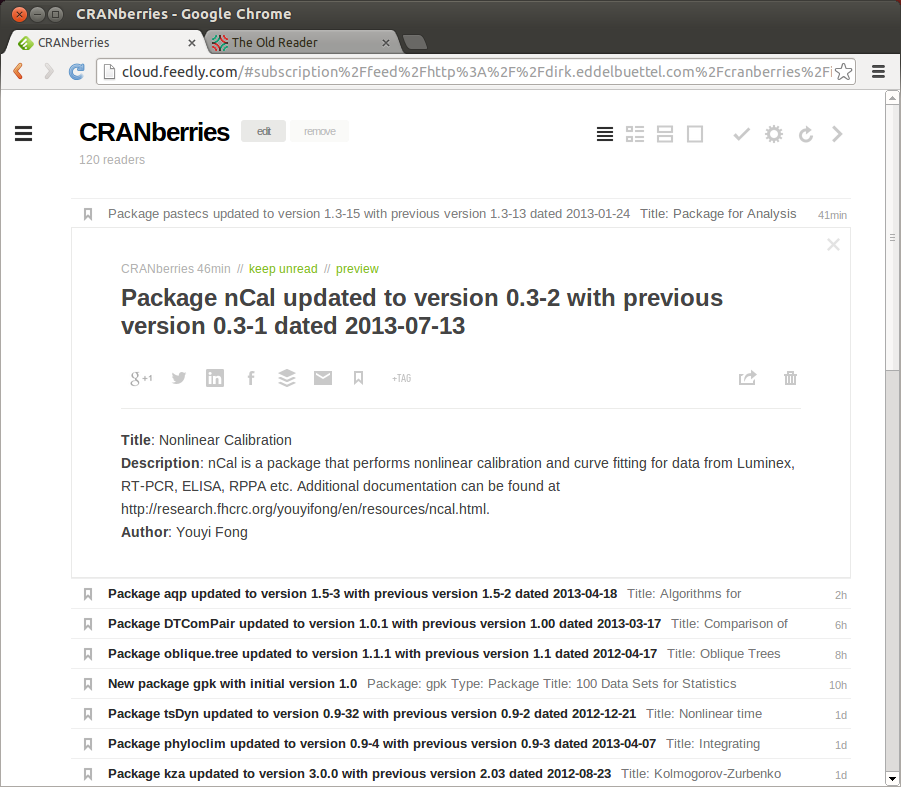
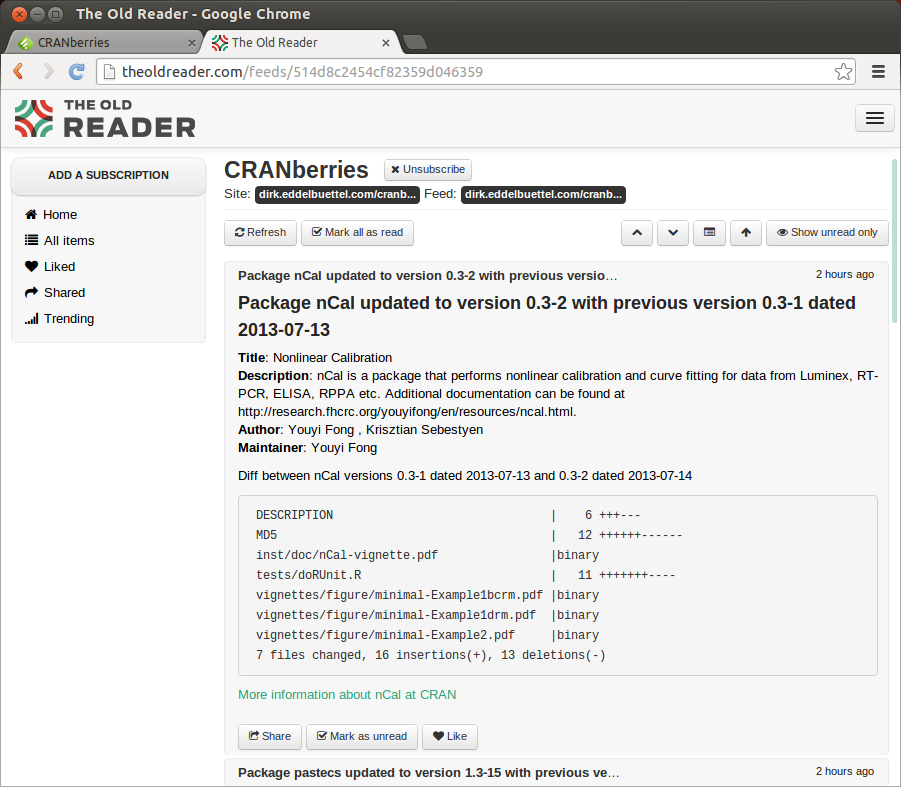
With the demise of Google Reader, many of us have scrambled to find alternatives which cover many/most of the features we were used to. For me, synchronised access from web and mobile counts quite high, and I want the (Android) mobile experience to be pretty pleasant too. So with that, and like many other folks, I had shifted over to Feedly. And before I carry on, let me say that Feedly actually does pretty well. They handled the onslaught of new users; they also listened and changed their UI a little to be more compact and Reader-alike And most importantly, it mostly just works. Until it doesn't. Around the time Feedly shifted folks to their own cloud-based backend, posts from my very own CRANberries aggregator of CRAN package changes for R started to show only truncated posts. See this screenshot from reading Feedly: Feedly truncates the CRANberries post and compare it with this one from TheOldReader: OldReader shows the full CRANberries post which contains the diffstat output, nicely marked up and all. Now, it so happens that I am the creator of the very RSS feed I am consuming here, and I wrote it so that I could read the very diffstat output that is now missing. And I know full well that neither the code, nor the hosting (on my own box), nor any other aspect changed. Before confirming this via TheOldReader, I looked at the RSS output, and I tried other frontend and apps --- and it became clear that the bug seems to be at the Feedly cloud storage level. And trying to be a good sport, I submitted a bug report / suggestion, but to no avail (apart from two other chiming in that they see this elsewhere too). Given that I am the coder behind the feed that is displayed in a truncated manner, I am aware that I am using a code stack that is stale (the original Blosxom static web generator) yet which has not posed another problem anywhere in the decade I used it. Nor does the CRANberries feed pose a problem when aggregated and viewed via the TheOldReader code path, or for that matter via Planet R which also carries (parts of) CRANberries. So for now, I have to either pivot out of the CRANberries RSS reading in Feedly and go directly to the webpage (fine, but cumbersome and in need of a working connection) or use a second subscription mechanism. I appreciate what the TheOldReader folks are doing---presumably with a minor fraction of the resources available to Feedly---and may hang with them for now. But it would be awfully nice if Feedly could sleep off its hangover and fix this. In which case I'd be much happier recommending its service.

Michael Stapelberg: Systemd support in Debian packages: how to help

Sometimes, people show up in our IRC channel #debian-systemd or on our mailing list pkg-systemd-maintainers@lists.alioth.debian.org and ask how they can help. This blog post answers that question. First of all, whatever you end up doing, please coordinate with us first! Saying hi in our IRC channel or on our mailing list and explaining what you intend to do is all we ask for. In the past, people have filed bug reports with service files that are not idiomatic, and we really need to avoid that. Currently, our biggest task is to add/improve systemd support to individual Debian packages, and this is where we can use a lot of help. We have a dashboard which contains two lists:
  1. Packages that ship a service file, but don t use dh-systemd yet.
    These need to be updated to get proper maintscripts (e.g. deb-systemd-helper enable/disable calls, possibly start/stop/restart calls).
  2. Packages that ship an init script but no service file yet.
    These need a service file plus dh-systemd support.
Adding a service file and dh-systemd support After you picked a service from the second list in our dashboard, first double-check that there is no bug filed against it yet (the dashboard might be a few hours behind). Then, search for a service file, either upstream or in other distributions such as Arch Linux, Fedora, Gentoo, etc. In case there is no service file yet, write one. Please carefully test the service file (e.g. does starting/stopping/restarting and reloading work) and send it to us for review. Be careful to avoid obvious regressions from the sysvinit init script. That is, don t just write a very simplistic service file that breaks a use-case which formerly worked. If in doubt, ask pkg-systemd-maintainers or chose a different package to work on. Afterwards, add systemd support by using the dh-systemd helper, see https://wiki.debian.org/Systemd/Packaging. The last step is to file a proper bug report against the package that uses our usertag and CCs pkg-systemd-maintainers. See http://bugs.debian.org/714190 for an example. Replacing custom maintscripts with dh-systemd Check if the package currently has any direct systemctl calls in its maintscripts and remove them if so (see http://bugs.debian.org/713853 for an example). Follow https://wiki.debian.org/Systemd/Packaging to add systemd support using the dh-systemd helper. Check whether the maintscripts look good and generate a debdiff to highlight the differences between the old and the new version:
debdiff --controlfiles=ALL OLD_amd64.changes NEW_amd64.changes
Then file a bug report which uses our usertag and CCs pkg-systemd-maintainers. See http://bugs.debian.org/713853 for an example. Thanks! Thank you for helping us and Debian in general!

Niels Thykier: Britney excuses out of date

In my previous post, I explained about the age excuse in Britney. In this post, I will cover the slightly more tricky out of date excuse. A simple example of excuse is:
out of date on mipsel: blinken (from 4:4.8.4-1)
In this simple case, Britney simply states that the binary blinken on mipsel has not yet been rebuilt. Generally, the presence of an excuse like this is sufficient to stop testing migration. The exception to this rule is if the architecture has been marked as not keeping up . At the moment we do not have any such architectures. The tricky part of an out of date -excuse is that Britney simply identifies a symptom and not a cause. In the excuse above, it is not possible to determine if the build failed on that architecture or simply has not finished yet. But the part that probably confuses the most, is when Britney lists binaries no longer built from that source:
out of date on i386: libfsoframework0 (from 0.11.0-1.1)
This case actually happens quite often and is (usually) a sign of a transition has been started. The part that confuses many is that the build-state of their package will be Installed (as in It was built successfully and has been uploaded to the archive ). From there they tend to conclude Britney is broken , where The excuse information is a bit unhelpful might be more accurate. Caveats:
  1. If the source package has not yet been built on that architecture, these old binaries are interleaved into the regular list of out of date -binaries.
  2. The list of excuses are updated twice a day (and there is also a delay between its update and the PTS picking it up). Thus, if the build-state of your package for that architecture has been Installed for less than 24 hours, you may just want double check before jumping to conclusions.
The problem is that the binary still has reverse dependencies in unstable, so it cannot migrate to testing. When the last reverse dependency has been updated, the FTP masters will usually semi-automatically decruft your package and the excuse will disappear. On the other hand, if the binary still has reverse dependencies, you probably started a transition. In that case, your package will be stuck in unstable until all the reverse dependencies are ready (or, at least, rebuilt to use the replacement package). Generally, it is good if the Release Team was involved before you did this (see this page ). In summary, if your package has Out of date on [architecture] in its excuses it can be one (or more) of:

Next.

Previous.