Lior Kaplan: Anonymous CVE requests
A year ago I ve blogged about people requesting CVE without letting upstream know. On the other hand, per requests from Debian, I m working on improving PHP upstream CVE request process. For the last few release this means I ask the security list members which issues they think should have CVE and ask for them in parallel to the release being made (usually in the space between the release being tagged publicly and is actually announced).
In the last week, I ve encountered a case where a few CVE were assigned to old PHP issues without any public notice. The fixes for these issues have been published a year ago (August 2015). And I find out about these assignment through warning published by the distributions (mostly Debian, which I m close to).
Sometimes things fall between the chairs, and it s perfectly OK to ask for CVE to make sure security issues do get attention even if time has passed. But after the issues (and fixes) are public, I don t see a reason to do so without making the request itself public as well. And even if the request wasn t public, at least notify upstream so this info can be added to the right places. Most of these bug were found out when I started to add sequential number into the CVE search after getting an a notice from Debian for two of the issues.
Filed under: Debian GNU/Linux, PHP
- CVE-2015-8873 for PHP #69793
- CVE-2015-8874 for PHP #66387
- CVE-2015-8876 for PHP #70121
- CVE-2015-8877 for PHP #70064
- CVE-2015-8878 for PHP #70002
- CVE-2015-8879 for PHP #69975
- CVE-2015-8880 for PHP aa8cac57 (Dec 2015)
Filed under: Debian GNU/Linux, PHP
 Several years ago I've

 Over the past year I ve been refining my understanding of the core
claims of Kantian ethics. I ve realised that I have deeply Kantian
intuitions about a lot of issues, and I understand these intuitions
better now that I can put them in Kantian terms. Consider two
exercises of state power: riot police suppressing protesters by
non-lethal means, and soldiers shooting protesters to death. I feel
more uncomfortable thinking about the first: there s something
altogether more sinister about it than the second, even though the
second is much more sad.
I think that the reason is that non-lethal weaponry is designed to
take away people s agency, and it often achieves this aim by means of
emotional manipulation. Riot police use so-called baton charges to
incite fearful retreat. Protesters have reasoned that in their
political situation, they have a duty to resist the incumbent
government. Riot police seek to unseat this conviction and cause fear
to determine what the protesters will do. In Kantian terms, the
riot police fail to respect the moral agency of the protesters by
seeking to unseat the moral personality s determination of what the
protester will do.
A controversial example that Kant uses to make this point is the axe
murderer case. Kant asks us to imagine that someone bangs on our
front door and begs us to hide him in our house, because someone who
wishes to kill him is coming up behind them. We do so. When the axe
murderer arrives, he goes door-to-door and asks us whether the
intended victim is in each house. Kant says that it is morally wrong
to lie to the axe murderer and say that the victim is not in your
house. How could this be? Surely there is a moral duty to protect
the victim from being killed? Indeed there is, but when it comes into
conflict with the duty not to lie, that second duty wins out. That s
because respecting the moral agency of individuals is paramount. In
this case, we would fail to respect the murderer s agency if we didn t
allow him to take the decision to murder or not murder the victim; by
lying to him we (disrespectfully) bypass his choice as to whether to
do it.
It s obviously crazy to say that we are morally required to give up
the victim. Kant gives the wrong answer in this case. However, the
case definitely reveals a requirement to respect other people s view
of what they should do, and give them a chance to do it. Similarly it
seems like we shouldn t give semi-automatics to our riot police, but
there s something wrong with a lot of what they do.
During the recent campaigns about Britain s EU referendum, some
criticised Jeremy Corbyn s campaigning on the grounds that he failed
to make an emotional appeal, instead asking people to make their own
rational decision when they come to cast their vote. So he lost out
the emotional appeals other people were making. It seems that he was
successfully respecting individual agency. You ve got to give people
a chance to live up to their own idea of what they should do.
I m not sure how to reconcile these various ideas, and I m not sure
what it says about me that I find non-lethal weaponry as uncomfortable
as I do.

 How to help
A good first step is simply looking over the
 I was assigned another 15 hours of work by Freexian's Debian LTS
initiative and carried over 5 from last month. I worked a
total of 19 hours, carrying over 1.
I spent a week in the Front Desk role and triaged many new security
issues for wheezy.
I prepared the Linux 3.2.81 stable update, sent it out for review
and finally released it. I then rebased the wheezy-security branch
on top of that and added some later security fixes that were not yet
suitable for a kernel.org update. I uploaded to wheezy-security and
issued
 My monthly report covers what I have been doing for Debian. I write it for Debian s Long Term Support sponsors but also for the wider free software community in the hope that it might inspire people to get more involved with Debian or free software in general.
Debian Android
 There is this long-running workshop series Haskell in Leipzig, which is a meeting of all kinds of Haskell-interested folks (beginners, experts, developers, scientists), and for year s instance,
 I've been tweaking the
 Future plans include the addition of a video RSS feed, and showing the
videos on the debconf16 website. Stay tuned.

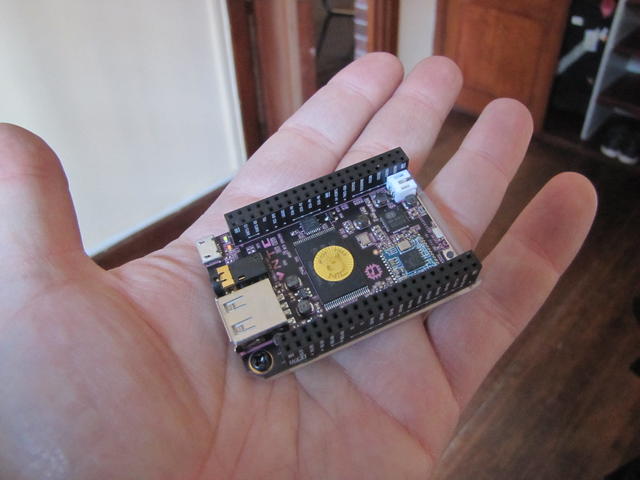
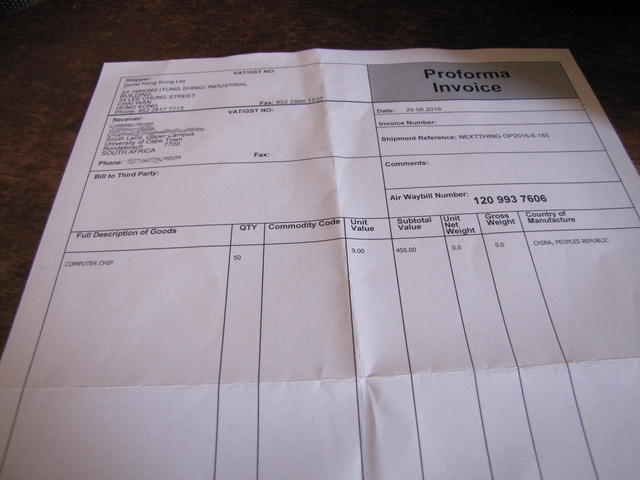
 I had my strong doubts as to whether the shipment would be allowed through customs, and was happily surprised by a smiling Graham today before noon. He handed me a smallish box that arrived to his office, containing...